Infrastructure Australia’s transport priorities for Australian cities in 2009

Sat 20 March, 2010

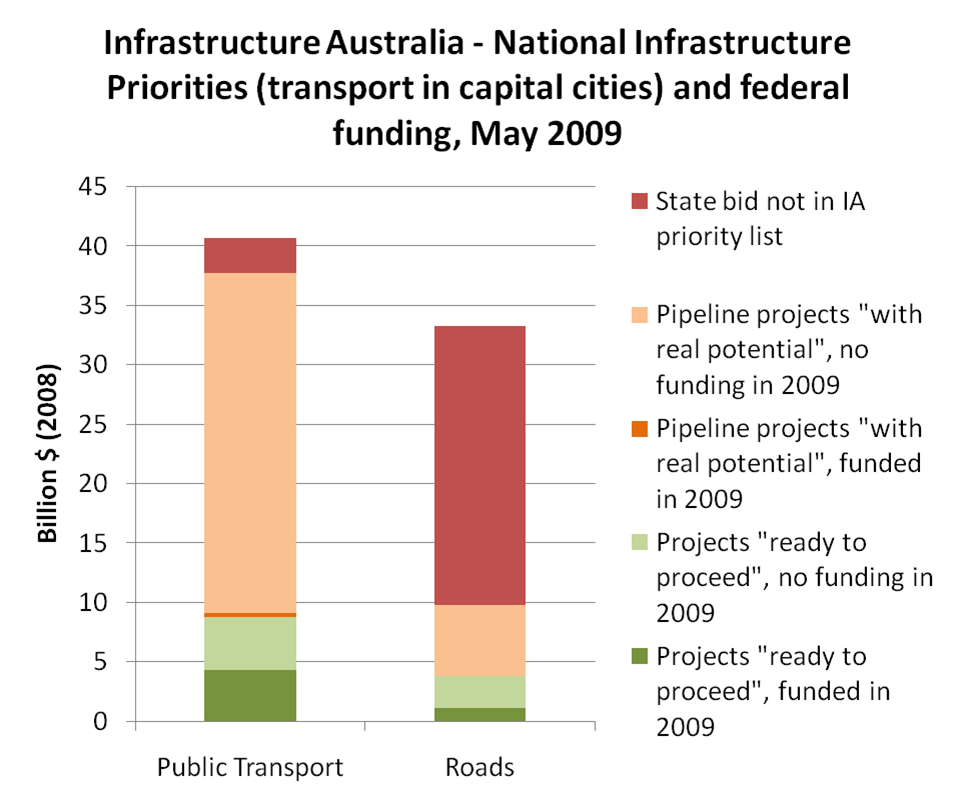
The following chart suggests that in 2009, Infrastructure Australia thought public transport was a higher priority than road expansion in Australian capital cities.

It compares state government bids for capital city transport projects (in 2008), what Infrastructure Australia thought were the priorities (in May 2009), and of these, which projects received funding in the 2009/10 federal budget (May 2009).

Clearly public transport projects came out much better than urban road projects when Infrastructure Australia applied their selection criteria, which included climate change, livability, sustainability and productivity (I suggest you read the Infrastructure Australia publication for more details).

Of the state public transport bids, only light rail in Canberra, and a small project in Geelong were not shortlisted. Most city road projects were not short-listed.

Infrastructure Australia short-listed public transport projects with four times the value of the road projects. Federal funding was a 5:1 ratio of public transport to roads. (Note: these ratios are for capital city projects only).

There was also federal funding for about $1.2b of country highway projects that were not short-listed by Infrastructure Australia.

Note: Some projects were not entirely road or public transport but I have classified them by the dominant component, and there were some small  city transport projects that were not listed by IA, but were funded anyway. However the impacts of these issues would be very small on the chart above.


Mapping public transport service provision

Sat 20 March, 2010

Just how much public transport service do people get in different parts of Melbourne? How can you visualise service provision across a city? Here is my attempt.

A measure of PT service provision

Some routes run high frequencies, some run over a long span of hours, some do both. Some routes have lots of short trips that don’t run the full length. How do you translate all this into something that is meaningful?

My preferred measure is simple: (one-direction) departures per stop or station per week. It reflects both span of hours and frequency of service (although it doesn’t differentiate between them). And by calculating this at the stop level, you account for trips that don’t run the full length of the route.

PT service provision in Melbourne

Thanks to the recent release of public transport data by the Victorian government, I’ve been able to calculate the number of public transport departures per week per train, tram and bus stop for all of Victoria as at December 2009, and put them on a map.

Below is a map for the Greater Melbourne area (to see the detail you will need to click to enlarge and then zoom-in further).

Public transport departures per week per stop in greater Melbourne, December 2009

I would love to see similar maps of other cities in Australia, if anyone is able to produce them (happy to host them on this blog). Similar Sydney public transport data is available here, but I haven’t looked to see if enough detail is available to produce a similar map.

Broad observations

A few things stick our pretty quickly:

  • Inner Melbourne is blessed with lots of public transport (lots of black and dark green).
  • Outer Melbourne – in particular suburbs created in recent decades – have relatively low levels of service (especially on buses). This probably largely reflects government transport priorities when they were established. Few of these have since been upgraded in frequency, although many have been upgraded in span of hours in recent years.
  • In several outer suburbs of Melbourne there are some orange dots representing very low service levels – particularly around Narre Warren/Berwick, Mooroolbark and Lilydale, Upwey, Cranbourne and Frankston South. Unfortunately these too often correspond with areas of highest social need for public transport.
  • The growth corridors in the north (Hume and Whittlsea) and Melton have relatively good levels of service (though there are coverage issues). Services in the Werribee area are soon to be upgraded. The Pakenham, Sunbury and Caroline Springs growth areas have lower service levels (not to mention coverage gaps), while the Casey growth has the some of the worst service levels of any growth area.

Limitations and qualifications on the data:

Things I need to mention:

  • Tram and bus stops almost always serve on travel direction only. Meanwhile, train departures are registered against a station, regardless of the direction. To make the numbers comparable, I have halved the number of departures at train stations (except end stations). This means the train stations are coloured by the average number of departures in each of two directions (and yes, Newport station shows up black because of the shuttles to Williamstown).
  • Train stations arguably have more utility than bus or tram stops, as trains are generally much faster than the other modes. I’ve shown train stations with a larger diamond shape, and metro stations are always on top of bus and tram, even if service levels are lower.
  • Some bus routes run in one direction in the morning, and the other direction in the afternoon. This means than the service per stop is split between both sides of the road and low values result for both stops. A good example is route 558 in north-western Reservoir which shows up in orange (for those who have a good grasp of Melbourne’s geography). There is arguably less utility in a service that only runs in one direction for half the day, so perhaps the low scores for these stops do reflect passenger utility. But then other one-way loop routes operate in the same direction all day (eg route 582 in Eltham, 775 in Frankston, 461 in Hillside) and their stops show up with more departures.
  • Only fixed stop locations show up on TeleBus routes (in Mooroolbark/Lilydale and Rowville areas), but they still largely indicate the level of service for on-demand services.
  • In almost all cases, bus and tram stops are encoded separately even if they are physically in the same location. Where buses and trams run along the same road, tram stops will generally cover up bus stops as they generally receive more service (eg Keilor Road buses on the 59 tram, low frequency bus route 468 and trams 82 and 57 on Raleigh Road, bus route 732 and tram 75 on Burwood Highway)

Some peculiarities

For those that know Melbourne geography well and are interested in the detail (everyone else stop reading now)…

  • If you can make out Wellington Road, you’ll see occasional black dots. This is SmartBus route 900 that operates a limited stops service, overlapping with some local routes.
  • There are dark green dots through Warrandyte where a number of services to Doncaster and the city overlap with services to Eltham.
  • The bus services that parallel the Stony Point train line actually have more service than the train line (in many areas).
  • The Upfield rail line shows up as having the lowest level of service of any near-city railway line (largely due to 20 minute peak headways).
  • In a triangle between St Kilda, St Kilda Road and Caufield, there is a grid of high frequency services (of which the buses I suspect aren’t well-known).
  • Some not-so-well known high frequency corridors are visible in the suburbs:
    • Across the middle northern suburbs you will see a few black east-west roads. These are from the red orbital SmartBus route 903 overlapping other frequent routes like 513 and 527.
    • Between Frankston and Mornington, although route 788 has stopping restrictions which overplays the “catchable” service along the path. However there is essentially an all stops bus every 20 minutes between Frankston and Mornington, seven days a week until 10pm.
    • In the middle eastern suburbs you can see several long north-south routes that are green – these are the SmartBus routes along Warrigal Road, Blackburn Road, Springvale Road and Stud Road.
    • Clayton station to Monash University Clayton campus (three routes overlap, including one SmartBus route)
    • The Trainlink service on route 571 between Epping Station and South Morang (where a bus meets every train, seven days a week),
    • The Trainlink service to Cranbourne East shows up with several green dots (in contrast to low service in Cranbourne West).
    • The Western Highway out to Caroline Springs. People like to joke that Caroline Springs does not have any public transport. The truth is that some parts are well serviced by routes 216 and 456 (although they don’t operate to a even combined headway). Meanwhile newer parts of Caroline Springs are not yet within walking distance of public transport.
    • Belmore Road (Kew/Balywn) gets high frequency services from three overlapping bus routes (201, 202, 302) however they run to different destinations (the city, Kew, Doncaster and Box Hill).
    • Between St Kilda and Brighton Beach and between Sandringham and Black Rock several routes overlap to provide a high frequency service (216, 600, 922, 923).
    • Along Princes Highway between Oakleigh Station and Monash University Clayton (routes 800, 802, 804, 862 provide 7 buses an hour).
    • Between Lilydale Station and Chirnside Park Shopping Centre (serviced by many routes).
    • Buckley Street in Essendon/Keilor East has a very high frequency service (SmartBus 903 overlapping with the relatively high frequency 465).
    • Most bus routes around Footscray are high frequency (some are more frequent than the tram route 82 between Footscray and Moonee Ponds). In particular, there are several high frequency corridors between Footscray and Sunshine. These bus routes are well patronised.
    • Thompsons and Doncaster Roads leading into the Eastern Freeway.
    • Route 250 which runs through Clifton Hill to Latrobe University Bundoora, with various other routes overlapping in different sections. At the other end it combines with 251 and 253 to provide a weekday 10 minute service to City Road and Bay Street Port Melbourne.
    • Between Dandenong and the western edge of Endeavour Hills where overlapping routes then split (15 minute headways on weekdays).
  • Sometimes the departures per stop on each side of the road just straddle the colour blocks on the legend. The better served stops appear on top (eg Lorimer Street in Fishermans Bend, route 534 in Glenroy, route 664 near Croydon).
  • Some other low service peculiarities:

Peak oil

Sun 14 March, 2010

[updated September 2011]

While there is a plethora of content on the web about peak oil, I can’t seem to find many charts that track the current medium-term trends in global oil supply and price (a lot of the reports go into great detail about explaining short-term trends, or show long-term trends without the most recent data).

So here is an attempt at some medium term analysis of the data (if anyone can suggest other/better sources of such analysis I’d be pleased to hear about them).

Current medium-term trends

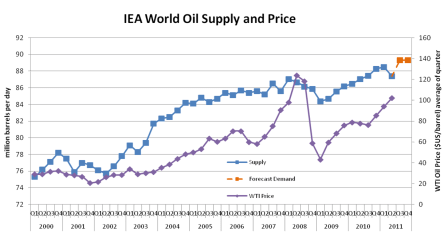
The first chart uses International Energy Agency (IEA) quarterly data on world oil supply until 2011Q2, projected demand for the last two quarters of 2011 (as at September 2011), together with the average WTI oil price in $US for each quarter.
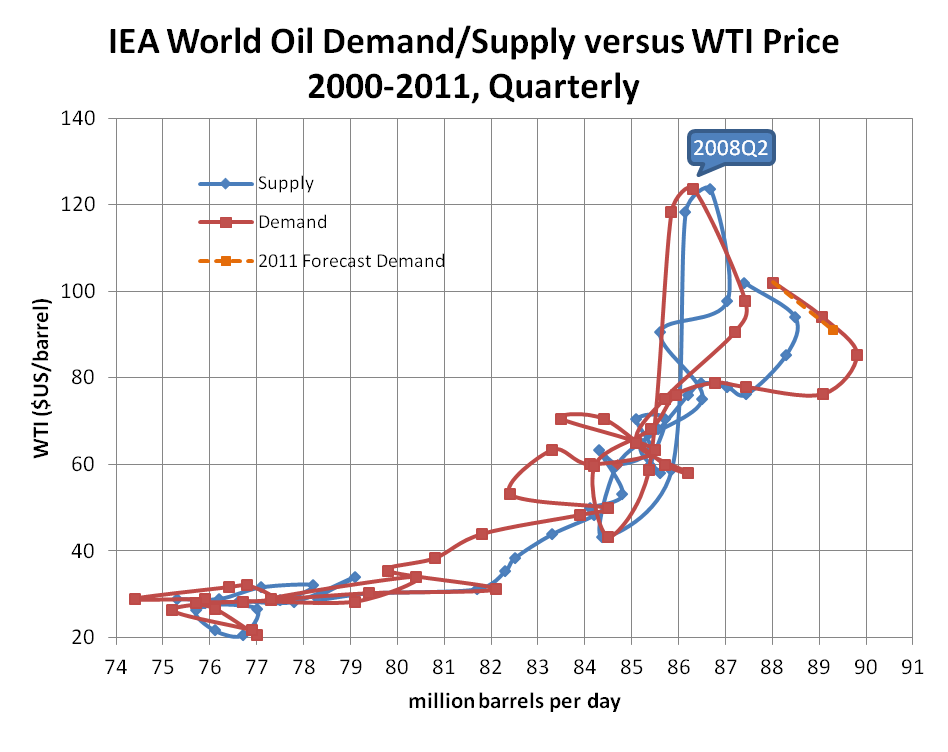
The second chart simplistically looks at the relationship between price and demand/supply for each quarter 2000 to 2011Q1. I’ve also added forecast 2011 demand for remaining 2011 (assuming a $91 price). Note: there are small differences between supply and demand each quarter due to stockpiling etc.
 

Yes this is a very simplistic representation of world oil markets (it doesn’t adjust for inflation or global exchange rates), but I think it is still interesting. You can see that there are differences between quarterly demand and supply as the red and blue lines don’t always overlap. For example, according to the data, supply exceeded demand in the quarters where prices peaked, but then demand exceeded supply for the two previous quarters.

Observations

I’m certainly not a qualified oil market analyst, and this isn’t rigorous analysis, but a few things do stick out:

  • World oil supply grew strongly between 2002 and 2005 and then was stuck around 84-87 million barrels per day (mb/d) until 2010. Supply grew to a new high of 88.5 mb/d in 2011 Q1, but then dropped in 2011 Q2. The September 2011 Oil Market Report suggests supply is now 89.1 mb/d.
  • During 2007 and the first half of 2008, oil prices grew strongly while supply was relatively unchanged, suggesting a demand-supply crunch.
  • After mid 2008, both prices and supply collapsed, around the same time as the global financial crisis hit.
  • During 2009, prices almost doubled, while supply only grew a small amount (although a devaluing of the US dollar explains some of this).
  • During the first three-quarters of 2010 supply grew but prices stabilised. But since 2010Q4, prices increased, even though supply reduced in 2011Q2. At the time of writing WTI oil was around US$91, and supply had increased again.
  • Looking at the second chart, it appears we have broken through the 88 mb/d threshold without the same prices seen in 2008.

The future?

It’s very hard to speculate, and I’m not particularly qualified. At present it appears oil prices have fallen with global economic conditions, supply has increased to a new high, and demand is also higher than ever.

Will it be possible to continue to ramp up supply to meet the further increases in demand?

The peak oil theory essentially suggests that new oil sources are harder to find and extract, that many existing fields are in unavoidable production decline, and so it is getting harder just to maintain current supply levels with new fields, let alone grow production overall. And harder still to grow production without increasing prices.

We’ve seen some supporting evidence in 2008, but conflicting evidence in 2010. That might have something to do with exchange rates. Oil prices fell in 2010Q3, but the US dollar was strong in mid 2010. Probably need more thorough analysis than what I have done. But the data is what it is. And all will be revealed in time.

But what will transport investors assume? Increasing global supply without significant price growth over the next 30 years does not look like a particularly safe assumption! But I fear it is the default assumption.