My second look at 2011 census data focusses on motor vehicle ownership rates. Is the rate of car ownership still increasing? Has the rate of car ownership dropped in any areas?
Measuring motor vehicle ownership rates
The raw census data provides the number of dwellings with 0, 1, 2, 3 or 4+ motor vehicles in each geographic area. Often people draw maps showing the proportion of dwellings with 2+ motor vehicles. That is easy to do, but it ignores the number of driving aged adults likely to be in those households.
Here’s a map showing the median household size in persons for 2011 (click to enlarge):
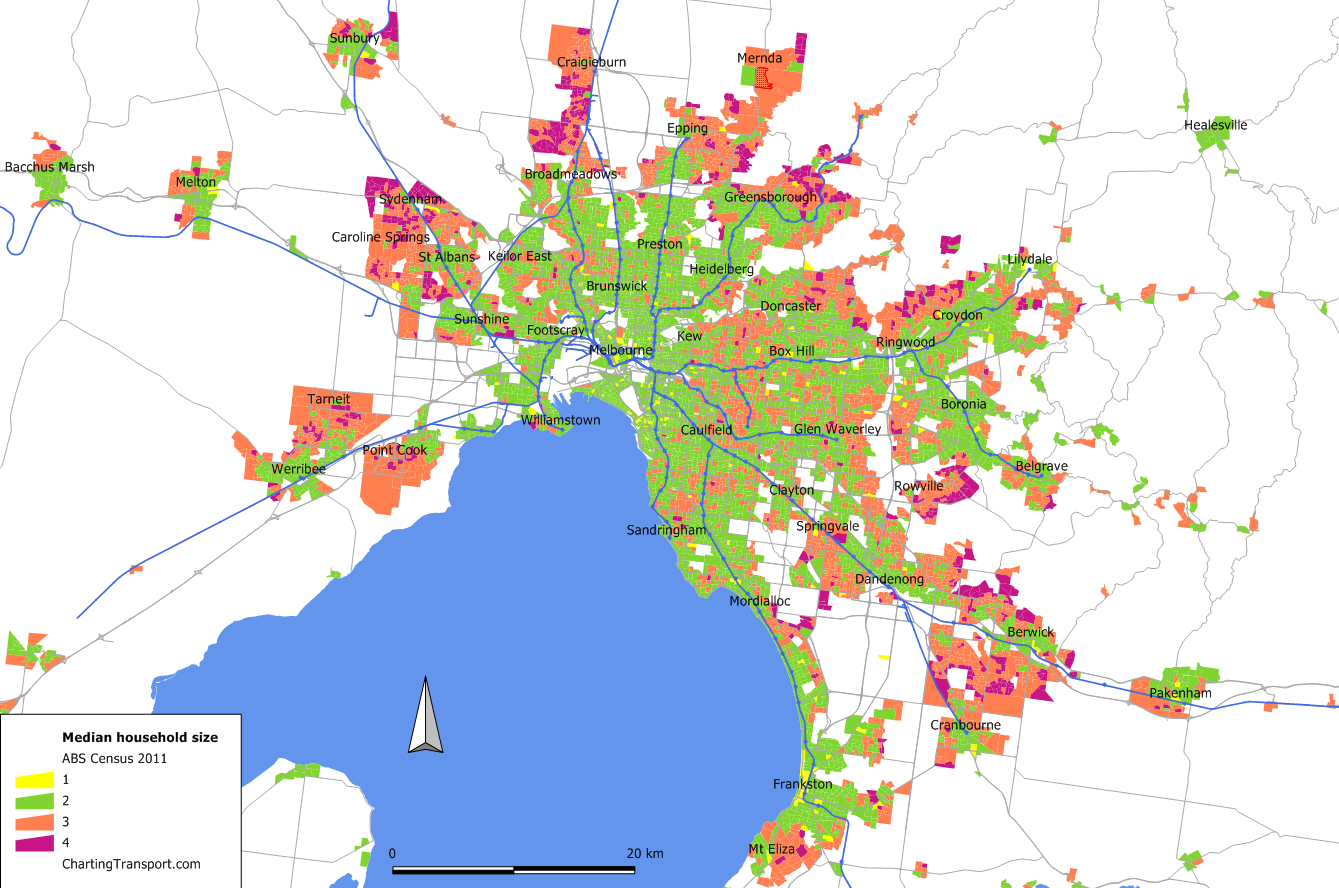
There’s a very distinct trend that household sizes are larger on the fringe. Looking at VISTA data, households in the outer suburbs are more likely to have more licensed drivers (I define “independent licensed drivers” as people with a full or probationary license, and MSD refers to Melbourne Statistical Division):
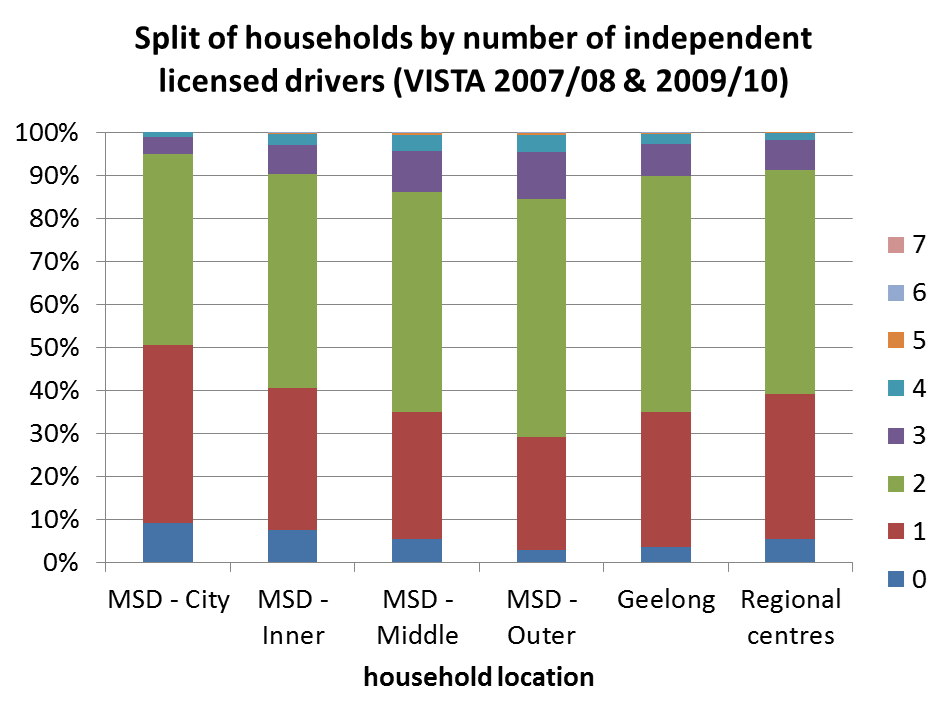
16% of households in the outer suburbs of Melbourne have 3 or more independent licensed drivers whereas the figure is only 10% in the inner suburbs.
My preferred measure is to estimated the ratio of home-based motor vehicles to the driving age population (unfortunately the census doesn’t provide data on driver’s license ownership). To make such a calculation I have to make a few assumptions:
- Dwellings that did not state number of motor vehicles had no motor vehicles.
- Dwellings that stated 4 or more motor vehicles had an average 4.3 vehicles (average figure obtained from VISTA 2007/08 and 2009/10 combined). This average could of course change over time, so there’s a slight imperfection in the calculation for around 5-6% of dwellings. I have assumed a constant 4.3 across 2006 and 2011.
- Driving aged population is approximated by people aged 20-74 (I used 20-74 as I only have population counts in 5 year groupings for small areas). Of course there are some people aged 20-74 who do not have a driver’s license, and there are people aged under 20 and over 74 who do have a driver’s license. See my previous post about who uses public transport for charts showing the rate of driver’s license ownership by age group.
Melbourne motor vehicle ownership maps
I have calculated an estimated ratio of home-based motor vehicles to the notional driving aged population for Melbourne, at smallest available geographies for 2006 and 2011 (Census Collection Districts and Statistical Area Level 1 respectively).
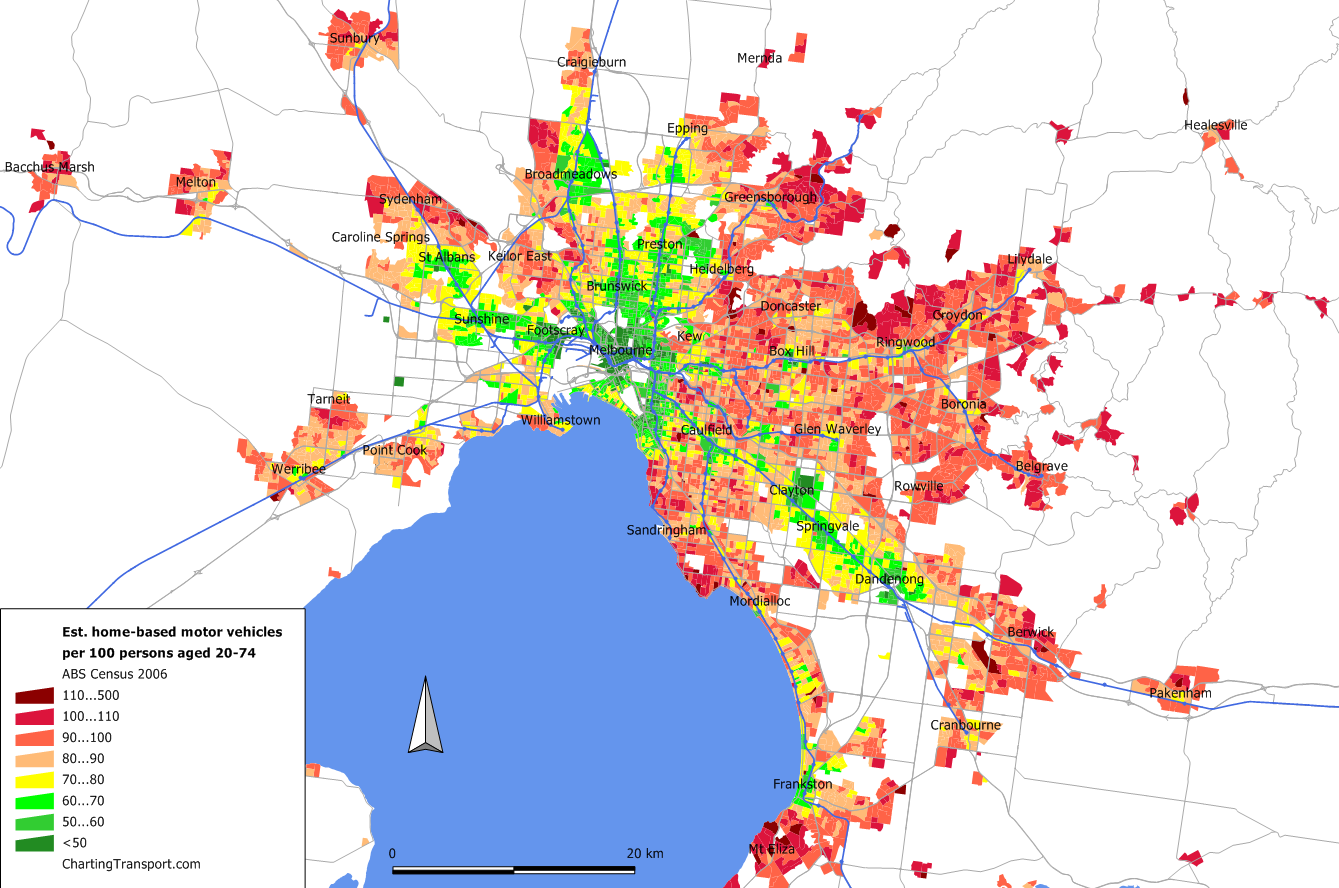
Here is a map showing the estimated rate of motor vehicle ownership in 2006 at the Census Collection District level:
Here is a map showing the estimated rate of motor vehicle ownership in 2011 at Statistical Area Level 1:
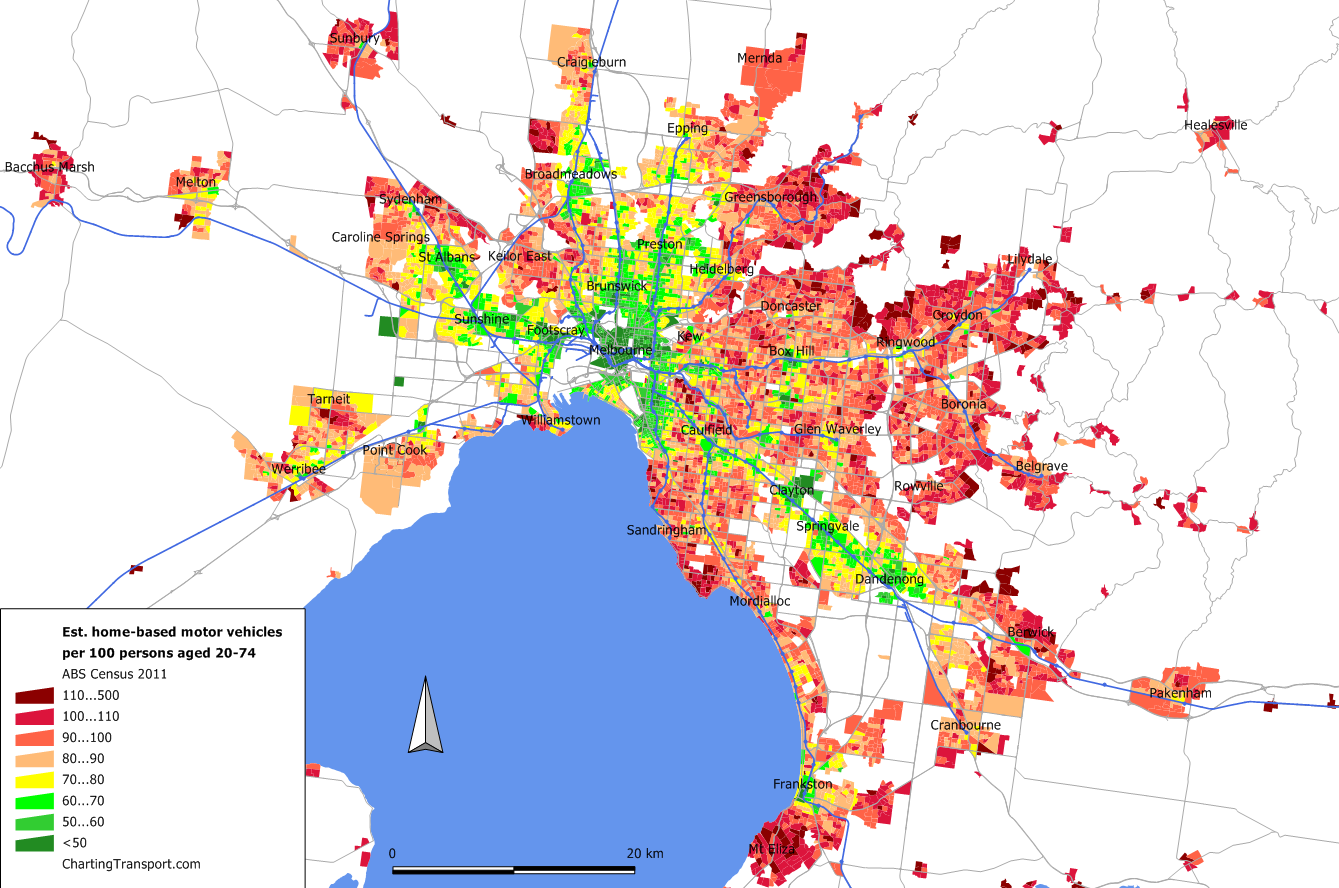
You can see lower motor vehicle ownership rates around:
- the inner city areas where there is a high quality public transport;
- some lower socio-economic suburban areas such as St Albans, Broadmeadows, Preston, Springvale, Dandenong, Frankston; and,
- tertiary education campuses including Clayton, Bundoora, Burwood, Glenferrie, Box Hill, Holmesglen.
The highest rates of motor vehicle ownership are seen in:
- relatively wealthy suburbs on the urban fringe (often with low density rural residential style developments), including Greenvale, Eltham north, Donvale, Mt Eliza, Narre Warren north, Lysterfield; and,
- relatively wealthy middle suburbs, such as Ivanhoe, Toorak, Beaumaris, Essendon, Kew, Brighton.
Changes in motor vehicle ownership 2006 to 2011
So how have motor vehicle ownership rates changed? You could flip back and forwards between the above two maps, but with different geographies it isn’t easy to spot all the changes.
Some areas that appear to have had reductions in motor vehicle ownership rates include pockets of Werribee/Hoppers Crossing, Burwood (around the Deakin University campus), and central Frankston. Some areas that appear to have had significant increases in motor vehicle ownership rates include Mt Eliza, Doncaster, Templestowe, Williamstown, and North Ringwood.
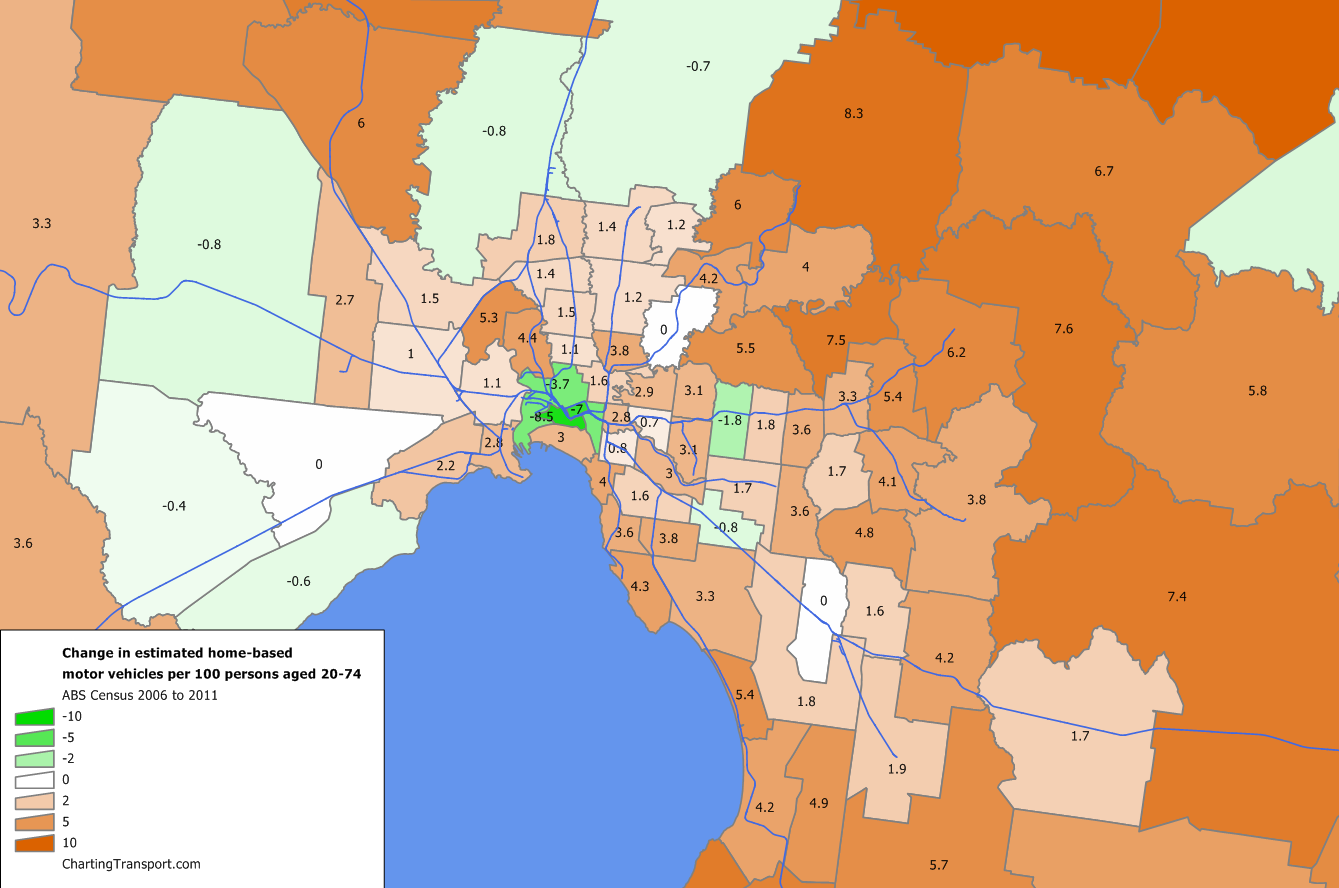
A more systemic comparison requires use of the smallest common geographical unit common to both the 2006 and 2011 censuses, which is the Statistical Local Area (SLA). The following map shows the change in estimated motor vehicle ownership rates between 2006 and 2011 at the SLA level:
There are a few notable reductions in the rate of car ownership:
- The City of Melbourne, particularly the CBD and Southbank/Docklands
- Box Hill (perhaps due to an influx of students at Deakin University Burwood campus)
- Monash – south west (which includes Monash University)
- The outer western and northern suburbs
- Yarra Ranges – Part B (non-metropolitan, and I’m not sure what might be happening there)
The biggest rises can be seen in:
- Manningham (west and east)
- Moonee Valley
- Rowville
- Sunbury
- Nillumbik
- Yarra Ranges
- Cardinia – north (non-urban)
- Kingston – south
- Casey – south
- Mornington Peninsula – West
So what might explain these patterns?
- There has been a long term trend of increasing car ownership (refer previous post). Certainly the real cost of car ownership has been going down for some time now.
- Areas with large numbers of tertiary students appear to have had a decline in car ownership, perhaps reflecting successful mode shift campaigns with staff and students, and/or an influx of international students who might be less inclined to buy a car and/or drive.
- A growth in apartment living in the inner city, where there is less need to own a car due to high quality public transport and many destinations within walking distance. Although I note that motor vehicle ownership rates still rose in the neighbouring City of Yarra, suggesting densification a couple of suburbs out from the CBD seems to still be introducing more cars (and/or other motor vehicles).
- I’m really not sure why the rates of car ownership appeared to decline slightly in the outer growth areas to the west and north, but not the south-east (although the Cranbourne and Pakenham SLAs only showed relatively small increases of 1.7 and 1.9 respectively). I should point out that the decreases are very small (all less than 0.8) and probably not significant when considering the assumptions I have had to make in calculating the estimates.
I’d also make the comment that increased car ownership doesn’t mean increased car use. As I’ve pointed out elsewhere on this blog, average km travelled per car has peaked in Australia, as has car passenger km per capita.
Other motor vehicle ownership analysis
For more on car/motor vehicle ownership see:
- a previous post about trends in car ownership over the years at a state (and whole of Melbourne) level using data from the annual ABS Census of Motor Vehicles
- analysis of motor vehicle ownership saturation in households, in my first post on who uses public transport.


 Posted by chrisloader



 Charting Transport