Spatial changes in Melbourne journey to work 2006-2011

Tue 30 October, 2012

How have the mode shares of journeys to work changed by different home locations in Melbourne?

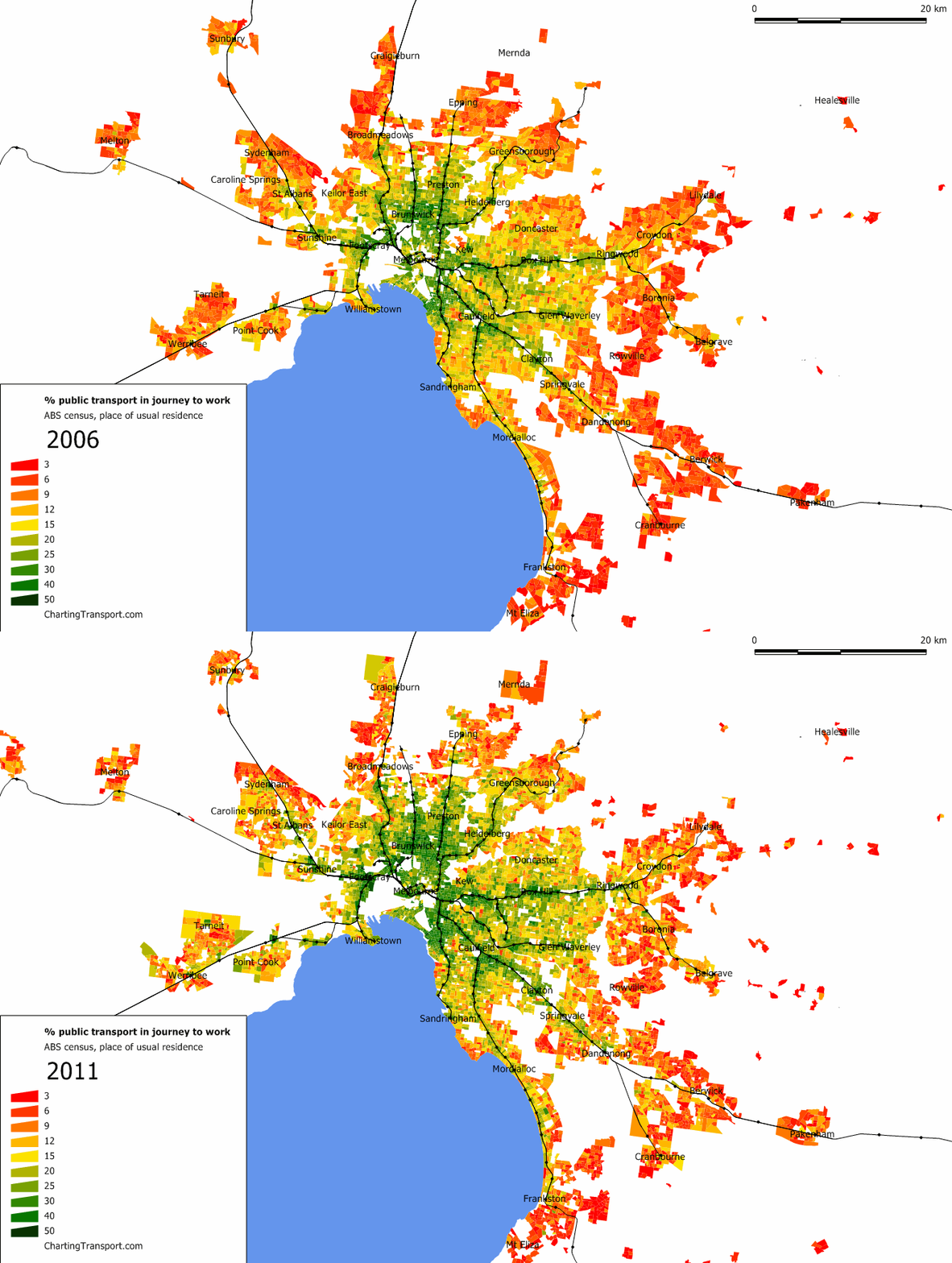
The following animations show various mode shares for journeys to work from census collection districts for 2006 and Statistical Area Level 1 (SA1) for 2011. These are the smallest geographies available for each census. All the data is by place of usual residence.

I’ve animated each image to alternate between 2006 and 2011, so you can gaze at them and spot the changes. But you’ll need to click on them to enlarge and see the animation.

Public transport

Public transport mode share is mostly up across the board. Some exceptions include:

  • Langwarrin (east of Frankston)
  • Dingley
  • Greenvale
  • Hillside
  • Eastern parts of Rowville

Sustainable transport (only)

This map excludes those who used private transport to reach public transport. It shows that on the suburban fringe, the vast majority of people are still using private motorised transport to get to work. Areas without significant growth include Sunbury, South Morang, Greenvale, Rowville, Berwick north, Skye/Carrum Downs, Mt Eliza, Dingley, areas around the Ringwood-Lilydale rail line, and Westmeadows.

[minor corrections to map made 5 Nov 2012]

Train

Melb train

[minor corrections to map made 6 Sep 2013]

There is growth across mode areas of Melbourne. You can see a massive difference in Roxburgh Park Craigieburn area following the extension of suburban electric services to Craigieburn.

Bus

You can see a substantial increases:

  • in Doncaster area following the introduction of 7 SmartBus routes (including 4 to the CBD).
  • in pockets between the Ringwood and Dandenong rail lines in the middle eastern suburbs. These areas had SmartBus routes introduced in 2002/2005, and perhaps it is taking a while to translate to bus in journey to work.
  • Around Abbotsford/Collingwood, perhaps reflecting increased train crowding and introduction of four SmartBus routes along Hoddle Street creating an extremely frequent service to the city.

Tram

You can see increased mode share across the network, particularly around the outer end of the tram route to Bundoora (zone 2 only in 2006, included in zone 1 in 2011) (but less so in Vermont South).

Active transport (only)

You can see gains in the Brunswick, Northcote, Kew and Foostcray areas.

Walking only

I can see little change between 2006 and 2011, which is in line with little change in the overall share for Melbourne.

Cycling

Cycling continues to grow rapidly in the inner northern suburbs, but also a little to the inner east and inner south.

Train and Bicycle

With the introduction of Parkiteer cages at train stations, was there any increase in the number of people riding to train stations?

The numbers are so small, it is difficult to see spatially, but there was a substantial increase in overall numbers from around 1200 to 1800.

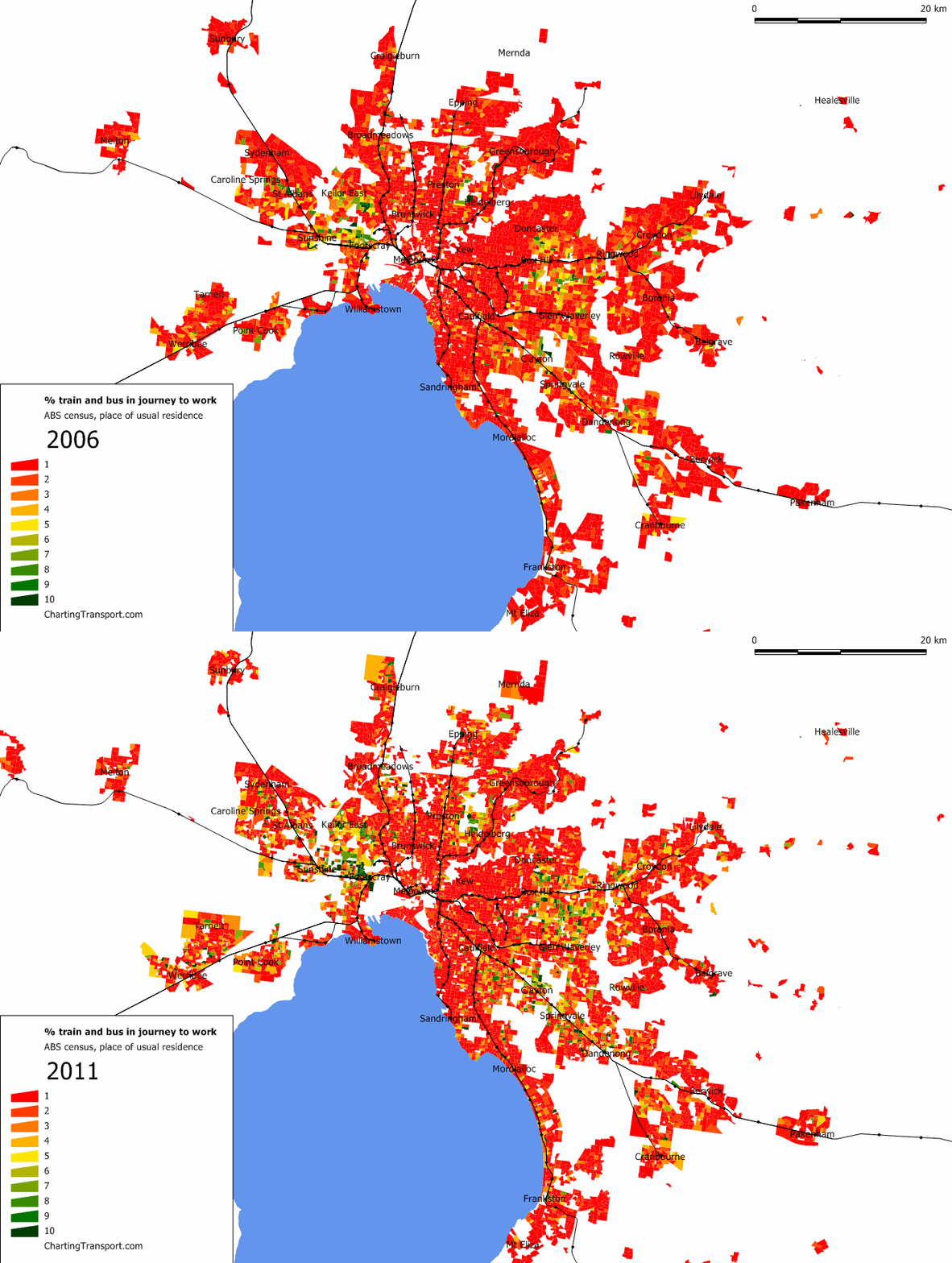
Train and bus

You can see increases around the Dandenong rail line, between the Glen Waverley and Ringwood rail lines, around Werribee/Tarneit, and around Sydenham.

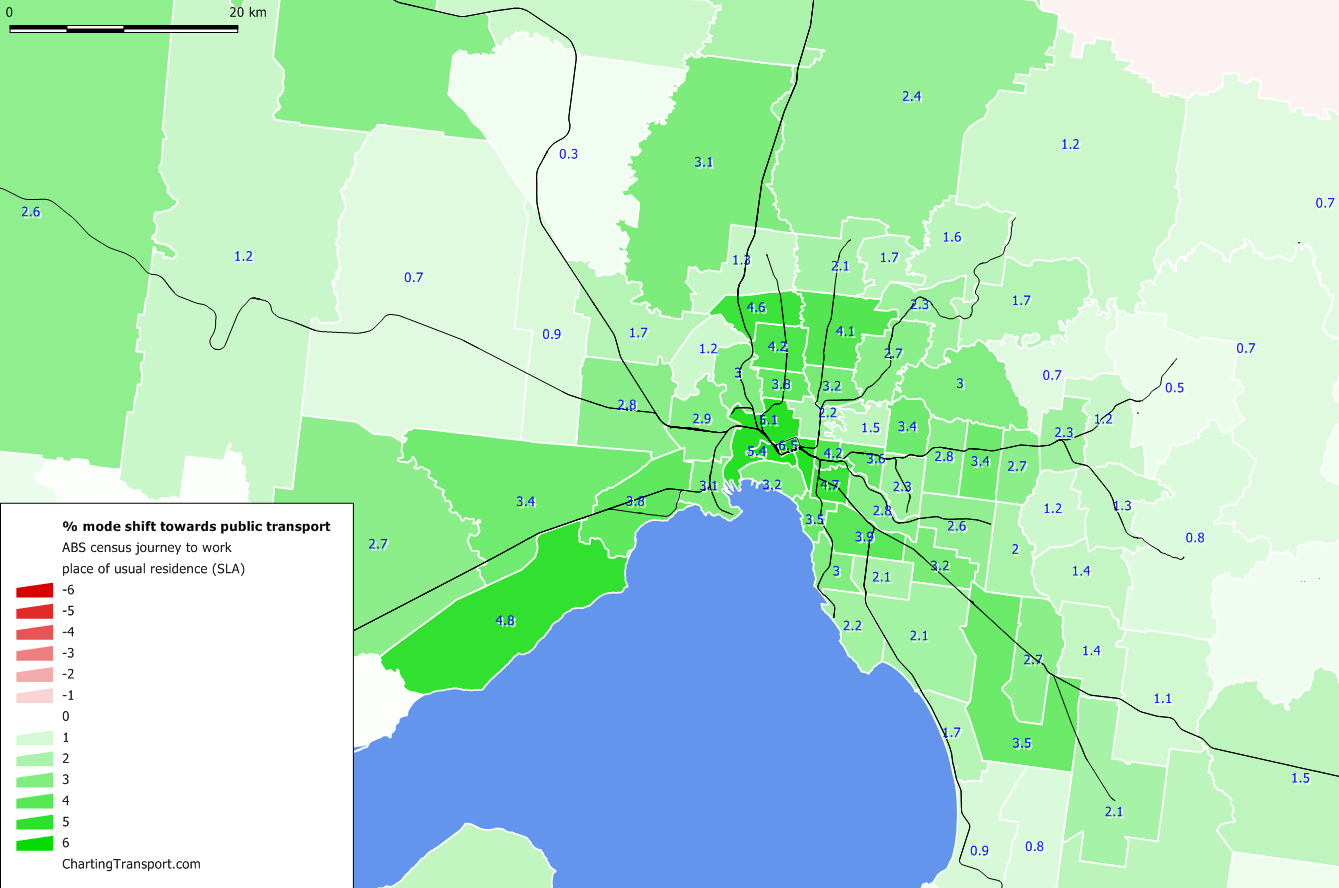
Public transport mode shift by SLA

Here’s a map showing the mode shift towards public transport by Statistical Local Area (SLA), the smallest geography for which results are available for both the 2006 and 2011 censuses.

The biggest mode shifts were in the City of Melbourne, followed by Wyndham – south (Point Cook), South Yarra/Prahran, and Moreland – north. Nowhere in Melbourne did public transport mode share reduce.

I’m sure other people will find more patterns in the maps than I have been able to today. Please comment on any interesting finds. I might come back later and update this post when I have more time.

I will aim to do a similar exercise for other cities soon.


Trends in journey to work mode shares in Australian cities to 2011

Tue 30 October, 2012

[updated December 2012 with more Canberra and Hobart data, and removing ‘method of travel not stated’ from all mode share calculations]

The ABS has just released census data for the 2011 journey to work (amongst other things). This post takes a city-level view of mode share trends.

Public transport

The following chart shows the public transport share for journeys to work for people within Statistical Divisions (up to 2006) and Greater Capital City Statistical Areas (for 2011) for each of the Australian major capital cities.

PT mode share trend

You can see 2011 increases in public transport more share in all cities except Adelaide, Hobart and Canberra. Melbourne grew by 2.2%, Perth by 2.1%, Sydney by 2.0%, Brisbane by 1.1% while Adelaide, Canberra and Hobart dropped by 0.1%.

But there are limitations of this data:

  • Census data is usually available by place of enumeration (where you actually were on census night) and/or place of usual residence. In the above chart the following years are by place of enumeration: 1991,  2001, 2006, 2011. I am just not sure whether the other years are place of enumeration or place of usual residence (ABS were unfortunately not as rigorous with their labelling of data tables in the past). There may be small differences in the results for place of usual residence.
  • The data available to me has been summarised in a “lossy” fashion when it comes to public transport mode share. It means that a journey involving tram or ferry and one or more non-PT modes is not counted as public transport in any of the results (it falls under “other two modes” or “other three modes” which includes PT and non PT journeys). For example, car + ferry or bicycle + tram. That means the true share of trips involving public transport will be slightly higher than the charts above, particularly for Melbourne and Sydney.
  • The 2011 figures relate to Greater Capital City Statistical Areas. For Perth, Melbourne, Adelaide, Brisbane and Hobart these are larger than the statistical divisions used for 2006 and early data. This means people on the fringe are now included, and they are likely to have lower rates of public transport use. So the underlying trends are likely to be higher growth in public transport mode share.

The limitations in counting of tram and ferry trips can be overcome by measuring mode share by workplace location, although I can only get such data for 2001, 2006 and 2011:

PT mode share by workplace trend

These figures are all higher because they include people travelling to work in the metropolitan areas from outside (where PT might have a higher mode share via rail networks for example) and they count all journeys involving ferry and tram. Between 2006 and 2011, Melbourne grew the fastest – by 2.4%, Sydney and Perth were up 2.0%, Brisbane up 1.2% and very little change in Adelaide, Canberra and Hobart.

Cycling

The following chart shows cycling only journey to work mode share:

cycling only mode share trend

(Adelaide and Perth are both on 1.3% in 2011)

Canberra is the stand-out city, owing to a good network of off-road bicycle paths through the city. But Melbourne has shown the fastest increase, going from 1.o% in 2001 to 1.6% in 2011.

Adelaide, Perth, Brisbane and Melbourne had a significant drop between 1991 and 1996, but this did not occur in Hobart, Canberra or Sydney.

Canberra, Melbourne and Sydney have shown the most growth in recent times. Adelaide and Hobart unfortunately went backwards in 2011. I’m not sure why Adelaide dropped so much, maybe it was a product of weather on the two census days?

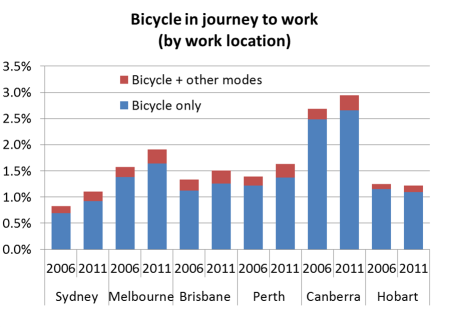
Here’s another view that includes journeys with bicycle and other modes (by work location, not home location):

Bicycle any mode share

Perth and Canberra had the largest growth in journeys involving cycling and other modes.

Walking only

walking only mode share trend

Walking only rose in all cities 2001 to 2006, but then fell in most cities between 2006 and 2011 (Perth and Brisbane the exceptions). Perhaps surprisingly, Hobart had a higher rates of walking to work than all other cities.

Car

The following chart shows the proportion of journeys to work made by car only (either as driver or passenger):

car only mode share

(both Adelaide and Hobart were on 82.7% in 2011)

You can see car mode share peaked in 1996 in all cities except Canberra where it peaked in 2001, and Hobart where the 2011 result was just under the 1996 result.

Hobart, Adelaide and Canberra had small rises in 2011 (1.0%, 0.4% and 0.1% respectively) while Perth had the biggest drop in car mode share (down 2.6%), followed by Melbourne (down 2.0%), Sydney (down 1.8%) and Brisbane (down 0.9%).

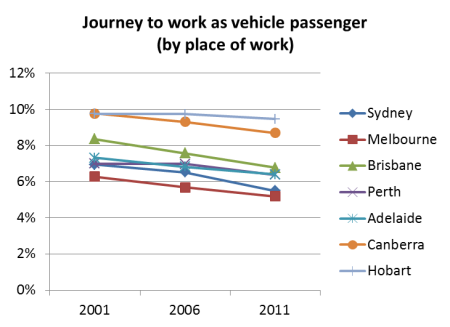
Vehicle passenger

Vehicle passenger by work location

Travel as a vehicle passenger has declined in all cities, suggesting we are doing a lot less car pooling and commuter vehicle occupancy is continuing to decline in line with increasing car ownership. Curiously Hobart and Canberra topped the cities for vehicle passenger mode share.

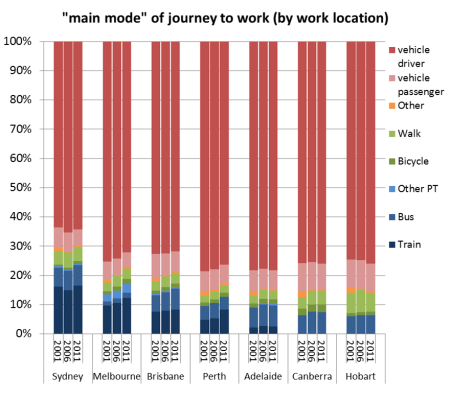
Overall mode split

Because of the issue of under-counting of tram and ferry data for place of enumeration, I’ve constructed the following chart using place of work and a “main mode” summary:


work dest mode split 2001-2011

I assigned a ‘main mode’ based on a hierarchy as follows:

  • Any journey involving train is counted with the main mode as train
  • Any other journey involving bus is counted with the main mode as bus
  • Any other journey involving tram and/or ferry is counted as “PT Other”
  • Any other journey involving car as driver, truck or motorbike/scooter is counted as “vehicle driver”
  • Any other journey involving car as passenger or taxi is counted as “vehicle passenger

In future posts I plan to look at the change in spatial distribution of journey to work mode share (by home and work location).

I’d like to acknowledge Dr John Stone for assistance with historical journey to work data.


How did Sydney get to work in 2006?

Fri 26 October, 2012

With the imminent release of 2011 census journey to work data (30 October 2012), I thought it would be worth completing a look at 2006 data for Sydney and other cities. This post will take a more detailed look at Sydney, thanks to the free data provided by ABS and the Bureau of Transport Statistics New South Wales (BTS NSW).

There are five parts to this post:

  1. Mode share by home location
  2. Mode share by work location
  3. Mode share for Sydney CBD workers
  4. An employment density map of Sydney
  5. The relationship between employment density and mode share

(get ready for 25 charts!)

In future posts I hope to look at Adelaide, Perth and Brisbane in more detail, and also compare 2006 and 2011 results.

Firstly a few definitions for mode shares:

  • Public transport: Any journey involving any public transport mode (private transport might also have been involved – eg park and ride).
  • Active transport: A journey that only involved only walking and/or cycling.
  • Sustainable transport: Public transport + Active transport (note: this includes private+public journeys, but not private+cycling journeys).

Also, I have included railway lines on the following maps, however the data I have is unfortunately quite old and doesn’t show the CBD area rail network or the airport line (the Epping-Chatswood line was not operational in 2006).

Method of journey to work by home location

Data is readily available on journey to work by home census collection district, however this is by place of usual residence. Ideally mode shares should be measured using place of enumeration (where people actually were on census night), but I haven’t forked out the $750 required to get access to ABS TableBuilder Pro which would provide that data. So the data I’m presenting is not ideal as some people would have been away from home on census morning and their modes of travel will be associated with their usual residence.

But the data still provides a fairly good feel for what happened as most people were probably at their usual residence, and hopefully most people filled out their forms accurately.

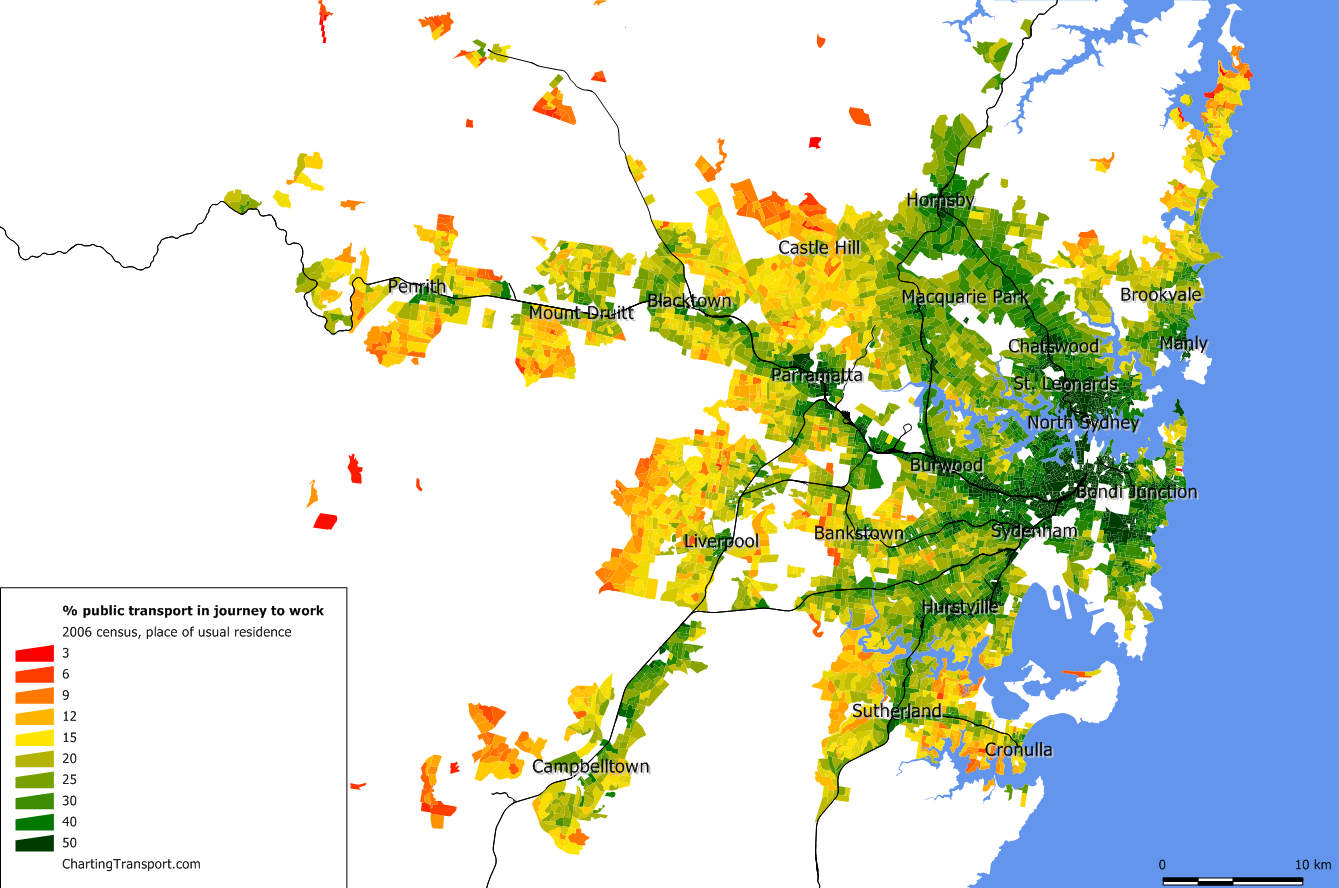
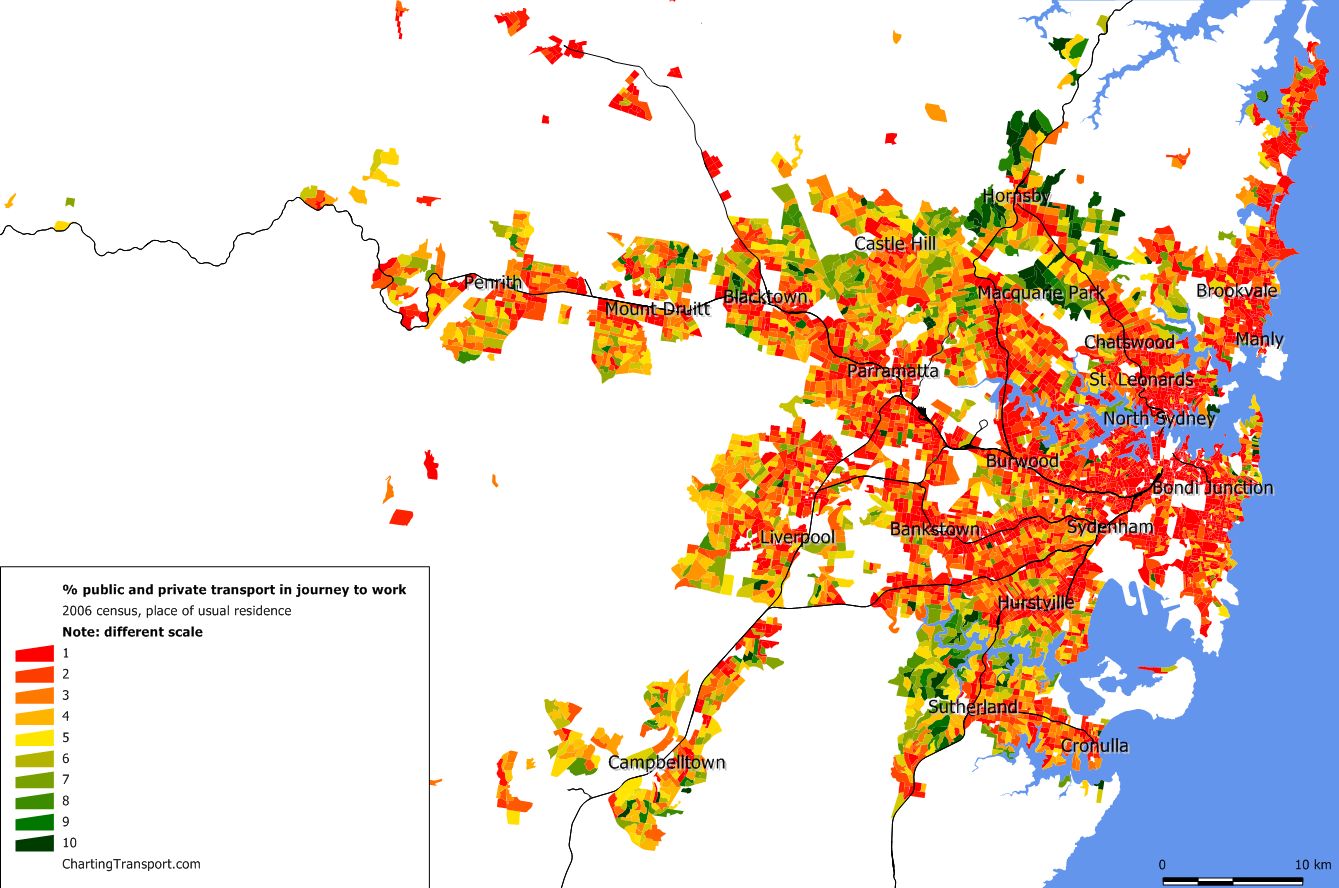
Public transport mode share

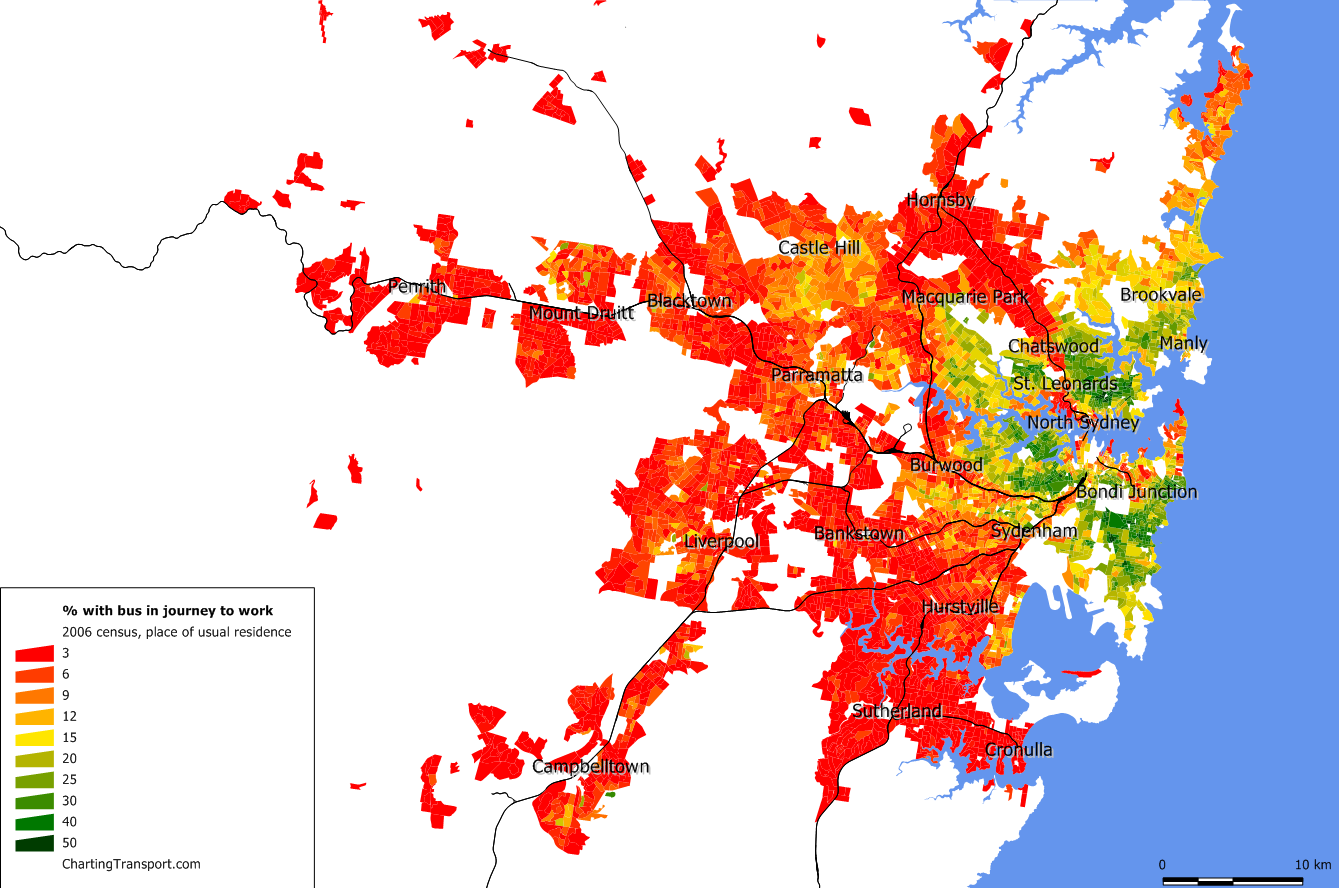
Sydney is a sea of green on this map (other cities will have the same colour scale, stay tuned!). Public transport use in journey to work was highest in the inner city area and along the train lines. It was lowest in the outer suburbs beyond the rail lines.

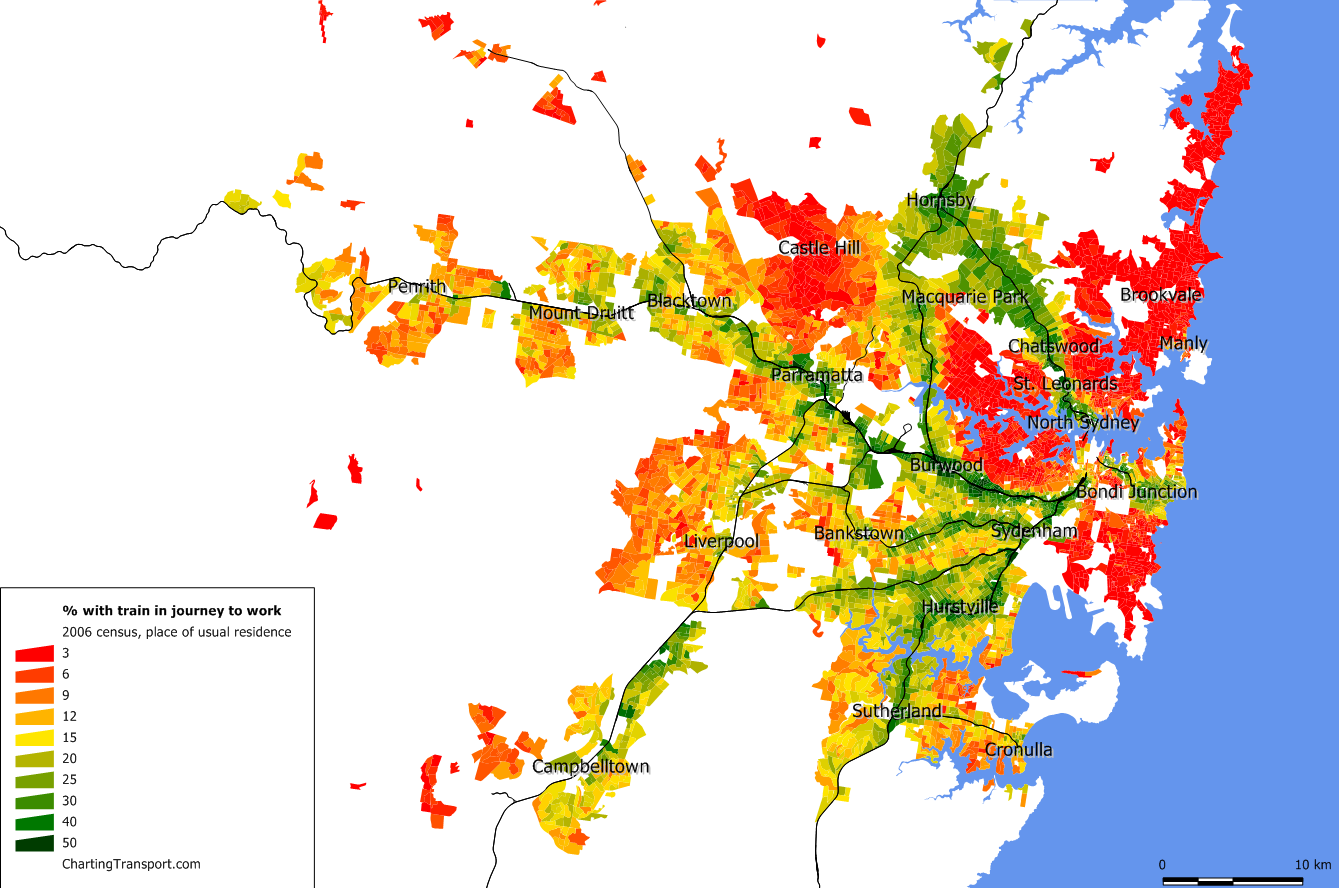
Train

There are three large and stark areas of red near the CBD and close to train lines. Most of these areas are served by direct and frequent bus services to the CBD, and while for some it might be quicker to change onto a train, this would probably be more expensive. Also, the area around Castle Hill has very low train mode share, although we will see shortly that of the small number who do commute to the CBD about three-quarters use public transport.

I note that the airport rail line (not drawn on the map) resulted in a high train mode share at Mascot but not at Green Square.

Bus

Bus mode share was high in the suburbs close to the Sydney CBD, but very low in the outer suburbs (with exceptions around Palm Beach in the north, Castle Hill (served by freeway buses), and seemingly random pockets north of Mount Druitt).

Train and bus

The following map shows people who used both train and bus in their journey to work:

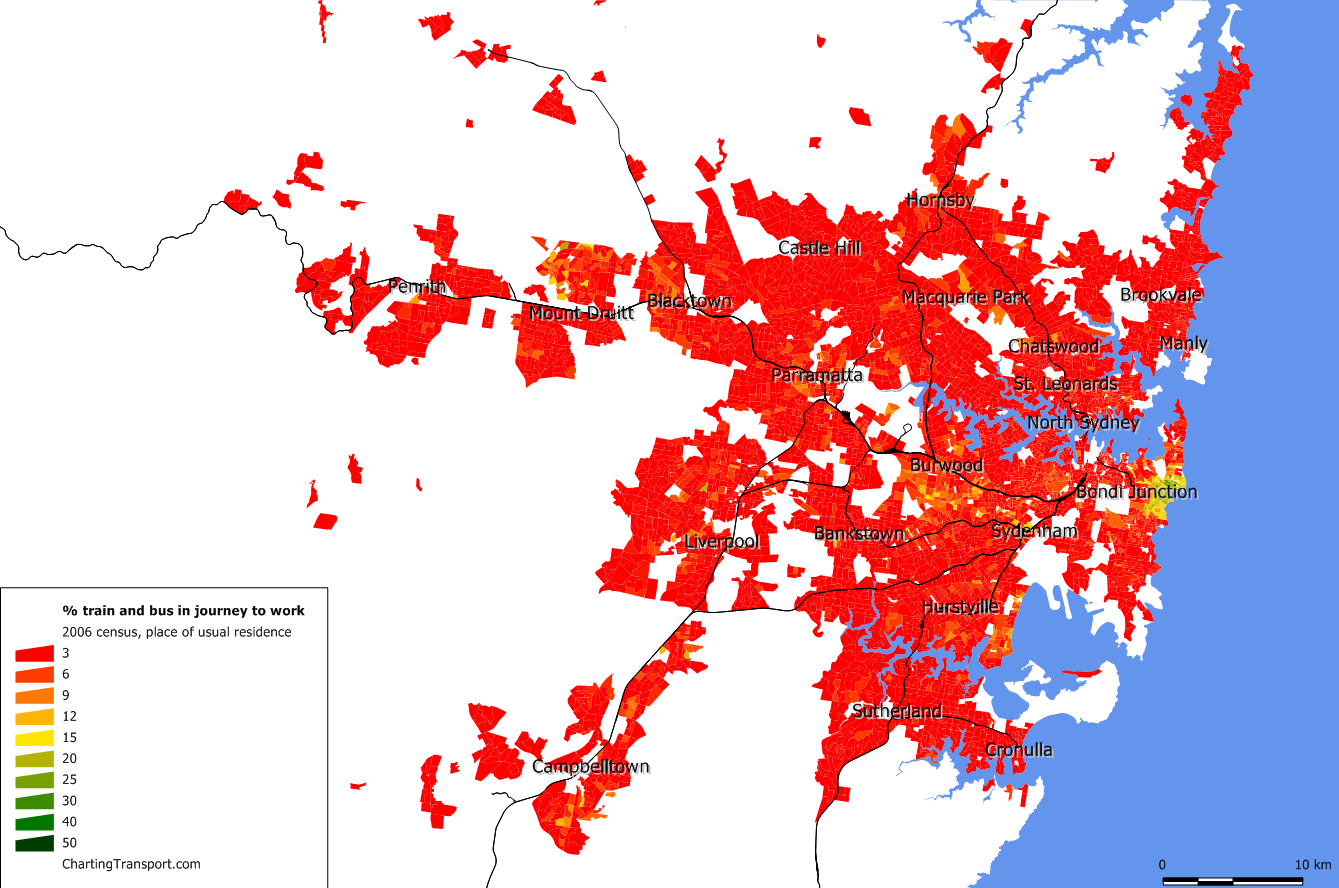
I’ve used the same colour scale as other maps, and so most of the city is red indicating very few bus-train transfers. The curious exception is around Bondi Beach/Bronte. This is probably all to do with the special Link Tickets that allow bus and train travel on the one ticket in this area only. They are designed for people visiting these areas, but they seem to be very popular with locals travelling to work.

I do wonder what would happen if there were valuable integrated tickets for more places (perhaps we’ll see some differences for 2011 thanks to MyZone).

Ferry

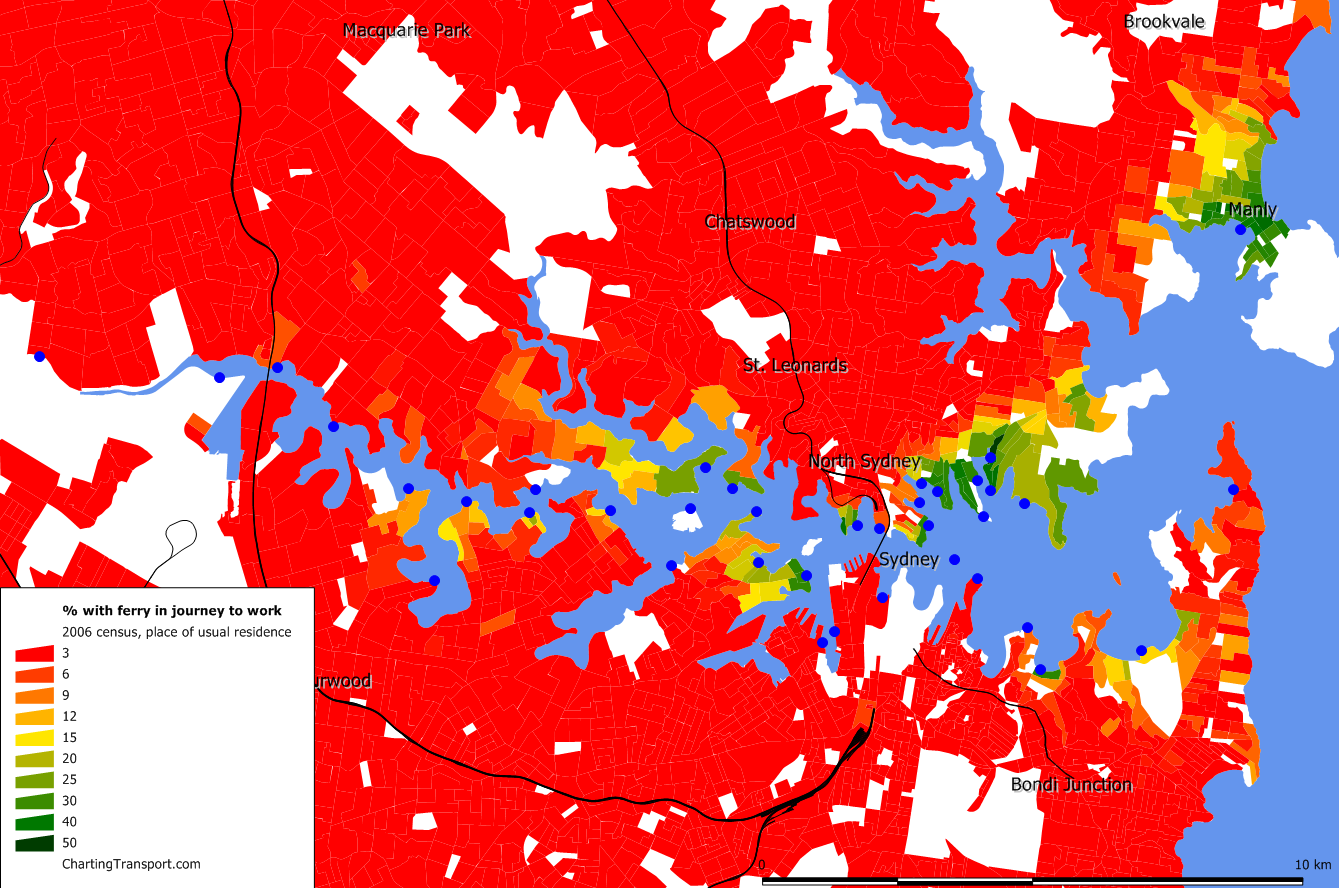
I’ve zoomed into the harbour for this map, and included the ferry wharves (some receiving a much more frequent peak period service than others).

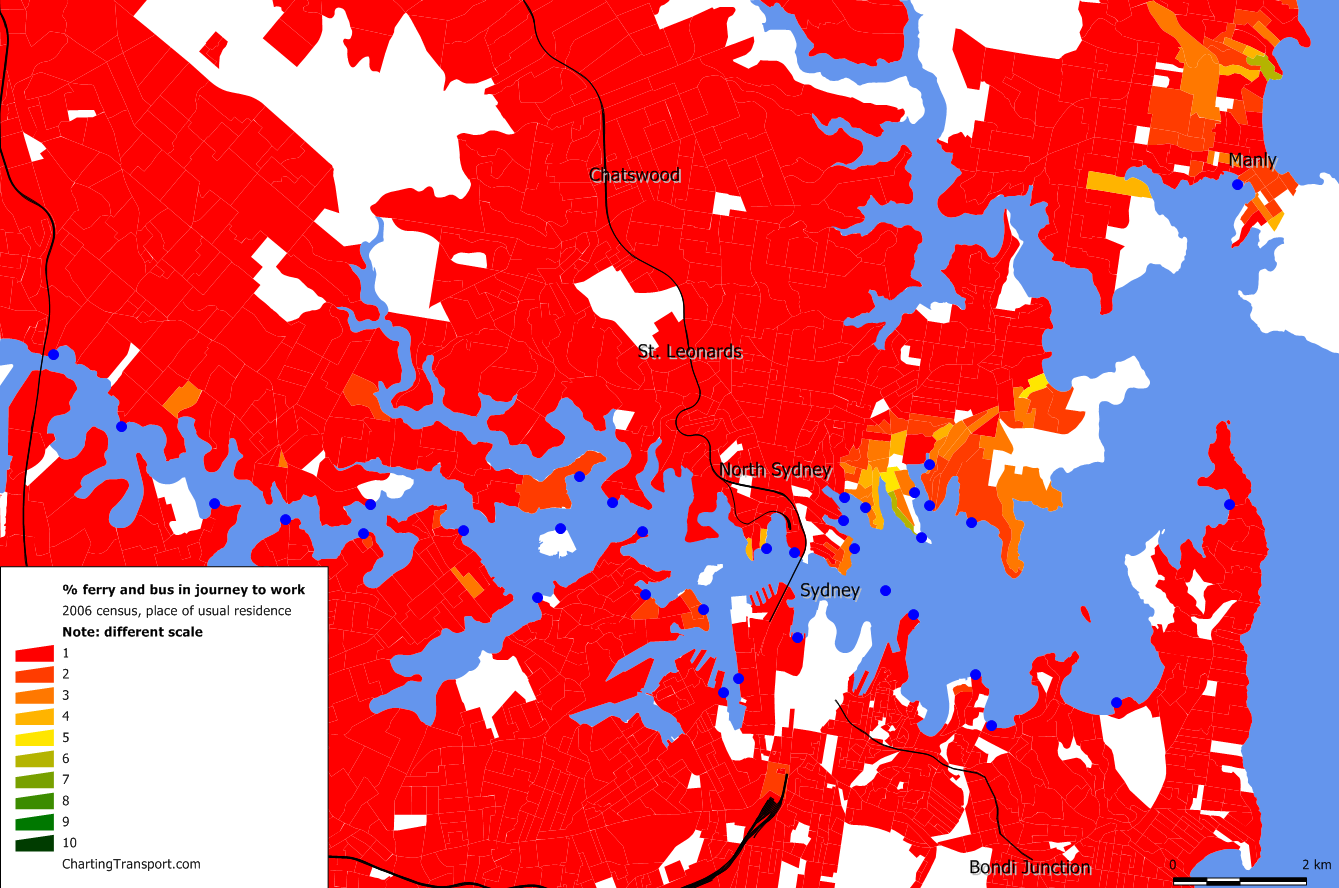
You can see high mode shares on the north shore, to the inner east, and around Manly (wharves which probably have fairly direct services to the CBD). This includes some areas a fair walk from the ferry terminals – with some people probably using connecting buses. In fact, here is a map showing bus and ferry commuters mostly on the north shore (note different colour scale):

Public and Private transport combined

The following map shows the percentage of people who used public transport as well as car, motorcycle and/or truck to get to work (again using a different colour scale):

Use of both public and private modes is most common in the northern suburbs around Hornsby (areas away from the train line), around Macquarie Park (now served by rail), north of Blacktown (now serviced by bus rapid transit), and west of Sutherland.

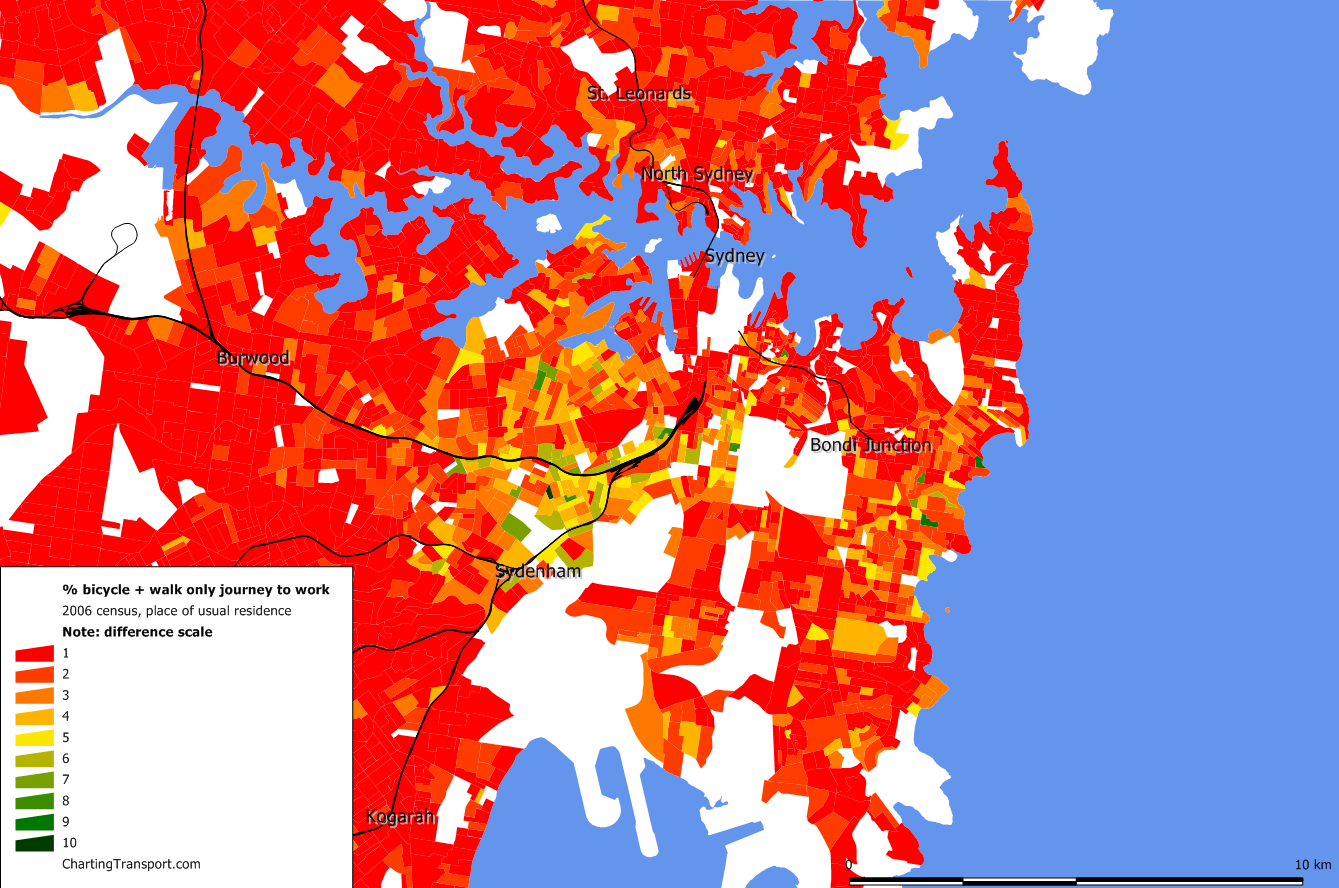
Cycling

The following map also uses the different scale, and I have zoomed into the areas with significant bicycle mode share.

The cycling mode share peaks at 11% from a pocket of Enmore, and seems to be the domain of the inner southern suburbs.

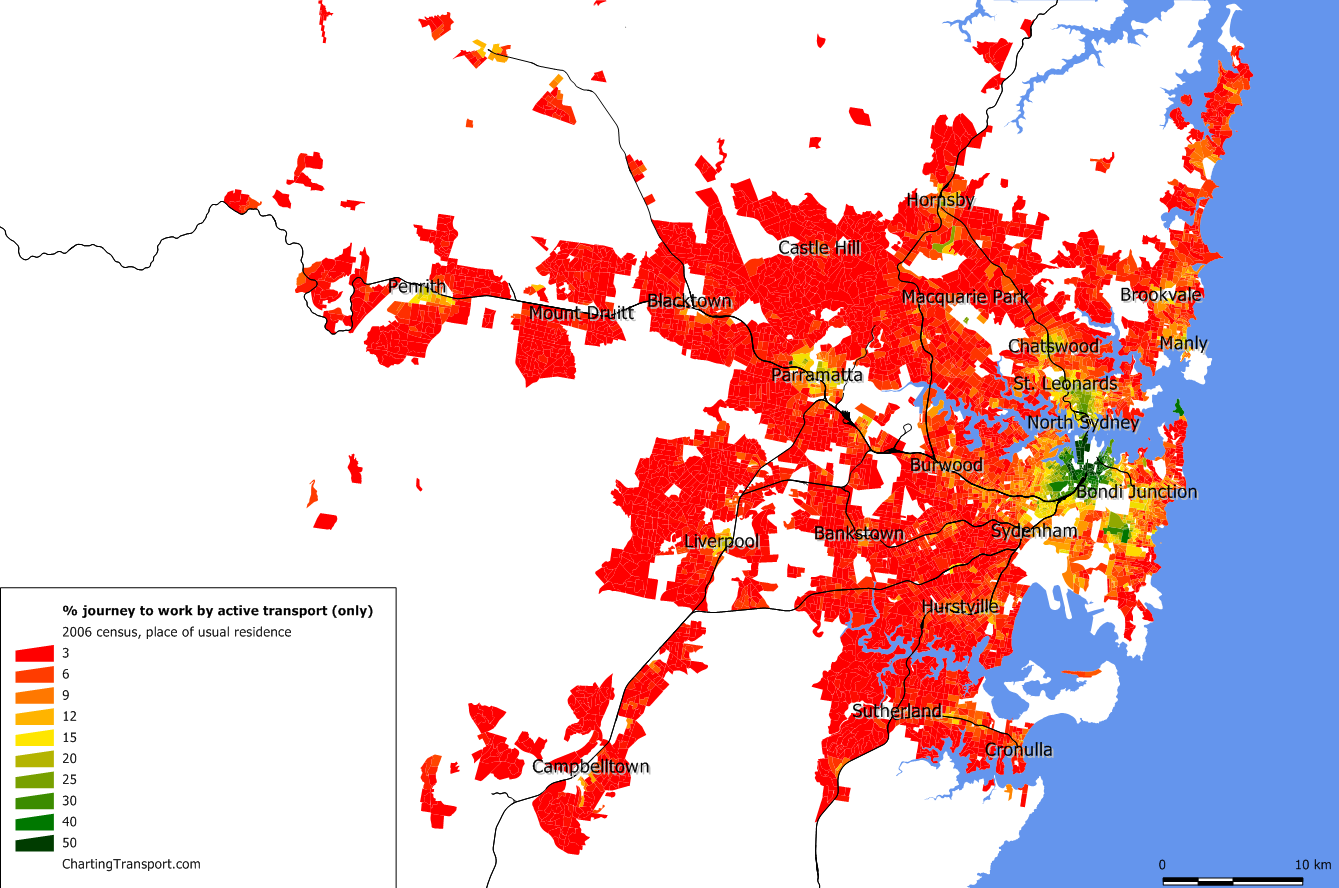
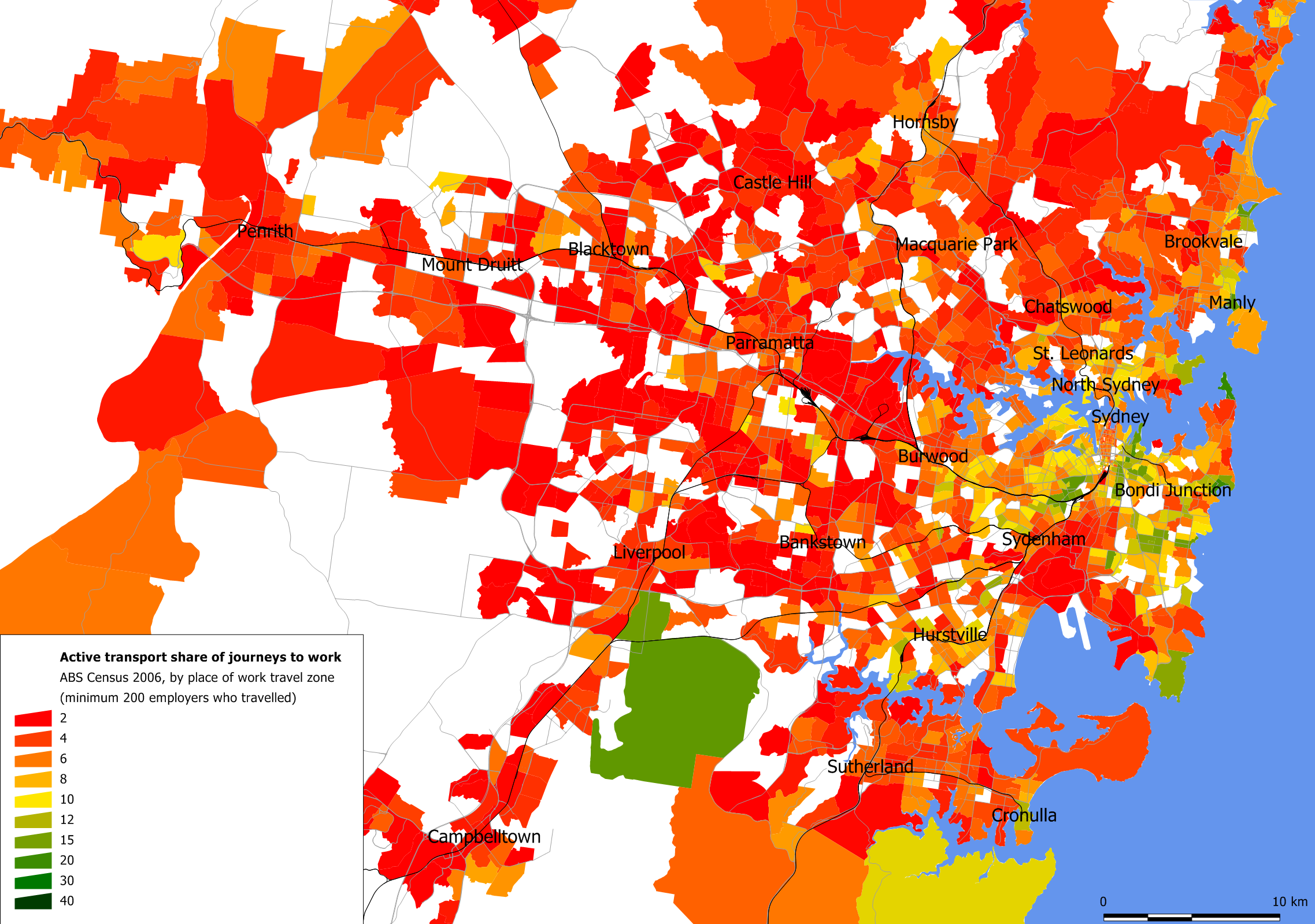
Active transport (only)

The following map shows people who only used walking and/or cycling to get to work:

You can see the walking/cycling hot spots are around the CBD, North Sydney, Parramatta, Chatswood, Liverpool, Penrith, and around Randwick/UNSW.

Method of journey to work by work location

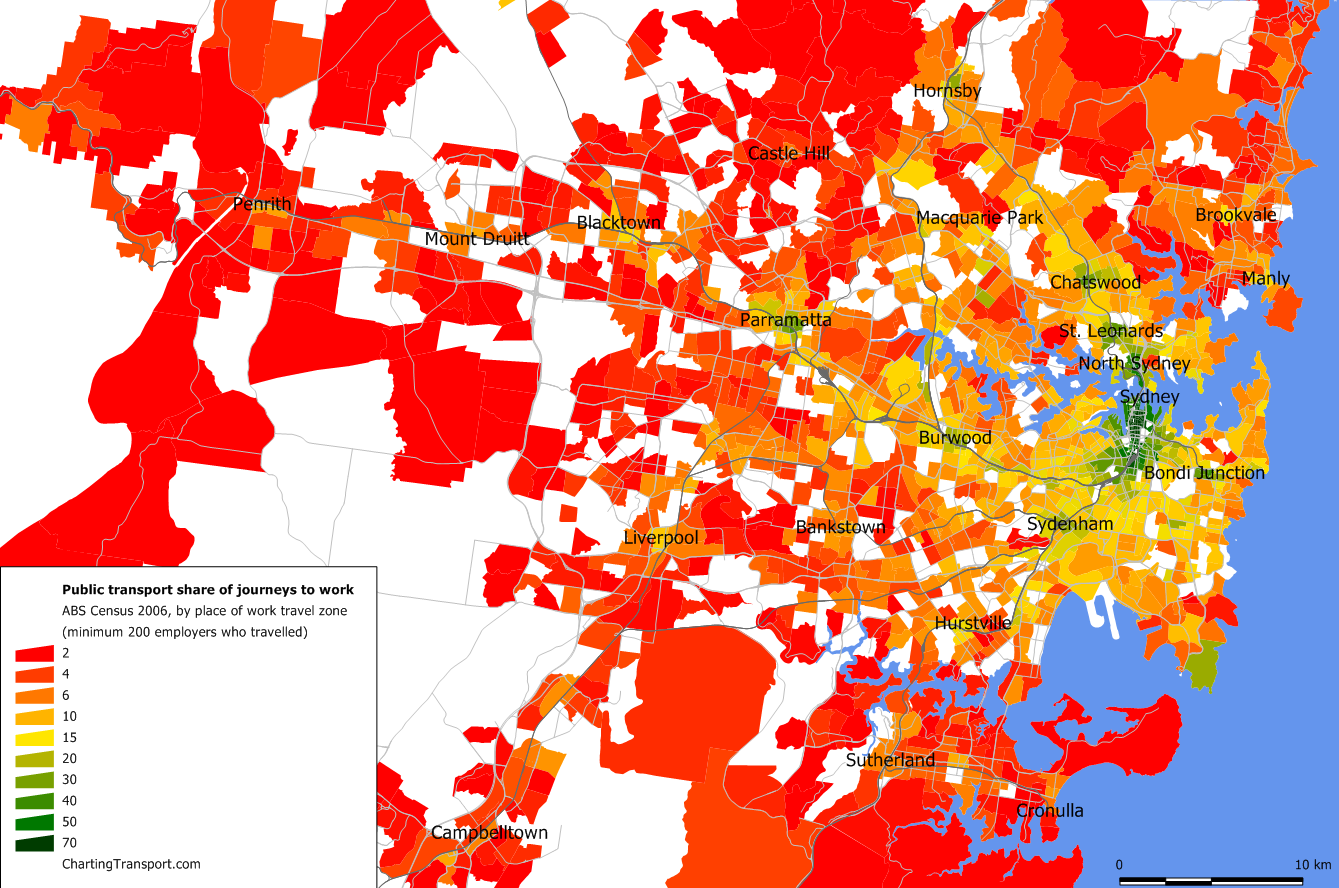
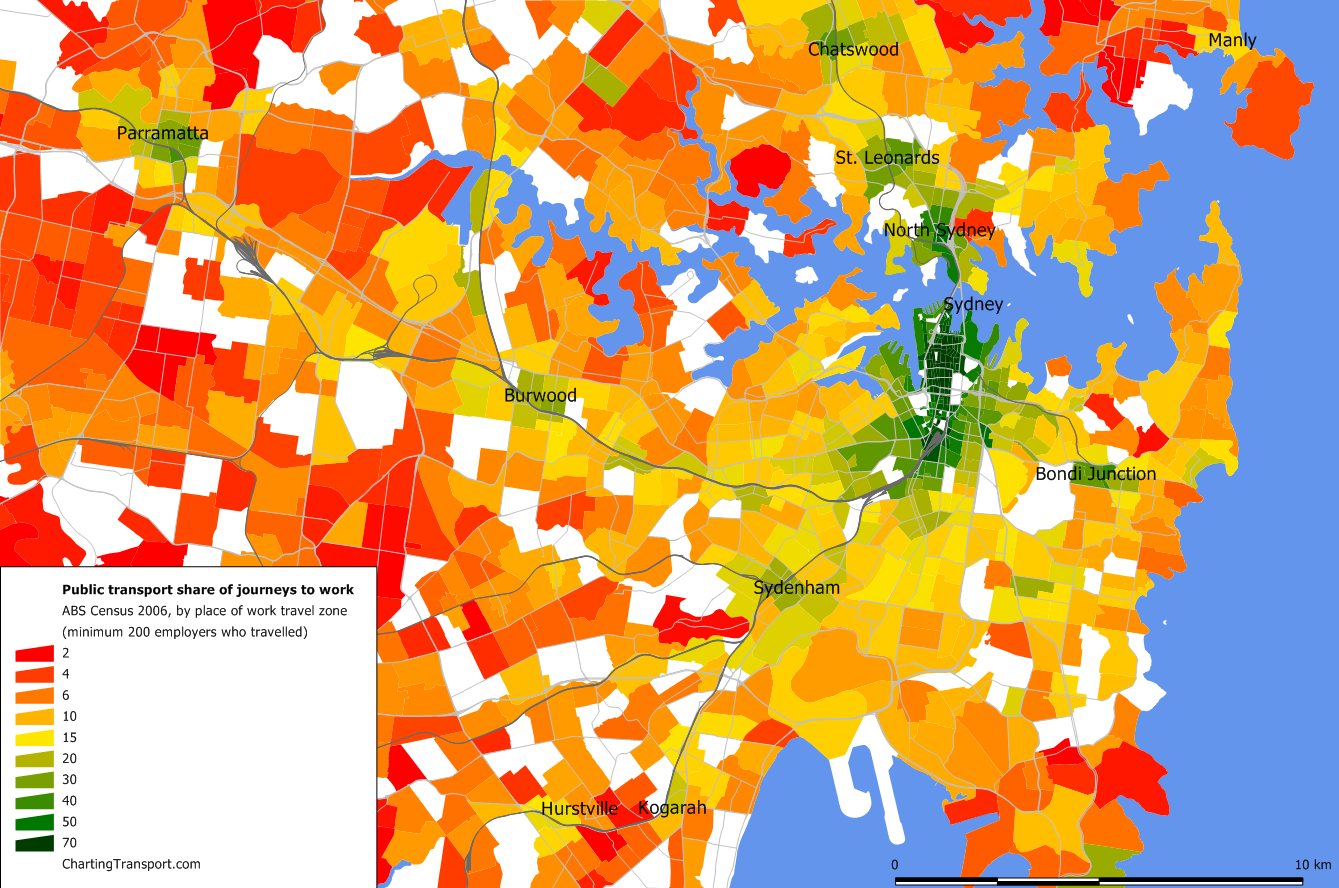
Here is a map showing the public transport mode share of journeys to travel zones in Sydney in 2006 (where 200 or more journeys were made):

It’s not just the Sydney CBD that had reasonably high public transport mode share. Public transport mode share peaked in the centre of the following regional hubs:

  • North Sydney 53%
  • Bondi Junction: 41%
  • Parramatta: 38%
  • Chatswood: 35%
  • St Leonards: 34%

(these are the highest value recorded by any travel zone in each centre).

By contrast, analysis of destination mode share for Melbourne showed all major suburban centres to have well less than 15% public transport mode share (most less than 10%).

Public transport mode share was also quite clearly higher along the train lines – particularly in the middle and outer suburbs.

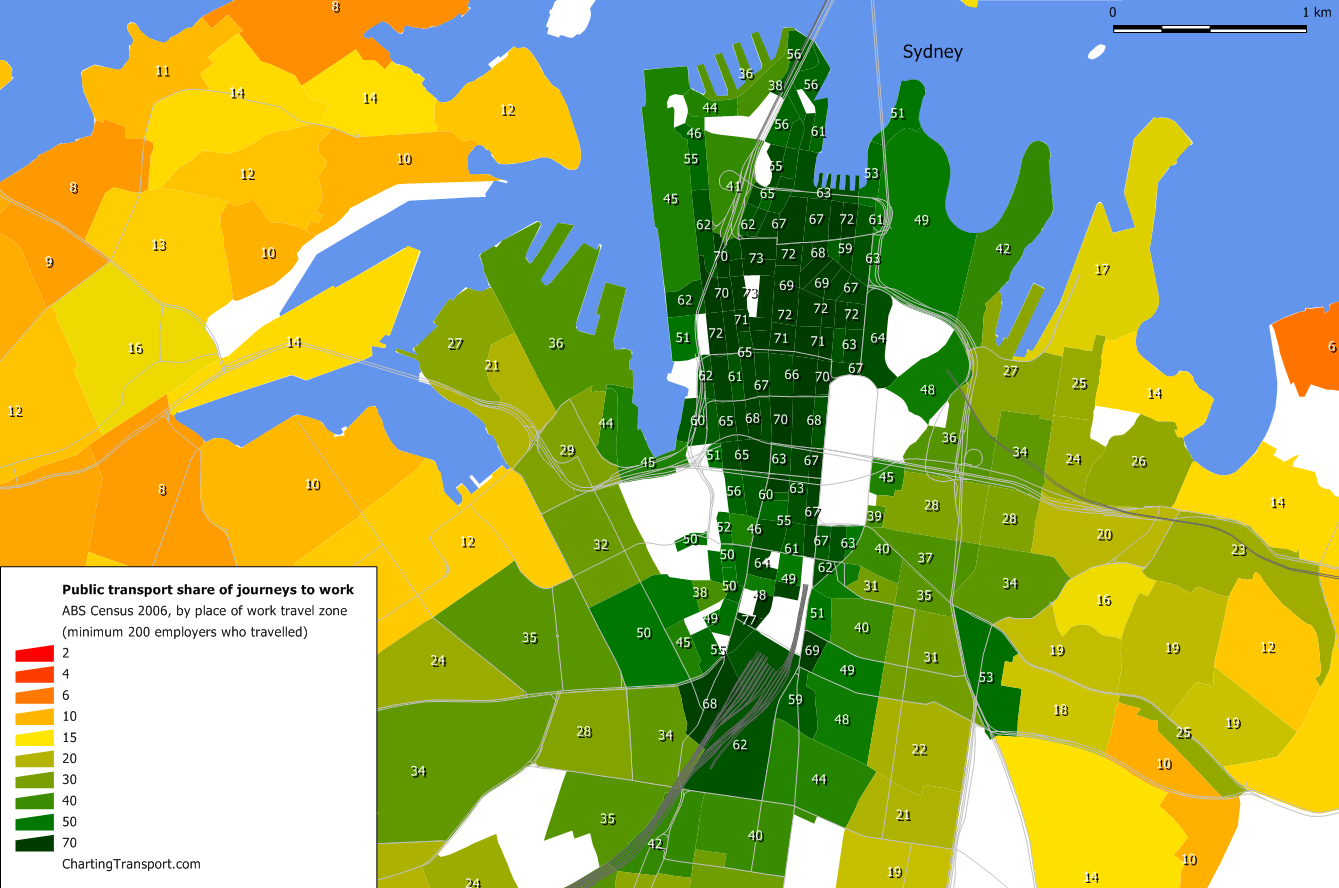
Here are enlargements of inner Sydney and the Sydney CBD area:


Here’s a map showing active transport mode share for greater Sydney workplace destinations:

Active transport was most commonly used to inner city areas including Newtown, Camperdown, Bondi Beach, Randwick, Paddington and Potts Point.  However it was low in the Sydney CBD. The Holsworthy Military Camp as a large green area in the south with high active transport mode share – probably because the military staff live on site. People more familiar with Sydney might be able to comment further.

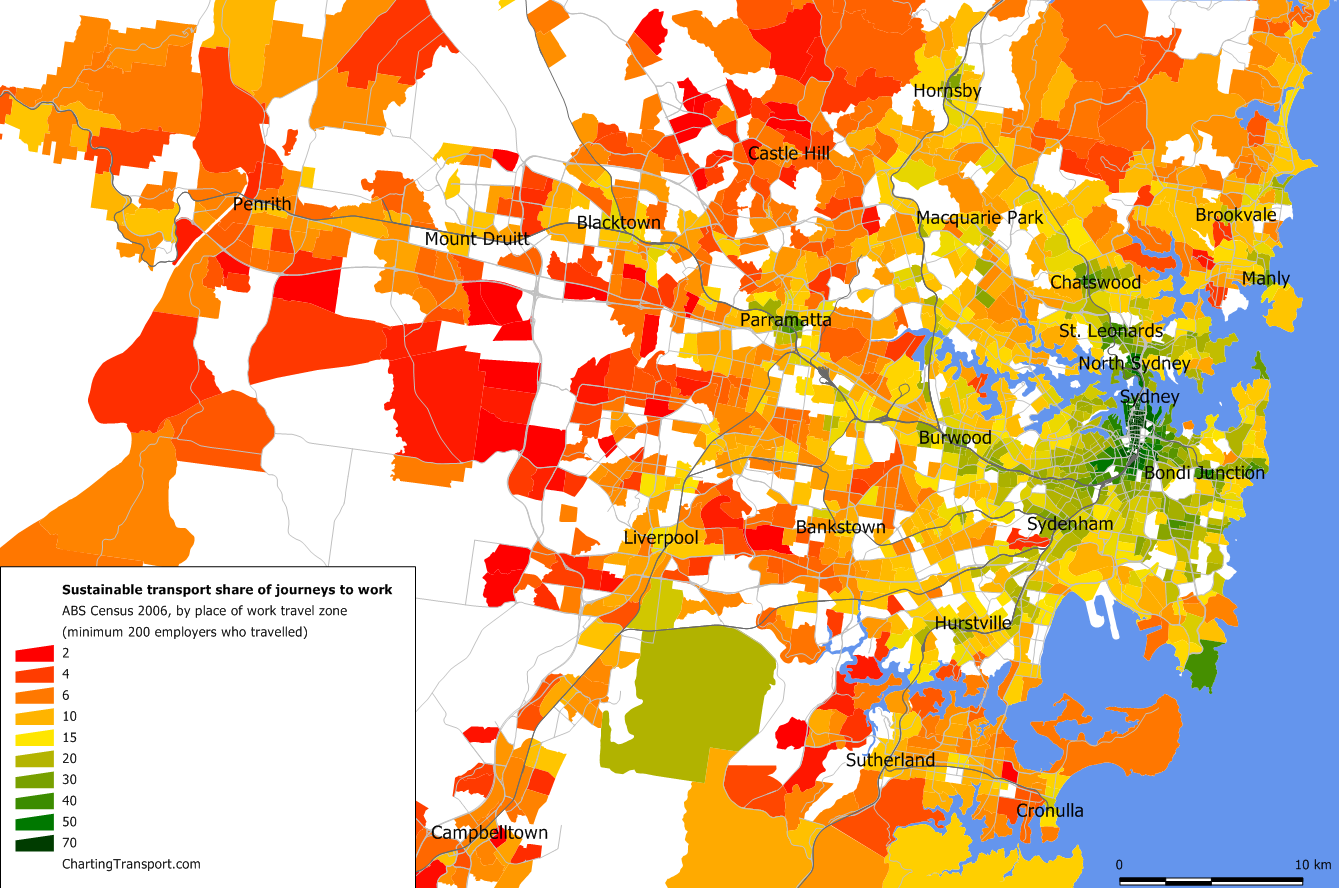
Here is sustainable transport mode share (public transport and active transport combined, everything else being private motorised transport). You can see that private transport was by far the dominant for western Sydney jobs.

Journeys to work in the Sydney CBD

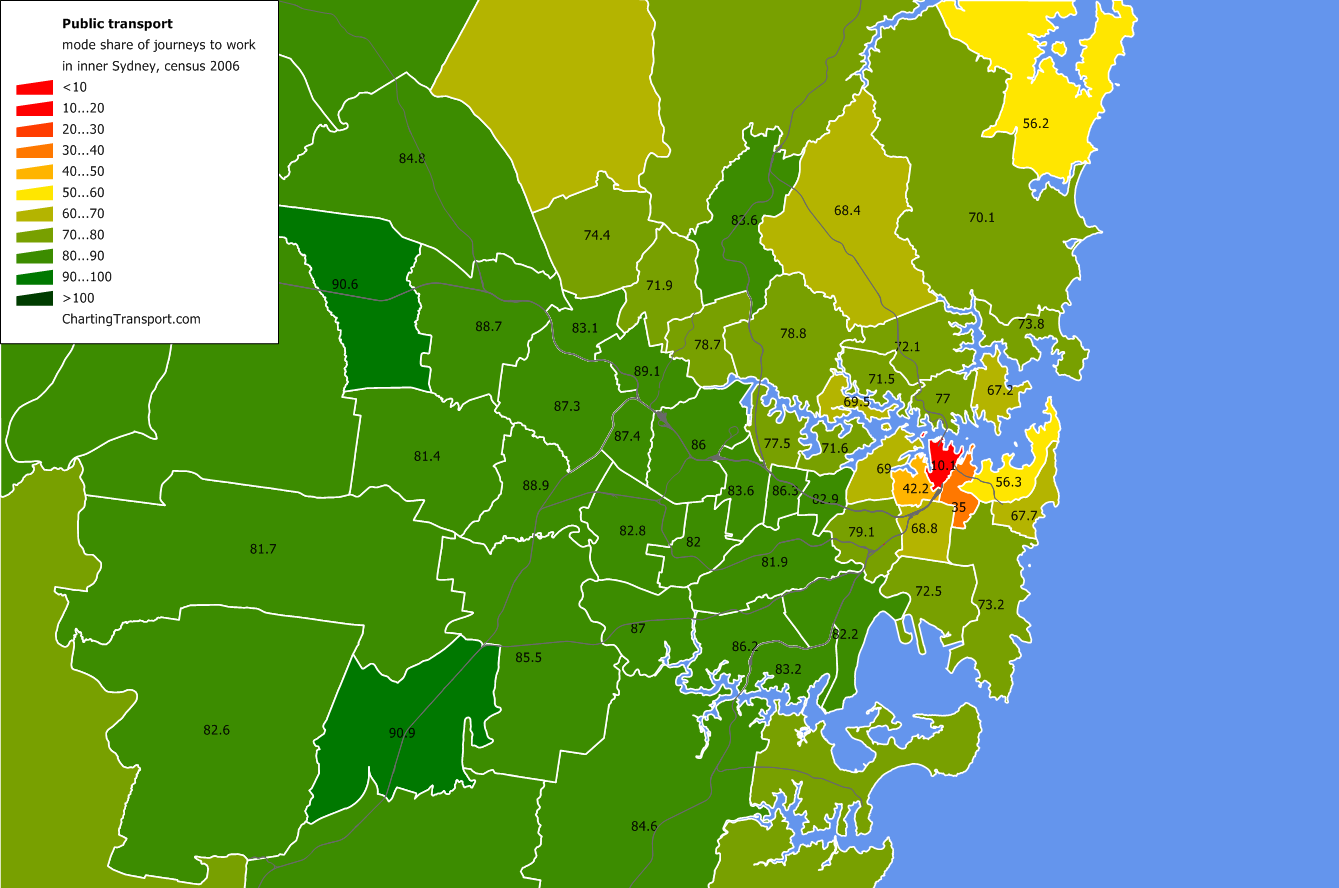
Here’s a map showing the public transport mode share by home location of journeys to work in the Sydney CBD (defined as the Sydney – inner SLA, the only red SLA on the map):

Public transport had a mode share around 70-80% for large areas of Sydney (in contrast to Melbourne where 60-70% was more common). However there was a much lower share from the CBD itself and areas adjacent.

Were they walking or cycling instead?

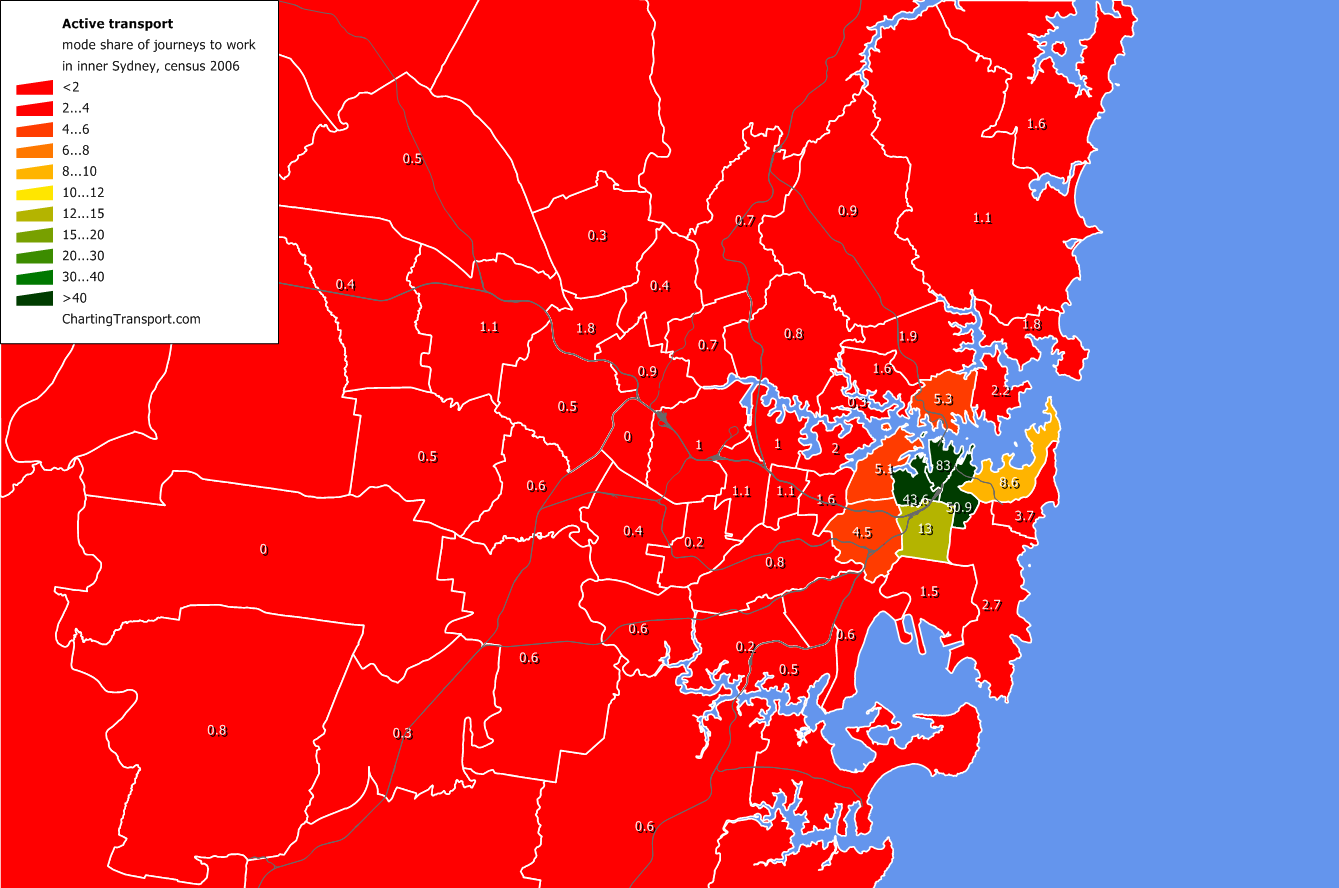
Well, yes for the City of Sydney areas, but not for Woollahra to the east. On the following sustainable transport mode share map, you can see that around 35% of workers from Woollahra commuted to the CBD by private transport (note I have used a different scale for this map):

Sustainable mode share is highest from the western and south-western suburbs, whereas many people chose to drive from the northern suburbs, the southern coastal areas, and even the inner eastern suburbs.

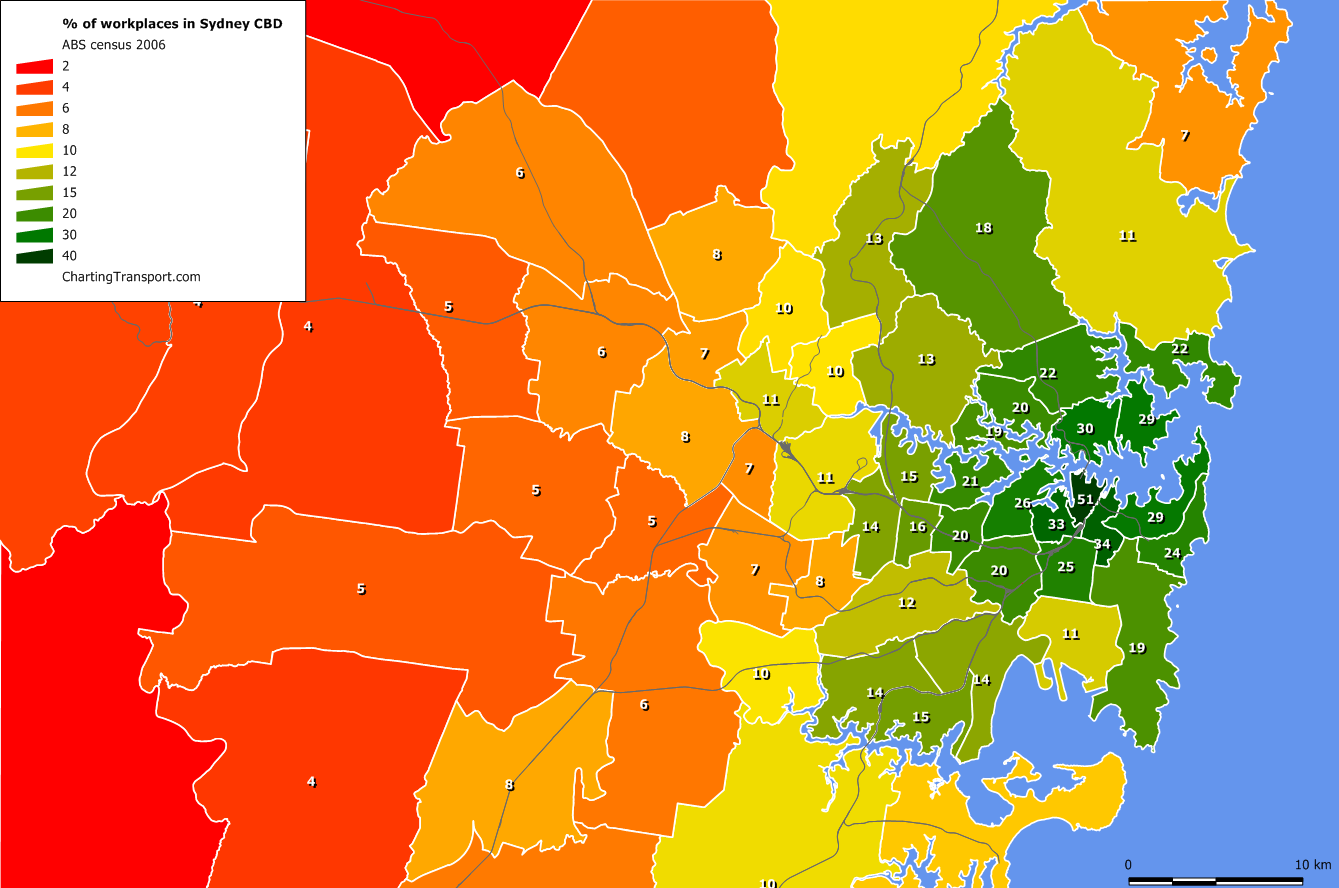
But what proportion of the working population commuted to the CBD?

Compared to the Melbourne CBD, the Sydney CBD seems to have a stronger role, even though Sydney has major employment centres outside the central CBD.

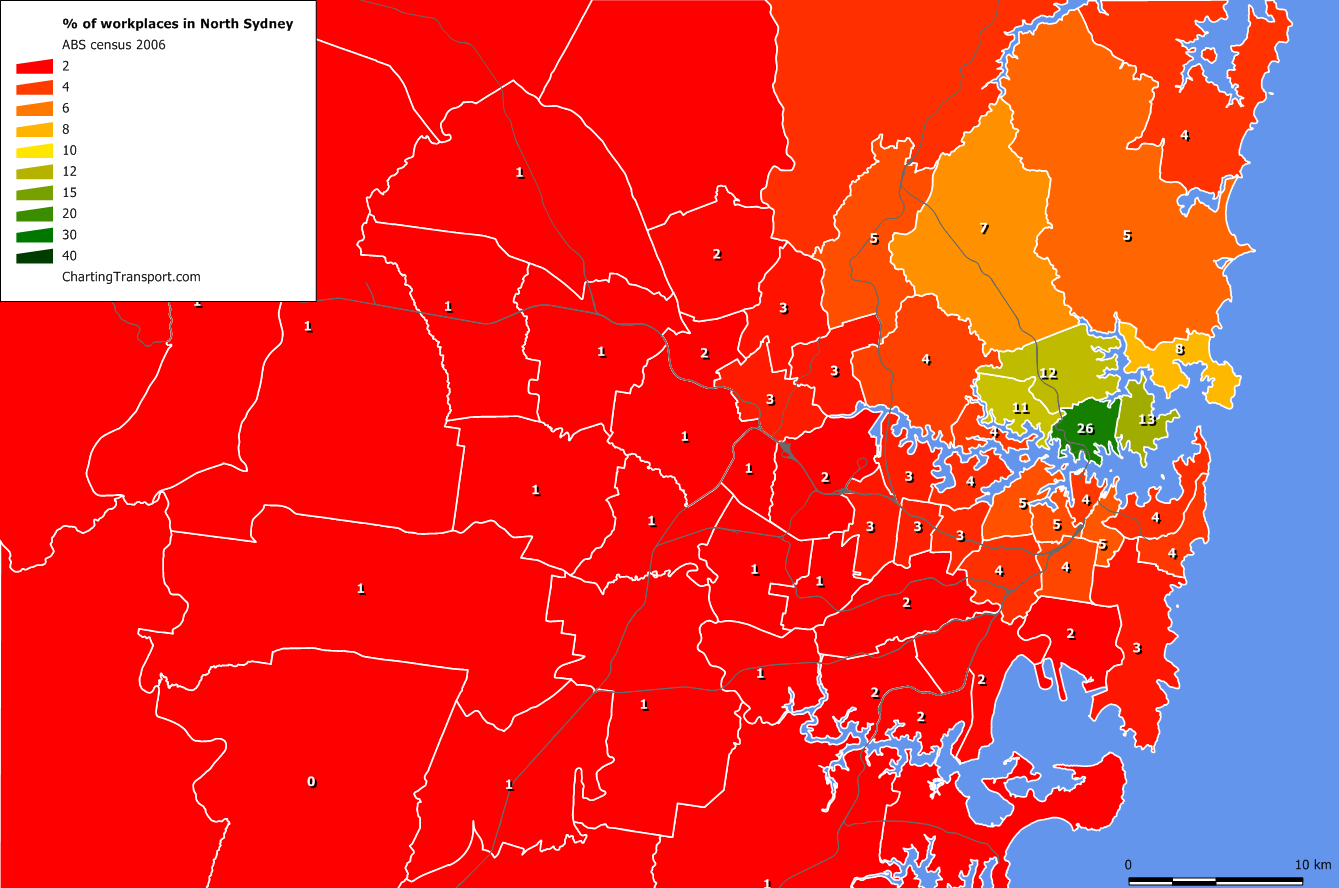
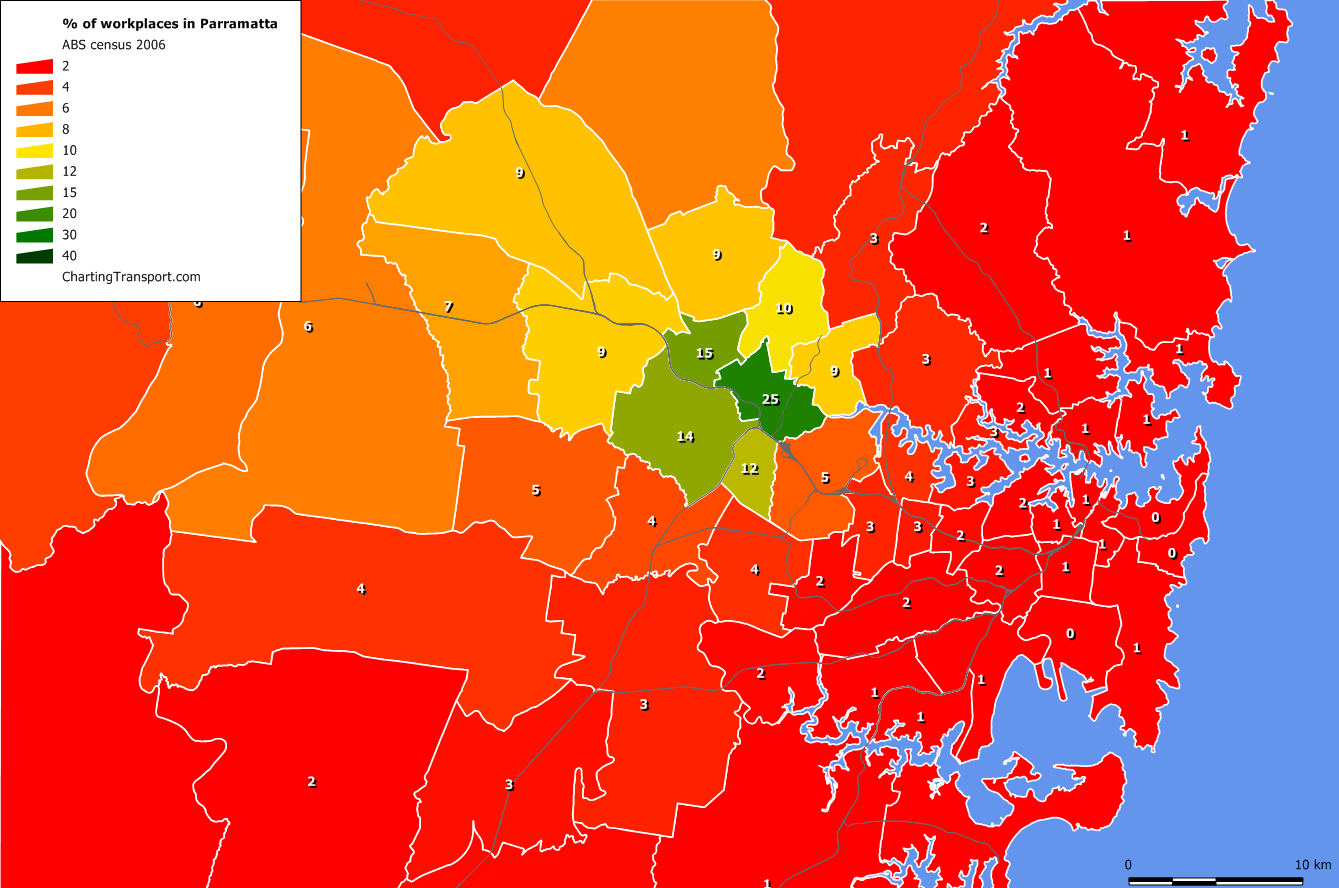
For anyone interested, here are similar maps for North Sydney and Parramatta as work destinations:

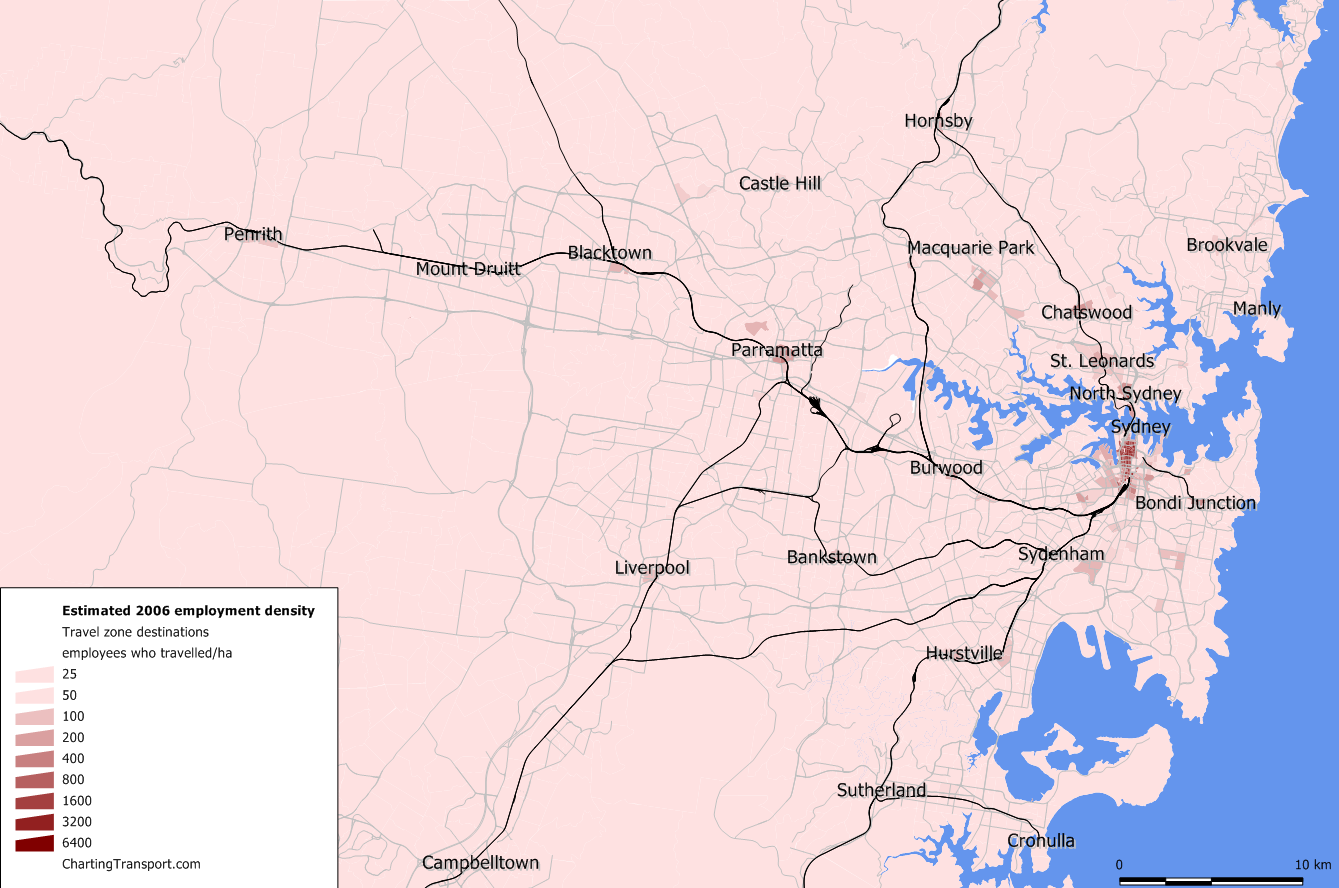
Sydney’s employment density

The BTS data also allows the construction of an employment density map. I’ve drawn this map based on people who travelled to each destination zone on census day.

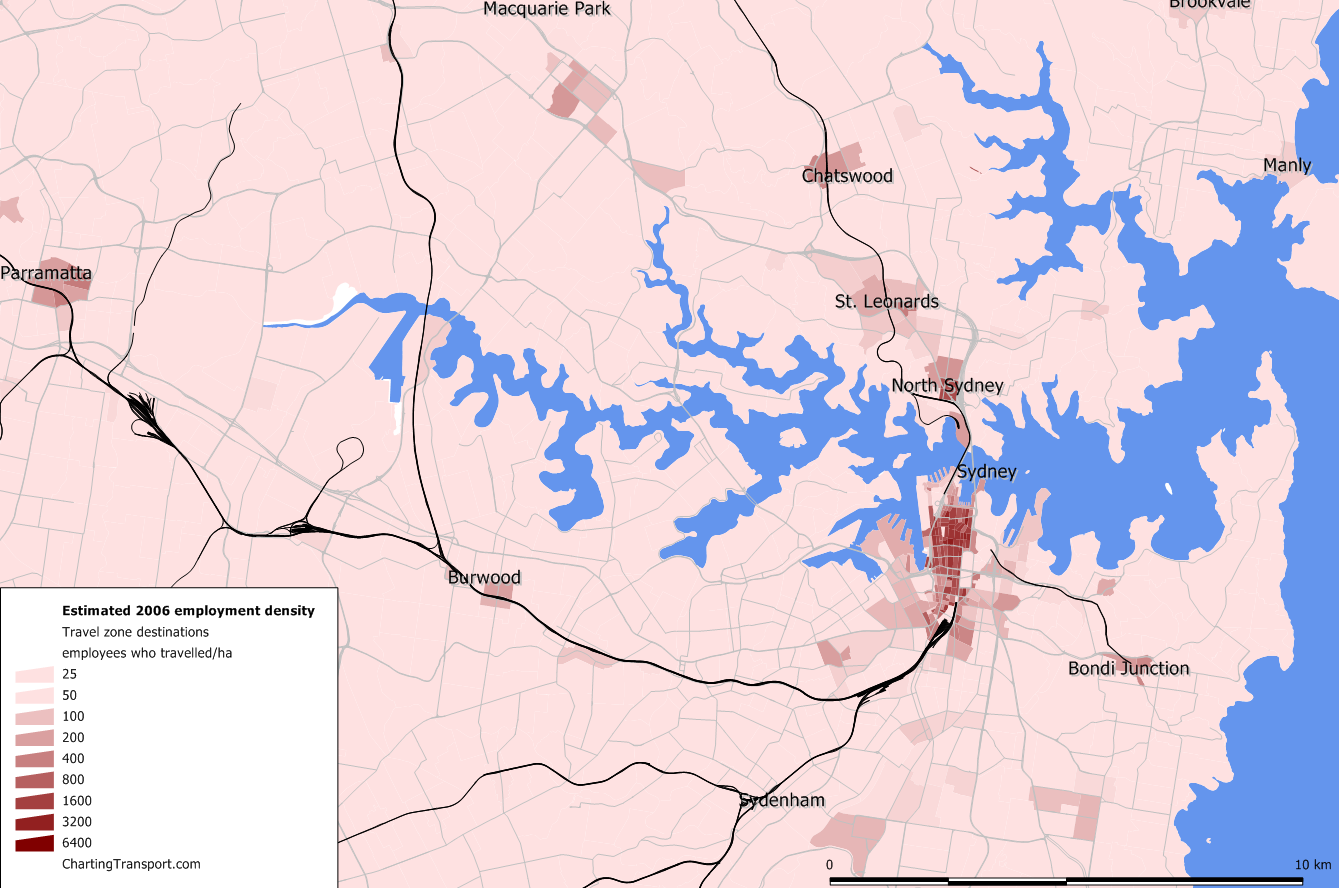
And a zoom in on the inner city:

Employment density and mode share

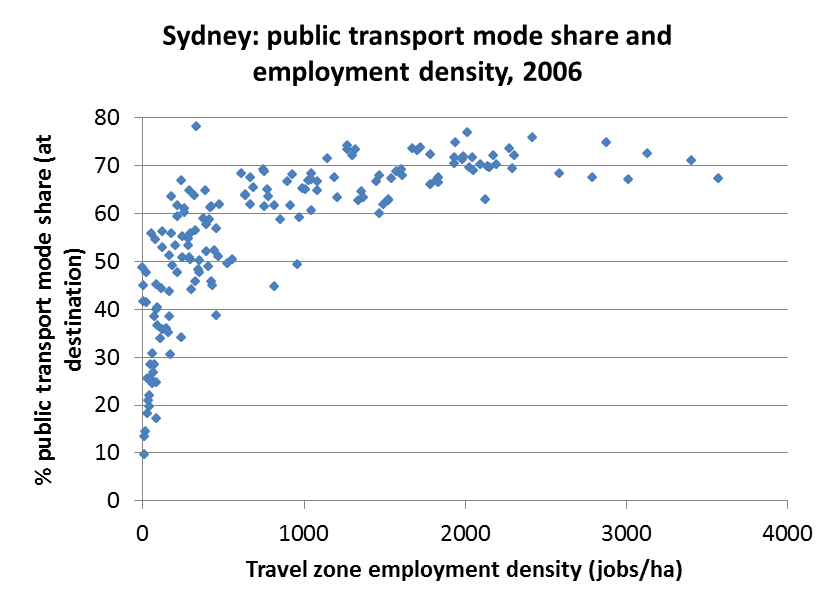
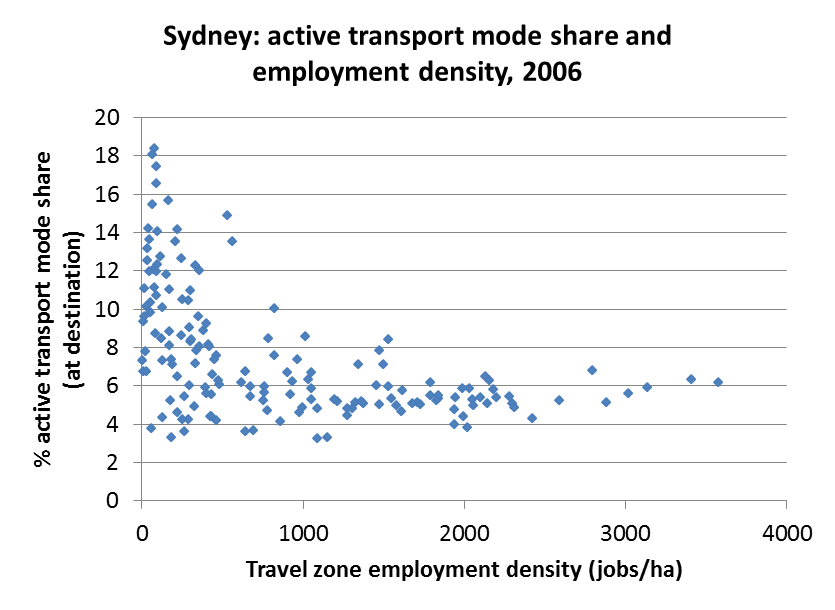
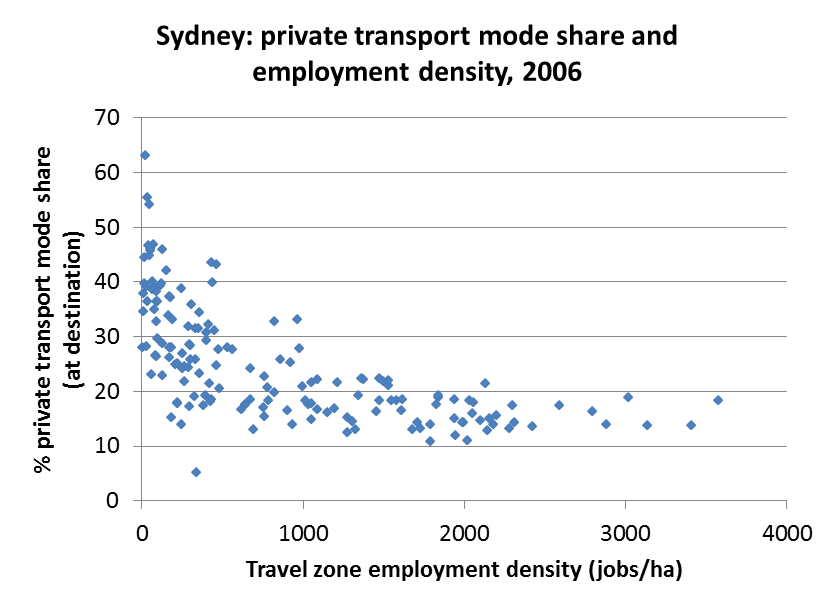
Finally. here is a look at the relationship between employment density and public, active and private transport mode share (by workplace zone).

I must stress that these results will strongly reflect the design of public transport – which is heavily geared towards places with high employment density (such as the Sydney CBD) as that is where public transport can generally complete strongest with private transport (the cost of parking and traffic congestion etc). By increasing employment density in any parcel of land you won’t automatically get high public transport mode share – you have to provide high quality public transport to that destination first!

No surprises there!

Was that what you expected? Active transport actually had the highest mode share in areas with the lower employment densities. These are likely to be mixed residential/employment areas where employees can live close by, military camps, and farms.

Finally, it will be little surprise that the lower employment densities had the highest private transport mode shares. These areas are likely to have ample room for free employee parking, and public transport is likely to struggle to efficiently deliver a small number of employees over a large area.


Comparing the residential densities of Australian cities (2011)

Fri 19 October, 2012

I’ve looked at Melbourne residential density in detail, so what about other Australian cities?  Is population weighted density a useful measure? Does population weighted density help explain differences in public transport mode shares?

For this exercise, I’ve looked at 2011 census data at the Statistical Area Level 1 (SA1) geography (currently the smallest geography for which population data is available) for Greater Capital City Statistical Areas (which include large tracts of rural hinterland). I’ve sometimes applied an arbitrary threshold of 3 persons per hectare to define urban residential areas.

Measures of overall density

Population weighted density is a weighted average of the density of all the parcels of land in the city, with the population of each parcel of land providing the weighting. This provides a figure indicative of the residential density of the “average person”, although that’s still a little abstract. A city where a large proportion of people live in dense areas will have a much higher weighted population density than average population density.

Average density is simply the total population divided by the area of the city (or if you like, the average density weighted by the areas of each parcel of land). In calculating average residential density (which I’m doing in this post), the area would only include residential areas (I’ve arbitrarily used a threshold of SA1s with at least 3 persons per hectare).

Another measure is urban density, which considers all the land that makes up the urban city, including non-residential areas, but excluding the rural land that makes up large parts of most metropolitan areas when defined by administrative boundaries. I have not attempted to measure ‘urban’ density in this post.

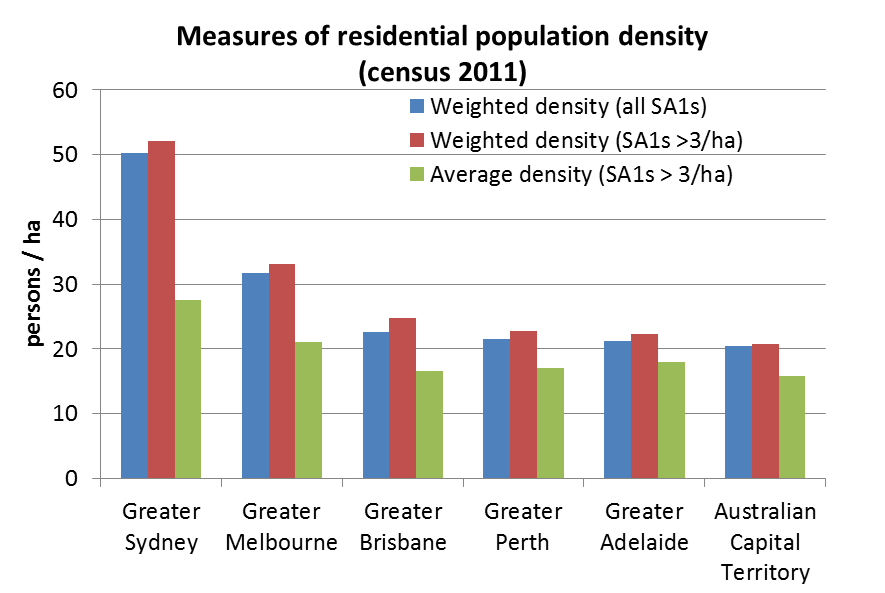
Firstly here’s a table of data for the six largest Australian cities with three different measures of 2011 residential density:

Greater Capital City Statistical Area Pop Pop (>3/ha) Area, square km (>3/ha) Pop-weighted density, persons/ ha (all SA1s) Pop-weighted density, persons/ ha (SA1s >3/ha) Average residential density, persons/ ha (SA1s >3/ha)
Greater Sydney 4391578 4225278 1530 50.2 52.1 27.6
Greater Melbourne 3999924 3832366 1812 31.8 33.1 21.1
Greater Brisbane 2066134 1866794 1127 22.6 24.8 16.6
Greater Perth 1728567 1639849 963 21.6 22.7 17.0
Greater Adelaide 1225136 1161668 644 21.2 22.3 18.0
Australian Capital Territory 356563 350917 221 20.5 20.8 15.9

You’ll notice that Melbourne has a lower population than Sydney, but the total land area above 3 persons/ha is much larger.

Here are those densities in chart form:
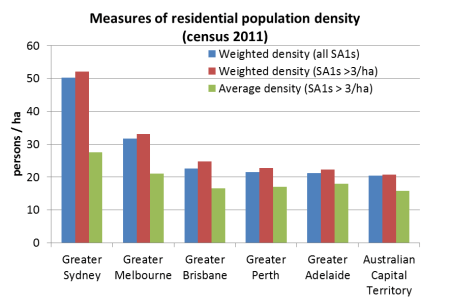
You can see Sydney has around double the population weighted density of most other cities, but its average density is only about 60% higher. These figures show Sydney has a very different density pattern compared other Australian cities.

You can also see very little difference in weighted density whether you exclude low density land parcels or not (the blue and red bars). The density is brought down only slightly by the relatively small number of people living in very low density areas (below 3 persons/ha) within the statistical geography. Thus weighted average density is a good way to get around arguments about the boundary of the “urban” area. But then we are only measuring residential density here – and the large unoccupied spaces between residents of a city are very important when it comes to transport issues.

Can you compare population weighted density of Australian cities with international cities? Yes, but only if the parcels of land used are of a similar size and created in a similar fashion. The more fine-grained the geography (ie smaller the parcels of land), the more non-residential pockets of land will be excluded from the calculation. Anyone doing an international comparison should compare how the ABS create their geography at SA1 level with approaches of other statistical agencies. And please comment below if you get a set of comparable figures.

Density by distance from the CBD

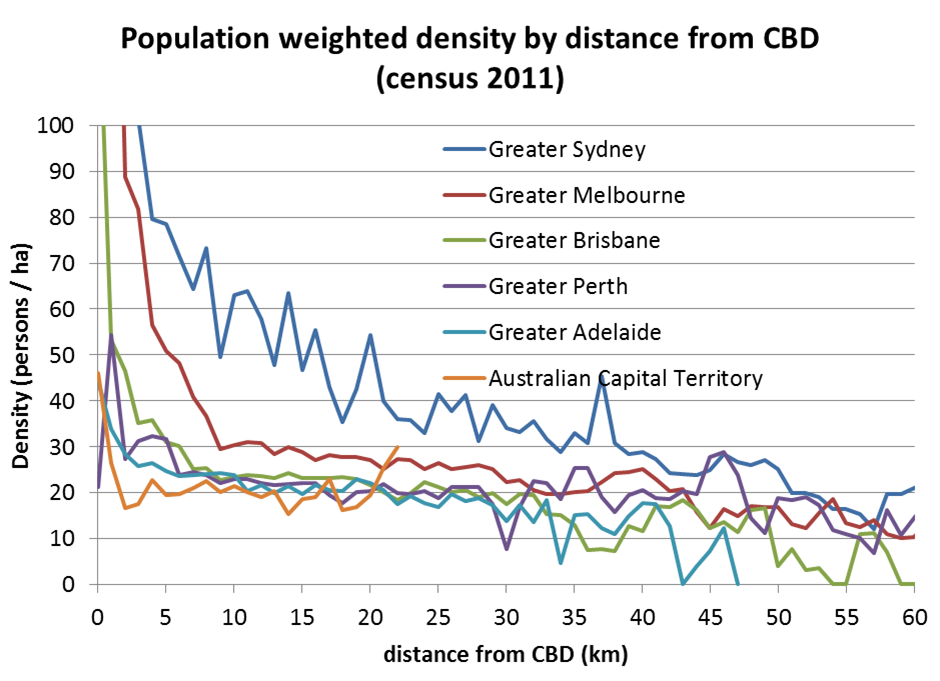
The differences in density can be seen a little more clearly when you look at weighted average density by distance from the city centre:

(note: I’ve chopped the vertical scale at 100 persons/ha so parts of central Sydney, Melbourne and Brisbane are off the scale).

For Perth, Adelaide, Brisbane and Canberra (ACT) you can see a weighted average density in the mid to low 20s for large areas of the city, indicating large tracts of what you might describe as traditional Australian suburbia. In Canberra this kicks in at just 2 km from the CBD, and in Adelaide it kicks in 3 km from the city.

In Melbourne the weighted average density doesn’t get below 30 until 9 kms from the CBD indicating a larger denser inner area, and in Sydney it doesn’t drop below 30 until you are 39 km from the CBD!

Distribution of population at different densities

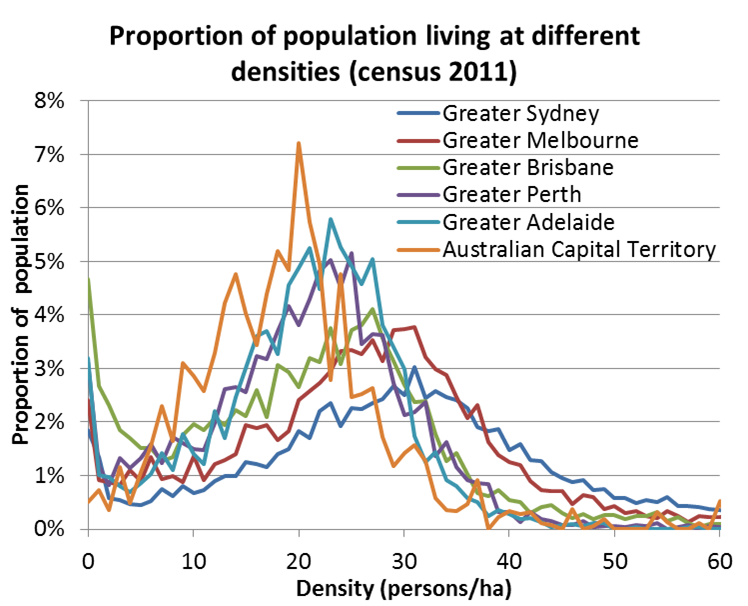
Here’s a frequency distribution of densities in the cities:

I’m using an interval of 1 person/ha, and the figures are rounded down to form the values on the X axis (ie: the value you see at 20 persons/ha is the proportion of the population living between 20 and 21 persons/ha).

You can see Sydney has the flattest distribution of all – indicating it has the widest range of densities of any city. Melbourne is not far behind, whereas Canberra has a lot of people living in areas between 12 and 24 persons/ha.

Note that many cities have a significant proportion of the population living at rural densities (0 to 1 person per hectare), particularly Greater Brisbane.

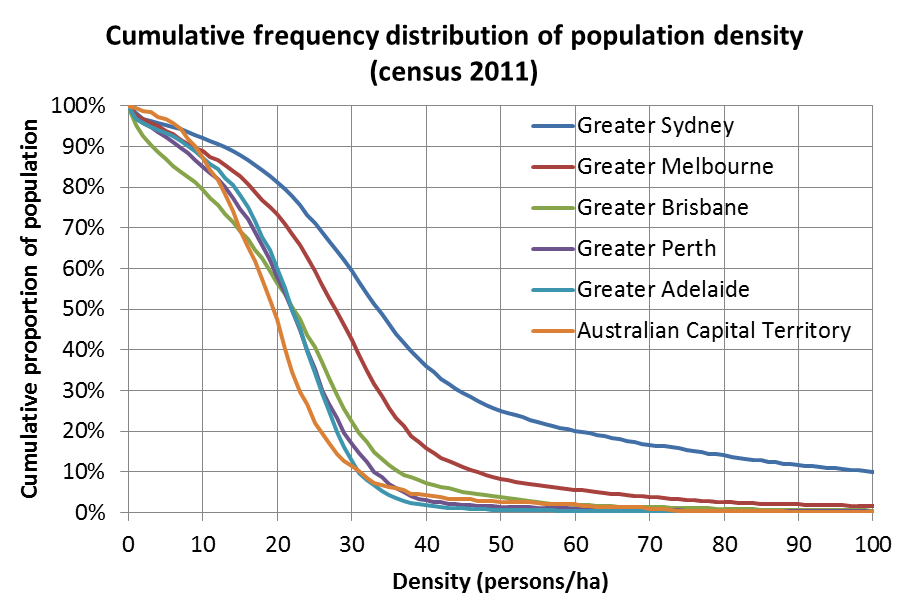
Another way to look at this data is a cumulative frequency distribution:
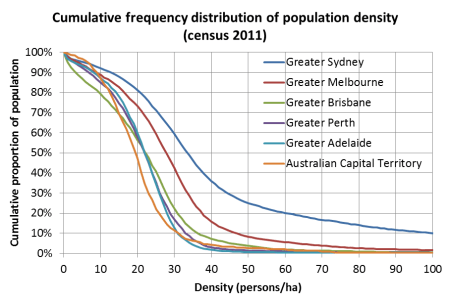
You can read off the median densities for the cities: Sydney 33, Melbourne 28, Brisbane 22, Perth 22, Adelaide 22, Canberra 19.

You can also see that 30% of people in Sydney live in densities of 44 persons/ha or more – compared to only 12% of Melburnians, 5% of Brisbanites, and less than 2% of people in the other cities.

If 15-30 persons per hectare is what you define as suburbia, then that’s 26% of Sydney, 37% of Melbourne, 44% of Brisbane, 55% of Perth, 57% of Canberra and 62% of Adelaide.

Spatial distribution of density

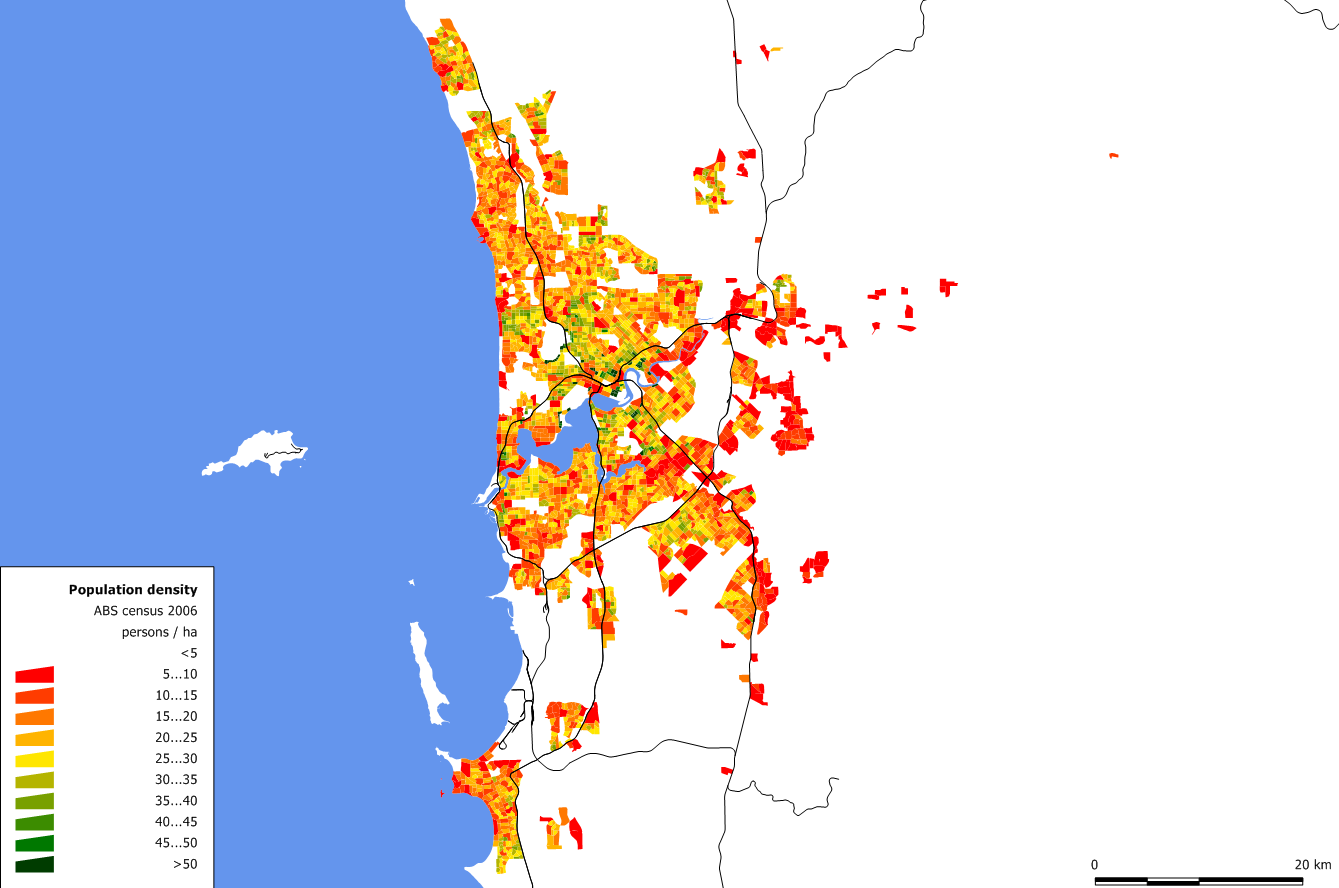
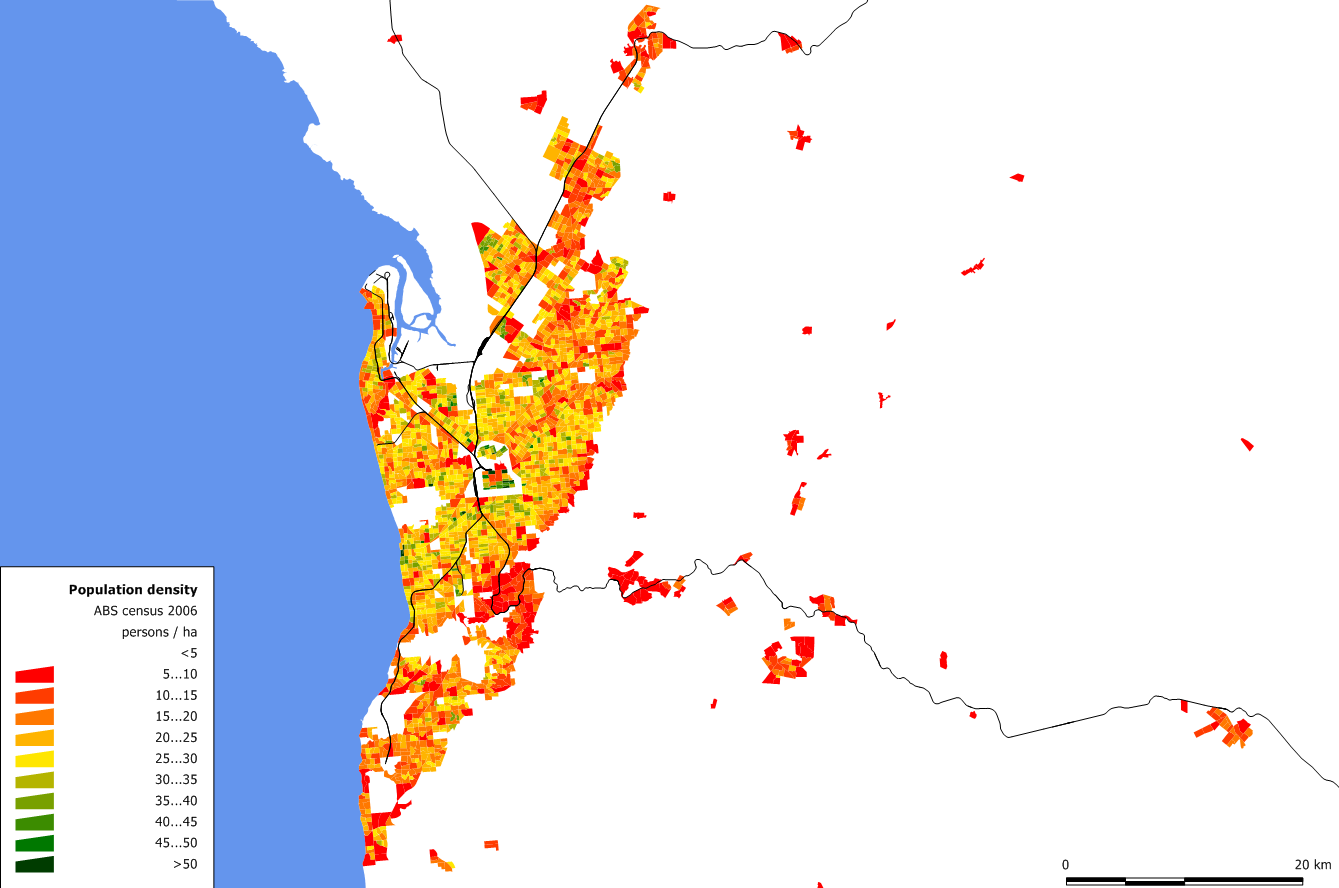
For the purest view of density you cannot get past a map. The following maps show a simple density calculation at the SA1 geography.

Update 22 Oct 2012: maps now include railway lines using OpenStreetMap data provided by Maps Without Borders. The data is licensed under Creative Commons Attribution-ShareAlike 2.0, copyright OpenStreetMap and contributors.

Sydney
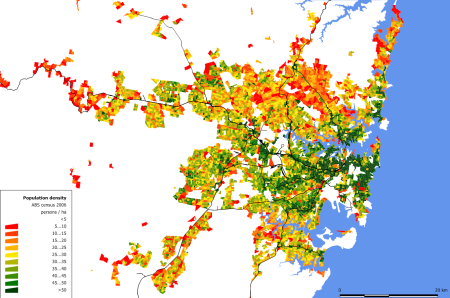
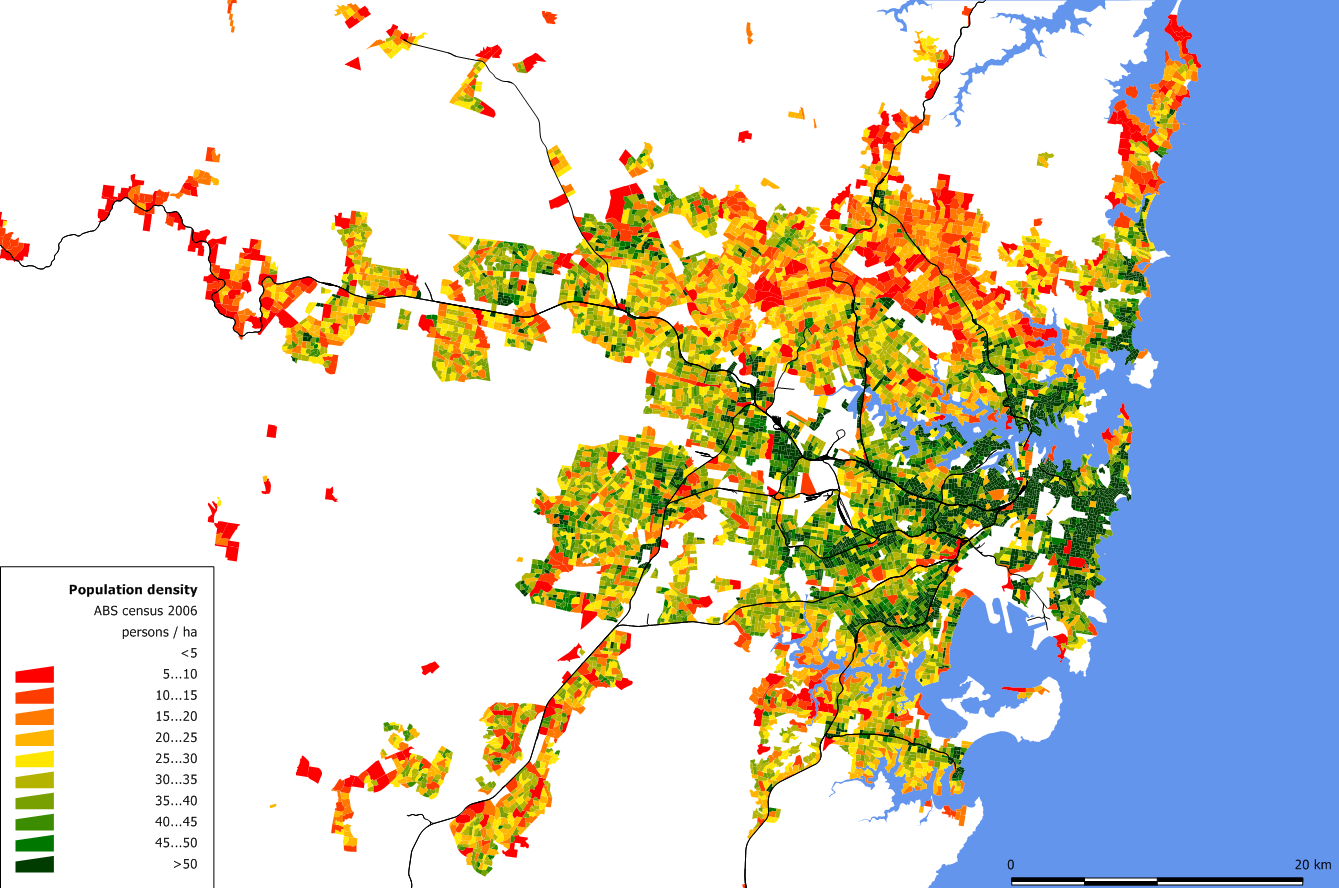
You can see vast areas of darker green (40+/ha), particularly between Sydney Harbour and Botany Bay. There are also quite a few green areas in the western suburbs, while the northern north shore has the lowest density. There are many concentrations of density around the passenger rail lines.

Melbourne (and Geelong)
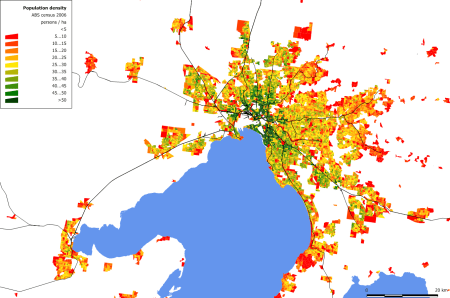
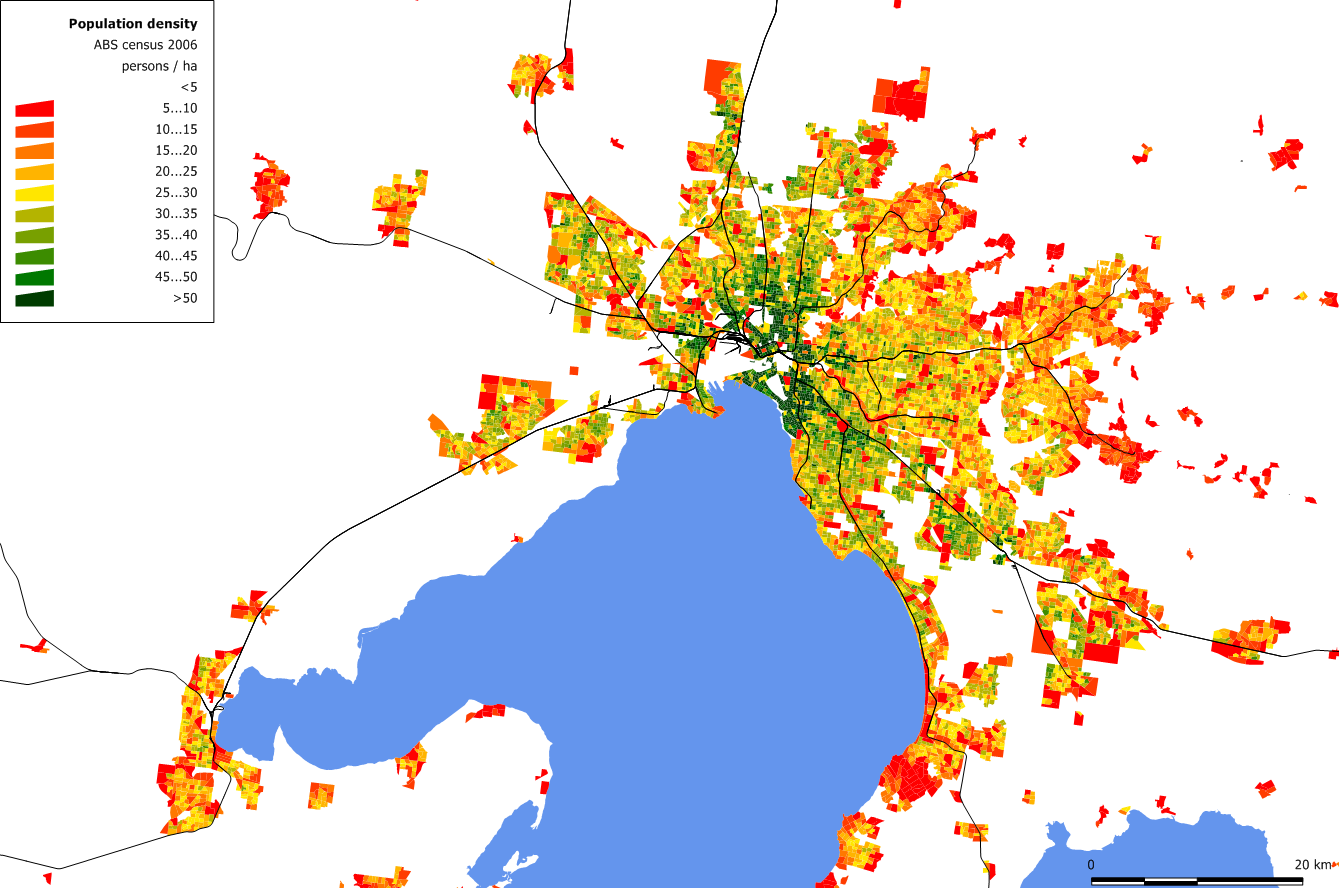
You can see areas of dark green around the inner city, with large tracts of yellow and green in the suburbs (25-35 persons/ha). There are however areas of moderate green (30-40) in some of the newer outer growth areas to the west and north, reflecting recent planning. There’s a not a strong relationship to train lines, but this might reflect higher densities equally attracted to tram lines (not shown on the map).

Note this map is slightly different to that in a recent post where I masked out non-residential mesh blocks.

Brisbane
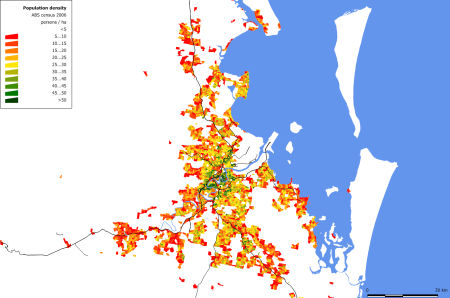
You can see dark green patches around the river/CBD, but then mostly medium to low densities in the suburbs. There’s very little evidence of higher densities in fringe growth areas. There are some denser areas around railway lines (note the map does not show Brisbane’s busway network).

Perth
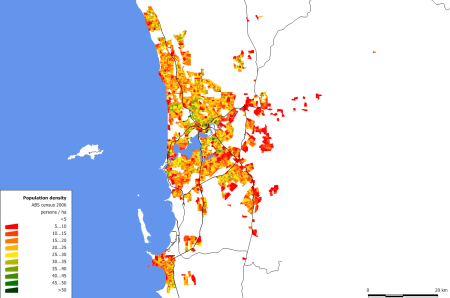
You can see green patches around the city, but also in some fringe growth areas where new planning controls are presumably forcing up densities. There are however vast tracts of orange (15-25 persons/ha), and little evidence of higher density around the rail lines (note: a lot of the lines are freight only and the north-south passenger line has very broad station spacing and limited walking catchment as most of it is within a freeway median).

Adelaide
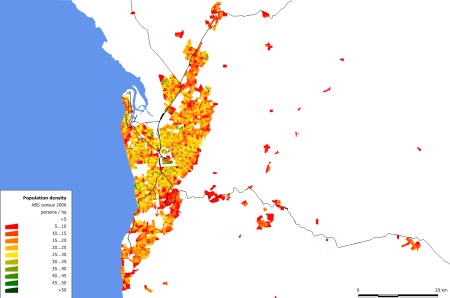
Adelaide some inner city blocks of high density, but once you get outside the green belt surrounding the city blocks, you fairly quickly head into suburban densities. There are only a few pockets of high density in the middle and outer suburbs, and very little relationship evident between density and the rail lines.

Canberra (and Queanbeyan)
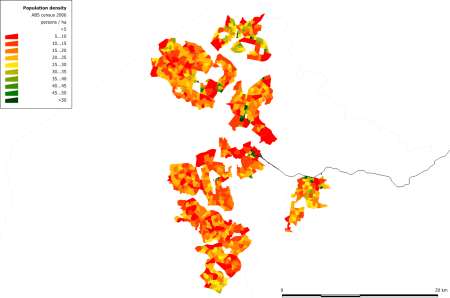
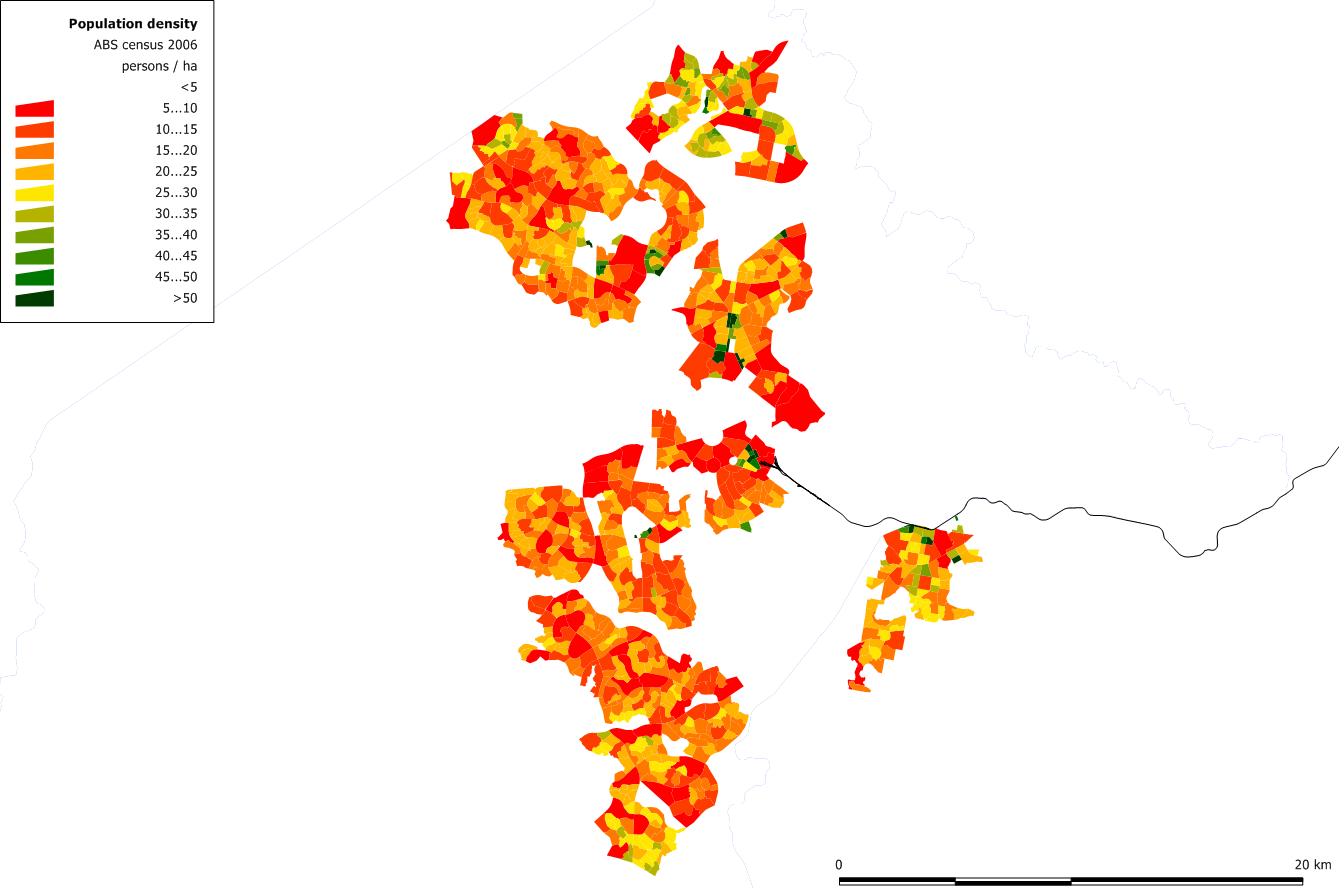
Canberra has vast areas at low density, and only a few pockets with dark green. There are however green patches on the fringes (particularly in the far north and far south), perhaps again reflecting planning policies forcing up densities.

Sydney is really quite a different city compared to the rest of Australia, with a much larger share of the population living in high density residential areas (more than I had expected). Melbourne has a much lower population weighted density (still quite a few people living in high density areas, but much less so than Sydney), followed by four cities that aren’t that different when it comes to density: Brisbane, Perth, Adelaide and Canberra.

What about density and public transport use?

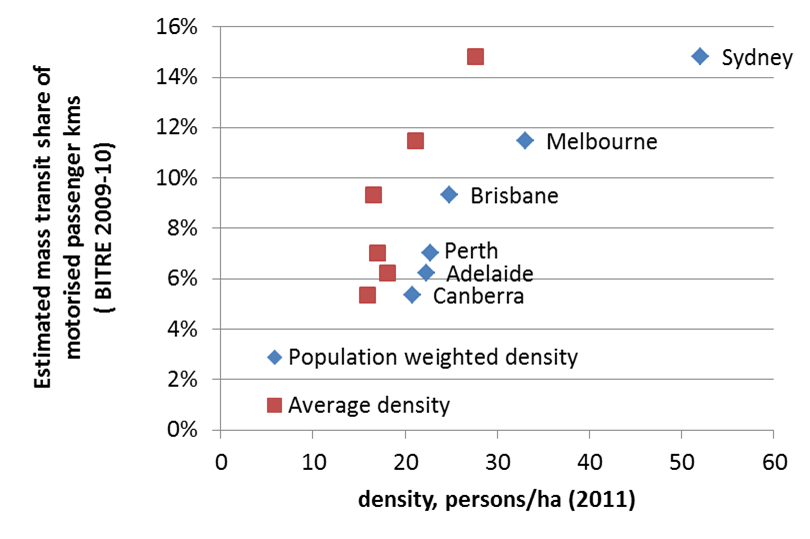
Here’s a comparison of density (measured as both average and population weighted) and the most recent estimate of public transport mode share of motorised passenger kms for Australian cities:
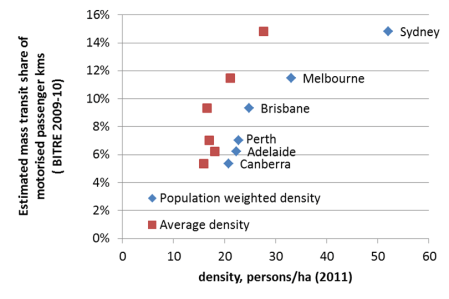
Population weighted density certainly shows a stronger relationship with public transport use than average density (r-squared of 0.89 versus 0.82 on a linear regression).

If you believe that higher population density will lead to higher public transport use (for a given level of public transport service), then you would expect Sydney to be well placed to have a higher public transport mode share. Which indeed it does, but does it have the same level of public transport supply as other cities, and are all other factors equal? That’s a very difficult question to answer.

You could measure public transport service kilometres per capita, but different modes have different speeds, stopping frequencies and capacities, public transport supply will vary greatly across the city, and some cities might have more effective service network designs that others.

If all cities had the same levels of public transport supply and all other things were equal, you might expect a straight line relationship (or perhaps an exponential relationship). But Brisbane and Melbourne (and to a small extent Perth) seem to be bucking what otherwise might be a linear pattern. Are these cities doing much better with quality and quantity of public transport supply? Or is it something else about those cities?

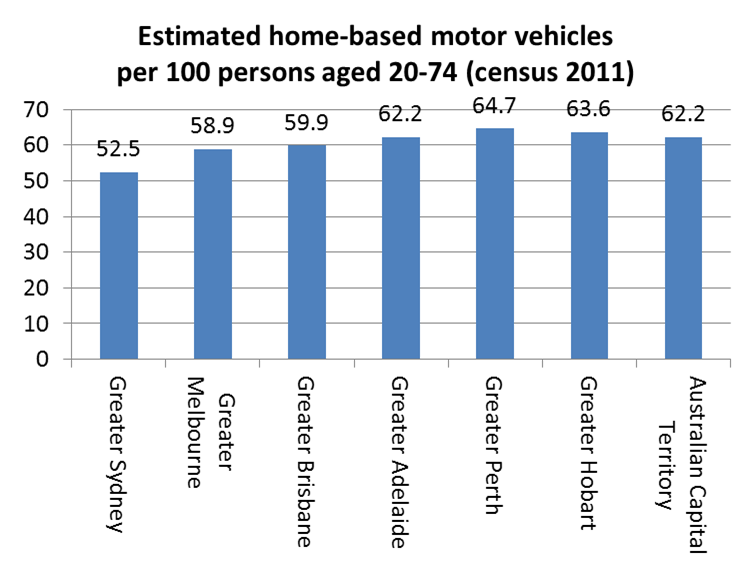
Car ownership rates do vary between Australian cities, but this might be more a product of public transport viability for particular residents:
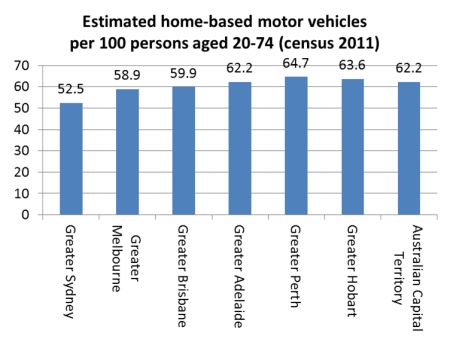
Also, we know that car ownership doesn’t have a strong relationship with car use.

When working population census data comes out I would like to look at the distribution of employment within cities. We know that public transport use is highest for journeys to work in the CBD (as it usually competes strongly against the car), so the proportion of a city’s jobs that are in the CBD is likely to impact the public transport mode share (at least for journeys to work). Moreover, a higher average employment density in general might be easier to serve with competitive public transport, and thus lead to a higher public transport mode share. It will hopefully also be possible to calculate weighted density of employment (at least at the SA2 level).
Finally, I’d like thank Alan Davies (The Urbanist) for inspiring this post.

Other posts about density: