Where do CBD private transport commuters live, and why do they choose private transport?

Sun 15 June, 2025

In my last post on this topic, I asked the question: who drives to work in major Australian city CBDs? This post will now look at where these drivers came from, and more specifically which parts of each city produced disproportionately large volumes of CBD drivers at high mode shares. I’ll also explore why some rapid transit lines are less successful at winning CBD commuter mode share.

In this post I’m using 2016 census data at SA2 geography (as the 2021 census was significantly impacted by COVID19). I’m focussed on “private transport” trips, that included car, truck, motorbike/scooter, and/or taxi but no modes of public transport. Over 80% of these journeys involved a car as driver, truck, or motorcycle/scooter, so it is likely the commuter was a driver.

I’m showing “rapid transit” lines and stations that were in operation in 2016 on these maps. My main criteria for a line being classed as rapid transit is that vehicles operate in an exclusive right of way completely separated from road traffic. So this includes regular train services, the Adelaide O-Bahn (guided busway), and the Brisbane busways. I’ve not included Sydney’s T-ways (busways and bus lanes) or any light rail lines because most have at-grade intersections with the road network that can cause delays. While these lines will perform better than buses and trams in mixed-traffic, they will generally be slower than other “rapid” trains.

If you are short on time, there’s a summary of themes at the end of this post.

Sydney

Here’s the private transport mode share of journeys to the Sydney CBD by home SA2 for 2016:
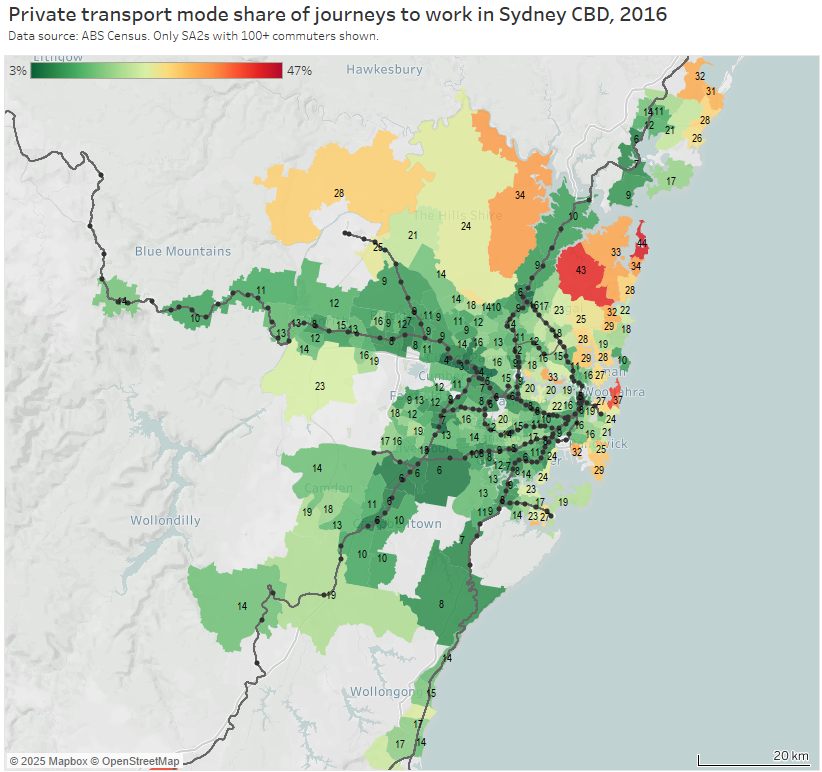
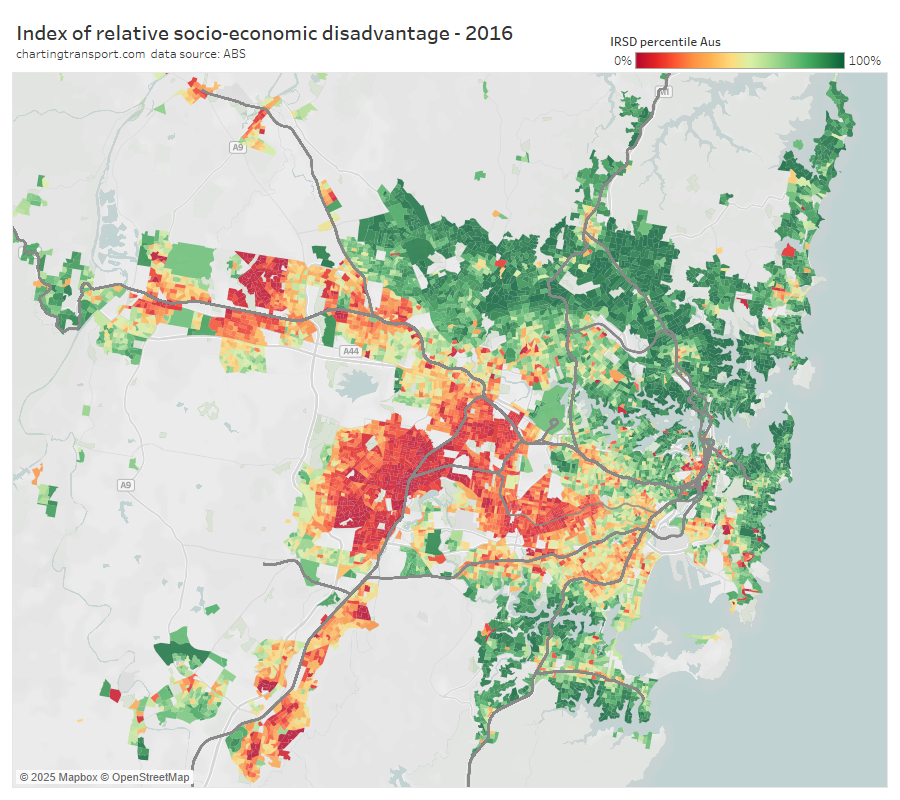
The highest private transport mode shares were on the north shore (except Manly which has a fast ferry), parts of The Hills Shire, and some eastern beachside suburbs. Many of these areas lack rapid transit access to the Sydney CBD. They are also quite socio-economically advantaged areas, as the following chart shows:
As a planner, I’m interested in home locations that are both generating particularly large volumes of private transport trips – and have high private transport mode shares. Public transport is generally highly competitive for CBD commuters (due to traffic congestion and parking costs) so these areas might be opportunities for mode shift if public transport can be made more rapid.

The next chart shows both the CBD private transport volumes and mode share at home SA2 geography. Areas with large circles that are orange to red are generating large volumes of private transport trips at a relatively high private transport mode share.
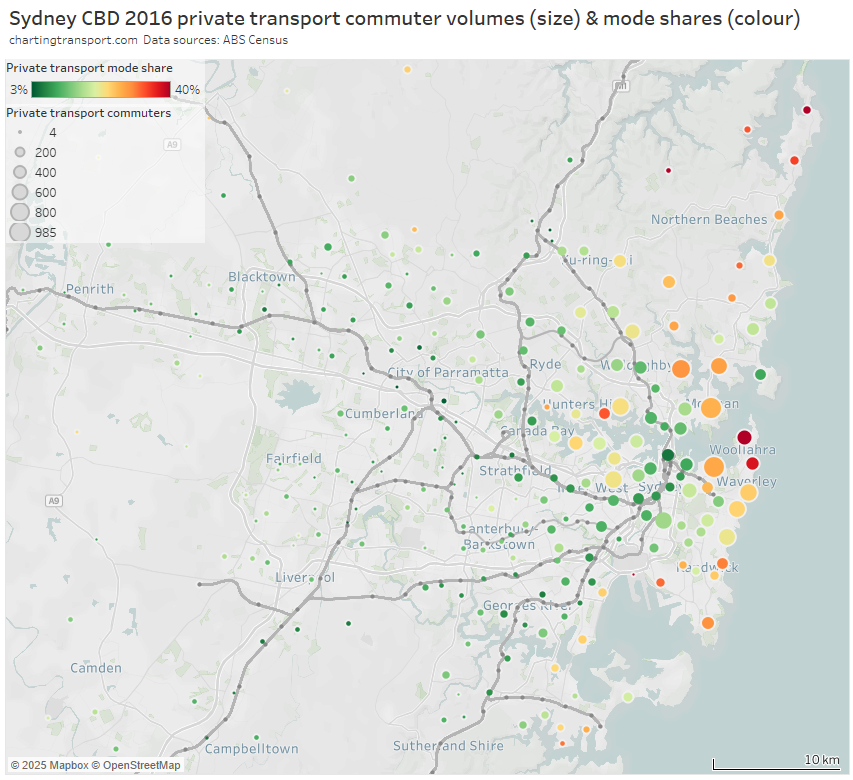
The areas of Sydney generating large volumes of private transport trips at a high mode share were mostly remote from rapid transit, including:

  • harbourside areas to the west, some of which will be served by the Sydney Metro West project
  • much of the north-eastern suburbs, some parts now served by the B-Line (an on-road bus rapid transit service that commenced in 2017)
  • some southern suburbs around Botany Bay such as Sans Souci, Ramsgate, and Sylvania that are remote from rail, and some suburbs south of the Cronulla train line (where on-road travel to the Sydney CBD via the Captain Cook Bridge is much more direct)
  • the eastern beachside suburbs, some of which are now served by the new L2 and L3 light rail lines, and also Woollahra which has an unbuilt train station

Melbourne

Firstly, private transport mode shares (note the colour scale for this map varies for each city):
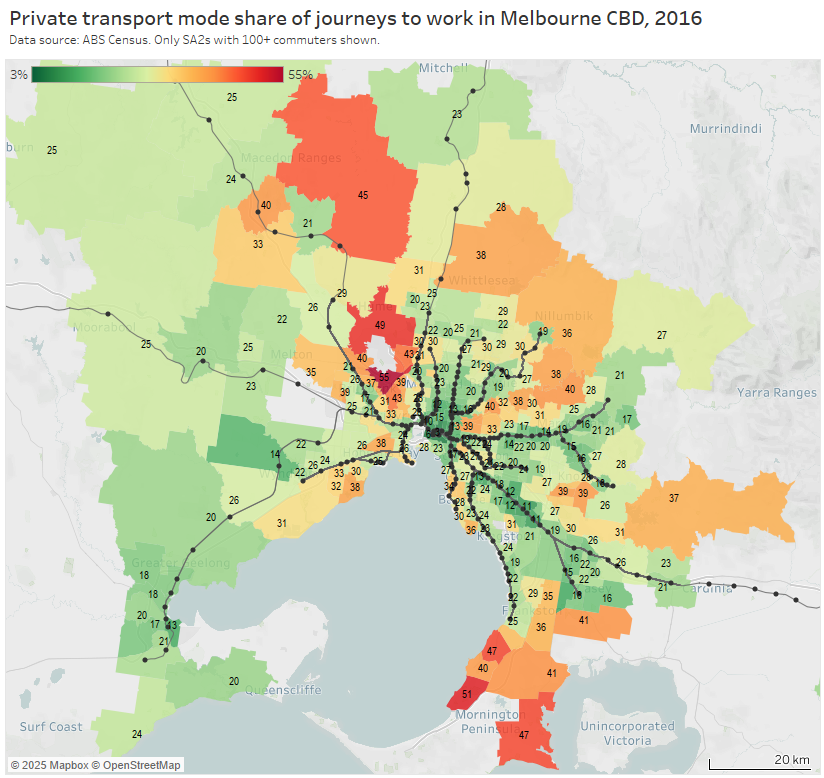
Secondly, private transport volumes and mode shares:
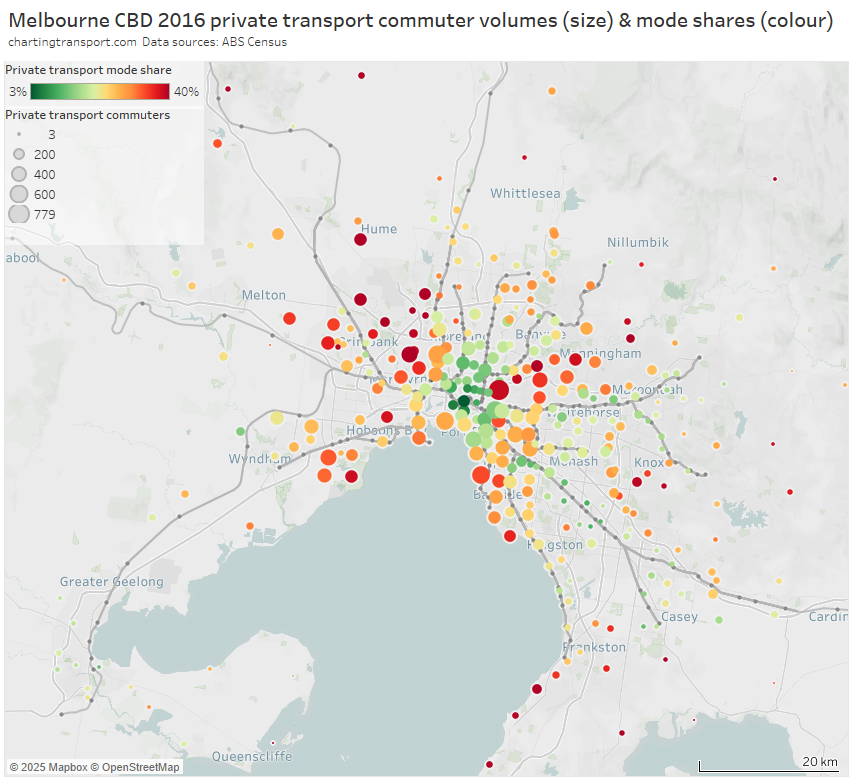
And the same again but with the inner and middle suburbs enlarged:
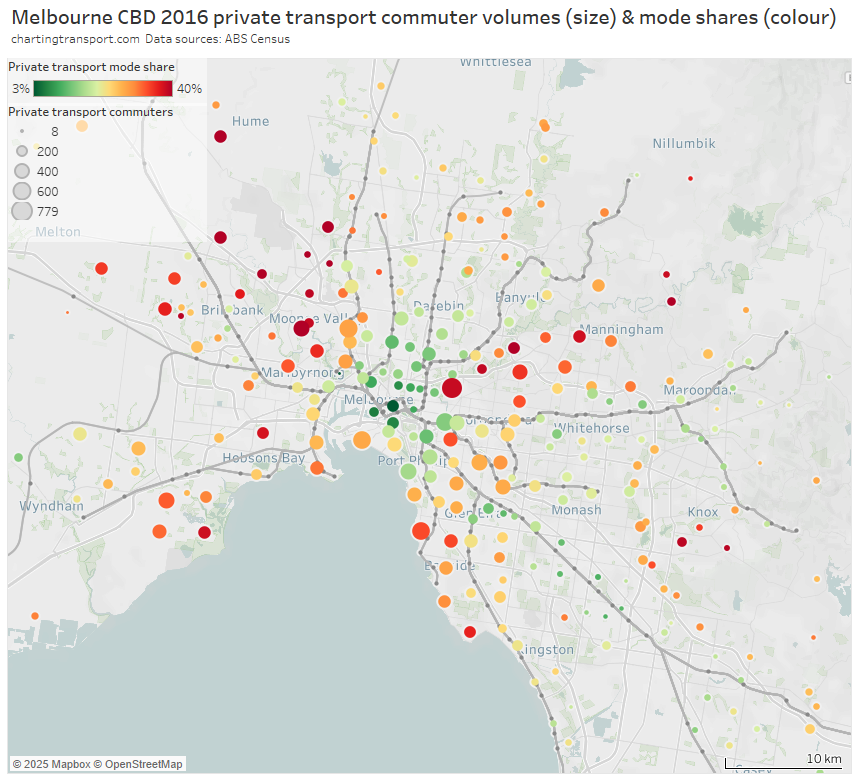
Areas with high private transport volumes and mode shares include:

  • Kew (779 trips and 39% private mode share) – which is connected to the CBD by two tram routes and two bus corridors, all involving mixed-traffic operations so not very “rapid”
  • the Balwyn North / Templestowe / Doncaster corridor – which is remote from the train network – although does have some high-frequency Eastern Freeway bus routes that operate with many bus priority lanes but certainly not full separation from traffic and intersection delays (a busway is under construction for the Eastern Freeway section of these routes)
  • Point Cook and Altona Meadows in the south-west – these areas are connected to the train network by some well-patronised feeder bus services
  • Brighton in the southern bayside suburbs – directly linked to the CBD by the Sandringham train line, but also some of the most socio-economically advantaged areas in Melbourne
  • several inner south-eastern suburbs including Toorak, Malvern, and Glen Iris, that are also relatively socio-economically advantaged and served by trams and trains
  • areas between the Sunbury and Craigieburn train lines in the north-west, including Maribyrnong, Keilor East, Niddrie, and Airport West (a planned new train station at Keilor East promises to reduce public transport journey times to the city by 20 minutes, so may trigger significant mode shift in this corridor)
  • some transit-rich inner areas along the Craigieburn line (including Essendon, Moonee Ponds, Ascot Vale) which might reflect train crowding issues experienced in 2016 (when ten AM peak trains were above the crowding benchmark – see report)
  • Caroline Springs, Hillside, and Taylors Hill between the Sunbury and Melton lines (these areas have since benefitted from the opening of the Caroline Springs Train Station in 2017 and bus frequency upgrades)
  • Altona North which is relatively remote from train stations – it has a relatively frequent freeway express bus service to the CBD that operates in mixed traffic on the congested Westgate Bridge from a rarely used park-and-ride facility. There have also been calls to reopen Paisley station in North Altona (trains only currently pass there on weekdays until around 7:30pm).
  • Greenvale in the northern suburbs, a low-density socio-economically advantaged suburb that was served by one not-very-direct or frequent bus route in 2016 (a second bus route has been added since), and has reasonably good freeway access to the central city
  • bayside suburbs south of Frankston (including Mount Eliza) – the commuter car park at Frankston station has since been expanded by 500 spaces.
  • areas around Rowville – which have high private transport mode shares but relatively small and low-density CBD commuter volumes. Rowville has long been the subject of advocacy for a train or trackless tram line, and currently has a high frequency bus route connecting it to the Dandenong train line, plus express buses to Glen Waverley station in peak periods.

Brisbane
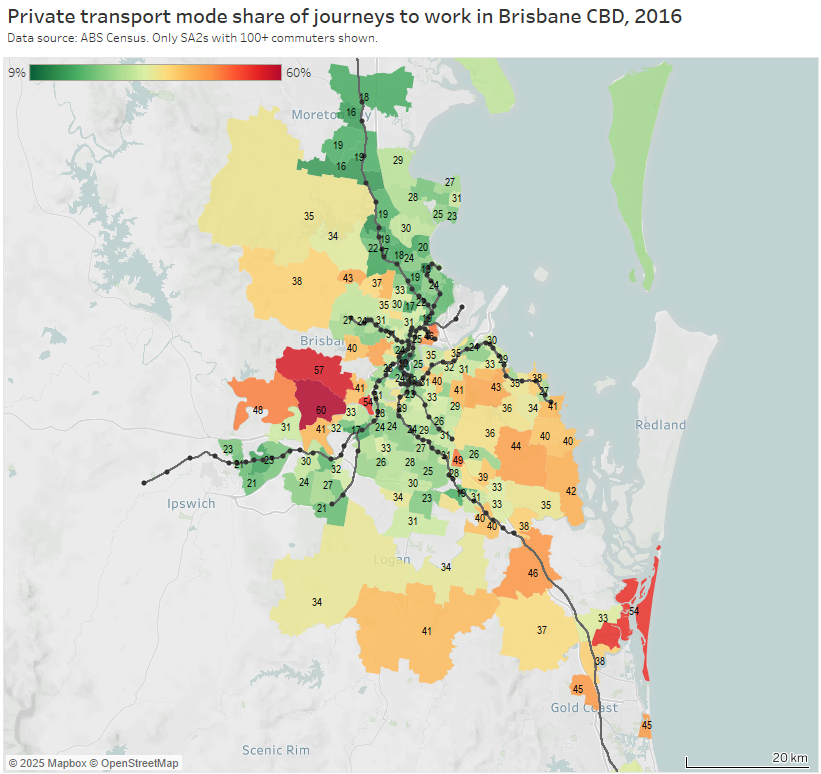
Note: the large green island to the north-east is Moreton Island, and it shares an SA2 with Scarborough and Newport on the mainland (very different areas!). I dare say there are unlikely to be many CBD commuters living on Moreton Island, and the 31% private mode share probably mostly reflects mainland commuters.
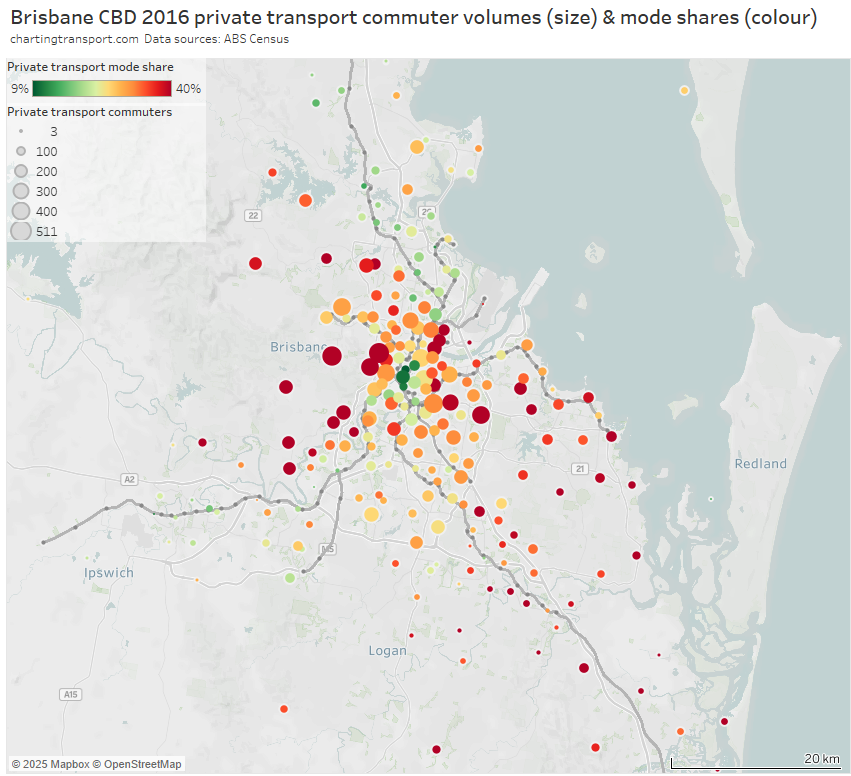
And an enlargement of the inner suburbs:
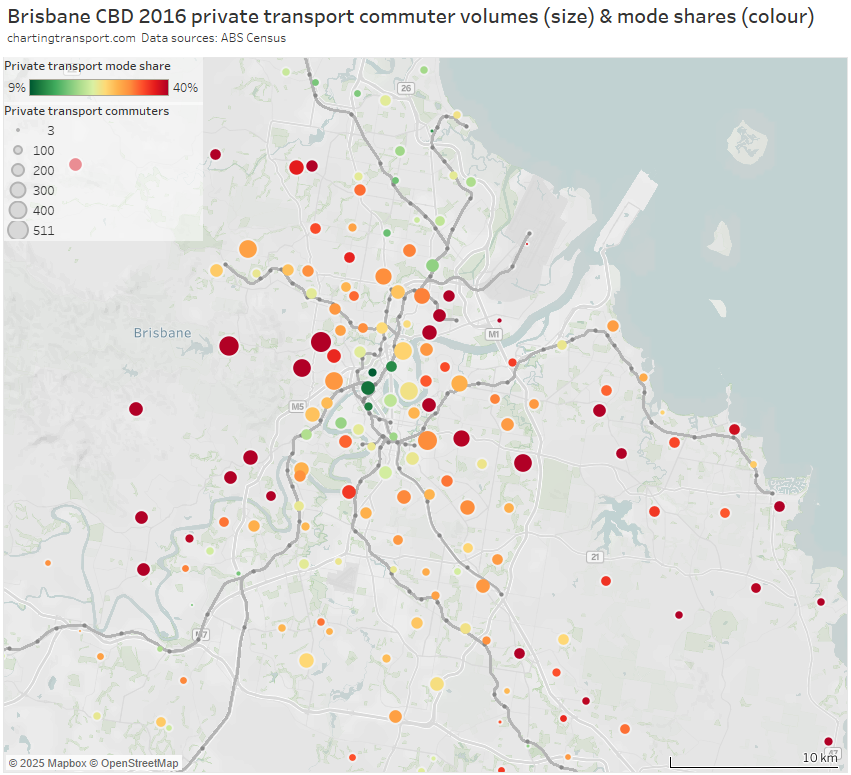
Areas with high private transport volumes and mode shares include:

  • the eastern corridor through Camp Hill and Carindale between the Cleveland line and the south-east busway – on-road bus upgrades have been recently implemented out towards Carindale
  • the outer ends of the Cleveland rail line in the eastern suburbs – perhaps related to the relative indirectness of the train line for travel to the CBD. Slightly more direct travel to the CBD will be possible with the Cross River Rail project providing an interchange opportunity at Boggo Road.
  • western suburbs that are remote from train lines and busways, including Ashgrove, Bardon, The Gap, Chapel Hill, and Brookfield – Kenmore Hills
  • some inner suburbs to the north-east of the CBD including Hamilton, Ascot, and Hendra – some of which are served by the indirect and half-hourly Doomben line
  • areas between the Ferny Grove and Nambour lines in the northern suburbs – although mode shift might occur in response to the recent northern transitway upgrades through to Chermside
  • Norman Park in the inner eastern suburbs served by the Cleveland line – perhaps because the train takes a very indirect route to the CBD from there, and the area is relatively socio-economically advantaged

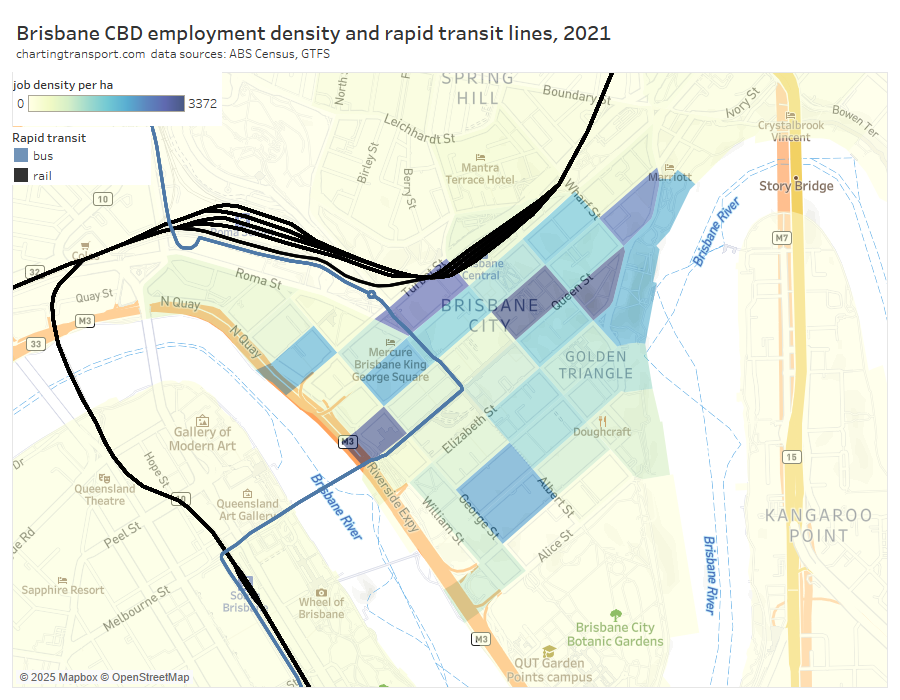
The following map shows Brisbane’s Central Station is not actually very central to the core of the CBD. You can also see the very indirect path of train lines approaching the city from the south (and east).
Perth
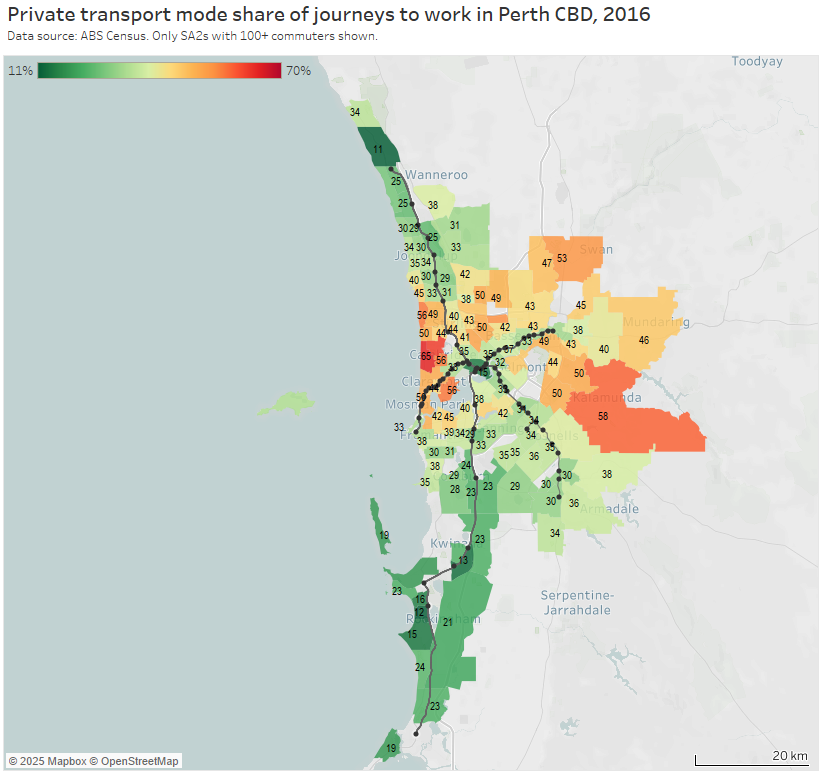
Note: Rottnest Island is included in the Fremantle SA2 but is unlikely to have had many Perth CBD commuters, so the colouring is probably misleading (same issue as Moreton Island).

For the private transport volume and mode share map I’ve had to stretch the colour scale to max out at 60% to better differentiate the SA2s:
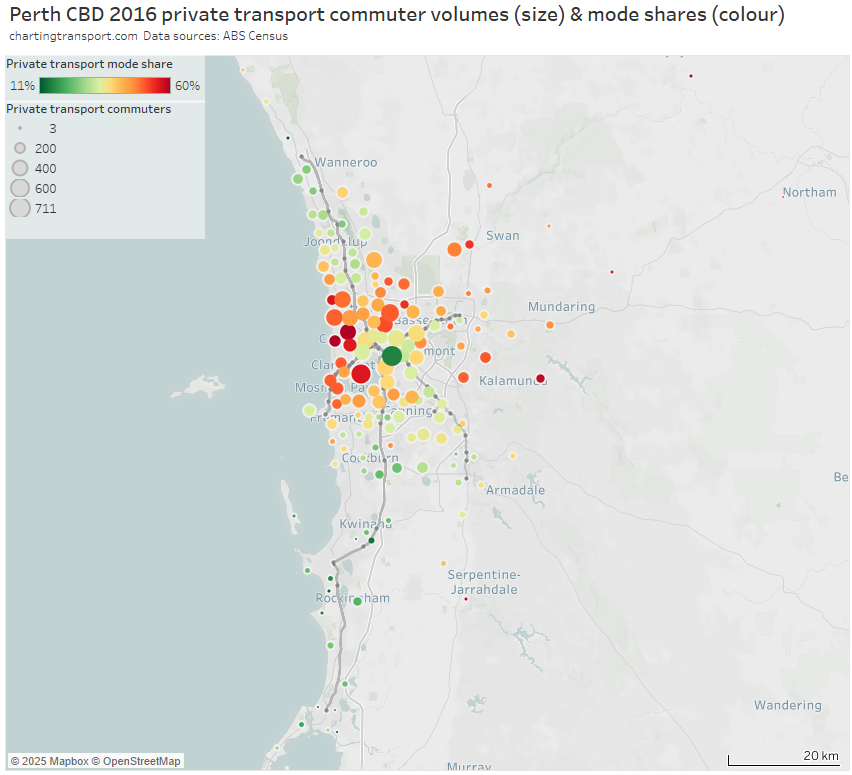
And an enlargement of the inner and middle suburbs:
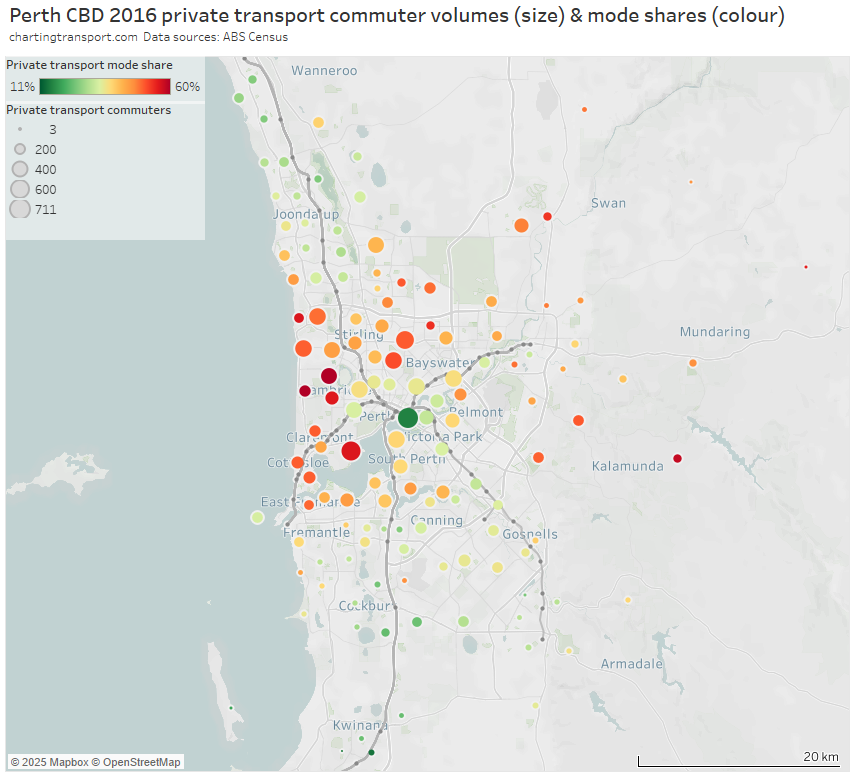
Areas with high private transport volumes and mode shares included:

  • western suburbs between the Joondalup and Fremantle rail lines, including 50% private mode share from Scarborough – where a trackless tram to the city has been proposed, and high frequency on-road bus route 990 operates to Glendalough Station and the Perth CBD.
  • Nedlands – Dalkeith – Crawley on the northern banks of the Swan River west of the city, which is a relatively advantaged area remote from the Fremantle train line – partially served by high frequency bus route 995.
  • northern suburbs between the Joondalup and Midland rail lines including Dianella, Yokine – Coolbinia – Menora, and Nollamara. There have been past plans for light rail and bus rapid transit along Alexander Drive in this corridor, and a high frequency bus route 960 was introduced in October 2016 (shortly after the census) now supported by about 2.6 km of peak period bus lanes closer to the city.
  • north-eastern suburbs including Morley, Ballajura, and Ellenbrook – which are now served by the recently opened Ellenbrook train line
  • suburbs between Fremantle and the Mandurah rail line including Melville, Applecross, Palmyra
  • Cottesloe / Claremont / Mosman Park areas on the Fremantle train line. These suburbs rank high on socio-economic advantage (but I do wonder if there might have been a disruption on the Fremantle line at the time of the census, as there was in 2021)
  • suburbs to the east out towards Kalamunda – although the private commuter volumes are small and sparse. The new Airport / High Wycombe train line has likely shifted some of these trips to public transport.
  • Stirling / Osborne Park / Balcatta / Hamersley / Karrinyup / Carine / Innaloo / Doubleview around the Joondalup (northern) line. Some but not all of these areas are at the higher end of socio-economic advantage. But also it’s important to note that the stations on these lines are much further apart and are located in a freeway median – so most commuters need to use a non-walking mode to get to them (or use an on-road bus route direct to the city where these exist). This probably makes public transport less attractive for these commuters
  • Manning – Waterford, Applecross, and Booragoon on the Mandurah (southern) line. Again these areas are relatively socio-economically advantaged and non-walk modes are required to get to widely-spaced stations in a freeway median

To further illustrate the station catchment issues, here’s a screengrab from Apple maps for Glendalough station on the Joondalup line, about 6 km from the Perth CBD:
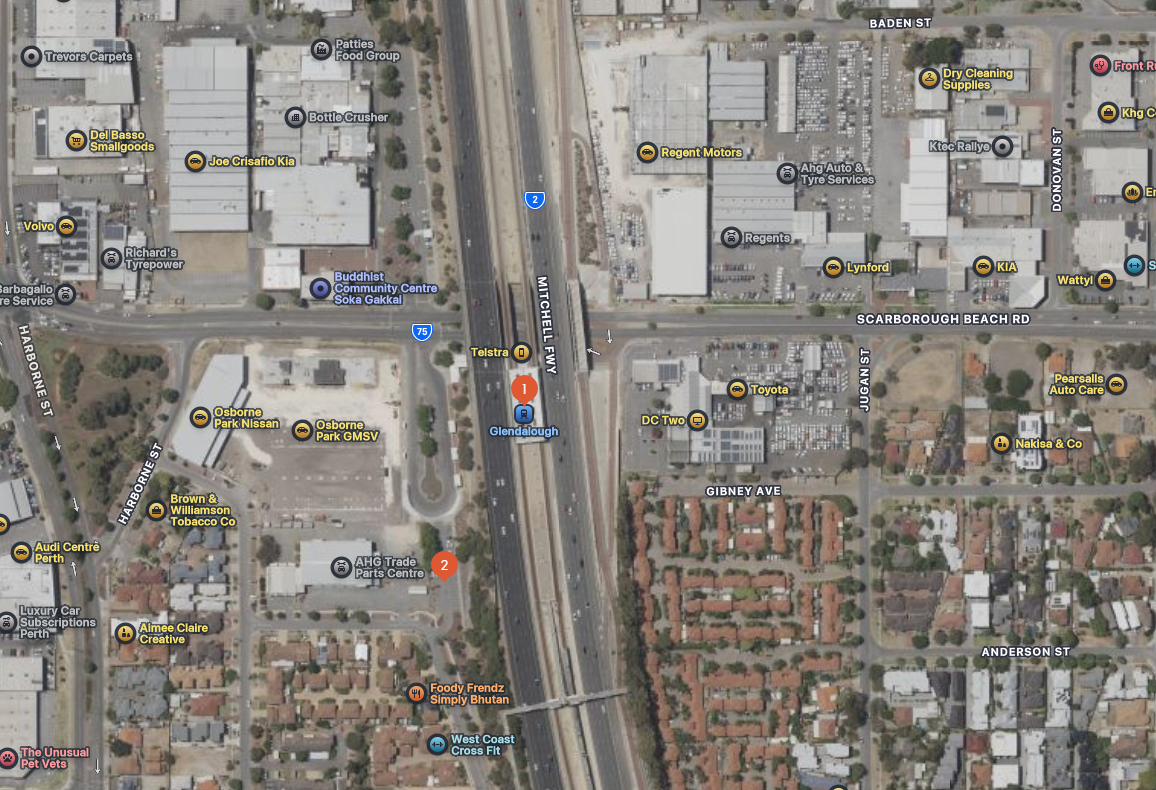
Land use around this station is predominantly car dealerships(!). The nearby residential areas are mostly 1-2 storeys, and there looks to be very poor pedestrian connectivity to the station from the residences to the south-east

I suspect adding more stations to the Joondalup and Mandurah lines in the inner suburbs probably wouldn’t have a huge impact on mode share because the lines are situated in freeway corridors with poor pedestrian walk up potential, and of course more stations would slow down trains and disadvantage commuters from further out (although some express running may be possible). It would probably also be hard to squeeze in more stations in the freeway corridors.

Perhaps a take-away here is that for the inner suburbs, rapid transit needs to be a walk-up proposition to compete with private transport.

Adelaide
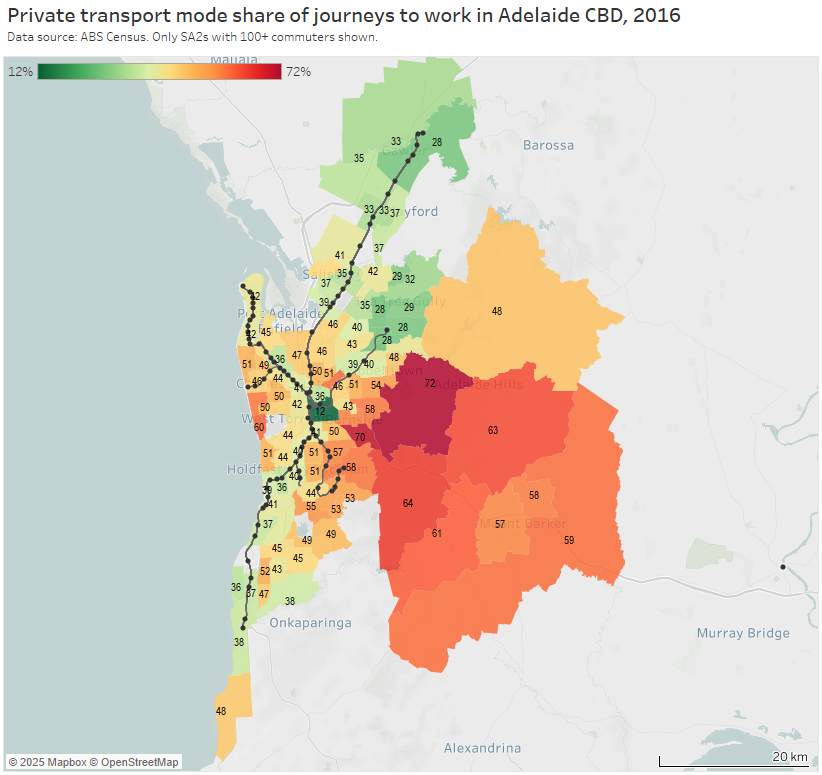
For the volume and mode share map I’ve again had to stretch the red colour scale to 60%:
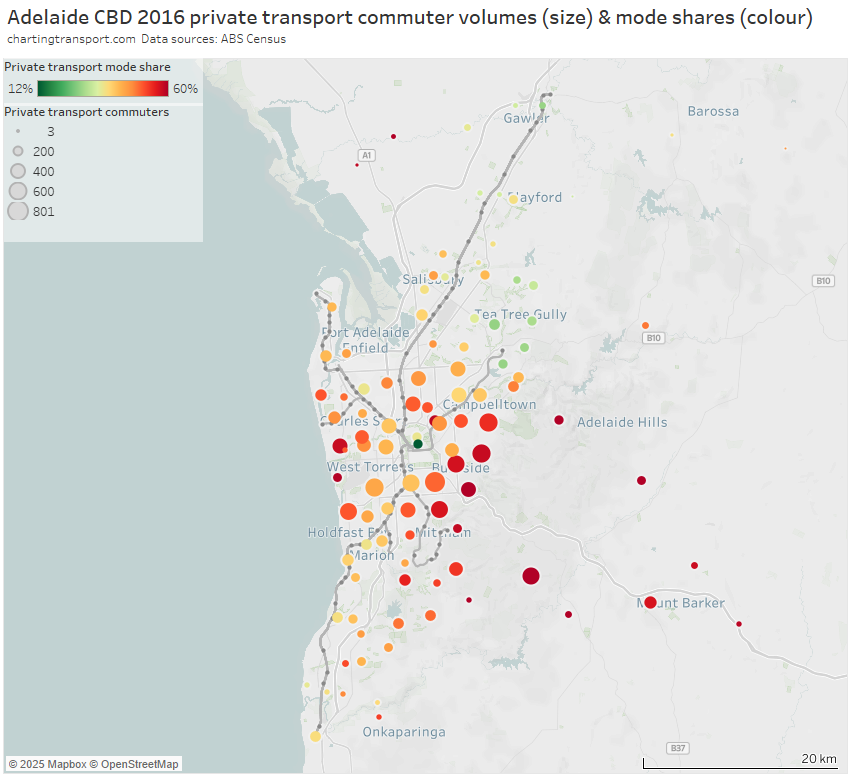
Areas of high private transport volumes and mode shares include:

  • the western suburbs in between the Grange and Seaford lines
  • areas around the Grange rail line in the western suburbs – possibly related to its half-hourly frequency and indirect path to the CBD
  • the eastern suburbs which lack rapid transit lines
  • some of the inner suburbs around the O-Bahn busway, which might be related to widely spaced stations in a river corridor (more on this below)
  • the Adelaide Hills, which includes many low density residential areas (such as Stirling / Aldgate)
  • the outer areas of the Belair rail line – which is highly indirect as it winds its way down the hills. Road connections from Belair to the CBD are much more direct and therefore time-competitive.
  • also the inner southern suburbs around the Belair rail line. To access the CBD the line snakes its way around the western and north-western edge of the city area and then terminates in the north-western edge of the core CBD area, making for an indirect journey from the southern suburbs to the core of the CBD. This probably explains why it struggles to compete with direct road links. (I’m also struck by the almost complete lack of transit-orientated development around most train stations in Adelaide!).

For those less familiar with the Adelaide CBD, here’s a map showing the train lines and O-Bahn bus corridor (the busway component actually ends at the eastern edge of the CBD), on top of employment density. Adelaide Train Station is unfortunately just outside the dense core of the CBD with many potential commuters having to walk several blocks.
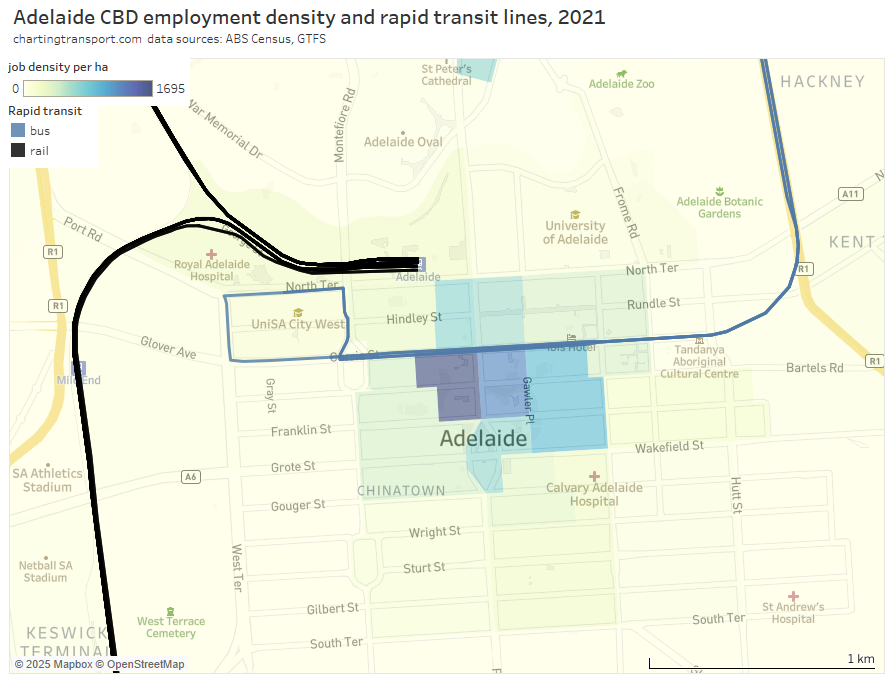
Of course realigning rail corridors is hardly easy or cheap. Infrastructure South Australia’s 20-year State Infrastructure Strategy includes a recommendation to investigate of the viability of an underground rail link (delivery in 5-10 years) – with the objective of overcoming a capacity-limited Adelaide Railway Station (refer recommendation 23). I think this recommendation justification overlooks the possibly much larger benefits it would deliver in terms of faster / more direct access to the core of the CBD which could enable significant mode shift to public transport across large parts of Adelaide.

Below is a Google maps screengrab of Adelaide’s Hawthorn station on the Belair line, about 5 km south of the CBD, where trains run about every 15 minutes in peak periods. The station is surrounded by low density residential areas, with many blocks big enough to accommodate private swimming pools. There’s not even a hint of transit orientated development here, which seems typical of most Adelaide train stations, even those in the inner suburbs with decent frequencies (as a Melbournian I find this scenario rather foreign!). Without a concentration of population around rapid transit stations, you are likely to see lower public transport mode shares at SA2 geography.
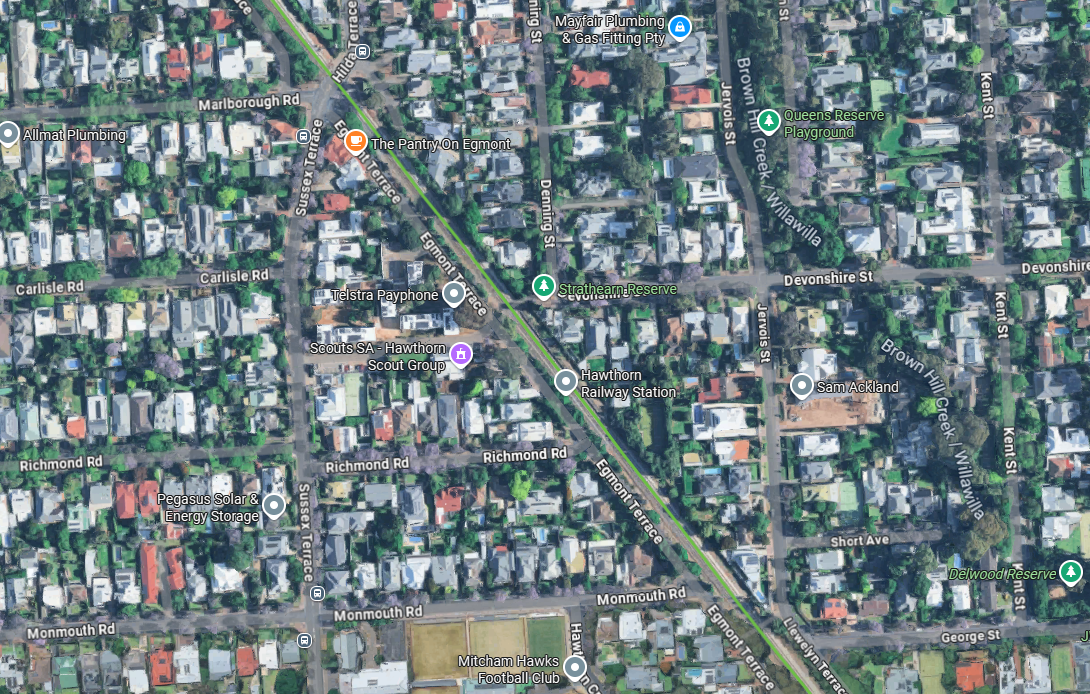
Whether developers would consider apartments around these stations as viable is another question.

Curiously, the lowest suburban private transport mode shares in Adelaide were mostly around the northern end of the Adelaide O-Bahn (Tea Tree Gully area). This confirms that a fast and frequent service to the core of the Adelaide CBD can be a competitive public transport offer. The O-Bahn’s strengths probably lie in its speed (a product of very wide station spacing), most commuters not needing to change buses to get onto the rapid section (although this can impact legibility and frequency), and providing direct access to the central core of the CBD. These attributes are not shared by much of Adelaide’s train network which probably explains it’s relatively poor mode share performance.

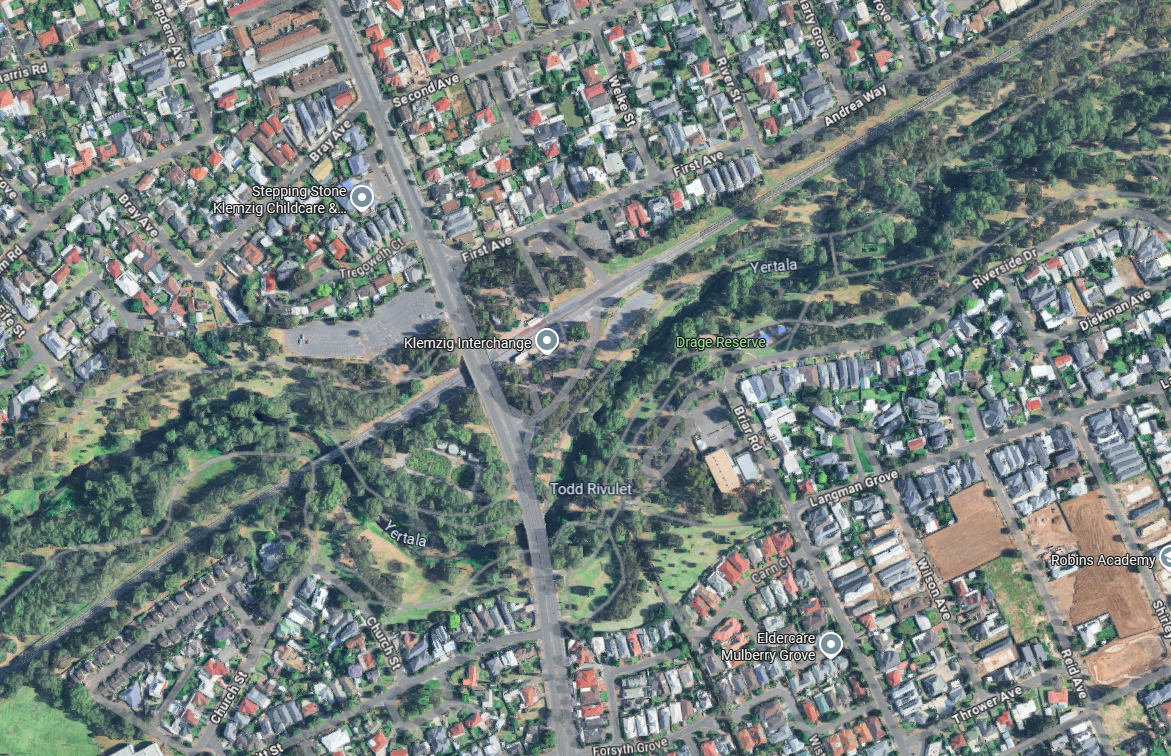
However the O-Bahn’s speed and alignment provides much less utility to the inner suburbs, in a very similar way to Perth’s Joondalup and Mandurah railway lines. Below is a Google Maps screengrab of Klemzig interchange O-Bahn station, about 6km from the Adelaide CBD. The station is immediately surrounded by car parks and beautiful parklands, and then relatively low density residential (peppered with a few terrace/townhouses). This makes for a rather limited walking catchment population.
How do mode shares vary by distance from CBDs and distance from stations?

The heatmap table below shows private transport mode shares by distance from CBDs and distance from rapid transit stations. Note the number of commuters in each grid cell varies considerably.
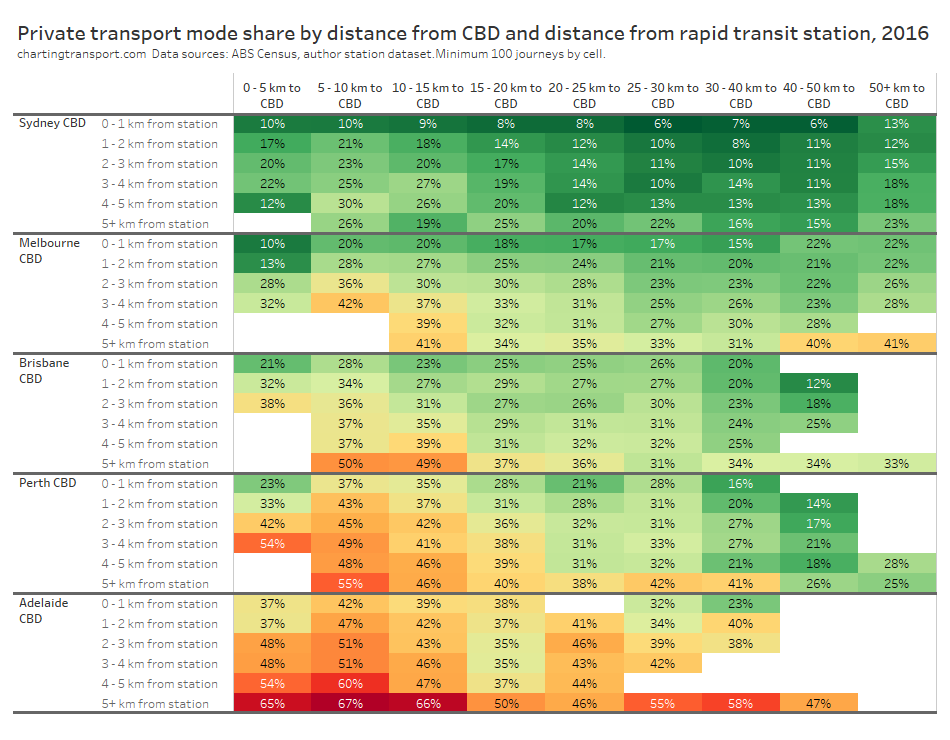
Within each city, some of the the highest private transport mode shares were seen for commuters living 5-10 km from their CBD and being distant from a rapid transit station. For these commuters private transport is likely often more cost- and time- competitive than on-road public transport. These areas are often highly advantaged suburbs, where CBD parking costs might be less of a concern for commuters.

Private transport mode shares were often lower for suburbs further from CBDs, even those not adjacent to rapid transit stations. For these commuters park-and-ride or bus feeder travel to train lines is likely more competitive with driving. These commuters can often be less socio-economically advantaged – and so a long drive to expensive CBD parking each day would be a significant barrier. For many parts of Sydney and Melbourne, such longer distance car commutes might also pass through several motorway toll gates.

Could public transport fare policies explain differences between cities? In Adelaide and Melbourne it is no more expensive to travel to the CBD from the outer suburbs than the inner suburbs, making public transport travel from the outer suburbs more cost-competitive. Sydney, Perth, and Brisbane had fares roughly proportional to travel distance in 2016, yet private transport mode shares were still relatively low in the outer suburbs. This suggests outer suburban commuters might not be highly sensitive to public transport fares, as other factors likely drive mode choice.

What are some common themes across cities?

Here are some take-aways that resonate for me:

  • Indirect train lines are less competitive: Brisbane, Adelaide, and Sydney have some rail routes that follow rather indirect paths to their CBDs, which reduce the travel time competitiveness of rail over private transport and thus impact mode shares.
  • CBD train stations probably need to be central to dense employment zones to win mode share: Adelaide and Brisbane currently lack train stations in the centre of their CBDs which makes public transport less competitive for CBD destinations more remote from stations. Brisbane will address this problem with Cross River Rail and Adelaide wants to plan for new underground rail.
  • There’s only so much you can do in the most socio-economically advantaged suburbs: Many cities have areas that are well served by rapid transit but still have high private transport mode shares. These tend to be some of the most advantaged suburbs, where many CBD workers are likely to be on high incomes and don’t wear the costs of private commuting. Shifting these commuters to public transport would probably require significant private transport disincentives.
  • Cities are filling many of the rapid transit gaps already: Many cities have projects (some completed since 2016) to improve public transport access to areas of high private transport volumes and mode share. I’m less familiar with Brisbane but was pleasantly surprised to discover projects to improve public transport in many of the corridors that were generating significant private transport trips in 2016 (although many were only semi-rapid on-road routes). This post might help planners and advocates identify projects and/or service uplifts that could tap into strong areas of latent demand. Of course introducing rapid transit will be more challenging / expensive in some corridors than others.
  • Inner suburban stations are probably mostly useful for commuters within walking distance. Some inner suburbs of Perth with nearby stations on the northern and southern rail lines, and some suburbs around the Adelaide O-Bahn stations have relatively high private transport mode share, probably because relatively few people live within walking distance of these stations. While many of these commuters could probably use a feeder bus to reach these stations, this adds journey time and connection risk making it less competitive with private transport (although higher bus frequencies can certainly help).
  • CBD commuters from the outer suburbs are quite willing to travel to rapid transit stations. We have seen relatively low private transport mode shares in many outer suburban areas – even when the nearest rapid transit station is a few kilometres away. The time and risk involved in using a feeder bus or commuter car park does not seem to harm public transport’s relative competitiveness for CBD commuters from the outer suburbs. Public transport fares don’t seem to be a major issue either.

I hope you’ve found this post interesting. I feel like I’ve learnt quite a bit from this analysis.

It’s certainly hard to capture all the nuance that might be applicable across all five cities, but let me know in the comments if you see more themes in the data.


Updated charts on Australian transport trends – May 2025

Wed 7 May, 2025

In the last few months I’ve been updating the Trends pages on Charting Transport with new data from BITRE, ABS, and other sources. This post provides summary charts across numerous aspects of transport with links for further detail.

The charts below are current at the time of this post, but I will be updating the charts on the Trends pages periodically (mostly 2-4 times per year), so go to those pages if you want to be sure you have the latest charts.

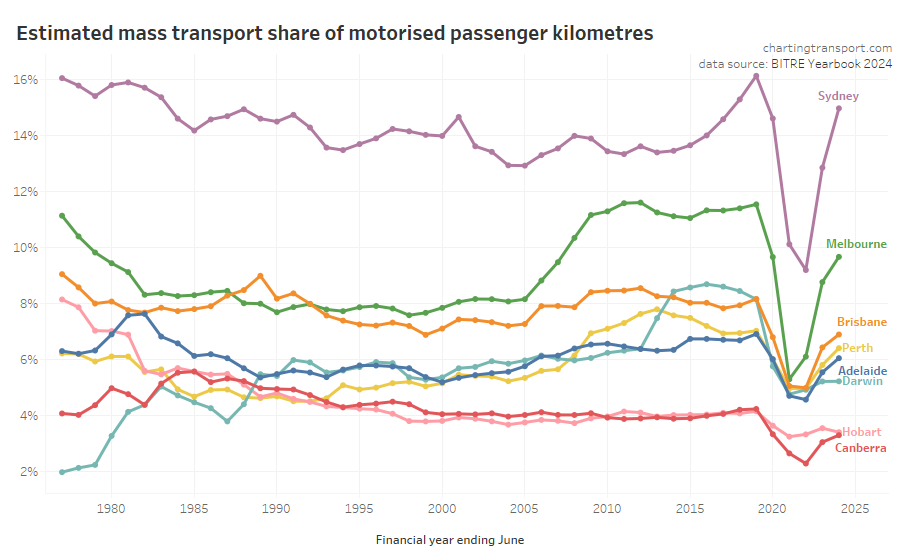
Mass transit mode shares bounced back a fair bit in 2023-24, although only Sydney appears to be close to pre-pandemic levels. Mass transit mode shares are below pre-pandemic levels presumably at least partly because of working from home.

More on trends in passenger travel mode split.

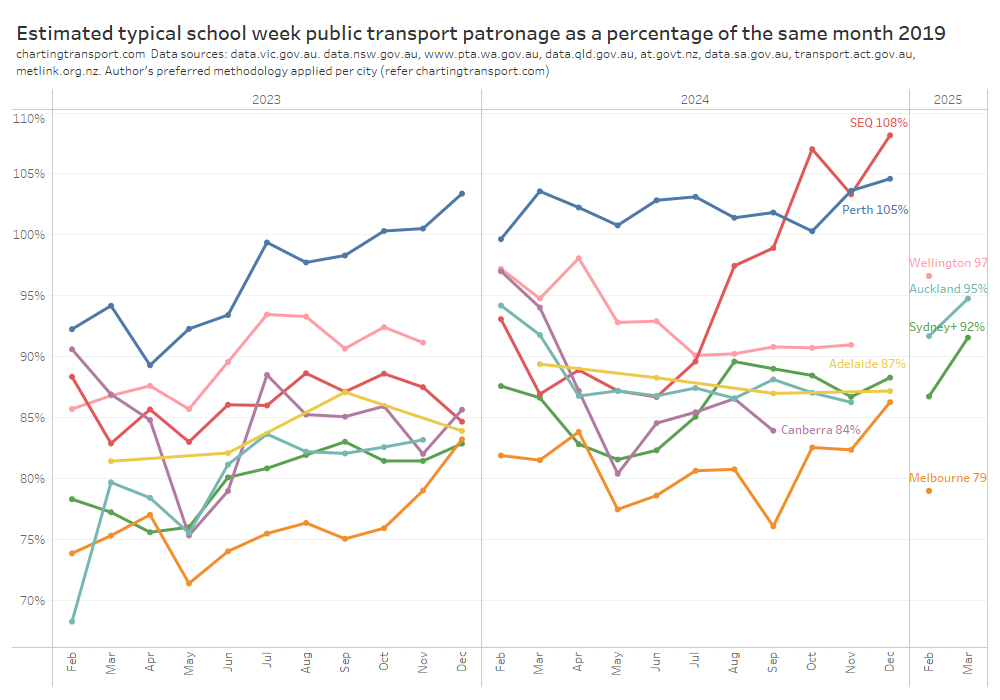
Public transport patronage has risen significantly in South East Queensland (followed a massive fare reduction). Perth is the only other city to have exceeded 2019 patronage levels so far.

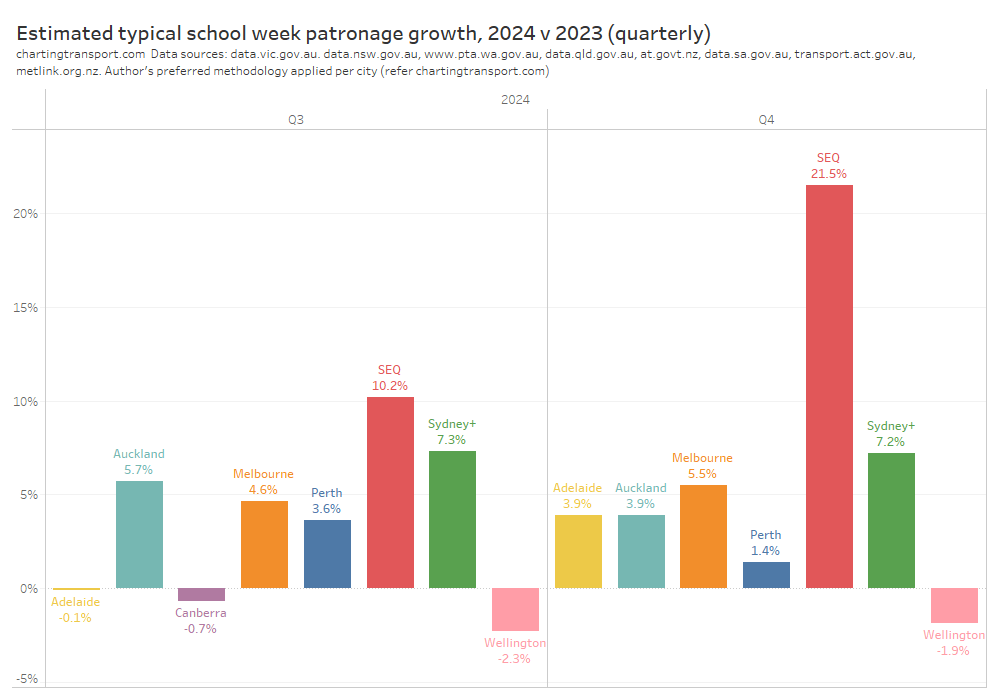
Patronage growth has slowed in most cities, but as of 2024 Q4 was still tracking above population growth in most cities (except Perth and Wellington).

More detailed trends in public transport patronage.

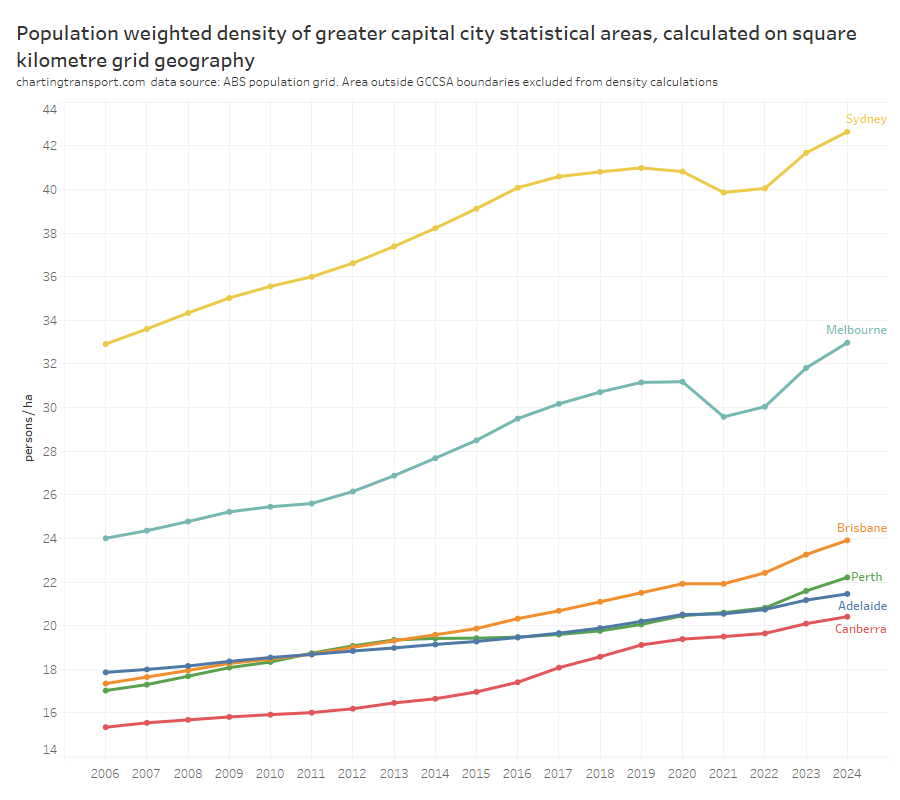
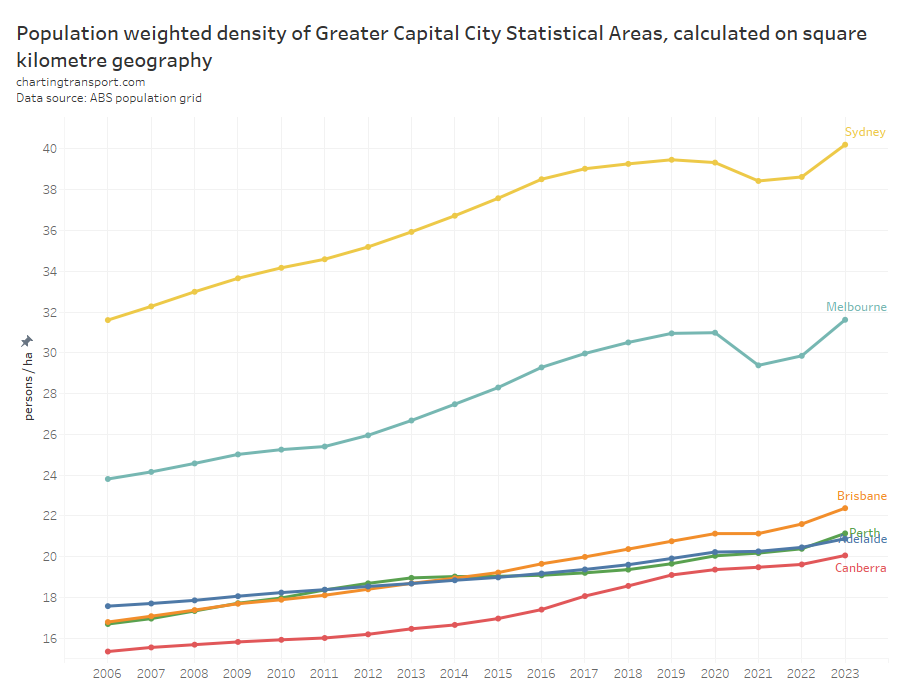
Population density is now rising rapidly in Australia’s largest cities, with Perth pulling ahead of Adelaide.

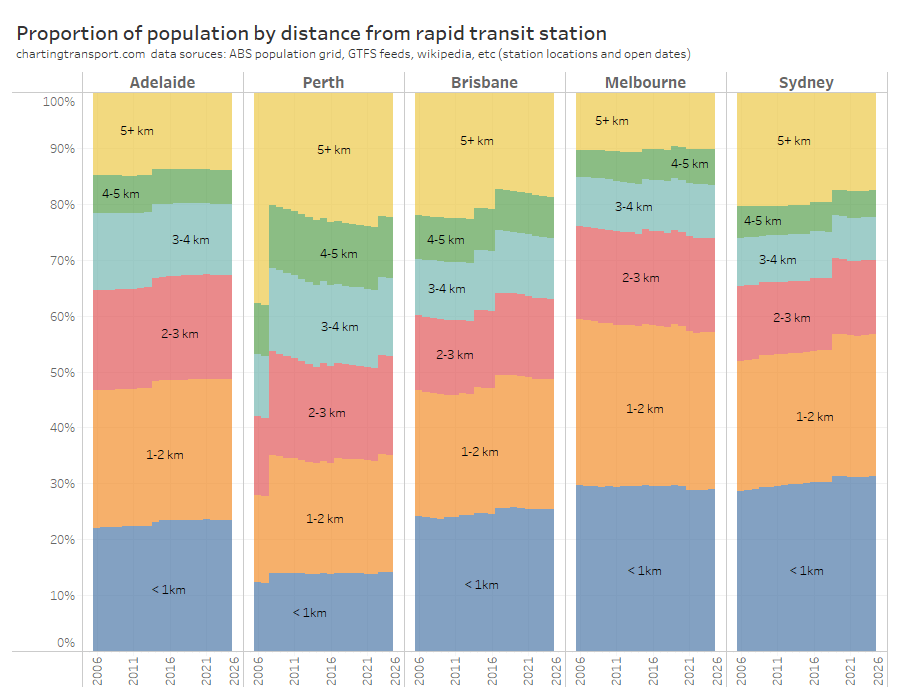
Most cities are improving the share of their population living close to stations over time. You can see the impact of opening new train lines/stations in several cities.

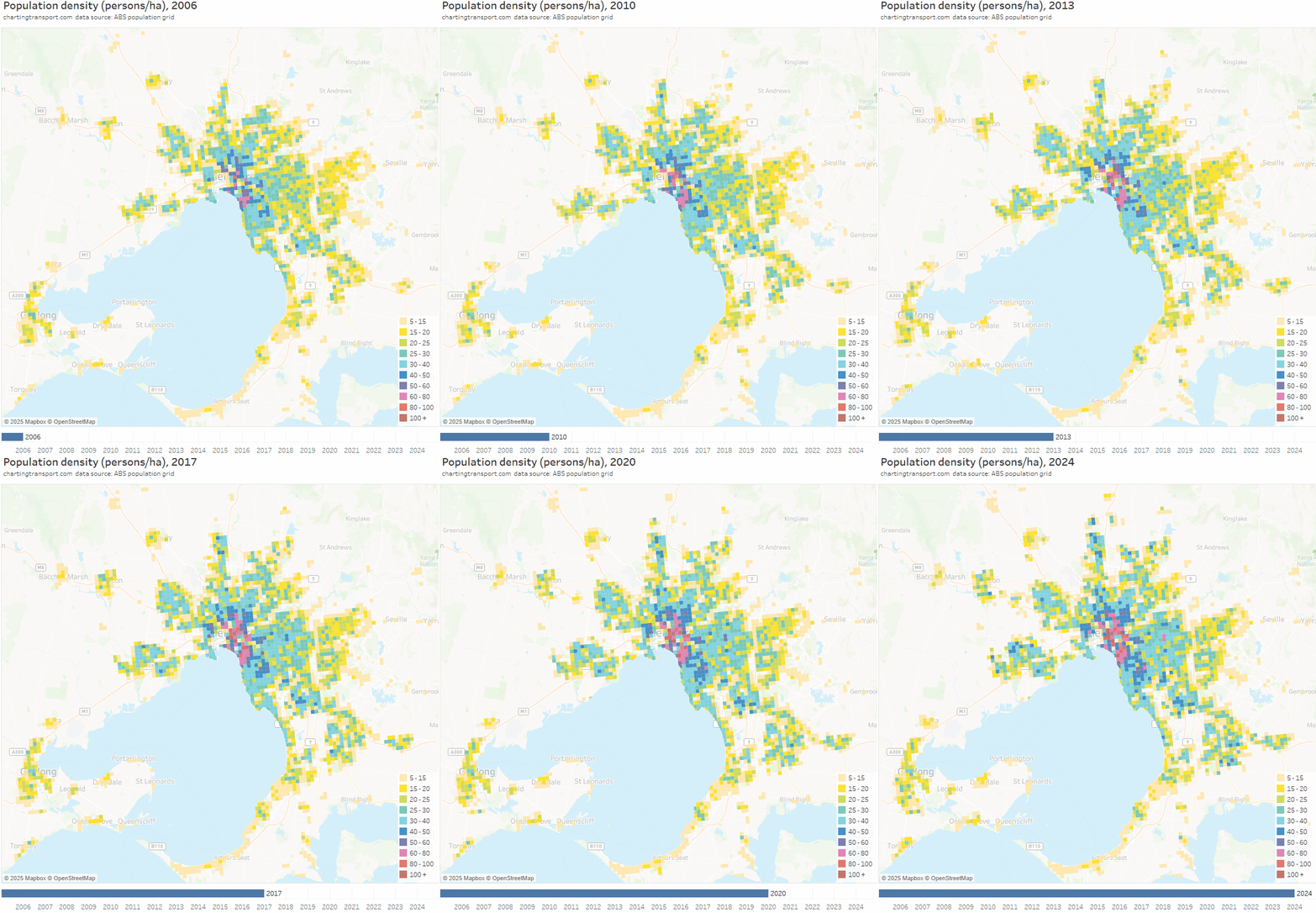
I’ve also created some new animated density maps for each city (2006 to 2024). Here’s Melbourne:

More on trends in density of major Australian cities (including animated density maps for other cities).

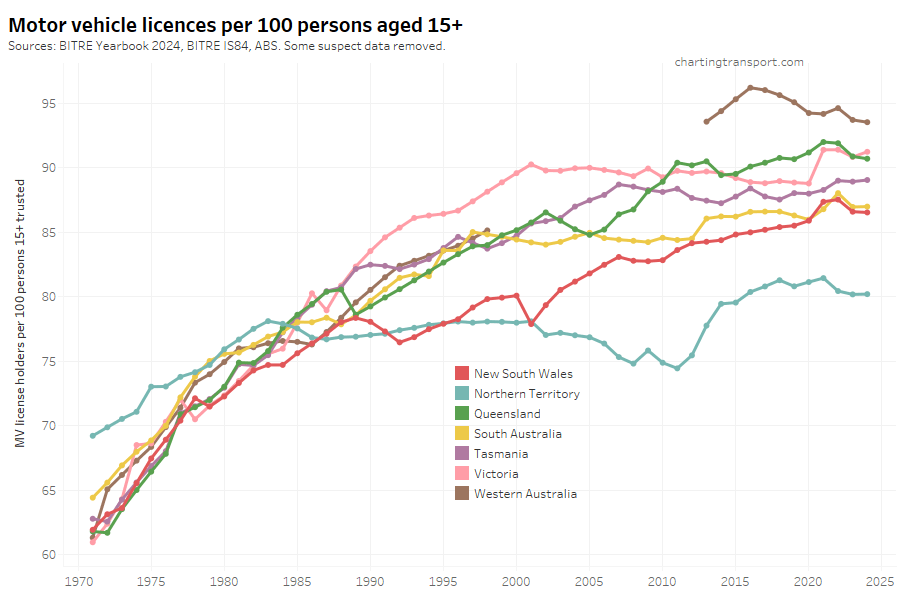
In 2023-24, driver’s licence ownership rates were flat in most states and territories.

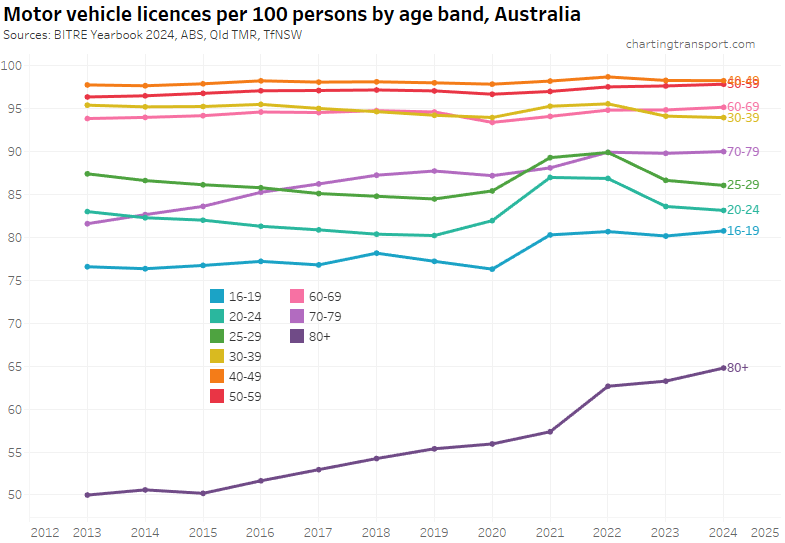
Motor vehicle licence ownership rates have varied by age group:

  • For those in their 20s, licence rates were declining but then peaked during pandemic as a lot of temporary residents left. It has since gone back into decline, but is above 2019 levels.
  • Licence ownership rates for teenagers jumped in 2021 but have been relatively flat since then.
  • Licence ownership rates for older Australians continue to increase (especially for those aged 80+)
More on driver’s licence ownership.

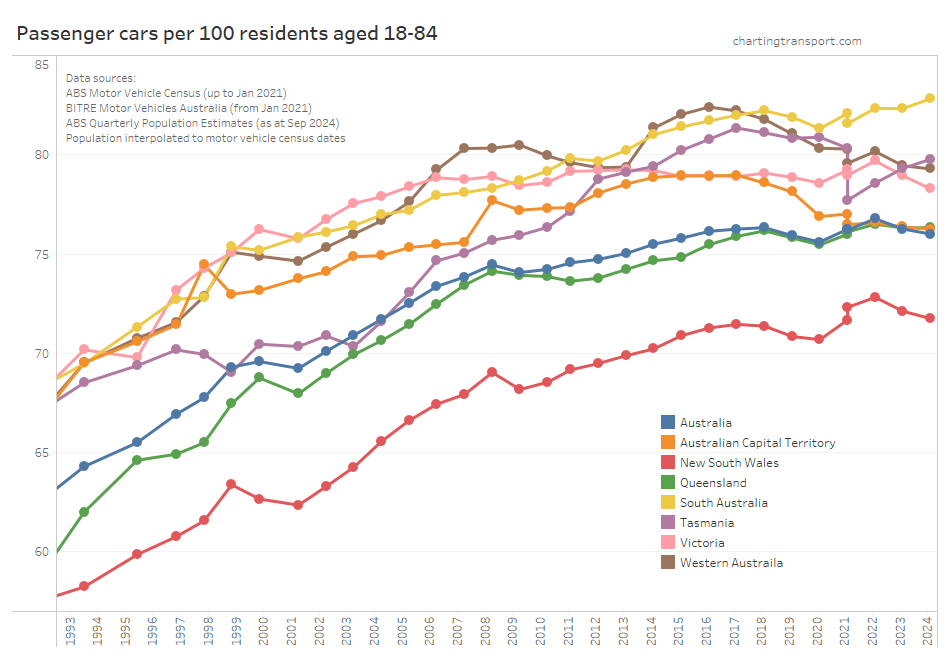
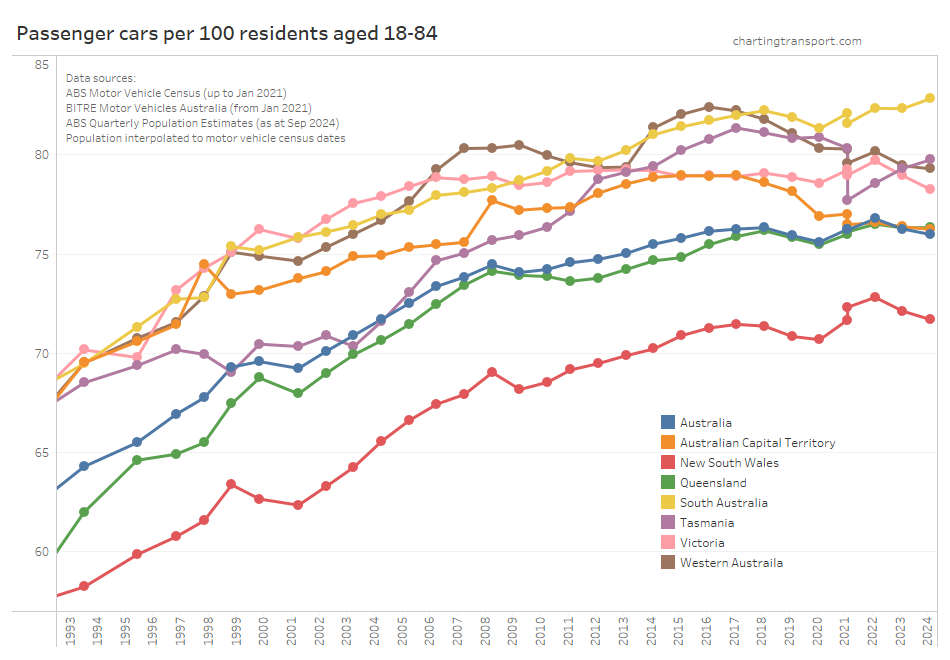
New South Wales, Victoria, and Western Australia saw a slight decline in motor vehicle ownership rates in the year to January 2024. Tasmania and South Australian were up, while ACT and Queensland were flat.

More on motor vehicle ownership rates.

Motor vehicle kilometres travelled was flat in most cities in 2023-24.

More on vehicle kilometres travelled and passenger kilometres travelled.
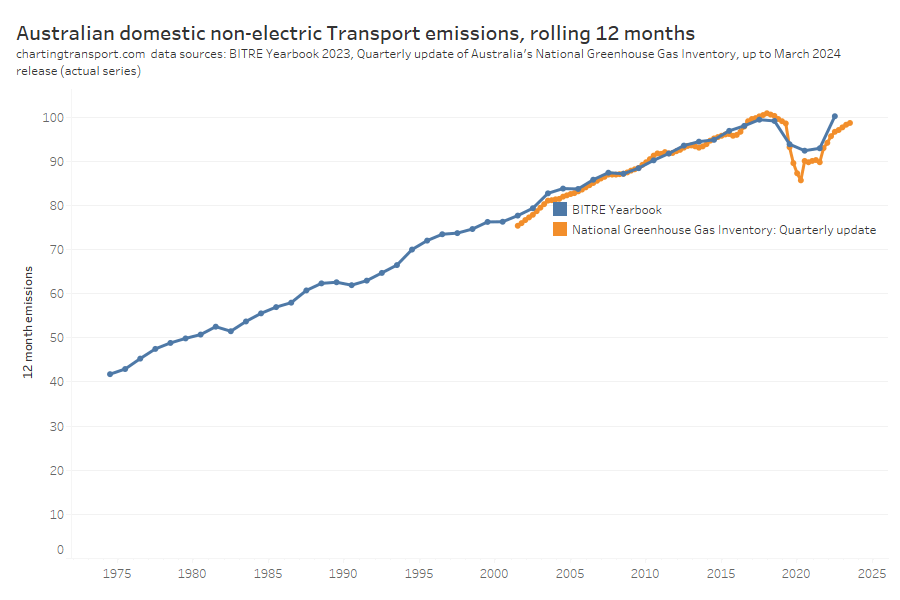
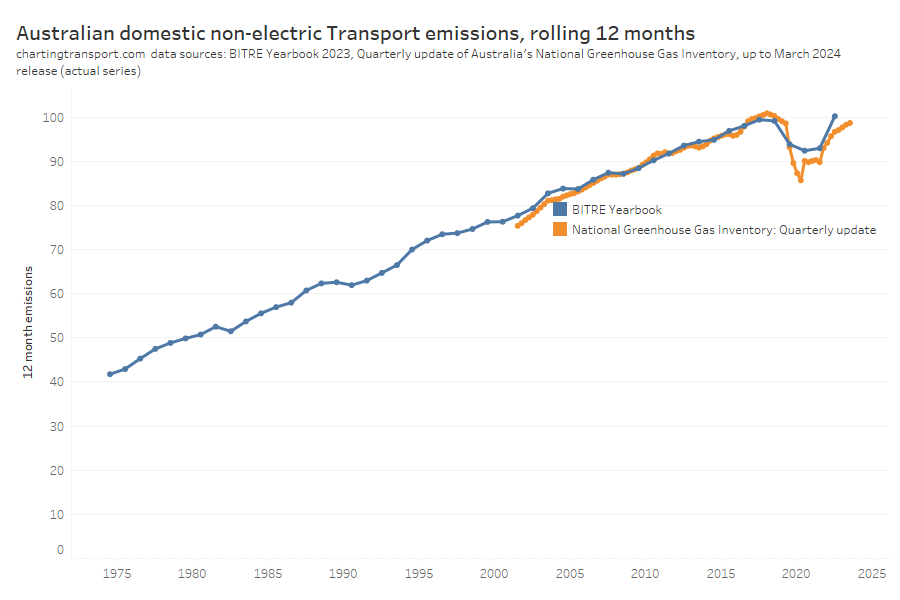
Non-electric transport greenhouse gas emissions are growing and are back around pre-pandemic levels.

Domestic aviation, truck, and light commercial vehicles emissions are higher than ever.
Only small improvements in emissions intensity are being made in Australia.

More on trends in transport emissions.

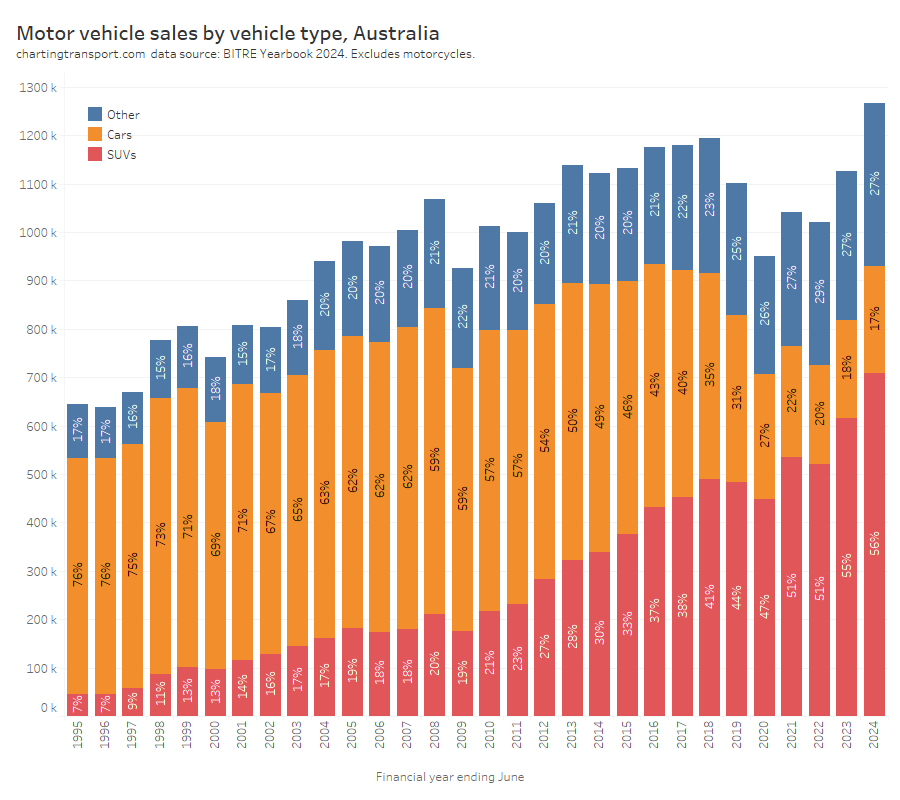
2023-24 was a record year for motor vehicle sales, with SUVs continuing to take a larger share of sales.

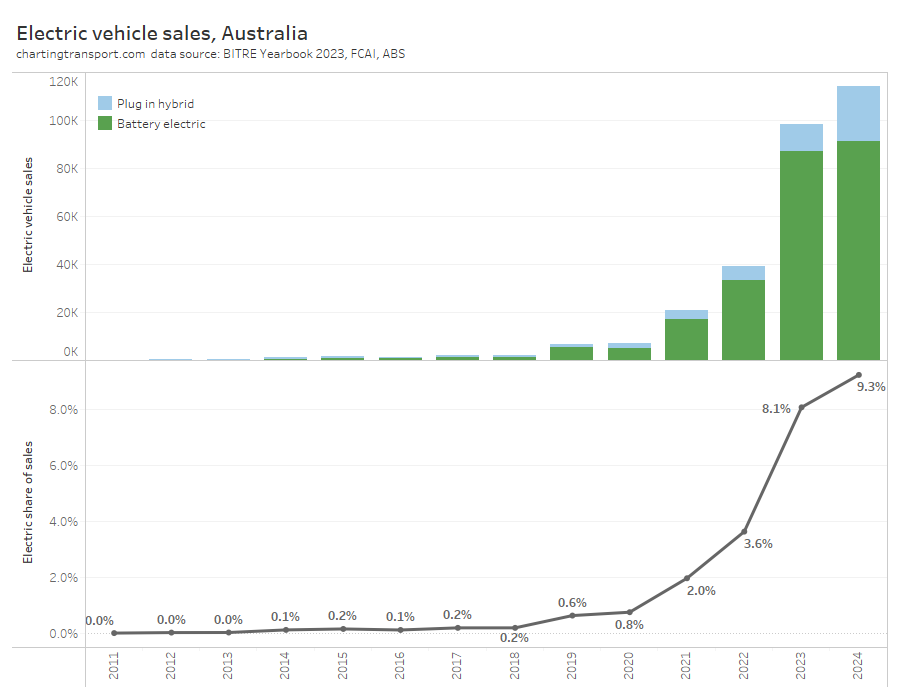
Electric vehicles continued to increase their share of all vehicle sales, although the rate of increase slowed in calendar 2024.

More detail on motor vehicle sales.

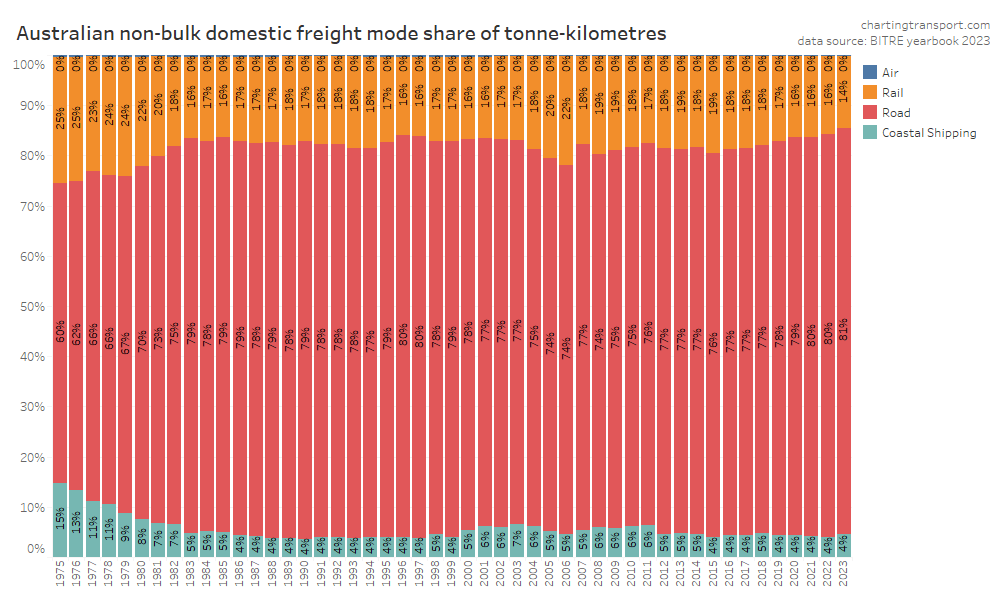
Rail is continuing to lose mode share of non-bulk freight movements.

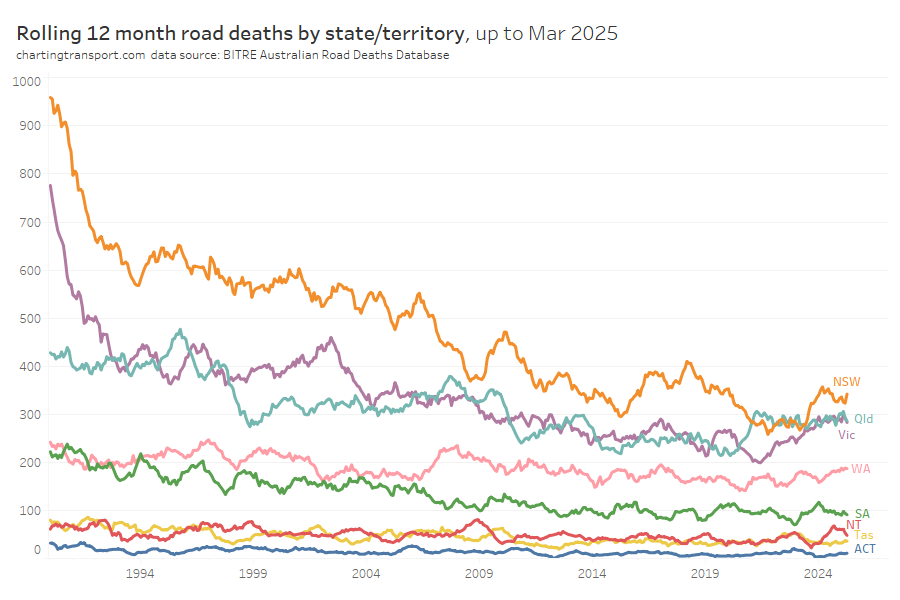
Road deaths have unfortunately not been trending downwards in recent times.

More on trends Australian road deaths.


Who drives to work in Australia’s CBDs?

Wed 9 April, 2025

Central Business District (CBD) generally have expensive car parking, congested radial roads, and public transport that is usually frequent, direct, and often fast. CBDs in larger cities are naturally strong markets for public transport.

Yet around three hundred thousand Australians drove to work in CBDs of Australian cities in 2016. Who are these people, and why might they have chosen to drive? And could they be enticed away from private transport?

I’ve touched on these topics a little in the past (see: The journey to work and the city centre (Australian cities 2001-2011), What can the 2021 census tell us about commuting to work in Australia’s big CBDs during the COVID19 pandemic?), but some recent social media discourse, an increase in the Melbourne central area parking levy, and the introduction of congestion pricing in New York has inspired me to tackle this question afresh and dig a bit deeper.

This post explores the factors of distance from rapid transit, income, occupation, public v private sector, hours worked, age, gender, parenting status, and distance from work.

Short on time? Just want the answers? Skip to the summary of findings.

About the data

I am focussing on mostly 2016 census data, as the 2021 census was heavily impacted by the COVID19 pandemic, with Sydney and Melbourne in lockdown on census day. Of course, travel behaviour in 2025 will be a bit different to 2016, however I would expect a lot of the mode choice fundamentals to be very similar for people making trips to CBDs (some might just be commuting fewer days per week).

I’ve looked at CBDs in all Australian cities with a population of 100,000+ (except the Sunshine Coast and Gold Coast that lack a clear central CBD). Furthermore, I’ve included some of the larger suburban employment clusters in Sydney that look and feel like CBDs (something quite unique to Sydney – see Suburban employment clusters and the journey to work in Australian cities). Private mode shares are very high for the smaller CBDs, so many of the charts in this post will focus on the larger CBDs where differences in private mode shares can be seen against many variables.

For each CBD I’ve chosen Destination Zones (DZs) that represent the core area of employment density – there is usually a high-contrast in density between a central area and its surroundings that enables a logical grouping of DZs. For the larger city CBDs, I’ve used the same areas as this post.

A lot of smaller cities have a major hospital facility close to the CBD, but just beyond the other areas of higher employment densities, and I’ve erred on the side of not including these destination zones, as we already know that hospitals have peculiar mode shares for employees (likely owing to shift work).

My analysis focuses on mostly on private transport mode share – that is people who used one or more modes of private transport (car, truck, motorbike, taxi), and no modes of public transport (train, tram, bus, ferry). Most – but not all – of these people drove a vehicle, but I’m going to use “driving” as a shorthand for headings in this post.

I don’t have access to unit-record census data, so I cannot easily apply regression-style models to determine factors for individual mode choice. Instead I’ll separately examine the relationship between mode share and various combinations of personal variables (as I often do on this blog).

Did commuters drive because they lived far from rapid transit?

I think of rapid transit as transit services where vehicles move at decent speed on a direct path along their own right of way with no delays from other traffic. This includes train lines, metros, busways, and potentially light rail (however most light railways in Australian cities are not completely separated from regular road traffic).

If people don’t have rapid transit close to their home, you’d expect private transport to be a more attractive option for commuting to CBDs.

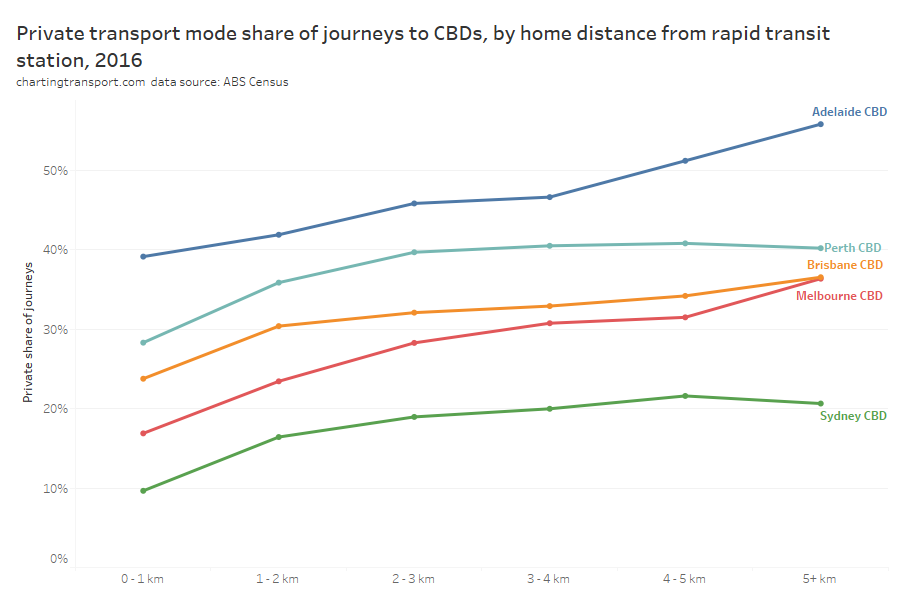
The following chart shows the private transport mode share of journeys to major city CBDs by home distance from a train or busway station:

Probably unsurprisingly, people living further from a rapid transit station were generally slightly more likely to use private transport to get to work, as public transport was probably less convenient (they would need to use a feeder bus, bicycle, or car to reach a station, or use slower on-street buses or trams all the way).

Perth private mode shares flatlined (on average) for distances of 2+ km from a station, suggesting Perth still has relatively attractive CBD public transport options for these areas (which includes both high frequency feeder bus services and direct to CBD bus services). However at the same time, Melbourne had lower CBD private transport mode shares than Perth at all distances from train stations.

However the differences in mode share between the cities were often as significant as the differences by station proximity for any one city.

A full 40% of Adelaide CBD commuters who lived within 1 km of a train station used private transport to get to work (probably not helped by the non-central location of Adelaide Train Station).

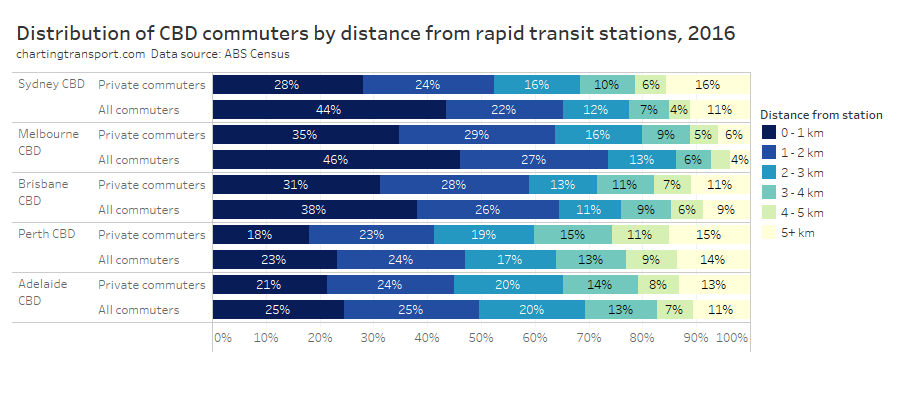
BUT, if you look at the distribution of commuter home locations by distance from train stations you get a different picture.

In Melbourne and Sydney almost half of CBD commuters lived within 1 km of a train or busway station, and they certainly had a lower private transport mode share. But still, 35% of Melbourne CBD private commuters, and 28% of Sydney CBD private transport commuters lived within 1 km of a train or busway station. That is, despite having good access to high quality public transport they choose private transport.

There must be another reason why these people chose private transport. It might be related to service quality (crowding was a significant issue on Melbourne’s train network in 2016), or it might be something else. I can only easily investigate this in terms of demographic variables so lets get into that.

Did commuters drive because they were on higher incomes?

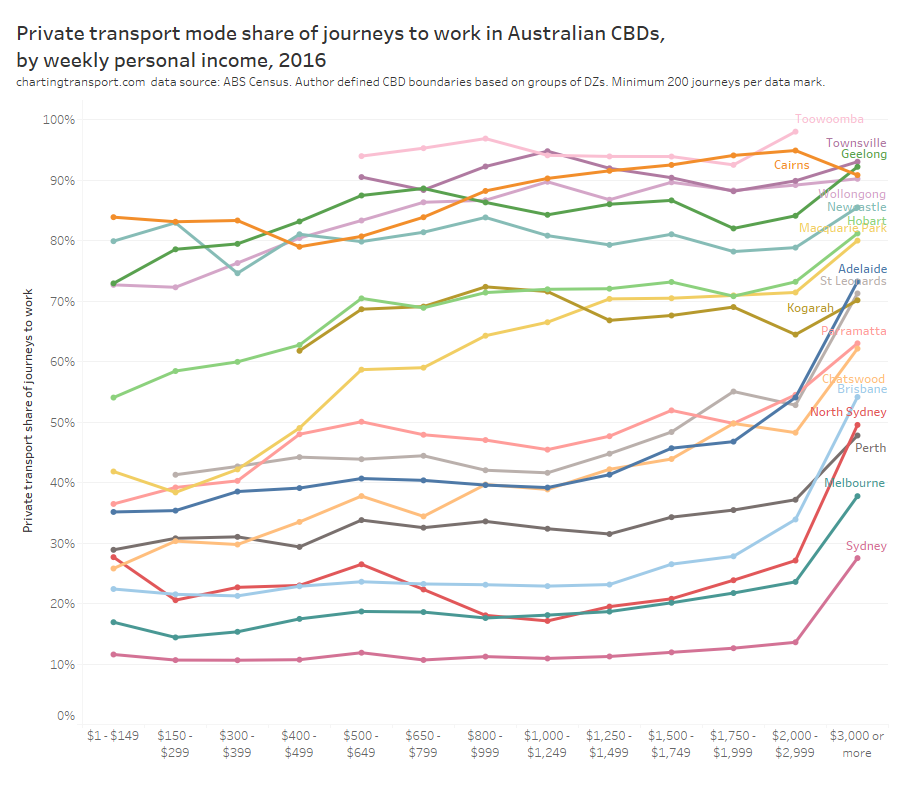
Here’s the private transport mode share of commuters by personal weekly income for all of the CBDs:

This chart shows a very clear trend – that private transport mode share peaked for people in the highest income bracket in most CBDs (especially large CBDs and suburban Sydney CBDs). No doubt this includes many executives who aren’t fussed by – or don’t themselves pay – parking costs (and possibly also car operating costs). I’ve shown before there’s generally a strong relationship between mode split and paid parking, but these people at the top income band were probably not being influenced much by price signals.

In fact, I recently spoke to an executive who was considering opting for a work car. He said that on an out-of-pocket basis it was cheaper for him to drive to work in his CBD than to use public transport!

Back to the chart.. If you ignore the top income band, for the larger CBDs private transport mode share was low and only rose slowly with income. The Sydney regional centres of North Sydney and Chatswood seem to show the strongest relationship between increasing income and increasing private mode share.

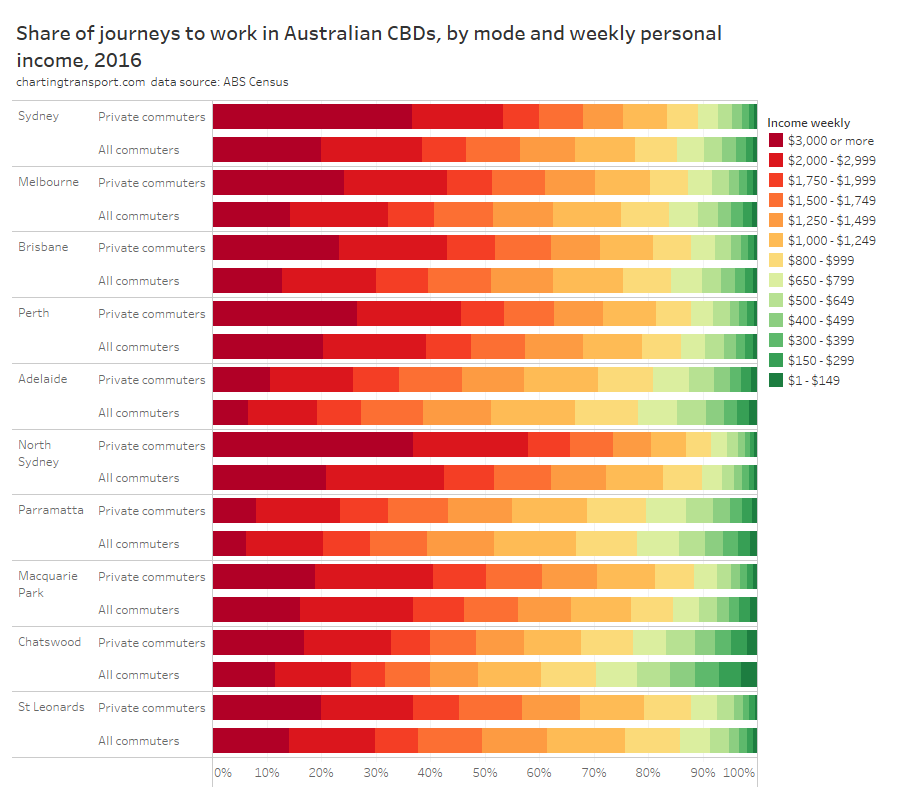
But what if we look at the volumes of commuters by income? The next chart shows the income distribution of private transport commuters, together with all commuters for reference (highest incomes on the left):

This chart shows that private commuter trips heavily skewed towards the highest income bands. Almost 37% of people who used private transport to the Sydney CBD had a weekly income in the top band ($3000+), yet that income band only accounted for 20% of overall commuters.

So it’s pretty clear that income had a strong relationship with private transport mode share, with commuters on high income more likely to drive and being disproportionately represented in general traffic and car parks. Having said that, a majority of commuters in the top income band still did not use private transport in Sydney, Melbourne, and Perth.

CBD parking levies will therefore disproportionately impact high income commuters (or their employers).

So we have disproportionate representation of high income earners and people living near rapid transit station driving to work. How are these dimensions related?

Did commuters drive because they had a high income, even though they lived close to rapid transit stations?

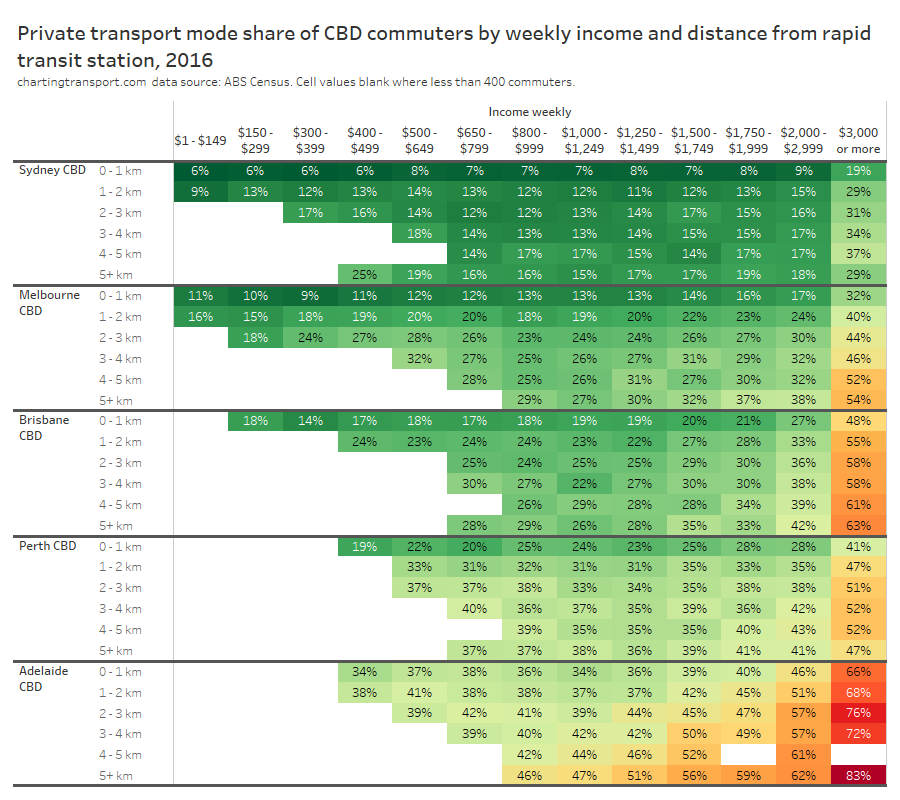
For this analysis I’ve combined the dimensions of income and proximity to rapid transit. Here is private transport mode share across these two dimensions:

The relationship between income and private transport mode share generally held up at all distances from a rapid transit station, and the relationship between distance from a rapid transit station and private mode share held up across most income bands.

So we know that people on high incomes were over-represented in private transport trips, and they also had relatively higher private transport mode shares even if they were close to rapid transit stations.

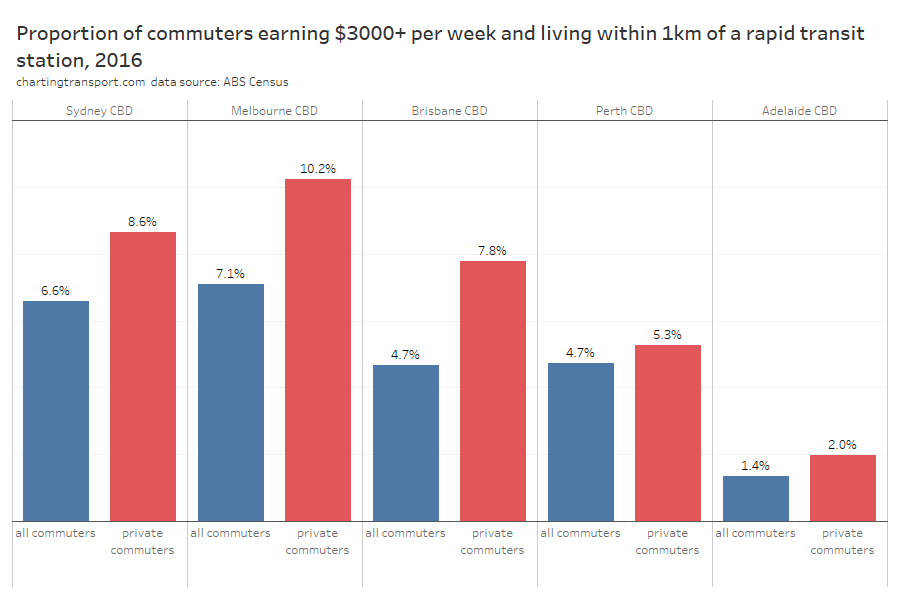
So were CBDs filled with the cars of high income commuters who lived close to rapid transit but choose not to use it? The following chart shows these commuters as a proportion of all commuters, and as a proportion of private commuters:

These commuters were certainly over-represented in the private transport volumes, but still didn’t make up a large proportion of the private transport volume.

Did commuters drive because of their occupation?

A common refrain when it comes to mode choice is that some types of workers cannot use public transport because they carry a lot of gear around with them.

Another explanation for high private transport mode share might be people more likely to be working shift work, and therefore needing to travel at times when public transport is less frequent, or perhaps not available at all.

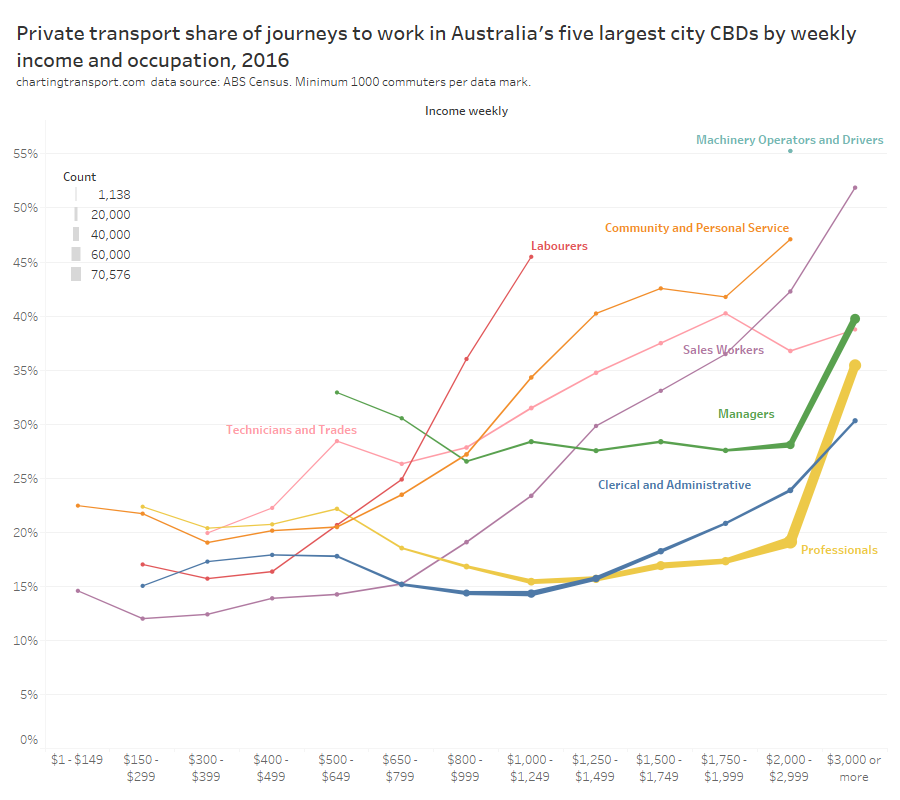
To explore this question, the following chart shows average private transport mode share by occupation (ANZSCO level 1) and income, across Australia’s five largest city CBDs. The line thickness represents the number of commuters with occupation and income range (I’ve excluded low volume data points).

Observations:

  • Machinery operators and drivers had very high private transport mode share – but there weren’t many of them and those that make the chart were on high incomes. I am guessing many commuted using their work vehicle, or were train drivers who might have registered a CBD station as their place of employment but might not have driven there (in other exploration I’ve found unusually long commute distances for employees in destination zones around Melbourne’s two main train stations).
  • Community and personal service workers tended to have higher private transport mode shares, particularly those on higher incomes – and I suspect many of these might have worked shifts, and therefore commuted when public transport is less available/attractive.
  • Labourers, community and personal service workers, technicians and trades, and sales workers had a strong relationship between income and private mode share.
  • Managers and professionals did not show strong increasing private transport mode share with increasing income, except for the top income band. I suspect these are largely office workers commuting in traditional peak periods where public transport is an attractive and competitive option.
  • For managers, professionals, and clerical and administrative workers, private transport mode shares were higher for those earning less than $800 per week, than those earning closer to $1000 per week. I suspect many of these people might have been working part-time and/or shift work, where public transport might be less convenient. More on that shortly.
  • Clerical and administrative workers showed a slightly stronger relationship between income and private transport trends towards higher incomes. I suspect this occupation actually includes a lot of finance professionals but I’m not quite sure why they would have a higher private transport mode share than other professionals (maybe they worked longer hours?).

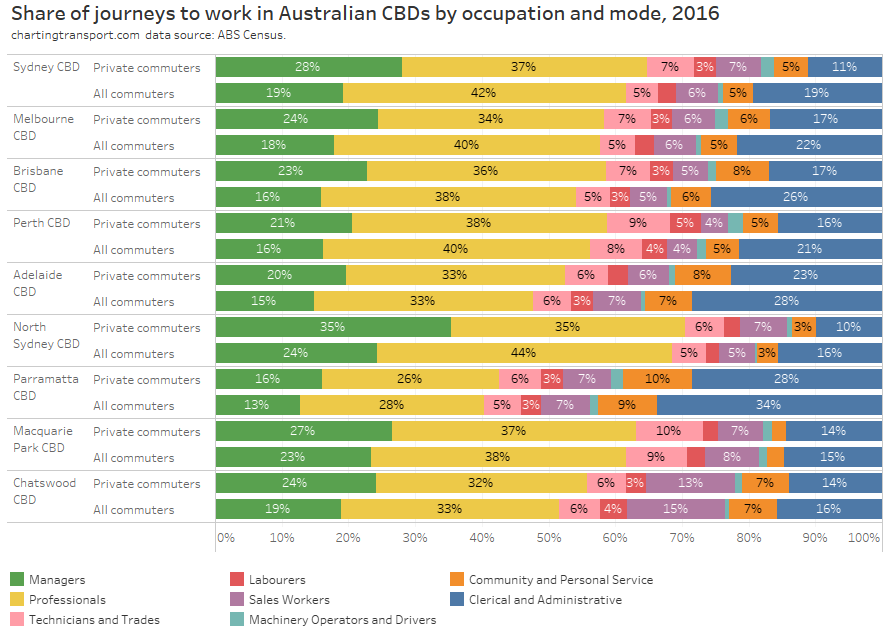
But how much did each of these occupation categories contribute to total private transport trips to CBDs?

If you study this chart, you’ll see that managers were the most over-represented occupation making up private transport trips, with the starkest difference in North Sydney. Professionals were actually under-represented in private transport trips in all cities, particularly the largest CBDs.

And those machinery operators and drivers who had such high private transport share – made up only a tiny portion of CBD workforces.

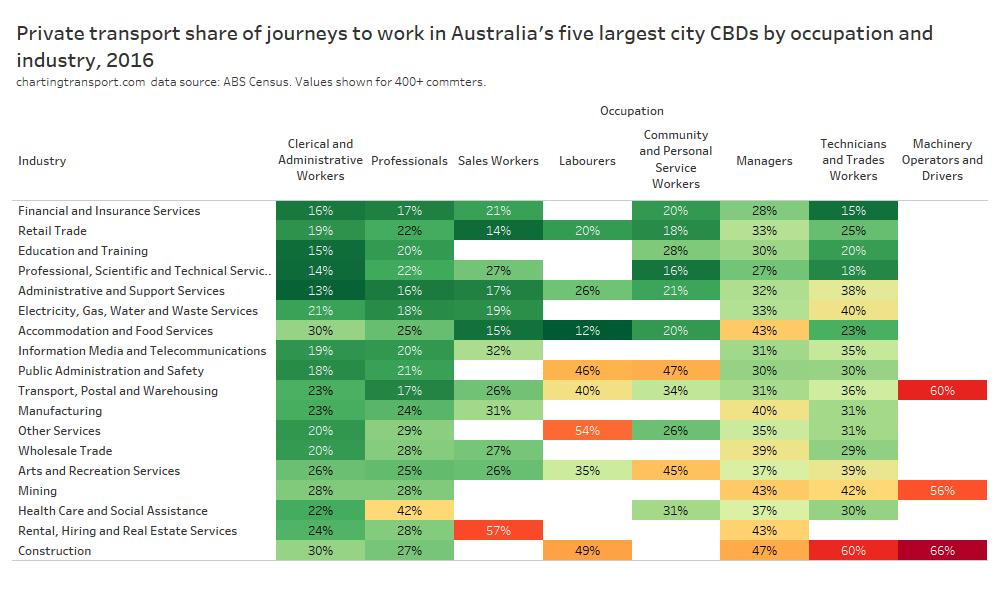
So were some types of managers more likely to use private transport than others? Here’s a heatmap table looking at private transport mode share by occupation AND industry of employment:

Some more distinct patterns emerge here. Managers in the construction, mining, rental, hiring and real estate services, manufacturing, and accommodation and food service industries had significantly higher private transport mode shares than managers in other industries. I suspect these could be explained by high salaries (eg mining), shift work (accommodation and food services), and need for a vehicle during the work day (rental, hiring, and real estate).

You can also see some other high private transport mode shares that seem pretty explainable:

  • 47% for public administration and safety / community and personal service workers – which probably includes a lot of police who might have done shift work,
  • 42% for professionals in health care and social assistance – probably including many shift working hospital staff,
  • 57% for sales workers in rental, hiring, and real estate services, who possibly need their car for work and/or are allowed to take company cars home.

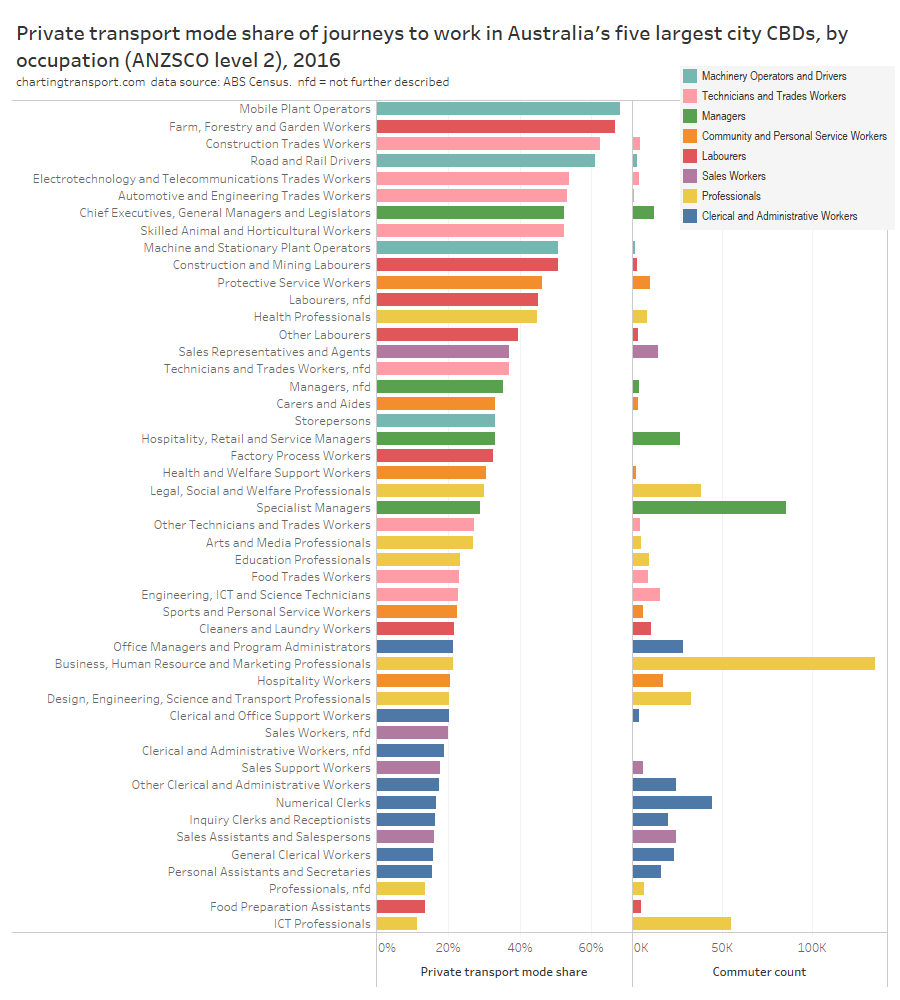
So far I’ve been speculating about mode shares for more specific occupation types, but it is possible to drill down the ANZSCO codes to understand things more deeply. First up, here are the average private transport mode shares and commuter volumes for level 2 occupation categories:

The highest private transport mode share was for mobile plant operators, but also there were only 421 such commuters across the five cities. The first large occupation category with a high private transport mode share was Chief Executives, General Managers and Legislators.

So while private transport mode shares do vary by occupation and industry, it seems to boil down to higher private transport mode share for people working shift work, people whose day job involves operating a motor vehicle, and tradies who clearly need to bring specialist equipment, amongst others. However these workers are a fairly small proportion of all CBD workers.

I’ve dug even deeper down to ANZSCO level 4 occupations. The top ten occupations with the highest private transport mode share (minimum 100 commuters) were:

  • 86% automobile drivers (no surprise here, this presumably this includes taxi drivers)
  • 81% bus and coach drivers (but only 165 workers across the five cities)
  • 81% earthmoving plant operators
  • 80% primary school teachers (that was unexpected!)
  • 79% surgeons (likely some shift work)
  • 75% fire and emergency workers (no doubt including many shift workers)
  • 75% truck drivers
  • 74% wall and floor tilers
  • 73% air conditioning and refrigeration mechanics
  • 72% aged and disability carers (many shift workers?)

Working down the list, other occupations of interest (to me) include:

  • legislators at 67% – sometimes parliament sits until very late at night
  • registered nurses at 61% – many shift workers no doubt
  • chief executives and managing directors at 55% – not quite as high as I expected – 46% in Sydney, 52% in Melbourne, and 73+% in the other cities (for interest: public transport mode shares were 45% in Sydney and 37% in Melbourne)
  • train and tram drivers at 48% – but much higher in Perth, Brisbane, and Adelaide (only 42% in Melbourne and 23% in Sydney)
  • police at 47% – likely many shift workers
  • software and applications programmers at 8% – at the very bottom of the list

And here’s the top ten occupations (at level 4) that used private transport to get to work, by volume :

  • 5.1% Barristers & Solicitors*
  • 4.5% Accountants and accounting clerks*
  • 3.1% Advertising, public relations and sales managers
  • 2.3% Contract, program and project administrators
  • 2.2% Management and organisation analysts
  • 2.0% ICT managers
  • 1.9% Chief executives and managing directors
  • 1.7% General Clerks
  • 1.7% Real Estate Sales Agents
  • 1.7% General Managers

These ten occupations accounted for 26.7% of all private transport commuter trips to work in CBDs in the five cities in 2016. I would expect many people with these occupations to also be on high incomes.

*I’ve (arbitrary) bundled two similar occupations here.

Were private sector commuters more likely to drive?

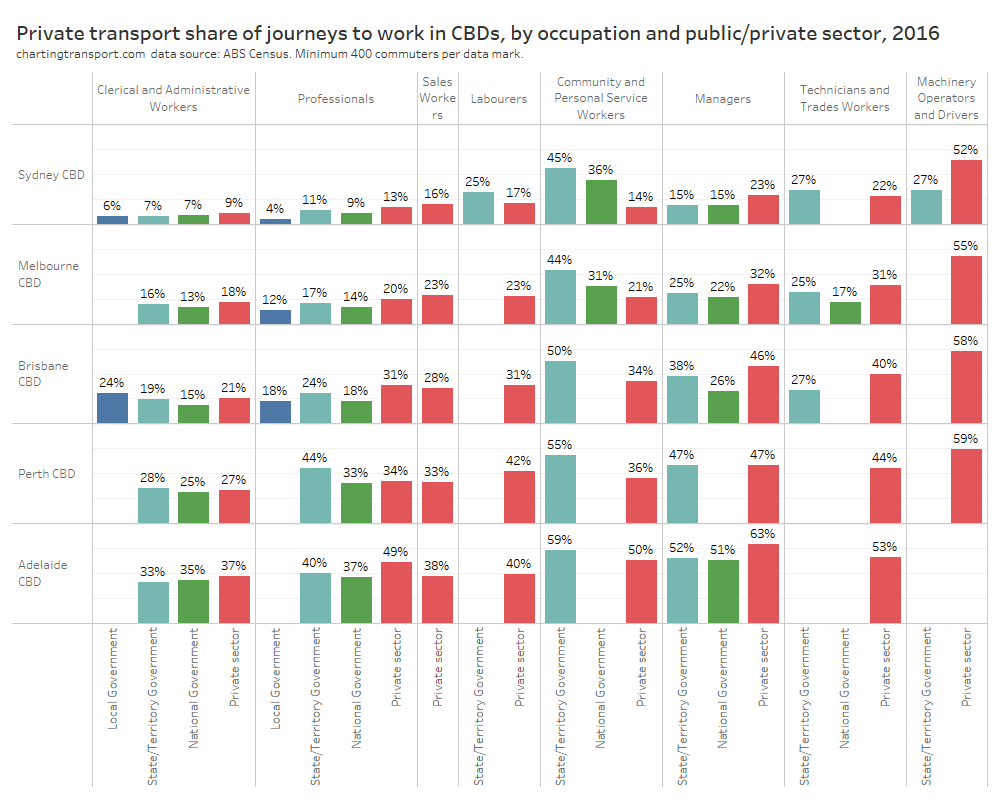
While private sector workers had the highest private transport mode share in most of the big cities (except Perth), there are big differences between occupations, so I think it’s worth looking at private mode shares by both occupation and sector of employment:

Local government professionals had the lowest private transport mode share in Sydney, Melbourne, and Brisbane.

The starkest difference between public/private sectors was in the “community and personal service workers” occupation category. I would expect many of the state government workers in this category to be hospital staff and police, many of whom would have been working shift work.

Any approach to congestion pricing in CBD areas might want to give consideration to these essential shift workers, who generally made up around 5% of CBD commuters (on a Tuesday at least, and it will vary by CBD).

Did commuters drive because they worked more hours per week?

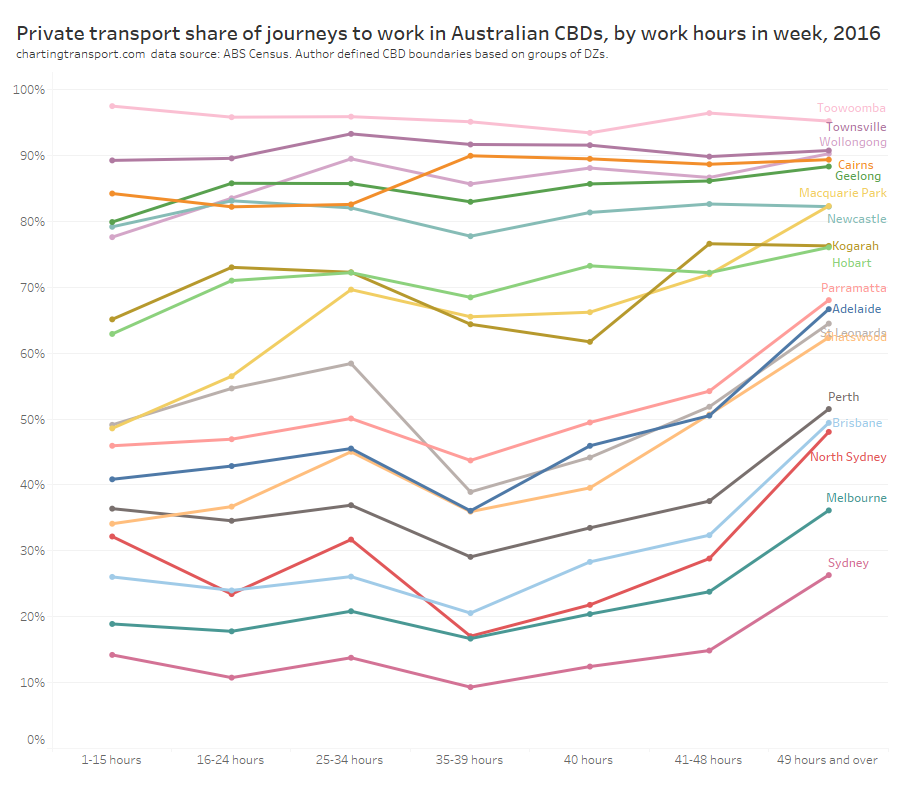
The census asks people how many hours they worked in the previous week – which hopefully also generally reflects how many hours they might have worked in the week of the census (there will be some minor exceptions, such as people returning from leave). The following chart shows the relationship between hours worked and private transport mode share across all the CBDs:

For the smaller CBDs there was very high mode private share, no matter what the working hours, so I will focus in the on larger CBDs.

In the larger CBDs:

  • Private transport mode share was lowest for those reporting 35-39 hours. About a quarter of these were public sector workers – the highest public sector share for any grouping of worked hours.
  • Private transport mode share had a mini-peak for 25-34 hours, which probably represents many people working part time 3-4 days per week. Perhaps these people were juggling other responsibilities and activities (eg parenting, studying) and decided a car better supported their complex multi-stop travel journeys? We will come back to parenting shortly.
  • Private transport mode share increased as hours worked increased from 35+ hours, peaking at those working 49+ hours in the week. Perhaps people working very long hours could not afford the extra time to use any other mode, perhaps they commuted outside traditional peak periods (perhaps as shift workers, or just because of very long days in the office), and/or perhaps they were very high income earners (more on this shortly).

One word of caution on this is that some people on higher incomes might not have worked many hours in the week before the census for random reasons (eg they were on leave). When I look at the approximate average income per hour worked of people who worked 1-15 hours, it was much higher than all other hours-worked bands.

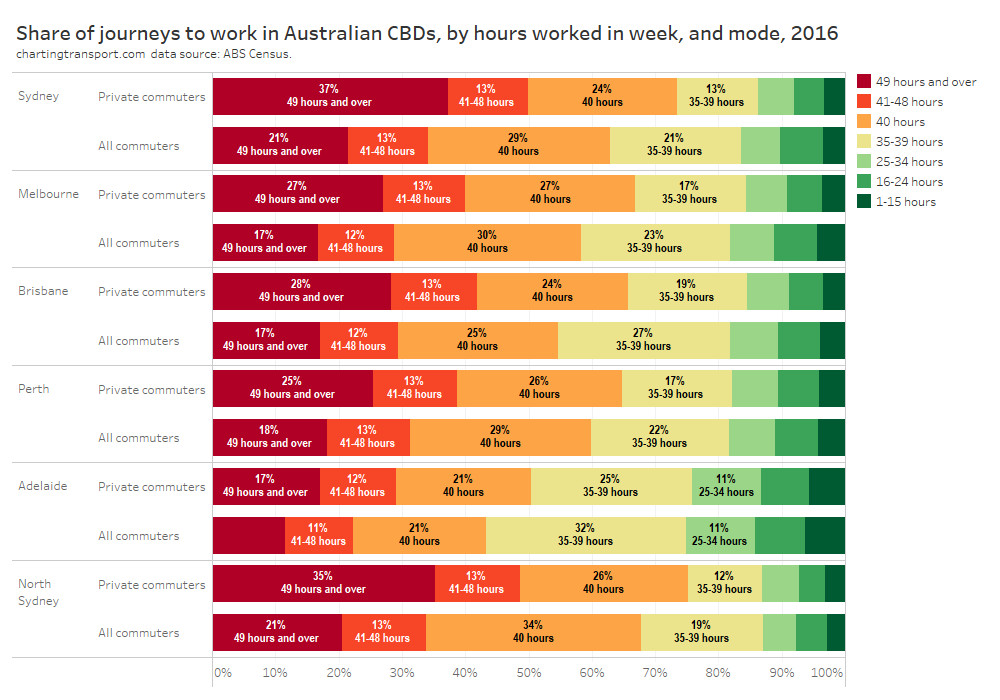
Here’s a view of the distribution of commuters (private transport commuters and all commuters) by hours worked in the last week for larger CBDs:

Commuters using private transport absolutely skewed toward people working longer hours (compared to all commuters). In particular a large share of private transport commuters worked 49 hours or more, which I’d suggest is pretty extreme overtime (these people are probably also time-poor so might be prepared to pay a premium for a faster mode of transport).

People working long hours naturally tended to have higher incomes. I’ve roughly estimated the average hourly income for each range of worked hours, and this shows a big step up in hourly income at 40 hours per week, and then another step up for those working 49+ hours per week. People working 40+ hours were also much more likely to be working in the private sector.

However not everyone working long hours was on a high income, so I’m wondering if these variables are strongly co-correlated.

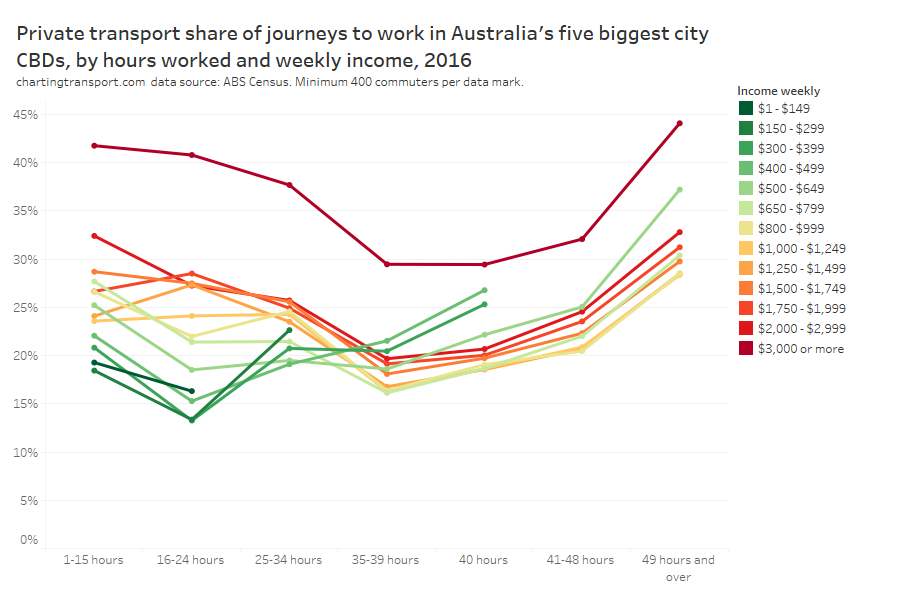
Here’s a chart showing private transport mode share by hours worked and weekly income for the five big city CBDs combined:

The chart suggests that both hours worked and weekly income were relatively independent drivers of mode share. Private transport mode share was higher for people on higher incomes regardless of hours worked. Private transport mode share was lowest for people working 35-39 hours across all income bands, except people on the lowest incomes working limited hours.

There were just under a thousand people working 49+ hours on a relatively low weekly income of $500-$649 who had a 37% private transport mode share across the five big cities. perhaps these people were working multiple jobs and/or shift work. These commuters were probably doing it tough with high transport costs and lower incomes – but thankfully there weren’t many of them.

Were older and/or parenting commuters more likely to drive?

In answering this question I’m going to also throw in the dimension of gender, as these three dimensions have shown up to be quite significant when it comes to mode shares generally in my previous analysis (see: How and why do travel patterns vary by gender and parenting status?).

Technical note: I am talking about gender, but the data reported by ABS is actually based on (binary) sex.

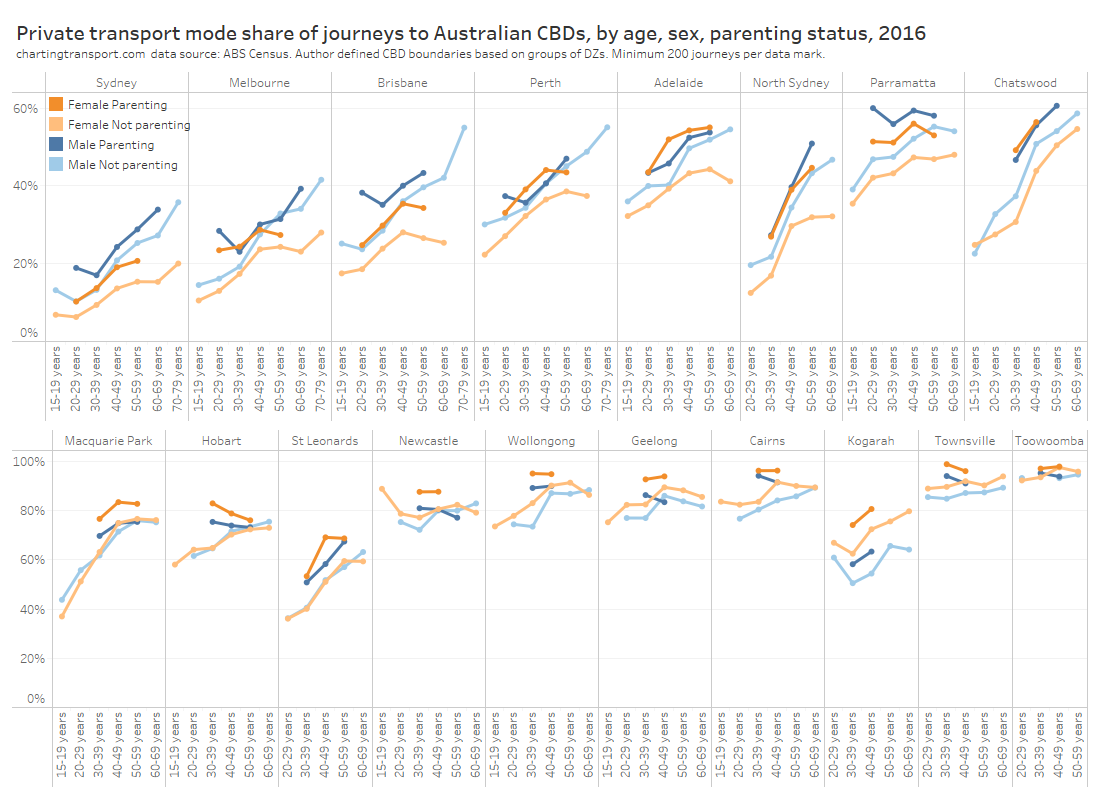
Here’s how private transport CBD commuter mode shares vary across age, gender, and parenting status:

There’s a bit going on here:

  • For males, there’s generally a strong relationship with private transport mode share increasing with increasing age.
  • For females, private transport mode share generally increased with age, but sometimes flatlined or declined for females over 50.
  • Parents generally had higher private transport mode shares, with dads having higher shares than mums in the largest centres, but then curiously mums had higher private shares in the smaller CBDs.
  • For non-parenting workers, males had higher private transport mode shares in the bigger CBDs, but again this curiously flipped for the smaller CBDs.

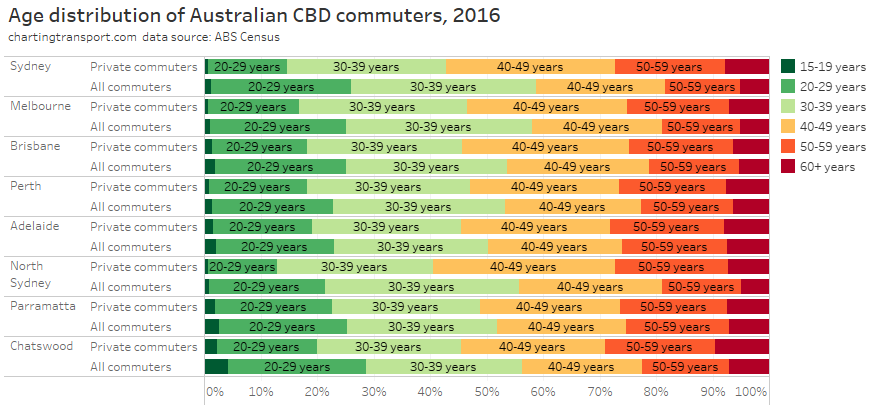
Here’s the distribution of CBD commuters by age for private commuters, and all commuters:

Private transport commuters are significantly skewed towards older age bands in most CBDs. Commuters over the age of 40 made up 41% of all Sydney CBD commuters, but accounted for 57% of private transport journeys. Melbourne was similar.

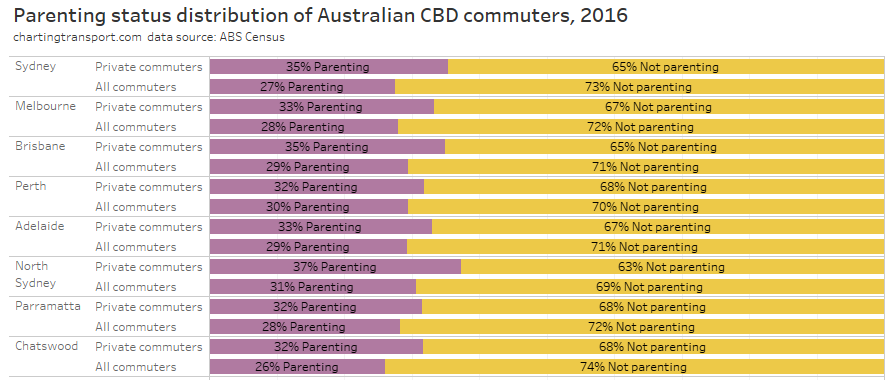
Here’s the distribution of parenting status for private commuters and all commuters:

Parents were slightly over-represented in private transport commuters in most CBDs, but the majority of private commuters were still non-parents.

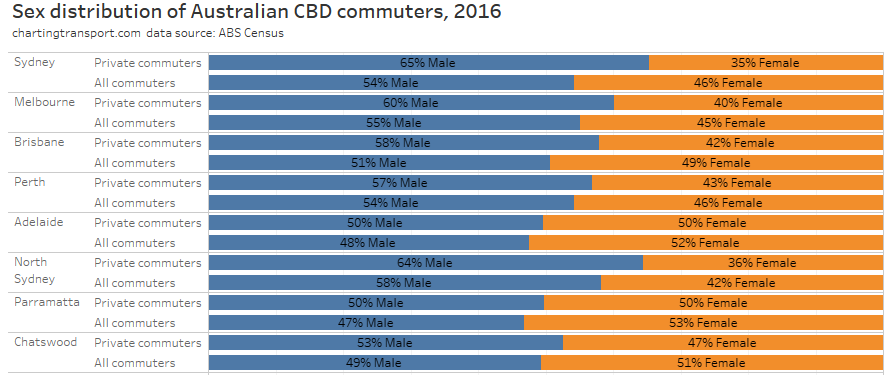
Here’s the gender distribution (reminder: ABS census data only includes binary sex):

Males were over-represented in private transport commuters, but not always by a large margin.

So are older commuters more likely to drive to work simply because they are more likely to be earning high incomes?

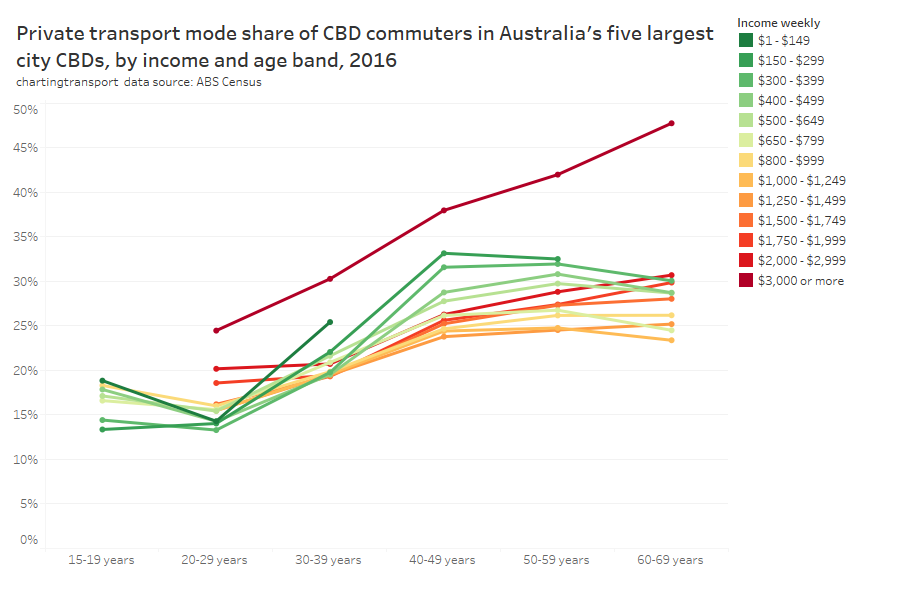
It looks like there was a strong relationship between age and mode choice, regardless of income band.

I suspect the peak in lower income commuters in their 40s might reflect part time parenting commuters. Younger people on higher incomes were much less likely to choose private transport.

This is all similar to previous analysis on public transport mode share in general against these variables (see: Why are young adults more likely to use public transport? (an exploration of mode shares by age – part 4). Older people generally used public transport less often, regardless of income and parenting status.

Did commuters drive because they were a long way from their CBD?

For people who drove to work in CBD, how far did they live from their CBD? And so, will CBD parking levies disproportionately hit people in the inner or outer suburbs?

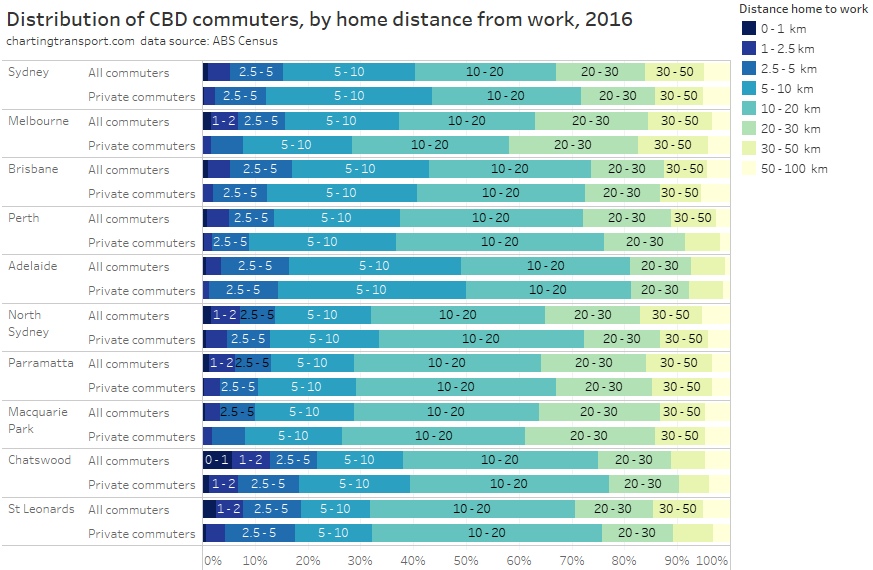
The next chart shows the distribution of CBD commuter home locations by distance from CBDs for all commuters, and private transport commuters (ABS calculates or estimates the on-road distance between each employee’s home and work location).

For very short journeys driving probably isn’t competitive with walking, so in all cities few private transport commutes were less than 2.5 km.

But if you look at the further distance bands, there’s not a lot of difference between private commuters compared to all commuters. In Melbourne private commuters skew slightly further out, while in Sydney they skew slightly further in. It varies a little by city.

It is also worth noting that CBD commuters don’t tend to live a long way from the CBD, because not many people make life choices that require long distance commutes. Around two-thirds of Sydney and Melbourne CBD commuters lived within 20km of the city.

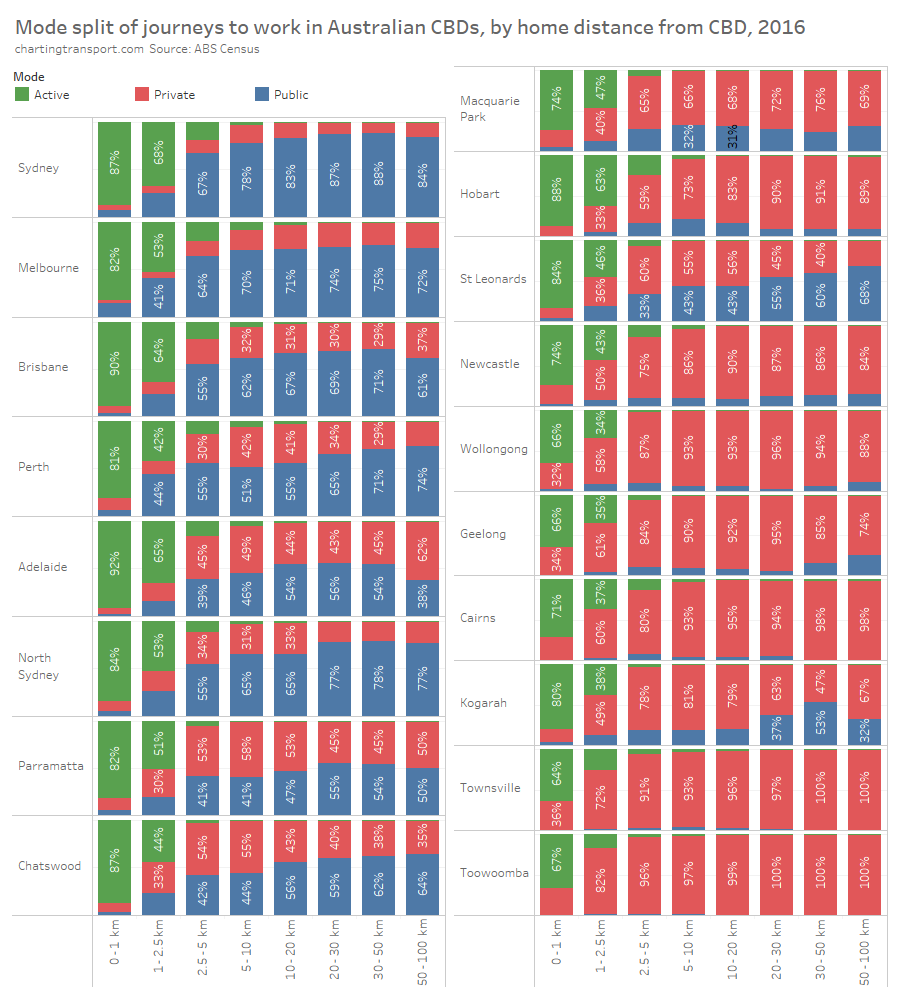
The following chart show the mode split of people who travelled to work, based on their distance from home to work:

Observations:

  • Active transport dominates very short trips, especially in the biggest CBDs. Walking is way cheaper than public or private transport, and possibly often faster. Public transport mode share for very short journeys was tiny, except for the Melbourne CBD which is probably explained by the Free Tram Zone in the CBD area making very short tram trips to work free (although a similar effect doesn’t show up for Perth CBD’s Free Transit Zone).
  • Active transport mode share fades away by 5 km from the CBD, and then it’s a contest between private and public transport. Public transport won the largest share in the biggest CBDs, while private transport dominated for the smaller CBDs.
  • For distances of more than 5 km, the split between public and private transport shows different patterns in different CBDs.
    • For Perth, Wollongong, Geelong, and the Sydney secondary CBDs of North Sydney, Parramatta, Chatswood, St Leonards, and Kogarah, public transport mode share increased with increasing distance. The secondary CBDs in Sydney are all well connected by the train network, and perhaps this is competing well with road tolls for private transport that generally increase with distance travelled. Perth, Wollongong, and Geelong are well connected by rail for many long distance commuters which might influence this pattern (rail being relatively cost and time competitive for longer distance trips).
    • For many CBDs the mode split remains fairly flat across distances, except for a spike in private mode share for trips 50-100km in Brisbane, Adelaide, and Parramatta.
    • Kogarah keeps showing up with wacky patterns in these charts. Public transport mode share is only strong for trips of 20-50 km, which probably represents many trips where metropolitan train travel is highly time and cost competitive.

This means that there isn’t a clear over-representation of private transport users for shorter or longer distances across the cities (beyond ~5km from CBD). Private transport commuters tend to travel similar distances to public transport commuters.

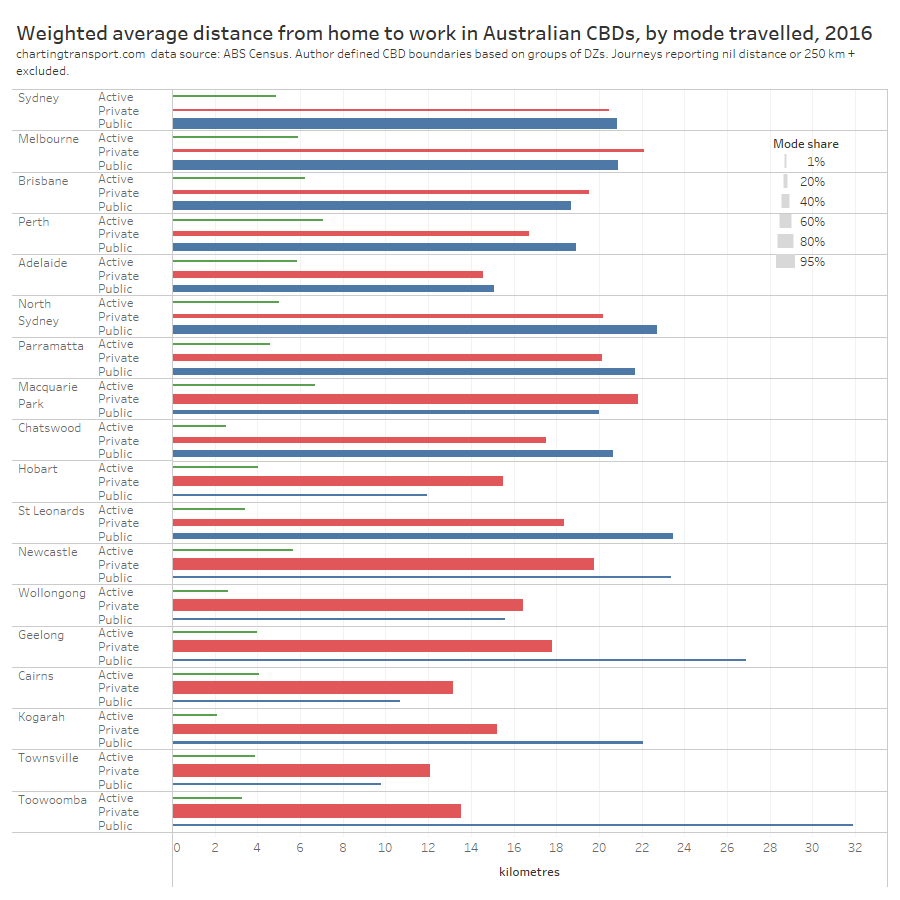
As something of an aside – another way of looking at this data is the estimated approximate average distance to work (I have to estimate these because journey lengths are reported in bands rather than precise figures). The following chart shows the approximate average distance to work, and the width of the bars is scaled to the relative mode share of each mode. So a skinny line shows the average distance of a minority mode.

Technical note: To calculate the approximate average distance from home, I take a weighted average of the mid-distances of each reported distance band, with the weighting based on the number of commuters reported in each distance band (I hope that makes sense!).

For the Sydney CBD, public transport trips had a slightly longer average commuting distance than private transport, but for the Melbourne CBD it was the other way around. There’s no clear pattern for the larger CBDs.

However for the smaller CBDs public transport tended to have much longer average distances (with Toowoomba the longest). This suggests public transport was more competitive for longer travel distances to smaller cities.

In summary – who drove to work in Australian CBDs in 2016?

My analysis has found that people with the following characteristics were significantly over-represented in private transport CBD commuting in Australia’s largest cities:

  • commuters on the highest incomes
  • commuters working very long hours
  • commuters living further from rapid transit stations
  • commuters who were parenting
  • older commuters (particularly for males)
  • males
  • commuters likely to be doing shift work – particularly police and medical workers

CBD commuters living within around 5 km of large CBDs and within around 2.5 km of smaller CBDs were more likely to use active transport for obvious reasons. Beyond these near-CBD areas, there were not clear relationships between mode split and distance from CBD.

There were also some types of commuters who had high private transport mode shares, but made up only a small volume of CBD commuters so were not significantly over-represented in private transport commuting. These included:

  • Part-time workers on high incomes
  • Workers who need a motor vehicle as part of their day job

What can public transport agencies do to try to shift these private transport CBD commuters towards public transport?

Many of these private transport commuters were on high incomes, and didn’t choose public transport, even though it was relatively close to home. These commuters probably won’t respond to fare reductions, but they (or their employers) may respond to private transport disincentives (eg parking levies, reduced parking availability, (de)congestion charging, changes to tax incentives).

For commuters working part time, shift work, and/or long hours, public transport agencies might want to ensure there is a reasonably frequent services from early morning until well into the evening on rapid transit lines. In 2017 Sydney boosted off peak train frequencies to 15 minutes or better over a very long span of hours, and patronage grew strongly (until the pandemic hit).

For parenting commuters, perhaps locating childcare centres, kindergartens, and schools closer to rapid transit stations might make it easier to mix work and parenting responsibilities while travelling on public transport. But of course relocating such facilities is hardly trivial, and high land values around rapid transit stations would also be a challenge. It may however assist with getting higher public transport mode shares for school travel, which is a significant travel demand in peak periods.

I haven’t been able to explore the issue of public transport service quality and mode choice, but ensuring public transport has sufficient capacity and reliability would obviously be desirable, and I suspect might be particularly important to people on higher incomes and/or working longer hours who consider themselves time-poor.

Of course the absence of rapid transit is associated with higher private transport mode share in most cities. Public transport agencies might want to consider which parts of their cities are generating higher concentrations of private transport CBD commuters, and whether that might be related to public transport service quality. All cities will have areas remote from rapid transit stations, but only some of these areas will have higher concentrations of CBD employees.

My next post on this topic will look at the spatial distribution CBD commuter mode shares and private commuter volumes in the larger cities.


The latest transport and city trends are now easier to find on the blog

Mon 18 November, 2024

It’s now much easier to find the latest key transport and city trends on Charting Transport. A new “Trends” menu item links to 13+ pages covering a range of key transport and city-related metrics (for Australia and sometimes also New Zealand). The pages cover passenger and freight mode shares, public transport patronage, city density, car and driver’s licence ownership, emissions, road deaths, and more.

I will endeavour to keep these pages updated as new data is released – which is mostly annually, but for sources that update monthly I will probably update the pages a few times a year (depending on the level of interest).

These pages will generally focus on the most useful summary charts, which will make it easier for me to update them relatively quickly. I’ll still be writing deeper once-off analysis on various topics, and I’ve included links from the Trends pages to these related blog posts.

This new approach also helps where I’m joining disparate data sources that update at different times of the year. For example, each December BITRE publish their Infrastructure and Transport Statistics Yearbook with lots of volume data, but I have to wait until March for ABS Regional Population data to extend per-capita metrics. Now I can update the volume charts in December, and the per-capita charts in March.

Often I find the addition of more recent data for a metric is not interesting enough to justify a new a blog post, but I’d still like it to be available to my readers. It doesn’t make sense to sit on this data waiting for an excuse to publish a new post, and now I won’t need to.

But if there are interesting new trends emerging, I will push out new blog posts (probably quite short ones with selected charts only) so my subscribers are alerted. If you are not already subscribed you can do that here:

Indeed, here are some…

Interesting trends from recently updated data

City population density has shot up in Melbourne and Sydney to reach new highs in June 2023. Other Australian cities also saw relatively large increases in population density during 2022-23.

Car ownership rates have dropped slightly in most states and territories (probably with the resumption of immigration):

Transport emissions are growing strongly again, and are back near 2019 levels:

I hope you find this new feature useful (I wish I had done this years ago).

Also let me know in the comments if you want to suggest Trends pages for more topics (subject to there being broad interest and relevant open data).