Are all the statistics we see about urban density and transport reliable?
In his most recent book Transport for Suburbia (and his paper to ATRF 2009), Paul Mees highlights mis-use of urban densities figures by some researchers – the trouble being inconsistent determination of what exactly is the urban area of a city when you calculate density (= population/area).
To redress the issue of data quality, Paul has used calculations based on the actual urbanised area for Australia, US, Canadian and English cities (looking at entire greater metropolitan areas). He’s used figures based on urbanised areas as opposed to a statistical district, municipal council area, or other arbitrary administrative boundary which could contain large areas of non-urbanised land.
The calculations define urbanised areas using the following criteria:
- US and Canadian cities: minimum 400 per square km,
- Australian cities: minimum 200 per square km (meaning Australian cities might be slightly understated)
- English cities: detailed mapping, likely to lead to slighty higher density figures.
So the calculations are not perfectly aligned, but they are more comparable than density calculations that use simple administrative boundaries. And they are also certainly consistent within each country.
He publishes tables of this data, talks about the relationships between them, but for some reason fails to plot the results on a chart. So I’ve decided to chart them (if you are after the data tables consult the ATRF paper above and/or the book).
The table of data is quite interesting in that it debunks some myths about the densities of various cities. Los Angeles is the highest density city in the entire table (the Freakonomics blog has a good series on Los Angeles Transportation: Facts and Fiction that is worth reading).
Firstly, car mode share in journey to work:
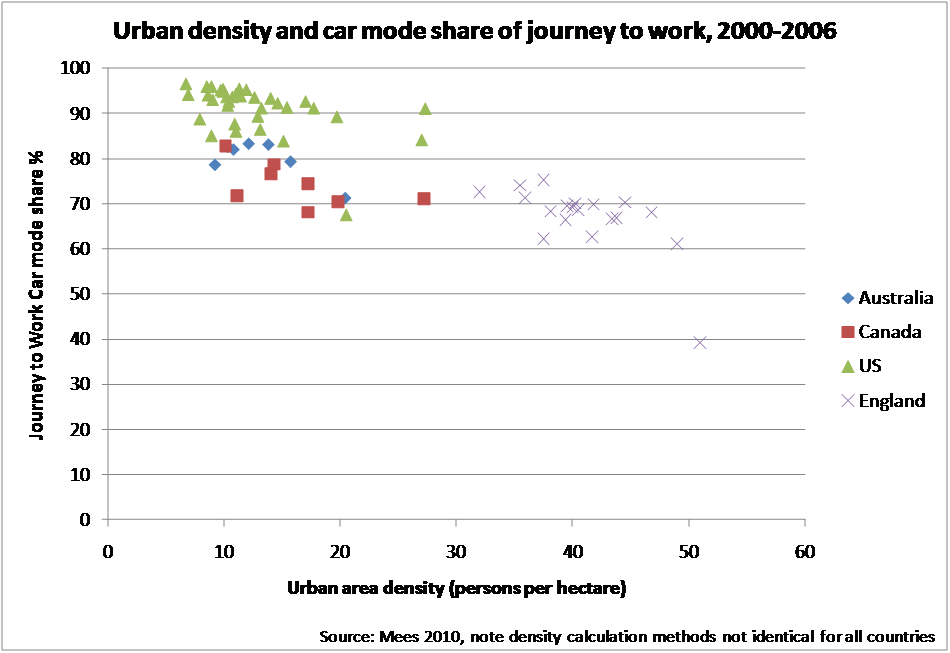
Is there a relationship between urban density and car mode share on journey to work? What do correlation coefficients say (closer to 1 and -1 means stronger) – something Mees didn’t calculate:
- Australia: -0.74
- Canada: -0.58
- US: -0.46
- England: -0.68
That suggests a relationship does exist, but it isn’t particularly strong. In reality, every city has unique characteristics and other attributes will explain the differences (the quality of services and infrastructure of alternative modes would certainly have a lot to do with it).
Looking at some outliers:
- London has the highest density and lowest car mode share. It compares so favourably to all other English cities in car mode share, despite being only slightly more dense than Brighton/Worthing/Littlehampton (one combined urban area).
- Canadian cities with the lowest car mode share are Toronto (highest density) and Victoria (second lowest density).
What about public transport mode share for journey to work?
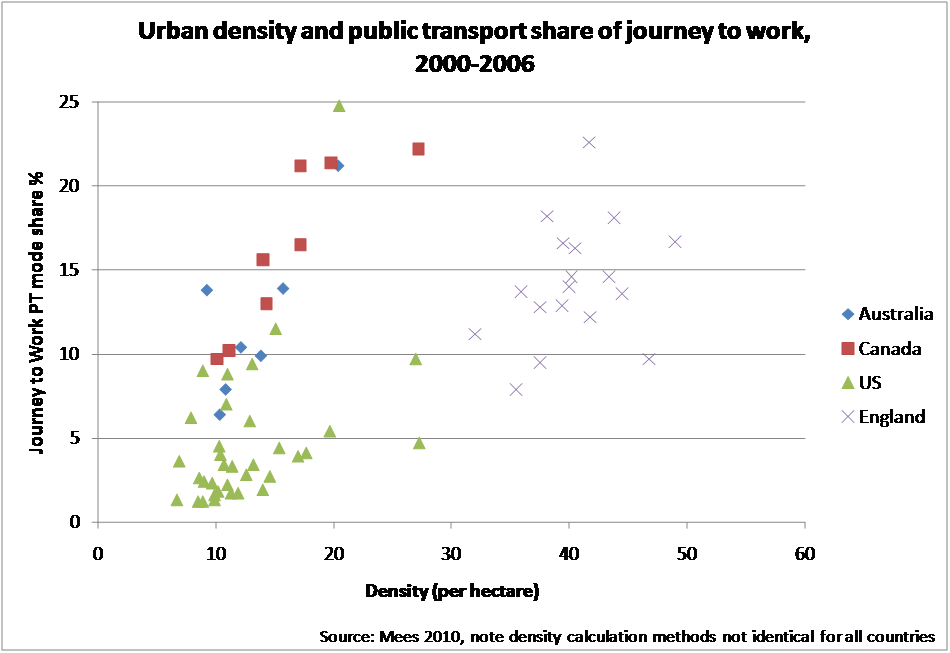
This chart shows relationships stronger in some countries than others. Indeed the correlation coefficients are:
- Australia: 0.79
- Canada: 0.87
- US: 0.42
- England: 0.58
So much stronger relationships in Canada and Australia. Again there is a lot at work (particularly the quality and quantity of available public transport, which is one of Paul’s points).
In terms of outliers:
- London is off the chart at 45.9% public transport.
- Brisbane is perhaps an outlier for Australia – low density but pretty much the same rate of public transport use as Melbourne.
- Los Angeles – which actually has the highest density of all the US cities but still relatively low public transport use.
- The city with the highest PT mode share in the US is New York, even though it isn’t the most dense city in the US (there is lots of sprawl outside Manhattan).
The following walking chart might seem to suggest a strong relationship when you look at all cities, but remember that the density measurements aren’t quite the same, so it’s not fully conclusive. However, English cities still tend to have higher densities, particularly as many have green belts to prevent sprawl.
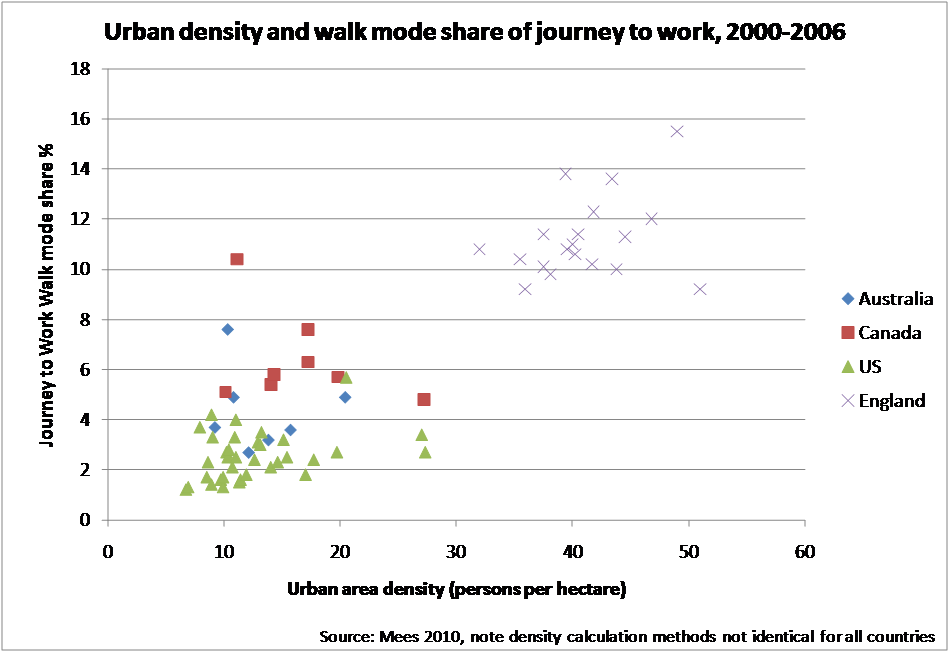
There is actually a negative correlation between density and walking (and cycling) for Australia and Canada. However I wouldn’t read too much into that as the sample size if small and there are lots of unique factors affecting each city.
But if you reckon there should be a positive correlation between walking and density, the outliers are:
- Victoria (Canada) – low density but high walking mode share.
- San Francisco and Los Angeles have low walking share.
- Hobart – highest walking share in Australia, despite low density (and a big river dividing it in two).
- Toronto – Canada’s most dense walking city, but least walking mode share
- London – highest density but lowest walking share (9.2%)
Same again for cycling:

It looks like almost no one cycles in the US, despite having more favourable climate than Canada. Again higher cycling rates in the UK.
Cycling outliers:
- Victoria (Canada) – high walking and cycling mode share
- Kingston upon Hull (UK) 11% – off the chart’s scale (Mees suggests a large university may be the cause)
- Canberra – which has a good network of bike paths (but still only 2.5% cycling mode share)
- Sydney – with just 0.7% cycling – hilly terrain not helping.
What if you add up all the sustainable transport modes (PT, walking and cycling)? In theory, density should help all sustainable transport modes.

The correlations are:
- Australia: 0.77
- Canada: 0.62
- US: 0.44
- England: 0.70
The English result is actually stronger than PT (0.58), walking (0.32) and cycling (0.02). Do people respond to density using different, but sustainable modes?
Can public transport be effective in low density cities?
Paul’s main argument is that low transport density isn’t a barrier to successful public transport, and that it is easier to change public transport provision in a city, than it is to change urban densities (not that increasing urban densities isn’t a worthy goal).
Certainly urban density makes it easier to make public transport successful, but I’d agree that it is possible to make public transport work a lot better in low density environments.
Indeed, in Melbourne, relatively high quality SmartBus routes (that run every 15 minutes for most of the day on weekdays, very good by suburban Melbourne standards!) have been trialled in the outer suburbs, and the patronage response has been much stronger than typical elasticities (the subject of another post).
More generally, in Melbourne over the last three years we’ve seen a very strong correlation between growth in service provision (26% more kms) and growth in patronage (29%) – more than any other potential driver of patronage (again, topic for another post).
Comparable cities for population and density
Finally, by plotting population and density, you can see which cities are most similar – at least in these two respects (I’ve only looked at cities under 7 million and UK cities are off the density scale). I’ve labelled Australian cities and nearby equivalents. Note: the US and Canadian data is year 2000, while Australia is 2006.


 Posted by chrisloader
 Charting Transport