A look at international transport emissions

Sun 27 June, 2010

How do Australia’s transport emissions compare with the rest of the world?

This post takes a high level look at some international data.

The most extensive data source appears to be from the International Energy Association, which includes 140 “countries” but uses slightly different estimation methodology to UNFCCC data.

Transport emissions per capita

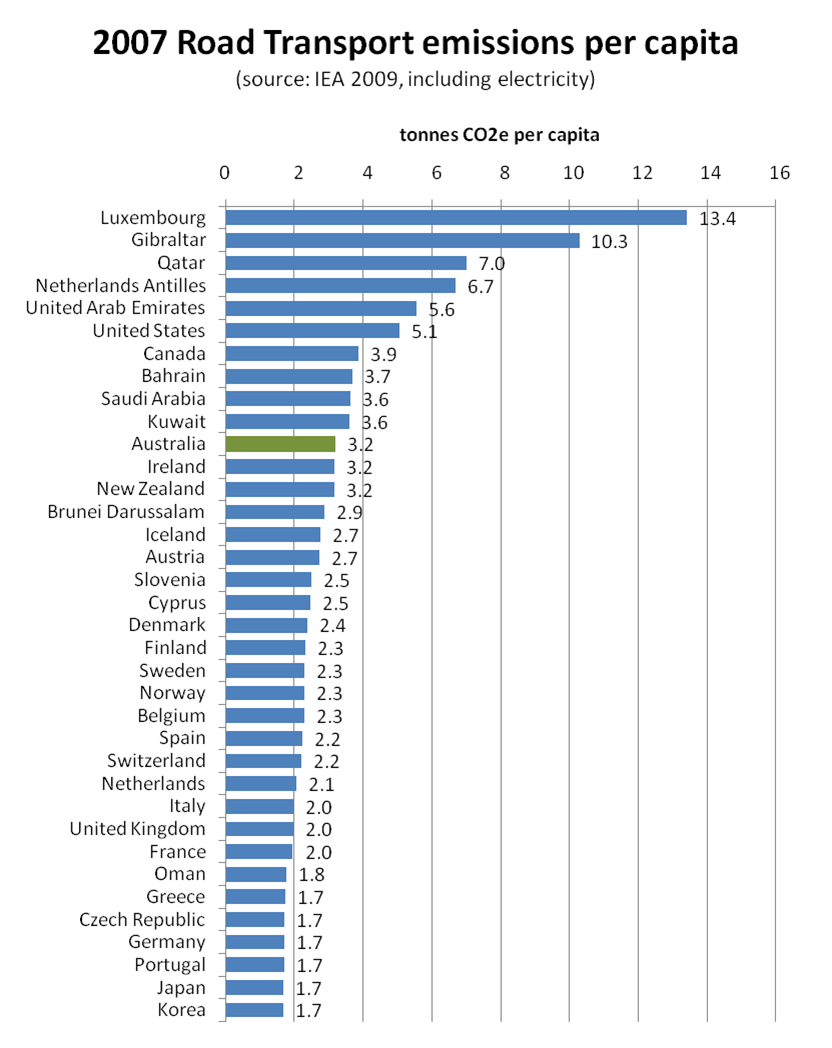
The following chart shows the countries with the highest transport emissions per capita in 2007, from IEA report CO2 Emissions from Fuel Combustion 2009.

Note there is a very long tail on this chart, and my cut off point is arbitrary (Portugal and Oman aslo come in at 1.8). For the record, the Democratic Republic of Congo is at the bottom of the list with 0.009 tonnes per capita.

The top of the list includes many very small countries:

  • Luxemburg has a population of 480,000 (and also the highest GPD per capita in the world)
  • Gibraltar has a population of 28,000 (where shipping and tourism are major industries)
  • Qatar has a population of 836,000
  • Netherlands Antilles (which consists of two sets of tiny islands in the Caribbean) has a population of 191,000. Petroleum is a major part of the economy leading to high wealth.

This makes Australia the fourth highest per capita transport emitter of countries with a population over 1 million. Australia is also fourth highest of the 31 OECD countries.

The following chart is for road transport, which is perhaps not as good a comparison given differences in rail and sea transport networks between countries:

Growth in transport emissions

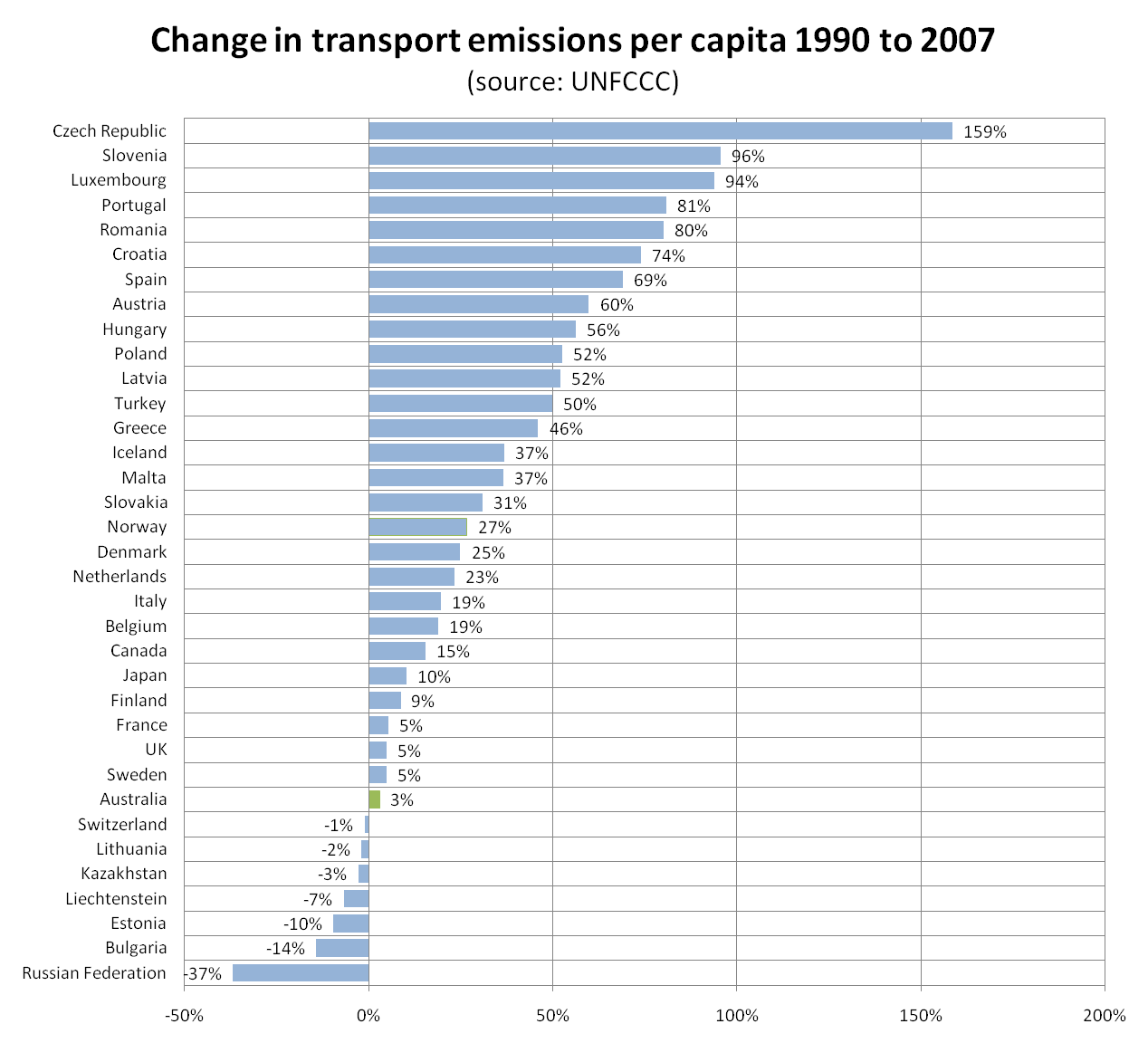
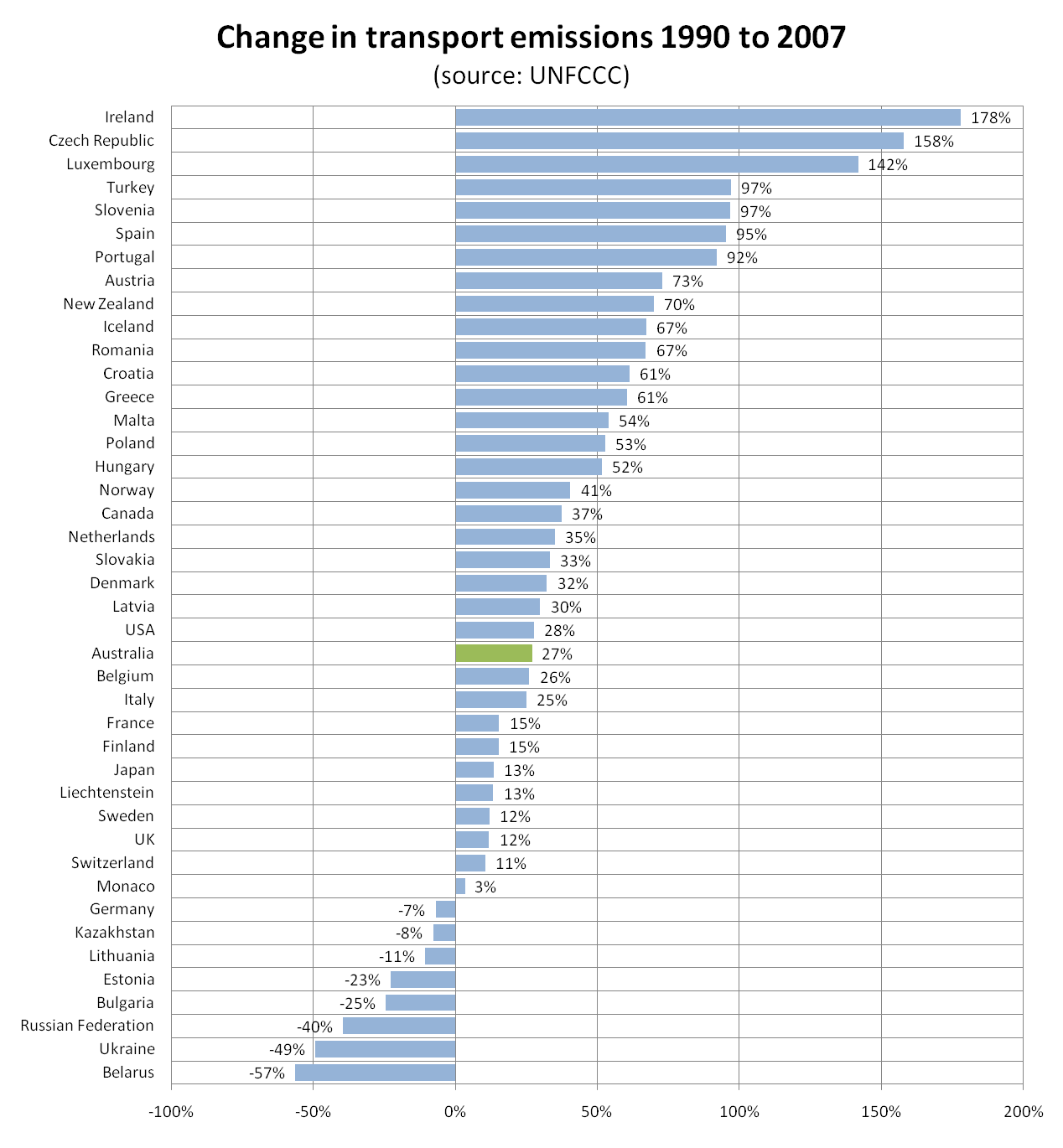
The following charts use time series data from the UNFCCC for countries where both a 1990 and 2007 figure is available.

Firstly the growth in annual transport emissions:

Many of the high growth countries are unexpected for me. The former states of the Soviet Union have shown large reductions in emissions.

Unfortunately the UNFCCC supplies less population data in their datasets, but the following chart shows the growth in per capita transport emissions for countries where 1990 and 2007 emissions and population data is available:

Transport emissions and wealth

So does being richer mean having higher transport emissions?

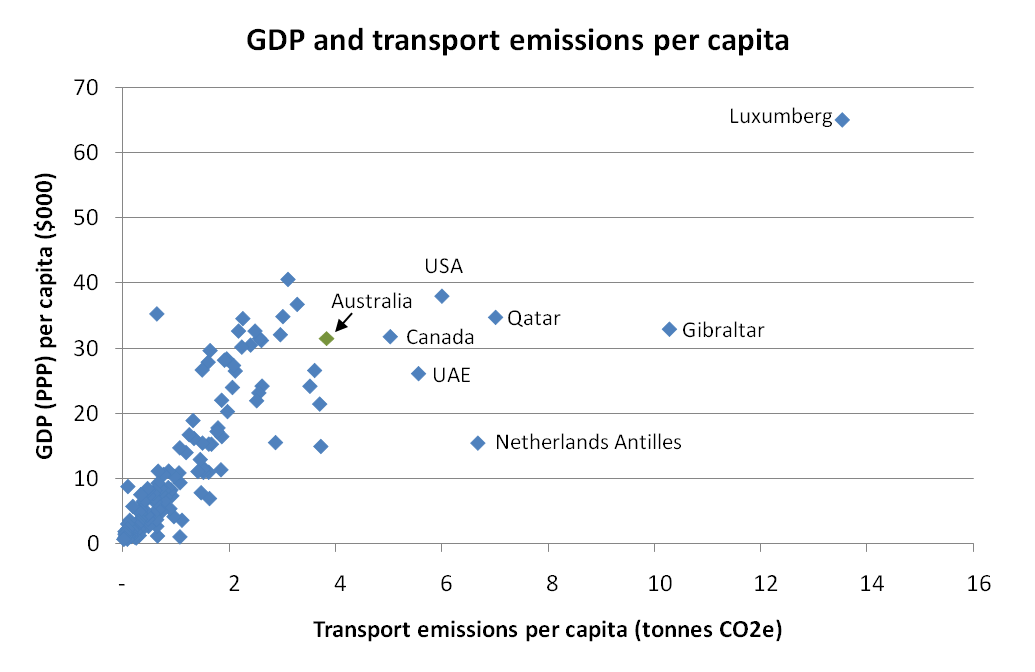
The following scatter graph shows transport emissions per capita and GDP per capita (2000 US dollars using purchasing power parity) for the countries in the IEA dataset:

On visual inspection there appears to be a strong correlation with a few outliers (the Netherlands Antilles comes up again!).

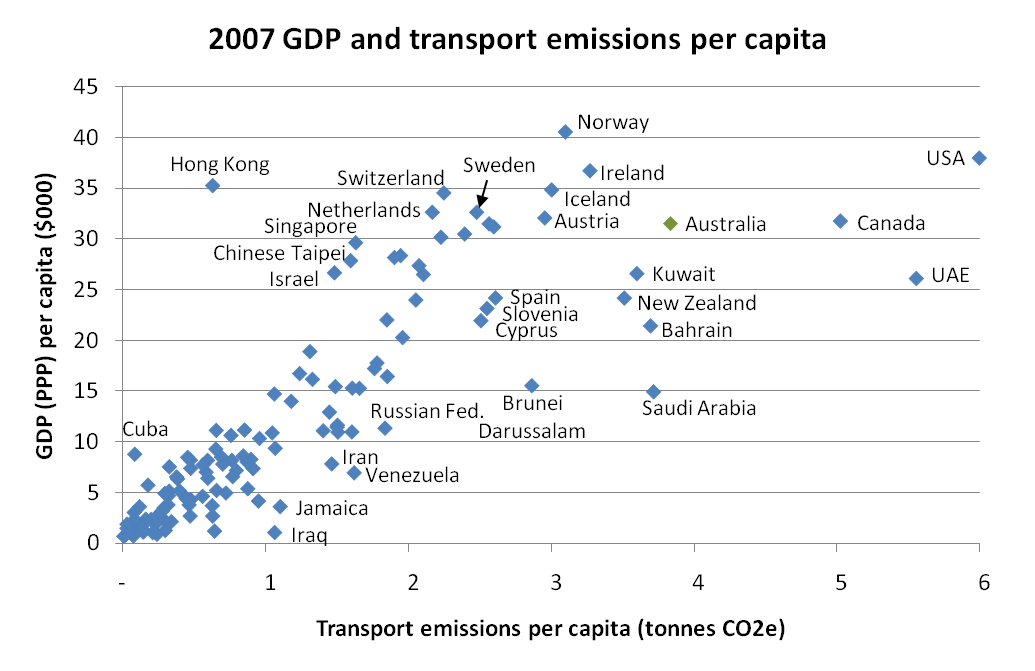
The following chart cuts out the high outliers and zooms into the bottom left corner:

Some interesting patterns appear with regard to countries not in the “main correlation” (if you will):

  • Many countries with higher emissions to wealth ratios have large oil industries (and often high petrol price subsidies). Eg Saudi Arabia, UAE, Brunei, Venezuela, Iraq, Bahrain, Iran.
  • Most countries with high wealth and lower emissions are small in size (Hong Kong being near the extremes for size and wealth).
  • Cuba, which lost its supply of oil from the Soviet support in 1989, is known for a dramatic transformation to reduce oil dependence. Cuba is showing somewhat modest wealth (slightly above the global median) with low transport emissions per capita.
  • The rich English-speaking countries of USA, Canada, New Zealand and Australia show high emissions per capita compared with other similarly wealthy countries. They could use the excuse of a large land mass, but this is less applicable to New Zealand. So is the high emissions a product of geographic size (note the Russian Federation shows relatively high transport emissions relative to wealth), and/or is it a product of unsustainable transport patterns? (those four countries being very car dependent for urban transport). Probably both I suspect.

Does this show countries that might be leaders at decoupling wealth from transport emissions?

Of the “non-tiny” states, Israel, Netherlands, Chinese Taipei, Switzerland and Sweden seem to be doing fairly well. The Netherlands is world-renowned for having high rates of cycling and I know the Netherlands, Switzerland, and Sweden have excellent public transport networks. I don’t know much about transport in Israel and Chinese Taipei.

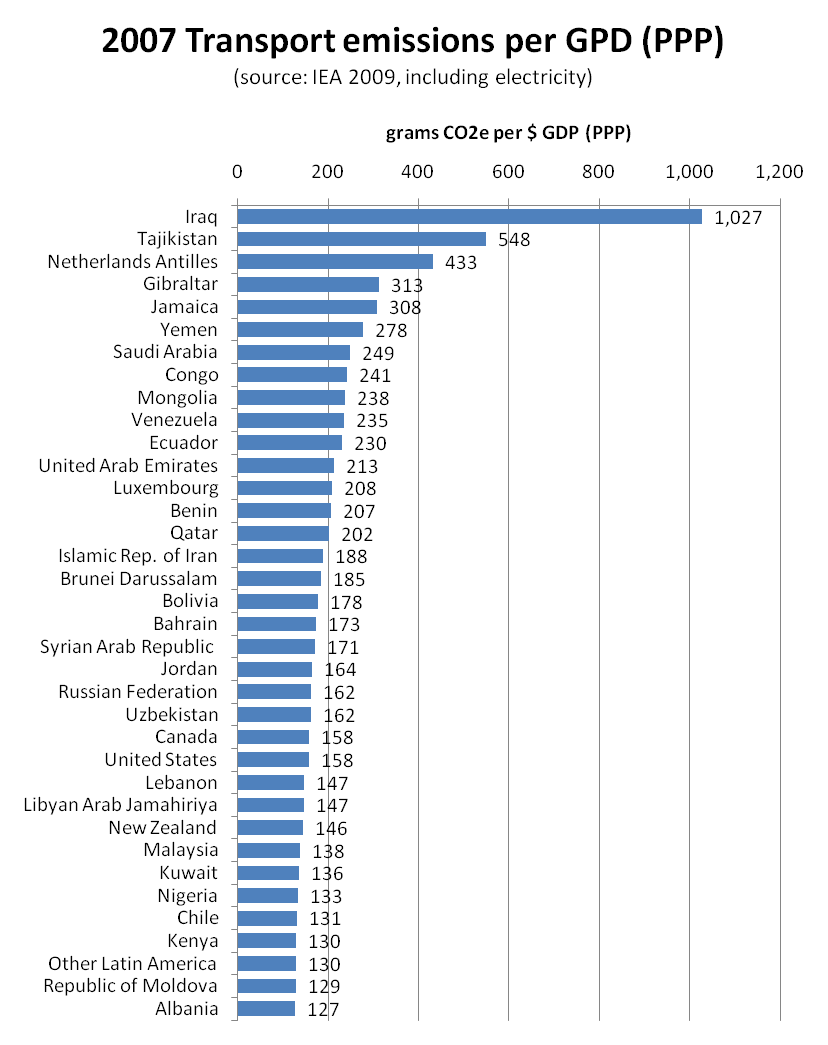
Another look at this is the ratio of transport emissions to GDP (PPP):

Again a lot of oil states appear high in this list (Australia comes in at 121 g/$). Interestingly, the Congo appears high in the list – perhaps because it has such a small GDP. But I am not sure that too many more conclusions can be drawn from this data.

International aviation emissions

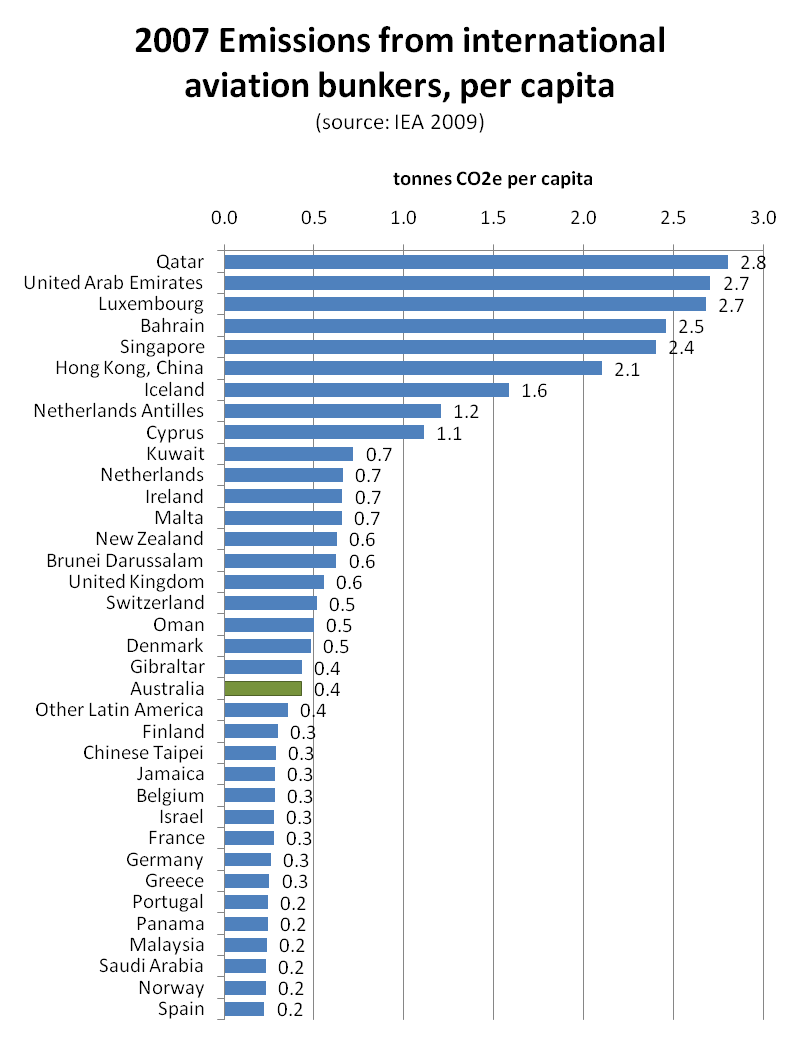
Finally, emissions from international aviation bunkers (that make up around 6% of global transport emissions) but are not included in country emissions figures:

Many of the top countries in this list are major international aviation hubs, eg Qatar, UAE, Singapore, Hong Kong. Assigning these emissions to those countries is probably unfair if a large proportion of the passengers are travelling through. But it does highlight their dependence on the very carbon intensive industry of international aviation.

Other countries are island states where water-based passenger transport is less competitive – eg Iceland, Netherlands Antilles, Cyprus, Ireland, New Zealand, UK, Malta. Others appear to simply be wealthy countries – eg Luxemburg, Bahrain, Kuwait, Netherlands.

Emissions from international marine bunkers make up around 9% of global transport emissions, according to the data.


Which trips are shifting modes in Melbourne?

Sun 20 June, 2010

We know there has been a strong shift to public transport in Australian cities, but which trips are changing modes?

I thought it worth examining Melbourne journey-to-work data from the ABS census for years 2001 and 2006 to look for patterns. Although much of the recent mode shift has occurred post 2006, this analysis still provides insights into the earlier mode shift that started in Melbourne around 2004.

I’ve specifically looked at trips with and between concentric rings of Melbourne, to keep the analysis relatively simple.

Note that journeys to work only represent around 27-30% of weekday trips in Melbourne (depending whether you measure trips or trip legs), so this isn’t a complete look at travel. However, the census does provide an extremely comprehensive dataset as pretty much the entire population was captured.

This isn’t a short post, so grab a cuppa. The second last chart is possibly the most interesting. And apologies that not all charts are easy to read as I haven’t quite mastered the best way to import charts into WordPress. Click on charts to see a larger cleaner version.

Defining regions:

Firstly, I’ve used the following definitions of “city” (or inner city), “inner” (or inner suburbs), “middle” and “outer” Melbourne:

(Note: these region definitions are quite different to those used in another post on urban sprawl and consolidation which had larger “inner” and “middle” regions).

Melbourne’s trams generally service the inner city and inner suburbs, while buses mostly service the inner, middle and outer suburbs. The metropolitan train network is shown in blue.

Note: this post looks at journeys to work between these rings, and not journeys that start or finish outside the Melbourne Statistical District. I don’t see this as an issue as I’m not trying to represent total Melbourne mode shares.

Total journey to work volumes

The journey to work data includes 1.25 million trips, 115,890 from the “city”, 191,556 from the “inner”, 442,282 from the “middle” and 498,595 from the “outer”.

To start the analysis, the following two charts shows the number of trips between each ring of Melbourne:

The next chart shows the change in number of journeys between each ring:

There has been a significant growth in trips from the outer suburbs (in line with population growth).

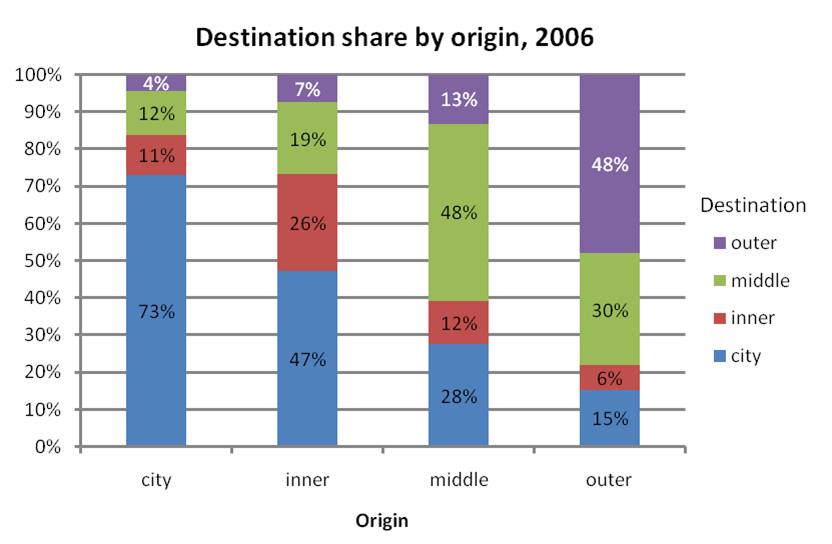
The next two charts show the 2006 flows looking at the destination share of each origin ring (adds to 100% for each “from region”), and as origin share for each destination ring (adds to 100% for each “to region”):
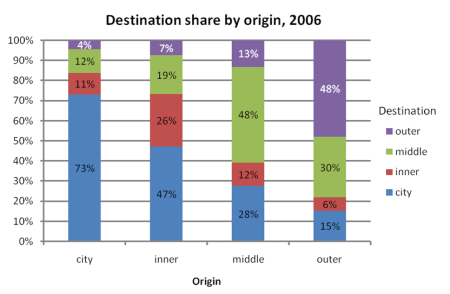
Some observations:

  • The largest movements are within the middle and outer suburbs, and to the city and inner suburbs.
  • People in the middle and outer suburbs are more likely to work in the inner city than the inner suburbs. Perhaps because it is easier to get to the inner city.
  • The middle suburbs are the biggest source of inner city workers (33%). Little wonder the trains are under stress.
  • Few people in the inner city and suburbs commute to the middle and outer suburbs, but there has been an increase in the number of people in the middle suburbs commuting to the outer suburbs.

Public transport mode shares

The following chart shows the public transport mode share for trips between the rings (those being any trip involving public transport):

Not surprisingly:

  • Public transport has a high mode share for trips to the inner city, but less so for people coming from the outer suburbs. Other evidence I have seen shows consistently high public transport mode share for trips to the CBD and surrounds, so this would probably suggest lower public transport mode share to the inner city outside vicinity of the CBD (remember from the above that “inner city” includes several local government areas).
  • Public transport mode share is higher for origins and destinations closer to the city centre, where service levels are more attractive than the middle and outer suburbs.
  • Public transport mode share for trips wholly within the middle and outer suburbs is very low. This presents challenges for the new Central Activities Districts, which will need higher quality public transport to avoid heavy car dependence.

The next chart shows the change in public transport mode share between 2001 and 2006:
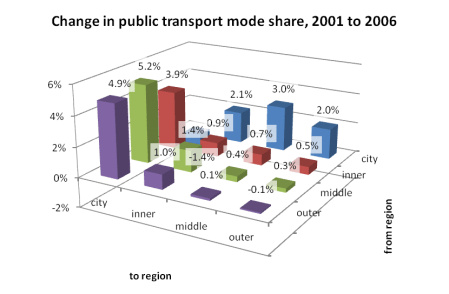
Observations:

  • The biggest shifts have occurred for trips to the inner city from the suburbs.
  • The next biggest mode shifts have been for outward trips from the inner city to the suburbs – although these are small in number.
  • Following that there have been small mode shifts to public transport for trips to the inner suburbs.
  • The figures actually suggest a 1.4% decline in public transport mode share for trips wholly within the inner city, even though there were around 3000 more such journeys in 2006. More on this follows below.
  • There was very little mode shift for journeys within the middle and outer suburbs, where public transport service levels are relatively low.

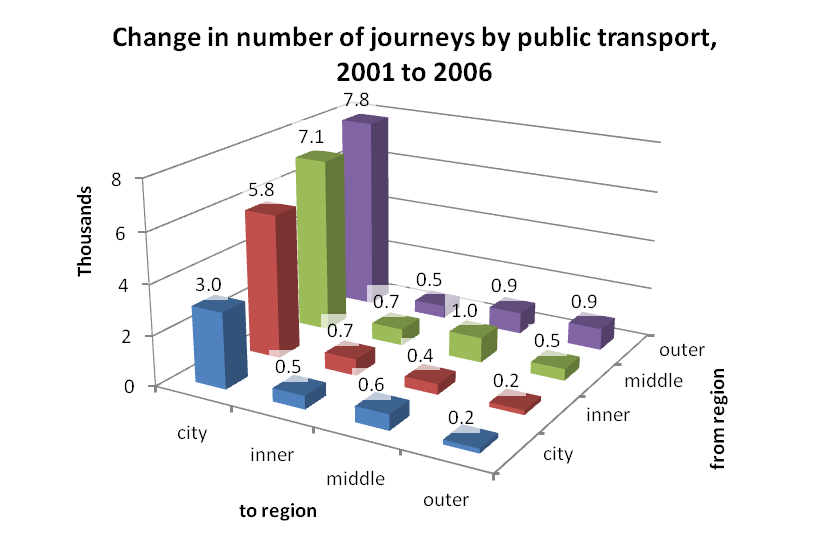
Looking at percent mode shares is not the fully story, as it depends on the volumes. The following chart shows the absolute change in trips by public transport between 2001 and 2006:

The chart shows significant growth in public transport trips to the inner city, particularly from the suburbs.

The following charts look at the increase in journeys involving each mode of public transport.

The biggest growth in train journeys has been from the outer suburbs to the inner city, followed by the middle and inner suburbs. This is consistent with evidence in another post that suggests train patronage is strongly linked to CBD employment.

Interestingly, this chart shows that additional journeys involving trams come from all parts of Melbourne. I would suggest this would be a combination of people living in the inner city and suburbs using nearby trams to get to jobs in the inner city, as well as people using trains from all parts of the city and transferring onto trams for the final leg to work. Melbourne’s multi-modal time-based ticketing removes any cost barrier from making such transfers – something still largely lacking in Sydney (is this a reason why there has been less mode shift in Sydney?).

You can also see an increase in train and tram usage for trips wholly within the inner city – despite the mode shift away from public transport in the inner city. This suggests the growth in public transport use from the inner city is being swamped by the growth in people walking and cycling to work (refer to charts on private car mode share below).

These generally small figures probably reflect the growth in population in the outer suburbs, more than anything else. However there is a notable increase in the use of buses by outer suburban commuters for trips to the inner city – suggesting more use of buses to access train stations (as very few outer suburban buses travel to the inner city).

Buses primarily serve the middle and outer suburbs of Melbourne, but they do aim to feed the train network. These figures suggest just 500 of the 7400 additional commuters from the outer suburbs to the inner city got to the station by bus. The average AM peak bus headway in the outer suburbs of Melbourne is over 40 minutes – which probably explains why new train users are not using buses to get to the station!

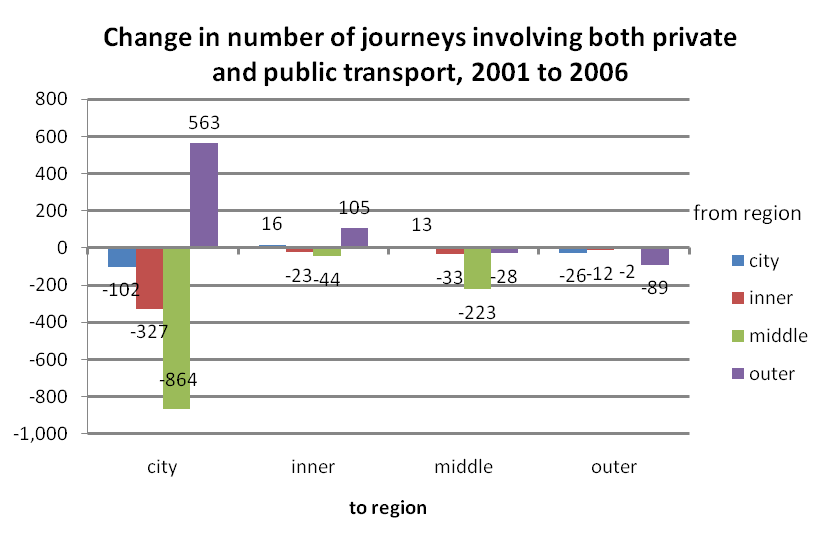
But curiously the data also shows only around 560 extra trips using both public and private transport to travel from the outer suburbs to the inner city, suggesting the other 6900 new commuters walked to stations in the outer suburbs. Perhaps this reflects full car parks at train stations.

This chart might suggest that people from the outer suburbs might be stealing parking places from those in the middle suburbs. However, there is an overall decline of around 1076 in people using private and public transport for journeys to work. As car parks are notorious for being full early on weekdays, this might suggest that the car parks are being used by journeys to places other than work.

For reference, the following chart shows who is using both private and public transport (mostly park and ride, but also car passengers who also used PT (kiss and ride)). I understand there are around 30,000 car parking spaces at Melbourne train stations, and the journey to work data shows around 23,500 car + train journeys to work.
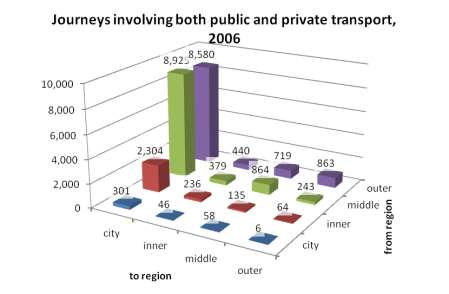
In a future post I plan to look at concentrations of combinations of modes in journeys to work. The results are quite interesting if you know local conditions around Melbourne.

Active transport mode shares

Along the same lines as above, the next charts shows mode shift towards active transport. I have considered a trip active transport if it involves a bicycle, or if it only involves walking.
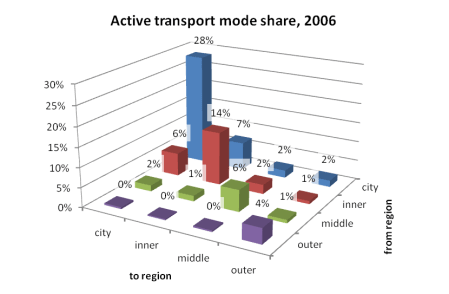
No surprises that active transport trips are generally within the same ring (short trips), and active transport has a higher mode share closer to the city (better cycling facilities and closer origins and destinations). Growth in the number of active transport trips in the outer suburbs probably reflects population growth as much as anything.
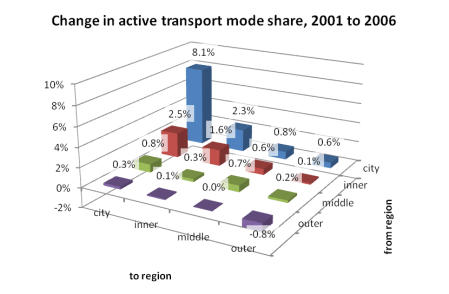
The mode shift has occurred mostly in the inner city, but also for trips from the inner suburbs to the inner city. Perhaps disturbingly, active transport mode share in the outer suburbs has declined, although this is simply growth in non-active transport trips swamping growth in active transport trips:

Of particular interest is the increase in cycling trips, shown in the following chart:

Not surprisingly, the growth is primarily from the inner city and suburbs to the inner city (which has been a major focus on bicycle infrastructure investment).

Private transport

First chart shows private transport mode share by trip type:
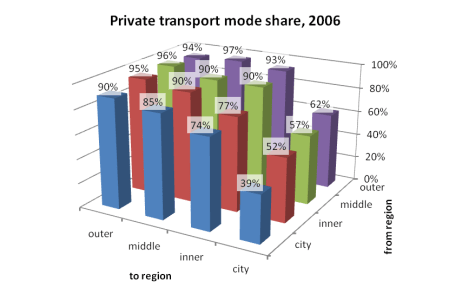
No surprises that private transport has the highest mode share for trips between the middle and outer suburbs, and the lowest mode share for trips to the inner city.

The greatest asymmetry involves trips to and from the inner city. Private transport has a higher mode share for trips from the inner city to the inner suburbs than vice-versa, despite counter-peak public transport service levels still being reasonably good in the AM peak. I’d suggest this probably largely reflects the relative ease of parking in the inner suburbs compared to the inner city, although outbound traffic congestion would also be slightly lower.

There has been an almost universal mode shift away from private transport, as shown in the following chart (note these are mode shifts AWAY from private transport, which is different to other charts in this post):

Again, the biggest mode shifts have been on trips to the inner city (and on the small number of outbound trips from the inner city), and higher closer to the city. There has actually been a mode shift towards private transport in the outer suburbs, which are generally poorly served by public transport, walking and cycling infrastructure. In particular, new suburbs often don’t receive any public transport until well after most residents have moved in.

The above chart also represents the mode shift towards ‘sustainable’ transport modes (walking, cycling and public transport). It shows a more consistent pattern than the mode shift towards public transport. It appears that there is a consistent mode shift to sustainable modes for trips to the inner city, but those originating from the inner city and suburbs are more likely to be a shift to active transport. Or perhaps simultaneous shifts from private to public transport and public to active transport.

Which leads to perhaps the most interesting chart in this post:

  • According to the data, there were 6 (yes, just six) less private transport trips within the inner city (although this number is certainly not precise due to ABS’s randomisation introduced to protect privacy).
  • There was a net decline in the number of private transport trips from the inner and middle suburbs to the inner city.
  • There were almost 11,000 additional private transport trips from the outer suburbs to the inner city. These create maximum congestion and probably reflect the low public transport service levels in the outer suburbs, and the lack of jobs in the outer suburbs for the new residents.
  • The 100,000 additional private transport trips from the outer suburbs largely reflects the large population growth.

This is entirely consistent with the trends of traffic volume’s on Melbourne’s roads, which show stagnation of inner metropolitan traffic volumes. Further evidence that mode shift to public transport is preventing congestion from getting a lot worse.

Mode share of new trips

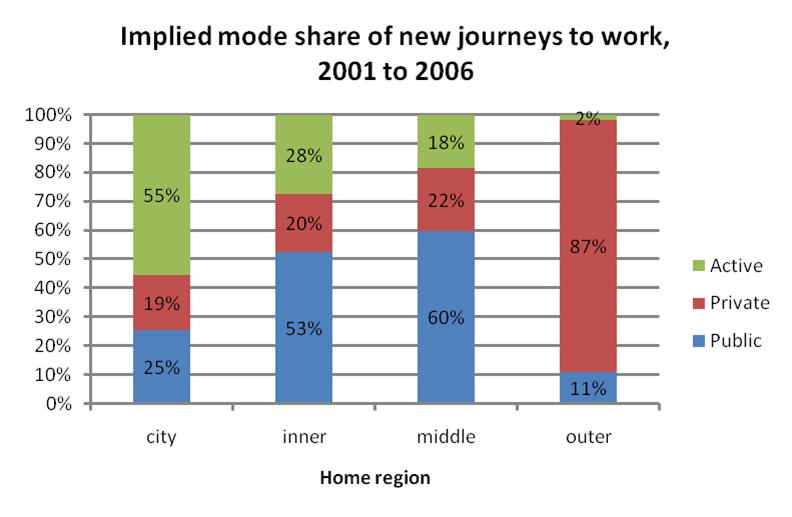
The following chart looks at the mode share of the absolute increase in journeys from each region. It essentially assumes that the existing population haven’t changed modes, but the new residents have chosen a different set of modes, which of course is very unlikely to be the case. But it does show the share of the growth in trips for region – for example, for every 100 new trips in the inner suburbs, only 20% of them were by private transport.

It shows that growth in active transport trips has dominated the inner city, while growth in public transport trips has dominated the inner and middle suburbs. Meanwhile, private transport has dominated the growth in trips in the outer suburbs. This is a very worrying statistic given half of Melbourne’s urban growth is in the outer suburbs.

Further reading:

Transport Demand Information Atlas for Victoria 2008, Volume 1,  Department of Transport

Travel to work in Australian capital cities, 1976-2006: an analysis of census data, Paul Mees, Eden Sorupia & John Stone, December 2007

I plan to make another post soon looking at the spatial distribution of mode use in journey to work. Stay tuned.

Illustrating the perverse Fringe Benefits Tax statutory formula for employer-provided cars

Sun 9 May, 2010

There was a chart on page 10 of the recently released Henry Tax Review Overview report that really caught my attention. It shows the kms travelled by employer-provided cars in Australia.

The massive spikes are a result of rate thresholds in the much-despised Fringe Benefits Tax (FBT) statutory formula for employer-provided cars, where travelling more kilometres often reduces your total costs.

In this method, the taxable value of the fringe benefit is essentially a percentage of the value of the car, and the percentage used depends on the total kms travelled each year:

  • Less than 15,000km – 26%
  • 15,000 – 24,999km – 20%
  • 25,000 – 40,000km – 11%
  • Over 40,000km  – 7%

These are not marginal rates, because the kms travelled is not directly used in the calculation of taxable value. Hence getting into the next bracket reduces your rate and your total tax bill, despite the marginal increase in direct running costs. This is utterly perverse as it provides an incentive for people to drive more kms, increasing congestion and greenhouse emissions!

There is also an operating costs method where the taxable value is essentially the proportion of running costs that were for private use (which is actually quite logical!). People are currently free to choose whichever method involves paying less tax. If there is a lot of personal use, then the statutory formula is often the way to go (travelling to and from work is generally classed as private travel).

So I’ve looked at the total cost of car ownership for a $35,000 car that has per-km costs of 17 cents per km, and standing costs of $167 per week (roughly the running costs of a Holden Commodore according to the RACV), using the fringe benefits tax rate of 46.5%. I’ve also assumed 70% private use when using the operating costs method.

The following chart shows the net running cost of such a vehicle, depending on the annual kms travelled, by both the statutory formula and operating cost methods:

You can see the step reductions in total costs when reaching each threshold in the statutory formula. In this example:

  • Driving 15,000 kms instead of 14,999 kms saves you $976
  • Driving 25,000 kms instead of 24,999 kms saves you $1465
  • Driving 40,000 kms instead of 39,999 kms saves you $488

These are big incentives to drive more kms!

You can also see that the operating costs method is not particularly attractive if most of the car’s use is private.

The FBT year ends March 31st each year. So is there evidence of big driving holidays in March each year as people try to get their kms over the next threshold?

The following chart shows the average monthly automotive gasoline sales for Australia for the period 2005-2009 (Source: Australian Petroleum Statistics). March stands out as the second highest month of the year for automotive fuel sales.

The FBT statutory formula might be responsible for the high average March figure, but I am a little reluctant to make that conclusion because I just don’t know enough about the other influences on monthly fuel sale volumes in Australia. Perhaps someone more knowledgeable than me could comment.


Public transport mode share – according to household travel surveys

Sat 10 April, 2010

[post revised and updated October 2012 with new data from Sydney, Brisbane, and New Zealand]

Arguably the best source of public transport mode share statistics is from household travel surveys that are conducted in most large Australia cities and all of New Zealand (unfortunately some surveys more regularly than others). A common measure is public transport’s share of motorised trips (although public transport will also be competing with unmotorised transport modes).

In household travel survey speak, a linked trip is a journey between two distinct non-travel activities, and may involve several trip legs or unlinked trips. For example, if you walk to a bus stop, catch a bus to the train station, then catch a train to the city, then walk to your workplace, that is one linked trip made up of 4 unlinked trips (walk, bus, train, walk). Similarly if you drive from your home to your workplace, that’s one linked trip made up of one unlinked trip (unless you decide to count walking to and from the car). Hence mode share figures that relate to unlinked motorised trips will always be higher than mode share figures that relate to linked trips.

The data I have been able to obtain for cities is sometimes linked trips, sometimes unlinked trips, and sometimes both. It should be possible to get figures for both for any city, and I hope to obtain such data from state transport agencies in the future.

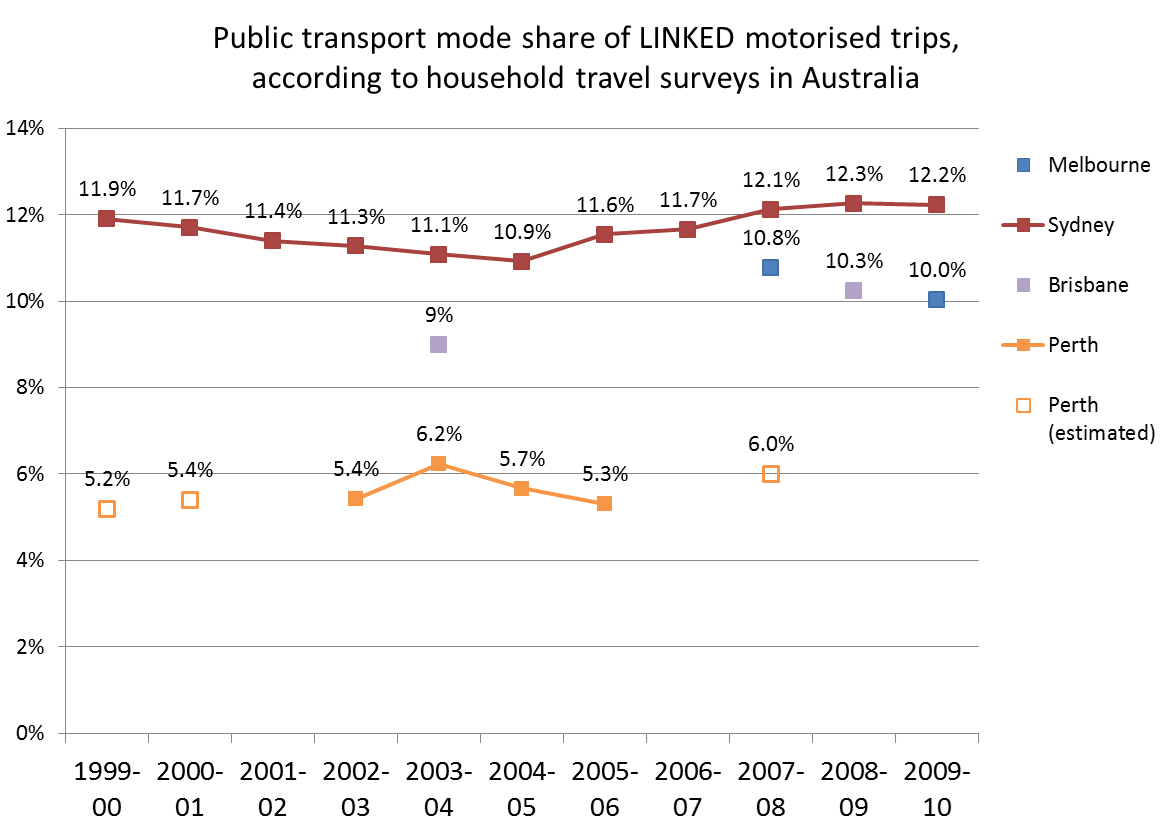
Here is the data I have for linked trips:

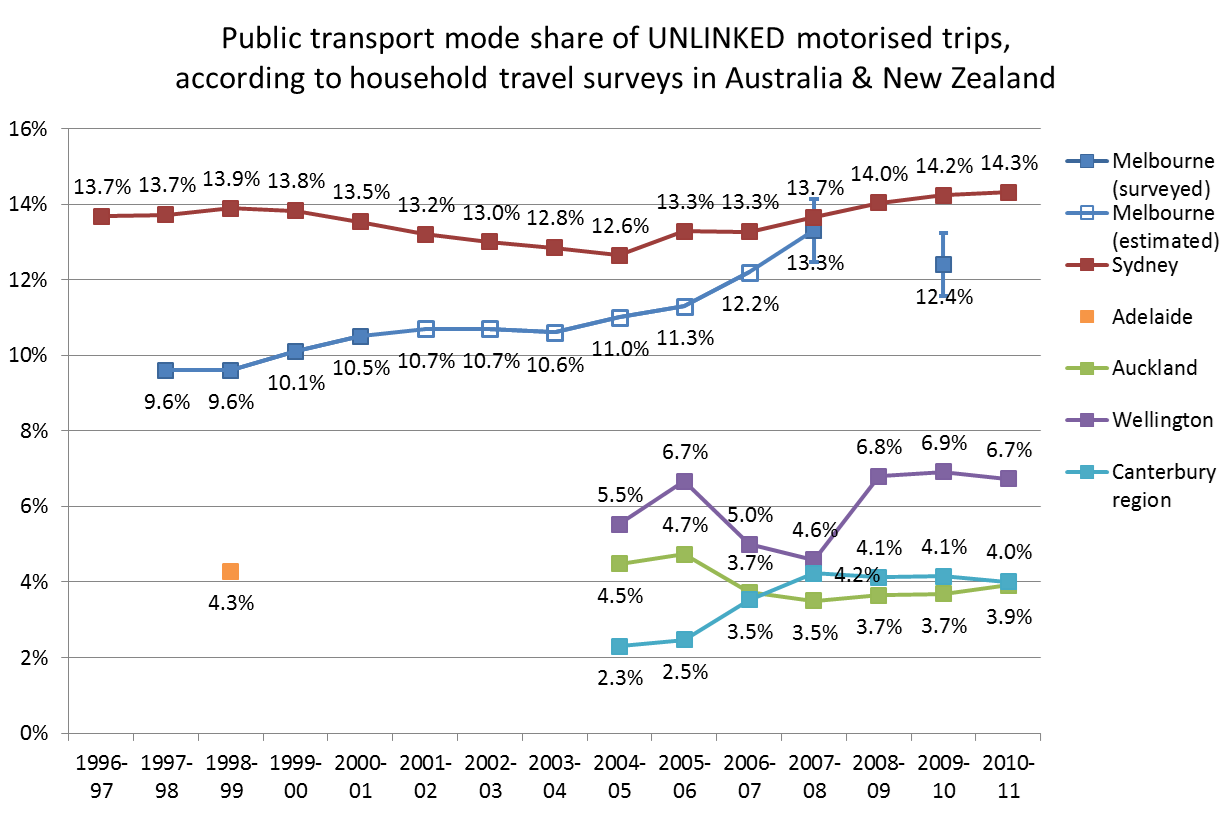
And here are the results for unlinked trips:

The Melbourne and Sydney measures are for weekdays only, whereas the New Zealand data appears to be for all days of the year.

In 2008, Melbourne appeared on track to overtake Sydney on unlinked trip public transport mode share, however the 2009-10 result for Melbourne was lower than predicted. Note that the error bars on the 2007-08 and 2009-10 VISTA survey results for Melbourne indicate the actual mode share might not have actually gone down significantly (similar error bars would apply to the linked trip data points). Over the same period public transport patronage grew by 11% and arterial road traffic grew by around 1.2%.

How reliable is this data?

Given that most household travel surveys interview thousands of households in any one year, the results should be pretty accurate for a high level reported figure such as mode share of trips. Household travel survey techniques have matured over the years, so it is likely they are reasonably reliable (particularly more recent results in larger cities).

The Perth survey data for 2003 to 2006 does not correlate with public transport patronage figures, that show a 12% growth over the same period.

For Brisbane 2003-04 I had to add whole number shares for each mode and divide by the sum of motorised mode shares. So there is some uncertainty about the precise motorised mode share.

The Melbourne official estimates for 2002-2007 were calculated using VicRoads traffic data, and public transport patronage figures.

(For more detail see the end of this post).

Linked or unlinked trips?

Calculating mode share based on linked trips removes the impact of public transport transfers. Cities where the public transport network is structured around feeder services with free transfers (eg bus to train) may have more public transport boardings (unlinked trips) than cities where transfers are “less encouraged” by the network design and fare systems (eg Wellington, Auckland, Sydney).

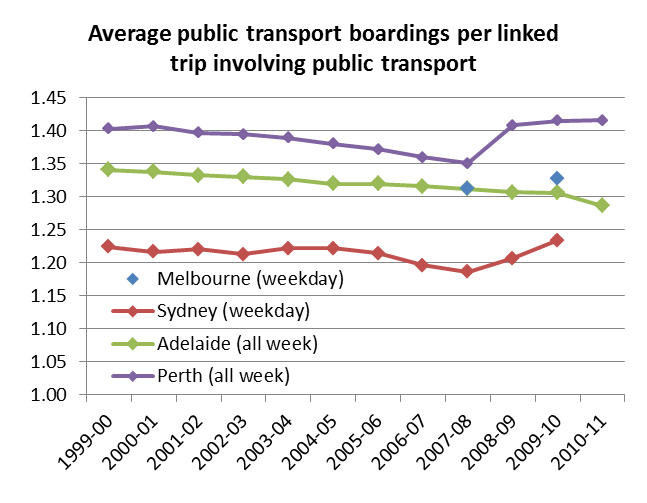
In fact, here is a chart showing the ratio of unlinked to linked public transport trips for four cities where I have data:

The Perth and Adelaide data is based on patronage figures that are reported as ‘initial boardings’ and ‘all boardings’. Annual reports comment that recent through-routing of bus services through the Adelaide CBD may have reduced the number of transfer boardings. You can see the transfer rate for Perth jumped after the southern suburbs railway opened at the end of 2007 (replacing many CBD bus routes with train feeder bus routes).

The Perth, Adelaide and Melbourne public transport fare systems are dominated by products that allow unlimited transfers within a time window (anywhere from 2 hours to 365 days). So while there may be a time and convenience penalty for transferring between two services, there is no financial penalty. Sydney’s public transport fare system has largely involved tickets for a single trip and/or one mode, such that another fare must be paid to transfer. Sydney’s CBD is also served by seemingly hundreds of bus routes – many of which parallel train lines – which enable people to travel to the city without having to transfer onto trains and pay a higher fare (even if that could provide a faster over journey).

The lower Sydney transfer rate partly explains why Melbourne and Sydney are much closer on mode share of unlinked trips, compared to mode share of linked trips. Network design will probably also have an impact.

There was a slight dip in the trend for Sydney around 2007-08 followed by a rise. I’m not sure what might explain that trend – the revamp of the fare system in April 2010 (introducing more multi-modal and multi-operator tickets) may have had a small impact on the 2009-10 figure.

The difference in these rates suggests that there could be quite substantial change in Sydney public transport use patterns should the fare system be revised to make free transfers the norm. Perhaps this might help ease the bus congestion issues in the CBD and allow higher bus frequencies in the suburbs? (assuming there is capacity to transfer bus passengers onto trains in the suburbs). There is one small area of Sydney where train+bus link tickets are available (no fare penalty for transferring), and the census data reveals a very significant rate of bus+train journeys to work in the Bondi Beach area, much higher than anywhere else in Sydney.

Other measures of public transport mode share

In another post, I looked at BITRE data on estimated passenger kms per mode in Australian cities (presumably calculated using patronage figures and average trip lengths from household travel survey data or elsewhere). That enabled calculation of estimated public transport mode share of motorised passenger kilometres, with continuous time series available for all Australia cities. However there will be many assumptions involved in these estimates.

Another measure is boardings per capita (covered here), although this also has the problem of different transfer rates in different cities.

The quest for a fair measure of public transport use continues!

Household travel survey sources:

Melbourne: Victorian Department of Transport (personal communications), but also available in the Growing Victoria Together Progress Report (page 387), in the 2009-10 Victorian State Budget Papers. Figures until 2001 were from the VATS survey, while the 2008 result is from the VISTA survey.

Sydney Household Travel Survey: Data was supplied by NSW Transport Data Centre by email. Public transport trips are inclusive of trains, buses, ferries, monorail and light rail.

Adelaide Household Travel Survey (AHTS): Adelaide Travel Patterns: an overview (if anyone can tell me about whether more recent surveys have been conducted I would be very appreciative, better still if I can get results data!).

South East Queensland Travel Survey: Brisbane Fast Facts Brochure (unclear dating, but PDF was created in 2006 so I assume the results are for 2003-04. The report does not mention whether these are mode shares for trips or kms, however it seems highly likely they are for trips as the walking mode share was 10% and we know walking trips are generally shorter than motorised trips). I also have results for 2008-09 courtesy of Ian Wallis and Associates. I unfortunately do not yet have results for the 2006-2008 survey.

Perth and Regions Travel Survey (PARTS): Data is from the PARTS Key Findings Report (by Data Analysis Australia). The  2003-2006 results are from PARTS, the 2000 figure is a TravelSmart estimate, and 2001 and 2008 estimates are from unspecified sources.

The New Zealand Household Travel Survey: Because of sample sizes, the figures for the New Zealand cities are two years combined (ie the “2010” figure is for 2008/09 and 2009/10). The Canterbury region includes Christchurch as well as a not insignificant surrounding population. The Auckland region is more similar to the Australian cities statistical divisions. The Wellington figures are for the Wellington Region, but are dominated by metropolitan Wellington.