Which trips are shifting modes in Melbourne?

Sun 20 June, 2010

We know there has been a strong shift to public transport in Australian cities, but which trips are changing modes?

I thought it worth examining Melbourne journey-to-work data from the ABS census for years 2001 and 2006 to look for patterns. Although much of the recent mode shift has occurred post 2006, this analysis still provides insights into the earlier mode shift that started in Melbourne around 2004.

I’ve specifically looked at trips with and between concentric rings of Melbourne, to keep the analysis relatively simple.

Note that journeys to work only represent around 27-30% of weekday trips in Melbourne (depending whether you measure trips or trip legs), so this isn’t a complete look at travel. However, the census does provide an extremely comprehensive dataset as pretty much the entire population was captured.

This isn’t a short post, so grab a cuppa. The second last chart is possibly the most interesting. And apologies that not all charts are easy to read as I haven’t quite mastered the best way to import charts into WordPress. Click on charts to see a larger cleaner version.

Defining regions:

Firstly, I’ve used the following definitions of “city” (or inner city), “inner” (or inner suburbs), “middle” and “outer” Melbourne:

(Note: these region definitions are quite different to those used in another post on urban sprawl and consolidation which had larger “inner” and “middle” regions).

Melbourne’s trams generally service the inner city and inner suburbs, while buses mostly service the inner, middle and outer suburbs. The metropolitan train network is shown in blue.

Note: this post looks at journeys to work between these rings, and not journeys that start or finish outside the Melbourne Statistical District. I don’t see this as an issue as I’m not trying to represent total Melbourne mode shares.

Total journey to work volumes

The journey to work data includes 1.25 million trips, 115,890 from the “city”, 191,556 from the “inner”, 442,282 from the “middle” and 498,595 from the “outer”.

To start the analysis, the following two charts shows the number of trips between each ring of Melbourne:

The next chart shows the change in number of journeys between each ring:

There has been a significant growth in trips from the outer suburbs (in line with population growth).

The next two charts show the 2006 flows looking at the destination share of each origin ring (adds to 100% for each “from region”), and as origin share for each destination ring (adds to 100% for each “to region”):
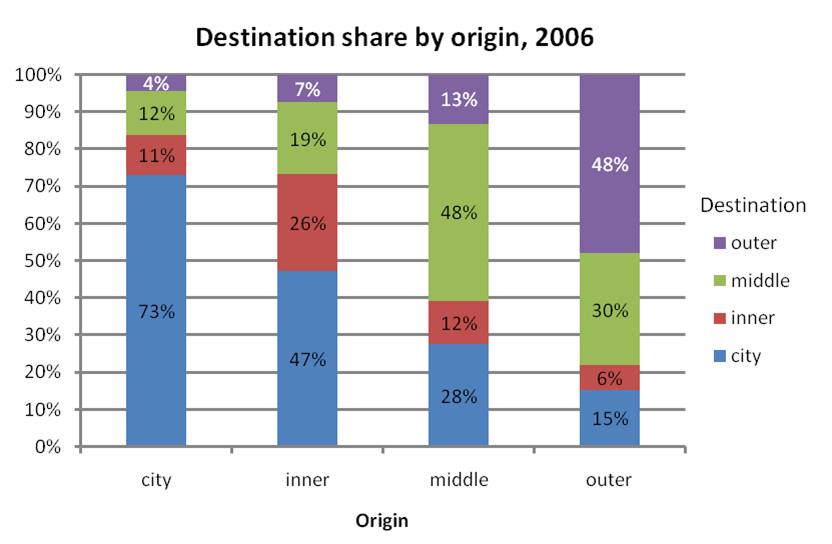
Some observations:

  • The largest movements are within the middle and outer suburbs, and to the city and inner suburbs.
  • People in the middle and outer suburbs are more likely to work in the inner city than the inner suburbs. Perhaps because it is easier to get to the inner city.
  • The middle suburbs are the biggest source of inner city workers (33%). Little wonder the trains are under stress.
  • Few people in the inner city and suburbs commute to the middle and outer suburbs, but there has been an increase in the number of people in the middle suburbs commuting to the outer suburbs.

Public transport mode shares

The following chart shows the public transport mode share for trips between the rings (those being any trip involving public transport):

Not surprisingly:

  • Public transport has a high mode share for trips to the inner city, but less so for people coming from the outer suburbs. Other evidence I have seen shows consistently high public transport mode share for trips to the CBD and surrounds, so this would probably suggest lower public transport mode share to the inner city outside vicinity of the CBD (remember from the above that “inner city” includes several local government areas).
  • Public transport mode share is higher for origins and destinations closer to the city centre, where service levels are more attractive than the middle and outer suburbs.
  • Public transport mode share for trips wholly within the middle and outer suburbs is very low. This presents challenges for the new Central Activities Districts, which will need higher quality public transport to avoid heavy car dependence.

The next chart shows the change in public transport mode share between 2001 and 2006:

Observations:

  • The biggest shifts have occurred for trips to the inner city from the suburbs.
  • The next biggest mode shifts have been for outward trips from the inner city to the suburbs – although these are small in number.
  • Following that there have been small mode shifts to public transport for trips to the inner suburbs.
  • The figures actually suggest a 1.4% decline in public transport mode share for trips wholly within the inner city, even though there were around 3000 more such journeys in 2006. More on this follows below.
  • There was very little mode shift for journeys within the middle and outer suburbs, where public transport service levels are relatively low.

Looking at percent mode shares is not the fully story, as it depends on the volumes. The following chart shows the absolute change in trips by public transport between 2001 and 2006:
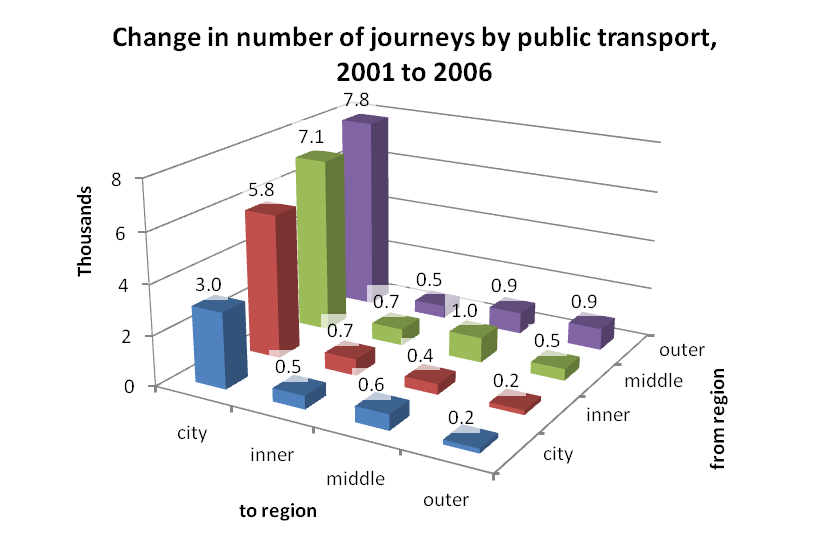
The chart shows significant growth in public transport trips to the inner city, particularly from the suburbs.

The following charts look at the increase in journeys involving each mode of public transport.

The biggest growth in train journeys has been from the outer suburbs to the inner city, followed by the middle and inner suburbs. This is consistent with evidence in another post that suggests train patronage is strongly linked to CBD employment.

Interestingly, this chart shows that additional journeys involving trams come from all parts of Melbourne. I would suggest this would be a combination of people living in the inner city and suburbs using nearby trams to get to jobs in the inner city, as well as people using trains from all parts of the city and transferring onto trams for the final leg to work. Melbourne’s multi-modal time-based ticketing removes any cost barrier from making such transfers – something still largely lacking in Sydney (is this a reason why there has been less mode shift in Sydney?).

You can also see an increase in train and tram usage for trips wholly within the inner city – despite the mode shift away from public transport in the inner city. This suggests the growth in public transport use from the inner city is being swamped by the growth in people walking and cycling to work (refer to charts on private car mode share below).

These generally small figures probably reflect the growth in population in the outer suburbs, more than anything else. However there is a notable increase in the use of buses by outer suburban commuters for trips to the inner city – suggesting more use of buses to access train stations (as very few outer suburban buses travel to the inner city).

Buses primarily serve the middle and outer suburbs of Melbourne, but they do aim to feed the train network. These figures suggest just 500 of the 7400 additional commuters from the outer suburbs to the inner city got to the station by bus. The average AM peak bus headway in the outer suburbs of Melbourne is over 40 minutes – which probably explains why new train users are not using buses to get to the station!

But curiously the data also shows only around 560 extra trips using both public and private transport to travel from the outer suburbs to the inner city, suggesting the other 6900 new commuters walked to stations in the outer suburbs. Perhaps this reflects full car parks at train stations.
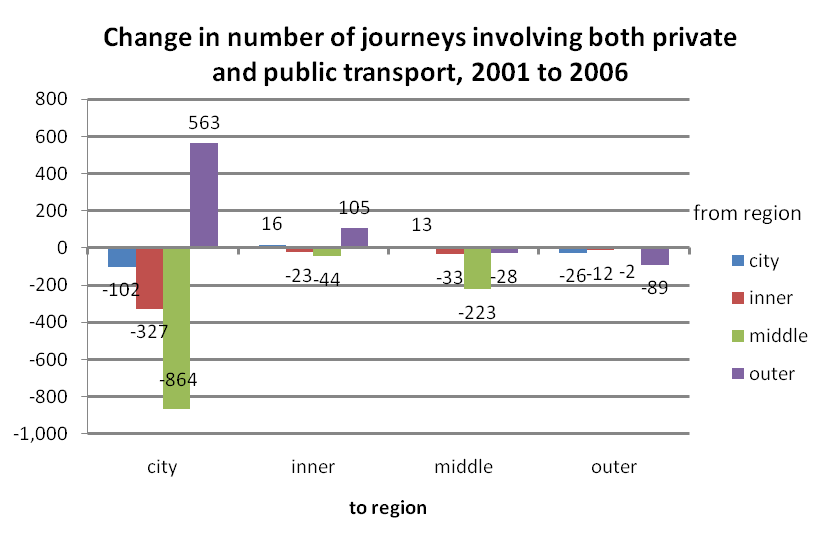
This chart might suggest that people from the outer suburbs might be stealing parking places from those in the middle suburbs. However, there is an overall decline of around 1076 in people using private and public transport for journeys to work. As car parks are notorious for being full early on weekdays, this might suggest that the car parks are being used by journeys to places other than work.

For reference, the following chart shows who is using both private and public transport (mostly park and ride, but also car passengers who also used PT (kiss and ride)). I understand there are around 30,000 car parking spaces at Melbourne train stations, and the journey to work data shows around 23,500 car + train journeys to work.

In a future post I plan to look at concentrations of combinations of modes in journeys to work. The results are quite interesting if you know local conditions around Melbourne.

Active transport mode shares

Along the same lines as above, the next charts shows mode shift towards active transport. I have considered a trip active transport if it involves a bicycle, or if it only involves walking.

No surprises that active transport trips are generally within the same ring (short trips), and active transport has a higher mode share closer to the city (better cycling facilities and closer origins and destinations). Growth in the number of active transport trips in the outer suburbs probably reflects population growth as much as anything.

The mode shift has occurred mostly in the inner city, but also for trips from the inner suburbs to the inner city. Perhaps disturbingly, active transport mode share in the outer suburbs has declined, although this is simply growth in non-active transport trips swamping growth in active transport trips:

Of particular interest is the increase in cycling trips, shown in the following chart:

Not surprisingly, the growth is primarily from the inner city and suburbs to the inner city (which has been a major focus on bicycle infrastructure investment).

Private transport

First chart shows private transport mode share by trip type:

No surprises that private transport has the highest mode share for trips between the middle and outer suburbs, and the lowest mode share for trips to the inner city.

The greatest asymmetry involves trips to and from the inner city. Private transport has a higher mode share for trips from the inner city to the inner suburbs than vice-versa, despite counter-peak public transport service levels still being reasonably good in the AM peak. I’d suggest this probably largely reflects the relative ease of parking in the inner suburbs compared to the inner city, although outbound traffic congestion would also be slightly lower.

There has been an almost universal mode shift away from private transport, as shown in the following chart (note these are mode shifts AWAY from private transport, which is different to other charts in this post):

Again, the biggest mode shifts have been on trips to the inner city (and on the small number of outbound trips from the inner city), and higher closer to the city. There has actually been a mode shift towards private transport in the outer suburbs, which are generally poorly served by public transport, walking and cycling infrastructure. In particular, new suburbs often don’t receive any public transport until well after most residents have moved in.

The above chart also represents the mode shift towards ‘sustainable’ transport modes (walking, cycling and public transport). It shows a more consistent pattern than the mode shift towards public transport. It appears that there is a consistent mode shift to sustainable modes for trips to the inner city, but those originating from the inner city and suburbs are more likely to be a shift to active transport. Or perhaps simultaneous shifts from private to public transport and public to active transport.

Which leads to perhaps the most interesting chart in this post:

  • According to the data, there were 6 (yes, just six) less private transport trips within the inner city (although this number is certainly not precise due to ABS’s randomisation introduced to protect privacy).
  • There was a net decline in the number of private transport trips from the inner and middle suburbs to the inner city.
  • There were almost 11,000 additional private transport trips from the outer suburbs to the inner city. These create maximum congestion and probably reflect the low public transport service levels in the outer suburbs, and the lack of jobs in the outer suburbs for the new residents.
  • The 100,000 additional private transport trips from the outer suburbs largely reflects the large population growth.

This is entirely consistent with the trends of traffic volume’s on Melbourne’s roads, which show stagnation of inner metropolitan traffic volumes. Further evidence that mode shift to public transport is preventing congestion from getting a lot worse.

Mode share of new trips

The following chart looks at the mode share of the absolute increase in journeys from each region. It essentially assumes that the existing population haven’t changed modes, but the new residents have chosen a different set of modes, which of course is very unlikely to be the case. But it does show the share of the growth in trips for region – for example, for every 100 new trips in the inner suburbs, only 20% of them were by private transport.
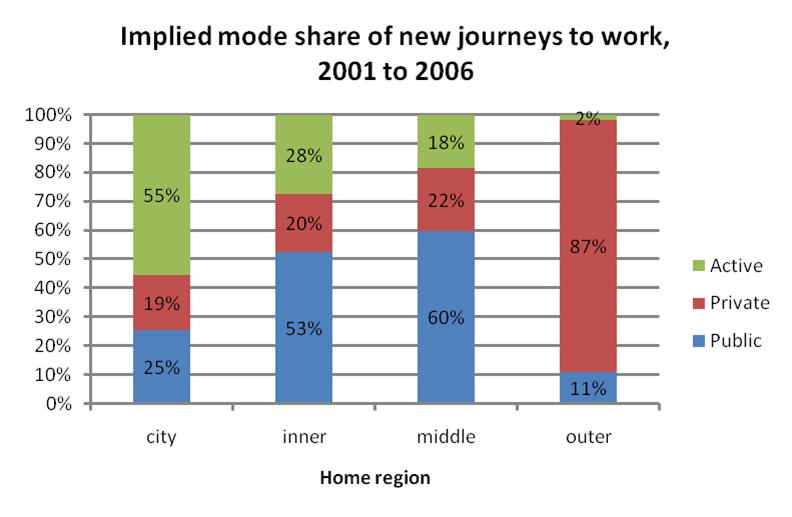
It shows that growth in active transport trips has dominated the inner city, while growth in public transport trips has dominated the inner and middle suburbs. Meanwhile, private transport has dominated the growth in trips in the outer suburbs. This is a very worrying statistic given half of Melbourne’s urban growth is in the outer suburbs.

Further reading:

Transport Demand Information Atlas for Victoria 2008, Volume 1,  Department of Transport

Travel to work in Australian capital cities, 1976-2006: an analysis of census data, Paul Mees, Eden Sorupia & John Stone, December 2007

I plan to make another post soon looking at the spatial distribution of mode use in journey to work. Stay tuned.


Public transport mode share – according to household travel surveys

Sat 10 April, 2010

[post revised and updated October 2012 with new data from Sydney, Brisbane, and New Zealand]

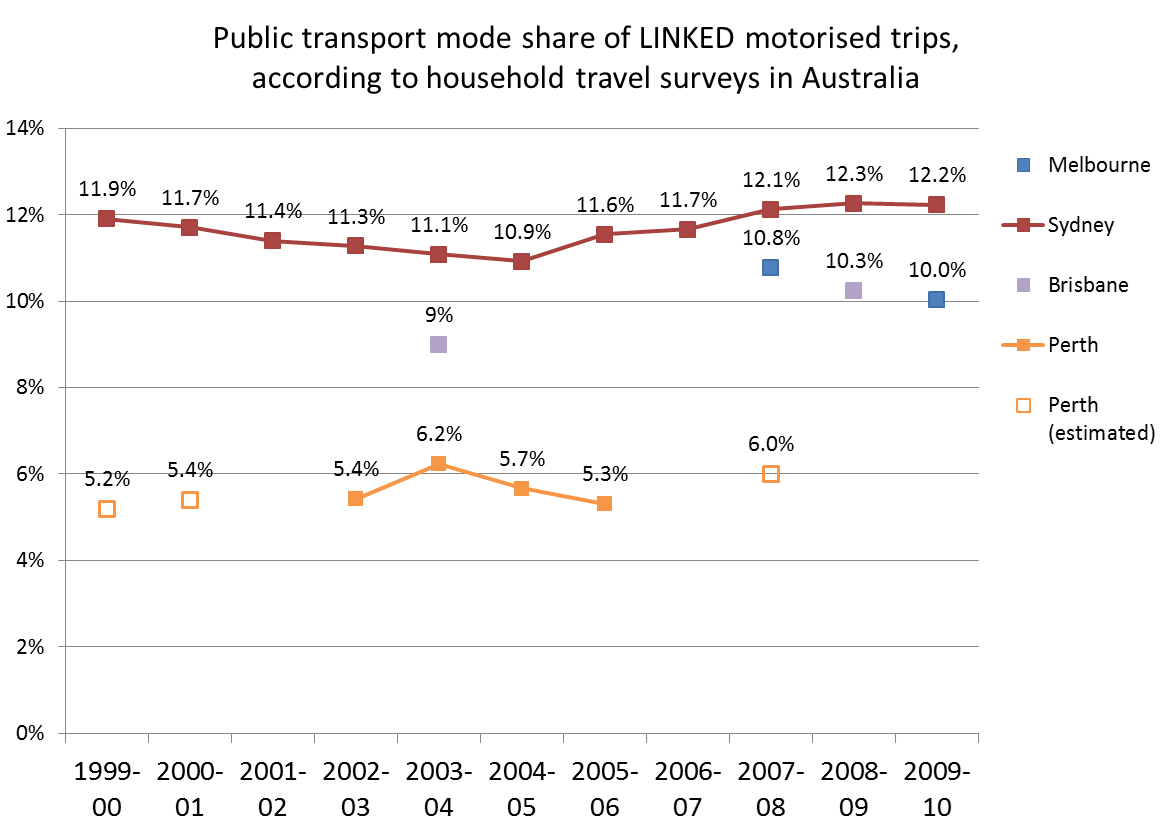
Arguably the best source of public transport mode share statistics is from household travel surveys that are conducted in most large Australia cities and all of New Zealand (unfortunately some surveys more regularly than others). A common measure is public transport’s share of motorised trips (although public transport will also be competing with unmotorised transport modes).

In household travel survey speak, a linked trip is a journey between two distinct non-travel activities, and may involve several trip legs or unlinked trips. For example, if you walk to a bus stop, catch a bus to the train station, then catch a train to the city, then walk to your workplace, that is one linked trip made up of 4 unlinked trips (walk, bus, train, walk). Similarly if you drive from your home to your workplace, that’s one linked trip made up of one unlinked trip (unless you decide to count walking to and from the car). Hence mode share figures that relate to unlinked motorised trips will always be higher than mode share figures that relate to linked trips.

The data I have been able to obtain for cities is sometimes linked trips, sometimes unlinked trips, and sometimes both. It should be possible to get figures for both for any city, and I hope to obtain such data from state transport agencies in the future.

Here is the data I have for linked trips:

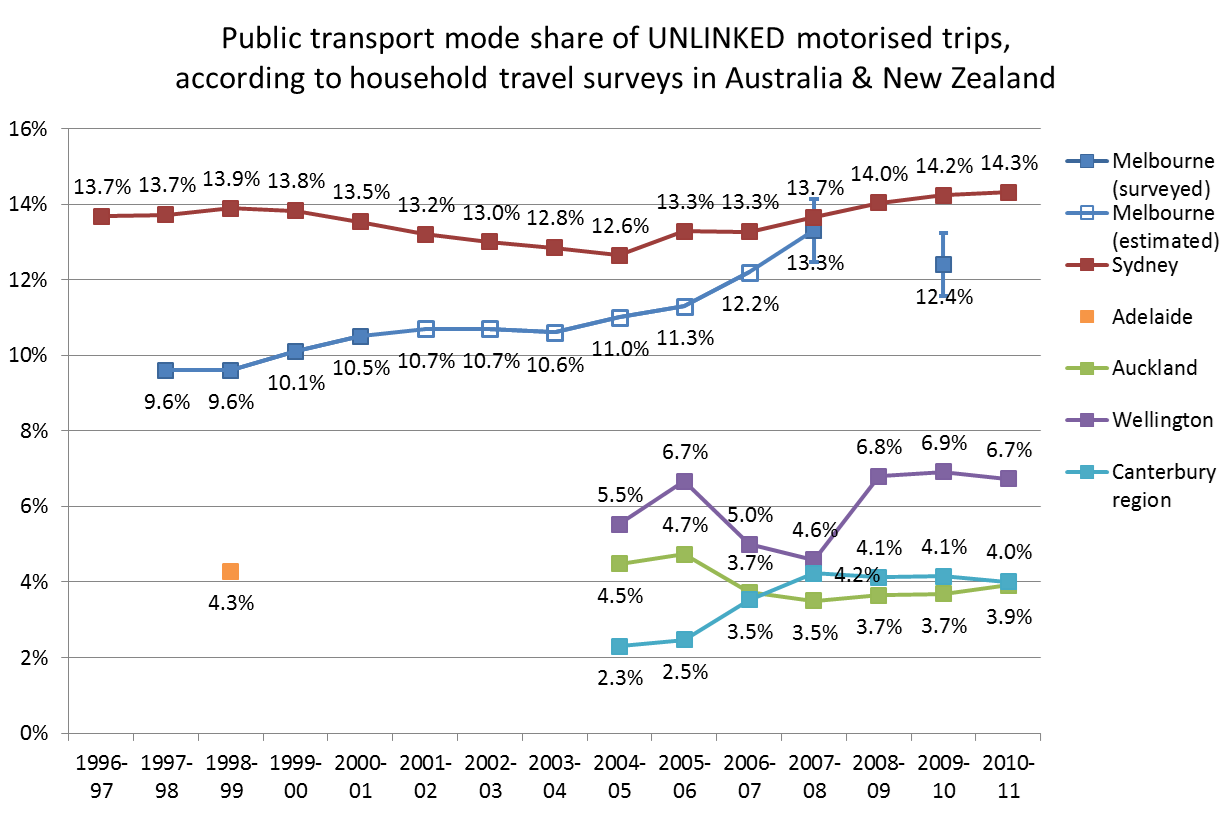
And here are the results for unlinked trips:

The Melbourne and Sydney measures are for weekdays only, whereas the New Zealand data appears to be for all days of the year.

In 2008, Melbourne appeared on track to overtake Sydney on unlinked trip public transport mode share, however the 2009-10 result for Melbourne was lower than predicted. Note that the error bars on the 2007-08 and 2009-10 VISTA survey results for Melbourne indicate the actual mode share might not have actually gone down significantly (similar error bars would apply to the linked trip data points). Over the same period public transport patronage grew by 11% and arterial road traffic grew by around 1.2%.

How reliable is this data?

Given that most household travel surveys interview thousands of households in any one year, the results should be pretty accurate for a high level reported figure such as mode share of trips. Household travel survey techniques have matured over the years, so it is likely they are reasonably reliable (particularly more recent results in larger cities).

The Perth survey data for 2003 to 2006 does not correlate with public transport patronage figures, that show a 12% growth over the same period.

For Brisbane 2003-04 I had to add whole number shares for each mode and divide by the sum of motorised mode shares. So there is some uncertainty about the precise motorised mode share.

The Melbourne official estimates for 2002-2007 were calculated using VicRoads traffic data, and public transport patronage figures.

(For more detail see the end of this post).

Linked or unlinked trips?

Calculating mode share based on linked trips removes the impact of public transport transfers. Cities where the public transport network is structured around feeder services with free transfers (eg bus to train) may have more public transport boardings (unlinked trips) than cities where transfers are “less encouraged” by the network design and fare systems (eg Wellington, Auckland, Sydney).

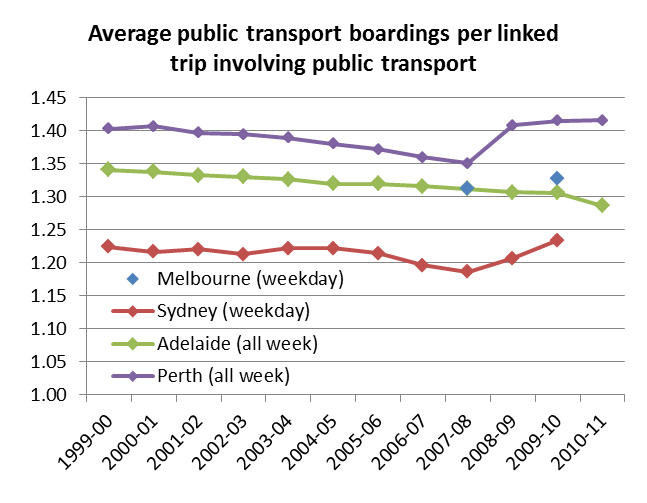
In fact, here is a chart showing the ratio of unlinked to linked public transport trips for four cities where I have data:

The Perth and Adelaide data is based on patronage figures that are reported as ‘initial boardings’ and ‘all boardings’. Annual reports comment that recent through-routing of bus services through the Adelaide CBD may have reduced the number of transfer boardings. You can see the transfer rate for Perth jumped after the southern suburbs railway opened at the end of 2007 (replacing many CBD bus routes with train feeder bus routes).

The Perth, Adelaide and Melbourne public transport fare systems are dominated by products that allow unlimited transfers within a time window (anywhere from 2 hours to 365 days). So while there may be a time and convenience penalty for transferring between two services, there is no financial penalty. Sydney’s public transport fare system has largely involved tickets for a single trip and/or one mode, such that another fare must be paid to transfer. Sydney’s CBD is also served by seemingly hundreds of bus routes – many of which parallel train lines – which enable people to travel to the city without having to transfer onto trains and pay a higher fare (even if that could provide a faster over journey).

The lower Sydney transfer rate partly explains why Melbourne and Sydney are much closer on mode share of unlinked trips, compared to mode share of linked trips. Network design will probably also have an impact.

There was a slight dip in the trend for Sydney around 2007-08 followed by a rise. I’m not sure what might explain that trend – the revamp of the fare system in April 2010 (introducing more multi-modal and multi-operator tickets) may have had a small impact on the 2009-10 figure.

The difference in these rates suggests that there could be quite substantial change in Sydney public transport use patterns should the fare system be revised to make free transfers the norm. Perhaps this might help ease the bus congestion issues in the CBD and allow higher bus frequencies in the suburbs? (assuming there is capacity to transfer bus passengers onto trains in the suburbs). There is one small area of Sydney where train+bus link tickets are available (no fare penalty for transferring), and the census data reveals a very significant rate of bus+train journeys to work in the Bondi Beach area, much higher than anywhere else in Sydney.

Other measures of public transport mode share

In another post, I looked at BITRE data on estimated passenger kms per mode in Australian cities (presumably calculated using patronage figures and average trip lengths from household travel survey data or elsewhere). That enabled calculation of estimated public transport mode share of motorised passenger kilometres, with continuous time series available for all Australia cities. However there will be many assumptions involved in these estimates.

Another measure is boardings per capita (covered here), although this also has the problem of different transfer rates in different cities.

The quest for a fair measure of public transport use continues!

Household travel survey sources:

Melbourne: Victorian Department of Transport (personal communications), but also available in the Growing Victoria Together Progress Report (page 387), in the 2009-10 Victorian State Budget Papers. Figures until 2001 were from the VATS survey, while the 2008 result is from the VISTA survey.

Sydney Household Travel Survey: Data was supplied by NSW Transport Data Centre by email. Public transport trips are inclusive of trains, buses, ferries, monorail and light rail.

Adelaide Household Travel Survey (AHTS): Adelaide Travel Patterns: an overview (if anyone can tell me about whether more recent surveys have been conducted I would be very appreciative, better still if I can get results data!).

South East Queensland Travel Survey: Brisbane Fast Facts Brochure (unclear dating, but PDF was created in 2006 so I assume the results are for 2003-04. The report does not mention whether these are mode shares for trips or kms, however it seems highly likely they are for trips as the walking mode share was 10% and we know walking trips are generally shorter than motorised trips). I also have results for 2008-09 courtesy of Ian Wallis and Associates. I unfortunately do not yet have results for the 2006-2008 survey.

Perth and Regions Travel Survey (PARTS): Data is from the PARTS Key Findings Report (by Data Analysis Australia). The  2003-2006 results are from PARTS, the 2000 figure is a TravelSmart estimate, and 2001 and 2008 estimates are from unspecified sources.

The New Zealand Household Travel Survey: Because of sample sizes, the figures for the New Zealand cities are two years combined (ie the “2010” figure is for 2008/09 and 2009/10). The Canterbury region includes Christchurch as well as a not insignificant surrounding population. The Auckland region is more similar to the Australian cities statistical divisions. The Wellington figures are for the Wellington Region, but are dominated by metropolitan Wellington.


Mapping public transport service provision

Sat 20 March, 2010

Just how much public transport service do people get in different parts of Melbourne? How can you visualise service provision across a city? Here is my attempt.

A measure of PT service provision

Some routes run high frequencies, some run over a long span of hours, some do both. Some routes have lots of short trips that don’t run the full length. How do you translate all this into something that is meaningful?

My preferred measure is simple: (one-direction) departures per stop or station per week. It reflects both span of hours and frequency of service (although it doesn’t differentiate between them). And by calculating this at the stop level, you account for trips that don’t run the full length of the route.

PT service provision in Melbourne

Thanks to the recent release of public transport data by the Victorian government, I’ve been able to calculate the number of public transport departures per week per train, tram and bus stop for all of Victoria as at December 2009, and put them on a map.

Below is a map for the Greater Melbourne area (to see the detail you will need to click to enlarge and then zoom-in further).

Public transport departures per week per stop in greater Melbourne, December 2009

I would love to see similar maps of other cities in Australia, if anyone is able to produce them (happy to host them on this blog). Similar Sydney public transport data is available here, but I haven’t looked to see if enough detail is available to produce a similar map.

Broad observations

A few things stick our pretty quickly:

  • Inner Melbourne is blessed with lots of public transport (lots of black and dark green).
  • Outer Melbourne – in particular suburbs created in recent decades – have relatively low levels of service (especially on buses). This probably largely reflects government transport priorities when they were established. Few of these have since been upgraded in frequency, although many have been upgraded in span of hours in recent years.
  • In several outer suburbs of Melbourne there are some orange dots representing very low service levels – particularly around Narre Warren/Berwick, Mooroolbark and Lilydale, Upwey, Cranbourne and Frankston South. Unfortunately these too often correspond with areas of highest social need for public transport.
  • The growth corridors in the north (Hume and Whittlsea) and Melton have relatively good levels of service (though there are coverage issues). Services in the Werribee area are soon to be upgraded. The Pakenham, Sunbury and Caroline Springs growth areas have lower service levels (not to mention coverage gaps), while the Casey growth has the some of the worst service levels of any growth area.

Limitations and qualifications on the data:

Things I need to mention:

  • Tram and bus stops almost always serve on travel direction only. Meanwhile, train departures are registered against a station, regardless of the direction. To make the numbers comparable, I have halved the number of departures at train stations (except end stations). This means the train stations are coloured by the average number of departures in each of two directions (and yes, Newport station shows up black because of the shuttles to Williamstown).
  • Train stations arguably have more utility than bus or tram stops, as trains are generally much faster than the other modes. I’ve shown train stations with a larger diamond shape, and metro stations are always on top of bus and tram, even if service levels are lower.
  • Some bus routes run in one direction in the morning, and the other direction in the afternoon. This means than the service per stop is split between both sides of the road and low values result for both stops. A good example is route 558 in north-western Reservoir which shows up in orange (for those who have a good grasp of Melbourne’s geography). There is arguably less utility in a service that only runs in one direction for half the day, so perhaps the low scores for these stops do reflect passenger utility. But then other one-way loop routes operate in the same direction all day (eg route 582 in Eltham, 775 in Frankston, 461 in Hillside) and their stops show up with more departures.
  • Only fixed stop locations show up on TeleBus routes (in Mooroolbark/Lilydale and Rowville areas), but they still largely indicate the level of service for on-demand services.
  • In almost all cases, bus and tram stops are encoded separately even if they are physically in the same location. Where buses and trams run along the same road, tram stops will generally cover up bus stops as they generally receive more service (eg Keilor Road buses on the 59 tram, low frequency bus route 468 and trams 82 and 57 on Raleigh Road, bus route 732 and tram 75 on Burwood Highway)

Some peculiarities

For those that know Melbourne geography well and are interested in the detail (everyone else stop reading now)…

  • If you can make out Wellington Road, you’ll see occasional black dots. This is SmartBus route 900 that operates a limited stops service, overlapping with some local routes.
  • There are dark green dots through Warrandyte where a number of services to Doncaster and the city overlap with services to Eltham.
  • The bus services that parallel the Stony Point train line actually have more service than the train line (in many areas).
  • The Upfield rail line shows up as having the lowest level of service of any near-city railway line (largely due to 20 minute peak headways).
  • In a triangle between St Kilda, St Kilda Road and Caufield, there is a grid of high frequency services (of which the buses I suspect aren’t well-known).
  • Some not-so-well known high frequency corridors are visible in the suburbs:
    • Across the middle northern suburbs you will see a few black east-west roads. These are from the red orbital SmartBus route 903 overlapping other frequent routes like 513 and 527.
    • Between Frankston and Mornington, although route 788 has stopping restrictions which overplays the “catchable” service along the path. However there is essentially an all stops bus every 20 minutes between Frankston and Mornington, seven days a week until 10pm.
    • In the middle eastern suburbs you can see several long north-south routes that are green – these are the SmartBus routes along Warrigal Road, Blackburn Road, Springvale Road and Stud Road.
    • Clayton station to Monash University Clayton campus (three routes overlap, including one SmartBus route)
    • The Trainlink service on route 571 between Epping Station and South Morang (where a bus meets every train, seven days a week),
    • The Trainlink service to Cranbourne East shows up with several green dots (in contrast to low service in Cranbourne West).
    • The Western Highway out to Caroline Springs. People like to joke that Caroline Springs does not have any public transport. The truth is that some parts are well serviced by routes 216 and 456 (although they don’t operate to a even combined headway). Meanwhile newer parts of Caroline Springs are not yet within walking distance of public transport.
    • Belmore Road (Kew/Balywn) gets high frequency services from three overlapping bus routes (201, 202, 302) however they run to different destinations (the city, Kew, Doncaster and Box Hill).
    • Between St Kilda and Brighton Beach and between Sandringham and Black Rock several routes overlap to provide a high frequency service (216, 600, 922, 923).
    • Along Princes Highway between Oakleigh Station and Monash University Clayton (routes 800, 802, 804, 862 provide 7 buses an hour).
    • Between Lilydale Station and Chirnside Park Shopping Centre (serviced by many routes).
    • Buckley Street in Essendon/Keilor East has a very high frequency service (SmartBus 903 overlapping with the relatively high frequency 465).
    • Most bus routes around Footscray are high frequency (some are more frequent than the tram route 82 between Footscray and Moonee Ponds). In particular, there are several high frequency corridors between Footscray and Sunshine. These bus routes are well patronised.
    • Thompsons and Doncaster Roads leading into the Eastern Freeway.
    • Route 250 which runs through Clifton Hill to Latrobe University Bundoora, with various other routes overlapping in different sections. At the other end it combines with 251 and 253 to provide a weekday 10 minute service to City Road and Bay Street Port Melbourne.
    • Between Dandenong and the western edge of Endeavour Hills where overlapping routes then split (15 minute headways on weekdays).
  • Sometimes the departures per stop on each side of the road just straddle the colour blocks on the legend. The better served stops appear on top (eg Lorimer Street in Fishermans Bend, route 534 in Glenroy, route 664 near Croydon).
  • Some other low service peculiarities:

Car ownership and public transport

Sun 17 January, 2010


Is there a link between good quality public transport and car ownership rates? Will high density urban develop around good quality public transport lead to significant increases in car ownership?

Obviously not a new topic, but in this post I hope to at least illuminate the state of play in Melbourne (as per the 2006 census).

The Australian Census provides very detailed data on car ownership to a high resolution. The data includes the number of 0, 1, 2, 3 and 4 or more car households in each Census Collection District (which average around 225 dwellings). Most spatial representations of car ownership show the number of households with 0,1,2,3, or 4 or more cars. This is fine, except it ignores household size. Single occupant households are unlikely to have 3 cars, while large family households with grown up children are more likely to have 4 cars.

So I have looked at the data differently in two ways:

  • Rather than cars per household, I’ve used cars per 100 adults for an area (I define “adults” below). This removes household size from the equation. Essentially what I did was add up the number of reported cars in each CCD, which for 0,1,2 and 3 car households is straight forward. 5.1% of households in Victoria reported “4 or more” motor vehicles and a further 3.7% did not specify the number of motor vehicles. In the absence of more detailed information, I have assumed an average of 4.2 motor vehicles for households reporting “4 or more” and zero motor vehicles present where households did not respond. While this means there is a small level of uncertainty as to the actual total number of motor vehicles in each census collection district, these represent small percentages of the total, and it is still possible to compare relative levels of car ownership between areas. Hence I refer to the car ownership rates as estimate.
  • I divide the number of cars by the number of “adults” – ie people who are generally of driving age. As the census reports age in 5 year blocks, I’ve used 20-74 as the age range where most people would be eligible and confident to obtain a drivers license. This is fairly arbitrary I agree. People under 20 can drive and own cars, as can those over 74, but they are perhaps less likely to do so.

So the calculations are not an exact science, but give a pretty good idea of the car ownership rates for different areas. It also allows me to show car ownership rates on a single map, rather than the need for multiple maps. In the maps below I have only shown urban areas that come within a minimum urban residential density, so the boundaries between urban and regional areas are clearer.

Superimposed on the map are high quality public transport routes that existed in Melbourne in 2006. I’ve used all train lines (stations are marked), all tram routes, and selected bus routes with “high” service levels – reasonable frequency and long span (at most a 16 minute headway on weekdays inter-peak). It’s hard to define a perfect threshold for bus routes as some have good frequency but poor span of hours in 2006. Again not a perfect science.

Here are the maps for greater Melbourne and inner Melbourne (click on them for higher resolution – you may need to click again to zoom in).


Observations and Analysis

Pockets of low car ownership rates are generally found:

  • In lower socio-economic areas (eg around Broadmeadows, St Albans, Dandenong)
  • Near large activity centres with public transport hubs (eg Ringwood, Box Hill, Dandenong, Frankston)
  • Where there is a dense grid of high quality public transport – ie you can catch public transport in multiple directions relatively easily to get to a range of destinations. This includes areas where the high frequency transport is provided by buses and not trams (eg the Footscray to Sunshine Corridor).
  • Residential colleges near universities (eg Clayton, Caulfield, Bundoora, Maribyrnong)
  • Army bases (eg near Watsonia)
  • Prisons (you can see a couple in the west)
  • Areas of higher income generally have higher car ownership. Higher than local trend car ownership can be seen in areas like (west) Kew, Toorak, Brighton and Greenvale.

Note that this exercise does not aim to fully explain the reason for rates of car ownership in Melbourne. There is extensive literature available about this subject. We have primarily set out to highlight car ownership rates in Melbourne to inform debate.

Conclusions and Commentary

  • The maps show low levels of car ownership in many places where there is a dense network of high quality public transport. That suggest that high frequency public transport routes operating from early to late in multiple directions is an enabler for people to choose not to own a car.
  • Increasing population in areas with dense networks of high quality public transport is therefore less likely to result in high levels of car ownership and use.
  • The tram network provides the radial links in most cases, while bus routes are needed to provide links across the tram routes. By upgrading a few more inner city bus routes, a larger area could support higher populations with low car ownership rates and high liveability.
  • Even those people who do bring cars with them will probably leave them parked most of the time as walking, cycling or public transport will be an easier option for most trips. High rates of car ownership do not necessarily translate into high rates of car use.

This analysis was the subject a media story in The Age, in November 2009.