Spatial analysis of Melbourne household travel data

Sun 17 January, 2010

Thanks to the Department of Transport providing public access to VISTA (Victorian Integrated Survey of Travel and Activity) 2007-2008 travel data, it is fairly easy to plot some results geographically for Melbourne (I’m planning to plot some other patterns, but this is a first installment with some general patterns).

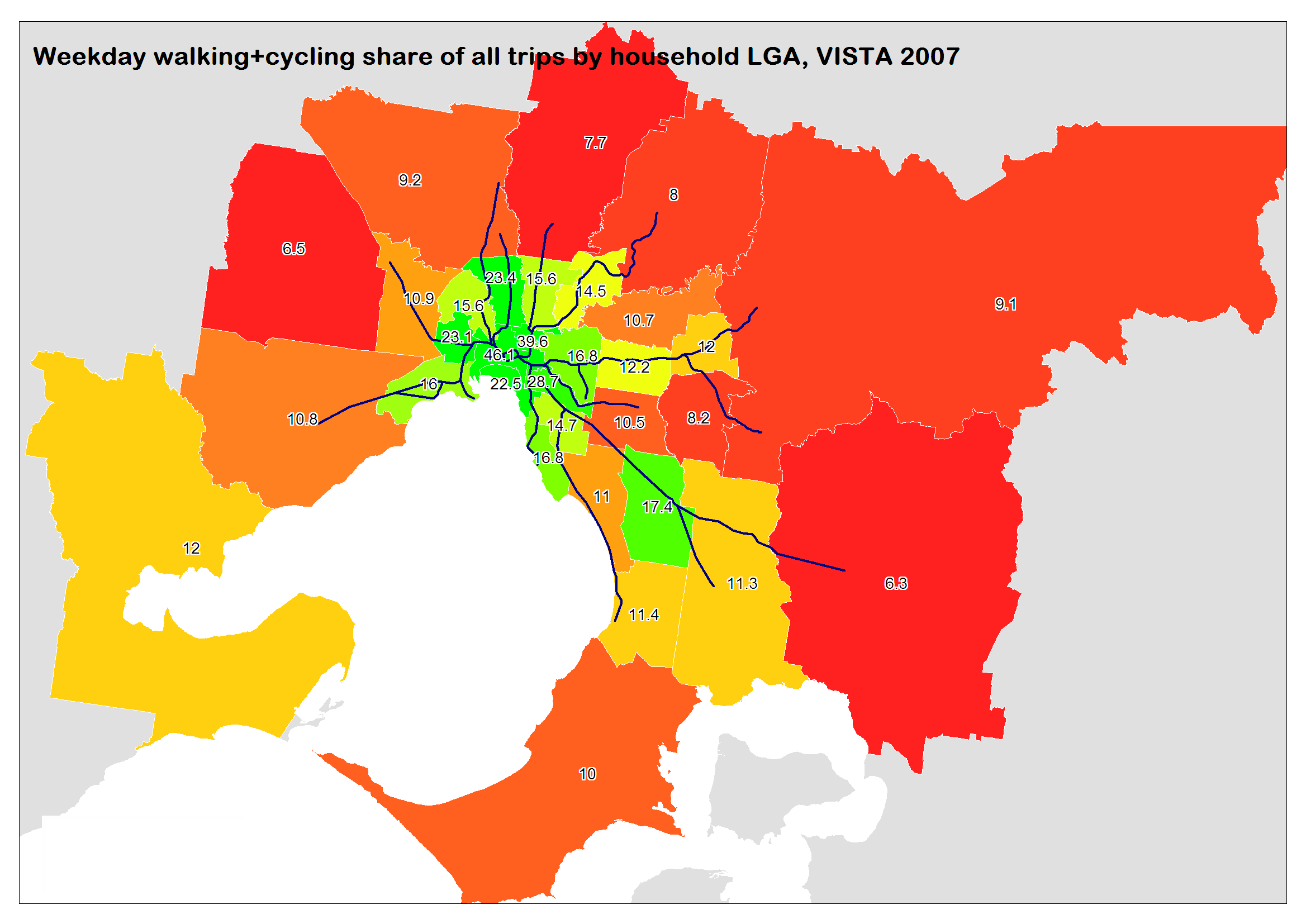
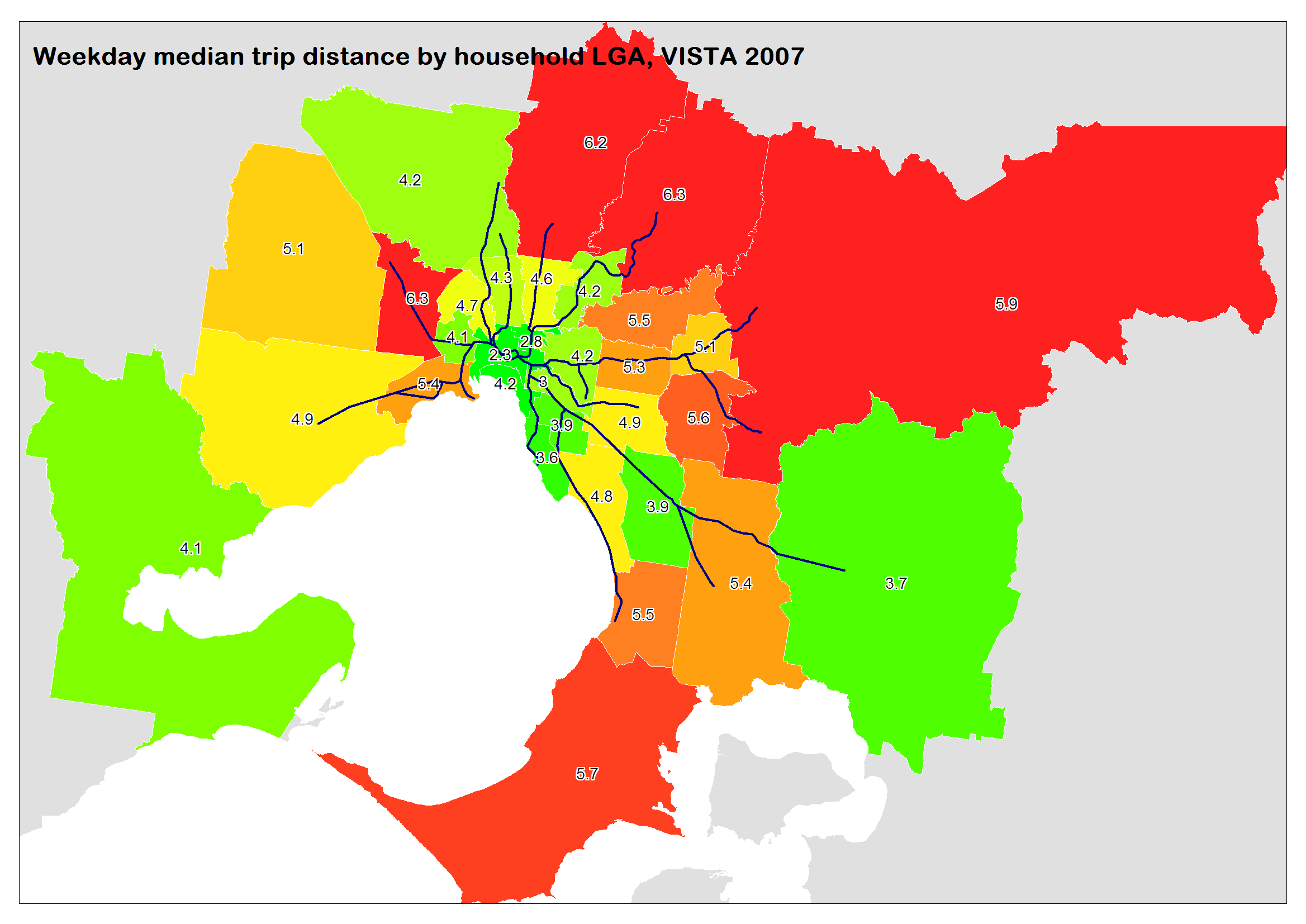
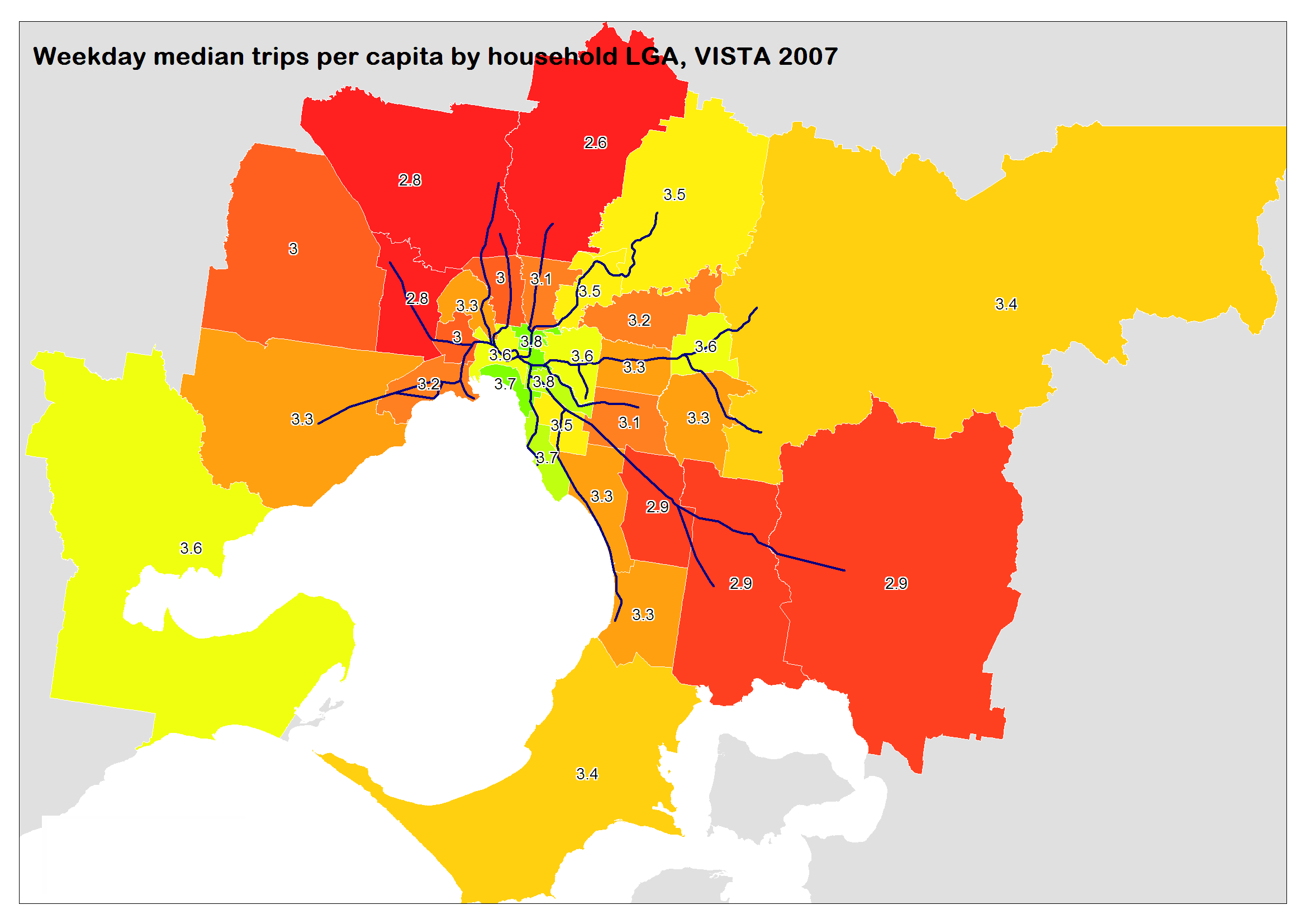
The gallery below contains maps showing mode shares and trip distances for each LGA (Local Government Area) in Melbourne.
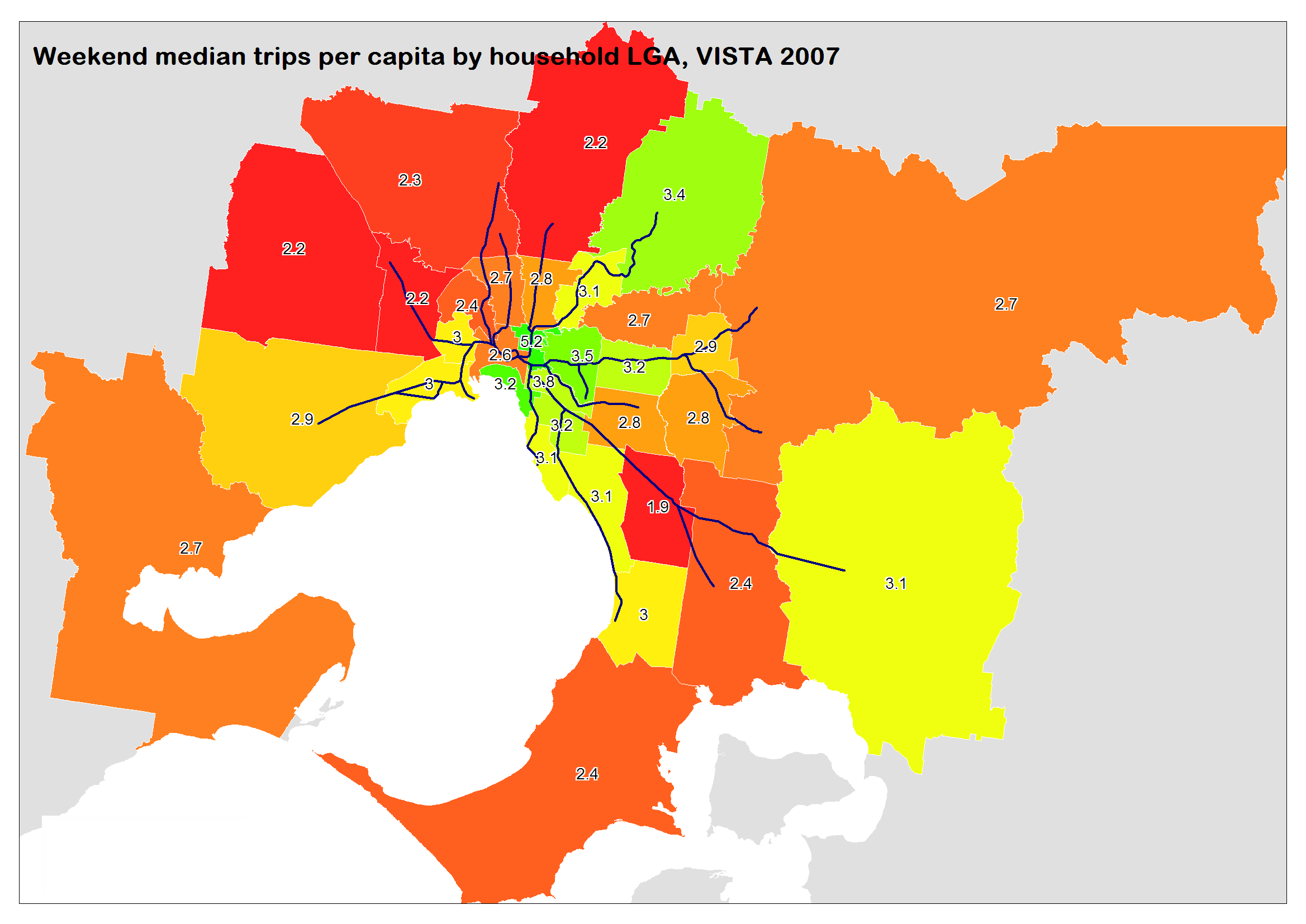
If you don’t know Melbourne’s LGAs by name, a reference map is included above (also showing train lines).

Notes:

  • All data is by LGA of residence, which is different to LGA of trip origin.
  • Total weekday travel distance sums the kms of all trips (as opposed to median trip length)
  • Mode shares are for all trips, not just motorised trips.
  • The colour scale for each map is different. I have a 14 colour scale (using “equal count” ranges) and I have deliberately not included a legend. So refer to the numbers for each LGA for relative values. Note the colour band jumps are not always ideal, do refer to the numbers as well as colours when comparing.

Observations:

  • Average trip distances don’t actually vary a huge deal if you look at the numbers (except the inner city, Brimbank and the outer north-east) – probably because most trips are local trips. Longer median trip distances in the outer north-east might be due to a larger rural population (smaller urban areas in these LGAs).
  • Trips per capita seem to be lowest in the growth interface councils. This might be related to more babies being present in these areas(?).
  • Total weekday travel distance seems to be highest in the outer west and east (less so the outer north)
  • Walking and cycling rapidly declines with distance from the CBD, with Greater Dandenong something of an outlier.
  • Private transport mode share tends to increase with distance from CBD, with Dandenong again something of an outlier (probably due to low socio-economic status).
  • Public transport mode share is higher in the inner city and inner northern areas. Lowest in the outer south east and south west (Dandenong again perhaps a bit of a local outlier – even though many parts have relatively poor bus service levels).

Of course there are lots of factors at play in all this (income, household types, demographics, PT supply, employment distribution, etc) and I’ve mostly speculated on some potential causes – certainly not attempted to explain all the causes in this post!

How reliable is this data?

VISTA is a very comprehensive household travel survey, and it includes over 17,000 households, almost 44,000 people who made over 145,000 trips – all in 12 months. The median trips per LGA is around 3500 – by around 1000 people (although some more than others – the smallest is Cardinia with 578 trips measured).

So in most cases the sample sizes are very large, giving a small margin of error. The data has been weighted to match the demographics of Melbourne in the 2006 census, which will control against under or over sampling of particular demographic groups.

Travel distances aren’t perfect – straight line distances between points are scaled up to take account of indirect routes being used for all modes (except trains where exact distances are known).

Household travel surveys are never perfect, but I think VISTA is a well developed and comprehensive survey and the outputs will be quite reliable as long as you are not disaggregating data into small segments. The weekend data in the maps above has the smallest sample sizes the (median sample of trips for the weekend is around 700 per LGA).


Urban density and public transport mode share

Sat 16 January, 2010

Are all the statistics we see about urban density and transport reliable?

In his most recent book Transport for Suburbia (and his paper to ATRF 2009), Paul Mees highlights mis-use of urban densities figures by some researchers – the trouble being inconsistent determination of what exactly is the urban area of a city when you calculate density (= population/area).

To redress the issue of data quality, Paul has used calculations based on the actual urbanised area for Australia, US, Canadian and English cities (looking at entire greater metropolitan areas). He’s used figures based on urbanised areas as opposed to a statistical district, municipal council area, or other arbitrary administrative boundary which could contain large areas of non-urbanised land.

The calculations define urbanised areas using the following criteria:

  • US and Canadian cities: minimum 400 per square km,
  • Australian cities: minimum 200 per square km (meaning Australian cities might be slightly understated)
  • English cities: detailed mapping, likely to lead to slighty higher density figures.

So the calculations are not perfectly aligned, but they are more comparable than density calculations that use simple administrative boundaries. And they are also certainly consistent within each country.

He publishes tables of this data, talks about the relationships between them, but for some reason fails to plot the results on a chart. So I’ve decided to chart them (if you are after the data tables consult the ATRF paper above and/or the book).

The table of data is quite interesting in that it debunks some myths about the densities of various cities. Los Angeles is the highest density city in the entire table (the Freakonomics blog has a good series on Los Angeles Transportation: Facts and Fiction that is worth reading).

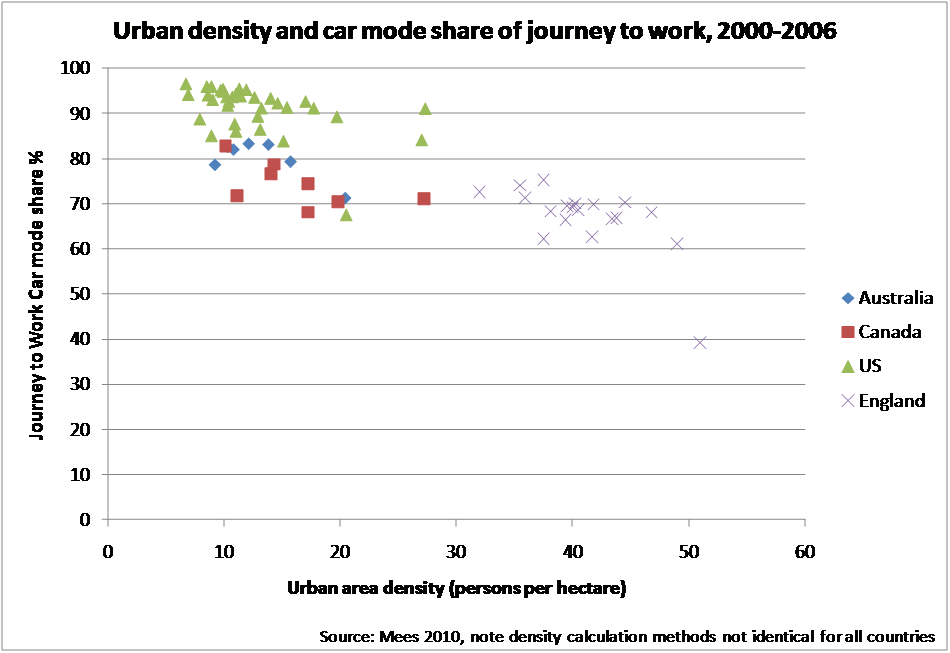
Firstly, car mode share in journey to work:

Is there a relationship between urban density and car mode share on journey to work? What do correlation coefficients say (closer to 1 and -1 means stronger) – something Mees didn’t calculate:

  • Australia: -0.74
  • Canada: -0.58
  • US: -0.46
  • England: -0.68

That suggests a relationship does exist, but it isn’t particularly strong. In reality, every city has unique characteristics and other attributes will explain the differences (the quality of services and infrastructure of alternative modes would certainly have a lot to do with it).

Looking at some outliers:

  • London has the highest density and lowest car mode share. It compares so favourably to all other English cities in car mode share, despite being only slightly more dense than Brighton/Worthing/Littlehampton (one combined urban area).
  • Canadian cities with the lowest car mode share are Toronto (highest density) and Victoria (second lowest density).

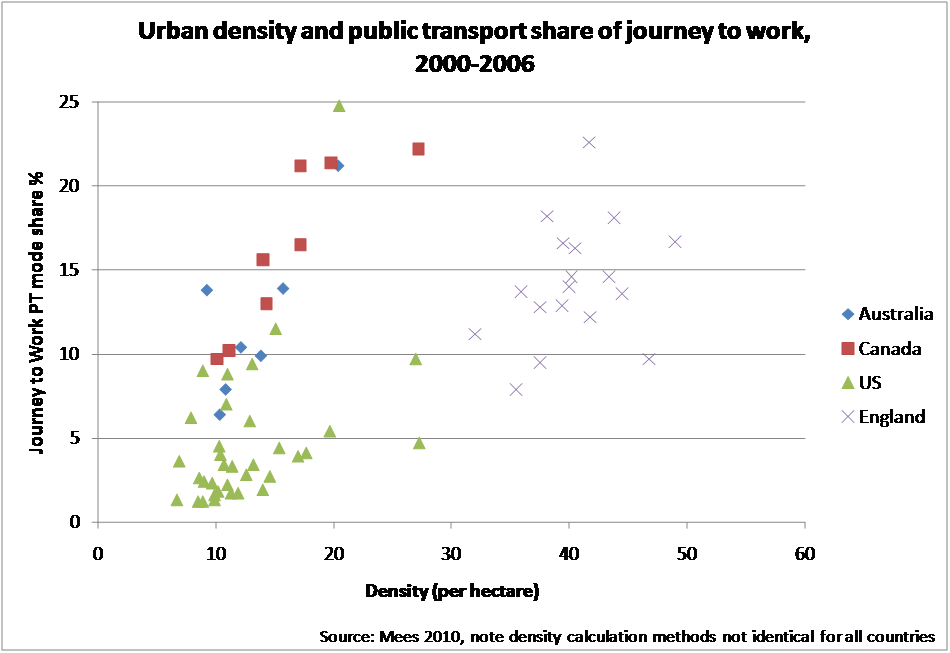
What about public transport mode share for journey to work?

This chart shows relationships stronger in some countries than others. Indeed the correlation coefficients are:

  • Australia: 0.79
  • Canada: 0.87
  • US: 0.42
  • England: 0.58

So much stronger relationships in Canada and Australia. Again there is a lot at work (particularly the quality and quantity of available public transport, which is one of Paul’s points).

In terms of outliers:

  • London is off the chart at 45.9% public transport.
  • Brisbane is perhaps an outlier for Australia – low density but pretty much the same rate of public transport use as Melbourne.
  • Los Angeles – which actually has the highest density of all the US cities but still relatively low public transport use.
  • The city with the highest PT mode share in the US is New York, even though it isn’t the most dense city in the US (there is lots of sprawl outside Manhattan).

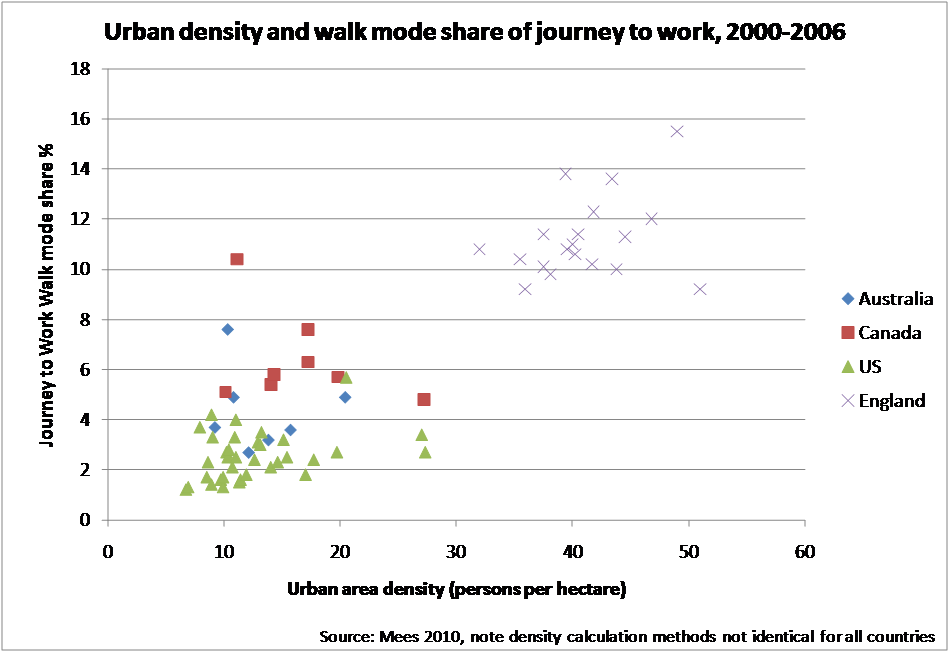
The following walking chart might seem to suggest a strong relationship when you look at all cities, but remember that the density measurements aren’t quite the same, so it’s not fully conclusive. However, English cities still tend to have higher densities, particularly as many have green belts to prevent sprawl.

There is actually a negative correlation between density and walking (and cycling) for Australia and Canada. However I wouldn’t read too much into that as the sample size if small and there are lots of unique factors affecting each city.

But if you reckon there should be a positive correlation between walking and density, the outliers are:

  • Victoria (Canada) – low density but high walking mode share.
  • San Francisco and Los Angeles have low walking share.
  • Hobart – highest walking share in Australia, despite low density (and a big river dividing it in two).
  • Toronto – Canada’s most dense walking city, but least walking mode share
  • London – highest density but lowest walking share (9.2%)

Same again for cycling:

It looks like almost no one cycles in the US, despite having more favourable climate than Canada. Again higher cycling rates in the UK.

Cycling outliers:

  • Victoria (Canada) – high walking and cycling mode share
  • Kingston upon Hull (UK) 11% – off the chart’s scale (Mees suggests a large university may be the cause)
  • Canberra – which has a good network of bike paths (but still only 2.5% cycling mode share)
  • Sydney – with just 0.7% cycling – hilly terrain not helping.

What if you add up all the sustainable transport modes (PT, walking and cycling)? In theory, density should help all sustainable transport modes.

The correlations are:

  • Australia: 0.77
  • Canada: 0.62
  • US: 0.44
  • England: 0.70

The English result is actually stronger than PT (0.58), walking (0.32) and cycling (0.02). Do people respond to density using different, but sustainable modes?

Can public transport be effective in low density cities?

Paul’s main argument is that low transport density isn’t a barrier to successful public transport, and that it is easier to change public transport provision in a city, than it is to change urban densities (not that increasing urban densities isn’t a worthy goal).

Certainly urban density makes it easier to make public transport successful, but I’d agree that it is possible to make public transport work a lot better in low density environments.

Indeed, in Melbourne, relatively high quality SmartBus routes (that run every 15 minutes for most of the day on weekdays, very good by suburban Melbourne standards!) have been trialled in the outer suburbs, and the patronage response has been much stronger than typical elasticities (the subject of another post).

More generally, in Melbourne over the last three years we’ve seen a very strong correlation between growth in service provision (26% more kms) and growth in patronage (29%) – more than any other potential driver of patronage (again, topic for another post).

Comparable cities for population and density

Finally, by plotting population and density, you can see which cities are most similar – at least in these two respects (I’ve only looked at cities under 7 million and UK cities are off the density scale). I’ve labelled Australian cities and nearby equivalents. Note: the US and Canadian data is year 2000, while Australia is 2006.


Car and transit use per capita in Australian cities (Peak Car)

Fri 8 January, 2010

[post updated in January 2016 with data from the 2015 BITRE Yearbook. For some more recent data see this post published in December 2018. First published January 2010]

Thanks to the Bureau of Infrastructure, Transport and Regional Economics’ Australian Infrastructure Statistics Yearbook 2015, a great set of time series data is available on transport behaviour. This post looks at trends in private and public transport use in Australian cities up until 2013-14.

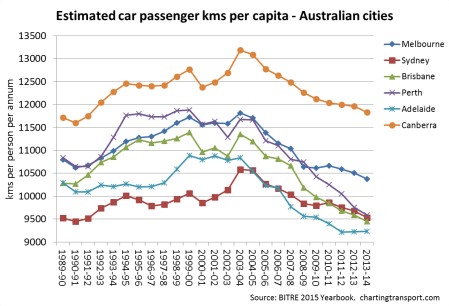
The first chart shows car passenger kms per capita peaked in 2004 for all cities and has been mostly in decline since then (with the possible exception of Adelaide in recent years).

car pass kms per capita 4

This is clear evidence of “peak car” use per capita in Australian cities.

Canberra has the highest car passenger kms per capita – perhaps due to the low density city, relatively sparse bus services, and general ease of using private transport.

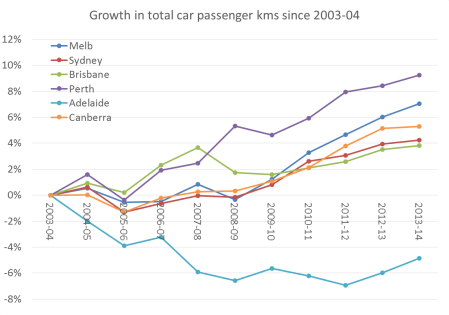
The underlying figures show relatively little growth in total car passenger kms in most cities in the ten years since 2003-04:

index of car passenger kms 2

Perth has shown the greatest increase in total car passenger kms despite the reduced car use per capita, presumably mostly reflecting strong population growth. Canberra, Sydney and Melbourne show a flat-lining in car passenger kms between 2004 and 2009 (a period of time that is becoming very familiar on this blog). I’m not sure why Adelaide has seen declining car passenger kms (it’s population did grow over this period by 10%).

Does this mean we are travelling less? The following chart shows estimated motorised passenger kms per capita, and yes in all cities there was a peak in 2003-04 followed mostly by declines. This might be people taking shorter trips, people taker fewer trips, and/or people substituting motorised transport with non-motorised transport.

motorised pass kms per capita 4

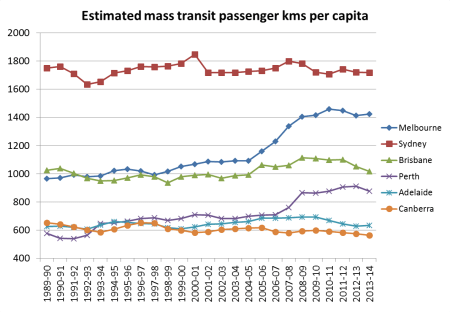
There is another story in the data. Mass transit passenger kms per capita rose significantly in Melbourne and Perth between 2005 and 2011:

mass transit share of pass kms 4

However, more recently there have been slight declines in Brisbane, Perth, Adelaide, and Canberra.

Sydney shows up with many more mass transit kms per capita than any other city (68% of which is on rail). While I am not sure exactly how BITRE sourced their train patronage data for “Sydney”, my experience is that patronage data is only readily available for a very wide definition of Sydney’s railways including lines beyond the Sydney Statistical Division including Newcastle, Nowra, and the Hunter Valley.

You can also see a spike in mass transit use in Sydney in 2000/01 – the year containing the Olympic Games.

Previous strong growth in Brisbane might reflect considerable investment in bus services (BITRE have published three years of bus data showing Brisbane increasing from 53.0 million kms in 2005-06 to 61.2 million kms in 2007-08). More recent stagnation in mode share might reflect above-CPI fare rises and changes to patronage measurement methodology.

The data also allows a calculation of mass transit’s share of motorised passenger kms:

Melbourne and Perth are the stand outs for mass transit mode shift based on these figures, particularly in the years leading up to 2009. Adelaide, Sydney and Brisbane also saw mode shift between around 2004 and 2009, but Adelaide and Brisbane have gone backwards since then.

Note there are other ways to more directly measure transport mode share – primarily household travel surveys, covered in another post.

Finally, here is a stark comparison of total car and mass transit passenger kilometre growth since 2003-04 (with population growth included for reference):

car v pt growth aus large cities 2

Car use has grown more than four times slower than population growth, and almost seven times slower than mass transit use.

Business as usual no longer

In the frequently cited BITRE 2007 report on congestion costs, they made a “business as usual” assumption that mode shares will not change (ref page 8) and that car use per capita would increase (ref page 47), and then forecast that avoidable congestion costs in Australia will more than double between 2005 and 2020. The latest BITRE evidence is that mode shares are not business as usual in most cities and that car use per capita is decreasing. See another post reviewing the forecasts of the costs of congestion.

An updated 2015 BITRE report on the costs of congestion looks at the issues of per capita vehicle user into the future in a bit more detail, including acknowledging researchers highlighting peak car.

Their new high case scenario assumes the recent downturn in per capita vehicle use is essentially all GFC related (and has persisted for 10 years), and that things will now bounce back to old patterns (and grow even faster than the 2007 forecast). Their medium case also assumes a reversal of trend, but that we’ll only return to the previous peak level by 2030, and a low case continues the current trend.

The following chart shows forecasts compared to estimated actual vehicle kilometres per capita.

BITRE vkms per capita estimates

The 2007 forecast was not only trending in the wrong direction, their starting assumption about vehicle km per capita for 2007 was well above the (revised) estimated actual.

The new estimates for the “avoidable social costs of congestion” in 2030 are $48.2b for the high case, $37.3b for the median case, and only $25.1b for the low case. BITRE suggest this median estimate is the upper range of what is plausible, but if current trends continue, the avoidable social costs of congestion would be a third lower.

See also a recent piece on this subject by Professor Peter Newman in The Conversation.

Some disclaimers:

  • I’ve called it “mass transit” as the data does not seem to differentiate public, school and private bus passengers. Passengers on chartered buses aren’t usually considered “public transport”, but they still are a very space efficient way to move people on roads.
  • km figures are reported on financial years, while population figures are for June at the end of that financial year. So the “real” per km figures are slightly less, but I’m really just looking at trends and relative numbers here.