What’s happening with car occupancy?

Sat 20 August, 2011

[updated April 2016]

Is car occupancy trending down as car ownership goes up? What factors influence car occupancy? What is the impact of parents driving kids to school?

Following a suggestion in the comments on my last post about car ownership, this post takes a detailed look at car/vehicle occupancy.

What are the trends in car occupancy? 

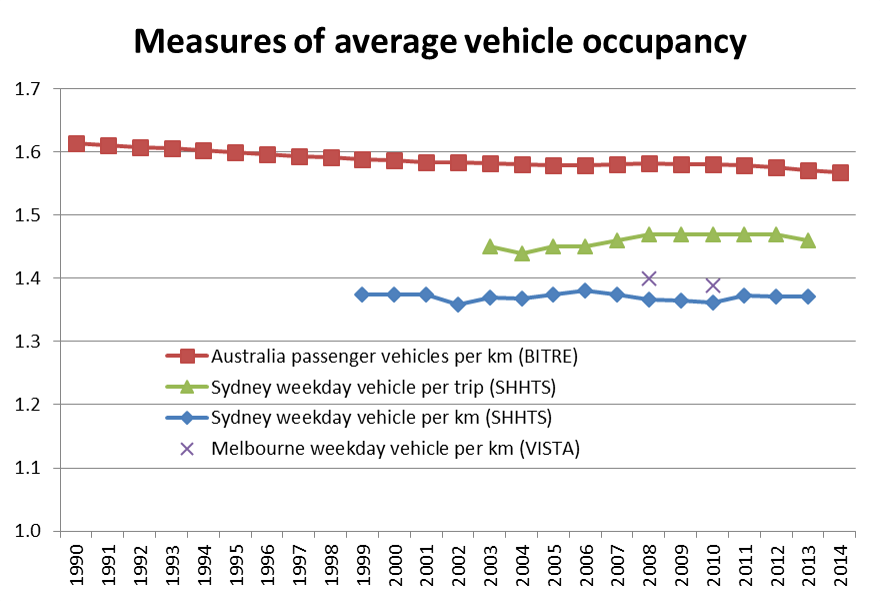
This first chart shows average vehicle occupancy from a number of different measures that are more recently updated:

  • Australian passenger vehicles – measured as the ratio of person-kms in passenger vehicles, to total passenger vehicle kms (both estimates, and unfortunately this can only be calculated for all of Australia, using BITRE data).
  • Sydney weekday vehicle occupancy, both per trip and per km, from the Sydney Household Travel Survey (SHHTS). These figures include all private vehicles (not just cars).
  • Melbourne weekday vehicle occupancy per km, from the Victoria Integrated Survey of Travel and Activity (2012/13 data wasn’t available at the unlinked trip level at the time of updating this post). Again, these figures include all private vehicles (not just cars).

The BITRE figures show a fairly smooth and slow downwards trend from 1.62 in 1990 to 1.57 in 2014. The Sydney figures are a little more noisy, but surprisingly quite flat around 1.37 (on a distance measure), and increasing on a trip basis (suggesting occupancy is rising on shorter trips and/or declining on longer trips). Only the BITRE figures are confined to passenger vehicles, which probably explains the differences between the series (the SHHTS and VISTA data will include private vehicles such as motorbikes, trucks and light commuter vehicles).

The census journey to work question gathers data on how people travelled to work, including car drivers and car passengers. While not a clean measure, it is possible to calculate an implied car occupancy as (car drivers + car passengers) / (car drivers). For the purposes of this calculation, I have only taken “car driver only” and “car passenger only” trips (which excludes park-and-ride and kiss-and-ride public transport trips). I do not have data on trip lengths, and average car passenger trips might be different on average to car driver trips.

There’s a pretty clear downwards trend as relatively fewer people travel to work as car passengers. In fact, the data suggests extremely low levels of car pooling, and that over 90% of car journeys to work have no passengers in most cities. But keep in mind that car-only mode share of journeys to work peaked in 1996, so the net change is proportionally less people travelling as car passengers and proportionally more people travelling on non-car modes.

So in summary, there is some evidence of very gradual declines in car occupancy for all travel purposes, and strong evidence of a decline in vehicle occupancy on the journey to work.

Trends in car occupancy by time of day

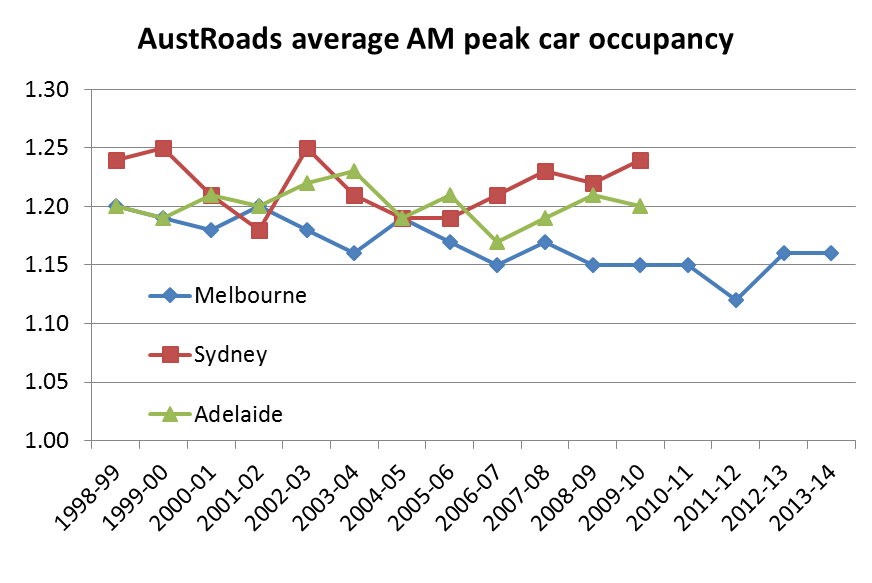
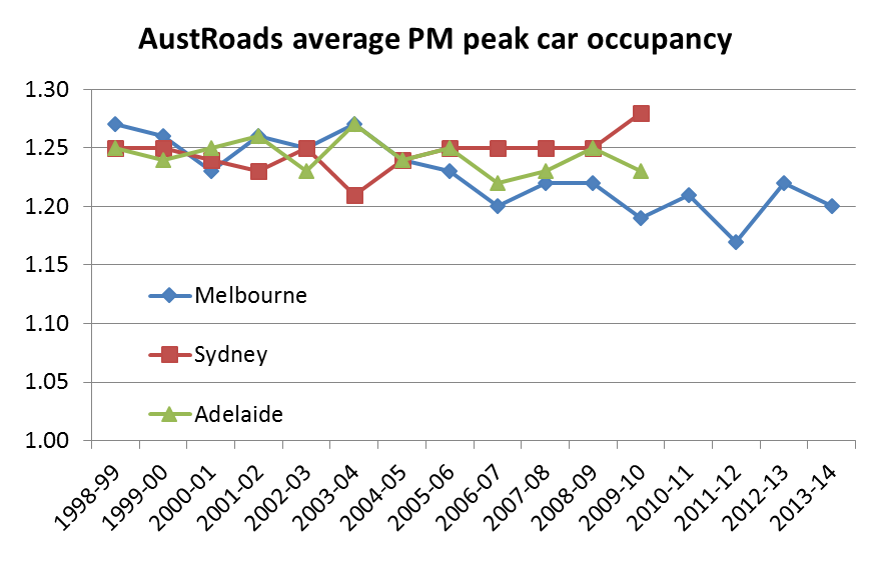
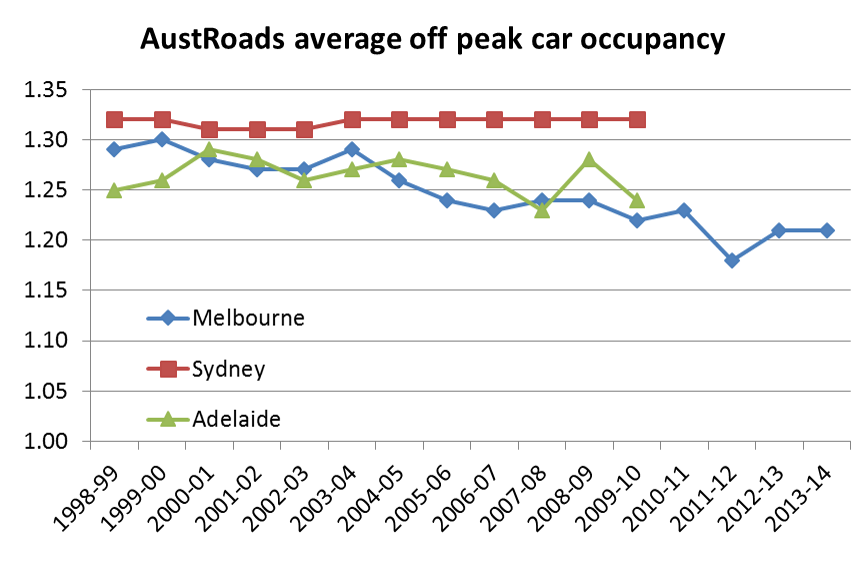
Many state road agencies make direct and regular measurements of vehicle occupancy in capital cities and their data is collated by AustRoads.

Unfortunately only four cities report such data to AustRoads. Brisbane data has several missing years – and the three most recent years’ figures reported are all identical, so I’m inclined not to plot them. That leaves Melbourne, Sydney and Adelaide. Unfortunately the AustRoads website hosting these statistics appears to no longer work, but VicRoads separately publish Melbourne data (but much less for more recent years). What follows is all the data I have been able to collect.

Firstly, all day (weekday) average occupancy:

There doesn’t appear to be much in the way of clear trends as the data seems quite noisy (I’m not sure anyone could explain the year by year variations). Perhaps Melbourne average all day occupancy was trending down.

Data is available for three sub-periods:

Again lots of noise, and no clear trends.

Noisy again. It’s looks like Melbourne is no longer trending down.

This data is remarkably flat for Sydney, while Melbourne appears to still be trending down.

It’s little surprise that AM peak has the lowest occupancy, as it is dominated by journeys to work. More on that soon.


Notes on the AustRoads/VicRoads data:

Along with the noise in the data, there is some ambiguity in the methodology. The AustRoads website reports “car” occupancy, but the methodology doesn’t seem to filter for cars. Are buses included or not? It says the survey should be undertaken in March/April to avoid school and public holidays. But March and April have heaps of holidays (Easter, Anzac Day, and Labour Day in many states).

But the AustRoads data is certainly collected on representative arterial roads, where you might expect lower occupancy because of longer trips that are more likely to be work-related.

What’s the relationship between car ownership and car occupancy?

You might expect car occupancy to go down as car ownership goes up. In other words: we have more cars and need to share them less.

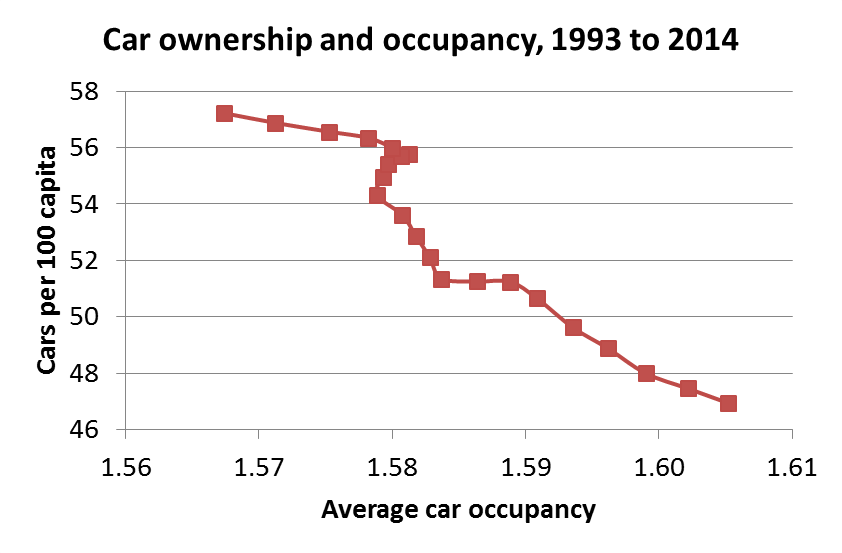
Here’s what the relationship looks like for Australia as a whole (using car occupancy derived from BITRE data):

There are five quite different periods:

  • From 1993 to 1999 (bottom right) car occupancy declined as car ownership increased. As you might expect.
  • From 1999 to 2001 car ownership stalled, but car occupancy continued to decline.
  • From 2001 to 2005 car ownership rose again, but car occupancy declined more slowly.
  • From 2005 to 2010 car occupancy increased slightly, while car ownership had slow growth. This is the period when public transport mode shift took hold in most Australian cities.
  • From 2010 to 2014 car occupancy dropped more quickly, while car ownership had slow growth. In this period there was much less mode shift to public transport in most Australian cities.

The relationship is changing, probably influenced by other factors. BUT it could also be that I’m reading too much into the precision of the car occupancy figures – we are talking about variations in the fourth significant figure only for the last few years. The BITRE figures are estimates themselves. Maybe someone from BITRE would care to comment on the precision?

What about different road types?

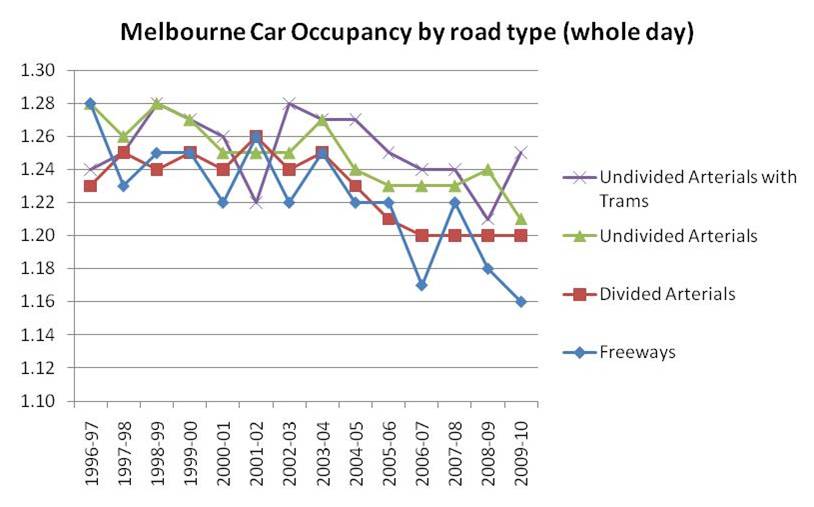
Looking at Melbourne data in more detail, car occupancy appears to have declined most on freeways and divided arterials:

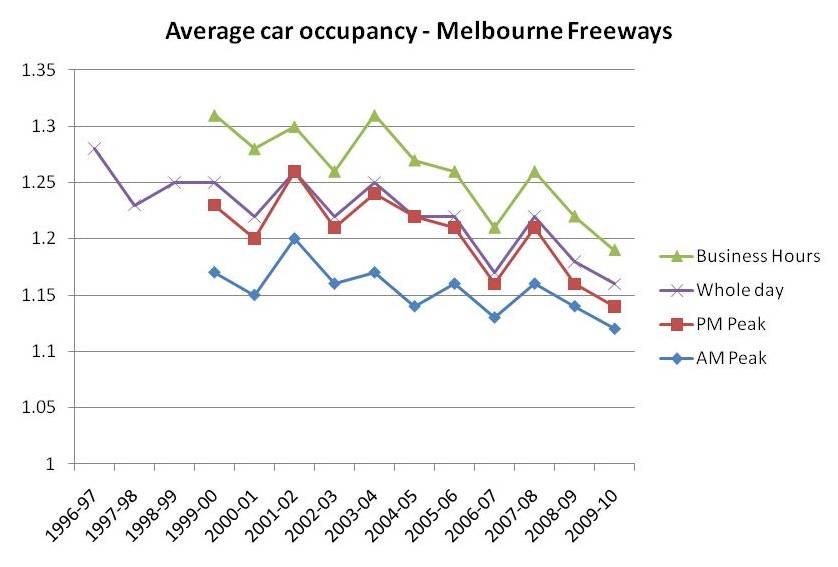
On freeways, the decline is most evident during business hours:

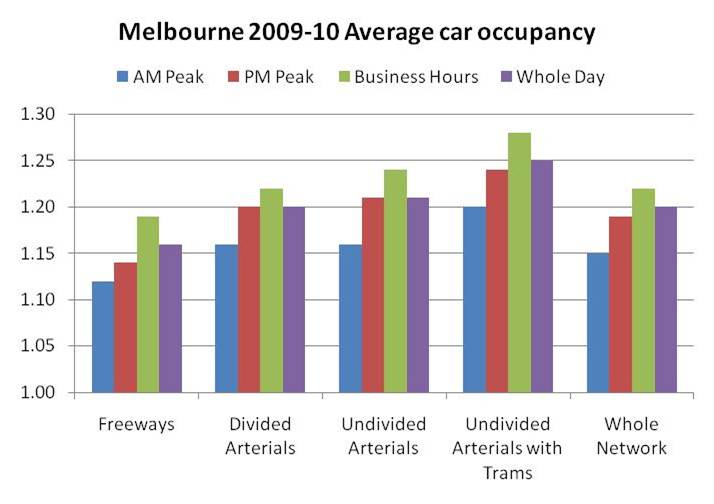
Here is a chart comparing car occupancy figures for arterial roads in Melbourne (2009/10):

You can see car occupancy lowest on freeways, and highest on undivided arterials with trams (all in the inner suburbs). Otherwise very little difference (in 2009/10 at least).

How do Australian cities compare?

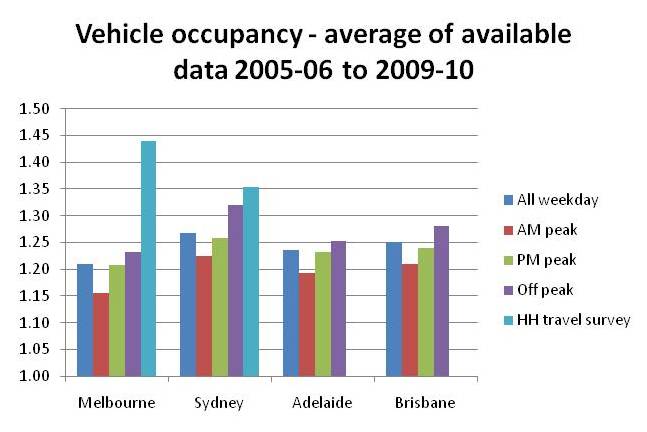
To try to take out some of the noise, I’ll take the average of the last four years for the AustRoads data and Sydney and Melbourne household travel survey data:

Melbourne appears to have the lowest occupancy, and Sydney the highest – except when it comes to household travel survey data where Melbourne is much higher. But this might just be differences in methodologies between states.

Factors influencing car/vehicle occupancy (in Melbourne)

Having access to the 2007-08 VISTA data, it’s possible to disaggregate vehicle occupancy on almost any dimension you can imagine. I’ll try to restrict myself to the more interesting dimensions!

For most charts I have used vehicle occupancy rather than car occupancy. Cars and 4WD/SUVs combined accounted for 88% of vehicle kms in the dataset so there shouldn’t be a lot of difference. But I’ll start with looking at..

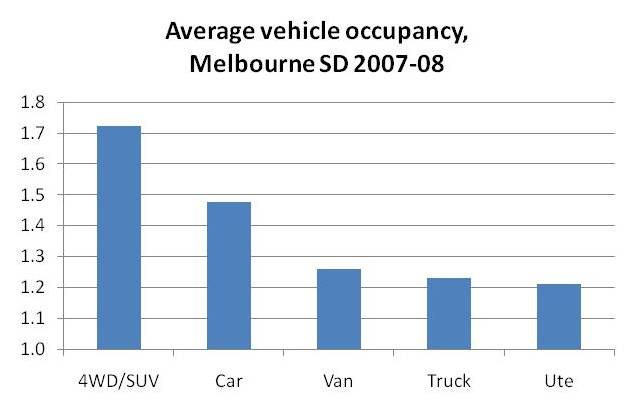
Vehicle type

Now that’s a surprise: 4WD/SUVs have a much higher average occupancy than cars. Why is that?

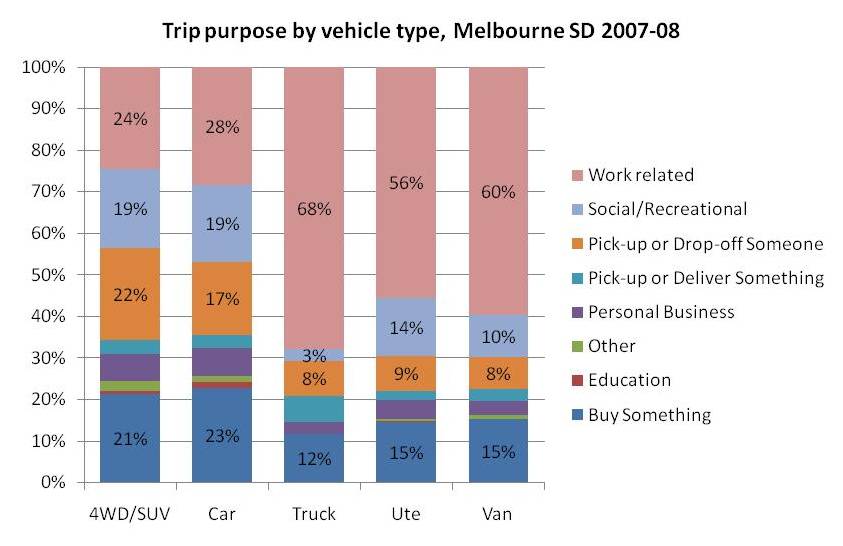
Are they used for different purposes?

Not a great deal of difference between cars and 4WD/SUVs, although 4WD/SUVs are slightly more commonly used to pick up or drop off someone.

More likely explanations (from the data) are:

  • 4WD/SUV come from larger households on average (3.5 people v 3.1 for cars).
  • 4WD/SUVs are also more likely than cars to belong to households that are couples with kids.
More on both of these point soon.

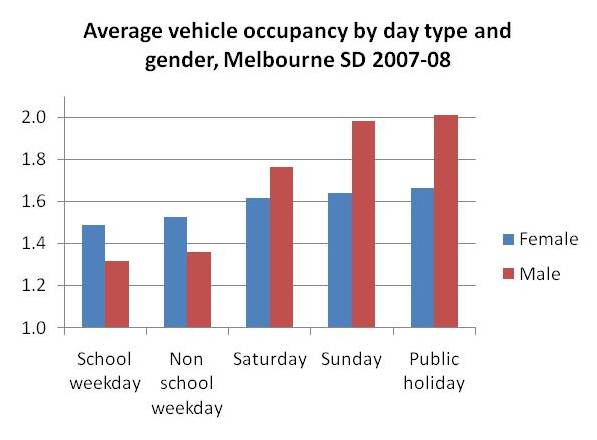
Day of the week

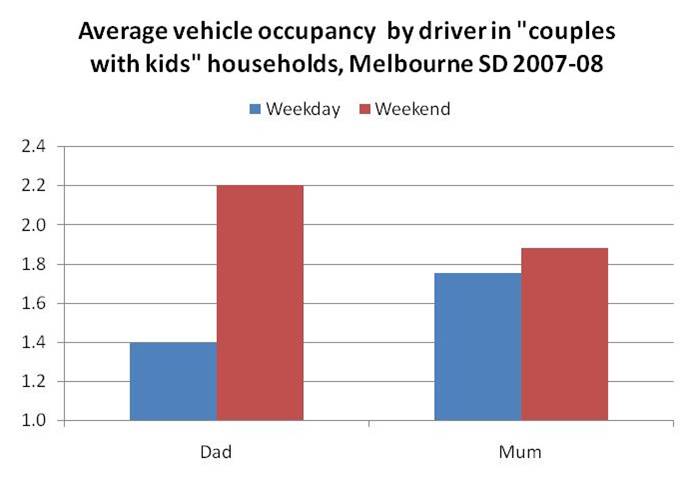
Probably not a huge surprise that cars have less occupants on weekdays than weekends. Male drivers are much more likely to have no passengers on weekdays, but an average of one passenger on weekends. Whereas there is much less variation for females.

Is this traditional gender roles in the family? (There is a chart to answer almost any question you know..)

There you go: dads much more likely to drive the family around on weekends, and mums more likely to drive them around on weekdays. And while on the subject…

Household types and sizes

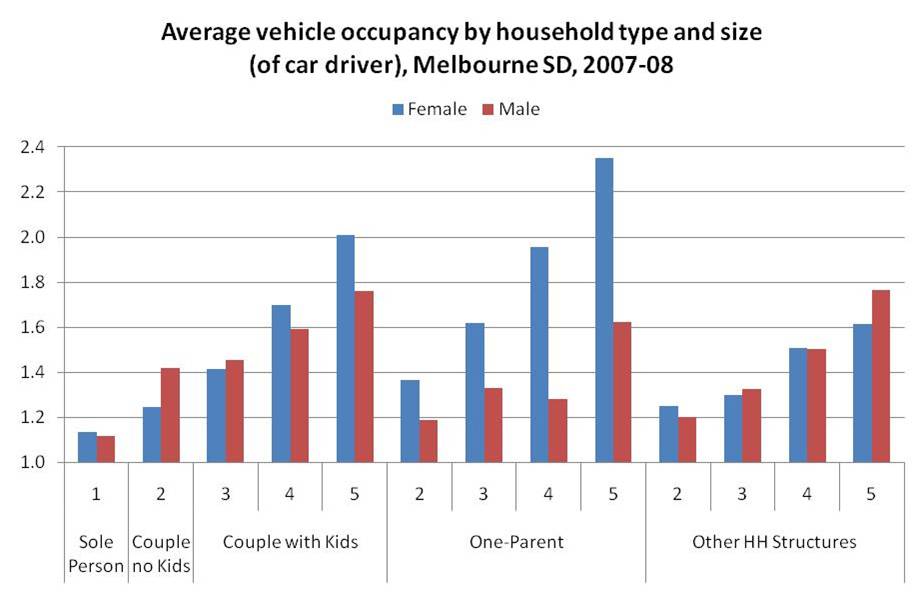
Little surprise that car occupancy increases with household size. It is easier to car pool when you have the same origin.

Note that the sample size of one parent households of size 5 are small (especially for male drivers). But curiously single mothers have much higher occupancies than single fathers.

There is also a small sample of other household structures with 5 people.

Unsurprisingly, people living alone are likely to have the lowest car occupancies. With increasingly prevalence of sole person households, you might expect continuing declines in average car occupancy.

Trip purpose

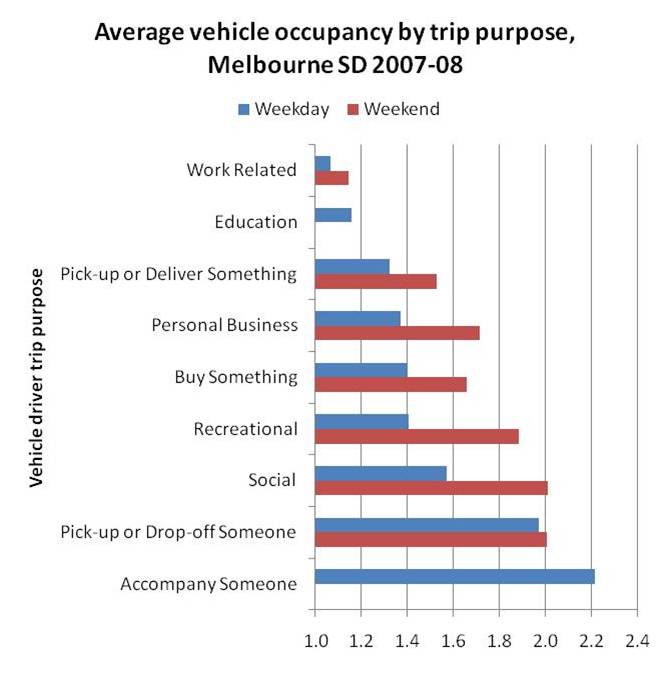
Again work trips are the least likely to involve passengers, particularly on weekdays (average occupancy 1.07). Driven trips to education are not far behind. Little surprise that accompanying someone, or picking up or dropping off someone averages around 2 or more. Occupancies for personal business, shopping, recreational and social trips are in the middle, but much higher on weekends when householders are probably more likely to travel together to common destinations.

Many people would argue that demand for public transport is lower on the weekend. These figures would support that argument, but lower weekend patronage would also reflect lower service levels.

Note: the sample sizes of weekend education and accompanying someone trips were too small to be meaningful so I left them off.

Time of day

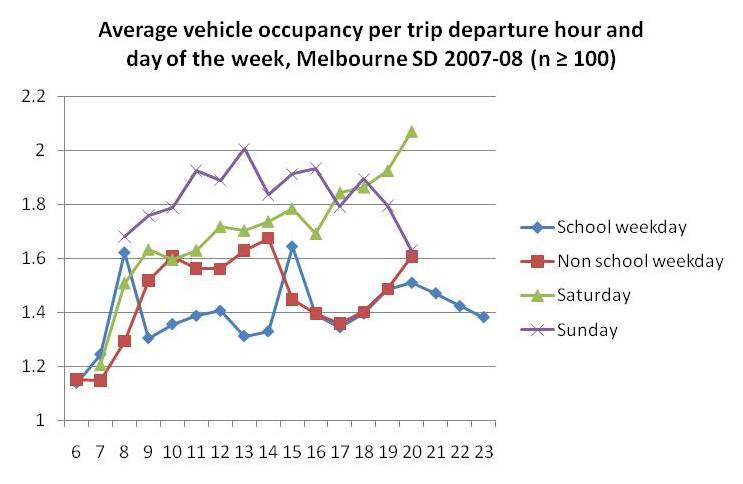
There you go, car occupancy peaks between 8 and 9am and between 3 and 4 pm on school days: parents driving kids to/from school.

But vehicle occupancy is highest on Saturday nights when people are socialising, and interestingly Sundays are well above Saturdays (less personal business on Sundays perhaps?). Non-school weekdays have higher occupancies than school weekdays, possibly with parents also taking time off work and spending time with kids.

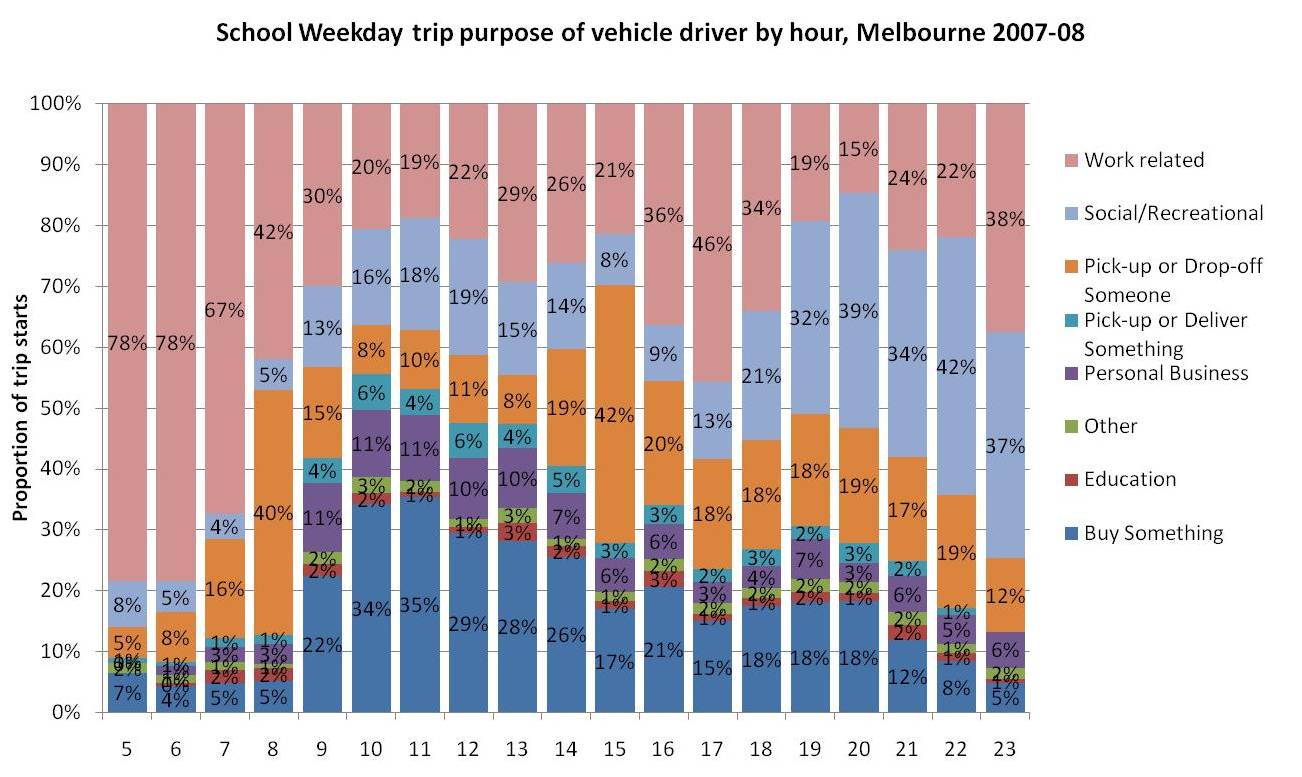
Just looking at the school peak more closely, here is a chart showing car driver trip purposes by hour of the day on school weekdays. You’ll almost certainly have to click on this one to read the detail.

The most frightening statistics are in the school peaks. A staggering 40% of car trips between 8 and 9am, and 42% of car trips between 3 and 4pm are to pick up or drop off someone (suggesting a fault in the reported vehicle occupancy for trips picking up somebody). This will almost certainly be dominated by school children. No wonder traffic congestion eases so much in school holidays.

That said, car trips to/from school are shorter than other trip types (as we saw in an earlier post). The data suggests 19% of car kilometres of trips starting between 8-9am are to pick-up/drop-off someone, and for 3-4pm the figure is 24%. That’s still a sizeable chunk of total road traffic. It suggests there are huge congestion relief benefits to be had in getting kids to walk, ride or use public transport to/from school.

Geography

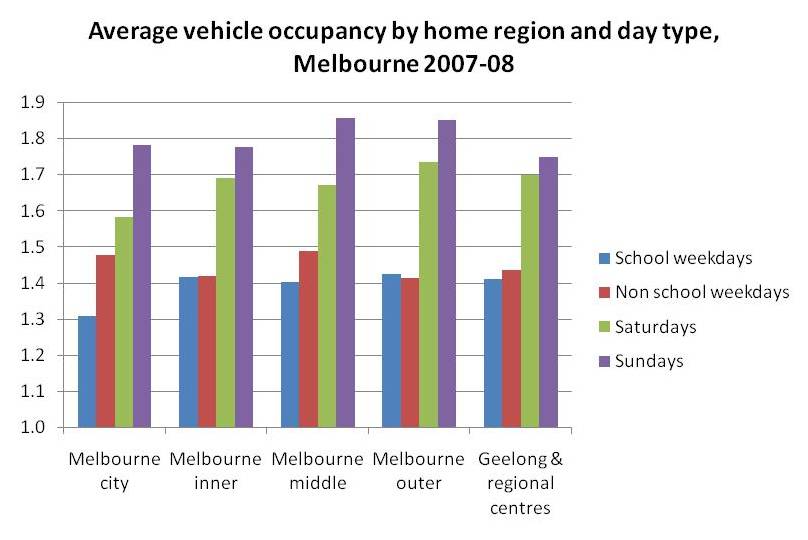
There’s not a lot of difference other than for the inner city, where school day occupancies are lower. For someone in the inner city to drive a car, they are probably heading out of the city and any other members of their household might be less likely to have the same destination and/or would have good public transport options for their travel.

The non-school weekday figures show some variation, and while the sample sizes are all over 250, there are some vehicles with an occupancy of 14 recorded. unfortunately because the underlying data is discrete, medians aren’t an easy way around this issue.

Age

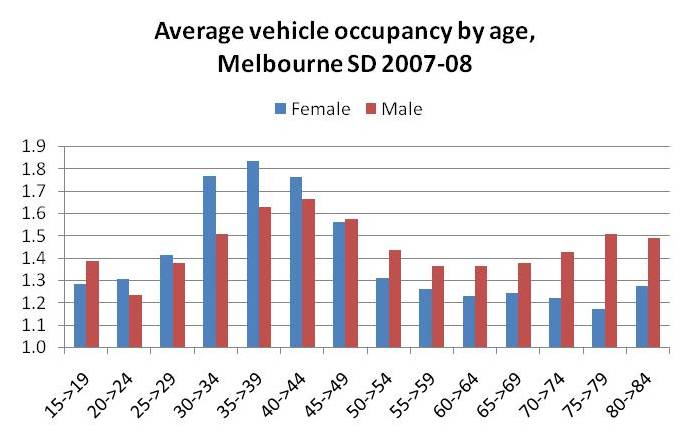
This would suggest traditional gender roles are in play: Average car occupancy is highest for drivers aged 30-45, the most common age groups for parents of pre-driving aged children. And women seem to be doing more ferrying of the kids than men.  In the older age groups men are more likely to be driving with passengers.

Income

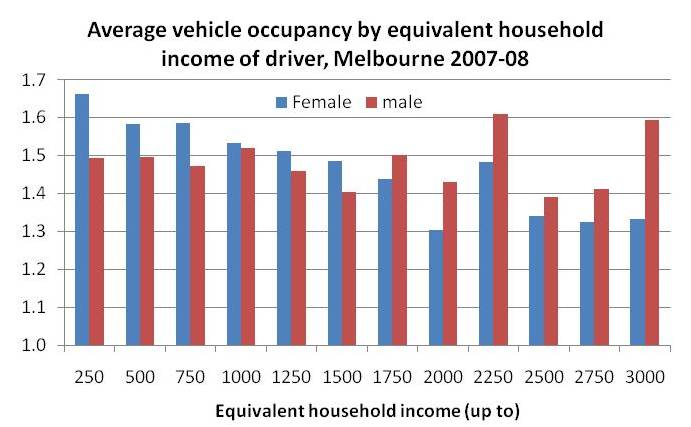
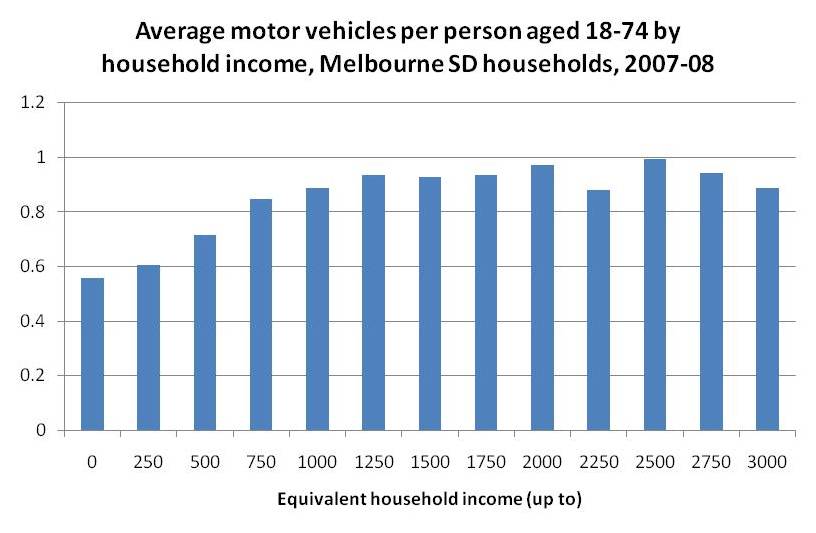
Vehicle occupancy seems to go down as we have higher incomes (moreso for females), but there seems to be some noise in the data (eg the spike at 3000 is due to one vehicle with 12 occupants). Females with lower household incomes have higher vehicle occupancies (maybe those without an income but looking after a family).

This trend reflects the fact that car/vehicle ownership goes up as wealth goes up:

The threshold for car ownership is around $1250 per week (equivalised to a single occupant household). As Australians have become increasingly wealthy in real terms, we can afford to own more cars.

Trip distance

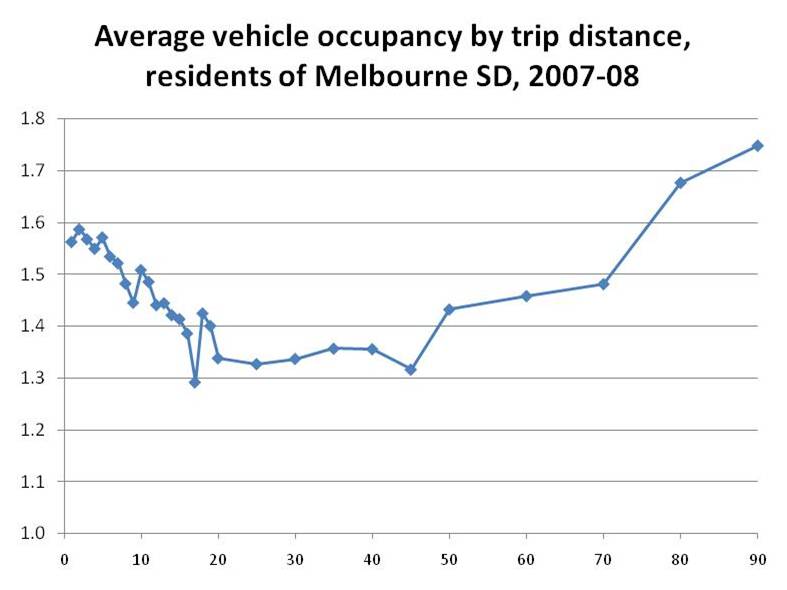
While there is probably a little noise in this data, there is a fairly clear pattern. Very short trips and very long trips are likely to have higher occupancies. The median trip distance for non-work trips is around 4kms, while work trips are much longer, which fits with the average occupancies for different trip purposes.

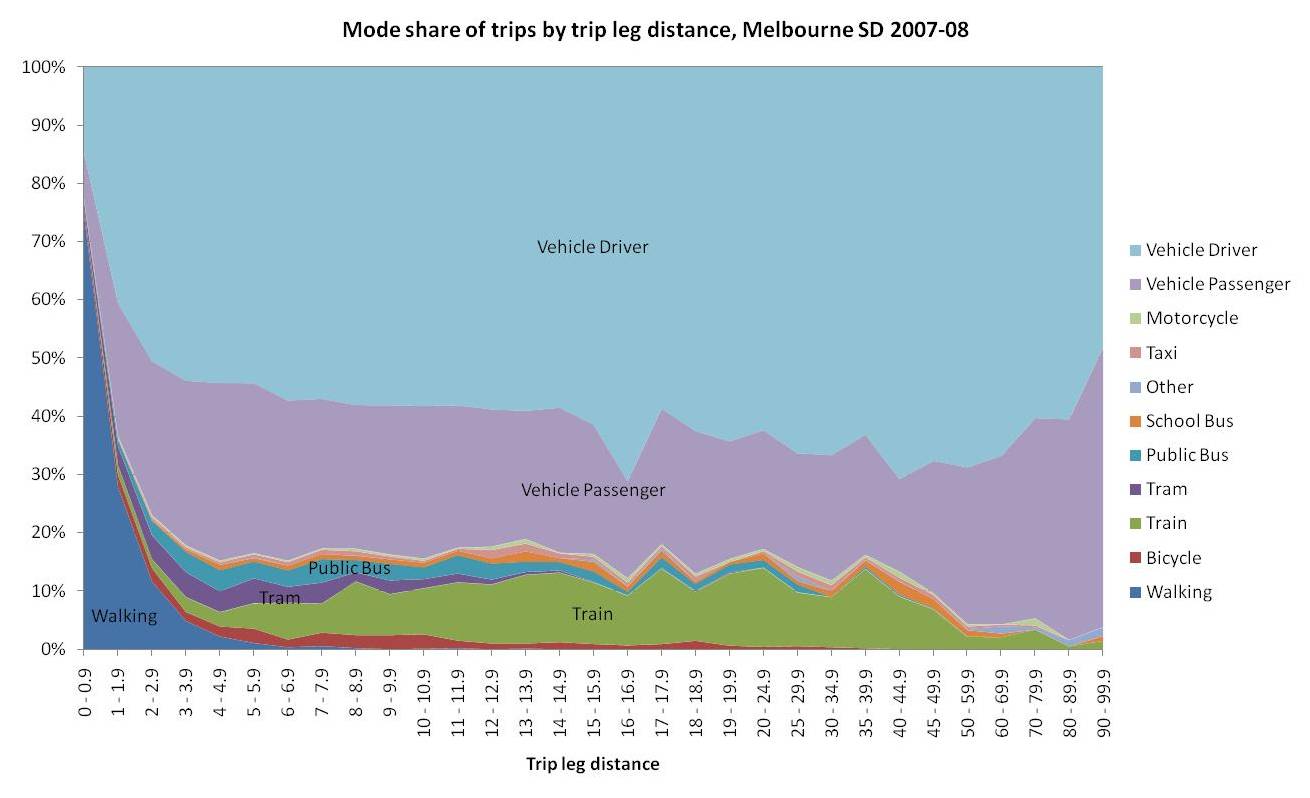
In fact, here is a mode share breakdown by trip distance (for trip legs):

You can see car passenger becomes more common for very long trips (note the X axis scale is not uniform). (Don’t ask me why driving is so popular for distances of 16-16.9 kms! It’s probably a bit of noise)

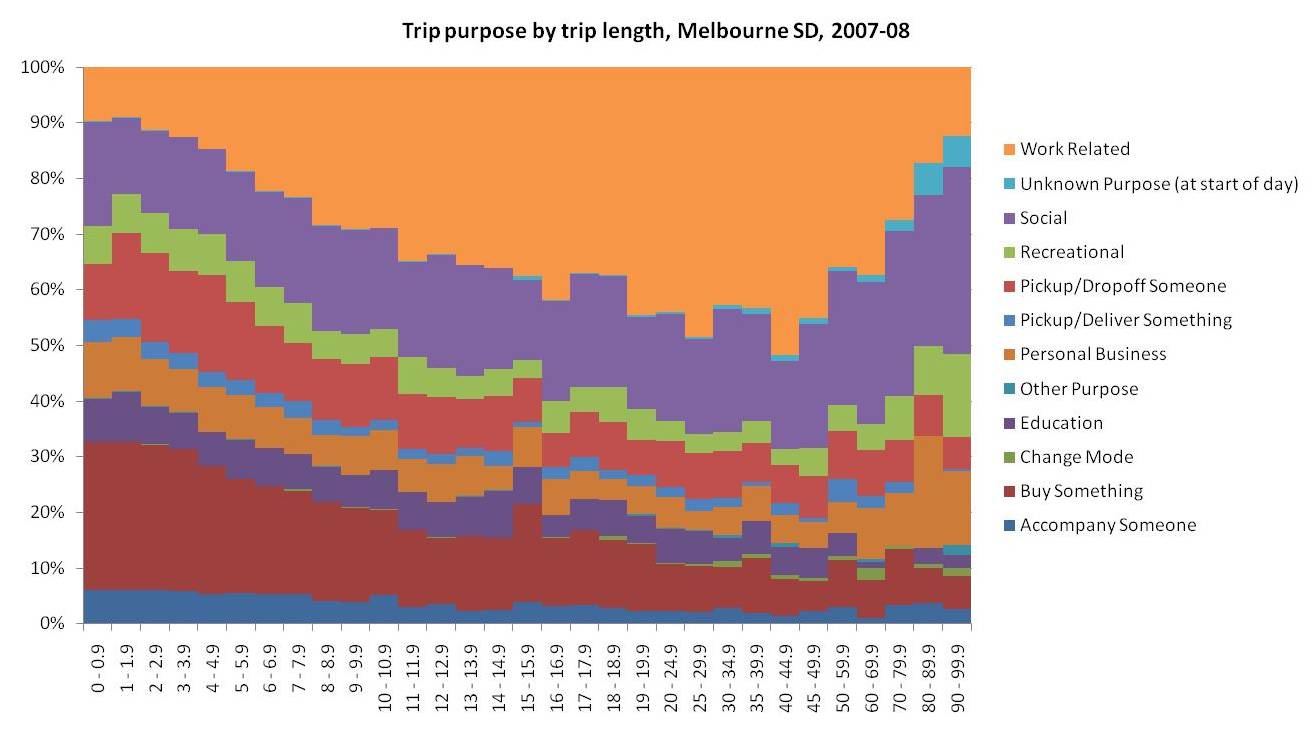
And if you look at the trip purposes of these very long trips, you’ll longer trips are more likely to be social or personal business:

(note: this chart is by trips, and not trip legs)

Main Activity

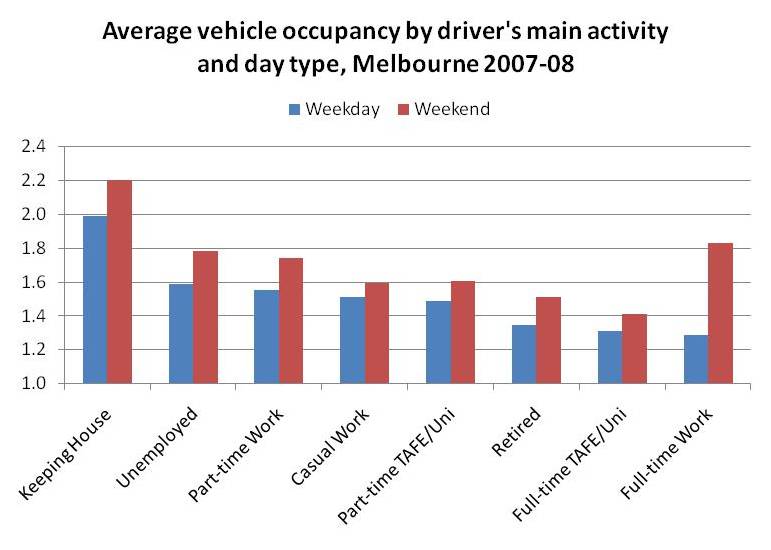
Probably little surprise that those “keeping house” have the highest occupancy in general, but that full-time workers have very low occupancy on weekdays, but very high occupancy on weekends.

There you go, possibly more than you ever wanted or needed to know about vehicle occupancy!


How does travel vary across Melbourne and regional centres in Victoria?

Sun 19 June, 2011

What differences are there in car use by geography, income, household type, and age?

And could you do more to reduce car use by pushing population growth to regional cities instead of the fringe of Melbourne?

I thought I’d take a closer look at travel and trip distances using massive 2007-08 VISTA dataset, and see what factors lead to variations.

In this post I look at travel distances (total and by car) and mode splits across geographies, trip purposes, incomes, ages, and household types. And more.

While the results might not be too surprising, I hope you’ll find the evidence interesting.

How do travel distances vary by geography?

In a previous post I showed that people in the outer suburbs generally have a longer median travel distance:

The patterns were not uniform in the outer suburbs. Nillumbik is the second highest on 35.1 kms per person, while Hume is much lower on 19.6. Factors such as incomes and household types might explain this variation (more on that later).

Most of my analysis will deal with six geographic zones – four rings of Melbourne, Geelong and other regional cities in the VISTA sample combined (Ballarat, Bendigo, Shepparton and the Latrobe Valley). Here’s a map of the Melbourne zones:

Note: I’ve used “city” as shorthand for the central area, and “inner” as shorthand for the inner suburban ring.

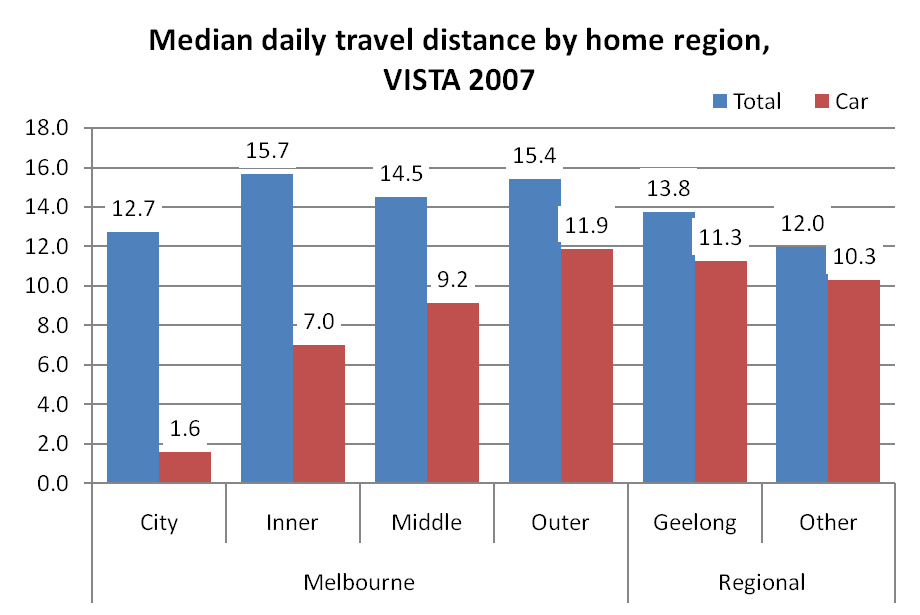
Based on those zones, here is a simpler view of daily travel distances (total and by car):

This suggests little difference in total travel distance, but significant differences in car travel distances.

I’ve not used averages because some trips were extremely long (the longest trip by an inner city resident was 833 km) which can skew the averages.

But is median the right measure of travel distance? Probably not, if you look at the following chart of the cumulative distribution of all day travel distances:

How do you read this chart? A point on each line means Y% of people travelled up to X kms per day. Essentially the lower the curve on the chart, the longer distance those people travelled.

You can see differences between distributions are not straight forward:

  • The lower half of travel distances were quite similar.
  • The differences manifest in the top half of distances. You can see that people in outer Melbourne were much more likely to clock up longer travel distances that those in the inner city. For example, 30% of people in the outer suburbs travelled more than  , while only 15% of people who live in the inner city travelled more than 40 kms.
  • In fact, there were more long distance travellers in outer Melbourne than in Geelong or the other regional centres.
  • 24% of people in the outer suburbs of Melbourne did not travel at all, while only 15% of inner city residents did not travel on the survey day. This causes the distances to cross around the median.
  • There is greater diversity in travel distances of people in the outer suburbs, including about the quarter who did not travel.

Here is the same again for car distance travelled (probably the most important chart in this post):

The differences are much clearer here, with car use and travel distance increasing through Melbourne by distance from the city, and the outer Melbourne suburbs having the longest car travel distances. Distances in Melbourne’s outer suburbs are generally longer than in Geelong and the regional centres.

Interestingly, 48% of inner city residents made no car travel at all, hence the very low median. While the city, inner and middle lines converge at a longer distance, the outer suburbs still had 10% of people doing more than 80 kms in cars.

How does mode share vary by geography?

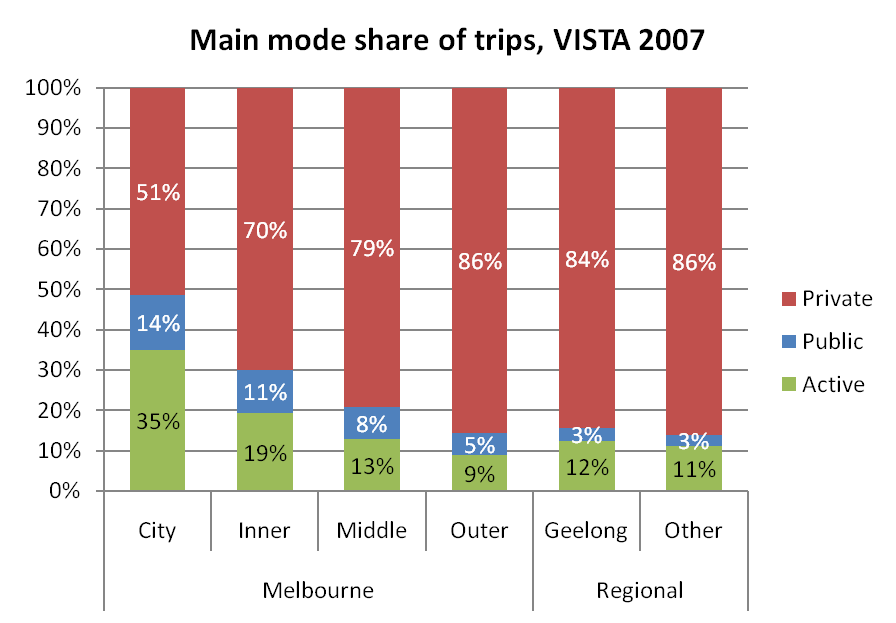
The distributions on car distance travelled reflect mode splits across the regions. Here is a chart of mode split for trips (using the ‘main’ mode for the trip, which means car+PT trips are counted as PT):

Active and public transport mode shares fell away with distance from the centre of Melbourne. I expect this will be a product of poorer service levels, and a smaller proportion of people travelling to Melbourne’s CBD (the main market where public transport dominates).

But here’s a slightly different take, the mode share of person travel distances:

There is much less variation in public transport mode share of kms travelled. This points to people in the outer suburbs of Melbourne, Geelong and other regional centres making much longer trips when they travelled by public transport. I expect many of these will be long distance rail trips to Melbourne.

The clear difference is that people in the outer suburbs and regional cities did a lot less walking/cycling and lot more travel by car.

What about mode share of very short trips?

Walking is a significant mode in the inner city, and many destinations are within walking distance. You might think that the regional centres are similar, because they are more compact in general.

Well, it appears not. Here is a chart of mode shares of trips under 1km (probably a walkable distance for most people).

Around half the short trips in the outer suburbs , Geelong and regional centres were made by private transport – essentially cars! Why did people drive for such short trips in these areas? Is it a lack of safe places to walk/cycle? Or is it a lack of disincentives to drive?

Digging deeper, even for recreational trips of less than 1km in the outer suburbs, 30% were made by car!

Does the number of trips made vary by geography?

The following chart shows the distribution of the number of trips made. In VISTA, a trip is defined as travel between two activities.

People in the inner city generally made more trips, and those in the middle and outer suburbs made fewer trips. This will also be influencing the total distance travelled per day.

Note: very few people make only 1 trip in a day because it essentially means you start and finish you day in different locations (within the VISTA definitions of a day at least).

How do trip lengths vary?

Here is a distribution chart of lengths of trips (for any purpose):

By almost any measure, those in the outer suburbs of Melbourne made the longest trips. They were followed by people who live in the middle suburbs of Melbourne and Geelong. This means that either people choose to partake in activities that were further away, or (more likely) those activities were further away from home.

What about trip distances for different purposes?

First up, median trip distances by purpose:

Work related trip distances were clearly the longest, especially in the outer suburbs. The “median” person living in the outer suburbs of Melbourne travelled 16 kms for work (note that not all “work related” trips are to/from home).

Here’s a closer look at the distribution of trip lengths between home and work:

The differences when looking only at home to work and work to home trips is much more stark, with the outer suburbs of Melbourne fairing worst by a long way.

The median distances in Geelong and the other regional centres were actually less than the inner suburbs of Melbourne, however they have a long tail with over 10% of trips in Geelong more than 50km.

Back to the previous chart, social trips also get longer as you move to the outer suburbs of Melbourne, which suggests that outer suburbs are not as self-contained for social destinations.

Most other trips purposes had a median around 3-4 kms, although this was more like 2-3 kms in the inner city, and distances increase in the outer suburbs. Chauffeuring trips (pick up or drop off someone) show the least variability (many of these would be taking kids to/from school).

Trips to education were longest in the inner suburbs, possibly reflecting children from wealthy families attending private schools that are further away.

How does travel time vary by trip purpose?

You can see:

  • Work trips take the most time in Melbourne, but there isn’t a lot of variation. This supports the hypothesis that people have a commuting travel time budget, and generally find work within that budget.
  • Work travel times were highest in the inner suburbs (perhaps related to slower road speeds) and outer suburbs (much longer distances).
  • Education trip times were longer in the inner and middle suburbs (perhaps related to congestion and/or longer trips to private schools by children in wealthy families)
  • 10 minutes was the most common median trip time – which actually shows up as 9 minutes in the chart, owing to the way I calculate medians in Excel (sorry, not perfect, but Excel doesn’t do medians in pivot tables).

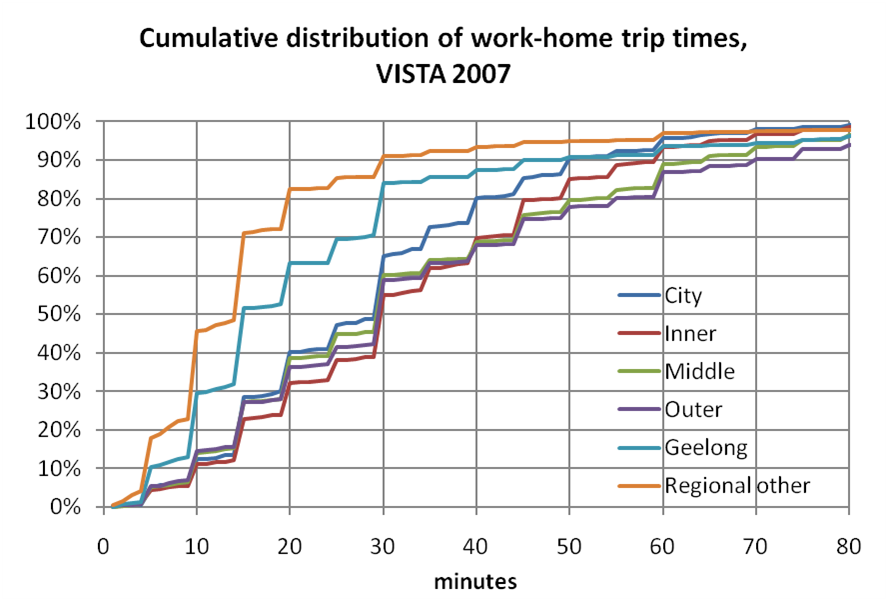
Here’s a closer look at work-home trip time distributions:

You can see big steps at the multiples of five minutes, as people tend to round estimated trip times to the nearest 5 minutes. Median trip times in Melbourne are all around 30 minutes, and much lower in Geelong and regional centres. People in the inner suburbs were least likely to have commute trips less than 20 minutes, while the outer suburbs were most likely to have trip times over 30 minutes.

How does travel speed vary by trip purpose?

As you might expect, trips were faster in the outer suburbs, probably because a combination of less congestion and more roads designed primarily to move vehicles quickly (freeways and divided arterials).

Education trips didn’t speed up as much in the outer suburbs, perhaps because they were more likely to be on public transport. Which brings us to…

How does mode share vary by trip purpose?

Around half of education trip kms were by public transport overall, although this was curiously lower in the inner city and outer suburbs.

Work trips had the next highest public transport mode share, which fell away towards the outer suburbs.

Other trip types mostly had slightly higher public transport mode shares closer to the centre of Melbourne. Note: I have not excluded very long trips from this analysis, so they might throw the figures slightly.

Here is another view, private transport mode share:

You can see more significant trends across Melbourne, as people in the inner city and suburbs were more likely to travel by active transport.

What other factors influence travel distance and mode split?

Different households will have different travel needs, and the distribution of household types across Melbourne is not even:

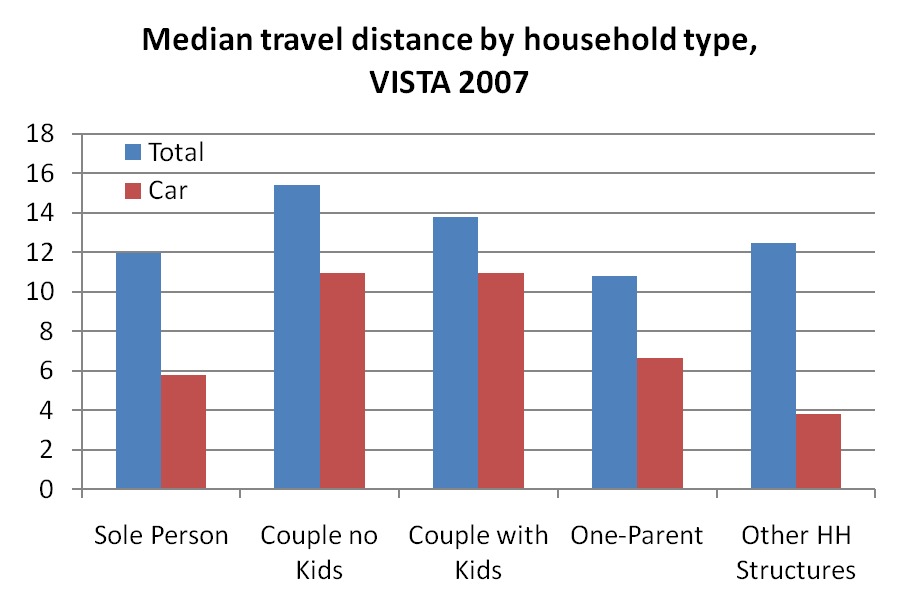
And median per person travel distance varied by household type:

You can see that the household types more prevalent in the outer suburbs (couples with or without kids) have the highest median car travel distances. So this will be impacting longer travel distances in the outer suburbs. You can also see that couples with kids have the highest car mode share, which is no big surprise!

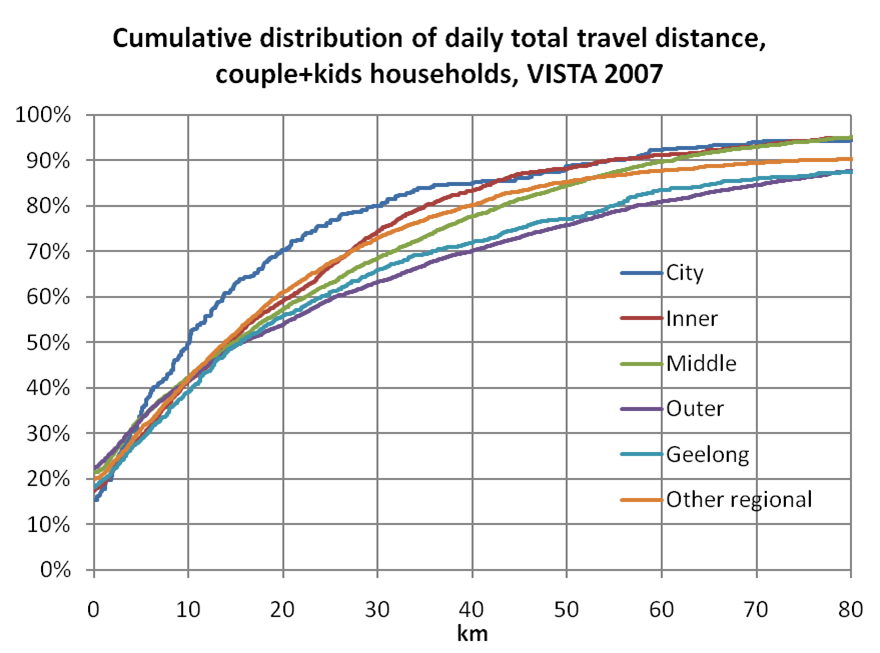
Here’s a look at the distribution of total travel distance for people living in households that were couples + kids, one of the most common household type:

Couples with kids in the inner city certainly travel less distance, and while the bottom half of people were similar for other regions, the travel distances were much longer in the upper half of such people, suggesting geography still had a big impact.

Equally household incomes were not consistent across Melbourne:

Equivalised household income is a measure that allows income comparisons across different household sizes. It is calculated as household income divided by a measure of householders: the first person is assigned a value of 1.0, subsequent persons over 15 years are 0.5, and any children are 0.3.

Curiously, the inner city has the lowest income profile in Melbourne (note that VISTA 2007 did not include Southbank and Docklands residents), while the wealthy live in the inner suburbs.

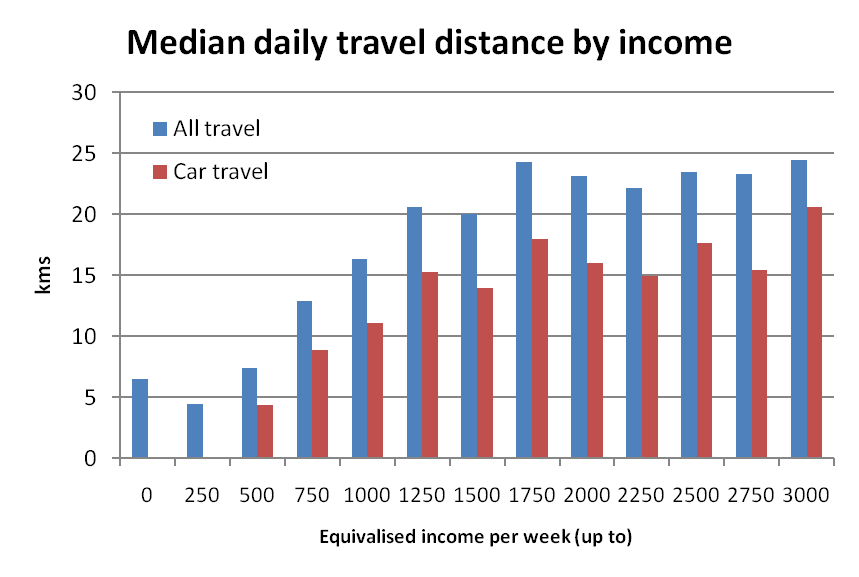
It will come as little surprise that household income is a driver of total – and car-based – travel distance:

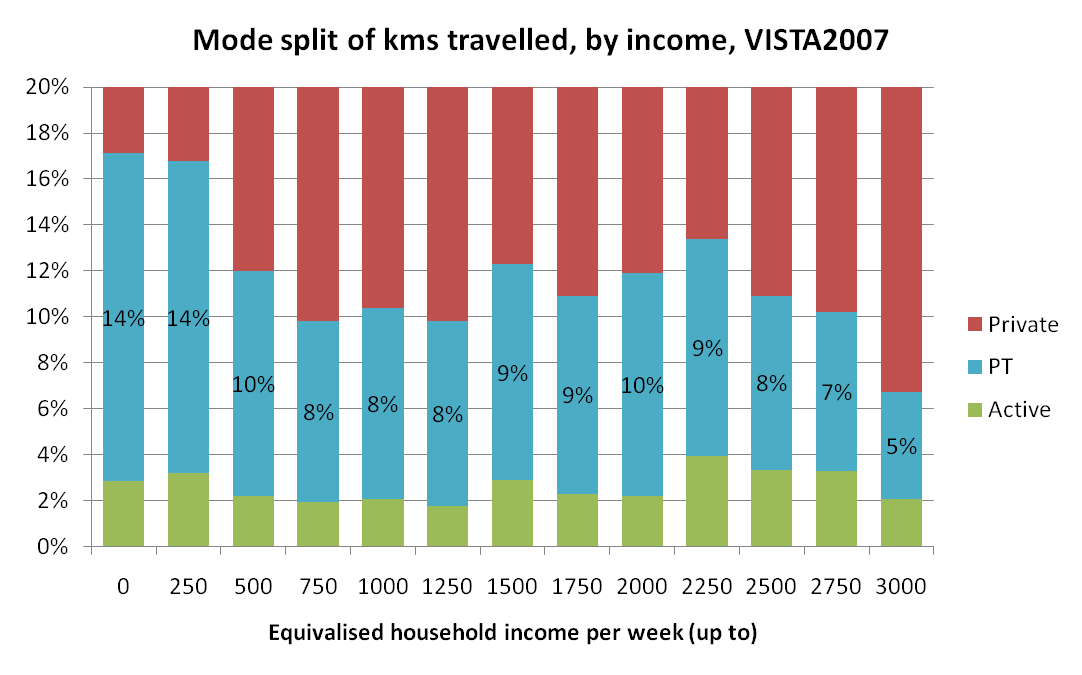
Do rich people shun public transport?


No, only the very-rich seem to shun public transport. According to the VISTA numbers (which are weighted to census 2006 demographics), only 10% of people live in households with an equivalised income over $2000.

The highest concentration of wealthy people is in the inner suburbs, travel distances are generally shorter (although income might explain longer travel distances in relatively wealthy Nillumbik).

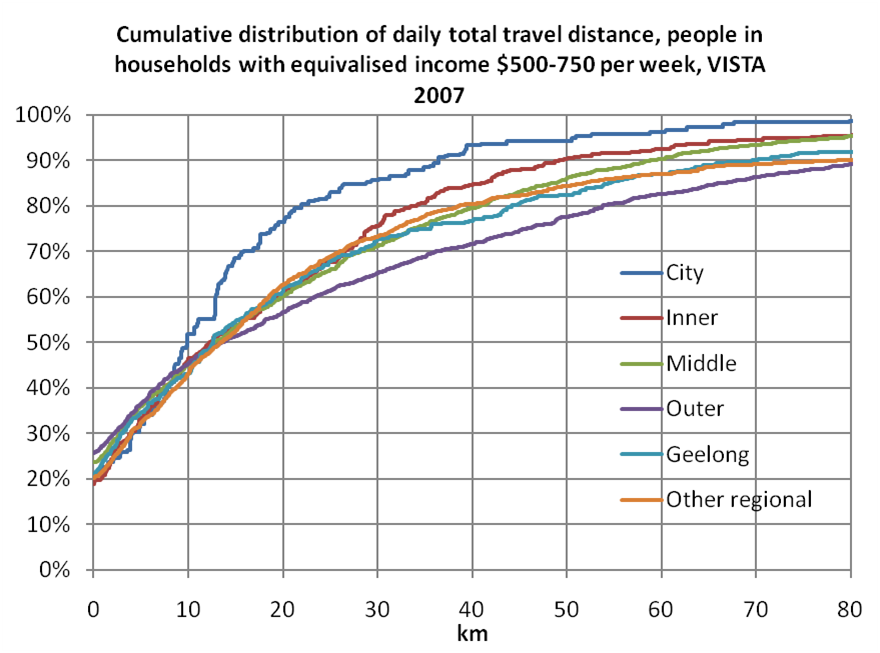
To isolate household income, here is a distribution chart for people in households with an equivalised income of between $500 and $750 per week (the largest $250 bracket overall):

Again the lower half exhibits very little difference, while the outer suburbs of Melbourne has much longer distances in the upper half. (note the inner city line is quite jagged, because the sample size in this instance is only 204).

What about age:

People aged 20-64 certainly travelled longer distances. Looking at the distribution of ages, there were more people aged 20-74 living in the inner city and inner suburbs, compared to middle and outer Melbourne. There is very little difference in the percentage of the population between 25 and 64 across the regions (those with the largest car travel distances).

And yes, public transport mode share is lowest amongst very young children and the middle-aged (the later group often being the decisions makers!):

And finally (without going through all the detail here) people who work full-time tend to travel more, but they become less prevalent as you move away from the centre of Melbourne.

So, should we encourage population growth in regional centres instead of Melbourne’s outer suburbs?

Well, it’s probably the wrong question to ask! People in inner Melbourne do a lot less car travel than anywhere else. This analysis clearly shows that encouraging people to move into inner Melbourne would probably do the most to reduce car travel per capita.

People currently living in the outer suburbs of Melbourne travel more and do more car kms than those in regional cities. The main problem is that their work and social trips are much longer.

The evidence suggests putting people into regional cities would generate less car travel than putting people on the fringe of Melbourne.

However, there are several points worth considering:

  • If you can generate jobs in the outer suburbs of Melbourne, you might be able to reduce work travel distances. Easy to say, but it defies agglomeration economies that cause jobs to co-locate in the inner city and suburbs. If Melbourne’s Central Activities Areas (formerly Central Activities Districts (formerly Transit Cities)) can become significant employment destinations then that will certainly help.
  • If you do encourage people to settle in regional cities, will they have the same transport profile as existing residents? I would guess that there would be a significant difference between people living in the centre of regional cities, and those living on the fringe. The reduced car travel advantages of regional cities are probably largely eroded on the fringes of the regional cities. However, encouraging higher density in the inner areas of the regional cities would probably generate less car kms.
  • If you increase the population in regional cities without also increasing employment opportunities, you’ll create unemployment problems and/or force people to travel further to get to work. This would cancel out some of the benefits of locating people in regional centres. It may also increase demand on long distance V/line commuter trains into Melbourne (which currently consume valuable metropolitan train paths with low passenger density).

It doesn’t seem like there is much difference between the outer suburbs and regional cities. But there is a much bigger difference when you compare these with the inner suburbs of Melbourne.

If we really want to reduce car use, we’ll need to do relatively easy things like:

  • Locate people in inner city and suburban areas, where travel distances are short and there is viable high quality public transport (though it will probably require capacity upgrades)
  • Increase public transport service levels in existing outer suburbs and regional cities, with a particular focus on efficiently connecting people to employment areas by public transport.
  • Break down the barriers to walking and cycling in the outer suburbs and regional cities. Footpaths and safe places to ride would be a good start!

Notes about the data:

  • Wherever possible I have used person weightings in VISTA, which are for all week travel and align VISTA data with 2006 census data on demographics.
  • I have determined trip purpose by looking at the destination purpose of each trip. If the destination is not home, then I assign the destination purpose as the trip purpose. If the destination purpose is home, then I assign the origin purpose as the trip purpose. This gets around the common problem of nearly half of all trips having “go home” as the trip purpose, which costs you half your data when analysing by trip purpose.

Where do people in Melbourne go to work?

Sat 23 April, 2011

[Updated in August 2011 with a better map format, and now maps for 21 SLAs]

In an earlier post, I looked at where employees come from for some major employment destinations around Melbourne. This post does the flip-side: What are the work destinations for people in different parts of Melbourne? How well does the current public transport network connect people to where they work? What implications does this have for the proposed rail lines to Doncaster and Rowville?

I’ll take a detailed look at Rowville, Manningham, and Berwick, and a briefer look at Altona, Broadmeadows, Cranbourne, and Sunshine.

About the maps

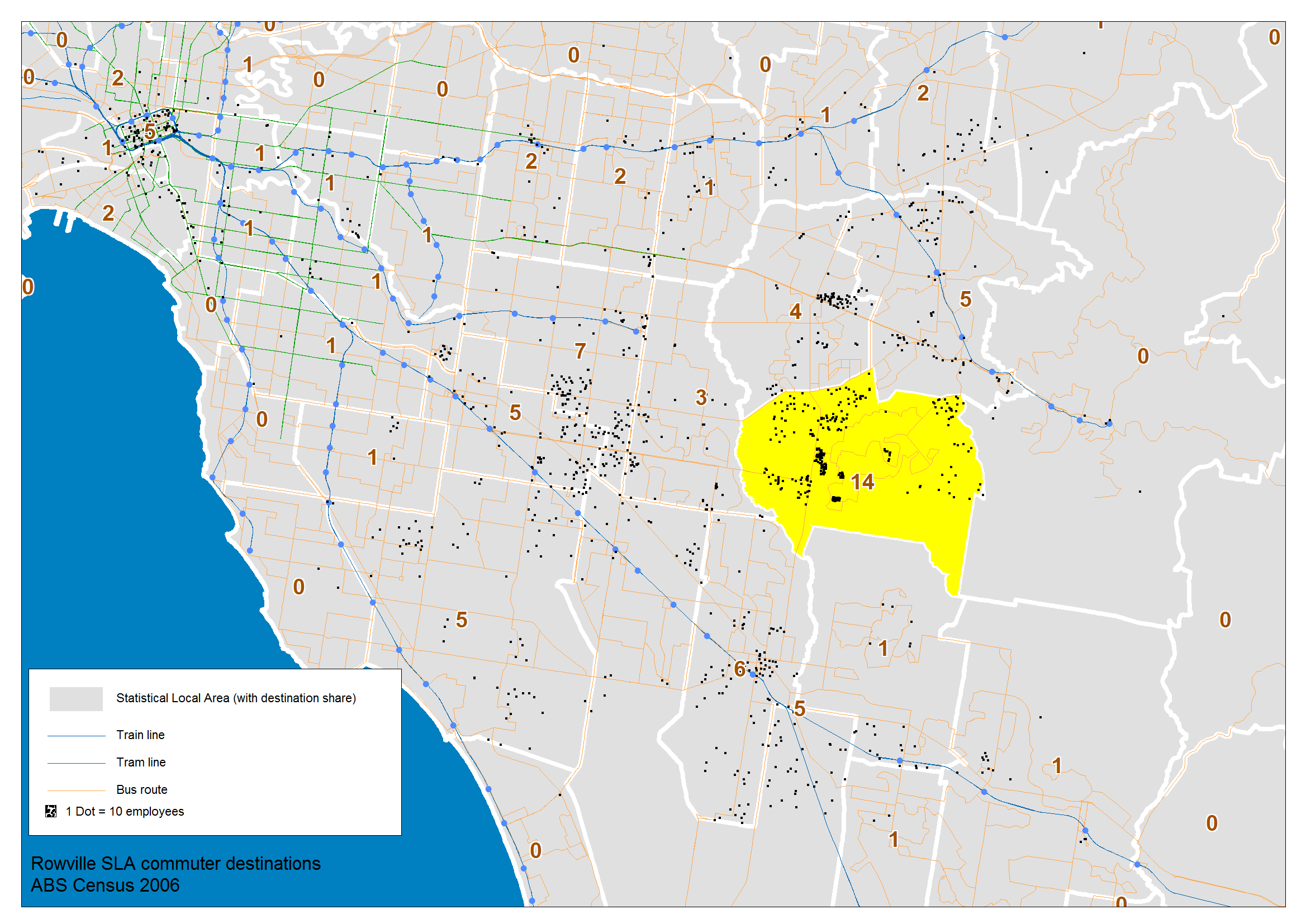
I’ve used a dataset of that contains the volumes of people commuting each SLA (Statistical Local Area) to destination zones in Melbourne from the 2006 census (with thanks to the Department of Transport). I’ve then trimmed each destination zone to keep only areas where employment activity would be expected (using ABS mesh blocks). That is, I’ve removed parklands, residential areas, etc.

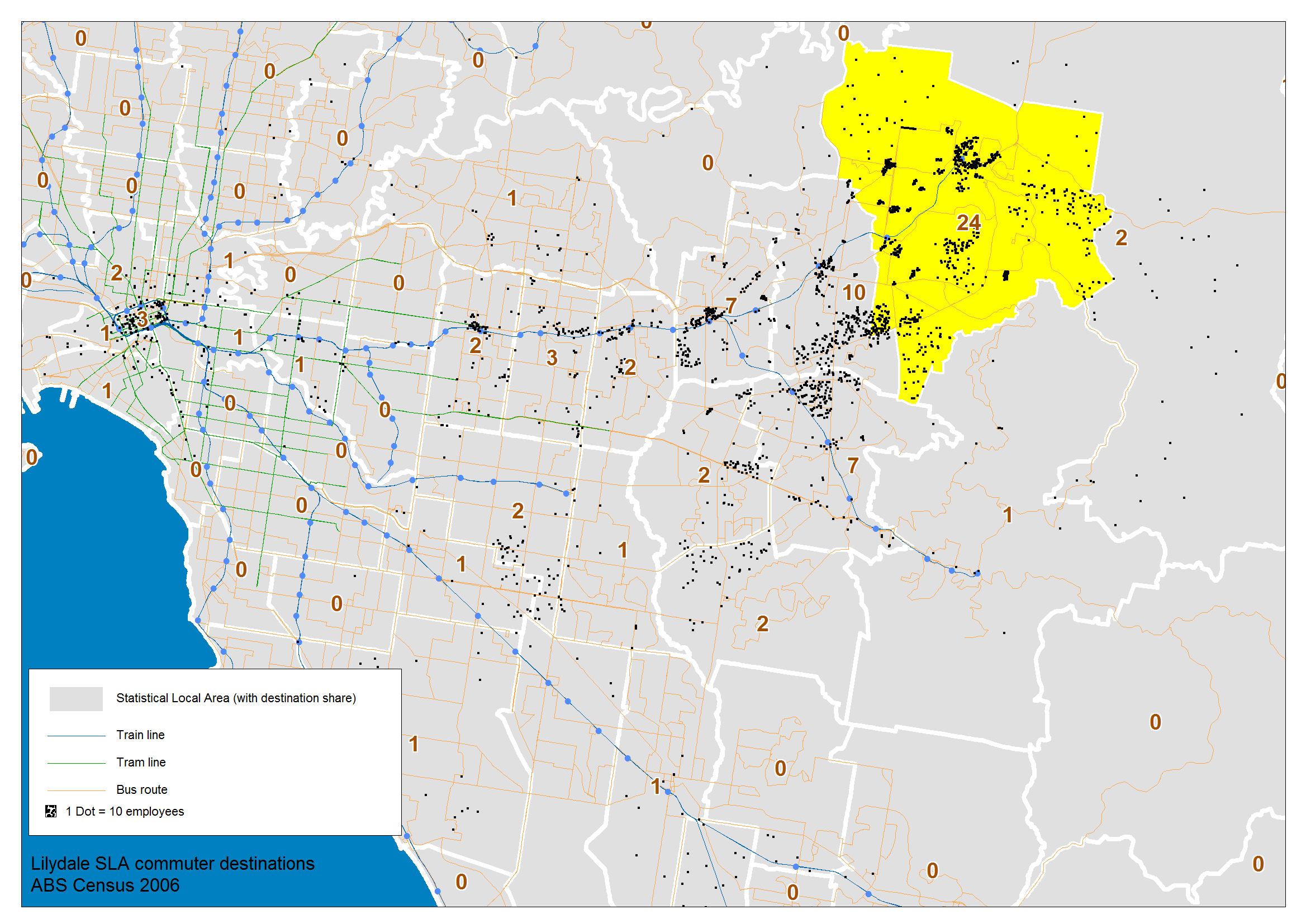
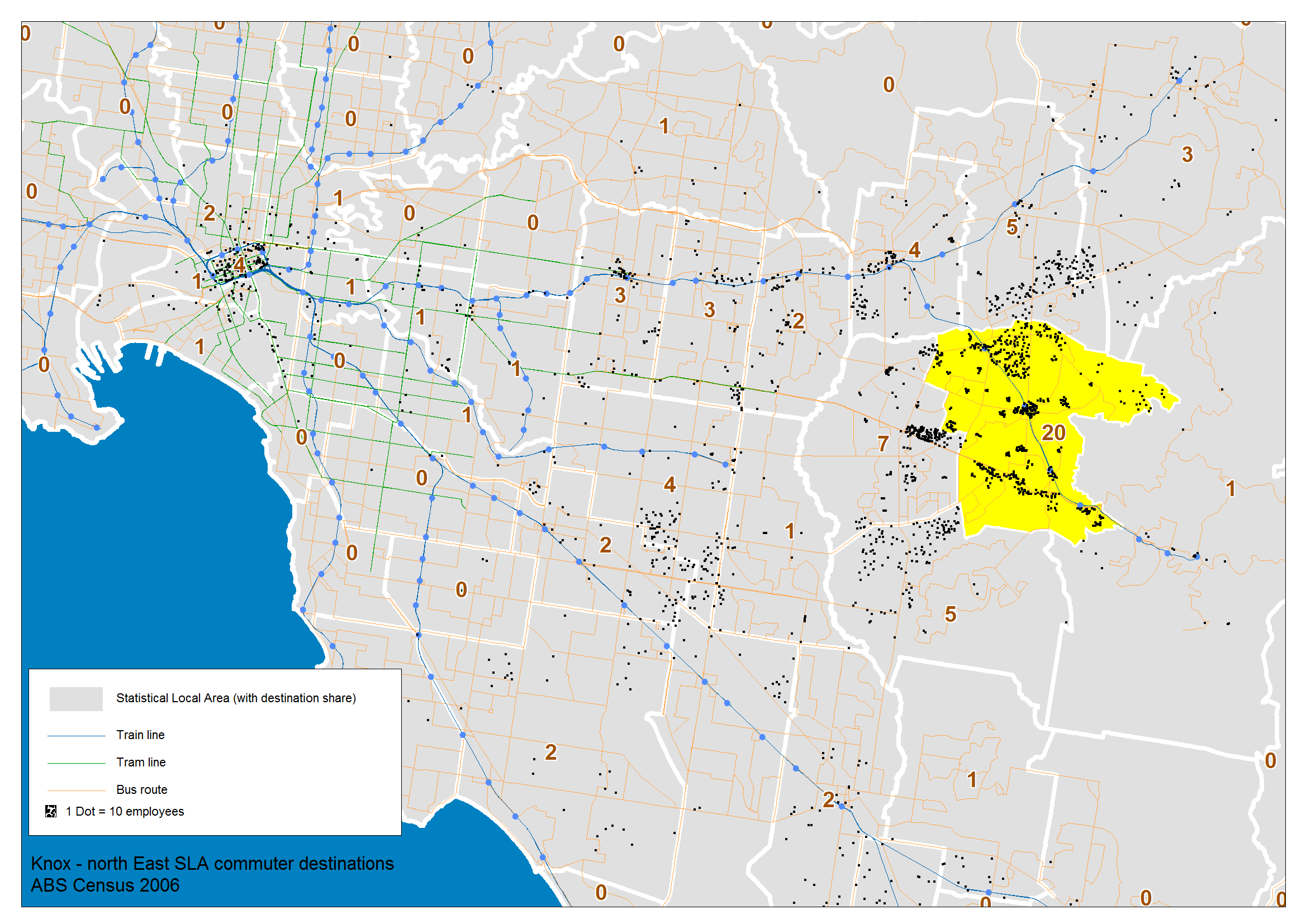
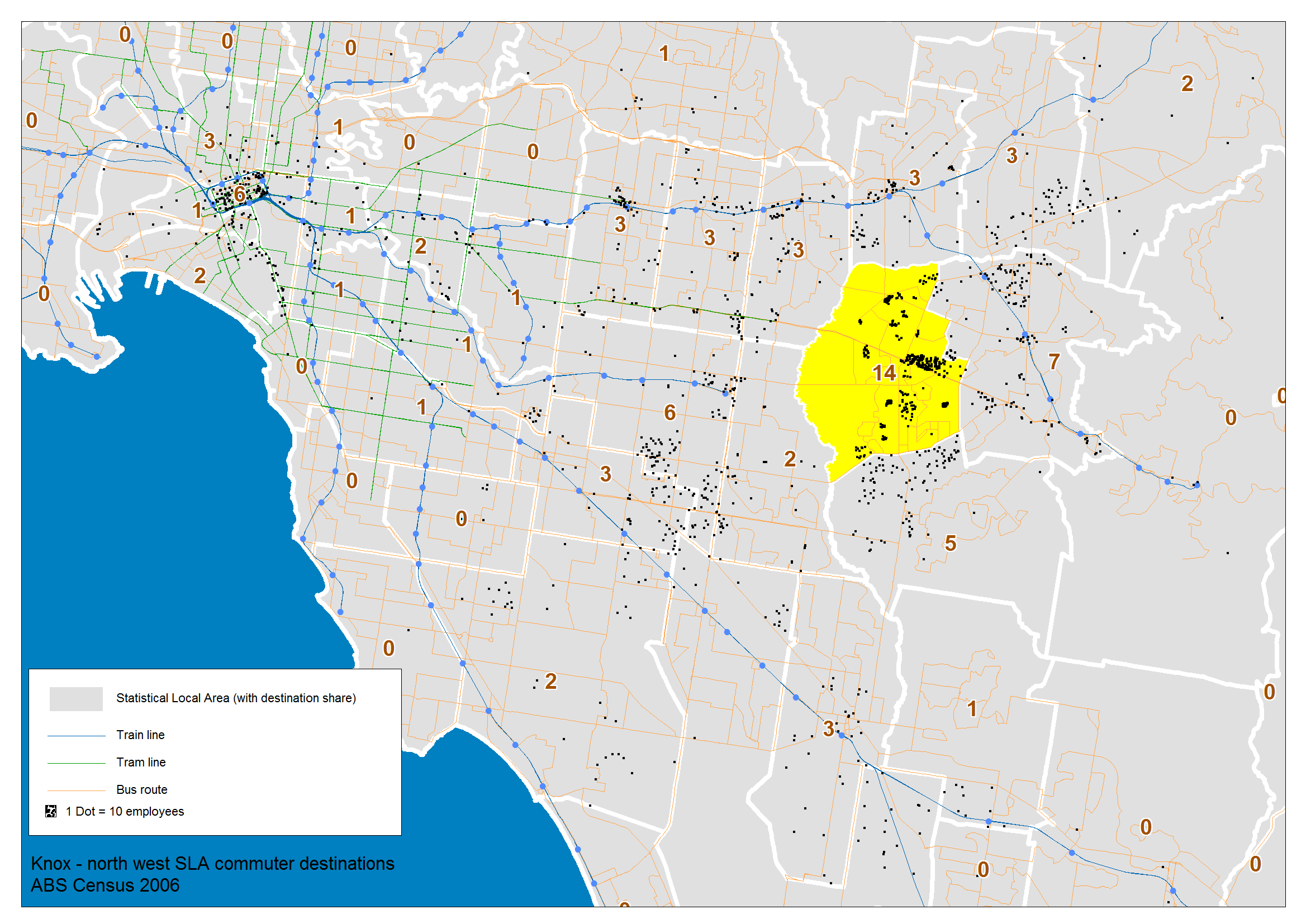
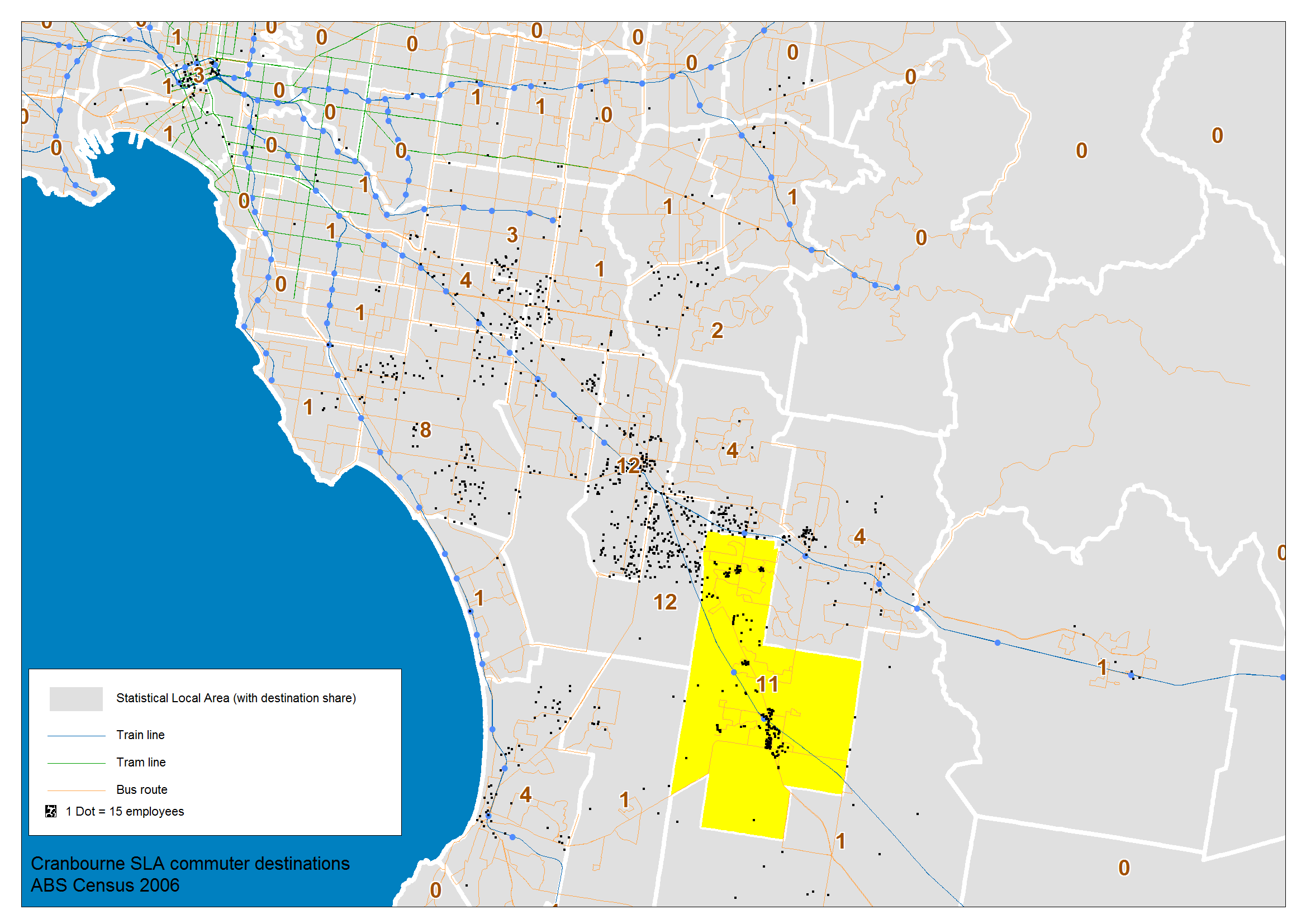
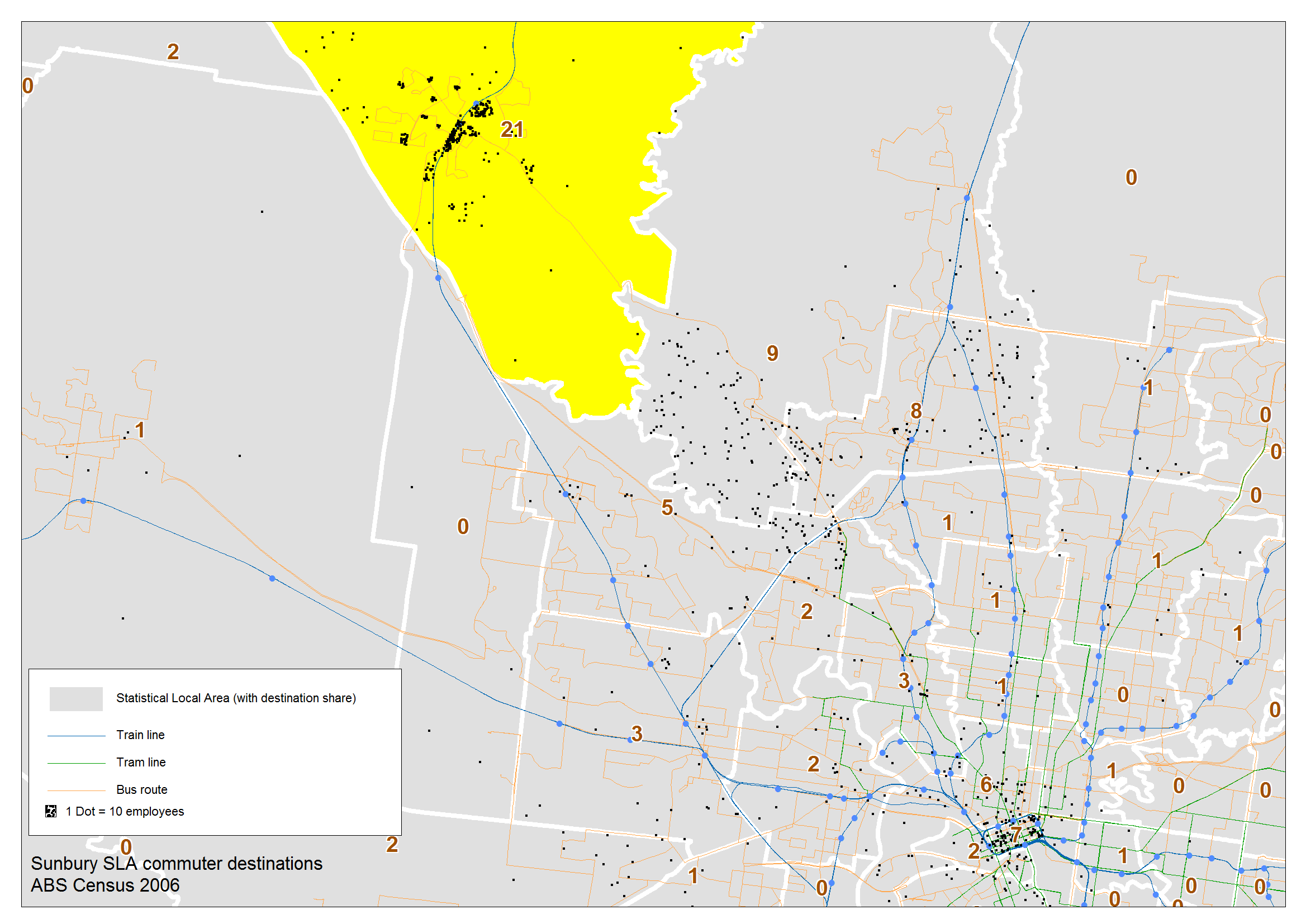
Then I’ve used dot distribution mapping, where each dot represents 10 or 15 employee destinations (depending on the SLA). I’ve also overlaid each SLA’s percentage share of journey to work destinations from the SLA in question (shaded yellow), to give a broader perspective.

Rowville

The “Knox (C) South” SLA might as well be called Rowville as that suburb dominates the SLA. The following map shows the density of worker destinations in 2006. (As usual, you’ll need to click to zoom in and see the detail).
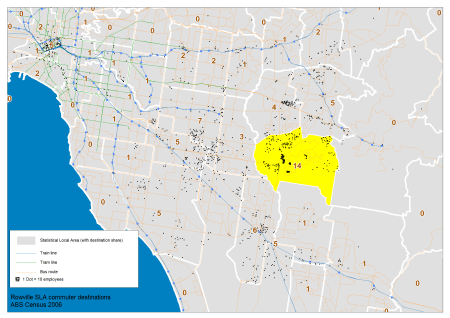
There are quite a few dense destinations within the SLA, including (hyperlinks are to Melway maps):

Nearby destinations to the west include:

Major destinations to the north and south include:

Further afield there are concentrations in:

You’ll also find that most schools in and near Rowville show up on the map.

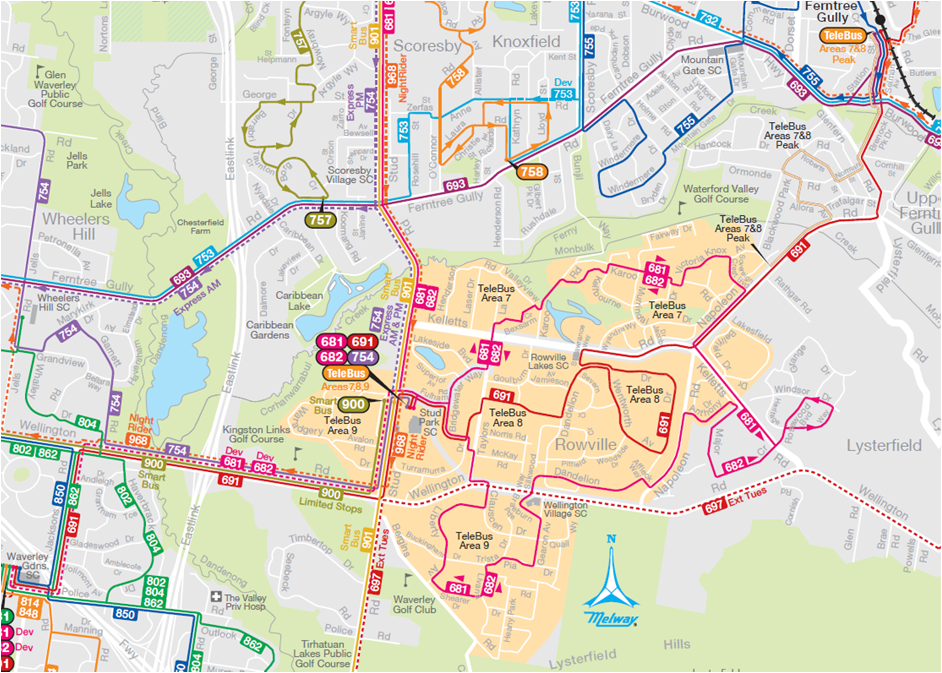
Rowville is only served by buses for public transport, but there are now direct connections from Rowville to most of these destinations, particularly following the introduction of SmartBus routes 900 (west to Clayton, Oakleigh, Chadstone and Caulfield) and 901 (north Knox and Ringwood, and south to Dandenong and Frankston). The 900 was a completely new route, and the 901 an upgrade of an existing route, both occurring after the 2006 census.

However neither of those routes operate east of Stud Road, where most Rowville residents are located. Those people need to change buses at Stud Park Shopping Centre, which is not easy as most local bus routes in eastern Rowville run every 30 minutes in the peak (and are highly indirect). You can see the local network on the Metlink public transport map for the Rowville area:
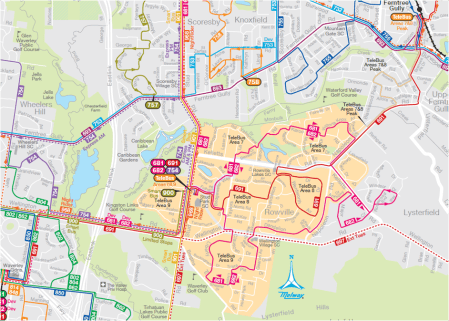
The recent Bus Service Review in the area did propose route 900 be extended east towards Ferntree Gully which would introduce a direct public transport connection to many of the major employment destinations for local residents.

Notable destinations not well connected by public transport include:

  • The Caribbean Business Park in Scoresby (marked Caribbean Gardens on the above map): The only access by public transport is the 753 and 693 bus routes at the northern edge. There are around five trips per hour combined in the AM peak, but the headway becomes 30 minutes later in the AM peak. This business park only has one entrance road and is away from major public transport routes making it difficult to service. It is however conveniently located next to Eastlink, and obviously has a high car dependence. They just need to hope oil prices stay cheap. Well, cheap-ish.
  • The Notting Hill industrial area around Ferntree Gully Road: People wanting to get to jobs in this area need to change buses. The current network allows you to reach Notting Hill by changing between bus routes that operate every 15 minutes (which could be worse).
  • The Tally Ho business park in Burwood East (corner Burwood Highway and Springvale Road): This is at the intersection of a SmartBus route and a tram line, so there is relatively good public transport to the site. However the challenge is the distance involved, and from Rowville a transfer is required between SmartBus routes.
  • The Bayswater industrial area: This is only directly connected from Rowville by three extended trips on bus route 691 in the AM peak. In the PM peak, no trips run through from Bayswater to Rowville, so a transfer is required at Boronia.
  • The Valley Private Hospital, which is just across Dandenong Creek in Mulgrave but not near any bridges.
  • The Coles Headquarters in Tooronga (Glen Iris). This employment centre is only really serviced by one bus route (624), or a lengthy (and hilly) walk from Tooronga train station or the Burke Road tram (72).
  • The Box Hill CAD, again some distance away. Can be reached with a bus-bus or bus-train transfer (about 1 hour on PT).
  • The St Kilda Road employment area is hard to reach (particularly adjacent to Albert Park). You either have to go to Flinders Street and catch a tram south (an indirect journey), get off a train at Armadale and transfer to a slow tram, or change from train to tram at South Yarra (but this only serves the northern end of the patch). Again, this looks like more evidence to support a new PT route from South Yarra Station to the Albert Park section of St Kilda Road (and possibly beyond). This was recommended as part of the Bus Service Review for the area.

The first two of these destinations are along Ferntree Gully Road, and so it might be tempting to try to run a new bus route from Rowville along Ferntree Gully Road. But rather than trying to pair all origins and destinations with direct bus routes (creating a large confusing network of low-frequency bus routes), maybe the answer lies in better frequency on the 693 (or more even headways between the 693 and 753) to reduce transfer penalties. Another improvement would be to introduce a stop on the four express route 754 trips, should that be deemed acceptable by the powers that be(!). The 754 express bus used to be the fastest way from Rowville to the CBD, but this is no longer the case following the introduction of the 900 SmartBus (in 2006).

The following table shows the total numbers of journeys to work to the top SLA destinations, and the public transport mode share

Destination SLA Journeys PT share
Knox (C) – South 2368 2%
Monash (C) – Waverley West 1128 2%
Gr. Dandenong (C) – Dandenong 1035 1%
Knox (C) – North-East 897 1%
Monash (C) – South-West 831 2%
Gr. Dandenong (C) Bal 829 1%
Kingston (C) – North 815 1%
Melbourne (C) – Inner 800 57%
Knox (C) – North-West 753 4%
Monash (C) – Waverley East 591 4%
Melbourne (C) – Remainder 430 23%
Whitehorse (C) – Box Hill 319 3%
Maroondah (C) – Croydon 305 0%

The City of Melbourne is the only destination with any serious PT mode share, which is important to keep in mind considering the above analysis. Perhaps the mode share for some of the directly connected destinations may have risen since 2006 due to the new SmartBus routes. But then maybe public transport will always struggle to compete with plentiful free employee parking (that employers are paying for).

What does this mean for a rail line to Rowville?

If rail were to run via Wellington Road, certainly it would connect Rowville to a number of its major employment destinations to the west. However if the rail ended at Stud Park Shopping Centre, there would still be a transfer problem for most people who live in the eastern part of Rowville (something that can be more easily fixed by extending existing SmartBus route 900). It would not also be an ideal park and ride station, being an activity centre with limited land space.

1450 people from Rowville commuted to the City of Melbourne, and a further 2550 commuted to the City of Monash, a total of 4000 trips (exactly, as it happens). If the train line achieved a 50% share of all travel to Melbourne and Monash (2000 people), that is 3 trains at comfortable loading from Rowville. Of course there would be additional demand from other areas along the route, and for trips to other destinations. But then again not all destinations in Monash and Melbourne would be well served by the rail line (eg Glen Waverley).

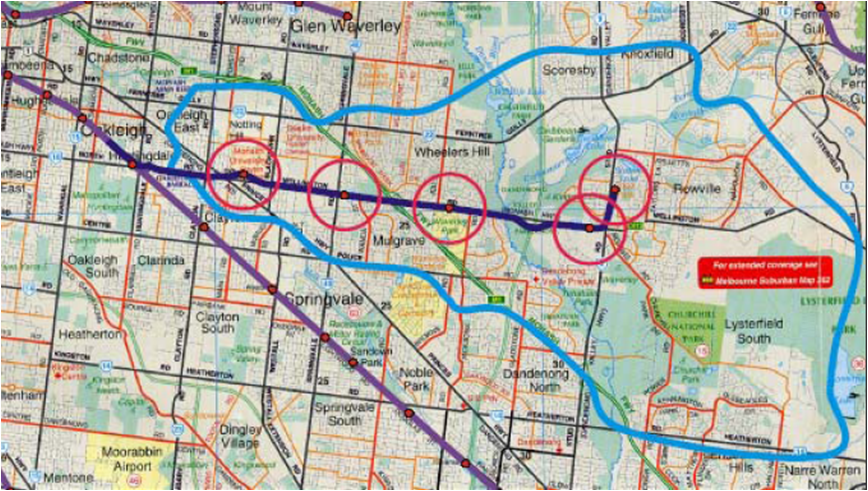
The Rowville Railway Prefeasibility Study 2004 (commissioned by Knox Council), simply assumed 7% of peak period journeys to work in the line’s catchment would use the train (refer page 38), without checking census data about where Rowville residents currently work (though it turns out that many do work along the rail line). They arrived at a figure of 3360 journeys to work by Rowville rail, using a total catchment population of 100,000 (allowing for park and ride), shown in the map below.
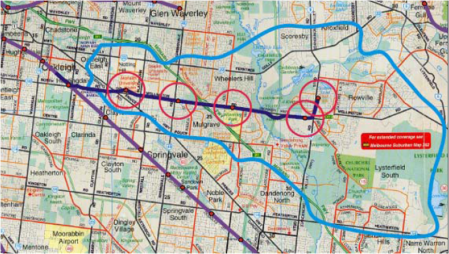
They assumed 70% of these would be within one hour and then calculated an “hourly” peak patronage estimate of 2352 trips. They described this figure as the patronage per hour in the peak, but this is a little misleading because the other 30% of journeys to work by train (1008) would be outside the busiest hour of the peak. Assuming a three hour AM peak, it might be around 500 for the first and third peak hours. Not a lot of demand.

Obviously university students and people travelling for other non-work purposes would add to these commuter figures, but I am not sure whether there will be sufficient demand to justify the cost of grade-separated heavy rail to a low-density area of Melbourne that is a not an urban growth area. While the residential densities in the catchment are not the lowest in Melbourne, there are large areas of parkland and other non-residential land use that dilutes the average density of the catchment (an issue that equally applies to the proposed Knox tram extension). A shorter line as far as Monash University might be more viable.

In addition, the study assumed a large park and ride catchment. For many people in this catchment, the car travel time saving of having a park and ride train station slightly closer on the Rowville line would be quite small. I suspect many of these trips will be diverted park and ride from the Dandenong and Glen Waverley lines, rather than trips mode shifted to public transport.

Alan Davies, on his Melbourne Urbanist blog has suggested that perhaps such a rail line should veer to the north to capture more of the Notting Hill employment area (and possibly also Chadstone Shopping Centre). Looking at the current employment destinations, there would appear to be some merit in this idea, as long as it still served Monash University. Although without a reservation in place, it would probably require a very expensive tunnel.

Perhaps in a future post I could look at the destinations of a broader catchment of the proposed Rowville rail line (although my dataset only has origins at the SLA level). Alas, I’m doing this in my own time, so I will have to see how I go.

Hopefully we will get a better feel for the economics in the upcoming study into Rowville rail.

Manningham West

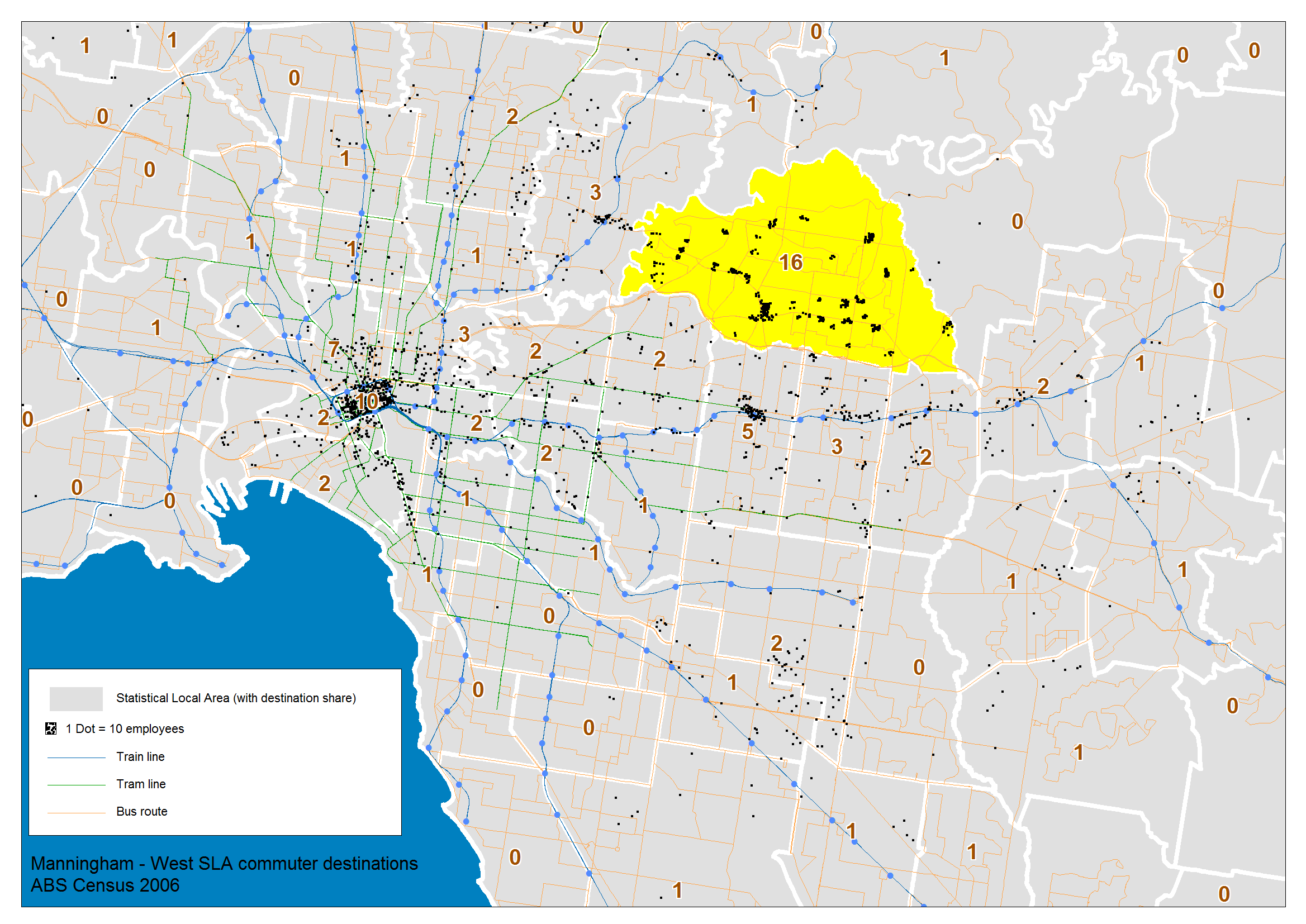
The Manningham West SLA captures the main residential half of Manningham, centred around Doncaster, Templestowe and Donvale. Here is a map showing the employment destination densities for Manningham west residents:
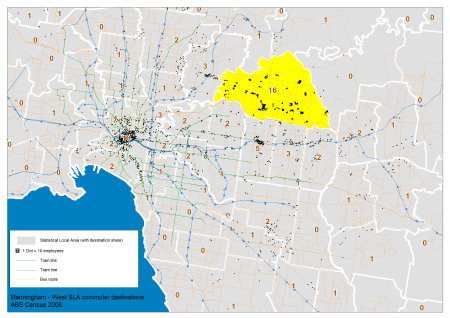
Within the SLA, you can see various pockets of destination density, all of which are either shopping areas or schools. In fact, Manningham lacks any significant industrial areas, large medical facilities, or tertiary education institutions. Only 16% of Manningham west workers went to a job located within Manningham west (but this is not actually very low compared to other SLAs in Melbourne, perhaps the subject of future post).

Nearby major destinations include:

Major destinations further afield include:

  • Kew Junction
  • Hawthorn/Camberwell corridor, along Burwood Road/Camberwell Road, including Swinburne University
  • inner northern suburbs (Carlton/Fitzroy)
  • Melbourne CBD
  • St Kilda Road (particularly the Albert Park section)
  • Royal Melbourne Hospital and the Children’s Hospital in Parkville

In terms of public transport access to employment, the following destinations are more problematic:

  • Access to Heidelberg is only provided by the 903 SmartBus (although at a 7.5 minute frequency in peak periods making transfers from other routes easier). There is no east-west connection into Heidelberg from the Templestowe area (an issue identified in the bus service review).
  • There is no direct linkage to Ivanhoe, compounded by limited access to Heidelberg.
  • The hospitals in Parkville (which require two bus transfers, or a tram connection in the CBD)
  • St Kilda Road requires a tram transfer in the CBD. While this is relatively direct, it’s not particularly fast, and the City of Melbourne is planning to remove the tram stops at the corner of Swanston and Lonsdale Streets, the transfer point for such commuters (this is in fact the busiest tram-bus transfer location in all of Melbourne).

Until recently, the “Golden Mile” along Whitehorse Road had very little public transport coverage, but SmartBus route 901 now connects large parts of Manningham with this area (and Ringwood).

The following table shows the major SLA destinations:

Destination SLA Journeys PT share
Manningham (C) – West 5773 4%
Melbourne (C) – Inner 3819 53%
Melbourne (C) – Remainder 2421 20%
Whitehorse (C) – Box Hill 1768 8%
Yarra (C) – North 1201 9%
Banyule (C) – Heidelberg 1161 2%
Whitehorse (C) – Nunawading W. 1081 3%
Port Phillip (C) – West 902 17%
Boroondara (C) – Hawthorn 882 4%
Darebin (C) – Preston 874 2%
Monash (C) – Waverley West 834 2%
Melbourne (C) – S’bank-D’lands 742 33%
Yarra (C) – Richmond 715 9%

What does this mean for a rail line to Doncaster?

Certainly a railway between Doncaster and the city would connect Manningham West to many of its employment destinations in the inner city area.

The journey to work destination SLAs that would be served by a Doncaster railway (Melbourne Inner, Southbank/Docklands, Yarra (North and Richmond) and maybe half of Melbourne remainder) would cover around 8000 trips on 2006 census figures. If the public transport mode share to these SLAs was the same as for trips from all origins (other than the inner city and Manningham west), then that would be around 3900 journeys to work journeys by public transport, or around five comfortably full trains. Over a three hour peak period, that would require less than two trains per hour. However, adding non-work related trips, you might justify three trains per hour in the peak from Doncaster. This would be much less frequent than most train lines in Melbourne.

Doncaster rail also faces similar challenges to Rowville rail, in that most of the catchment would need to use car or bus to access the train line (assuming a Doncaster train line terminated at Doncaster Hill. Already a large regional shopping centre, there would be little room for park and ride, and commuter parking is probably the last sort of inactive land use you want in a major activity centre anyway.

Which would mean buses would need to be the primary access mode for train passengers. This introduces a transfer to most trips, when compared to current direct to city bus services available to most people in Manningham. Transfers bring walking and waiting times, and inconvenience and risk of missed connections (all up what transport planners call transfer penalties).

The Eddington East West Link Study includes an appendix summarising their assessment of mass transit options for Doncaster (appendix C, pages 272-8). It reports a heavy rail line would provide a journey time of 25-30 minutes from Doncaster Hill to Melbourne Central, and that a bus service with high levels of bus priority could complete the trip in 25-35 minutes. SmartBus route 907 is currently timetabled to take around 39 minutes between Doncaster Hill and Melbourne Central in the AM peak, so it would appear the study team anticipated greater bus priority.

Introducing a bus-train transfer to trips to the city would require maybe 5 minutes of transfer time, plus a transfer penalty to account for the inconvenience and missed transfer risk (particularly if trains only run every 15-20 minutes). The journey time advantage of heavy rail quickly evaporates when you include a bus-train transfer to most journeys. You would also need a large bus terminal capable of holding maybe 10-15 feeder buses all meeting the same train if you want to minimise transfer times.

I suspect the lack of compelling travel time savings, and relatively low transport demand will make it difficult to justify the capital cost of Doncaster rail, especially considering the tunnelling required when the line leaves the Eastern Freeway catchment (Eddington estimated a cost of $1.7-2b). This was the finding of Eddington study, but the detail of their analysis was unfortunately not published. And now we are going to have yet another study.

Another factor limiting demand on the corridor is the lack of specialised destinations (such as hospitals or universities) in Manningham to create demand outside commuter peak flows. For example, only 245 people reported commuting from Melbourne or Yarra to Manningham west in the 2006 census, and only 22 of them did so by public transport.

Of course building a train line would change land use patterns, which would probably increase the travel demand from what it was in 2006. But would this increase be enough to return a favourable benefit-cost ratio? And is the railway being built to meet existing latent demand, or create new demand?

Berwick

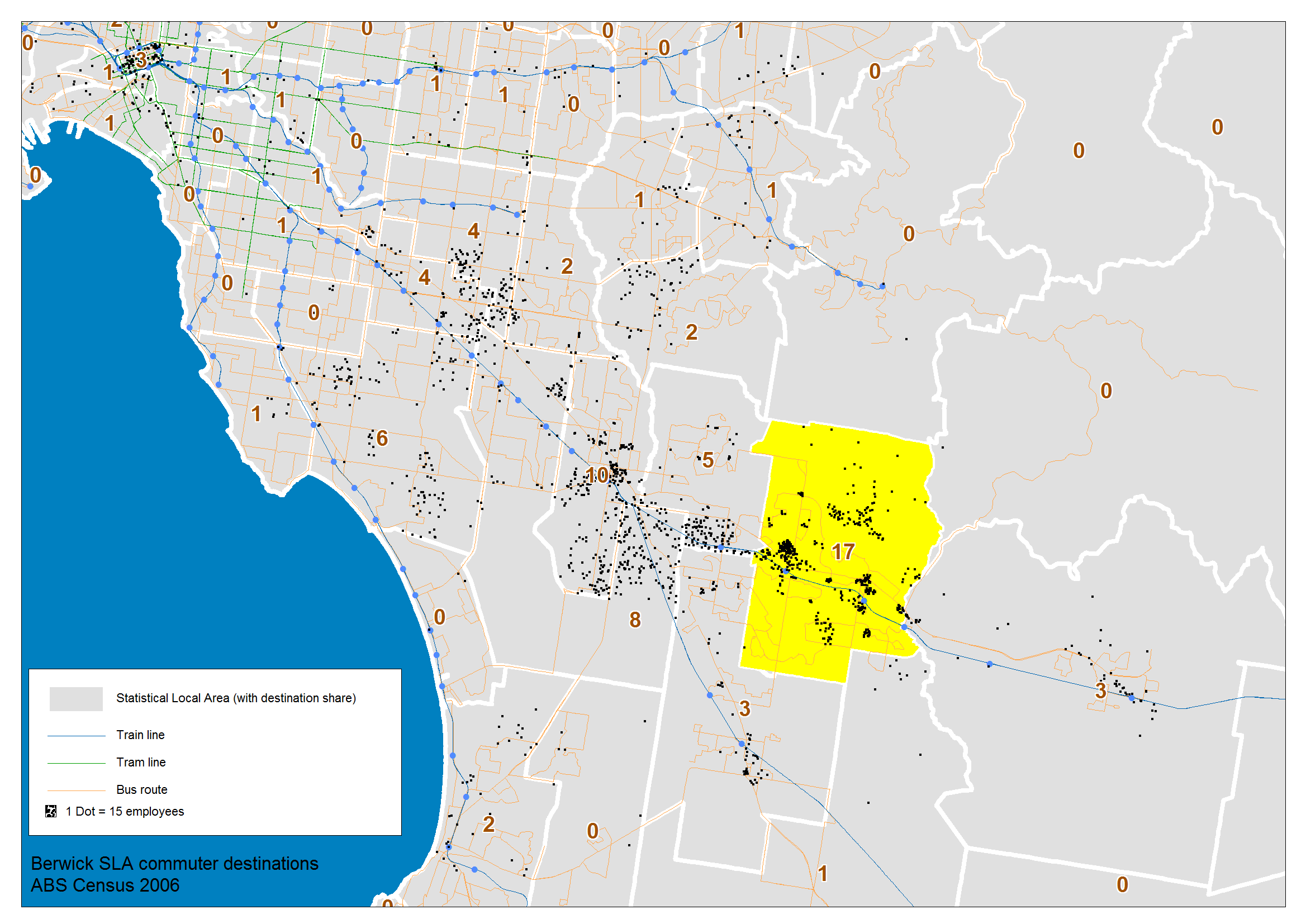
The Berwick SLA (part of Casey) is in Melbourne’s outer south eastern suburbs, and is still seeing urban growth.
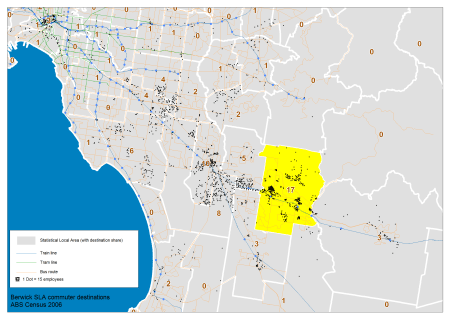
The major local destinations include:

The biggest nearby destinations include:

Further afield destinations include:

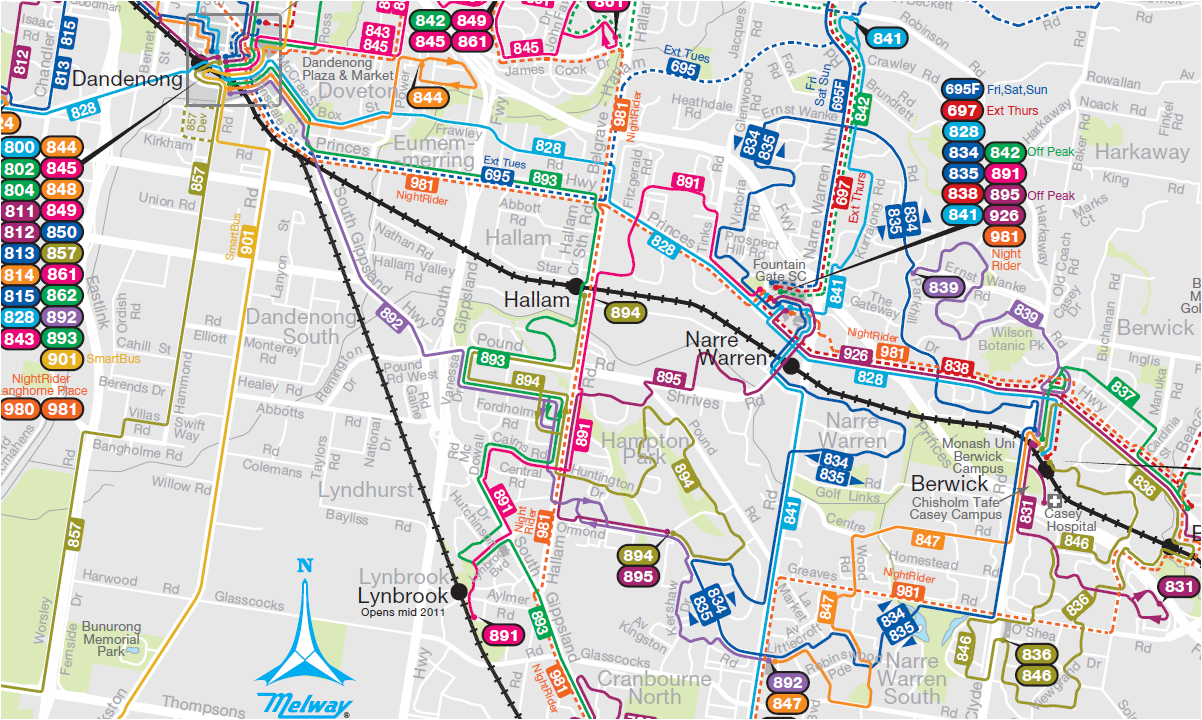
Here is part of the Metlink map showing the Berwick area:
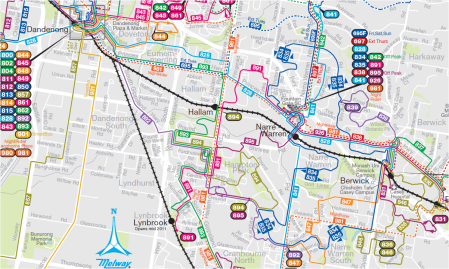
Notable destinations not well connected by public transport include:

  • The industrial area of Hallam. Bus route 828 almost reaches the Hallam industrial area, but then deviates north to residential areas (and I’m not advocating a change, by the way). Otherwise Hallam station is the south-east corner of the area.
  • The large employment area of Dandenong South. Reopening and providing pedestrian access to General Motors Station might help provide access to some parts (it is now ironically abutted by a large employee car park) (see wikipedia if you are interested in the history of this station). The bus service review for the area advocated new east-west routes from Berwick to Dandenong South, which would obviously greatly assist in connecting employees to workplaces. The bus network in Casey was upgraded in late 2010, but no east-west routes were introduced.
  • The Clayton/Mulgrave/Notting Hill industrial area is again a problem area. Some parts are near to train stations (providing a direct connection), but most require a change to a bus. For someone not living near a train station in Berwick, the journey would be bus-train-bus, which would not compete well with the car (especially with free parking). I do wonder if a direct bus service (with express running in between) might be viable.
  • Caribbean Gardens Business Park (see Rowville discussion)
  • The Coles headquarters(see Rowville discussion)
  • St Kilda Road (see Rowville discussion)

The following Metlink map shows the lack of east-west bus services across the rail line between the residential and employment areas:

A number of people travel long distances to get to work from Berwick, where public transport will struggle to compete with the car, due to low average bus speed as much as anything. I’ll look at average travel distances in another post.

Here are the volumes and public transport mode shares for major destination SLAs:

Destination SLA Journeys PT share
Casey (C) – Berwick 5934 2%
Gr. Dandenong (C) – Dandenong 3650 3%
Gr. Dandenong (C) Bal 2902 2%
Kingston (C) – North 2058 2%
Casey (C) – Hallam 1856 2%
Monash (C) – Waverley West 1367 1%
Monash (C) – South-West 1299 5%
Melbourne (C) – Inner 1232 73%
Cardinia (S) – Pakenham 1028 4%
Casey (C) – Cranbourne 1000 1%
Knox (C) – South 872 0%
Frankston (C) – West 631 1%
Melbourne (C) – Remainder 622 39%

Again, only the CBD shows up with large public transport mode share, although curiously Monash South West is at 5% (almost entirely involving train).

Other SLAs

For interest, I have looked at a few other SLAs around Melbourne. I’ll discuss these briefly in terms of problematic public transport access to employment.

Western

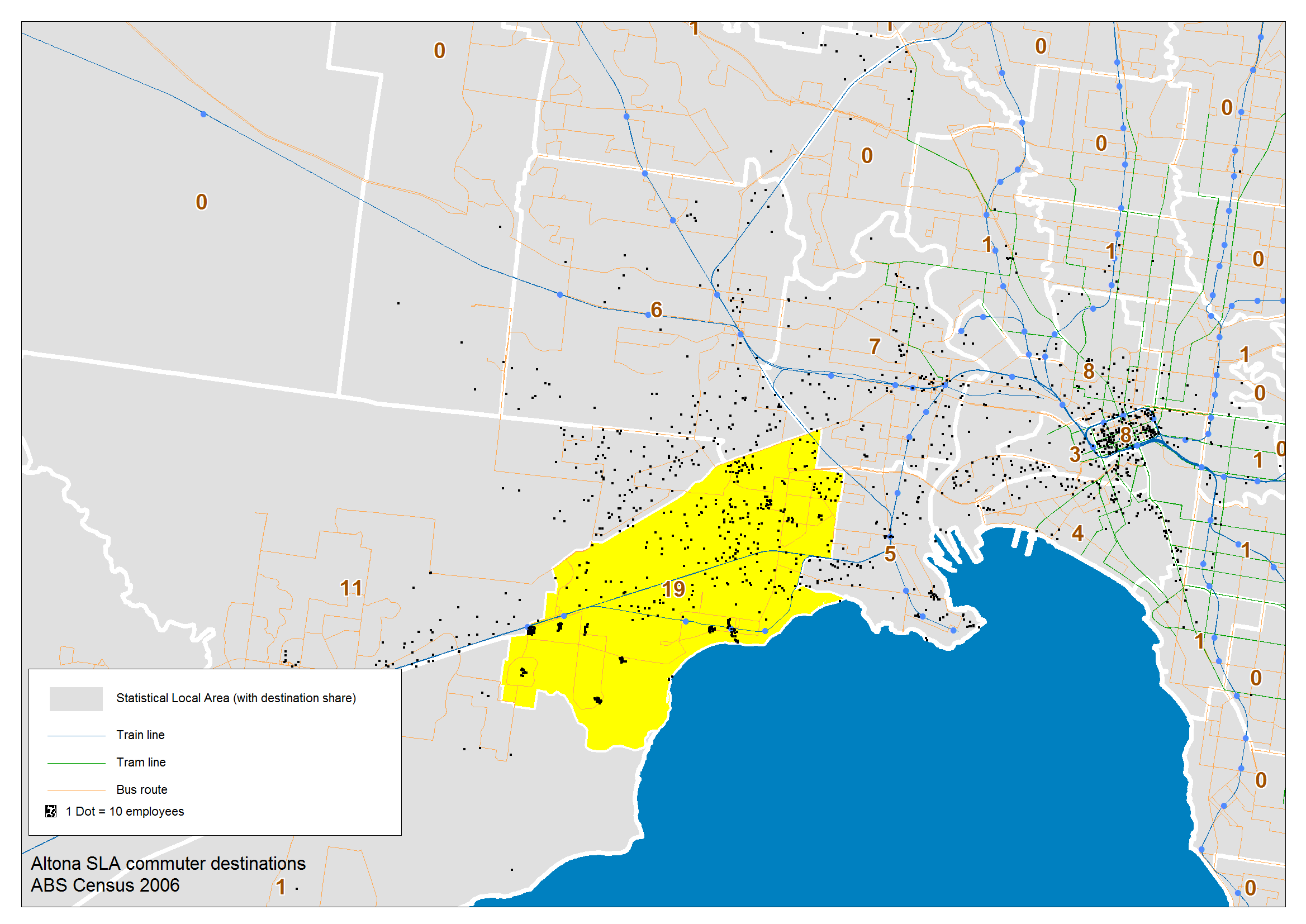
Altona
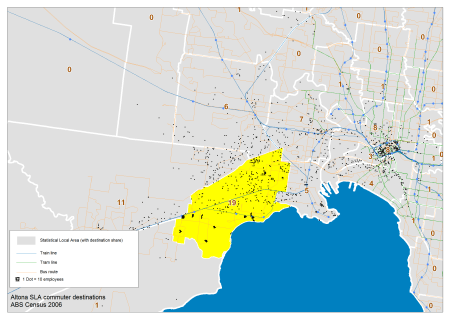
This map shows some problem areas for public transport access, including:

  • Large parts of the industrial areas within the SLA, which have no service at all. Particularly the Toyota factory on Grieve Parade (okay, it does have bus route 232, but that only runs to/from the Melbourne CBD on a few peak period trips).
  • Victoria University Newport Campus
  • Fishermans Bend industrial area (the bus service review recommended route 232 be re-routed along Lorimer Street to improve connectivity to the main employment area)

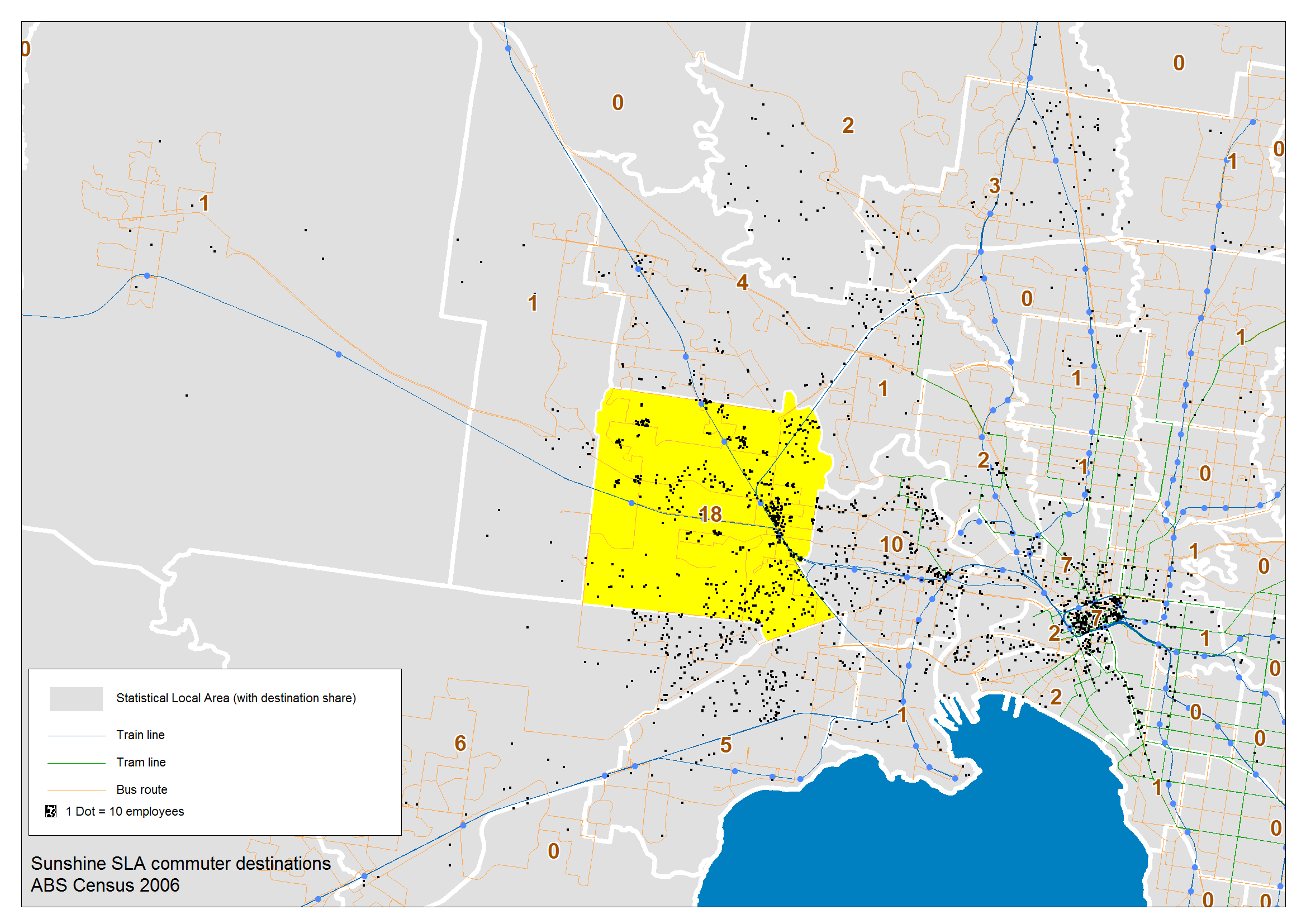
Sunshine
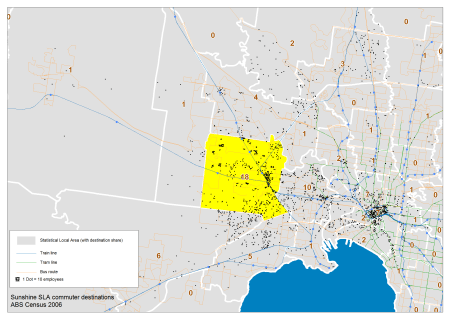
Public transport doesn’t provide strong service to:

  • The Laverton North/Derrimut industrial area. A new bus route 417 was introduced into this area recently, but it only provides access from Laverton station in the south.
  • Moonee Ponds has a surprising concentration of destinations, and currently a transfer is required at Highpoint to a tram.
  • Fishermans Bend again shows up, with the only access being via the CBD. The recent relocation of Fishermans Bend bus routes to Southern Cross station will certainly assist these people to use public transport.
  • The Altona North industrial area, particularly the Toyota factory on Grieve Parade.
  • Melbourne Airport.

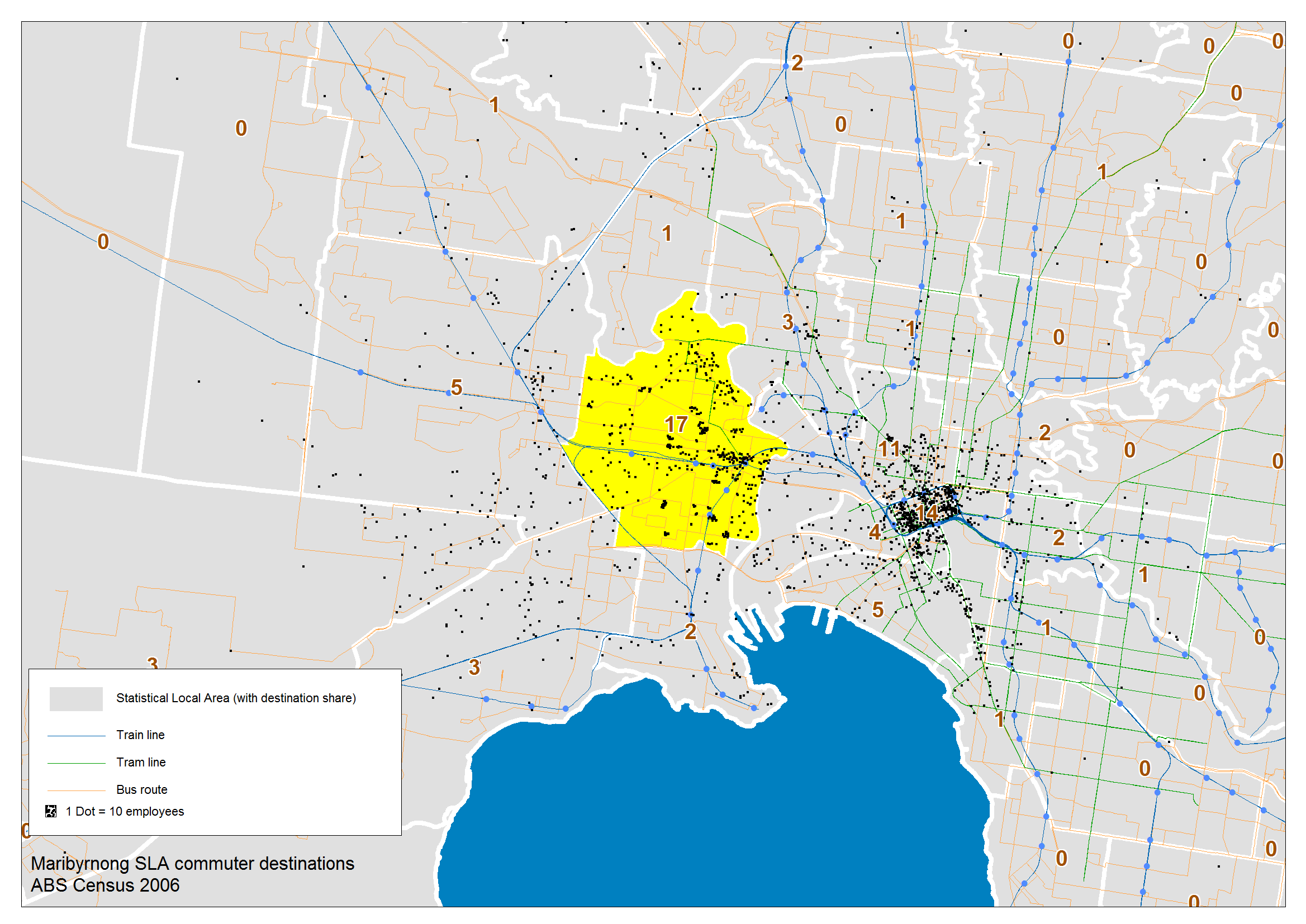
Maribyrnong

Maribyrnong is quite well connected by public transport to most employment destinations.

However there are some more difficult destinations:

  • Laverton North industrial area (partially connected by bus route 414)
  • Altona industrial area (that has almost no public transport)
  • Fishermans Bend (need to transfer to bus at Southern Cross Station, much less direct than driving)

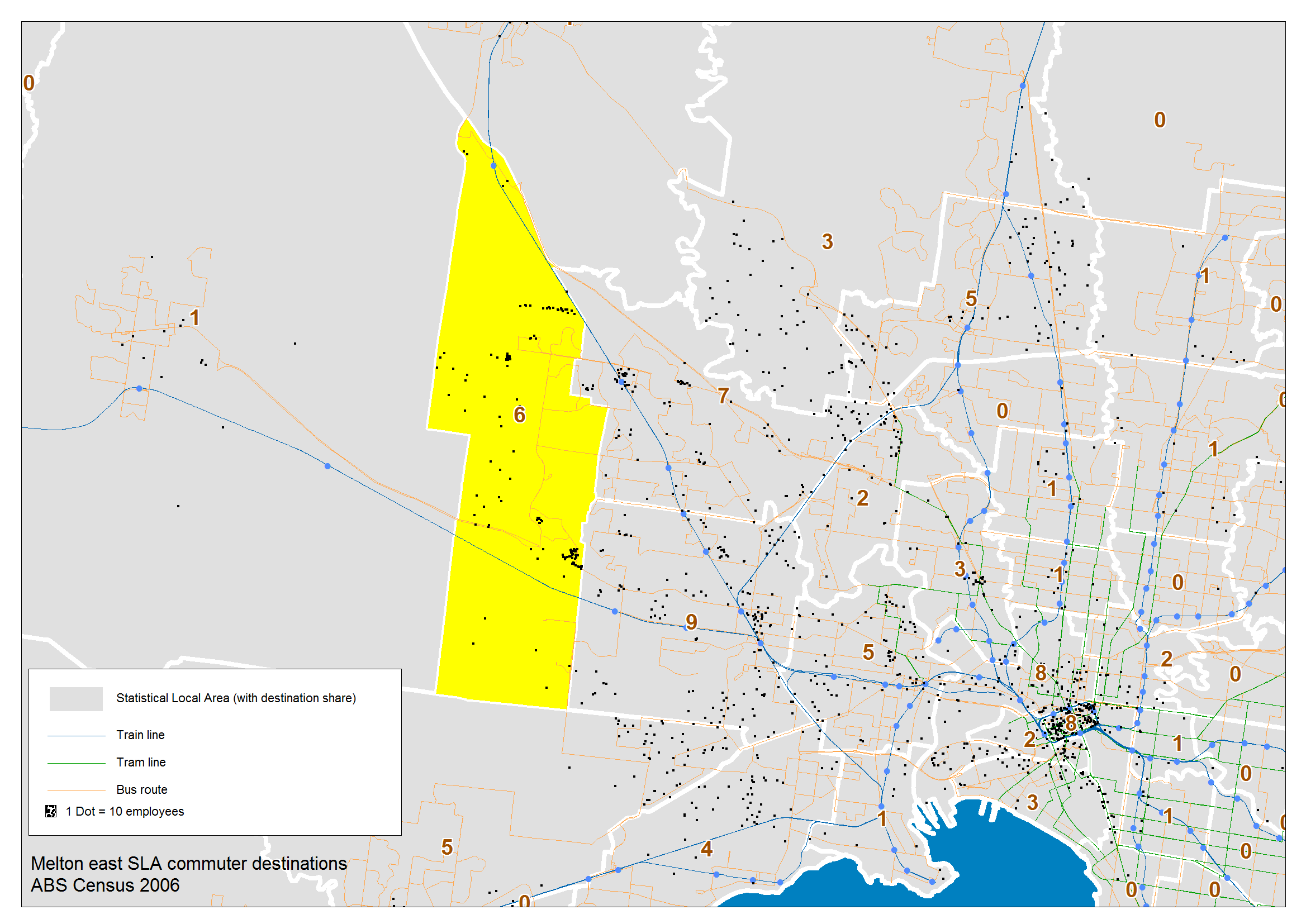
Melton East
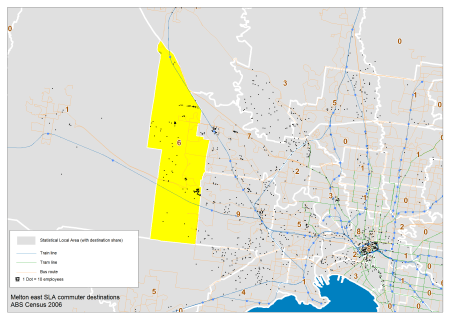
Melton east includes Caroline Springs, Taylors Hill and Hillside. It represents the north-western fringe of contiguous urban Melbourne.

You can see a wide range of work destinations – many a long distance away, suggesting a lack of nearby employment opportunities is an issue.

There are many popular work destinations difficult to reach by public transport, including:

  • Laverton North and Altona industrial areas
  • Melbourne Airport
  • Tullamarine industrial area around Sharps Road (completion of SmartBus route 902 would assist)
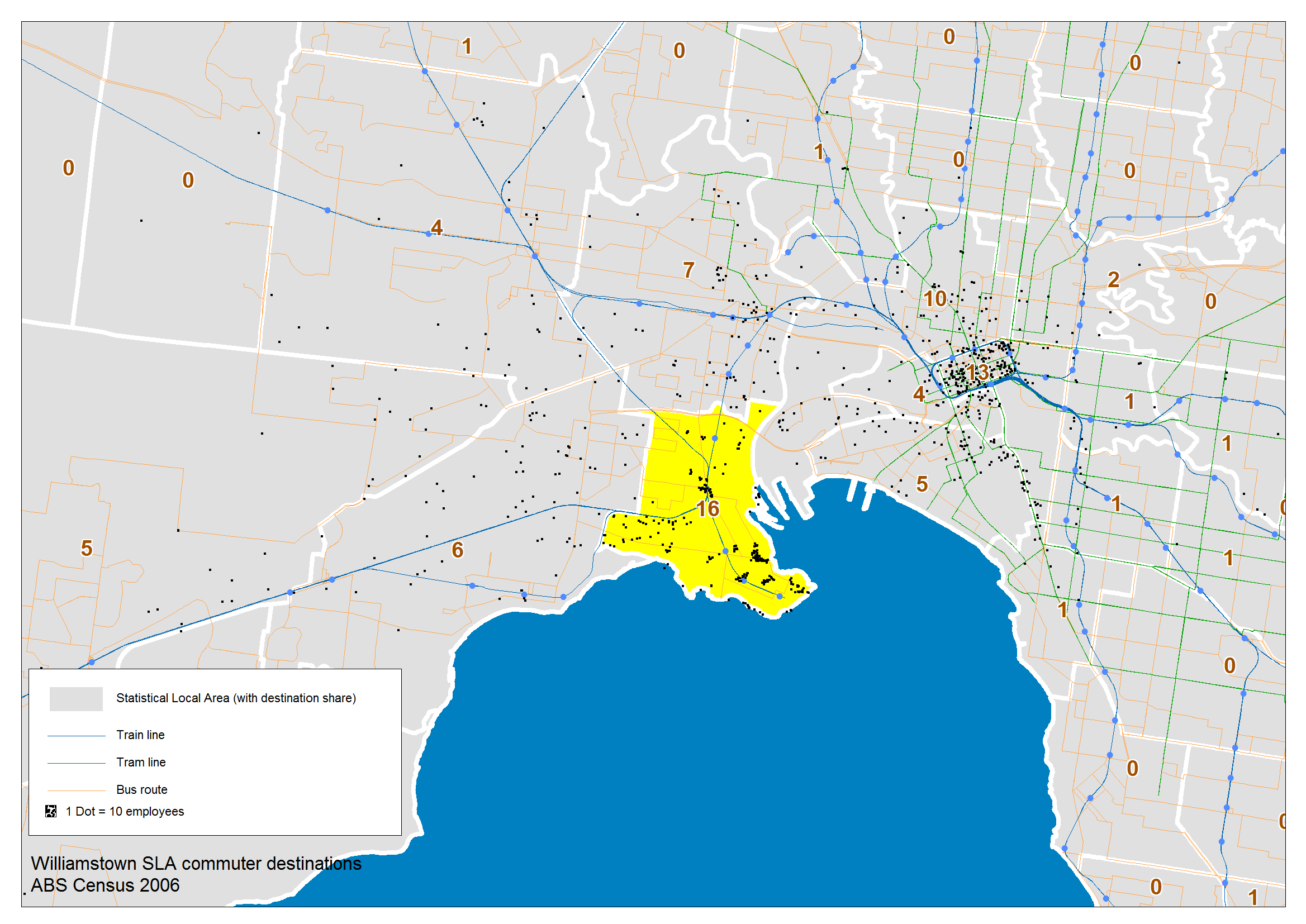
  • Somerton industrial area (902 completion would assist, although this is a long distance to travel)

Williamstown
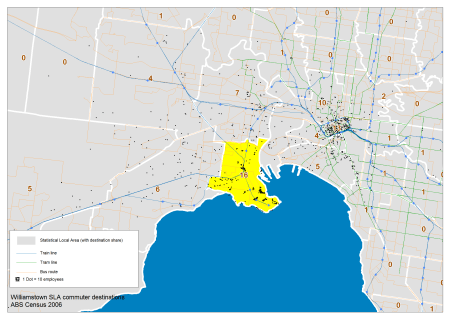
27% of destinations are within the City of Melbourne.

Popular destinations difficult to reach by public transport include:

  • The Altona industrial area
  • Fishermans Bend (which can be reached much more directly by car)

Other SLAs – North

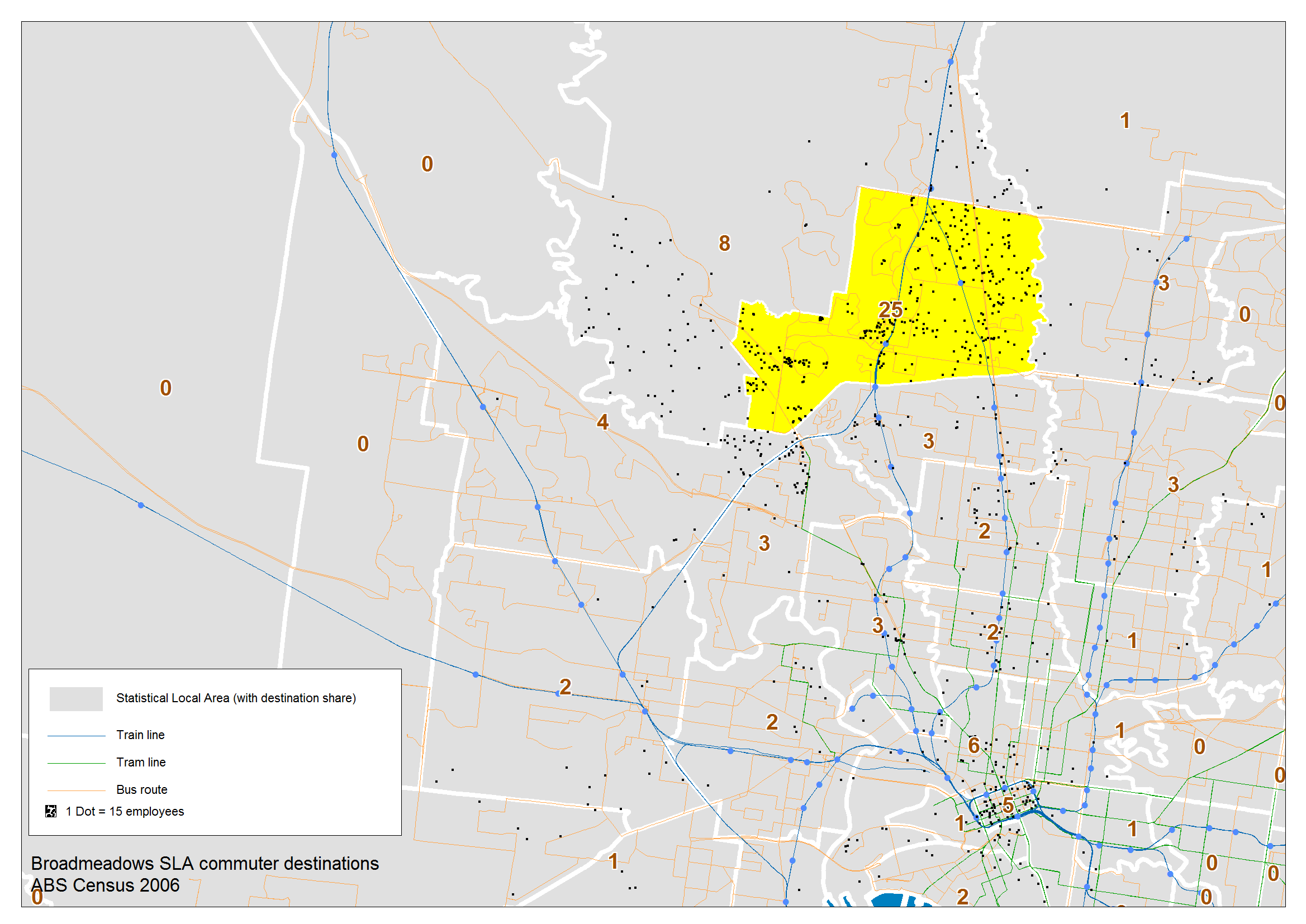
Broadmeadows
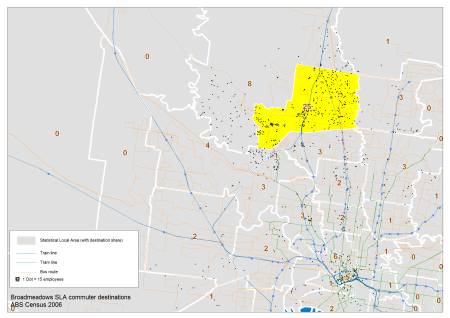
Public transport doesn’t provide strong service to:

  • The Tullamarine industrial area around Sharps Road/Airport Drive. The Green orbital SmartBus (902) would close this gap if extended to Werribee as originally planned.
  • The Tullamarine industrial area near the airport along Melrose Drive (served by the infrequent 478/479 bus routes, for which an upgrade was promised in May 2010 following the Bus Service Review, but still not delivered as at July 2011)

The recent extension of SmartBus routes 901 and 902 will have greatly improved public transport access to the Somerton/Campbellfield industrial area, and access to Airport West.

You can see a smattering of dots over the land covered by Melbourne Airport and the adjacent industrial area to the south. Because this is all one destination zone, the employement is diluted across the zone, whereas in reality the employment will be concentrated around the terminals and industrial area.

We know that a lot of Melbourne Airport workers come from nearby suburbs, including Broadmeadows. The recent extension of SmartBus route 901 has significantly improved access to Melbourne Airport from the Broadmeadows area. Although its current bus stop at the airport is unfortunately quite a distance from all the terminals!

Sunbury
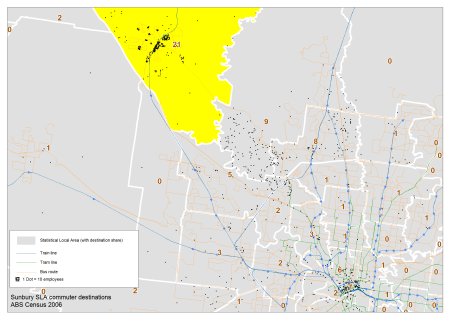
Sunbury is a satellite urban area north-west of Melbourne, with most of this SLA being rural land and 21% of Sunbury SLA residents work in Sunbury itself.

Around 9% of commuters worked in and around Melbourne Airport (distributed over a large destination zone in the map, refer discussion in Broadmeadows section above). There are bus services between Sunbury and Melbourne Airport but they operate very infrequently (a service upgrade has been promised).

A significant number also work in the Somerton industrial area, which is not directly connected by public transport – and would be difficult to be connected efficiently.

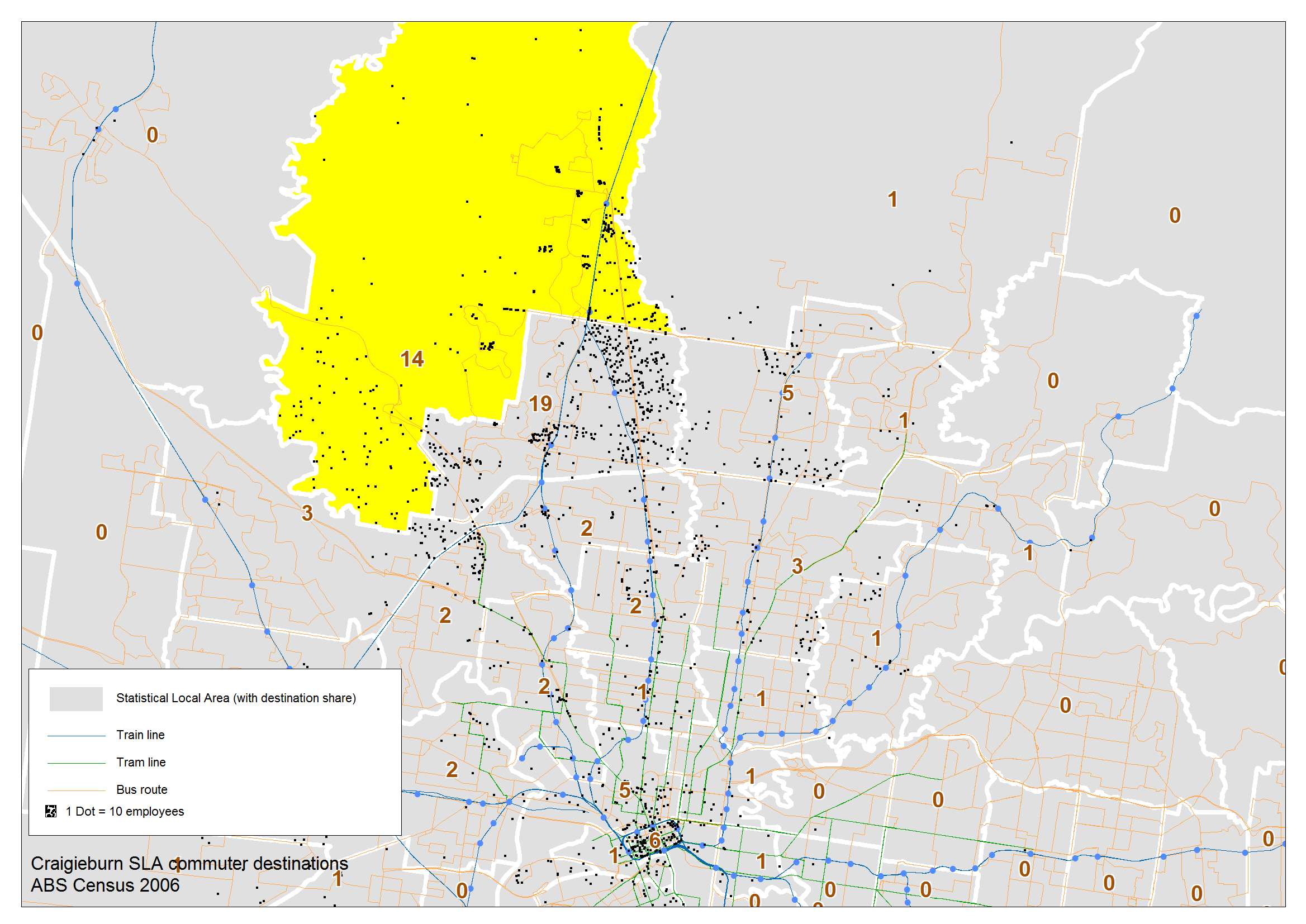
Craigieburn
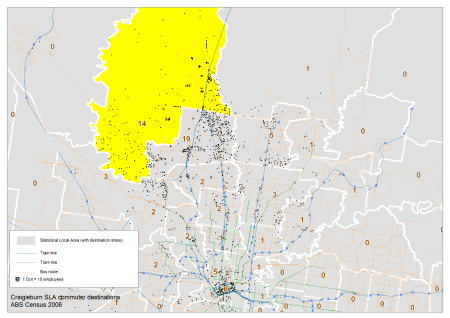
The vast majority of residents in this SLA live in the suburbs along the eastern edge of the SLA (including the Greenvale area to the east of the “14” label). The rest of the SLA is mostly rual land, although it includes Melbourne Airport and an adjacent industrial area in Tullamarine.

Work destinations difficult to reach by public transport include:

  • Melbourne Airport
  • Industrial areas in Tullamarine and Airport West
  • Thomastown (although it can be reached via Broadmeadows on SmartBus 902)

Moreland north
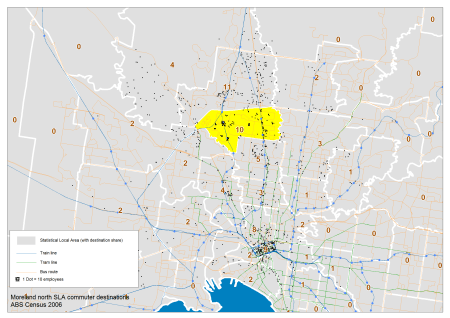
This SLA is mostly made up of the suburbs of Glenroy and Hadfield.

The biggest destination is Broadmeadows to the immediate north. Connectivity to the north is limited to the two train lines, and two bus routes (one very infrequent). The northern part of the Somerton industrial area can only be reached by public transport with a transfer between relatively infrequent routes.

Brunswick
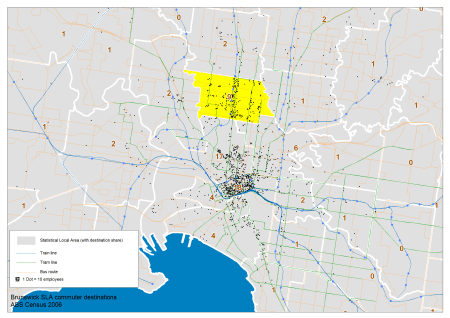
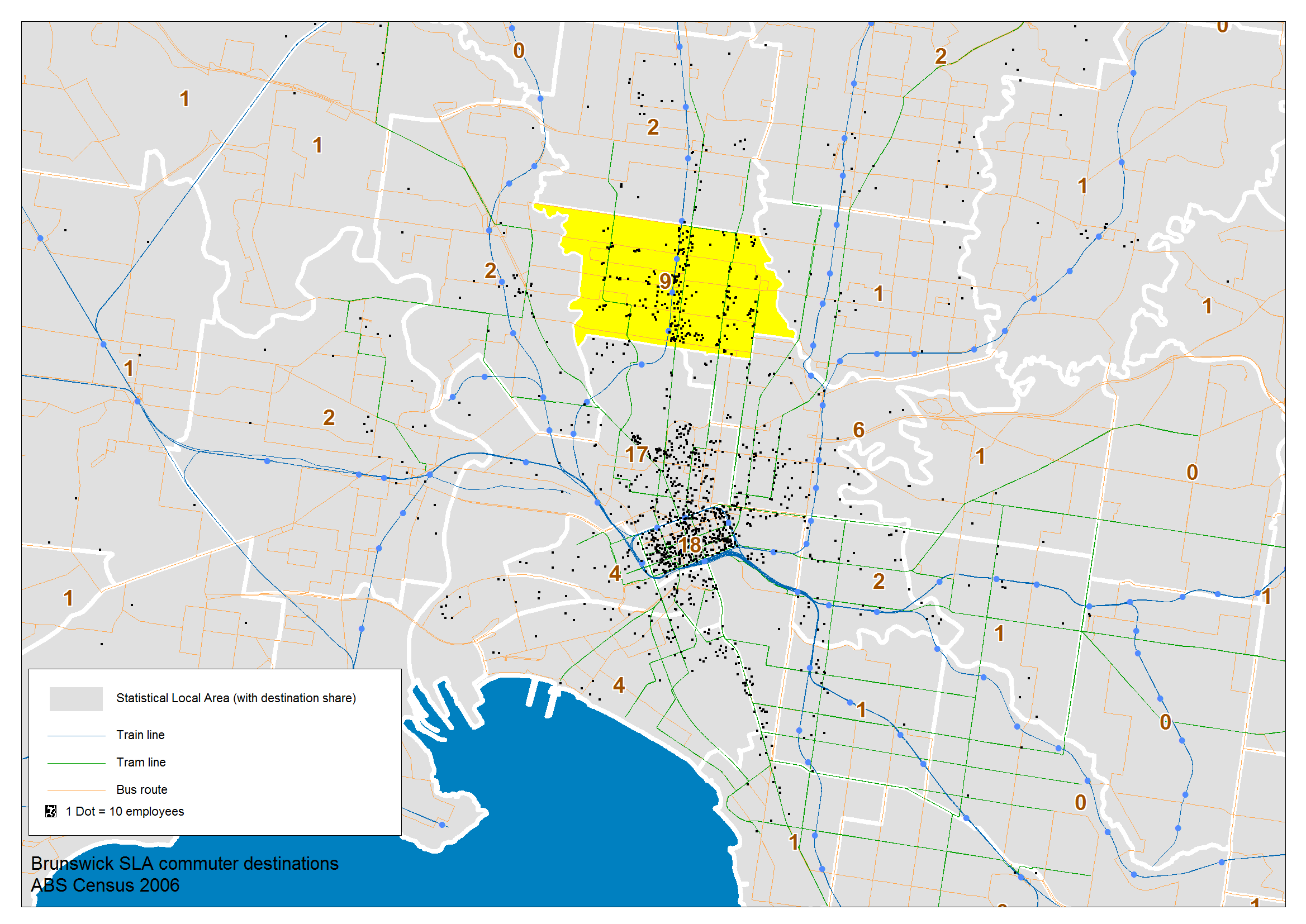
A significant proportion of Brunswick residents travelled to the south, including the Melbourne CBD.  There are no significant destinations that are difficult to reach by public transport.

Heidelberg
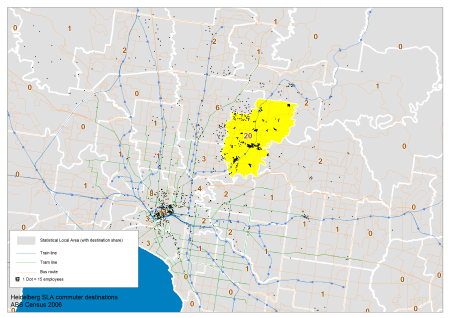
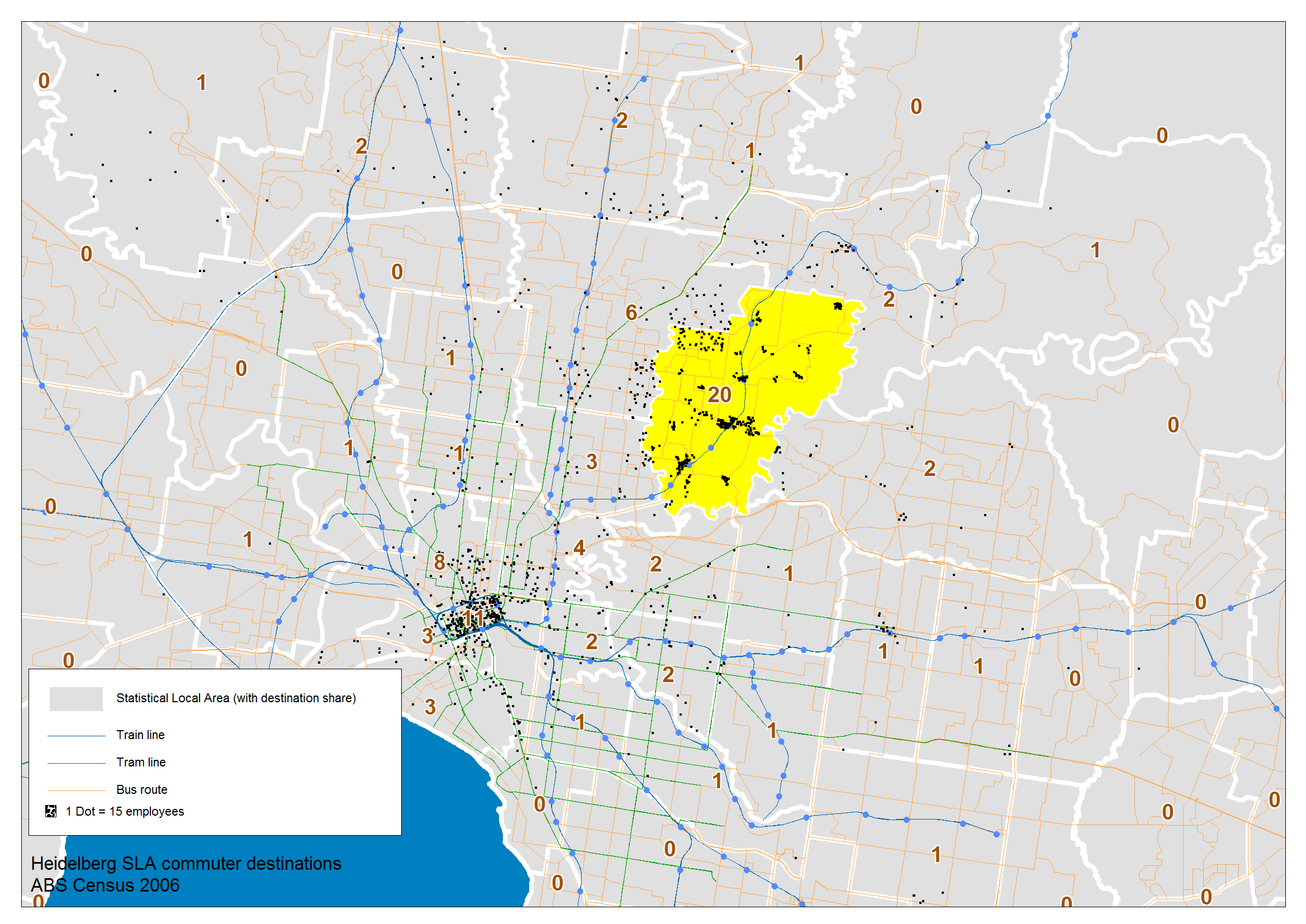
The only work destination somewhat difficult to reach by public transport is the Carlton/Parkville area, as half of peak period trains do not stop at Victoria Park station, which provides a transfer opportunity to high frequency buses to Carlton.

Other SLAs – eastern and south-eastern

Ringwood
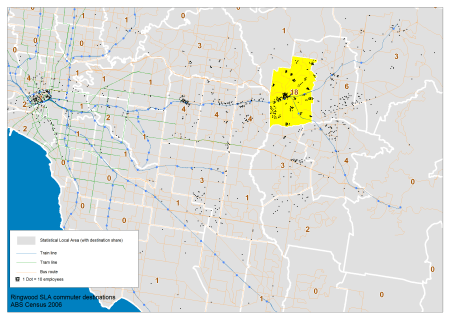
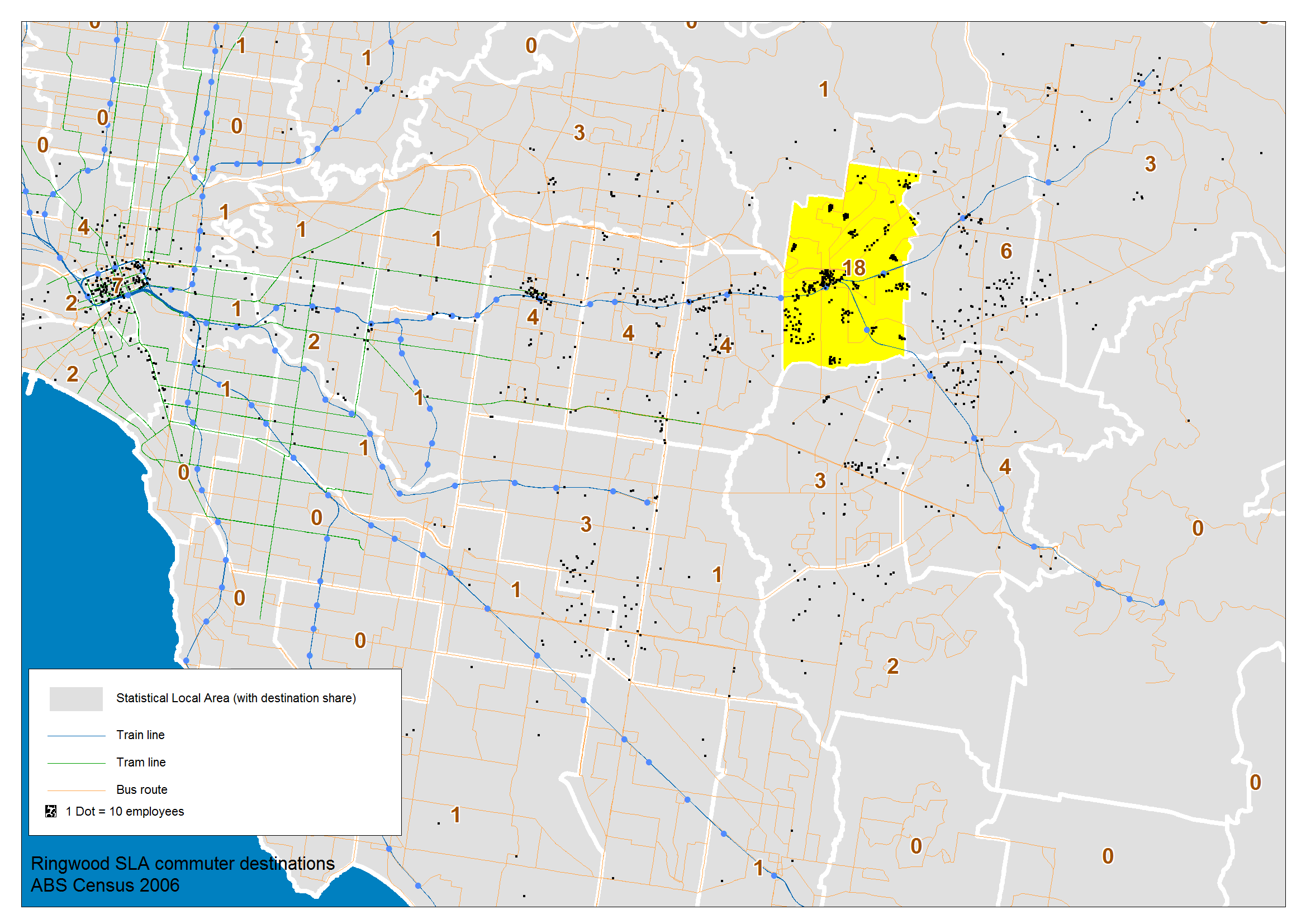
Ringwood has direct public transport links to most destinations, including those along the railway line to the city, and the 742 bus to the Notting Hill area. The Bayswater industrial area and St Kilda Road commercial area are a little more difficult to reach by public transport.

Croydon
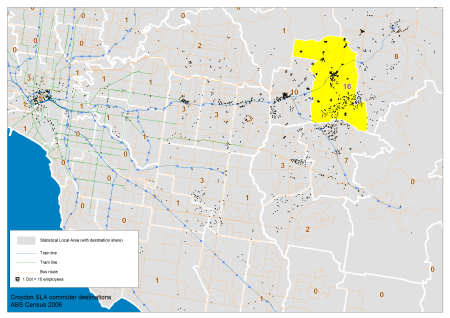
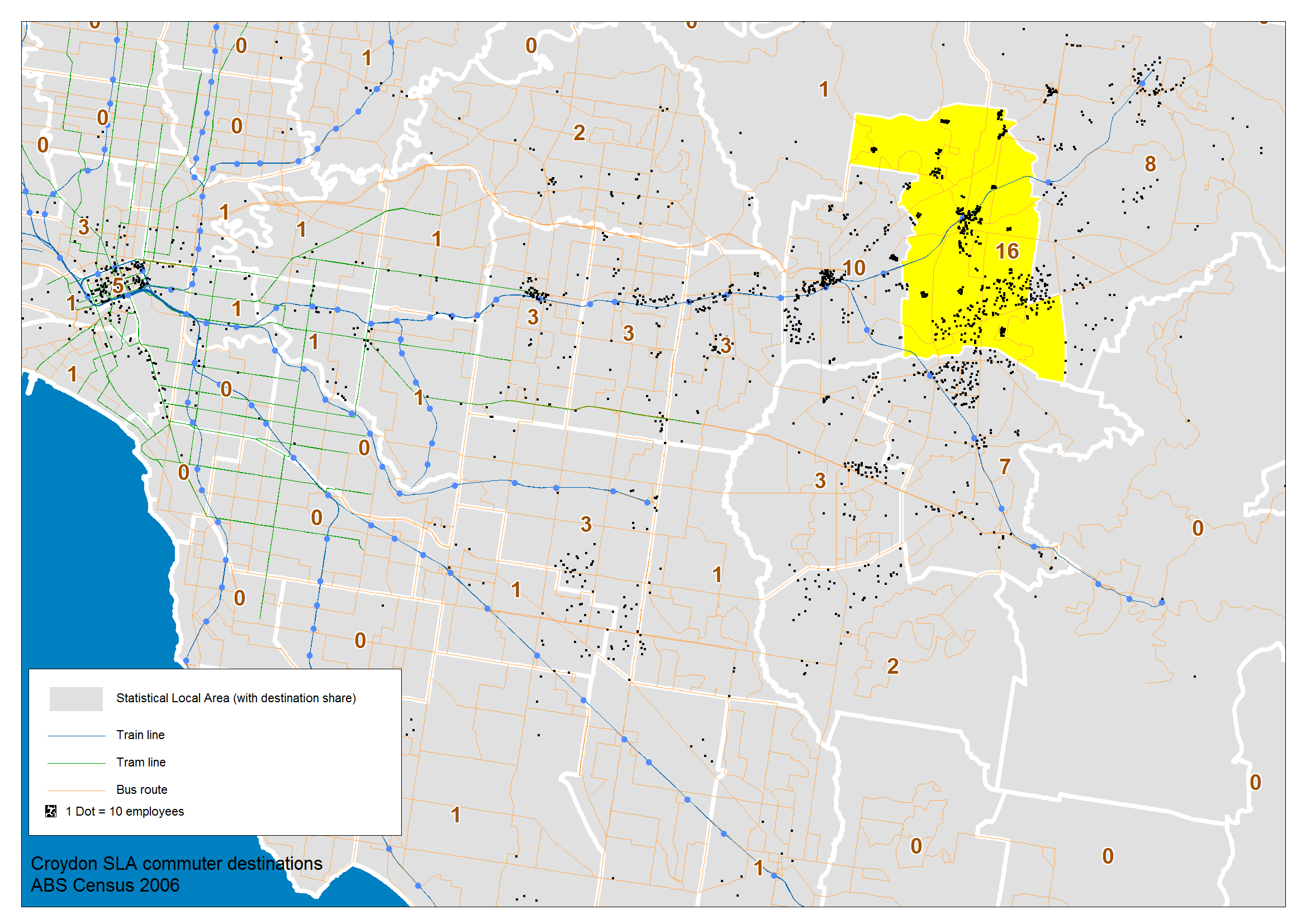
A significant destination for Croydon SLA residents is the Bayswater and Bayswater North industrial areas. The lack of a bus service along Colchester Road would make this area difficult to reach by public transport for a number of workers.

A significant number of destinations were along the Lilydale/Ringwood train line, making public tranpsort access relatively easy.

A fair number of people commuted to the Clayton/Notting Hill industrial area, and as it happens, bus route 737 connects Croydon to this area (although travel times would not be short).

Melbourne’s CBD only accounts for 5% of work destinations from Croydon.

Lilydale
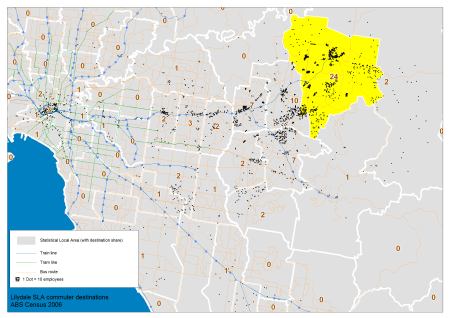
There are a number of popular destinations difficult to reach by public transport:

  • Just to the north of the station is an industrial area that is beyond walking distance of public transport (around Beresford Road).
  • Curiously, the southern most part of the suburb of Kilsyth – a rural area (this might actually mostly be the Boral quarry on Cantebury Road, which is connected by bus 679).
  • The Bayswater industrial area.
  • The eastern part of Mount Evenlyn and Wandin North (again, most of this land is rural so the actual employment might be in spot concentrations within the destination zone).

Knox – north east
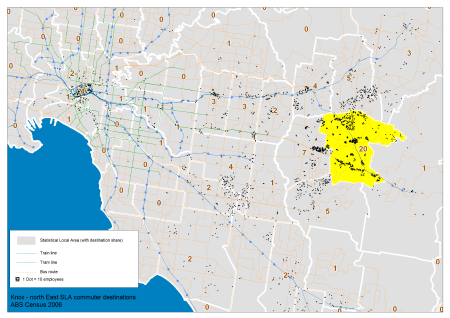
A significant proportion of workers had destinations in Bayswater/Bayswater North industrial areas, Knox City and around Boronia station. Most popular destinations are actually connected by public transport from significant parts of the SLA.

Knox – North west
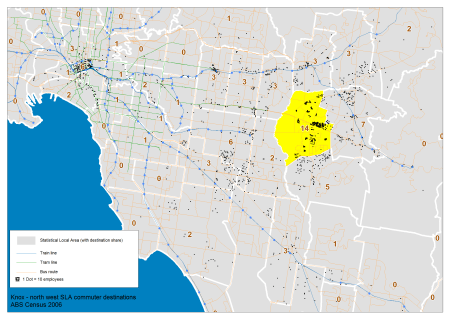
There is some degree of public transport connection to most destinations, although parts of Bayswater North are more difficult to reach.

Only 6% of residents in this SLA work in the Melbourne CBD. A tram extension to Knox City would connect some employment destinations along the way, but would not be an effective way to reach the Melbourne CBD by public transport given the distance and slow speed (bus+train would be faster).

Cranbourne
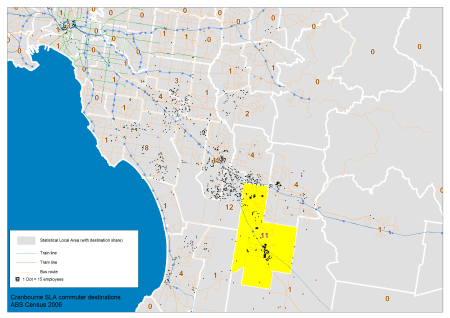
The standout issue for this SLA is Dandenong South. There is only one bus route connecting the SLA with just parts of Dandenong South industrial area. From the distribution of dots it appears that around 1 in 5 Cranbourne commuters travelled to Dandenong South.

The recent bus service review recommended much better east-west connectivity, but this was not done in the late 2010 upgrade to Casey bus services (unfortunately you wont find the detail in the executive summary of the bus service review, you have to order the full report from the Department of Transport).

Access to the Clayton/Mulgrave/Notting Hill and Braeside industrial areas, and St Kilda Road employment area is also problematic, for the same reasons as outlined for Rowville.


Unfortunately analysis of census journey to work data was not done in this level of detail in the 2007-2009 Bus Service Reviews across Melbourne. Hopefully my analysis can now provide greater evidence to support public transport planning.
A look at Melbourne CBD transport

Sun 23 January, 2011

My last post looked at suburban employment areas, but what about the CBD? With the review of the City of Melbourne’s Transport Strategy, I’ve taken on a detailed analysis of transport to and from the CBD.

In this post I’ll look at questions like:

  • Do CBD commuters come from the inner or outer suburbs?
  • Do wealthy executive types snub public transport?
  • How does mode share vary between the sexes and young and old?
  • What impact are employer parking and driving subsidies having on mode choice?

I’m mostly focussing on the inner Melbourne CBD – using the ABS definition of “Melbourne – inner” SLA, which is essentially the Hoddle grid. However I’ve included Southbank or Docklands a couple of times, and there are also some comparisons with Sydney, Brisbane and Perth CBDs.

This is a long post, so grab a cuppa and get comfortable.

Where do the commuters come from?

According to the 2006 census, there were 137,853 commuter journeys into the CBD.

The first map shows the number of commuters from each SLA in Melbourne. The shading represents simple density of CBD commuters by area, which is not ideal because outer metro SLAs can be impacted by low average population density. At the same time, not all SLAs have the same population so some will always have large numbers (eg Manningham west). As always, click to zoom in.

The CBD attracted workers from all over Melbourne, but certainly with a high concentration from the inner suburbs.

To get around the density issue, I’ve drawn a map showing the percentage of workers from each SLA who work in the CBD, Southbank or Docklands:

You can see the percentage drops off fairly uniformly by distance. The CBD is not a major destination for most middle and outer suburban areas.

What modes of transport do commuters use? (by area)

Firstly a map showing the public transport mode share from each SLA (green = higher):

Public transport mode share was largely above 70% for much of Melbourne and indeed most surrounding areas.

A few low spots stick out:

  • Manningham west and east, serviced only by buses (that have recently been signficantly upgraded)
  • Northern parts of Boroondara and 52% and 55%. These wealthy areas are serviced by frequent trams and buses, although with a relatively slow trip in.
  • Rowville (Knox south) is at 57%, but bear in mind there were only 800 commuters from Rowville to the CBD (and I expect most of these would be park and ride train commuters). In fact, the catchment of the proposed Rowville rail line passes through three SLAs, with a total CBD commuter population of 4138. Allowing for catchments of other radial public transport lines in the SLAs, the CBD commuter catchment of the proposed Rowville line might be 2000-3000, or about 3 full trains. But of course a line would also be used for trips to other destinations (particularly Monash), and it would probably cause changes in travel patterns over time once built. I might look at this more in a future post. In the meantime you might want to read Alan Davies take, and a 2004 pre-feasibility study (here is a summary presentation).
  • Wealthy Brighton is well serviced by the Sandringham line, but only half used public transport to get to the CBD. There is no easy freeway connecting Brighton and the CBD, so why are they driving? I’ll come back to that.
  • The inner SLAs in Melbourne, Yarra and Port Phillip are slightly lower, probably due to a high rate of walking and cycling. More on that later too.

You can see a high PT mode share for the relatively small numbers of commuters from Geelong (around 800 in total). $4.3b is being spent on a regional rail link, that will separate regional trains from suburban trains. Regional trains from outside Melbourne seat less than 500 people, but because they run express through much of Melbourne they each consume probably around two all-stopping suburban train paths (which have a capacity of around 1000 each). I haven’t seen any debate about whether encouraging regional commuting by train into central Melbourne is worthwhile, though I’m sure people living in those areas appreciate the trains.

Next a map showing private transport mode share (red = higher):

Private transport mode share was highest for Manningham, northern Boroondara, Wyndham South (including Point Cook), Bayside, Rowville, and the outer northern fringes.

But a high car mode share may not be a huge issue if the number of car commuters is low. The next map shows the number of private transport commuter trips from each SLA, shaded by relative density:

Observations:

  • Like we saw in my last post for South Melbourne, there were large numbers of car commuters coming from the inner suburbs, particularly to the south-east. These areas are well connected to the CBD by public transport, and also quite wealthy. Is wealth a driver of higher car mode share? Read on.
  • Manningham west had a large number of car commuters (with a reasonable density). This area is entirely reliant on bus services, which have been upgraded considerably since 2006, with strong patronage growth resulting. In 2006, the last bus from the CBD on the Eastern Freeway – Doncaster Road route (307) was around 6:45pm. It’s now around midnight (on route 907 that replaced 307).
  • There were also a large number from Wyndham north-east (Werribee – Hoppers Crossing area) which is not shaded dark on the map due to low average population density. In 2006, peak train services on the Werribee line were often 20 minutes apart, and bus services only ran every 40 minutes. The train frequency has since increased to 6/hour but the (feeder) bus frequencies are still 40 minutes in peak periods.
  • Moonee Valley (Moonee Ponds-Essendon area) was a large contributor of cars, despite frequent trains and trams to the CBD. Not sure why that is, although Essendon is a relatively wealthy area.

Here is a another map of private transport commuters, except it is shaded by numbers rather than density. Manningham west stands out, but bear in mind it is one of the largest SLAs in Melbourne by population. You can see the outer western SLAs show up on this map also.

And for a flip side, here is where the public transport passengers were coming from (shaded by density):

There are large concentrations coming from the inner suburbs, but also the middle eastern suburbs which are well connected by trains. The Manningham west area had over 2000 public transport commuters to the CBD, many of which would have been on buses only.

Again, to get around the low population density problem, I’ve also drawn a similar map shaded by total numbers:

We saw low PT and car mode shares for the inner city. I haven’t drawn a map of walking mode share for the CBD but you can see public and private transport mode shares are low in the inner city, with walking likely to fill the gap. A map of walking mode share to any work destination is in another post.

The cycling figures are quite interesting. Next map shows the bicycle mode share to the CBD (any trip involving bicycle) (green=higher):

The figures are for Yarra north, Brunswick and Northcote are surprisingly high at 8-10%. Remember that the census is taken in winter (August). As I recall it wasn’t a rainy day. Bicycle mode share is also lower for commuters from the City of Melbourne itself. SLAs in grey lacked sufficient data.

Here are the total number of CBD bicycle commuters per SLA (shading by numbers, not density):

According to the data, people also rode from as far out as Frankston, Croydon, Ringwood and Sunbury! Census data is like that (as I recall, someone in Banyule claimed to have gone to work by ferry).

What modes did people use overall?

Here is a chart showing the overall mode split for all CBD workers:

Trains accounted for almost half of all CBD arrivals.

While buses accounted for only 2% of all CBD commuters, they were the only mode used by 32% in Manningham west, 11% in Kew, 9% in Camberwell north, 7% in Maribyrnong, and 5% in Altona.

Next chart shows mode split in a more simplified form:

Public Transport dominates, but still over a quarter came by car – including over 32,000 car drivers.

Public transport took 67% of motorised commuter trips into the CBD.

Active transport is at 8%, which probably represents those who live within walking distance of the CBD.

So how does Melbourne compare to other large Australian cities? The following chart compares Sydney, Brisbane, Perth and Melbourne CBDs. I’ve used the SLA that represents the inner core of business activity in each city to try to make in a reasonably fair comparison. Unfortunately Adelaide does not have a true inner CBD SLA to compare against (the central SLA includes all of North Adelaide, including lower density residential areas).

Sydney has the highest public transport mode share, with Melbourne and Brisbane very close (to my surprise). Perth is very much a car CBD, although mode shares are likely to have changed following the opening of the Mandurah rail line since 2006. The 2011 figures will be very interesting.

Perth walking more share was 3.0%, lower than 5.3-5.8% in the other cities – probably because of a lack of inner city residents.

And for the record, cycling was highest in Melbourne at 2.3%, followed by Perth at 2.0%, Brisbane at 1.5%, and Sydney at 0.8%.

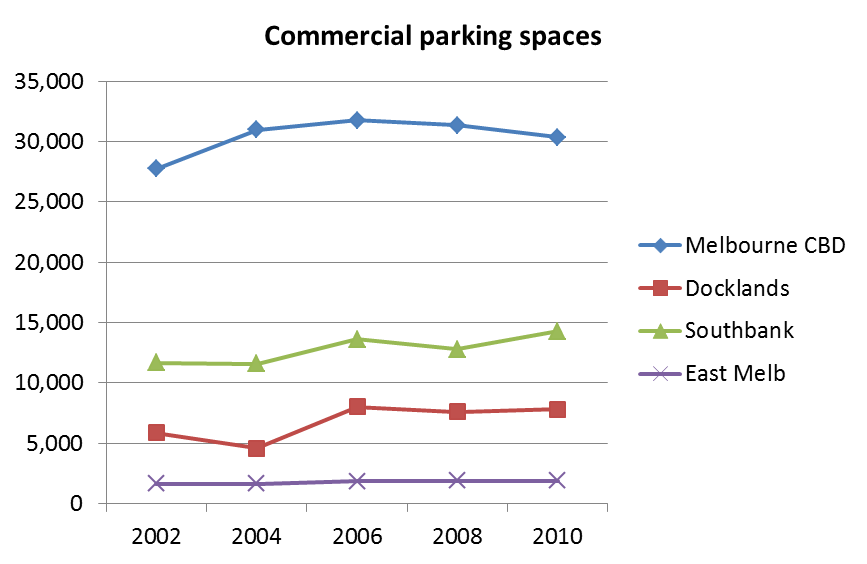
The number of car driver journeys to work in the Melbourne CBD actually decreased from 34,289 in 2001 to 30,570 in 2006, a mode share drop from 27% to 23% (ref). This happened despite a 20% increase in the number of parking spaces in the CBD between 2000 and 2006 (ref):

I’ve included Southbank and Docklands in this chart for interest – Southbank parking supply actually went down between 2006 and 2008.

[parking stats updated June 2012 with 2010 CLUE data:]

Looking at commercial parking spaces only:

The number of commercial parking spaces has actually declined in the CBD and there has been very little growth in Docklands (despite an increase in employment).

Here is the ratio of employees to commercial parking spaces:

While the ratios are flat in three of the areas, Docklands has seen strong growth in employment without equivalent growth in commercial car parking.

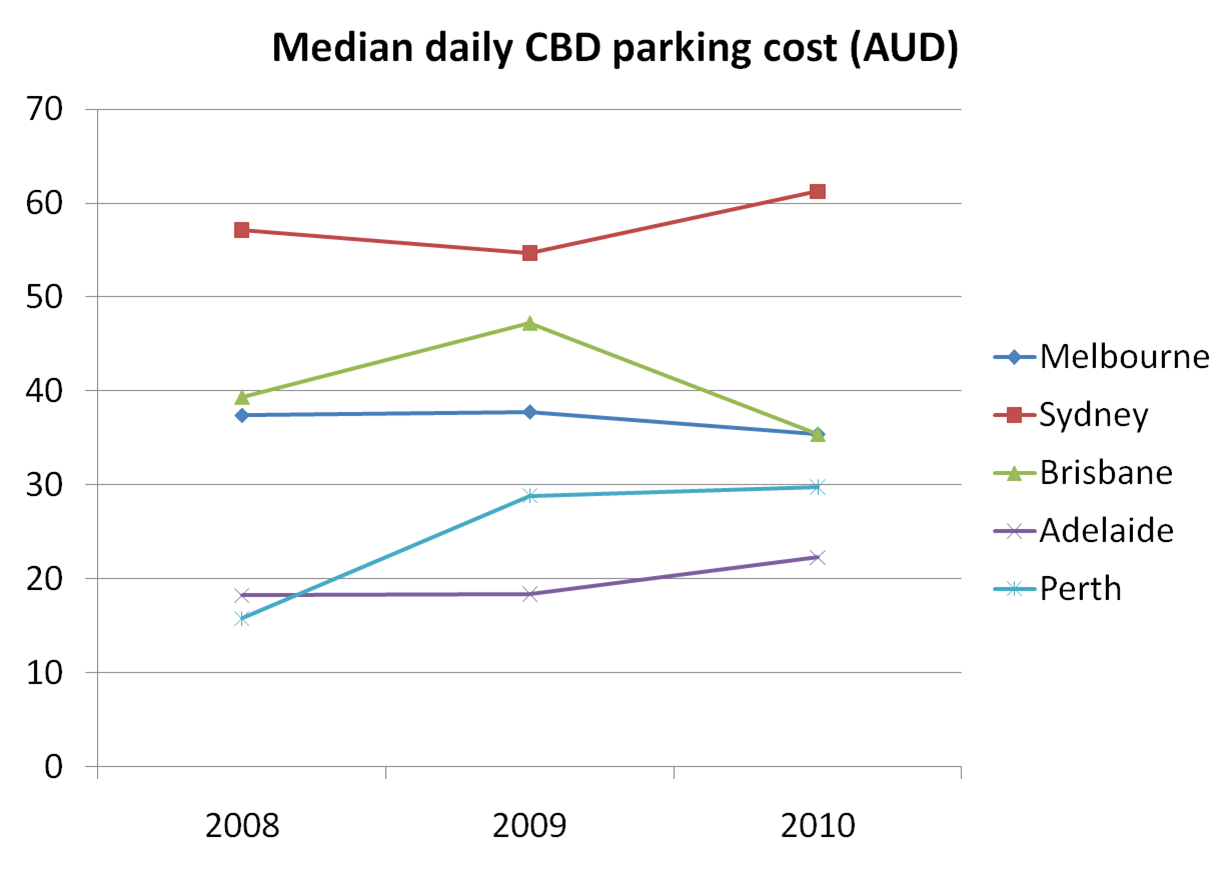
Colliers International have recently begun surveying CBD parking costs. Here are the results for Australia (adjusted to AUD using 1 July exchange rates):

I don’t pretend to be an expert in CBD parking markets, but the differences between daily and monthly rates suggest some complexity. In Melbourne at least, it is quite common to find “early bird” parking for $13-17 (and “early bird” usually means parking your car before 10am).

I’m perhaps more inclined to go on the monthly rates, as they are probably more competitive. Melbourne prices collapsed in 2010, at the same time that public transport patronage growth stalled. Prices also went down in all other cities except Perth (which had the strongest public transport growth of the major cities in 2009-10).

So is CBD parking price a driver of public transport patronage? Probably too early to tell because of a lack of much time series on parking cost data (including 2006 data), but worth looking at in future.

What modes are different commuters using?

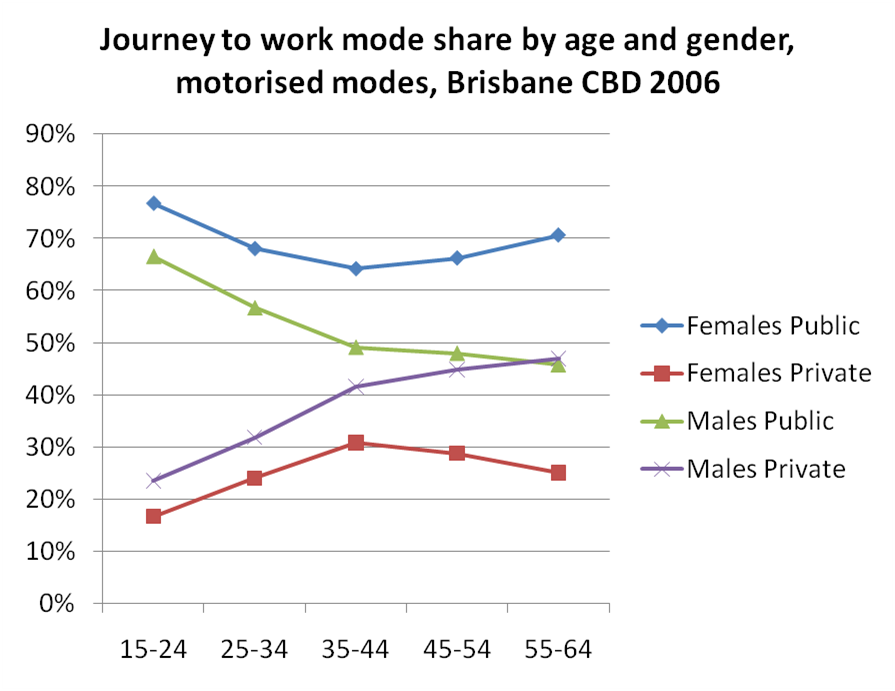
Firstly, mode share of motorised journeys by age and gender:

As you might expect, public transport mode share is higher amongst younger people and females. But for females it is also high for older women, with a curious dip at 35-44 years (typical kids at primary school years?). For men, private transport mode share was higher for older men. I’ve not shown 65-74 because the total number of such commuters was very small.
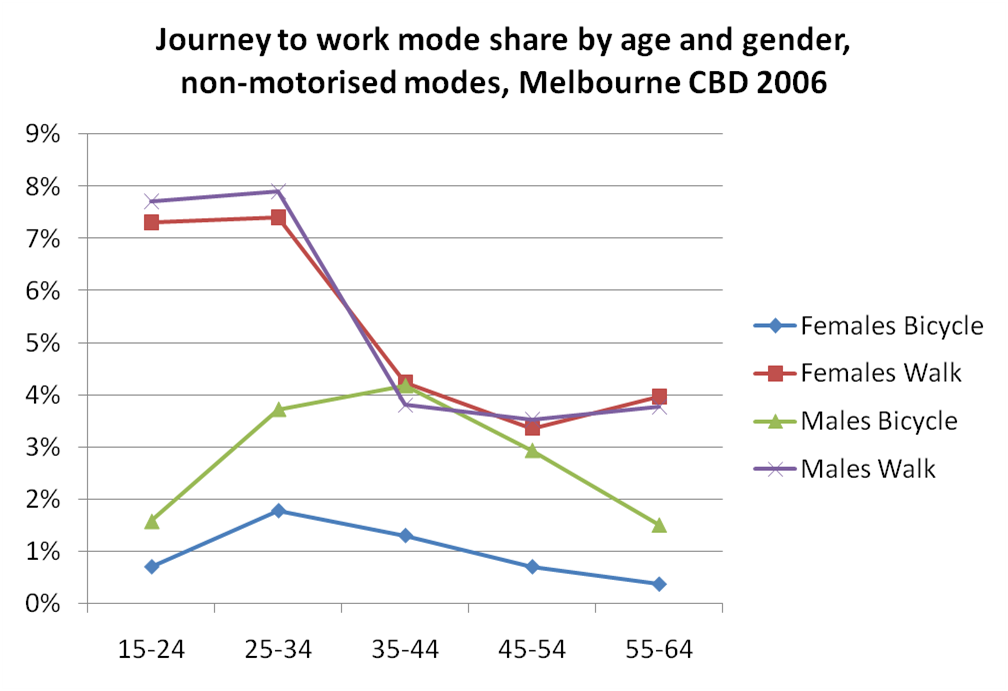
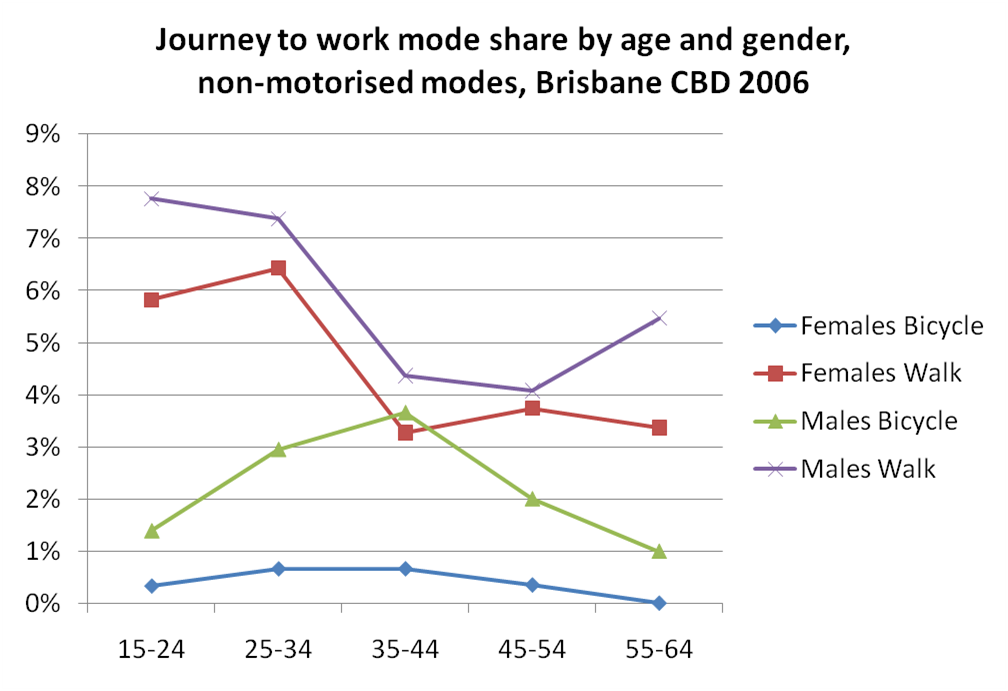
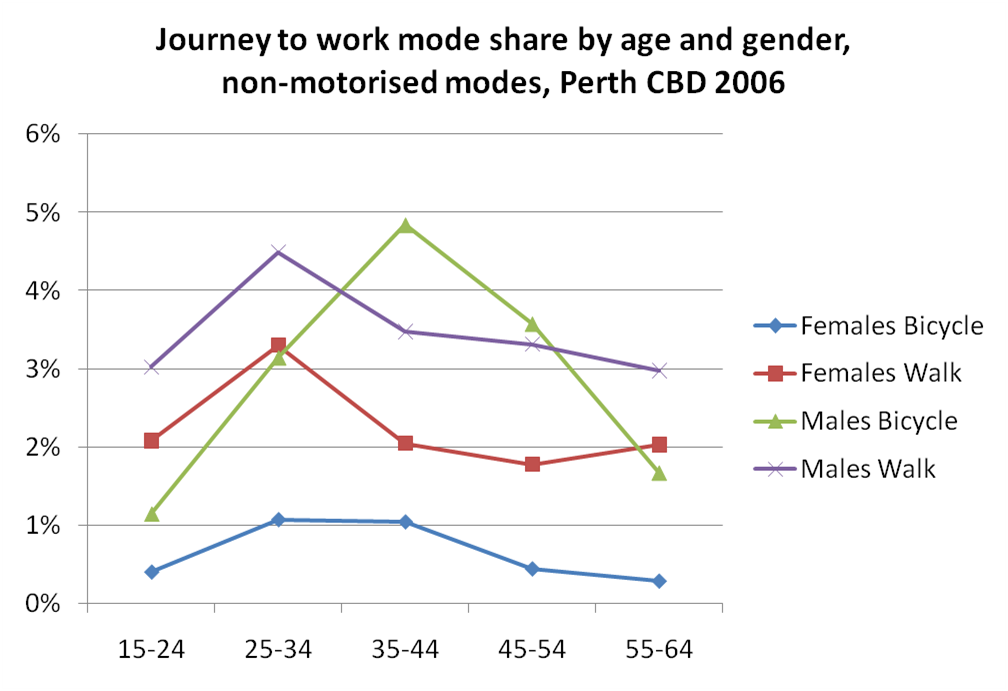
I’ve put non-motorised modes on a separate chart as they are much lower shares:

Walking was much higher for younger people. Is this because of lower car ownership, less willingness/ability to pay for transport, higher residential proximity to the CBD, and/or higher health and fitness focus? Unfortunately I don’t have the datasets to answer those questions.

Cycling mode share peaked with men aged 35-44, with men much more likely to cycle than women.

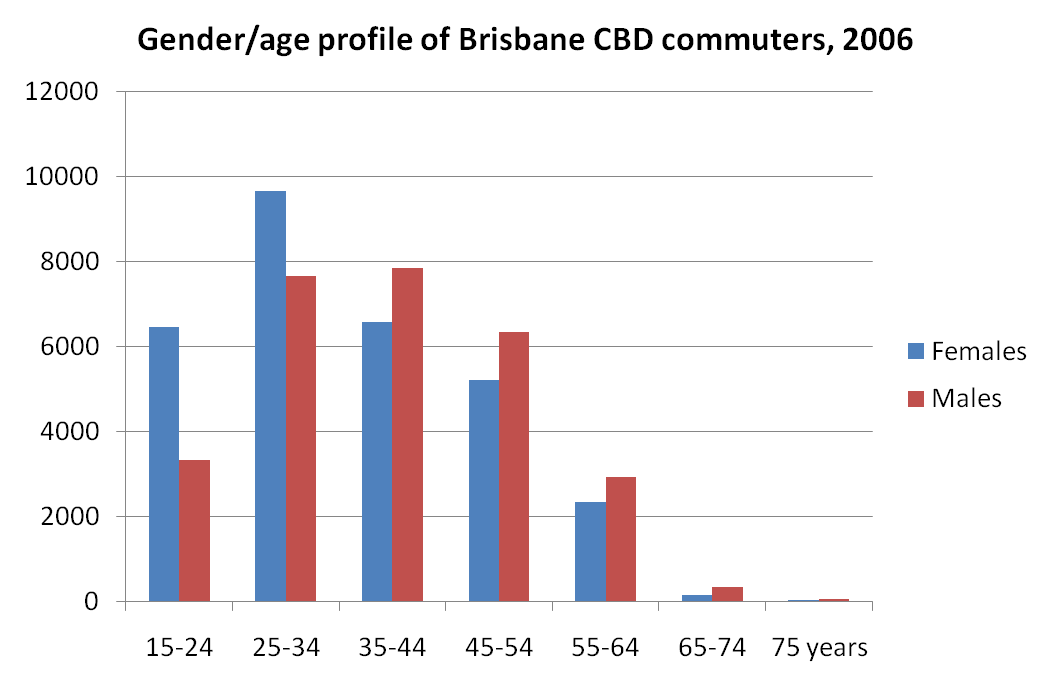
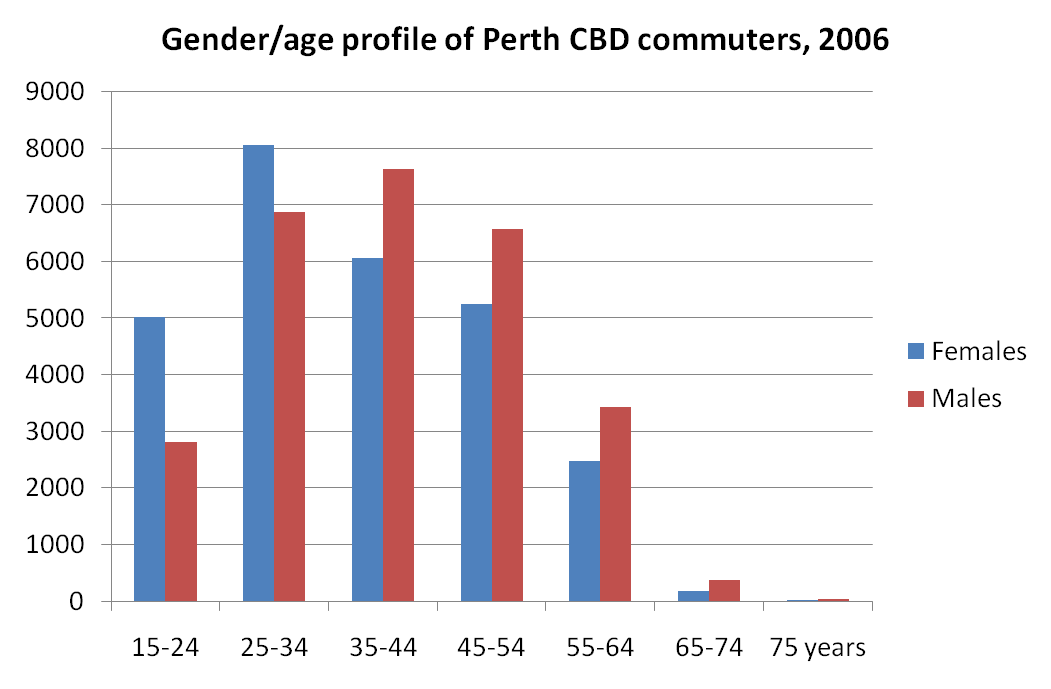
For reference, here is a demographic breakdown of CBD workers – it peaks at 25-34, with women slightly younger on average:

And here are the same charts for Brisbane:

Sydney:

and Perth:

You can see:

  • cycling mode share peaked for men aged 35-44 in all cities
  • walking tended to peak for people aged 25-34
  • public transport mode share dipped for women aged 35-44 in all cities
  • In Perth, men aged over 35 had a higher private transport mode share than public transport, the only city where this occurred.

So, do executives (presumably many from wealthy inner city suburbs) shy away from using public transport?

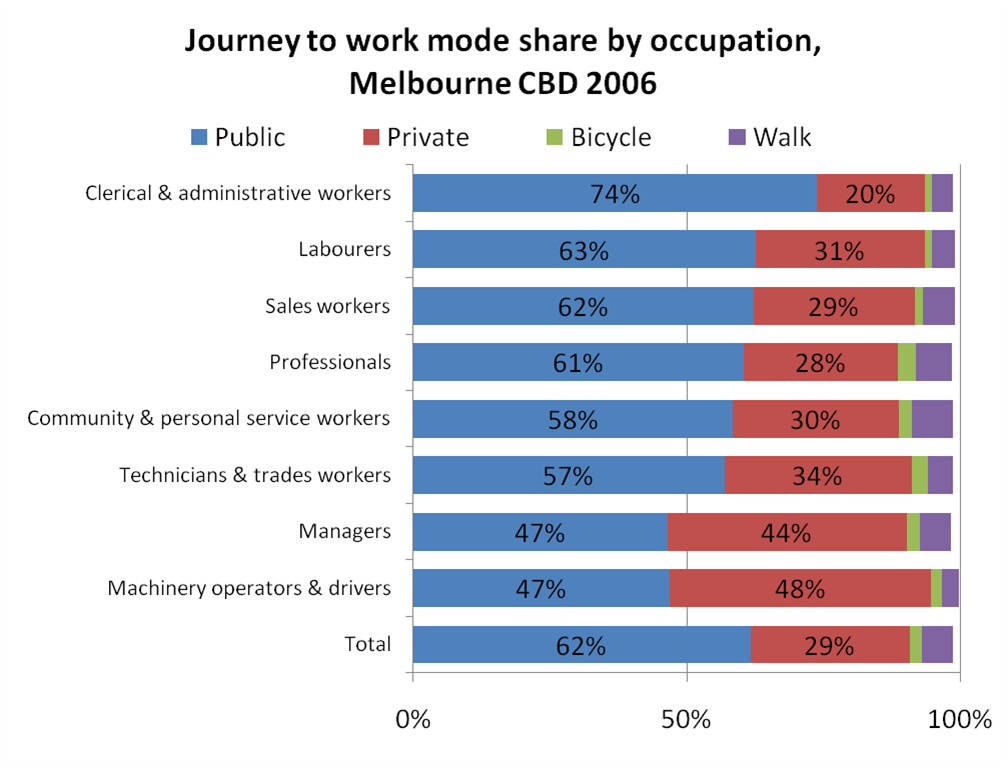
Indeed they do. They represented 16% of Melbourne CBD workers, but 24% of car commuters (9538 car trips in total). Maybe because many of them get company cars/parking as parts of their packages? More on that coming up.

Lower paid clerical and administrative workers were most likely to use public transport (and probably least able to afford driving and parking costs).

Note that Machinery operators & drivers also had a higher private transport mode share – I expect many are professional drivers coming in their work car (there were only around 1000 in this occupational category).

Back to managers – the next chart shows they are also more likely to snub public transport in Sydney, Brisbane and Perth:

What about other trip purposes?

The following charts show data from the VISTA 2007 household travel survey, that includes all trip types and all of Melbourne.VISTA is a survey, not a census, so there is a margin or error involved, and unfortunately the sample sizes are not large (provided in charts as “n=”). The total VISTA 2007 dataset has 2955 surveyed trips into the Melbourne CBD (across all days of the week), of which 1973 were motorised.

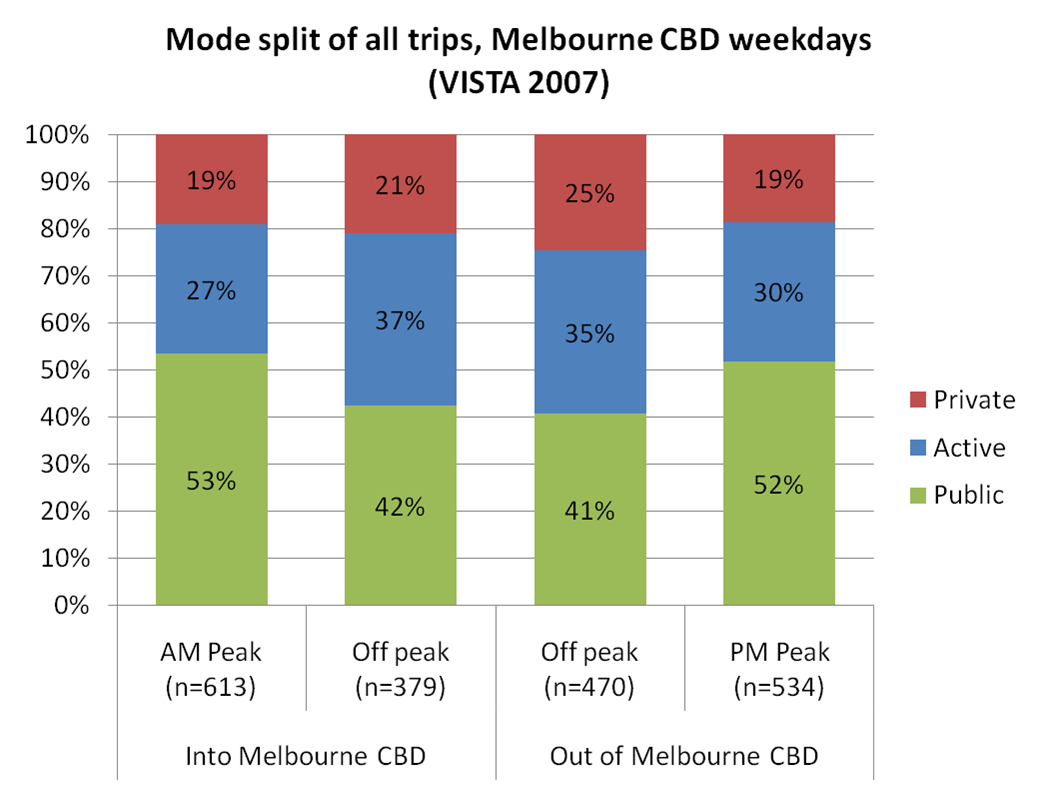
First chart shows mode split for trip legs into and out of the CBD, by time of day on weekdays:

Weekday AM peak is 7-9am, and PM peak is 3-6pm, anything else is classed as off-peak. Unfortunately there are only 190 trips in/out of the CBD on weekends in the sample, which has too large a margin of error to be too meaningful (7%).

Active transport (walking and cycling) and public transport were clearly dominant. When looking only at motorised trips, Public transport took 74% of inbound AM peak and outbound PM peak trips, and 67%/62% of off-peak in/out bound trips.

Recall above that motorised journeys to work in 2006 were 67% by public transport, suggesting people travelling for reasons other than work in peak periods were slightly more likely to use public transport.

What about wealth? I’ve used average household income per occupant, to remove the impacts of household size, and grouped this by $500 amounts. Note: the sample sizes are quite small for larger income groups.

Sure enough, there appears to be a trend that people from higher income households were more likely to use private transport for travel into the CBD.

What about age?

While the sample sizes are relatively small, there certainly appears to have been a higher propensity to use private transport for travel to the CBD by middle-aged people.

There may be a trend back to public transport for older people, but the margin of error is around 10% for the last two age groups so this is not certain. However it would fit with Seniors being able to access cheaper public transport fares.

In terms of gender, 73% of females who used motorised transport came by public transport, compared to 67% of males – a similar difference to commuters.

Who’s paying for the private transport?

While for many people driving to the CBD for work everyday is something of a non-option, there are still tens of thousands who do. Is employer sponsored driving and parking costs influencing their mode choice?

VISTA lets us take a look at that also, although there is only a sample of 183 AM peak private transport trips (margin of error around 7%).

According to the data, around 29% of cars driven into the CBD in the AM peak had their running costs paid by a company, and 36% had parking paid for by employers. Remarkably, 34% reported no parking costs for off-street parking (these trips mostly for work purposes) – which doesn’t sound right for the CBD in the AM peak! I’m not aware of any publicly available free off-street parking spaces. Perhaps the respondents overlooked the fact that someone else was at least paying for the land on which they parked? If that is the case, then it would appear that less than a third of cars driven into the CBD in the AM peak were not employer subsidised in parking or running costs.

Employer subsidies appear to be an incentive to drive to the CBD. By contrast, only around 2% of general Melbourne AM peak car drivers had employee paid parking, and only around 13% had car running costs paid by an employer (VISTA 2007).

One of the most effective ways to reduce car mode share for journeys to work in the Melbourne CBD would appear to be reducing employer subsidies for parking and driving costs. Schemes such as parking cash out help employees see how much their parking and driving costs are being subsidised. If they have the option of receiving that money directly as salary they might make different choices (depending on tax treatment of course!).

That said, with current capacity issues on Melbourne’s trains and trams, trying to shift more CBD commuter trips from car to public transport in the short-term might not be a government priority just at the moment.

And lastly, for the record, 6 and 8 cylinder cars parked in the CBD did not appear to be over-represented. Cars of well-known luxury brands were over-represented (15% v 6% metro average).

I think that’s enough now! 🙂

Active transport is at 8%, which probably represents those who live within walking distance of the CBD. In order to take out the walking component, I’ve also taken a sample that excludes an “inner ring” around the CBD, as shown in the following map:

If you take out the inner ring, the mode split is 69% PT, 28% car, 1.9% cycling and 1.4% walking longer distances.