How is public transport patronage recovering after the pandemic in Australian and New Zealand cities?

Tue 8 August, 2023

With the COVID19 pandemic seemingly behind us, what has been happening to public transport patronage? Has it recovered to 2019 levels? In which cities is public transport patronage recovering the strongest?

This post provides my best estimates of how much public transport patronage has recovered in major Australian and New Zealand cities.

In my last post I talked about the problems when transit agencies only publish monthly total patronage (or weekly or quarterly totals). For those cities that don’t publish more useful data, I’ve used what I think is a reasonable methodology to try to adjust those figures to take into account calendar effects.

Unlike most of my posts, I’ll present the findings first then explain how I got them (because I reckon a good portion of even this blog’s readers might be less interested in the methodology).

Estimates of typical school week public transport patronage recovery

Here’s a chart comparing estimated typical school week patronage per month to the same month in 2019 (the year before the COVID19 pandemic) where clean data is available. My confidence levels around estimates for each city is discussed further below.
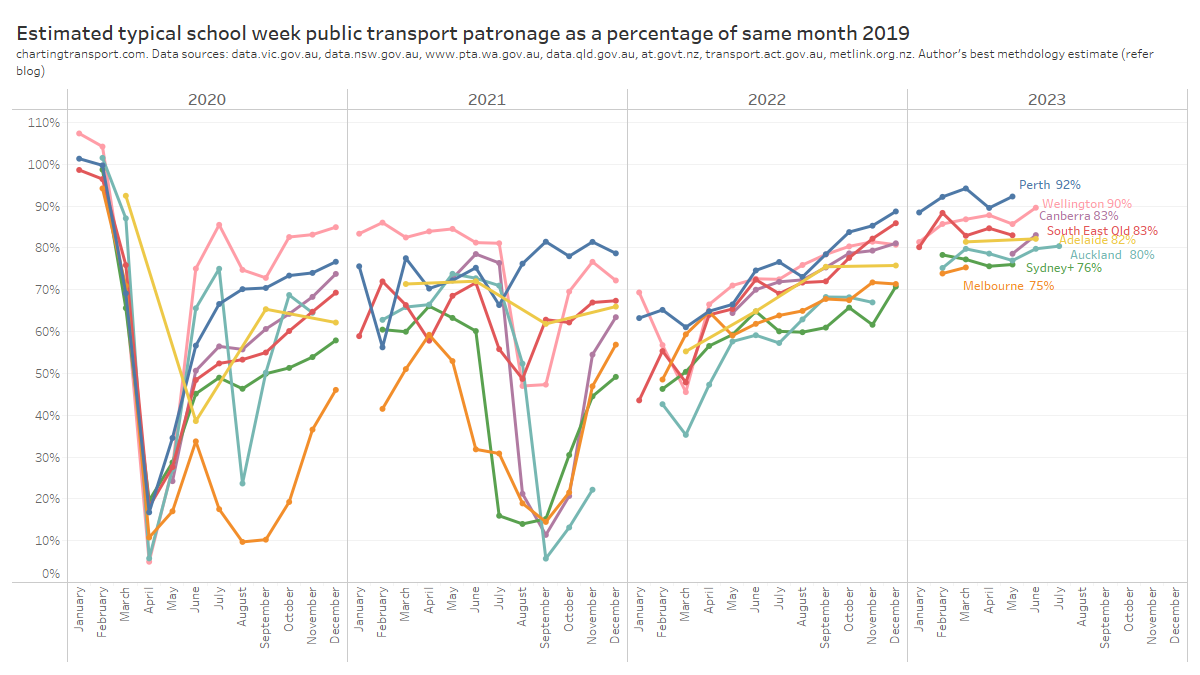
Technical notes: Sydney+ refers to the Opal ticketing region that includes Greater Sydney, Newcastle/Hunter, Blue Mountains, and the Illawarra. Typical school week patronage is the sum of the median patronage for each day of the week (where available), otherwise an estimate of average school week patronage. More explanation below.

Perth has been at or near the top of patronage recovery for most recent months, perhaps partly boosted by a new rail line opening to the airport and High Wycombe in October 2022.

Wellington – which I suspect is an unsung public transport powerhouse – is in second place at 90%, whilst all other cities are between 75% and 83%.

Looking at the 2023 data, most cities appear to be relatively flat in their patronage recovery (except Perth and Wellington), which might suggest that travel patterns have settled following the pandemic (including a share of office workers working remotely some days per week).

How does patronage recovery compare to population growth?

I’ve calculated the change in population for each city since June 2019. For South East Queensland I’ve used an approximation of the Translink service area, and for “Sydney+” I’ve used an approximation of the Opal fare region covering Sydney and surrounds. At the time of writing, population estimates were only available until June 2022.
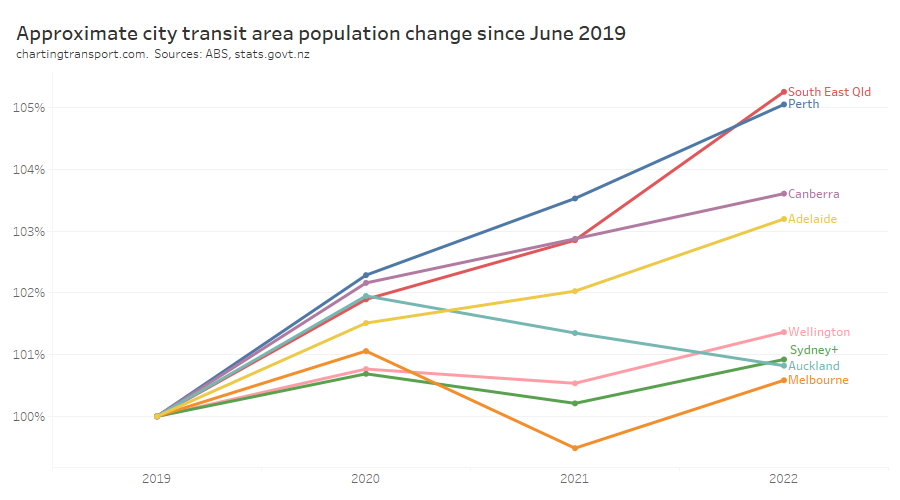
There are significant differences between the cities.

So how does public transport patronage recovery compare to population change? The following chart shows June 2022 patronage and population as a proportion of June 2019 levels:

The changes in population are much smaller than the changes in patronage and I have deliberately used a similar scale on each axis to illustrate this. Population growth certainly does not explain most of the variation in patronage recovery, but it is very likely to be a factor.

Perth had the highest patronage recovery in June 2022, but only some of this could be attributed to high population growth. Wellington had little population growth but the second highest patronage recovery to June 2022.

Perth might have the highest patronage recovery rate overall because it spent the least amount of time under lockdown, and so commuters had less time getting used to working at home. Melbourne, Sydney, Canberra, and Auckland spent the longest periods under lockdown, and – with the exception of Canberra – seem to be tracking at the bottom end of the patronage recovery ratings, which might reflect their workers becoming more comfortable with working from home during the pandemic. However I’m just speculating.

How has patronage recovery varied by day type?

Here’s patronage recovery for school weekdays (for cities which publish weekday data):
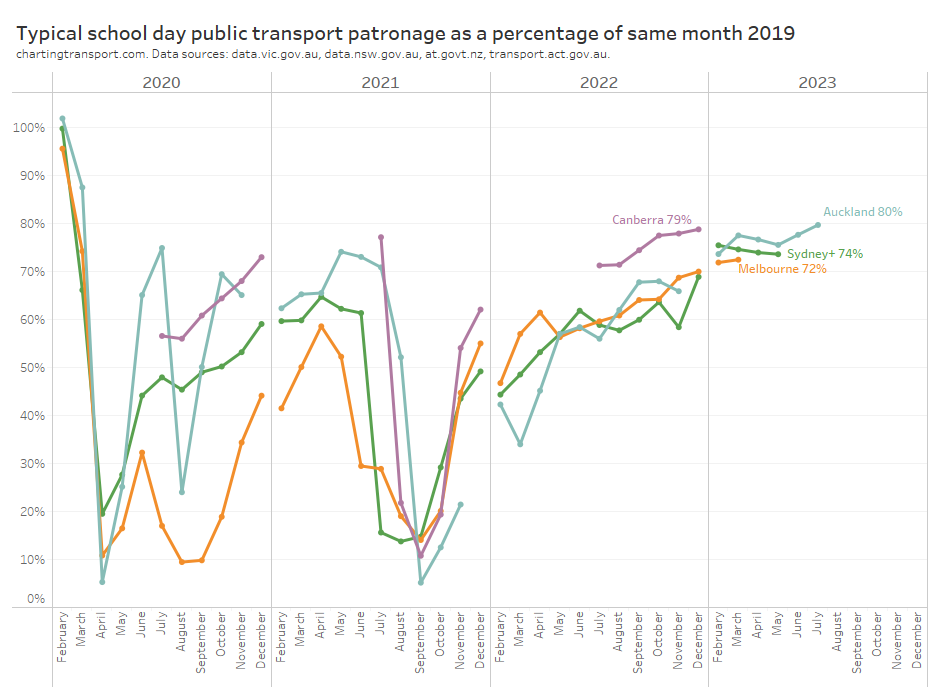
Note: Canberra estimates are only available for July to December because daily patronage data has unfortunately not been published for January to June 2019.

And here is the same for weekends (again for the same four cities that publish weekend data):
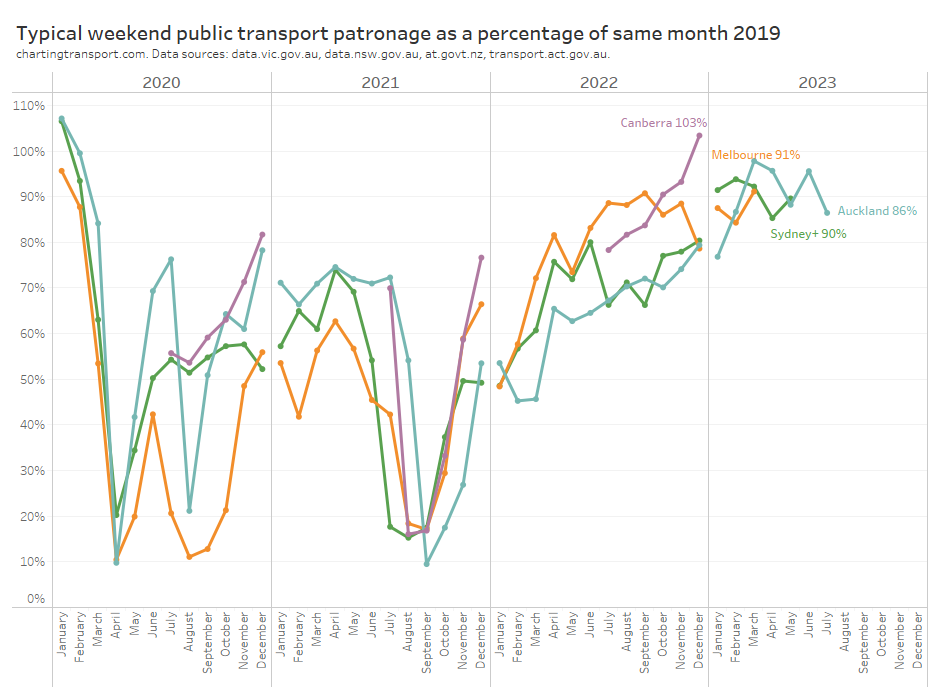
Weekend patronage is a bit more volatile as weekends typically have varying levels of major events and planned service disruptions. Most months also only have 8 weekend days, so a couple of unusual days can skew the month average and create “noise” in the data.

However all cities have been above 90% patronage recovery on weekends. Weekend patronage has returned more strongly than weekday patronage, probably because new remote working patterns only significantly impact weekdays.

How has patronage recovery varied between cities by mode?

I’m only confident about predicting modal patronage in cities that report daily or average day type patronage by mode, as the day type weightings used from another city might not apply equally to all modes.

Here is school weekday train patronage recovery for Sydney, Melbourne, and Auckland:
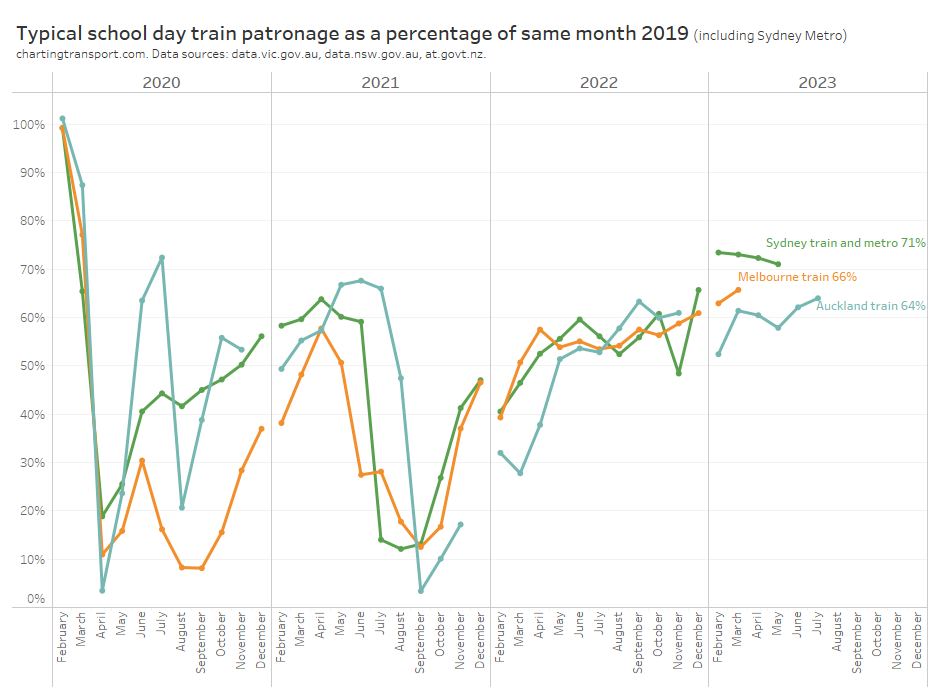
Auckland is slightly below Sydney and Melbourne, and recovery rates are lower than public transport overall. I suspect this may be due to train networks having a significant role in CBD commuting – a travel market most impacted by remote working.

And here is the data for weekends:

Curiously there is a lot more variation between cities. There’s also a lot more variation between months, which could well be related to the “noise” of occasional planned service disruptions and major events.

Here is average school day bus patronage for four cities where data is available:
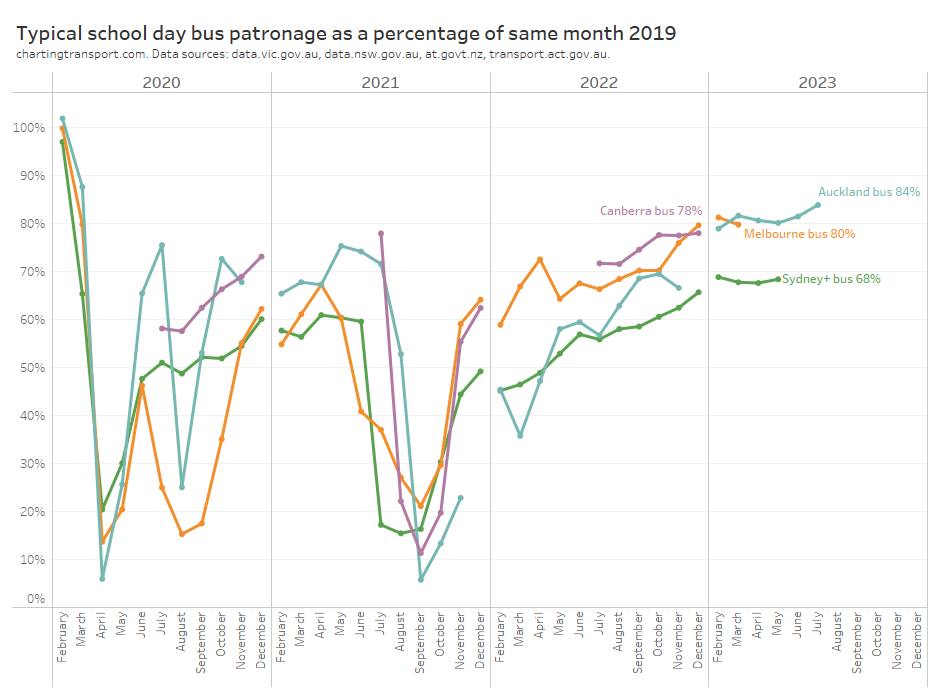
Bus patronage recovery is lowest in Sydney, perhaps because buses play a more significant role in Sydney CBD commuter travel which will be impacted by working from home (Melbourne’s bus services are mostly not focussed on the CBD). However buses also play a major role in public transport travel to the CBDs of Auckland and Canberra, although with probably lower public transport mode shares (unfortunately it doesn’t seem possible to get public transport mode share for the Auckland CBD from 2018 NZ Census data).

And for completeness, here is a chart for weekend bus patronage:
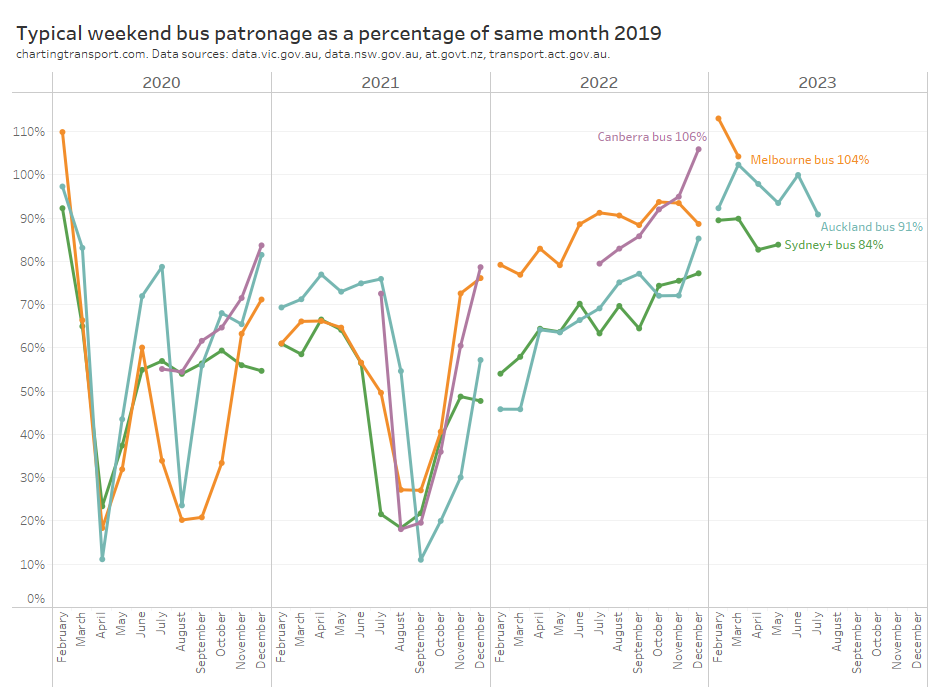
Weekend bus patronage recovery is higher than weekdays, and higher than weekend train patronage recovery, in all cities. Reported weekend bus patronage in Canberra, Melbourne, and Auckland has exceeded 2019 level in recent months.

How good are these estimates?

Some agencies publish very useful data such as daily patronage or day type average patronage, while others only publish monthly or quarterly totals which is much less useful for trend analysis. Here’s a summary of how I estimated time-series patronage and therefore patronage recovery in each city (which I will explain below).

City/regionData used to estimate time-series patronageConfidence
MelbourneReported average patronage by day of the week and day typeHigh
Sydney+ = Greater Sydney, Newcastle/Hunter, Blue Mountains, Wollongong (Opal catchment)Reported average school weekday and average weekend day patronage per month (dashboard)Moderate
South East Queensland (Translink) – including Brisbane, Gold Coast, Sunshine CoastReported weekly totals, aggregated to months, and adjusted by day type weightings calculated for Melbourne 2022.Lower
AdelaideReported quarterly totals, adjusted by day type weightings calculated for Auckland 2022.Lower
PerthReported monthly totals, adjusted by day type weightings calculated for Auckland 2022.Lower
CanberraReported daily patronage (from July 2019) and monthly total patronage for May and June 2019 adjusted by day type weightings calculated for Canberra 2022 (weekdays) and 2019 (weekends and public holidays). Data pre-May 2019 has been excluded as there was a step change in boardings when a new network was implemented in late April 2019. May 2019 has been included however I should note it had unusually high boardings.Moderate
AucklandReported daily patronage (up to 23 July 2023 at the time of writing).High
WellingtonReported monthly totals, adjusted by day type weightings calculated for Auckland 2022.Lower

For Melbourne and Auckland excellent data is published that allows calculation of typical school week patronage for February to December, which gives me high confidence in the estimates. Canberra has published daily patronage data but only from July 2019 so I’ve had to estimate school week patronage for May and June 2019 from monthly totals (process described below).

You’ll notice I’ve referred to “typical” patronage rather than average patronage. For cities with daily data, I’ve summed the median patronage of each relevant day of the week, rather than taking a simple average of days of that day type in the month. Taking the median can help remove outlier days, and summing over the days of the week means I’m weighting each day of the week equally, regardless of how many occurrences there are in a month (eg a month with 5 Sundays and 4 Saturdays). For Melbourne I’ve only got the average patronage per day of the week, but I’m still summing one value of each day of the week.

Transport for NSW have an interactive dashboard from which you can manually transcribe (but not copy or download) the average school weekday patronage and average weekend daily patronage for each mode and each month. I’ve compiled a typical school week estimate using 5 times the average school weekday plus 2 times the average weekend day. This is likely pretty close to what true average school week patronage is (more discussion below).

But what about the other cities?

How can you estimate patronage trends in cities where only monthly, quarterly, or weekly total patronage data is available?

Rather than simply calculating percentage patronage recovery on monthly totals (which has all the issues I explained in my previous post), I’ve made an attempt to compensate for the day type composition of each month in each city.

Basically this method involves calculating a weighting for each month, based on the day type composition of each month. If you divide total monthly patronage by the sum of weightings for all days of each month you can get a school weekday equivalent figure on which you can do time series analysis.

This requires a calendar of day types, and assumptions around the relative patronage weightings of each day type.

I’ve compiled calendars for each city using various public sources (including this handy machine readable public holiday data by data.gov.au).

Technical note: In New Zealand it seems schools generally are able to vary their start and end of year by up to 5 regular weekdays. I’ve excluded these 10 weekdays from many calculations because they do not represent clean school or school holiday weekdays. For December 2019 I have also excluded two weeks for Auckland due to unusually low reported patronage due to bus driver industrial action.

The assumed day type weightings need to come from another city, on the hope that they will be similar to the true value. But which city, and measured in what year?

I’ve calculated the relative patronage weights of each day type for Melbourne, Canberra, Auckland, plus one school week sample from February 2020 for Sydney+ (Opal region). These are indexed to a school Monday being 1.
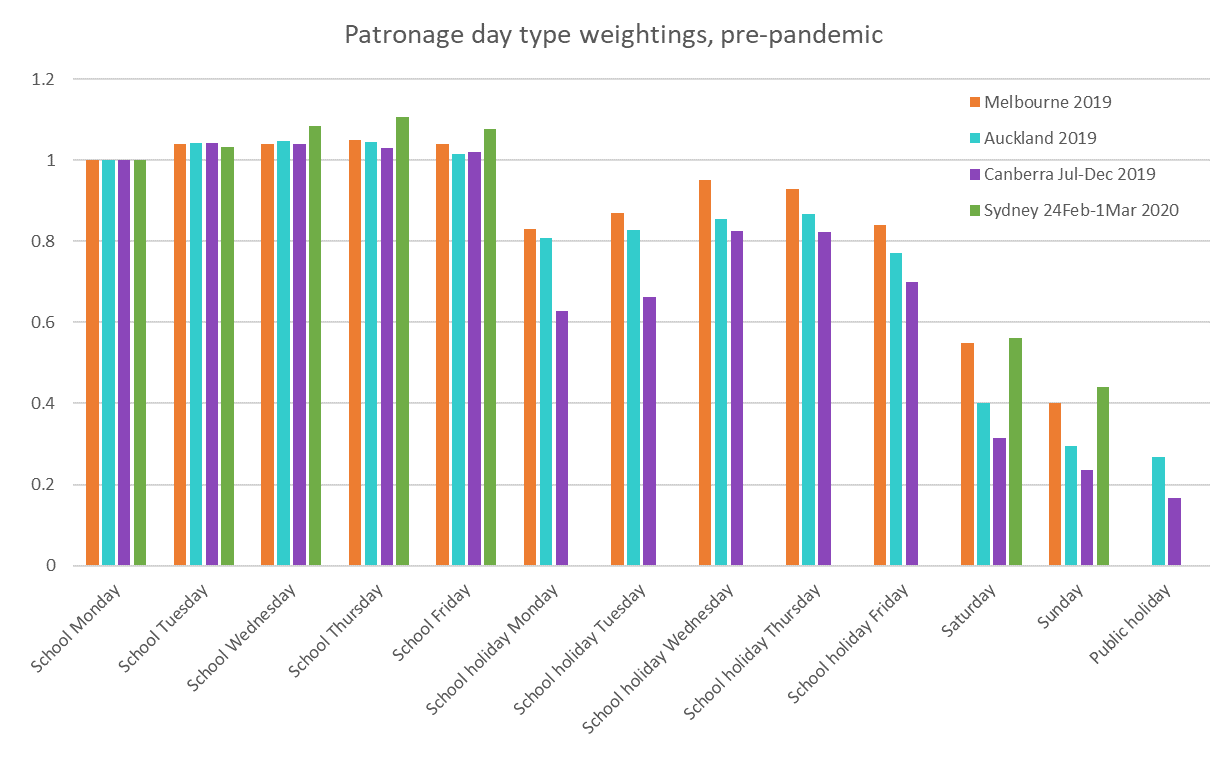
Note: no data is available for public holidays in Melbourne, and the Sydney data does not include school holiday weekdays or public holidays.

Melbourne, Canberra, and Auckland weightings are pretty similar across days of the week for school days, but Melbourne’s school holiday weekdays and weekends were relatively busier than both Auckland and Canberra. The Canberra school holiday figures are highly variable between weekdays and are only available for the second half of 2019 (so are impacted more significantly by the timing of Christmas).

The data suggests the big cities of Sydney and Melbourne attract much more weekend patronage compared to the smaller cities. They also have higher public transport mode shares – refer Update on Australian transport trends (December 2022) for comparisons between Australia cities. In terms of public transport share of journeys to work, Auckland was at around 14% in 2018, while Melbourne was 18.2% in 2016). This suggest Melbourne day type weightings might be suitable for larger cities while Auckland day type weightings might be suitable for smaller cities.

The next question is: which year’s weightings should be used? The chart above showed day type weightings from pre-pandemic times, but it turns out they have changed a bit since the pandemic. Here are 2022 day type weightings:
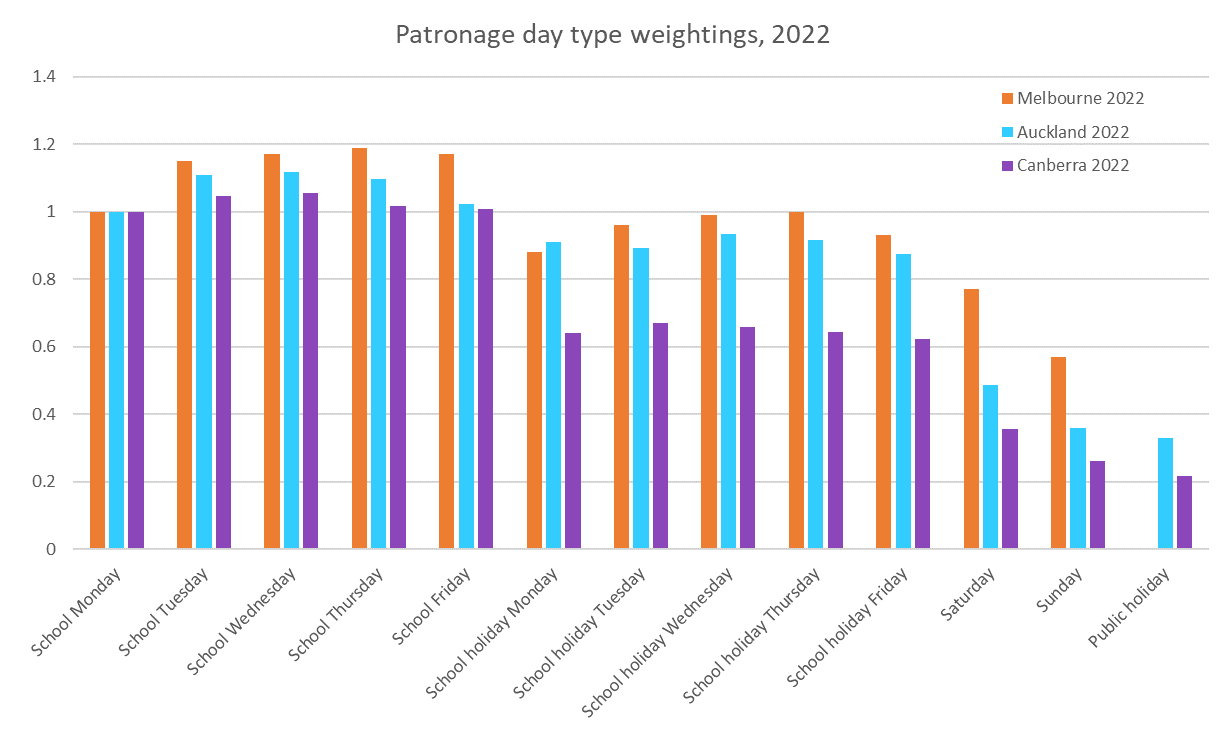
In all cities in 2022 there is a lot more variation across Monday to Friday school days (Mondays and Fridays being popular remote working days) and school holiday weekdays are much more similar between Melbourne and Auckland, while weekends remain quite different.

In fact here’s how the cities with available data compare for ratios between weekends and school weekdays in 2019 and 2022:
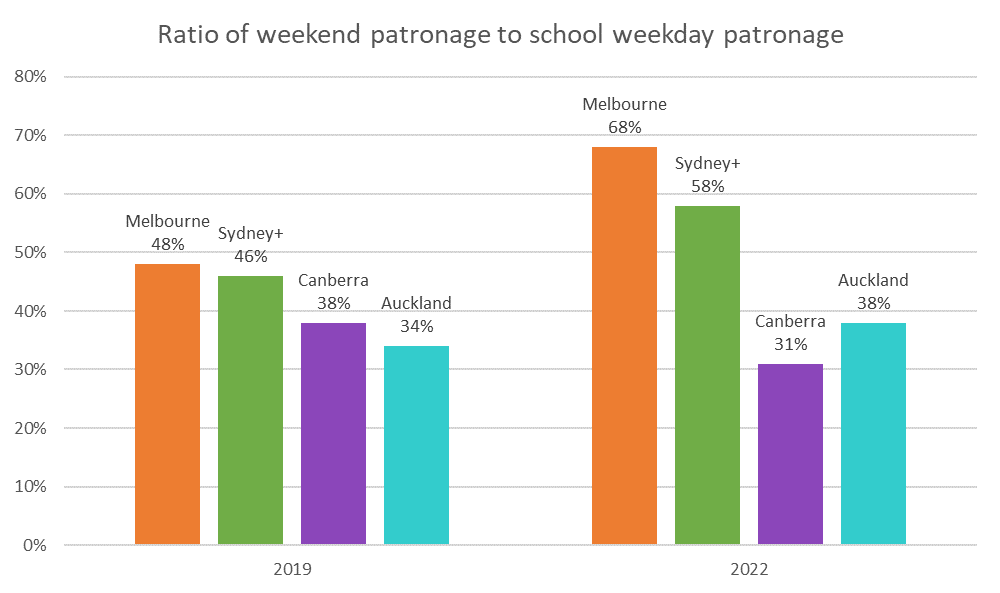
The ratios increased in all cities between 2019 and 2022 except Canberra. The 2019 ratios are remarkably close between Melbourne and Sydney, but the 2022 data shows a higher weighting for weekends in Melbourne than Sydney. The Auckland and Canberra ratios are substantially lower in both years. The ratio went down in Canberra in 2022 possibly due to issues obtaining enough drivers to run weekend timetables in that city.

So what day type weightings should we use for each city?

Should we use Melbourne, Auckland, or Canberra weightings, and from what year should we derive these weightings? And how worried should we be about getting these weightings right?

Well, Auckland provides us with daily patronage data for a “medium sized” city, which allows us to compare calculated typical school week patronage, and also allows calculations as if only more summary data was available (as per other cities). However we need to exclude both January and December, as there were no normal school weekdays in those months in 2019.
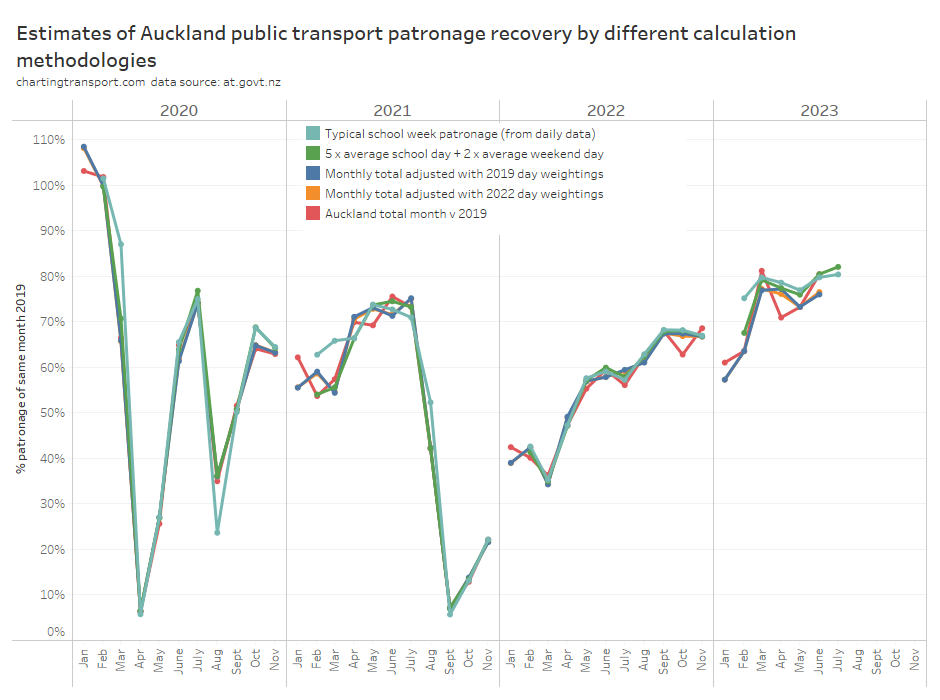
The red line (total monthly patronage with no calendar effect adjustments) has the most fluctuations month to month and I’m pretty confident this is misleading for all the reasons mentioned in my last post.

Most of the other methodologies produce a figure fairly close to the best estimate (teal line), except in 2021 and 2023.

The green line (compiled 5 x average school day + 2 x average weekend day) is mostly within 2% of the (arguably) best estimate, but there are variations that will be explained by the green line not taking into account the day of the week composition of the month, nor excluding outlier busy/quiet days (unlike medians). So if you only have average school weekday and average weekend day data you’re not going to be too far off the best estimate. That gives me “moderate” confidence to use Sydney’s average school weekday and average weekend day patronage data to estimate patronage recovery.

But what if you only have total monthly patronage and have to use day type weightings? It’s a bit hard to see the differences in the above chart, so here’s a zoom in for 2022 and 2023:
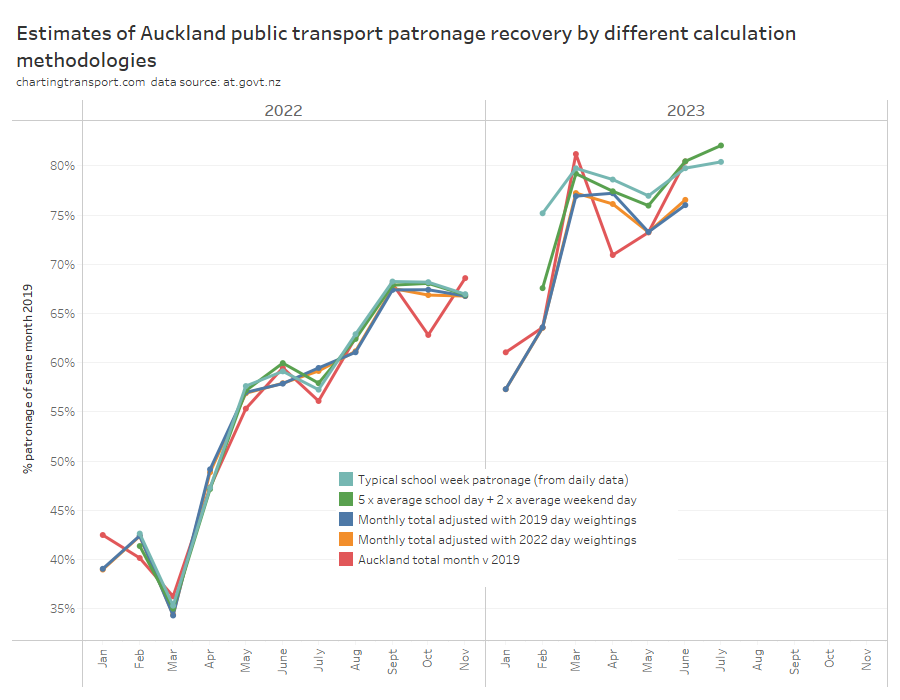
There’s not a lot of difference between the 2019 and 2022 day type weightings, and notably both methods underestimate patronage recovery for most months of 2023, which is not ideal. Note: February 2023 had several days of significant disruptions due to major flooding events which impacted most measures (except the “typical school week” measure that uses medians to reduce the impact of outliers).

Sydney also provides data that allows us to compare day type weighting estimates to the probably quite good compiled school week estimate (based on 5 average school weekdays and 2 average weekend days). The next chart includes estimates of Sydney patronage recovery using day type weightings from Melbourne and Auckland for different years:
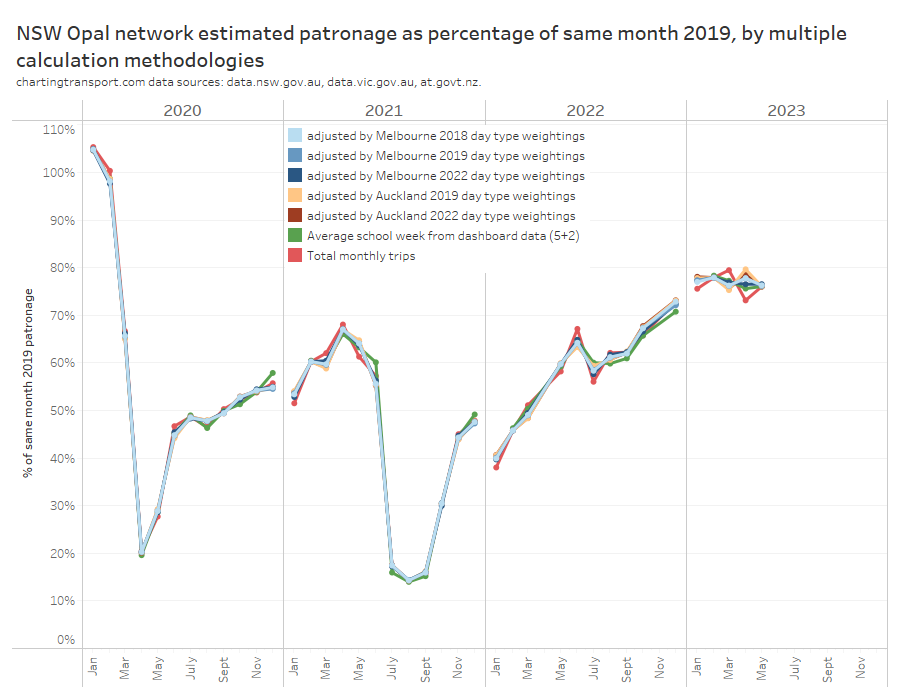
Technical note: I have assumed Melbourne public holidays have the same day type weighting as Sundays, for want of more published data.

The estimates are mostly pretty close, but let’s zoom into recent months to see the differences between the methodologies more clearly:
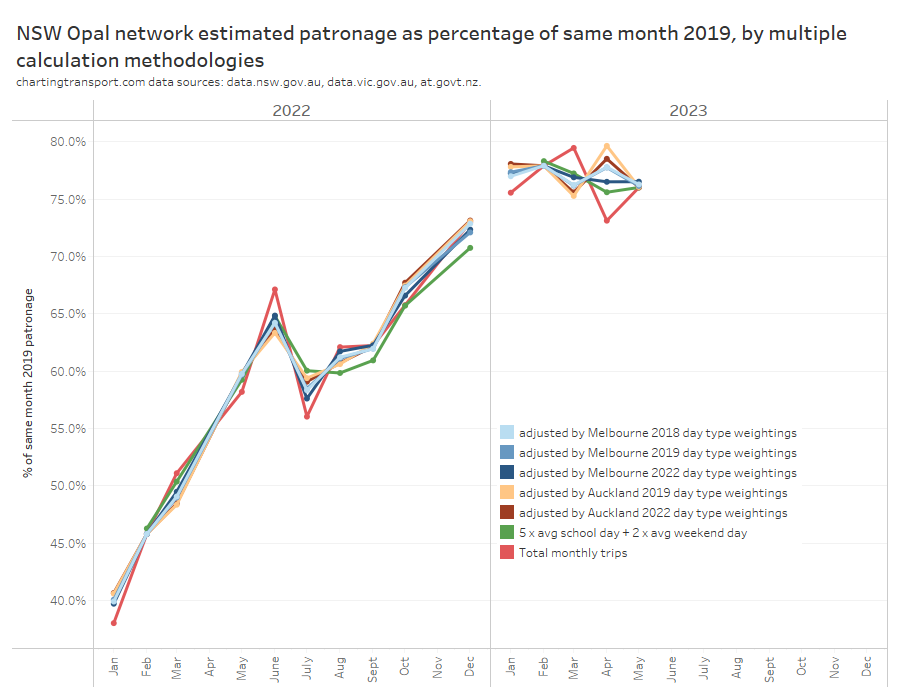
The closest estimate to the compiled average school week data is using Melbourne 2022 day type weightings to adjust monthly totals (the difference is up to 0.9% in April 2023). This suggests Melbourne is probably the best city from which to source day type weightings to apply to Sydney (both large cities), and 2022 (a post-pandemic year) might be a better source year for these weightings. That’s consistent with Sydney having similar ratios of weekday to weekend patronage as Melbourne.

You can see the red line (a simple total monthly patronage comparison) is again often the biggest outlier, which is what happens when you don’t control for calendar effects. I mentioned at the start of my last post that the raw monthly totals suggested a misleadingly large 6.4% drop in patronage recovery from 79.5% in March 2023 to 73.1% in April 2023. On the average school week estimates, patronage recovery dropped only 1.8% from 77.2% to 75.6%.

So which city’s day type weightings are most appropriate for the smaller cities of Perth, Adelaide, Wellington, and Brisbane that don’t currently publish day type patronage? Does it even make a lot of difference?

Well here are patronage recovery estimates for Adelaide, Brisbane, Wellington, and Perth using both Melbourne and Auckland day type weightings from 2022.

Most of the estimates are within 1%, although there are some larger variances for Wellington and Perth.

The Wellington recovery line is smoother for Melbourne weightings in 2021, but smoother with Auckland weightings in 2022 and 2023 (so far). The Wellington estimates can differ by up to 2% and a smoother trend line may or may not mean that one source city for day type weightings is better than the other.

The fact that Melbourne day weightings worked better than Auckland day weightings when it came to Sydney suggests that larger city weightings might be appropriate for other large cities, and perhaps smaller city weightings might be appropriate for other smaller cities.

I have adopted Melbourne day type weightings for South East Queensland, and Auckland day type weightings for Adelaide, Perth, and Wellington, on the principle that larger cities are likely to have relatively higher public transport patronage on weekends (compared to weekdays). Of course I would really rather prefer to not have make assumptions.

That was pretty complicated and involved – is there a lazy option?

Okay, so if you don’t have – or want to compile – calendar data and/or you don’t want to use day type weightings from another city, you can still compile rolling 12 month patronage totals and compare those year-on-year to estimate patronage growth.

The worst times of year at which to measure year-on-year patronage growth are probably at the end of March, June, September, and December (because of when school holidays fall). Of course being quarter ends, these are also probably the most common times it is measured!

It’s slightly better to measure year on year growth for 12 month periods ending with February, May, August, and/or November, as years ending in these months will contain four complete sets of school holidays, and exactly one Easter (at least for countries with similar school terms to Australia and New Zealand). However there will still be errors because of variations in day type composition of those 12 month periods.

In my last post I introduced the mythical city of Predictaville, where public transport patronage is perfectly constant by day type and they follow Victorian school and public holidays. Here is what Predictaville patronage growth would look like measured year on year at end of November each year:

Calculated growth ranges between +0.8% and -0.9%, which is about half as bad as +1.6% to -1.6% when measured at other month ends, but still not ideal (the true value is zero). The errors in the real world will depend on the relative mix of patronage between day types (Predictaville patronage per day type was modelled on Melbourne’s buses).

That’s a not-too-terrible option for patronage growth, but if you are interested in patronage recovery versus 2019 on a monthly basis, I’m not sure there is any reasonable lazy option.

Let’s hope the usefulness of published patronage data improves soon so complicated assumptions-based calendar adjustments and problematic lazy calculation options can be avoided!


How is population density changing in Australian cities? (2023 update)

Sat 10 June, 2023

This detailed post from 2023 does not include the population latest data. For the latest summary metrics, see Trends in major city population density.

With the release of more detailed 2021 census data and June 2022 population estimates, it’s now possible to look more closely at how Australia’s larger capital cities have changed, particularly following the onset of the COVID19 pandemic in 2020.

This post examines ABS population grid data for 2006 to 2023 for Greater Capital City Statistical Areas, including:

  • Trends in overall population-weighted density for cities;
  • Changes in the distribution of population living at different densities;
  • Changes in the distribution of population living at different distances from each city’s CBD;
  • Changes in population density by distance from each city’s CBD;
  • Changes in the distribution of population living at different distances from train and busway stations;
  • Changes in population density in areas close to train and busway stations;
  • The population density of “new” urban residential areas in each city (are cities sprawling at low density?); and
  • Changes in the size of the urban residential footprint of cities.

I’ve also got some animated maps showing the density of each city over those years, and I’ve had a bit of a look at how the ABS corrected population estimates for 2007 to 2021 following the release of 2021 census data.

For some other detailed analysis – and a longer history of city population density – see How is density changing in Australian cities? (2nd edition).

I’ve not included the smaller cities of Hobart and Darwin as they have a small footprint, and too many grid cells are on the edge of an urban area.

Population weighted density

My preferred measure of city density is population-weighted density, which takes a weighted average of the density all statistical areas in a city, with each area weighted by its population (this stops lightly populated rural areas pulling down average density – for more discussion see How is density changing in Australian cities? (2nd edition)).

I also prefer to calculate this measure on a consistent statistical area geography and the only consistent statistical area geography available for Australia is the square kilometre population grid published by the ABS.

With the recent release of 2021 census data, ABS issued revised population grid estimates for all years from 2017 onwards, which saw significant corrections in some cities (see appendix for more details). There has also been a slight change in the methodology for the 2021 grid that ABS say may result in a more ‘targeted representation’, but it’s unclear what that means.

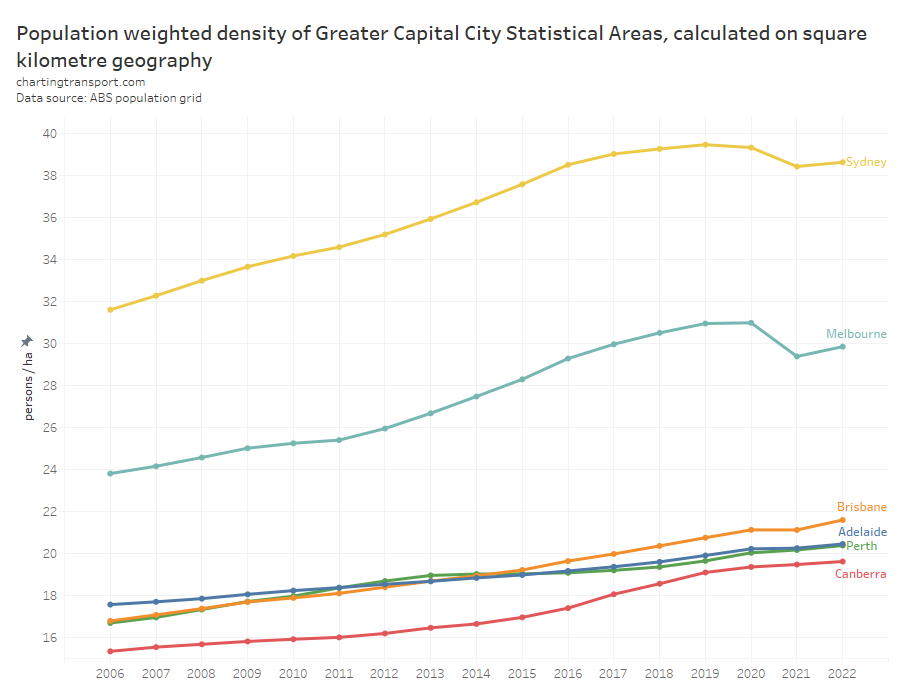
Here’s the revised trend in population weighted density calculated on square km grid geography for Greater Capital City Statistical Areas in June of each year:

Sydney has almost double the population density of most other Australian cities (on this measure), with the exception being Melbourne which sits halfway in between.

Population weighted density was rising in all cities until 2019, although the growth was notably slowing in Sydney from about 2016.

The pandemic hit in March 2020 and led to a flatlining of density in Melbourne and a decline in Sydney by June 2020, while other cities continued to densify. Then Sydney and Melbourne’s population weighted density dropped considerably in the year to June 2021 – probably a combination an exodus of temporary international migrants and internal migration away from the big cities (particularly Melbourne that had experienced long lockdowns). Most other cities flatlined between June 2020 and June 2021.

Then by June 2022 density had increased again in all cities, after international borders reopened in early 2022.

I expect some fairly substantial changes between June 2022 and June 2023 in some cities as migration has surged further and rental vacancy rates have plummeted in several cities.

Population living at different densities

The following chart shows the proportion of the population in each city living at different density ranges over time:

All cities show a sustained pre-pandemic trend towards more people living at higher densities. However the pandemic saw significant drops in people living at the higher density categories in 2021 in Melbourne, Sydney, and Canberra.

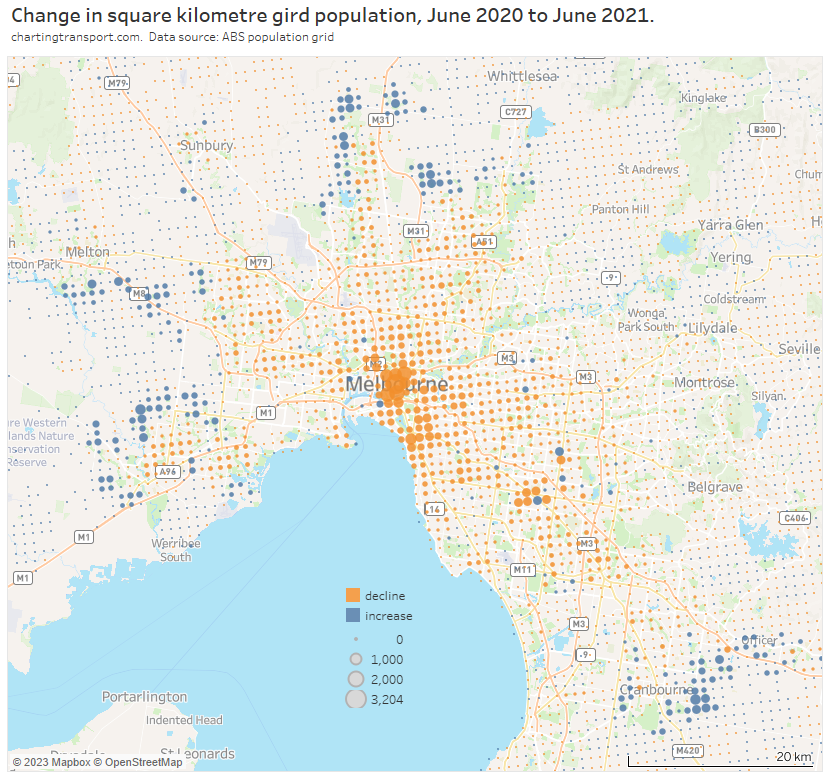
So where was this loss of density? The next chart shows the change in population for grid squares across Melbourne between June 2020 and June 2021. Larger dots are more change, blue is an increase and orange is a decline:

You can see significant declines in population (and hence population density) in the inner city areas – so much so that the dots overlap. This is likely largely explained by the exodus of many international students and other temporary migrants.

You can also see population decline around Monash University’s Clayton campus in the south-eastern suburbs.

At the same time there were large increases in population in the outer growth areas, as is normally the case. Other pockets of population growth include Footscray, Moonee Ponds, Box Hill, Port Melbourne, Clayton (M-City), and Doncaster, likely related to the completion of new residential towers.

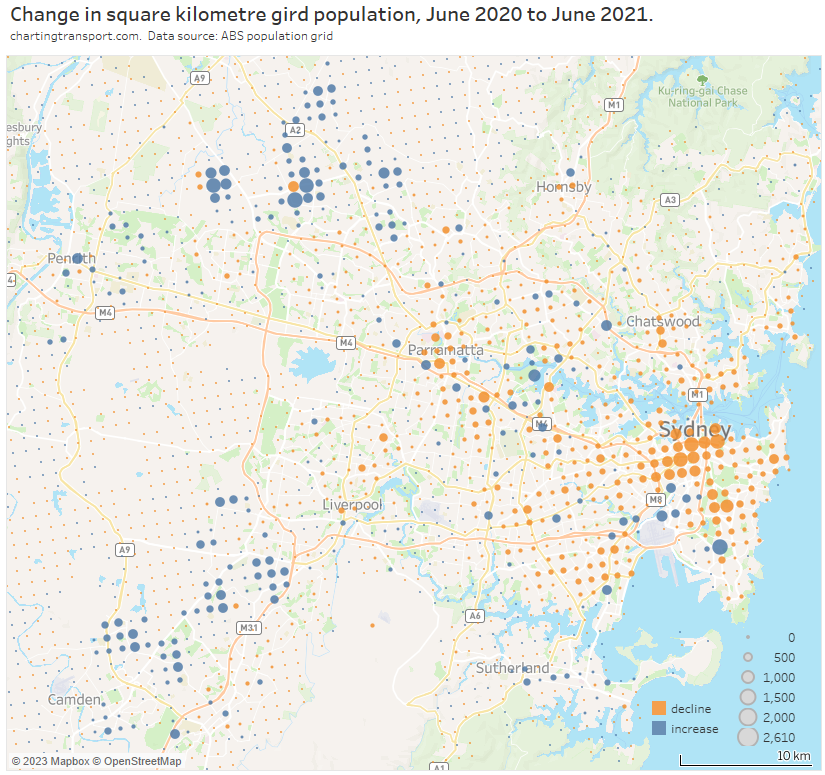
Here’s the same for Sydney:

There was significant population decline in the inner city and around Kensington (which has a major university campus), and the largest growth was seen in urban fringe growth areas to the north-west and south-west. Pockets of population growth were also seen at Wentworth Point, Eastgardens, Mascot, North Ryde, and Mays Hill, amongst others.

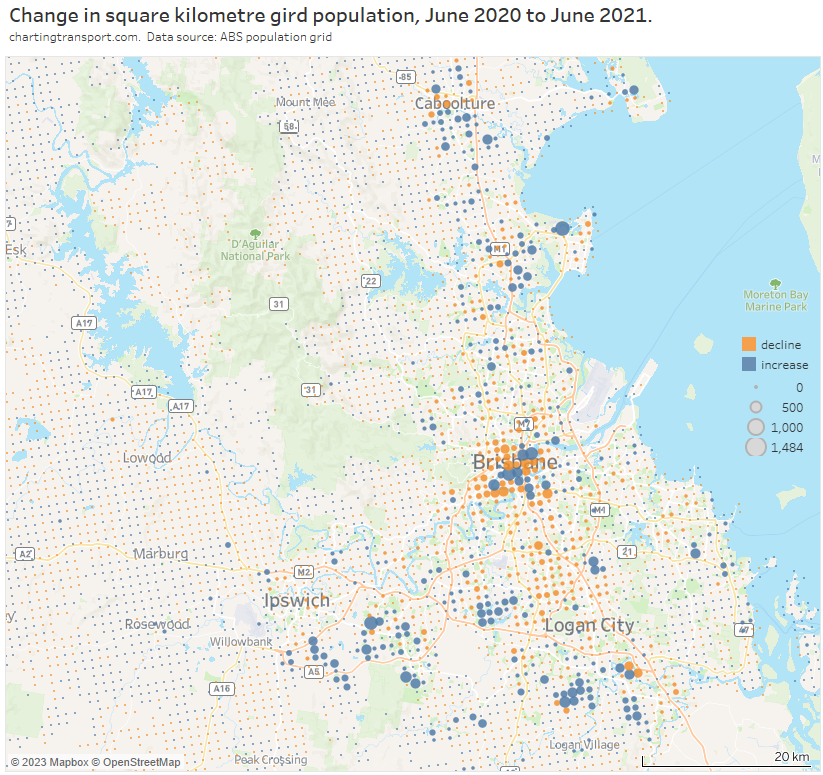
Here is the same for Brisbane:

Inner-city Brisbane was much more a mixed bag, which explains the less overall change in the density composition of the city. Some areas showed declines (including St Lucia, New Farm, Kelvin Grove, Coorparoo) while others saw increases (including Fortitude Valley, West End, South Brisbane, Buranda, CBD south).

Proportion of population living at different distances from the city centre

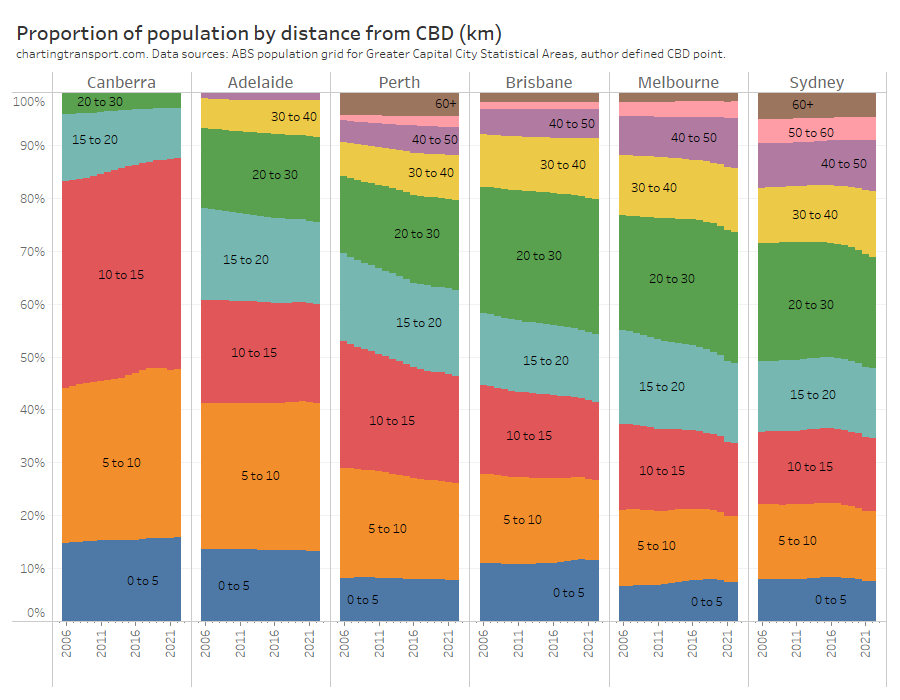
The next chart shows the proportion of people living at approximate distance bands from each city’s CBD over time:

All cities have seen a general trend towards more of their population living further from the CBD, with the notable exception of Canberra which has seen the outer urban fringe expanding by little more than a couple of kilometres at the most, and substantial in-fill housing at major town centres and the inner city (see also animated density map below). I should note that the Greater Capital City Statistical Area boundary for Canberra is simply the ACT boundary, and does not include the neighbouring NSW urban area of Queanbeyan, which is arguably functionally part of “greater Canberra”.

In 2021, Sydney and Melbourne saw a step change towards living further out, in line with the sudden reduction in central city population.

Population density by distance from a city’s CBD

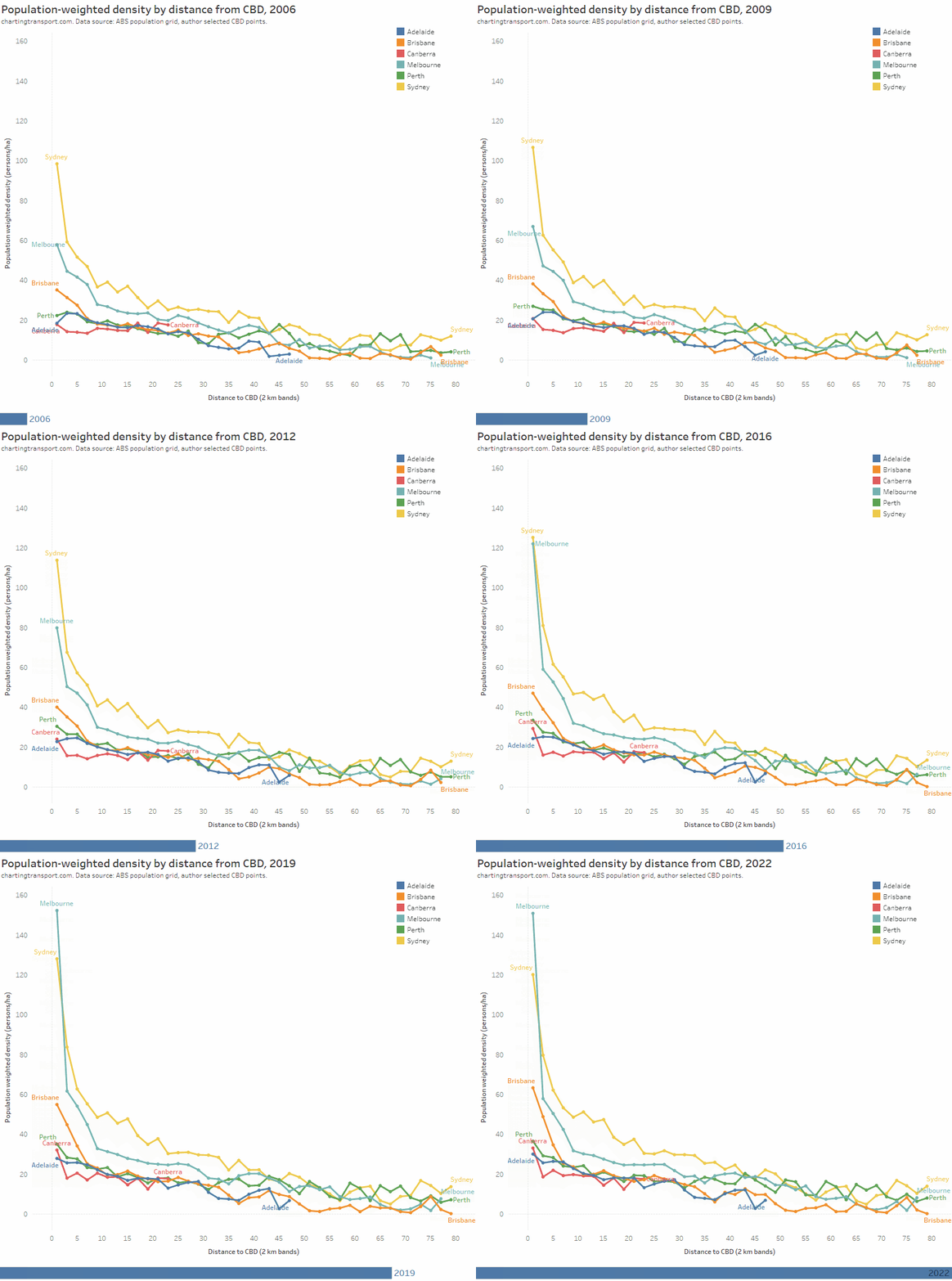
Here’s an animated chart showing how population weighted density has varied by distance from each city’s CBD over time:

In most cities there has been a trend to significantly increasing density closer to the CBD, with central Melbourne overtaking central Sydney in 2017.

Sydney has maintained significantly higher density than all other cities at most distances from CBDs, with Melbourne a fair step behind, then most other cities flatten out to around 20-26 persons/ha from around 6+km out from their CBDs in 2022.

Canberra appears to flatten out to around 20 persons/ha at 3-4 kms from its CBD (Civic) however it is important to note that Canberra has a lot of non-residential land relatively close to Civic which reduces density for many grid cells that are on an urban fringe (refer maps toward the end of this post).

Population living near rapid transit stations

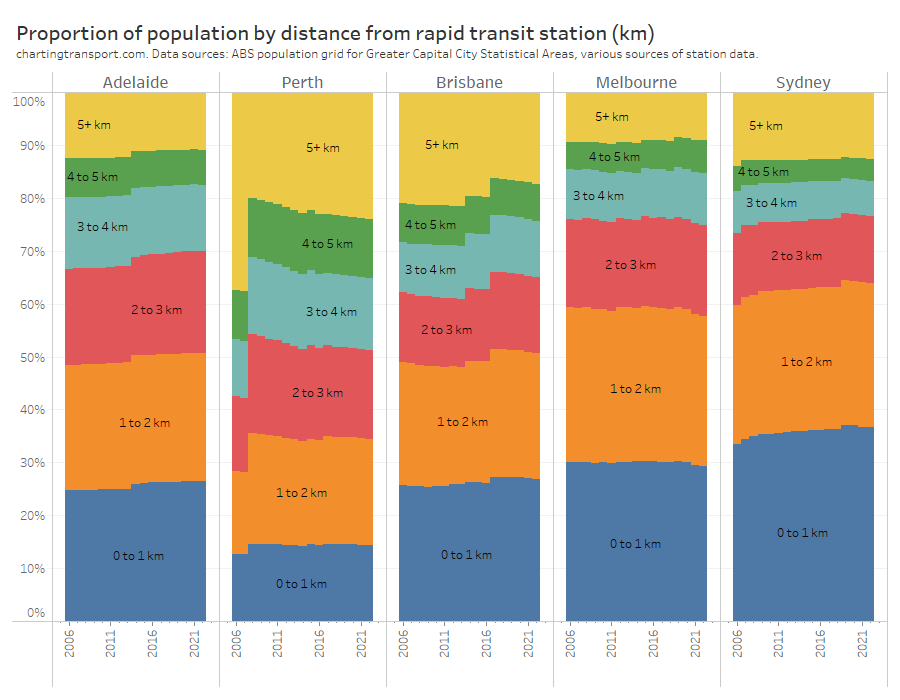
I’ve been maintaining a spatial data set of rapid transit stations (train and busway stations) including years of opening and closing, and from this it’s possible to assess what proportion of each city lives close to stations:

Sydney has the largest proportion of it’s population living quite close to rapid transit stations, with Perth having the lowest.

There are step changes on this chart where new train lines have opened. Sydney, Brisbane, and Adelaide have been successful at increasing population close to stations. The opening of the Mandurah rail line made a big difference in Perth in 2009 but the city has been growing remote from stations since then (MetroNet projects will probably turn this around significantly in the next few years). Melbourne was roughly keeping the same proportion of the population close to stations although that changed in 2021 with the exodus of inner city residents (I anticipate a substantial correction in 2023).

Population density around rapid transit stations

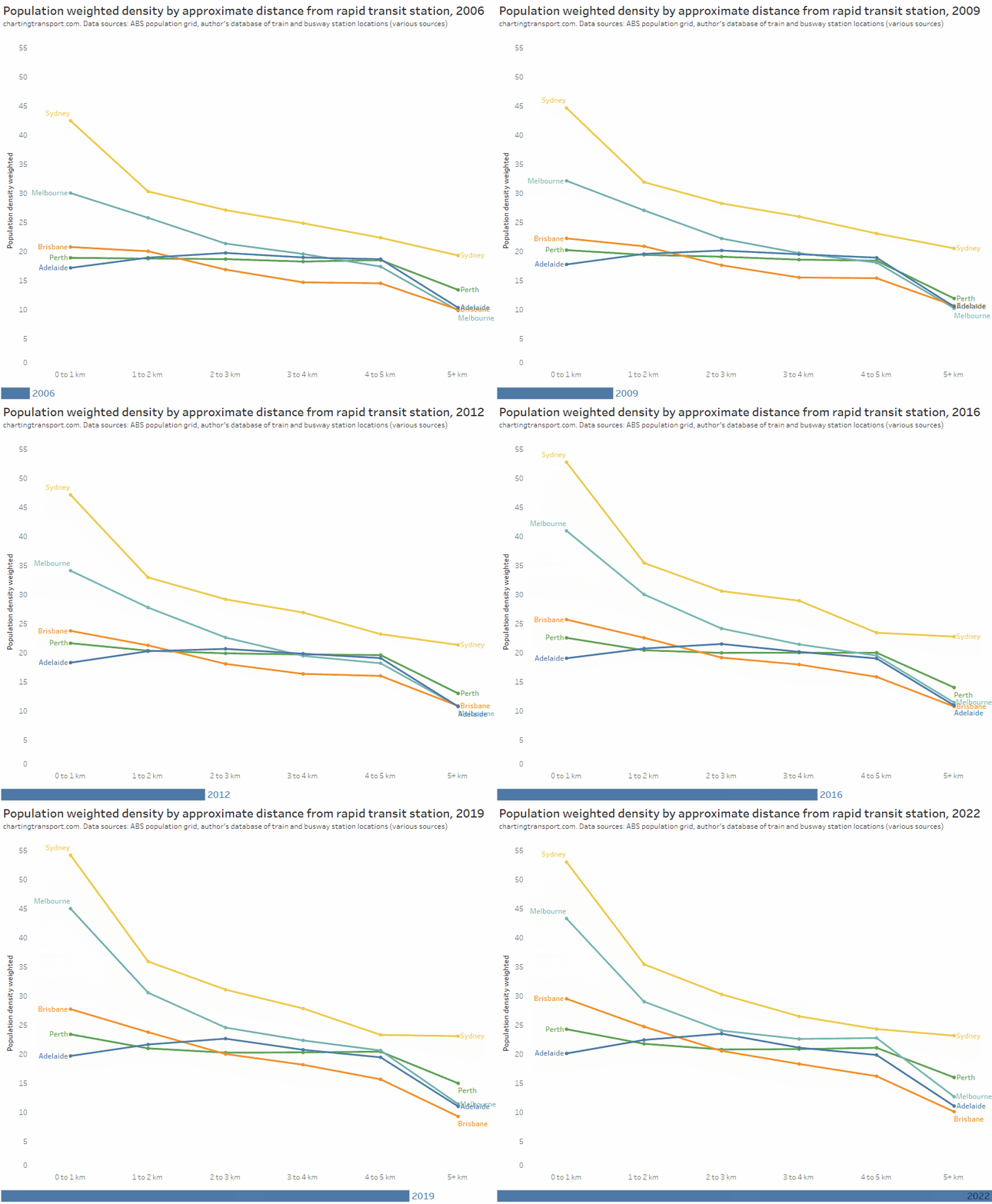
The following animated chart shows the aggregate population-weighted density for areas around rapid transit stations in the five biggest cities over time:

Sydney has lead Australia with higher densities around train stations, followed by Melbourne. Perth has only slightly higher densities around stations (in aggregate) compared to other parts of the city. Population density is generally lower around Adelaide train and busway stations compared to the rest of the city – the antithesis of transit orientated development.

How dense are new urban areas?

I’ve previously looked at the density of outer urban growth areas on my blog, and here is another way of looking at that using square kilometre grid data.

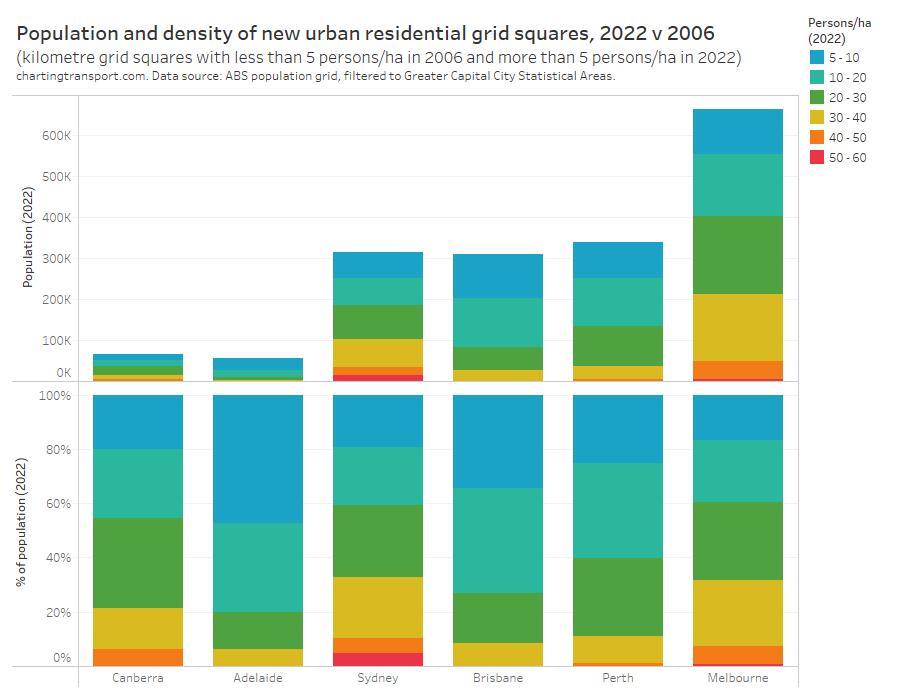
I’ve attempted to identify new urban residential grid squares by filtering for squares that averaged less than 5 persons per hectare in 2006 and more than 5 persons per hectare in 2022 (using 5 persons/ha as an arbitrary threshold for urban residential areas, and I think that’s a pretty low threshold).

The vast bulk of these grid cells (and associated population) are on the urban fringe, but a handful in each city are brownfield sites that were previously non-residential (for Melbourne 99% of the population of these grid cells are in urban fringe areas).

It’s also not perfect because square kilometre grid cells will often contain a mix of residential and non-residential land uses, but it is analysis that can be done easily and quickly, and in aggregate I expect it will be broadly indicate of overall patterns.

The following chart shows the population of new urban residential grid cells (since 2006), and the proportion of this population by 2022 population density:

You can see Melbourne has almost double the population in these new urban residential grid squares compared to Perth, Brisbane, and Sydney. This indicates Melbourne has been sprawling more than any other city since 2006. Slow-growing Adelaide only put on about 56k people in new urban grid squares, slightly less than Canberra.

The bottom half of the chart shows that new urban grid squares in Sydney, Melbourne, and Canberra are generally much more dense than those in other cities. This likely reflects planning policies for higher residential densities in new urban areas in those cities. In fact, all of these grid cells with density 40+ in 2022 are on the urban fringes, except one brownfield cell in Mascot (Sydney).

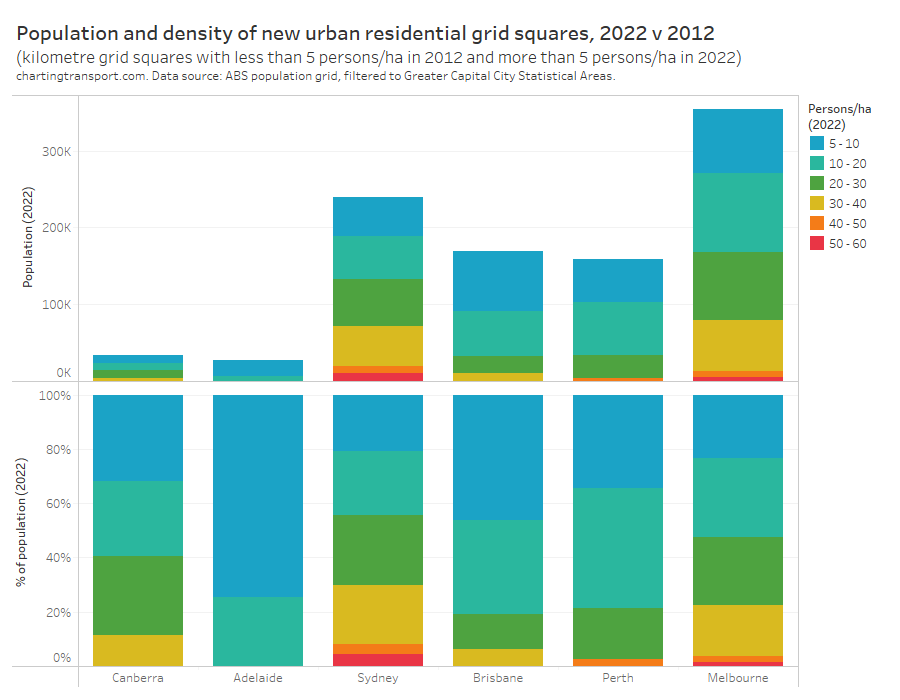
But of course planning policies can change over time, so here is the equivalent chart looking at new urban residential squares since 2012:

It’s not a lot different. The density of these more recent new urban residential grid cells is generally highest in Sydney, following by Melbourne and Canberra. New urban residential grid cells in Adelaide mostly had fewer than 20 persons/ha, but then also there are not that many such grid cells and they didn’t have much population in 2022.

Perth has managed one new grid cell with over 40 persons/ha in 2022 – it is located in Piara Waters (which has many single storey houses with tiny backyards).

How much has the urban footprint of cities been expanding?

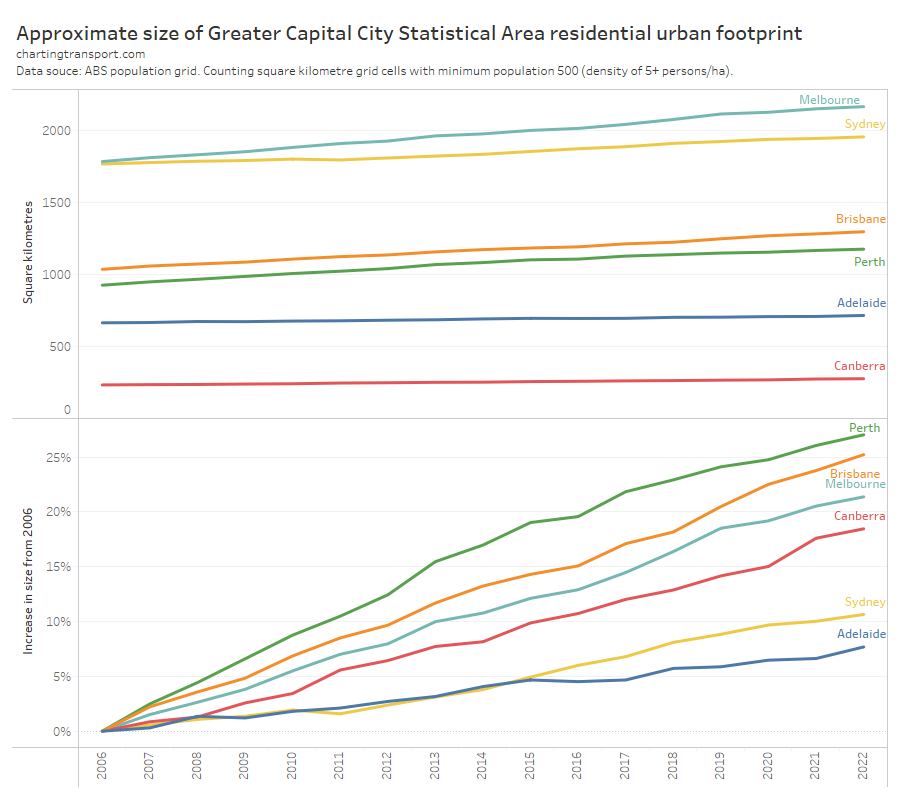
The population grid data only measures residential population so it cannot be used to estimate the size of the total urban footprint of cities over time, but we can use it to estimate the urban residential footprint. I’ve again used 5 persons/ha as a threshold, and here’s how the cities have growth since 2006:

Melbourne and Sydney had much the same footprint in 2006 but Melbourne has since grown significantly larger in size than Sydney, although Sydney still has a larger Capital City Statistical Area population.

The bottom half of the chart shows that Perth has had the largest percentage growth in urban residential area, followed by Brisbane then Melbourne. Sydney and Adelaide have had the least growth in footprint, and are also seeing the least population growth in percentage terms.

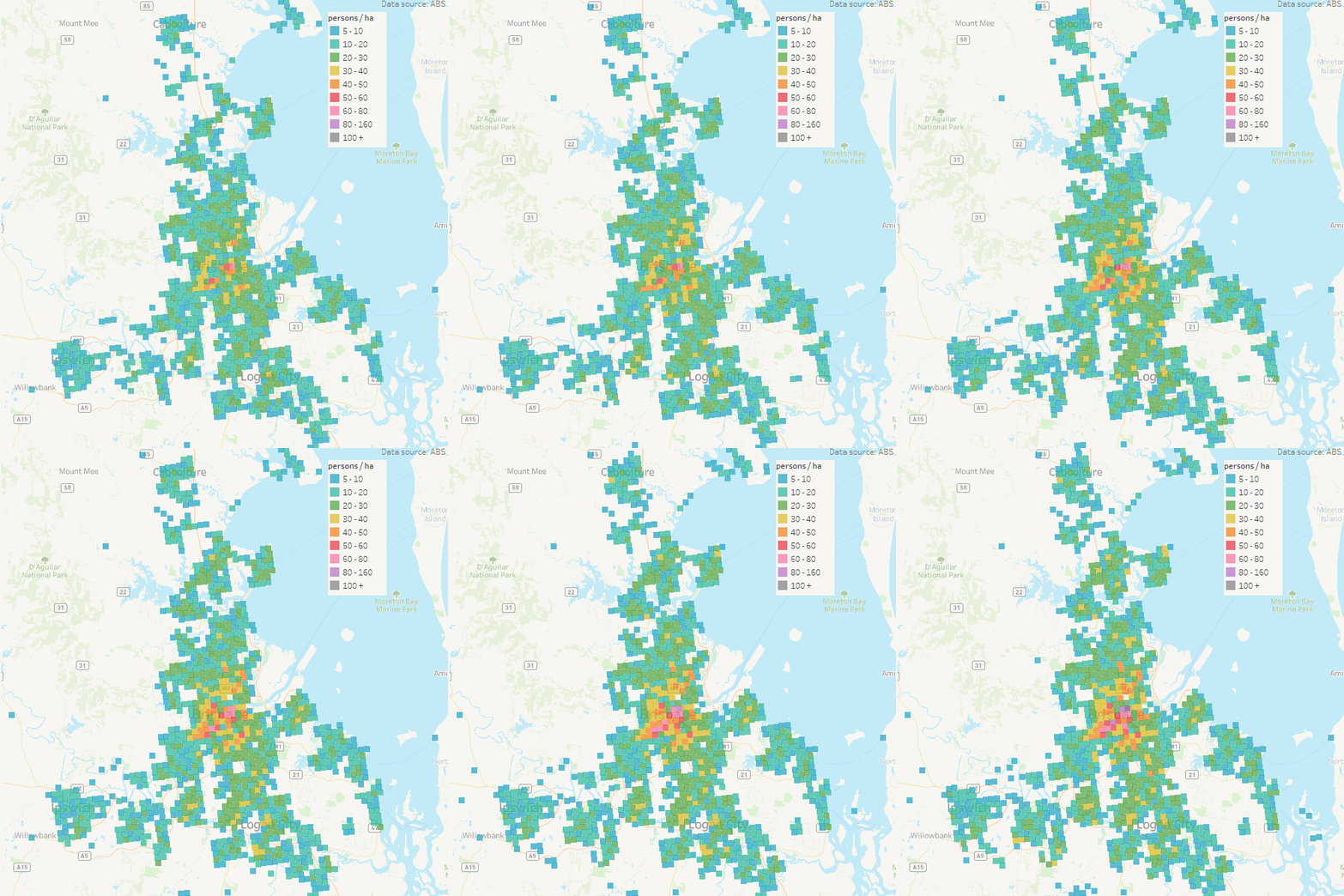
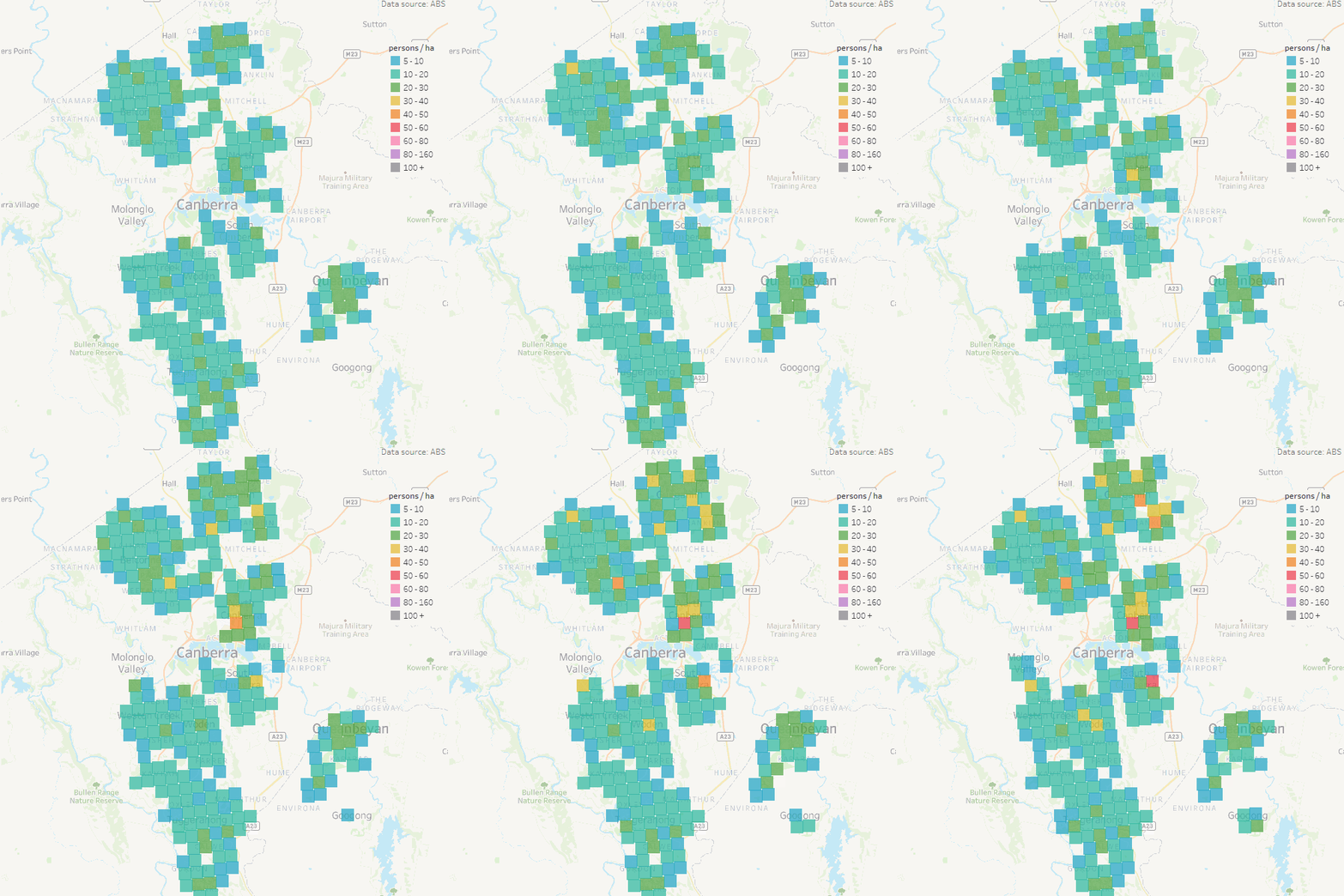
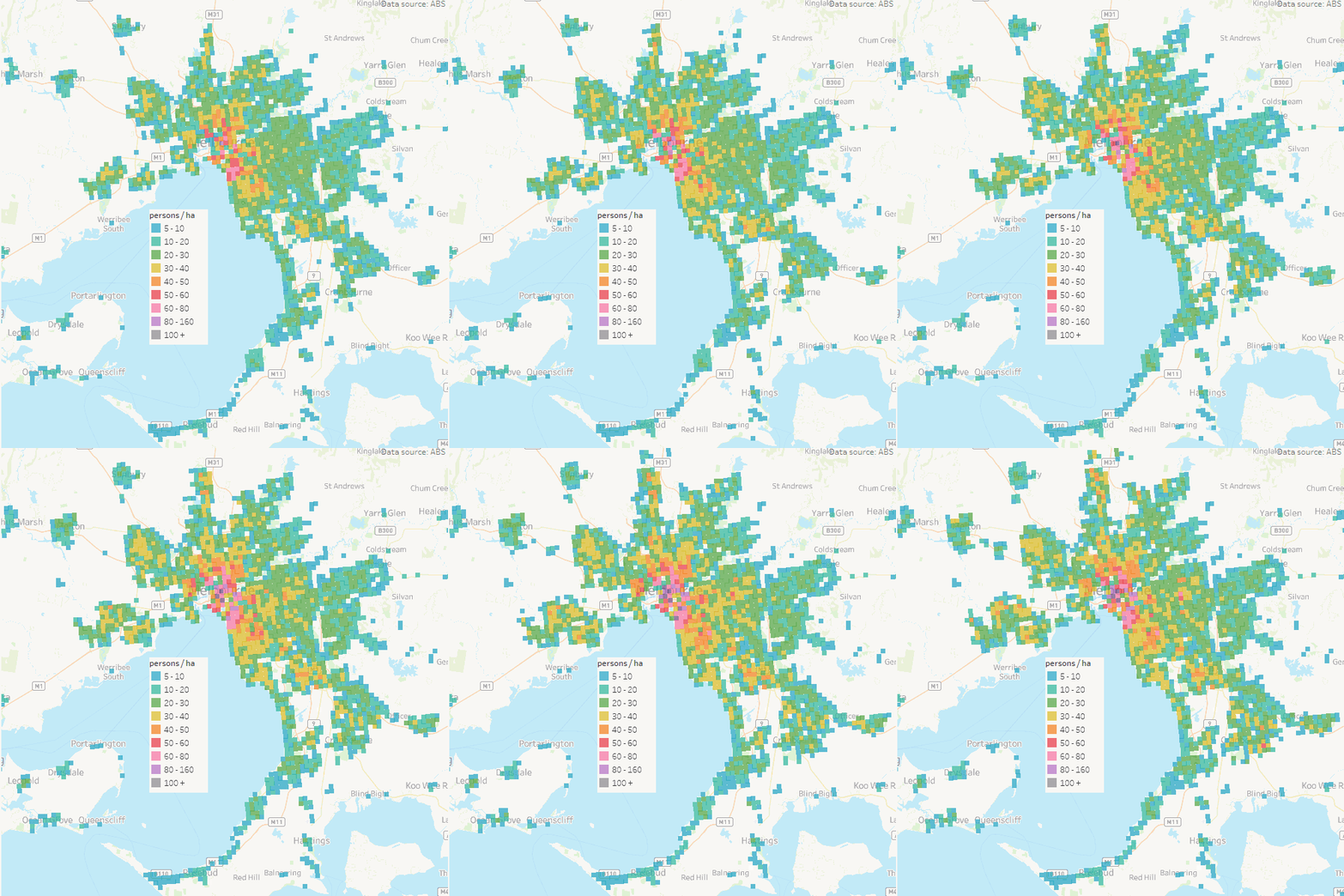
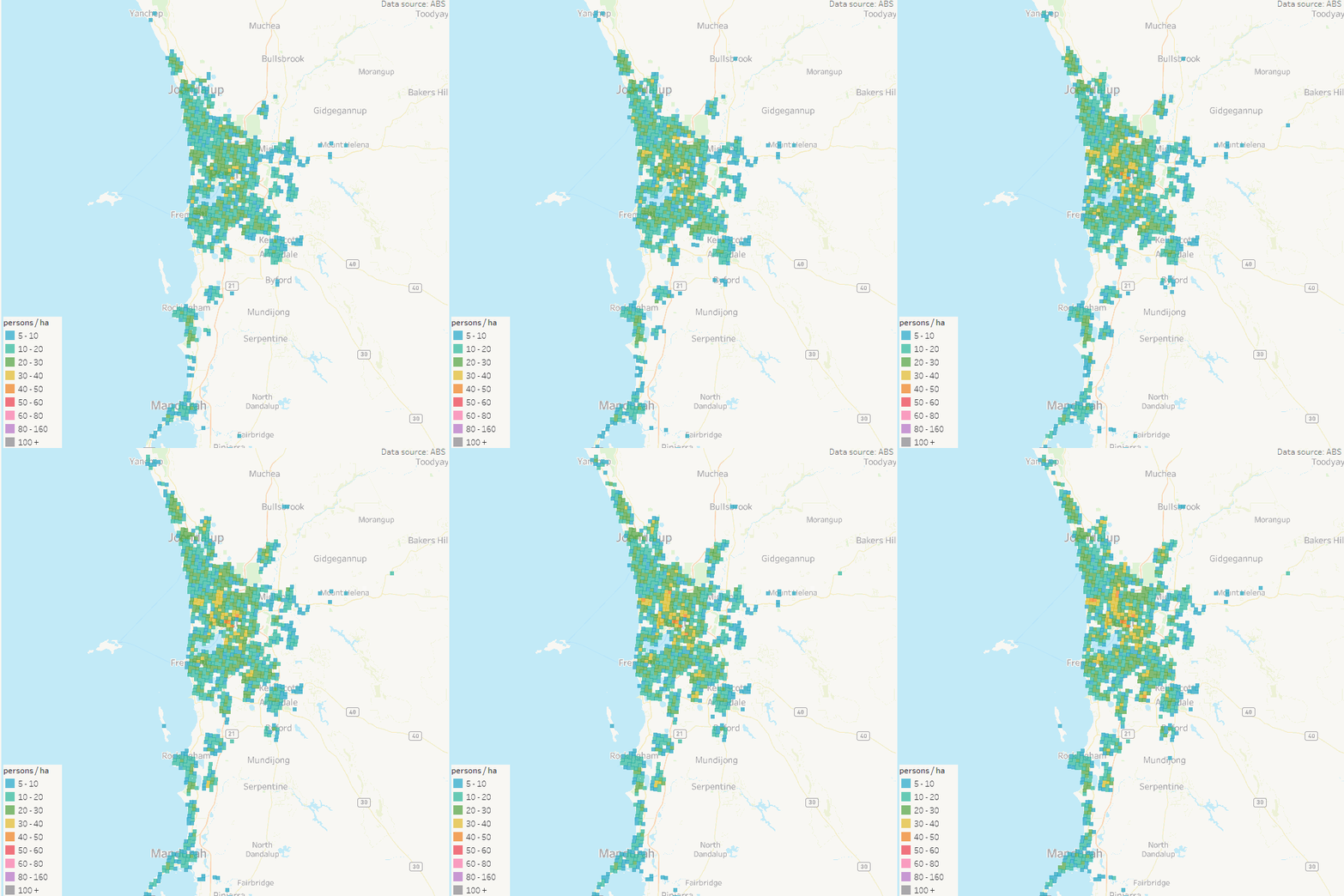
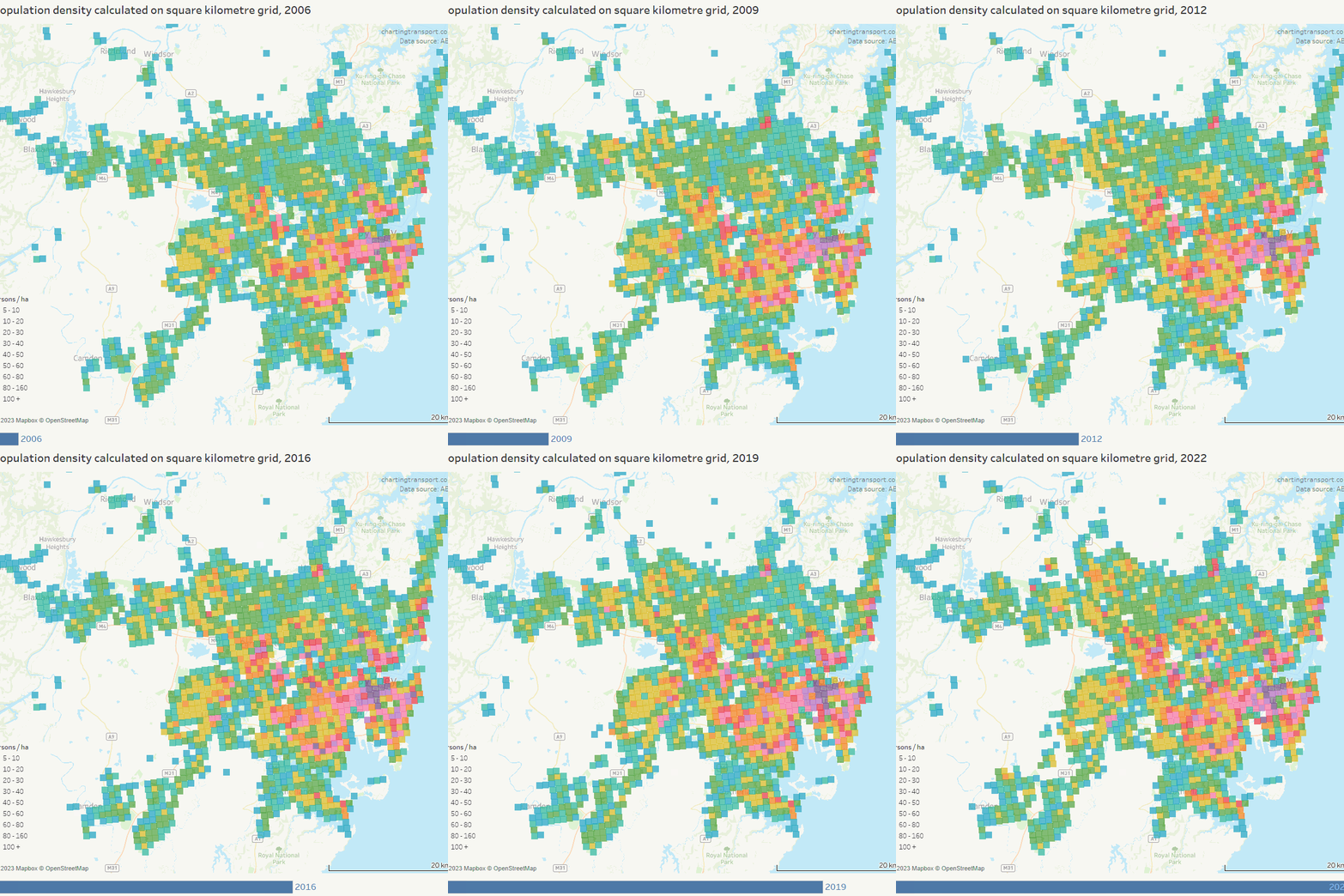
Animated density maps of Australian cities

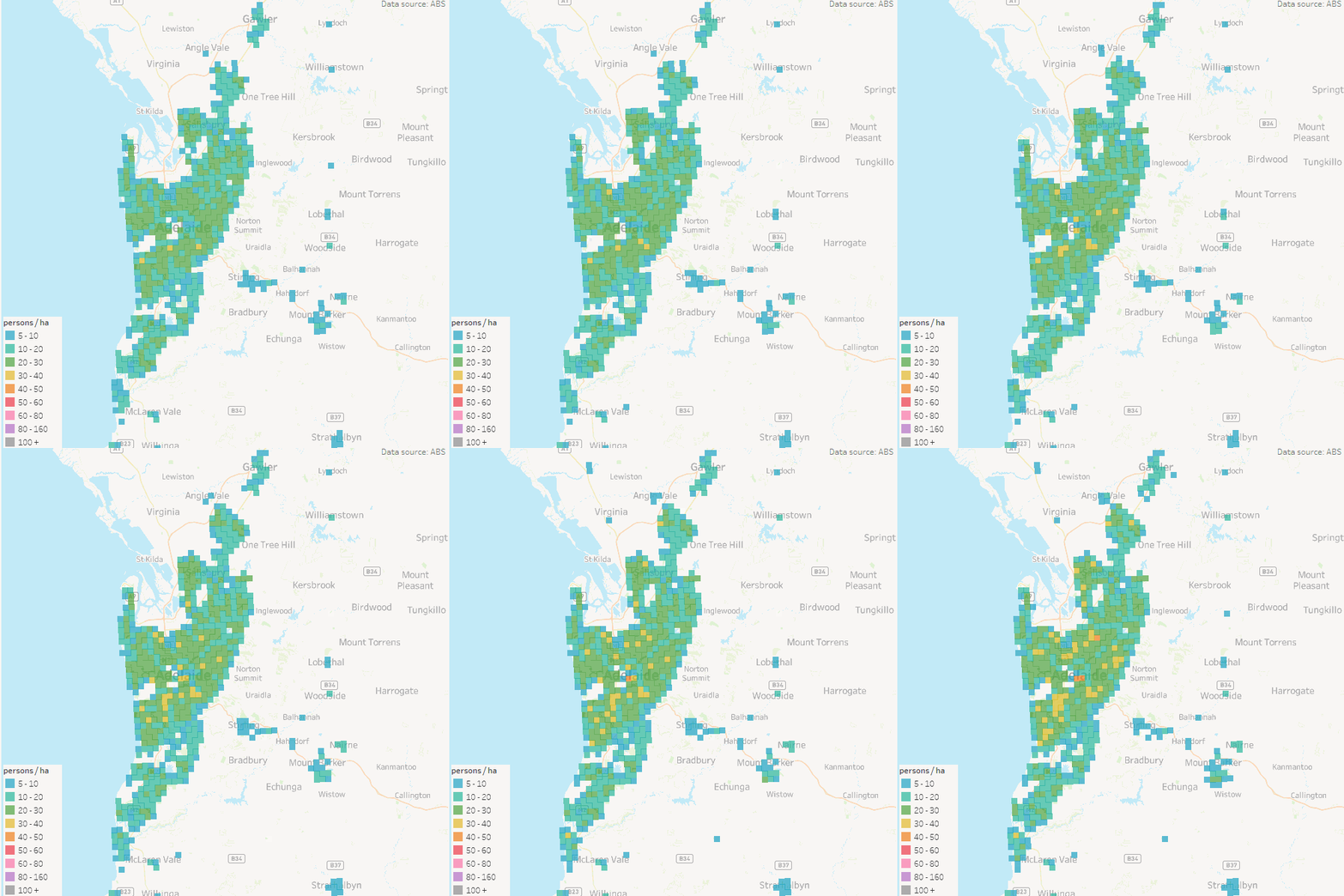
Here are some animated density maps for Australia’s six largest cities from 2006 to 2022 for you to ponder.

Some things to watch for:

  • Limited urban sprawl and significant densification of pockets of established areas in Canberra
  • Much larger areas of higher density in Sydney and Melbourne
  • Relatively high densities in some urban growth areas in Melbourne, Brisbane, and Sydney from the late 2010s
  • Low density sprawl in Perth, but also densification of some inner suburban areas (along the Scarborough Beach Road and Wanneroo Road corridors, and inner suburbs like Subiaco and North Perth)
  • Limited urban sprawl in Adelaide, along with densification of inner suburbs

Appendix: Corrections to ABS population estimates following Census 2021

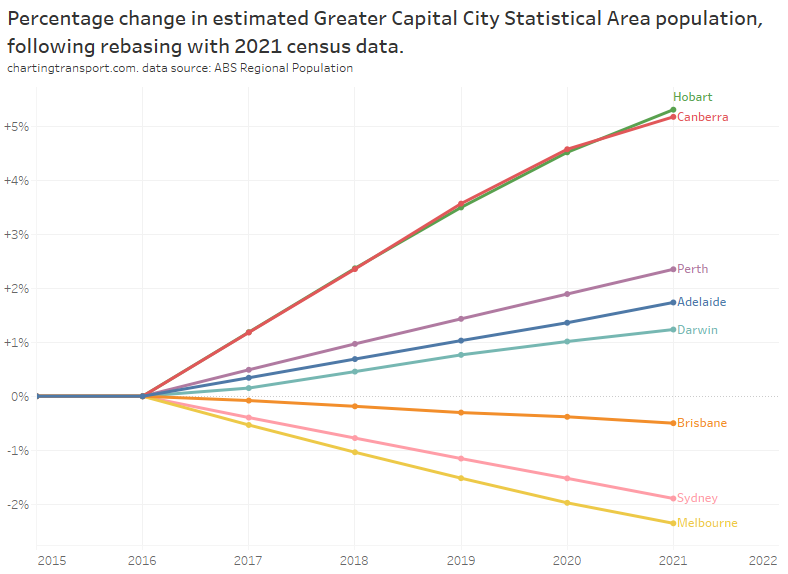
The 2021 census resulted in quite large revisions to estimated population in many cities as shown in the following chart.

Melbourne’s estimated 2021 population was revised down 2.4%, Sydney down 1.9%, while Canberra and Hobart were revised up more than 5%. To be fair to the ABS, the pandemic and border closures were unprecedented and their impacts on regional population were not easy to predict.

These corrections sum to a linear trend between 2016 and 2021 at the city level, although there was a redistribution of the estimated population within each city.

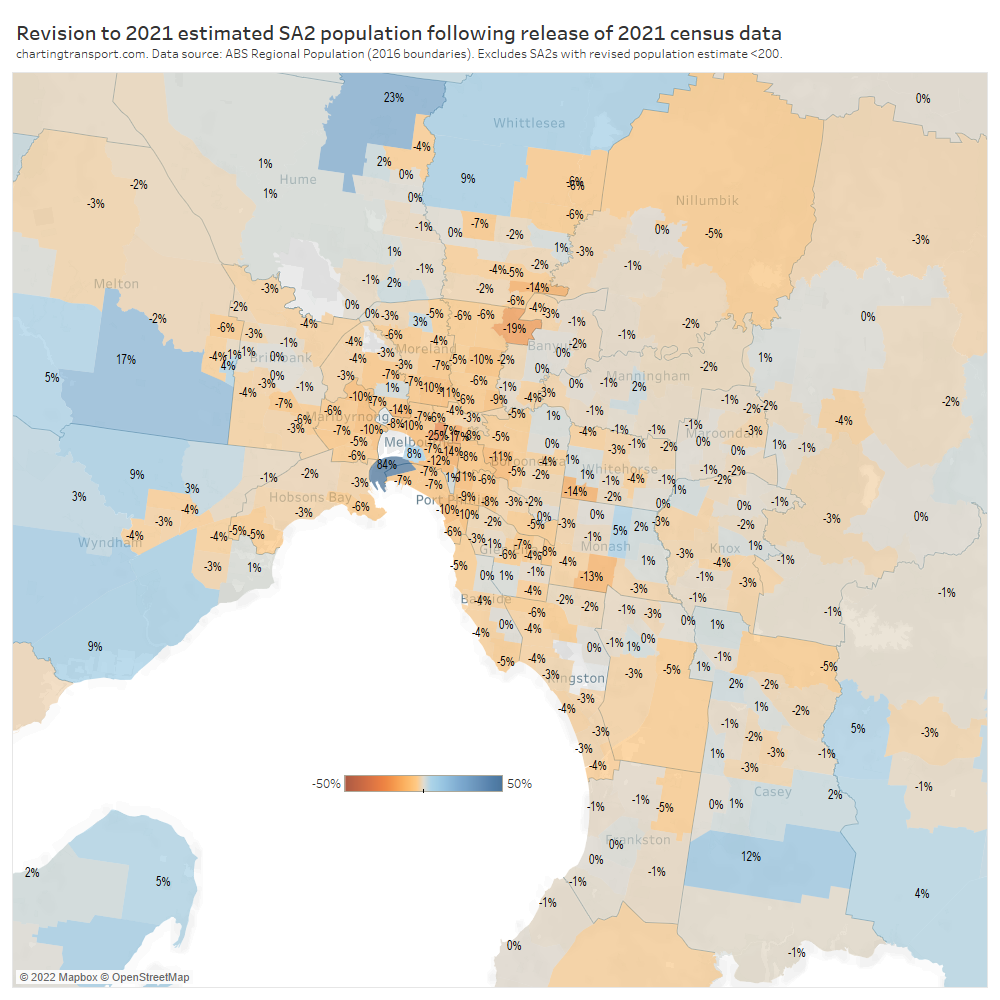
The following chart shows some detail of estimated population revisions at SA2 level for Melbourne in 2021:

The biggest reduction was in Carlton (-25% right next to University of Melbourne), and there were also reductions near other university campuses, including Kingsbury (-19%), Burwood (-14%) and Clayton (-13%). The biggest upwards revision was Fishermans Bend (+84%), and there were plenty of upwards revisions in outer urban growth areas.

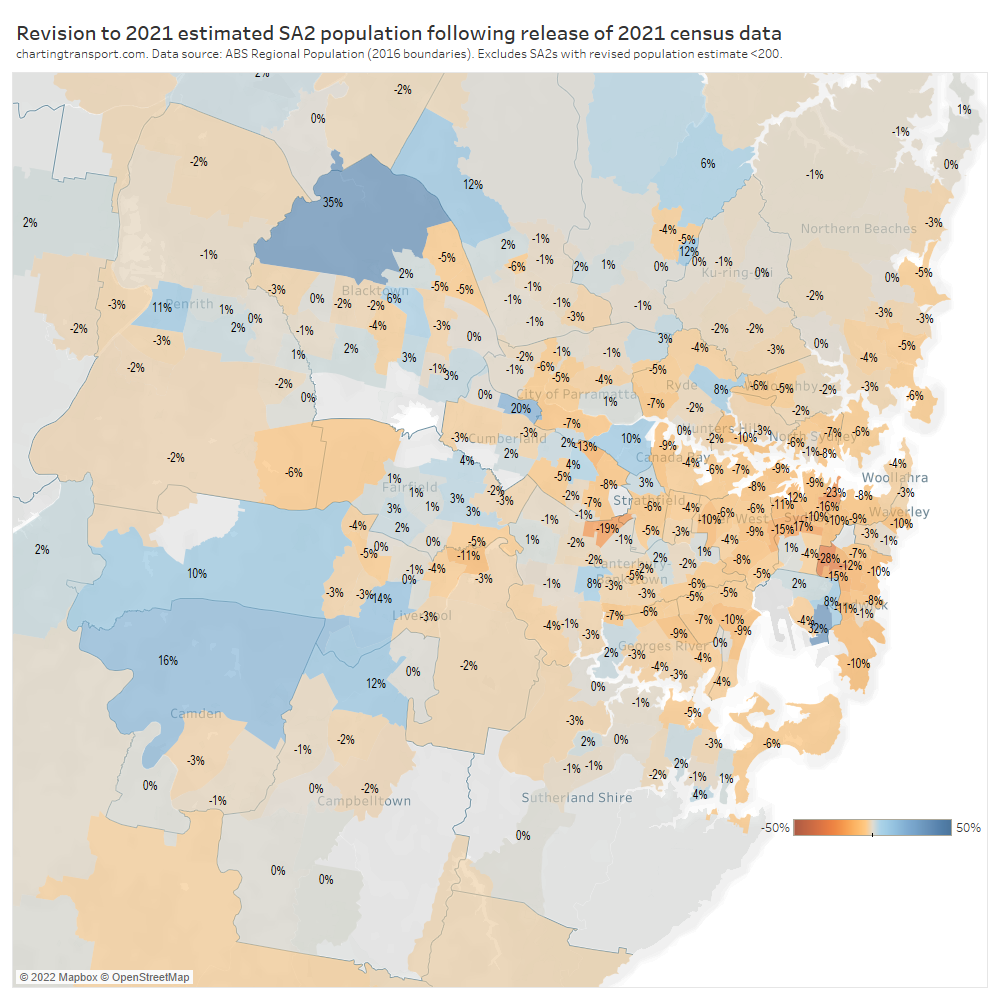
And here is Sydney:

There were big reductions in Kensington (-28%, centred on UNSW), Redfern-Chippendale (-17%), many other areas near university campuses, and around the Sydney CBD.

Like Melbourne, urban growth areas on the fringe were revised upwards, including +35% in Riverstone-Marden Park.


How did Perth’s CBD end up with 19% more private transport commuters in 2021?

Sat 3 June, 2023

Note: Since publishing this post, it has come to my attention that Perth’s Fremantle train line was closed on census day in 2021, which may have impacted mode shares in Perth.

ABS census data tells us that Perth’s CBD experienced a massive 19% jump in the number of private transport commuter trips between 2016 and 2021. That’s over 5000 more journeys – mostly as car drivers – and is quite likely to have made traffic congestion worse.

So how did that happen? Where were these extra commuters travelling to? Were there particular changes in the modal mix in different parts of the CBD? Was this growth enabled by a big increase in car parking capacity? And what has been happening to car park pricing?

This post digs a little deeper following my last post that explored the impact of COVID on journey to mode shares in Australian cities in 2021.

A quick recap of overall changes in journey to work in the Perth CBD

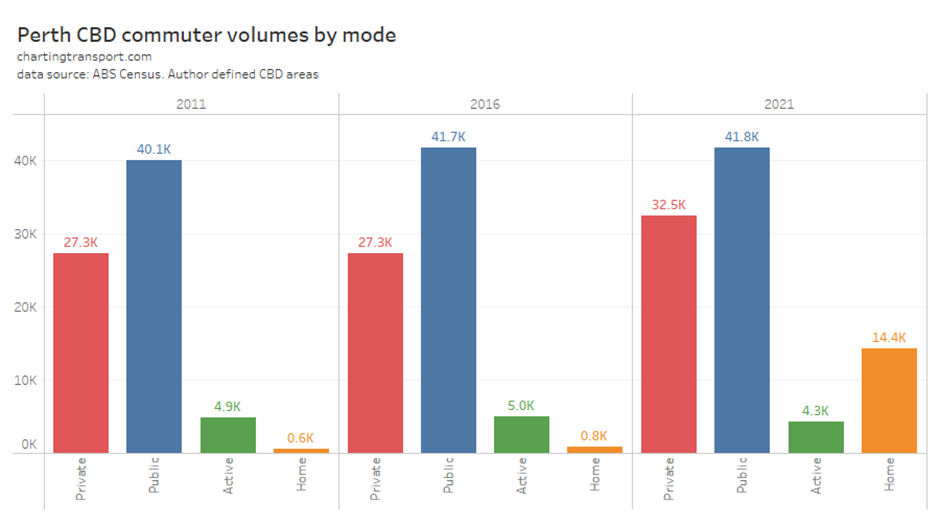
Here’s the volume of Perth CBD commuters by main mode, including working at home in 2011, 2016, and 2021:

See my last post for my definition of the Perth CBD. A trip involving any public transport is classed as public, a trip that involves only walking or cycling is classed as active, and any other form of travel is classed as private.

At the 2021 census, Perth was COVID-free with relatively few restrictions on intra-state movement or activity.

Total employment in the CBD grew by a massive 26% from 82,214 in 2016 to 103,944 in 2021. Private transport trips increased by 19%, but because this was less growth than overall employment growth there was actually a commuter mode shift away from private transport of 1.6% (from 36.5% to 34.9%).

The biggest increase in CBD worker volumes was in those who worked at home.

Public transport commuting to the CBD increased by only 85 trips between 2016 and 2021, but still accounted for more trips than private transport.

LATE EDIT: It’s just come to my attention that the Fremantle train line was closed on the day of the 2021 census (10 August), which will have suppressed public transport mode share in the western suburbs.

My last post concluded there was likely a significant mode shift from public transport to remote working. There was some mode shift away from public transport and towards remote working and private transport for some middle age groups, although some of this shift is likely to be a normal trend seen as people age (and become parents). I was unable to identify occupations that saw a substantial mode shift from public transport to private transport, although some occupations saw a lot more private transport growth than public transport growth.

This post now takes that analysis a bit further by looking at spatial variations in the modal mix by workplace location.

Where were the extra private transport commuters working?

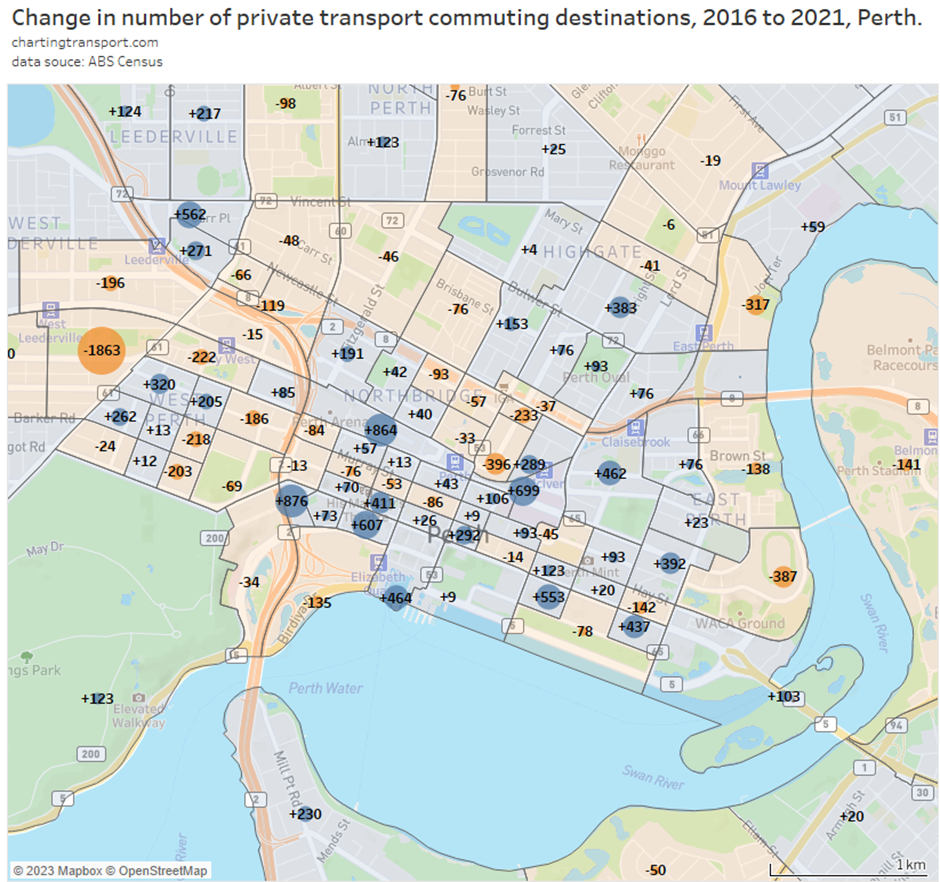
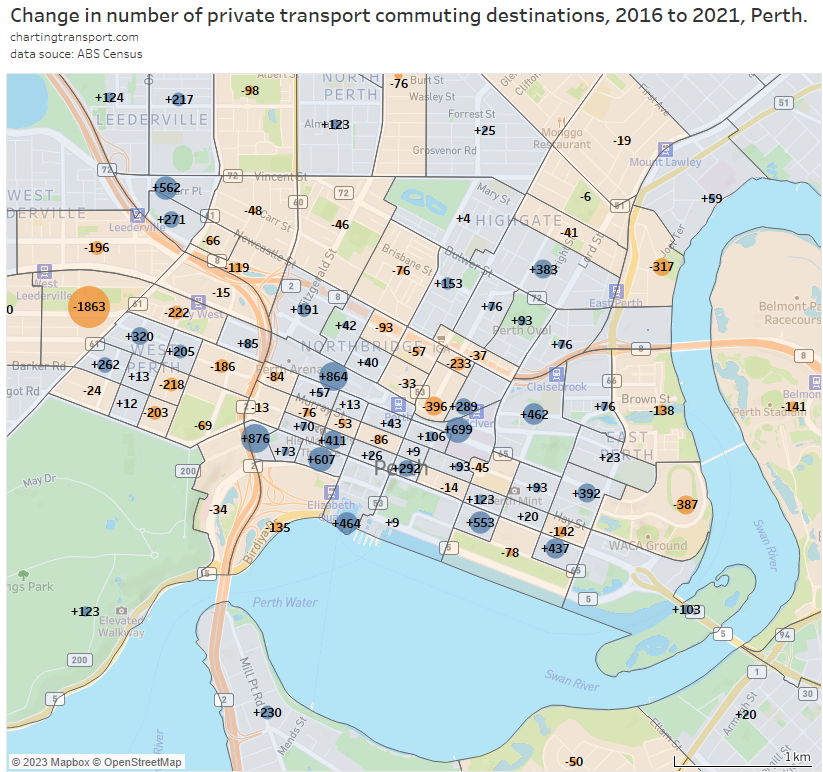
Here’s the change in private commuter trips for each destination zone around the Perth CBD:

Note: the circles aren’t always drawn in the middle of each destination zone, aren’t intended to highlight any particular location within each zone, and may not be representative of major car park locations.

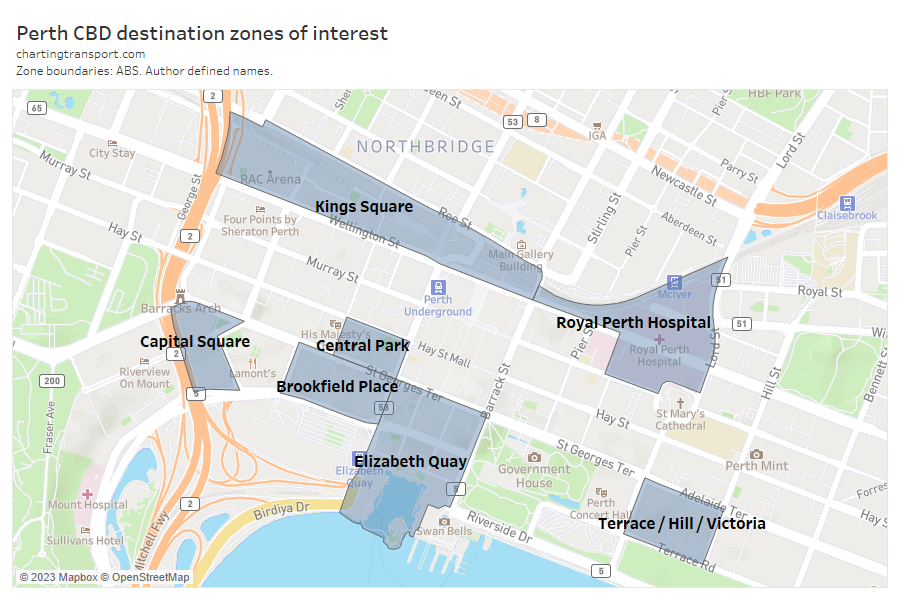
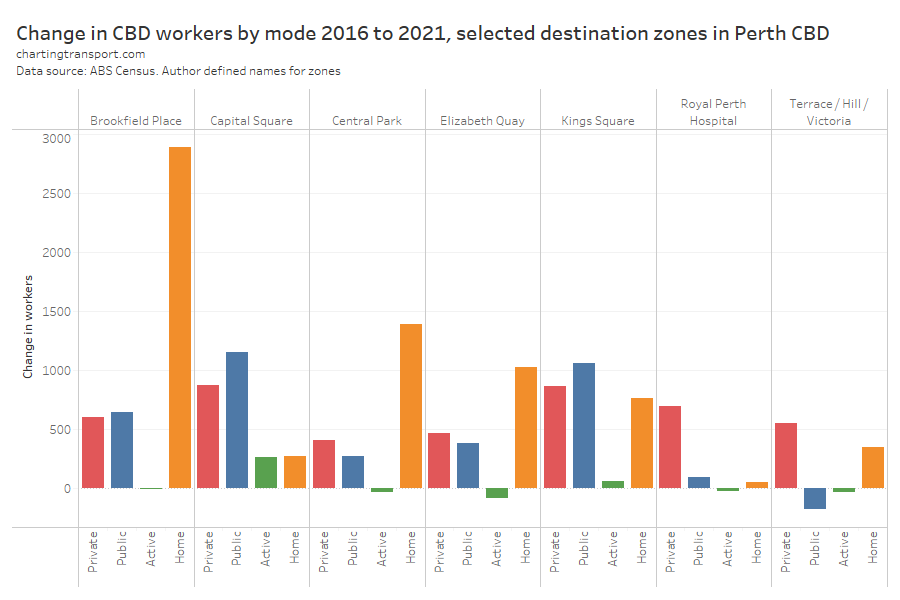
There were both increases and decreases around the CBD. I’m going to focus in more detail on the following high-growth destination zones that I’ve arbitrarily named by a dominant building, precinct, or bordering streets:

Most of the zones that saw a big increase in private transport commuter trips also saw a big increase in public transport trips.

Capital Square saw jobs more than triple between 2016 and 2021 as a major new development was completed (including the new Woodside headquarters). It had the largest increase in private transport trips, but even more new trips were by public transport. The development includes five levels of car parking on a fairly large site (at least 659 car parks according to some planning documents). It also saw the largest growth in active transport commuter trips of any destination zone in the Perth CBD.

The zone I have labelled Kings Square (which includes Perth Arena and the new Shell and HBF buildings) saw only slightly more new public transport trips than new private transport trips, despite Perth train station being inside the zone.

The Royal Perth Hospital zone had almost all of its net job growth accounted for by private transport, some of which would have been shift workers. This is consistent with my last post that found a large increase in private transport commuters under the “carers and aids” and “health and welfare support” occupation groups. The hospital is directly adjacent to McIver train station, served by multiple train lines.

One mixed-use block between Terrace Road, Victoria Avenue, Adelaide Terrace, and Hill Street had an increase in private trips and a decrease in public trips. It’s difficult to speculate why this occurred due to the diverse mix of land uses.

The Elizabeth Quay zone saw more growth in private trips than public trips, despite being immediately adjacent to Elizabeth Quay train station. I’ve not been able to identify any large new car parks in the area. Car parks immediately north of the development site were offering $25 all-day car parking at the time of writing which I suspect the average employee might not consider particularly affordable.

The Brookfield Place and Central Park zones mostly saw a big increase in the number of remote workers.

Outside the CBD, the biggest decline in private trips was -1863 in a zone near West Leederville station where the Princess Margaret Hospital for Children closed in 2018 (replaced by the Perth Children’s Hospital in Nedlands).

Where was there a shift from public to private transport?

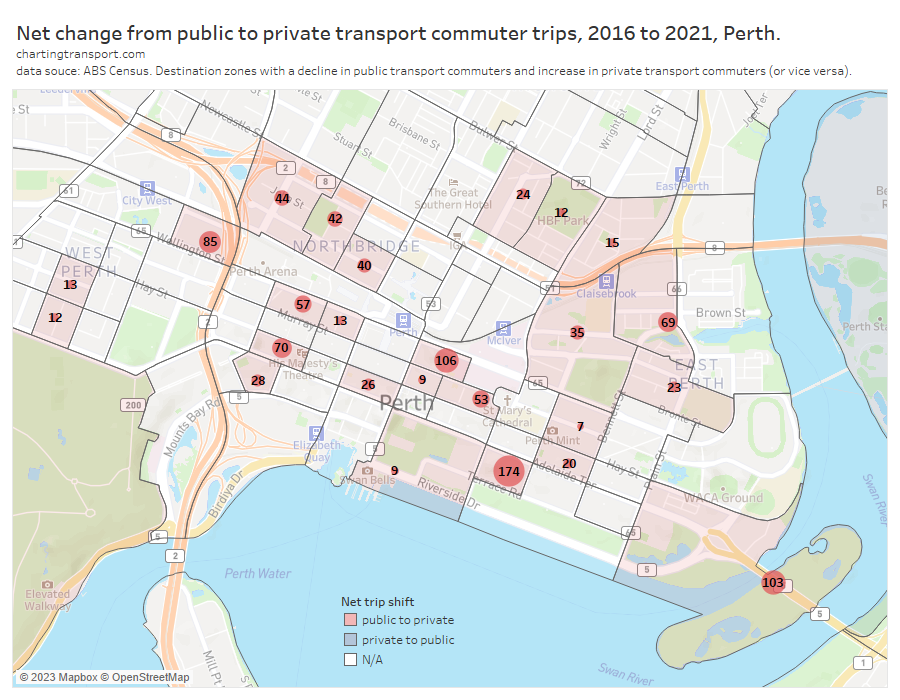
The following map shows destination zones where there was a decline in public transport trips and an increase in private transport trips (no zones showed the opposite flow):

Just under than half of the destination zones around the Perth CBD saw some sort of net shift to private transport, and most of these were very small numbers. In total these zones account for 492 trips within for my definition of the Perth CBD, about 0.5% of all workers. A net shift from public transport explains less than 10% of the total increase in private transport commuter trips.

This is consistent with analysis in my last post (which disaggregated by birth cohorts and occupations) and again suggests the growth in private trips was broadly in line with the overall growth in CBD employment. It also fits with the hypothesis that the biggest mode shift was from public transport to remote working.

Another way of analysing mode shift is to look the percentage change in private transport mode share by zone:

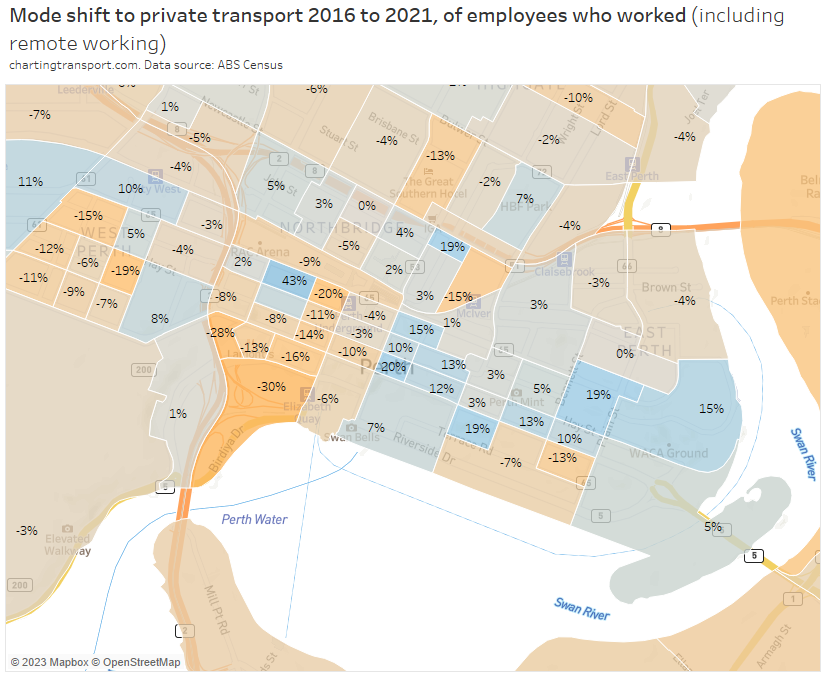
In the western part of the main CBD area there were many zones with a large mode shift away from private transport, and many of these zones had high employment density.

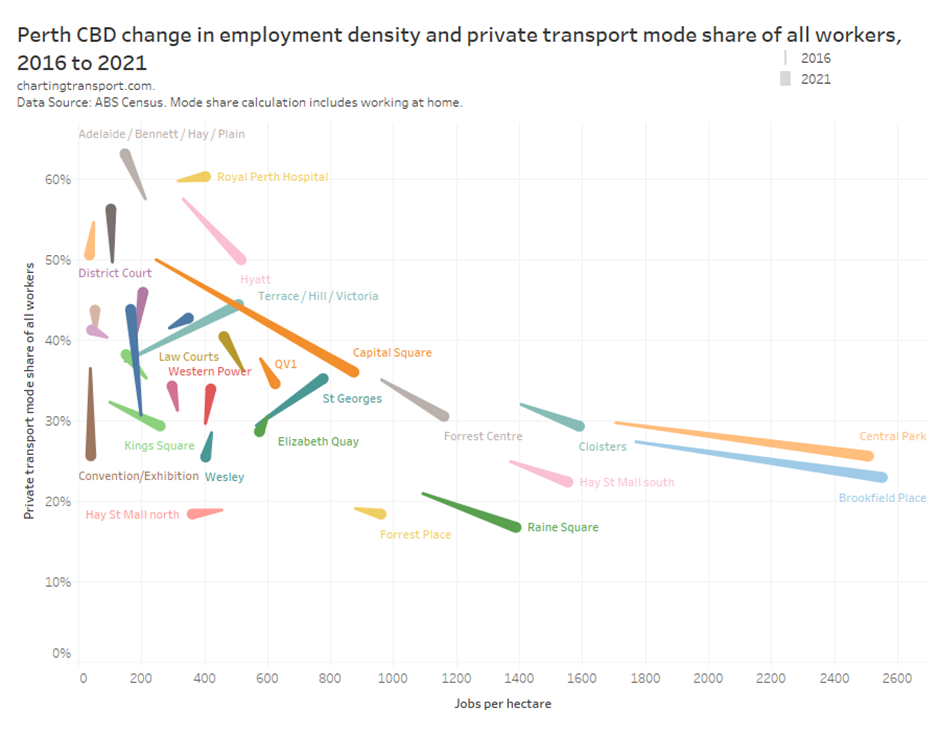
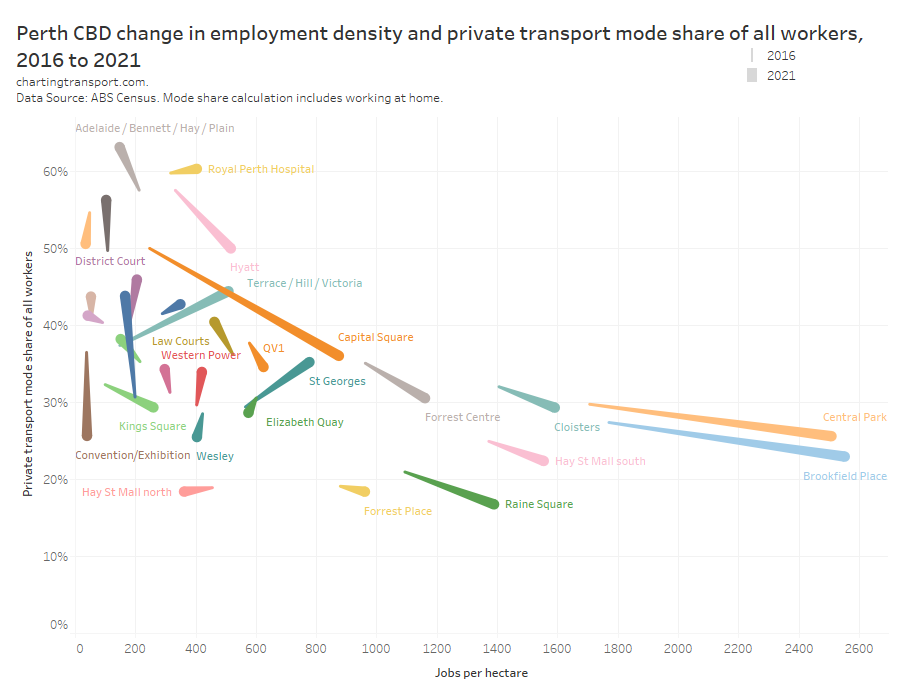
In fact, the next chart shows how employment density and private transport mode share changed between 2016 and 2021 in the Perth CBD, with the thin end of each ‘comet’ being 2016 and the thick end being 2021 (I’ve arbitrarily named several more destination zones based on major landmarks or surrounding streets).

Note: some destination zones include significant land that is not built up (eg parkland, water bodies, and/or freeway interchanges) and these will have understated employment density. This incudes Convention/Exhibition and Elizabeth Quay.

The dominant pattern is that the zones with high and increasing employment density mostly saw declining private transport mode share, although the “Terrace / Hill / Victoria” block was a standout exception having increasing employment density and increasing private mode share.

How did the CBD absorb so many more car commuters?

It’s hard to know for sure but some possible explanations include:

  • New car parking supply: I’ve already mentioned the Capital Square development that included five levels of parking. Locals might know of other new large CBD car parks, but I’ve struggled to identify any large car parks on Parkopedia or Google Maps that didn’t already exist in 2016. Many new office buildings don’t appear to include large car parks.
  • Perth was in a “mining downturn” in 2016: The Perth CBD only added 1.7k jobs between 2011 and 2016, and there was no significant increase in private commuter trips. According to a Property Council report in August 2016, Perth was experiencing very high office vacancy rates (21.8%) and had been experiencing a decline in office space demand that started around 2013. So it seems quite plausible that car parking supply grew between 2011 and 2016, but commuter parking demand only grew strongly after 2016.
  • Reduced short-term parking demand? Perhaps there has been a decline in demand for short-term parking (through the normalisation of online business meetings) enabling more all-day parking. But I’m just speculating.

Someone reading this from the parking industry might be able to share some insights (please add comments).

What’s been happening to Perth CBD car parking prices?

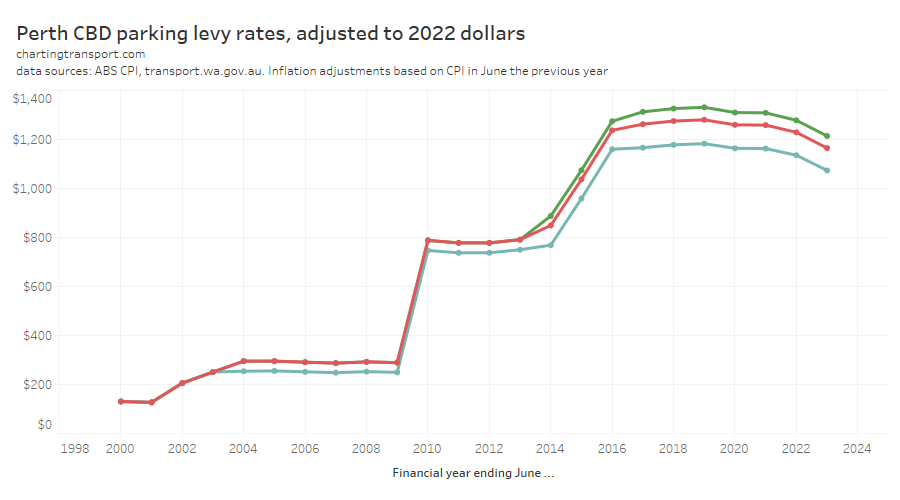
Like Sydney and Melbourne, Perth has a CBD parking levy – an annual fee collected by government per space. Here’s what’s been happening to the levy prices in real terms:

The parking levy increased substantially in real terms in 2010 and again between 2014-2016, but in recent years has not been keeping up with inflation. Between 2016 and 2021 there was almost no real change in the levy.

So what’s been happening to car park prices?

The City of Perth itself operates a large number of CBD car parks and in 2021/22 parking revenue accounted for 36% of its total income (source: budget 2022-23).

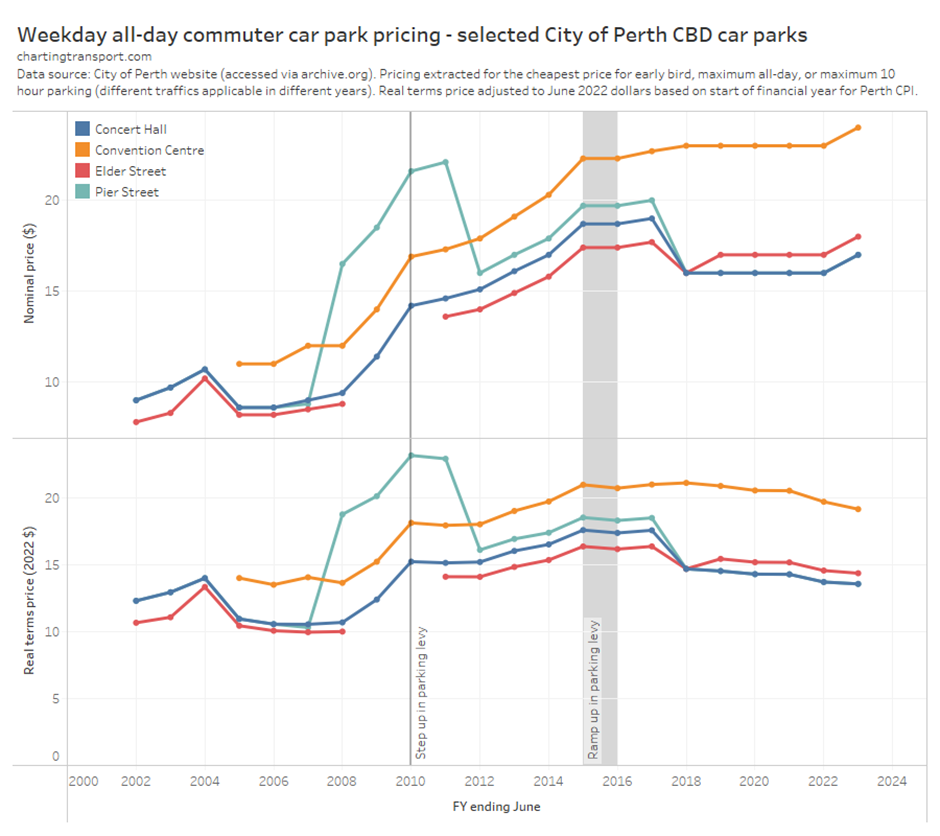
Thanks to the incredible resource that is the Wayback Machine, I’ve been able to dig out prices at their CBD car parks right back to 2001-02. For the sake of manageable analysis I’ve focussed on four relatively large central CBD car parks – Concert Hall (399 spaces), Convention Centre (1428 spaces), Elder Street (1052 spaces) and Pier Street (680 spaces). Here’s how those prices have changed over time, in nominal and real terms:

The 2010 and 2015 jumps in the pricing levy were clearly reflected in retail parking prices.

In real terms, parking prices peaked around 2015-2017 and have been in decline since then. Prices for several car parks were cut substantially in 2017/18 – perhaps as a belated response to a reduction in office commuter demand during the mining downturn. Then parking prices were frozen from 2019 to 2022 – presumably due to the pandemic.

So despite the massive increase in CBD parking demand, the City of Perth reduced – rather than increased – all-day parking prices, and so has probably also missed out on significant additional revenue. This has arguably helped facilitate the big increase in commuter traffic volumes, along with the likely associated urban amenity impacts of more traffic in the CBD.

The City of Perth is a democratic local government so it’s probably not going to behave in an entirely economically rational way when it comes to price setting. Prices are also locked in for each financial year so are much less dynamic. So what have commercial parking operators been doing?

Unfortunately I’ve not been able to use the Internet Archive to find historical commercial car parking prices in the Perth CBD back to 2016. What I can tell you is that “flexi” online parking at the Wilson Parking run Central Park car park has risen from $19 in October 2021 to $26 in May 2023 – suggesting commercial operators are not afraid to change their pricing. That said, the Kings Complex car park (517 Hay Street, near Pier Street) has had no increase in its online daily rate between October 2021 and May 2023 ($18).

So what is Perth’s parking policy?

The current Perth parking policy (2014) states:

“This policy recognises that vehicular access to, from and within central Perth is a critical element in ensuring its continued economic and social viability. It also continues to recognise the need to preserve and enhance the city’s environment. The policy aims to address these needs by supporting the provision of a balanced transport network in order to manage congestion and provide for the efficient operation of the transport network to, from and within the city centre.”

I suspect the term “balanced transport” is indicative of not trying to shift travel towards more sustainable, non-car modes. And I guess it would also be hard for the City of Perth to start discouraging something that generates more than one third of its annual revenue. Although an increase in prices might increase revenue, even if it reduces demand.

Furthermore, the Western Australian government is also continuing to widen Perth’s freeways, in the hope this might reduce traffic congestion. I’m not sure many cities have succeeded with such strategies, but good luck Perth!

Finally…

Wasn’t Perth public transport patronage below pre-pandemic levels in 2021?

I noted above that there were just 85 additional public transport commuters to Perth’s CBD in 2021 compared to 2016. But Perth’s overall public transport patronage in August 2021 was around 22%* below that in August 2016. If the number of CBD public transport commuters didn’t decline, the overall patronage decline must represent a mode shift away from public transport for trips to other destinations and/or for purposes other than travelling to work (and/or a decline in the number of such trips made by any mode).

*August 2016 had one more school weekday and one fewer Sunday than August 2021 which means we cannot directly compare total monthly patronage of the two months but they will be fairly close. It would be much cleaner to compare average school weekday patronage figures between months and years, but unfortunately few agencies publish such numbers (Victoria does now).