Which Australian city is sprawling the most?

Sat 3 December, 2016

[Updated May 2019 with June 2018 population estimates and new data on components of population growth]

For a while now, I’ve been tracking urban sprawl and consolidation in Melbourne, but some interesting research prompted me to compare Melbourne to the other large Australian cities.

My question for this post: How do Australian cities compare for growing out versus up? (and by growth I’m talking about population)

Firstly, I need to define “outer” growth.

To do this, I’ve mapped the 2001, 2006, and 2011 ABS urban centre boundaries of each city. I’ve then looked at Statistical Area 3 regions within each Greater Capital City area that either saw substantial urban growth between 2001 and 2011, or were located on the fringe of the main urban area.

Here’s a map of Melbourne, with my designated “outer” areas shaded in a transparent blue:

The area in the middle is mostly shaded green – land considered by the ABS to be urban since at least 2001. There are a few yellow and orange areas (developed 2001-06 and 2006-11 respectively) that are not part the blue shaded “outer” area. The larger orange section visible in the south is mostly green wedge or industrial land, so does not represent growth of residential areas (maps for other cities below). The other yellow and orange areas are relatively small, and many have non-residential land uses.

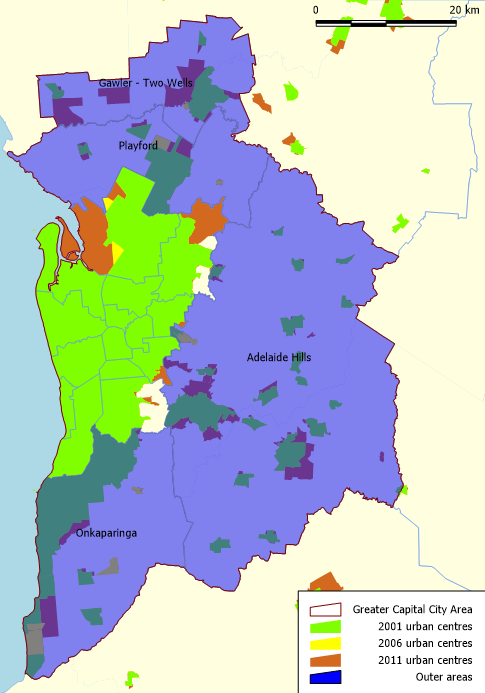
I’ve done a similar process for Sydney, Perth, Adelaide, and the conurbation of South East Queensland (i.e. Brisbane, Gold Coast, and Sunshine Coast combined). See the end of this post for equivalent maps of these cities.

With an outer area defined for each city, I have calculated the annual population growth of these outer areas (based on 30 June estimates for each year) as a proportion of total population growth in each city:

percentage outer city population growth v4

As you can see almost all recent population growth in Perth is happening in the outer suburbs (in fact there was population decline in the rest of Perth in 2015-2016), while it has been around half in Melbourne and South East Queensland, and lower in other cities, although Sydney had an uptick in 2018.

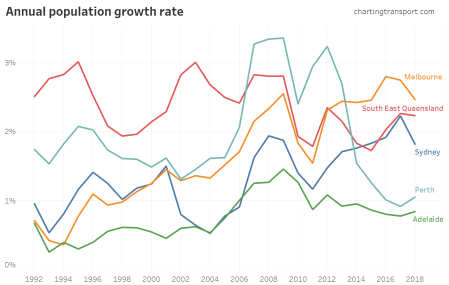
For reference, here are annual population growth rates for the five cities:
city population growth v2

Perth saw dramatic growth between 2007 and 2013, but much less growth in the last few years, and most of that happened in outer areas. In recent years Melbourne has grown the fastest.

The population data I’m using goes back to 1991, which creates some interesting results in the early nineties (even though my defined “outer” areas are trying to measure growth from 2000 onwards). In Adelaide in 1993 the outer areas had “156%” of the city’s population growth – which actually means that the outer areas grew (by 4509 people) while the inner areas had population decline (by 1617 people). At the same time in Melbourne, “103%” of population growth occurred in the outer areas as there was a net reduction of 393 people in the inner areas of Melbourne.

This reflects a previous trend for cities to grow mostly outwards until the mid-1990s, when urban densification took off. For more on this topic see How is density changing in Australian cities? (2nd edition)

So is Perth the most sprawling large city in Australia? Well, yes in terms of percentage of population growth, but not in terms of absolute population growth in outer areas:

outer city population growth v4

On my definitions of outer areas, Melbourne is charging ahead, with over 66,000 residents moving into growth areas in 2017-18. Perth peaked in 2012, but has fallen back since. Adelaide just hasn’t seen a lot of population growth in recent decades.

I’m measuring sprawl by population, but you could argue that it might be better measured by urbanised area. Unfortunately that is tricky because definitions of urbanised area have changed over time and occasionally have large jumps as non-urban wedges are absorbed.

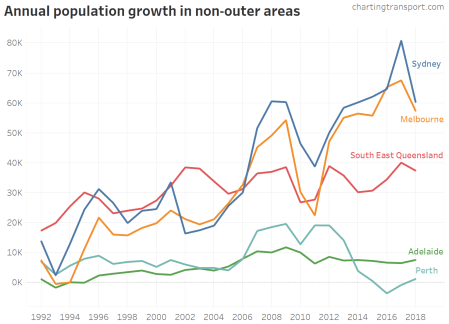
Population growth in outer Sydney slowed dramatically between 2002 and 2006. The chart below shows there was also a slow down in non-outer areas, although it was a little less dramatic. Around this time Sydney also transitioned from around 50% of growth being in outer areas, down to around 30%.

Here is the annual population growth in the non-outer areas of each city:
nonouter city population growth v4

Around 2007 there was an acceleration of population growth in non-outer areas in most cities (although there was a subsequent lull around 2010-2012). In 2015-16 in Perth, the population of the non-outer areas decreased by an estimated 3524 people.

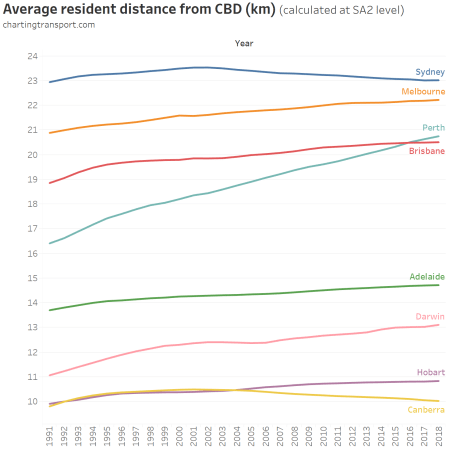
Another measure of sprawl is the average distance of residents from the city centre. Here are rough calculations for Greater Capital City areas using SA2 data (it would probably be unfair to measure all of South East Queensland against the Brisbane CBD):
Average resident distance from CBD on SA2

On this measure Perth is sprawling the fastest, with the average resident in 2018 being roughly 21 km from the CBD, up from just over 16 km in 1991. Sydney and Canberra have seen a reduction in average distance from the CBD, as inner areas become more dense.

A couple of things to note:

  • The outer areas will have some combination of urban growth and urban densification. My guess is that most population growth will be from urban sprawl, as urban consolidation is more likely to happen in the inner and middle suburbs. But my method doesn’t attempt to remove urban consolidation in outer areas.
  • You might be wondering about the inclusion of outer areas that are not experiencing urban growth. These areas are unlikely to have much population growth at all, so will have little impact on the calculations of percentage of growth in outer areas.

That said, I’ve also done a more fine grained analysis of outer growth areas using census data without these issues. See: Are Australian cities sprawling with low-density car-dependent suburbs?

Where did the new residents come from?

The ABS now publishes the components of population growth down to SA2 geography for 2016-17 onwards, so we can dig a little deeper.

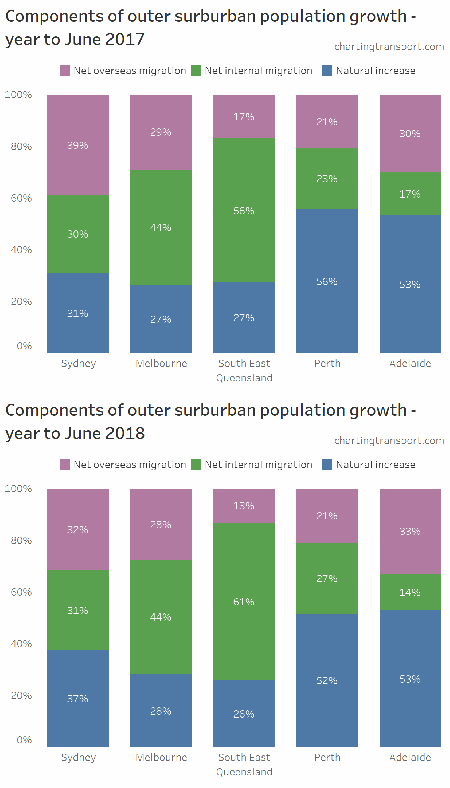
Here are the components of outer suburban population growth in 2016-17 and 2017-18 (animated):
Components of city outer population growth

Internal migration refers to people moving to/from other parts of Australia (possibly including other parts of the city)

In Perth and Adelaide, less than half of the outer suburbs population growth was from new residents, whereas it was more like 72% in the other three urban centres. This might reflect relatively slower outer urban growth in Perth and Adelaide – with population growth coming more from existing residents growing families rather than new residents moving in.

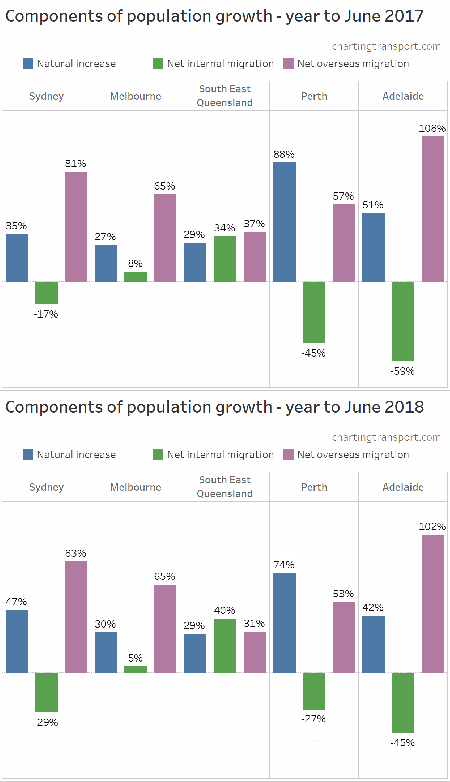
Here are the components of population growth for the five urban centres as a whole:
Components of city population growth

Sydney, Perth, and Adelaide have seen existing residents leave for other parts of Australia, replaced with births and international migrants.

Here’s the same for the non-outer suburbs:
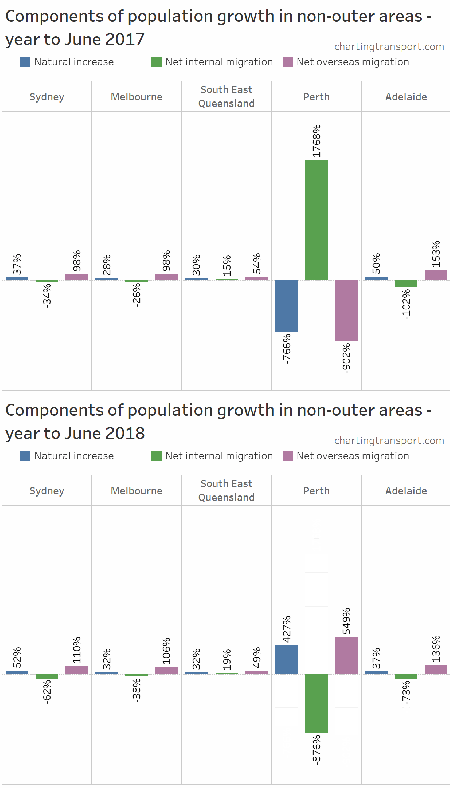
Components of city nonouter population growth

The three columns for each city do actually add to 100%. In Perth the net of the components was very little population change, so each component becomes a very large percentage of the small net total population change.

That chart is quite confusing, so instead let’s look at the underlying numbers:
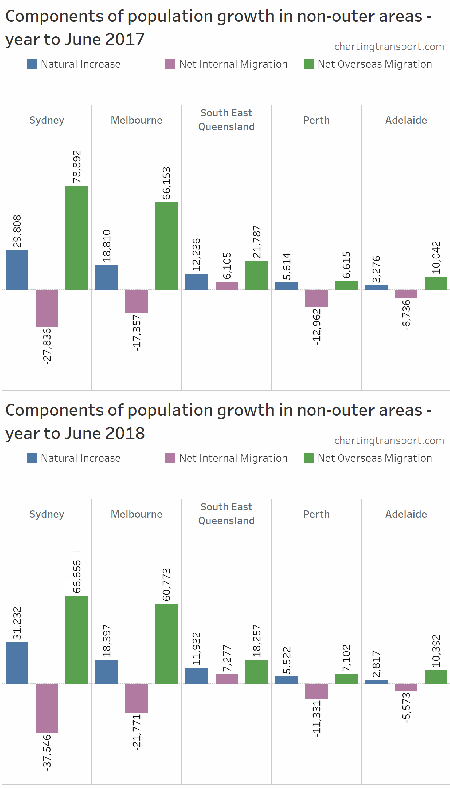
Components of city nonouter population growth quantity

In Melbourne and Sydney, the net increase from births/deaths in non-outer areas was effectively cancelled out by people migrating away domestically (many likely to the outer suburbs of the same city), with the net population growth then mostly accounted for by net overseas immigration.

The only urban area where the existing non-outer area didn’t see net outbound domestic migration was South East Queensland.

For further analysis on the components of population growth, see Visualising the components of population change in Australia

Some non-Australian readers might be confused by the term “overseas”. We use it interchangeably with “international” because Australia has no land borders with other countries.

Appendix – Maps showing outer areas of cities

For Melbourne refer to the top of this post.

Sydney
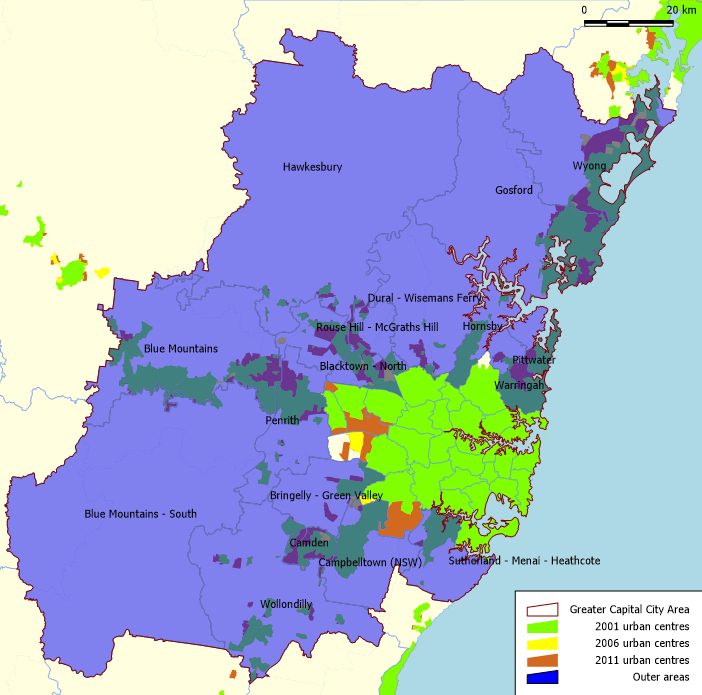
sydney-cropped

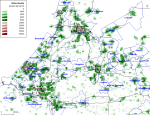
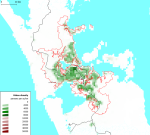
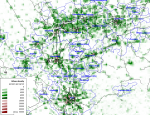
I’ve used the full Greater Capital City area, which includes the Central Coast (Gosford / Wyong). This is arguably part of a conurbation with Newcastle but I’ve kept to the Greater Sydney boundary.  The large orange and yellow non-outer area to the west is mostly parkland or industrial, while the orange area to the south is mostly the Holsworth Military area which was defined as urban from 2011.

South East Queensland
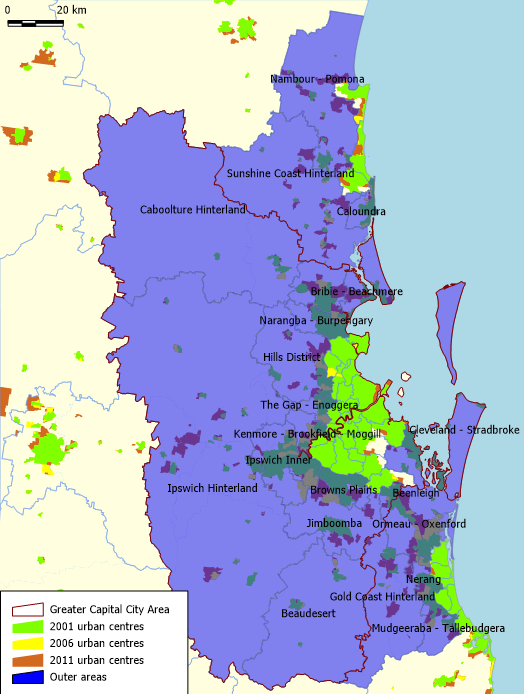
seq-cropped

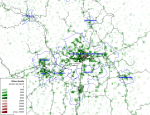
I’ve included all of Greater Brisbane, as well as the Gold Coast (as far as the border with NSW) and the Sunshine Coast. The conurbation population includes the established areas of the Gold Coast and Sunshine Coast as non-outer areas. The orange areas on the Sunshine Coast mostly contain National Parks and the airport, although it also includes the relatively new suburb of Peregian Springs, so not a perfect definition.

Perth

perth-cropped

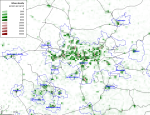
The non-outer area is fairly well-defined as almost entirely urban in 2001. The entire of the City of Joondalup (on the northern coast, mostly surrounded by Wanneroo) counts as urban in 2001, although the suburb of Iluka in the north-western corner has developed more recently, so the calculation won’t be perfect.

Adelaide
adelaide-cropped

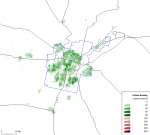
The two large orange areas in the non-outer area are non-residential, so there will be little fringe growth outside the blue area.


Are Melbourne’s suburbs full of quarter acre blocks?

Sun 22 May, 2016

A lot has been said about the great Australian dream of moving to the suburbs and living on a quarter acre block. But is Melbourne suburbia actually full of quarter acre blocks? Where are they to be found? Are they disappearing? This post delves into block sizes in Melbourne.

Where are the quarter acre blocks?

A quarter-acre translates to 1011.7 square metres in modern units, but for the purposes of this post I’ll allow some leeway and count any block between 900 and 1100 square metres. For this post I’ve also filtered out blocks in planning zones that cannot include dwellings (eg industrial areas), but that does mean I’ve included blocks in mixed use zones, commercial zones, etc. So not every block counted is residential. Also some larger blocks might contain multiple small dwellings but not actually be subdivided (eg a block of flats).

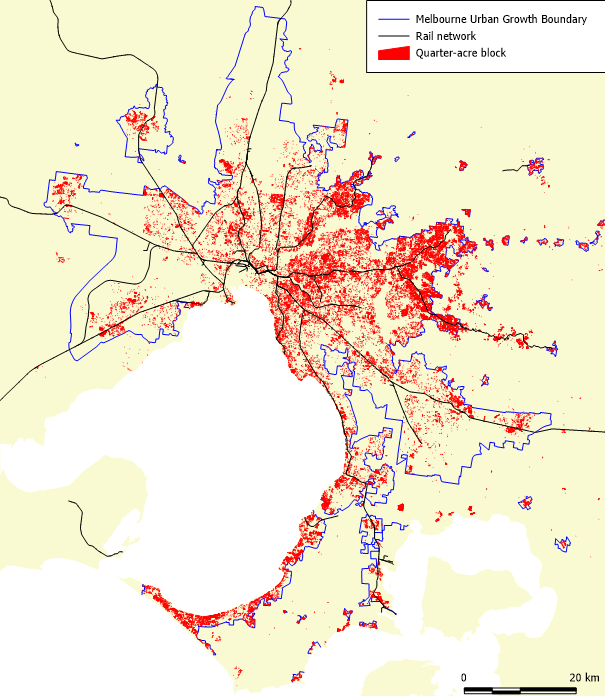
First up, here is a map of Melbourne showing the prevalence of quarter acre blocks. It looks like there are lots of them, but because the blocks are so small, the total area occupied by quarter-acre blocks is significantly over-represented on this large scale map.

Melbourne quarter acre block map

There are larger concentrations in the outer north-east and outer-east, but very few blocks in the current growth areas to the west, north and south-east.

Here are the top 20 suburbs for numbers of quarter-acre blocks:

Mooroolbark 1625
Rye 1545
Ferntree Gully 1504
Boronia 1471
Croydon 1437
Mount Martha 1430
Eltham 1229
Mount Eliza 1125
Werribee 1054
Sunbury 1035
Lilydale 996
Mornington 982
Reservoir 978
Balwyn North 936
Berwick 898
Upwey 897
Pakenham 772
Langwarrin 767
Kilsyth 732
Greensborough 724

There are almost 78,000 quarter-acre blocks within Melbourne’s Urban Growth Boundary, which sounds like a lot, but is only 3.75% of the 1.8 million blocks in my dataset.

So what are typical block sizes in Melbourne?

For this analysis I’m considering blocks within land use zones that can include dwellings, that are also within the urban growth boundary. But I’ve excluded blocks of less than 40 square metres on the assumption these are unlikely to contain dwellings.

Here’s the frequency distribution of block sizes in Melbourne:

The most common block size is 640-660 square metres, and 34.5% of blocks are between 520 and 740 square metres. The median is 540-560 square metres. 180-200 is the most common smaller block size, and there is a small spike in block sizes of 1000-1020 square metres, which includes the quarter-acre block. But quarter-acre blocks are certainly very uncommon.

I’ve calculated the median block sizes for all suburbs within Melbourne’s Urban Growth Boundary.

The inner city has median block sizes under 300 square metres, and 300-500 is typical in the inner northern and western suburbs. Block sizes are larger in the middle and outer eastern suburbs, older suburbs in the south-east, and blocks along the Mornington Peninsula. But the more recent growth areas to the west, north and south-east see median block sizes of between 400 and 500 square metres (purple), reflecting higher dwelling densities encouraged by current planning policy for growth areas. Quarter-acre blocks are the median only in places like Upwey, Belgrave and Portsea.
Inner city Carlton has the lowest median of 100-120 square metres, followed by Cremorne, North Melbourne, South Melbourne at 120-140 square metres, and then Abbotsford, Fitzroy North, Port Melbourne, Richmond, West Melbourne at 140-160 square metres. Urbanised suburbs at the other end of the scale include Park Orchards at 3020, Selby at 1440, and Warrandyte at 1260.

There are two interesting outliers in the central city: Southbank (in yellow) has a median block size of 980 square metres, and Docklands (in blue) has a median of 660 square metres. Both have been redeveloped in recent decades with many medium to high-rise apartment towers on those larger blocks.

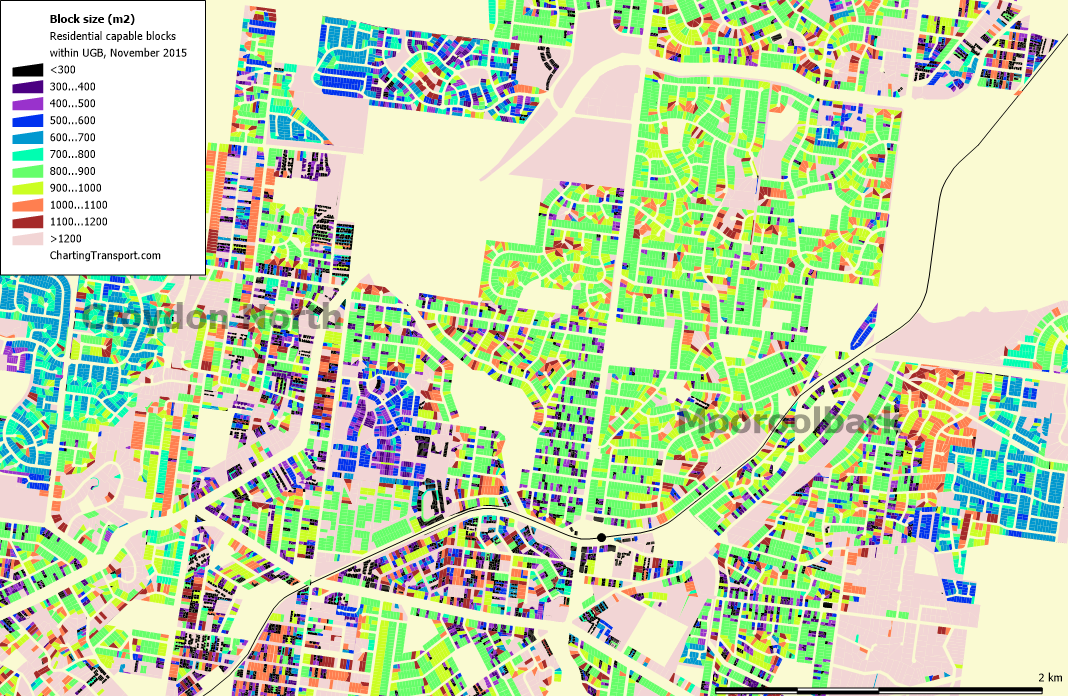
Beyond these medians, there is a lot of variation within suburbs. Let’s go for a wander around the city.

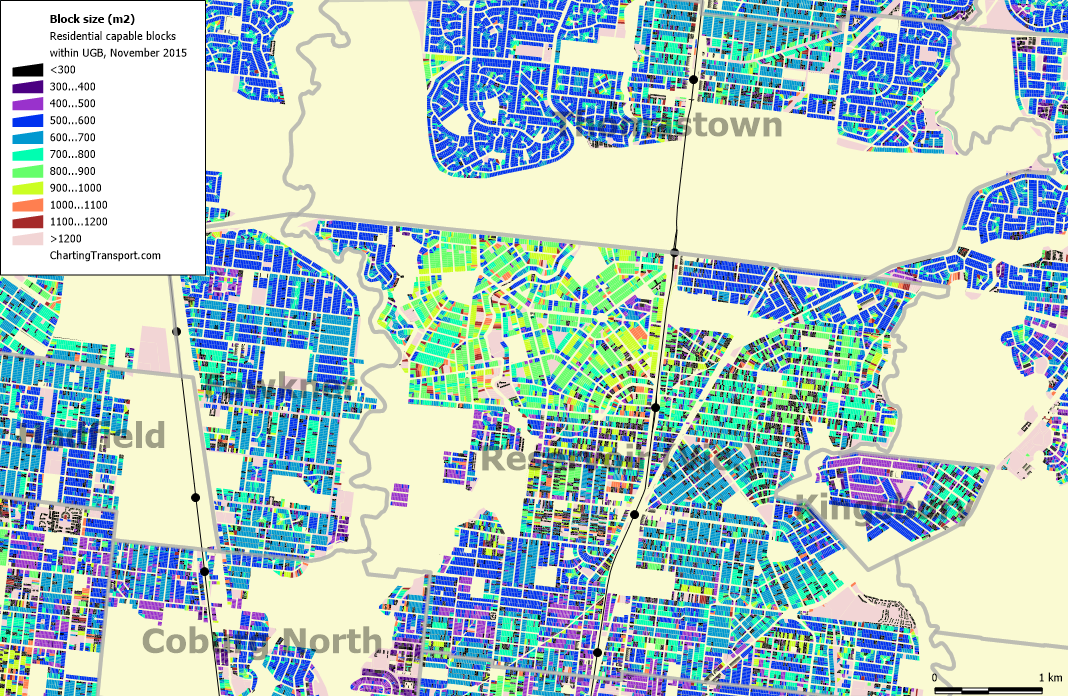
Mooroolbark has the highest count of quarter-acre blocks and a median size of 840 square metres. As well as larger blocks, you can see a lot of further subdivision, particularly close to the train line (thin black line).

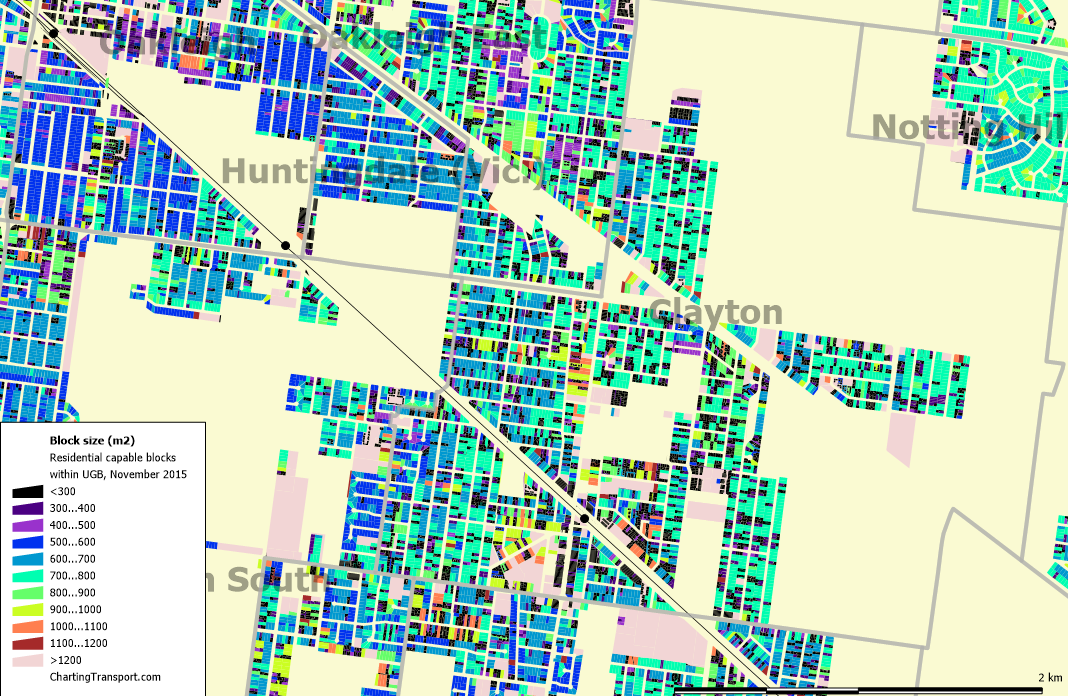
You may have noticed in the suburb map above a black coloured suburb in the middle south-eastern suburbs. That suburb is Clayton, and here is how it looks:

While blocks of 700-800 square metres were probably typical in the original subdivision, further subdivided blocks now outnumber the larger blocks, with a median of 260 square metres. Clayton of course is home to a major Monash University campus, and I suspect a lot of the smaller blocks house students.

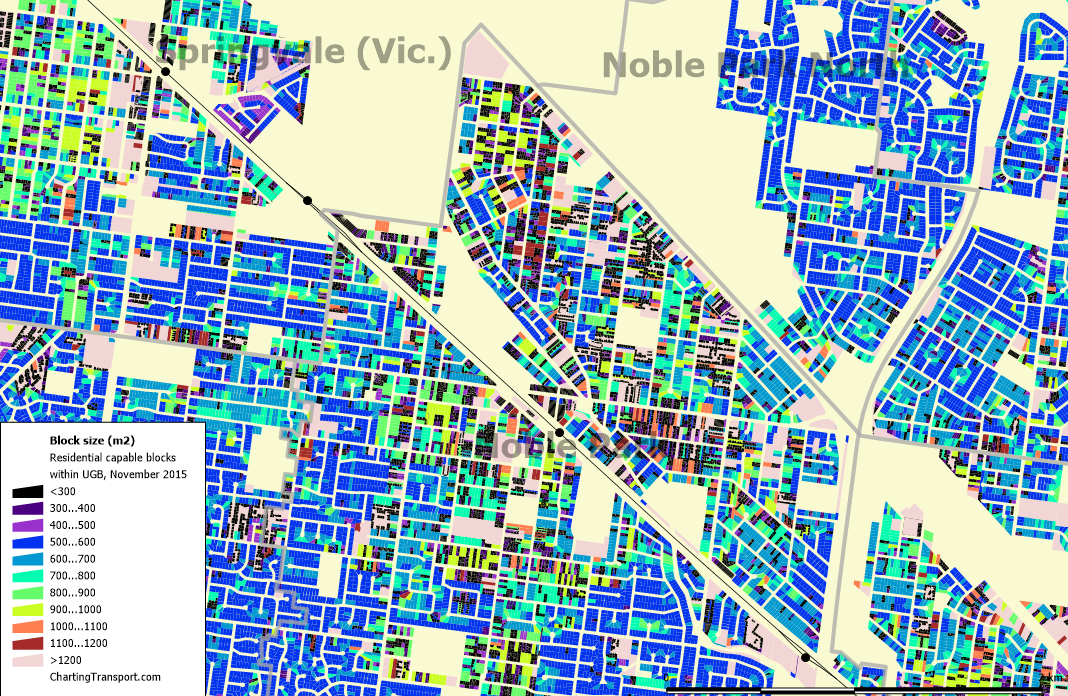
A bit further down the line in Noble Park you can see extensive further subdivision near the rail line, surrounded by almost uniform blocks of 500-600 square metres:

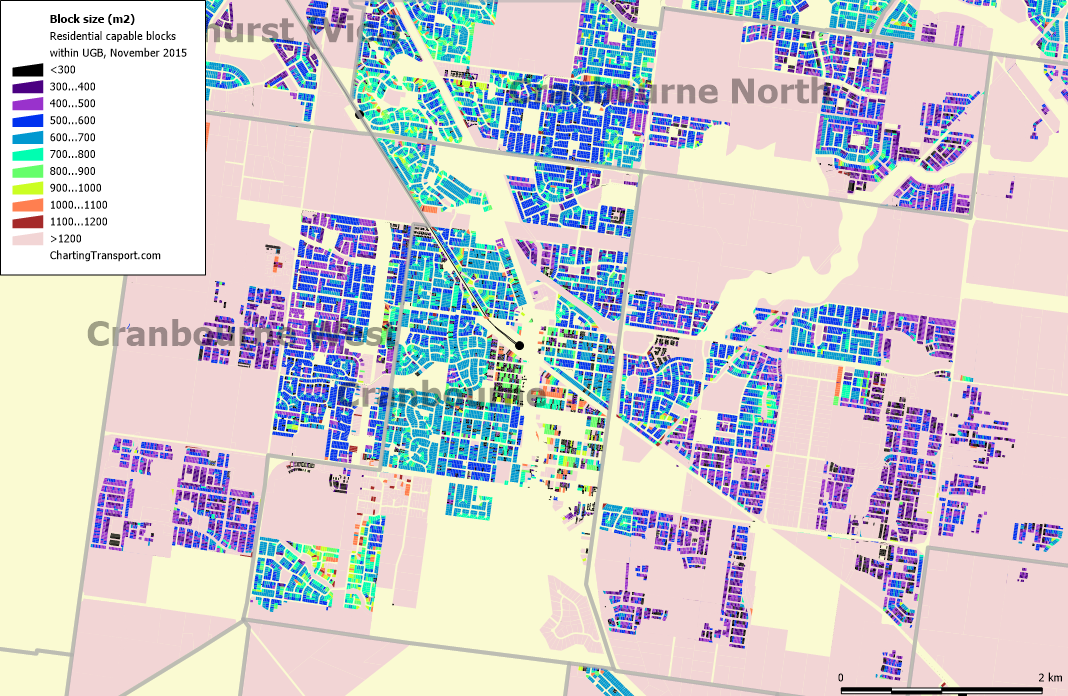
Heading further south, Cranbourne is an interesting mix. The inner core (old town) has larger blocks but lots of further subdivision. This is surrounded by many blocks of around 700-800 square metres, but the most recent development has much smaller bocks, most less than 500. It’s a bit like tree rings, with each ring of incremental urban growth reflecting the preferred new block size of the time.

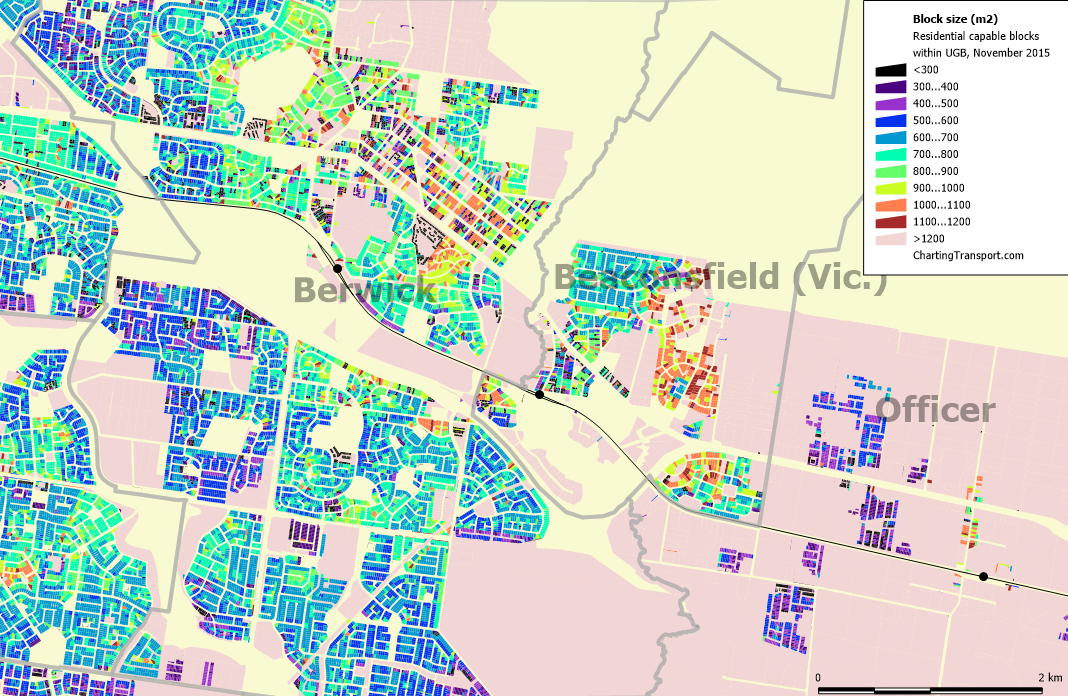
The area around Berwick also has a wide variety of block sizes, depending on the timing of development:

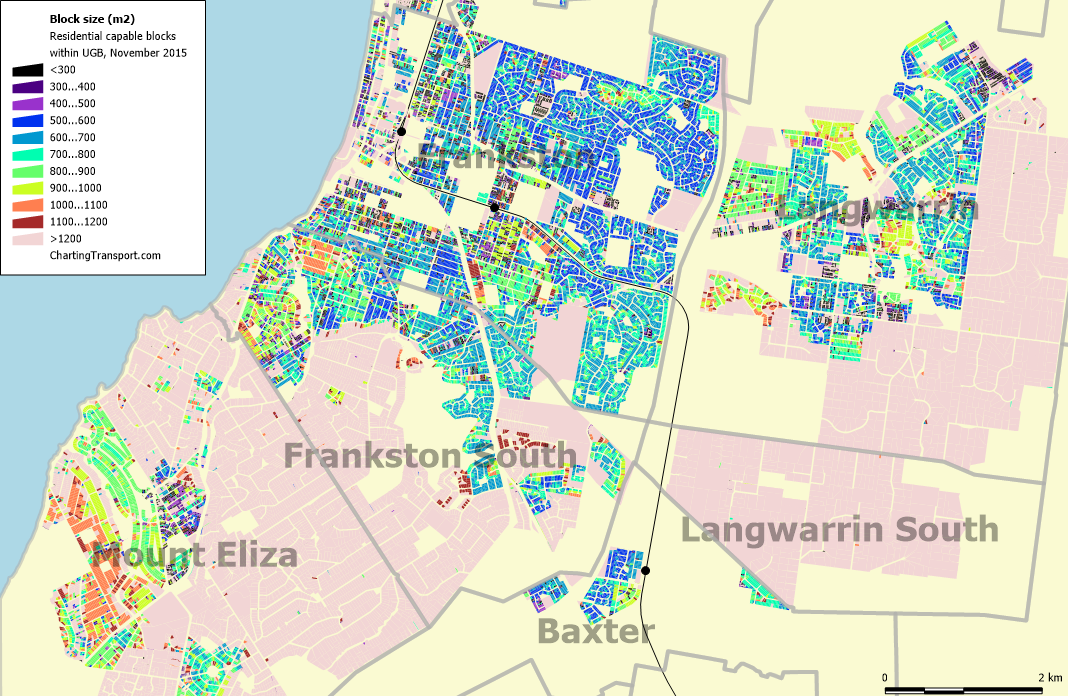
Here is the Frankston area:

Again significant further subdivision in central Frankston, a variety of block sizes in different parts of Langwarrin, and lots of large blocks in Frankston South and Mount Eliza (in some of the pink areas most blocks are over 2500 square metres).

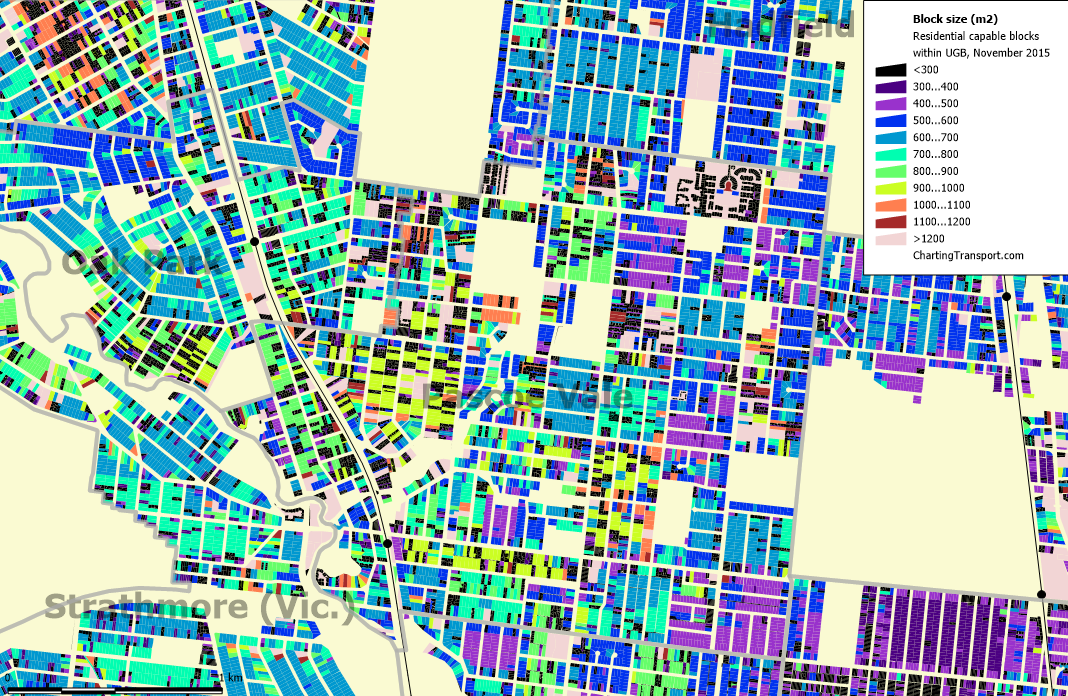
In the middle northern suburbs you can see suburbs from an era when new block sizes were relatively large, and they’ve since had extensive subdivision. Here is Pascoe Vale:

Here is Reservoir. You can see smaller blocks in the surrounding suburbs:

The large block area to the west of the train line was apparently developed around the 1960s.

And to the west St Albans is another suburb with larger blocks being subdivided:

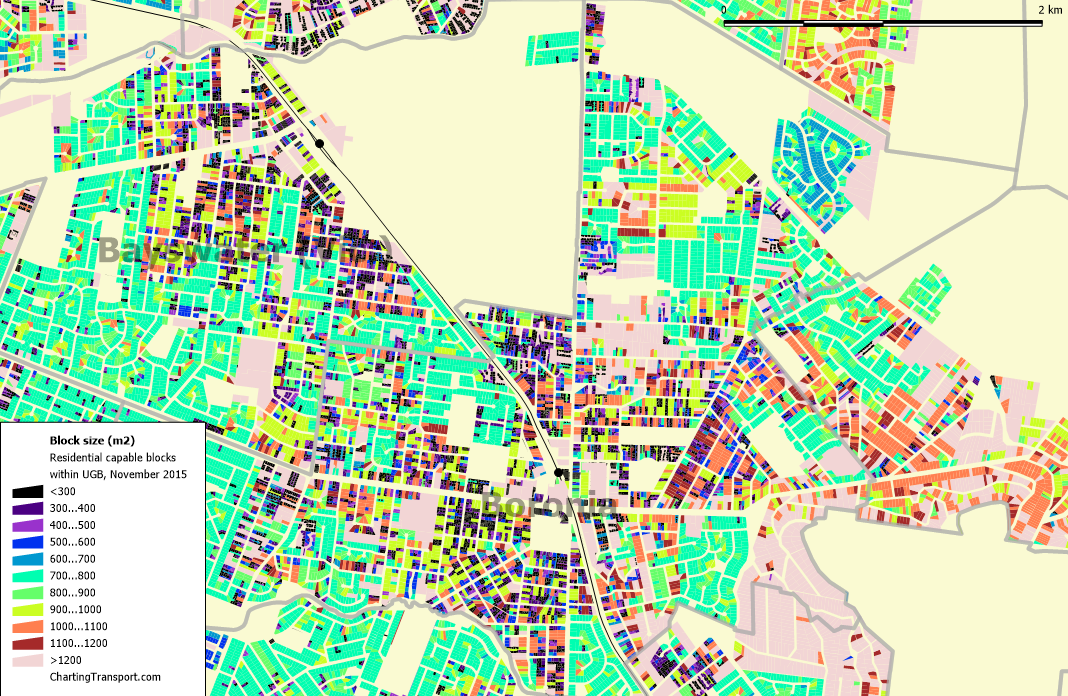
And further east there is a lot of further subdivision in Boronia and Bayswater, particularly near the rail stations:

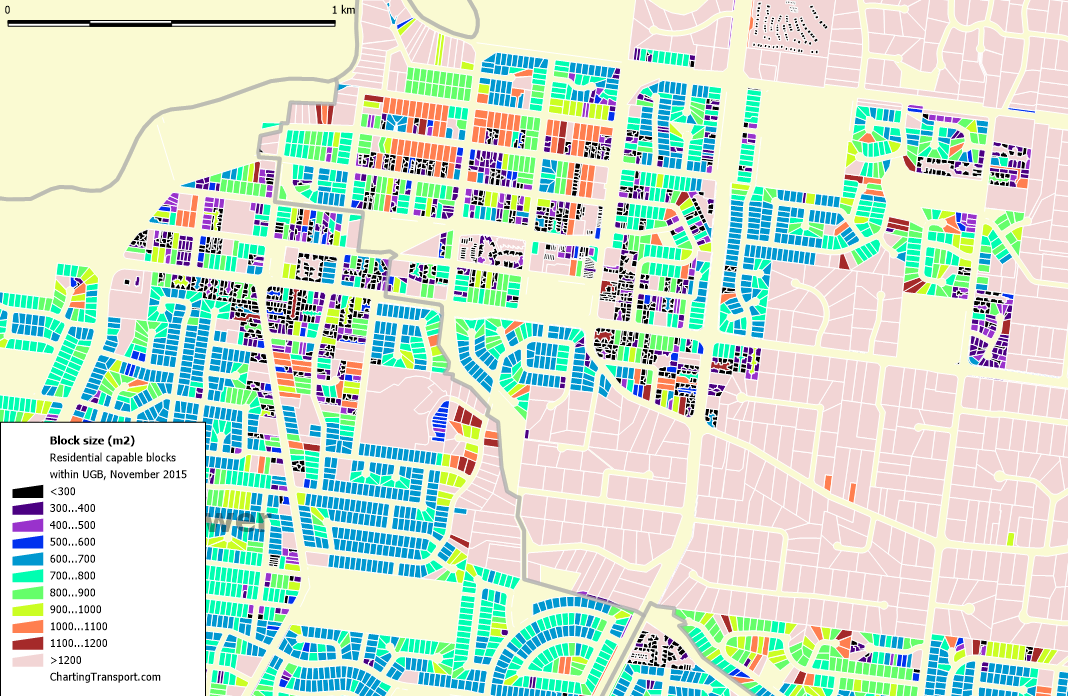
The north-west corner of Templestowe has not too many larger blocks yet to be subdivided. But to the south-east you can see areas with blocks larger than 1200 square metres (light pink).

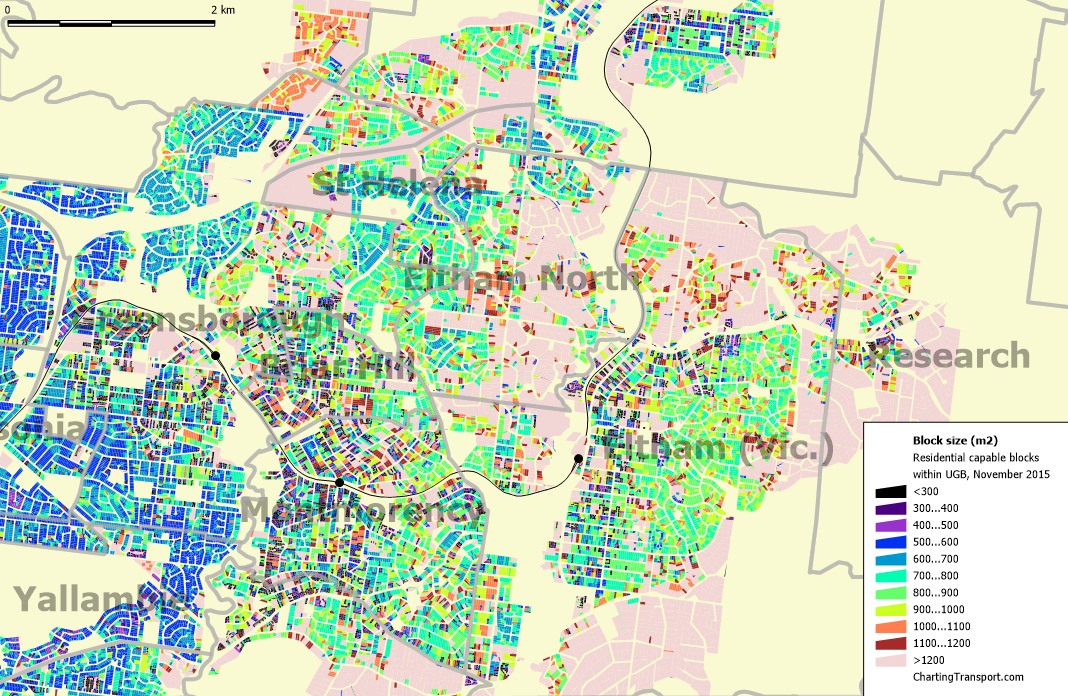
The area around Eltham has many large blocks, including many larger than quarter-acres. There has been quite a bit of subdivision around the rail stations however.

Another area with many large blocks is around Upwey/Belgrave:

A significant proportion of blocks are larger than a quarter-acre, with a median of 1060 in Belgrave, 1120 in Upwey, 1000 in Tecoma, and 980 in Upper Ferntree Gully.

If you want a quarter-acre block relatively close to the city, then Balwyn North has quite a few (many with swimming pools). Good luck saving a deposit for those.

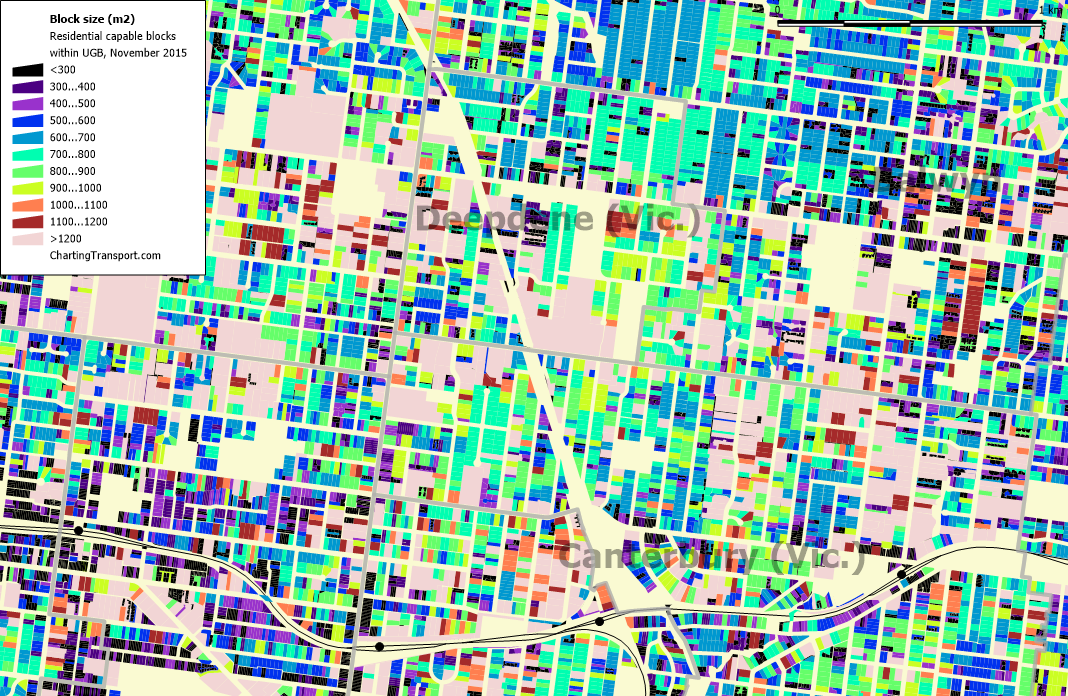
But if a quarter-acre block isn’t big enough and you can afford the real estate, then you might want to try Canterbury or Deepdene, also relatively close to the city:

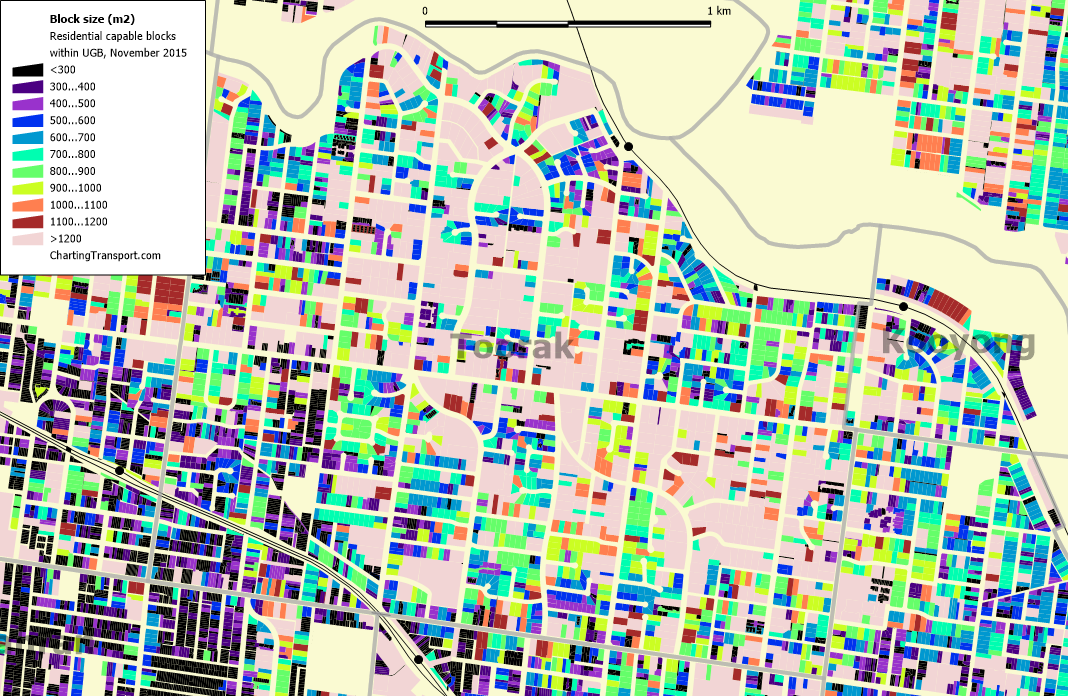
Or of course Toorak with plenty of very large blocks even closer to the city (although many will contain apartment buildings).

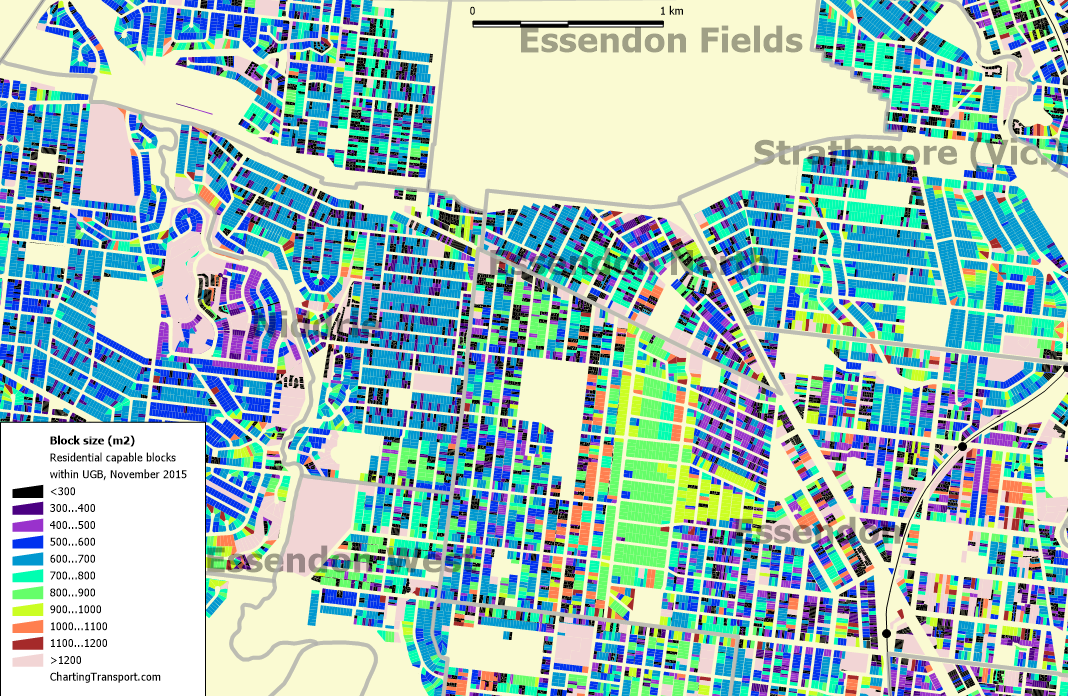
Essendon also has some larger blocks, including some quarter-acres:

There has been plenty of further subdivision, but there is also a stripe of green that is mostly in tact (a restrictive covenant applied perhaps?). You can also see the recent Valley Lake development in purple in Niddrie.

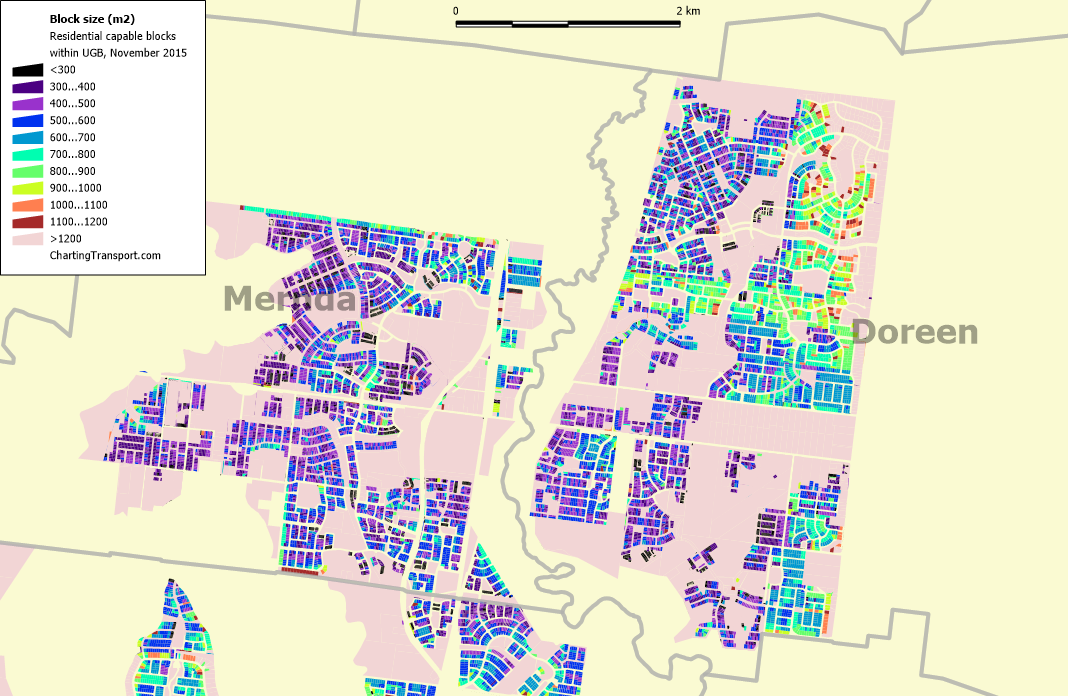
Most of the growth areas have small blocks, but here are some exceptions in eastern Doreen:

So there is plenty of variation in block sizes across Melbourne, but not that many quarter-acre blocks. Perhaps we should talk more about the one-seventh-acre block.

Data acknowledgement

This analysis was made possible with data available from data.vic.gov.au under a creative commons license. The data is Copyright © The State of Victoria, Department of Environment, Land, Water & Planning 2016.

I have used November 2015 property boundary data and May 2016 planning zones (sorry, not quite aligned, but this post has been a while in the making and the differences are unlikely to be significant).


How do Australian and European cities compare for population and area?

Sun 6 December, 2015

Following on from my previous post comparing the density of Australian and European cities, there has been some interest in the relative size of Australian and European cities. This post takes a quick look.

To make comparisons, I’ve taken the square kilometre population grid data for Europe and Australia, and summed the population and number of cells within the urban area/centre boundaries (as discussed in last post) that have at least 100 residents (ie 1 person per hectare or more) for each city. I’ve included this (arbitrary) threshold as some urban area boundaries seem to include some non-urban land. It means that I’m approximately measuring the populated areas of cities, and large parks, industrial areas, airports, etc may therefore be excluded in this analysis.

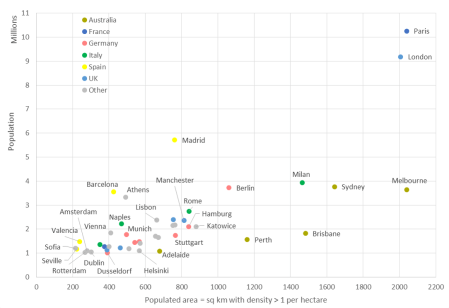
Here’s a chart of population versus populated area (click to enlarge):


So Melbourne is about the same size as London and Paris but has less than half the population. Brisbane is a similar size to Milan, with half the population. Perth is larger than Berlin, but has around half the population. Adelaide has a similar population to Seville and Sofia, which are about a third the size. Sydney has a similar population as Barcelona but is almost four times larger.

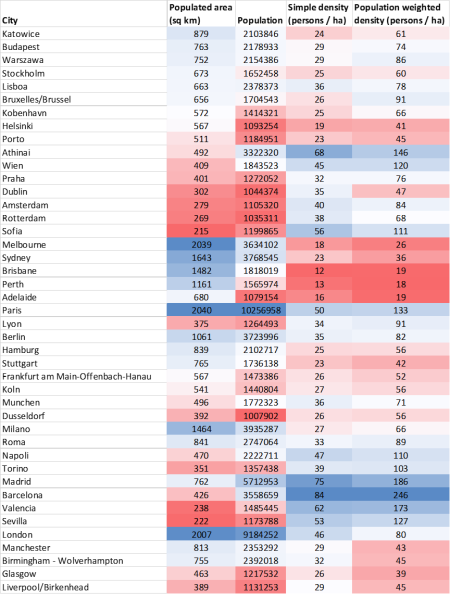
Because I couldn’t label all the cities in the chart above, here is a data table (smaller values in red, larger values in blue):

AU EU city data table
I’m hoping to add Canadian and US cities to my analysis soon.


Comparing the densities of Australian, European, Canadian, and New Zealand cities

Thu 26 November, 2015

[updated March 2016 to add Canadian and New Zealand cities]

Just how much denser are European cities compared to Australian cities? What about Canadian and New Zealand cities? And does Australian style suburbia exist in European cities?

This post calculates the population-weighted density of 53 Australian, European, and Canadian cities with a population over 1 million, plus the three largest New Zealand cities (only Auckland is over 1 million population). It also shows a breakdown of the densities at which these cities’ residents live, and includes a set of density maps with identical scale and density shading.

Why Population Weighted Density?

As discussed in previous posts, population-weighted density attempts to measure the density at which the average city resident lives. Rather than divide the total population of a city by the entire city area (which usually includes large amounts of sparsely populated land), population weighted density is a weighted average of population density of all the parcels that make up the city. As I’ve shown previously, the size of the parcels used makes a big difference in the calculation of population-weighted density, which makes comparing cities difficult internationally.

To overcome the issue of different parcel sizes, I’ve used kilometre grid population data that is now available for both Europe and Australia. I’ve also generated my own kilometre population grids for Canadian and New Zealand cities by proportionally summing populations of the smallest census parcels available.

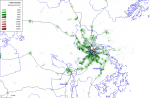
Some measures of density exclude all non-residential land, but the square kilometre grid approach means that partially populated grid parcels are counted, and many of these parcels will include non-residential land, and possibly even large amounts of water. It’s not perfect, particularly for cities with small footprints. For example, here is a density map around Sydney harbour (where light green is lower density, dark green is medium density and red is higher density):

Sydney harbour

You can see that many of the grid cells that include significant amounts of water show a lower density, when it fact the population of those cells are contained within the non-water parts of the grid cell. The more watery cells, the lower the calculated density. This is could count against a city like Sydney with a large harbour.

Defining cities

The second challenge with these calculations is a definition of the city limits. For Australia I’ve used Urban Centre boundaries, which attempt to include contiguous urbanised areas (read the full definition). For Europe I’ve used 2011 Morphological Urban Areas, which have fairly similar rules for boundaries. For Canada I’ve used Population Centre, and for New Zealand I’ve used Urban Areas.

These methodologies tend to exclude satellite towns of cities (less so in New Zealand and Canada). While these boundaries are not determined in the exactly the same way, one good thing about population-weighted density is that parcels of land that have very little population don’t have much impact on the overall result (because their low population has little weighting).

For each city, I’ve included every grid cell where the centroid of that cell is within the defined boundaries of the city. Yes that’s slightly arbitrary and not ideal for cities with dense cores on coastlines, but at least I’ve been consistent. It also means some of the cells around the boundary are excluded from the calculation, which to some extent offsets the coastline issues. It also means the values for Australian cities are slightly different to a previous post.

All source data is dated 2011, except for France which is 2010, and New Zealand which is 2013.

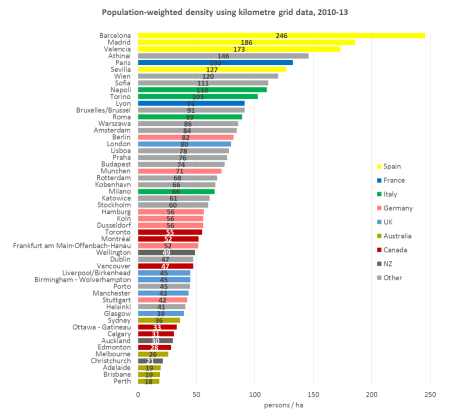
Comparing population-weighted density of Australian, European, Canadian and New Zealand cities

AU EU CA NZ Population Weighted Density

You can see the five Australian cities are all at the bottom, most UK cities are in the bottom third, and the four large Spanish cities are within the top seven.

Sydney is not far below Glasgow and Helsinki. Adelaide, Perth and Brisbane are nothing like the European cities when it comes to (average) population-weighted density.

Three Canadian cities (Vancouver, Toronto and Montreal) are mid-range, while the other three are more comparable with Australia. Of the New Zealand cities, Auckland is surprisingly more dense than Melbourne. Wellington is more dense that Vancouver (both topographically constrained cities).

But these figures are only averages, which makes we wonder…

How much diversity is there in urban density?

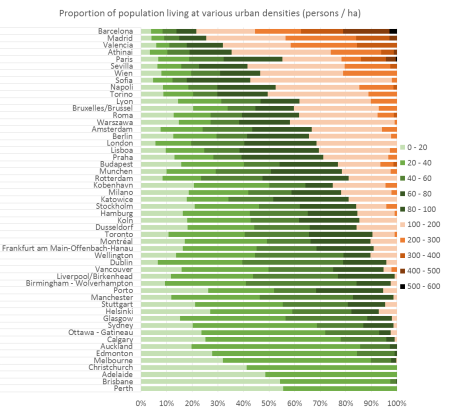
The following chart shows the proportion of each city’s population that lives at various urban density ranges:

AU EU CA NZ urban density distribution

Because of the massive variations in density, I had to break the scale interval sizes at 100 persons per hectare, and even then, the low density Australian cities are almost entirely composed of the bottom two intervals. You can see a lot of density diversity across European cities, and very little in Australian cities, except perhaps for Sydney.

You can also see that only 10% of Barcelona has an urban density similar to Perth or Adelaide. Which makes me wonder…

Do many people in European cities live at typical Australian suburban densities?

Do many Europeans living in cities live in detached dwellings with backyards, as is so common in Australian cities?

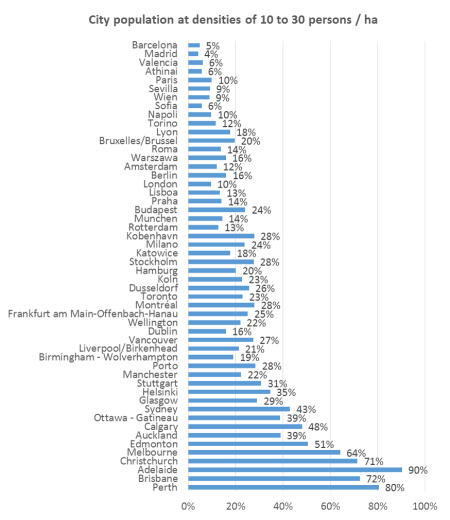
To try to answer this question, I’ve calculated the percentage of the population of each city that lives at between 10 and 30 people per hectare, which is a generous interpretation of typical Australian “suburbia”.

AU EU CA NZ cities percent at 10 to 30 per hectare

It’s a minority of the population in all European cities (and even for Sydney). But it does exist. Here are examples of Australian-style suburbia in outer Hamburg, Berlin, LondonMilan, and even Barcelona (though I hate to think what some of the property prices might be!)

How different is population-weighted density from regular density?

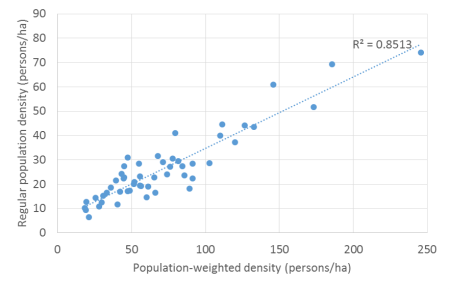
Now that I’ve got a large sample of cities, I can compare regular density with population weighted densities (PWD):

PWD v regular density 2

The correlation is relatively high, but there are plenty of outliers, and rankings are very different. Rome has a regular density of 18, but a PWD of 89, while London has a regular density of 41 and PWD of 80. Dublin’s regular density of 31 is relatively close to its PWD of 47.

Wellington’s regular density is 17, but its PWD is 49 (though the New Zealand cities regular density values are impacted by larger inclusions of non-urbanised land within definitions of Urban Areas).

So what does the density of these cities look like on a map?

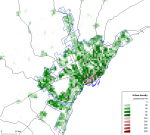
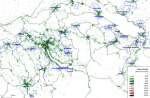
The following maps are all at the same scale both geographically and for density shading. The blue outlines are urban area boundaries, and the black lines represent rail lines (passenger or otherwise, and including some tramways). The density values are in persons per square kilometre (1000 persons per square kilometre = 10 persons per hectare). (Apologies for not having coastlines and for some of the blue labels being difficult to read).

Here’s Barcelona (and several neighbouring towns), Europe’s densest large city, hemmed in by hills and a coastline:

Barcelona

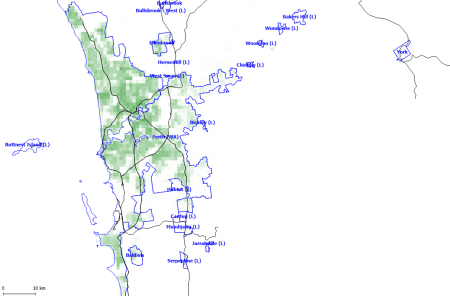
At the other extreme, here is Perth, a sea of low density and the only city that doesn’t fit on one tile at the same scale as the other cities (Mandurah is cut off in the south):


Perth

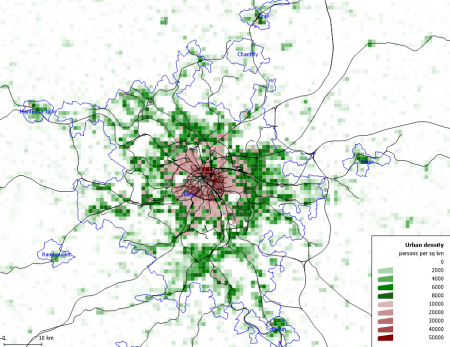
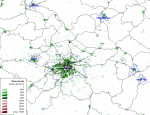
Here is Paris, where you can see the small high density inner core matches the high density Metro railway area:

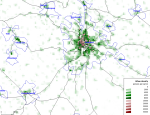
Paris

Similarly the dense inner core of London correlates with the inner area covered by a mesh of radial and orbital railways, with relatively lower density outer London more dominated by radial railways:

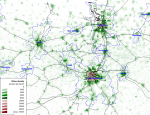
London

There are many more interesting patterns in other cities.

What does this mean for transport?

Few people would disagree that higher population densities increase the viability of high frequency public transport services, and enable higher non-car mode shares – all other things being equal. But many (notably including the late Paul Mees) would argue that “density is not destiny” – and that careful design of public and active transport systems is critical to transport outcomes.

Zurich is a city often lauded for the high quality of its public transport system, and its population weighted density is 51 persons/ha (calculated on the kilometre grid data for a population of 768,000 people) – which is quite low relative to larger European cities.

In a future post I’ll look at the relationship between population-weighted density and transport mode shares in European cities.

All the density maps

Finally, here is a gallery of grid density maps of all the cities for your perusing pleasure (plus Zurich, plus many smaller neighbouring cities that fit onto the maps). All maps have the same scale and density shading colours.

Please note that the New Zealand and Canada maps do not include all nearby urbanised areas. Apologies that the formats are not all identical.