How do commuting distances vary across Australian cities?

Mon 9 October, 2023

Having previously analysed commuting distances in Melbourne and Victoria, this post turns attention to other Australian cities. I’ll answer questions such as: Where are there longer commutes? What might explain differences in commute distances? How long are commutes in outer urban growth areas in different cities?

I’m using ABS calculated on-road distances between homes and regular workplaces from the 2021 census, regardless of whether people travelled to work on census day. For more on the data and calculations see the last post.

How do median distances to work vary by city overall?

I’ve measured the median distance to work for both the usual residents and the workers of each greater capital city statistical area (GCCSA) for 2021. These are often a bit different because some people live and work in different GCCSAs, and I’ll come back to that.

The chart shows that the capital city areas all have longer median distances to work than other parts of each state, which is unsurprising. Here’s some comments on the cities in order:

  • Perth tops the chart with the longest median distances to work. Perth has a large and long low density footprint sprawled along the coastline, so long commuter distances are not hugely surprising.
  • Melbourne comes in second place. It is the largest city by area, but is more dense than Perth.
  • Brisbane comes in third place. Brisbane is slightly larger than Perth in area, but not stretched out quite so far, and with a larger population than Perth, but lower density than Melbourne.
  • Canberra is next. It’s a relatively small city so you might expect shorter commute distances, but overall it is quite a low density city with a fragmented urban structure (divided by green areas). It also has an extensive high-speed and rarely-congested highway network that makes driving longer distances relatively easy.
  • Sydney is next, the largest city by population and population density, and a city with multiple significant employment clusters, which probably contributes to a smaller median distance than most other big cities.
  • Darwin is a tiny city, but like Canberra it has a fragmented urban structure, and Darwin’s CBD is at the end of a peninsula (with a median distance for employees of 12 km), which probably contributes to relatively long median commutes.
  • Adelaide is the smallest of the five larger cities, with a mostly contiguous urban structure, which probably explains it’s lower median distances.
  • Hobart is another very small city, which probably explains shorter commutes, although it is split over a wide river mouth which would lengthen many commute distances.

On the chart you can also observe small differences between median distances for usual residents and workers in some cities that I think are worth mentioning:

  • Canberra has a longer median distance for workers, which probably reflects many workers living across the border in NSW.
  • Perth has a longer median distance for usual residents than workers, which might reflect fly-in-fly-out commuters who live in Perth.
  • Sydney and Melbourne have a longer median distance for workers, which might reflect commuters from outside the metropolitan area (particularly Melbourne’s many commuter towns which I explored in the last post).
  • Workers in the “rest of WA” and “rest of NT” have relatively long median distances, which I suspect reflects fly-in-fly-out employment in the resources sector.

How do distances to work vary across cities

I’ve already examined Melbourne in my last post. What follows are maps and some discussion for other cities, followed by some observations across the cities.

Sydney

(you might want to click/tap to expand some of these maps to see the detail more clearly)

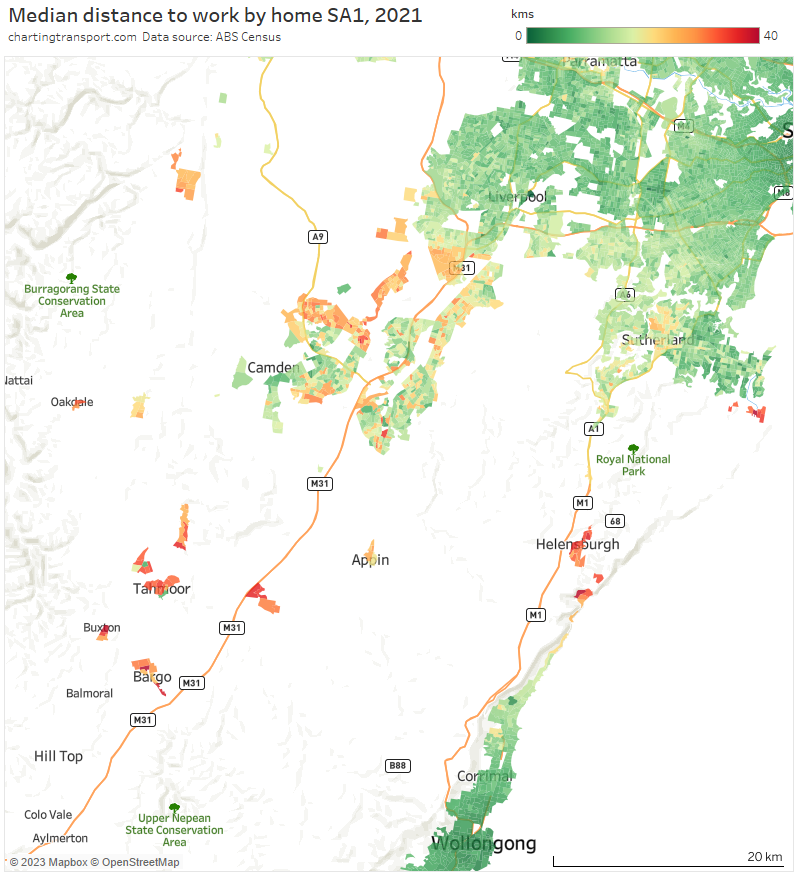
Shorter median distances were found around in areas around the Sydney CBD, which is no surprise. Generally longer distances were seen in the growth areas to the south-west (including Oran Park, Leppington, Gledswood Hills, Gregory Hills, Edmondson), north-west (including Schofields, Marsden Park, Box Hill) and eastern Blue Mountains (including Springwood and Hazelbrook, but not Katoomba).

Other relative outliers include:

  • Bundeena in the far south-east (median distances up to 50 km), which is connected to the rest of Sydney by a very long and windy road journey through the Royal National Park, plus a short ferry to Cronulla (not considered by ABS when calculating commute distances).
  • Pockets of Bonnet Bay in the south (median distance of 26 km) which have a rather indirect access road to the rest of Sydney.
  • Palm Beach (median distance of 37 km) at the tip of the northern beaches region.

Does Sydney have commuter towns? Yes, but perhaps not as many as Melbourne. The map above shows long median distances as far as Hazelbrook in the west, and the map below shows several towns to the south that show longer median distances (many commuters from these towns might also work in Wollongong).

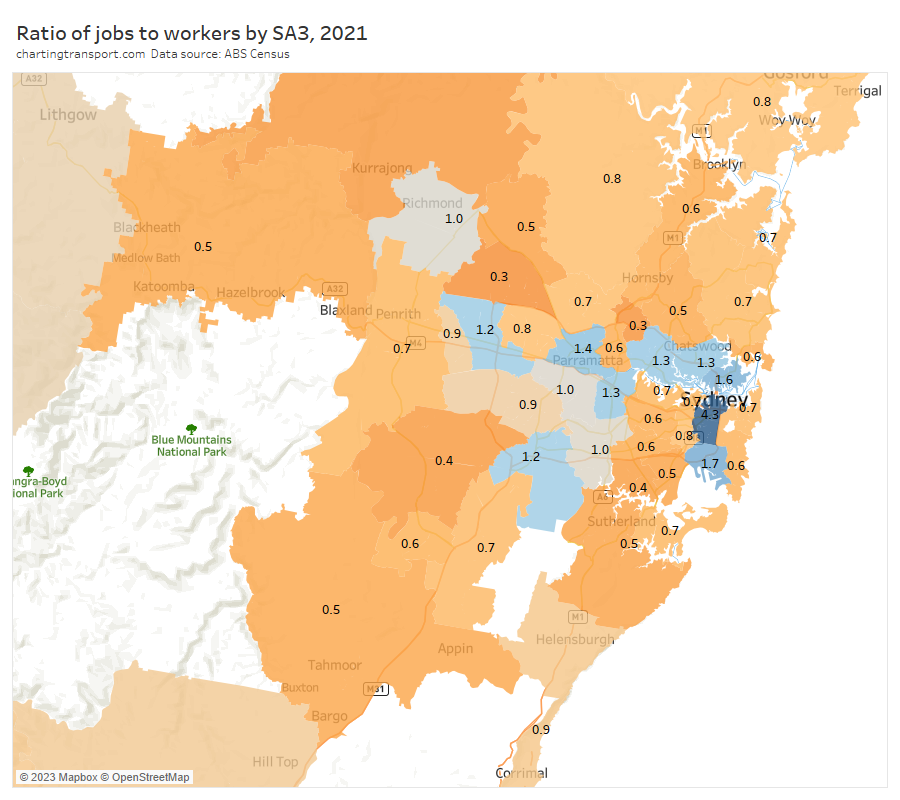
Here’s how Sydney looks for the ratio of jobs to workers in SA3s:

The outer south-west has a low ratio and is quite remote from any SA3 with a surplus of jobs, hence relatively long median distances to work. Some pockets of the north-west had low ratios, but were adjacent to higher ratio areas nearby.

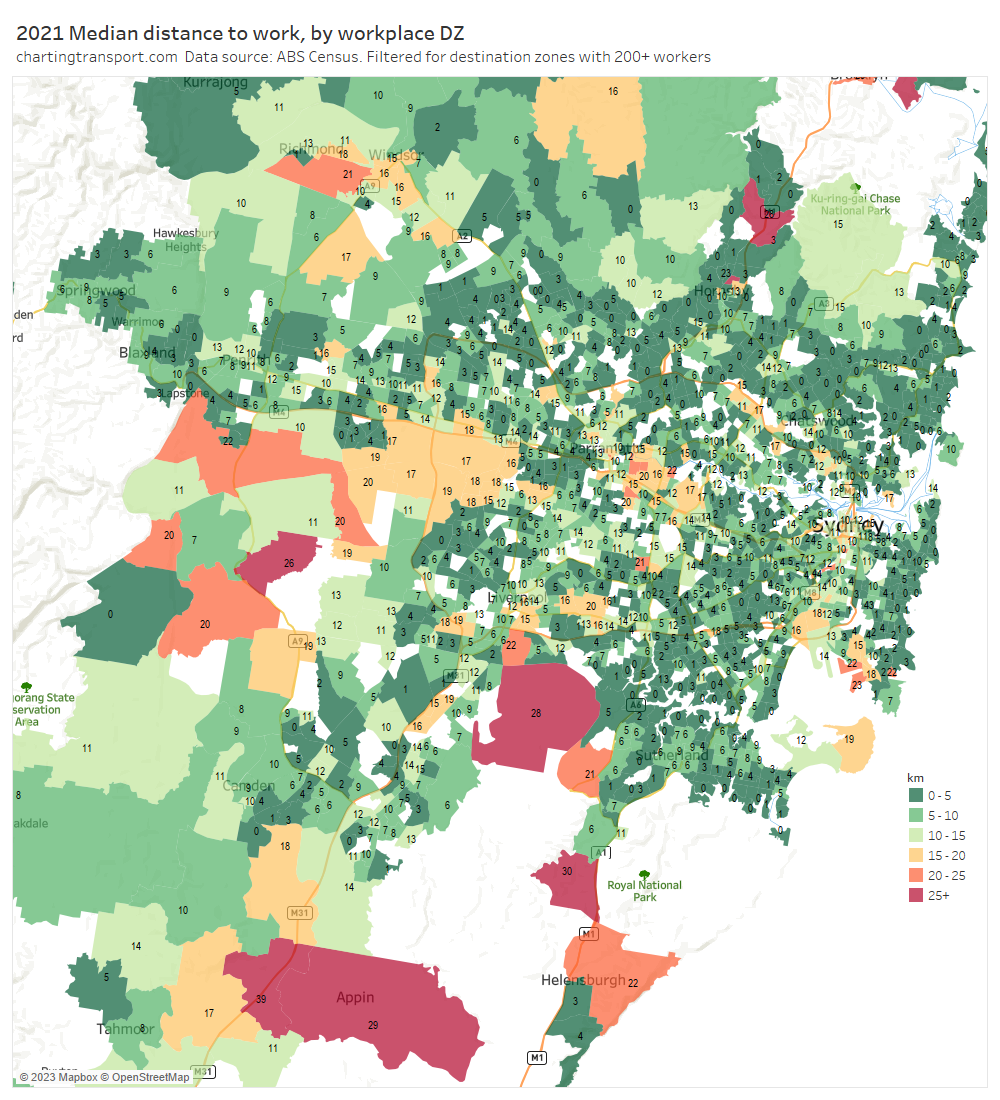
Here are median distances to work by workplace destination zones (DZs):

Unlike Melbourne there were not large industrial areas with median distances over 20 km.

There were a few isolated pockets with long distances including Badgerys Creek (Western Sydney International Airport construction site), the Holsworthy Army Barracks, and Waterfall (maybe related to a rail depot).

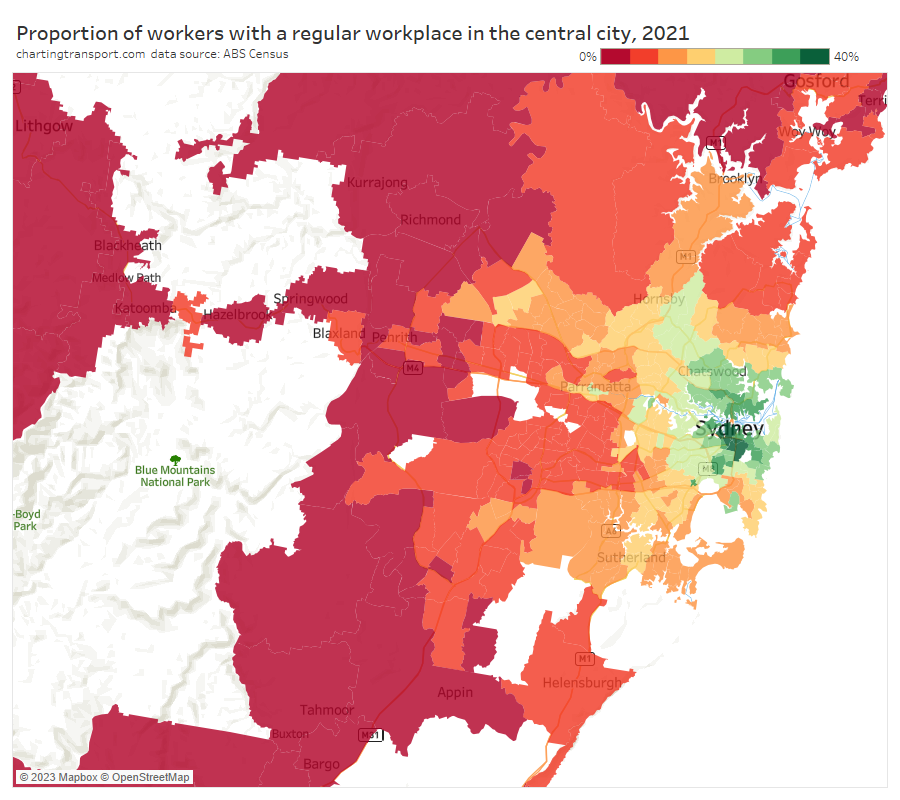
Here’s the proportion of workers who were employed in central Sydney (including Sydney CBD, Haymarket, Millers Point, The Rocks):

Like most cities, the influence of the central city declines with distance from the CBD. Some relative anomalies for their distance include:

  • Outer north-western suburbs (including Baulkham Hills and Blacktown – North SA3s) have relatively high dependence on the Sydney CBD for jobs, and associated longer median commuter distances.
  • Bankstown is relatively close to the Sydney CBD but with with many SA2s below 10% for central city workers, perhaps reflecting relative socio-economic disadvantage.

South East Queensland

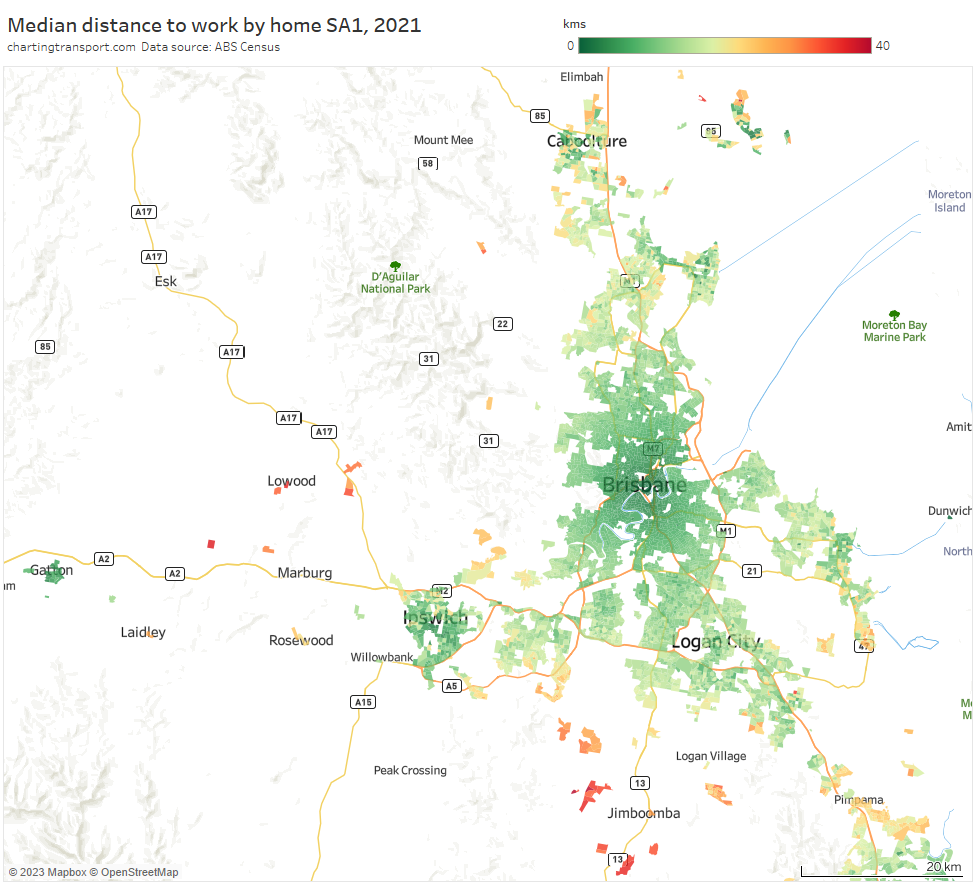
First up, Brisbane medians distances by home SA1:

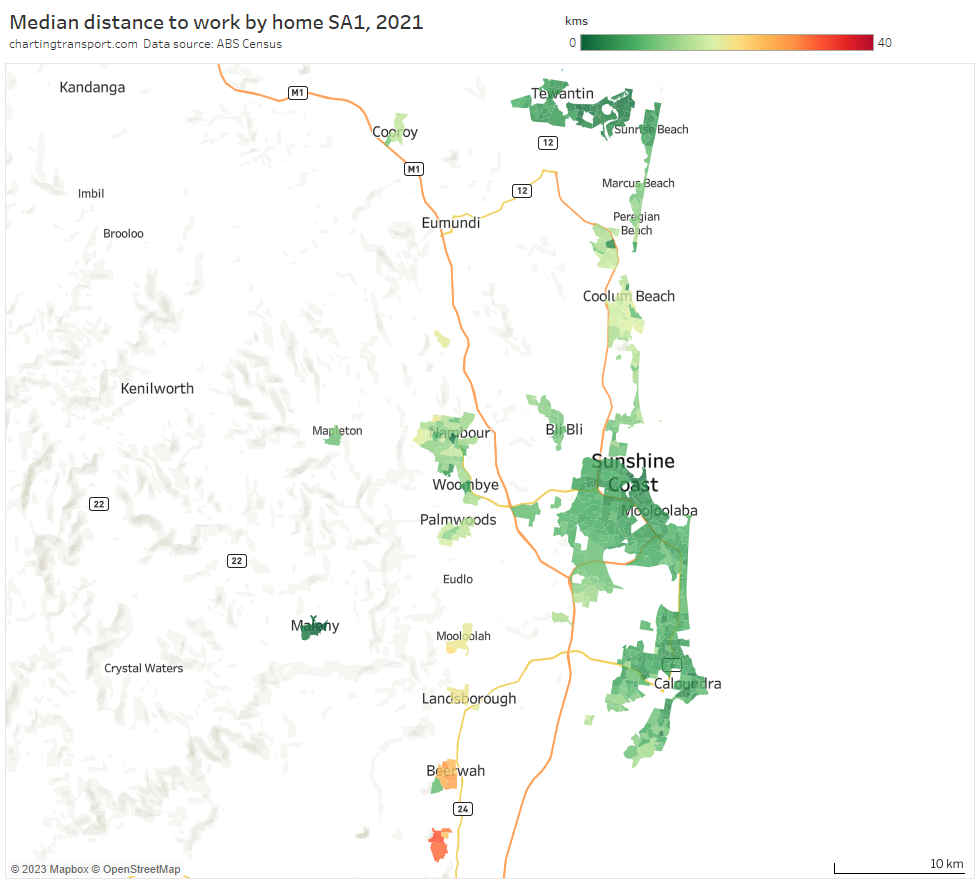
The longest median distances can be found in some low density suburban areas around Jimboomba, Yarrabilba, New Beith, Lowood, and the Lockyer Valley. Some relatively long median distances were also seen around Ormeau and Pimpama (suburbs between Brisbane and the Gold Coast), Springfield Lakes, parts of Caboolture, and Bribie Island. Looking at the urban fabric, these appear to be mostly relatively modern low density residential estates (rather than old towns). I’m not seeing many commuter towns around Brisbane.

Curiously there are relatively short median distances around the outer suburban area of Ipswich in the west (I’ll come back to this).

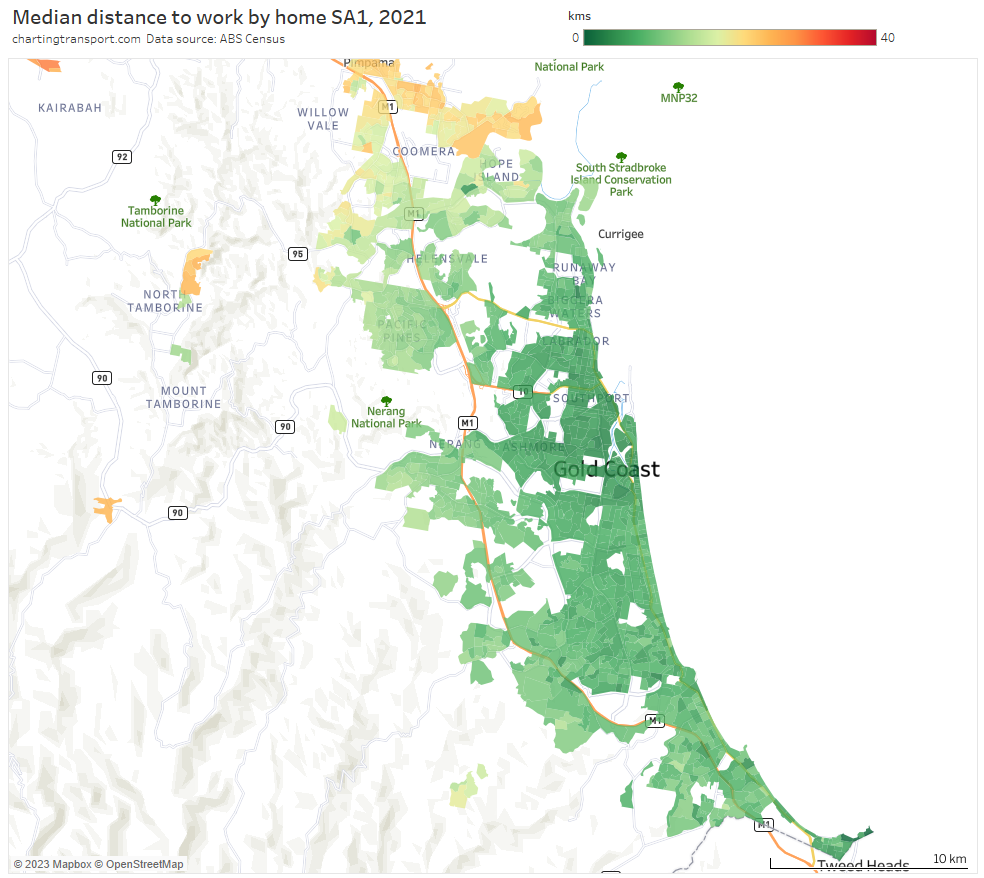
Here’s the Gold Coast:

Median distances are mostly relatively short except for the northern fringe and around Tambourine Mountain in the hinterland. Jobs are much more distributed across the Gold Coast (see map below) compared to other cities dominated by one CBD, which might explain relatively short commute distances.

Here’s the Sunshine Coast:

Distances are relatively short except for the Glass House Mountains and Beerwah to the south (probably containing commuters to Brisbane and the Sunshine Coast).

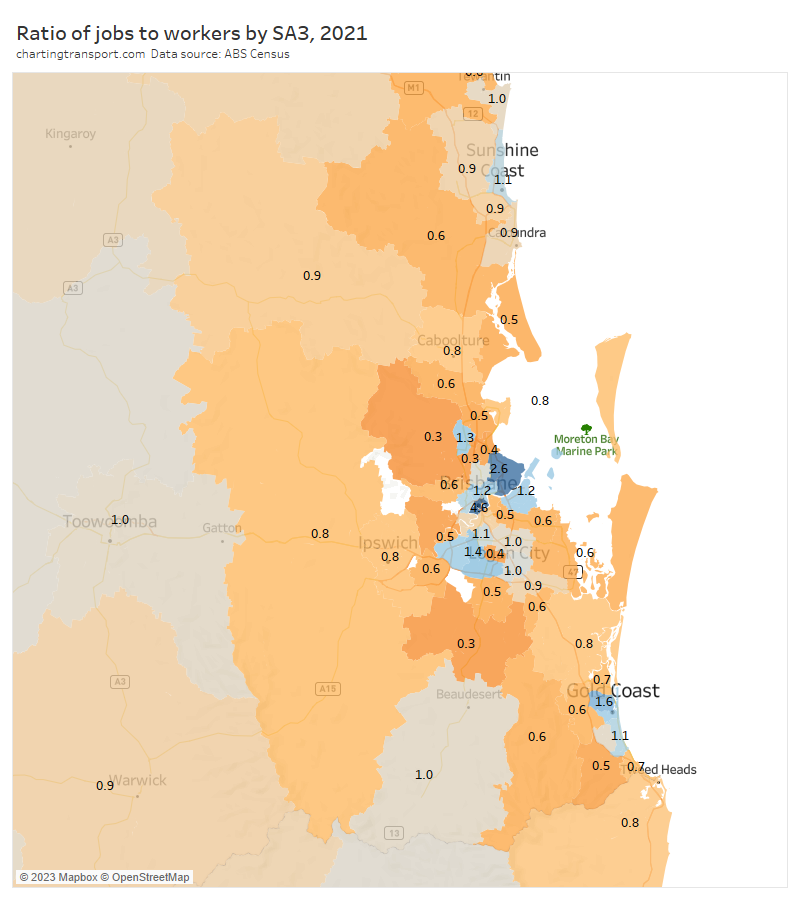
Here’s how South East Queensland looks for jobs to workers ratio:

You can see surpluses of jobs in the central parts of Brisbane, the Gold Coast and the Sunshine Coast.

The outer suburban Ipswich area comes in surprisingly high at 0.8, which almost certainly explains the relatively shorter distances to work found in the area. I’m not very familiar with Brisbane’s urban history, but the presence of so many jobs in the Ipswich area is probably saving a fair amount commuting distance and taking some pressure of the transport network.

Jimboomba and The Hills District had a ratio as low as 0.3. Jimboomba’s low density, fragmented urban structure, lack of local jobs, and remoteness from the main Brisbane urban area likely explains the very long median distances to work, and likely high levels of car dependency.

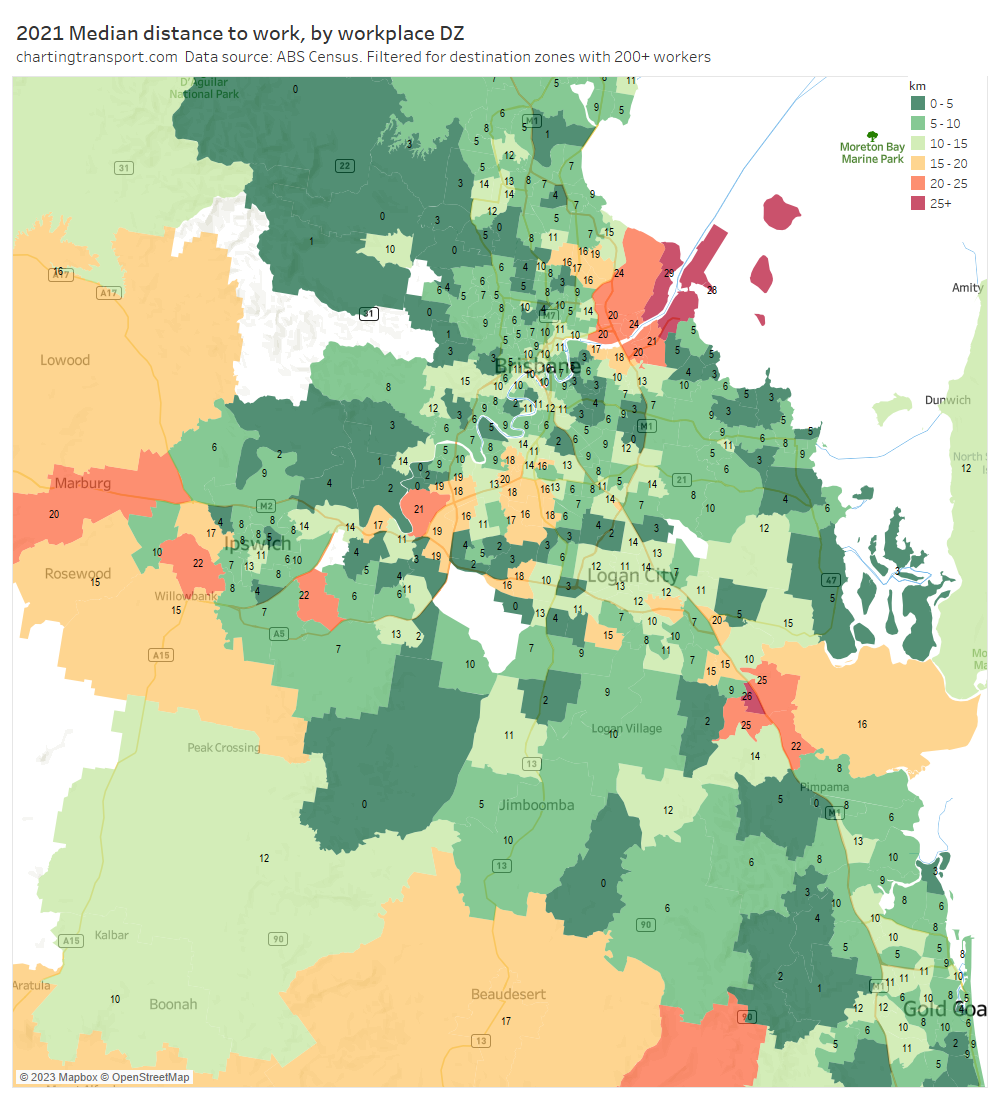
Here are median distances to work by workplace DZs for the Brisbane area:

Long distances were seen around Brisbane Airport and the Port of Brisbane (24-25 km, both relatively remote from residential areas), the Yatala industrial areas on Brisbane’s outer south (25-26 km), Wacol (21 km, which is dominated by correctional facilities), Swanbank (22 km, dominated by power stations), and the RAAF Amberley air base in Rosewood (22 km).

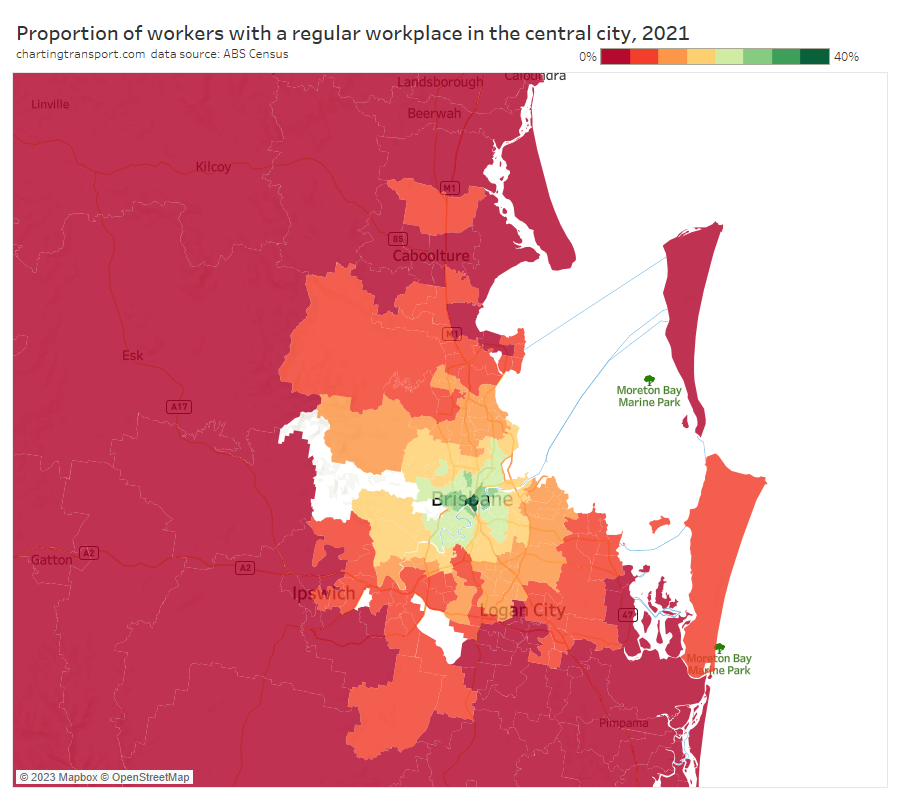
Here is map showing the proportion of workers who worked in “central Brisbane” (defined as the Brisbane CBD plus Spring Hill SA2):

There aren’t huge anomalies by distance. But I might perhaps call out New Beith in the south, Elimbah in the north, and North Stradbroke Island in the east as relative outliers with not-so-low (5-10%) percentages working in central Brisbane. You can also see the Ipswich area had a low dependence on central Brisbane for employment, consistent with the relatively high rate of job self-sufficiency.

Perth

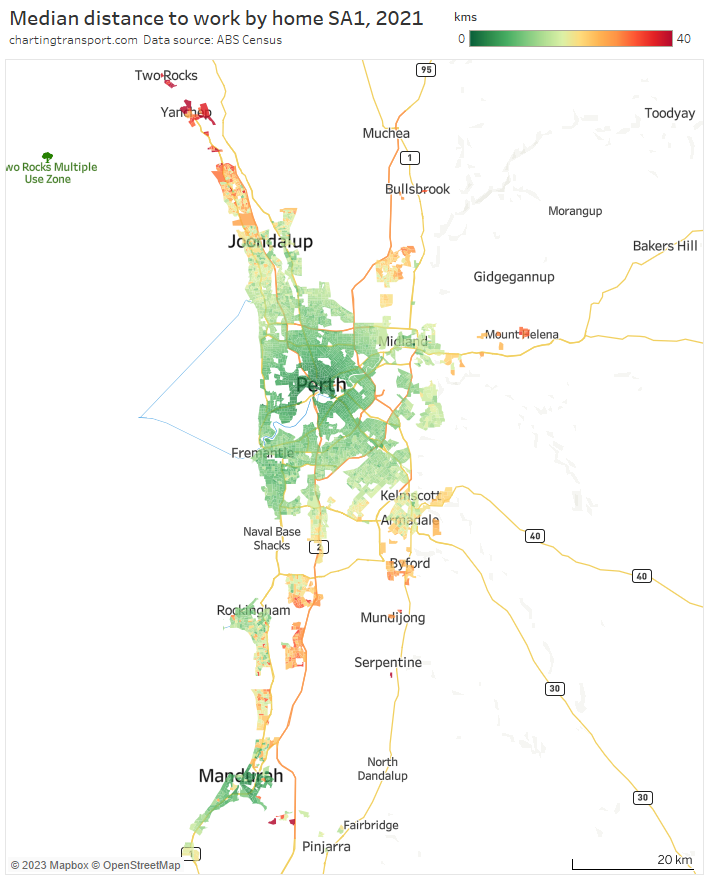
Perth has the longest median distance to work of all capital cities, and you can see many suburbs with relatively long distances, most acutely in the far-north around Two Rocks and Yanchep (several SA1s having a median above 40 km) and Yunderup (between Mandurah and Pinjarra in the south). Long median distances are seen north of Joondalup, throughout the satellite Ellenbrook region in the north-east, in Mount Helena and other hills towns to the east, around Byford in the south-east, around Wellard and Baldivis in the south, and in coastal areas between Rockingham and Mandurah.

I should point out that the map only includes Greater Perth SA1s. The SA2 of Chittering to the north east of Perth (including Muchea and Bindoon) has a median distance to work of 46 km, and 54% of its workers worked in Greater Perth (to which is it connected by a freeway). It contains quite a few very low density rural-living residential areas.

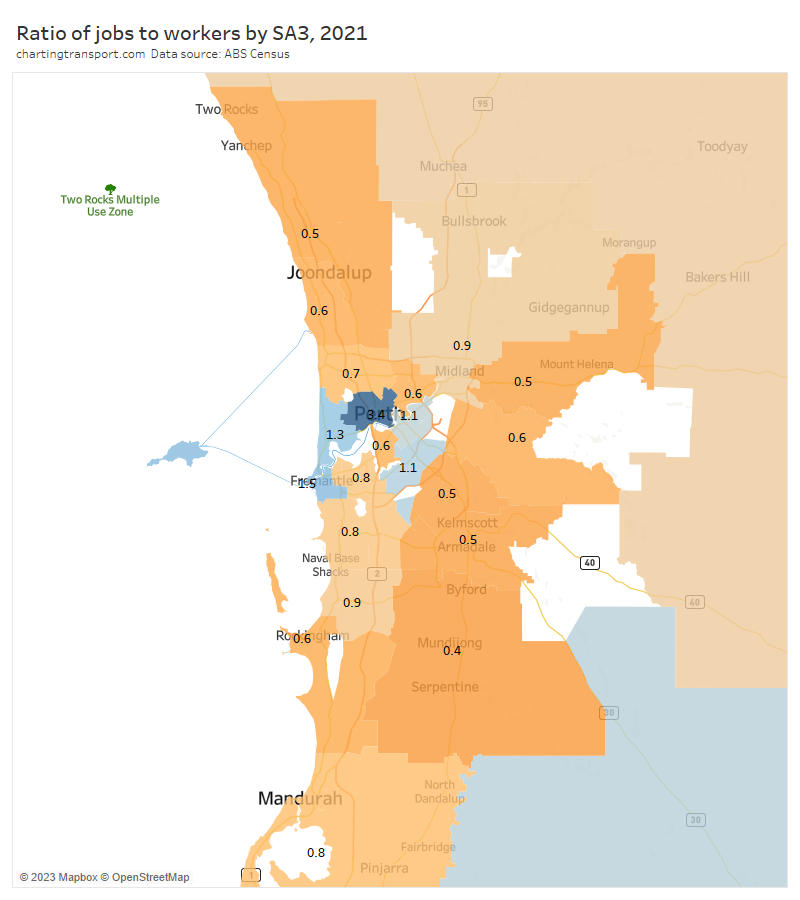
Here’s the jobs to worker ratio map:

There were very low ratios in the outer northern, eastern, and south-eastern suburbs, which explains the long median distances to work from these areas.

Here are median distances to work by workplace destination zones:

The longest medians were seen for Perth Airport and around the Kwinana industrial areas. Other destination zones with long distances are rural areas outside of Perth (not unexpected), plus Wadjemup (Rottnest Island) where distances are obviously not on-road but imputed to be 1.3 times the straight line distance. Many workers are likely to commute by ferry from Perth.

Here’s the proportion of workers who work in central Perth (defined as including the CBD, Northbridge and East Perth):

The dependence on central Perth extends a fair way into the jobs-poor northern suburbs. Both the northern suburbs train line and the Mitchell Freeway have been extended several times as the urban area has expanded, perhaps a case of transport-driven sprawl.

The CBD’s influence also extends a fair distance south including Wellard and Baldivis that have relatively long median distances to work (and are closer to the Kwinana Freeway than the Mandurah rail line).

Adelaide

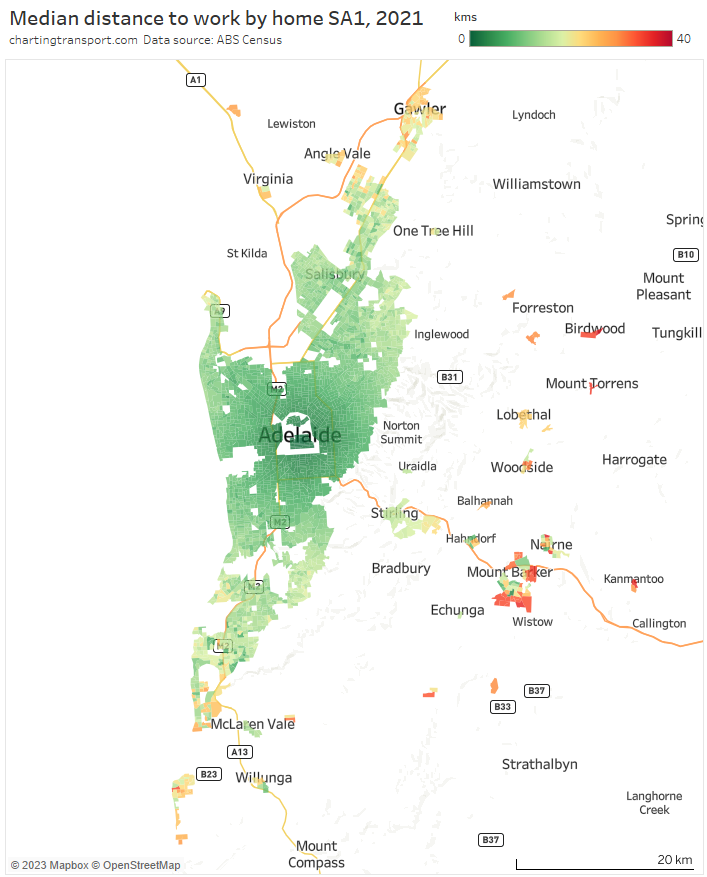
Median distances to work were relatively short for most of the main contiguous urban area of Adelaide. Higher medians were seen in the detached urban areas of Gawler in the north, Aldinga Beach in the south, and many Adelaide Hills towns (particularly outer parts of Mount Barker).

Here is the jobs to workers ratio map:

The outer suburbs on all sides had low ratios and hence longer median distances to work.

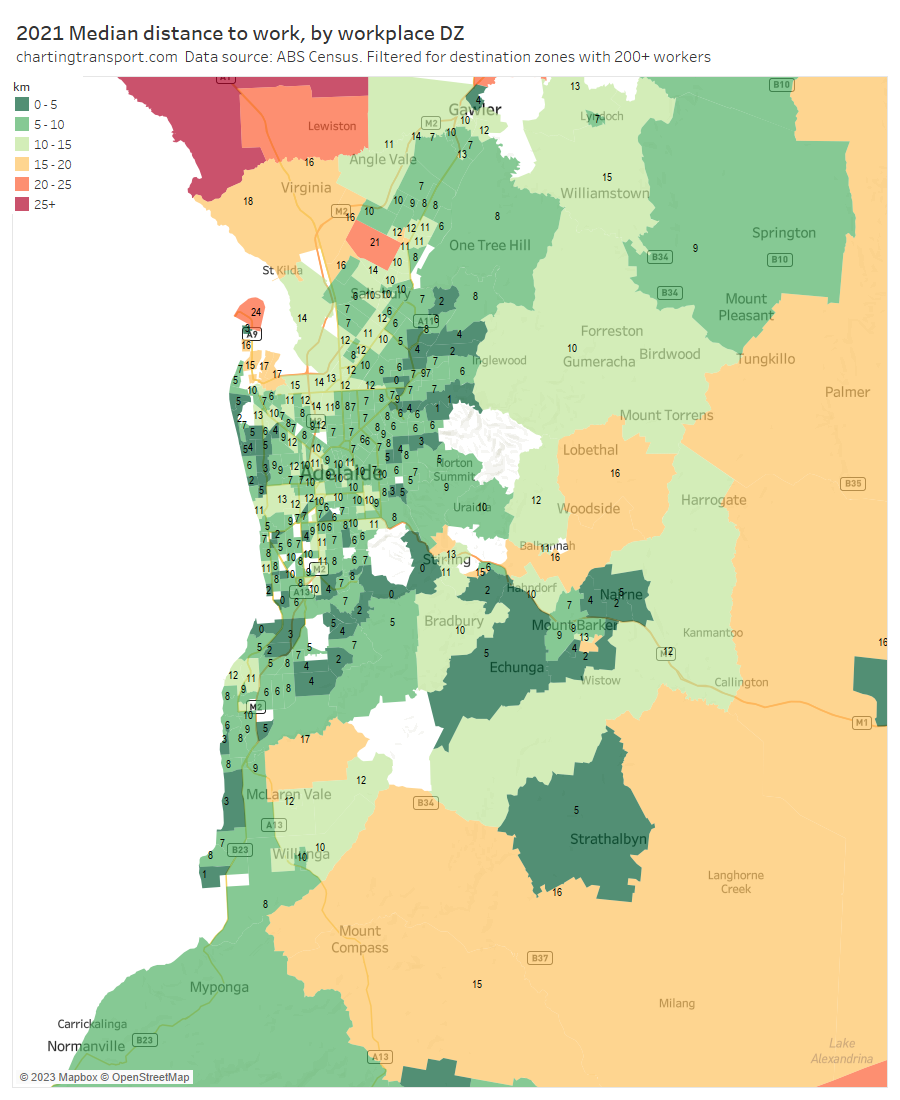
Here are median distances to workplaces by destination zone:

Median distances are relatively short for most workplace areas with the relatively urban exceptions of North Haven / Outer Harbour (at the tip of a peninsula), and the RAAF Edinburgh air base in the north.

Canberra

Most areas of Canberra had median distances under 20km, except around Banks in the far south, and Googong to the south-east (over the border in New South Wales, where 73% of workers work in the ACT).

I’ve previously described towns with a very long median distance as commuter towns – and for Canberra this would include Murrumbateman, Gundaroo, Bungendore, and Collector.

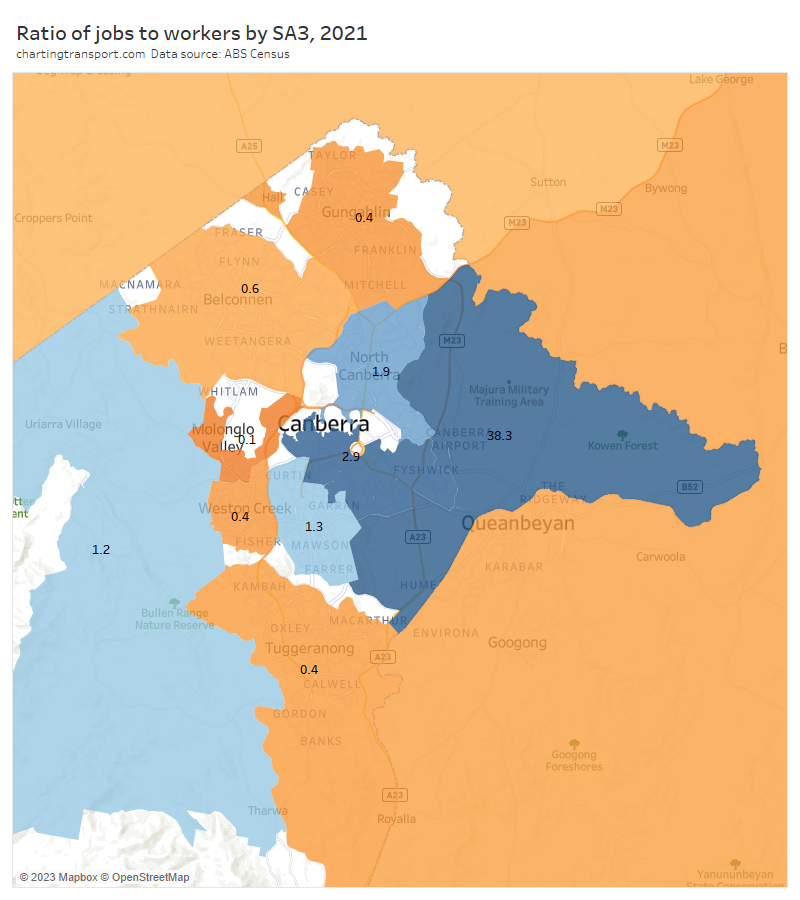
Here is the jobs to worker ratio map for SA3s:

Canberra East had a huge ratio – only 532 workers lived in that SA3 dominated by employment land uses. Low ratios were seen in Tuggeranong in the south, Gungahlin in the north, and Queanbeyan to the east (which had a ratio 0.5 and 71% of workers in the Queanbeyan SA2 worked in the ACT).

An extremely low ratio of 0.1 was seen around the Molonglo Valley, but this area is right next door to jobs rich areas of central Canberra.

The Young – Yass SA3 to the north west of Canberra came in at 0.7, unusually low for a regional area suggesting some dependence on Canberra for jobs. In fact 52% of workers in Yass Surrounds and 34% of the Yass township worked in the ACT. The town of Yass had median distances to work mostly under 5 km, however the 75th percentile distances to work in many parts of Yass was over 40 km.

Here are median distances to work for workplace destination zones:

The only urban area with relatively long workplace median distances was Canberra airport.

I’m not going to do as detailed analysis for the smaller cities that follow.

Hobart

The main urban areas of Hobart had relatively short distances, with outlying commuters towns such as New Norfolk, Brighton, Sorell, Dodges Ferry, Snug, and particularly South Arm showing much longer medians.

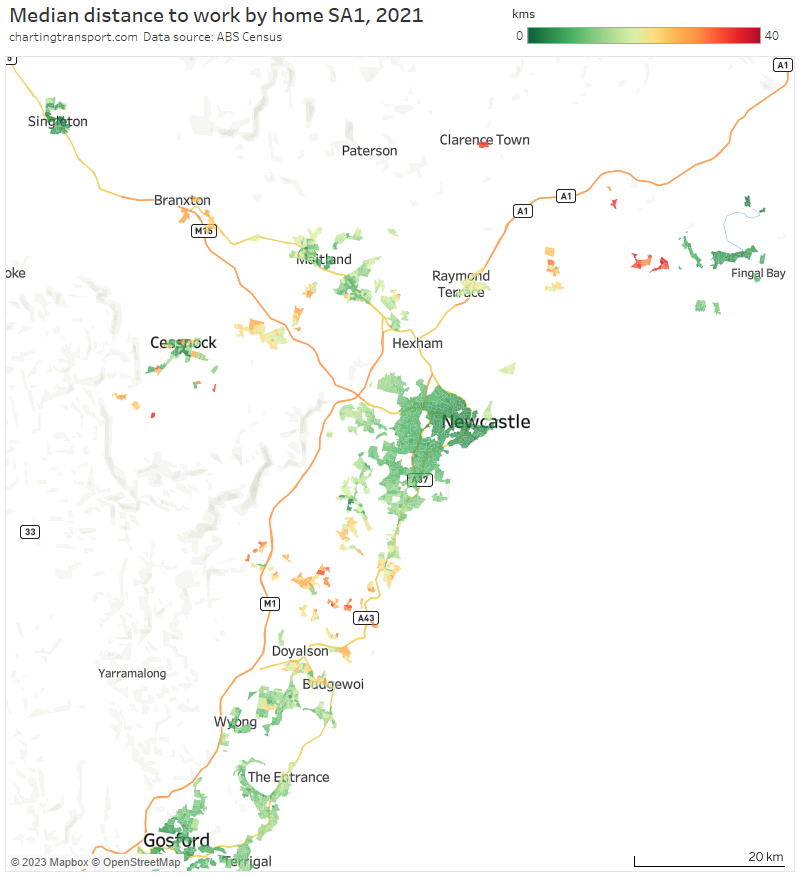
Newcastle / Central Coast / Hunter region

Longer median distances are seen at several small urban areas between Wyong and Newcastle, around Kurri Kurri – Abermain. Branxton, Clarence Town, Lemon Tree Passage, and Tanilba Bay. Singleton, Cessnock, and Nelson Bay have relatively short median distances and are likely less reliant on Newcastle for employment.

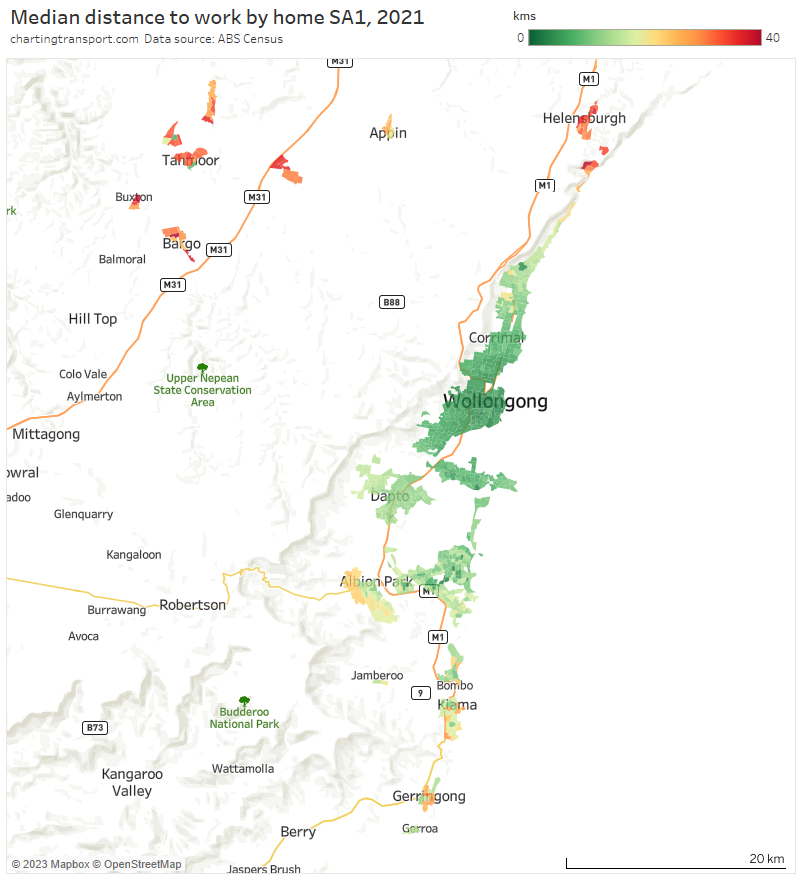
Wollongong

Note data is not shown for urban areas around Robertson and Mittagong.

Median distances were mostly relatively short, with exceptions in the north (Helensburgh) and south (Albion Park, Kiama, and Gerringong) of what is also a skinny coast-hugging urban settlement pattern.

How do the urban growth areas of big cities compare?

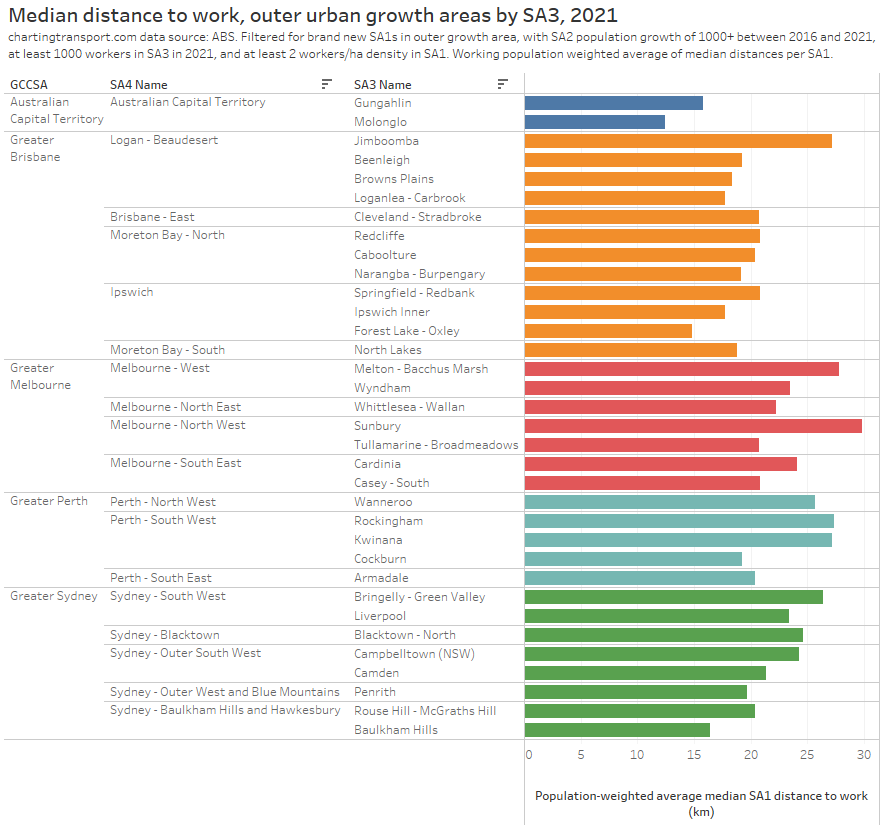
For this analysis I’ve filtered for new (in 2021) outer urban growth SA1s, and calculated the population-weighted-average median distance to work of these SA1s aggregated to SA3 level (not a perfect calculation, but hopefully close enough).

Note: The Tullamarine – Broadmeadows SA3 in Melbourne is perhaps poorly named – it actually includes Craigieburn and stretches north to Mickleham.

The outer urban growth SA3s with the longest median distances to work (perhaps call them commuter suburbs) were Sunbury in Melbourne’s north-west, followed by Melton – Bacchus Marsh in Melbourne’s west, Jimboomba south of Brisbane, Rockingham and Kwinana south of Perth, and Bringelly – Green Valley in Sydney’s west.

The outer urban growth SA3s with the shortest median distances to work included those around the smaller city of Canberra, the Ipswich region of western Brisbane, and the Baulkham Hills region of north-western Sydney. New residents in these areas will be generating fewer commuter kilometres to their city’s transport task (relative to other outer growth areas).

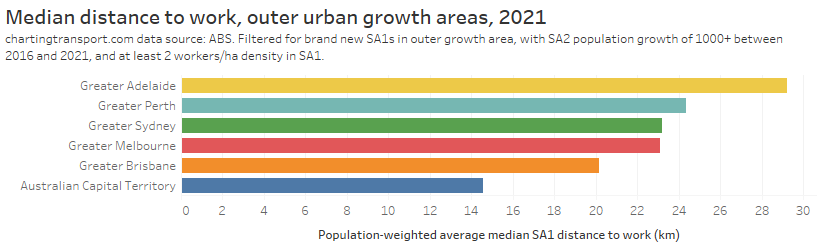
You might be wondering why Adelaide is missing from the above chart. It is a city with quite slow population growth and did not have enough growth in each SA3s to qualify with my filters.

Here’s the same data aggregated up to city level, which shows Adelaide actually with the longest commute distances from outer growth areas, followed by Perth.

What can we take away from this city analysis?

Longer commute distances seem to be strongly associated with imbalances in the distribution of jobs and workers within cities, particularly where these imbalances stretch out over long distances (Perth being the classic example). That’s probably no great surprise to many readers.

So if a city wanted to reduce commuting distances (and therefore demand on its transport system) it could consider:

  • slowing urban sprawl – particularly in corridors which already have worker to jobs imbalances and long commute distances,
  • increasing residential densities around existing major employment clusters, and/or
  • attempting to distribute more employment to outside the CBD – probably easier said than done, but Sydney has done it successfully with relatively high public transport mode share, while Canberra has done it with low public transport mode share (~12%) in town centres.

How is public transport patronage recovering after the pandemic in Australian and New Zealand cities?

Tue 8 August, 2023

With the COVID19 pandemic seemingly behind us, what has been happening to public transport patronage? Has it recovered to 2019 levels? In which cities is public transport patronage recovering the strongest?

This post provides my best estimates of how much public transport patronage has recovered in major Australian and New Zealand cities.

In my last post I talked about the problems when transit agencies only publish monthly total patronage (or weekly or quarterly totals). For those cities that don’t publish more useful data, I’ve used what I think is a reasonable methodology to try to adjust those figures to take into account calendar effects.

Unlike most of my posts, I’ll present the findings first then explain how I got them (because I reckon a good portion of even this blog’s readers might be less interested in the methodology).

Estimates of typical school week public transport patronage recovery

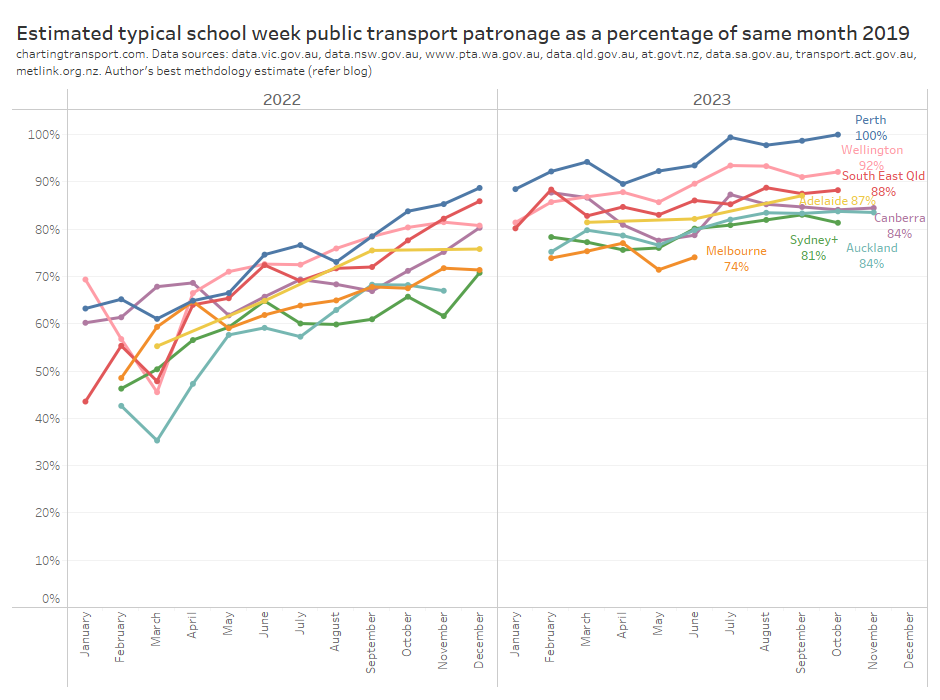
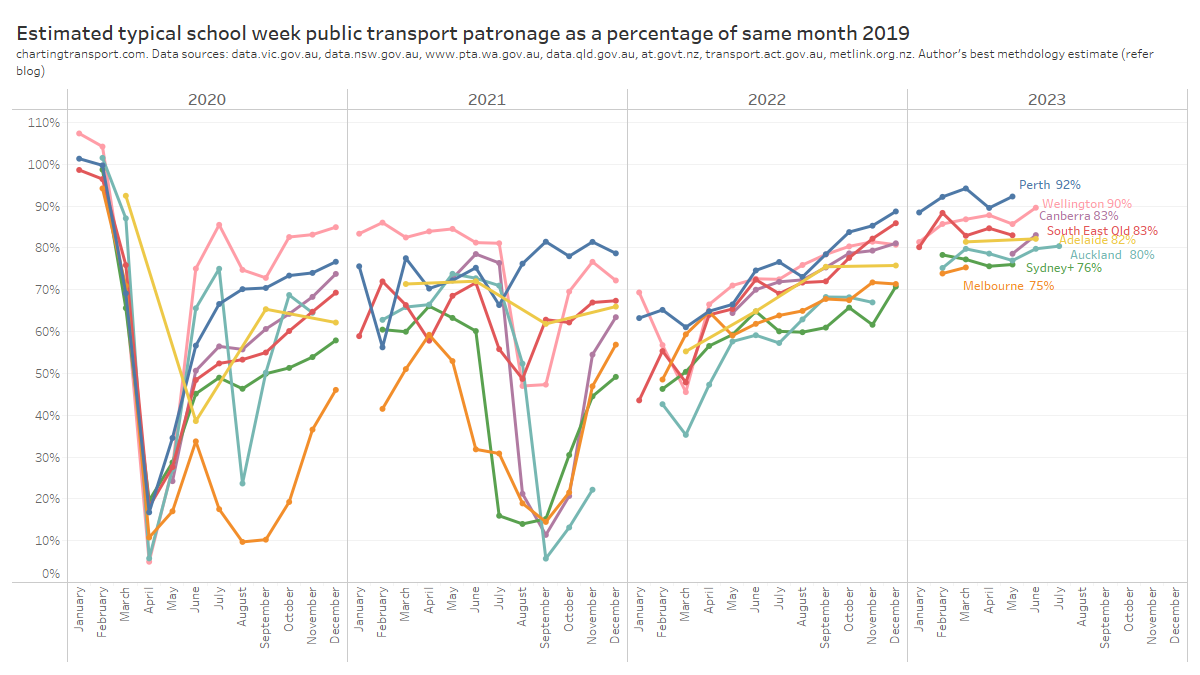
Here’s a chart comparing estimated typical school week patronage per month to the same month in 2019 (the year before the COVID19 pandemic) where clean data is available. My confidence levels around estimates for each city is discussed further below.

Technical notes: Sydney+ refers to the Opal ticketing region that includes Greater Sydney, Newcastle/Hunter, Blue Mountains, and the Illawarra. Typical school week patronage is the sum of the median patronage for each day of the week (where available), otherwise an estimate of average school week patronage. More explanation below.

Perth has been at or near the top of patronage recovery for most recent months, perhaps partly boosted by a new rail line opening to the airport and High Wycombe in October 2022.

Wellington – which I suspect is an unsung public transport powerhouse – is in second place at 90%, whilst all other cities are between 75% and 83%.

Looking at the 2023 data, most cities appear to be relatively flat in their patronage recovery (except Perth and Wellington), which might suggest that travel patterns have settled following the pandemic (including a share of office workers working remotely some days per week).

How does patronage recovery compare to population growth?

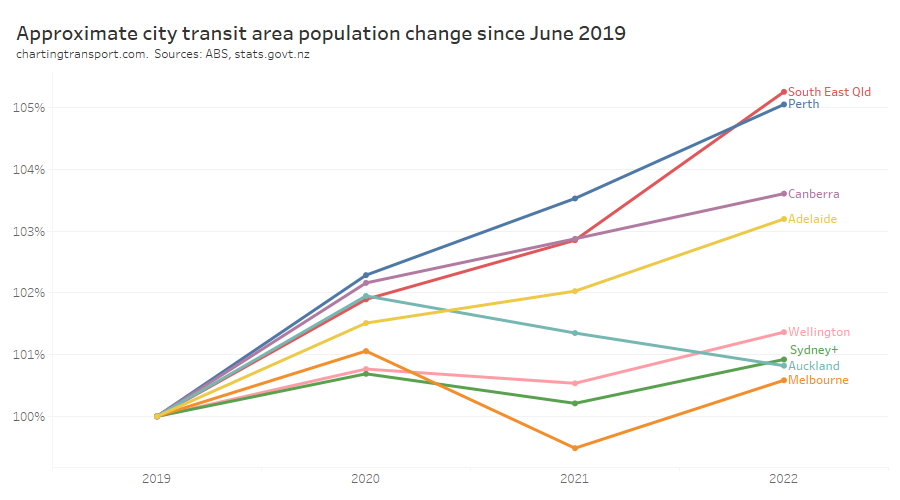
I’ve calculated the change in population for each city since June 2019. For South East Queensland I’ve used an approximation of the Translink service area, and for “Sydney+” I’ve used an approximation of the Opal fare region covering Sydney and surrounds. At the time of writing, population estimates were only available until June 2022.

There are significant differences between the cities.

So how does public transport patronage recovery compare to population change? The following chart shows June 2022 patronage and population as a proportion of June 2019 levels:

The changes in population are much smaller than the changes in patronage and I have deliberately used a similar scale on each axis to illustrate this. Population growth certainly does not explain most of the variation in patronage recovery, but it is very likely to be a factor.

Perth had the highest patronage recovery in June 2022, but only some of this could be attributed to high population growth. Wellington had little population growth but the second highest patronage recovery to June 2022.

Perth might have the highest patronage recovery rate overall because it spent the least amount of time under lockdown, and so commuters had less time getting used to working at home. Melbourne, Sydney, Canberra, and Auckland spent the longest periods under lockdown, and – with the exception of Canberra – seem to be tracking at the bottom end of the patronage recovery ratings, which might reflect their workers becoming more comfortable with working from home during the pandemic. However I’m just speculating.

How has patronage recovery varied by day type?

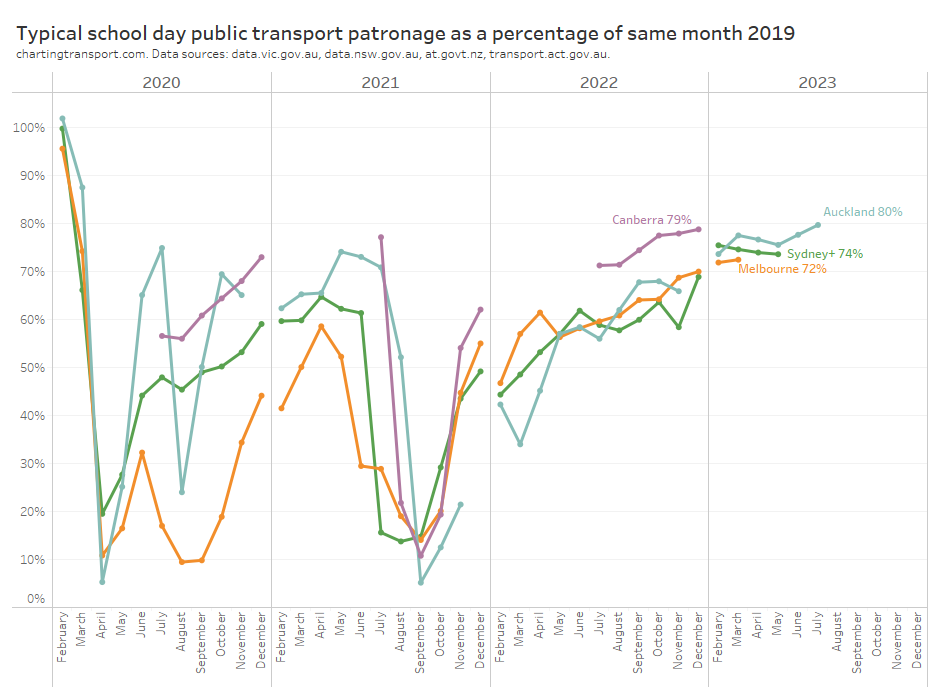
Here’s patronage recovery for school weekdays (for cities which publish weekday data):

Note: Canberra estimates are only available for July to December because daily patronage data has unfortunately not been published for January to June 2019.

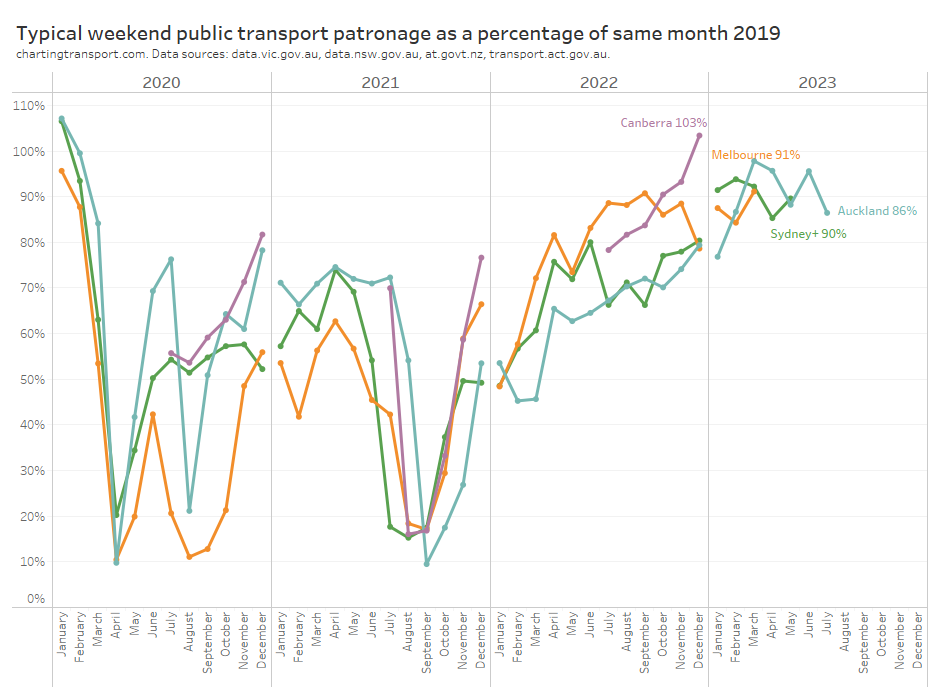
And here is the same for weekends (again for the same four cities that publish weekend data):

Weekend patronage is a bit more volatile as weekends typically have varying levels of major events and planned service disruptions. Most months also only have 8 weekend days, so a couple of unusual days can skew the month average and create “noise” in the data.

However all cities have been above 90% patronage recovery on weekends. Weekend patronage has returned more strongly than weekday patronage, probably because new remote working patterns only significantly impact weekdays.

How has patronage recovery varied between cities by mode?

I’m only confident about predicting modal patronage in cities that report daily or average day type patronage by mode, as the day type weightings used from another city might not apply equally to all modes.

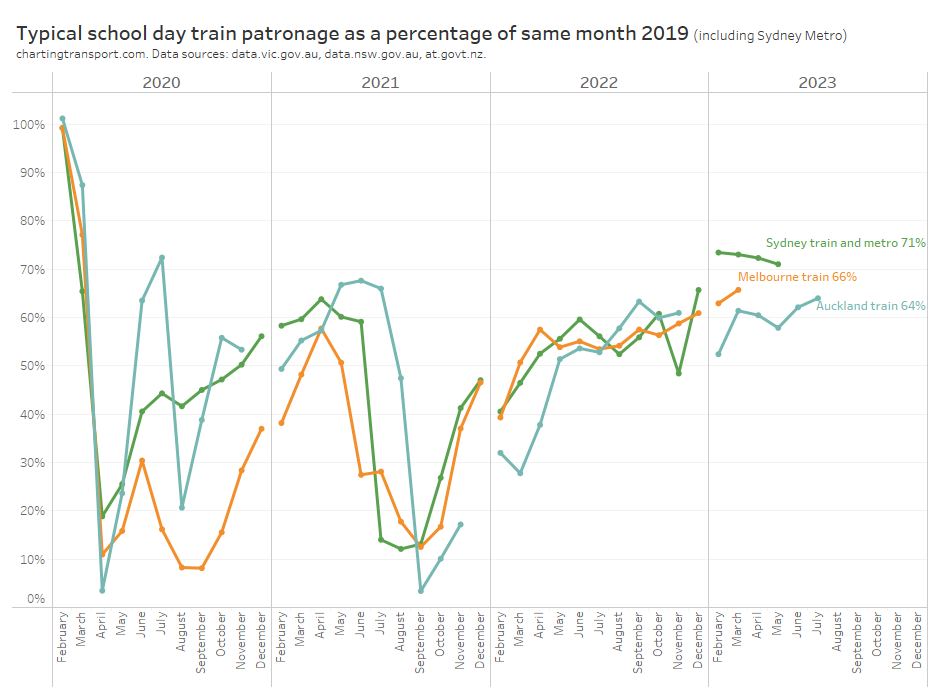
Here is school weekday train patronage recovery for Sydney, Melbourne, and Auckland:

Auckland is slightly below Sydney and Melbourne, and recovery rates are lower than public transport overall. I suspect this may be due to train networks having a significant role in CBD commuting – a travel market most impacted by remote working.

And here is the data for weekends:

Curiously there is a lot more variation between cities. There’s also a lot more variation between months, which could well be related to the “noise” of occasional planned service disruptions and major events.

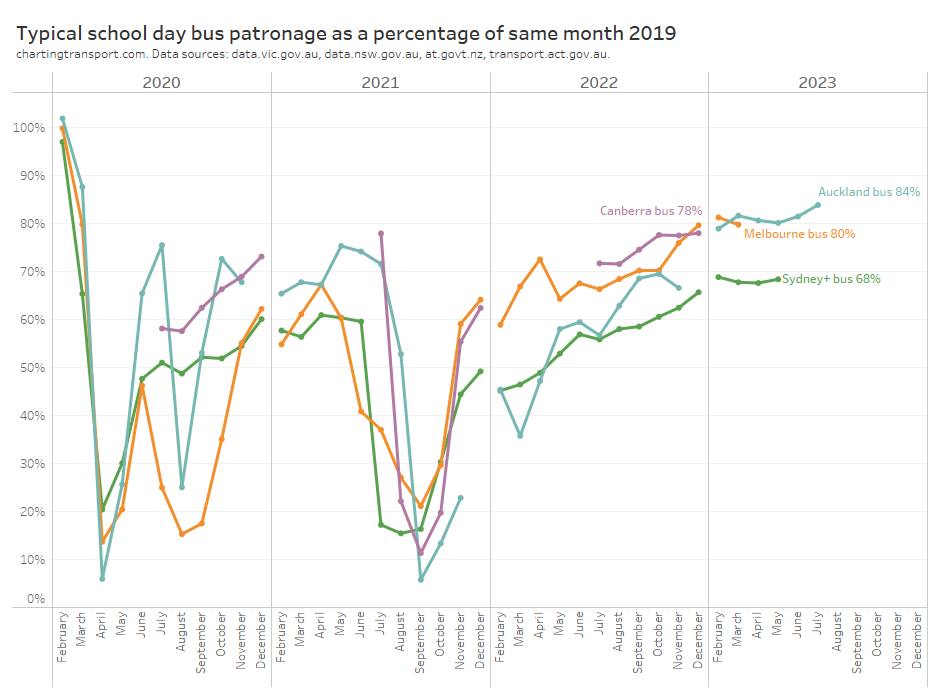
Here is average school day bus patronage for four cities where data is available:

Bus patronage recovery is lowest in Sydney, perhaps because buses play a more significant role in Sydney CBD commuter travel which will be impacted by working from home (Melbourne’s bus services are mostly not focussed on the CBD). However buses also play a major role in public transport travel to the CBDs of Auckland and Canberra, although with probably lower public transport mode shares (unfortunately it doesn’t seem possible to get public transport mode share for the Auckland CBD from 2018 NZ Census data).

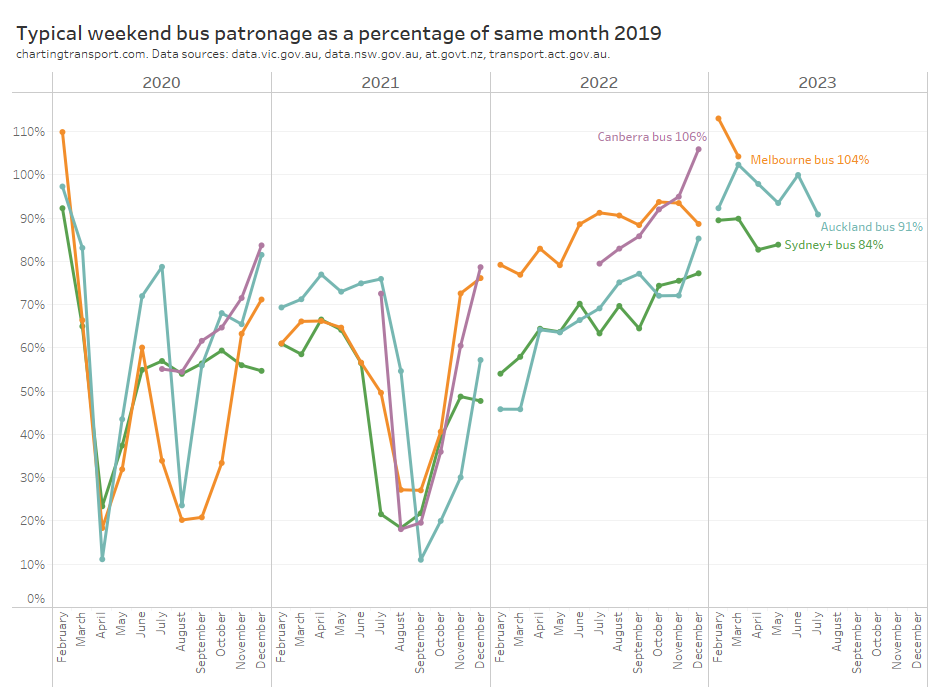
And for completeness, here is a chart for weekend bus patronage:

Weekend bus patronage recovery is higher than weekdays, and higher than weekend train patronage recovery, in all cities. Reported weekend bus patronage in Canberra, Melbourne, and Auckland has exceeded 2019 level in recent months.

How good are these estimates?

Some agencies publish very useful data such as daily patronage or day type average patronage, while others only publish monthly or quarterly totals which is much less useful for trend analysis. Here’s a summary of how I estimated time-series patronage and therefore patronage recovery in each city (which I will explain below).

City/regionData used to estimate time-series patronageConfidence
MelbourneReported average patronage by day of the week and day typeHigh
Sydney+ = Greater Sydney, Newcastle/Hunter, Blue Mountains, Wollongong (Opal catchment)Reported average school weekday and average weekend day patronage per month (dashboard)Moderate
South East Queensland (Translink) – including Brisbane, Gold Coast, Sunshine CoastReported weekly totals, aggregated to months, and adjusted by day type weightings calculated for Melbourne 2022.Lower
AdelaideReported quarterly totals, adjusted by day type weightings calculated for Auckland 2022.Lower
PerthReported monthly totals, adjusted by day type weightings calculated for Auckland 2022.Lower
CanberraReported daily patronage (from July 2019) and monthly total patronage for May and June 2019 adjusted by day type weightings calculated for Canberra 2022 (weekdays) and 2019 (weekends and public holidays). Data pre-May 2019 has been excluded as there was a step change in boardings when a new network was implemented in late April 2019. May 2019 has been included however I should note it had unusually high boardings.Moderate
AucklandReported daily patronage (up to 23 July 2023 at the time of writing).High
WellingtonReported monthly totals, adjusted by day type weightings calculated for Auckland 2022.Lower

For Melbourne and Auckland excellent data is published that allows calculation of typical school week patronage for February to December, which gives me high confidence in the estimates. Canberra has published daily patronage data but only from July 2019 so I’ve had to estimate school week patronage for May and June 2019 from monthly totals (process described below).

You’ll notice I’ve referred to “typical” patronage rather than average patronage. For cities with daily data, I’ve summed the median patronage of each relevant day of the week, rather than taking a simple average of days of that day type in the month. Taking the median can help remove outlier days, and summing over the days of the week means I’m weighting each day of the week equally, regardless of how many occurrences there are in a month (eg a month with 5 Sundays and 4 Saturdays). For Melbourne I’ve only got the average patronage per day of the week, but I’m still summing one value of each day of the week.

Transport for NSW have an interactive dashboard from which you can manually transcribe (but not copy or download) the average school weekday patronage and average weekend daily patronage for each mode and each month. I’ve compiled a typical school week estimate using 5 times the average school weekday plus 2 times the average weekend day. This is likely pretty close to what true average school week patronage is (more discussion below).

But what about the other cities?

How can you estimate patronage trends in cities where only monthly, quarterly, or weekly total patronage data is available?

Rather than simply calculating percentage patronage recovery on monthly totals (which has all the issues I explained in my previous post), I’ve made an attempt to compensate for the day type composition of each month in each city.

Basically this method involves calculating a weighting for each month, based on the day type composition of each month. If you divide total monthly patronage by the sum of weightings for all days of each month you can get a school weekday equivalent figure on which you can do time series analysis.

This requires a calendar of day types, and assumptions around the relative patronage weightings of each day type.

I’ve compiled calendars for each city using various public sources (including this handy machine readable public holiday data by data.gov.au).

Technical note: In New Zealand it seems schools generally are able to vary their start and end of year by up to 5 regular weekdays. I’ve excluded these 10 weekdays from many calculations because they do not represent clean school or school holiday weekdays. For December 2019 I have also excluded two weeks for Auckland due to unusually low reported patronage due to bus driver industrial action.

The assumed day type weightings need to come from another city, on the hope that they will be similar to the true value. But which city, and measured in what year?

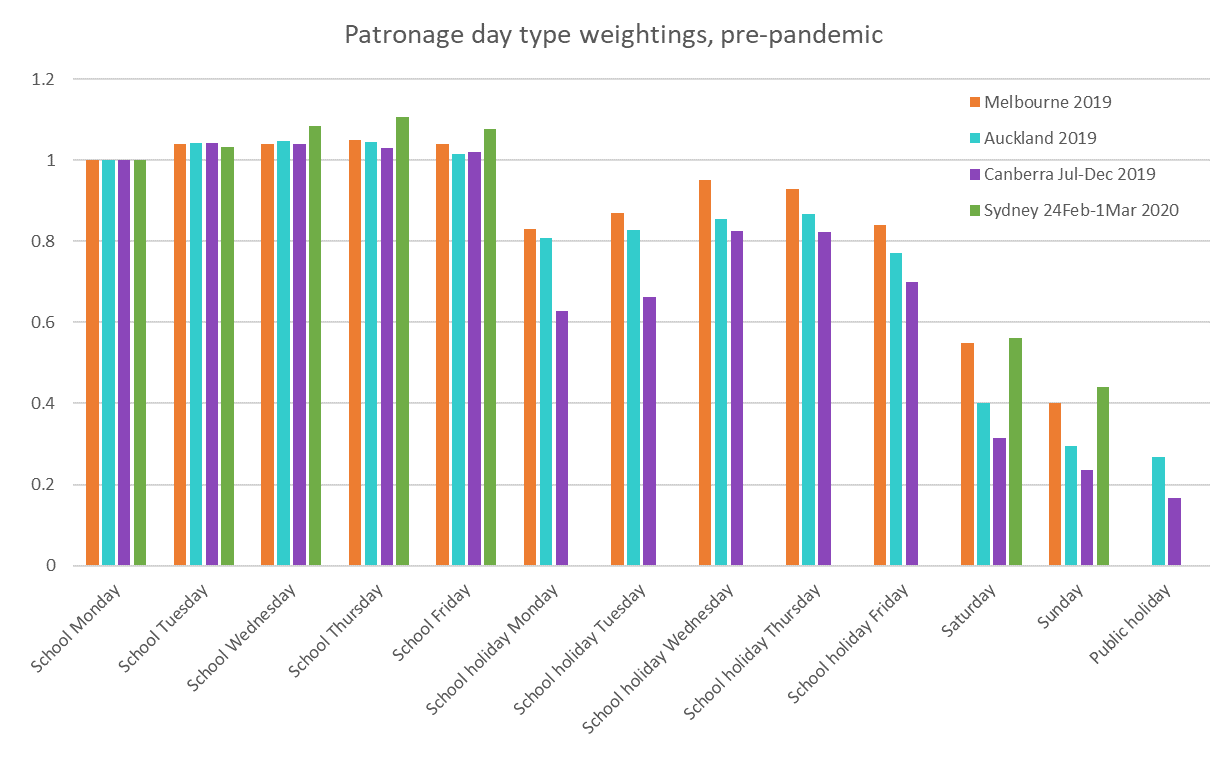
I’ve calculated the relative patronage weights of each day type for Melbourne, Canberra, Auckland, plus one school week sample from February 2020 for Sydney+ (Opal region). These are indexed to a school Monday being 1.

Note: no data is available for public holidays in Melbourne, and the Sydney data does not include school holiday weekdays or public holidays.

Melbourne, Canberra, and Auckland weightings are pretty similar across days of the week for school days, but Melbourne’s school holiday weekdays and weekends were relatively busier than both Auckland and Canberra. The Canberra school holiday figures are highly variable between weekdays and are only available for the second half of 2019 (so are impacted more significantly by the timing of Christmas).

The data suggests the big cities of Sydney and Melbourne attract much more weekend patronage compared to the smaller cities. They also have higher public transport mode shares – refer Update on Australian transport trends (December 2022) for comparisons between Australia cities. In terms of public transport share of journeys to work, Auckland was at around 14% in 2018, while Melbourne was 18.2% in 2016). This suggest Melbourne day type weightings might be suitable for larger cities while Auckland day type weightings might be suitable for smaller cities.

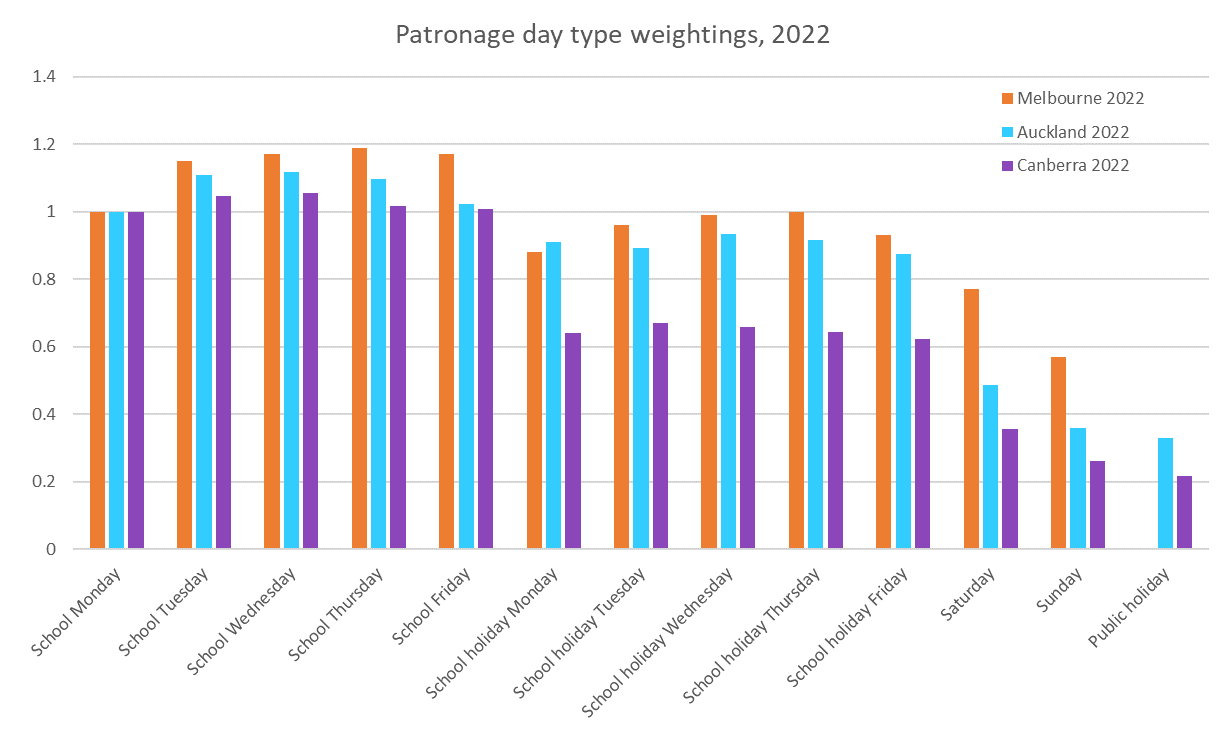
The next question is: which year’s weightings should be used? The chart above showed day type weightings from pre-pandemic times, but it turns out they have changed a bit since the pandemic. Here are 2022 day type weightings:

In all cities in 2022 there is a lot more variation across Monday to Friday school days (Mondays and Fridays being popular remote working days) and school holiday weekdays are much more similar between Melbourne and Auckland, while weekends remain quite different.

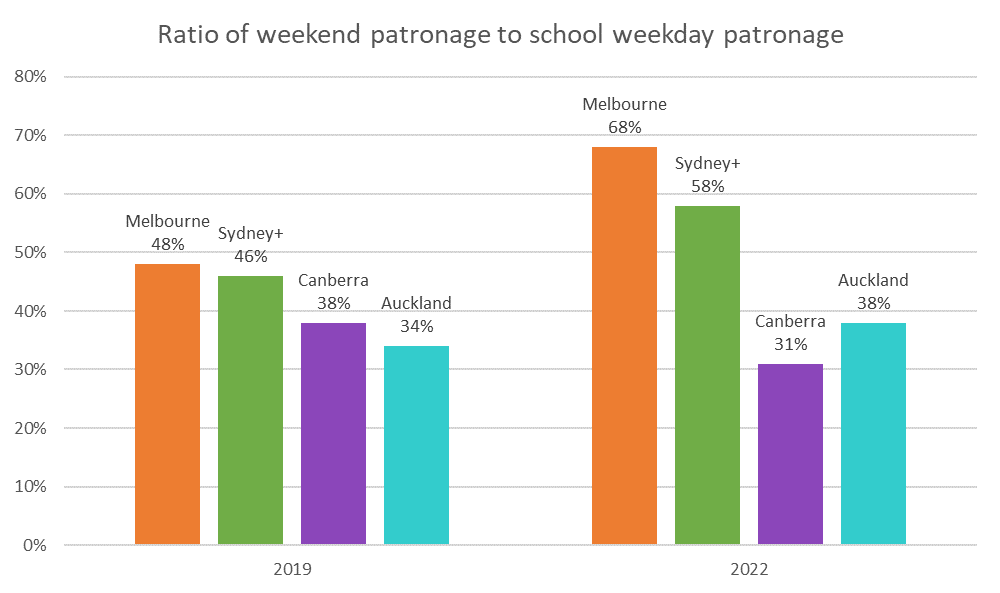
In fact here’s how the cities with available data compare for ratios between weekends and school weekdays in 2019 and 2022:

The ratios increased in all cities between 2019 and 2022 except Canberra. The 2019 ratios are remarkably close between Melbourne and Sydney, but the 2022 data shows a higher weighting for weekends in Melbourne than Sydney. The Auckland and Canberra ratios are substantially lower in both years. The ratio went down in Canberra in 2022 possibly due to issues obtaining enough drivers to run weekend timetables in that city.

So what day type weightings should we use for each city?

Should we use Melbourne, Auckland, or Canberra weightings, and from what year should we derive these weightings? And how worried should we be about getting these weightings right?

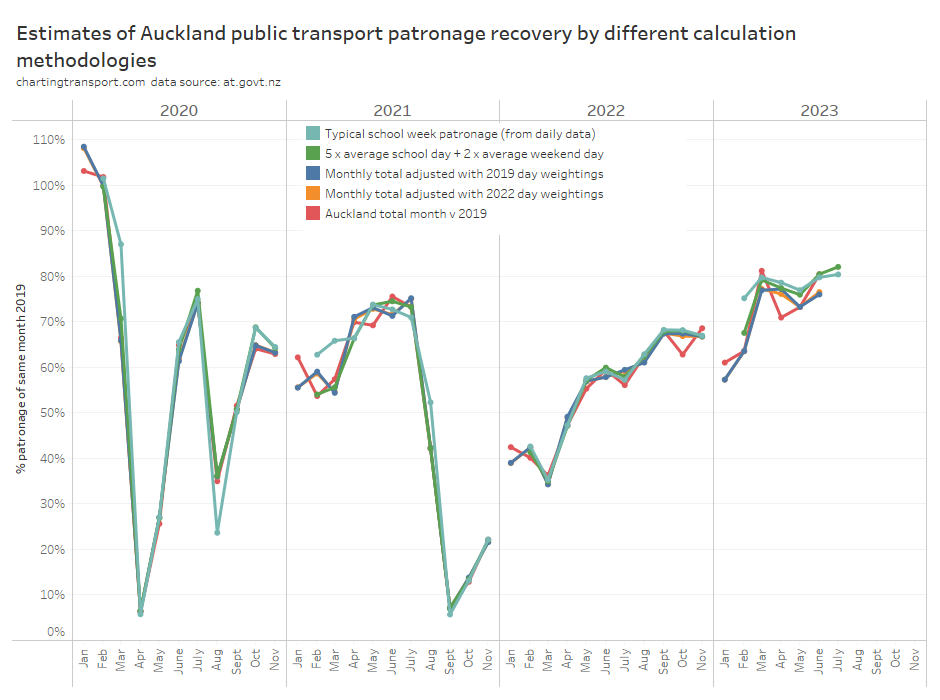
Well, Auckland provides us with daily patronage data for a “medium sized” city, which allows us to compare calculated typical school week patronage, and also allows calculations as if only more summary data was available (as per other cities). However we need to exclude both January and December, as there were no normal school weekdays in those months in 2019.

The red line (total monthly patronage with no calendar effect adjustments) has the most fluctuations month to month and I’m pretty confident this is misleading for all the reasons mentioned in my last post.

Most of the other methodologies produce a figure fairly close to the best estimate (teal line), except in 2021 and 2023.

The green line (compiled 5 x average school day + 2 x average weekend day) is mostly within 2% of the (arguably) best estimate, but there are variations that will be explained by the green line not taking into account the day of the week composition of the month, nor excluding outlier busy/quiet days (unlike medians). So if you only have average school weekday and average weekend day data you’re not going to be too far off the best estimate. That gives me “moderate” confidence to use Sydney’s average school weekday and average weekend day patronage data to estimate patronage recovery.

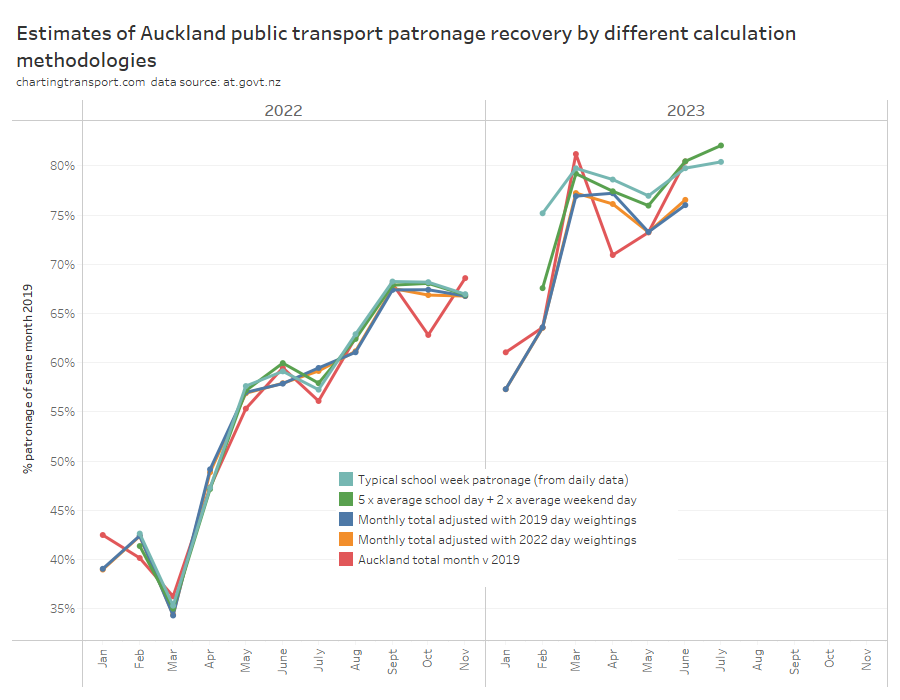
But what if you only have total monthly patronage and have to use day type weightings? It’s a bit hard to see the differences in the above chart, so here’s a zoom in for 2022 and 2023:

There’s not a lot of difference between the 2019 and 2022 day type weightings, and notably both methods underestimate patronage recovery for most months of 2023, which is not ideal. Note: February 2023 had several days of significant disruptions due to major flooding events which impacted most measures (except the “typical school week” measure that uses medians to reduce the impact of outliers).

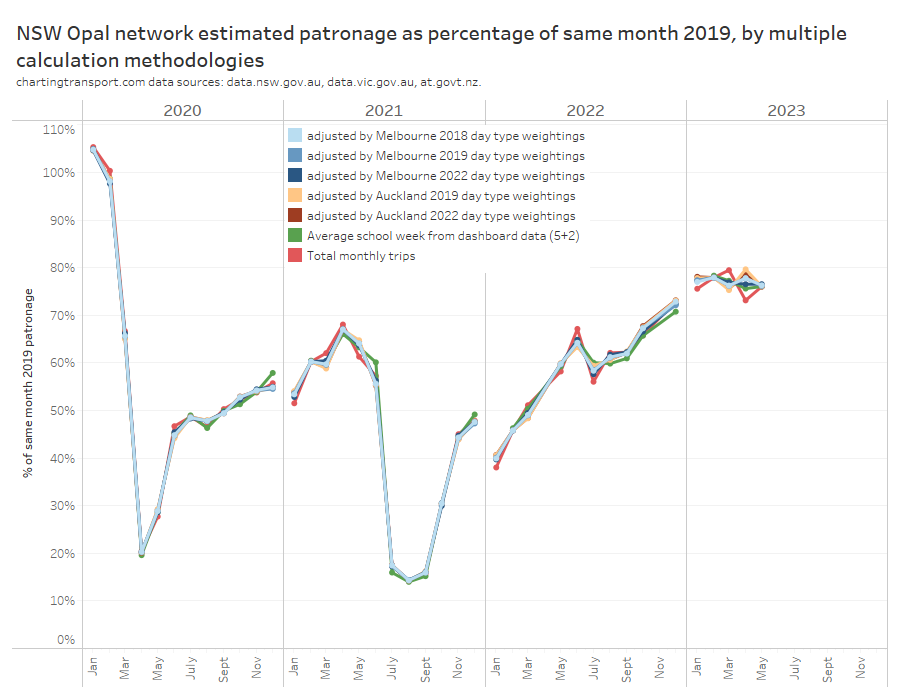
Sydney also provides data that allows us to compare day type weighting estimates to the probably quite good compiled school week estimate (based on 5 average school weekdays and 2 average weekend days). The next chart includes estimates of Sydney patronage recovery using day type weightings from Melbourne and Auckland for different years:

Technical note: I have assumed Melbourne public holidays have the same day type weighting as Sundays, for want of more published data.

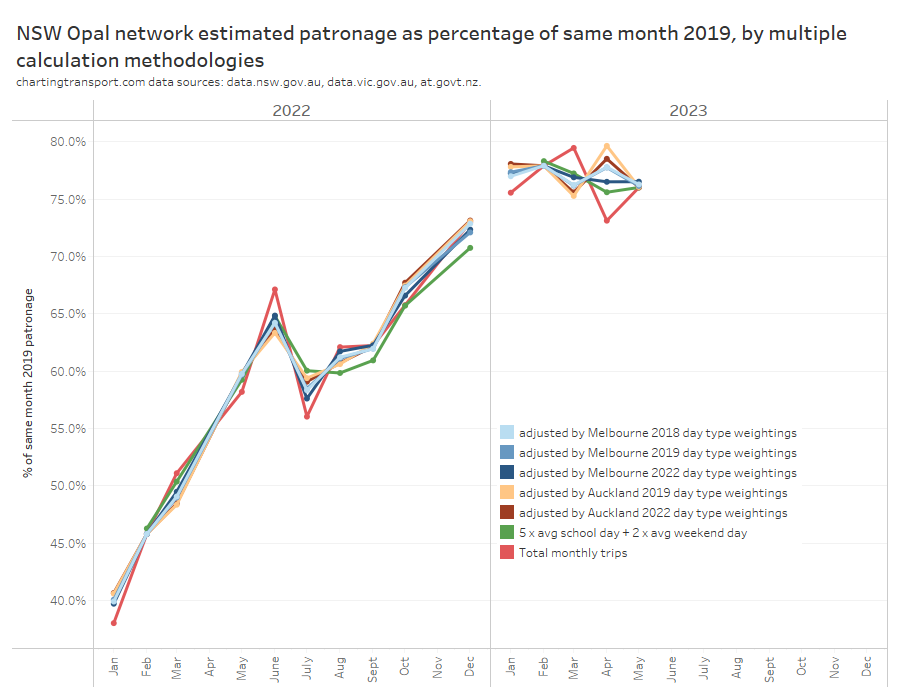
The estimates are mostly pretty close, but let’s zoom into recent months to see the differences between the methodologies more clearly:

The closest estimate to the compiled average school week data is using Melbourne 2022 day type weightings to adjust monthly totals (the difference is up to 0.9% in April 2023). This suggests Melbourne is probably the best city from which to source day type weightings to apply to Sydney (both large cities), and 2022 (a post-pandemic year) might be a better source year for these weightings. That’s consistent with Sydney having similar ratios of weekday to weekend patronage as Melbourne.

You can see the red line (a simple total monthly patronage comparison) is again often the biggest outlier, which is what happens when you don’t control for calendar effects. I mentioned at the start of my last post that the raw monthly totals suggested a misleadingly large 6.4% drop in patronage recovery from 79.5% in March 2023 to 73.1% in April 2023. On the average school week estimates, patronage recovery dropped only 1.8% from 77.2% to 75.6%.

So which city’s day type weightings are most appropriate for the smaller cities of Perth, Adelaide, Wellington, and Brisbane that don’t currently publish day type patronage? Does it even make a lot of difference?

Well here are patronage recovery estimates for Adelaide, Brisbane, Wellington, and Perth using both Melbourne and Auckland day type weightings from 2022.

Most of the estimates are within 1%, although there are some larger variances for Wellington and Perth.

The Wellington recovery line is smoother for Melbourne weightings in 2021, but smoother with Auckland weightings in 2022 and 2023 (so far). The Wellington estimates can differ by up to 2% and a smoother trend line may or may not mean that one source city for day type weightings is better than the other.

The fact that Melbourne day weightings worked better than Auckland day weightings when it came to Sydney suggests that larger city weightings might be appropriate for other large cities, and perhaps smaller city weightings might be appropriate for other smaller cities.

I have adopted Melbourne day type weightings for South East Queensland, and Auckland day type weightings for Adelaide, Perth, and Wellington, on the principle that larger cities are likely to have relatively higher public transport patronage on weekends (compared to weekdays). Of course I would really rather prefer to not have make assumptions.

That was pretty complicated and involved – is there a lazy option?

Okay, so if you don’t have – or want to compile – calendar data and/or you don’t want to use day type weightings from another city, you can still compile rolling 12 month patronage totals and compare those year-on-year to estimate patronage growth.

The worst times of year at which to measure year-on-year patronage growth are probably at the end of March, June, September, and December (because of when school holidays fall). Of course being quarter ends, these are also probably the most common times it is measured!

It’s slightly better to measure year on year growth for 12 month periods ending with February, May, August, and/or November, as years ending in these months will contain four complete sets of school holidays, and exactly one Easter (at least for countries with similar school terms to Australia and New Zealand). However there will still be errors because of variations in day type composition of those 12 month periods.

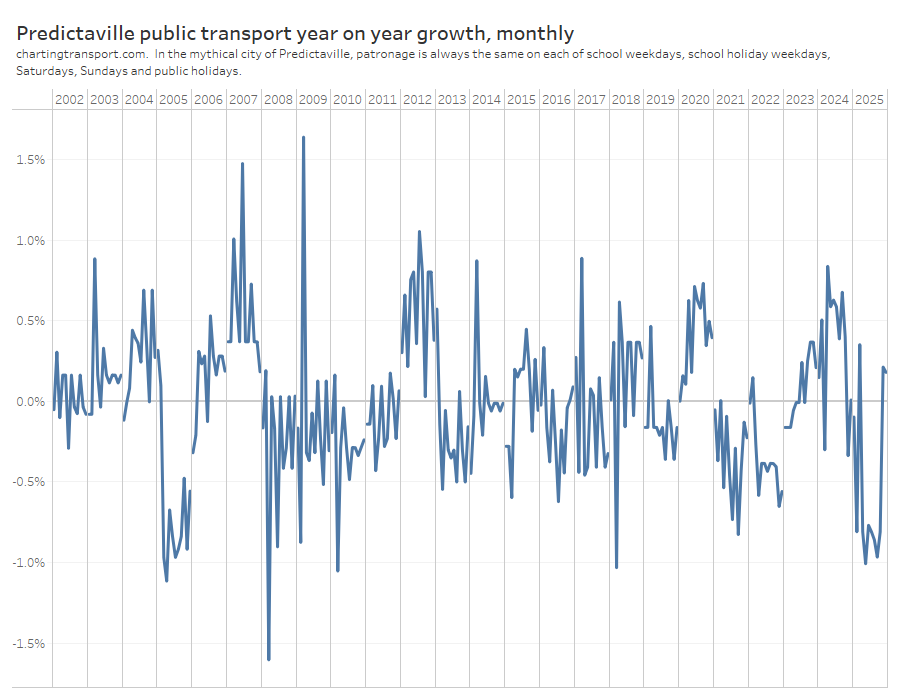
In my last post I introduced the mythical city of Predictaville, where public transport patronage is perfectly constant by day type and they follow Victorian school and public holidays. Here is what Predictaville patronage growth would look like measured year on year at end of November each year:

Calculated growth ranges between +0.8% and -0.9%, which is about half as bad as +1.6% to -1.6% when measured at other month ends, but still not ideal (the true value is zero). The errors in the real world will depend on the relative mix of patronage between day types (Predictaville patronage per day type was modelled on Melbourne’s buses).

That’s a not-too-terrible option for patronage growth, but if you are interested in patronage recovery versus 2019 on a monthly basis, I’m not sure there is any reasonable lazy option.

Let’s hope the usefulness of published patronage data improves soon so complicated assumptions-based calendar adjustments and problematic lazy calculation options can be avoided!


We need to do better at reporting and analysing public transport patronage

Wed 12 July, 2023

Sydney’s public transport total patronage in March 2023 was at 79.5% of March 2019 patronage, but then April 2023 total patronage was 73.1% of April 2019 patronage. Does that mean there was a 6.4% decline in the rate of public transport use in April 2023? Actually, no, not at all.

The most common, simple, and obvious way to report public transport patronage is monthly totals. Plenty of agencies do this, but I’m here to argue that invites bad analysis and false conclusions. We can and need to do better.

Let me explain…

Not all days are the same

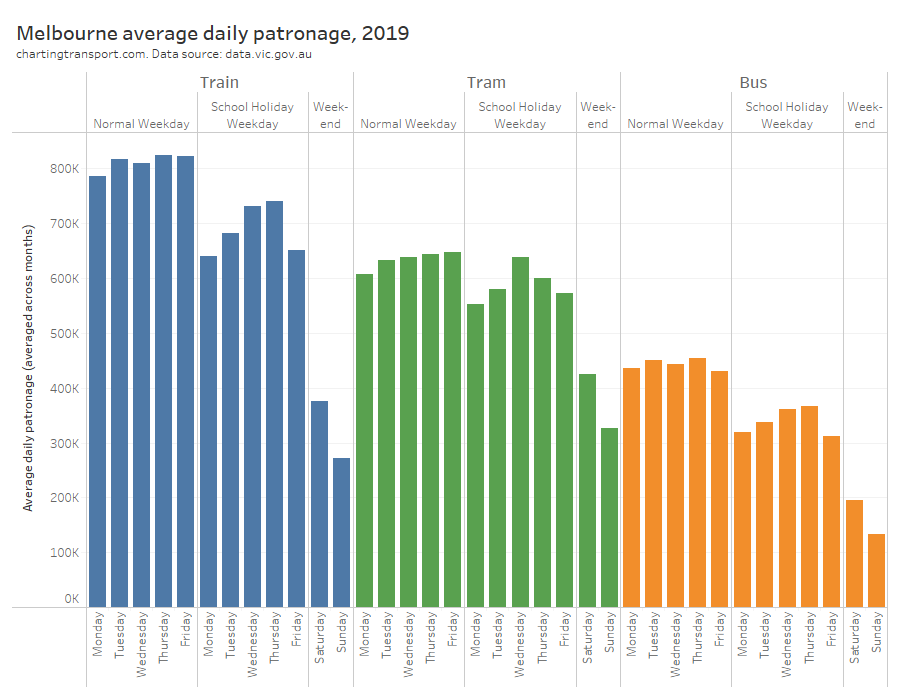
This is stating the obvious, but patronage generally varies by day of the week, and also between school and non-school weekdays. Here’s how it looks for Melbourne 2019 (thanks to newly published data):

The variations across Monday to Friday have increased even more post the pandemic, but that’s another story.

Not all months are the same

Obviously months are not all the same length. A month with 31 days is generally likely to have higher patronage than a month with 28 or 30 days.

Also, most months have a number of days that is not a multiple of 7 – which means that any month is going have a different mix of days of the week in any year (although three-quarters of Februarys are an exception). And we know patronage varies by individual day of the week.

Furthermore, school holidays and public holidays don’t always fall in the same months each year. In particular, Easter is sometimes in March and sometimes in April, and many jurisdictions shift school holidays to line up with Easter in each year. The end result is that the composition of each month can vary considerably between years, both in terms of days of the week and day types.

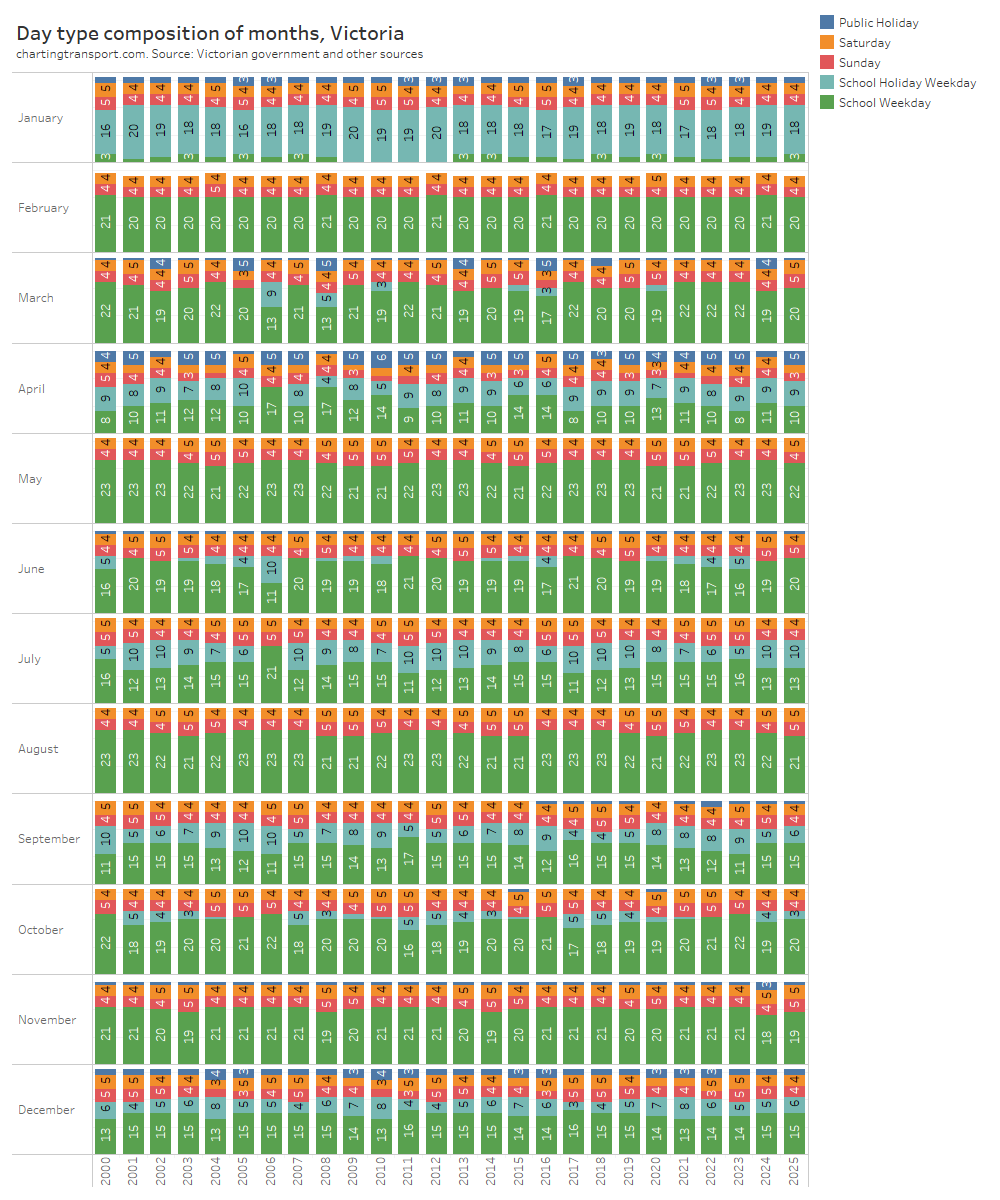
Here’s the day type make up of each month for Victoria for 2000 to 2025:

Some months are pretty consistent – May generally has 21 to 23 school weekdays. But other months vary wildly. March can have anywhere between 8 and 17 school weekdays and anywhere between 1 and 5 public holidays (counting all days of the Easter long weekend as public holidays). There are also big fluctuations in June and July, with school holidays mostly falling in July but sometimes partly or fully in June. And any given month might have 4 or 5 Saturdays and 4 or 5 Sundays (or maybe even 3 if one of them is a public holiday).

In March 2006, Victorian autumn school holidays were in March (when Melbourne hosted the Commonwealth Games) instead of the normal April, and the winter school holidays were entirely in June (normally mostly in July). This will happen again in 2026 when Victoria again hosts the Commonwealth Games.

Not all quarters are the same

If months are quite variable in composition, does aggregating to quarters reduce the issues?

In Victoria (and most Australian states), school holidays generally straddle or fall very close to the start/end of quarters. This means there is a fair amount of variability in the day type makeup of most quarters:

In Victoria, quarter 1 can have anywhere between 35 and 44 school days, and between 3 and 7 public holidays. You might also notice that a new Q3 public holiday was introduced in 2016 (Grand Final Eve in late September), and then there was a one-off extra public holiday for the Queen’s death in 2022. The number of public holidays also increases when Christmas Day falls on a Saturday or Sunday.

If you want to understand underling patronage trends, you don’t want to be led astray by these sorts of changes. Quarters are no better than months for analysing total public transport patronage.

Not all financial years are the same either

Another very common way to report patronage data – especially in annual reports – is by financial years (July – June) but they aren’t all that consistent over time either, given that school holidays can slide between June and July, like has happened in Victoria:

Hopefully you’ve got the idea that it isn’t a great idea to analyse total monthly, quarterly, or even financial year patronage if you want to assess trends over time. Yet that’s exactly the most common data you are likely to find.

Calendar years are slightly better for day type composition consistency, but in Victoria calendar years can vary between 50 and 54 school holiday weekdays. And of course every fourth year is one day longer than the others.

A better way: average daily patronage by day of the week and day type

Victoria is now publishing average daily patronage by day of the week and day type (school or non-school weekday) for each month (excluding public holidays).

This means it is possible to compile average school week patronage (being the sum of average daily Sunday, school Monday, school Tuesday, school Wednesday, school Thursday, school Friday, and Saturday patronage). An average school week patronage figure is readily calculable for all months except January (because they have few school days and variable start dates between schools make it a bit messy).

An average school week figure can be calculated regardless of shifting dates of school holidays, public holidays and the general day of the week composition of any month across years. And analysts don’t need to worry about having their own calendar of school and public holidays.

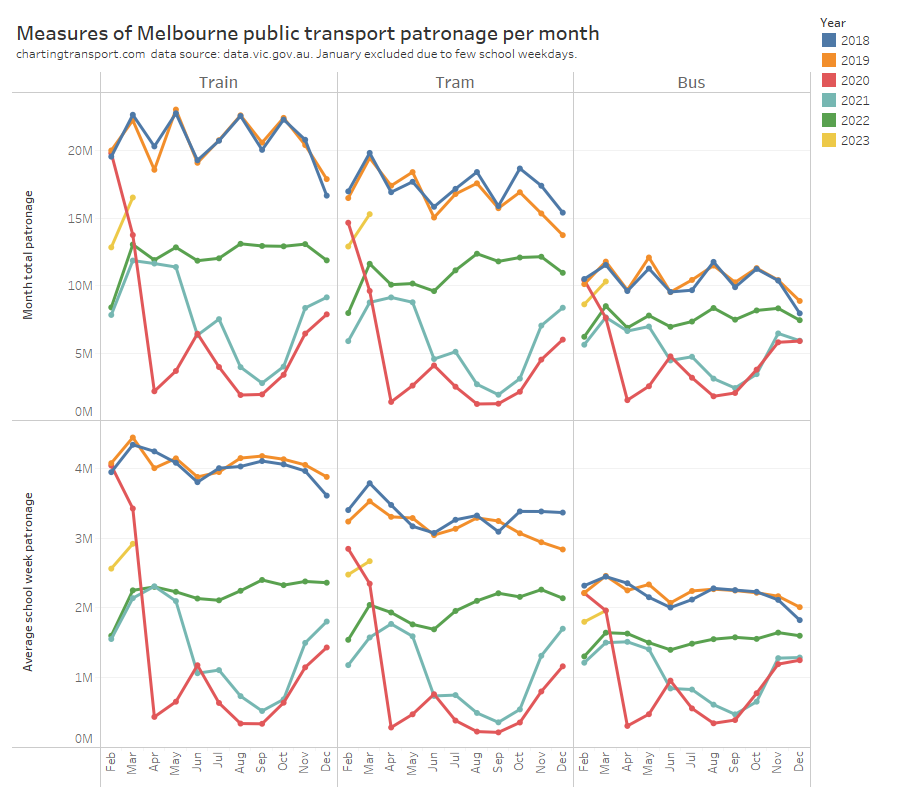
How much cleaner is average school week patronage? Victoria also publishes monthly totals, which makes it possible to compare to average school week figures, as per the following chart:

Note: This time period of course includes the COVID pandemic including lockdowns which is interesting in itself, but for the point of this post I suggest you focus on pre-pandemic years 2018 and 2019.

Monthly total patronage jumps up and down a fair bit in 2018 and 2019 (with higher totals for most 31-day months, who would have guessed?), but average school weekday patronage was relatively smooth across the year as you might expect. The average school week patronage data also shows clearly that March is the busiest month of the year. But if you looked at the monthly totals you might draw the false conclusion that days in May are generally as busy as days in March (at least for 2018).

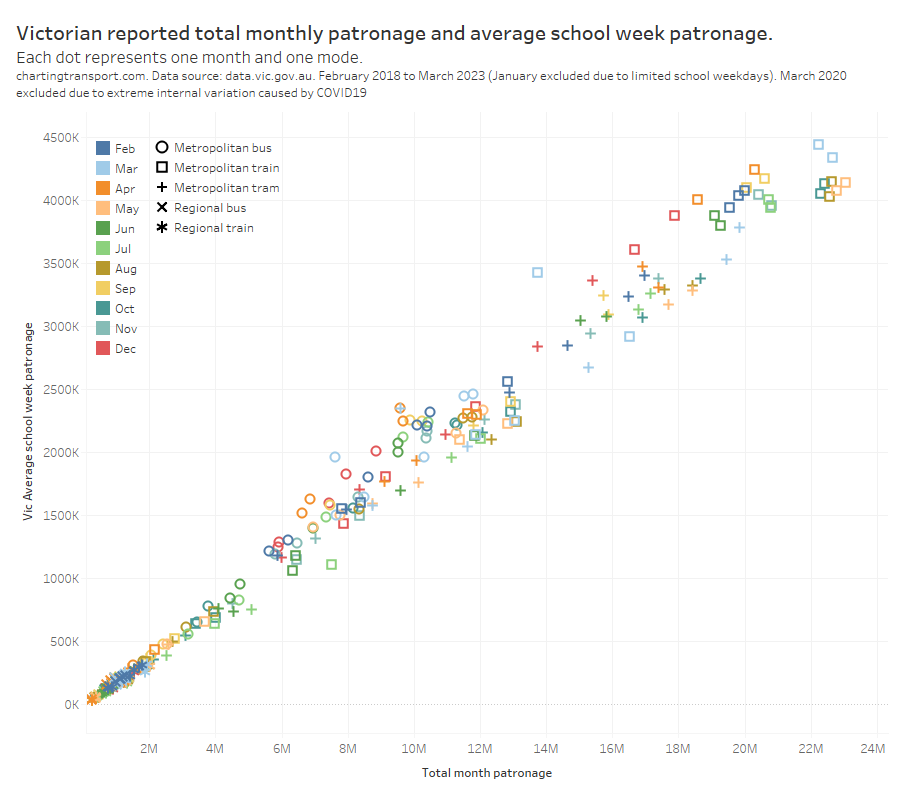
To further illustrate the differences, the next chart compares monthly average school week patronage to total monthly patronage, for all months February 2018 to March 2023 (excluding Januarys). Each dot is a mode and a month/year, and if total monthly patronage was as good a representation of patronage as school week patronage then this would need to be a fairly thin cloud as data points.

You can see the cloud is not very thin. March and April are often outliers, as they are subject to shifting Easter and school holidays.

March 2020 is actually one of the biggest outliers – as it was also when Melbourne first went into a COVID lockdown.

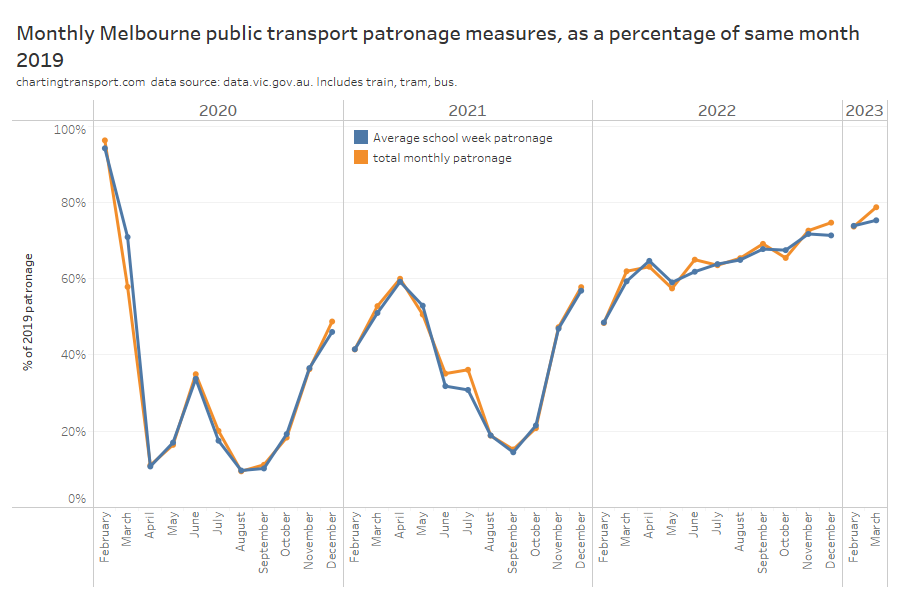
Another common form of analysis in recent (pandemic) times has been to compare monthly patronage to the same month in (pre-pandemic) 2019, to get an indication of patronage recovery. The following chart shows patronage relative to 2019 using both total monthly patronage and average school week patronage for Melbourne’s public transport:

You can see the orange line (total monthly patronage) is prone to bouncing around month to month, while the blue line (average school week) generally shows a smoother trend. Someone not knowing any better might have been slightly alarmed or confused about the steep decline in total monthly patronage recovery in October 2022, whereas on the average school week measure it was only a slight drop on September 2022 (perhaps because of planned disruptions to the network?).

Total March 2023 Melbourne public transport patronage was 78.8% of the total in March 2019, but 75.3% of the March 2019 average school week patronage. The total monthly patronage approach arguably overestimates the likely underlying patronage recovery by 3.5%.

How much noise gets introduced when analysing monthly totals?

Let me introduce you to the mythical city of Predictaville. Nothing ever changes in Predictaville. There is no population growth, no behaviour change, no pandemics, no seasons, no illness. It’s very boring and entirely predictable.

Every school weekday there are exactly 440,000 public transport boardings, every school holiday weekday it is 340,000, every Saturday 195,000, Sunday 135,000, and public holiday 110,000. Remarkable round numbers, I know. It’s been like this since 2001 and all indications are that it will be like this until at least 2025.

These numbers just happen to be pretty similar to average Melbourne bus patronage in 2019, and Predictaville just happens to follow the Victorian school and public holiday calendar.

So public transport patronage growth in Predictaville is going to be exactly zero all the time, right?

That’s what you will get when measuring growth by average school weeks.

But what if you were measuring growth year on year using total monthly patronage?

According to this measure, patronage in Predictaville sometimes grows at +1.6% per annum and sometimes declines at -1.6% per annum. You might think 2012 and 2020 were growth years, while 2005, 2008 and 2021 saw declines. All misleading.

This is actually a chart indicating the sort of avoidable error introduced when you do analysis on total monthly patronage. We don’t need and shouldn’t have this sort of error in our analysis; particularly if it is going to influence policy decisions.

How is patronage data being reported in Australia and New Zealand now?

At the time of writing…

Transperth and Wellington’s Metlink only publish monthly totals, which is problematic, as explained above.

Transport for NSW publishes monthly total patronage which is likewise problematic.

They also have an interactive dashboard that effectively provides average weekday patronage, average school weekday patronage, and average weekend/public holiday daily patronage (but not average school holiday weekday patronage). Unfortunately you cannot download this data, and it doesn’t take into account that different months contain different numbers of Sundays, Mondays, Tuesdays, Wednesday, Thursdays, Fridays, and Saturdays. We know patronage varies by day of the week. Worse still, there is likely a significant difference between typical Saturday and Sunday patronage and different months might have 4 or 5 Saturdays and 4 or 5 Sundays. This means the average weekend daily patronage figures have avoidable misleading variations between months and years.

NSW have also published very detailed Opal data for selected weeks in 2016 and 2020 (only two were pre-pandemic school weeks), but no such data on an ongoing basis.

Transport Canberra reports average weekday and weekend daily boardings by quarter, but doesn’t distinguish school and non-school weekdays and bundles public holidays with weekends, which makes it very difficult to cleanly analyse growth trends. However they also publish daily data which is useful, but you need a calendar of school and public holidays.

The South Australian government reports quarterly Adelaide boardings (buried in a dataset about complaints) which is problematic as I’ve explained above. You can also get daily Metrocard validations by route (not quite the same as boardings), although exact numbers are not reported – just bands in multiples of 10, which makes it pretty much impossible to sum to estimate total daily patronage.

Translink (south east Queensland) publishes weekly passenger trip counts (to 2 decimal places!), which is slightly better than monthly, but analysts still need to have their own calendar of school holidays or public holidays to make sense of variations week to week. And at the time of writing data unfortunately hadn’t been updated since October 2022.

Auckland publishes monthly and daily patronage figures which is very handy. The daily data allows you to construct average school week patronage, but you need a calendar of school and public holidays.

So my plea to all agencies is to consider publishing average daily patronage by day type and day of the week, as Victoria now does. This will enable external analysts to do cleaner patronage analysis with much less effort. Perhaps an organisation like BITRE could even compile a national database of such data.

Even better would be for agencies to also publish daily patronage estimates, along with a day type calendar including school and public holidays, which would enable analysts to do even more with the data.

Can we do even better for patronage reporting and analysis?

Average patronage by day of the week and day type avoids much of the misleading variations in total monthly patronage data, helping us to better understand underlying trends.

But there will still be other smaller sources of misleading variations and you could definitely take this further, for example:

  • Filter out Mondays next to a Tuesday public holiday and Fridays next to a Thursday public holiday, as these are popular days for workers to take leave to create a long weekend.
  • Likewise, filter out weeks with more two or more public holidays falling within Monday to Friday – which are also popular times to generate longer holidays with fewer annual leave days.
  • Filter out the first / last weeks of the school year if some schools follow a slightly different calendar (particularly in New Zealand). I discarded January above partly for this reason. All Decembers (in Australia at least) will also be impacted by senior students finishing school earlier, but the impact might vary year to year.
  • Filter only for weeks where both school and most universities are teaching (although that leaves you with only about six months of the year, plus not all universities follow the same academic calendar).
  • Filter out any days with free travel or large-scale disruptions (planned or unplanned). For example, free travel is usually offered on New Year’s Eve and Christmas Day in Victoria. And Sydney had several free travel days following major unplanned disruptions in 2022.
  • Filter out Saturdays and Sundays on long weekends and during school holidays, which are probably more likely to be impacted by larger scale planned disruptions.

I mentioned at the start of this post that variations in Sydney monthly total patronage recovery figures were misleading, and hopefully you now understand why. In an upcoming post I’ll estimate underlying patronage recovery across big cities in Australia and New Zealand, and explain why I think actual underlying patronage recovery in Sydney didn’t change so much between March and April 2023.


How is population density changing in Australian cities? (2023 update)

Sat 10 June, 2023

This detailed post from 2023 does not include the population latest data. For the latest summary metrics, see Trends in major city population density.

With the release of more detailed 2021 census data and June 2022 population estimates, it’s now possible to look more closely at how Australia’s larger capital cities have changed, particularly following the onset of the COVID19 pandemic in 2020.

This post examines ABS population grid data for 2006 to 2023 for Greater Capital City Statistical Areas, including:

  • Trends in overall population-weighted density for cities;
  • Changes in the distribution of population living at different densities;
  • Changes in the distribution of population living at different distances from each city’s CBD;
  • Changes in population density by distance from each city’s CBD;
  • Changes in the distribution of population living at different distances from train and busway stations;
  • Changes in population density in areas close to train and busway stations;
  • The population density of “new” urban residential areas in each city (are cities sprawling at low density?); and
  • Changes in the size of the urban residential footprint of cities.

I’ve also got some animated maps showing the density of each city over those years, and I’ve had a bit of a look at how the ABS corrected population estimates for 2007 to 2021 following the release of 2021 census data.

For some other detailed analysis – and a longer history of city population density – see How is density changing in Australian cities? (2nd edition).

I’ve not included the smaller cities of Hobart and Darwin as they have a small footprint, and too many grid cells are on the edge of an urban area.

Population weighted density

My preferred measure of city density is population-weighted density, which takes a weighted average of the density all statistical areas in a city, with each area weighted by its population (this stops lightly populated rural areas pulling down average density – for more discussion see How is density changing in Australian cities? (2nd edition)).

I also prefer to calculate this measure on a consistent statistical area geography and the only consistent statistical area geography available for Australia is the square kilometre population grid published by the ABS.

With the recent release of 2021 census data, ABS issued revised population grid estimates for all years from 2017 onwards, which saw significant corrections in some cities (see appendix for more details). There has also been a slight change in the methodology for the 2021 grid that ABS say may result in a more ‘targeted representation’, but it’s unclear what that means.

Here’s the revised trend in population weighted density calculated on square km grid geography for Greater Capital City Statistical Areas in June of each year:

Sydney has almost double the population density of most other Australian cities (on this measure), with the exception being Melbourne which sits halfway in between.

Population weighted density was rising in all cities until 2019, although the growth was notably slowing in Sydney from about 2016.

The pandemic hit in March 2020 and led to a flatlining of density in Melbourne and a decline in Sydney by June 2020, while other cities continued to densify. Then Sydney and Melbourne’s population weighted density dropped considerably in the year to June 2021 – probably a combination an exodus of temporary international migrants and internal migration away from the big cities (particularly Melbourne that had experienced long lockdowns). Most other cities flatlined between June 2020 and June 2021.

Then by June 2022 density had increased again in all cities, after international borders reopened in early 2022.

I expect some fairly substantial changes between June 2022 and June 2023 in some cities as migration has surged further and rental vacancy rates have plummeted in several cities.

Population living at different densities

The following chart shows the proportion of the population in each city living at different density ranges over time:

All cities show a sustained pre-pandemic trend towards more people living at higher densities. However the pandemic saw significant drops in people living at the higher density categories in 2021 in Melbourne, Sydney, and Canberra.

So where was this loss of density? The next chart shows the change in population for grid squares across Melbourne between June 2020 and June 2021. Larger dots are more change, blue is an increase and orange is a decline:

You can see significant declines in population (and hence population density) in the inner city areas – so much so that the dots overlap. This is likely largely explained by the exodus of many international students and other temporary migrants.

You can also see population decline around Monash University’s Clayton campus in the south-eastern suburbs.

At the same time there were large increases in population in the outer growth areas, as is normally the case. Other pockets of population growth include Footscray, Moonee Ponds, Box Hill, Port Melbourne, Clayton (M-City), and Doncaster, likely related to the completion of new residential towers.

Here’s the same for Sydney:

There was significant population decline in the inner city and around Kensington (which has a major university campus), and the largest growth was seen in urban fringe growth areas to the north-west and south-west. Pockets of population growth were also seen at Wentworth Point, Eastgardens, Mascot, North Ryde, and Mays Hill, amongst others.

Here is the same for Brisbane:

Inner-city Brisbane was much more a mixed bag, which explains the less overall change in the density composition of the city. Some areas showed declines (including St Lucia, New Farm, Kelvin Grove, Coorparoo) while others saw increases (including Fortitude Valley, West End, South Brisbane, Buranda, CBD south).

Proportion of population living at different distances from the city centre

The next chart shows the proportion of people living at approximate distance bands from each city’s CBD over time:

All cities have seen a general trend towards more of their population living further from the CBD, with the notable exception of Canberra which has seen the outer urban fringe expanding by little more than a couple of kilometres at the most, and substantial in-fill housing at major town centres and the inner city (see also animated density map below). I should note that the Greater Capital City Statistical Area boundary for Canberra is simply the ACT boundary, and does not include the neighbouring NSW urban area of Queanbeyan, which is arguably functionally part of “greater Canberra”.

In 2021, Sydney and Melbourne saw a step change towards living further out, in line with the sudden reduction in central city population.

Population density by distance from a city’s CBD

Here’s an animated chart showing how population weighted density has varied by distance from each city’s CBD over time:

In most cities there has been a trend to significantly increasing density closer to the CBD, with central Melbourne overtaking central Sydney in 2017.

Sydney has maintained significantly higher density than all other cities at most distances from CBDs, with Melbourne a fair step behind, then most other cities flatten out to around 20-26 persons/ha from around 6+km out from their CBDs in 2022.

Canberra appears to flatten out to around 20 persons/ha at 3-4 kms from its CBD (Civic) however it is important to note that Canberra has a lot of non-residential land relatively close to Civic which reduces density for many grid cells that are on an urban fringe (refer maps toward the end of this post).

Population living near rapid transit stations

I’ve been maintaining a spatial data set of rapid transit stations (train and busway stations) including years of opening and closing, and from this it’s possible to assess what proportion of each city lives close to stations:

Sydney has the largest proportion of it’s population living quite close to rapid transit stations, with Perth having the lowest.

There are step changes on this chart where new train lines have opened. Sydney, Brisbane, and Adelaide have been successful at increasing population close to stations. The opening of the Mandurah rail line made a big difference in Perth in 2009 but the city has been growing remote from stations since then (MetroNet projects will probably turn this around significantly in the next few years). Melbourne was roughly keeping the same proportion of the population close to stations although that changed in 2021 with the exodus of inner city residents (I anticipate a substantial correction in 2023).

Population density around rapid transit stations

The following animated chart shows the aggregate population-weighted density for areas around rapid transit stations in the five biggest cities over time:

Sydney has lead Australia with higher densities around train stations, followed by Melbourne. Perth has only slightly higher densities around stations (in aggregate) compared to other parts of the city. Population density is generally lower around Adelaide train and busway stations compared to the rest of the city – the antithesis of transit orientated development.

How dense are new urban areas?

I’ve previously looked at the density of outer urban growth areas on my blog, and here is another way of looking at that using square kilometre grid data.

I’ve attempted to identify new urban residential grid squares by filtering for squares that averaged less than 5 persons per hectare in 2006 and more than 5 persons per hectare in 2022 (using 5 persons/ha as an arbitrary threshold for urban residential areas, and I think that’s a pretty low threshold).

The vast bulk of these grid cells (and associated population) are on the urban fringe, but a handful in each city are brownfield sites that were previously non-residential (for Melbourne 99% of the population of these grid cells are in urban fringe areas).

It’s also not perfect because square kilometre grid cells will often contain a mix of residential and non-residential land uses, but it is analysis that can be done easily and quickly, and in aggregate I expect it will be broadly indicate of overall patterns.

The following chart shows the population of new urban residential grid cells (since 2006), and the proportion of this population by 2022 population density:

You can see Melbourne has almost double the population in these new urban residential grid squares compared to Perth, Brisbane, and Sydney. This indicates Melbourne has been sprawling more than any other city since 2006. Slow-growing Adelaide only put on about 56k people in new urban grid squares, slightly less than Canberra.

The bottom half of the chart shows that new urban grid squares in Sydney, Melbourne, and Canberra are generally much more dense than those in other cities. This likely reflects planning policies for higher residential densities in new urban areas in those cities. In fact, all of these grid cells with density 40+ in 2022 are on the urban fringes, except one brownfield cell in Mascot (Sydney).

But of course planning policies can change over time, so here is the equivalent chart looking at new urban residential squares since 2012:

It’s not a lot different. The density of these more recent new urban residential grid cells is generally highest in Sydney, following by Melbourne and Canberra. New urban residential grid cells in Adelaide mostly had fewer than 20 persons/ha, but then also there are not that many such grid cells and they didn’t have much population in 2022.

Perth has managed one new grid cell with over 40 persons/ha in 2022 – it is located in Piara Waters (which has many single storey houses with tiny backyards).

How much has the urban footprint of cities been expanding?

The population grid data only measures residential population so it cannot be used to estimate the size of the total urban footprint of cities over time, but we can use it to estimate the urban residential footprint. I’ve again used 5 persons/ha as a threshold, and here’s how the cities have growth since 2006:

Melbourne and Sydney had much the same footprint in 2006 but Melbourne has since grown significantly larger in size than Sydney, although Sydney still has a larger Capital City Statistical Area population.

The bottom half of the chart shows that Perth has had the largest percentage growth in urban residential area, followed by Brisbane then Melbourne. Sydney and Adelaide have had the least growth in footprint, and are also seeing the least population growth in percentage terms.

Animated density maps of Australian cities

Here are some animated density maps for Australia’s six largest cities from 2006 to 2022 for you to ponder.

Some things to watch for:

  • Limited urban sprawl and significant densification of pockets of established areas in Canberra
  • Much larger areas of higher density in Sydney and Melbourne
  • Relatively high densities in some urban growth areas in Melbourne, Brisbane, and Sydney from the late 2010s
  • Low density sprawl in Perth, but also densification of some inner suburban areas (along the Scarborough Beach Road and Wanneroo Road corridors, and inner suburbs like Subiaco and North Perth)
  • Limited urban sprawl in Adelaide, along with densification of inner suburbs

Appendix: Corrections to ABS population estimates following Census 2021

The 2021 census resulted in quite large revisions to estimated population in many cities as shown in the following chart.

Melbourne’s estimated 2021 population was revised down 2.4%, Sydney down 1.9%, while Canberra and Hobart were revised up more than 5%. To be fair to the ABS, the pandemic and border closures were unprecedented and their impacts on regional population were not easy to predict.

These corrections sum to a linear trend between 2016 and 2021 at the city level, although there was a redistribution of the estimated population within each city.

The following chart shows some detail of estimated population revisions at SA2 level for Melbourne in 2021:

The biggest reduction was in Carlton (-25% right next to University of Melbourne), and there were also reductions near other university campuses, including Kingsbury (-19%), Burwood (-14%) and Clayton (-13%). The biggest upwards revision was Fishermans Bend (+84%), and there were plenty of upwards revisions in outer urban growth areas.

And here is Sydney:

There were big reductions in Kensington (-28%, centred on UNSW), Redfern-Chippendale (-17%), many other areas near university campuses, and around the Sydney CBD.

Like Melbourne, urban growth areas on the fringe were revised upwards, including +35% in Riverstone-Marden Park.