How and why do travel patterns vary by gender and parenting status?

Mon 1 July, 2024

A lot of published transport analysis – including on this blog – has been gender-blind. Yet there are quite significant differences in travel patterns between men and women, and also between parents and non-parents. Advances in equality of opportunity have not eliminated these differences.

This post goes all-in with disaggregating a wide range of available data on transport behaviour on gender and parenting status in Melbourne, and explores some factors likely influencing these behaviours.

I will look at trip rates, trip chaining, time spent travelling, destination distance from home, distance travelled, travel to the central city, time of day, mode splits, use of different modes, trip purposes, and radial-ness of travel. I’ll also look at explanatory variables including main activity, occupation, employment industry, access to independent private mobility, and geographic distribution of home and work locations. Yeah that’s a lot, but don’t worry, there is a summary towards the end.

There’s also an interesting aside about dwelling bedroom counts around train stations.

This post is mostly focussed on working aged people (approximated by the age range 20-64), as children and seniors are likely to have different travel patterns again. And for the purposes of this analysis, I’m classifying people as “parents” or “parenting” if they live with their children – i.e. they are likely caring for their children (although some might have relatively independent adult children living with them). Parents whose adult children have all left home will be classified as other males/females.

About the data

I have access to very detailed household travel survey data for my home city of Melbourne for the pre-pandemic years 2012-2018, so that’s my primary source (officially VISTA – the Victorian Integrated Survey of Travel and Activity, get data here). It covers all types of non-commercial travel by residents, on all days of the year. Of course that data is pre-COVID and things will have changed somewhat since then but rich post-COVID data is not yet available.

I’m aggregating outputs to differentiate school weekdays, non-school weekdays, and weekends (I have excluded data for public holidays).

The VISTA data reports on binary gender, so unfortunately I can only cover males and females. That said, even if it did include more diverse gender categories, it would likely be very difficult to get statistically significant sample sizes for non-binary gender groupings.

There’s no special treatment required for same-sex parenting couples – they each count as mums or dads based on their reported gender.

Here’s how prevalent the different gender + parenting classifications are by age band in the weighted VISTA data for 2012-18:
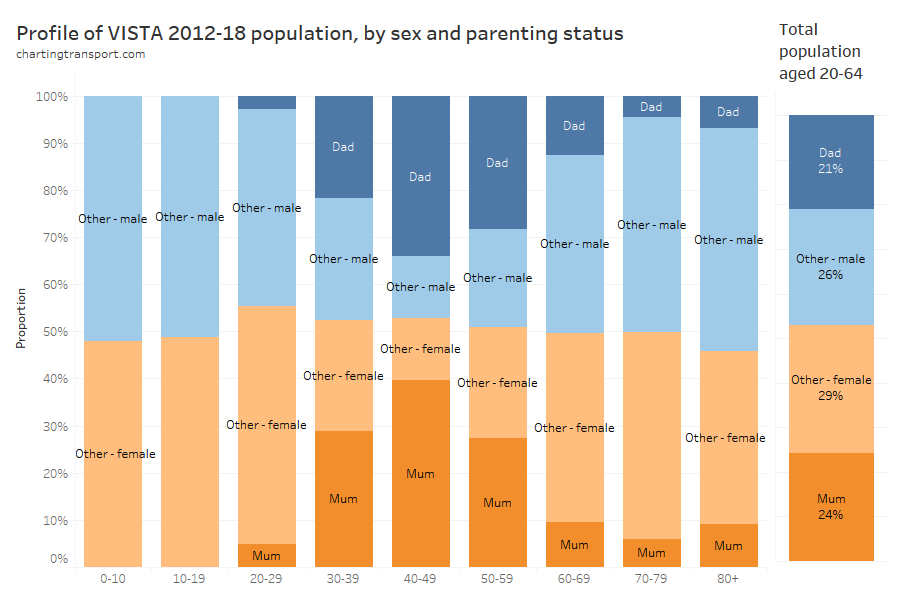
The survey weightings don’t quite lead to a perfectly balance between genders across all age bands.

Parenting was most common amongst those aged 40-49 (almost three-quarters), and lower prevalence in younger and older age groups (under 8% for those aged 20-29).

Curiously there was a slight uptick in parents living with their children for ages 80+, which might be elderly parents living with – and being cared by – their adult children.

Across the approximate working aged population (20-64), parents accounted for 45% of the population.

In some sections I’ve also used ABS Census data from 2016 and 2021. This data is segmented slightly differently, with parenting being indicated by whether the person does unpaid work to care for their own children (so might exclude parents with relatively independent adult children living with them). Unless noted otherwise, it includes people aged 15+, and journey to work data only includes those who travelled to work and reported their travel modes.

Let’s get into it..

Trips per day

For this analysis a trip is travel between two places where a purposeful activity takes place, and may involve multiple trip legs (eg walk-bus-walk-train-walk).
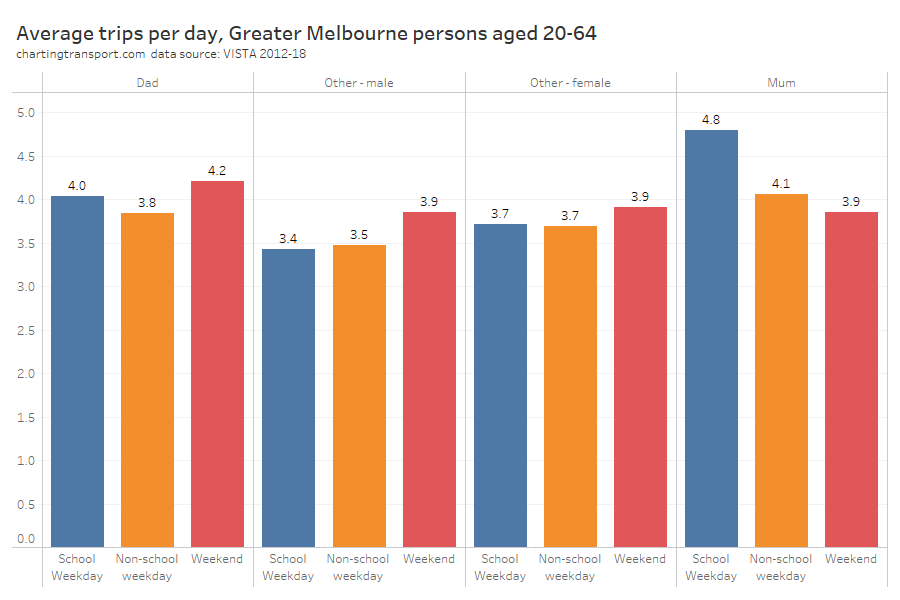
Mums easily made the most number of trips on school weekdays, but dads made more trips on weekends than mums. Trip rates were higher on weekends for all person classifications except mums.

Trip chaining

I’ve heard much about women doing a lot more trip chaining – where a person leaves home and travels to one activity, then one or more other activities, before returning home. For example: home to school drop-off to work to school pickup to home.

As a simple measure of trip chaining, I’m counting the number of trips that don’t have an origin or destination at a place of accommodation (places of accommodation almost always being the survey home). I am aware of other definitions of trip chaining that only count where there is a short activity between trips but that would be require much more complex analysis.
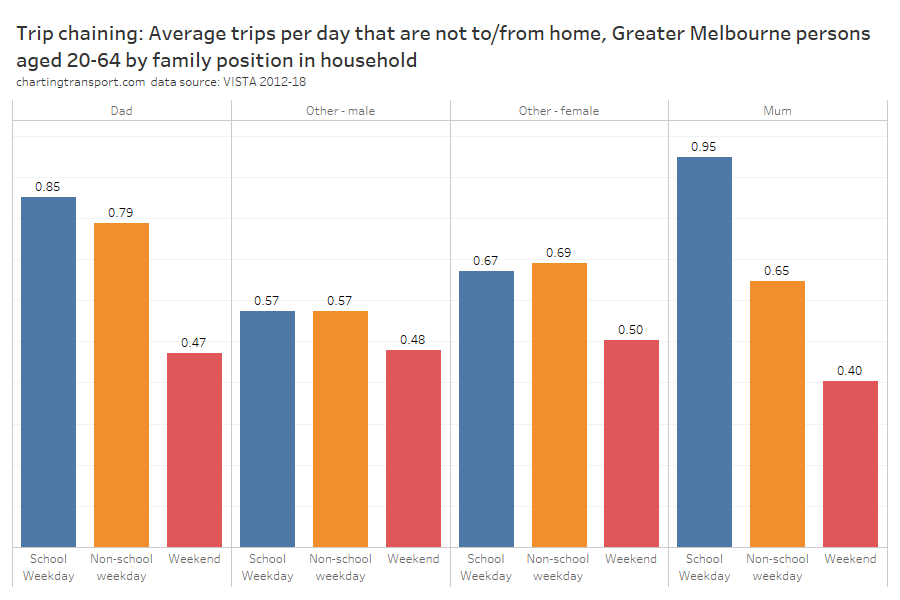
As expected, mums were doing a lot of trip chaining on school weekdays, but curiously dads weren’t that far behind. And in the school holidays and on weekends dads were doing more train chaining than mums (perhaps to give mums a break?).

Trip chaining was much less common on weekends for all groups.

For mums the most common trip type not involving travel to or from home was between work and pick-up or drop-off of someone (most likely between a school and a workplace). A long way behind was travel between work and shopping, pick-up/drop-off someone and shopping, and between two pick-up/drop-off someone activities.

For dads the most common trip type not involving travel to/from home was between two work-related activities, closely followed by between work and pick-up / drop-off someone, and then between work and social activities.

So mums’ trip chaining was dominated by pick-ups and drop-offs of people, while dads’ was not.

Time spent travelling
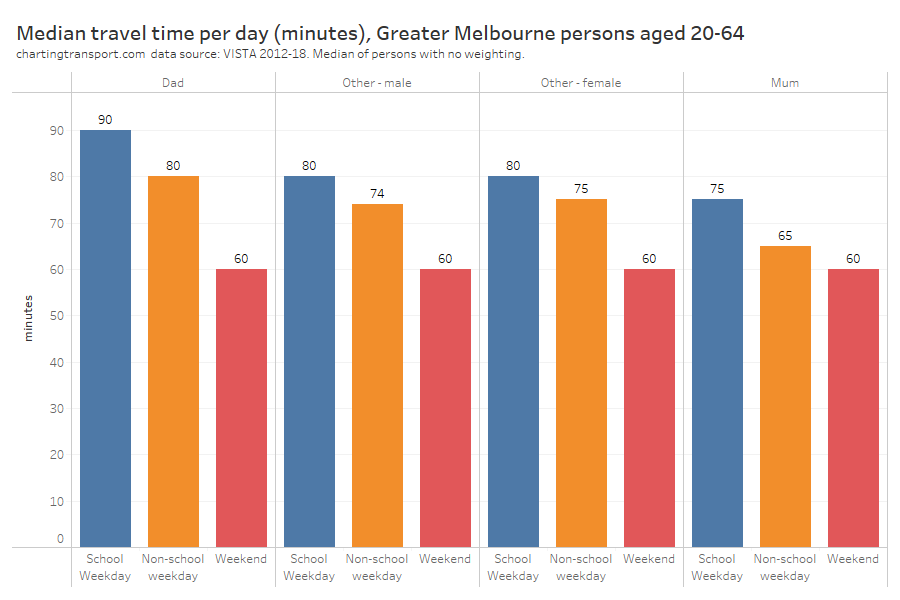
There’s not a huge variation in median travel time per day between person groups, but dads had the highest on weekdays and mums generally had the lowest. Note that reported travel times were very often rounded to multiples of 5 minutes hence most of these medians are also multiples of 5.

Technical note: I have created a chart with average travel times and the numbers were higher but the shape of the chart was almost identical so I’m not including that here.

Travel distance from home

So were dads travelling further from home? I’ve calculated the straight distance between the home location and all travel destinations, and this chart shows the medians:
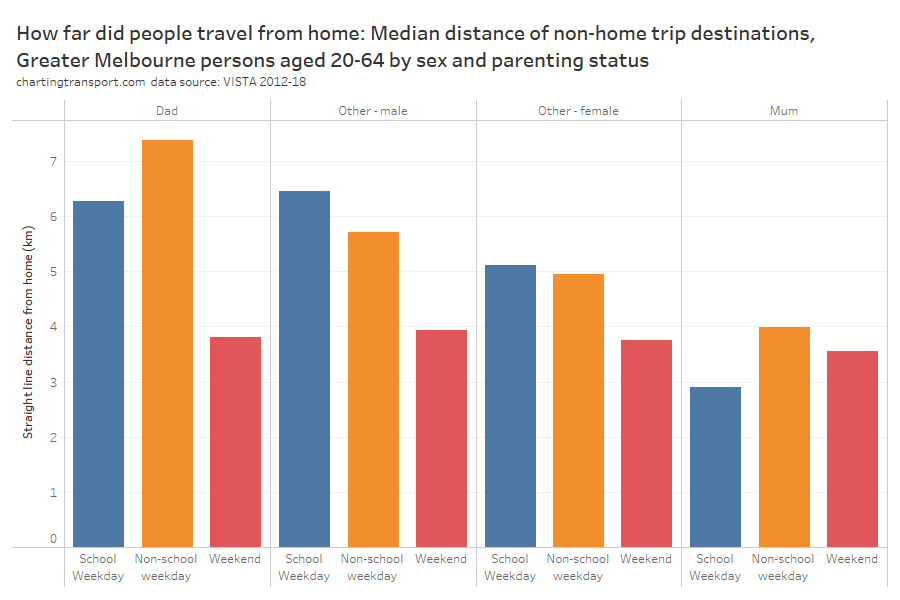
Dads sure did travel further from home on weekdays (particularly on school holidays when they might not be doing school drop-offs / pick-ups), with mums generally staying much closer to home.

Curiously, other males also travelled further from home than other females, so this pattern appears to be related to gender to some extent.

There was a lot less variation on weekends, with people generally travelling closer to home, as you might expect.

Daily distance travelled

Let’s broaden that out to median total distance travelled per day:
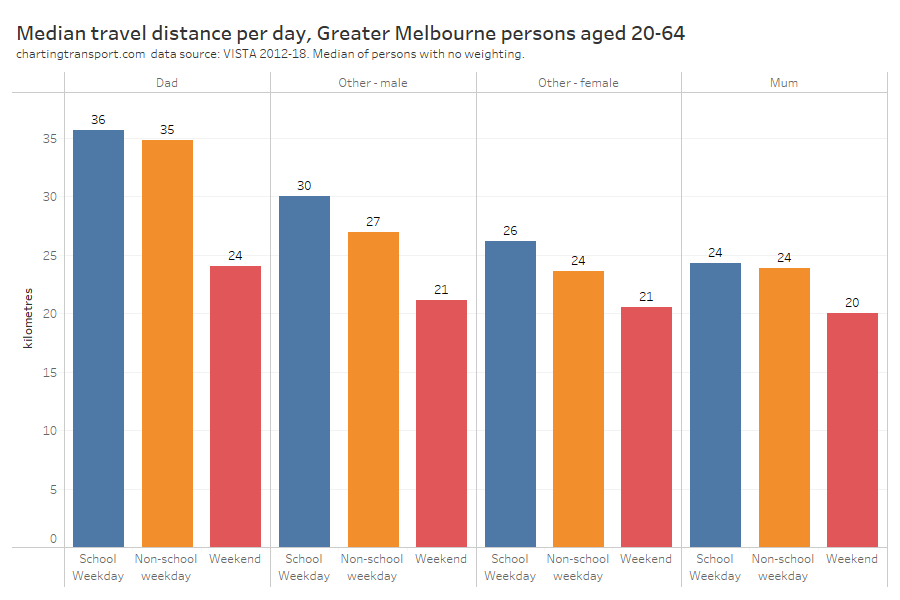
Dads generally travelled further on all day types, and mums the least. Everyone generally travelled less on weekends, and to some extent during school holidays (compared to school weekdays).

Travel distance to work

We can use ABS Census data to understand the on-road distance between home and workplaces, including for 2021. This data is for the working population aged 15+, and differentiates people based on whether they are caring for their own children (which is slightly different from living with their children).
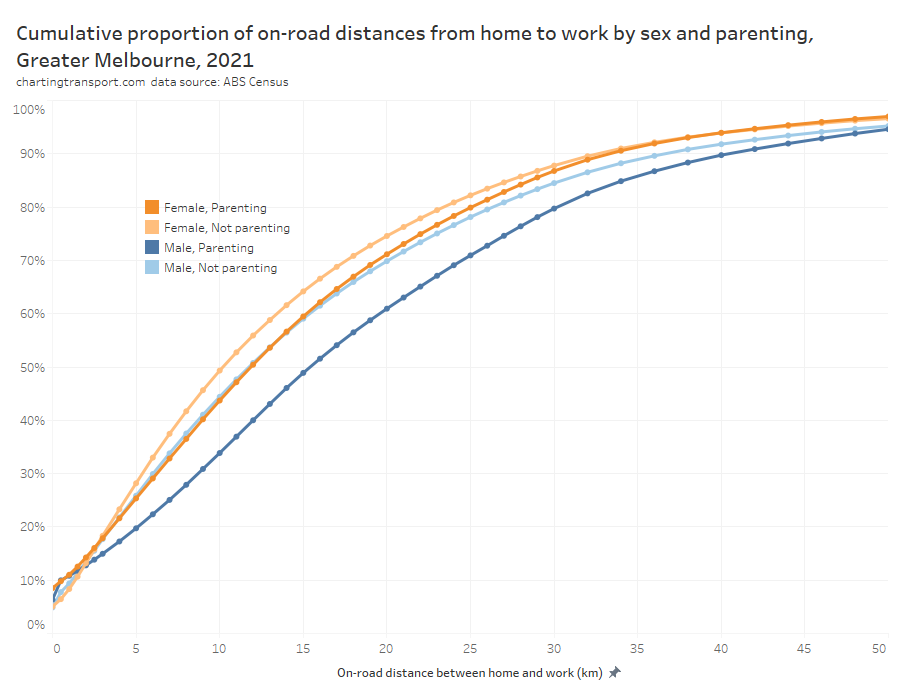
The median distances to work were highest for dads at around 15.4 km for dads, followed by 11.9 km for mums, 11.7 km for other males, and 10.2 km for other females.

Travel to/from Central Melbourne

Public transport has its highest mode shares for travel to/from central Melbourne, so how did that vary by sex and parenting status? (for this analysis I’ve defined central Melbourne as the SA2s of Melbourne, Docklands, Southbank, and East Melbourne – on 2016 boundaries).
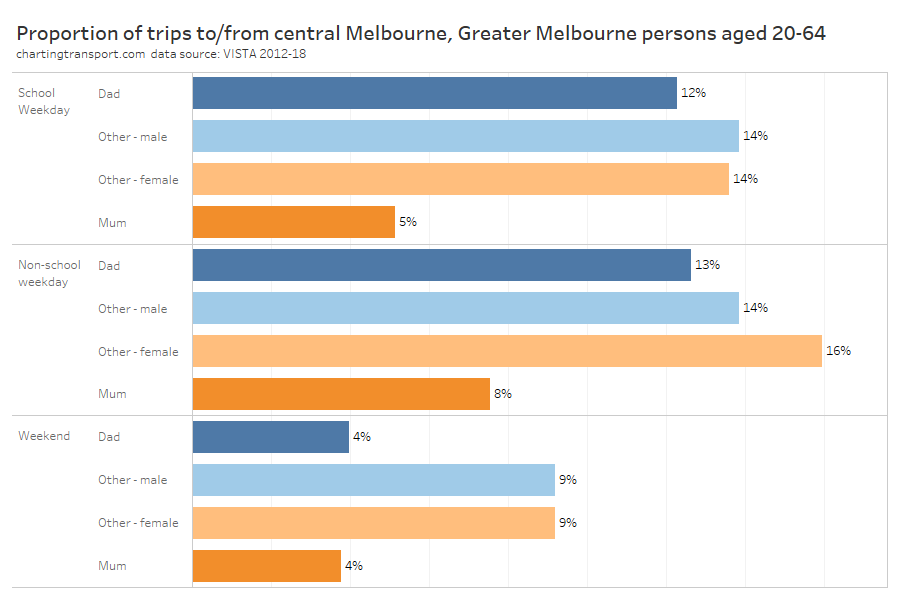
Before you get too excited about the differences, it’s worth pointing out all the proportions are small. The vast majority of people in Greater Melbourne don’t travel to central Melbourne on any given day. And of course people who lived in central Melbourne had many of their trips counted in this chart.

Sure enough, on weekdays dads were much more likely to travel to central Melbourne, and mums were least likely (although it was higher in the school holidays). On weekends, non-parents were much more likely to travel to the central city than parents (a fair bit of socialising by younger independent adults, no doubt).

Time of day of travel

The following chart shows the share of trip start times across the day for the different person types, and different day types:
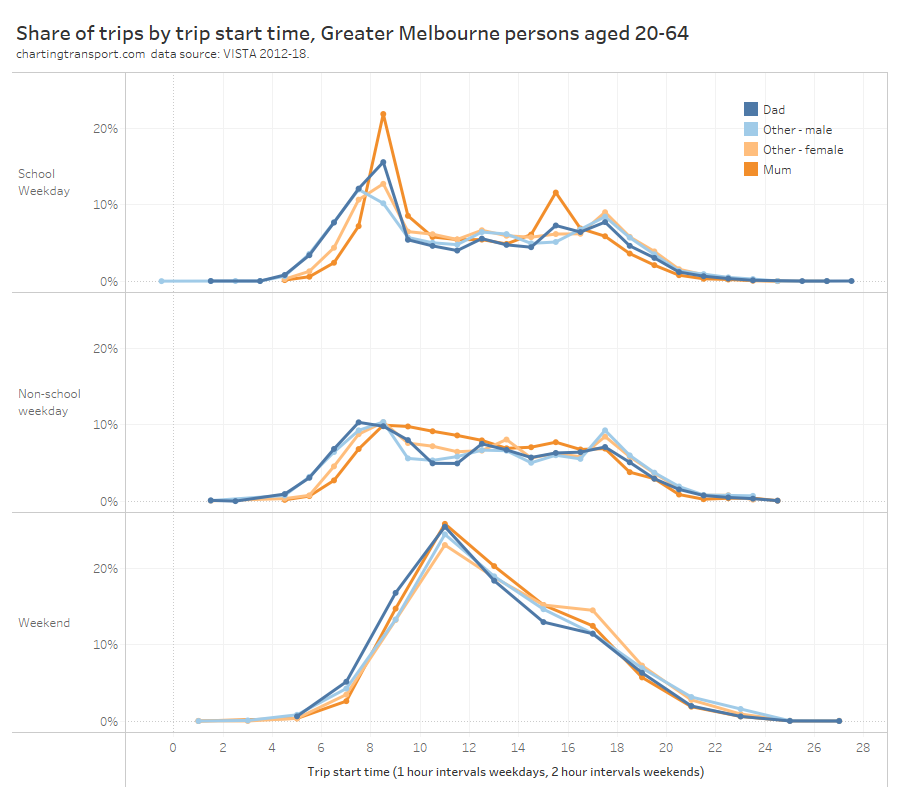
Technical note: due to smaller sample sizes, weekend travel has been aggregated into 2-hour intervals. Weekdays have been aggregated into 1-hour intervals.

You can clearly see that on school weekdays, mums are doing a lot of travel between 8 and 9am, and between 3 and 4pm, which obviously relate to school start and finish times. In the school holidays, mums are doing a lot more travel through the interpeak period, probably reflecting parenting activities for kids not at school.

On school days, trips by dads started earlier and finished later than mums. But during school holidays dads made a smaller proportion of their trips between 8am and 9am, suggesting they also had a significant role in school drop offs in the morning.

During the weekday inter-peak period dads were less likely to travel than mums (except around lunchtime). Other females had a small peak in travel around 5-6pm, which is probably related to them being more likely to work full time.

On weekends it seems dads were slightly more likely to travel in the morning compared to mums who were slightly more likely to travel in the afternoon.

Did mum or dad take the kids to/from school?

We’re seeing some pretty strong themes related to the school peaks. It is possible to filter for trips to pick up or drop off someone from a place of education on school weekdays and then disaggregate between mums and dads. I’ve split this analysis into an AM peak, a PM school peak (2-4pm), and a PM commuter peak (4-6pm) – as there were significant numbers of pick ups later in the afternoon – presumably following after-school care.
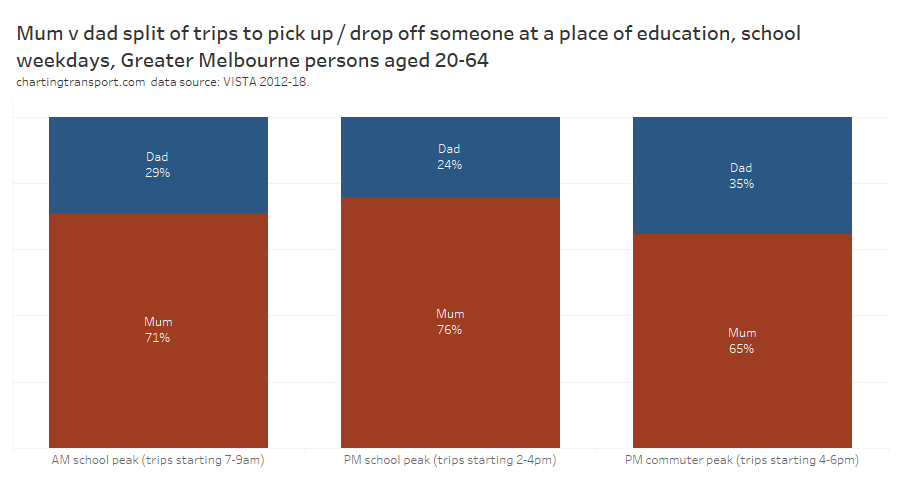
Mums did the bulk of school drop offs and pick ups at all times of day, particularly in the PM school peak. In the PM commuter peak, dads share of pick ups rose to 35% – no doubt related to the ability to do these pick ups after a full-time day at work.

What types of adults are using modes at different times of day?

For this question I have limited analysis to school weekdays, aggregated all of public transport to one group, and aggregated vehicle drivers, passengers, and motorcyclists into “vehicle” to overcome issues with small sample sizes. I’ve included the proportion of the working aged population sample on the right-hand side for ready reference.
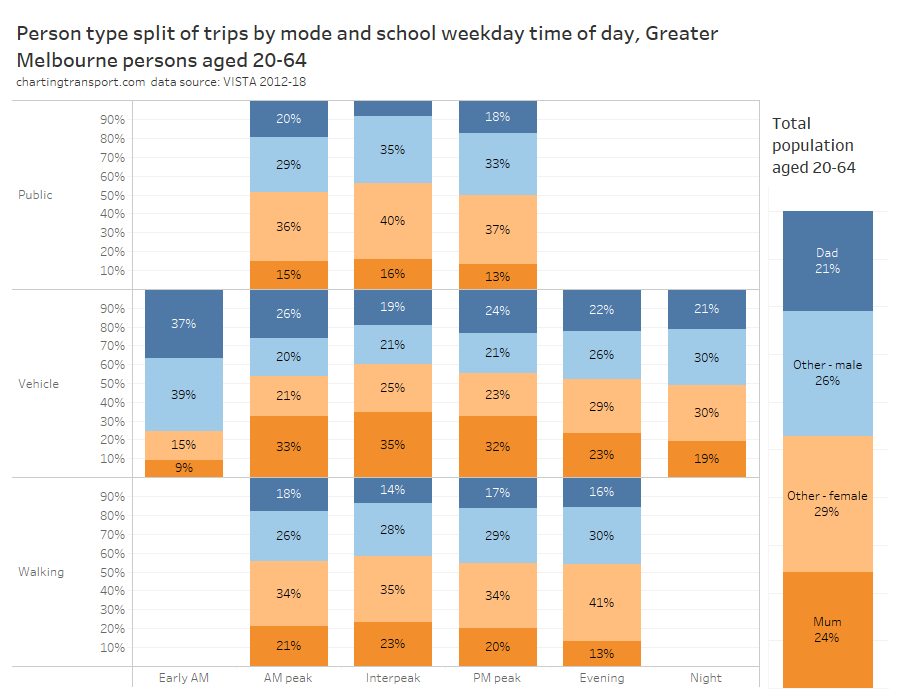
In general, parents were over-represented in vehicles in peak periods, mums were over-represented in the interpeak in vehicles, and parents were under-represented in public and active transport at most times of day.

The peak periods saw more public transport trips by dads than mums, while the roads (and footpaths) saw a lot more trips by mums than dads.

Early morning travel was predominately by males (76%), while females were slightly more prevalent in vehicles during the interpeak (60%). Reported walking trips skewed female at all times of day.

However if we look at travel time, rather trip counts, we get a slightly different picture:
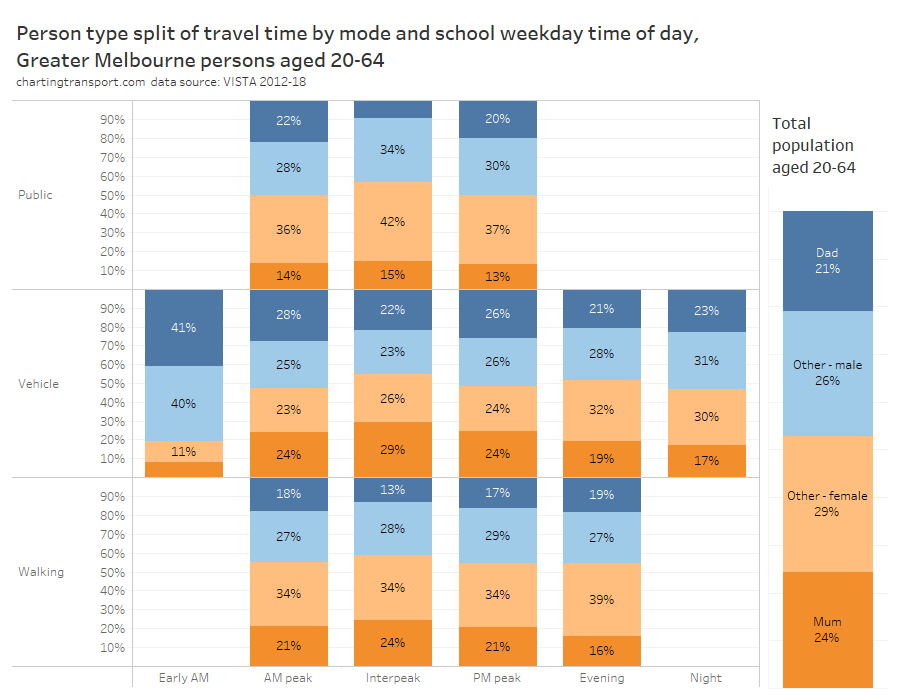
Dads spent more time travelling than mums in peak periods on both public and private transport, but much less time than mums in the inter-peak.

Mode split

Here’s how it looks for travel in general:
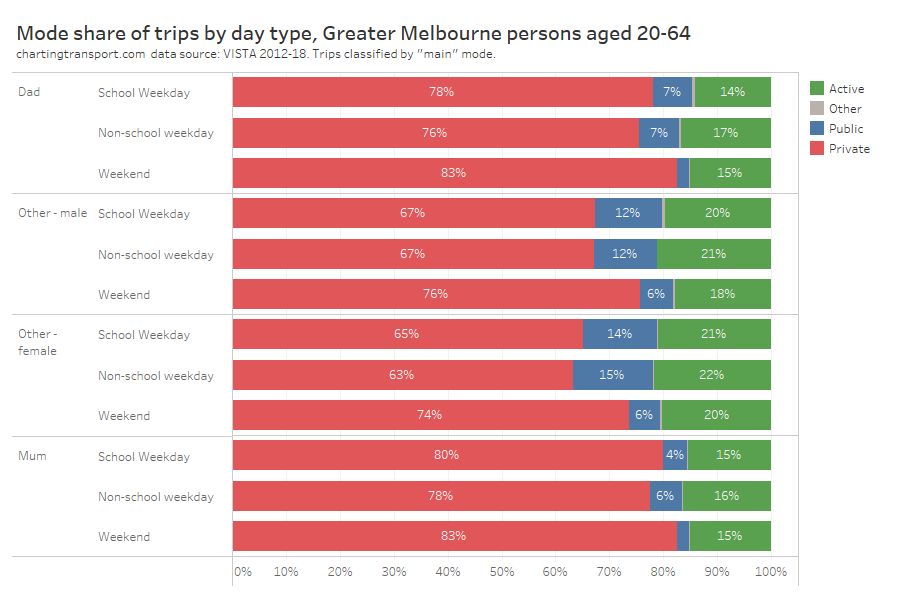
Mums were the least likely to use public transport (especially on the weekend), closely followed by dads.

Non-parents had the lowest private transport mode share (although still a majority mode share), and were most likely to use active transport.

Here’s overall mode shares of journeys to work (Greater Melbourne 2016), which I’ve disaggregated for workplaces inside and outside the City of Melbourne area (as workplace location has a massive impact on mode shares):
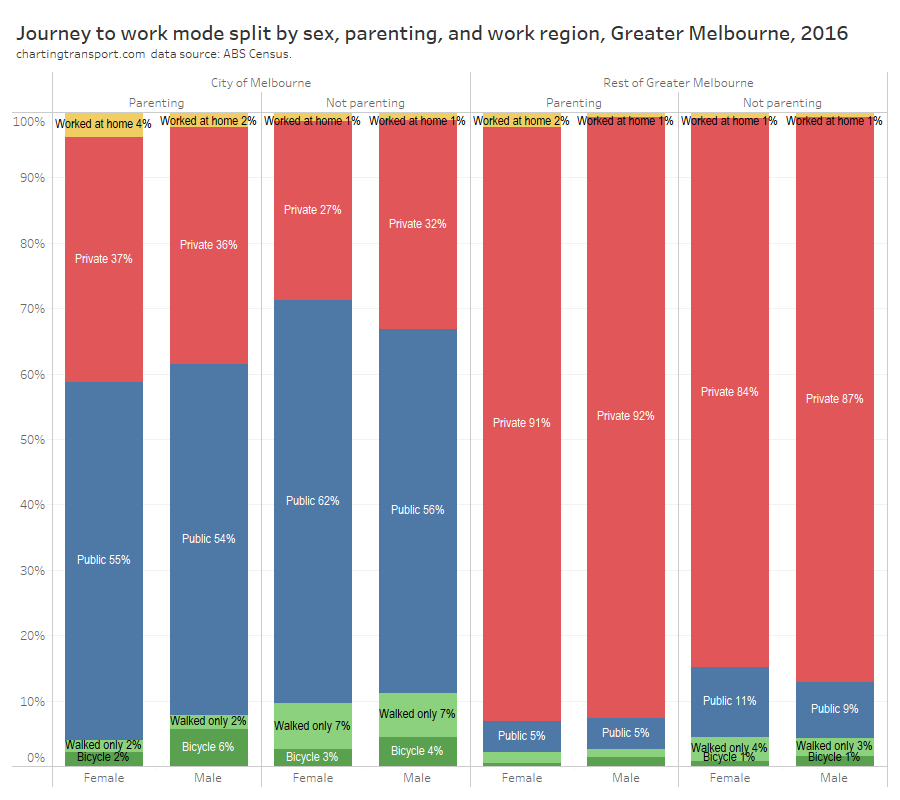
Parents were much more likely to use private transport across the geographies and sexes. Of those working outside the City of Melbourne, parents also had about half the public transport mode share of non-parents.

Men were much more likely to cycle to work than women, and dads were more likely to cycle than other men.

Here is a look at private transport mode shares by distance between home and work, gender and parenting status:
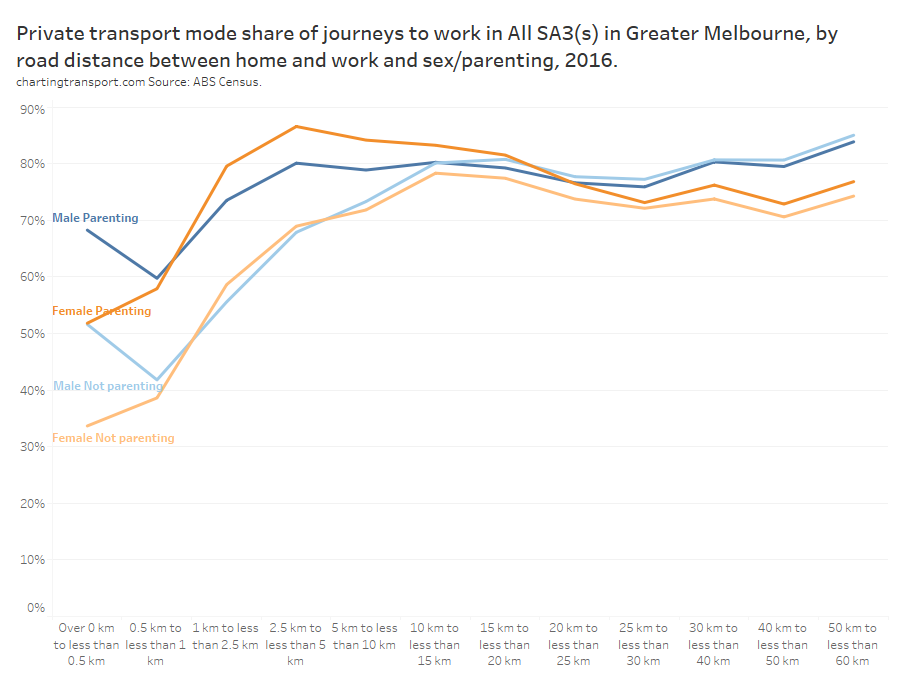
The difference in private mode share between parents and non-parents was largest for journeys up to 10 km. Mums had the highest private mode share for journeys 1 to 20 kms. For journeys over 25 km, sex became more influential than parenting status with men more likely to use private transport.

Another curiosity here is the very short journeys (less than 0.5 km) where men were much more likely to use private transport than women (regardless of parenting status) – for what is probably a walkable distance for most people. Are men more lazy when it comes to short walks to work? And/or are men more likely to need their car at work?

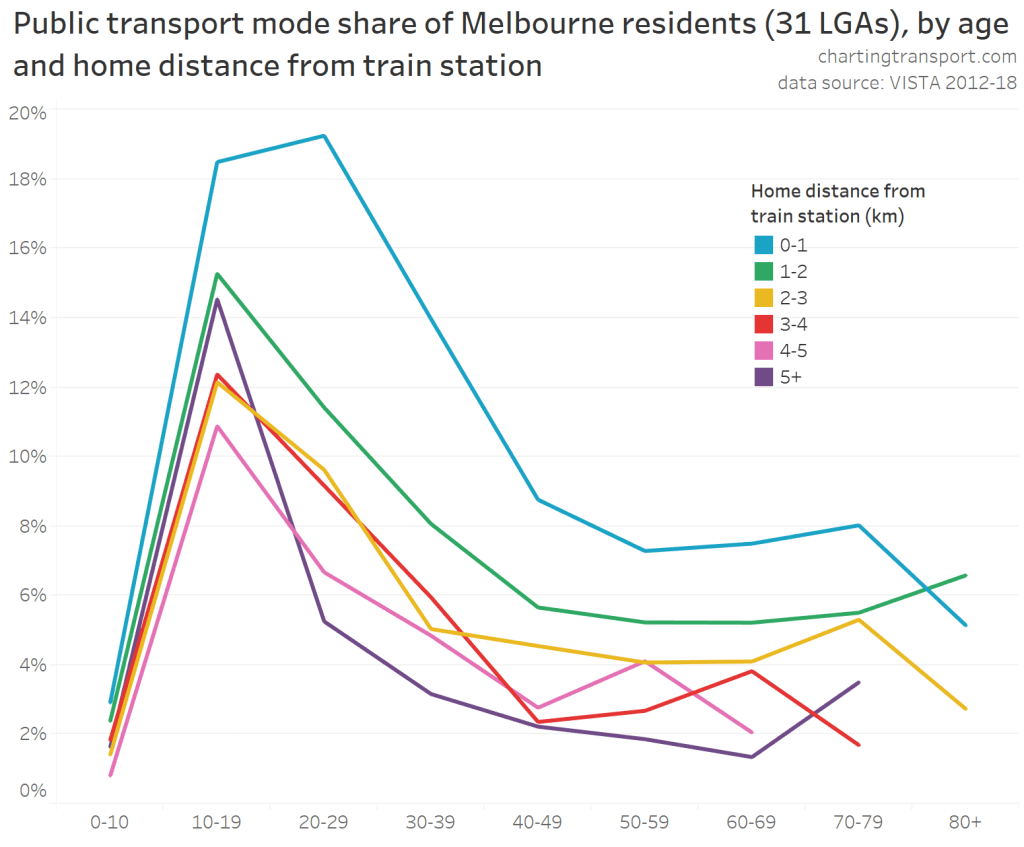
I have previously also analysed public transport mode share by age and family position. I’ve reproduced that analysis here:
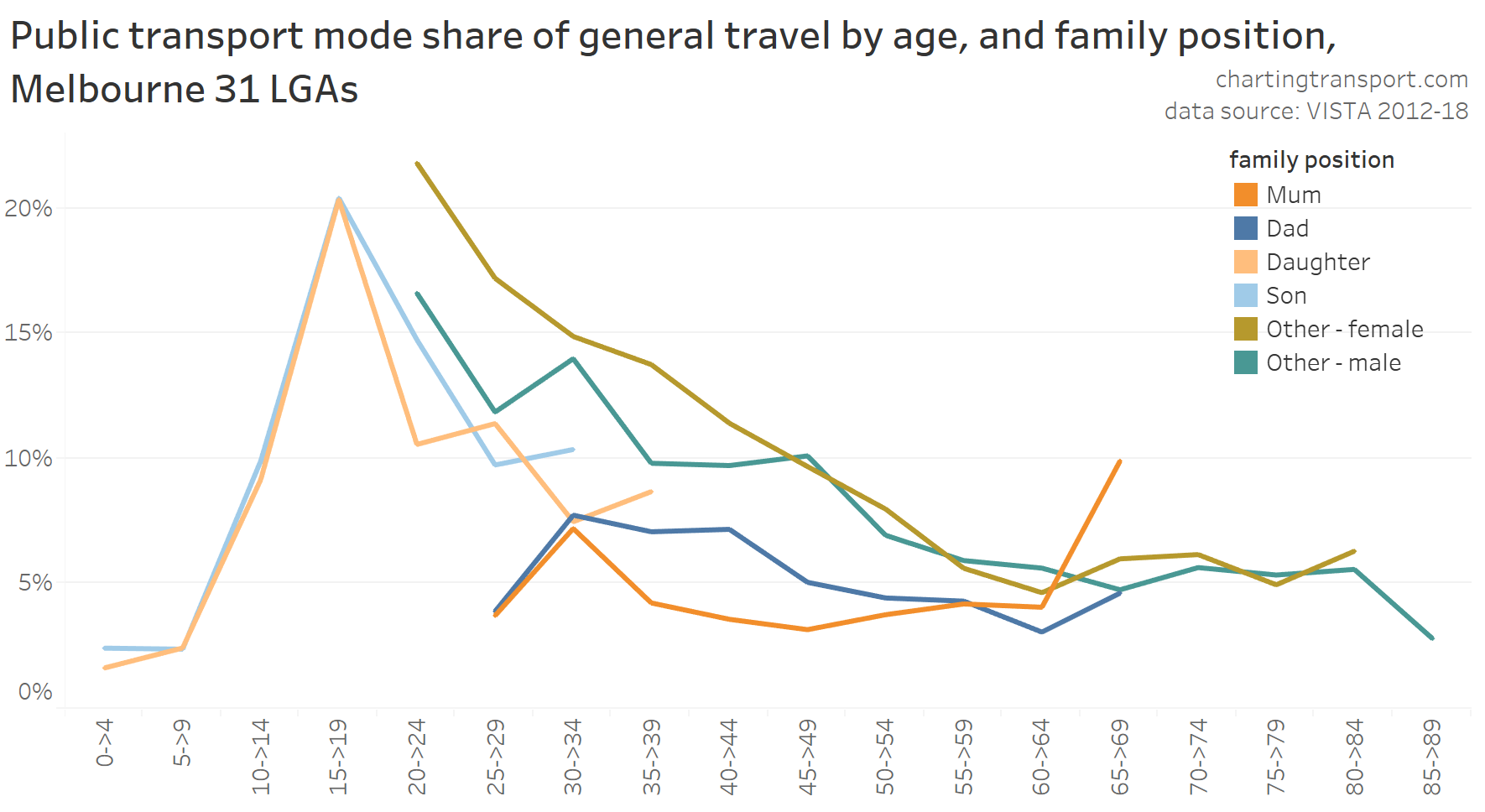
For ages 35 to 59, mums generally had lower public transport mode share than dads. Younger non-parenting women had higher public transport mode shares than younger non-parenting men.

Here’s how it looks for 2016 journeys to work (I’m not using 2021 data because of COVID lockdowns):
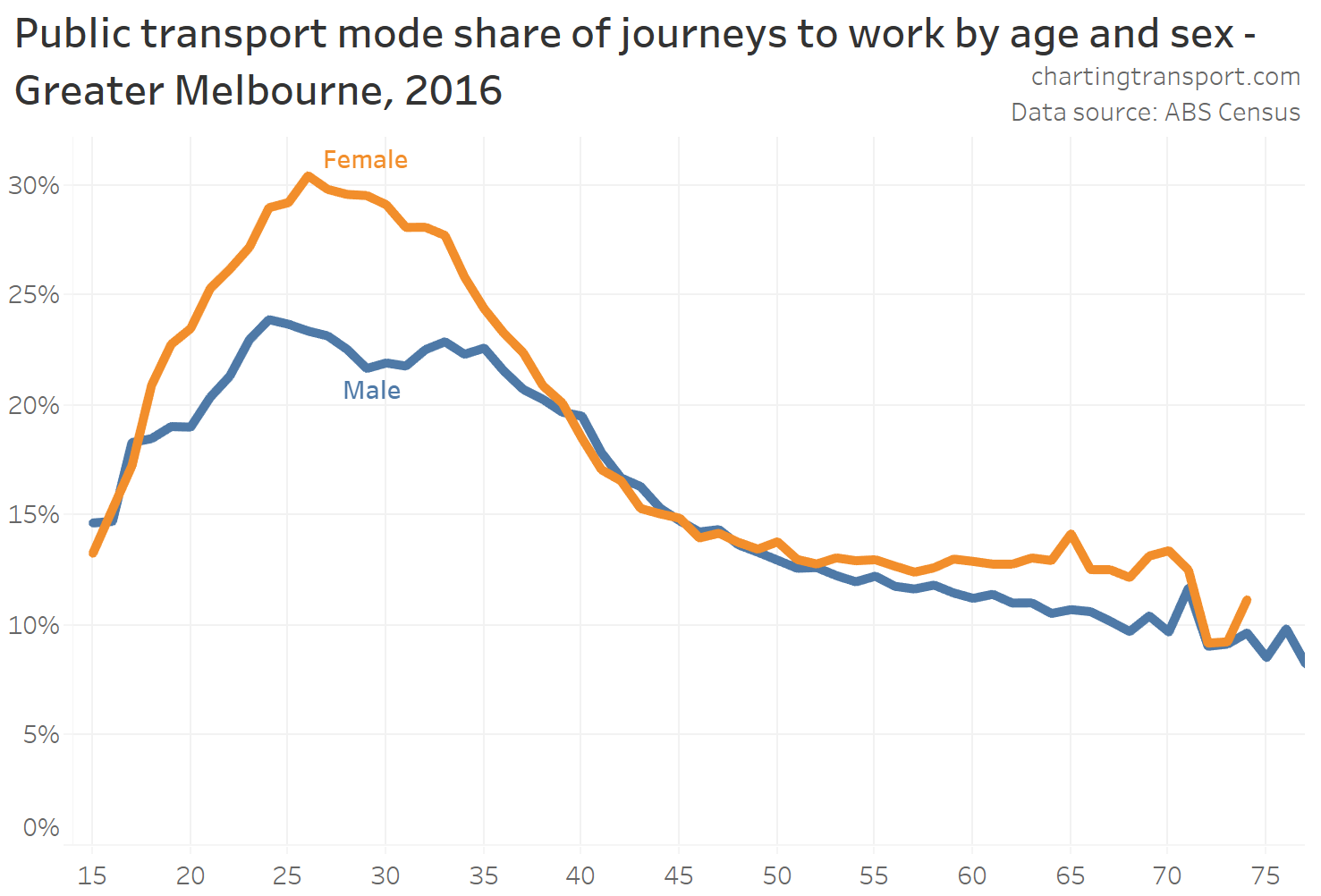
Female public transport mode share was signficantly higher than males for most ages – except for those typical parenting years between their late 30s to early 50s. Younger adults were much more likely to work in the inner city, and even more so for females. For more discussion on this, see Why are younger adults more likely to use public transport? (an exploration of mode shares by age – part 1)

I’ve also split this by sex and parenting status and analysed the changes between 2006 and 2016 (analysis lifted from: Why are young adults more likely to use public transport? (an exploration of mode shares by age – part 3))
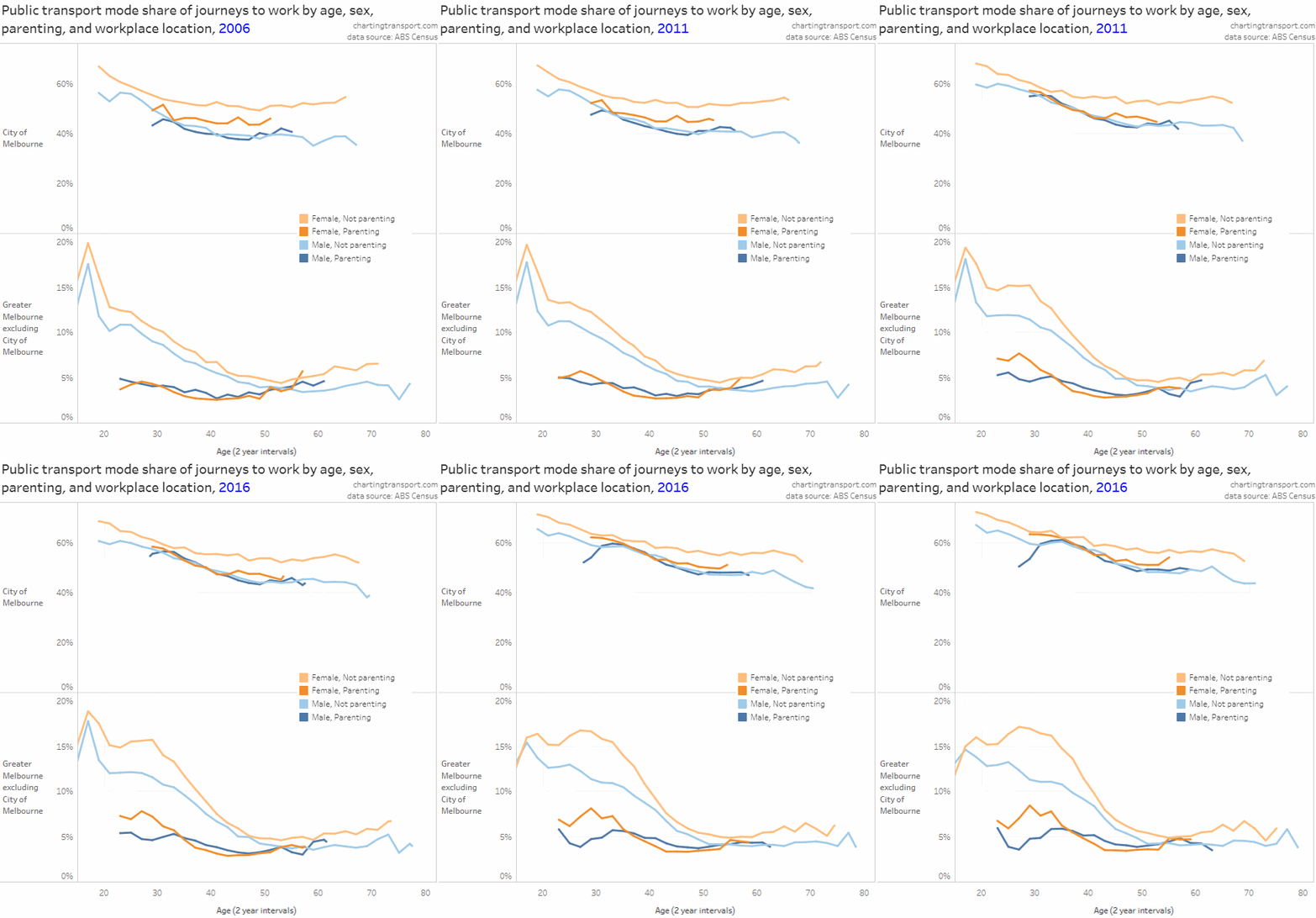
Note there is a very different Y-axis scale for City of Melbourne and elsewhere.

There were a few really interesting take-aways:

  • Public transport (PT) mode shares increased over time for almost all age bands, work locations, and for parenting and non-parenting workers.
  • Parenting workers mostly had lower public transport mode shares than non-parenting workers of the same age, except for:
    • dads over 30 who worked in the City of Melbourne,
    • mums in their early 30s who worked in the City of Melbourne in 2016, and
    • mums and dads in their 50s who worked outside the City of Melbourne (who had low PT mode shares around 4-5%, similar to non-parenting workers of the same age)
  • Public transport mode shares for journeys to work in the City of Melbourne mostly declined with increasing age between 20 and 50, regardless of parenting responsibilities.
  • For people who worked outside the City of Melbourne, the mode share profile across age changed significantly over time for young adults. In 2006 there was a steady decline with age, but in 2011 PT mode shares were generally flat for those in their 20s, and in 2016 PT mode shares peaked for women in their late 20s (and also had a quite new pattern for dads in their 20s).
  • For parenting workers who worked outside the City of Melbourne there was actually a slightly higher PT mode share for those over the age of 50. Parents over 50 might have older children who are more independent and therefore less reliant on their parents for transport. This might make it easier for the parents to use public transport. However this trend did not hold for dads in 2016.
  • PT mode shares for non-parenting women increased slightly beyond age 55 for all work locations. This will include women who were never parents, as well mums with non-dependent children so might again reflect a small return to public transport once children become independent. It may also be influenced by discounted PT “Seniors” fares available to people over 60 who are not working 35+ hours per week.

Mode split of public transport use

Which modes of public transport were the different person classifications using in Melbourne? Sufficient survey sample is only available for school weekdays, and it’s important to keep in mind that trams dominate inner city radial on-street public transport in Melbourne (unlike most comparable cities where buses dominate this function). This chart adds up all trip legs so there is no data loss with multi-modal public trips:
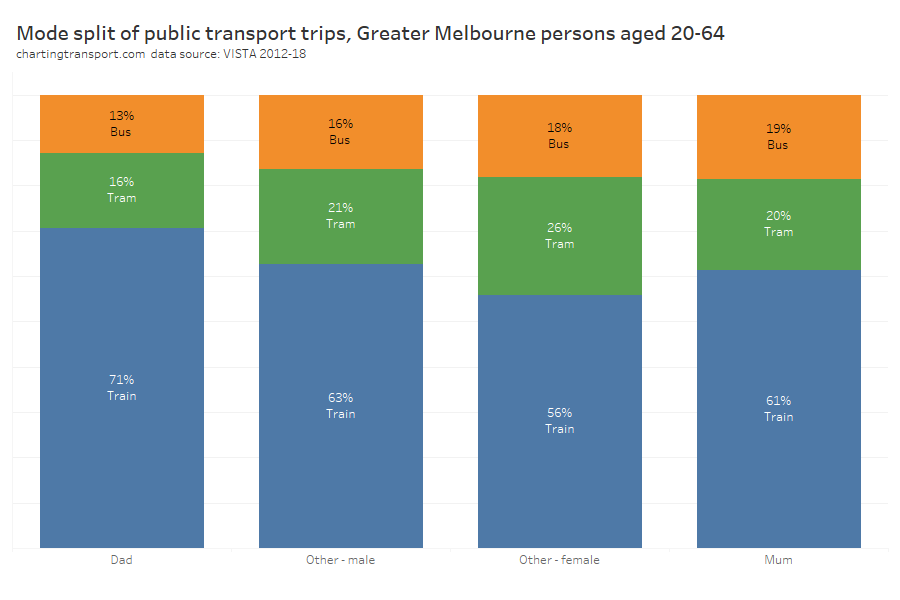
Unfortunately this data doesn’t line up with reported public transport patronage for the same time period (below), suggesting that tram travel may be under-reported in VISTA (although the above chart is filtered for persons aged 20-64):
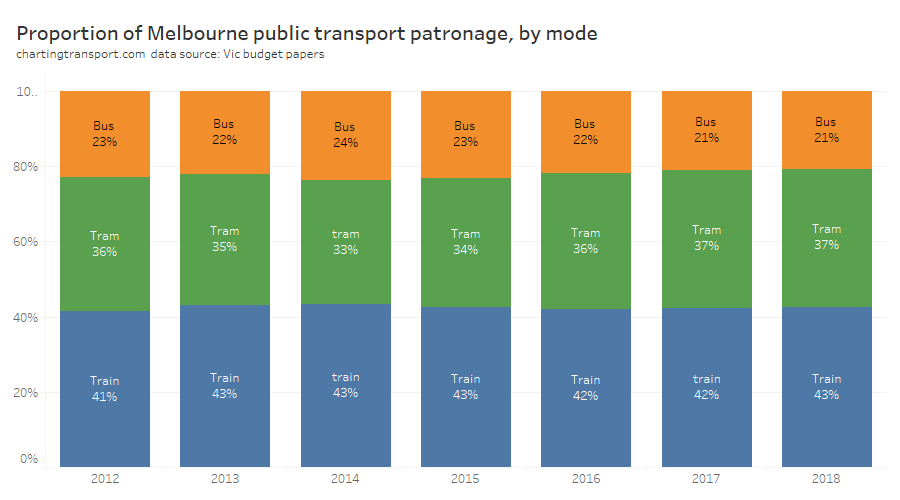
Biased as the VISTA data might be towards certain modes, it still suggests dads were more likely to be using trains and least likely to be using buses.

I’ve also looked at use of public transport in journeys to work for 2016. Workers can report up to three modes of travel, and I’ve extracted counts of workers who used each of the three main modes of public transport in Greater Melbourne (note: people who used multiple public transport modes will be counted in multiple columns).
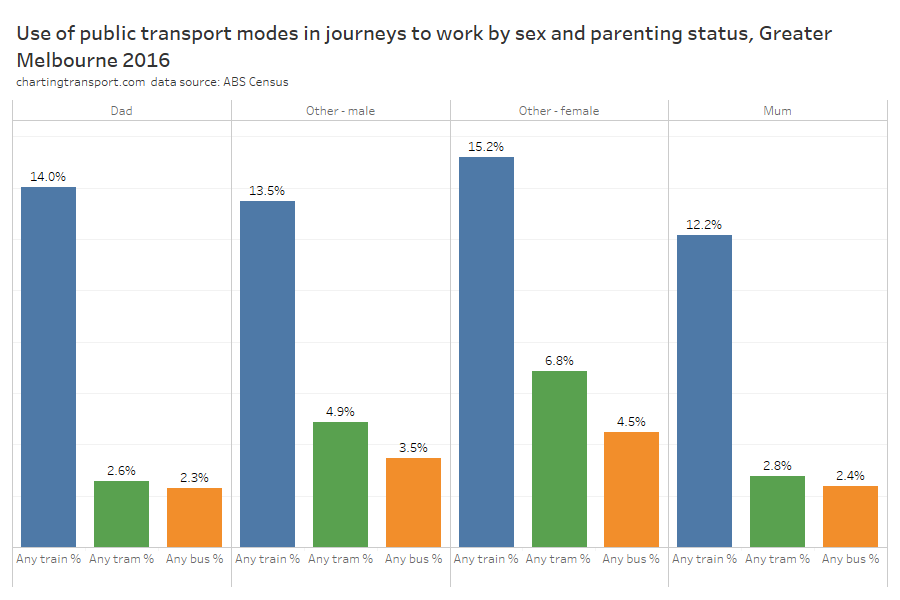
Parents (who travelled to work) were much less likely use bus or tram to get to work than non parents. But the story is bit different for trains: Dads were slightly more likely to commute by train than other males, while mums were less likely to commute by train than other females. This might be related to where mums work – more on that soon.

Mode use by sex and parenting

We can flip the mode-split charts around to look at the composition of adult users of different travel modes:
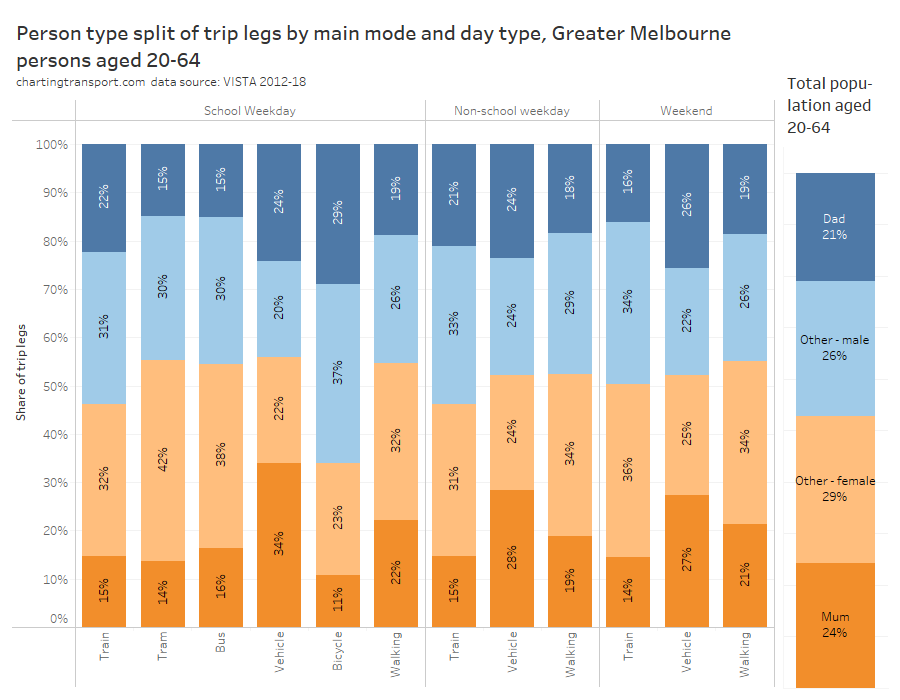
Technical Note: there’s insufficient sample of tram, bus, and bicycle travel on non-school weekdays and weekends so those are not on the chart.

Trams, buses, private vehicles, and walking generally skewed female, while trains and particularly bicycles skewed male (except weekend trains).

Mums were under-represented on all modes except private vehicles where they were significantly over-represented. Mums were least represented on bicycles.

Dads were under-represented on trams and buses, and over-represented in vehicles, and on bicycles.

Non-parents were over-represented on trains and trams, and walking on weekends.

There were many more dads than mums on trains on weekdays, and many more mums than dads travelling in (private) vehicles on school weekdays (but not so much on weekends and school holidays).

Trip purposes

We want to know the purposes of people’s travel, but actually purpose can only really be attributed to the activity before and after a trip. For this analysis I’ve used the trip destination purpose as the trip purpose, and I’ve excluded trips where the destination was home (as that would be close to half of trips and not very interesting). Also keep in mind that trips can also vary considerably in length and duration.
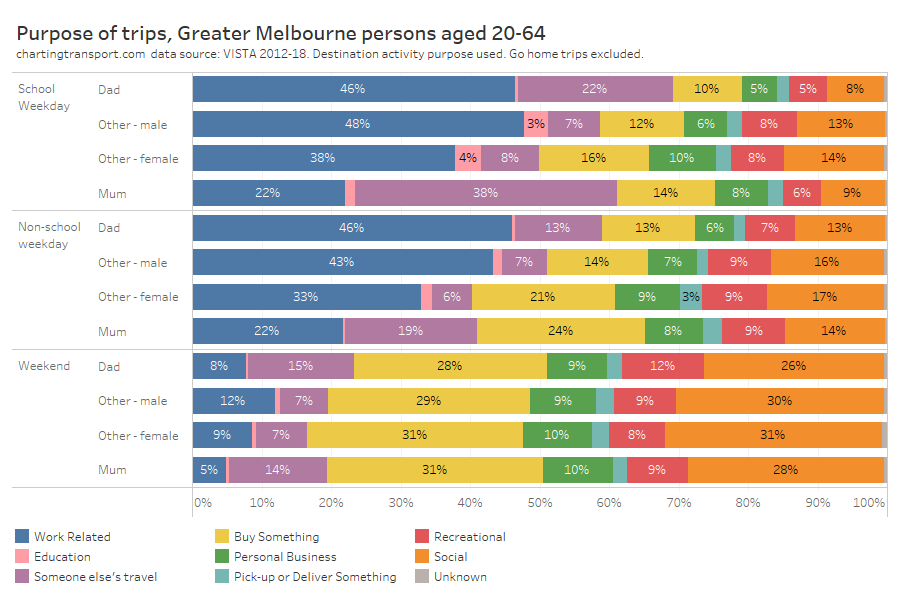
On weekdays, significantly more trips by males were work-related. Mums had a standout different pattern on school weekdays with many more trips being about someone else’s travel (particularly school children) and much less often being work-related (or should we say “paid work”-related).

During school holidays, about 1 in 5 trips by mums were about other people’s travel. But on weekends dads were doing slightly more trips that are about other people’s travels (perhaps to make up for them doing less of such trips on weekdays?).

On weekends social and shopping trips were much more common than work trips, as you’d expect.

Radial-ness of travel

A while ago I looked at the radial-ness of travel – that is the difference in bearing (angle) between a trip aligned directly to/from the Melbourne CBD and the actual alignment of the trip. Trips generally skew towards being radial, reflecting the importance of the central city, and just generally the shape of the city. Previously I’ve disaggregated by age, sex, and many other variables.

So how does radial-ness vary across sex and parenting status?
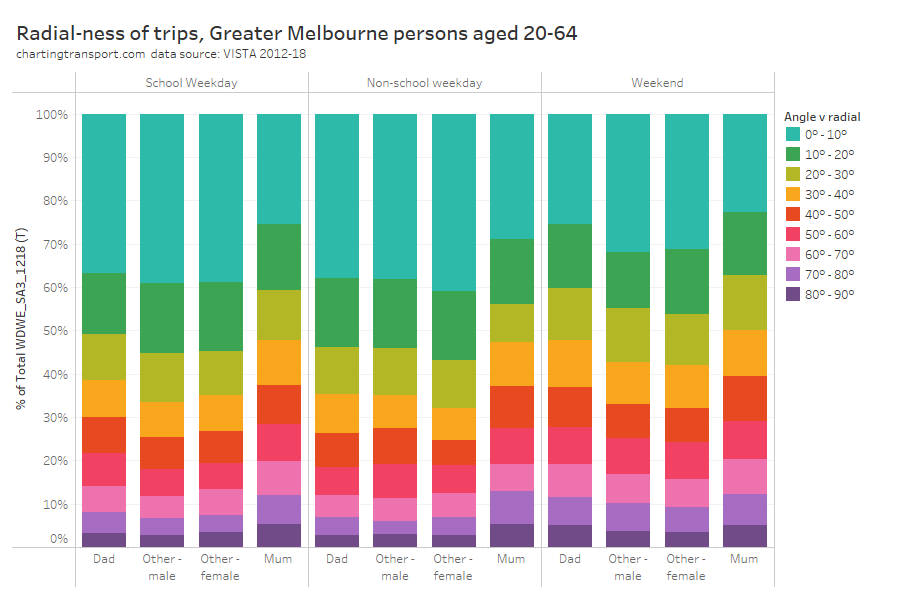
On weekdays mums were the clear outlier, with substantially fewer radial trips and more non-radial trips, likely including many trips to/from schools and other caring destinations.

Weekend travel was a fair bit less radial in general, and again mums had the least radial travel of all person groups.

Okay so that’s a lot of ways we can compare travel patterns by sex and parenting (let me know if you think I’ve missed any other useful breakdowns). Now…

What can explain these differences?

A lot of the above data is probably unsurprising, because males and females, and particularly mums and dads, generally have different levels of workforce participation and caring responsibility, amongst other differences. What follows is an examination of potential explanatory variables for the different travel behaviour observed.

Main activity

First up, main activity as captured by VISTA:
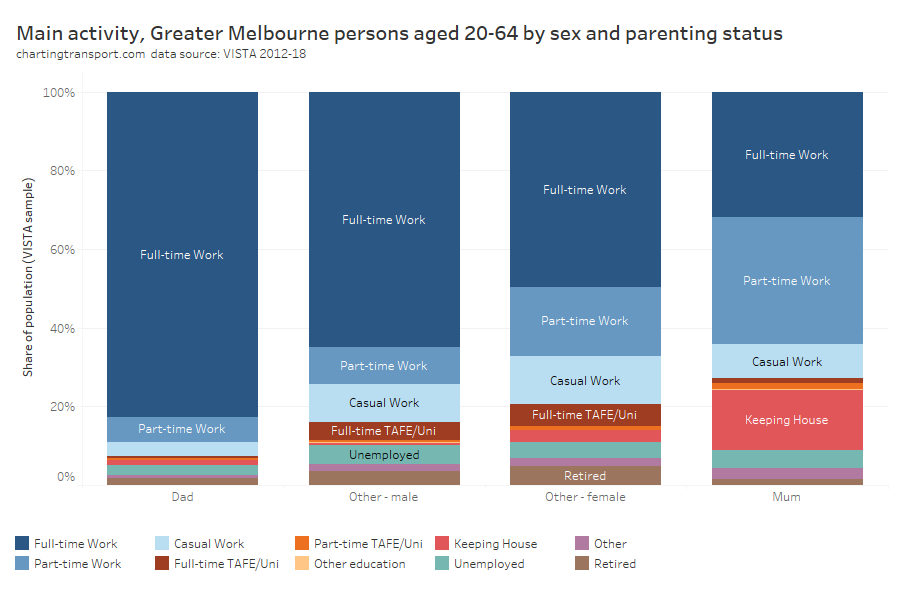
Dads were most likely to be working full-time, and mums least likely to be working full-time. Mums were much more likely to be working part-time or “keeping house”.

As an aside: I actually find “keeping house” to be a bit devaluing of parents (usually mums) who dedicate much of their time doing the critically important work of raising children. And I know from personal experience it’s pretty hard to actually “keep house” when you have young children who need active engagement across most of their waking hours. No doubt others falling in the “keeping house” category might be caring for other adults or the elderly. Is it time for a caring-related category?

Curiously non-parenting females were much less likely to be working full time than non-parenting males. Perhaps non-parenting females were more likely to be doing some caring for others not living with them? Perhaps some mums decide to stay working part-time after their children move out? Or it might be something else?

We can break the analysis down further by age:
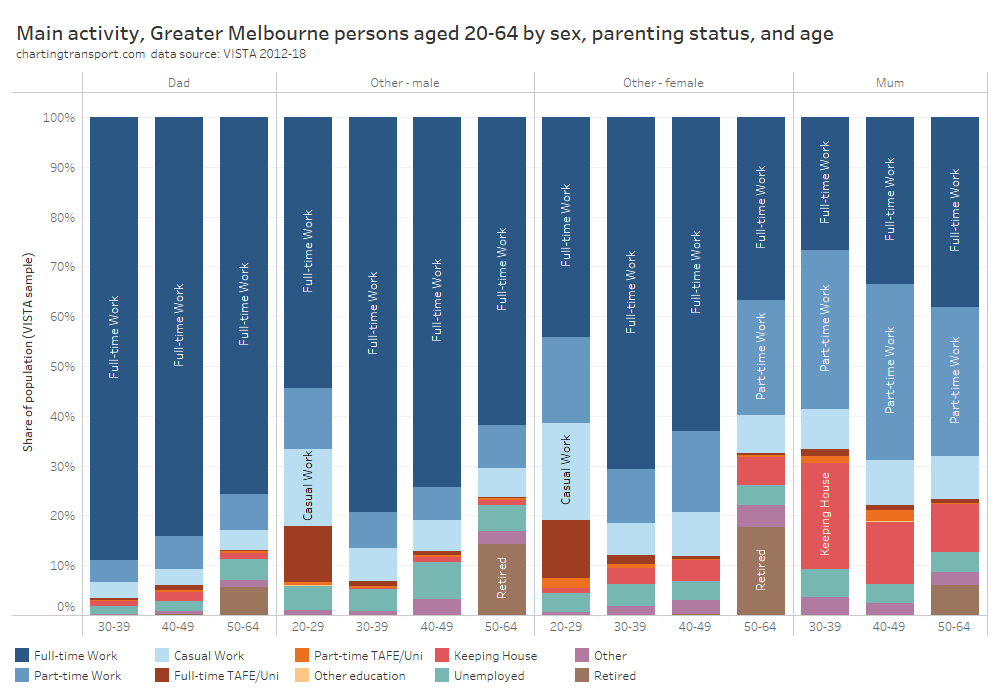
Technical note: Data isn’t presented for mums and dads aged 20-29 due to insufficient survey sample.

Curiously, dads were less likely to be working full-time with increasing age, while mums became slightly more likely to be working full-time at older ages (as children get older and require less supervision?).

Occupation (employment)

We call drill down further by looking at employment occupations:
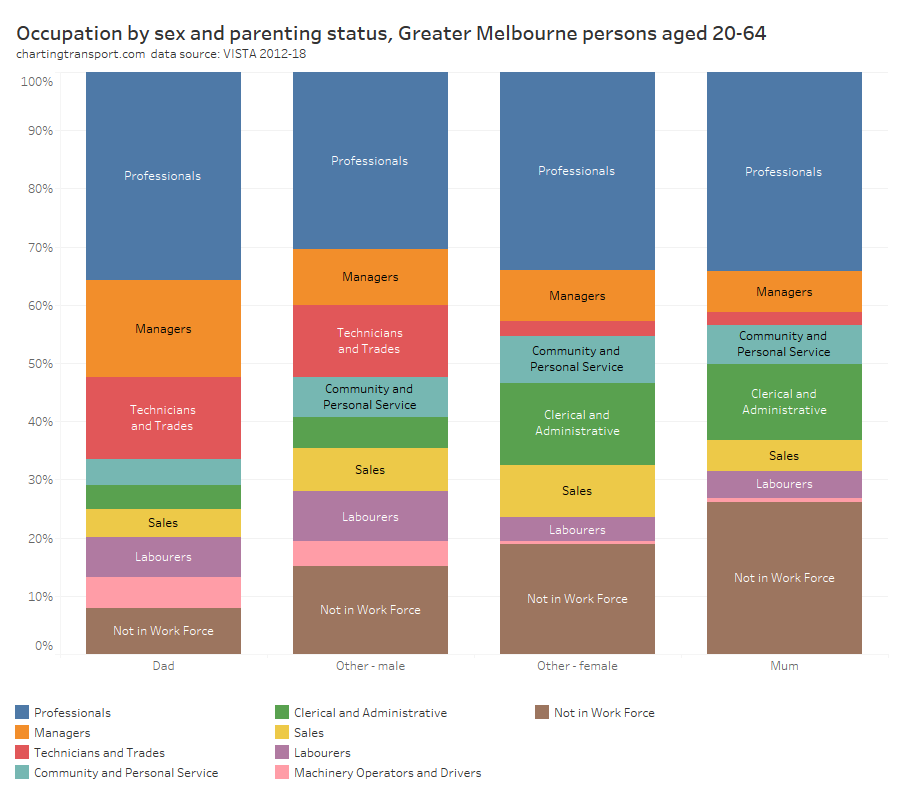
Mums were much less likely to be in the workforce than dads, but curiously had almost the same proportion of professionals (perhaps reflecting women’s slightly higher levels of education, on average).

Men were more likely to work in occupations where public transport is probably less competitive, including technicians, trades workers, labourers, and machinery operators and drivers (with likely exceptions for central city work sites).

Employment Industry

There are also notable differences in employment industries by sex and parenting:
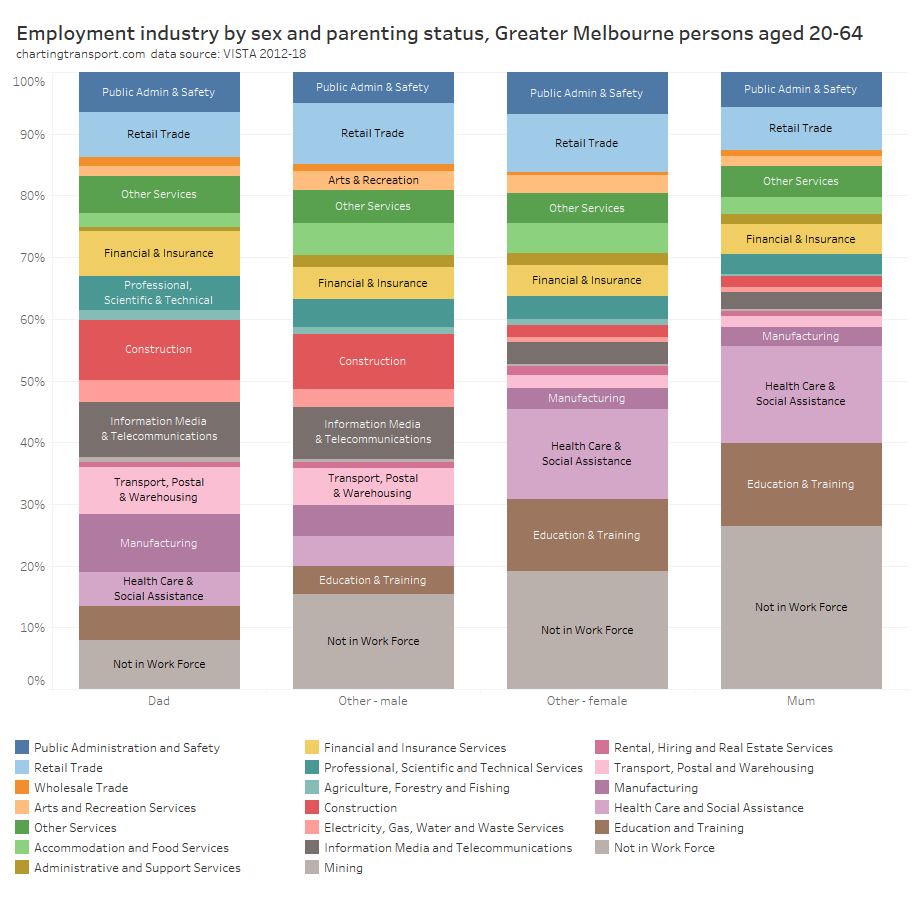
There are probably no great surprises in the above chart, with men much more likely to work in construction, information media and telecommunications, manufacturing, transport, postal, and warehousing, and women much more likely to work in education, training, health care, and social assistance.

Access to independent private mobility

Does the ability of people to drive themselves around in private vehicles differ by gender and parenting status? And could this explain their different travel patterns?

For this analysis, I’ve re-used the following household classifications from a previous post:

  • No MVs – no motor vehicles,
  • Limited MVs – fewer motor vehicles than licenced drivers, or
  • Saturated MVs – at least as many motor vehicles as licenced drivers.

I’ve also classified individuals as to whether or not they have a “solo” driving licence (i.e. probationary or full licence, but not learner’s permit).

I’ve then combined these two dimensions (except for people in households with no motor vehicles as driver’s licence ownership is largely immaterial for this analysis).
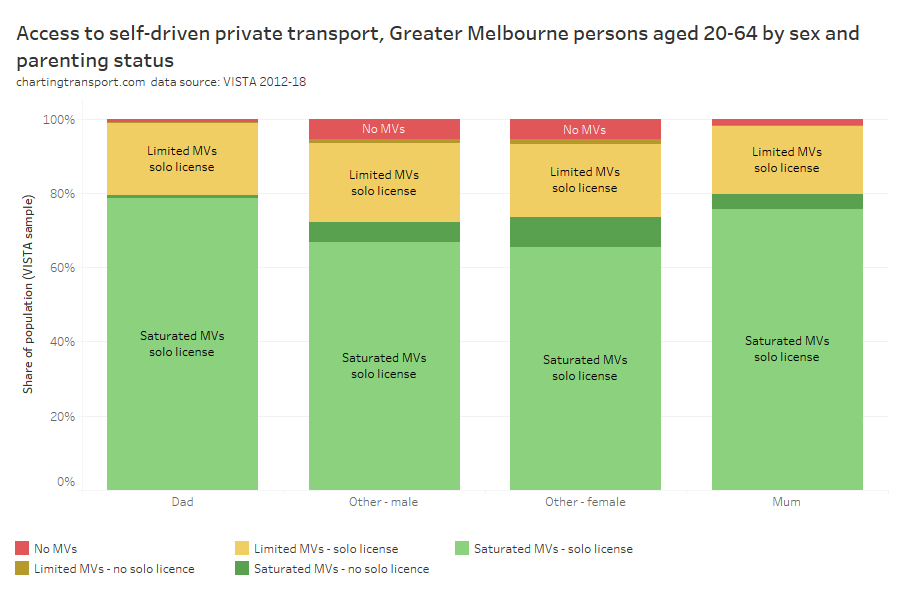
There were small differences between mums and dads, with mums slightly less likely to have a solo driver’s licence than dads (95% v 98%), mums slightly less likely to have independent private mobility (75.5% v 78.6%), and mums slightly more likely to live in a household without any motor vehicles (1.7% v 1.0%). These slight differences might suggest mums would have lower private transport mode shares than dads, but we’ve actually seen above that the opposite is true. Therefore access to independent private mobility is unlikely to explain much of the differences in travel between mums and dads.

There weren’t substantial differences between non-parenting men and women, other than non-parenting men having slightly high solo licence ownership (91% v 88%).

Parents were more likely to have a solo driver’s licence than non-parents, and over three-quarters lived in a household with saturated motor vehicle ownership. Access to independent private mobility aligns strongly with parents’ much higher private transport mode shares, and is probably considered essential for parents in most parts of Melbourne.

Indeed, we can also break this down by geography – using a simple inner/middle/outer disaggregation of Melbourne:
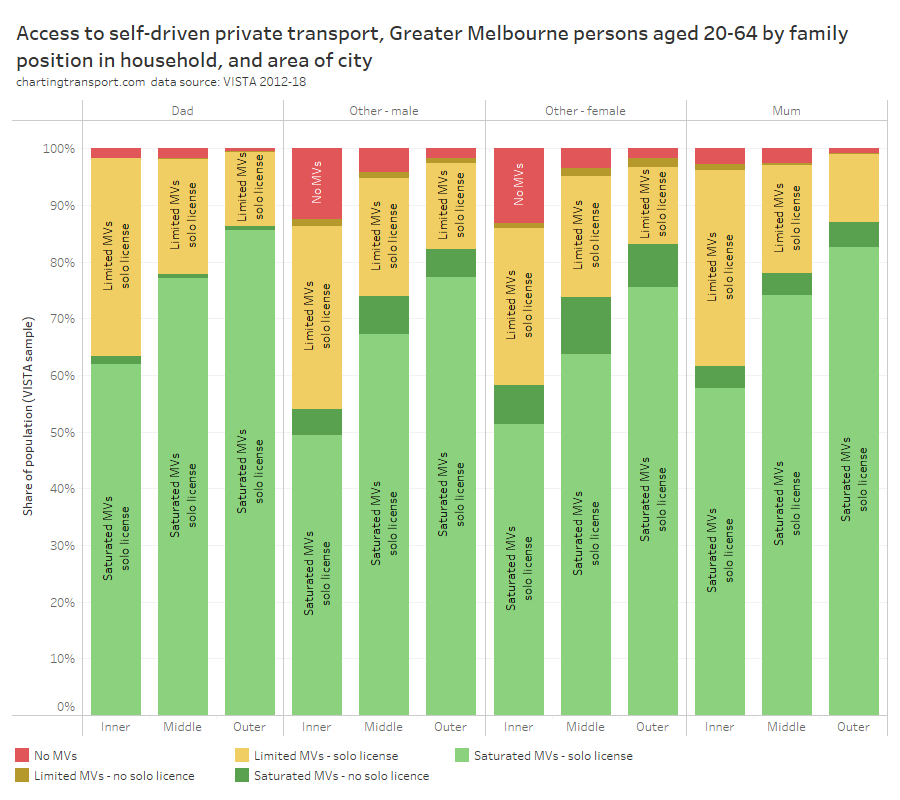
For all person categories there’s a strong relationship with distance from the city centre, with significantly lower levels of motor vehicle ownership in the inner areas. However solo licence ownership was very high for parents even in the inner suburbs (94% of mums and 98% of dads).

86% of dads and 87% of mums in outer Melbourne lived in households with saturation motor vehicle ownership. However, 5% of mums in the outer suburbs didn’t have a solo licence, which could make getting around quite challenging, and highlights the importance of quality public transport services in these areas.

Around 14% of non-parents in the inner suburbs lived in households without motor vehicles.

Where do parents tend to live?

It probably won’t surprise many readers to hear that parents made up a much larger share of the residential population in the outer suburbs, particularly urban growth areas:
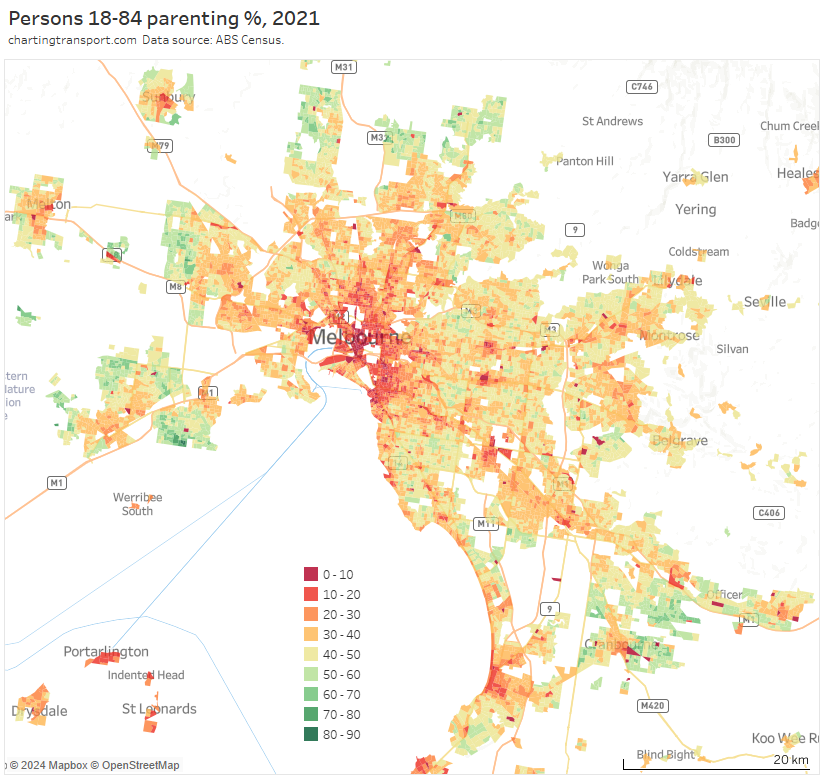
But if you look closely, you’ll also see quite low proportions of parents along train lines, tram lines, and the public transport rich inner suburbs.

In fact, it’s possible to examine the type of households per dwelling by distance from train stations (I’m excluding areas within 3 km of the CBD).
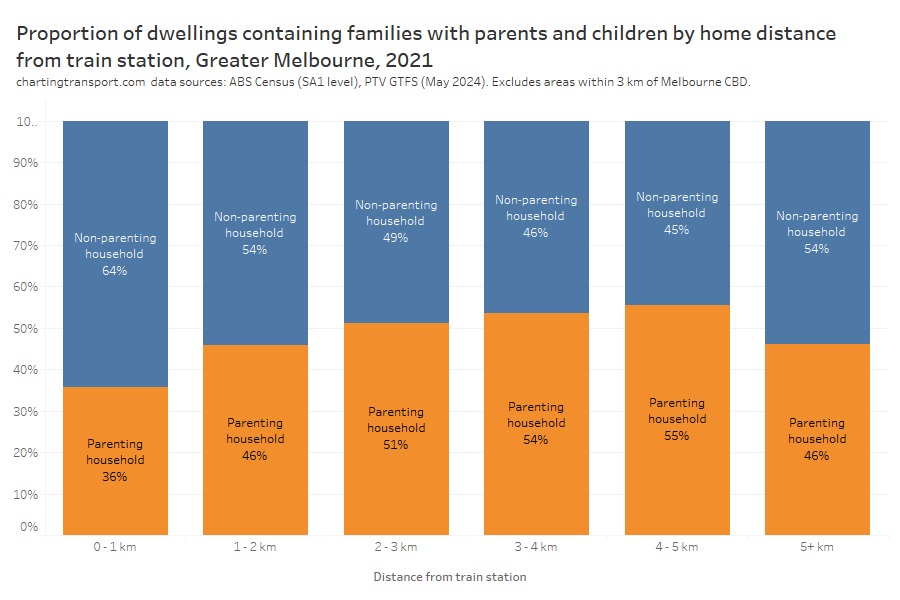
Technical notes: I’ve calculated straight distance between SA1s centroids and their nearest train station points as per GTFS data in May 2024. The only significant change in train stations between August 2021 and May 2024 was the merger of Surrey Hills and Mont Albert into Union Station in 2023. So it’s not perfect analysis but I’m also not interested in precision below 1% resolution. I’ve also excluded unoccupied and non-private dwellings.

Dwellings close to train stations are significantly less likely to contain parents.

Is this because parents cannot afford family-friendly dwellings near train stations? Is it because dwellings near train stations are less family-friendly? Or is it because many parents like to build their own home on the urban fringe? Or some combination of these?

Well, the census tells us how many bedrooms there are in most occupied private dwellings, and the following chart shows the relationship between number of bedrooms and distance from train stations (again, excluding areas within 3 km of the CBD):
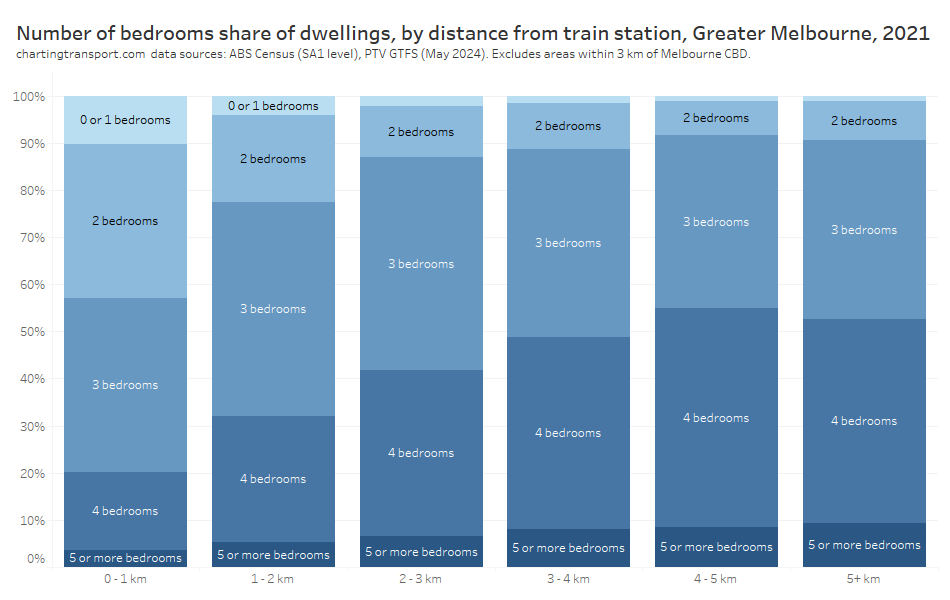
Sure enough, dwellings near train stations generally had fewer bedrooms.

And we can also use census data to show the relationship between number of bedrooms in a dwelling, and whether the household includes parents + children:
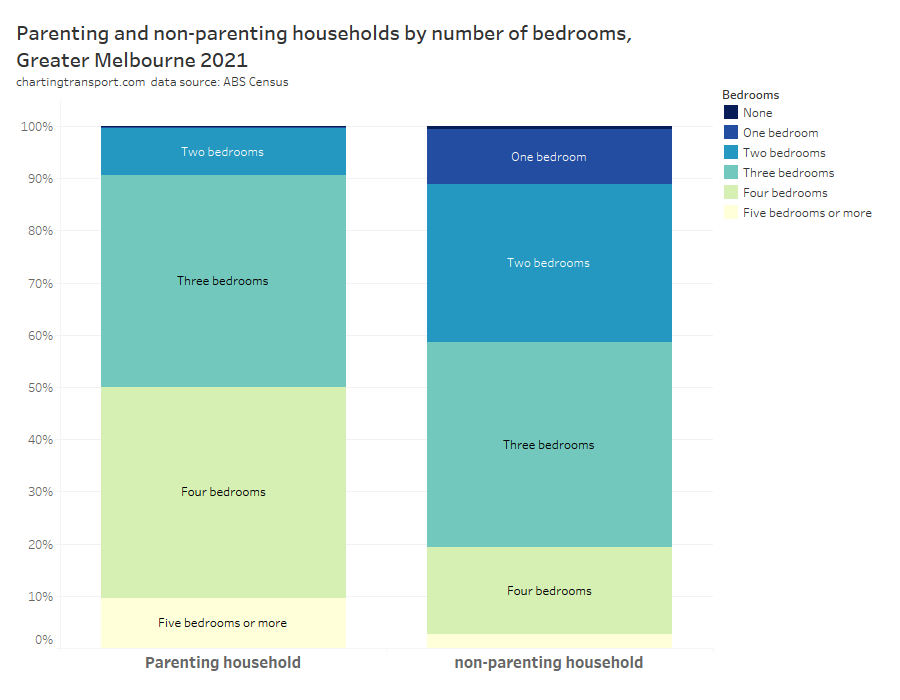
Over 90% of parenting households had three or more bedrooms, and half had four or more bedrooms. But almost half of all dwellings within 1 km of a train station had two or fewer bedrooms rendering them not very family-friendly.

Just to take it slightly further, I’ve put all three dimensions on one chart and this shows that dwellings close to stations with three or more bedrooms were slightly less likely to house parenting families:
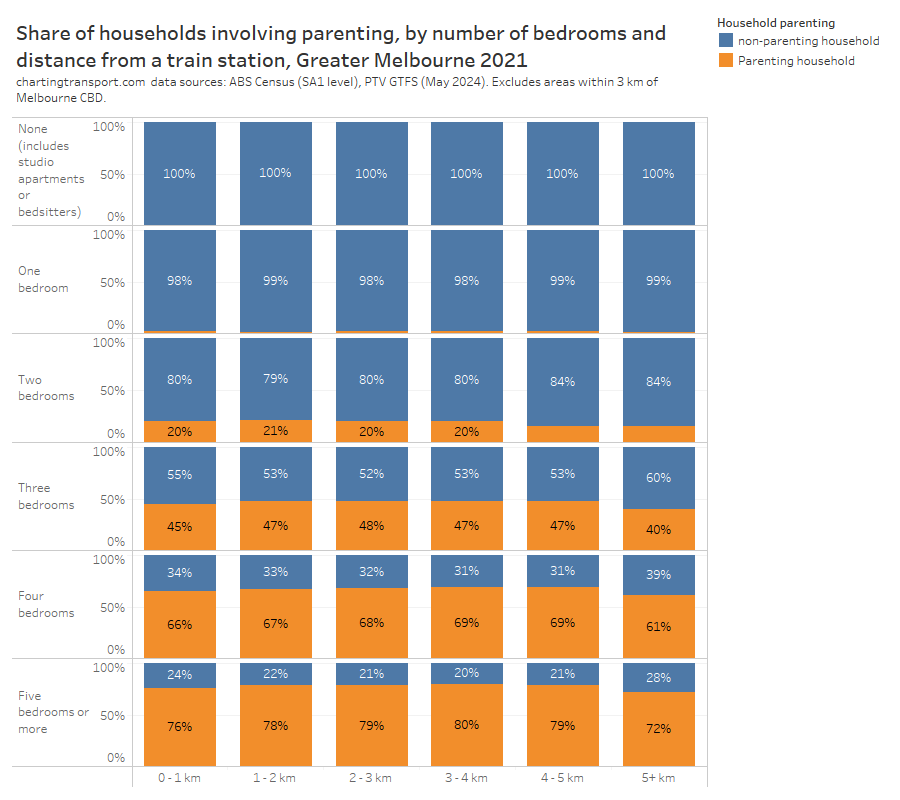
I think the lower availability of family-friendly housing near rapid public transport is quite likely to be contributing to lower public transport mode shares for parents, particularly as there is a clear relationship between public transport use and proximity to rapid transit stations (see: Are Australian cities growing around their rapid transit networks?)

That said, there may also be an issue around whether many families can afford three-bedroom homes close to train stations as they often have less than two full-time incomes supporting three or more people. Might young professional couples with no kids and/or share houses of young professionals be better placed to compete for this housing?

Where do men and women work in Melbourne?

Could differences in journey to work mode splits be explained by differences in workplace location?

Here’s a map of gender balance by workplace location across Melbourne for 2021 at destination zone geography (DZs) (sorry not all outer suburbs included on the map as I didn’t want to lose the inner area detail). Blue areas skew male, orange areas skew female.
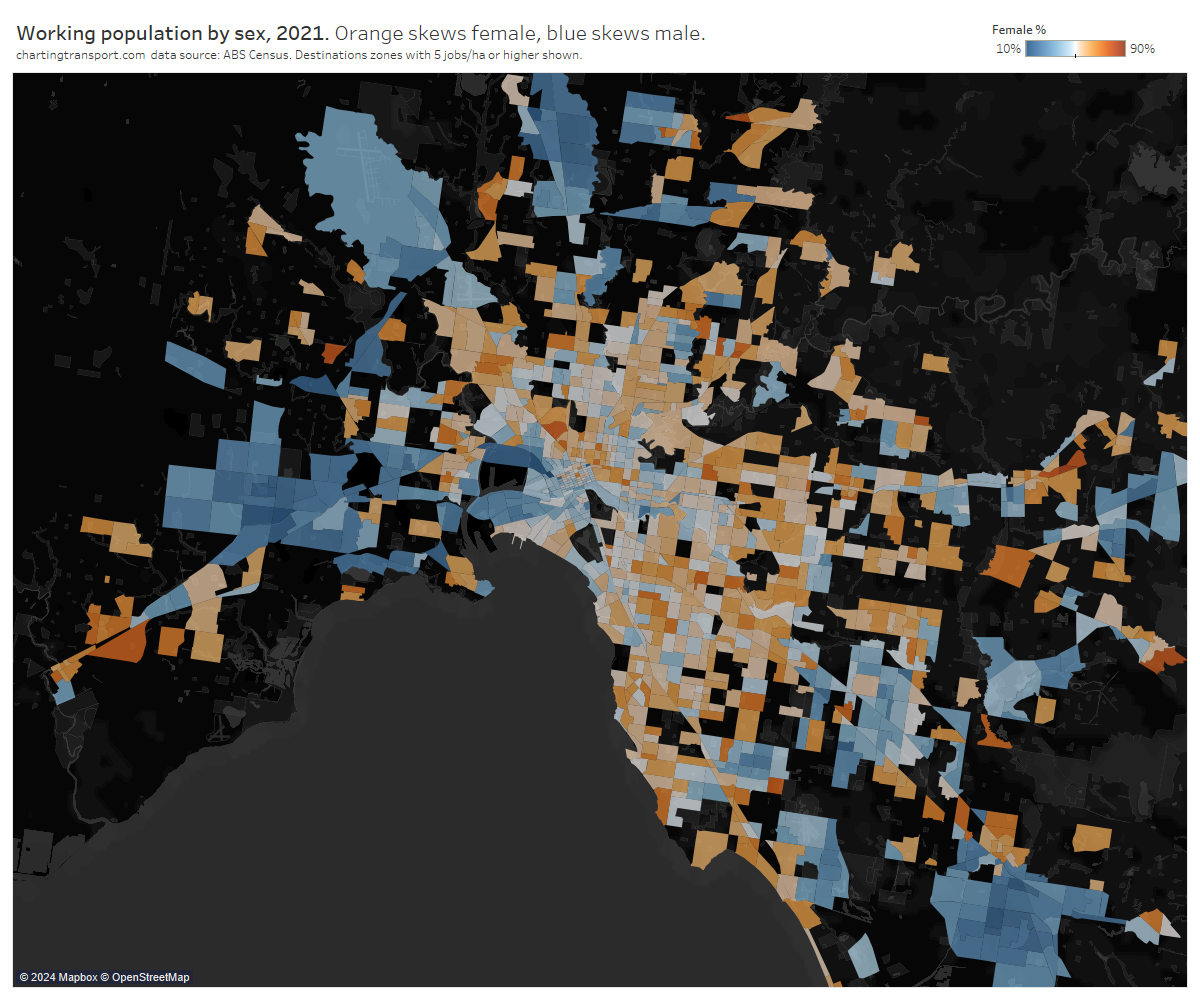
Anyone with knowledge of Melbourne’s urban geography will instantly see large industrial areas shaded blue, and plenty of orange in most other places.

These skews follow industries with male and female dominant workforces. In fact, I’ve manually done some rough grouping of destination zones where there is a clear dominant land uses (not exhaustive but results should be fairly indicative), and here is the sex breakdown by land use type:
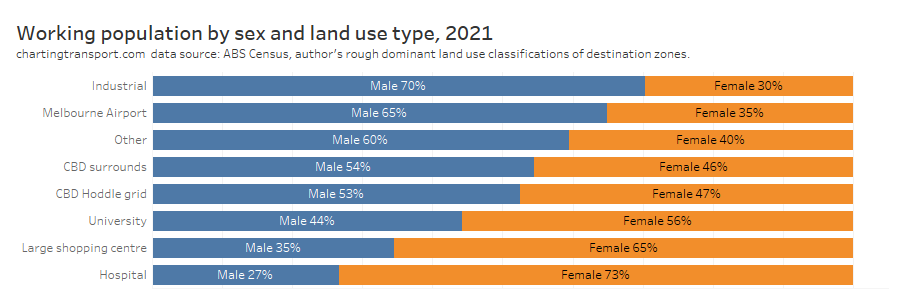
Industrial areas and Melbourne Airport skewed heavily male, while hospitals and large shopping centres skewed female. Universities skewed female, and the CBD and surrounding areas slightly skewed male.

What about parenting? Something to keep in mind is that 43% of the working population were living with their children.
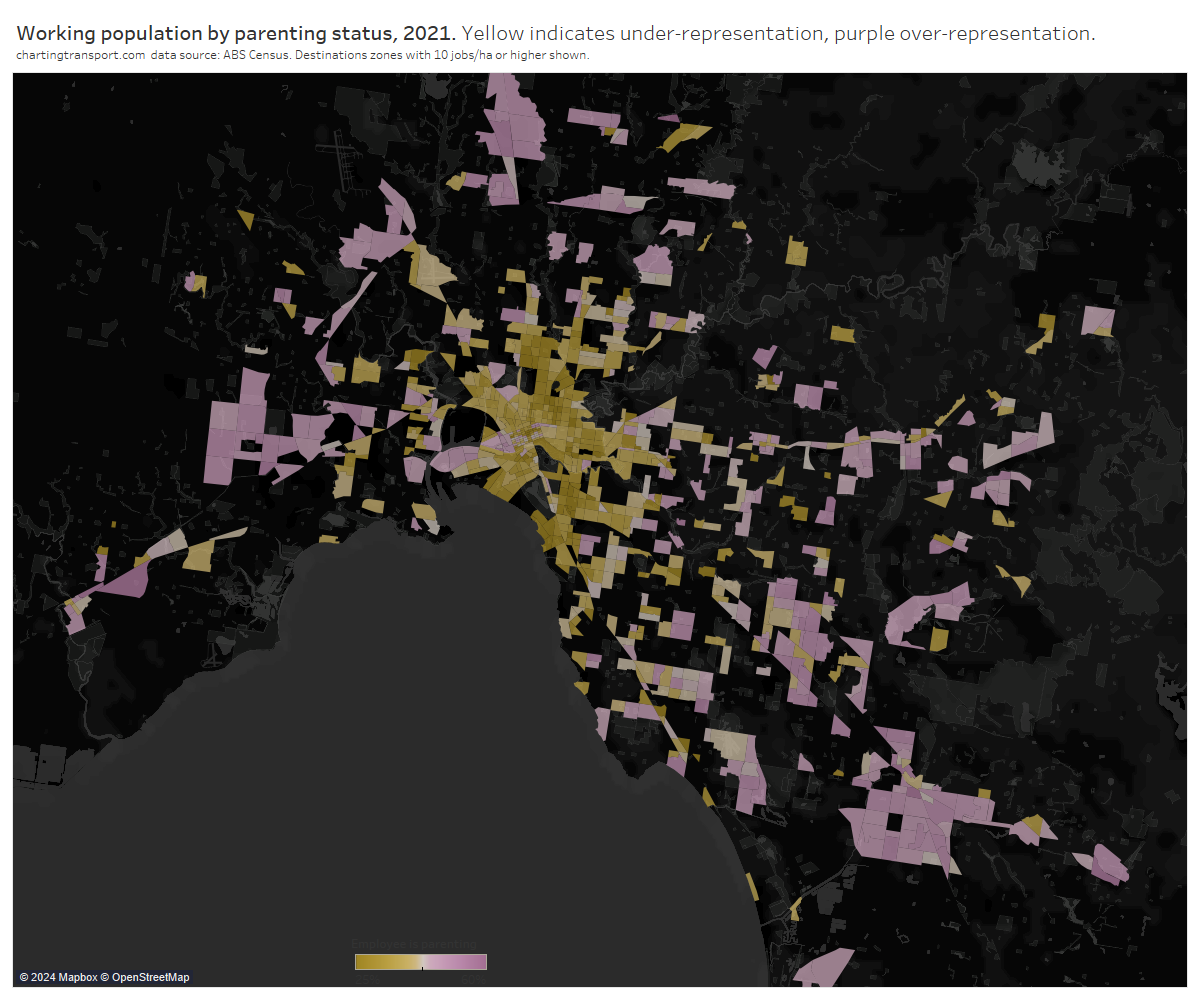
Parenting workers were seen more in the middle and outer suburbs, which is also where parents skewed as a home location, so there’s undoubtedly a relationship there.

Here’s the parenting breakdown by dominant land use classification:
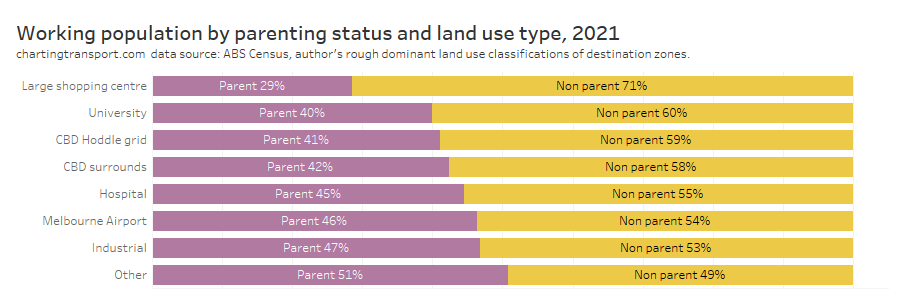
Parents were under-represented in major shopping centres (I’m guessing a skew to younger employees), but also to a small extent universities and the central city. Parents were slightly over-represented in hospitals, Melbourne Airport, industrial areas, and the rest of Melbourne.

Another way to represent this data is looking at the distribution of workplace locations by distance from the Melbourne CBD:
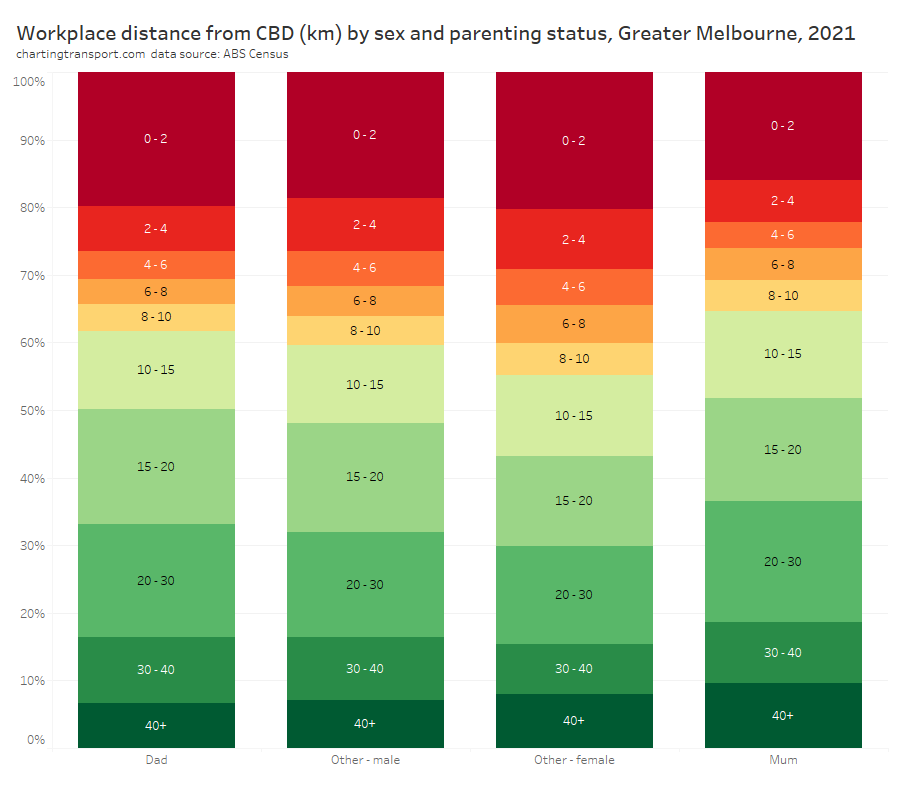
Probably the biggest stand-out is that mums skewed towards suburban employment locations, while non-parenting females were more likely to be working closer to the city centre.

The distribution of workplace distance from the CBD for males only differed slightly between those parenting and non-parenting. Dads were less likely to be work between 2-10 km from the Melbourne CBD than non-parenting males.

Employment density

I’ve previously shown that private transport mode shares are generally much lower in areas with higher job density (likely due to higher car parking costs and increased public transport accessibility). So do mums/dads/others typically work in areas of lower or higher job density, and could this explain differences in their mode splits?

To answer this I’ve calculated an aggregate weighted job density of the areas in which each category of person tends to work. How does that work? Well to start with I’ve calculated the job density of every destination zone in Greater Melbourne. I’ve then calculated a weighted average of these densities, where the density of each destination zone is weighted by the number of dads/mums/other males/other females working in that zone.
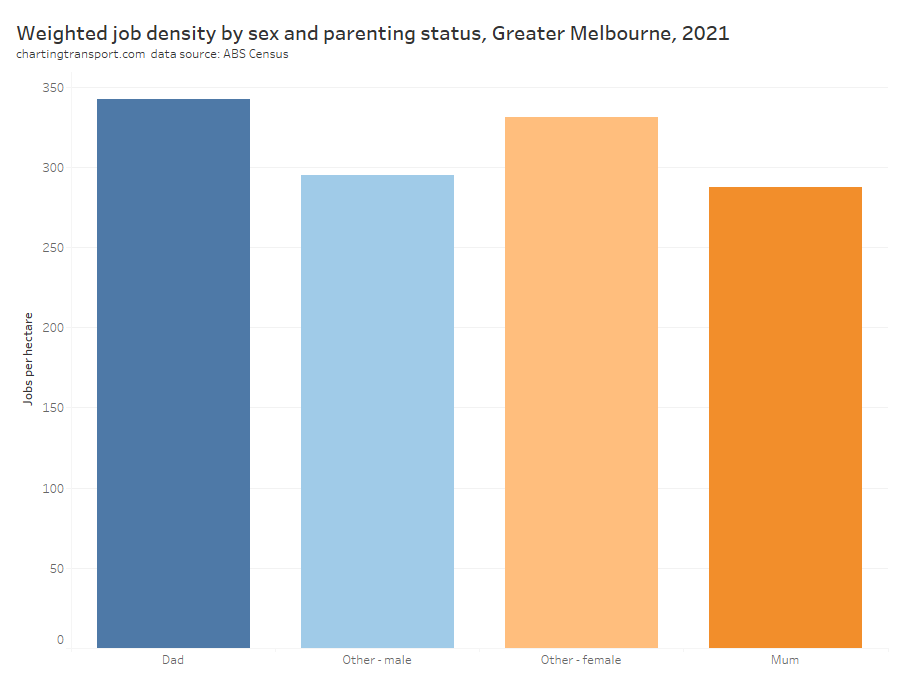
For females, those non-parenting generally worked in more jobs dense areas, compared to mums. This probably partly explains the lower public transport mode shares of mums.

For males it was the reverse – dads generally worked in more jobs-dense locations.

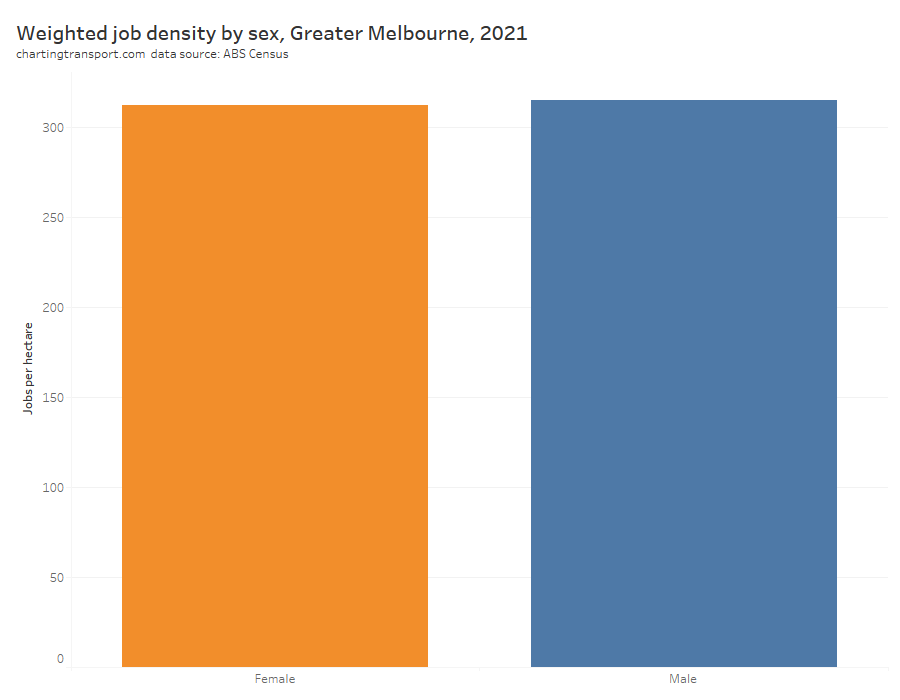
Overall was only a tiny difference between men and women in aggregated weighted job density:
That was a lot of charts, can you summarise that?

The following table attempts to highlight key variations from the overall average for different types of adults:

Type of adultTravel patternsDestination patternsMode split Explanatory factors
ParentsMore trips per person on weekdays.
More trip chaining.
Higher private mode share.Live further from public transport.
Lack of family-friendly dwellings near public transport.
Live in outer suburbs.
Higher car ownership.
MumsMore travel during weekday interpeak.
Highest trip chaining.
Travel closer to home.
Work closer to home.
Less radial travel.
Least likely to work in CBD.
Very high private transport mode share.Do most school drop offs / pick ups.
Least likely to work full time.
Less likely to work in job-dense areas.
DadsTravel longer distances.
Travel further from home.
More time spent travelling.
Travel further from home.
Work further from home.
More likely to work in CBD.
More likely to use trains.
More likely to use bicycles.
Most likely to work full time.
More likely to work in job-dense areas.
Non-parenting womenTravel closer to home.
Work closer to home.
Higher public transport use.More likely to work in job-dense areas.
Most likely to work in central city.

The explanatory factors in the right hand column will not be independent. For example, many parents probably find it infeasible to live near public transport, so they live further away and are more car-dependent.

What does all this mean for transport planning interventions?

I won’t say a lot on this topic (I tend to avoid policy prescriptions on this blog) but I will say I think some caution is required here.

One perspective might be that the proportion of males and females travelling on a mode at a particular time of the week will not change, and therefore interventions might predominantly benefit the existing user base (eg higher inter-peak public transport service frequencies might benefit women more than men).

However another perspective might be that interventions remove the barriers for one gender to utilise a mode of transport and might have significant benefits for the minority gender in the current user base. For example, significantly safer cycling infrastructure might encourage more women to cycle and lead to a more even balance between genders – indeed I’ve uncovered evidence about that on this blog.

So many mums driving kids to school!

One thing that really stands out to me is that mums do the vast majority of school drop offs and pick ups, and most of this travel is (now) happening by private vehicle. This is potentially impacting women’s workforce participation, and the traffic volumes are certainly contributing to road congestion. It might also be impacting women’s mode choices as school trips are generally more difficult on public transport, and mums do a lot of trip chaining. They might be using private transport for some trips mostly because those trips are chained with school drop-off/pick-ups.

What could you do to reduce private transport trips for school drop off / pick ups, and potentially also increase women’s workforce participation and public transport mode share?

  • Make interventions that increase the share of school students who travel to/from school independently by active or public transport
  • For school trips that are accompanied by a parent, encourage a mode shift towards active transport (realistically, public transport is less likely to be an attractive mode for many accompanied trips to school, unless it is on the way to another destination)
  • Provide at-school before-school and after-school care to enable both parents the opportunity to work full time (indeed government subsidies are provided in Victoria at least)

How might things have have changed post-COVID?

Unfortunately at the time of writing rich data is only really available for pre-COVID times.

A major change post-COVID is that many white collar professionals are now working from home some days per week, which has reduced travel to major office precincts.

I would not be surprised to see dads taking a slightly higher share of the school drop-off pick-up task as this can be easier to do on a work-from-home day. Might this have enabled women to work longer hours? There have also been higher child-care subsidies implemented recently that might also lift women’s workforce participation.

Indeed here’s a chart summarising female labour force status since 2012 (not seasonally-adjusted):
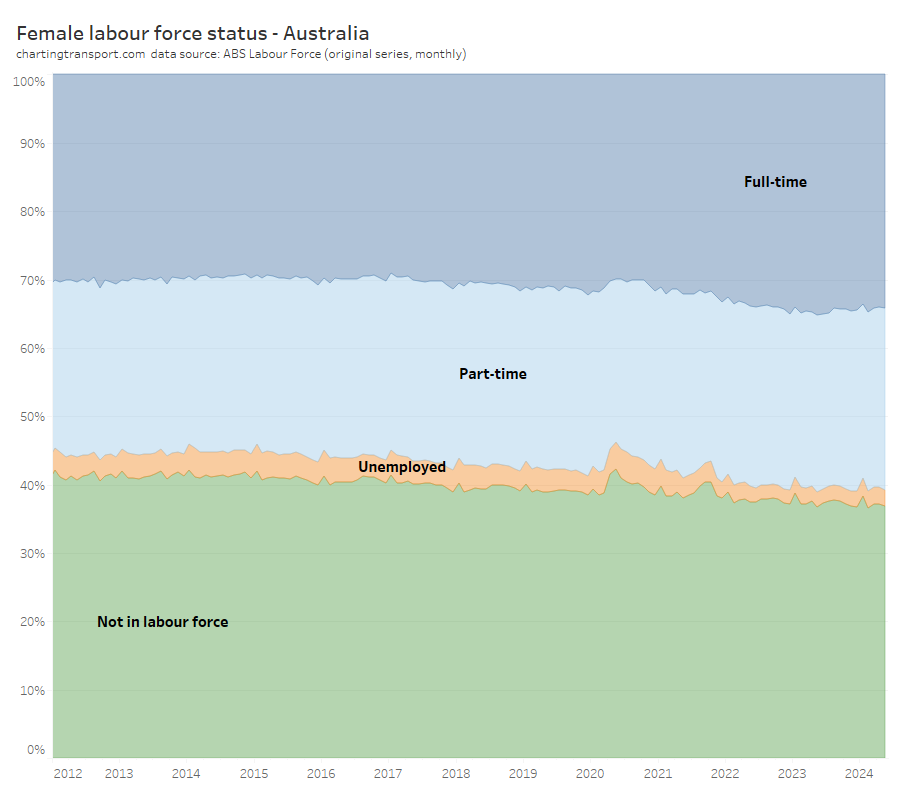
Technical note: I would have preferred to use seasonally adjusted or trend series numbers to remove the noise, but these data sets do not include counts for “not in labour force”

Following the major COVID disruption period around 2020-2021, women have been more likely to be working full time and more likely to be in the labour force. This might be partly related to new working-from-home patterns.

Hopefully more post-COVID travel data will be released before too long and I can investigate if there are any substantial shifts in the patterns between men and women, parents and non-parents.

Do let me know if you think there is more that should explored regarding the differences in travel patterns and explanatory variables for men and women, parents and non-parents.


How did Perth’s CBD end up with 19% more private transport commuters in 2021?

Sat 3 June, 2023

Note: Since publishing this post, it has come to my attention that Perth’s Fremantle train line was closed on census day in 2021, which may have impacted mode shares in Perth.

ABS census data tells us that Perth’s CBD experienced a massive 19% jump in the number of private transport commuter trips between 2016 and 2021. That’s over 5000 more journeys – mostly as car drivers – and is quite likely to have made traffic congestion worse.

So how did that happen? Where were these extra commuters travelling to? Were there particular changes in the modal mix in different parts of the CBD? Was this growth enabled by a big increase in car parking capacity? And what has been happening to car park pricing?

This post digs a little deeper following my last post that explored the impact of COVID on journey to mode shares in Australian cities in 2021.

A quick recap of overall changes in journey to work in the Perth CBD

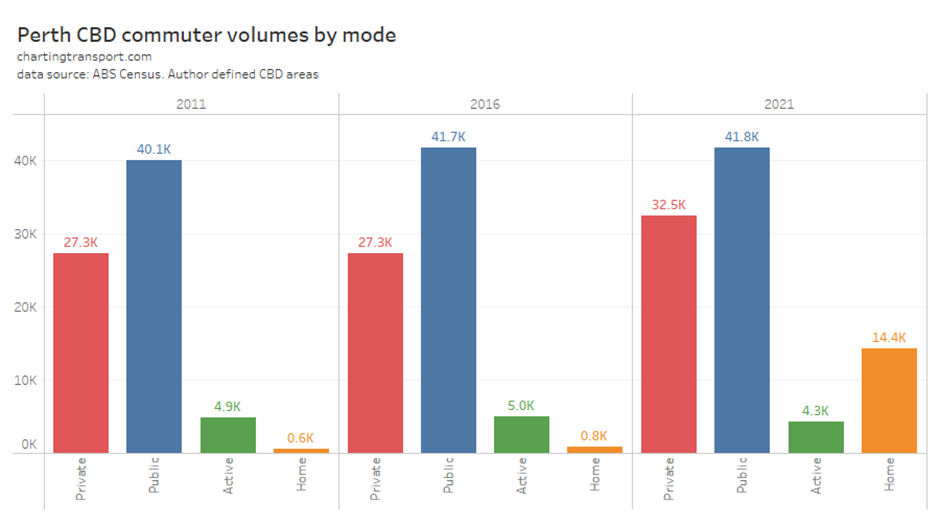
Here’s the volume of Perth CBD commuters by main mode, including working at home in 2011, 2016, and 2021:

See my last post for my definition of the Perth CBD. A trip involving any public transport is classed as public, a trip that involves only walking or cycling is classed as active, and any other form of travel is classed as private.

At the 2021 census, Perth was COVID-free with relatively few restrictions on intra-state movement or activity.

Total employment in the CBD grew by a massive 26% from 82,214 in 2016 to 103,944 in 2021. Private transport trips increased by 19%, but because this was less growth than overall employment growth there was actually a commuter mode shift away from private transport of 1.6% (from 36.5% to 34.9%).

The biggest increase in CBD worker volumes was in those who worked at home.

Public transport commuting to the CBD increased by only 85 trips between 2016 and 2021, but still accounted for more trips than private transport.

LATE EDIT: It’s just come to my attention that the Fremantle train line was closed on the day of the 2021 census (10 August), which will have suppressed public transport mode share in the western suburbs.

My last post concluded there was likely a significant mode shift from public transport to remote working. There was some mode shift away from public transport and towards remote working and private transport for some middle age groups, although some of this shift is likely to be a normal trend seen as people age (and become parents). I was unable to identify occupations that saw a substantial mode shift from public transport to private transport, although some occupations saw a lot more private transport growth than public transport growth.

This post now takes that analysis a bit further by looking at spatial variations in the modal mix by workplace location.

Where were the extra private transport commuters working?

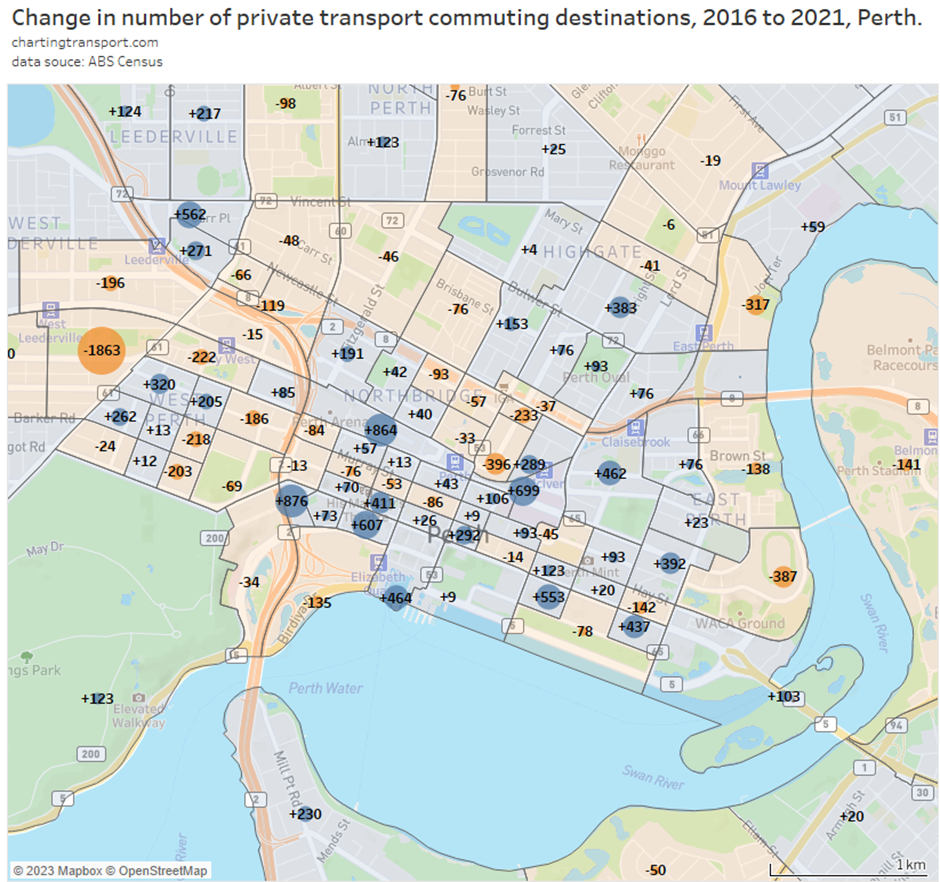
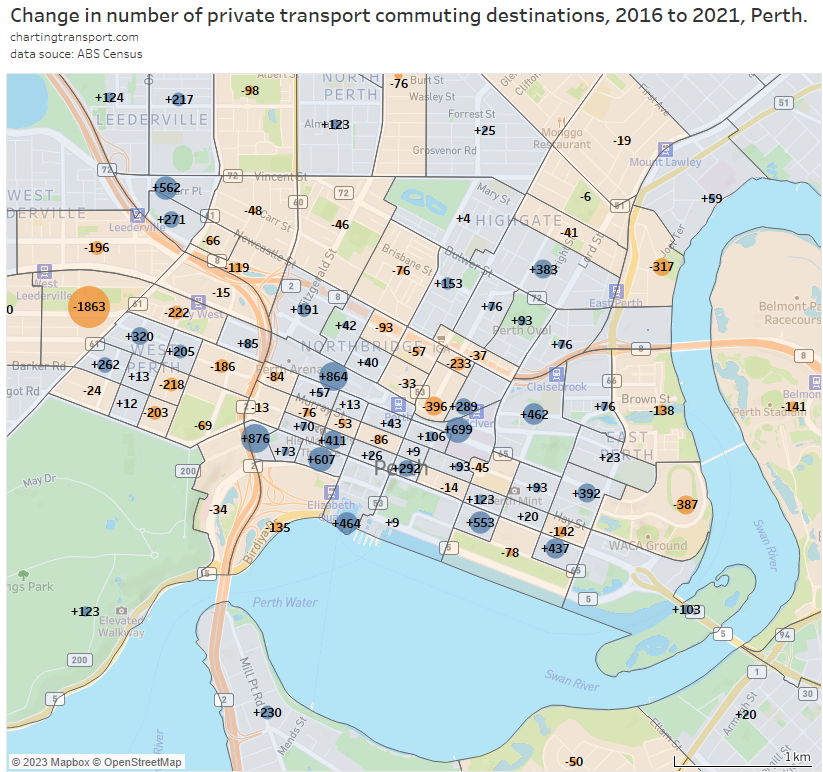
Here’s the change in private commuter trips for each destination zone around the Perth CBD:

Note: the circles aren’t always drawn in the middle of each destination zone, aren’t intended to highlight any particular location within each zone, and may not be representative of major car park locations.

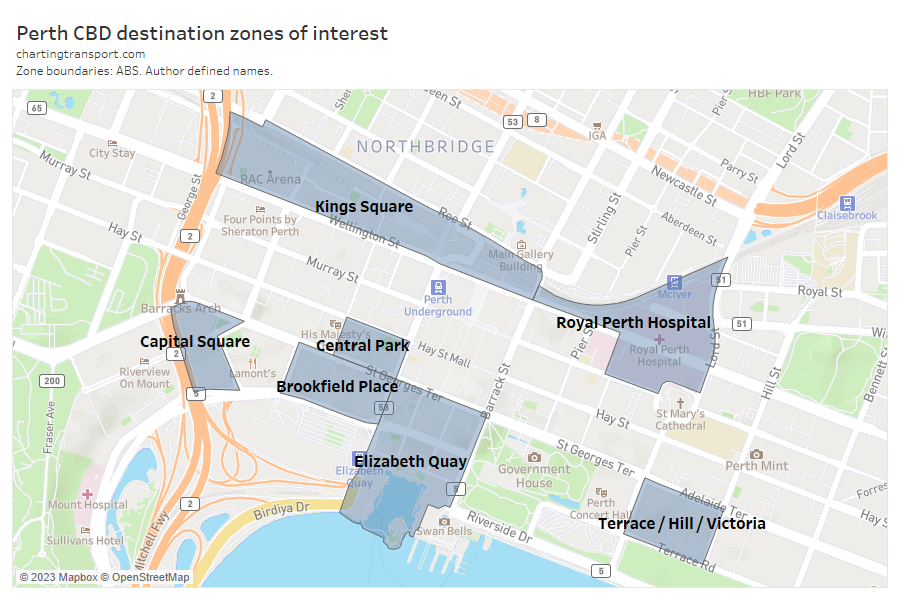
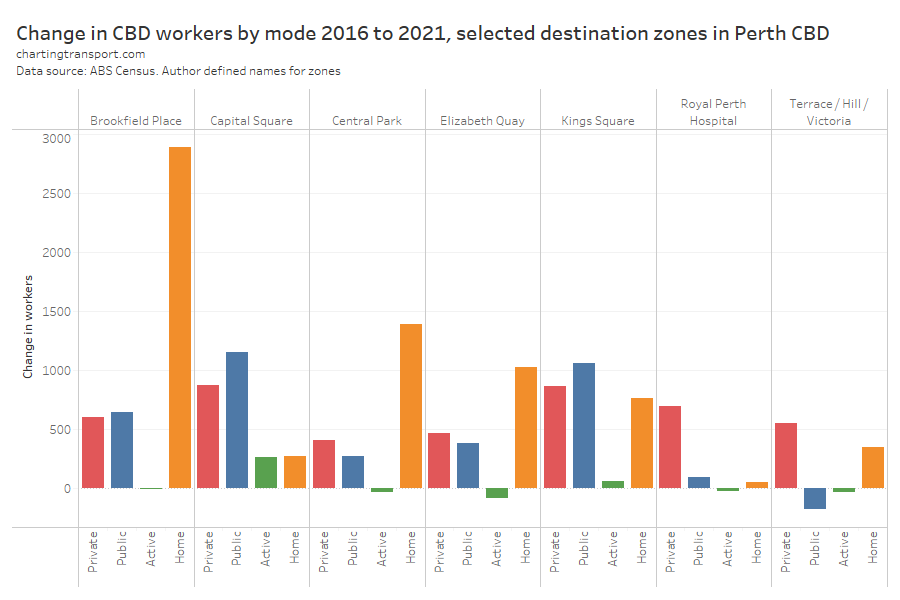
There were both increases and decreases around the CBD. I’m going to focus in more detail on the following high-growth destination zones that I’ve arbitrarily named by a dominant building, precinct, or bordering streets:

Most of the zones that saw a big increase in private transport commuter trips also saw a big increase in public transport trips.

Capital Square saw jobs more than triple between 2016 and 2021 as a major new development was completed (including the new Woodside headquarters). It had the largest increase in private transport trips, but even more new trips were by public transport. The development includes five levels of car parking on a fairly large site (at least 659 car parks according to some planning documents). It also saw the largest growth in active transport commuter trips of any destination zone in the Perth CBD.

The zone I have labelled Kings Square (which includes Perth Arena and the new Shell and HBF buildings) saw only slightly more new public transport trips than new private transport trips, despite Perth train station being inside the zone.

The Royal Perth Hospital zone had almost all of its net job growth accounted for by private transport, some of which would have been shift workers. This is consistent with my last post that found a large increase in private transport commuters under the “carers and aids” and “health and welfare support” occupation groups. The hospital is directly adjacent to McIver train station, served by multiple train lines.
One mixed-use block between Terrace Road, Victoria Avenue, Adelaide Terrace, and Hill Street had an increase in private trips and a decrease in public trips. It’s difficult to speculate why this occurred due to the diverse mix of land uses.

The Elizabeth Quay zone saw more growth in private trips than public trips, despite being immediately adjacent to Elizabeth Quay train station. I’ve not been able to identify any large new car parks in the area. Car parks immediately north of the development site were offering $25 all-day car parking at the time of writing which I suspect the average employee might not consider particularly affordable.

The Brookfield Place and Central Park zones mostly saw a big increase in the number of remote workers.

Outside the CBD, the biggest decline in private trips was -1863 in a zone near West Leederville station where the Princess Margaret Hospital for Children closed in 2018 (replaced by the Perth Children’s Hospital in Nedlands).

Where was there a shift from public to private transport?

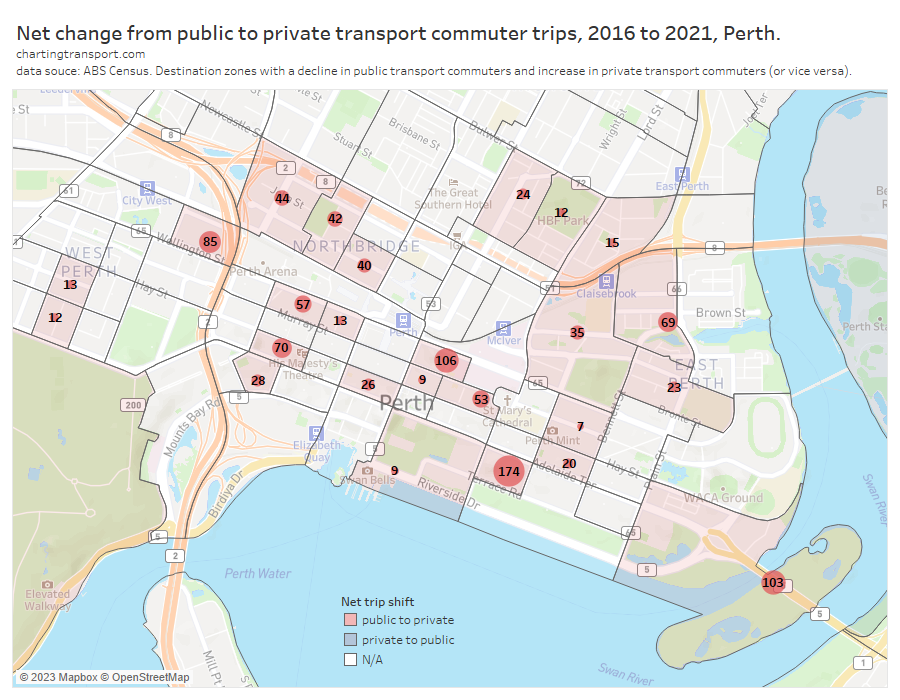
The following map shows destination zones where there was a decline in public transport trips and an increase in private transport trips (no zones showed the opposite flow):

Just under than half of the destination zones around the Perth CBD saw some sort of net shift to private transport, and most of these were very small numbers. In total these zones account for 492 trips within for my definition of the Perth CBD, about 0.5% of all workers. A net shift from public transport explains less than 10% of the total increase in private transport commuter trips.

This is consistent with analysis in my last post (which disaggregated by birth cohorts and occupations) and again suggests the growth in private trips was broadly in line with the overall growth in CBD employment. It also fits with the hypothesis that the biggest mode shift was from public transport to remote working.

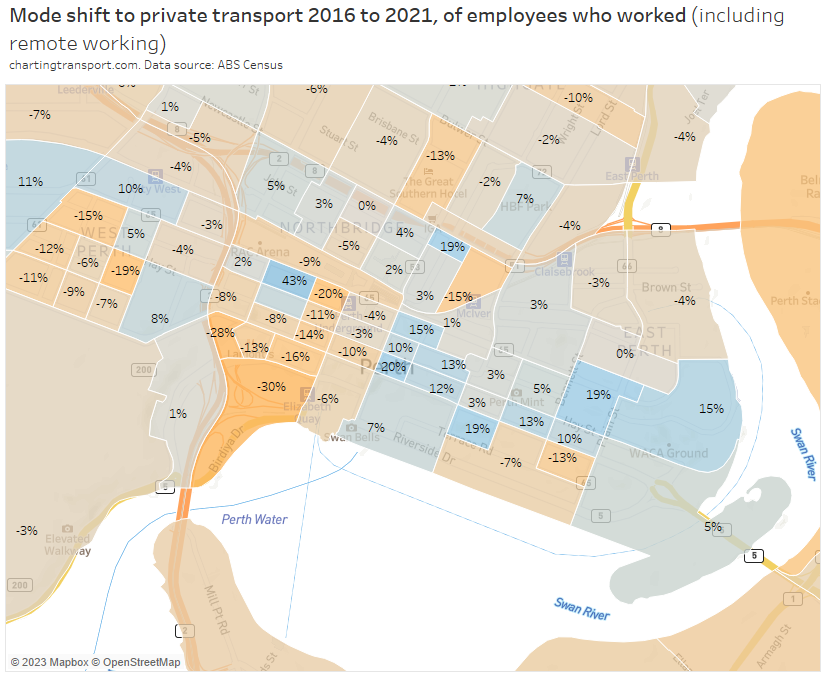
Another way of analysing mode shift is to look the percentage change in private transport mode share by zone:

In the western part of the main CBD area there were many zones with a large mode shift away from private transport, and many of these zones had high employment density.

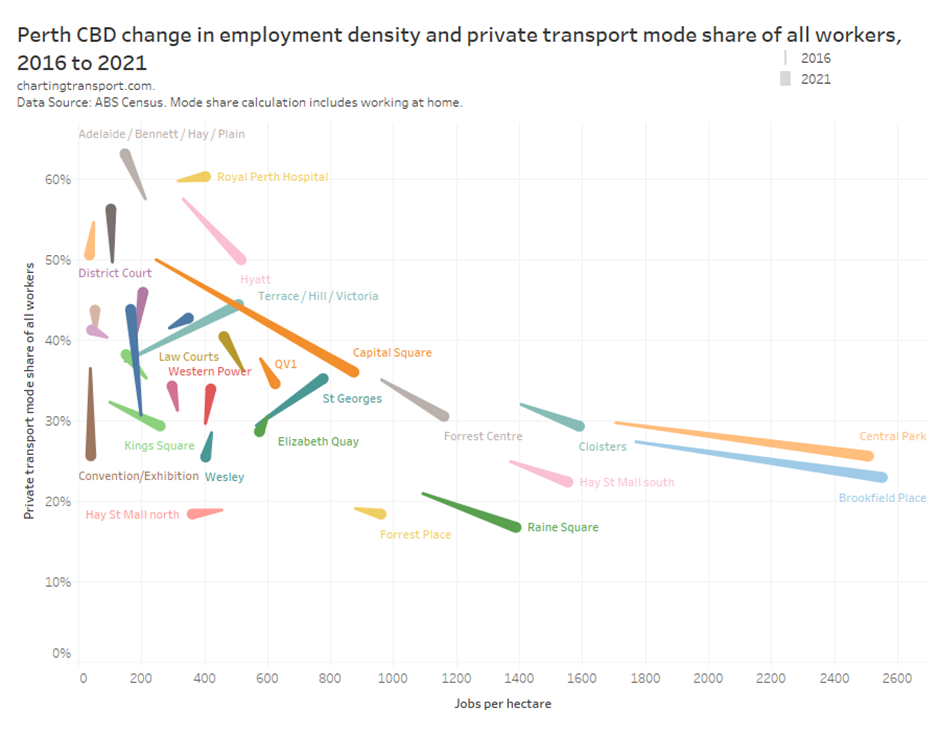
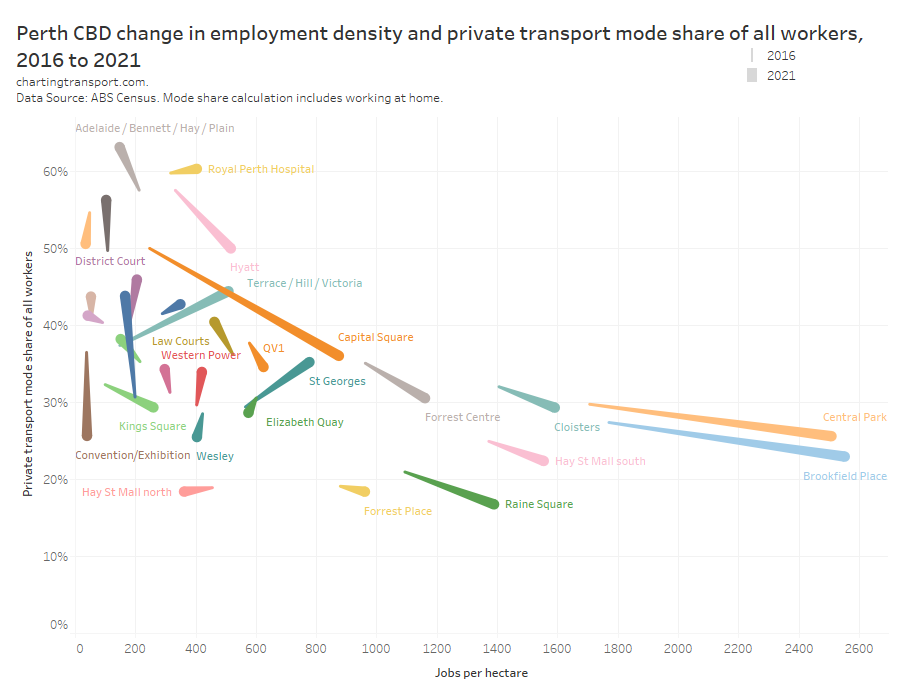
In fact, the next chart shows how employment density and private transport mode share changed between 2016 and 2021 in the Perth CBD, with the thin end of each ‘comet’ being 2016 and the thick end being 2021 (I’ve arbitrarily named several more destination zones based on major landmarks or surrounding streets).

Note: some destination zones include significant land that is not built up (eg parkland, water bodies, and/or freeway interchanges) and these will have understated employment density. This incudes Convention/Exhibition and Elizabeth Quay.

The dominant pattern is that the zones with high and increasing employment density mostly saw declining private transport mode share, although the “Terrace / Hill / Victoria” block was a standout exception having increasing employment density and increasing private mode share.

How did the CBD absorb so many more car commuters?

It’s hard to know for sure but some possible explanations include:

  • New car parking supply: I’ve already mentioned the Capital Square development that included five levels of parking. Locals might know of other new large CBD car parks, but I’ve struggled to identify any large car parks on Parkopedia or Google Maps that didn’t already exist in 2016. Many new office buildings don’t appear to include large car parks.
  • Perth was in a “mining downturn” in 2016: The Perth CBD only added 1.7k jobs between 2011 and 2016, and there was no significant increase in private commuter trips. According to a Property Council report in August 2016, Perth was experiencing very high office vacancy rates (21.8%) and had been experiencing a decline in office space demand that started around 2013. So it seems quite plausible that car parking supply grew between 2011 and 2016, but commuter parking demand only grew strongly after 2016.
  • Reduced short-term parking demand? Perhaps there has been a decline in demand for short-term parking (through the normalisation of online business meetings) enabling more all-day parking. But I’m just speculating.

Someone reading this from the parking industry might be able to share some insights (please add comments).

What’s been happening to Perth CBD car parking prices?

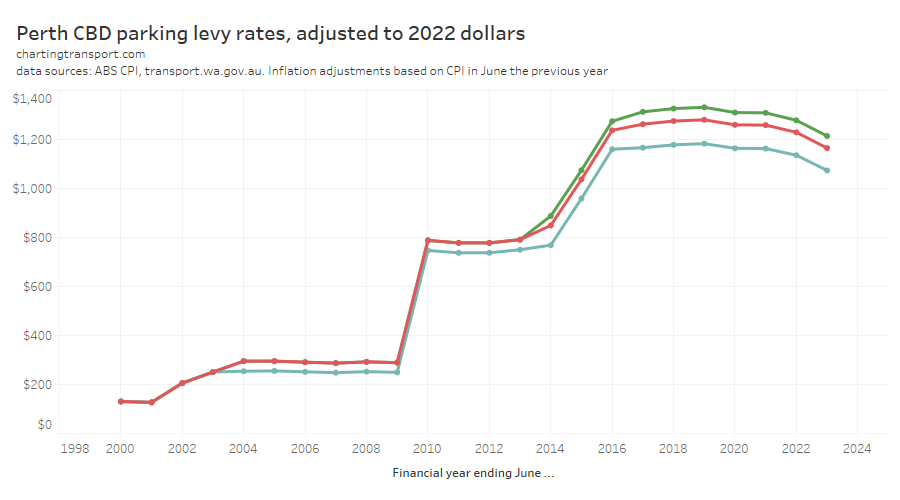
Like Sydney and Melbourne, Perth has a CBD parking levy – an annual fee collected by government per space. Here’s what’s been happening to the levy prices in real terms:

The parking levy increased substantially in real terms in 2010 and again between 2014-2016, but in recent years has not been keeping up with inflation. Between 2016 and 2021 there was almost no real change in the levy.

So what’s been happening to car park prices?

The City of Perth itself operates a large number of CBD car parks and in 2021/22 parking revenue accounted for 36% of its total income (source: budget 2022-23).

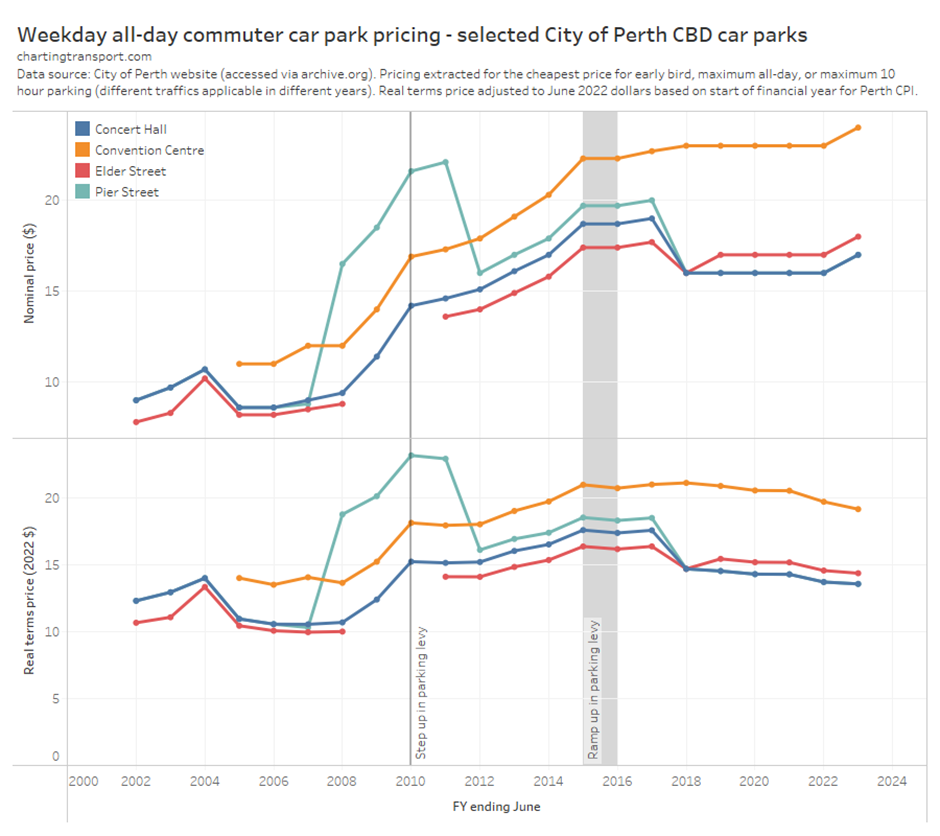
Thanks to the incredible resource that is the Wayback Machine, I’ve been able to dig out prices at their CBD car parks right back to 2001-02. For the sake of manageable analysis I’ve focussed on four relatively large central CBD car parks – Concert Hall (399 spaces), Convention Centre (1428 spaces), Elder Street (1052 spaces) and Pier Street (680 spaces). Here’s how those prices have changed over time, in nominal and real terms:

The 2010 and 2015 jumps in the pricing levy were clearly reflected in retail parking prices.

In real terms, parking prices peaked around 2015-2017 and have been in decline since then. Prices for several car parks were cut substantially in 2017/18 – perhaps as a belated response to a reduction in office commuter demand during the mining downturn. Then parking prices were frozen from 2019 to 2022 – presumably due to the pandemic.

So despite the massive increase in CBD parking demand, the City of Perth reduced – rather than increased – all-day parking prices, and so has probably also missed out on significant additional revenue. This has arguably helped facilitate the big increase in commuter traffic volumes, along with the likely associated urban amenity impacts of more traffic in the CBD.

The City of Perth is a democratic local government so it’s probably not going to behave in an entirely economically rational way when it comes to price setting. Prices are also locked in for each financial year so are much less dynamic. So what have commercial parking operators been doing?

Unfortunately I’ve not been able to use the Internet Archive to find historical commercial car parking prices in the Perth CBD back to 2016. What I can tell you is that “flexi” online parking at the Wilson Parking run Central Park car park has risen from $19 in October 2021 to $26 in May 2023 – suggesting commercial operators are not afraid to change their pricing. That said, the Kings Complex car park (517 Hay Street, near Pier Street) has had no increase in its online daily rate between October 2021 and May 2023 ($18).

So what is Perth’s parking policy?

The current Perth parking policy (2014) states:

“This policy recognises that vehicular access to, from and within central Perth is a critical element in ensuring its continued economic and social viability. It also continues to recognise the need to preserve and enhance the city’s environment. The policy aims to address these needs by supporting the provision of a balanced transport network in order to manage congestion and provide for the efficient operation of the transport network to, from and within the city centre.”

I suspect the term “balanced transport” is indicative of not trying to shift travel towards more sustainable, non-car modes. And I guess it would also be hard for the City of Perth to start discouraging something that generates more than one third of its annual revenue. Although an increase in prices might increase revenue, even if it reduces demand.

Furthermore, the Western Australian government is also continuing to widen Perth’s freeways, in the hope this might reduce traffic congestion. I’m not sure many cities have succeeded with such strategies, but good luck Perth!

Finally…

Wasn’t Perth public transport patronage below pre-pandemic levels in 2021?

I noted above that there were just 85 additional public transport commuters to Perth’s CBD in 2021 compared to 2016. But Perth’s overall public transport patronage in August 2021 was around 22%* below that in August 2016. If the number of CBD public transport commuters didn’t decline, the overall patronage decline must represent a mode shift away from public transport for trips to other destinations and/or for purposes other than travelling to work (and/or a decline in the number of such trips made by any mode).

*August 2016 had one more school weekday and one fewer Sunday than August 2021 which means we cannot directly compare total monthly patronage of the two months but they will be fairly close. It would be much cleaner to compare average school weekday patronage figures between months and years, but unfortunately few agencies publish such numbers (Victoria does now).


Why are younger adults more likely to use public transport? (an exploration of mode shares by age – part 2)

Sun 27 September, 2020

This is the second post in a series that explores why younger adults are more likely to use public transport (PT) than older adults, with a focus on the types of places where people live and work, including proximity to train stations, population density, job density, motor vehicle ownership and driver’s licence ownership.

In the first post, we found younger adults in Melbourne were more likely to live and work close to the CBD, but this didn’t fully explain why they were more likely to use public transport.

This analysis uses 2016 ABS census data for Melbourne, and data for the years 2012-18 from Melbourne’s household travel survey (VISTA) – all being pre-COVID19. See the first post for more background on the data.

Proximity to train stations

Melbourne’s train network is the core mass rapid transit network of the city offering relatively car-competitive travel times, particularly for radial travel. It’s not Melbourne’s only high quality public transport, but for the want of a better metric, I’m going to use distance from train stations as a proxy for public transport modal competitiveness, as it is simple and easy to calculate.

In 2016 younger adults (and curiously the elderly) were more likely to live near train stations:

Almost 40% of people in their 20s lived within one km of a station. Could this partly explain why they were more likely to use public transport?

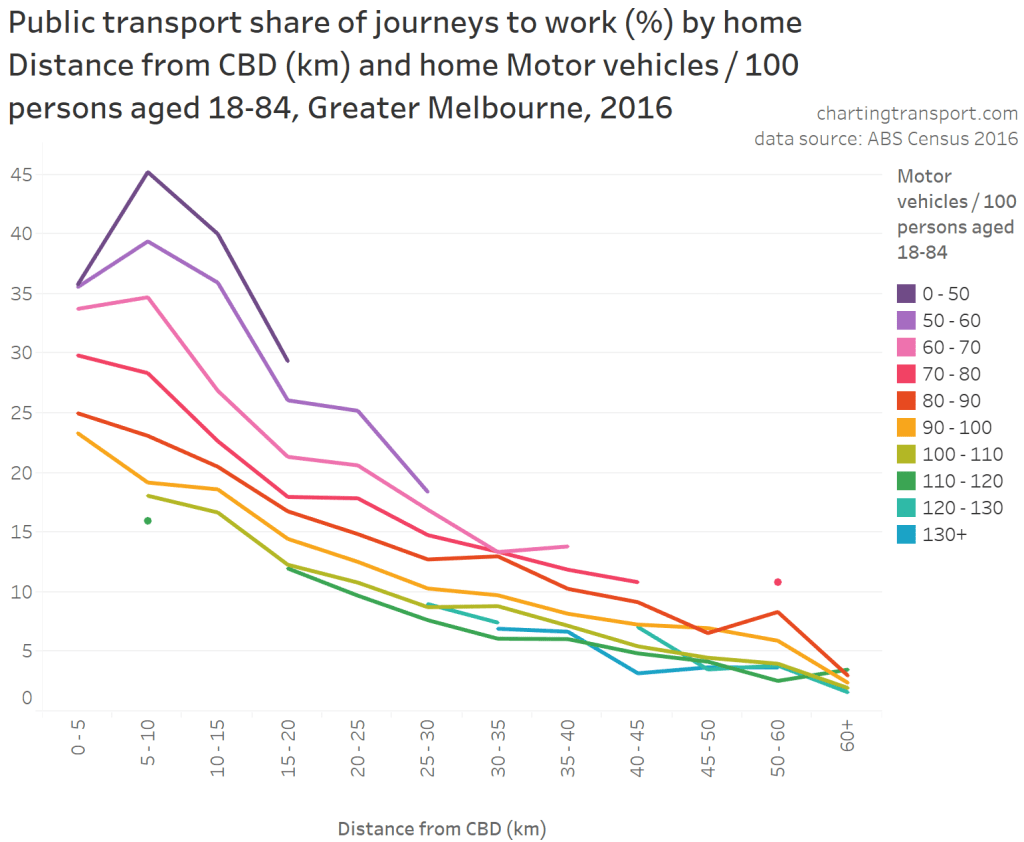
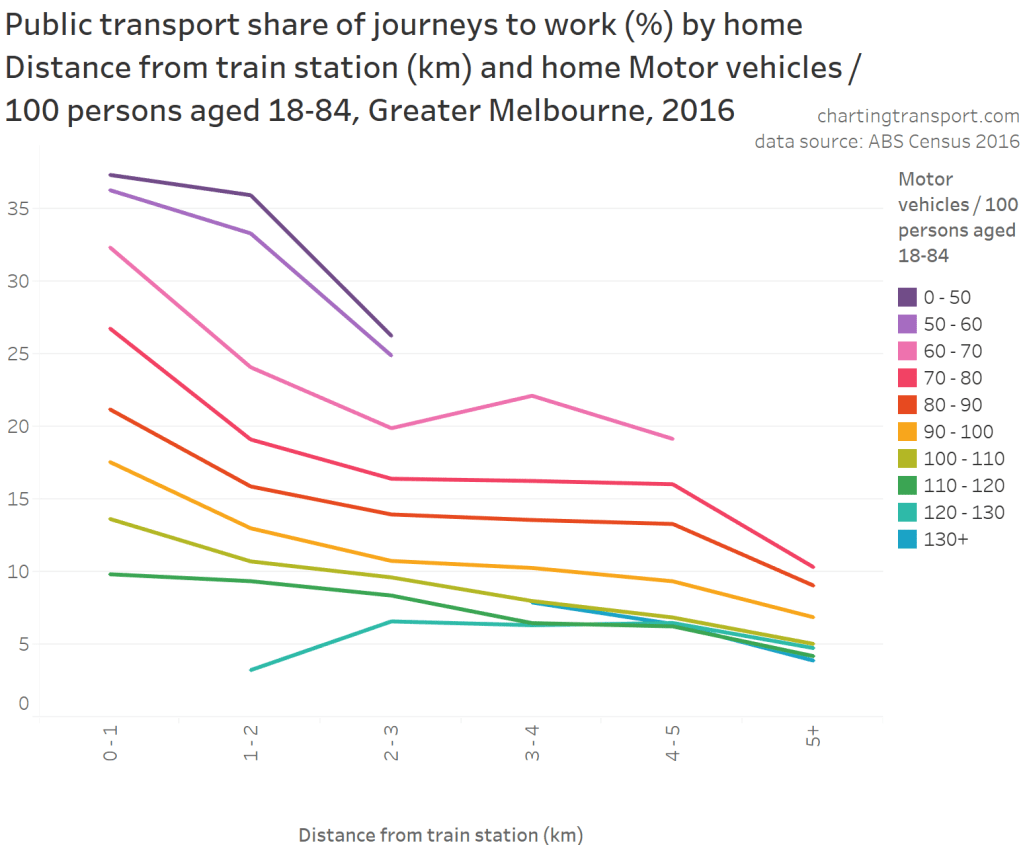
Well, maybe partly, but public transport mode shares of journeys to work were quite different between younger and older adults at all distances from train stations:

Public transport mode shares fell away with distance from stations, and age above 20 (the 15-19 age band being an exception).

With VISTA data we can look at general travel mode share by home distance from a train station:

There’s clearly a relationship between PT mode share and proximity to stations, but there’s also a strong relationship between age and PT use, at all home distance bands from train stations.

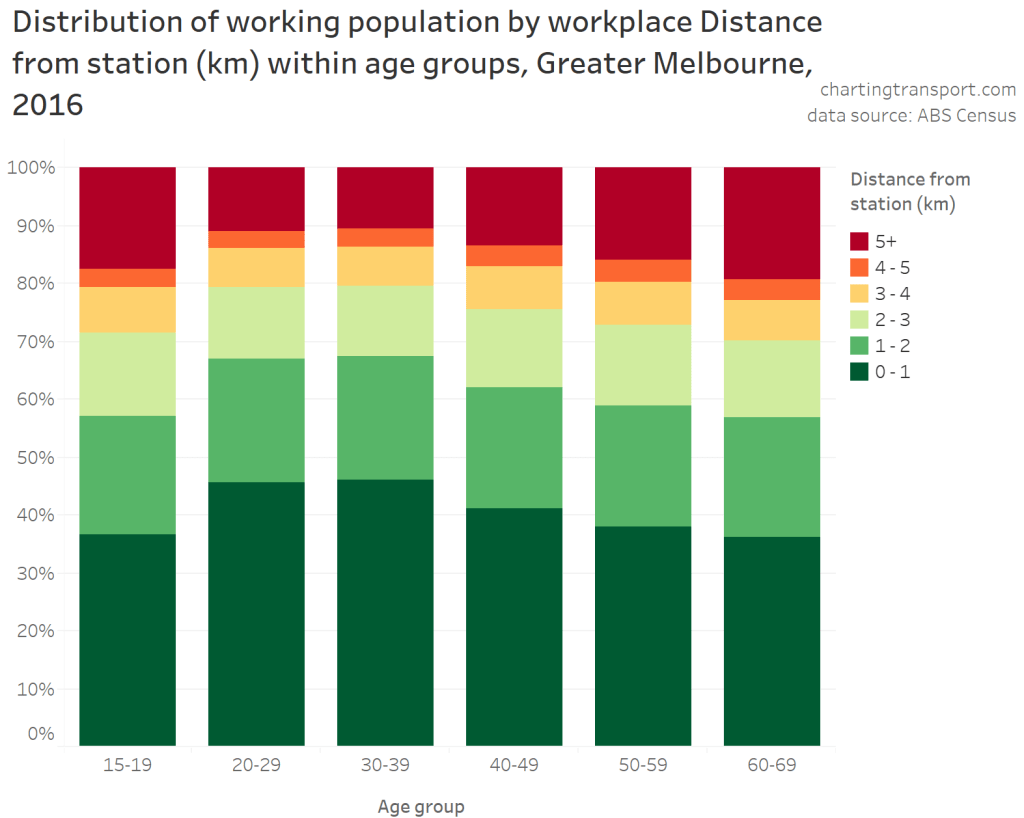
Younger adults were also more likely to work close to a train station. Indeed 46% of them worked within about 1 km of a station:

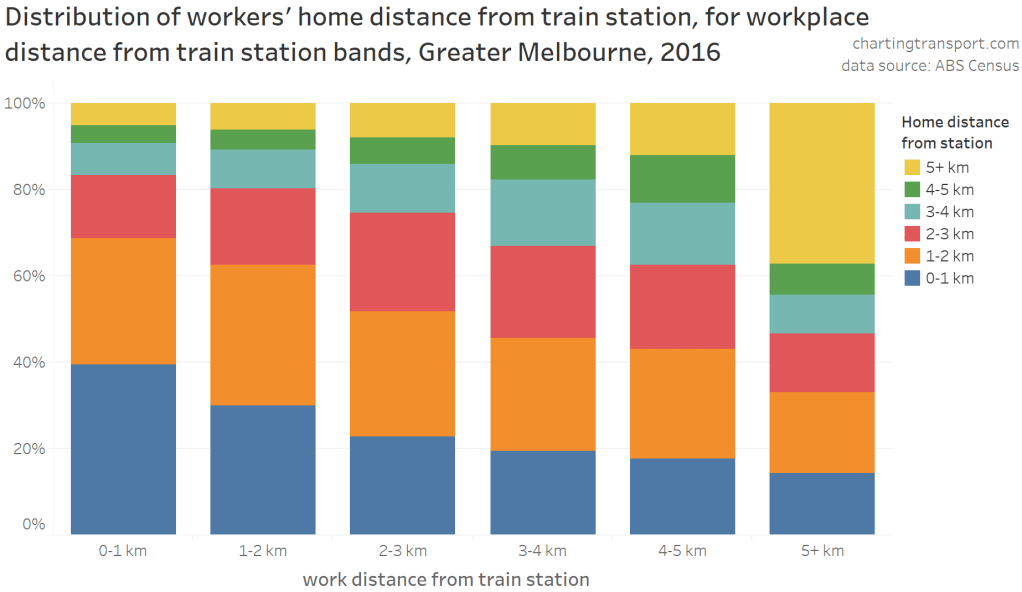
And unsurprisingly people who work near train stations are also more likely to live near train stations:

The chart shows around 70% of people who worked within 1 km of a station lived within 2 km of a station. Also, 37% of people who worked more than 5 km from a station, also lived more than 5 km from a station.

But again, journey to work PT mode shares varied by both age and workplace distance from a train station:

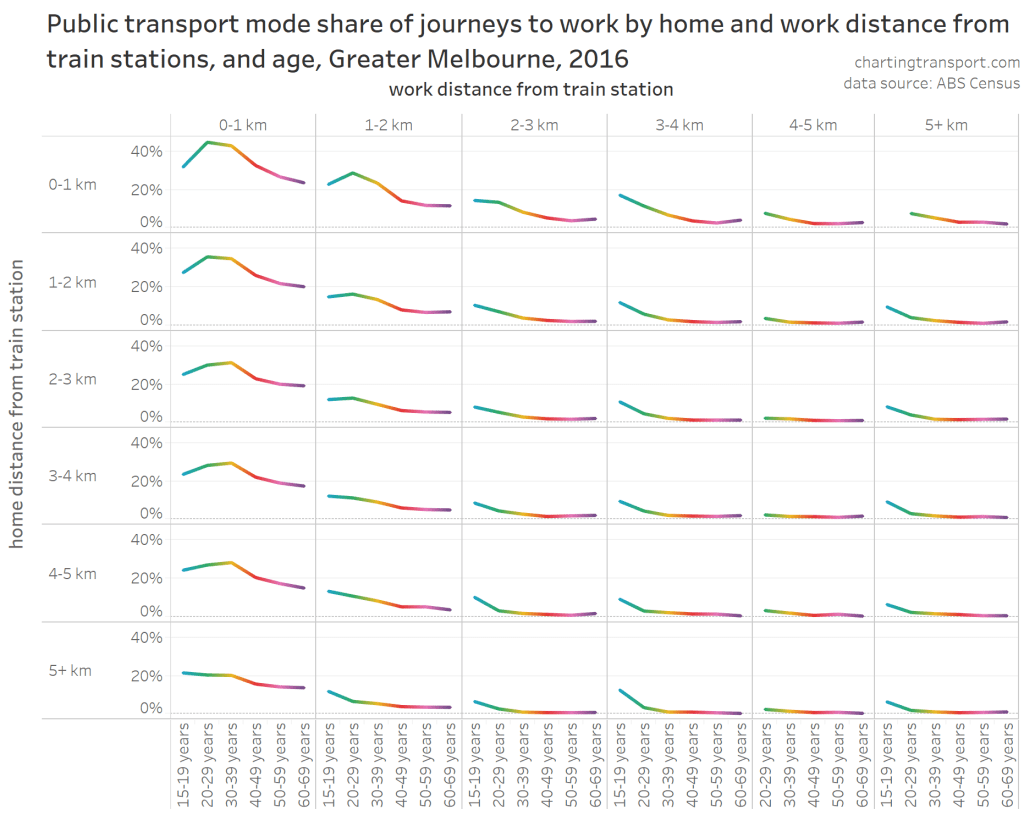
For completeness, here is another matrix-of-worms chart looking at journey to work PT mode shares by age for both work and home distances from train stations:

PT mode share declined with age for most distance combinations, but this wasn’t true for the 15-19 age band, particularly where both home and work were within a couple of kms of a station. We know from part one that teenagers are much less likely to work in the city centre, so this might represent teenagers who happen to live near a station, but work locally and can easily walk or cycle to work.

If we take age out for a moment, here is the relationship between PT mode share of journeys to work and both home and work distance from train stations:

The relationship between PT mode share and work distance from a train station is much stronger than for home distance from a station.

So while home and work proximity to train stations influenced mode shares, it doesn’t fully explain the variations across ages. So what if we combine…

Work distance from the CBD, home distance from a train station

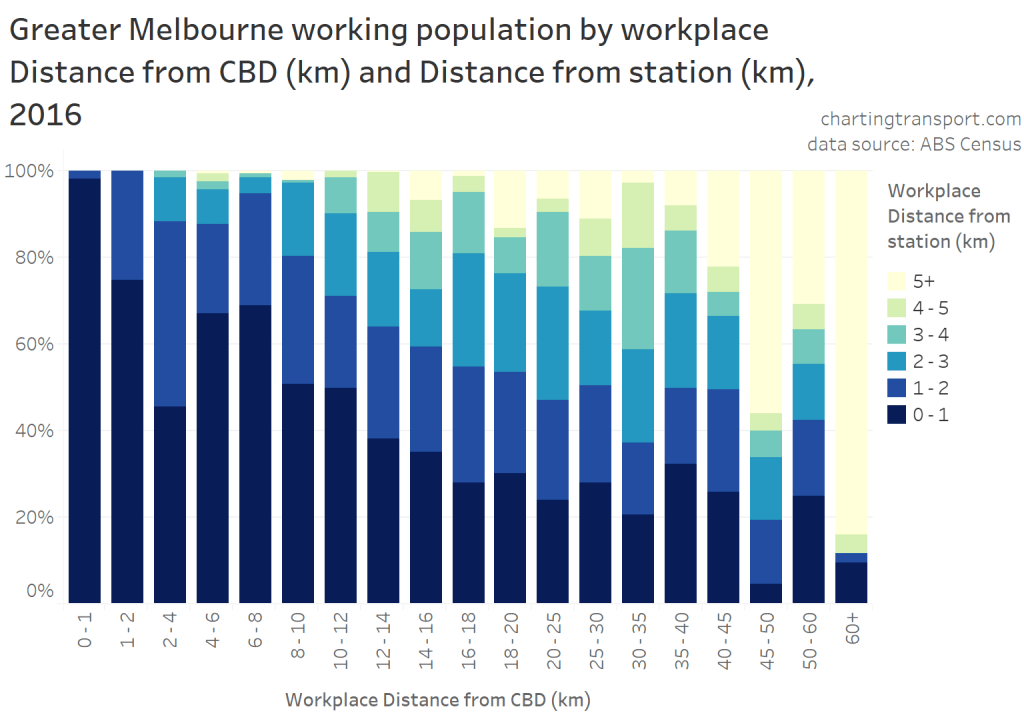
Work distance from a station is strongly related to work distance from the CBD, as the CBD and inner city has a higher density of train stations:

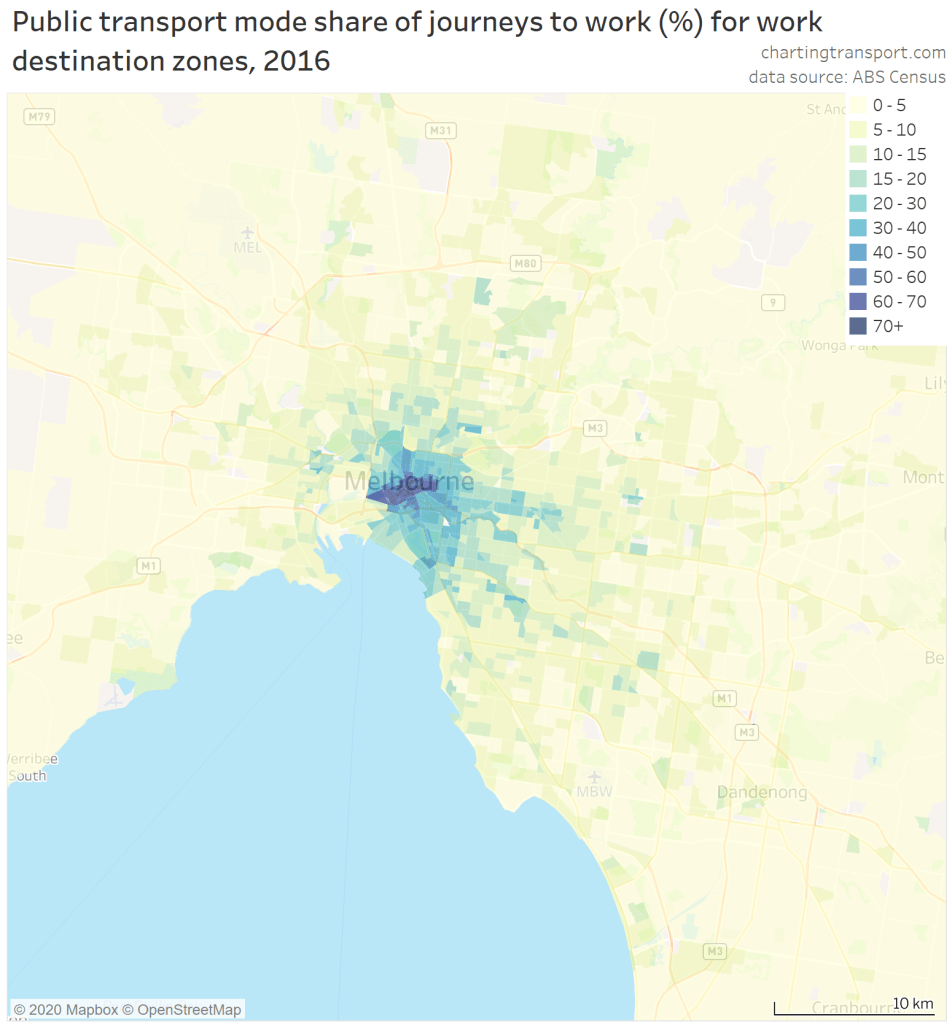
I expect workplace proximity to a train station to be a weaker predictor of mode share when compared workplace distance from CBD. That’s pretty evident when looking at journey to work PT mode share by place of work on a map:

And even more evident when you look at PT mode shares for both factors (regardless of age):

So perhaps work distance from the CBD, and home distance from a train station might be two strong factors for mode share? If we control for these factors, is there still a difference in PT mode shares across ages?

Time for another matrix of worms:

The chart shows that even when you control for both home distance from a station, and work distance from the CBD, there is still a relationship with age (generally declining PT mode share with age, with teenagers sometimes an exception). So there must be other factors at play.

Population density

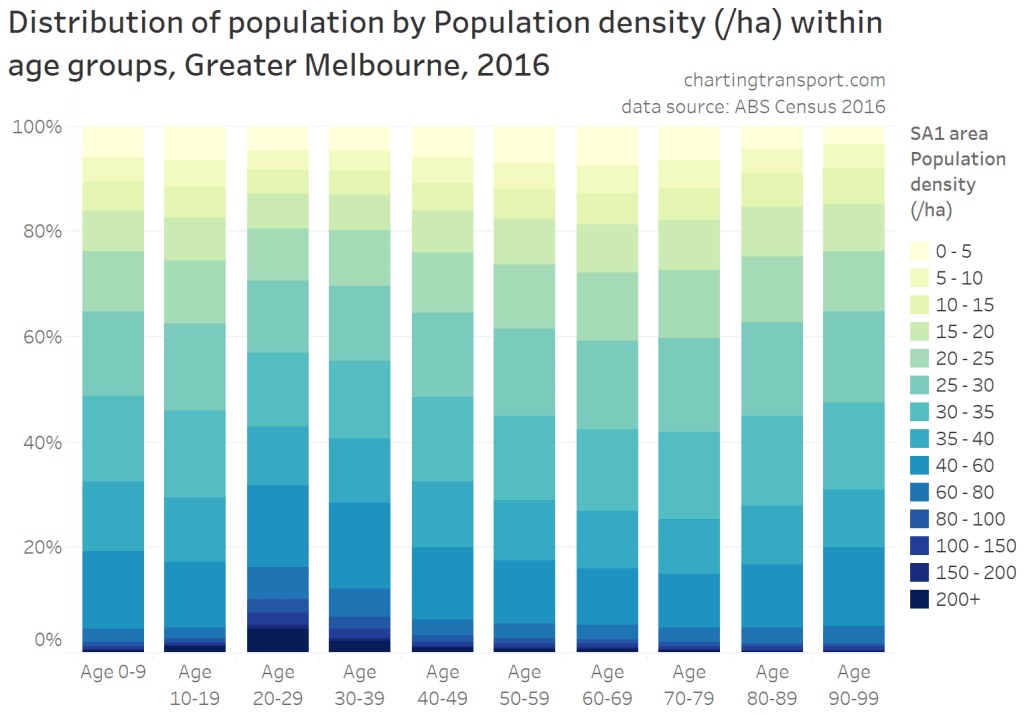
Consistent with proximity to train stations and the CBD, younger adults are more likely to live in denser residential areas:

Higher residential density often comes with proximity to higher quality public transport. Indeed, here is the distribution of population densities for people living at different distances from train stations:

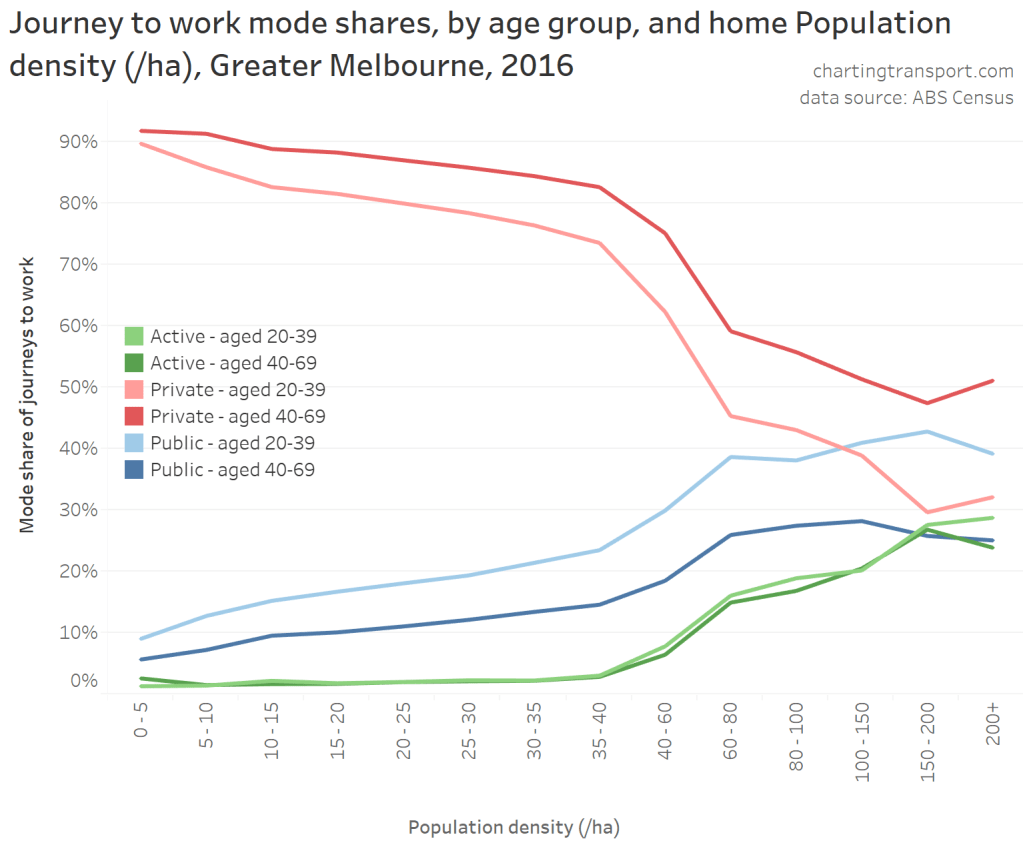
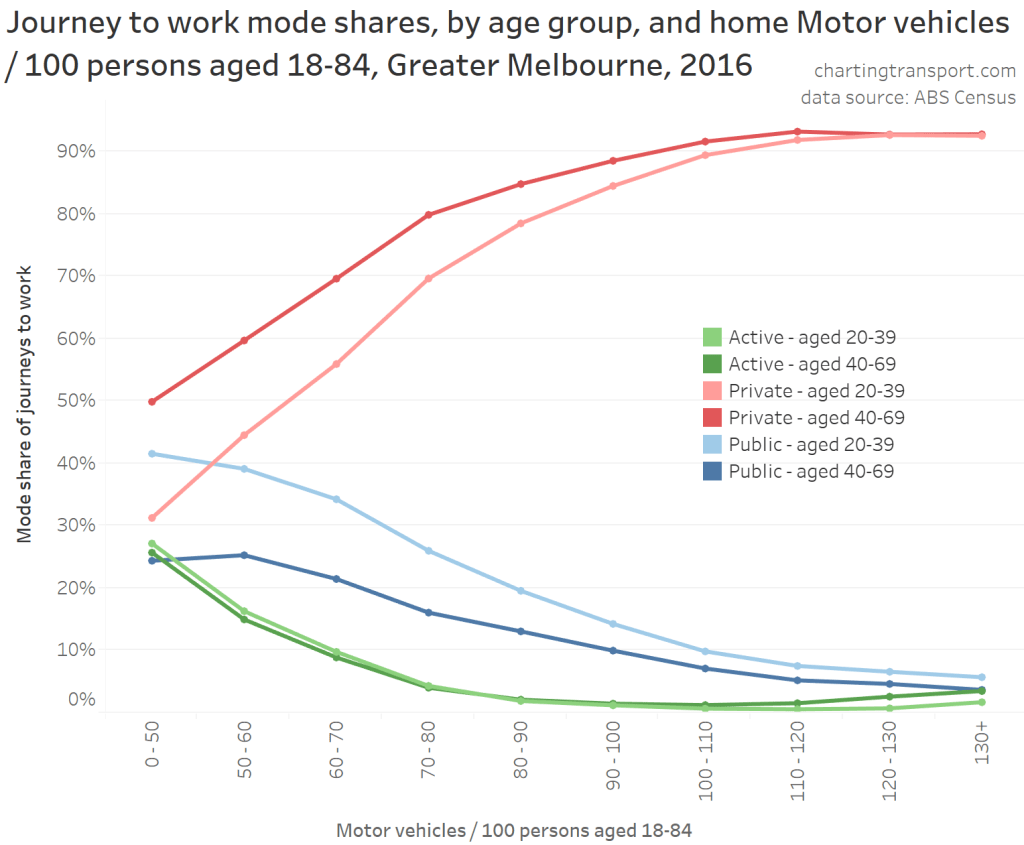
The next chart shows the relationship between residential density and mode shares – split between adults aged 20-39 and those aged 40-69:

The chart shows that both age and residential density are factors for journey to work mode shares. Younger adults had higher public transport mode shares for journeys to work at all residential density bands.

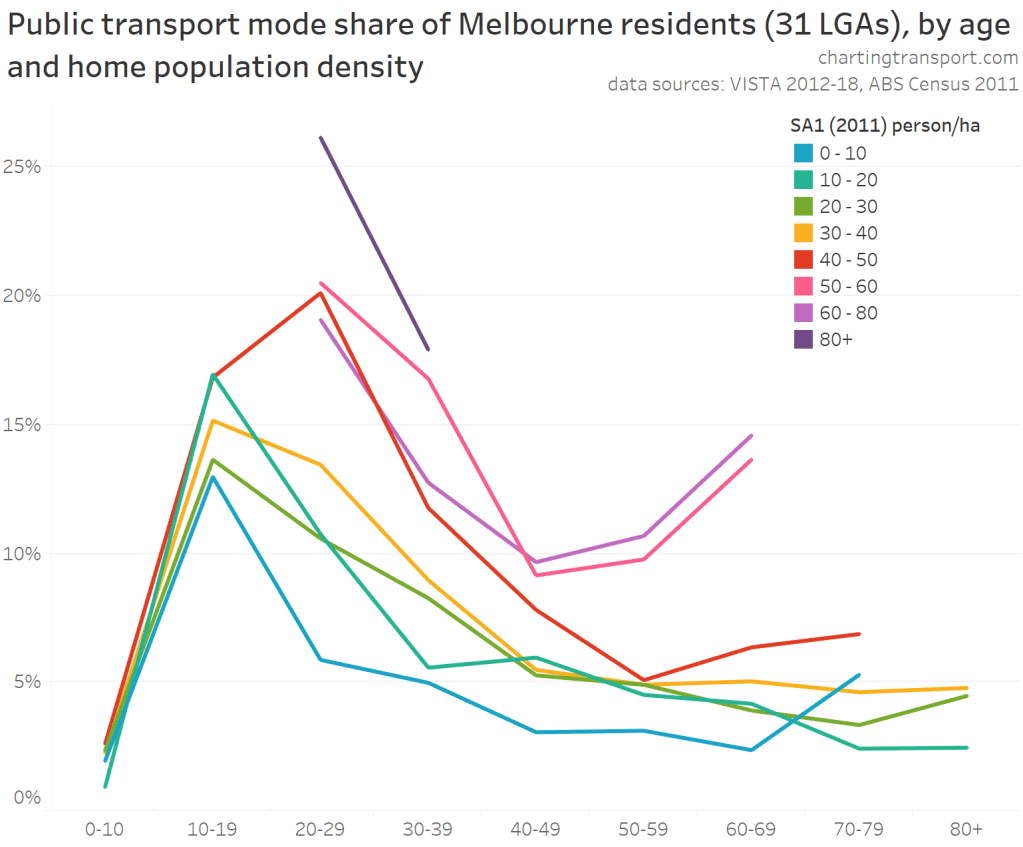
Similarly, VISTA data also shows PT mode shares vary significantly by both age and population density for general travel:

Technical note: data only shown where age band and density combination had at least 400 trips in the survey.

Curiously, people in their 60s living in areas with densities of 50-80 persons/ha were more likely to use public transport to get to work than those in their 40s and 50s living in the same densities (maybe due the presence of children?). For lower densities, PT mode share generally declined with increasing age (from 20s onward).

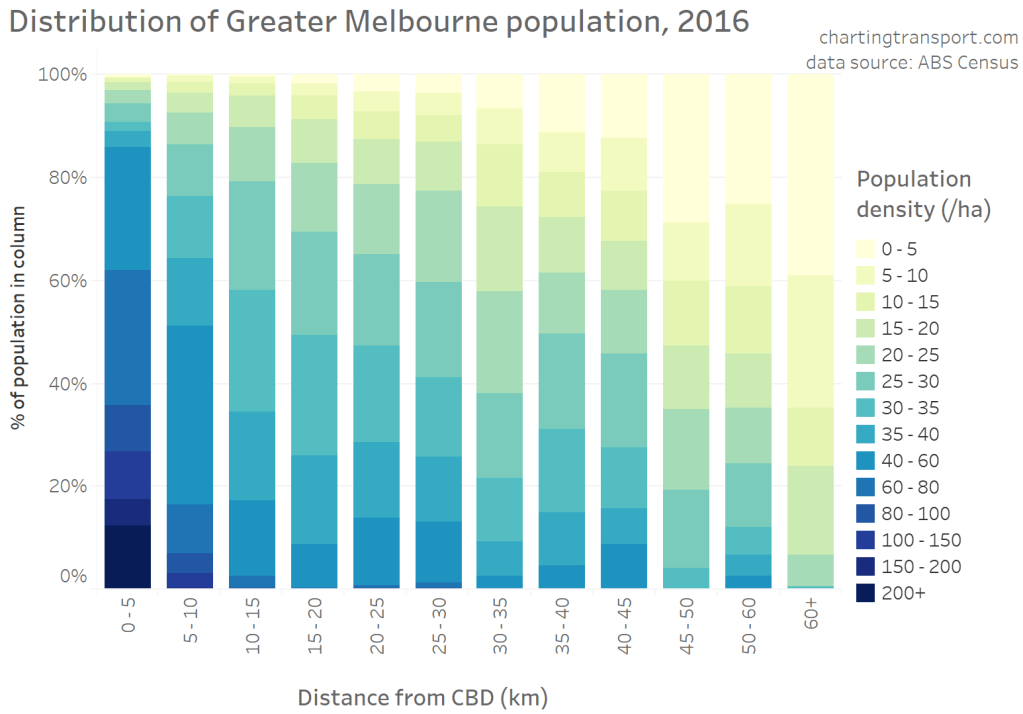
Population density is also generally related to distance from the CBD:

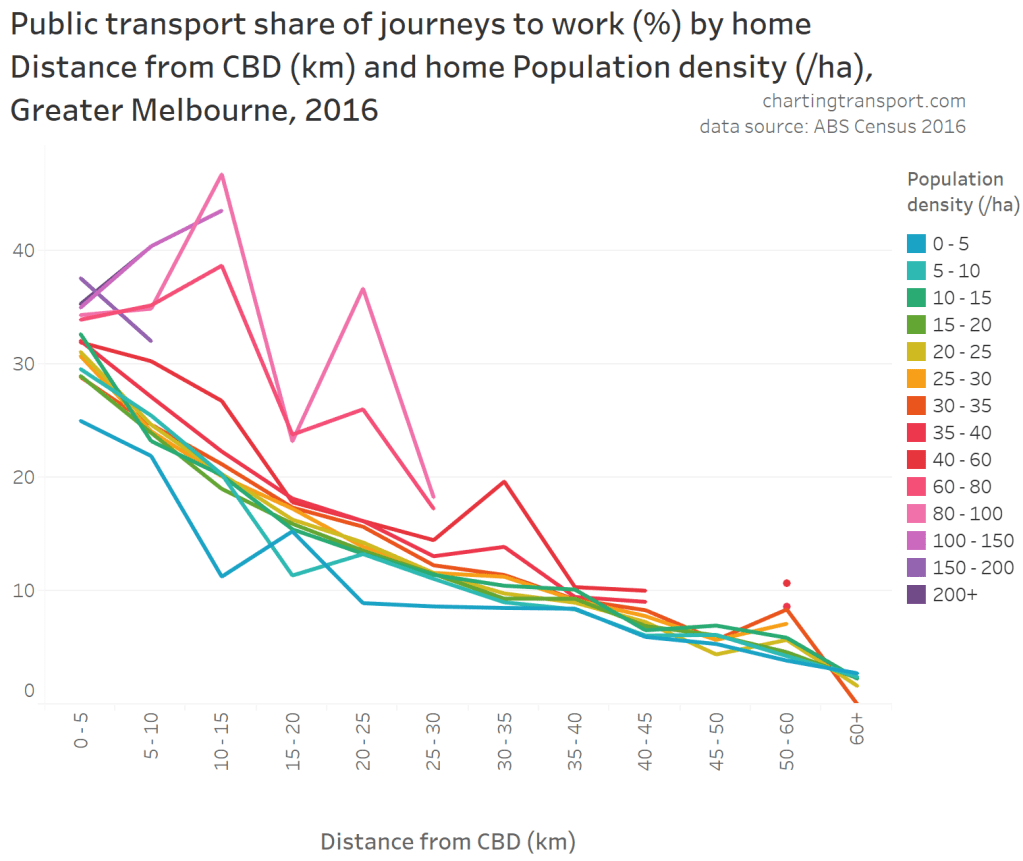
And here is a chart showing how PT mode share of journeys to work varied across both:

The chart shows home distance from the CBD had a larger impact on mode shares than population density. Indeed population density only seemed to have a secondary impact for densities above 40 persons/ha. However, as we saw in the first post, people living closer to the CBD were more likely to work in the city centre, and therefore more likely to use public transport in their journey to work.

Job density

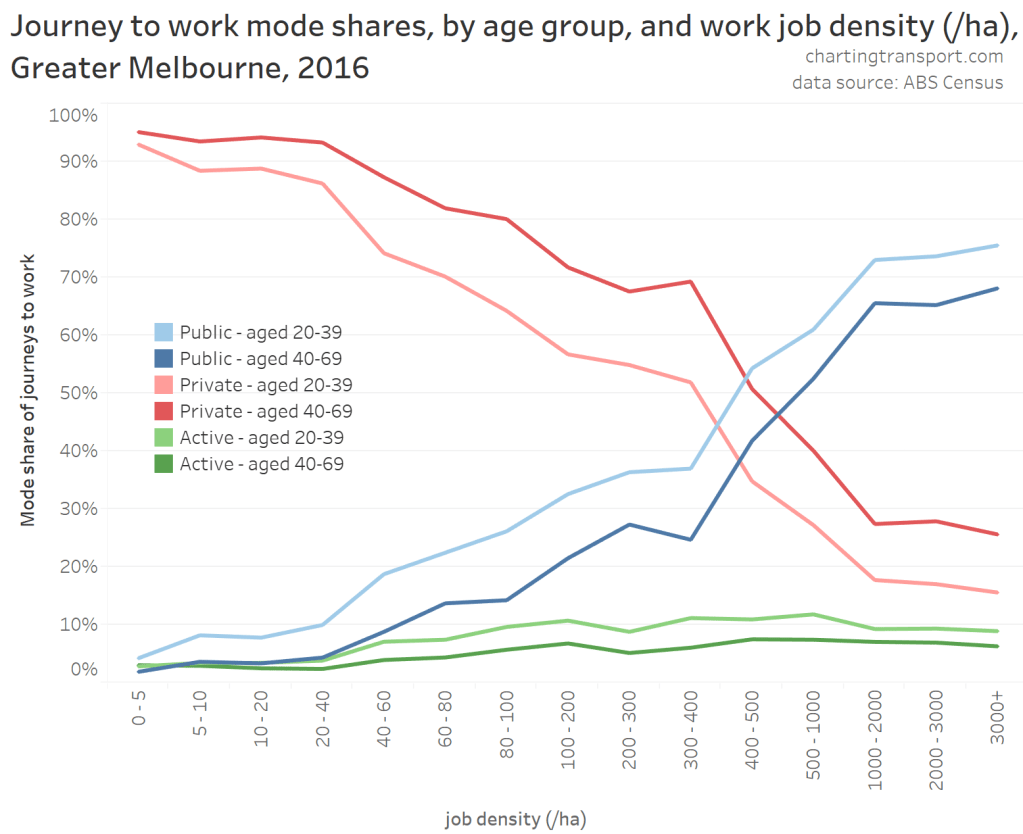
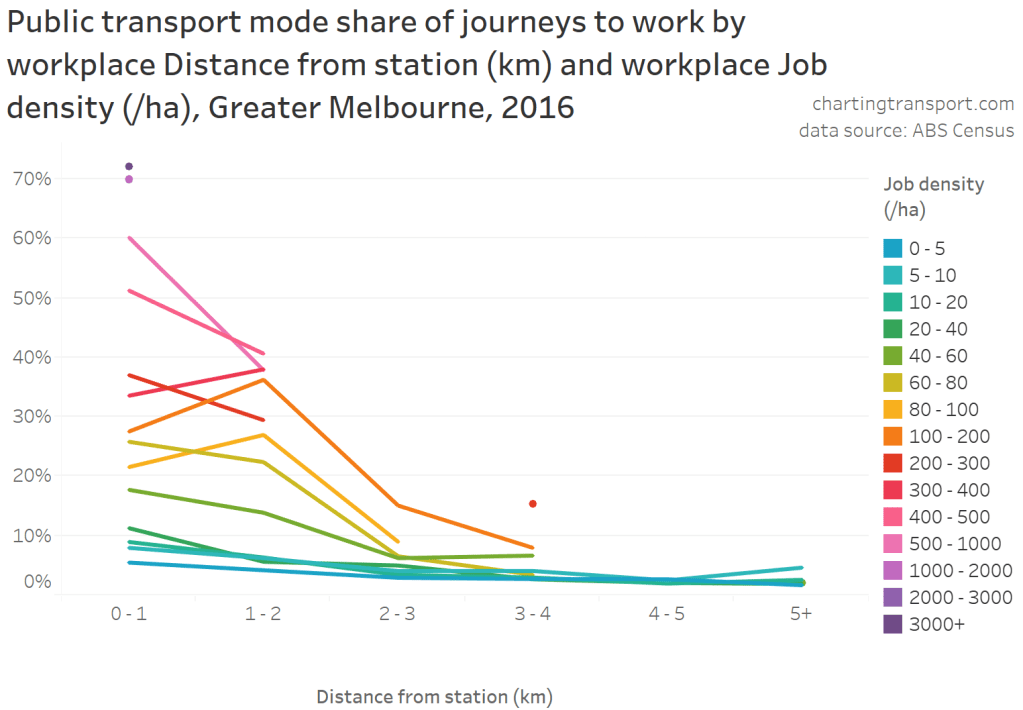
Young adults were more likely to work in higher density employment areas in 2016, where public transport is generally more competitive (with more expensive car parking):

But yet again, there is a difference in mode shares between age groups regardless of work location job density:

So job density doesn’t fully explain the difference in PT mode shares across age groups.

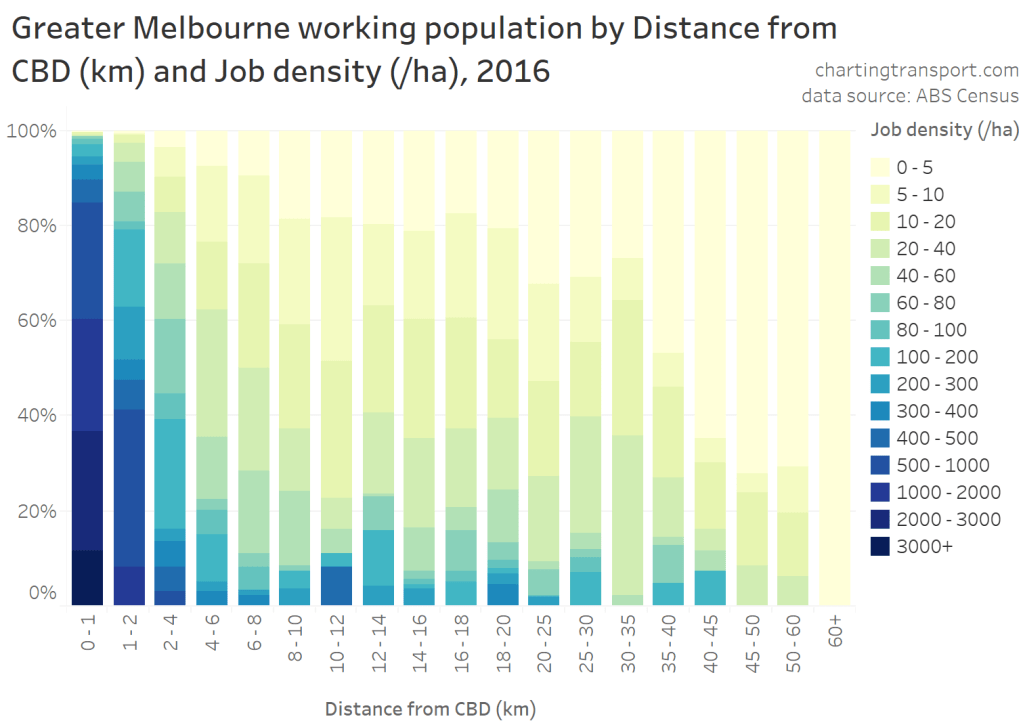
I should add that job density is also strongly related to workplace distance from the CBD:

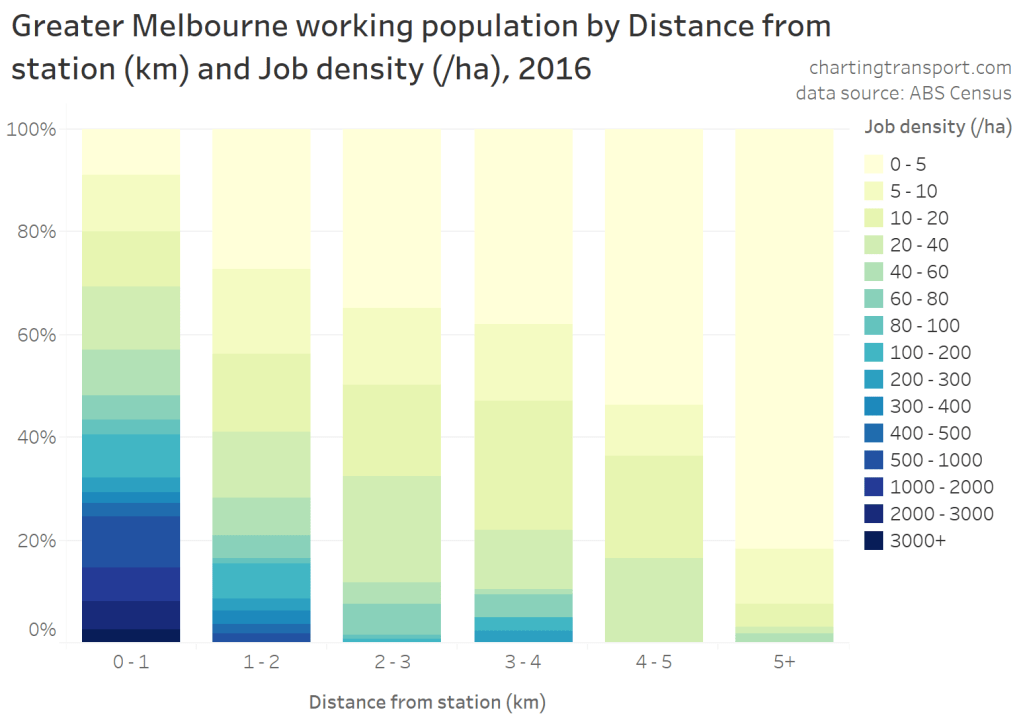
and workplace distance from train stations:

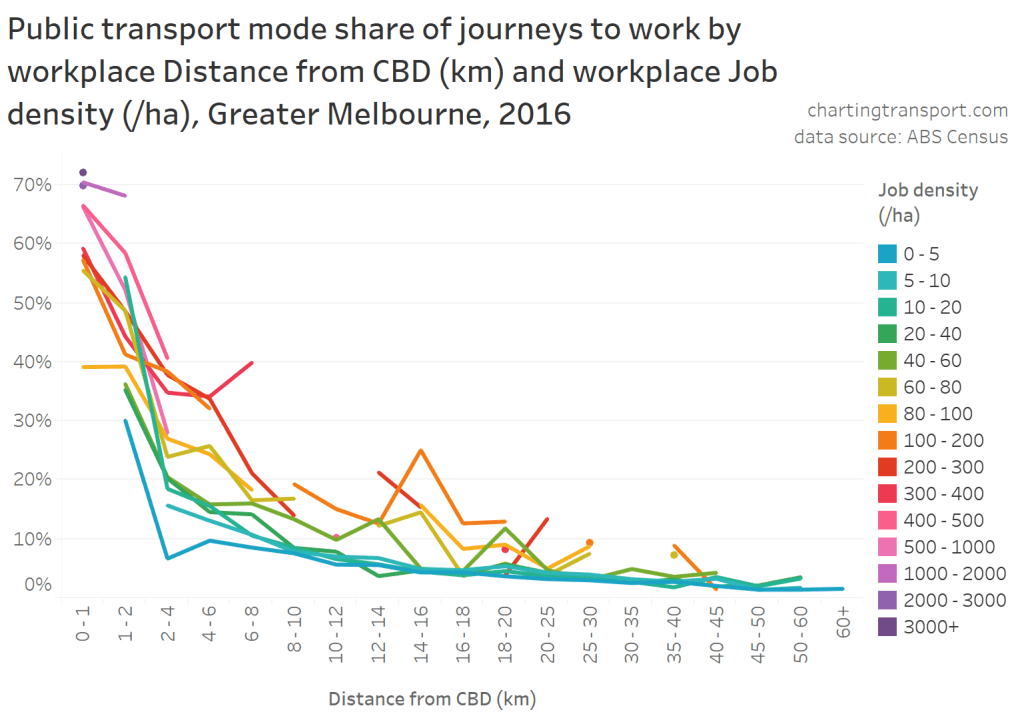
And putting aside age, PT mode shares for journeys to work are related to both workplace distance from the CBD and job density:

PT mode shares are also related to both job density and workplace distance from stations:

You might be wondering about the dot of higher job density (200-300 workers/ha) that is between 3 and 4 km from a train station. It’s one destination zone that covers Doncaster Westfield shopping centre – a large shopping centre on a relatively small piece of land (almost all of the car parking is multistory – see Google Maps)

Motor vehicle ownership

Are younger adults more likely to use public transport because they are less likely to own motor vehicles?

With census data, it is possible to measure motor vehicle ownership on an SA1 area basis by adding up household motor vehicles and persons aged 18-84 (as an approximation of driving aged people) and calculating the ratio. Of course individual households within these areas will have different levels of motor vehicle ownership.

Using this metric, young adults were indeed more likely to live in areas which have lower levels of motor vehicle ownership (in 2016):

But yet again, the PT journey to work mode shares varied between younger and older adults regardless of the levels of motor vehicle ownership of the area (SA1) in which they live:

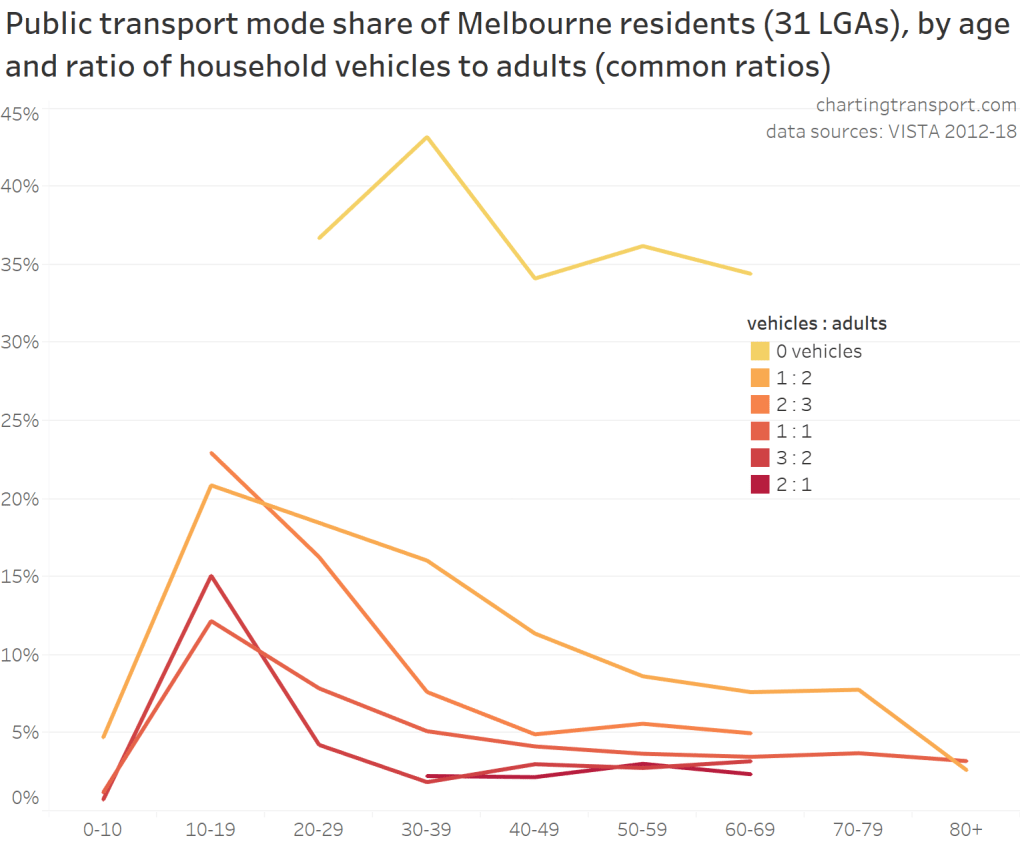
Using VISTA data, we can calculate motor vehicle ownership at a household level. I’ve classified households by the ratio of motor vehicles to adults.

VISTA data shows PT mode shares strongly related to both age and motor vehicle ownership (I’ve shown the most common ratios):

You might be wondering why I didn’t calculate motor vehicle ownership at the household level for census data. Unfortunately it’s not possible for me to calculate the ratio of household motor vehicles to number of adults because ABS TableBuilder doesn’t let me combine the relevant data fields (for some reason).

The best I can do is the ratio of household motor vehicles to the usual number of residents (of any age). The usual residents may or may not include children under driving age – we just don’t know.

Nevertheless the data is still interesting. Here is how public transport mode shares of journeys to work varied across different vehicle : occupant combinations for households in Greater Melbourne:

Yes that’s a lot of squiggly lines – but for most combinations (excluding those with zero motor vehicles) there was a peak of PT mode share in the early 20s, and then a decline with increasing age.

The lines with green and yellow shades – where the ratio is around 1:2 or 1:3 – show a sharp drop around the mid 20s. I expect these lines are actually a mix of working parents with younger children, and working adult children living with their (older) parents. The high mode shares for those in their early 20s could represent many adult children living with their parents (but without their own car), while those in their 30s and 40s are more likely to be parents of children under the driving age. So the sharp drop is probably more to do with a change in household age composition.

If we want to escape the issue of children, the highest pink line is for households with one motor vehicle and one person (so no issues about the age of children because there are none present) – and that line has a peak in PT mode share in the mid 30s and then declines with age, suggesting other age-related factors must be in play.

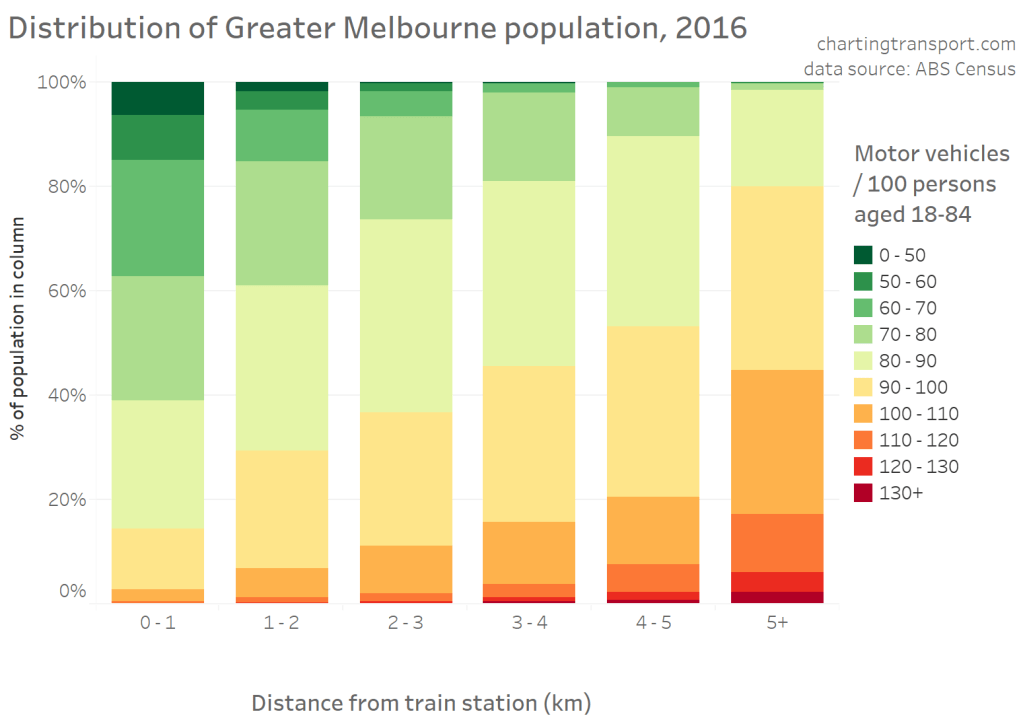
But motor vehicle ownership levels aren’t only related to age. They are strongly related to population density,

..home distance from the CBD,

..and home distance from train stations:

And public transport mode shares are related to both motor vehicle ownership rates and population density (with motor vehicle ownership probably being the stronger factor):

Technical note: for these charts I’ve excluded data points with fewer than 5 qualifying SA1s to remove anomalous exceptions.

Public transport mode shares are also related to both motor vehicle ownership and home distance from the CBD:

And shares are also related to both motor vehicle ownership and home distance from a train station:

In all three cases, PT mode shares fell with increasing levels of motor vehicle ownership, but this effect mostly stopped once there were more motor vehicles than persons aged 18-84.

Drivers licence ownership

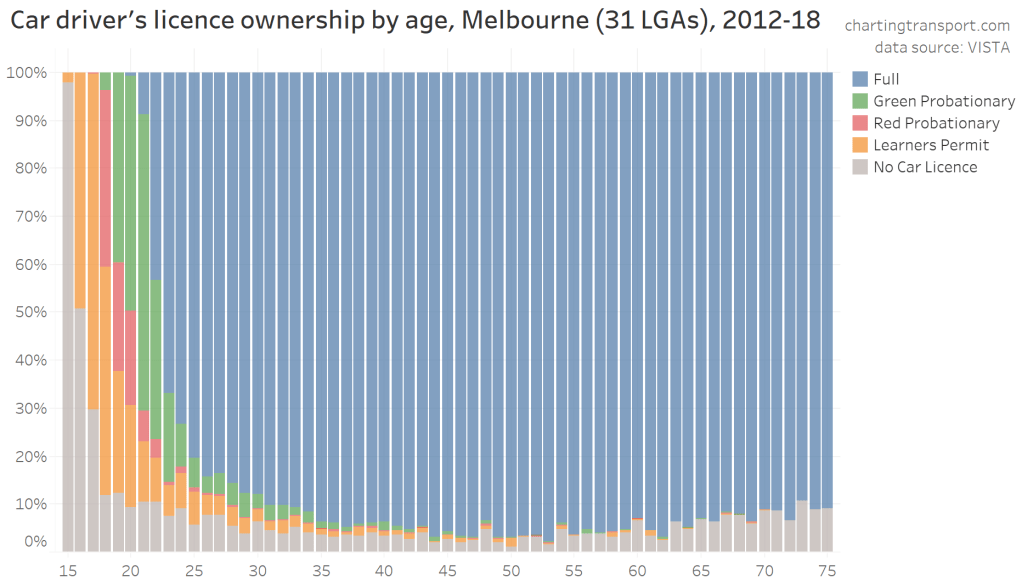
I’ve previously shown on this blog that people without a full car driver’s licence are much more likely to use public transport, which will surprise no one. So are younger adults less likely to have a driver’s licence?

VISTA data shows us that younger adults are indeed less likely to have a car driver’s licence, with licence ownership peaking around 97% for those in their late 40s and early 50s, and only dropping to 91% by age 75 (there is a little noise in the data):

So the lack of a driver’s licence by many young adults will no doubt partly explain why they are more likely to use public transport.

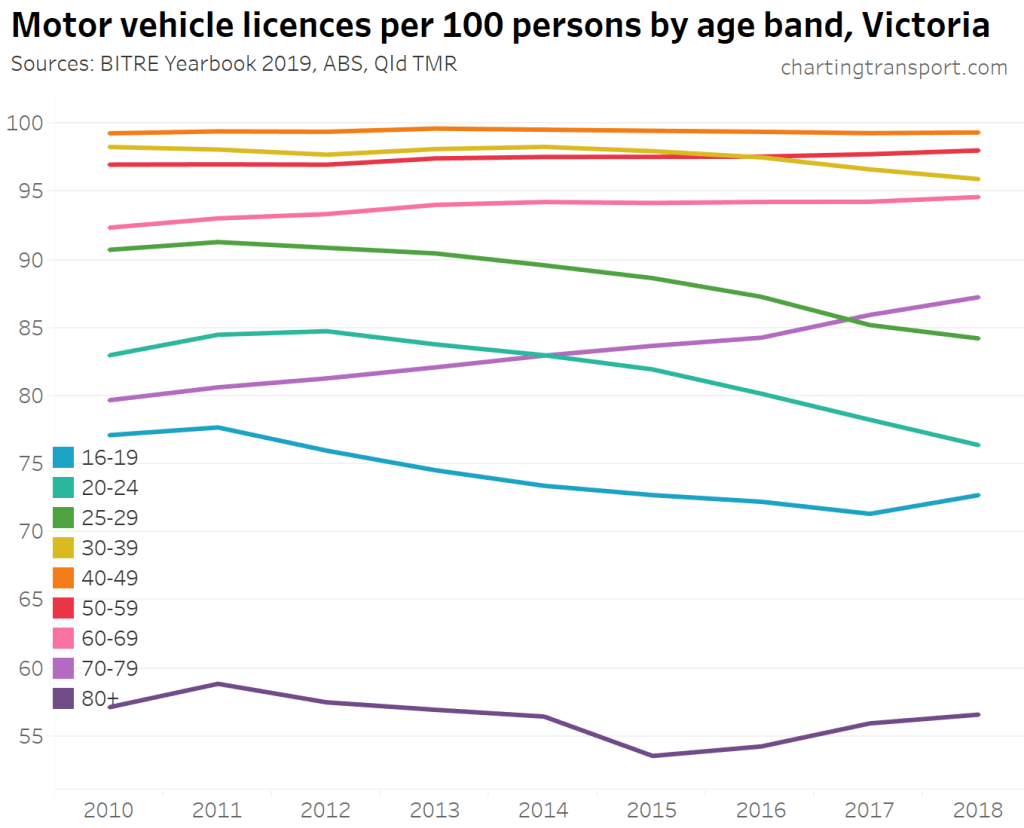
Consistent with VISTA, data from the BITRE yearbooks also shows that younger adults have become less likely to own a licence over time:

At the same time, those aged 60-79 have been more likely to own a licence over time.

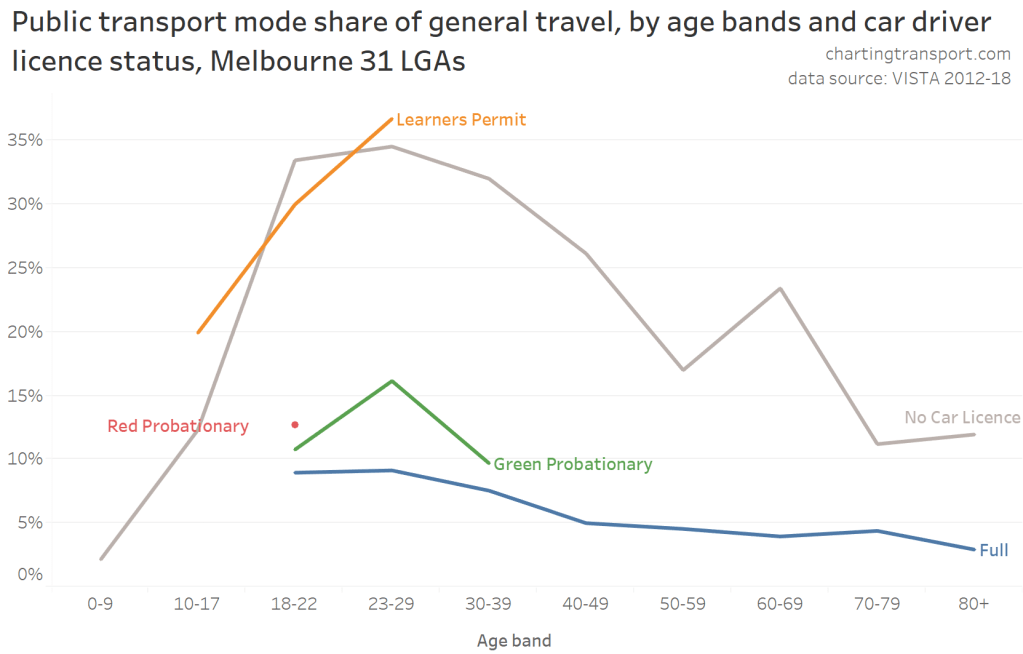
But do public transport mode shares vary by age, even for those with a solo driver’s licence? (by solo, I mean full or probationary licence). The following chart shows public transport mode shares for age bands and licence ownership levels (data points only shown where 400+ trips exist in the survey data).

PT mode shares peaked for age band 23-29 for most licence ownership levels, including no licence ownership (there isn’t enough survey data for people older than 22 with red probationary licences – the licence you have for your first year of solo driving).

As an aside, there is a curious increase in public transport mode share for those aged over 60 without a drivers licence – this may be related to these people being eligible for concession fares and occasional free travel with a Seniors Card (if they work less than 35 hours per week).

So even younger adults who own a driver’s licence are more likely to use public transport.

But is this because they don’t necessarily have a car available to them? Let’s put the two together…

Motor vehicle and driver’s licence ownership

For the following chart I’ve classified households as:

  • “Limited MVs” if there were more licensed drivers than motor vehicles attached to the household,
  • “Saturated MVs” if there was at least as many motor vehicles as licensed drivers, and
  • “No MVs” if there were no motor vehicles associated with the household.

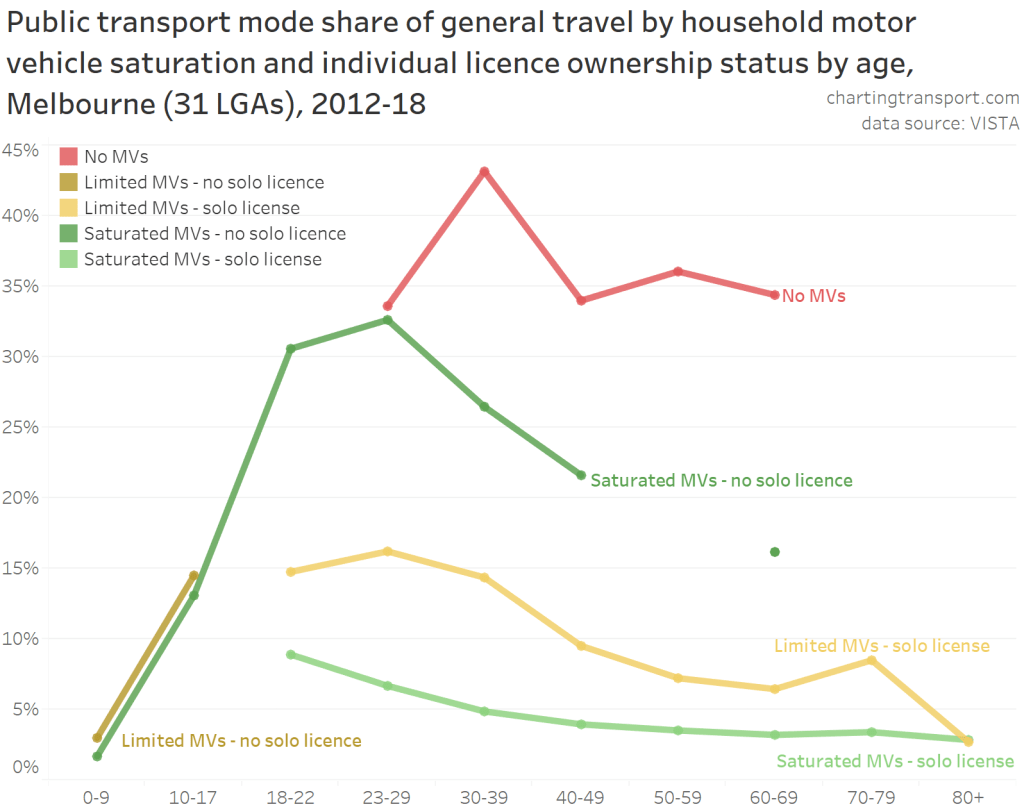
If there were any household motor vehicles I’ve further disaggregated by individuals with a solo licence and those without a solo licence (the latter may have a learner’s permit). I’ve only shown data points with at least 400 trip records in the category to avoid small sample noise (I am reliant on VISTA survey data).

Except for households with no motor vehicles, public transport mode share peaked for age band 18-22 or 23-29 and then declined with increasing age. So again there must be other age-related factors. However the impact of age is smaller than that of motor vehicle ownership and licence ownership.

Unfortunately driver’s licence ownership data is not collected by the census, so it is not possible to combine it with other demographic variables from the census.

Summary

So, what have we learnt in part two:

  • Younger adults are more likely to work and live near train stations, but that only partly explains why younger adults are more likely to use public transport.
  • Workplace distance from the CBD has a much bigger impact on public transport mode shares for journeys to work than home distance from a train station.
  • Younger adults are more likely to live in areas with higher residential density, but this only partly explains why they are more likely to use public transport.
  • Younger adults are more likely to work in areas with higher job density but this is highly correlated with workplace distance from the CBD, which is a stronger factor influencing mode shares.
  • Younger adults are more likely to live in areas with lower motor vehicle ownership (these areas are generally also have higher residential density and are closer to the city centre and to train stations), but this again only partly explains why they are more likely to use public transport. Motor vehicle ownership appears to be a stronger factor influencing mode shares than population density, distance from stations, or distance from the city.
  • Younger adults are less likely to have a driver’s licence, but again this only partly explains why they are more likely to use public transport.

While this analysis confirms younger adults tend to align with known factors correlating with higher public transport use, we are yet to uncover a factor or combination of factors that mostly explain the differences in public transport use between younger and older adults. That is, when we control for these factors we still see differences in public transport use between ages.

The next post in this series will explore the impacts on public transport use of parenting responsibilities, generational factors (birth years), and year of immigration to Australia.


What impact does paid car parking have on travel mode choice in Melbourne?

Thu 3 October, 2019

Paid parking is often used when too many people want to park their car in the same place at the same time. Does it encourage people to cycle or use public transport instead of driving? Does that depend on the type of destination and/or availability of public transport? Are places with paid parking good targets for public transport upgrades?

In this post I’m going to try to answer the above questions. I’ll look at where there is paid parking in Melbourne, how transport mode shares vary for destinations across the city, and then the relationship between the two. I’ll take a deeper look at different destination types (particularly hospitals), explore the link between paid parking and employment density, and conclude with some implications for public transport planners. There’s a bit to get through so get comfortable.

This post uses data from around 158,000 surveyed trips around Greater Melbourne collected as part of a household travel survey (VISTA) between 2012 and 2018, as well as journey to work data from the 2016 ABS census.

Unfortunately the data available doesn’t allow for perfect analysis. The VISTA’s survey sample sizes are not large, I don’t have data about how much was paid for parking, nor whether other parking restrictions might impact mode choice (e.g. time limits), and I suspect some people interpreted survey questions differently. But I think there are still some fairly clear insights from the data.

Where is there paid parking in Melbourne?

I’m not aware of an available comprehensive car park pricing data set for Melbourne. Parkopedia tells you about formal car parks (not on street options) and doesn’t share data sets for free, while the City of Melbourne provides data on the location, fees, and time restrictions of on-street bays (only). So I’ve created my own – using the VISTA household travel survey.

For every surveyed trip involving parking a car, van, or truck, we know whether a parking fee was payable. However the challenge is that VISTA is a survey, so the trip volumes are small for any particular place. For my analysis I’ve used groups of ABS Destination Zones (2016 boundaries) that together have at least 40 parking trips (excluding trips where the purpose was “go home” as residential parking is unlikely to involve a parking fee). I’ve chosen 40 as a compromise between not wanting to have too small a sample, and not wanting to have to aggregate too many destination zones. In some cases a single destination zone has enough parking trips, but in most cases I have had to create groups.

I’ve tried to avoid merging different land uses where possible, and for some parts of Melbourne there are just not enough surveyed parking trips in an area (see appendix at the end of this post for more details). Whether I combine zones or use a single zone, I’m calling these “DZ groups” for short.

For each DZ group I’ve calculated the percentage of vehicle parking trips surveyed that involved someone paying a parking fee. The value will be low if only some circumstances require parking payment (eg all-day parking on weekdays), and higher if most people need to pay at most times of the week for both short and long stays (but curiously never 100%). The sample for each DZ group will be a small random sample of trips from different times of week, survey years, and durations. For DZ groups with paid parking rates above 20%, the margin of error for paid parking percentage is typically up to +/- 13% (at a 90% confidence interval).

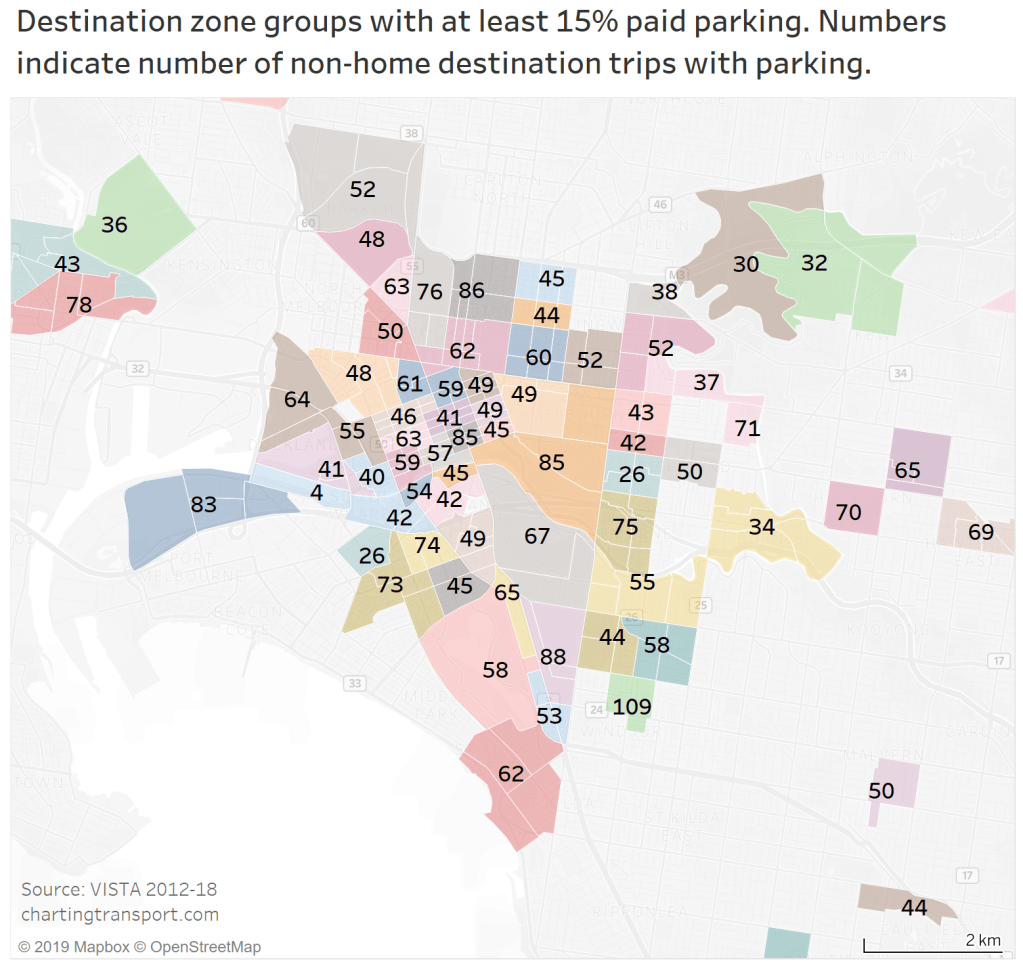
Imperfect as the measure is, the following map shows DZ groups with at least 10% paid parking, along with my land use categorisations (where a DZ group has a specialised land use).

There are high percentages of paid parking in the central city, as you’d expect. Paid parking is more isolated in the suburbs – and mostly occurs at university campuses, hospitals, larger activity centres, and of course Melbourne Airport.

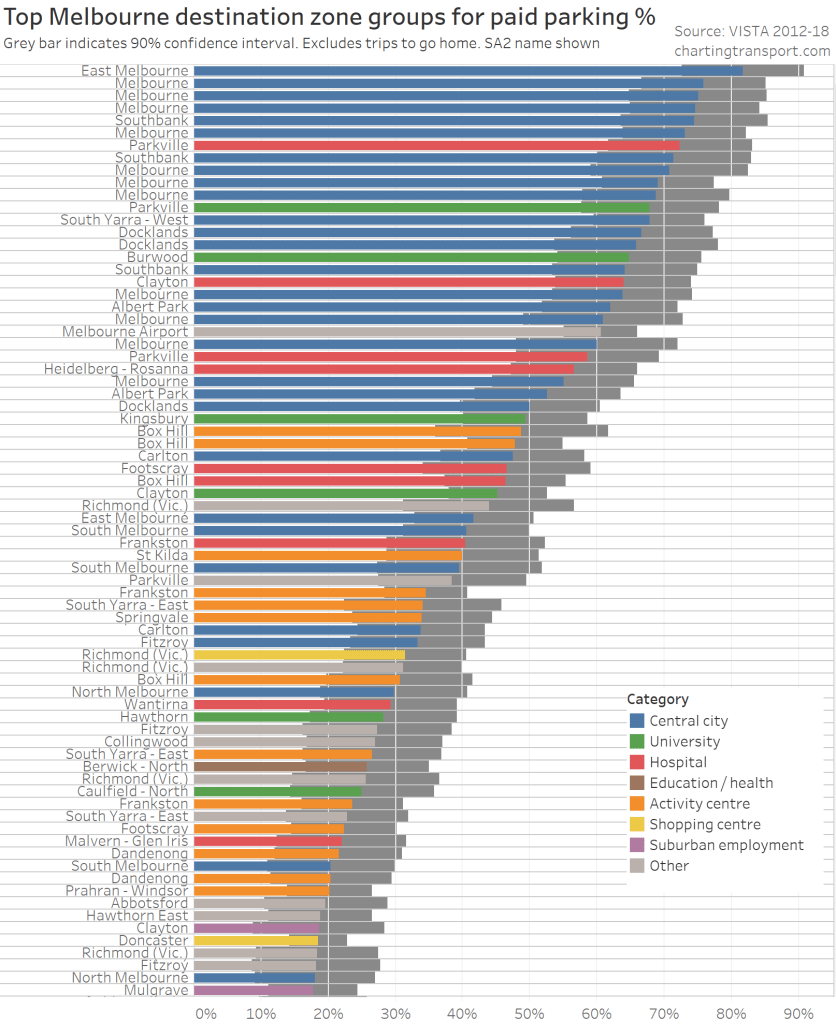
The next chart shows the DZ groups with the highest percentages of paid parking (together with the margin of error).

Technical note: the Y-axis shows the SA2 name, rather than the (unique but meaningless) DZ code(s), so you will see multiple DZ groups with the same SA2 name.

At the top of the chart are central city areas, major hospitals, several university campuses, and Melbourne Airport.

Further down the chart are:

  • larger activity centres – many inner suburban centres plus also Dandenong, Frankston, Box Hill, and curiously Springvale (where some controversial parking meters were switched off in 2017),
  • the area around Melbourne Zoo (Parkville SA2 – classified as “other”),
  • some inner city mixed-use areas,
  • two shopping centres – the inner suburban Victoria Gardens Shopping Centre in Richmond (which includes an IKEA store), and Doncaster (Westfield) – the only large middle suburban centre to show up with significant paid parking (many others now have time restrictions), and
  • some suburban industrial employment areas (towards the bottom of the chart) – in which I’ve not found commercial car parks.

These are mostly places of high activity density, where land values don’t support the provision of sufficient free parking to meet all demand.

While the data looks quite plausible, the calculated values not perfect, for several reasons:

  • Some people almost certainly forget that they paid for parking (or misinterpreted the survey question). For example, on the Monash University Clayton campus, 45% of vehicle driver trips (n = 126) said no parking fee was payable, 2% said their employer paid, and 12% said it was paid through a salary arrangement. However there is pretty much no free parking on campus (at least on weekdays), so I suspect many people forgot to mention that they had paid for parking in the form of a year or half-year permit (I’m told that very few staff get free parking permits).
  • Many people said they parked for free in an employee provided off-street car park. In this instance the employer is actually paying for parking (real estate, infrastructure, maintenance, etc). If this parking is rationed to senior employees only then other employees may be more likely to use non-car modes. But if employer provided is plentiful then car travel would be an attractive option. 22% of surveyed trips involving driving to the Melbourne CBD reported parking in an employer provided car park, about a quarter of those said no parking fee was required (most others said their employer paid for parking).
  • As already mentioned, the sample sizes are quite small, and different parking events will be at different times of the week, for different durations, and the applicability of parking fees may have changed over the survey period between 2012 and 2018.
  • The data doesn’t tell us how much was paid for parking. I would expect price to be a significant factor influencing mode choices.
  • Paid parking is not the only disincentive to travel by private car – there might be time restrictions or availability issues, but unfortunately VISTA does not collect such data (it would be tricky to collect).

How does private transport mode share vary across Melbourne?

The other part of this analysis is around private transport mode shares for destinations. As usual I define private transport as a trip that involved some motorised transport, but not any modes of public transport.

Rich data is available for journeys to work from the ABS census, but I’m also interested in general travel, and for that I have to use the VISTA survey data.

For much of my analysis I am going to exclude walking trips, on the basis that I’m primarily interested in trips where private transport is in competition with cycling and public transport. Yes there will be cases where people choose to walk instead of drive because of parking challenges, but I’m assuming not that many (indeed, around 93% of vehicle driver trips in the VISTA survey are more than 1 km). An alternative might be to exclude trips shorter than a certain distance, but then that presents difficult decisions around an appropriate distance threshold.

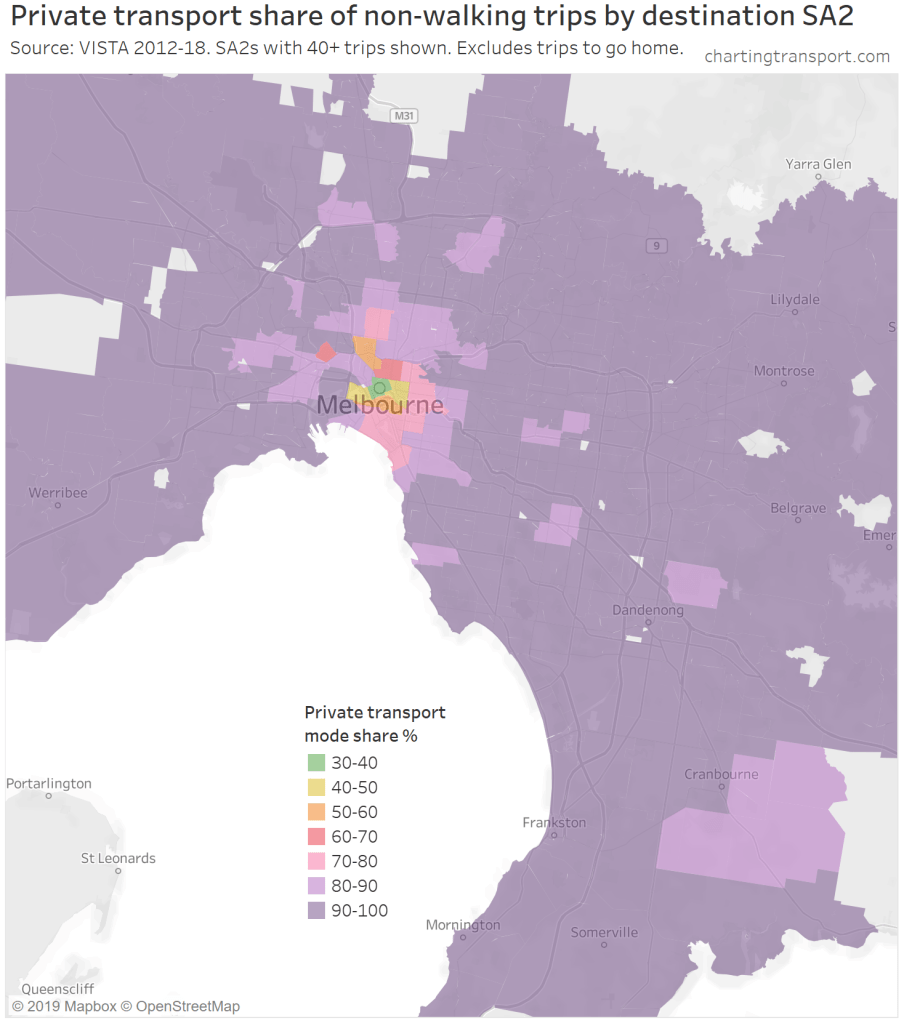
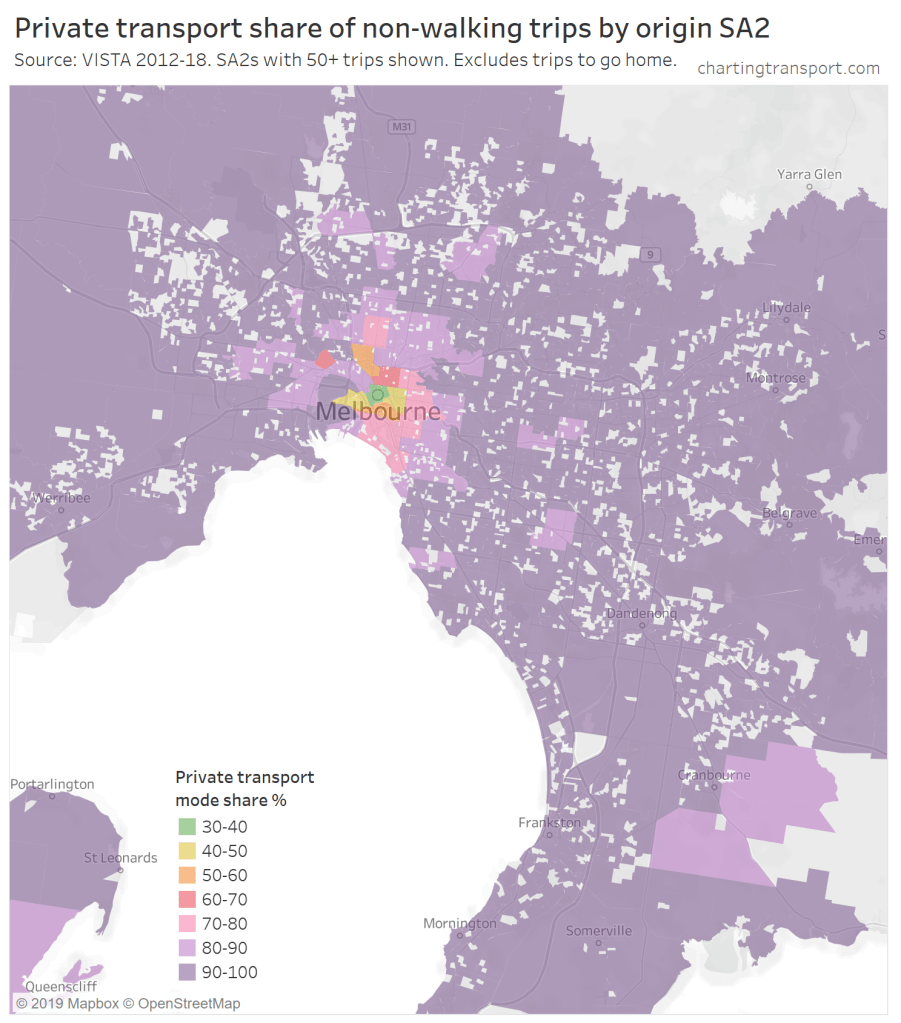
Here’s a map of private transport mode share of non-walking trips by SA2 destination:

Technical note: I have set the threshold at 40 trips per SA2, but most SA2s have hundreds of surveyed trips. The grey areas of the map are SA2s with fewer than 40 trips, and/or destination zones with no surveyed trips.

For all but the inner suburbs of Melbourne, private transport is by far the dominant mode for non-walking trips. Public transport and cycling only get a significant combined share in the central and inner city areas.

Where is private transport mode share unusually low? And could paid parking explain that?

The above chart showed a pretty strong pattern where private transport mode share is lower in the central city and very high in the suburbs. But are there places where private mode share in unusually low compared to surround land uses? These might be places where public transport can win a higher mode share because of paid parking, or other reasons.

Here’s a similar mode share map, but showing only DZ groups that have a private mode share below 90%:

If you look carefully you can see DZ groups with lower than 80% mode share, including some university/health campuses.

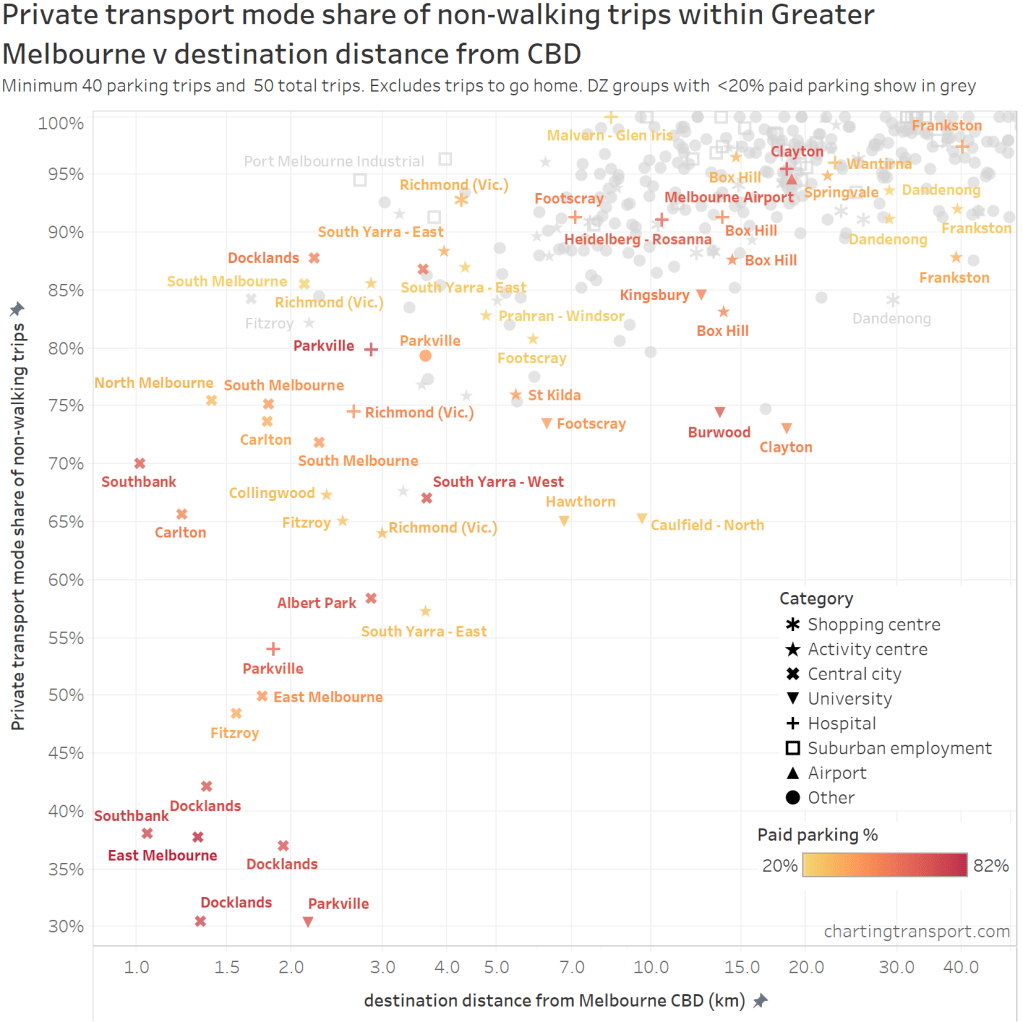
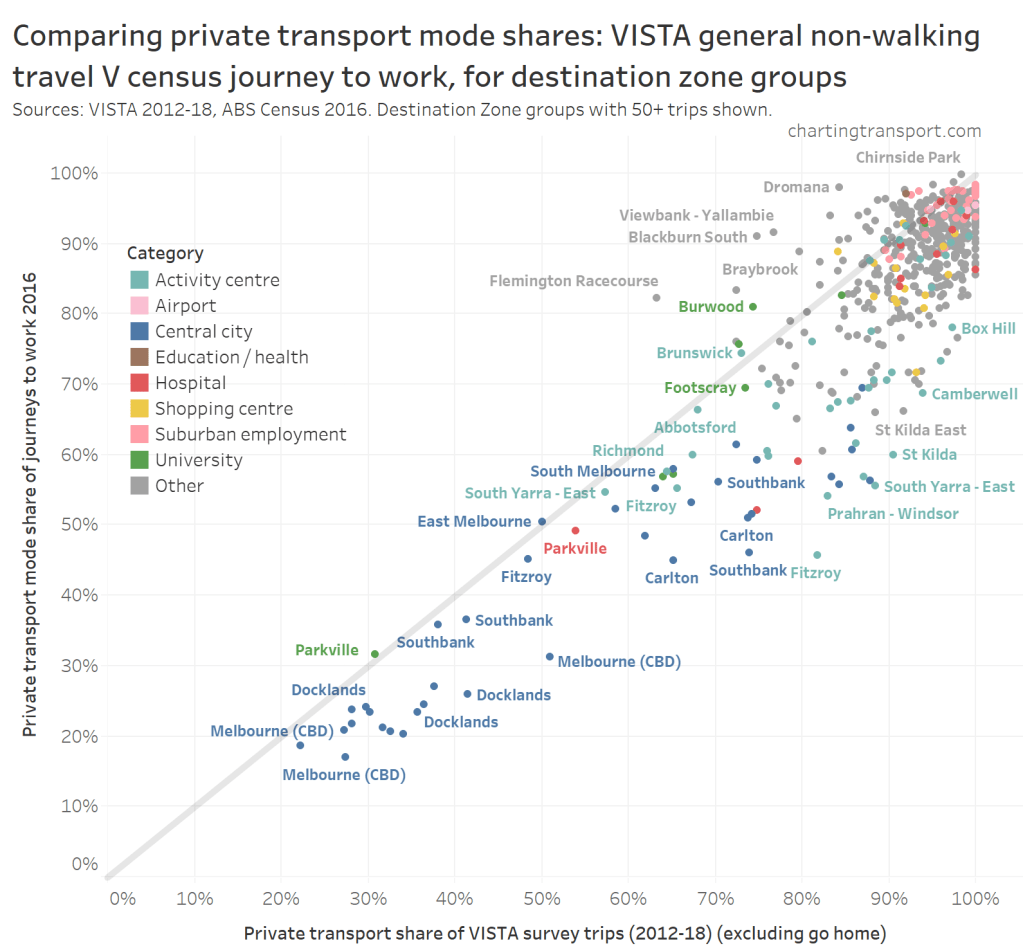
To better illustrate the impact of distance from the city centre, here’s a chart summarising the average private transport mode share of non-walking trips for selected types of places, by distance from the city centre:

Most destination place types are above 90% private transport mode share, except within the inner 5 km. The lowest mode shares are at tertiary education places, workplaces in the central city, secondary schools and parks/recreation. Up the top of the chart are childcare centres, supermarkets and kinders/preschool. Sorry it is hard to decode all the lines – but the point is that they are mostly right up the top.

The next chart brings together the presence of paid parking, distance from the CBD, destination place type, and private transport mode shares. I’ve greyed out DZ groups with less than 20% paid parking, and you can see they are mostly more than 3 km from the CBD. I’ve coloured and labelled the DZ groups with higher rates of paid parking. Also note I’ve used a log scale on the X-axis to spread out the paid DZ groups (distance from CBD).

Most of the DZ groups follow a general curve from bottom-left to top-right, which might reflect generally declining public transport service levels as you move away from the city centre.

The outliers below the main cloud are places with paid parking where private modes shares are lower than other destinations a similar distance from the CBD. Most of these non-private trips will be by public transport. The biggest outliers are university campuses, including Parkville, Clayton, Caulfield, Burwood, and Hawthorn. Some destinations at the bottom edge of the main cloud include university campuses in Kingsbury and Footscray, and parts of the large activity centres of Box Hill and Frankston.

Arguably the presence of paid parking could be acting as a disincentive to use private transport to these destinations.

Contrast these with other paid parking destinations such as hospitals, many activity centres, and Melbourne Airport. The presence of paid parking doesn’t seem to have dissuaded people from driving to these destinations.

Which raises a critical question: is this because of the nature of travel to these destinations means people choose to drive, or is this because of lower quality public transport to those centres? Something we need to unpack.

How strongly does paid car parking correlate with low private transport mode shares?

Here’s a chart showing DZ groups with their private transport mode share of (non-walking) trips and percent of vehicle parking trips involving payment.

Technical note: A colour has been assigned to each SA2 to help associate labels to data points, although there are only 20 unique colours so they are re-used for multiple SA2s. I have endeavoured to make labels unambiguous. It’s obviously not possible to label all points on the chart.

In the top-left are many trip destinations with mostly free parking and very high private transport mode share, suggesting it is very hard for other modes to compete with free parking (although this says nothing about the level of public transport service provision or cycling infrastructure). In the bottom-right are central city DZ groups with paid parking and low private transport mode share.

There is a significant relationship between the two variables (p-value < 0.0001 on a linear regression as per line shown), and it appears that the relative use of paid parking explains a little over half of the pattern of private transport mode shares (R-squared = 0.61). But there is definitely a wide scattering of data points, suggesting many other factors are at play, which I want to understand.

In particular it’s notable that the data points close to the line in the bottom-right are in the central city, while most of the data points in the top-right are mostly in the suburbs (they are also the same land use types that were an exception in the last chart – Melbourne Airport, hospitals, some university campuses, and activity centres).

As always, it’s interesting to look at the outliers, which I am going to consider by land use category.

Melbourne Airport

The airport destination zone has around 62% paid parking and around 92% private transport mode share for general trips (noting the VISTA survey is only of travel by Melbourne and Geelong residents). The airport estimates 14% of non-transferring passengers use some form of public transport, and that 27% of weekday traffic demand is employee travel.

Some plausible explanations for high private mode share despite paid parking include:

  • shift workers travelling when public transport is infrequent or unavailable (I understand many airport workers commence at 4 am, before public transport has started for the day),
  • unreliable work finish times (for example, if planes are delayed),
  • longer travel distances making public transport journeys slower and requiring transfers for many origins,
  • travellers with luggage finding public transport less convenient,
  • highly time-sensitive air travellers who might feel more in control of a private transport trip,
  • active transport involving long travel distances with poor infrastructure, and
  • many travel costs being paid by businesses (not users).

It’s worth noting that the staff car park is remote from the terminal buildings, such that shuttle bus services operate – an added inconvenience of private transport. But by the same token, the public transport bus stops are a fairly long walk from terminals 1 and 2.

The destination zone that includes the airport terminals also includes industrial areas on the south side of the airport. If I aggregate only the surveyed trips with a destination around the airport terminals, that yields 69% paid parking, and 93% private mode share. Conversely, the industrial area south of the airport yields 6% paid parking, and 100% private mode share.

Hospitals

Almost all hospitals are above the line – i.e. high private mode share despite high rates of paid parking.

The biggest outliers are the Monash Medical Centre in Clayton, Austin/Mercy Hospitals in Heidelberg, and Sunshine Hospital in St Albans South.

The Heidelberg hospitals are adjacent to Heidelberg train station. The Monash Medical Centre at Clayton is within 10 minutes walk of Clayton train station where trains run every 10 minutes or better for much of the week, and there’s also a SmartBus route out the front. Sunshine Hospital is within 10 minutes walk of Ginifer train station (although off-peak services mostly run every 20 minutes).

It’s not like these hospitals are a long way from reasonably high quality public transport. But they are a fair way out from the CBD, and only have high quality public transport in some directions.

The DZ containing Royal Melbourne Hospital, Royal Women’s Hospital, and Victoria Comprehensive Cancer Centre in Parkville is the exception below the line. It is served by multiple high frequency public transport lines, and serves the inner suburbs of Melbourne (also well served by public transport) which might help explain its ~45% private transport mode share.

The Richmond hospital DZ group is close to the line – but this is actually a blend of the Epworth Hospital and many adjacent mixed land uses so it’s not a great data point to analyse unfortunately.

So what might explain high private transport mode shares? I think there are several plausible explanations:

  • shift workers find public transport infrequent, less safe, or unavailable at shift change times (similar to the airport),
  • visitors travel at off-peak times when public transport is less frequent,
  • longer average travel distances (hospitals serve large population catchments with patients and visitor origins widely dispersed),
  • specialist staff who work across multiple hospitals on the same day,
  • patients need travel assistance when being admitted/discharged, and
  • visitor households are time-poor when a family member is in hospital.

The Parkville hospital data point above the line is the Royal Children’s Hospital. Despite having paid parking and being on two frequent tram routes, there is around 80% private transport mode share. This result is consistent with the hypotheses around time-poor visitor households, patients needing assistance when travelling to/from hospitals, and longer average travel distances (being a specialised hospital).

We can also look at census journey to work data for hospitals (without worrying about small survey sample sizes). Here’s a map showing the relative size, mode split and location of hospitals around Melbourne (with at least 200 journeys reported with a work industry of “Hospital”):

It’s a bit congested in the central city so here is an enlargement:

The only hospitals with a minority private mode share of journeys to work are the Epworth (Richmond), St Vincent’s (Fitzroy), Eye & Ear (East Melbourne), and the Aboriginal Health Service (Fitzroy) (I’m not sure that this is a hospital but it’s the only thing resembling a hospital in the destination zone).

Here’s another chart of hospitals showing the number of journeys to work, private transport mode share, and distance from the Melbourne CBD:

Again, there’s a very strong relationship between distance from the CBD and private transport mode share.

Larger hospitals more than 10 km from the CBD (Austin/Mercy, Box Hill, Monash) seem to have slightly lower private mode shares than other hospitals at a similar distance, which might be related to higher parking prices, different employee parking arrangements, or it might be that they are slightly closer to train stations.

The (relatively small) Royal Talbot Hospital is an outlier on the curve. It is relatively close to the CBD but only served by ten bus trips per weekday (route 609).

To test the public transport quality issue, here’s a chart of journey to work private mode shares by distance from train stations:

While being close to a train station seems to enable lower private transport mode shares, it doesn’t guarantee low private transport mode shares. The hospitals with low private transport mode shares are all in the central city.

So perhaps the issue is as much to do with the public transport service quality of the trip origins. The hospitals in the suburbs largely serve people living in the suburbs which generally have lower public transport service levels, while the inner city hospitals probably more serve inner city residents who generally have higher public transport service levels and lower rates of motor vehicle ownership (see: What does the census tell us about motor vehicle ownership in Australian cities? (2006-2016)).

Indeed, here is a map showing private transport mode share of non-walking trips by origin SA2:

Technical notes: grey areas are SA1s (within SA2s) with no survey trips.

Finally for hospitals, here is private transport mode share of journeys to work (from the census) compared to paid parking % from VISTA (note: sufficient paid parking data is only available for some hospitals, and we don’t know whether staff have to pay for parking):

There doesn’t appear to be a strong relationship here, as many hospitals with high rates of paid parking also have high private transport mode shares.

In summary:

  • The distance of a hospital from the CBD seems to be the primary influence on mode share.
  • Specialised hospitals with larger catchments (eg Children’s Hospital) might have higher private transport mode shares.
  • The quality of public transport to the hospital seems to have a secondary impact on mode shares.

Activity centres

Suburban activity centres such as Frankston, Box Hill, Dandenong, and Springvale have high private mode shares, which might reflect lower public transport service levels than the inner city (particularly for off-rail origins).

Box Hill is the biggest outlier for activity centres in terms of high private mode share despite paid parking. But compared to other destinations that far from the Melbourne CBD, it has a relatively low private transport mode share. It is located on a major train line, and is served by several frequent bus routes.

In general, there are fewer reasons why increased public transport investment might not lead to higher public transport mode share compared to airports and hospitals. Travel distances are generally shorter, many people will be travelling in peak periods and during the day, there are probably few shift workers (certainly few around-the-clock shift workers).

University campuses

The biggest university outliers above the line (higher private mode shares and higher paid parking %) are Deakin University (Burwood) and La Trobe University (Kingsbury). Furthermore, private transport also has a majority mode share for Monash University Clayton, Victoria University Footscray Park, Monash University (Caulfield) and Swinburne University (Hawthorn).

As discussed earlier, I suspect the rates of paid parking may be understated for university campuses because people forget they have purchased long-term parking permits.

The following chart shows the full mode split of trips to the University DZ groups in various SA2s (this time including walking trips):

Of the campuses listed, only Hawthorn and Caulfield are adjacent to a train station. Of the off-rail campuses:

  • Parkville (Melbourne Uni, 43% public transport) is served by multiple frequent tram routes, plus a high frequency express shuttle bus to North Melbourne train station. In a few years it will also have a train station.
  • Clayton (Monash, 22% PT) is also served by a high frequency express shuttle bus service to Huntingdale train station.
  • Burwood (Deakin, 19% PT) is on a frequent tram route, but otherwise moderately frequent bus services (its express shuttle bus service to Box Hill train station – route 201 – currently runs every 20 minutes)
  • Footscray (Park) (Victoria Uni, 14% PT) has bus and tram services to Footscray train station but they operate at frequencies of around 15 minutes in peak periods, and 20 minutes inter-peak.
  • Kingsbury (La Trobe Uni, 13% PT) has an express shuttle bus service from Reservoir station operating every 10 minutes on weekdays (introduced in 2016).

The success of high frequency express shuttle bus services to Parkville and Clayton may bode well for further public transport frequency upgrades to other campuses.

University campuses are also natural targets for public transport as university students on low incomes are likely to be more sensitive to private motoring and parking costs.

However university campuses also have longer average travel distances which might impact mode shares – more on that shortly.

Central city

Most central city DZ groups are in the bottom-right of the scatter plot, but there are some notable exceptions:

  • A Southbank DZ around Crown Casino has 65% paid parking and 70% private transport mode share. This was also an exception when I analysed journey to work (see: How is the journey to work changing in Melbourne? (2006-2016)) and might be explained be relatively cheap parking, casino shift workers, and possibly more off-peak travel (eg evenings, weekends).
  • Similarly, a Southbank DZ group around the Melbourne Convention and Exhibition Centre / South Wharf retail complex has 62% paid parking and around 74% private mode share. Many parts of this area are a long walk from public transport stops, and also there are around 2,200 car parks on site (with $17 early bird parking at the time of writing).
  • Albert Park – a destination zone centred around the park – has around 54% paid parking and 87% private transport mode share. Most of the VISTA survey trips were recreation or sport related, which may include many trips to the Melbourne Sports and Aquatic Centre. The park is surrounded by tram routes on most sides, but is relatively remote from the (rapid) train network.
  • Northern Docklands shows up with around 50% paid parking and around 88% private transport mode share, despite being very close to the Melbourne CBD. While this area is served by multiple frequent tram routes, it is a relatively long walk (or even tram ride) from a nearby a train station (from Leven Avenue it is 16 minutes by tram to Southern Cross Station and around 18 minutes to Flagstaff Station, according to Google). The closest train station is actually North Melbourne, but there is currently no direct public transport or pedestrian connection (the E-gate rail site and future Westgate Tunnel road link would need to be crossed).

Inner suburbs

Some places to the bottom-left of the cloud on the chart include inner suburban areas such as South Yarra, Fitzroy, Richmond, Abbotsford, Brunswick, and Collingwood. While paid parking doesn’t seem to be as common, private transport mode shares are relatively low (even when walking trips are excluded). These areas typically have dense mixed-use activity with higher public transport service levels, which might explain the lower private transport mode shares. These areas probably also have a lot of time-restricted (but free) parking.

What is the relationship between paid parking and journey to work mode shares?

For journeys to work we thankfully have rich census data, with no issues of small survey sample sizes.

The following chart combines VISTA data on paid parking, with 2016 census data on journey to work mode shares (note: the margin of error on the paid parking percentage is still up to +/-12%).

The pattern is very similar to that for general travel, and the relationship is of a similar strength (r-squared = 0.59).

There are more DZ groups below the line on the left side of the chart, meaning that the private transport mode share of journeys to work is often lower than for general travel.

Indeed, here is a chart comparing private transport mode share of general travel (VISTA survey excluding walking and trips to go home) with journeys to work (ABS census):

Note the margin of error for private transport mode shares is around +/-10% because of the small VISTA sample sizes.

For most DZ groups of all types, private transport mode shares are lower for journeys to work compared to general travel (ie below the diagonal line). This might reflect public transport being more competitive for commuters than for visitors – all-day parking might be harder to find and/or more expensive. This suggests investment in public transport might want to target journeys to work.

The DZ groups above the line include Flemington Racecourse (census day was almost certainly not a race day so there was probably ample parking for employees, while many VISTA survey trips will be from event days), Deakin Uni (Burwood), and a few others. Some of these DZ groups are dominated by schools, where workers (teachers) drive while students are more likely to cycle or catch public transport.

What about public transport mode shares?

The following chart shows VISTA public transport mode shares (for general travel) against paid parking percentages:

There are similar patterns to the earlier private transport chart, but flipped. The outliers are very similar (eg hospitals and Melbourne Airport in the bottom-right), although the top-left outliers include some destinations in socio-economically disadvantaged areas (eg Braybrook, Broadmeadows, Dandenong).

The DZ group in Blackburn South with no paid parking but 22% public transport mode share contains several schools but otherwise mostly residential areas, and the survey data includes many education related trips.

Are shift workers less likely to use public transport?

Shift workers at hospitals, Melbourne Airport, and the casino might be less likely to use public transport because of the inconvenience of travelling at off-peak shift change times, when service levels may be lower or non-existent.

Here’s a chart showing the mode split of VISTA journeys to work by destination type categories, and also type of working hours:

For hospitals, rostered shifts had a lower public transport mode share, compared to fixed and flexible hours workers, so this seems to support (but not prove) the hypothesis.

Public transport use is actually higher for rostered shift workers at other destination types, but I suspect these are mostly not around-the-clock shifts (eg retail work), and are more likely to be lower paid jobs, where price sensitivity might contribute more to mode choice.

Unfortunately there are not enough VISTA journey to work survey responses for Melbourne Airport to get sensible estimates of mode shares for different work types.

Do longer travel distances result in lower public transport mode shares?

Another earlier hypothesis was that destinations that attract longer distance trips (such as universities, hospitals, and airports) are more likely to result in private transport mode choice, as public transport journeys are more likely to require one or more transfers.

Trip distances to specialised places such as airports, suburban employment areas, universities and hospitals are indeed longer. But the central city also rates here and that has low private transport mode shares.

Digging deeper, here are median travel distances to DZ groups around Melbourne:

The central city has higher median trip distances but low private mode shares, while many suburban destinations (particularly employment/industrial areas, universities, and hospitals) have similar median travel distances but much higher public transport mode shares.

I think a likely explanation for this is that public transport to the central city is generally faster (often involving trains), more frequent, and involves fewer/easier transfers. Central city workers are also more likely to live near radial public transport lines. On the other hand, the trip origins for suburban destinations are more likely to be in the suburbs where public transport service levels are generally lower (compared to trip origins in the inner suburbs).

Cross-suburban public transport travel will often require transfers between lower frequency services, and will generally involve at least one bus leg. Very few Melbourne bus routes are currently separated from traffic, so such trips are unlikely to be as fast as private motoring (unless parking takes a long time to find), but they might be able to compete on marginal cost (if there is more expensive paid parking).

Of course this is not to suggest that cross-suburban public transport cannot be improved. More direct routes, higher frequencies, and separation from traffic can all make public transport more time-competitive.

How does parking pricing relate to employment density?

My previous research has confirmed a strong relationship between job density and lower journey to work private transport mode shares (see: What explains variations in journey to work mode shares between and within Australian cities?). Can this be explained by more paid parking in areas with higher job density?

The following chart compares weighted job density (from census 2016) and paid parking percentages (from VISTA):

Technical notes: Weighted job density is calculated as a weighted average of the job densities of individual destination zones in a DZ group, with the weighting being the number of jobs in each zone (the same principle as population weighted density). I have used a log-scale on the X-axis, and not shown DZ groups with less than 1 job/ha as they are not really interesting

There appears to be a relationship between job density and paid parking – as you would expect. The top right quadrant contains many university campuses, hospitals, and central city areas with high job density and high paid parking percentages.

In the bottom-right are many large job-dense shopping centres that offer “free” parking. Of course in reality the cost of parking is built into the price of goods and services at the centres (here’s a thought: what if people who arrive by non-car modes got a discount?). An earlier chart showed us that employees are less likely to commute by private transport than visitors.

The outliers to the top-left of the chart are actually mostly misleading. An example is Melbourne Airport where the density calculation is based on a destination zone that includes runways, taxiways, a low density business park, and much green space. The jobs are actually very concentrated in parts of that zone (e.g. passenger terminals) so the density is vastly understated (I’ve recommended to the ABS that they create smaller destination zones around airport terminal precincts in future census years).

Inclusion of significant green space and/or adjacent residential areas is also an issue at La Trobe University (Kingsbury data point with just under 50% mode share), RMIT Bundoora campus (Mill Park South), Royal Children’s Hospital (Parkville), Sunshine Hospital (St Albans South), Victoria University (Footscray (Park)), Albert Park (the actual park), and Melbourne Polytechnic Fairfield campus / Thomas Embling Hospital (Yarra – North).

I am at a loss to explain paid parking in Mooroolbark – the only major employer seems to be the private school Billanook College.

Can you summarise the relationship between paid parking and mode shares?

I know I’ve gone down quite a few rabbit holes, so here’s a summary of insights:

  • Distance from the Melbourne CBD seems to be the strongest single predictor of private transport mode share (as origin or destination). This probably reflects public transport service levels generally being higher in the central city and lower in the suburbs. Destinations further from the central city are likely to have trip origins that are also further from the central city, for which public transport journeys are often slower.
  • Paid parking seems to be particularly effective at reducing private transport mode shares at university campuses, and the impact is probably greater if there are higher quality public transport alternatives available.
  • There’s some evidence to suggest paid parking may reduce private transport mode shares at larger activity centres such as Box Hill and Frankston.
  • Most hospitals have very high private transport mode shares, despite also having paid parking. Hospitals with better public transport access have slightly lower private transport mode shares.
  • Destinations with around-the-clock shift workers (e.g. hospitals and airports) seem generally likely to have high private transport mode shares, as public transport services at shift change times might be infrequent or unavailable.
  • Suburban destinations that have longer median travel distances (such as hospitals, airports and industrial areas) mostly have higher private transport mode shares.
  • Even if there isn’t much paid parking, destinations well served by public transport tend to have lower private transport mode shares (although this could be related to time-restricted free parking).

If you’d like more on factors influencing mode shares, I’ve also explored this more broadly elsewhere on this blog, with employment density (related to parking prices), cycling infrastructure quality, proximity to rapid public transport, and walking catchment density found to be significant factors (see: What explains variations in journey to work mode shares between and within Australian cities?).

Are places with paid parking good targets for public transport investments?

Many of my recent conversations with transport professionals around this topic have suggested an hypothesis that public transport wins mode share in places that have paid parking. While that’s clearly the case in the centre of Melbourne and at many university campuses, this research has found it’s more of a mixed story for other destinations.

While this post hasn’t directly examined the impact of public transport investments on mode shares in specific places, I think it can inform the types of destinations where public transport investments might be more likely to deliver significant mode shifts.

Here’s my assessment of different destination types (most of which have paid parking):

  • Suburban hospitals may be challenging due to the presence of shift workers, patients needing assistance, visitors from time-poor households, and long average travel distances making public transport more difficult for cross-suburban travel. There’s no doubt many people use public transport to travel to hospitals, but it might not include many travellers who have a private transport option.
  • Larger activity centres with paid parking show lower private transport mode shares. Trips to these centres involve shorter travel distances that probably don’t require public transport transfers, and don’t suffer the challenges of around-the-clock shift workers, so they are likely to be good targets for public transport investment.
  • Universities are natural targets for public transport, particularly as many students would find the cost of maintaining, operating and parking a car more challenging, or don’t have access to private transport at all (around 35% of full time university/TAFE students do not have a full or probationary licence according to the VISTA sample). Universities do attract relatively higher public transport mode shares (even in the suburbs) and recent investments in express shuttle services from nearby train stations appear to have been successful at growing public transport patronage.
  • Melbourne Airport has high rates of paid parking and private transport mode share. It is probably a challenging public transport destination for employees who work rostered shifts. However already public transport does well for travel from the CBD, and this will soon be upgraded to heavy rail. Stations along the way may attract new employees in these areas, but span of operating hours may be an issue.
  • Job dense central city areas that are not currently well connected to the rapid public transport network could be public transport growth opportunity. In a previous post I found the largest journey to work mode shifts to public transport between 2011 and 2016 were in SA2s around the CBD (see: How is the journey to work changing in Melbourne? (2006-2016)). The most obvious target to me is northern Docklands which is not (yet) conveniently connected its nearby train station. Public transport is also gaining patronage in the densifying Fishermans Bend employment area (buses now operate as often as every 8 minutes in peak periods following an upgrade in October 2018).
  • Lower density suburban employment/industrial areas tend to have free parking, longer travel distances, and very high private transport mode shares. These are very challenging places for public transport to win significant mode share, although there will be some demand from people with limited transport options.

An emerging target for public transport might be large shopping centres that are starting to introduce paid or time-restricted car parking (particularly those located adjacent to train stations, e.g. Southland). That said, Westfield Doncaster, which has some paid parking (around 19%), has achieved only 6% public transport mode share in the VISTA survey (n=365), athough this may be growing over time. Meanwhile, Dandenong Plaza has around 16% public transport mode share despite only 6% paid parking.

Upgraded public transport to shopping centres might be particularly attractive for workers who are generally on lower incomes (we’ve already seen staff having lower private transport mode shares than visitors). Also, customer parking may be time-consuming to find on busy shopping days, which might make public transport a more attractive option, particularly if buses are not delayed by congested car park traffic.

There’s a lot going on in this space, so if you have further observations or suggestions please comment below.

Appendix: About destination group zones

Here is a map showing my destination zone groups in the central city area which have 15% or higher paid parking. Each group is given a different colour (although there are only 20 unique colours used so there is some reuse). The numbers indicate the number of surveyed parking trips in each group:

Some of the DZ groups have slightly less than 40 parking trips, which means they are excluded from much of my analysis. In many cases I’ve decided that merging these with neighbouring zones would be mixing disparate land uses, or would significantly dilute paid parking rates to not be meaningful (examples include northern Abbotsford, and parts of Kew and Fairfield). Unfortunately that’s the limitation of the using survey data, but there are still plenty of qualifying DZ groups to inform the analysis.

I have created destination zone groups for most destination zones with 10%+ paid parking, and most of the inner city area to facilitate the DZ group private transport mode share chart. I haven’t gone to the effort of creating DZ groups across the entire of Melbourne, as most areas have little paid parking and are not a focus for my analysis.