In the last few months I’ve been updating the Trends pages on Charting Transport with new data from BITRE, ABS, and other sources. This post provides summary charts across numerous aspects of transport with links for further detail.
The charts below are current at the time of this post, but I will be updating the charts on the Trends pages periodically (mostly 2-4 times per year), so go to those pages if you want to be sure you have the latest charts.
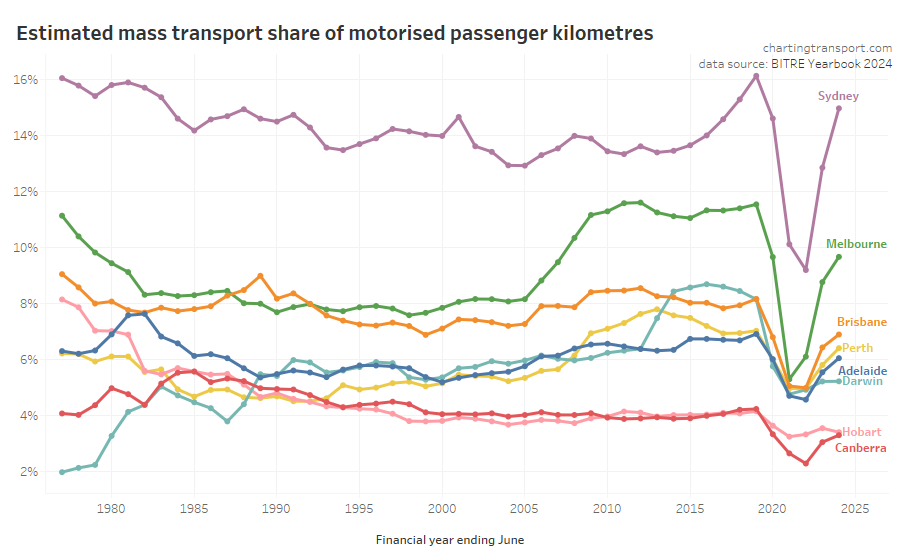
Mass transit mode shares bounced back a fair bit in 2023-24, although only Sydney appears to be close to pre-pandemic levels. Mass transit mode shares are below pre-pandemic levels presumably at least partly because of working from home.
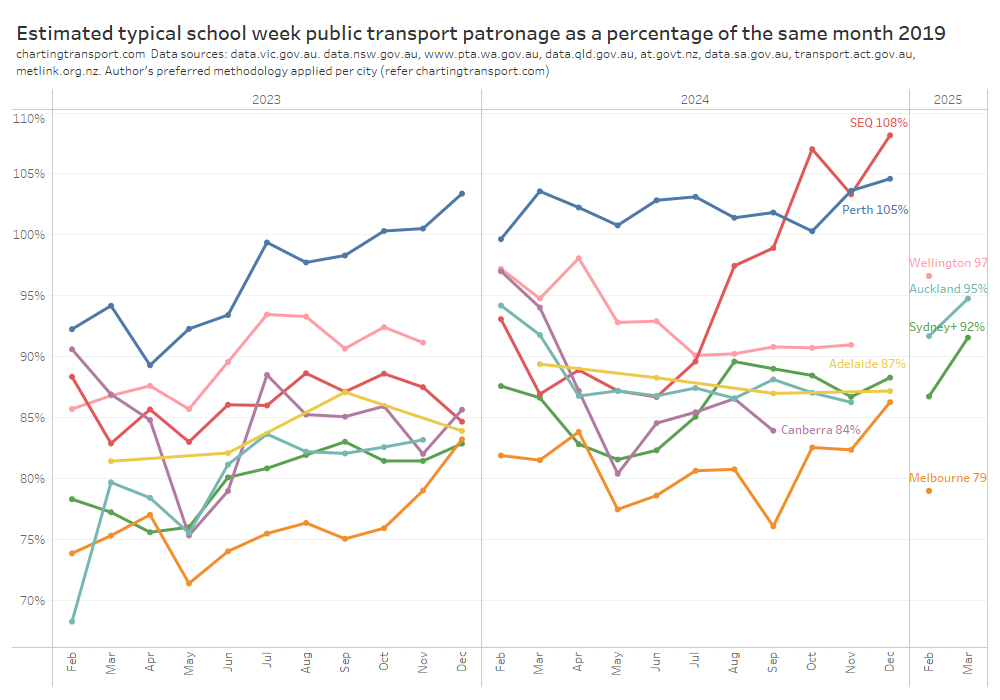
Public transport patronage has risen significantly in South East Queensland (followed a massive fare reduction). Perth is the only other city to have exceeded 2019 patronage levels so far.
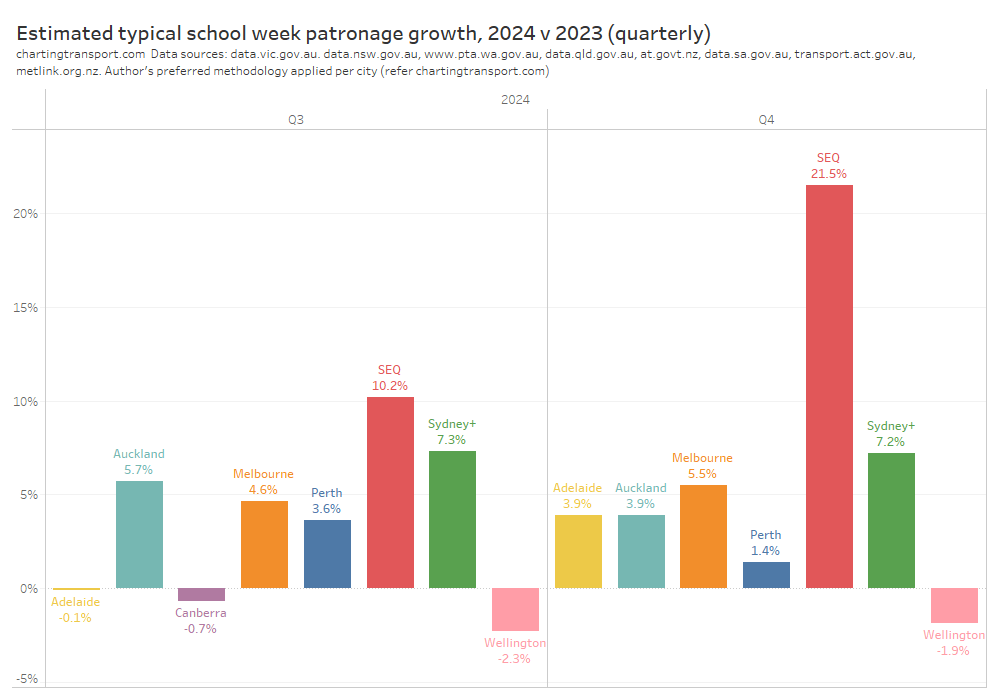
Patronage growth has slowed in most cities, but as of 2024 Q4 was still tracking above population growth in most cities (except Perth and Wellington).
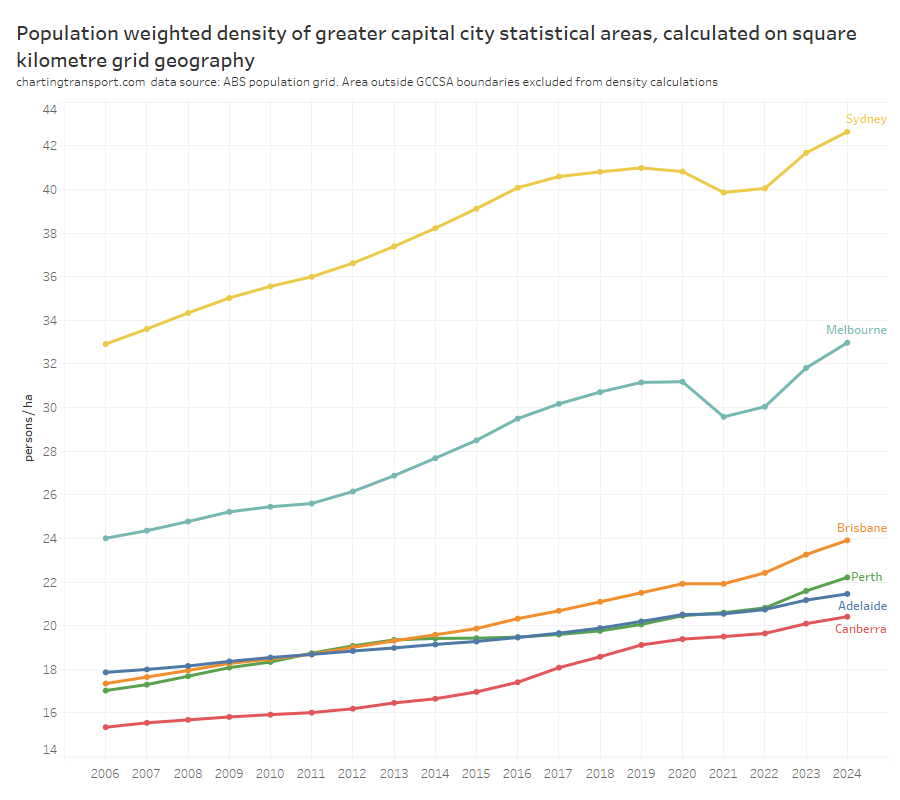
Population density is now rising rapidly in Australia’s largest cities, with Perth pulling ahead of Adelaide.
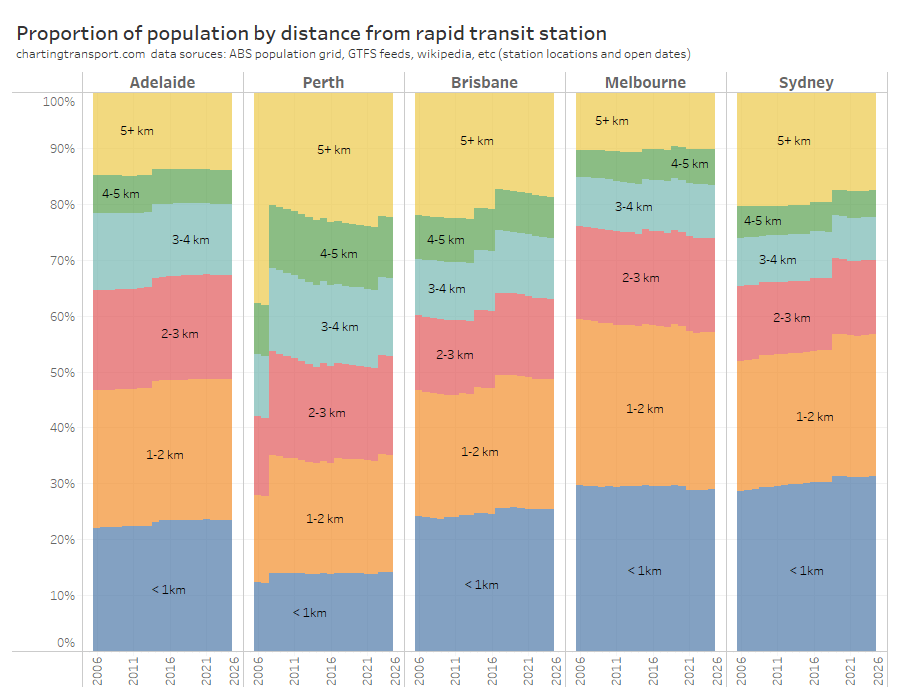
Most cities are improving the share of their population living close to stations over time. You can see the impact of opening new train lines/stations in several cities.
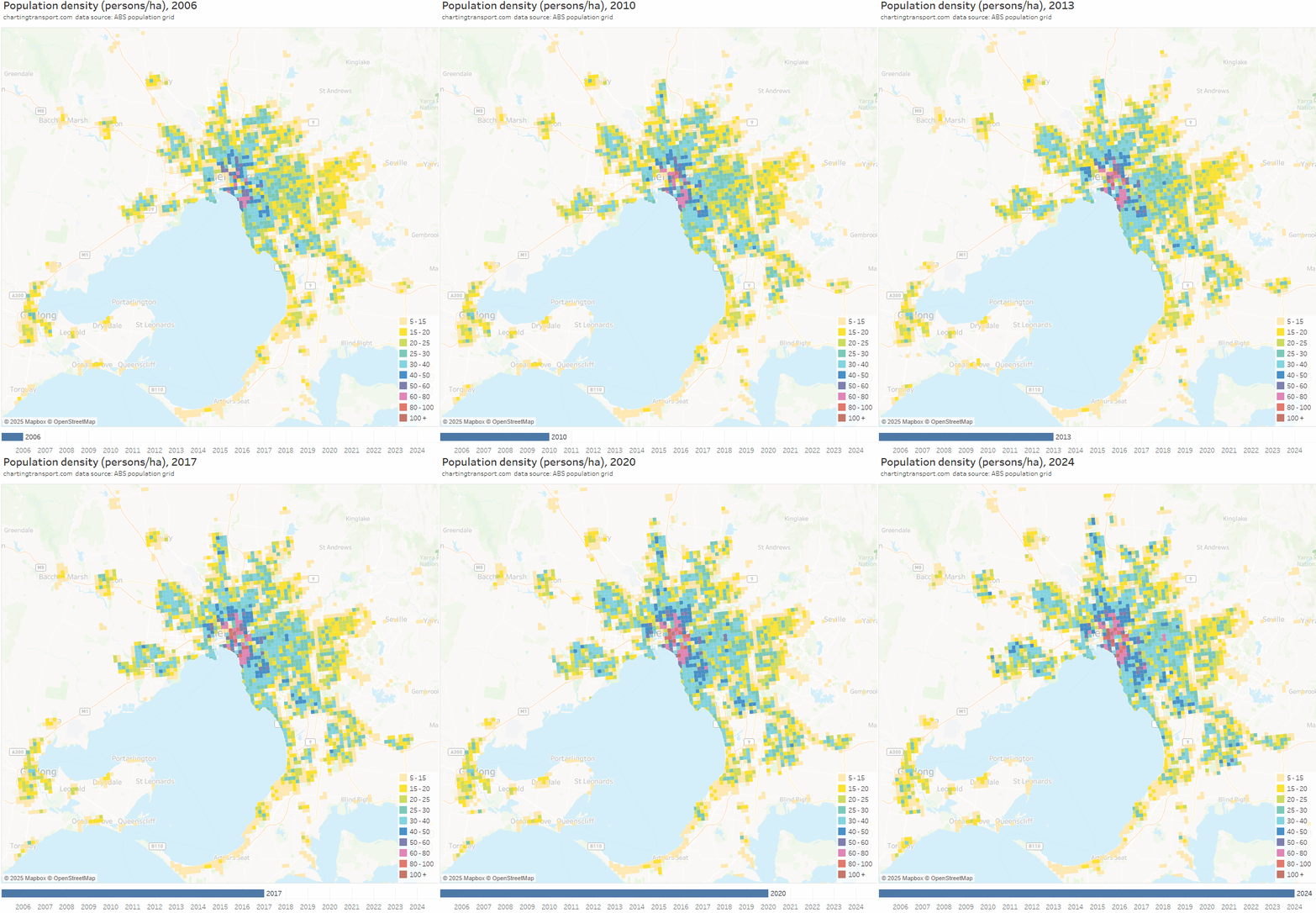
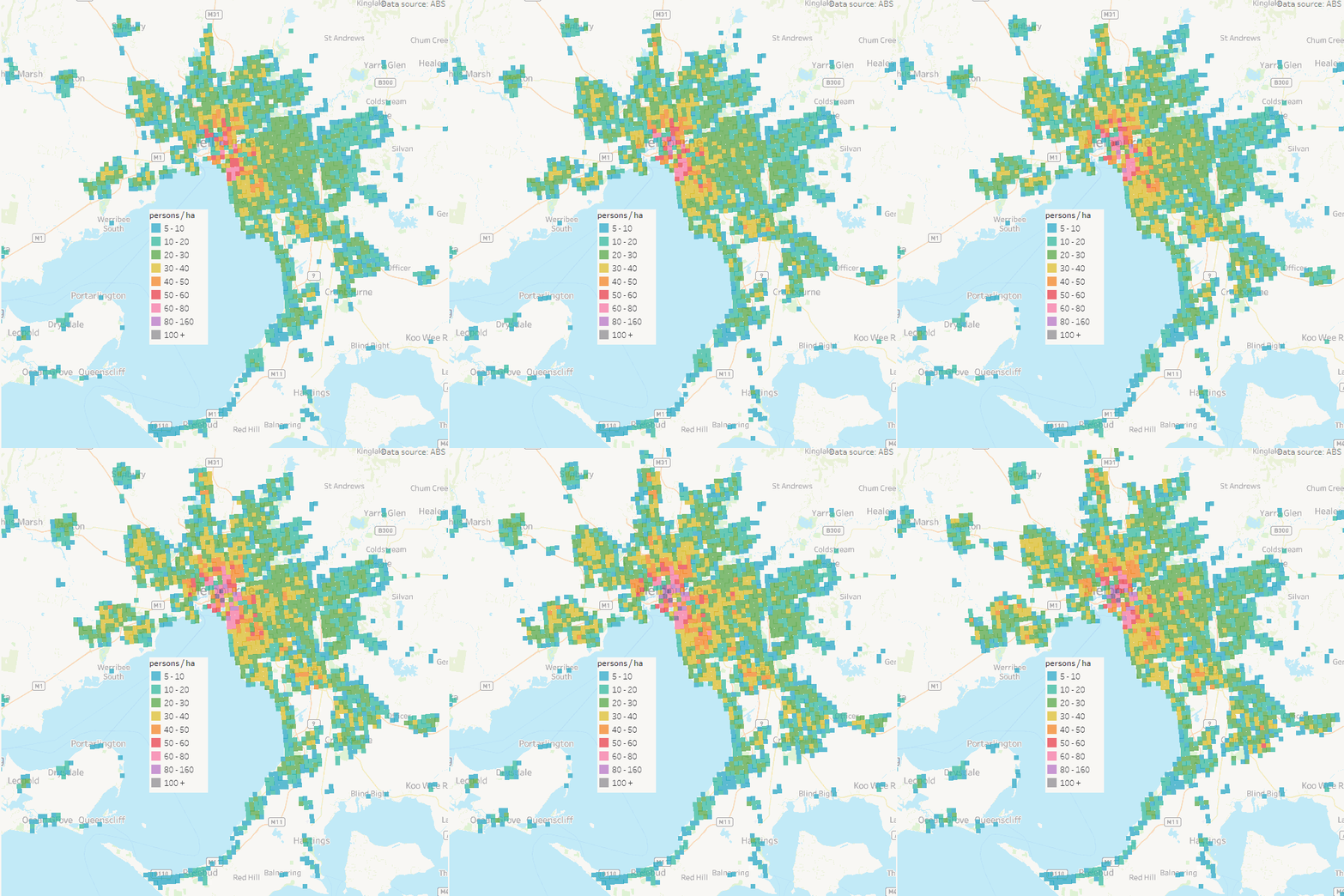
I’ve also created some new animated density maps for each city (2006 to 2024). Here’s Melbourne:
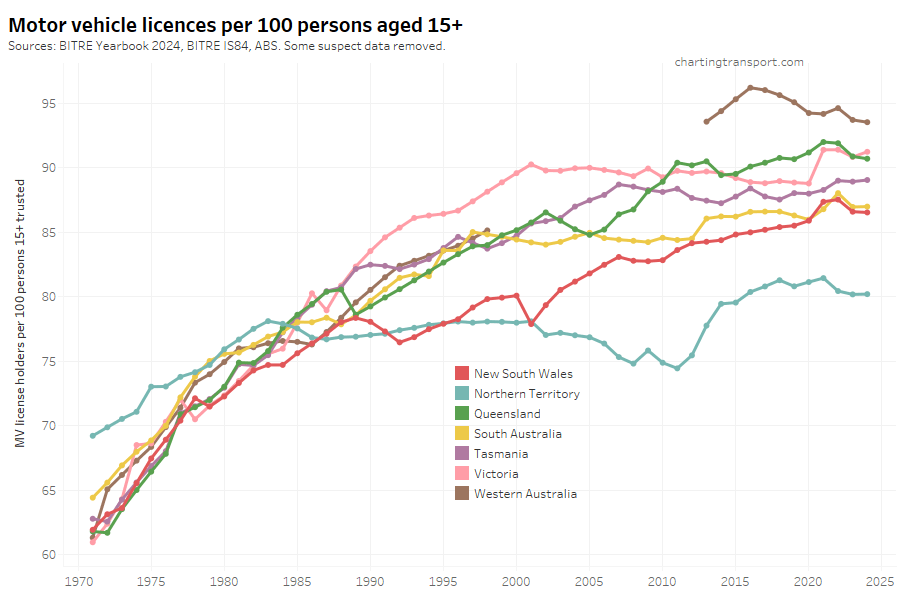
In 2023-24, driver’s licence ownership rates were flat in most states and territories.
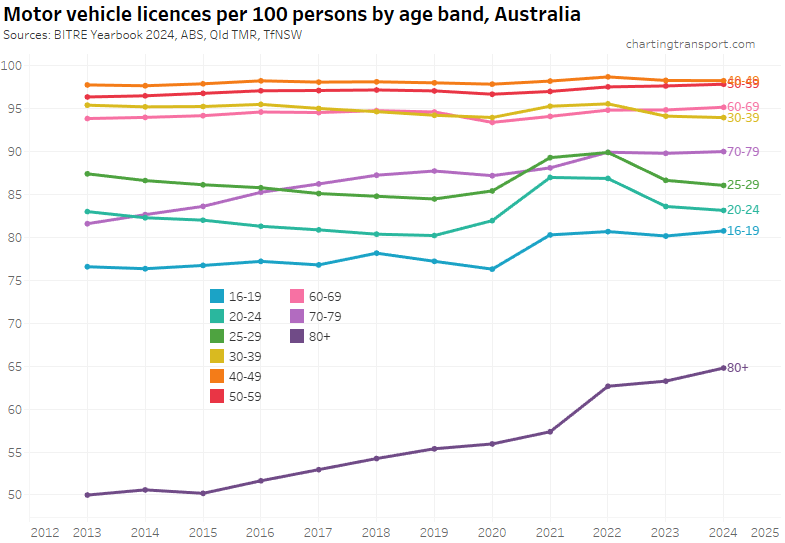
Motor vehicle licence ownership rates have varied by age group:
For those in their 20s, licence rates were declining but then peaked during pandemic as a lot of temporary residents left. It has since gone back into decline, but is above 2019 levels.
Licence ownership rates for teenagers jumped in 2021 but have been relatively flat since then.
Licence ownership rates for older Australians continue to increase (especially for those aged 80+)
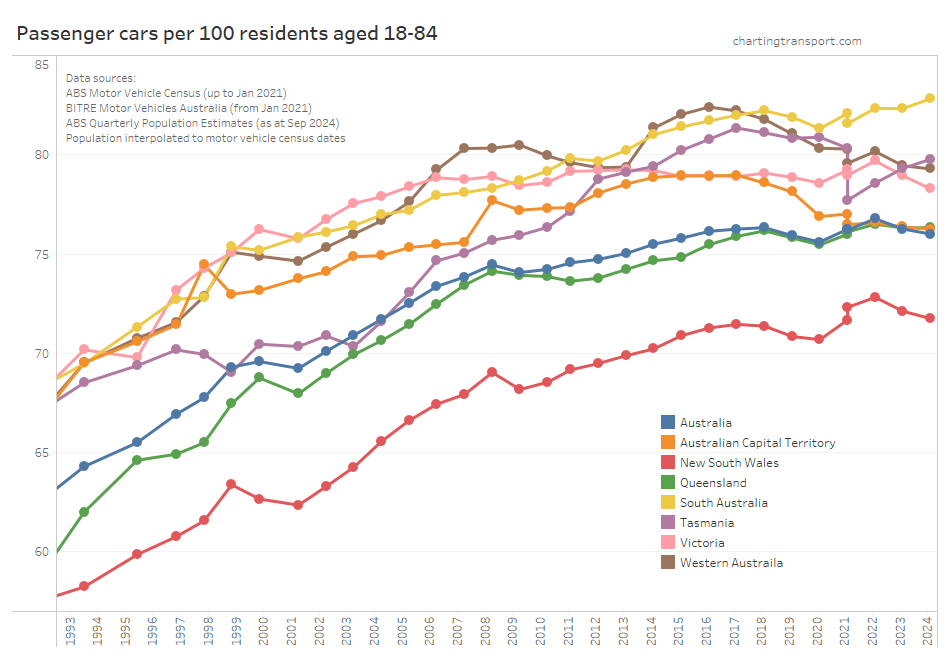
New South Wales, Victoria, and Western Australia saw a slight decline in motor vehicle ownership rates in the year to January 2024. Tasmania and South Australian were up, while ACT and Queensland were flat.
With the release of more detailed 2021 census data and June 2022 population estimates, it’s now possible to look more closely at how Australia’s larger capital cities have changed, particularly following the onset of the COVID19 pandemic in 2020.
This post examines ABS population grid data for 2006 to 2023 for Greater Capital City Statistical Areas, including:
Trends in overall population-weighted density for cities;
Changes in the distribution of population living at different densities;
Changes in the distribution of population living at different distances from each city’s CBD;
Changes in population density by distance from each city’s CBD;
Changes in the distribution of population living at different distances from train and busway stations;
Changes in population density in areas close to train and busway stations;
The population density of “new” urban residential areas in each city (are cities sprawling at low density?); and
Changes in the size of the urban residential footprint of cities.
I’ve also got some animated maps showing the density of each city over those years, and I’ve had a bit of a look at how the ABS corrected population estimates for 2007 to 2021 following the release of 2021 census data.
I’ve not included the smaller cities of Hobart and Darwin as they have a small footprint, and too many grid cells are on the edge of an urban area.
Population weighted density
My preferred measure of city density is population-weighted density, which takes a weighted average of the density all statistical areas in a city, with each area weighted by its population (this stops lightly populated rural areas pulling down average density – for more discussion see How is density changing in Australian cities? (2nd edition)).
I also prefer to calculate this measure on a consistent statistical area geography and the only consistent statistical area geography available for Australia is the square kilometre population grid published by the ABS.
With the recent release of 2021 census data, ABS issued revised population grid estimates for all years from 2017 onwards, which saw significant corrections in some cities (see appendix for more details). There has also been a slight change in the methodology for the 2021 grid that ABS say may result in a more ‘targeted representation’, but it’s unclear what that means.
Here’s the revised trend in population weighted density calculated on square km grid geography for Greater Capital City Statistical Areas in June of each year:
Sydney has almost double the population density of most other Australian cities (on this measure), with the exception being Melbourne which sits halfway in between.
Population weighted density was rising in all cities until 2019, although the growth was notably slowing in Sydney from about 2016.
The pandemic hit in March 2020 and led to a flatlining of density in Melbourne and a decline in Sydney by June 2020, while other cities continued to densify. Then Sydney and Melbourne’s population weighted density dropped considerably in the year to June 2021 – probably a combination an exodus of temporary international migrants and internal migration away from the big cities (particularly Melbourne that had experienced long lockdowns). Most other cities flatlined between June 2020 and June 2021.
Then by June 2022 density had increased again in all cities, after international borders reopened in early 2022.
The following chart shows the proportion of the population in each city living at different density ranges over time:
All cities show a sustained pre-pandemic trend towards more people living at higher densities. However the pandemic saw significant drops in people living at the higher density categories in 2021 in Melbourne, Sydney, and Canberra.
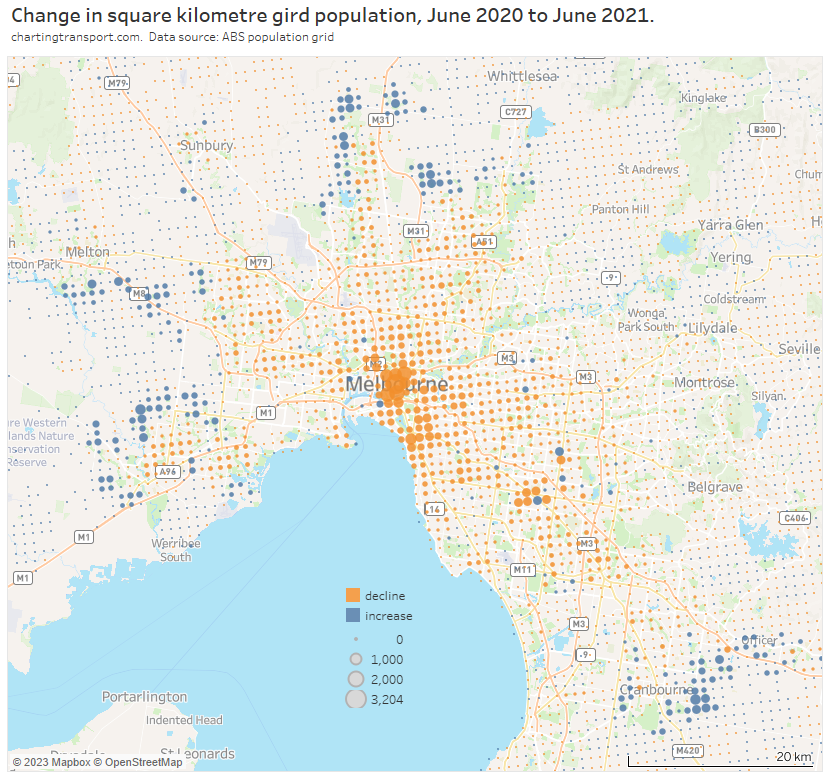
So where was this loss of density? The next chart shows the change in population for grid squares across Melbourne between June 2020 and June 2021. Larger dots are more change, blue is an increase and orange is a decline:
You can see significant declines in population (and hence population density) in the inner city areas – so much so that the dots overlap. This is likely largely explained by the exodus of many international students and other temporary migrants.
You can also see population decline around Monash University’s Clayton campus in the south-eastern suburbs.
At the same time there were large increases in population in the outer growth areas, as is normally the case. Other pockets of population growth include Footscray, Moonee Ponds, Box Hill, Port Melbourne, Clayton (M-City), and Doncaster, likely related to the completion of new residential towers.
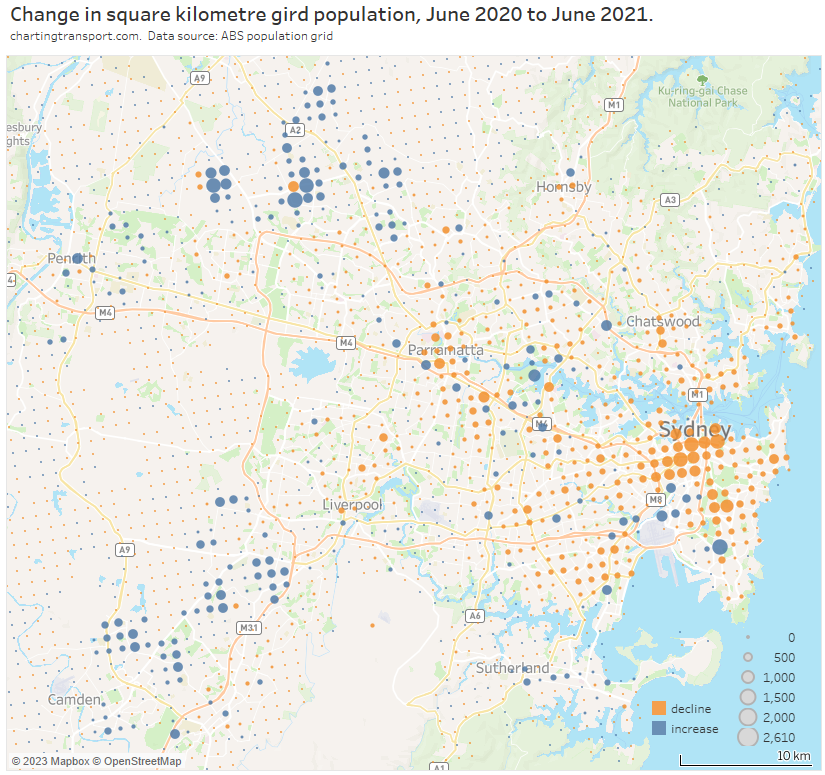
Here’s the same for Sydney:
There was significant population decline in the inner city and around Kensington (which has a major university campus), and the largest growth was seen in urban fringe growth areas to the north-west and south-west. Pockets of population growth were also seen at Wentworth Point, Eastgardens, Mascot, North Ryde, and Mays Hill, amongst others.
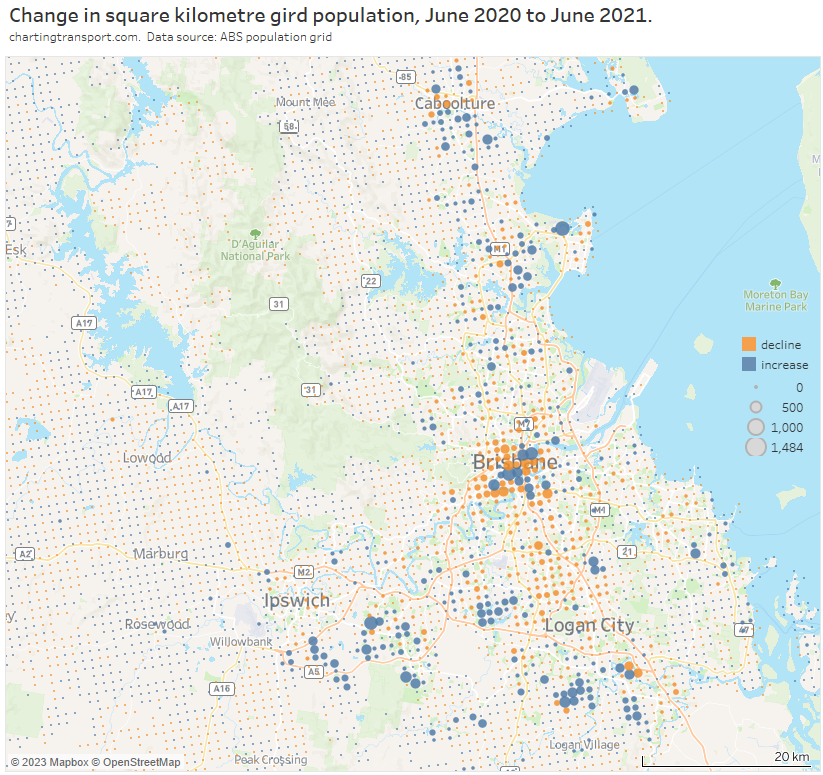
Here is the same for Brisbane:
Inner-city Brisbane was much more a mixed bag, which explains the less overall change in the density composition of the city. Some areas showed declines (including St Lucia, New Farm, Kelvin Grove, Coorparoo) while others saw increases (including Fortitude Valley, West End, South Brisbane, Buranda, CBD south).
Proportion of population living at different distances from the city centre
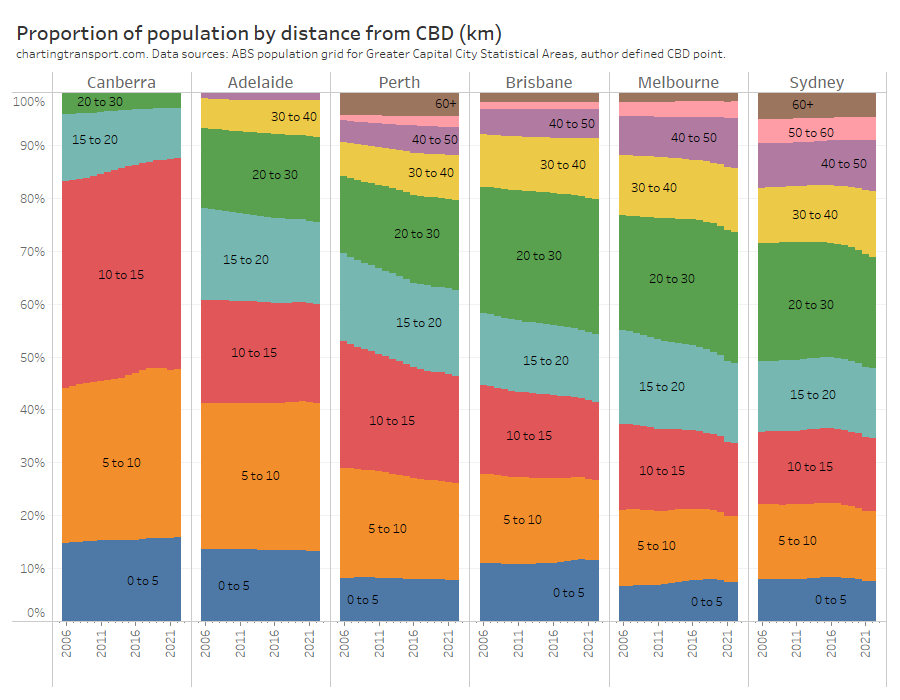
The next chart shows the proportion of people living at approximate distance bands from each city’s CBD over time:
All cities have seen a general trend towards more of their population living further from the CBD, with the notable exception of Canberra which has seen the outer urban fringe expanding by little more than a couple of kilometres at the most, and substantial in-fill housing at major town centres and the inner city (see also animated density map below). I should note that the Greater Capital City Statistical Area boundary for Canberra is simply the ACT boundary, and does not include the neighbouring NSW urban area of Queanbeyan, which is arguably functionally part of “greater Canberra”.
In 2021, Sydney and Melbourne saw a step change towards living further out, in line with the sudden reduction in central city population.
Population density by distance from a city’s CBD
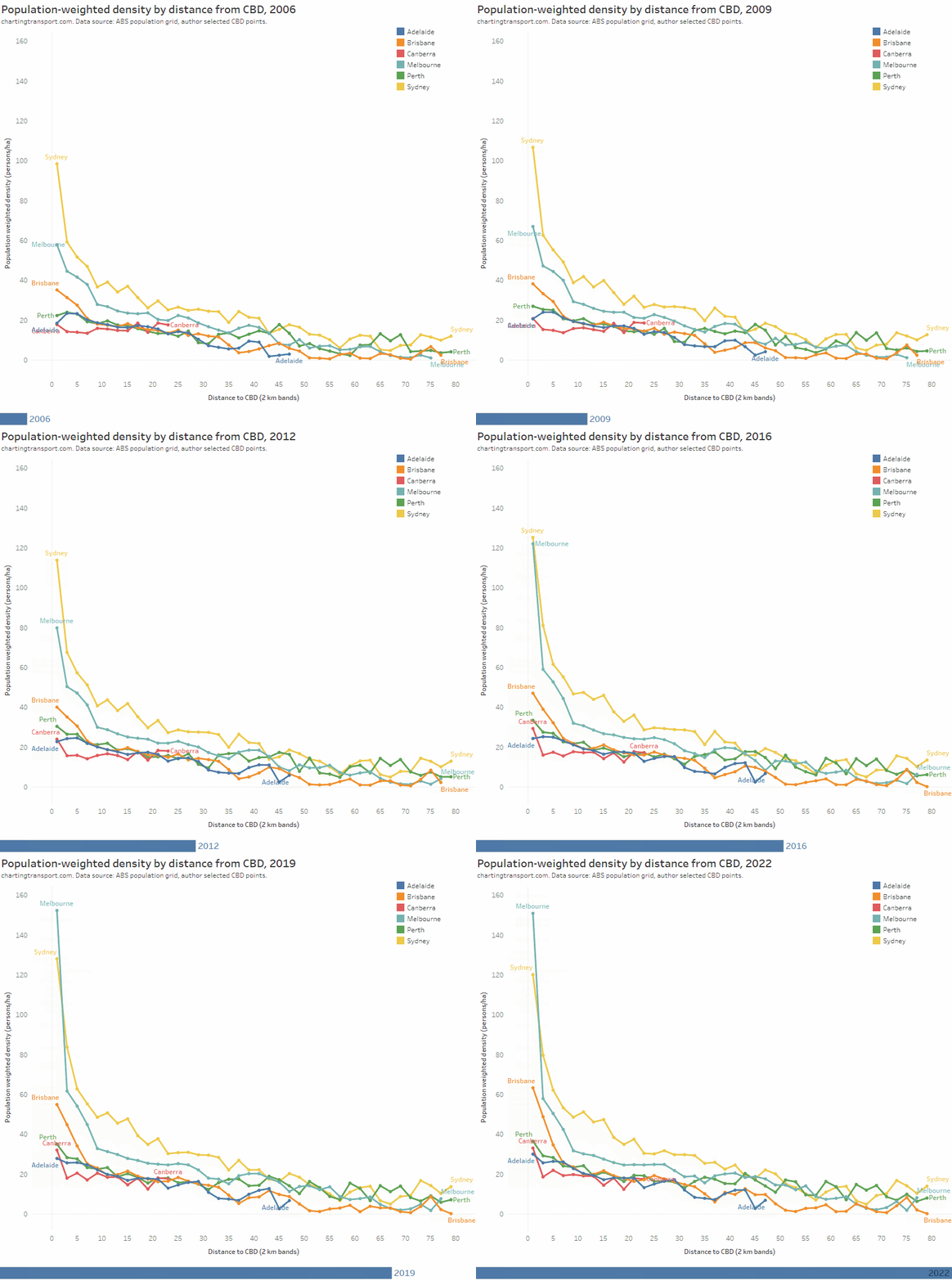
Here’s an animated chart showing how population weighted density has varied by distance from each city’s CBD over time:
In most cities there has been a trend to significantly increasing density closer to the CBD, with central Melbourne overtaking central Sydney in 2017.
Sydney has maintained significantly higher density than all other cities at most distances from CBDs, with Melbourne a fair step behind, then most other cities flatten out to around 20-26 persons/ha from around 6+km out from their CBDs in 2022.
Canberra appears to flatten out to around 20 persons/ha at 3-4 kms from its CBD (Civic) however it is important to note that Canberra has a lot of non-residential land relatively close to Civic which reduces density for many grid cells that are on an urban fringe (refer maps toward the end of this post).
Population living near rapid transit stations
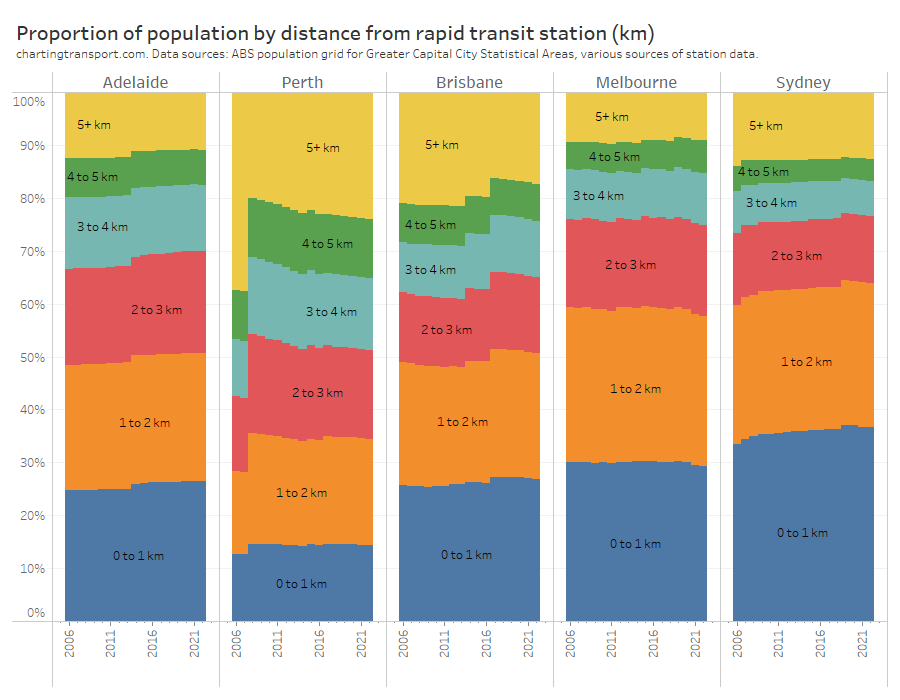
I’ve been maintaining a spatial data set of rapid transit stations (train and busway stations) including years of opening and closing, and from this it’s possible to assess what proportion of each city lives close to stations:
Sydney has the largest proportion of it’s population living quite close to rapid transit stations, with Perth having the lowest.
There are step changes on this chart where new train lines have opened. Sydney, Brisbane, and Adelaide have been successful at increasing population close to stations. The opening of the Mandurah rail line made a big difference in Perth in 2009 but the city has been growing remote from stations since then (MetroNet projects will probably turn this around significantly in the next few years). Melbourne was roughly keeping the same proportion of the population close to stations although that changed in 2021 with the exodus of inner city residents (I anticipate a substantial correction in 2023).
Population density around rapid transit stations
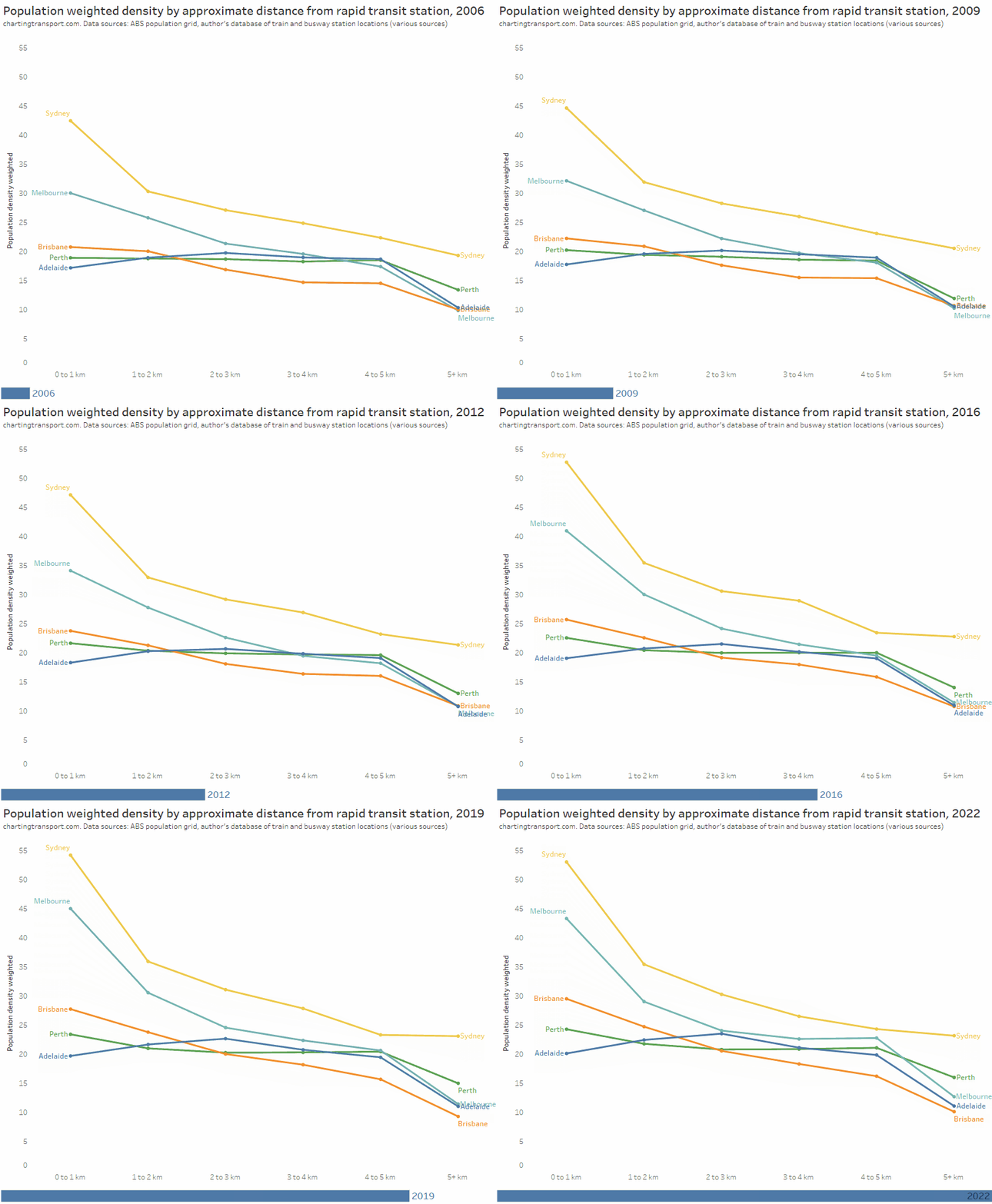
The following animated chart shows the aggregate population-weighted density for areas around rapid transit stations in the five biggest cities over time:
Sydney has lead Australia with higher densities around train stations, followed by Melbourne. Perth has only slightly higher densities around stations (in aggregate) compared to other parts of the city. Population density is generally lower around Adelaide train and busway stations compared to the rest of the city – the antithesis of transit orientated development.
How dense are new urban areas?
I’ve previously looked at the density of outer urban growth areas on my blog, and here is another way of looking at that using square kilometre grid data.
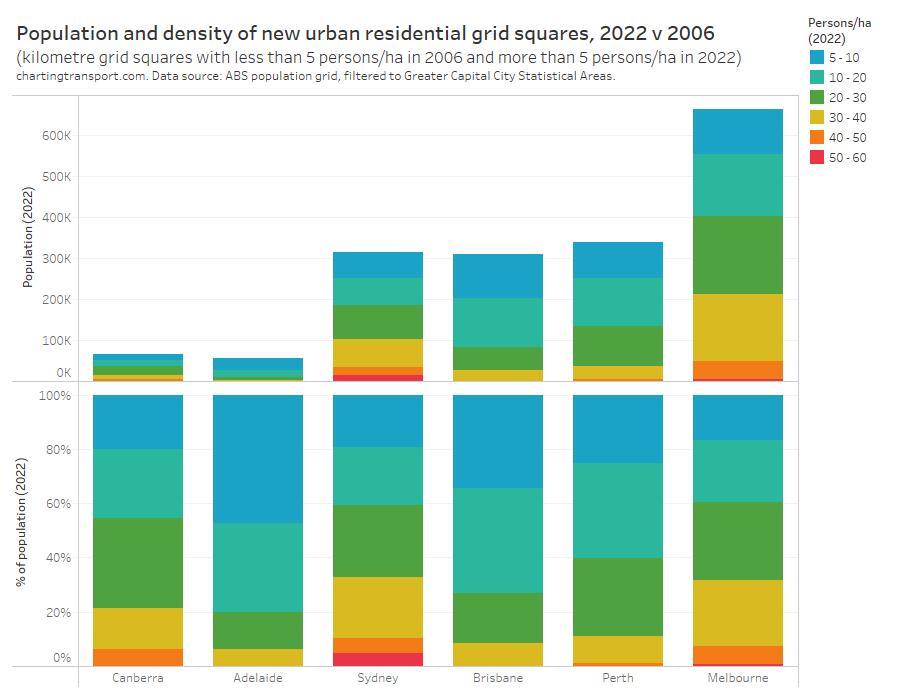
I’ve attempted to identify new urban residential grid squares by filtering for squares that averaged less than 5 persons per hectare in 2006 and more than 5 persons per hectare in 2022 (using 5 persons/ha as an arbitrary threshold for urban residential areas, and I think that’s a pretty low threshold).
The vast bulk of these grid cells (and associated population) are on the urban fringe, but a handful in each city are brownfield sites that were previously non-residential (for Melbourne 99% of the population of these grid cells are in urban fringe areas).
It’s also not perfect because square kilometre grid cells will often contain a mix of residential and non-residential land uses, but it is analysis that can be done easily and quickly, and in aggregate I expect it will be broadly indicate of overall patterns.
The following chart shows the population of new urban residential grid cells (since 2006), and the proportion of this population by 2022 population density:
You can see Melbourne has almost double the population in these new urban residential grid squares compared to Perth, Brisbane, and Sydney. This indicates Melbourne has been sprawling more than any other city since 2006. Slow-growing Adelaide only put on about 56k people in new urban grid squares, slightly less than Canberra.
The bottom half of the chart shows that new urban grid squares in Sydney, Melbourne, and Canberra are generally much more dense than those in other cities. This likely reflects planning policies for higher residential densities in new urban areas in those cities. In fact, all of these grid cells with density 40+ in 2022 are on the urban fringes, except one brownfield cell in Mascot (Sydney).
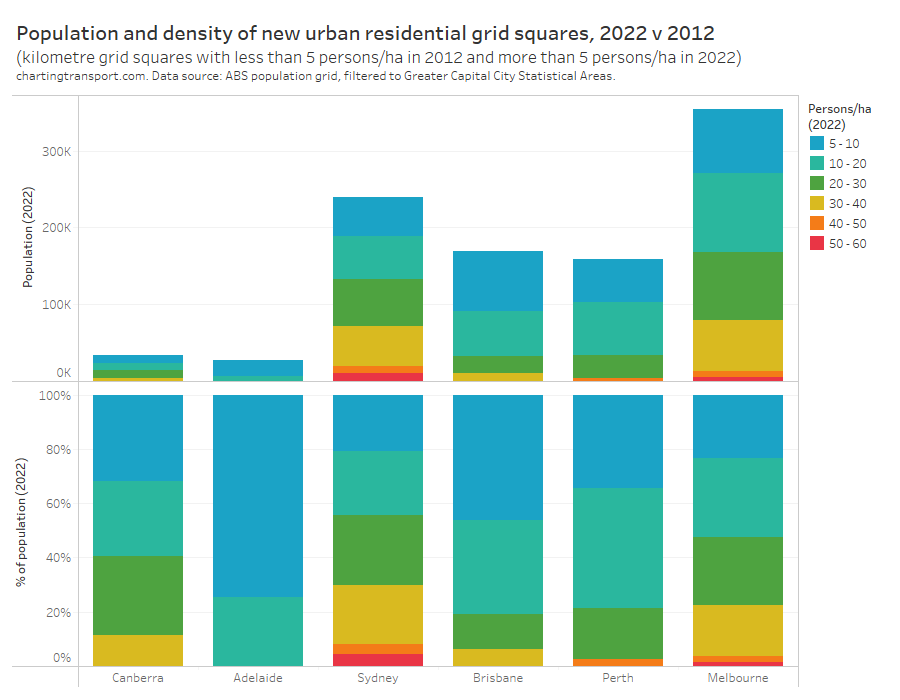
But of course planning policies can change over time, so here is the equivalent chart looking at new urban residential squares since 2012:
It’s not a lot different. The density of these more recent new urban residential grid cells is generally highest in Sydney, following by Melbourne and Canberra. New urban residential grid cells in Adelaide mostly had fewer than 20 persons/ha, but then also there are not that many such grid cells and they didn’t have much population in 2022.
How much has the urban footprint of cities been expanding?
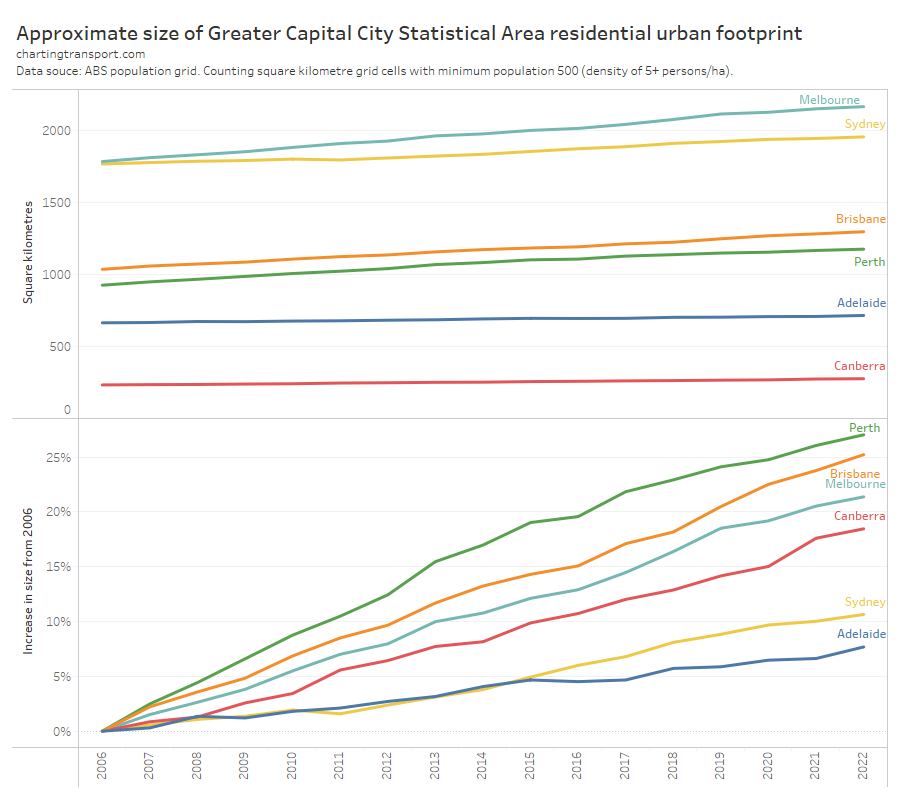
The population grid data only measures residential population so it cannot be used to estimate the size of the total urban footprint of cities over time, but we can use it to estimate the urban residential footprint. I’ve again used 5 persons/ha as a threshold, and here’s how the cities have growth since 2006:
Melbourne and Sydney had much the same footprint in 2006 but Melbourne has since grown significantly larger in size than Sydney, although Sydney still has a larger Capital City Statistical Area population.
The bottom half of the chart shows that Perth has had the largest percentage growth in urban residential area, followed by Brisbane then Melbourne. Sydney and Adelaide have had the least growth in footprint, and are also seeing the least population growth in percentage terms.
Animated density maps of Australian cities
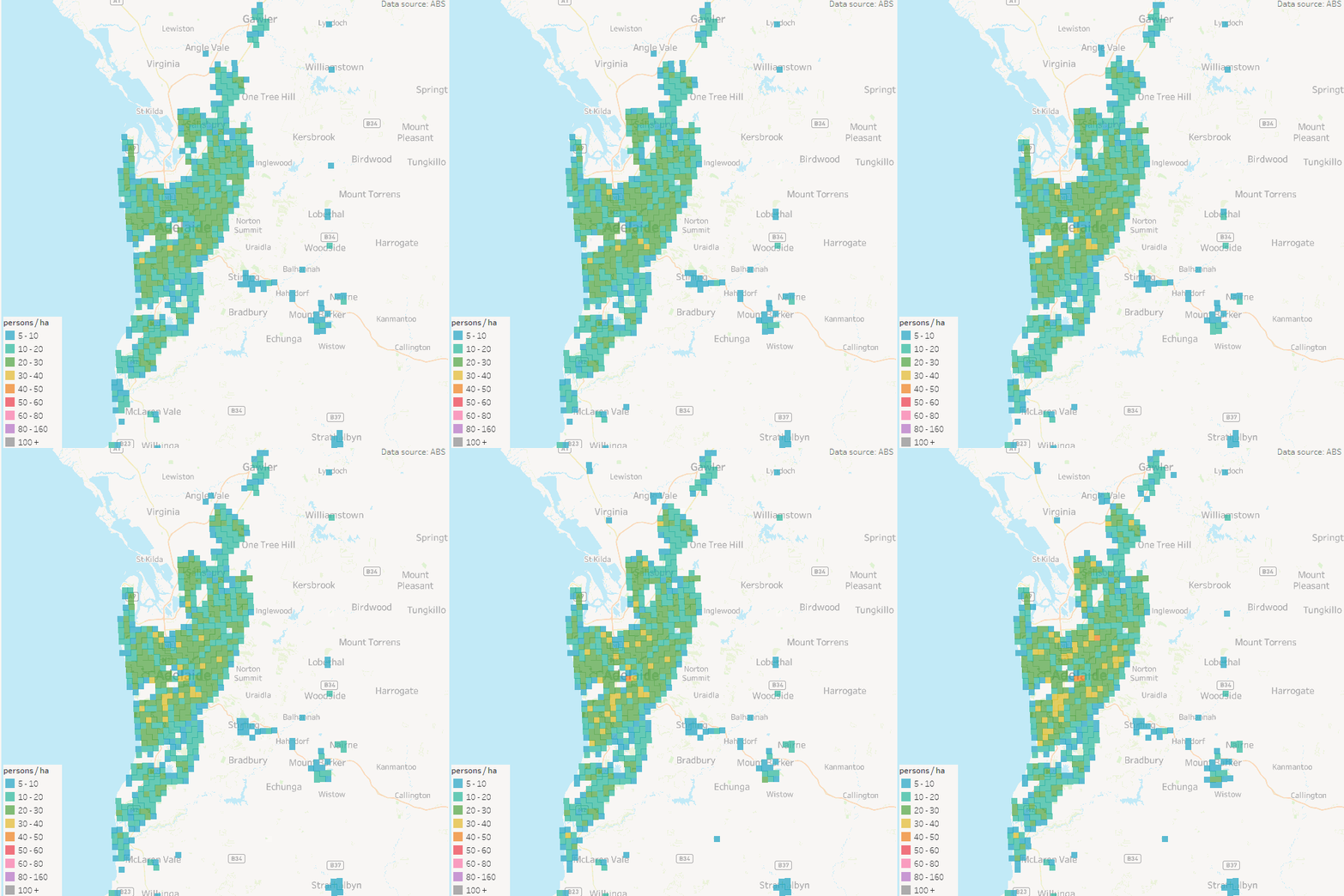
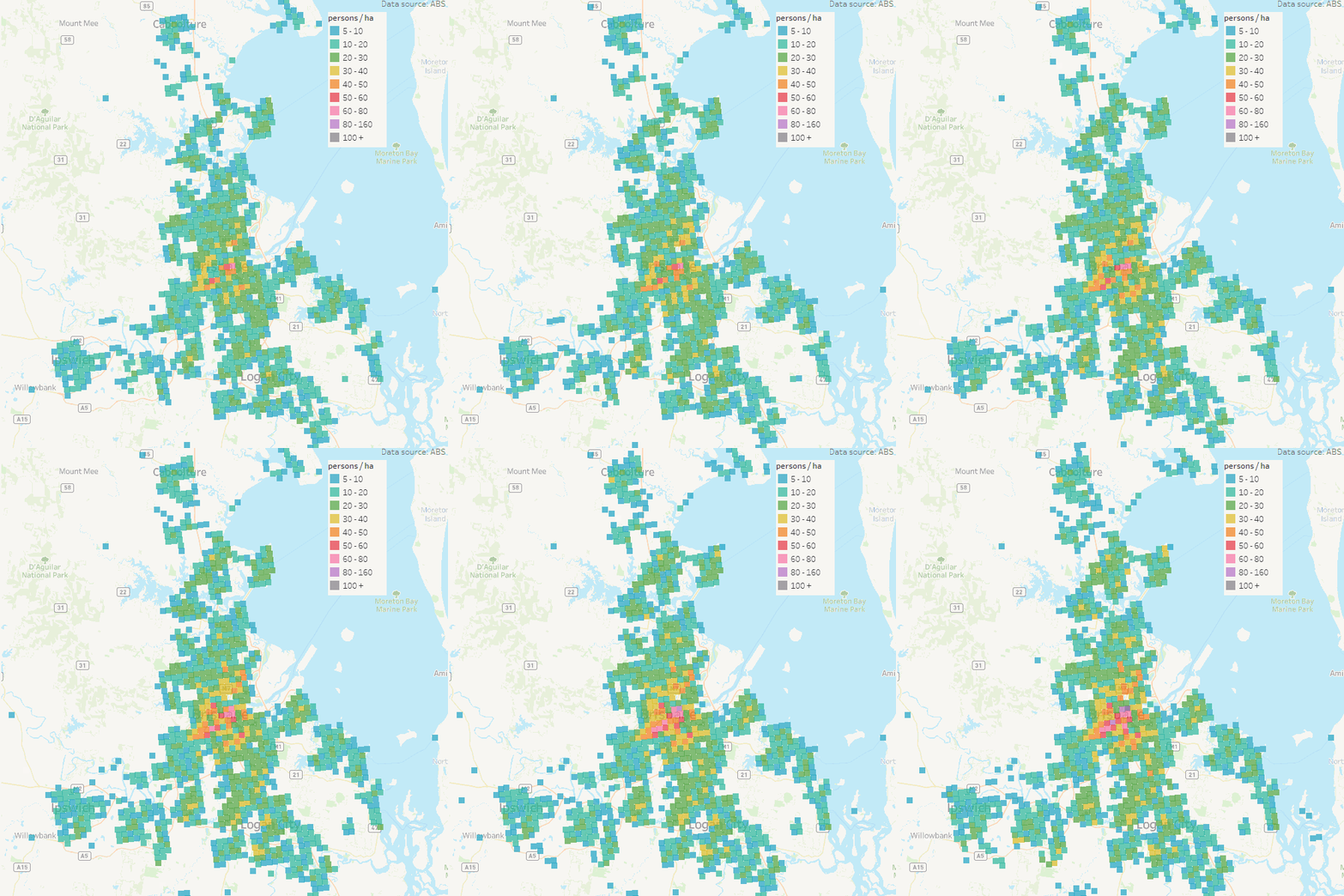
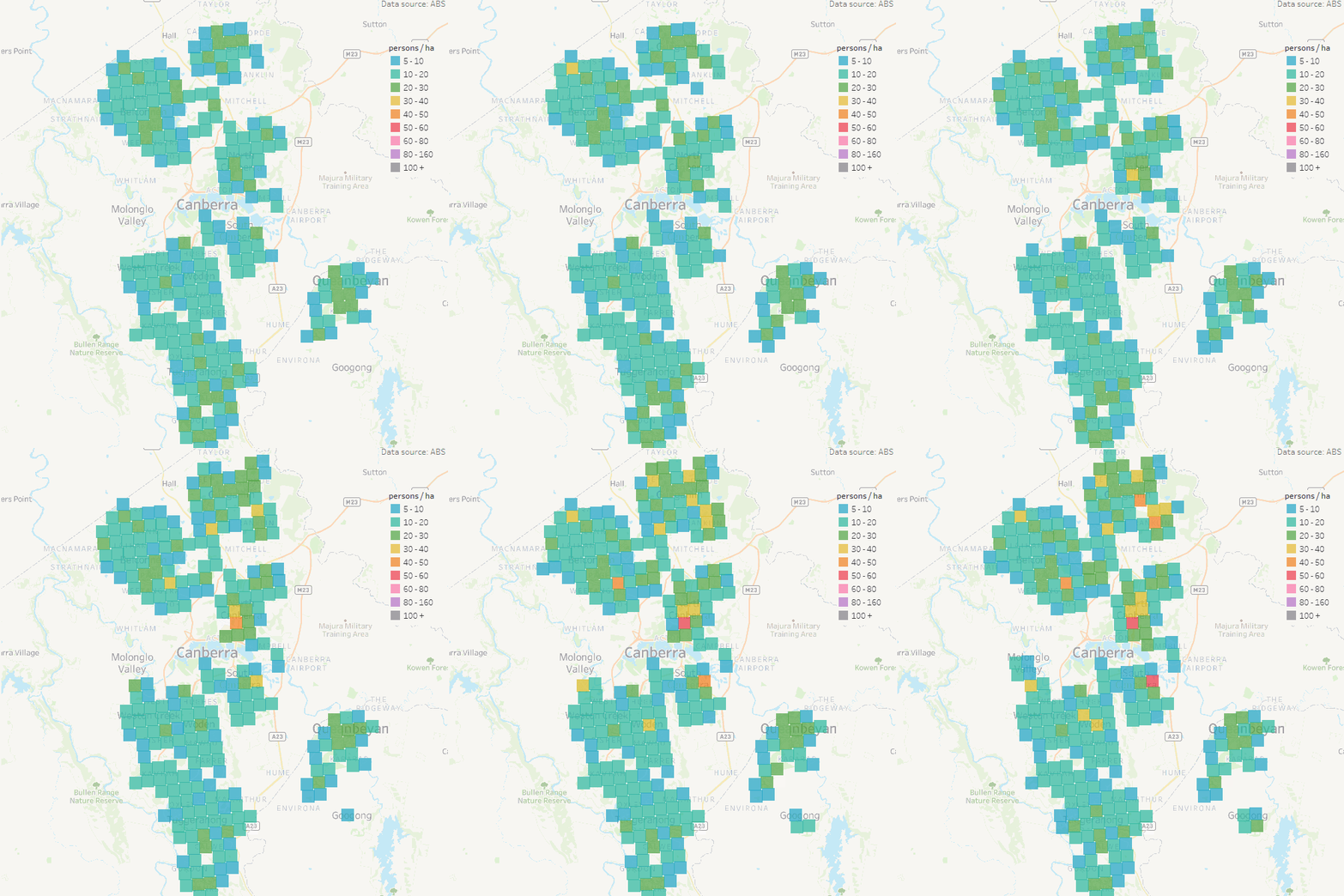
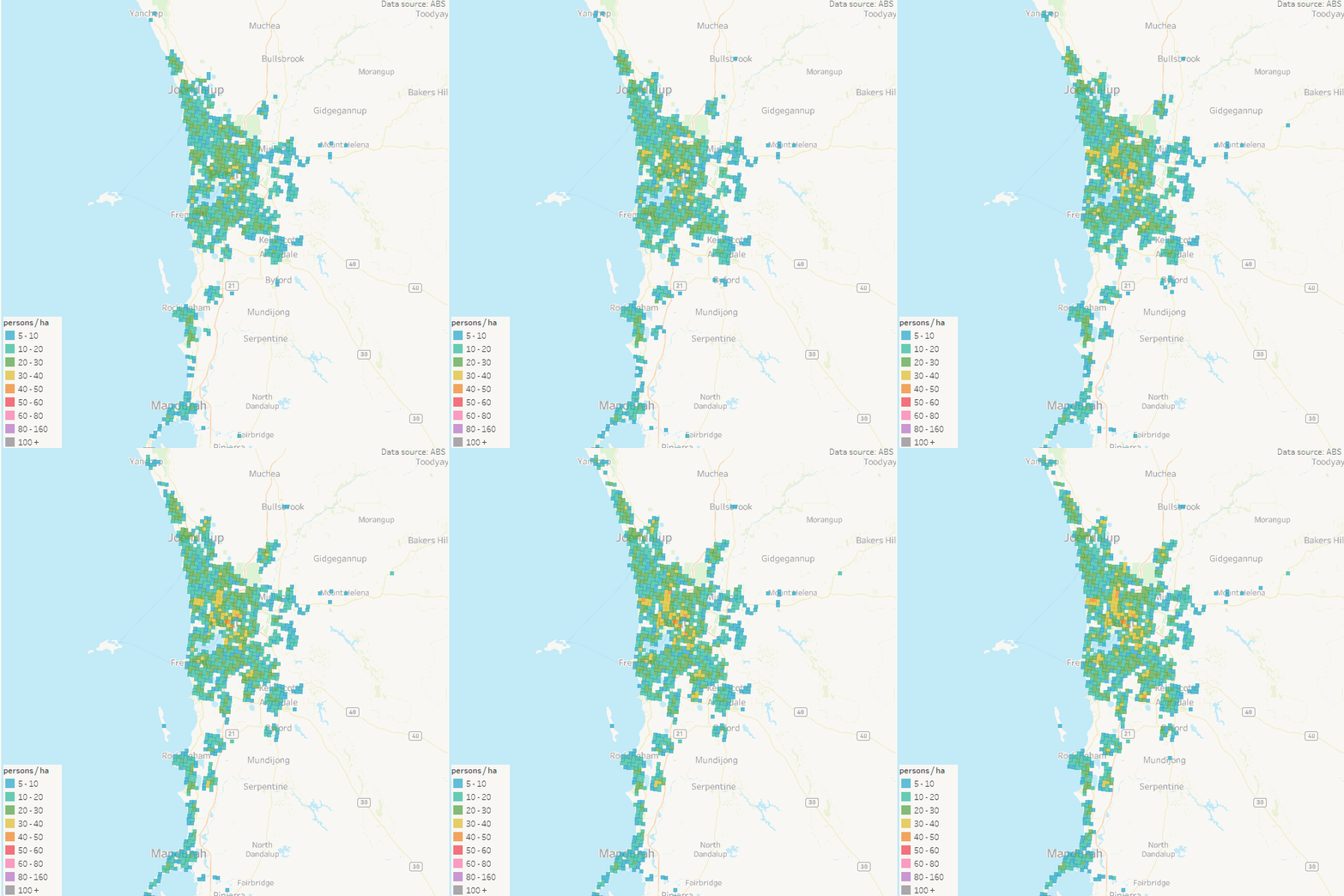
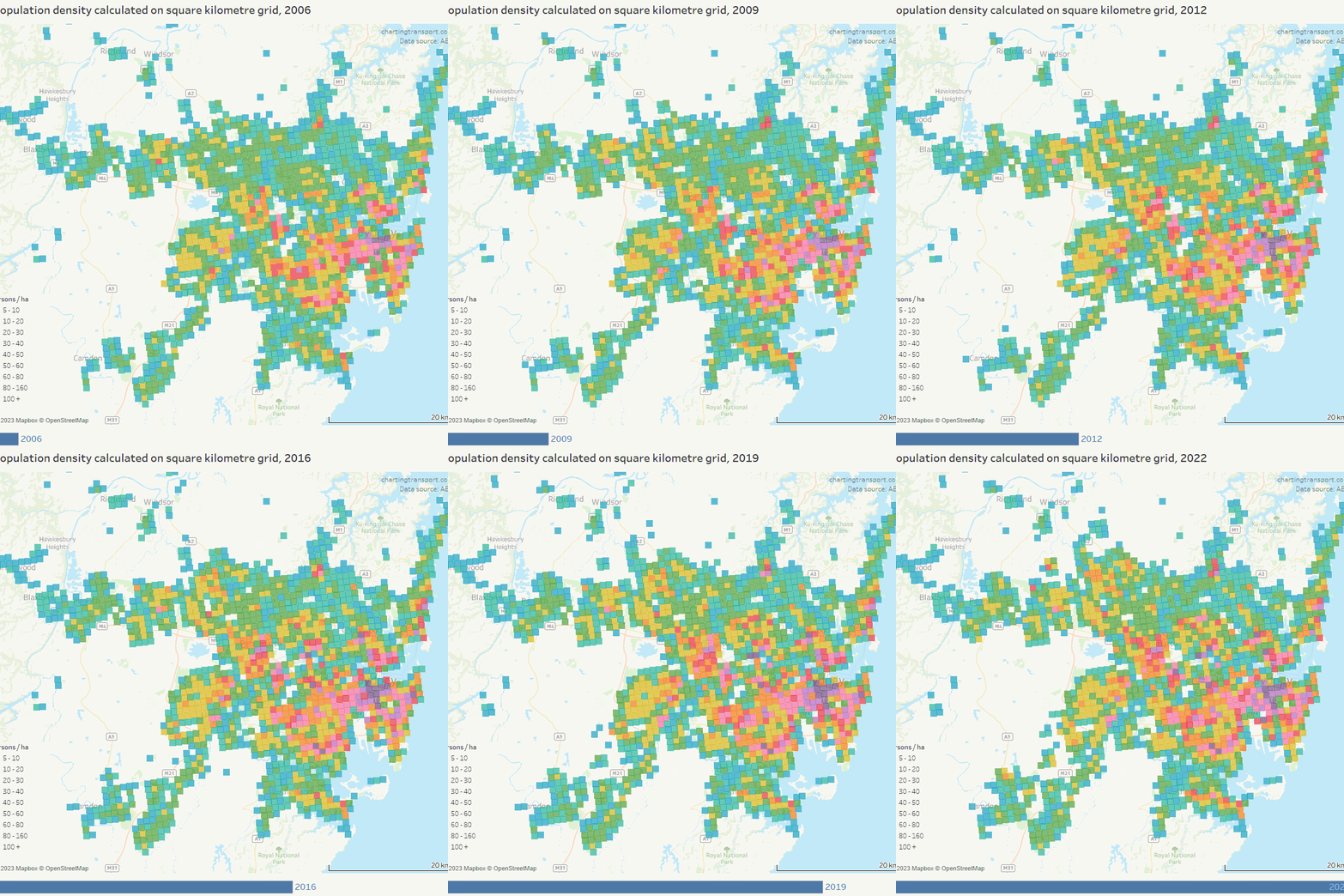
Here are some animated density maps for Australia’s six largest cities from 2006 to 2022 for you to ponder.
Some things to watch for:
Limited urban sprawl and significant densification of pockets of established areas in Canberra
Much larger areas of higher density in Sydney and Melbourne
Relatively high densities in some urban growth areas in Melbourne, Brisbane, and Sydney from the late 2010s
Low density sprawl in Perth, but also densification of some inner suburban areas (along the Scarborough Beach Road and Wanneroo Road corridors, and inner suburbs like Subiaco and North Perth)
Limited urban sprawl in Adelaide, along with densification of inner suburbs
Appendix: Corrections to ABS population estimates following Census 2021
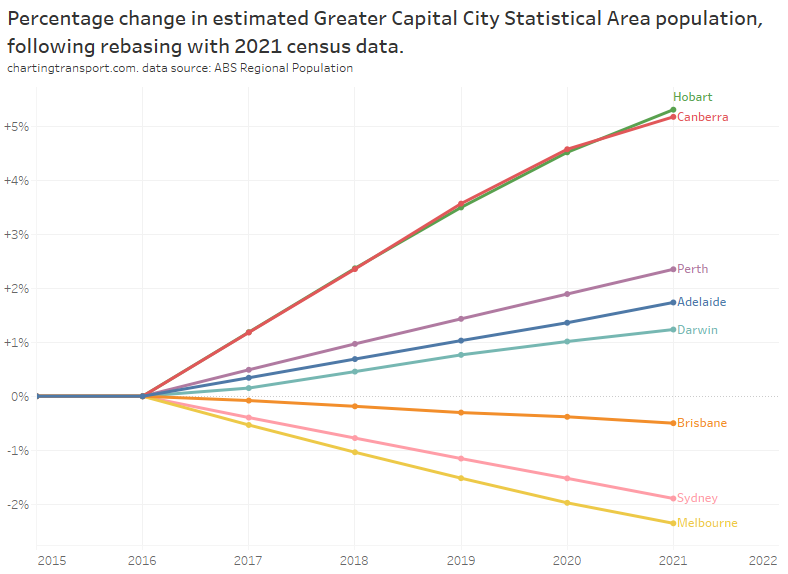
The 2021 census resulted in quite large revisions to estimated population in many cities as shown in the following chart.
Melbourne’s estimated 2021 population was revised down 2.4%, Sydney down 1.9%, while Canberra and Hobart were revised up more than 5%. To be fair to the ABS, the pandemic and border closures were unprecedented and their impacts on regional population were not easy to predict.
These corrections sum to a linear trend between 2016 and 2021 at the city level, although there was a redistribution of the estimated population within each city.
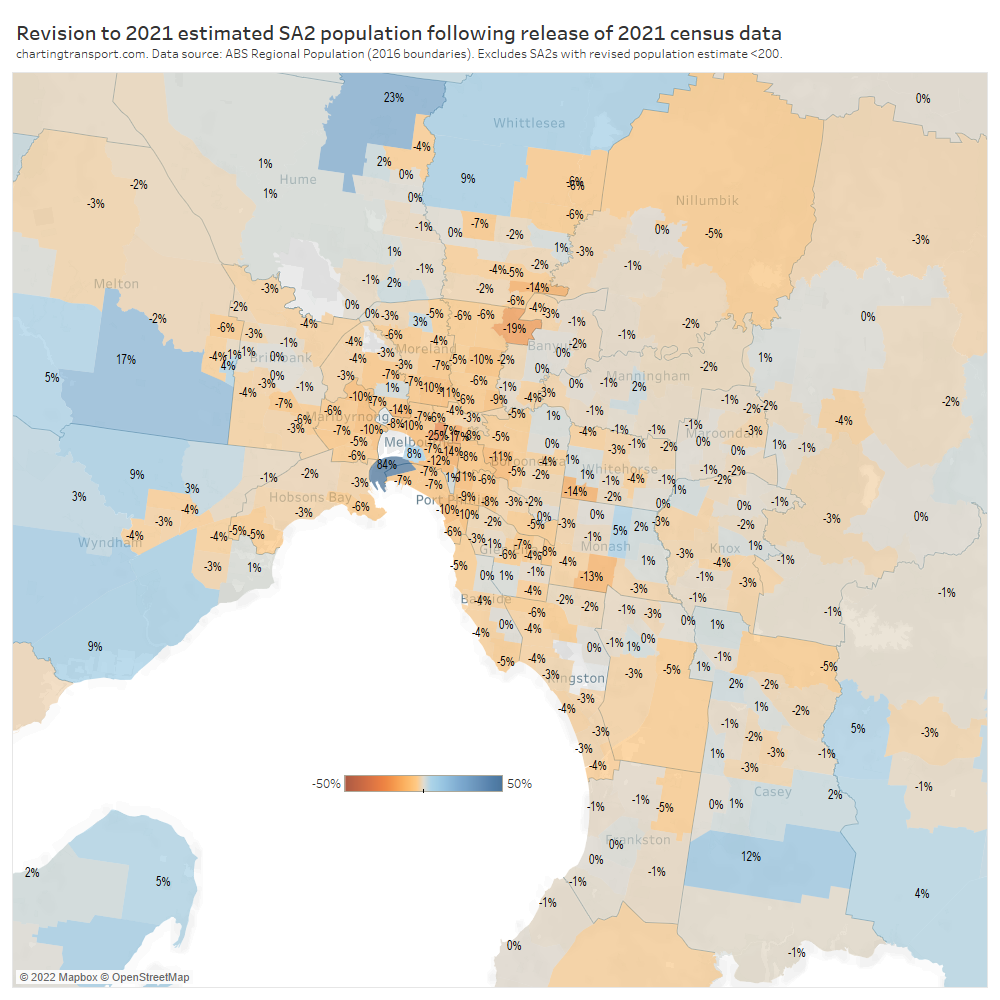
The following chart shows some detail of estimated population revisions at SA2 level for Melbourne in 2021:
The biggest reduction was in Carlton (-25% right next to University of Melbourne), and there were also reductions near other university campuses, including Kingsbury (-19%), Burwood (-14%) and Clayton (-13%). The biggest upwards revision was Fishermans Bend (+84%), and there were plenty of upwards revisions in outer urban growth areas.
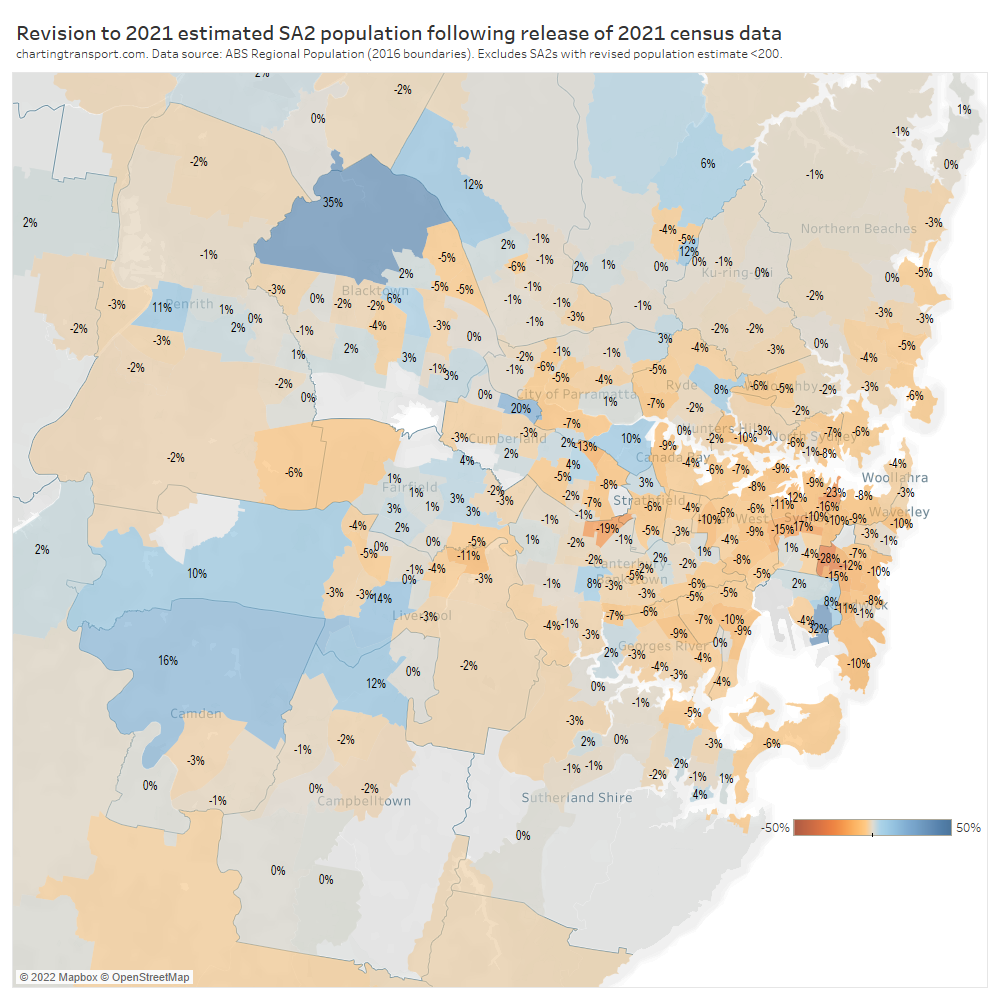
And here is Sydney:
There were big reductions in Kensington (-28%, centred on UNSW), Redfern-Chippendale (-17%), many other areas near university campuses, and around the Sydney CBD.
Like Melbourne, urban growth areas on the fringe were revised upwards, including +35% in Riverstone-Marden Park.
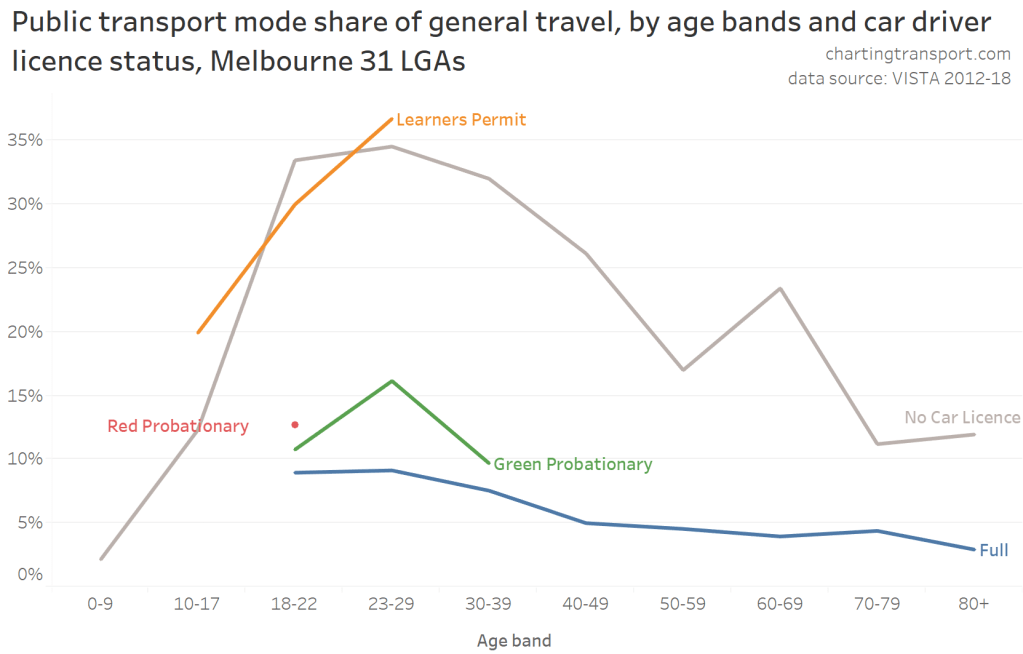
In a recent post I confirmed the link between driver’s licence ownership and public transport use at the individual level in Melbourne:
Unfortunately, spatial data around driver’s licence ownership is quite scarce in Australia, so not a lot is known about the spatial variations of licence ownership, nor what might explain them.
However, Transport for New South Wales do publish quarterly licensing statistics at the postcode level, and so this post takes a closer look at the patterns and possible demographic explanations of driver licence ownership across Sydney. I’ll also touch on the relationship between licence ownership and journey to work mode shares.
I have measured rates of licence ownership at the postcode level, and then compared these with other demographic factors that have shown to be significant in explaining variations in public transport mode shares in Melbourne (see my series on “Why are young adults more likely to use public transport”, parts 1, 2, and 3). These factors include socio-economic advantage and disadvantage, workplace location, age, recency of immigration, educational attainment, parenting status, motor vehicle ownership, population weighted density, proximity to high quality public transport, English proficiency, and student status.
I’m sorry it’s not a short post, but I have put some less profound analysis in appendices.
About the data
To calculate licence ownership rates you need counts of licences and population for geographic areas for the same point in time (or very close). Estimates of postcode population are only available from census data, so for most of the following analysis, I’ve combined 2016 “quarter 2” driver’s licence numbers (which includes learner permits) with (August) 2016 ABS census population counts. This is of course pre-COVID19, and patterns may (or may not) have changed since then.
I’ve mostly used population counts for persons aged 16-84. Obviously there are people over the age of 84 with licences, but I am attempting to discount people who may lose their eligibility to hold a licence due to aging.
I’ve also mapped postcodes to the Greater Sydney Greater Capital City Statistical Area boundary, and filtered for postcodes with a significant region within the Greater Sydney boundary (note that the boundaries do not perfectly align).
How does driver’s licence ownership vary across Sydney?
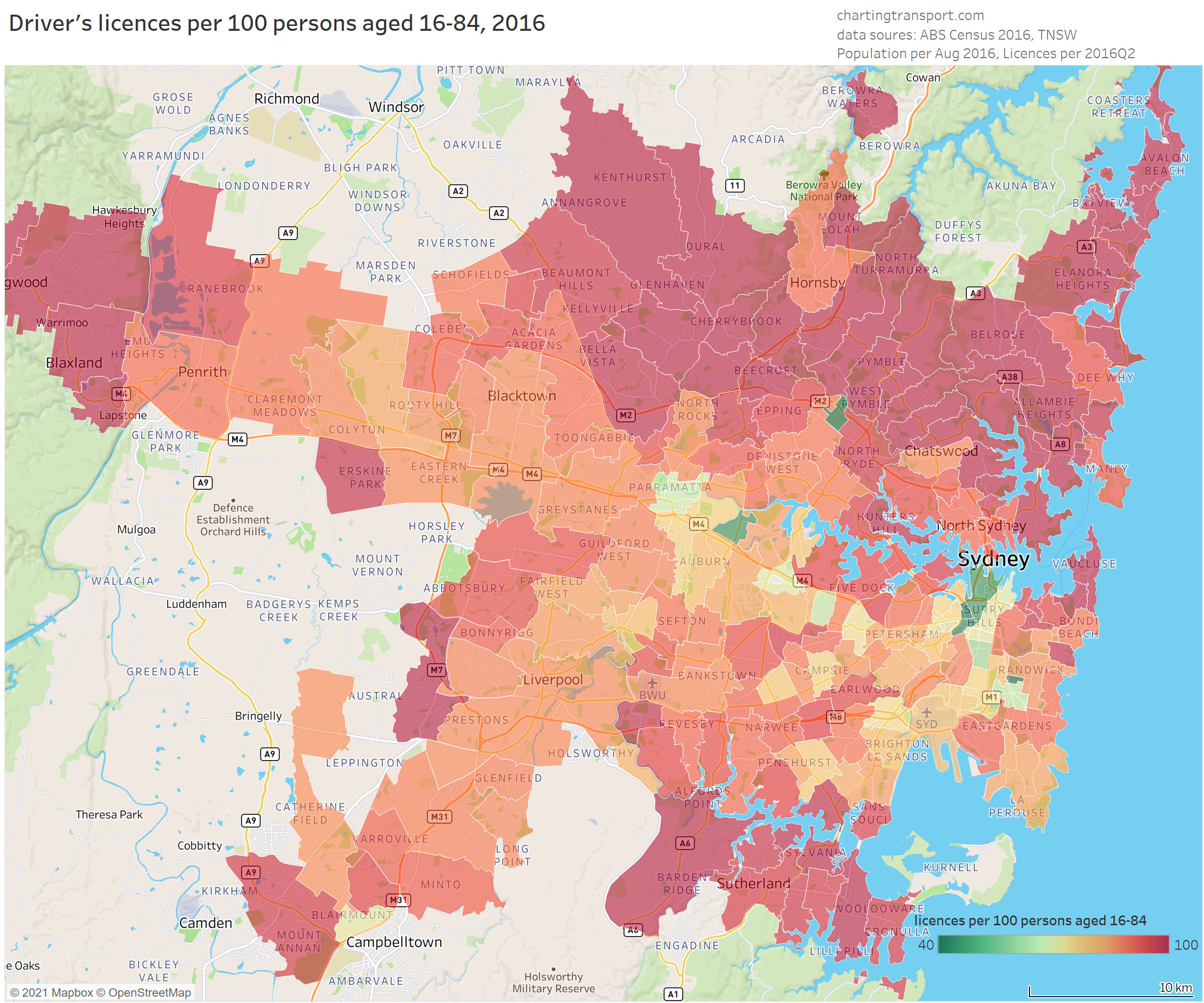
Here’s a map showing 2016 licence ownership rates for Sydney postcodes, with red signifying very high ownership, and green very low.
Technical note: For this map I have filtered to only show postcodes averaging at least 3 persons per hectare to focus on urban Sydney, but some excluded postcodes will be a mix of urban and non-urban land use so this is imperfect. Postcodes are not a great spatial geography for analysis as they vary significantly in size, but unfortunately that’s how the data is published (much easier for TNSW to extract I am sure).
The lowest licence ownership rates can be seen in and around the Sydney CBD, around major university campuses (especially UNSW/Randwick, Macquarie Park, University of Sydney/Camperdown), and at Silverwater (which includes a large Correctional Complex – inmates probably don’t renew their licence and would have a hard time gaining one!). There are also relatively low rates in some inner southern suburbs, in and near Parramatta, and near Sydney Airport.
Most outer urban postcodes have very high levels of licence ownership. One exception is postcode 2559 in the outer south-west, which contains a large public housing estate in the suburb of Claymore. More on that shortly.
Is there a relationship between licence ownership and journey to work transport mode share?
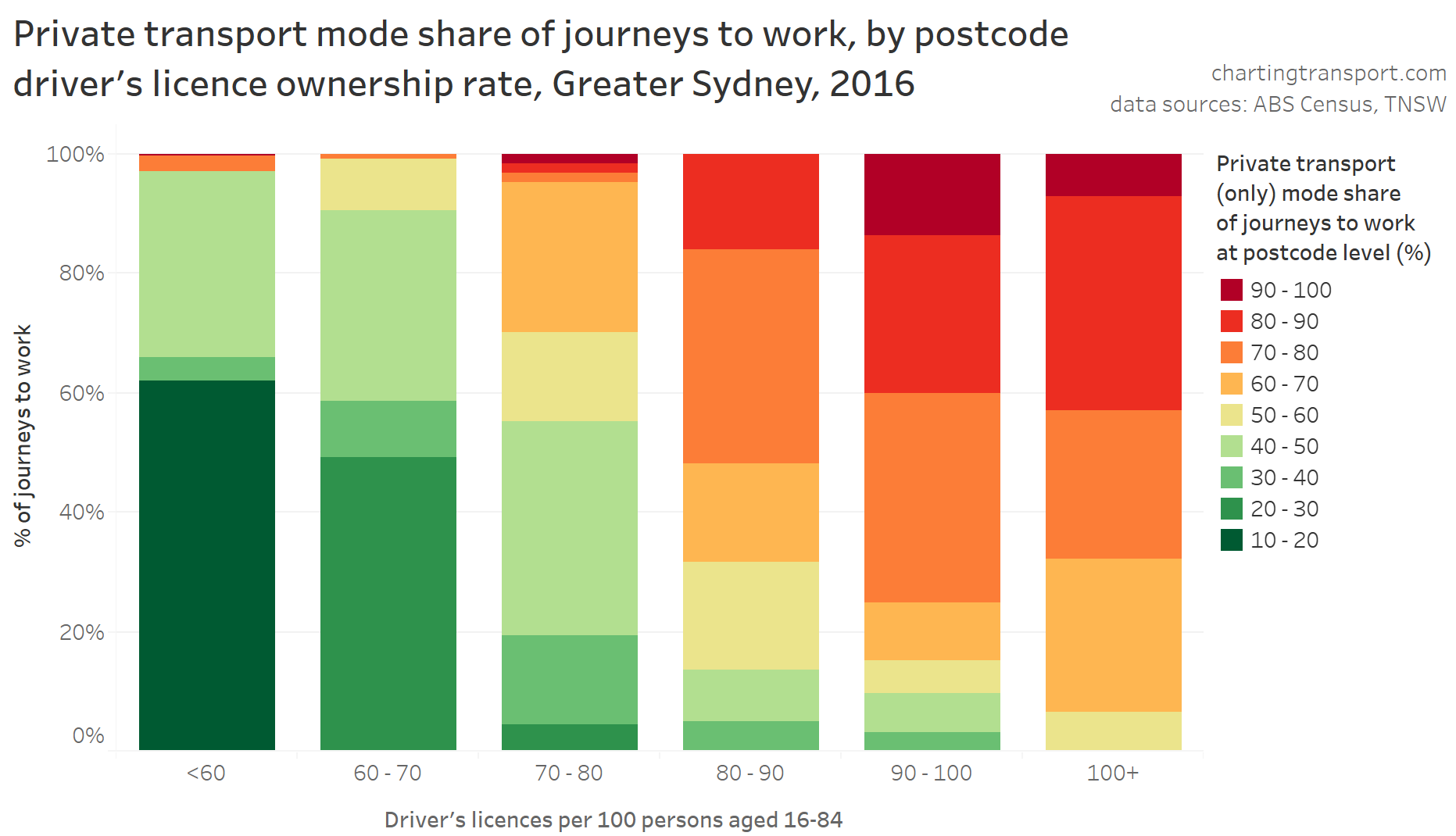
It will probably surprise no one that there was a relationship between driver’s licence ownership and private transport mode share of journeys to work. The following chart shows the average postcode mode share for the commuter population within specified bands of driver’s licence ownership.
I should point out that this a relationship, but not necessarily direct causality (either way). People might be more likely to get a driver’s licence because that is the only practical way to get work from where they live, and other people who do not want to – or cannot – get a driver’s licence may be able to choose to live and work in places that don’t require private transport to get to work.
And then there are some postcodes with pretty much saturated driver’s licence ownership but less than 60% private transport journey to work mode shares (top right). I’ll have more to say on these postcodes shortly.
The rest of this post will consider potential explanations for the spatial patterns of licence ownership, using demographic data for postcodes.
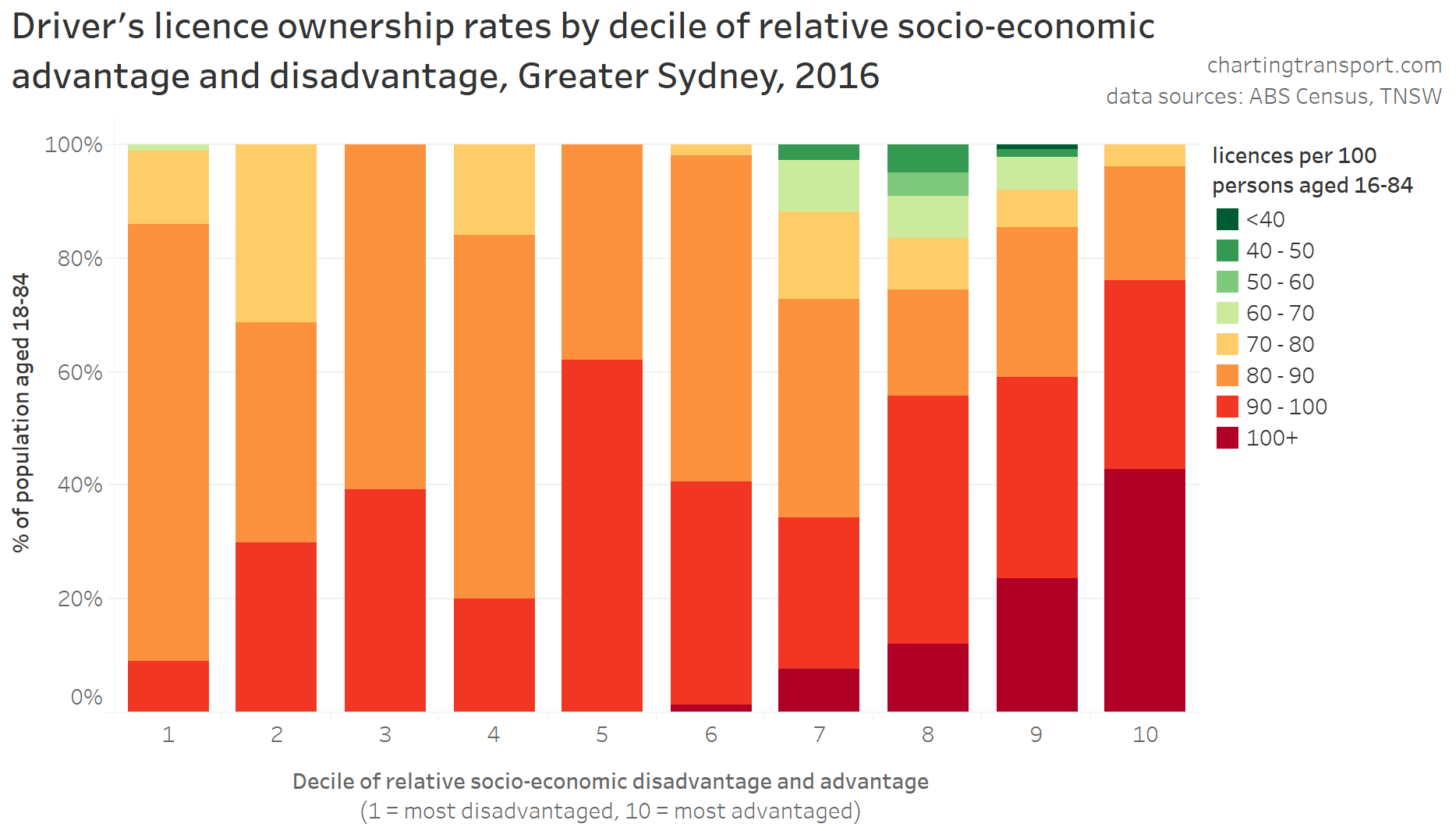
Near-saturated licence ownership was more common in the more advantaged postcodes, but lower rates of licence ownership were seen in postcodes in deciles 1, 7, and 8. Decile 1 stands to reason as areas of disadvantage (probably including many people unable to get a driver’s licence, eg due to disability), and the postcodes with very low licence ownership rates in deciles 7 and 8 contain or are adjacent to major university campuses.
However there are postcodes with licence ownership rates below 80 in all deciles – the relationship here is not super-strong and there are many exceptions to the pattern.
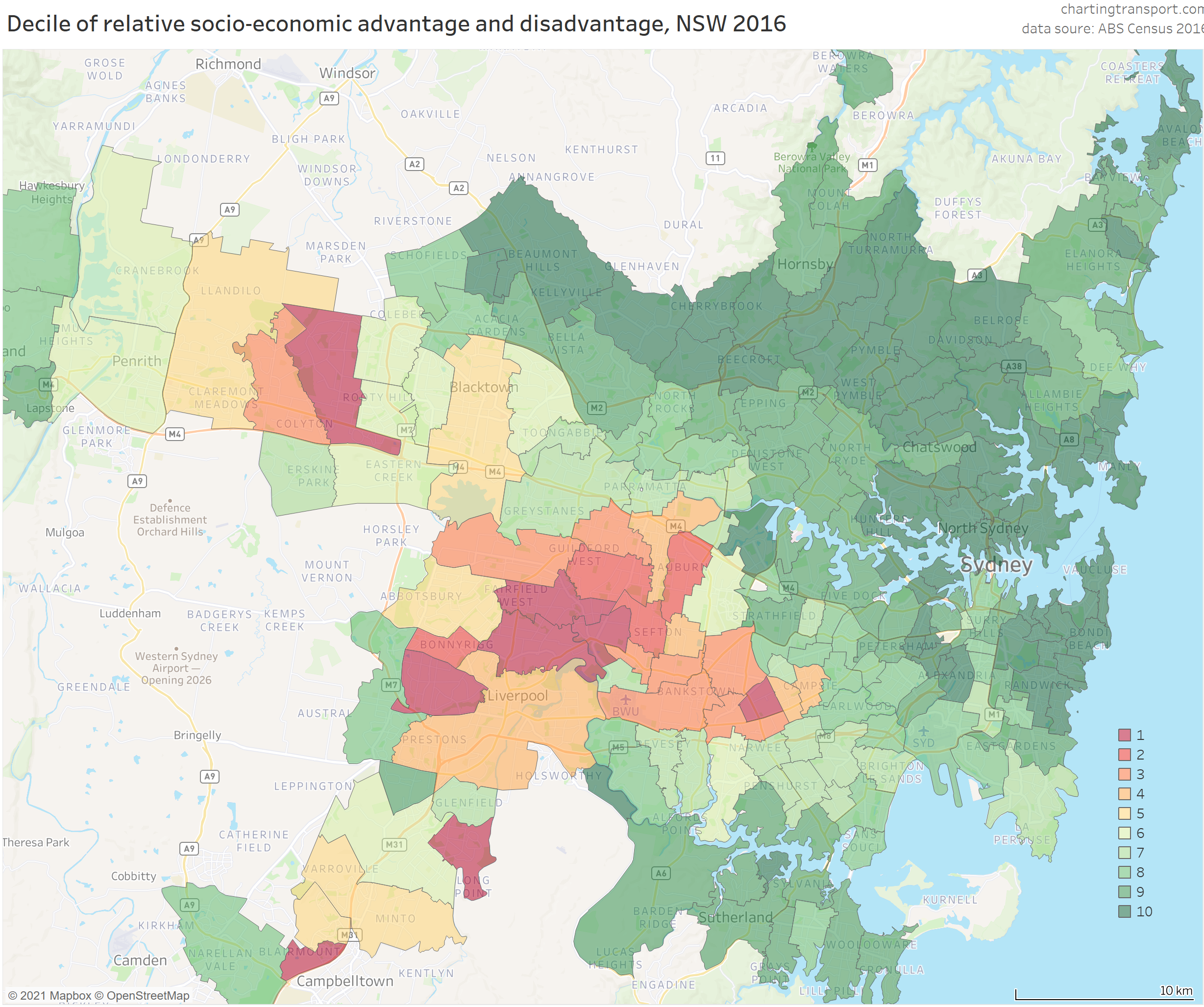
For people less familiar with the demographics of Sydney, here is a map showing 2016 ISRAD deciles for Sydney postcodes. Note that these deciles are calculated relative to the entire New South Wales population, and Sydney overall is more advantaged than the rest of the state, hence more green areas than red.
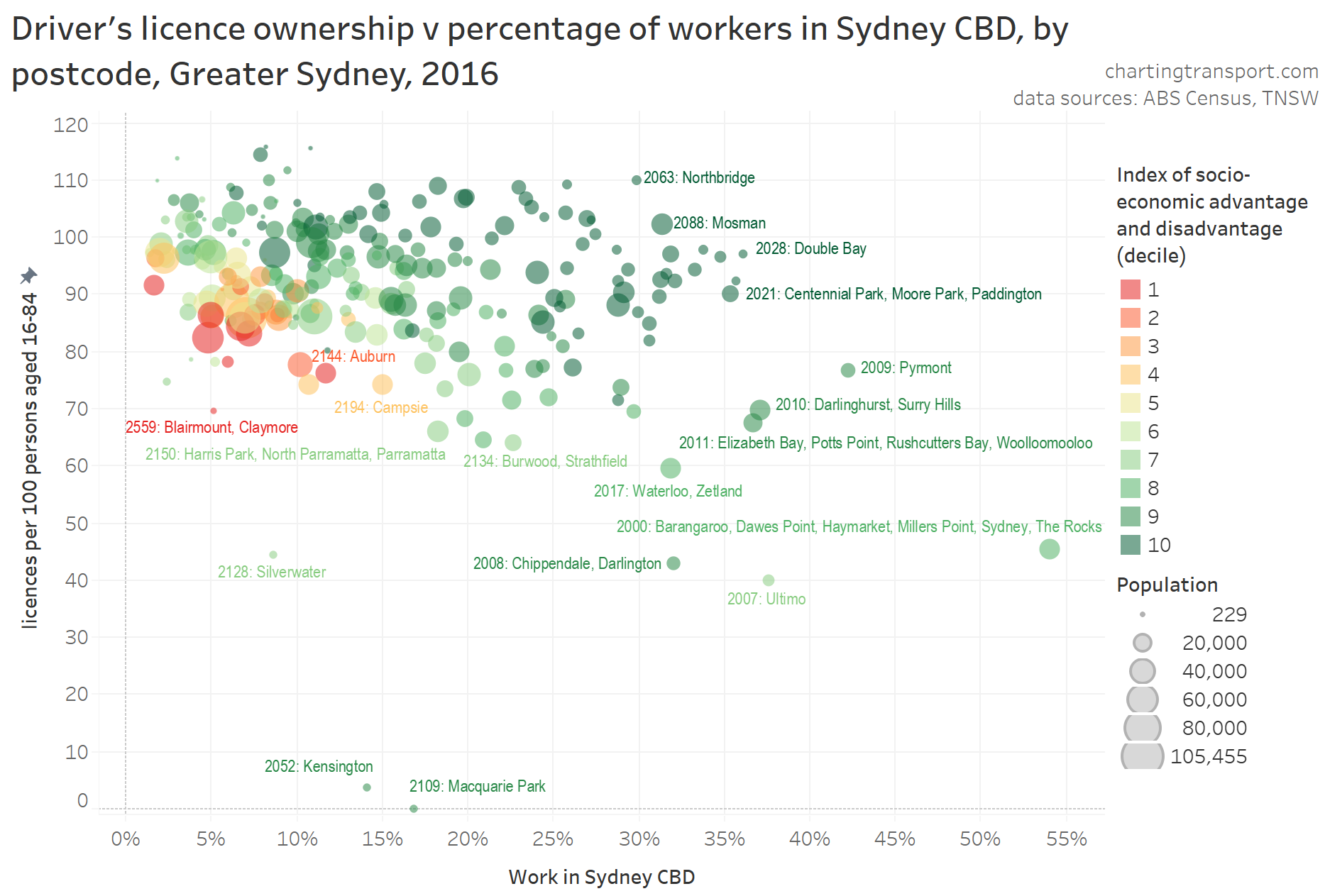
Here’s a scatter plot that shows that relationship. I’ve added socio-economic advantage and disadvantage colouring for further context, and labelled selected outlier and cloud-edge postcodes (unfortunately there is a slight bias against labelling postcodes containing many suburbs).
There is perhaps a weak relationship between work in Sydney CBD percentage and licence ownership, with postcodes containing larger shares of commuters going to the CBD (30%+) having lower licence ownership.
The chart also shows that disadvantaged postcodes generally had both fewer CBD commuters (as a proportion) and lower rates of licence ownership.
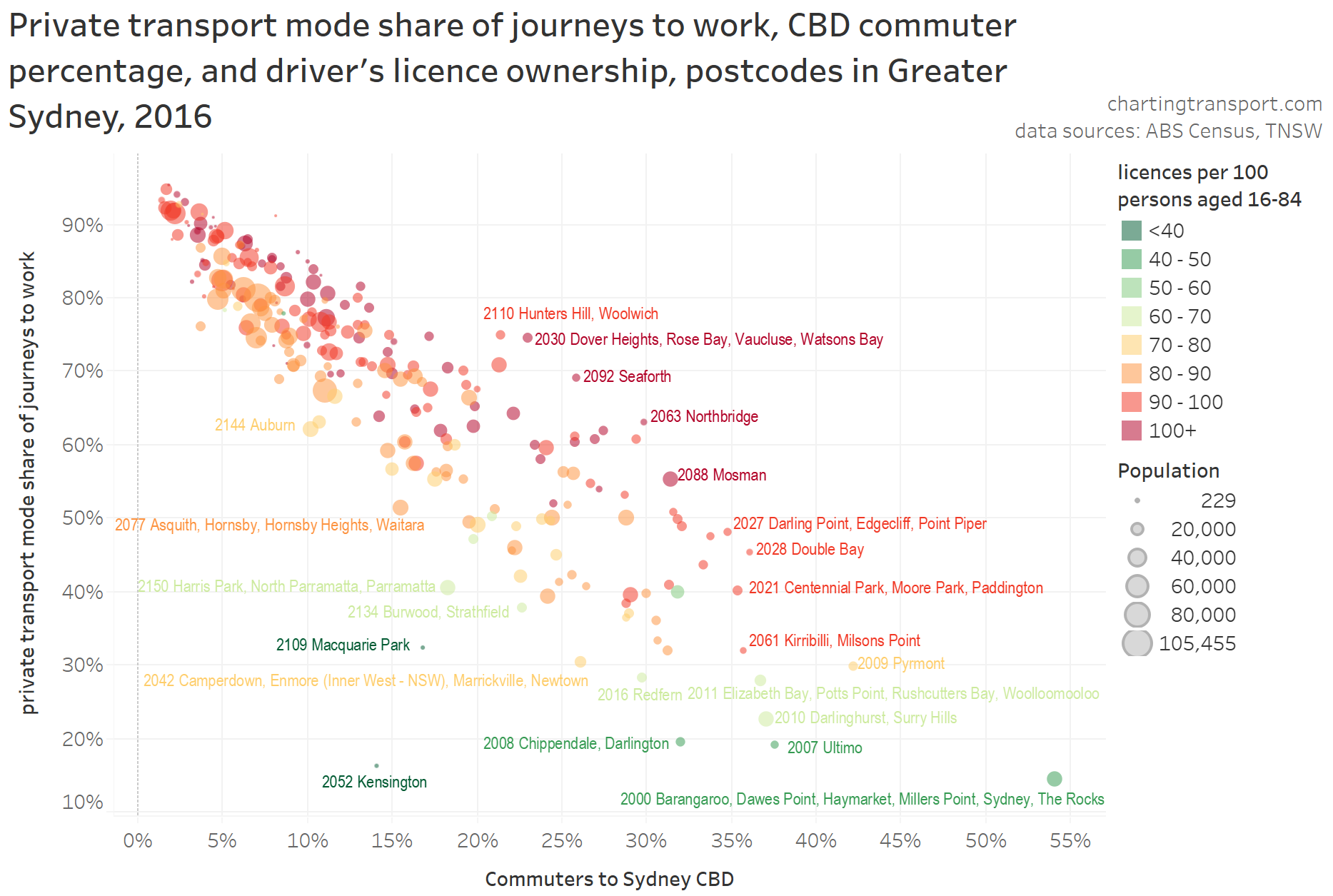
Commuter mode shares were much more strongly related to workplace location than licence ownership, as the following chart shows. Note that for this chart colour indicates licence ownership rate.
Within the main cloud, postcodes with lower rates of licence ownership (shades of orange) had slightly lower private transport mode shares and/or slightly lower percentage of commuters heading to the CBD. The upper outliers from the cloud include many wealthy postcodes that were not well connected to the CBD by the train network, while postcodes in the bottom-left of the cloud are on the train network.
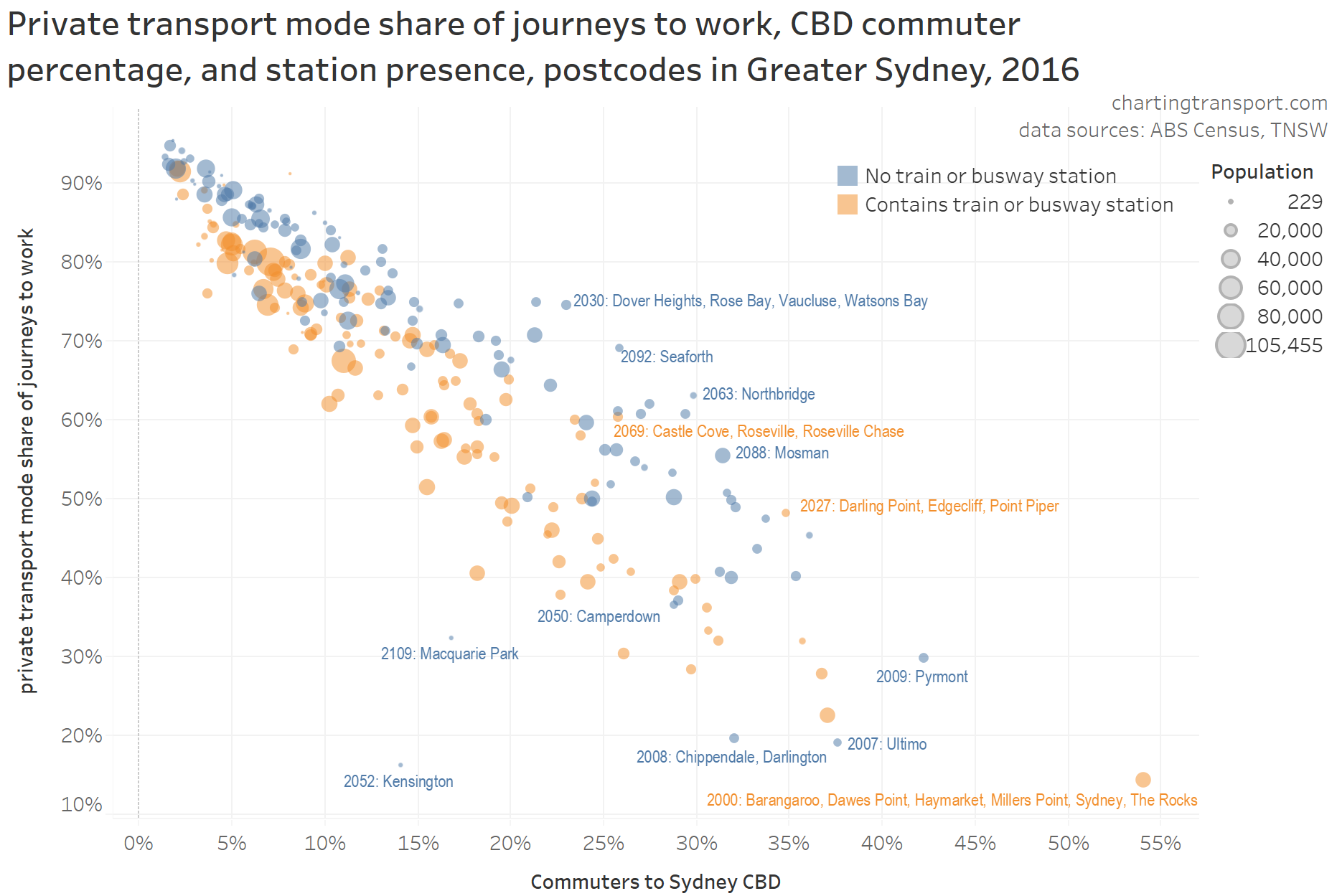
To explore that further, here’s a similar chart, but with the data marks coloured by a relatively blunt measure: whether or not the postcode contained a train or busway station (based on point locations for stations, which is not perfect as some postcodes are very large and only part of the area might be within reach of a station, while other postcodes might have a station just outside the area):
Generally the postcodes with a train or busway station are towards the bottom-left of the cloud, and those without towards the top-right. I’ve labelled a few exceptions, which include university suburbs such as Macquarie Park, Kensington, Camperdown, and some larger postcodes where a station only serves a minority of the postcode area (eg 2027 and 2069).
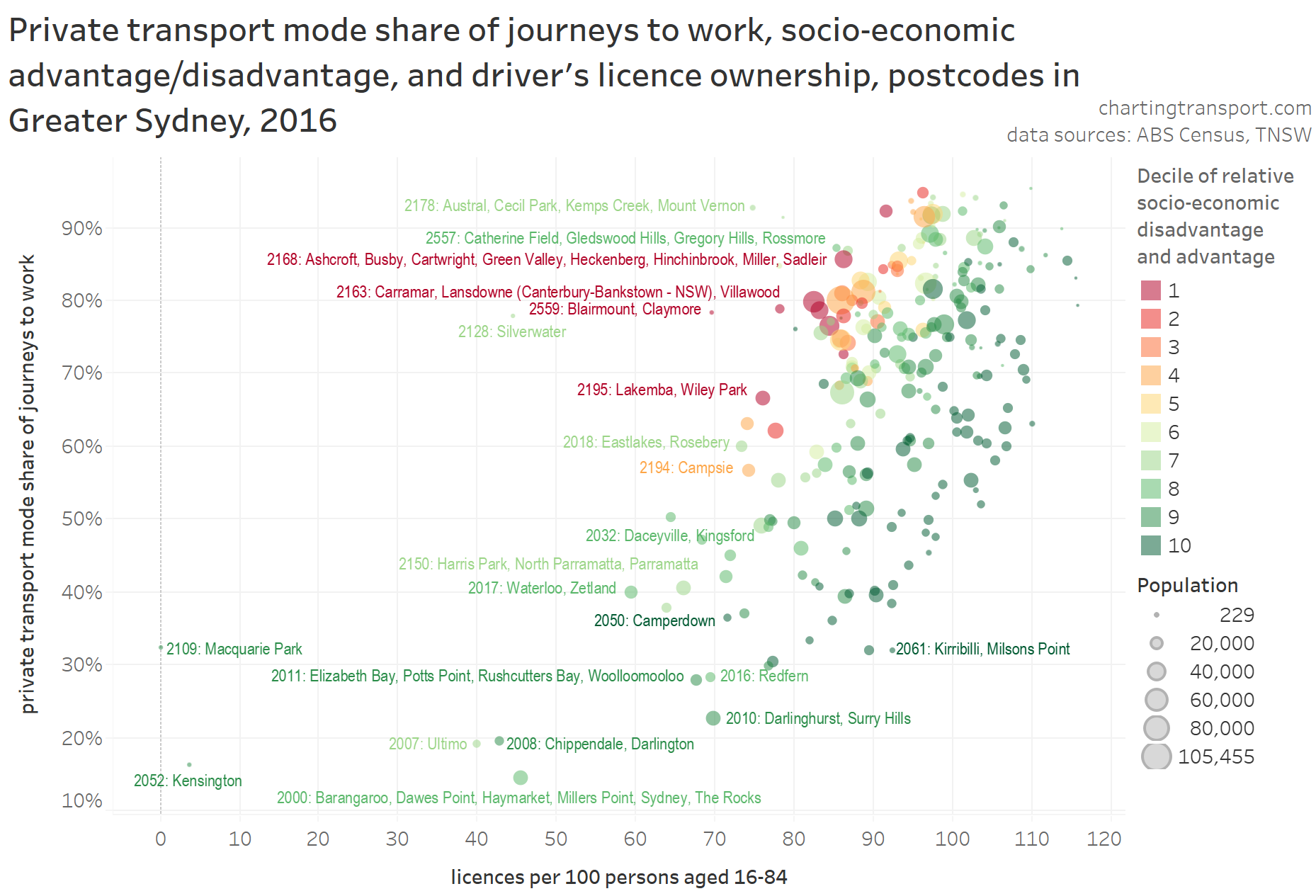
The next chart plots commuter mode shares, licence ownership, and socio-economic advantage/disadvantage:
You can see a significant – but not tight – relationship between licence ownership and commuter mode share. Within the main cloud, disadvantaged postcodes are to the top-left, and the more advantaged postcodes to the bottom-right. That is, many disadvantaged postcodes had high private transport mode share despite lower licence ownership, and many more advantaged areas had lower private mode share despite higher licence ownership.
This suggests licence ownership was not the strongest driver of commuter mode choice, at least at the postcode level. Workplace location seems far more influential.
Many advantaged areas are closer to CBD(s) and often have higher quality public transport, walking, and cycling options. People in more advantaged areas are also more likely to work in well-paying jobs in the central city, where public transport is a more convenient and affordable mode. These people also probably face fewer barriers in obtaining a driver’s licence for when they do want to drive (eg access to a car).
While disadvantaged postcodes generally had lower rates of licence ownership, fewer people in these postcodes worked in the Sydney CBD, and they also tended to have high private transport commuter mode shares. I suspect this may be related to many lower income workplace locations being generally less accessible by public transport (particularly jobs in industrial areas). Any cost advantage of public transport is less likely to offset the relatively high convenience of private transport (not to suggest the design quality of public transport services is not important, and not to go into the issues of capital v operating cost of private transport).
However, I suspect public transport could be more competitive for travel from these disadvantaged low-licence-ownership areas to local schools and activity centres. I am aware of some disadvantaged areas of Melbourne that have highly productive bus routes, but not necessarily high public transport mode shares of journeys to work (particularly parts of Brimbank). These areas may be worth targeting for all-day public transport service upgrades, to contribute to both patronage growth and social inclusion objectives.
Just to round this out, here’s a very similar chart, but with Sydney CBD commuter percentage used for colour:
For most rates of licence ownership, there was a wide range of private transport mode shares and a wide range of Sydney CBD commuter percentages. There is a relationship between licence ownership and mode share, but it is not nearly as tight as the relationship between Sydney CBD commuter percentage and mode share.
Age
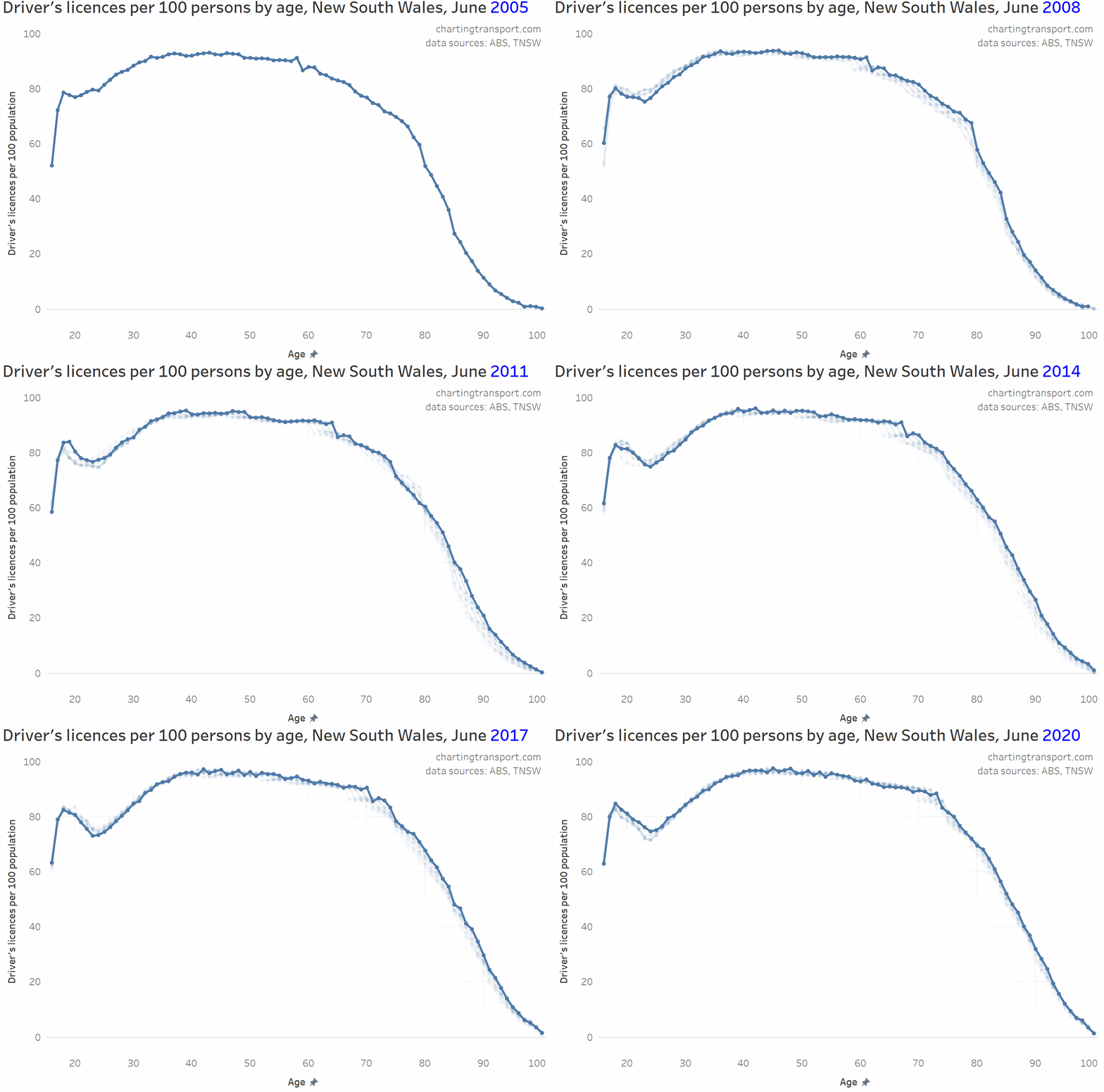
There’s obviously a relationship between age and licence ownership and NSW thankfully publishes detailed data on licence ownership by individual age. The following chart shows licence ownership by age, animated over time from 2005 to 2020.
Licence ownership peaks for ages around 35-70, and is lower for younger adults and tails off for the elderly as people become less capable of driving.
But there is a very curious dip in licence ownership around age 23-24, which became more pronounced after around 2008. Why might this be?
One hypothesis: People getting learner’s permits around age 18 but not progressing to a full licence and having their learner’s permit expire after 5 years – i.e. around age 22 or 23. I wonder whether people are getting a learner’s permit largely for proof of age purposes. NSW does have a specific Photo Card you can get for that, but the fee is $55 (or $5 at the time you get your driver’s licence), whereas a learner’s permit costs just $25 (and an Australia Post Keypass proof of age card costs $40). As of September 2020, there were 185,329 people aged 18-25 with a Photo Card, and 211,004 people aged 16-25 with a learner’s permit (unfortunately data isn’t available for perfectly aligning age ranges). Did something change about proof of age in 2008? I don’t live in Sydney but maybe locals could comment further on this?
However, I think I have uncovered a more likely explanation which I’ll discuss in the next section.
It would stand to reason that postcodes with more people in age ranges with lower licence ownership might have lower rates of licence ownership overall. I’ve calculated the ratio of the population aged 35-69 (roughly the peak licence-owning age range for 2016) to the population aged 15-84 (roughly the age range of most licence holders) for all postcodes to create the following chart:
You can see a very strong relationship between age make-up and licence ownership rates for postcodes (a linear regression gives an R-squared of 0.75). That is, the more the population skews to people aged 35-69, generally the higher the licence ownership rate.
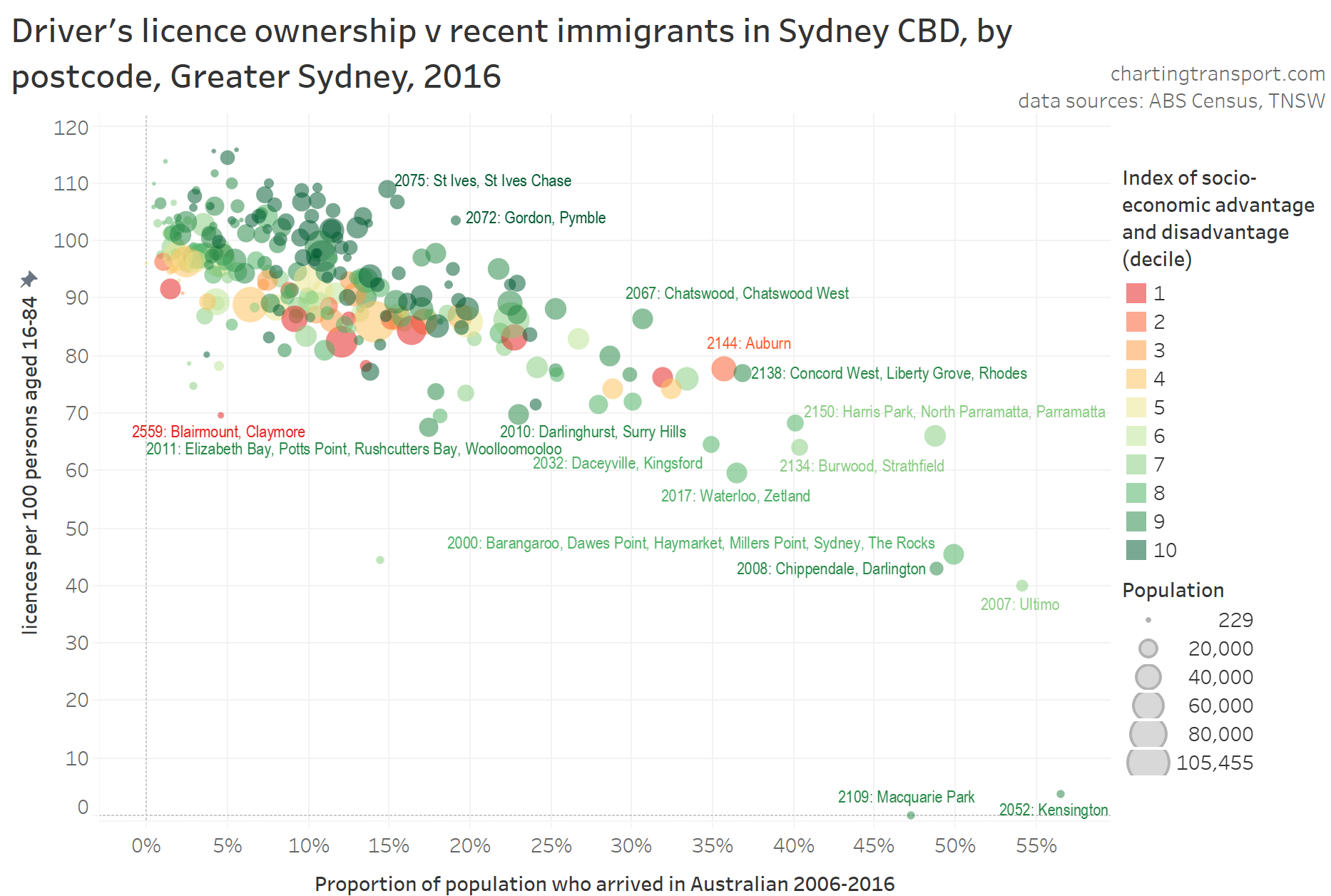
While I cannot directly match licence ownership and immigrant status at the individual level, I can compare these measures at the postcode level.
For the following chart I have classified postcodes by the percentage of residents who arrived between 2006 and 2016 – as at the 2016 census (my arbitrary definition of “recent immigrants” based on available data for this analysis), and compared that with licence ownership levels.
This chart shows a fairly strong relationship, and suggests more recent immigrants were less likely to have a driver’s licence – although the relationships is weaker for more disadvantaged postcodes (red/orange postcodes).
So why might recent immigrants be less likely to have a licence?
As we’ve already seen, some of these postcodes with low licence ownership are adjacent to universities, and no doubt included many international students who did not have a need for licence to get to study or work.
Many other skilled immigrants would work in the CBD(s), for which high quality public transport connections are generally available. In Melbourne, I found many recent immigrants live closer to the city where public transport is more plentiful, and many also live near train stations. Sydney is likely to be similar (more on that in a moment).
For some it might be because they cannot (yet) afford private transport (particularly immigrants on humanitarian visas) and/or that they don’t have sufficient English to get a learner’s permit (more on that later).
For some it might be that they are happy and attuned to using public transport, walking and/or cycling to get around, like they did in their country of origin. However when I analysed Melbourne commuter PT mode shares by immigrant country of origin, I didn’t find relationships I expected.
The age profile of immigrants skew towards younger adults, who for various reasons are less likely to own a driver’s licence.
I had wondered if some immigrants were driving using international licences instead, but NSW rules state that you can only drive on an international licence for up to three months, so that’s unlikely to explain the pattern.
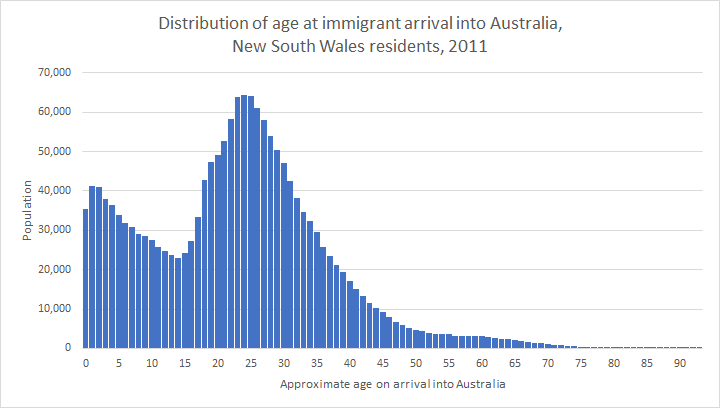
Here’s a chart showing that immigrants skew towards young adults. The chart shows the New South Wales 2011 population for each calculated approximate age of immigrants when they arrived in Australia (= age + arrival year – 2011) (the best data I have available at present):
The most common ages at arrival were around 23-25 years. Sound familiar? It is also the age where driver’s licence ownership rates dip in New South Wales. I reckon there’s a good chance the influx of immigrants of this age may explain the dip in licence ownership rates for people in their early 20s.
My recent Melbourne research found recent immigrants were also less likely to own a motor vehicle. This evidence suggests low rates of driver’s licence ownership is also strongly related to the relatively high use of public transport by recent immigrants.
For reference, here’s a map showing the percentage of residents in 2016 who had moved to Australia between 2006 and 2016. If you know a little about the urban geography of Sydney, you’ll see higher concentrations around the CBDs, university campuses, and along some major train lines.
Parenting status
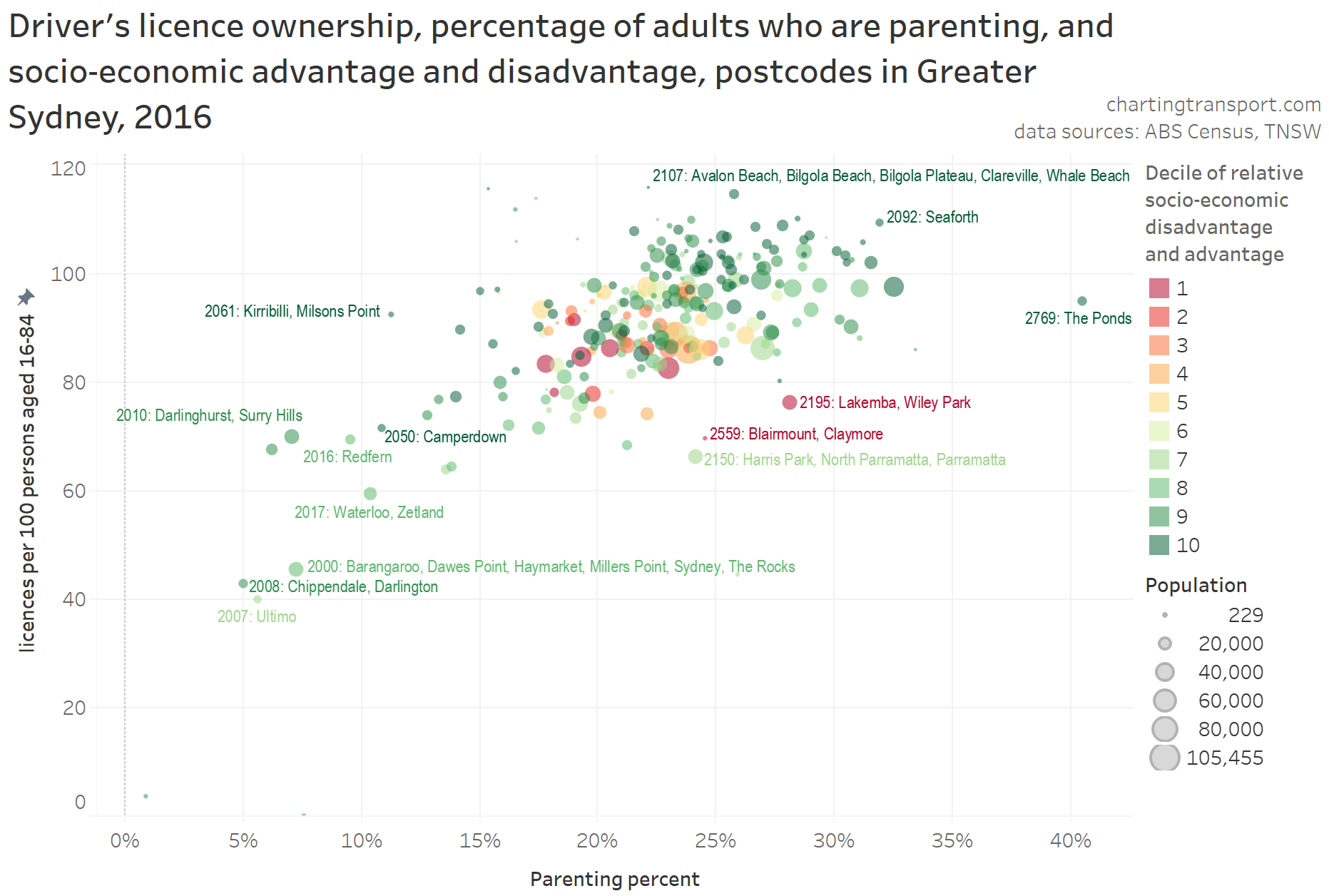
We know parents are less likely to use public transport (at least in Melbourne, but probably in all Australian cities), so are they also more likely to own a driver’s licence? The following data compares licencing and parenting rates (defined as proportion of adults doing unpaid caring work for their own children aged under 15) for postcodes:
There is a significant relationship, with postcodes with higher rates of parenting generally have higher rates of driver’s licence ownership. This may well be related to licence ownership rates also peaking for people of the most common parenting ages, and also the fact many young families live in the outer suburbs (where private transport is often more competitive than public transport). The postcodes with the lowest licence ownership rates also have very low proportions of parents (and probably contain many young adults who are studying).
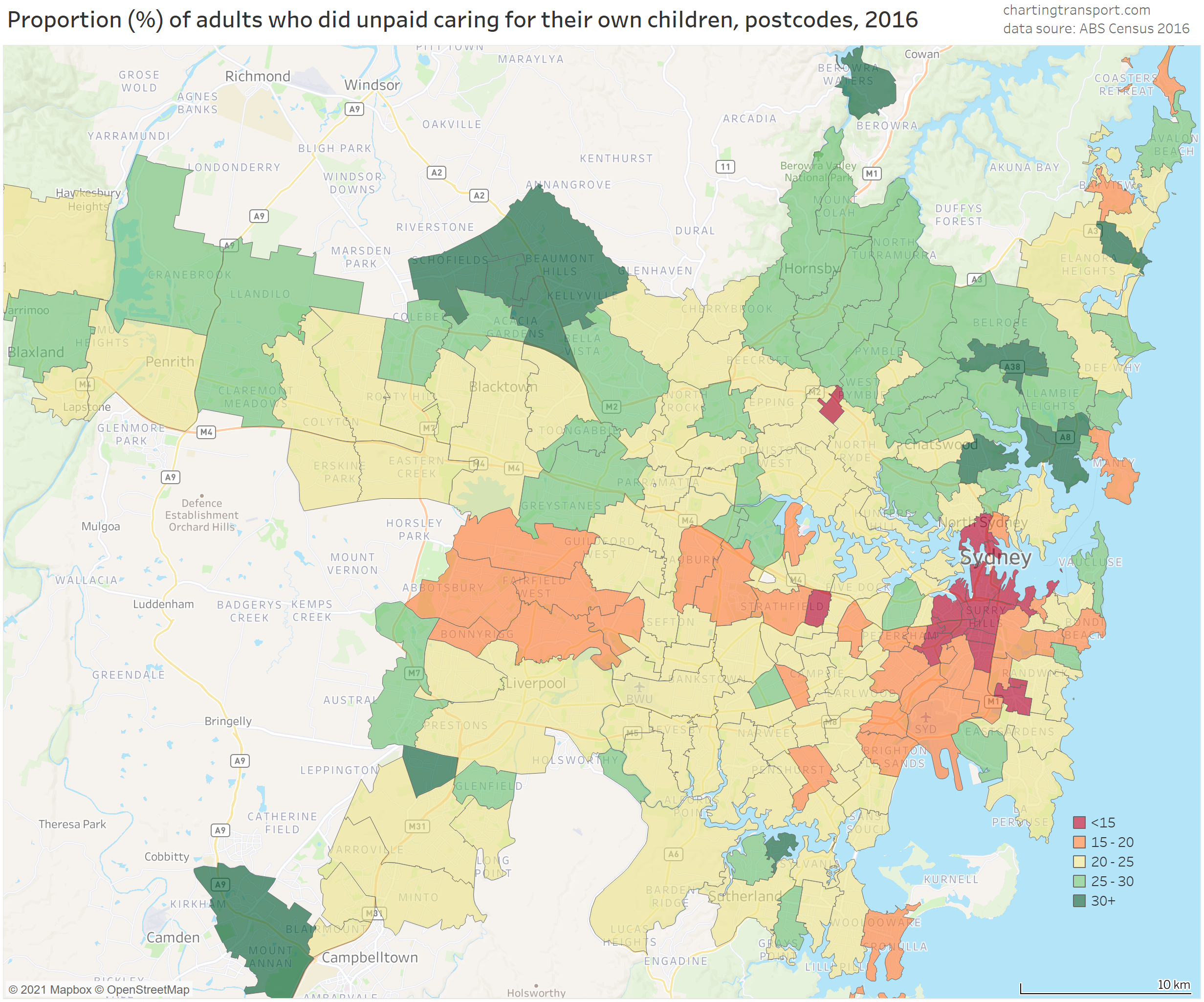
For reference here is a map of parenting percentages for Sydney postcodes:
Motor vehicle ownership
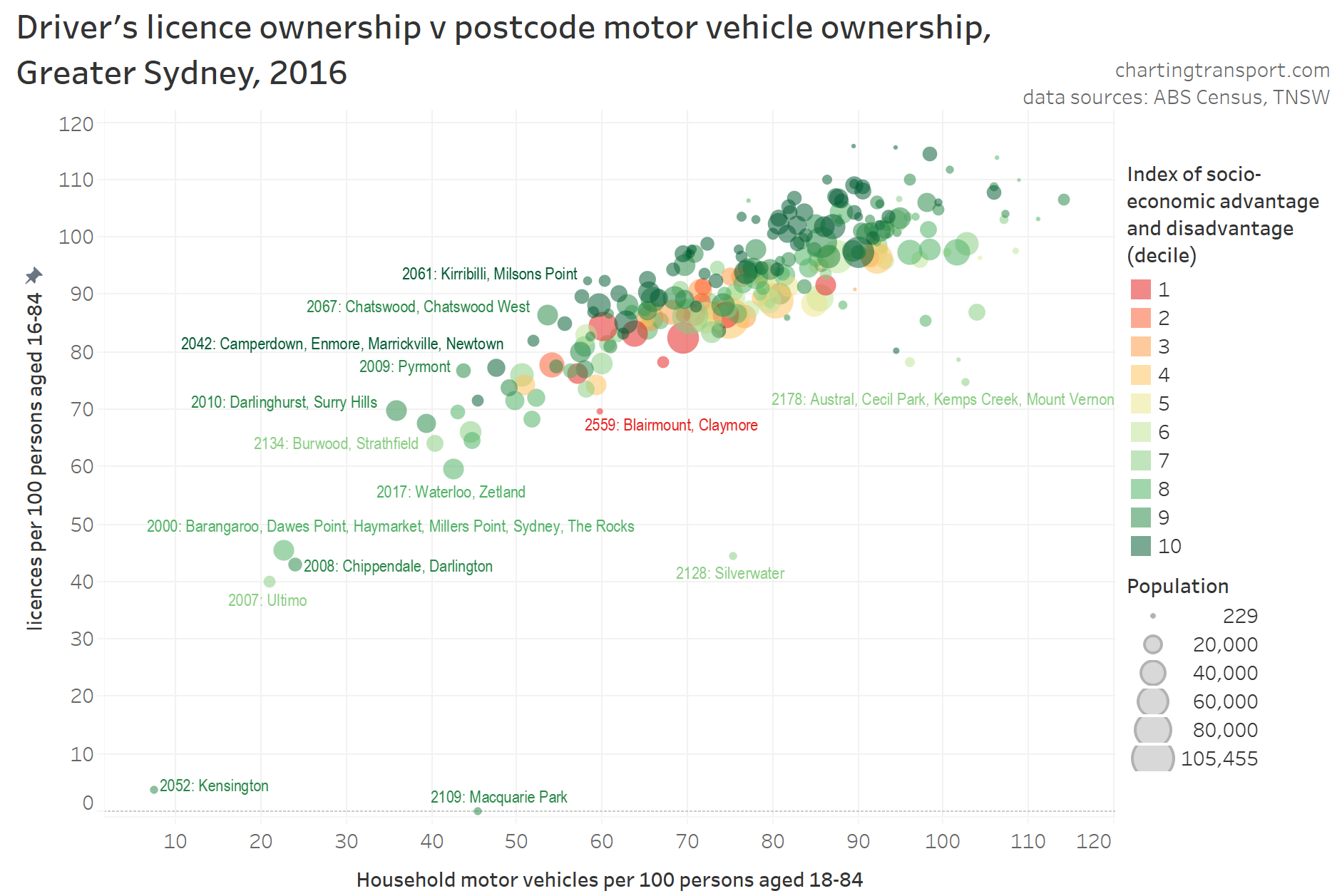
It stands to reason that areas with higher driver’s licence ownership rates might also have higher motor vehicle ownership rates. I’ve calculated the ratio of persons aged 18-84 to household motor vehicles for each postcode, to create the following chart:
You can see the relationship is very strong, with more advantaged (and often near-CBD) postcodes towards the top of the cloud, and more disadvantaged postcodes mostly at the bottom and middle of the cloud.
Silverwater is an outlier – but I should point out that my calculation of motor vehicle ownership only counts people living in private dwellings while licence ownership is for all residents (including the many who resided in Silverwater’s correctional facilities).
There are also a small curious bunch of outliers with around 100 motor vehicles per 100 persons aged 18-84 but only 70-90 licences per 100 persons aged 16-84. These include urban fringe suburbs such as Marsden Park, Riverstone, Oakville, Rossmore, Gregory Hills, Leppington, Voyager Point, Kemps Creek, and Horsley Park. Perhaps these areas may contain farm vehicles that might skew the motor vehicle ownership rates.
While spatial data about licence ownership is unfortunately not readily available for most states of Australia, this chart suggested that motor vehicle ownership (something thankfully still captured by the census, despite ABS trying to drop the question) is a reasonably strong proxy for licence ownership.
Population weighted density
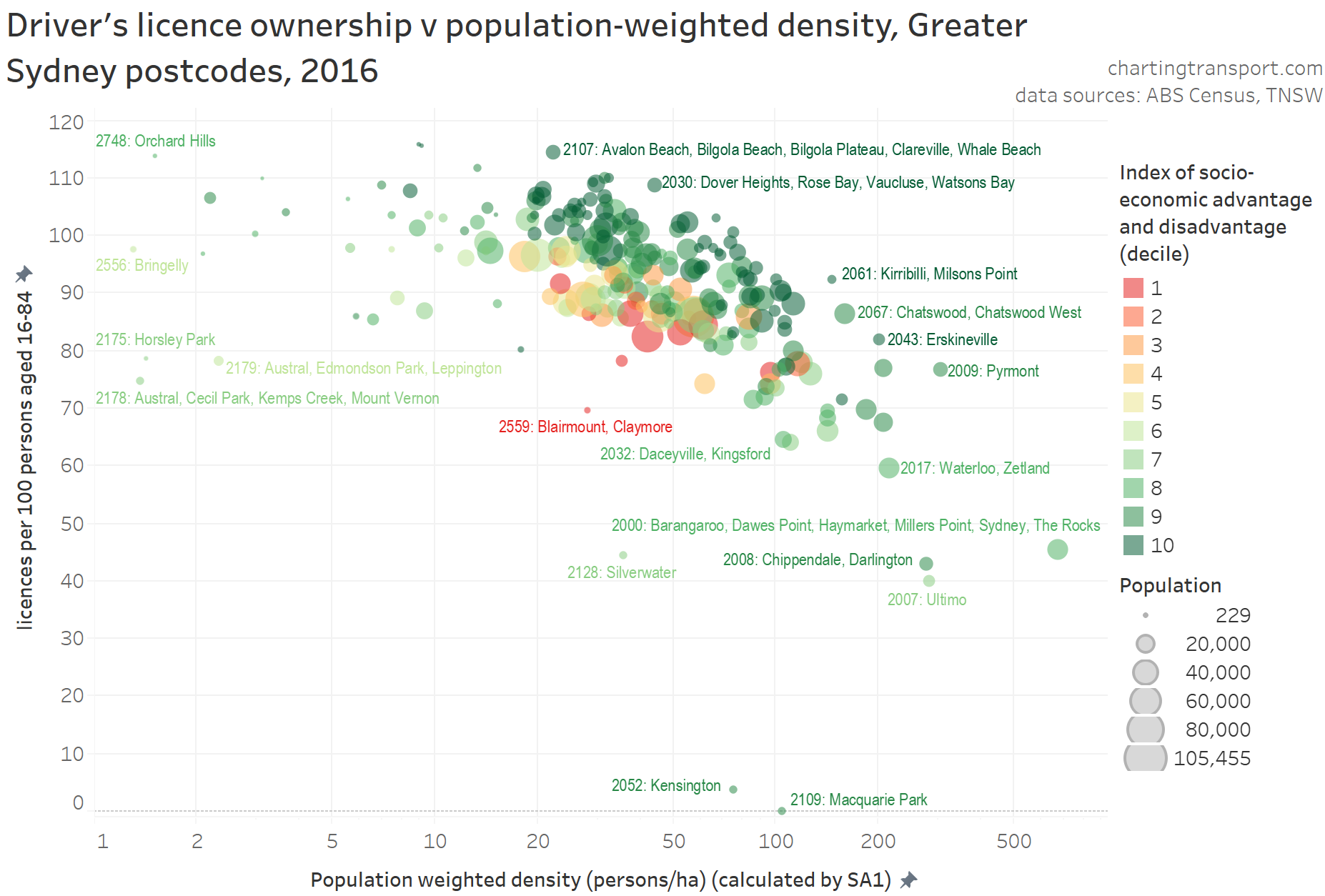
Given postcodes can be quite large (one has a population of over 100,000!), I prefer to use population-weighted density as a metric of urban density (as opposed to raw density). Here’s how that related to licence ownership (note a log scale on the X-axis):
That’s a pretty strong relationship, and of course not unexpected. Areas with higher population density generally have great public transport services, and more services and jobs would likely be accessible by walking, reducing the need for a car or driver’s licence.
Proximity to high quality public transport
I’ve previously confirmed a relationship between public transport mode share and proximity to high quality public transport, so does the presence of high quality public transport also relate to driver’s licence ownership?
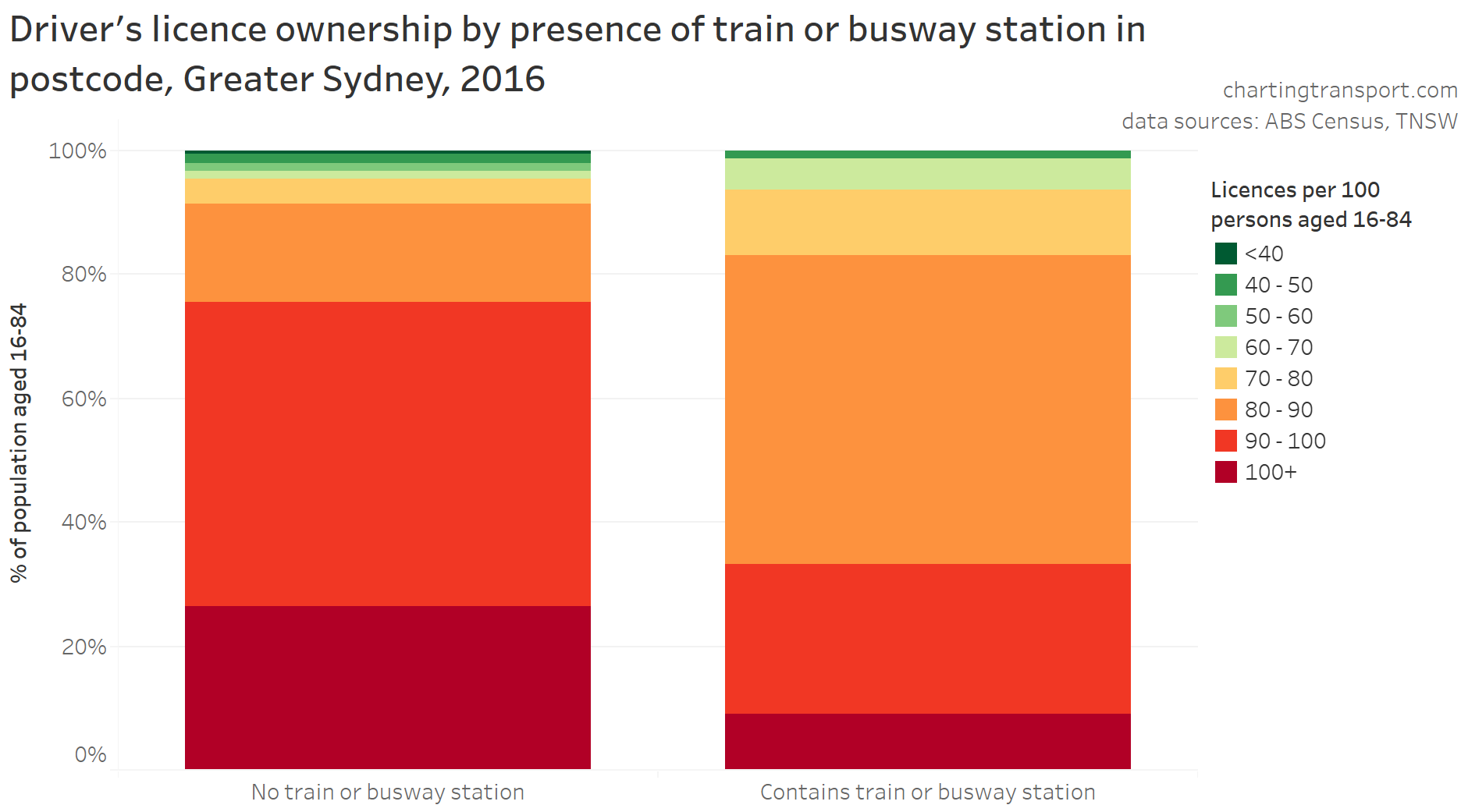
As mentioned above, I’ve classified postcodes as to whether or not there was a train or busway station contained within the postcode boundary in 2016. It’s a blunt measure because stations may only serve a small part of large postcodes, or there may be a station just outside a postcode’s boundary that still provides good rail access to that postcode. Some postcodes were also served by light rail and/or very high frequency bus services, just not a train or busway station. I’d love to be able to look at licence ownership by distance from stations, but licensing data is unfortunately only available for postcodes, which does not provide enough resolution.
You can see postcodes with a station generally have lower rates of licence ownership than those without, but there is still plenty of variance across postcodes.
The green postcodes in the top of the left column include Camperdown (University of Sydney, close to the CBD with very high frequency on-road buses), Ultimo (just next to Central Station and the CBD), Kensington (includes UNSW campus, with strong bus (and now light rail) connections), Chippendale / Darlington (wedged between Central and Redfern Stations), and Waterloo / Zetland (very close to Green Square Station and also served by high frequency on-road buses).
Many of the postcodes with stations but high licence ownership (bottom of right hand column) are in the outer suburbs, where train frequencies may be lower, and public transport services in non-radial directions may have lower quality.
So the exceptions to the relationship are quite explainable, and I’d suggest there is a strong relationship. Again, it may be people without a licence choosing to live near public transport, and/or people not near high quality public transport deciding they must have a licence to get around.
Educational qualifications
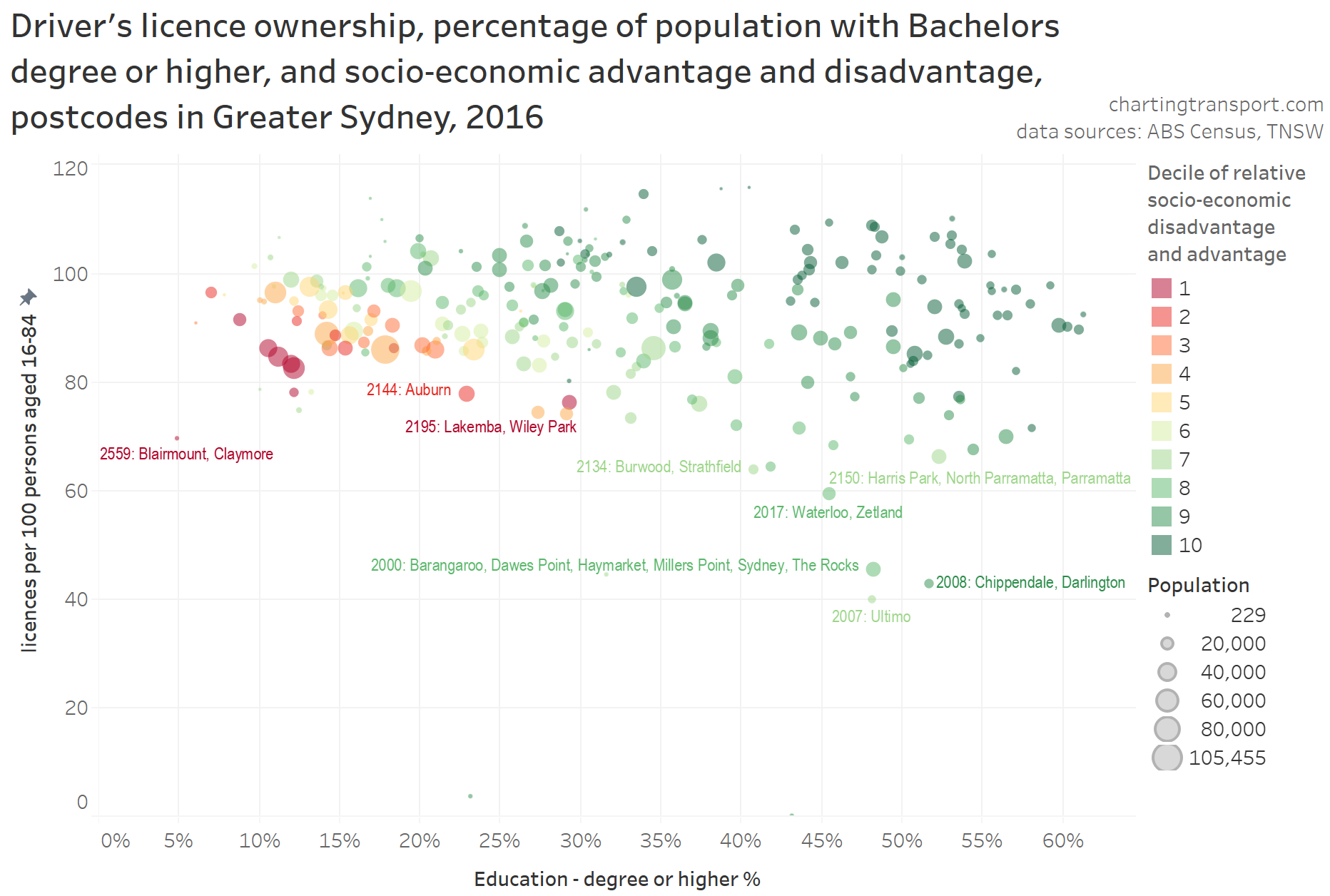
I have also found a relationship between educational qualifications and commuter mode shares in Melbourne, so are licencing rates related to levels of educational attainment in Sydney?
There’s not much of a relationship happening here between licence ownership and education, other than some inner city postcodes with a high proportion of educated residents and lower rates of licence ownership. There is of course an (expected) relationship between advantage and education.
But just on that, one curious outlier postcode on the chart is Lakemba / Wiley Park (2195), with 29% of the population having a Bachelor’s degree or higher, but it being in the most disadvantaged decile. This postcode has a large proportion of people not born in Australia, with significant numbers born in Lebanon and Bangladesh. Perhaps this reasonably well-educated but highly disadvantaged population is a product of lack of recognition of overseas qualifications, and/or maybe issues with discrimination.
Distance from Sydney CBD
In Melbourne, distance from the CBD has a strong relationship with mode choice, and I would not be surprised if there was similarly a relationship with licence ownership. However Melbourne only has one large dense employment cluster (the central city), while Sydney has multiple large dense employment clusters which is likely to lead to different patterns (see Suburban employment clusters and the journey to work in Australian cities).
From the first map in this post you cannot see a strong relationship between licence ownership and distance from the Sydney CBD – it is clear that many other factors are influencing licence ownership rates across Sydney (such as proximity to university campuses and employment clusters). Having said that, it seems clear that most “outer” suburban postcodes have high levels of licence ownership, but distance from the CBD is probably not a good proxy for “outer”.
Also some postcodes are quite large, and are a little problematic to assign to a distance value or range from the CBD, and the presence of two large harbours means crow-flies distance to the Sydney CBD is not necessarily reflective of ease/speed of travel to the Sydney CBD.
For these reasons I’ve not crunched data on home distance from the Sydney CBD. With a lot more effort, perhaps a metric could be created that considers travel time to Sydney’s major centres (although these centres vary in size).
Which factors have the strongest relationship with licence ownership?
The factors shown above had the strongest relationships with licence ownership (I tested three other factors which had weaker relationships, covered in the appendices below).
I put all the factors for Greater Sydney postcodes into a simple linear multiple regression model, and without labouring the details, I found that the following factors were significant at explaining postcode licence ownership rates (each with p-values less than 0.05 and overall an R-squared of 0.83), listed with the most significant first:
Ratio of population aged 35-69 : population aged 15-84. For every 1% this ratio is higher, licence ownership per 100 persons aged 16-84 is generally 1.0 higher (all other things being equal)
Rate of motor vehicle ownership: every extra motor vehicle per 100 persons aged 18-84, there are generally 0.35 more licences per 100 persons aged 16-84 (all other things being equal)
People who have a bachelors degree or higher: For every 1% this is higher, licence ownership per 100 persons aged 16-84 is generally 0.18 higher (all other things being equal)
Postcodes containing or adjacent to a major university campus or correctional centre. These postcodes generally had 14 fewer licences per 100 persons aged 18-64 (all other things being equal)
Factors that fell out of the regression as not significant were Sydney CBD commuter percentage, presence of a train or busway station, socio-economic advantage/disadvantage, population weighted density, parenting percentage, student status, and percent of population speaking English very well. Of course many of these metrics would correlate with the four significant factors above.
I was a little surprised to see educational qualifications show up as significant, given the weak direct relationship seen in the scatter plot, however the impact was small (0.18) and it may be acting as a proxy for other factors such as proportion of commuters working in the Sydney CBD (which was the “strongest” factor that fell out – having a p-value of 0.11).
This analysis was done using postcode level which has issues in terms of blending populations. It is possible to look at individuals using household travel survey data, and I’ve had a quick look using VISTA data from Melbourne. Without going into full detail in this post, I’ve found stronger relationships with age, sex, household income, parenting status, main activity, distance from train stations, and a weaker relationship with distance from CBD. Maybe that could be the focus of a future post.
I hope you’ve found this interesting.
Appendix 1: English proficiency
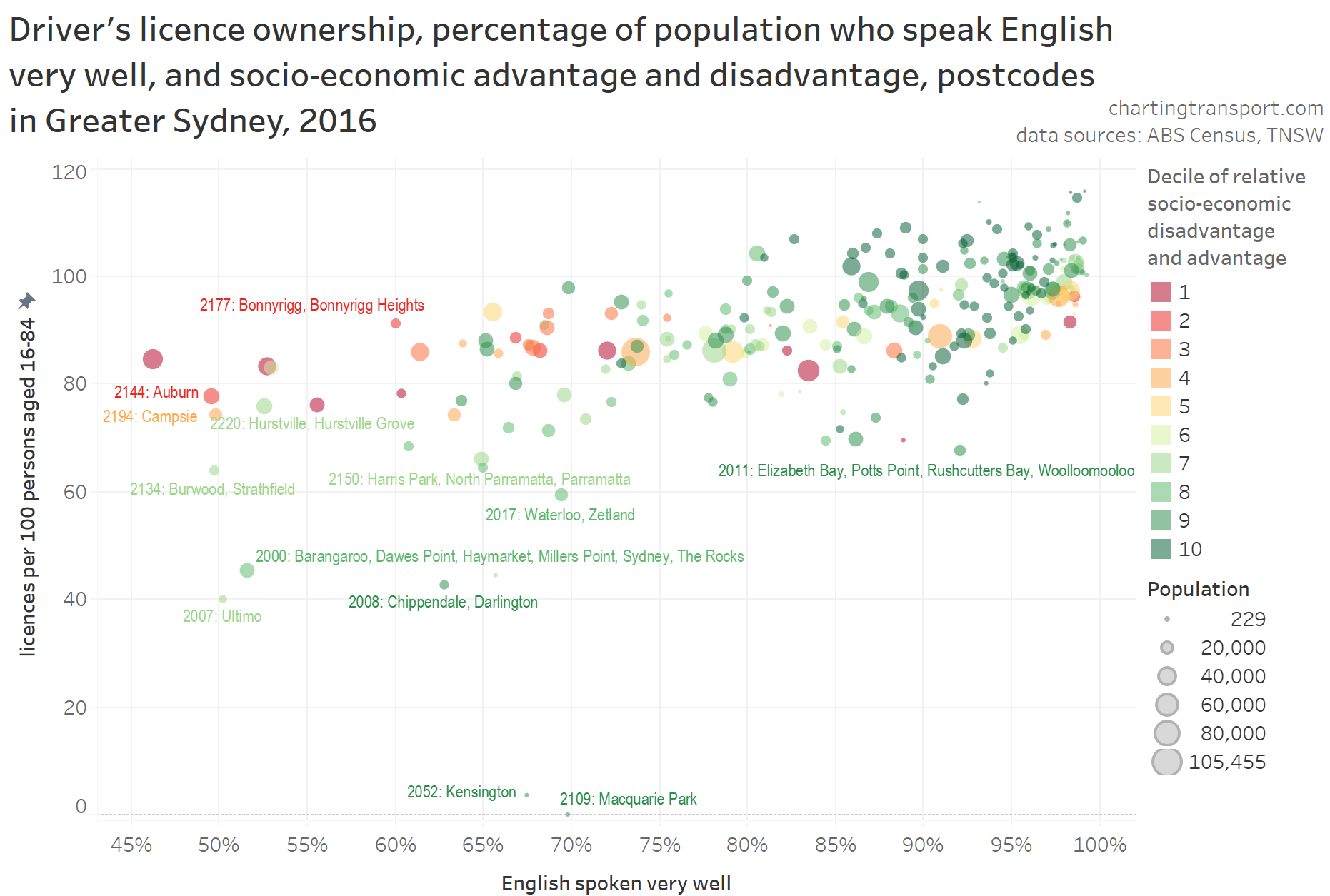
Probably related to recent immigrant figures, postcodes with a larger proportion of residents speaking English very well generally had slightly higher levels of licence ownership, although the relationship is not tight:
Curiously though, the relationship seems to be stronger for more advantaged postcodes. Disadvantaged postcodes with lower levels of English proficiency still had licence ownership rates of around 80 per 100 persons aged 16-84 (top-left of the cloud).
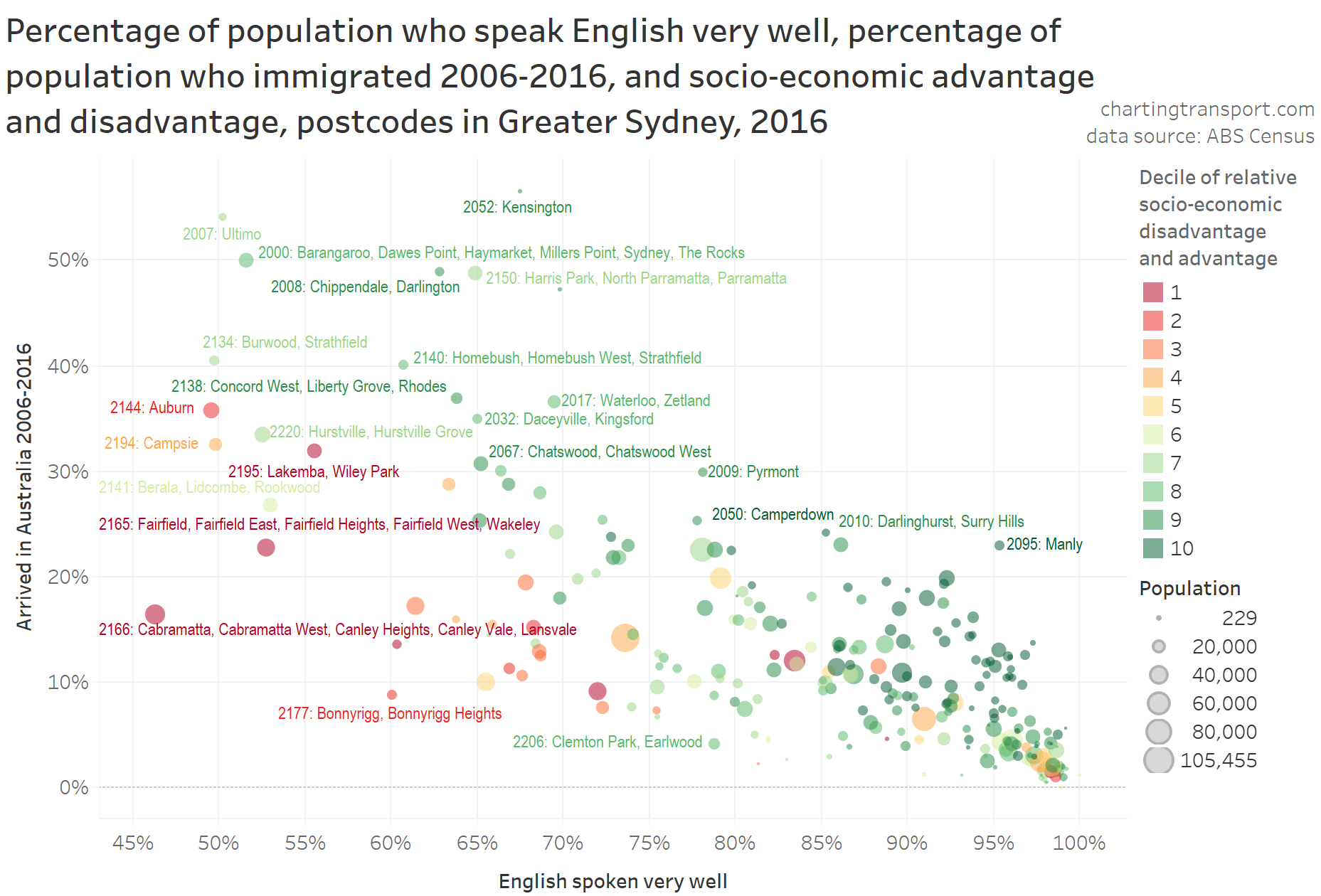
As an aside: is English proficiency lower in postcodes with many recent immigrants?
The answer is yes, but lower levels of English proficiency are not always explained by recent immigration. Of course some of the recent immigrants will speak English very well (many settling in places like Manly, Darlinghurst, Waterloo, Pyrmont), while others will not, depending on their country of origin. The large red dot to the bottom-left is postcode 2166, which includes the migrant area of Cabramatta (sorry about the label that overlaps other data points). It would appear that this postcode has many longer term residents who don’t speak English very well (although they might rank themselves as speaking English “well” rather than “very well”, which is below my arbitrary threshold of “very well” plus native English speakers).
Appendix 2: Student status
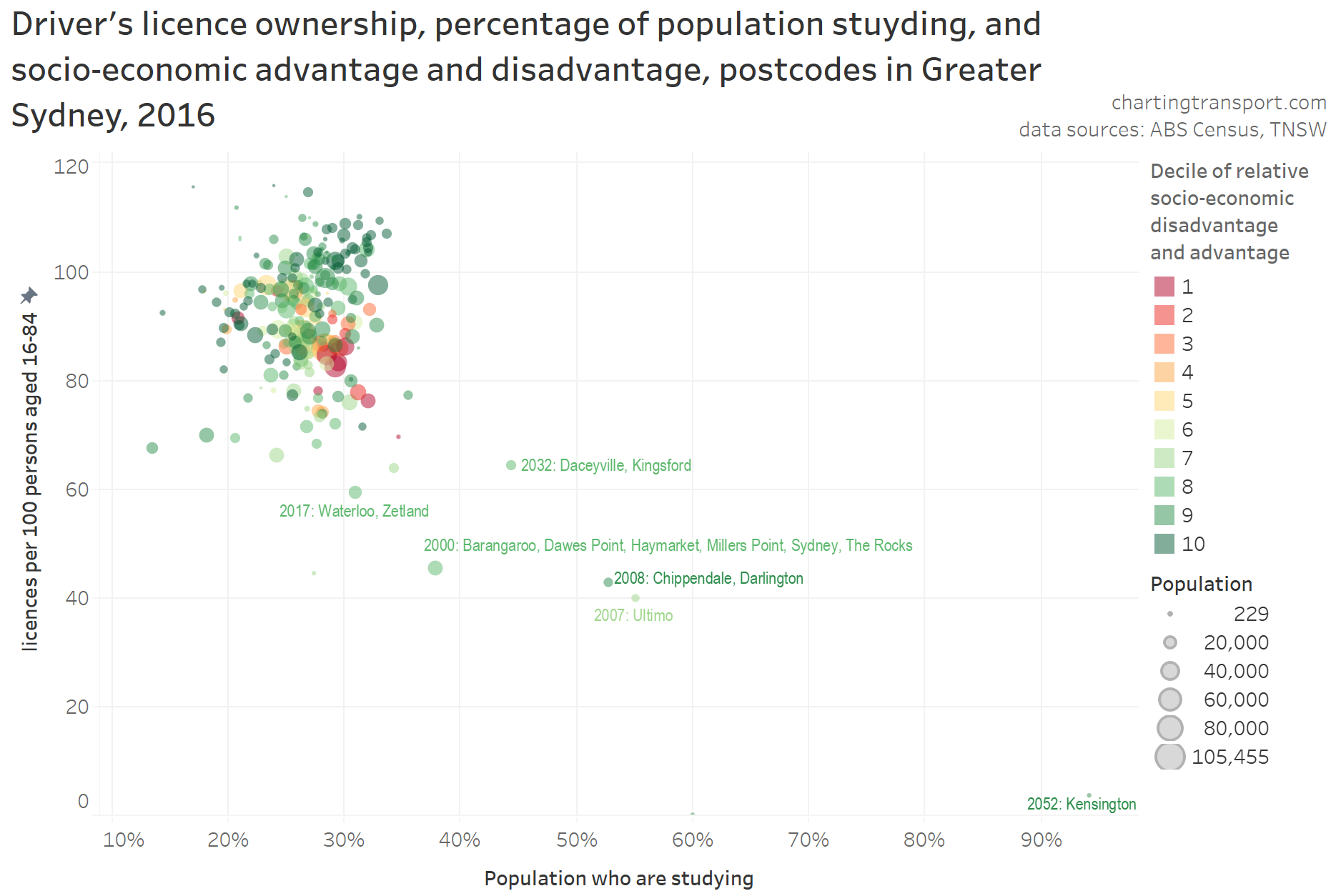
I have recently found a relationship between student-status and and journey to work mode shares in Melbourne (although yet to be published at the time of writing). So does the proportion of residents (over 15) who are studying have a relationship with driver licence ownership rates?
Here’s a scatter plot, with socio-economic advantage and disadvantage overlaid:
Apart from some exceptional postcodes with larger proportions of students, there appears to be little to no relationship between studying and licence ownership.
I’ve recently been analysing how public transport mode share varies with age and associated demographic factors. In part 3 of that series, I found that immigrants – and particularly recent immigrants – were much more likely to use public transport (PT) in their journey to work. This post explores why that might be, using data for Melbourne from the ABS Census (mostly 2016).
About immigrant data
The census covers both temporary and permanent residents. I’ve counted all people who were born overseas and came to Australia intending to stay for at least one year as “immigrants”, regardless of whether they were temporary or permanent residents.
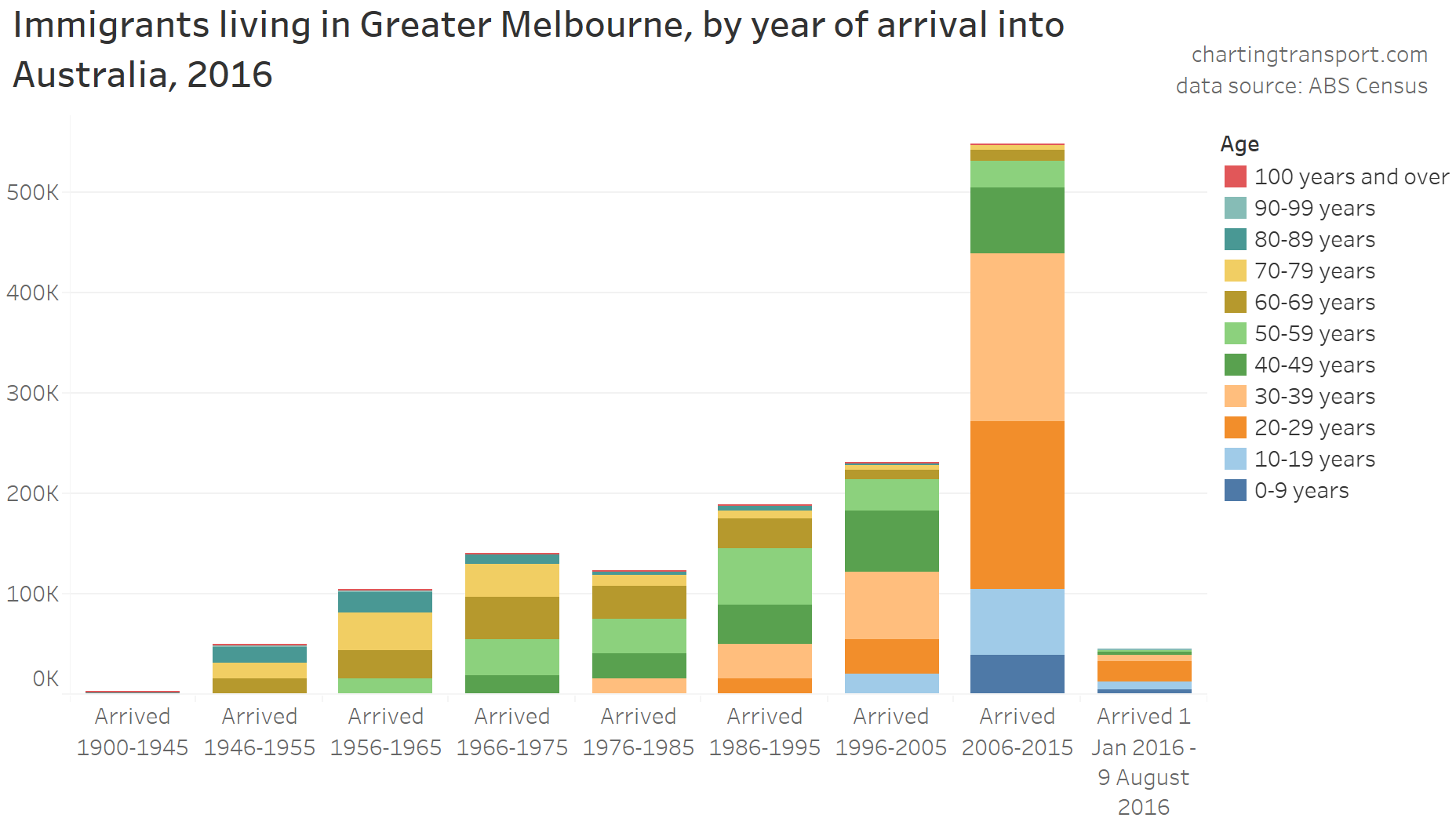
It’s worth looking at the number of immigrants living in Greater Melbourne by age and arrival year, as at 2016:
Except for the first and last columns, each column represents 10 arrival years. You can see a significantly larger population of immigrants who arrived between 2006 and 2015, and they skewed significantly to ages 20-39. We know from previous analysis that younger adults are more likely to use public transport, so age is likely to play a role.
But how many immigrants are temporary residents? The census doesn’t include a question about permanent residency, but it is possible to track arrival year range cohorts over time.
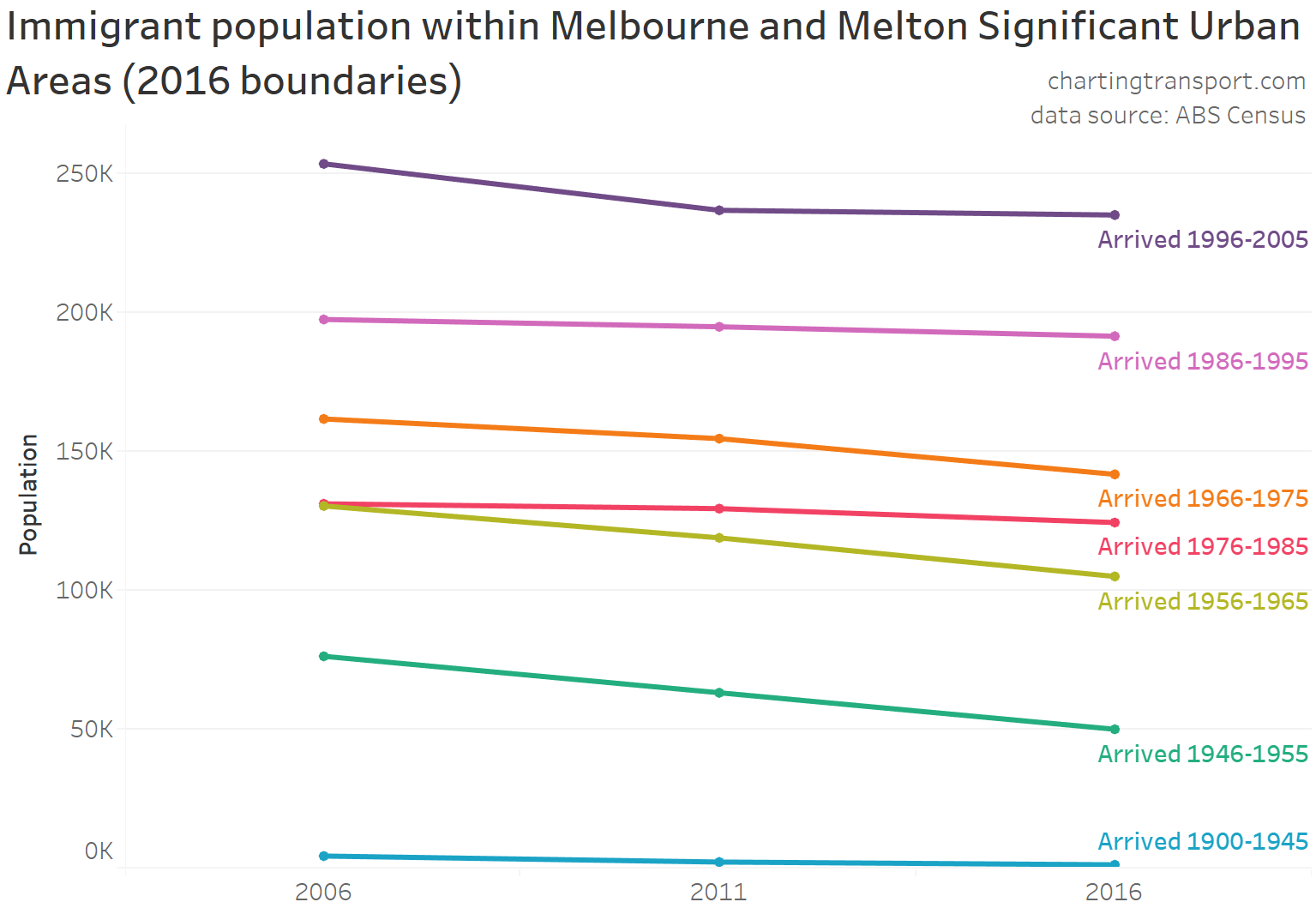
The following chart tracks the number of immigrants for arrival year ranges between the 2006, 2011 and 2016 censuses (using Significant Urban Area geography).
If there were a significant number of temporary residents (although still intending to stay at least one year), then you’d see a large drop in the population of people who arrived 1996 to 2005 over time between 2006 and 2011/2016. There certainly was a drop off, but it was a small proportion.
This suggests most migrants end up being long-term residents (including many who enter on temporary visas but then gain permanent residency).
Numbers in all arrival year ranges dropped slowly over time through people leaving Melbourne (and possibly Australia) and deaths (particularly for immigrants from earlier years many of whom would be in their senior years).
Immigrants and public transport mode share of journeys work
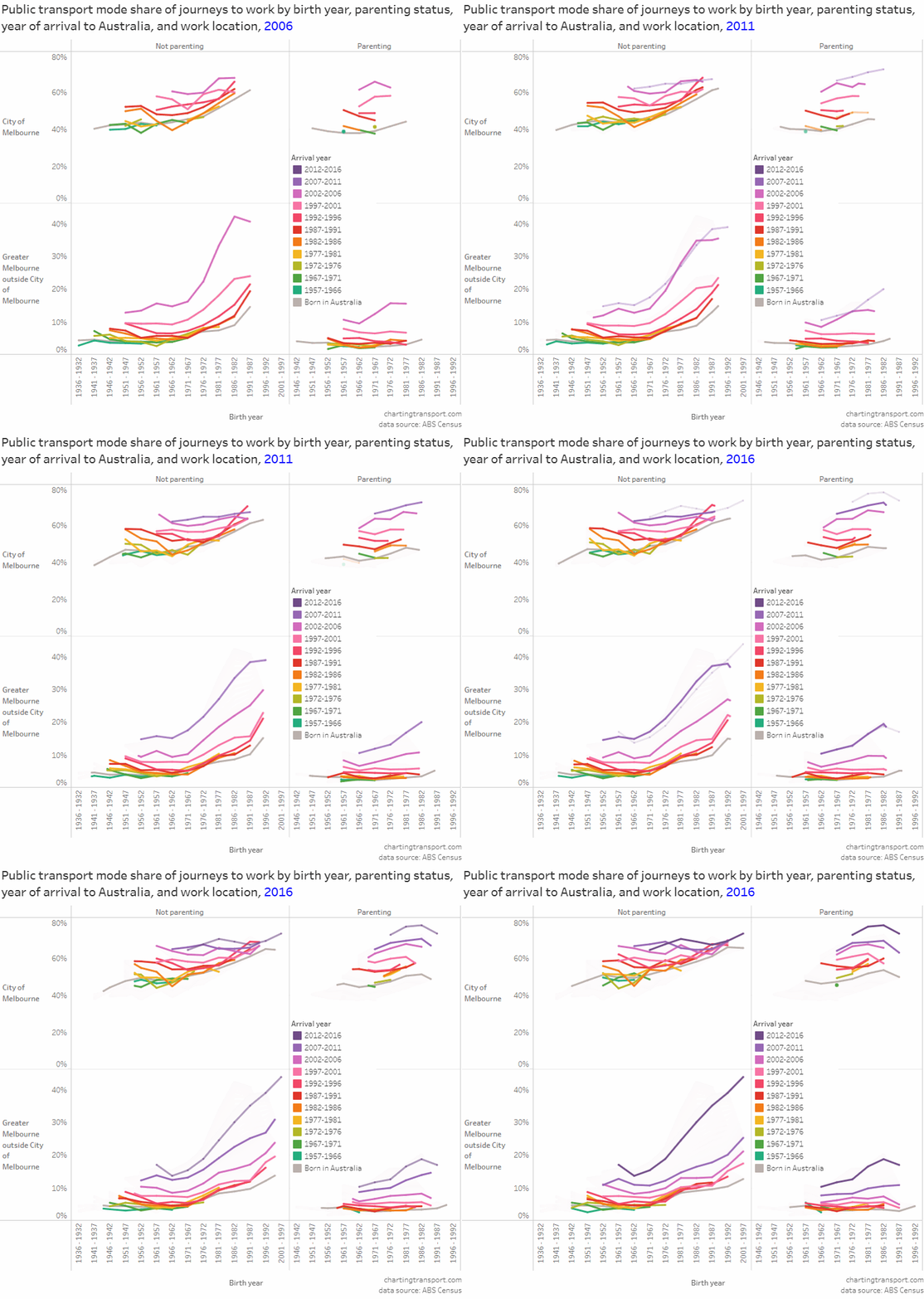
To recap my previous analysis, the relationship between immigration year and PT mode share has held for the last three censuses (2006, 2011, and 2016), regardless of parenting status, birth year, or whether the someone worked inside or outside the City of Melbourne (local government area):
So why might recent immigrants be more likely to use public transport? From looking at the data, I think there are several plausible explanations.
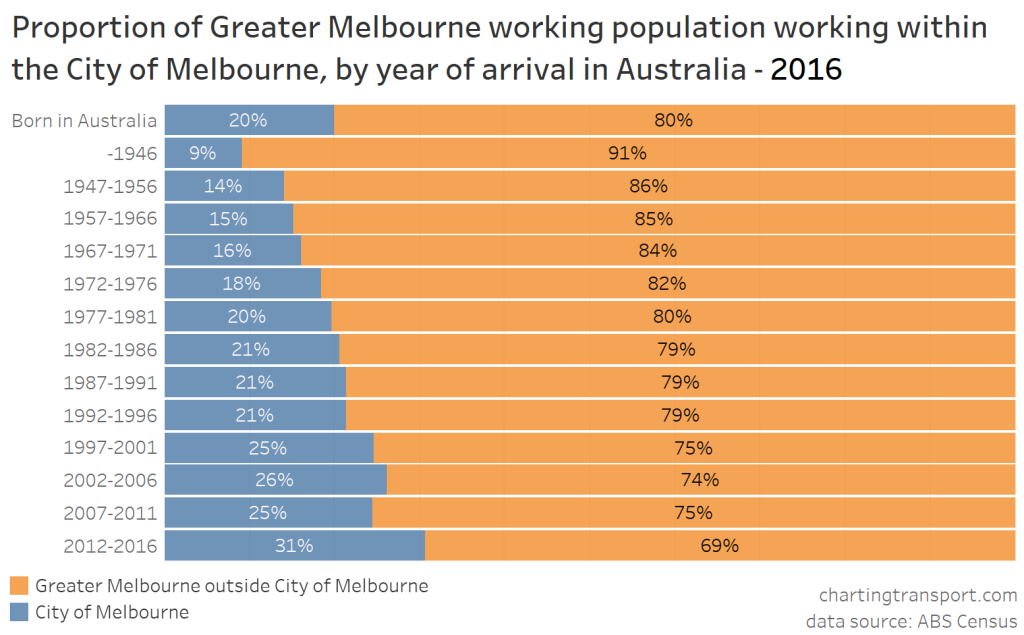
To start with, they were more likely to work in the City of Melbourne, and we know journeys to work in the City of Melbourne have much higher public transport mode shares:
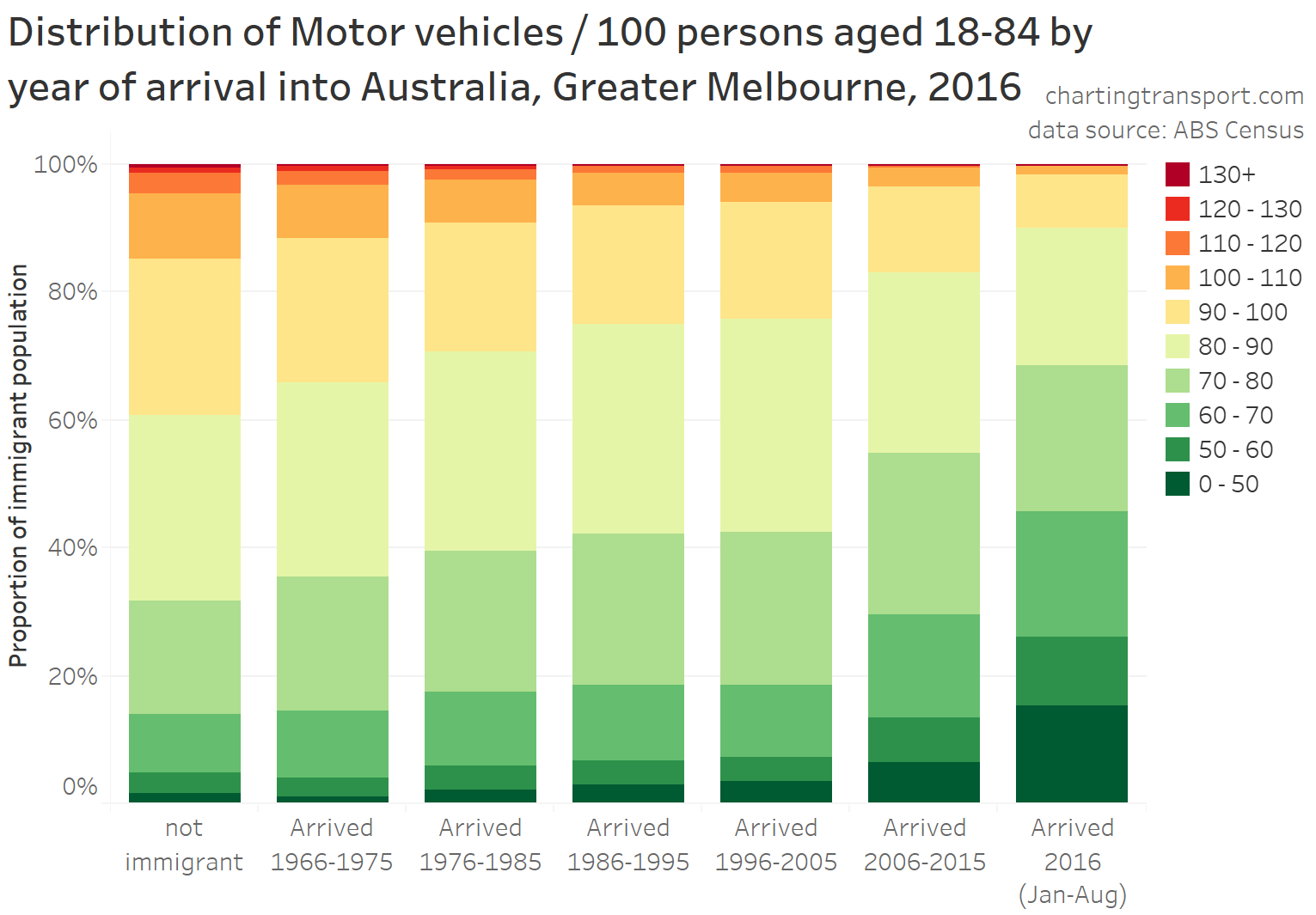
They were also more likely to live in areas with lower levels of motor vehicle ownership. Each column in the following chart represents the population of immigrants for a range of arrival years, and that population is coloured based on the motor vehicle ownership rate of all residents in the (SA1) areas in which they live (including non-immigrants). Note: immigrants themselves may have had different rates of motor vehicle ownership to the average of people in the areas in which they lived.
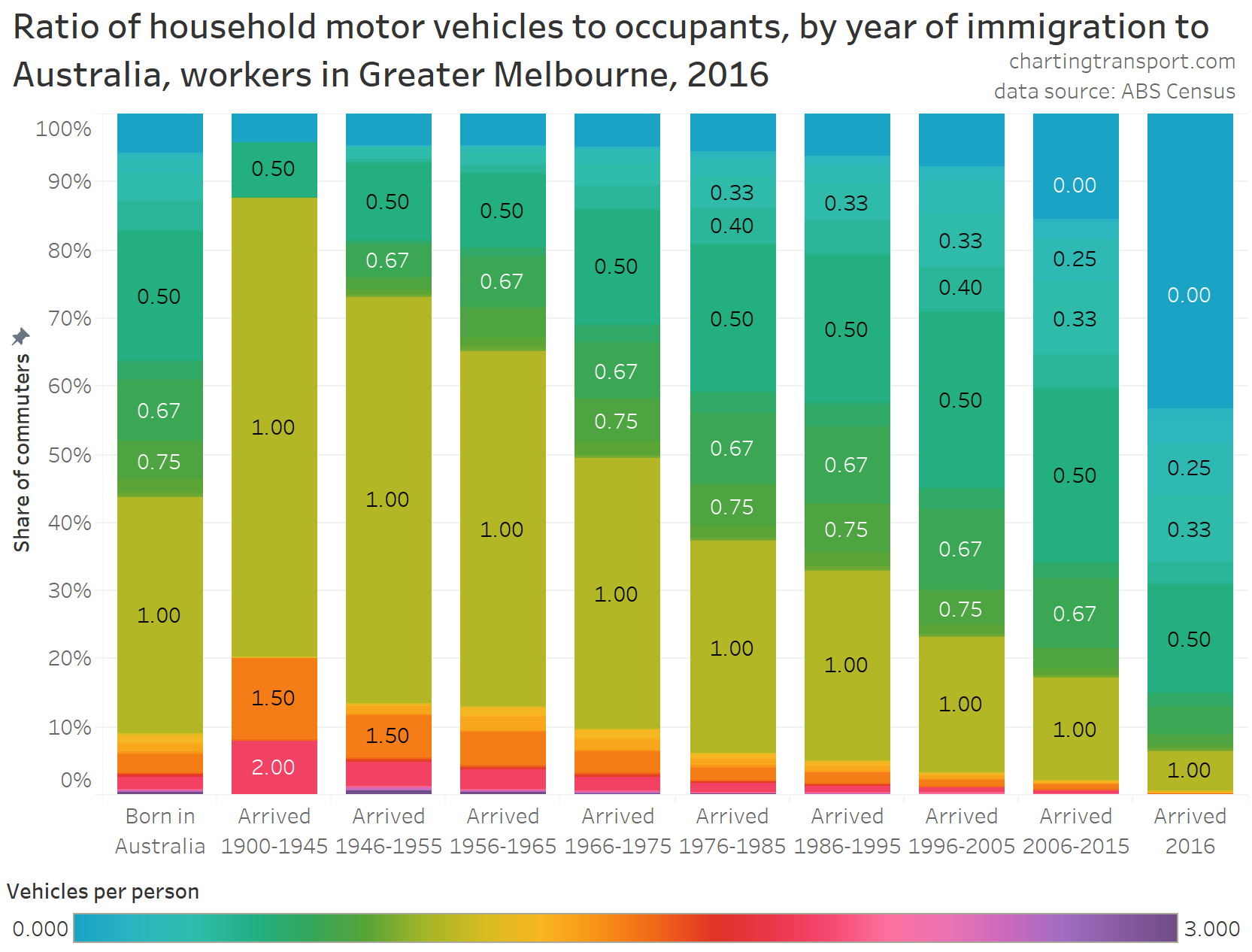
As I’ve mentioned previously, I do not have access to data to calculate the ratio of household motor vehicles to driving-aged adults within immigrant households, but I can calculate the ratio of household vehicles to all household residents (not all of whom may be of driving age).
The following chart shows that more recent immigrants were likely to have much lower levels of motor vehicle ownership that those who have been living in Australia longer.
Aside: Immigrants who arrived in Australia 1900-1945 had much higher rates of motor vehicle ownership than people born in Australia, but they were also all aged over 70 in 2016.
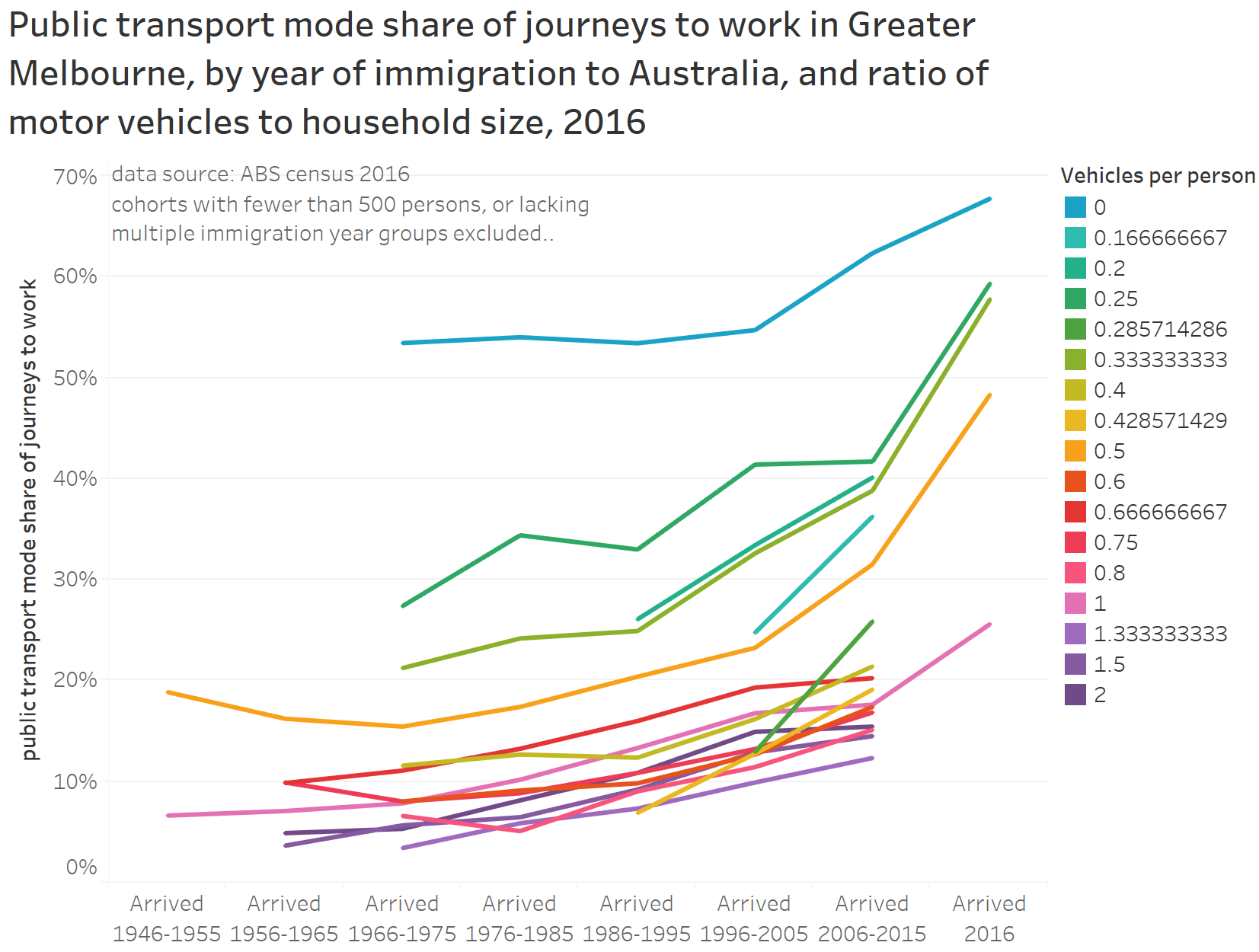
BUT if you look at PT mode shares for each vehicle : person ratio, there is still a relationship with year of arrival (see next chart), so car ownership doesn’t fully explain why recent immigrants were more likely to use public transport.
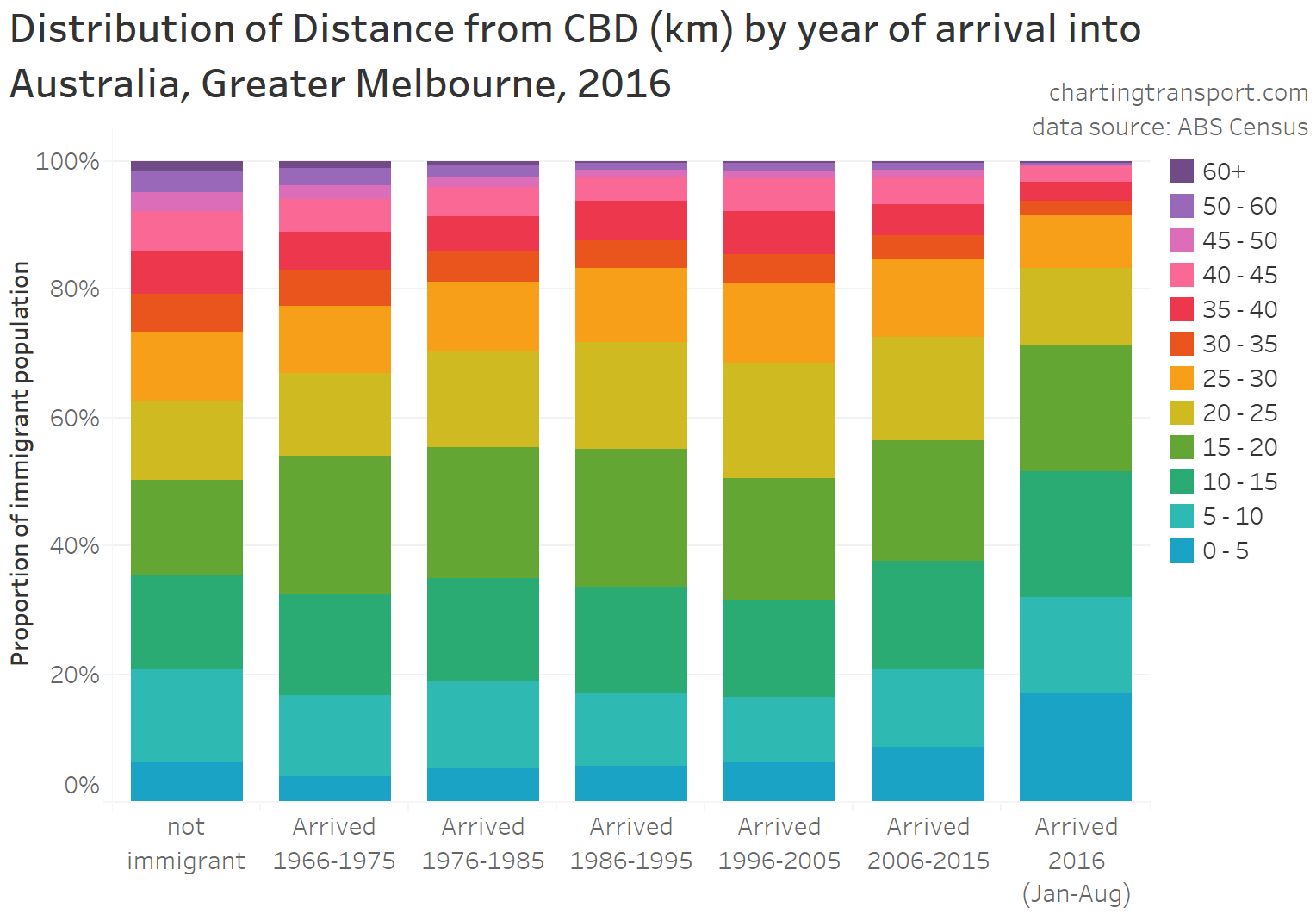
Looking at other factors, recent immigrants were slightly more likely to live closer to the city centre:
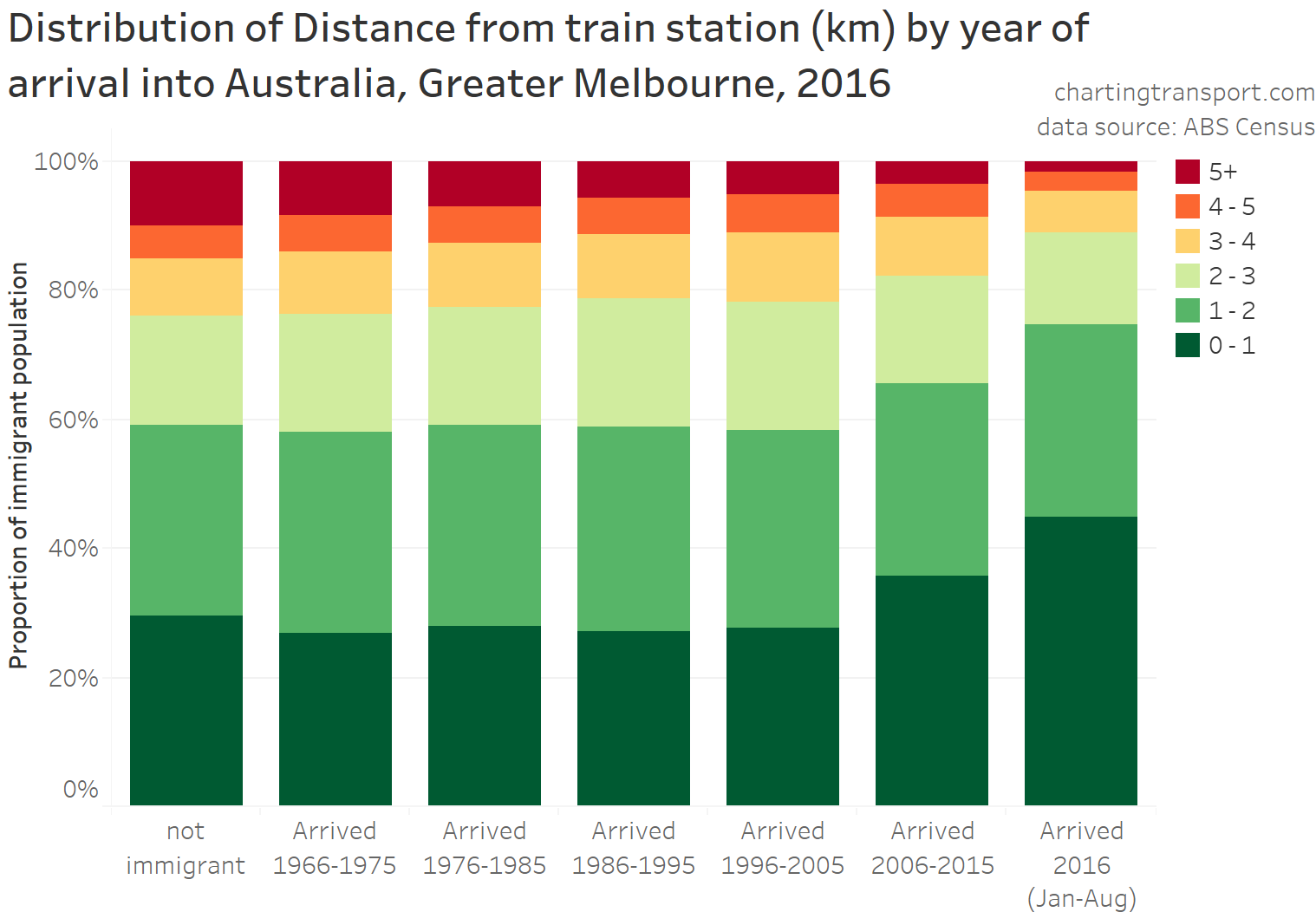
And they were more likely to live near a train station:
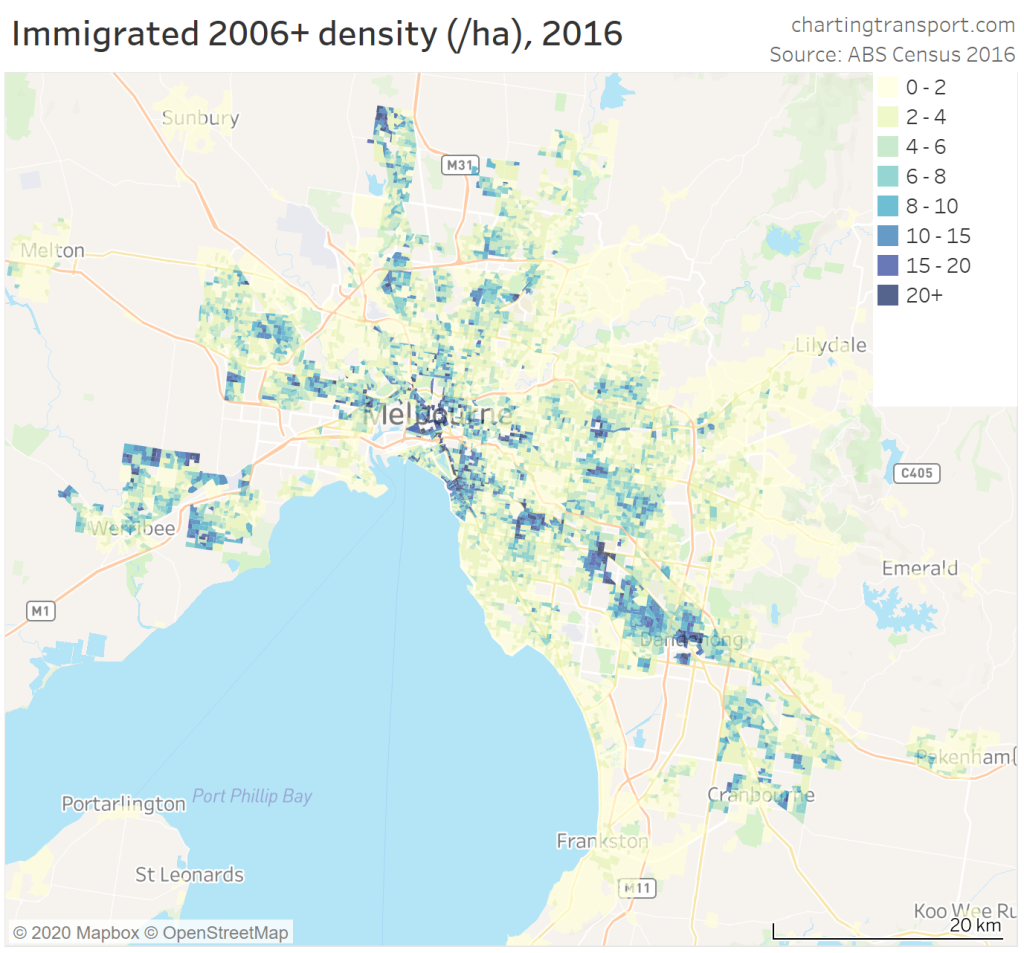
However not all recent immigrants to Melbourne lived near the city or a train station. Here’s a map showing the density of persons who arrived in Australia between 2006 and 2016 as at the August 2016 census.
There were significant concentrations in outer growth areas such Point Cook, Tarneit, and Craigieburn. These suburbs also happen to have very well patronised rail feeder bus routes, and unusually higher concentrations of central city commuters for their distance from the CBD.
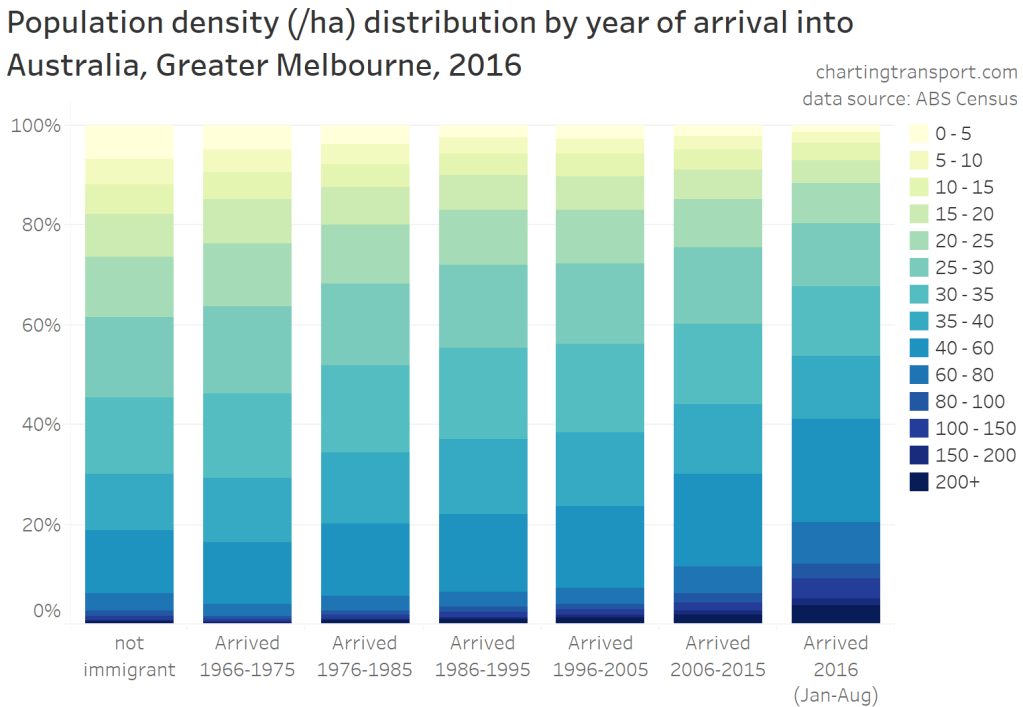
Recent immigrants were more likely to live in areas of higher residential density:
And they were more likely to work near the city centre:
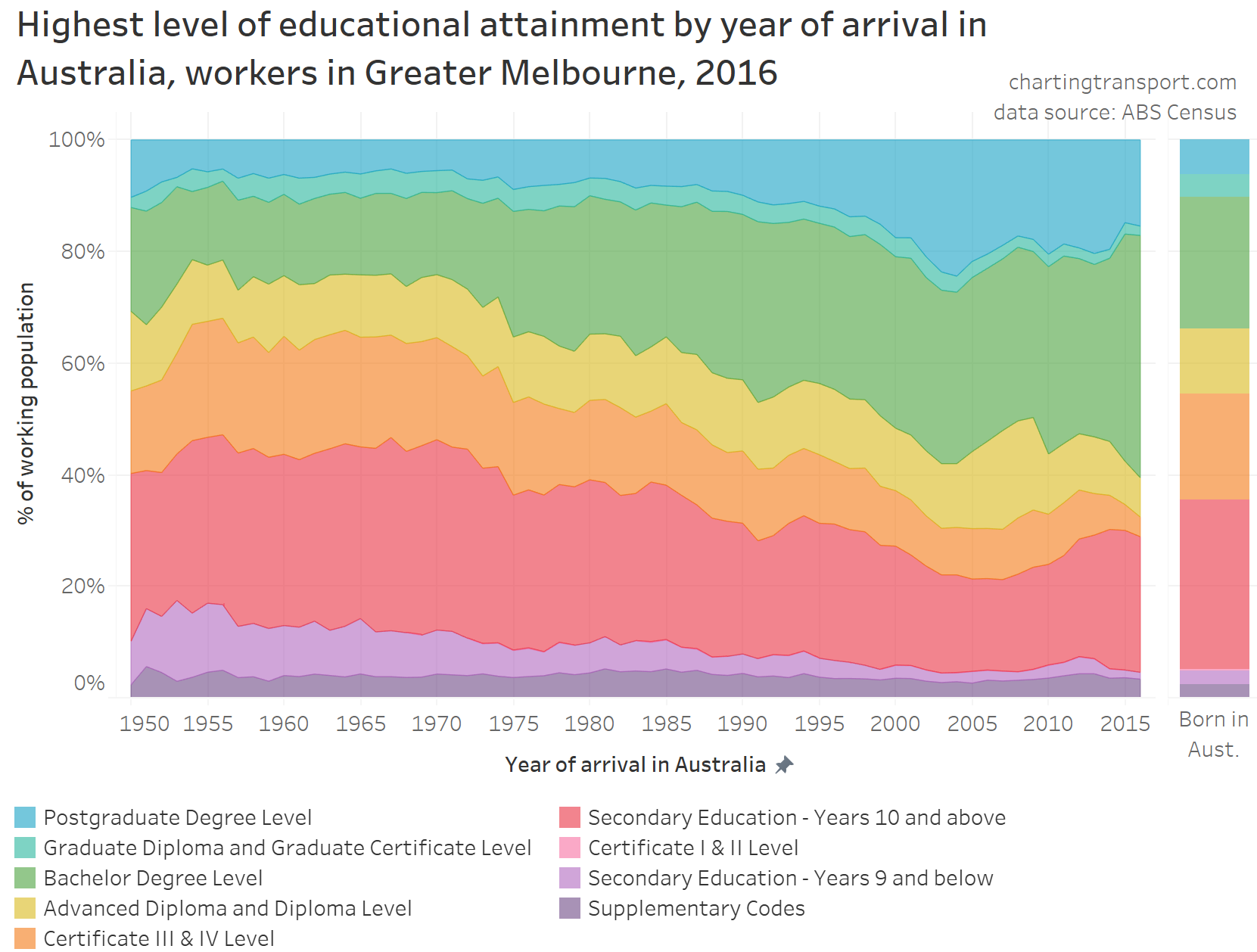
More-recent immigrants were also more likely to have a higher level of educational attainment than less-recent immigrants, and generally much higher than those born in Australia:
This probably reflects skilled immigration programs favouring people with higher educational qualifications. Indeed 60% of workers who arrived between January 2016 and the August 2016 census had a Bachelor or higher qualification. And we know from a previous post that highly qualified workers were more likely to work in central Melbourne, and were more likely to have used public transport in their journey to work.
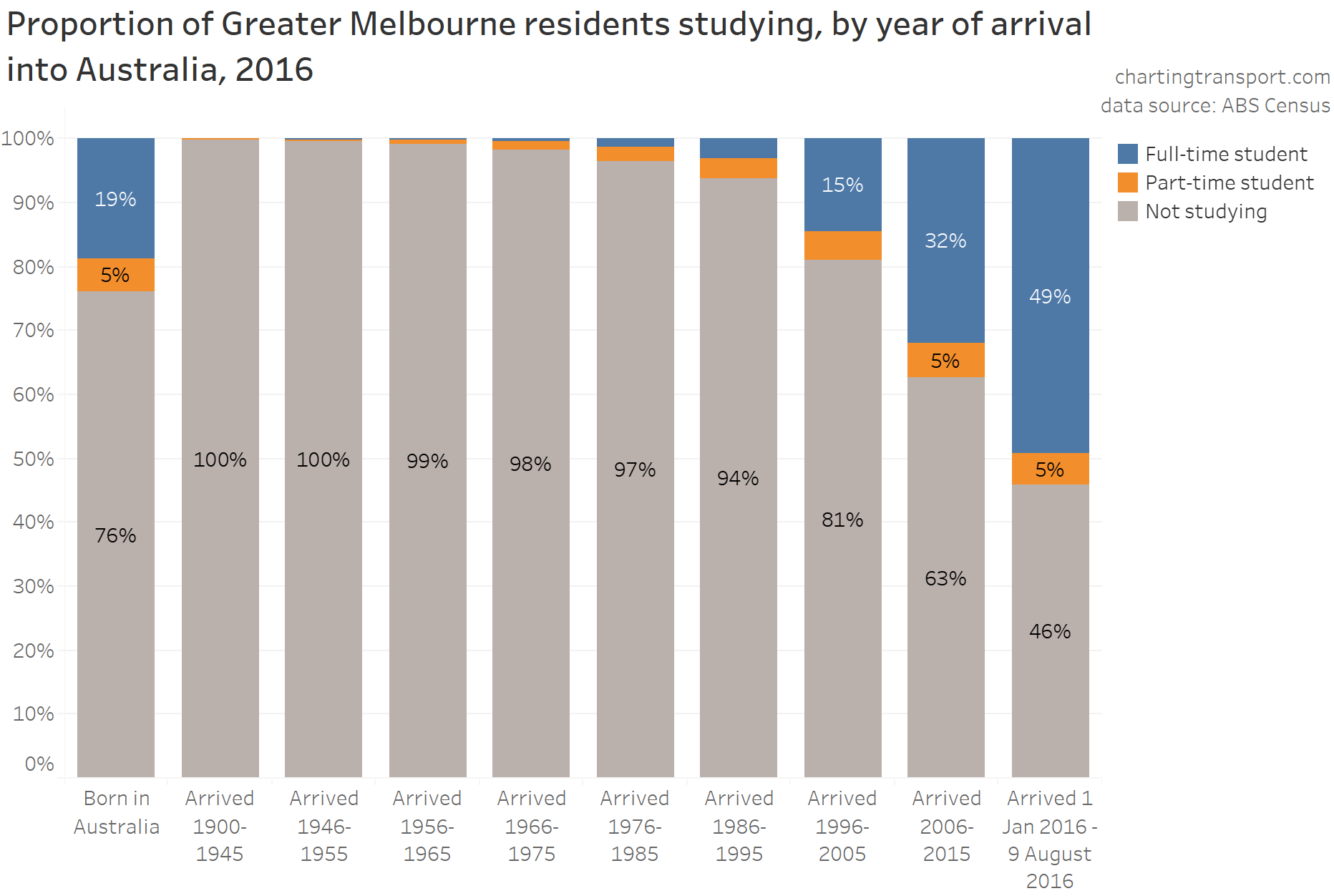
Not only were more recent immigrants generally highly educated, many came to Melbourne to study to raise their educational attainment. Here is a chart showing the proportion of immigrants who were full-time or part-time students, by arrival year groups:
I will explore the relationship between student status and journey to work mode shares in an upcoming post.
How did immigrants shift around Melbourne over time?
Could internal migration explain why immigrants shifted away from public transport over time? Using census data across 2006, 2011, and 2016, it is possible to roughly track the population distribution of particular immigrant cohorts (although it’s not perfect because these immigrants may have moved in/out of Melbourne or left Australia between censuses, including temporary residents).
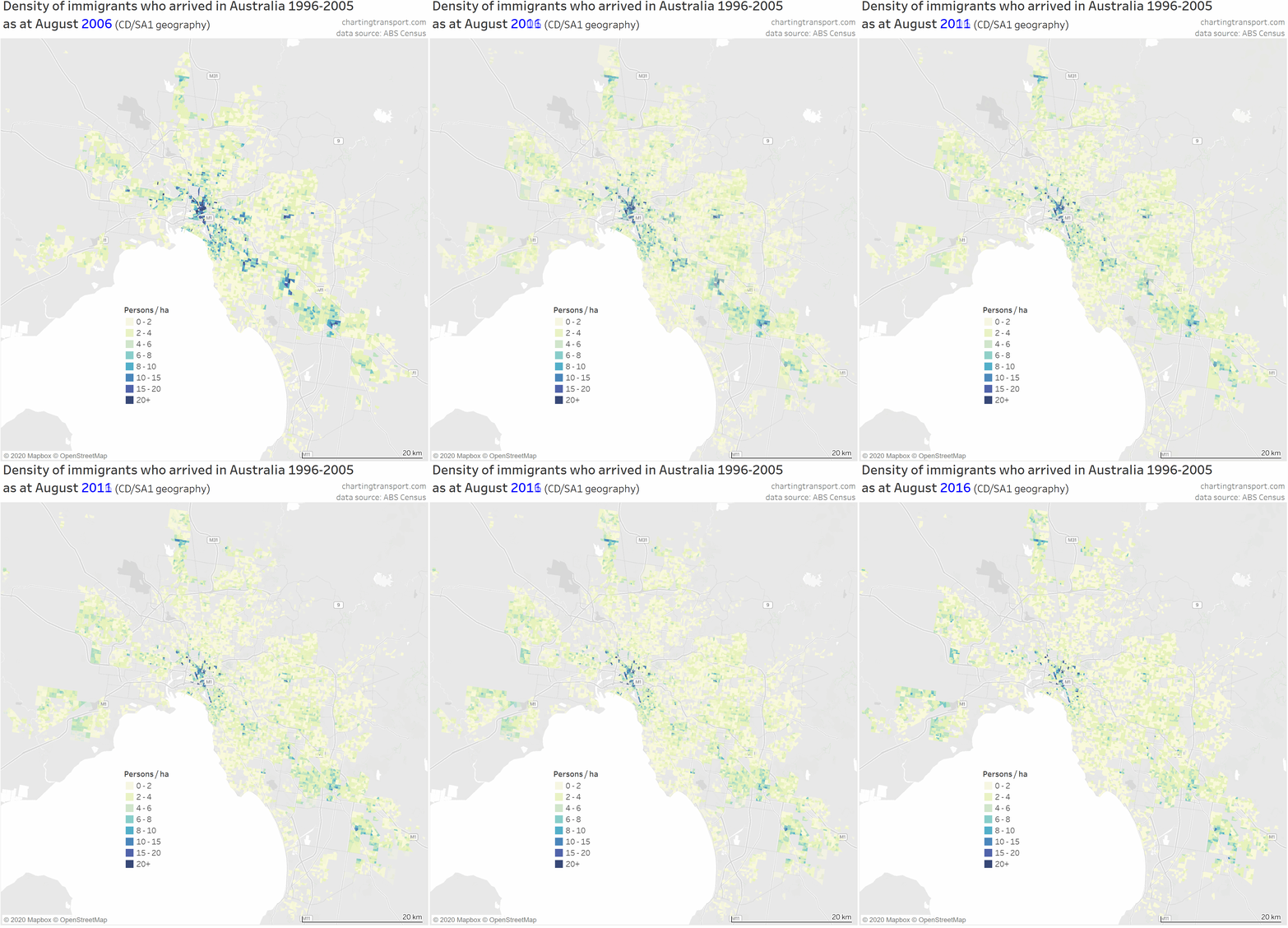
The following map shows the density of immigrants who arrived in Australia between 1996 and 2005 across census years 2006, 2011, and 2016:
In 2006 there were concentrations around the central city and many rail stations. But these concentrations reduced over time, with many of these people moving into other suburbs by 2011 or 2016 (or leaving Melbourne). In particular, many moved to outer suburbs such as Tarneit, Truganina, Point Cook, Derrimut, Craigieburn, Roxburgh Park, and Narre Warren South.
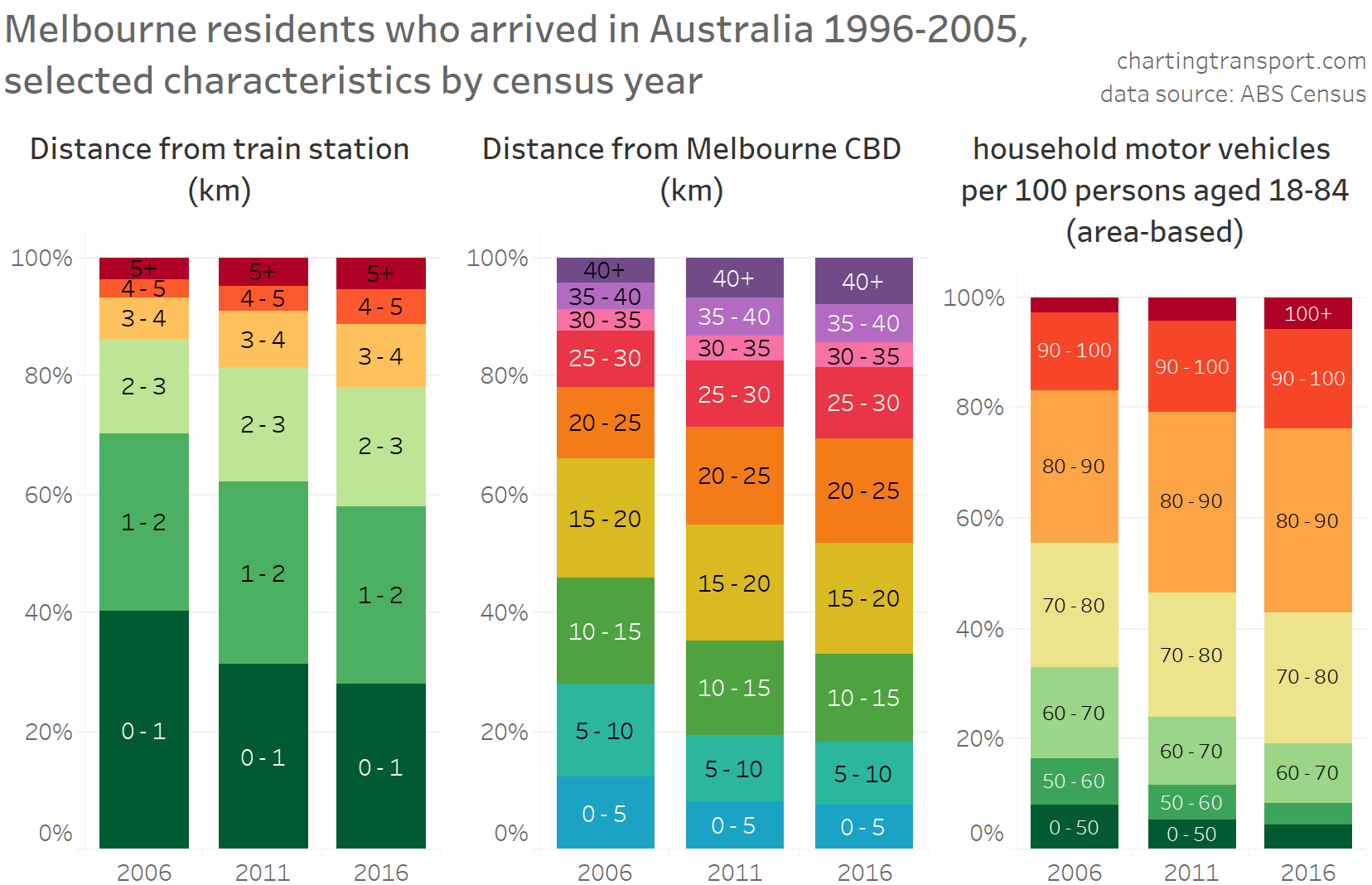
To help summarise these shifts, the following chart shows the distribution of this cohort across census years by distance from train stations, distance from the Melbourne CBD, and the motor vehicle ownership rate of the areas in which they lived:
You can see that they generally moved further away from train stations, further away from the CBD, and into areas that had higher levels of motor vehicle ownership. All these shifts are associated with reduced public transport mode share, and I suspect this pattern would not be unique to those who arrived 1996-2005.
Is there a relationship between PT mode shares and where people were born?
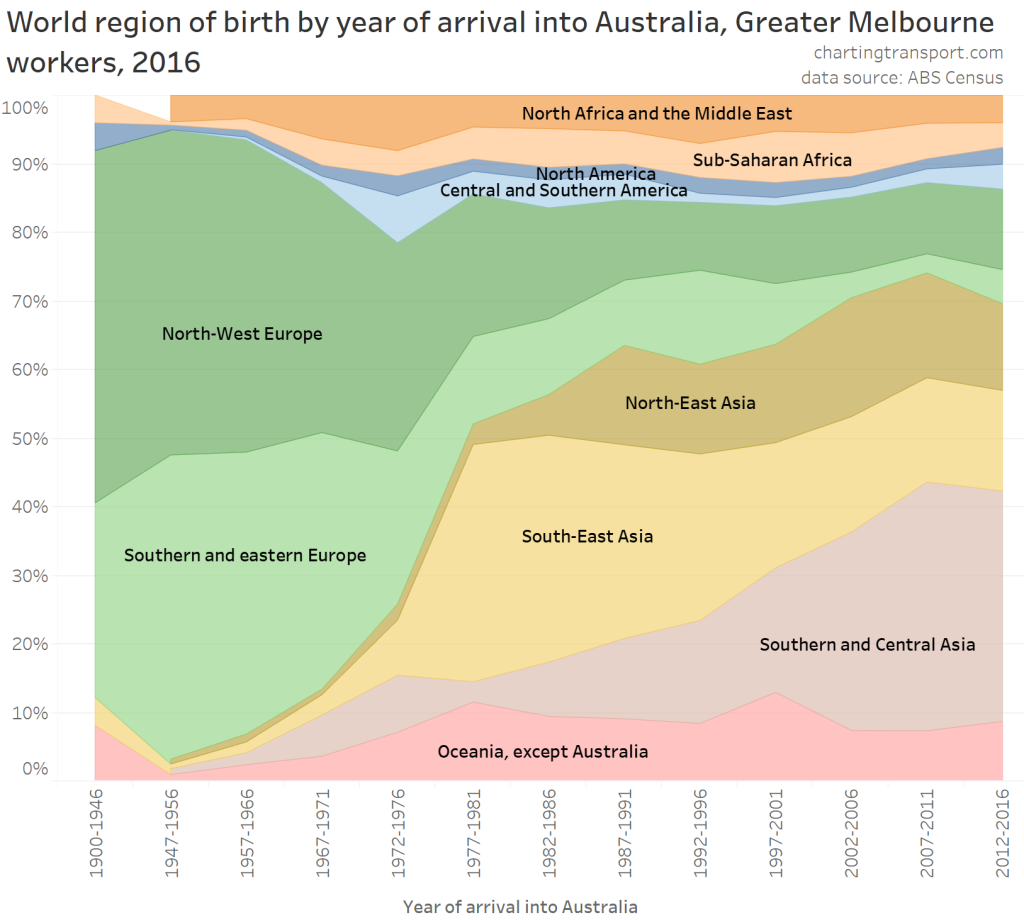
Firstly, here’s a chart showing the birth regions of Melbourne workers who were born outside Australia, by year of immigration (mostly 5 year bands). I’ve used ABS’s country of birth groups, except that I’ve separated North America from the other Americas.
The early half of the 20th century saw significant immigration from Europe, whereas in more recent times this has shifted to Asia, with southern and central Asia now the biggest source of immigrants. (Southern and central Asia includes India, Sri Lanka, Bangladesh, many former Soviet republics south of Russia and all “-stan” countries.)
So do journey to work public transport mode shares vary by immigrants’ region of birth?
There certainly is some variance between birth regions, but not quite what I was expecting. Immigrants from seemingly car-dominated north America had much higher PT mode shares than those born in European countries with reputations for higher quality public transport.
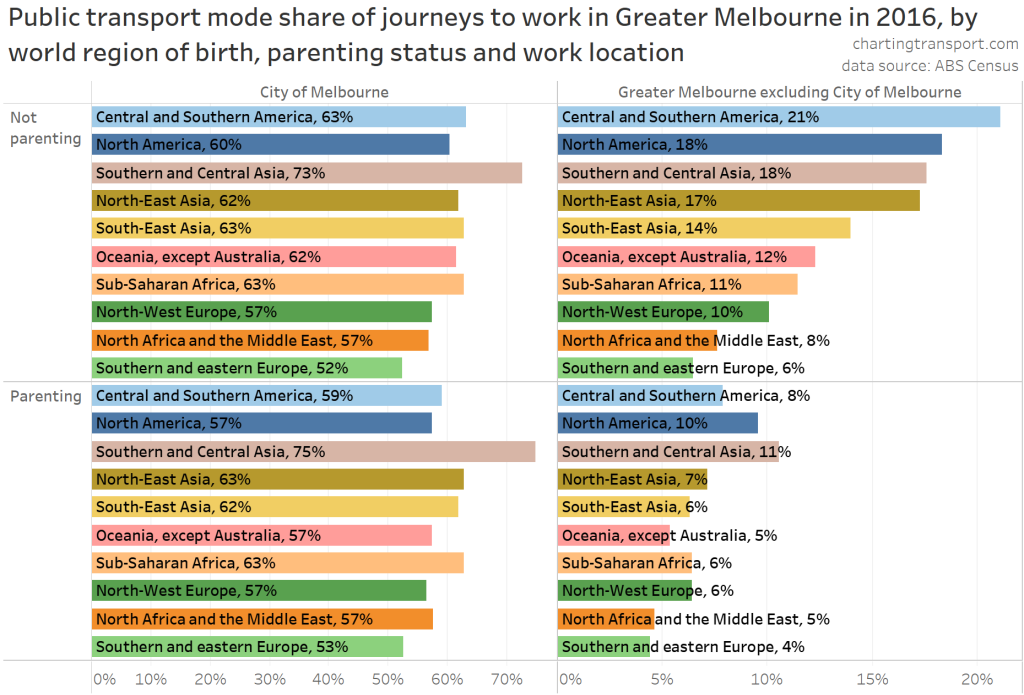
Of course people born in different parts of the world may be more or less likely to work in the City of Melbourne, and might be more or less likely to be parents. These factors strongly influence PT mode shares. So the next chart disaggregates the data by parenting status and work location (note a different X-axis scale used for each work location division).
This birth regions in this chart have the same ordering as the previous chart, but in most quadrants the mode shares are no longer in order (the top-right quadrant being the exception: non-parenting, working outside the City of Melbourne). Southern and central Asia tops PT mode shares for the other three quadrants, and by quite a large margin for City of Melbourne workers.
We know year of arrival into Australia is a significant factor in PT mode shares, and relative composition of immigrants has certainly changed over time. Also, age itself is likely to be a factor. The next chart adds these two dimensions. However, I have had to remove people working in the City of Melbourne, those under 20 and those over 60 – because the population for these categories became too small, introducing meaningless noise.
You can see there was a relationship between year of arrival and PT mode share within each age band, for both parenting and non-parenting workers. Central and Southern America generated the highest average PT mode shares while North Africa and the Middle East often had the lowest PT mode shares.
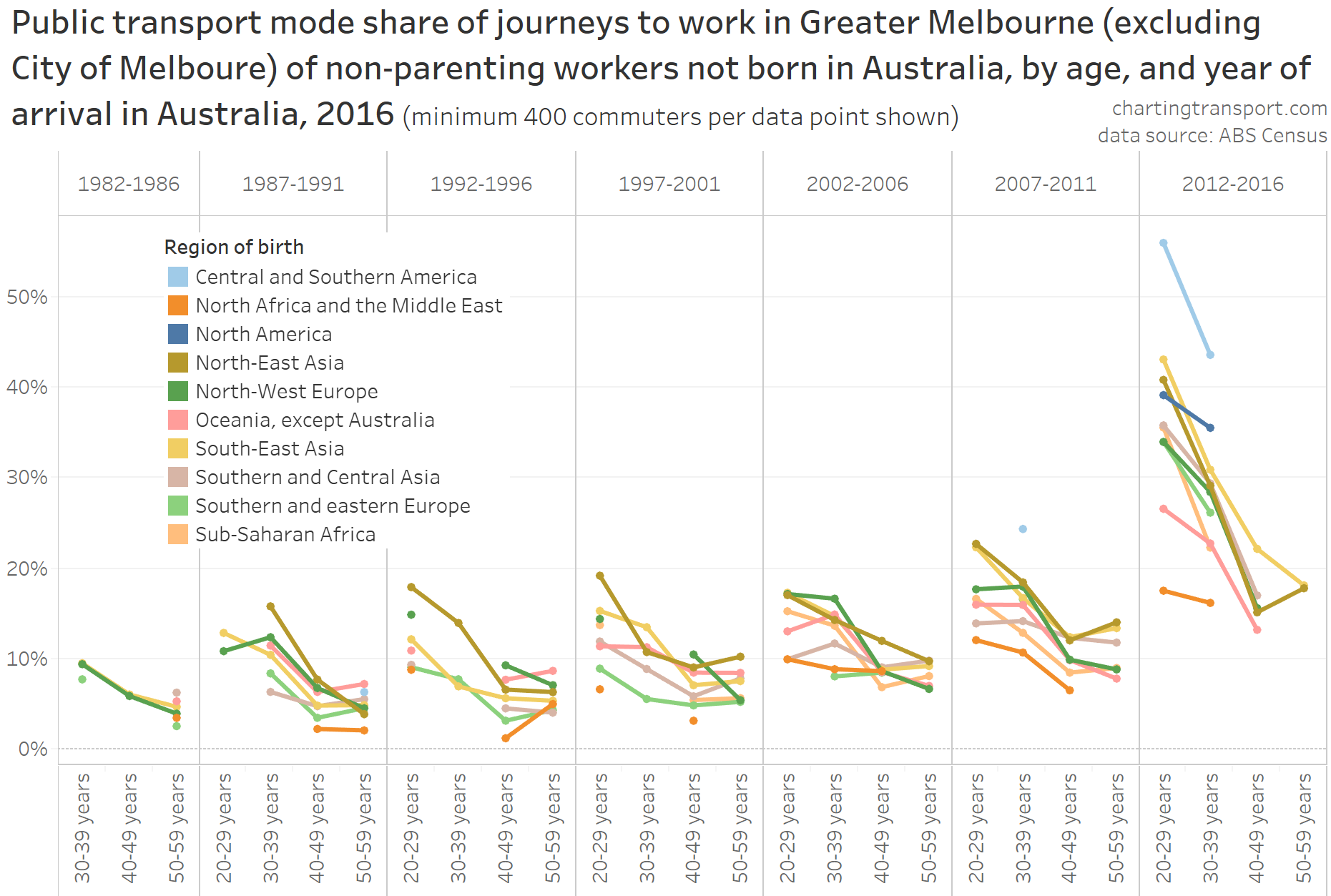
Here’s another look at that data, but comparing mode shares primarily by age rather than year of arrival. For this chart I’ve (also) removed parenting workers, and those who arrived before 1982, because they are mostly spread across just two 10 year age bands which isn’t really enough to show an age-based trend:
This chart shows that there was certainly a relationship between age and PT mode share for most birth regions (as well as year of arrival), at least for non-parents working outside the City of Melbourne.
I cannot be certain that this pattern also existed for all birth-regions for parenting workers and people who worked within the City of Melbourne, but I have previously shown a relationship between age and PT mode share for these categories (when ignoring birth region), so a relationship is likely.
So even with a changing mix of immigrant sources over time, age (or some other age-related factor) remains a significant factor when it comes to explaining public transport mode shares.
I hope you’ve found this at least half as interesting as I did.





 Posted by chrisloader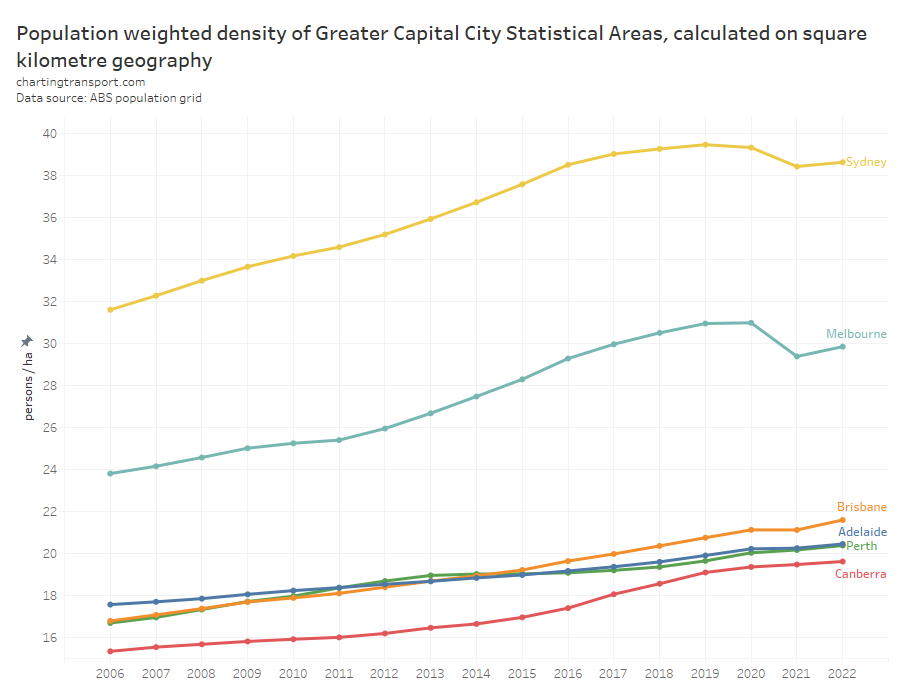








 Charting Transport