Changes in Melbourne motor vehicle ownership 2006 to 2011

Fri 12 October, 2012

My second look at 2011 census data focusses on motor vehicle ownership rates. Is the rate of car ownership still increasing? Has the rate of car ownership dropped in any areas?

Measuring motor vehicle ownership rates

The raw census data provides the number of dwellings with 0, 1, 2, 3 or 4+ motor vehicles in each geographic area. Often people draw maps showing the proportion of dwellings with 2+ motor vehicles. That is easy to do, but it ignores the number of driving aged adults likely to be in those households.

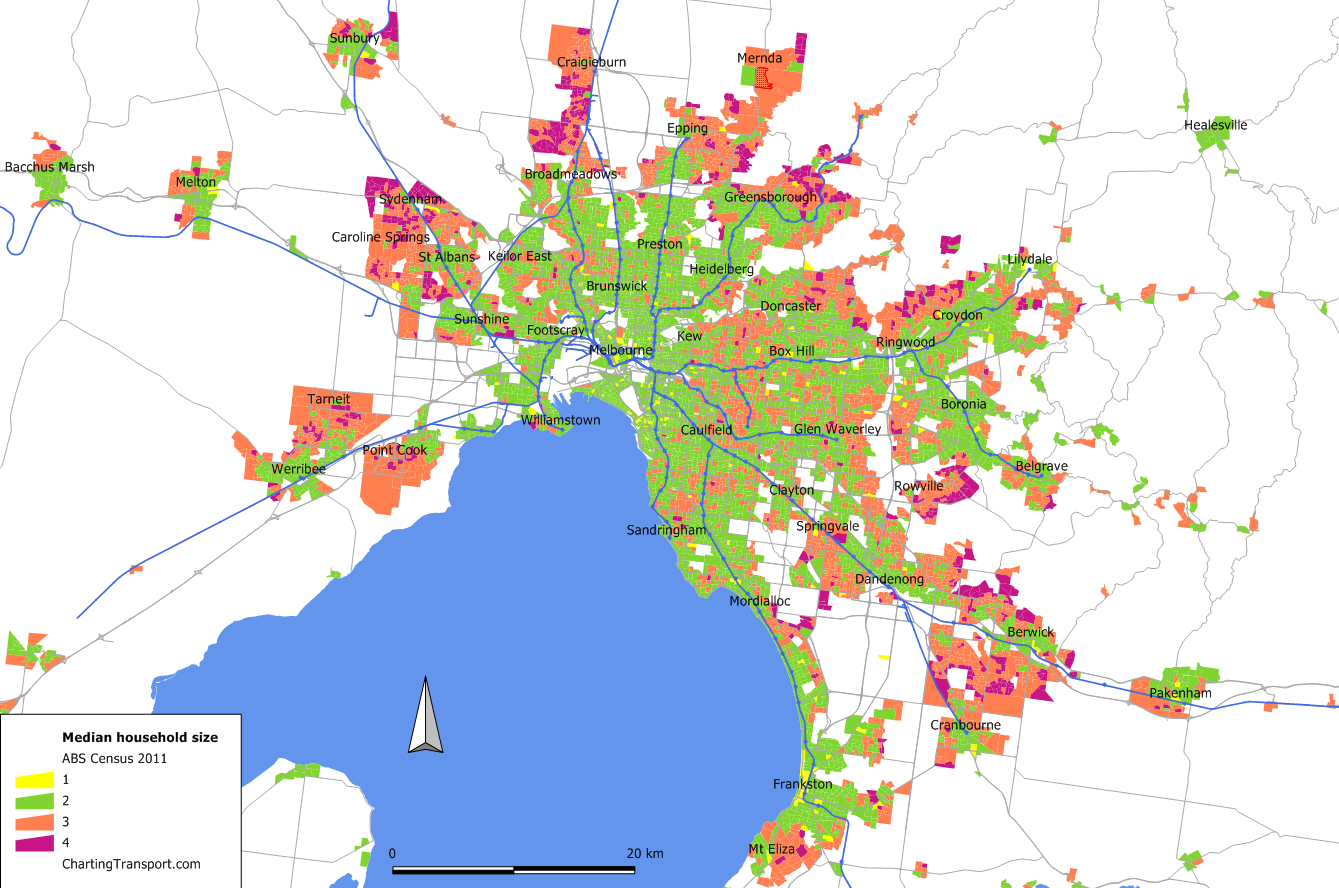
Here’s a map showing the median household size in persons for 2011 (click to enlarge):

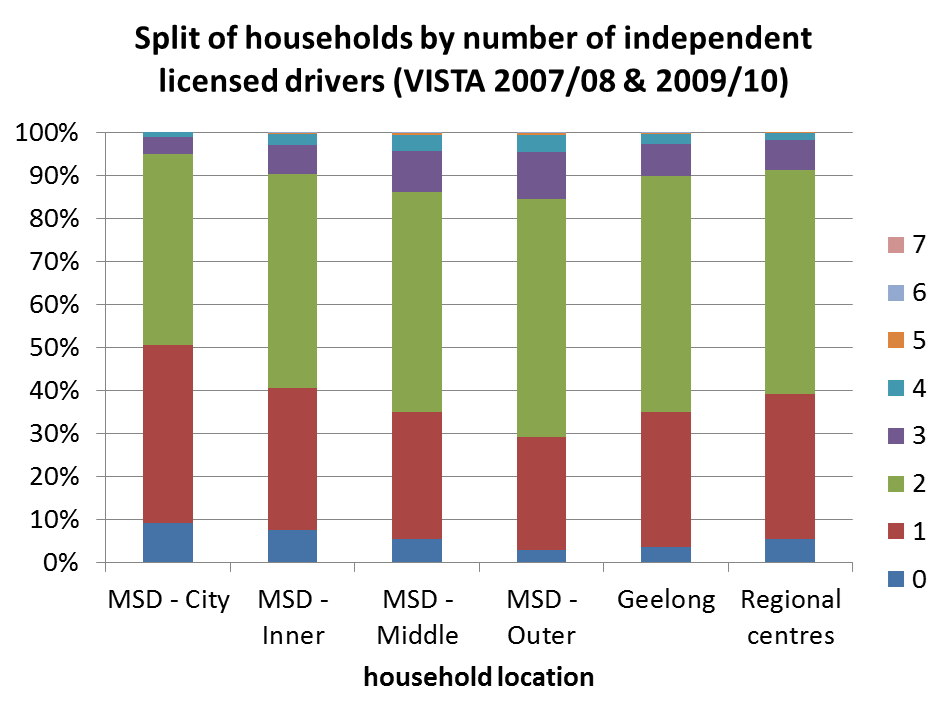
There’s a very distinct trend that household sizes are larger on the fringe. Looking at VISTA data, households in the outer suburbs are more likely to have more licensed drivers (I define “independent licensed drivers” as people with a full or probationary license, and MSD refers to Melbourne Statistical Division):

16% of households in the outer suburbs of Melbourne have 3 or more independent licensed drivers whereas the figure is only 10% in the inner suburbs.

My preferred measure is to estimated the ratio of home-based motor vehicles to the driving age population (unfortunately the census doesn’t provide data on driver’s license ownership). To make such a calculation I have to make a few assumptions:

  • Dwellings that did not state number of motor vehicles had no motor vehicles.
  • Dwellings that stated 4 or more motor vehicles had an average 4.3 vehicles (average figure obtained from VISTA 2007/08 and 2009/10 combined). This average could of course change over time, so there’s a slight imperfection in the calculation for around 5-6% of dwellings. I have assumed a constant 4.3 across 2006 and 2011.
  • Driving aged population is approximated by people aged 20-74 (I used 20-74 as I only have population counts in 5 year groupings for small areas). Of course there are some people aged 20-74 who do not have a driver’s license, and there are people aged under 20 and over 74 who do have a driver’s license. See my previous post about who uses public transport for charts showing the rate of driver’s license ownership by age group.

Melbourne motor vehicle ownership maps

I have calculated an estimated ratio of home-based motor vehicles to the notional driving aged population for Melbourne, at smallest available geographies for 2006 and 2011 (Census Collection Districts and Statistical Area Level 1 respectively).

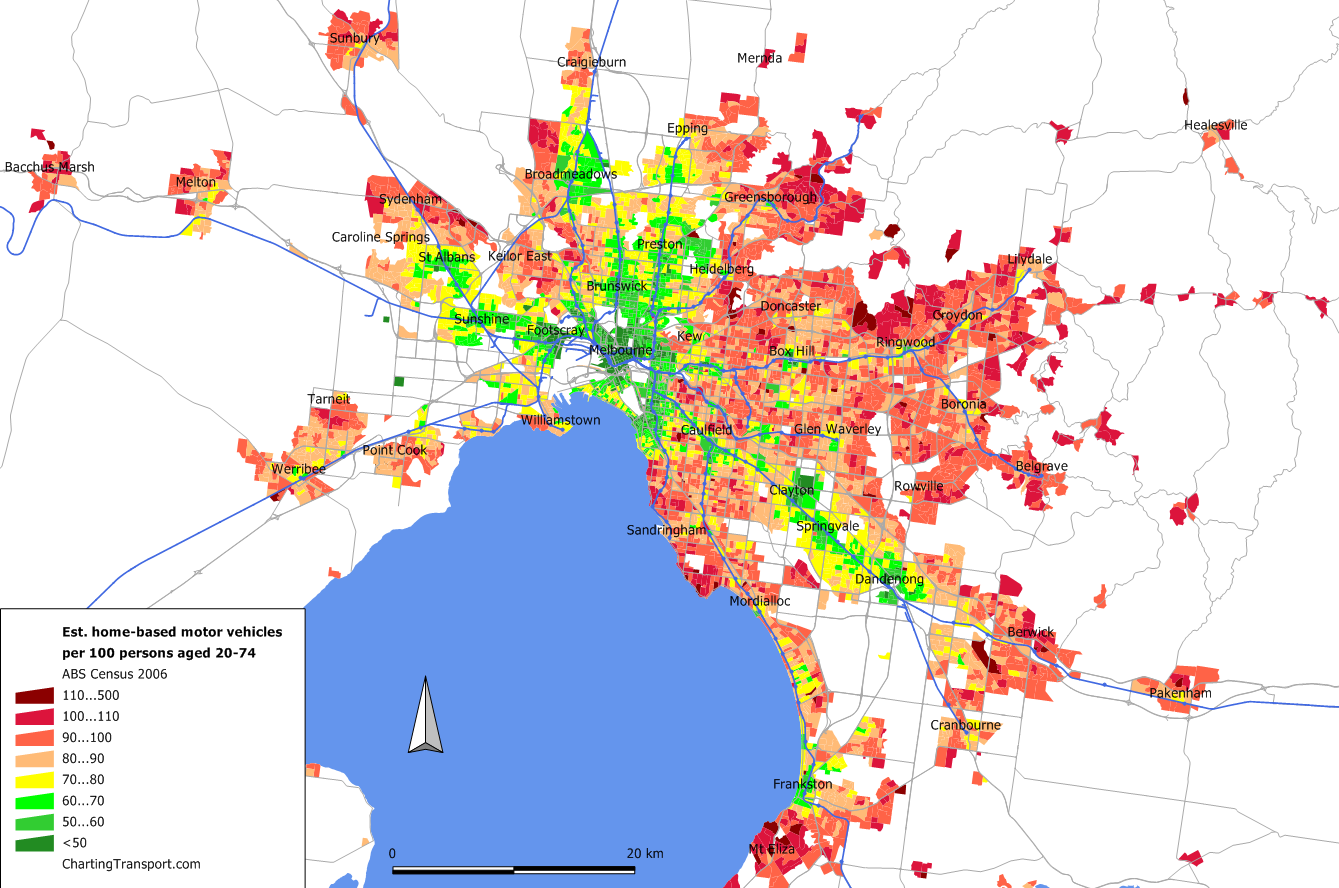
Here is a map showing the estimated rate of motor vehicle ownership in 2006 at the Census Collection District level:

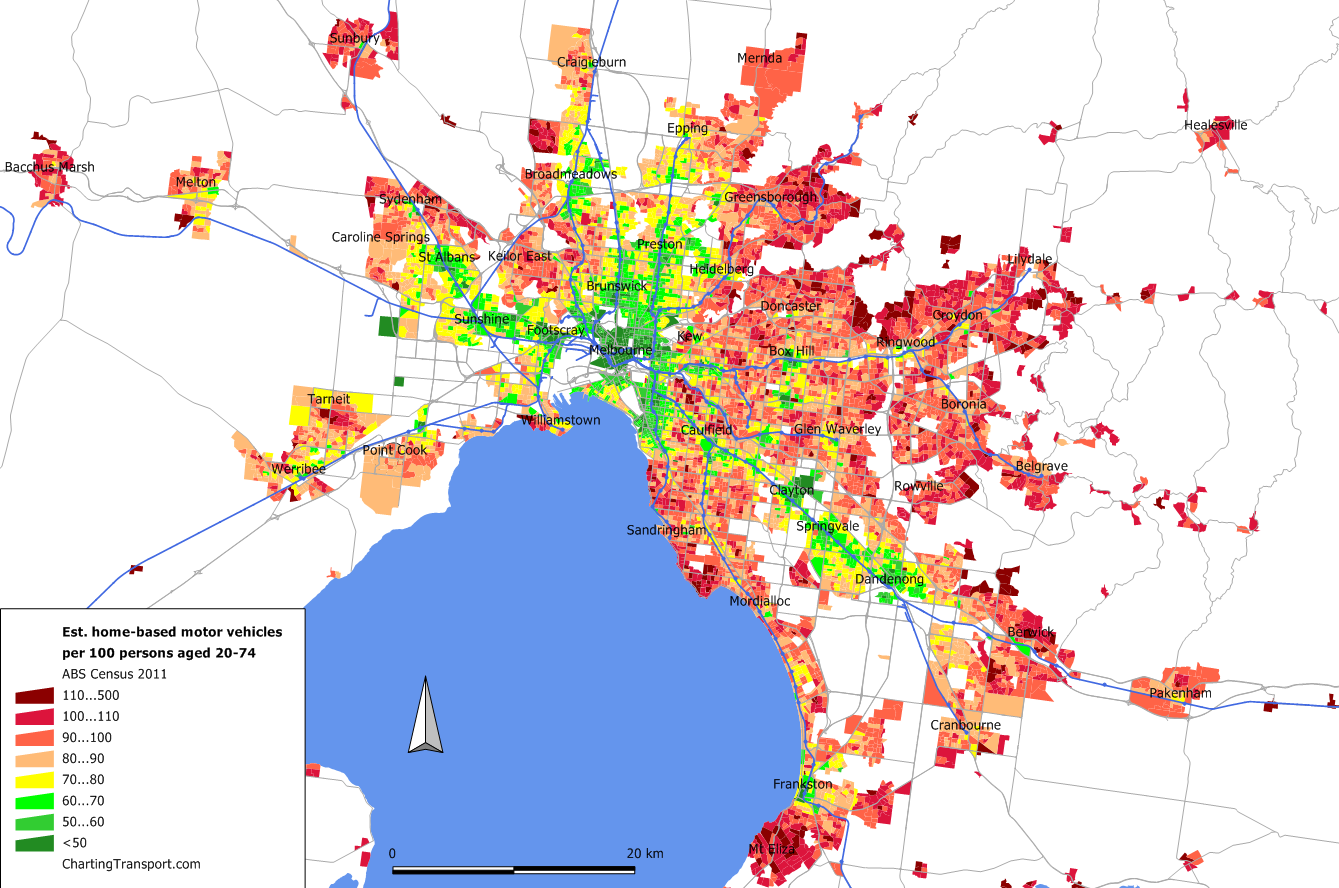
Here is a map showing the estimated rate of motor vehicle ownership in 2011 at Statistical Area Level 1:

You can see lower motor vehicle ownership rates around:

  • the inner city areas where there is a high quality public transport;
  • some lower socio-economic suburban areas such as St Albans, Broadmeadows, Preston, Springvale, Dandenong, Frankston; and,
  • tertiary education campuses including Clayton, Bundoora, Burwood, Glenferrie, Box Hill, Holmesglen.

The highest rates of motor vehicle ownership are seen in:

  • relatively wealthy suburbs on the urban fringe (often with low density rural residential style developments), including Greenvale, Eltham north, Donvale, Mt Eliza, Narre Warren north, Lysterfield; and,
  • relatively wealthy middle suburbs, such as Ivanhoe, Toorak, Beaumaris, Essendon, Kew, Brighton.

Changes in motor vehicle ownership 2006 to 2011

So how have motor vehicle ownership rates changed? You could flip back and forwards between the above two maps, but with different geographies it isn’t easy to spot all the changes.

Some areas that appear to have had reductions in motor vehicle ownership rates include pockets of Werribee/Hoppers Crossing, Burwood (around the Deakin University campus), and central Frankston. Some areas that appear to have had significant increases in motor vehicle ownership rates include Mt Eliza, Doncaster, Templestowe, Williamstown, and North Ringwood.

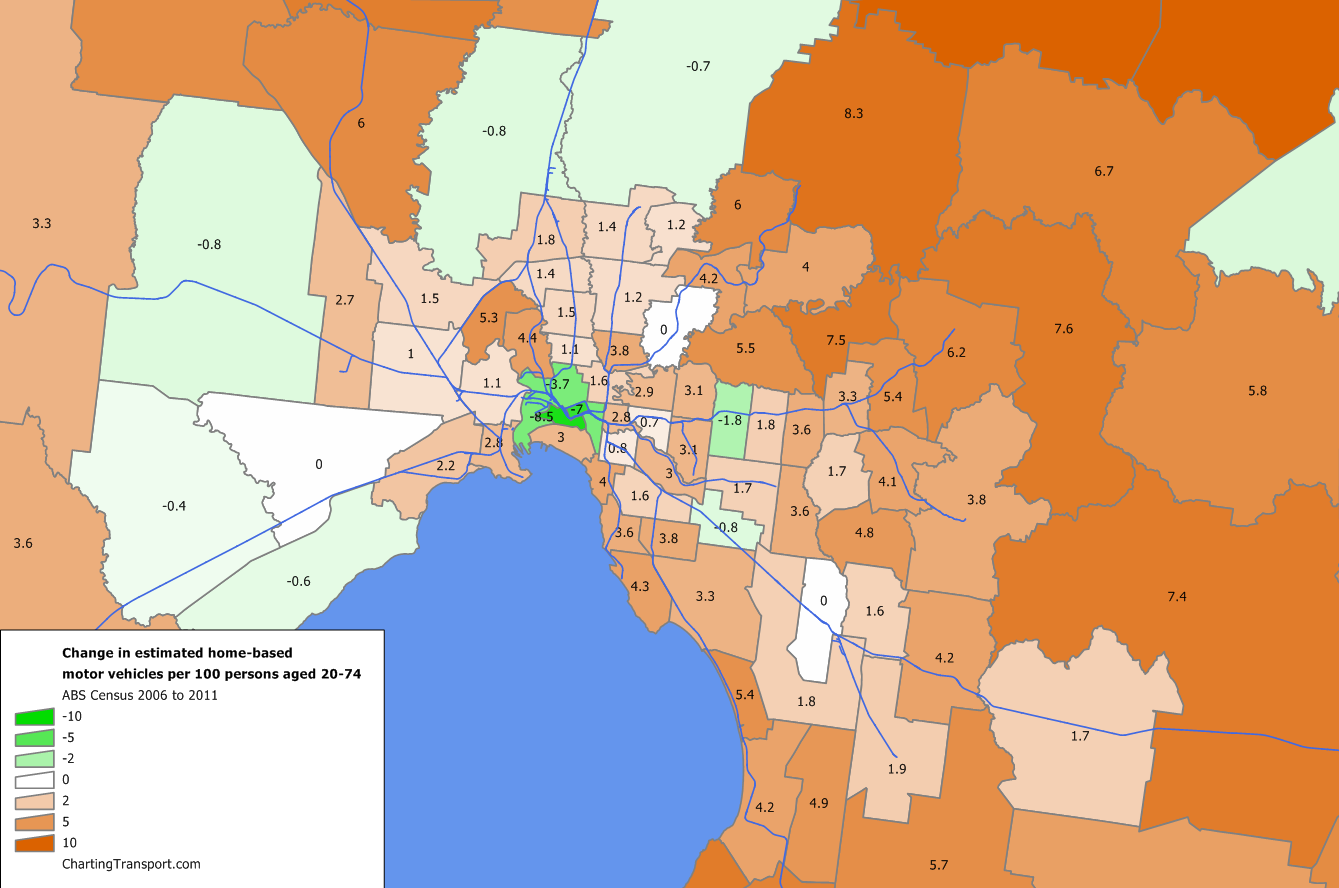
A more systemic comparison requires use of the smallest common geographical unit common to both the 2006 and 2011 censuses, which is the Statistical Local Area (SLA). The following map shows the change in estimated motor vehicle ownership rates between 2006 and 2011 at the SLA level:

There are a few notable reductions in the rate of car ownership:

  • The City of Melbourne, particularly the CBD and Southbank/Docklands
  • Box Hill (perhaps due to an influx of students at Deakin University Burwood campus)
  • Monash – south west (which includes Monash University)
  • The outer western and northern suburbs
  • Yarra Ranges – Part B (non-metropolitan, and I’m not sure what might be happening there)

The biggest rises can be seen in:

  • Manningham (west and east)
  • Moonee Valley
  • Rowville
  • Sunbury
  • Nillumbik
  • Yarra Ranges
  • Cardinia – north (non-urban)
  • Kingston – south
  • Casey – south
  • Mornington Peninsula – West

So what might explain these patterns?

  • There has been a long term trend of increasing car ownership (refer previous post). Certainly the real cost of car ownership has been going down for some time now.
  • Areas with large numbers of tertiary students appear to have had a decline in car ownership, perhaps reflecting successful mode shift campaigns with staff and students, and/or an influx of international students who might be less inclined to buy a car and/or drive.
  • A growth in apartment living in the inner city, where there is less need to own a car due to high quality public transport and many destinations within walking distance. Although I note that motor vehicle ownership rates still rose in the neighbouring City of Yarra, suggesting densification a couple of suburbs out from the CBD seems to still be introducing more cars (and/or other motor vehicles).
  • I’m really not sure why the rates of car ownership appeared to decline slightly in the outer growth areas to the west and north, but not the  south-east (although the Cranbourne and Pakenham SLAs only showed relatively small increases of 1.7 and 1.9 respectively). I should point out that the decreases are very small (all less than 0.8) and probably not significant when considering the assumptions I have had to make in calculating the estimates.

I’d also make the comment that increased car ownership doesn’t mean increased car use. As I’ve pointed out elsewhere on this blog, average km travelled per car has peaked in Australia, as has car passenger km per capita.

Other motor vehicle ownership analysis

For more on car/motor vehicle ownership see:

  • a previous post about trends in car ownership over the years at a state (and whole of Melbourne) level using data from the annual ABS Census of Motor Vehicles
  • analysis of motor vehicle ownership saturation in households, in my first post on who uses public transport.

Visualising the changing density of Australian cities

Mon 1 October, 2012

[This is an older post. For more recent analysis, see: How is density changing in Australian cities?]

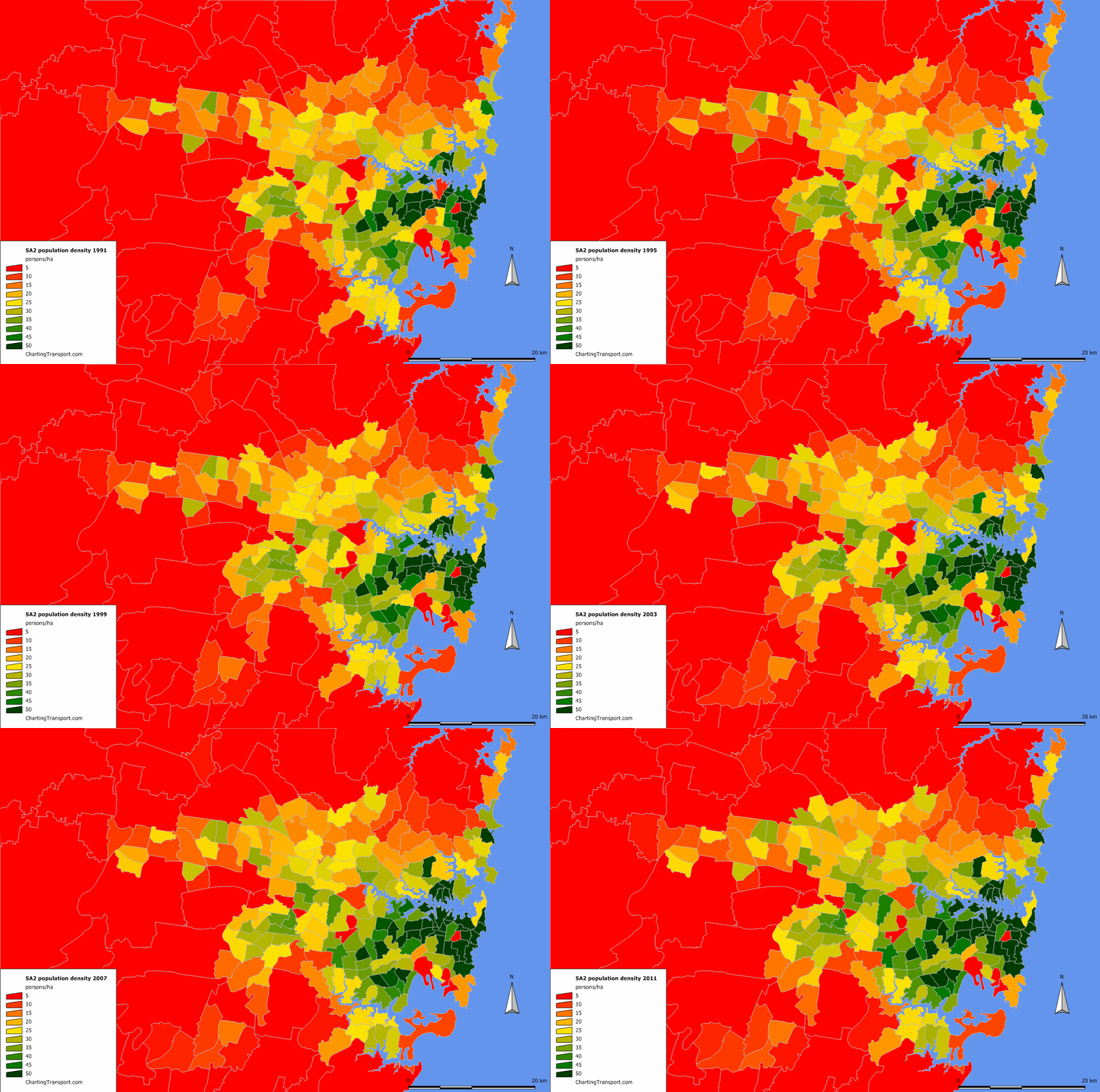
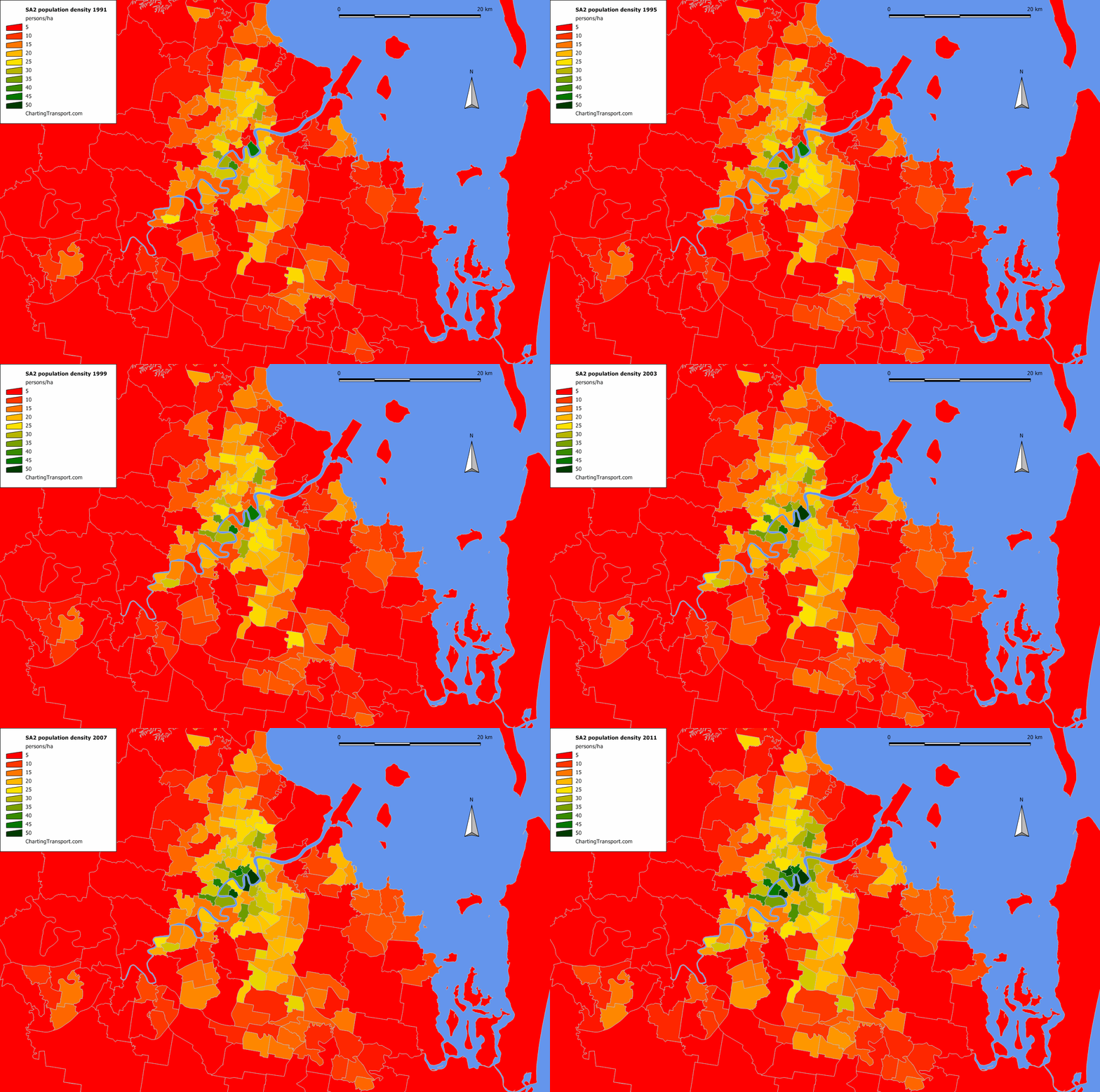
Following on from my last post on Melbourne density, I thought it would be worth creating animations of the change in population density in other large Australian cities.

Below are animated maps showing density using estimated annual population on the ABS Statistical Area Level 2 (SA2) geography for the period 1991 to 2011. You’ll need to click on them to see the animation (and you may have to wait a little if you have a slow connection).

I’ve used SA2 geography because it is the smallest geography for which I can get good time series data. Please note that some SA2s with substantial residential populations will still show up with low average density because they contain large parks and/or industrial areas, or are on the urban fringe and so only partially populated (the non-urban areas bringing down the average density).

Sydney

You can see the growth out to the north-west and south-west, the rapid population growth in the CBD and to the south of the CBD, and general densification of the inner suburbs.

Perth

Perth is a little less dramatic, but you can see strong growth to the far north in the late 2000s, populating of the CBD area, and increasing density in the inner northern suburbs. Many of the middle suburbs show very little change. A lot of Perth’s growth areas don’t seem to show up, probably due to low average densities of fringe SA2s that include non-urban areas.

Brisbane

You can see rapid population growth all over Brisbane, particularly in the CBD are inner suburbs.

Melbourne

In case you missed my last post, here is the map for Melbourne.

I had a bit of a look at Adelaide, but the changes between 1991 and 2011 were not very pronounced due to slow population growth. The process of creating these maps is fairly labour intensive so sorry Adelaide, no map for you (unless I get lots of requests).

I hope this is of interest.


A first look at 2011 Melbourne residential density, and how it has changed

Fri 21 September, 2012

With the gradual release of 2011 census data, I thought it would be worth looking at some transport related themes. I’ll start with residential density (for my look at 2006 density, see an earlier post). This post looks at 2011 density, and how density has changed over the years.

The big issue with residential density is how you measure it. In showing it graphically, I prefer to use the smallest available geographic areas, as that can remove tracts of land that are not used for residential purposes (such as parks, creeks, wide road reservations etc).

At the time of posting, 2011 census population data was only available at “Statistical Area Level 1” (SA1). In 2013, population figures for the smallest ABS geographic unit – mesh blocks – will be available for a fine grain look at density.

However, land use descriptions for mesh blocks were available at the time of posting. I have used the indicated land use of each block to mask out land where you would not expect people to live – including land that is classed as parkland, industrial, water, or transport.

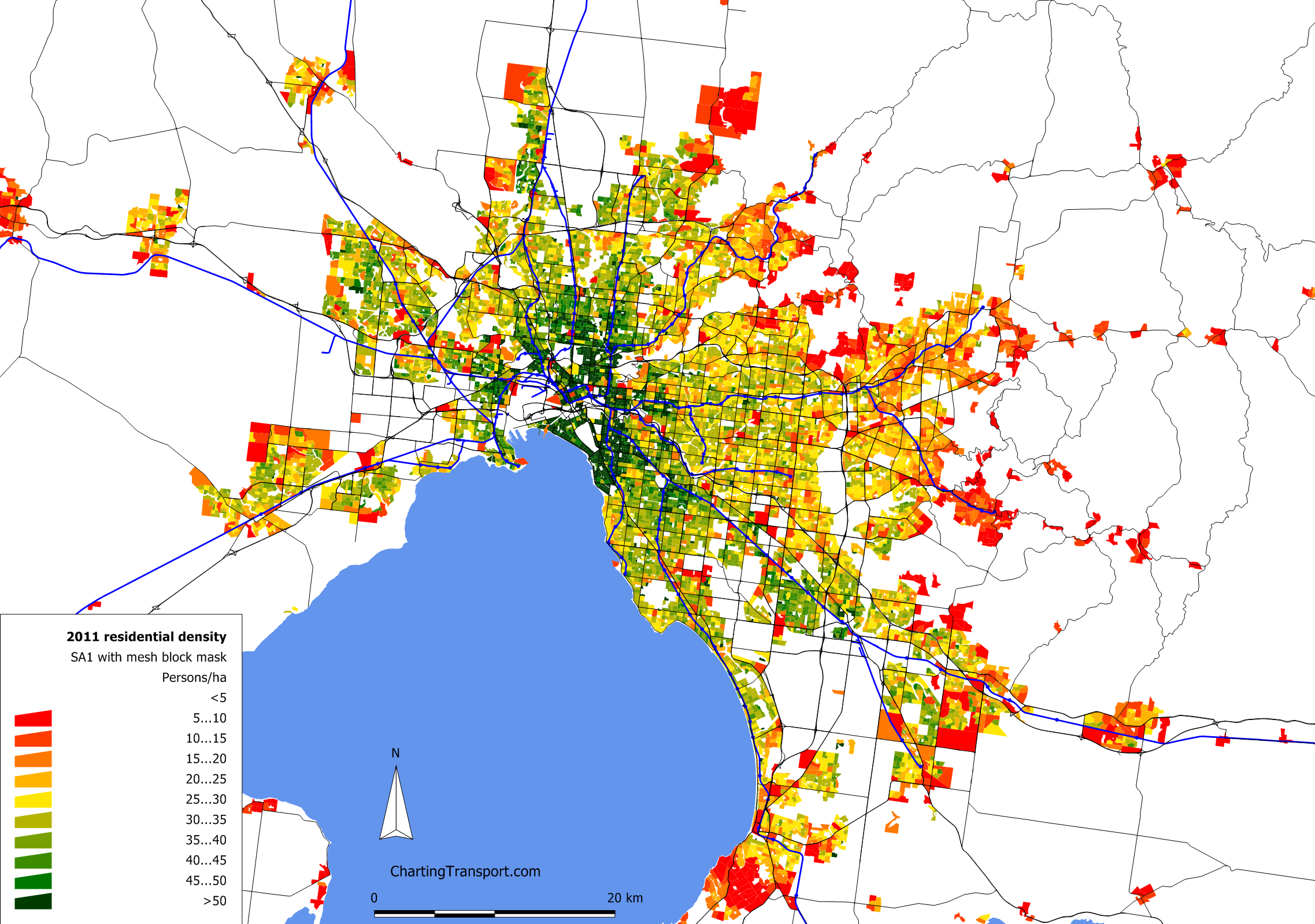
So the map below shows the residential density of Melbourne for SA1s, after stripping out non-residential land. The densities will be higher than if you simply looked at straight SA1 density, but I think they will be a better representation (although not as good as what can be drawn when 2011 mesh block population figures are available). You’ll want to click on the map to zoom in.

The map doesn’t show areas with less than 5 persons per hectare (otherwise there would be a sea of red in rural areas). Many of the red areas on the urban fringe are larger SA1s which will be fully residential in future but were only partially populated at the time of the census. However some are just low density semi-rural areas.

Note that the older middle and outer eastern suburbs are much less dense than the newer growth areas to Melbourne’s north and north-west.

How has density changed between 2006 and 2011?

I think the most interesting comparison will be between 2006 and 2011 mesh block density maps. We will be able to see in detail where densification has occurred, and it will be particularly interesting to look at activity centres.

The smallest unchanged geography level with time series data available is at Statistical Area Level 2 (SA2) – which generally contain one large suburb or a couple of smaller suburbs. Data is available for all years 1991 to 2011 (estimates for June 30, based on census results).

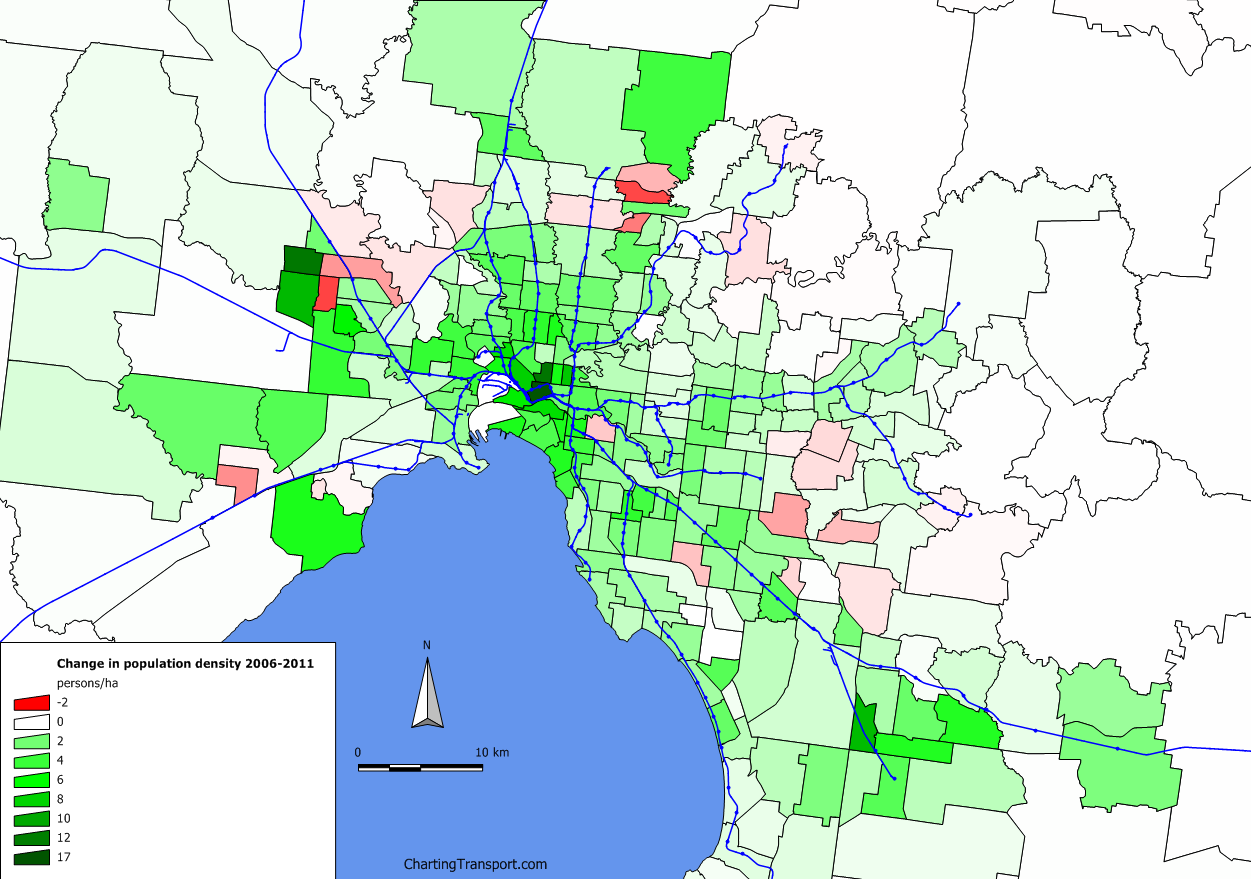
The following map shows the change in estimated density from 2006 to 2011 (using full SA2 land parcels, including any non-residential land). This could equally be considered density of population growth. Unfortunately urban growth in pockets of larger SA2s are less likely to show up as the impacts are washed across the entire SA2, but it gives some idea.

The map shows several SA2s with reduced population density, mostly outer established suburbs:

  • Mill Park – South -1.4 persons/ha
  • Mill Park – North -0.6 persons/ha
  • Bundoora West -0.5 persons/ha
  • Kings Park -1.5 persons/ha
  • Keilor Downs -0.8 persons/ha
  • Wheelers Hill -0.7 persons/ha
  • Toorak -0.4 persons/ha
  • Hoppers Crossing South -0.9 persons/ha
  • Rowville Central -0.5 persons/ha
  • Clarinda – Oakleigh South -0.5 persons/ha

There are increases in many areas, particularly:

  • the Melbourne CBD and immediate north
  • many of the inner suburbs
  • the outer growth areas, particularly to the west, north and south-east.
  • Ormond – Glen Huntly, up 4.4 persons per hectare (not sure what the story is there!)

How has density changed between 1991 and 2011?

Here is an animation showing how Melbourne’s density has changed between 1991 and 2011. You’ll need to click on this to see the animation and more detail.

Note in particular:

  • The CBD and Southbank area going from very sparse to very dense population.
  • The significant densification of Port Melbourne.
  • The significant densification of the inner northern suburbs, particularly in the late 2000s.
  • Some large SA2s in the growth areas don’t show up as becoming more dense as they are very large parcels of land with urbanisation only occurring in a small section. This is especially the case for Wyndham and Whittlesea.

So what was Melbourne’s “urban” density in 2011?

That all depends how you define “urban” Melbourne! The table below shows some calculations based on different criteria for including land. The more restrictive criteria will give an answer that is more of a “residential” than “urban” density.

The different geographies are confusing, so I have produced a map below to try to help.

When more census data is available I will aim to update this list (eg to include density of the Melbourne urban locality).

Geography Area 
(km2)
Population Density 
(pop/ha)
Areas on map
“Greater Melbourne” Greater Capital City Statistical Area 9990.5 3,999,982 4.0 white + yellow + green + red
SA1s, within Greater Melbourne, with population density >= 1 person/ha 2211.4 3,903,450 17.7 yellow + green + red
SA1s less non-residential land, within Greater Melbourne, with population density >= 1 person/ha 2295.2* 3,906,680 17.0 yellow + green
SA1s less non-residential land, within Melbourne Statistical Division, with population density > 1 person/ha 2199.7 3,862,387 17.6 yellow + green within purple boundary
SA1s less non-residential land, within Greater Melbourne, with population density >= 5 person/ha 1740.1 3,787,610 21.8 green

*This area is actually larger than the row above, because more SA1s meet the criteria. Confused? It’s because I’ve cut out the non-residential land from each SA1, which increases the average density of what remains meaning more SA1s meet the criteria. The residential land area of the extra SA1s was slightly more than the non-residential land that was cut out. On the map below there are some yellow and green areas that do not have red “underneath”. The red areas you see on the map below are non-residential land in SA1s.

I’ve calculated the average density of “Greater Melbourne” in the first row for completeness, but this is a bit meaningless as the vast majority of land in “Greater Melbourne” is non-urban land (the white area in the map below).

Here is a map showing the various land areas used in the calculations above (note green and yellow areas overlay most red areas):

I’ll aim to post more about 2011 density when ABS release more census data (including population figures for mesh blocks and ‘urban centres and localities’)


What sorts of people use public transport? (part two)

Sun 24 June, 2012

Part one of this analysis looked at how geography, motor vehicle ownership, driver’s licence ownership related to the use of public transport.

This second post will look at how other personal circumstances relate to public transport, including age, a person’s main activity (occupation), income, employment and household type. Much of this is purely for interest, but I have uncovered a few interesting factors that relate to levels of public transport use.

The analysis is of data from the 2007-08 and 2009-10 Victorian Integrated Survey of Travel and Activity (VISTA).

Make sure you read part one first, so you know how I have gone about this analysis and can decode the terms and acronyms used.

Age and gender

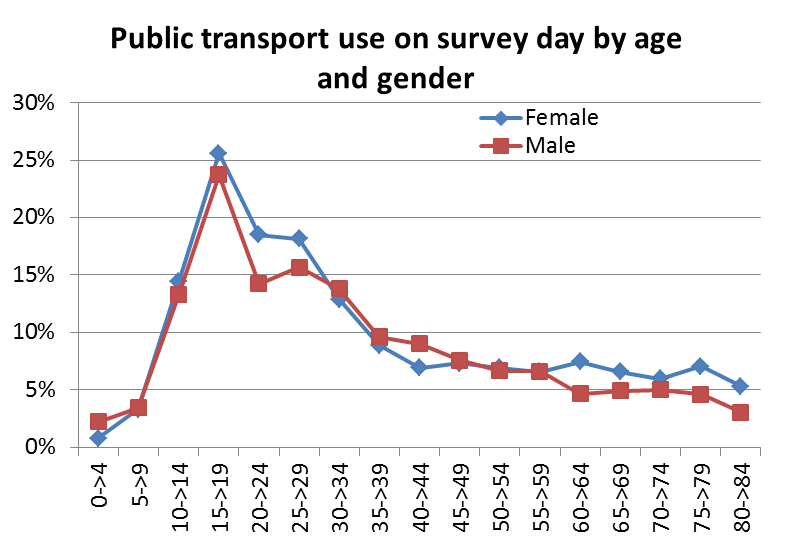
The following chart shows very clearly that public transport use (which includes school bus use) peaked for teenagers and fell away with age:
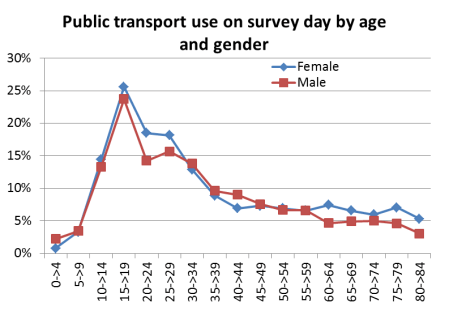
The chart debunks the myth that older people switch from cars to public transport as they give up driving. For males the trend in public transport use continued to decline with age, while females remained at around 7%.

Also of note is that young children had the lowest rates of public transport use of any age group. As you’ll see in a moment, they travelled a fair bit – just not on public transport.

Women aged 20-29 and over 60 were more likely to use public transport than men, while men aged 35-44 were more likely to use public transport than women of the same age. I’ll come to possible reasons for this soon.

As you might expect there were very similar patterns in driver’s licence ownership (see part one) and public transport use by age; although public transport use continued to be relatively high into the 30-34 age bracket and driver’s licence ownership is over 80% by age 30.

So why are there these discrepancies for people in their 30s and 40s? I’ll get to that soon.

But first, is public transport use related to the amount of travel people make?
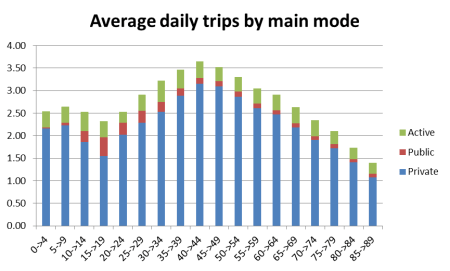
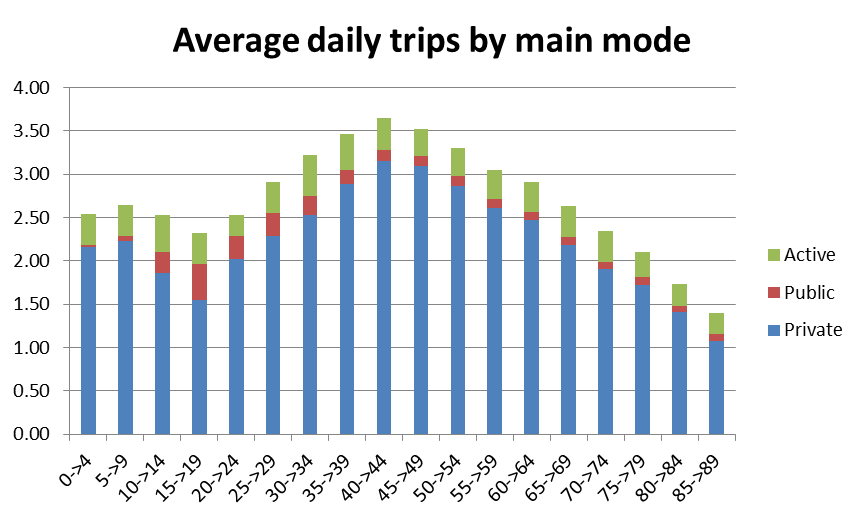
People aged 40-44 were the busiest travellers with 3.7 trips per day on average, which then fell with age. Between the ages of 20 and 44 people made many more trips, but became less likely to use public transport with age.

Young children do travel a fair bit, but rarely on public transport.

The average number of public transport trips per day peaked for teenagers, who also had the lowest overall trip making average.

The average number of active transport trips (walking and/or cycling only) did not seem to vary considerably by age.

Main activity

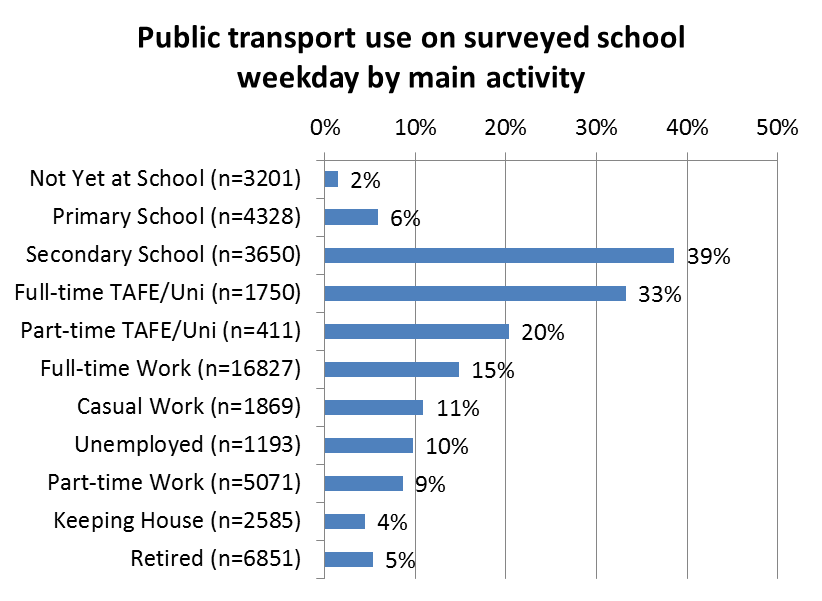
The VISTA survey classifies people by their main activity in life (you might think of this as occupation). Here’s a look at average public transport use on school weekdays.
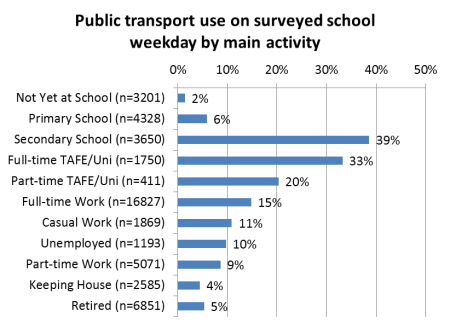
As we saw with age, public transport use peaked for secondary school children, with full time tertiary students not far behind. Children not yet at school were the least likely to use public transport, with those keeping house the next least likely.

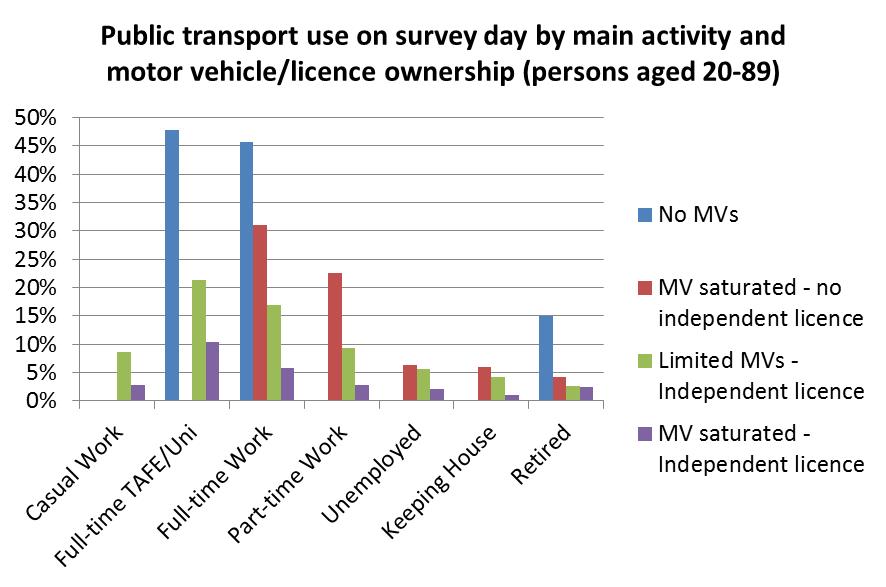
Is that because of their driver’s licence and car ownership status? The following chart tests public transport use by main activity and groupings of licence and motor vehicle ownership (where I could get a cohort of 200 or more – missing values are not 0%).
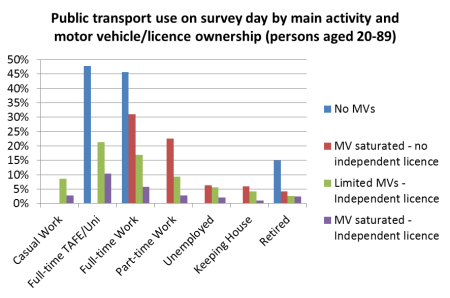
This chart suggests that full time students, full time workers and part time workers were generally more likely to use public transport even if they had access to private transport. Those unemployed, “keeping house”, or retired were only somewhat likely to use public transport if they had limited access to private transport.

So, motor vehicle ownership does not explain the low rate of public transport use by those “keeping house”. I’ll come back to that.

I expect the general explanation for the above chart is that public transport is more likely to be competitive to places of full time work or study, particularly those in the inner city. We know from a previous post that public transport use to suburban employment destinations is very low.

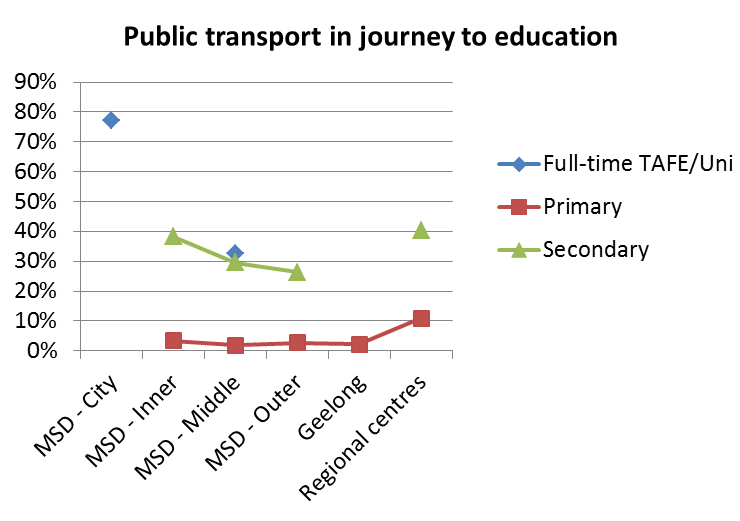
Here’s the picture for journeys to education in VISTA, by the location of education activity (note: cohort sizes down to 120 – a margin of error of 9%).

Very few primary school children took public transport to school (except in the regional centres), while 25-40% of suburban secondary and tertiary students used public transport. Public transport had a very high mode share in journeys to tertiary education in the inner city of Melbourne (where public transport works well and students probably cannot afford to park, even if they can drive a car).

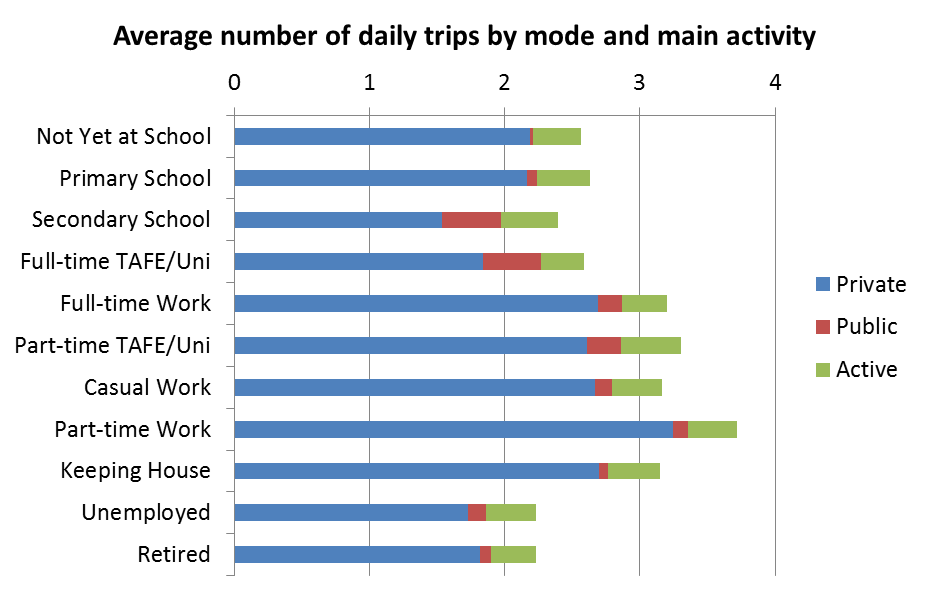
What about trip making rates by main occupation?
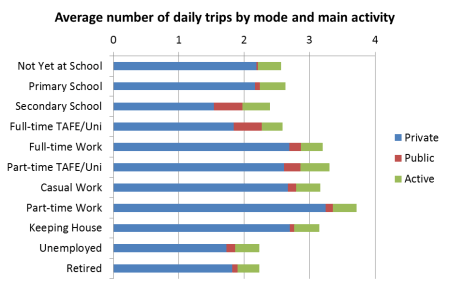
Part-time workers made the largest number of trips on average, while the unemployed and retired travelled the least. Those keeping house did a lot of travel, but very little of it on public transport.

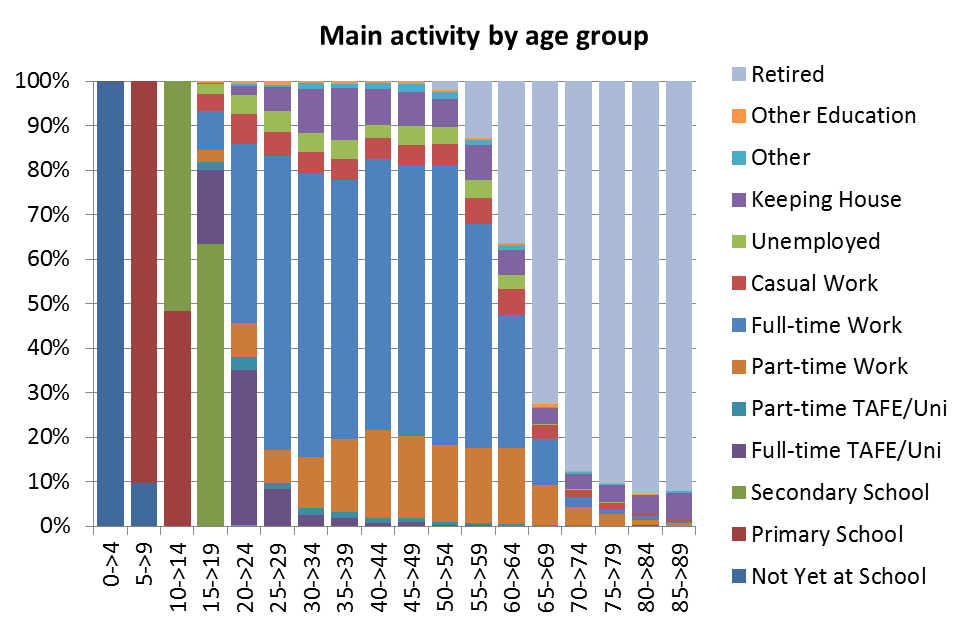
And in case you are interested in the relationship between age and main activity…
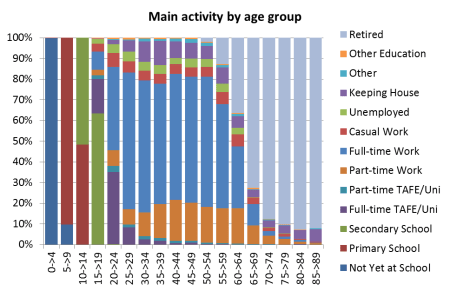
No big surprises there when you think about it. Notice that part time work became much more common from the late 30s.

Income

What impact does income have on public transport use?

I have used equivalised weekly household income per person as my measure, as this takes into account household size and the number of adults/children in those households. It essentially brings all households to the equivalent of a solo adult.
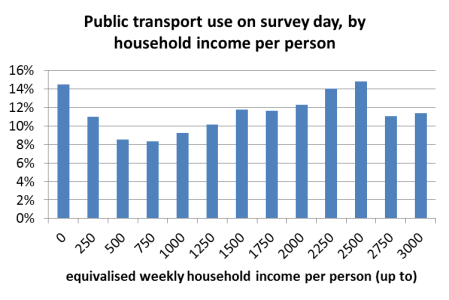
The pattern shows those on lower (but not very low) incomes were the least likely to use public transport. Those with no income were just as likely to use public transport as those on $2500 per week equivalised. So that debunks the myth that public transport is only for poor people! In fact people on very high incomes were more likely to use public transport than those on $500-1000 per week (peaking with those on $2250-2500 per week).

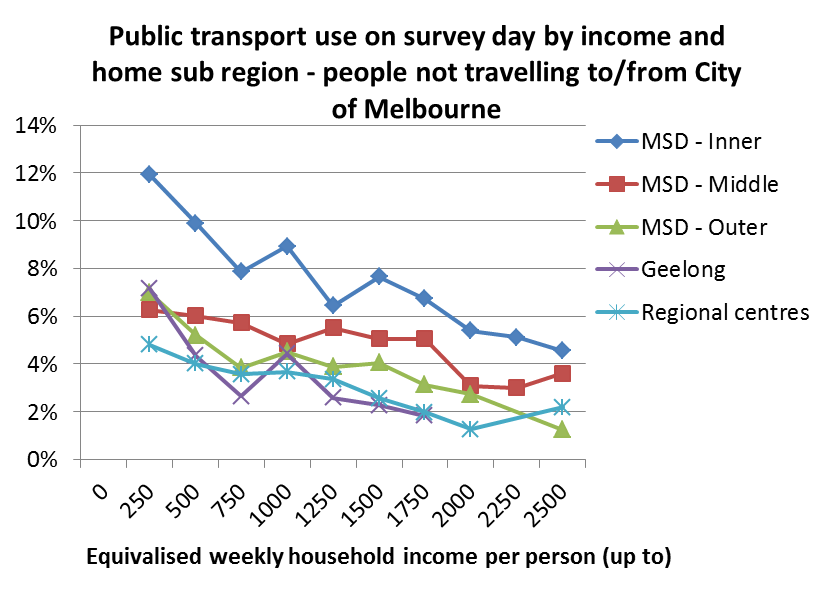
What’s driving this pattern? Well, we know that people on higher incomes are more likely to live closer to the city and probably work in the city centre, so what if I take geography out of the equation? The following chart looks at patterns within each home sub region and excludes people who travelled to or from the City of Melbourne (cohorts of less than 300 people not shown).

The trend now looks the reverse – people on higher incomes used public transport less for trips outside the City of Melbourne. But is that because people on higher income were more likely to travel to the City of Melbourne?
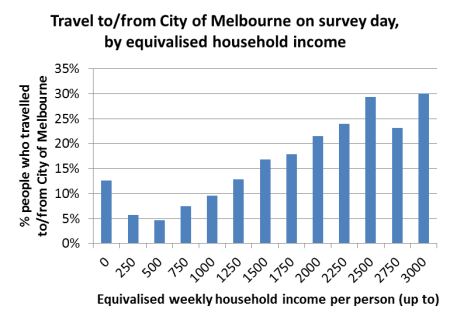
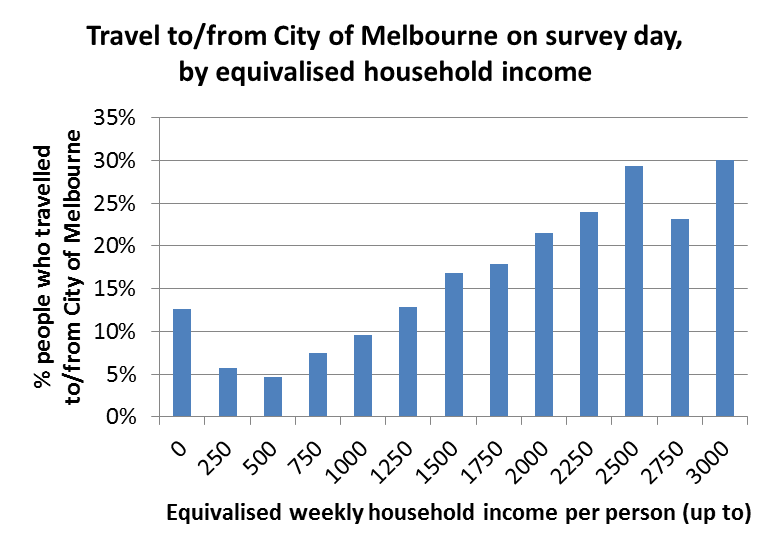
Well they certainly were much more likely to travel to/from the City of Melbourne. The shape of this chart is very similar to the chart showing overall public transport use by income, but the variation is much greater.

In order to remove the impact of travel to/from the City of Melbourne, I’ve calculated the use of public transport by those who did and those who did not travel to/from the City of Melbourne (chart shows cohorts with 200 or more):
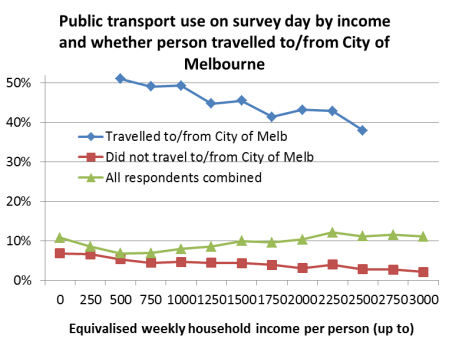
While the rate of public transport use went down by income for the two divisions (travel to/from City of Melbourne or not), the overall rate increased with income as a result of blending – at higher incomes more people were travelling to/from the City of Melbourne which lifts the overall average use of public transport.

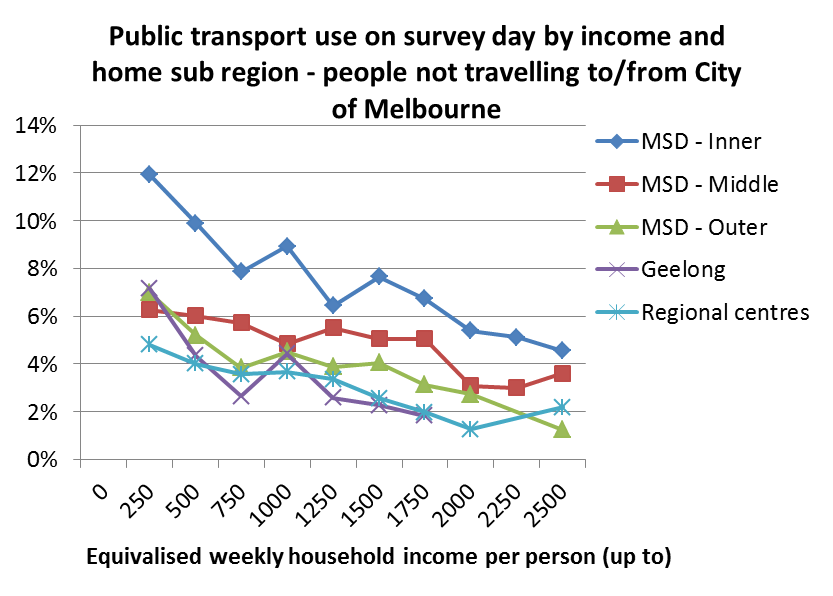
We know from part one that people living closer to the centre of Melbourne are more likely to use public transport for trips not involving the City of Melbourne. So here is a chart showing the rates of public transport use by income for those people not travelling to/from the City of Melbourne:

This suggests there may be a relationship between income and public transport use, though it is much less significant a determinant than whether or not someone travelled to the City of Melbourne.

But what about the other factors – like motor vehicle and licence ownership? In the following chart I’ve again limited myself to groupings where I could get a cohort of 200 or more (margin of error up to 7%).
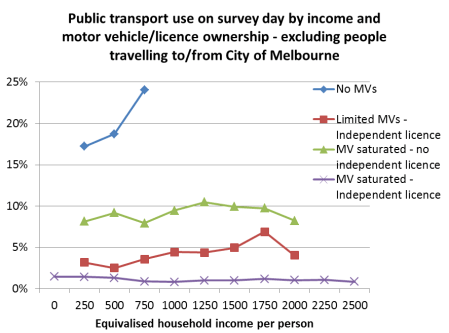
The pattern now looks like slightly increasing public transport use with income for some groups, when taking out motor vehicle/licence ownership (although the variation is within the margin of error so it might not be a significant pattern).

Might geography be at play here – that wealthier people live in areas with greater PT supply (ie closer to the city)? I cannot prove that because I cannot disaggregate this further.

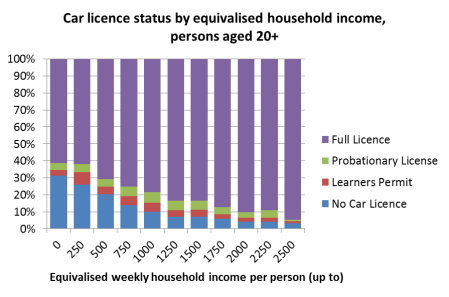
But thinking about it, wouldn’t licence and motor vehicle ownership increase with income? And we saw in part one that public transport use declines with licence and motor vehicle ownership.

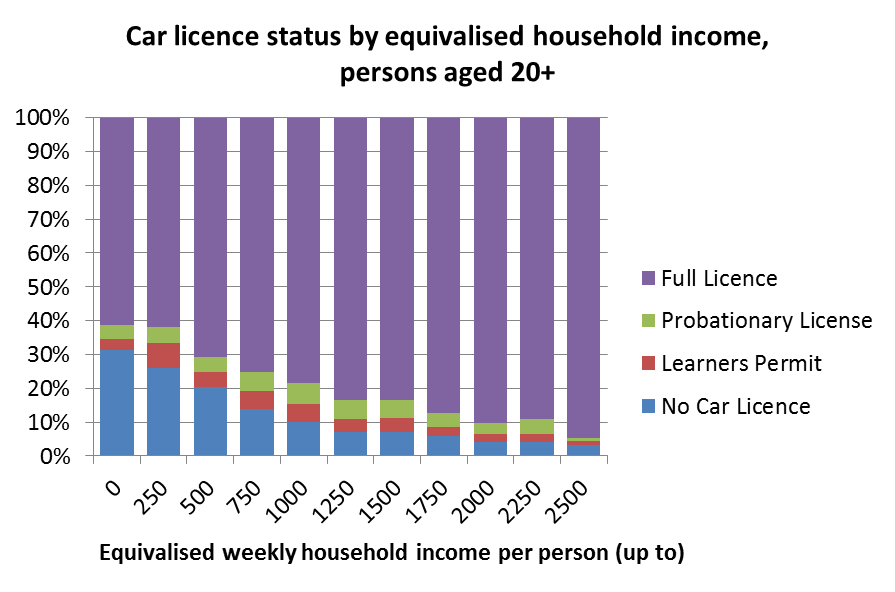
Well, here is licence ownership by income (for adults):
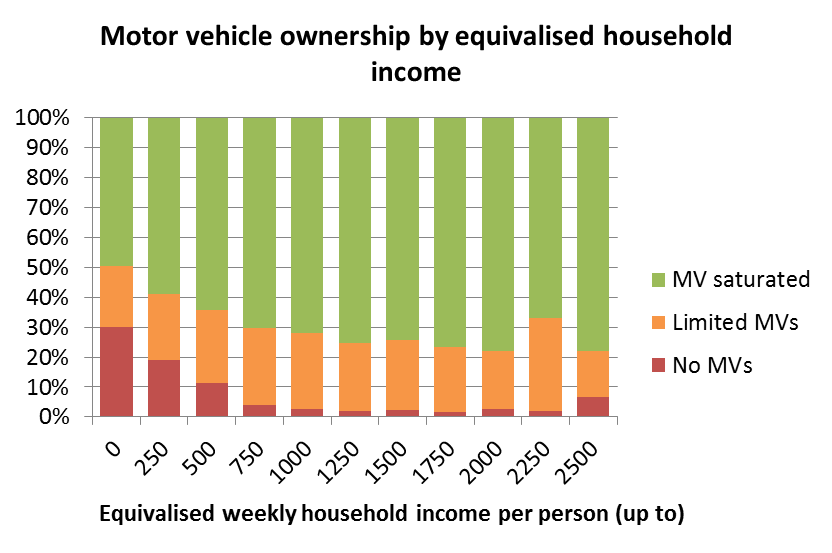
And here is motor vehicle ownership by income:
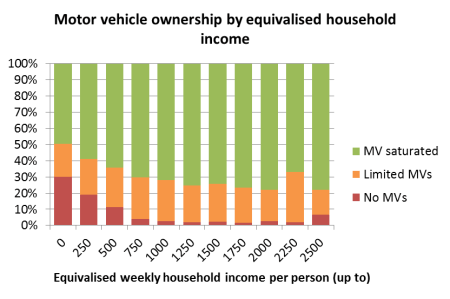
Licence ownership and motor vehicle ownership certainly increased with income, which you would expect to generally lead to lower public transport use.

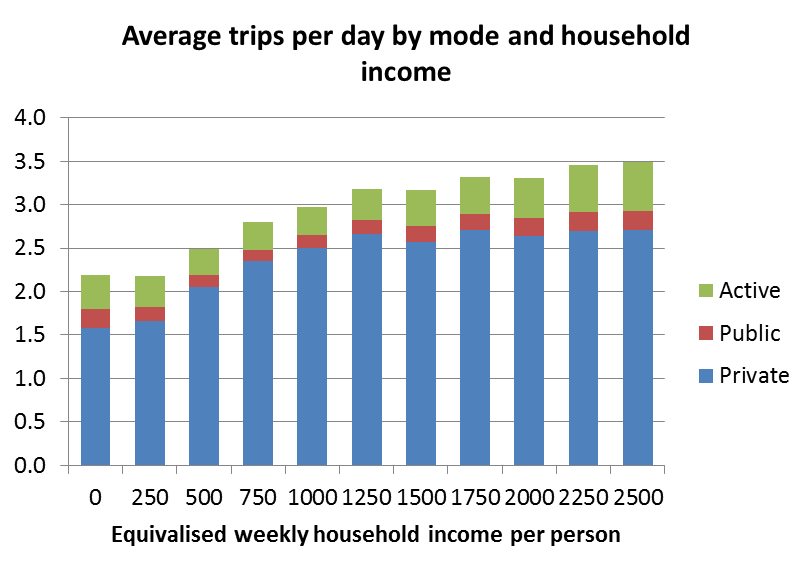
Furthermore, people in higher income households travelled more often on average, which might increase their chance of using public transport:

This leads me to conclude that income is very likely a driver of public transport use, and that people on higher incomes are less likely to use public transport, all other things being equal (though I haven’t tested for every other thing!). But the fact that people on higher incomes were more likely to travel to travel to/from the City of Melbourne trumped this income effect.

Employment type

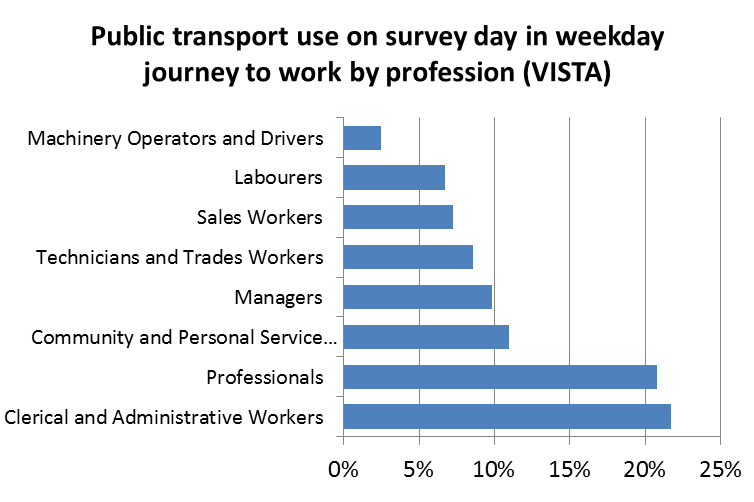
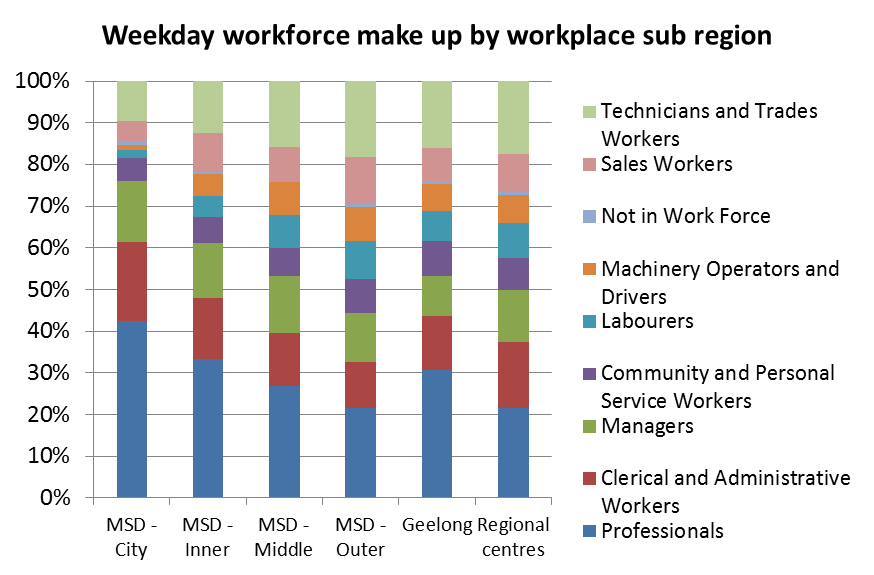
As we saw in a previous post, location of employment has the biggest bearing on public transport use. But here are a few breakdowns anyway (on weekday journey to work):
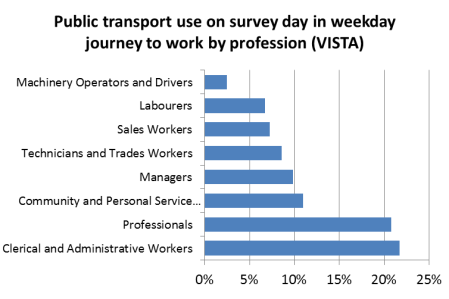
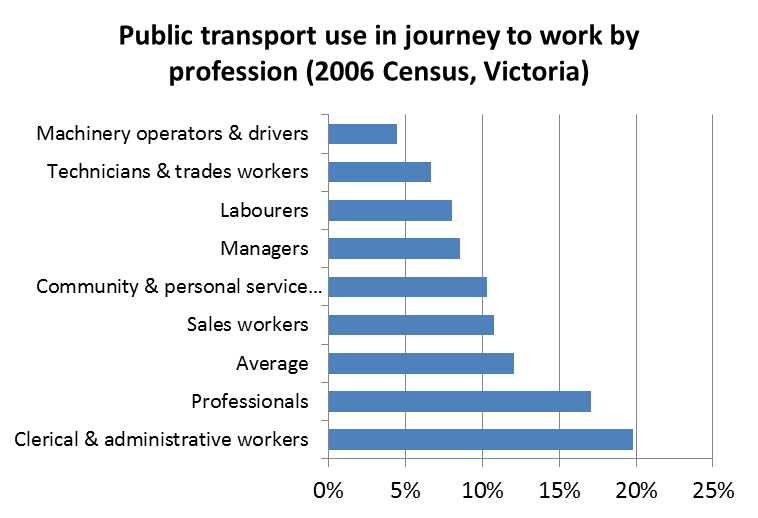
For comparison, here are the figures from the 2006 census for the whole of Victoria:
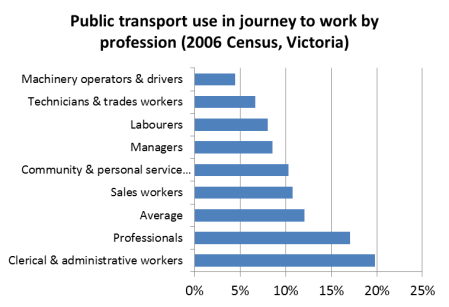
The margin of error on the VISTA data is around 4%, so they figures are reasonably similar.

And sure enough the jobs most prevalent in the inner city have the highest public transport mode share:
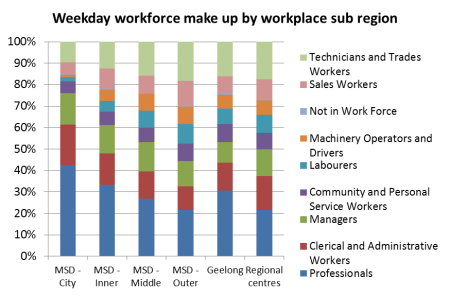
The two groups with highest public transport use are more likely to work in the inner city, so little surprise that they have the highest public transport use.

Managers are probably widely distributed across the sample area, and many would have packaged cars and/or parking as part of their salary packages.

Unfortunately the dataset is too small for me to disaggregate to people who don’t live or work in the City of Melbourne (in a previous post I found managers had lower rates of public transport use in the journey to work to the Melbourne CBD).

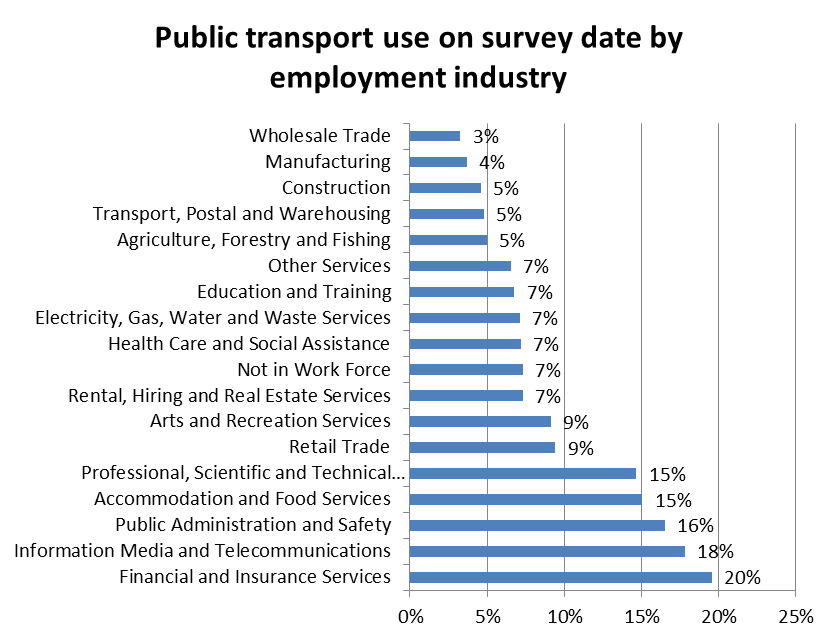
What about employment industry?
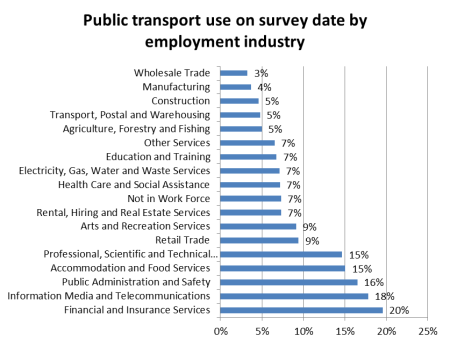
I suspect public transport use by employment industry will largely reflect employment location. Melbourne’s recent strong public transport growth could well relate to the changing mix of employment, with a move away from manufacturing and towards professional services. This might also be fuelling growth in CBD employment.

Household type

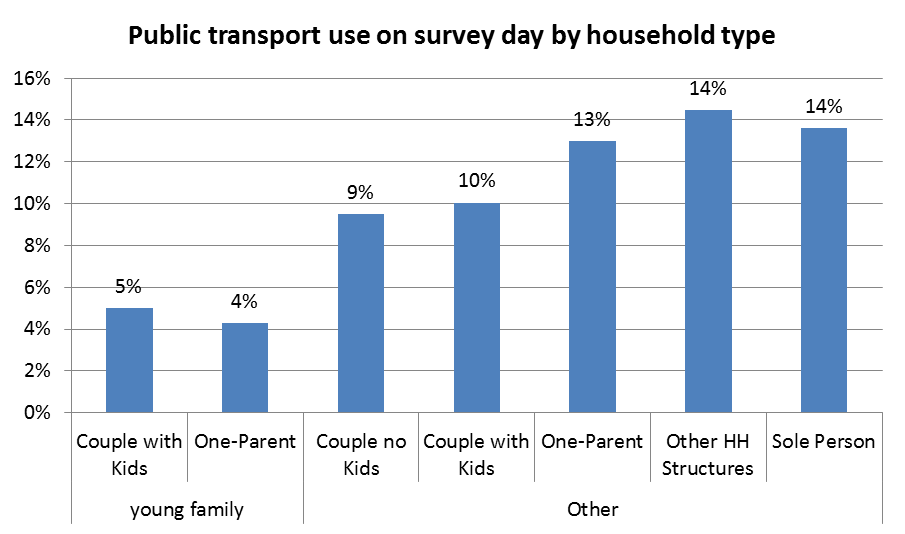
How does public transport use vary by household type? In some recent work I was looking at young families more closely, as they are a very common household type moving into growth areas on the fringes of our cities. I’ve defined a young family as being one or two parents with all children under 10 years of age.
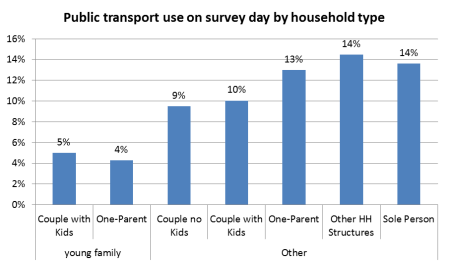
Consistent with very low rates of public transport use by young children, young families were least likely to use public transport (taken as the average across all household members). Sole person and mixed household structures were most likely to use public transport.

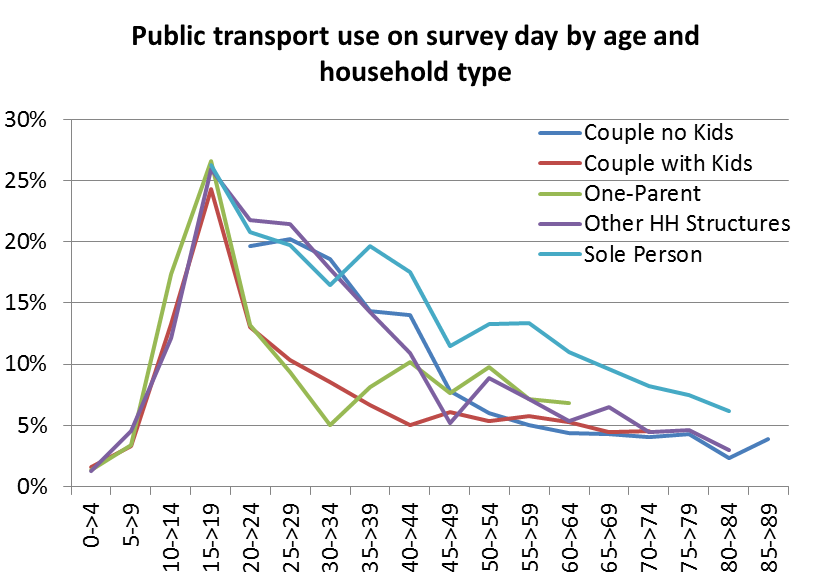
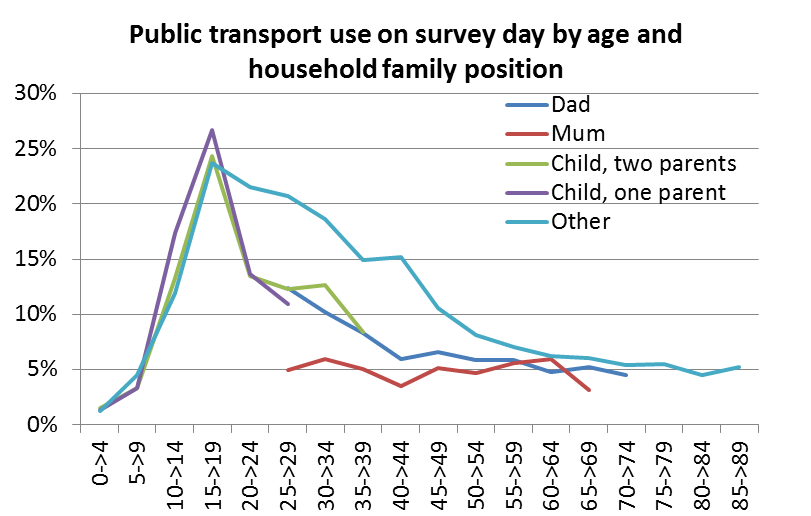
The above chart is a blend of parents and children, so here’s public transport use by age and household type:

You can see between the ages of around 20 to 44 that parents (with children at home) had much lower rates of public transport use than other people. This suggests that becoming a parent is probably a major cause for people to abandon public transport. I suspect this may be because travelling with young children on public transport can be a challenge. But maybe they are also time poor (more on that shortly).

I note also that sole person households had higher rates of public transport use, particularly after 35 years of age. Perhaps the slow demographic shift towards smaller households might lead to increased public transport use? A topic for further research perhaps.

Anyway, investigating family households further, I have defined each person by their household family position: mum, dad, child, or other (everyone not in a simple family household structure).
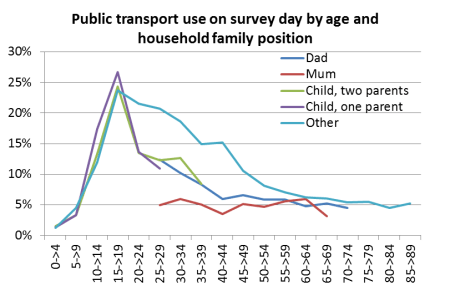
You can see here that children’s public transport use peaked at ages 15-19 and then fell with age. My cut-off for this chart was 400 persons in the cohort, and yes there were over 400 children aged 35-39 living with their parents in the sample.

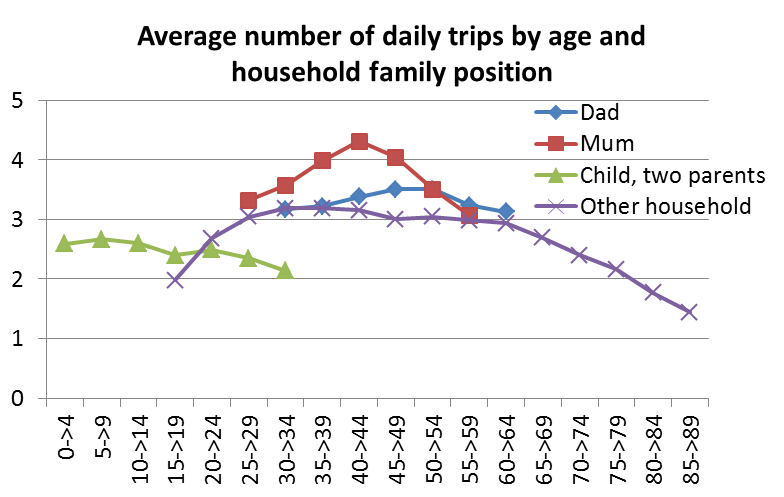
Mums used public transport a lot less than dads, particularly younger mums. Perhaps this is because they made a lot more trips per day?

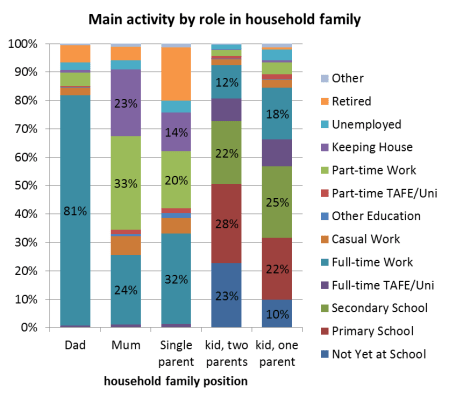
This result is consistent with the data showing that mums were much less likely to be working full time than dad. In fact over half were “keeping house” or working part time. Be careful of the subtle colour differences in the following chart:
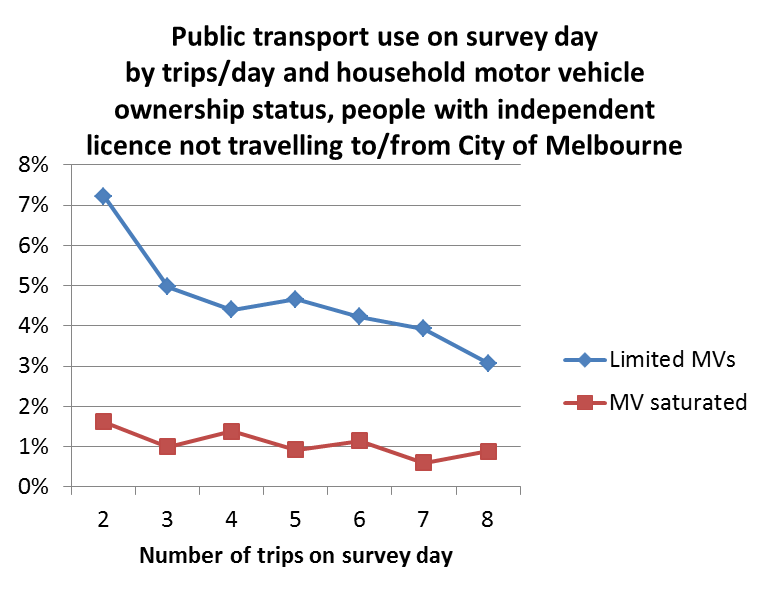
So does making more trips in a day reduce your chance of using public transport?
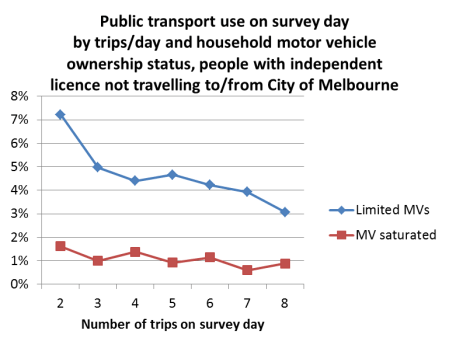
This chart excludes people who travel to/from the City of Melbourne (sorry about the mouthful of a chart title!). Having three or more trips in your day significantly reduced your chances of using public transport, but only really if you had limited household motor vehicle ownership. I’m guessing that the motor vehicles were more used by the people in the household who had to make more trips.

Curiously, a lot of single parents are retired. The data shows them to indeed be of retirement age – probably with adult children caring for them. They are probably not what you generally think of as single parent households, but technically that’s how they get classified.

So what are the strongest determinates of public transport use?

In my first post on this topic, the likely determinants of public transport use were:

  • Much higher for people travelling to/from the City of Melbourne (possibly increasing with home distance from the central Melbourne)
  • Decreases with distance from central Melbourne (probably a proxy for PT supply)
  • Higher for people with no or limited household motor vehicle ownership.
  • Higher for people without a probationary/full driver’s licence.

From this post we can probably add:

  • Very low usage by young children (primary school and below);
  • Very low for those for keeping house or working part time (often mums);
  • Lower for parents (in family households with non-adult children);
  • Lower for people on higher incomes (all other things being equal, which they usually are not!); and,
  • Lower for people making more trips per day.

Ideally I should run a logistic regression model to the data to analyse the drivers more systematically. I might see if I can do that in a part three.