How is the journey to work changing in Melbourne? (2006-2016)

Tue 5 December, 2017

Post last updated 11 May 2018. See end of post for details.

While journeys to work only represents around a quarter of all trips in Melbourne, they represent around 39% of trips in the AM peak (source: VISTA 2012-13). Thanks to the census there is incredibly detailed data available about the journey to work, and who doesn’t like exploring transport data in detail?

Between 2006 and 2016, Melbourne has seen mode shifts away from private transport and walking, and towards public transport and cycling. The following measures are by place of enumeration (and 2011 Significant urban area boundaries):

2006 2011 2016
Public transport (any) 14.16% 16.34% 18.15%
+2.18% +1.82%
Private transport (only) 80.43% 78.16% 76.20%
-2.28% -1.96%
Walk only 3.63% 3.46% 3.47%
-0.18% +0.01%
Bicycle only 1.34% 1.56% 1.63%
+0.23% +0.06%

This post unpacks where mode shifts and trip growth is happening, by home locations, work locations, and home-work pairs. It tries to summarise the spatial distribution of journeys to work in Melbourne. It will also look at the relationship between car parking, job density and mode shares.

I’m afraid this isn’t a short post. So get comfortable, there is much fascinating data to explore about commuting in Melbourne.

Public transport share by home location

Here’s an animated public transport mode share map 2006 to 2016 – you might want to click to enlarge, or view this map in Tableau (be patient it can take some time to load and refresh). For those with some colour-blindness, you can also get colour-blind friendly colour scales in Tableau.

The higher mode shares pretty clearly follow the train lines and the areas covered by trams, with mode share growing around these lines. Public transport mode shares of over 50% can be found in a sizeable patch of Footscray, and pockets of West Footscray, Glenroy, Ormond – Glen Huntly, Murrumbeena, Flemington, Docklands, Carlton, and South Yarra. Larger urban areas with very low public transport mode share can be found around the outer east and south-east of the city, particularly those remote from the rail network.

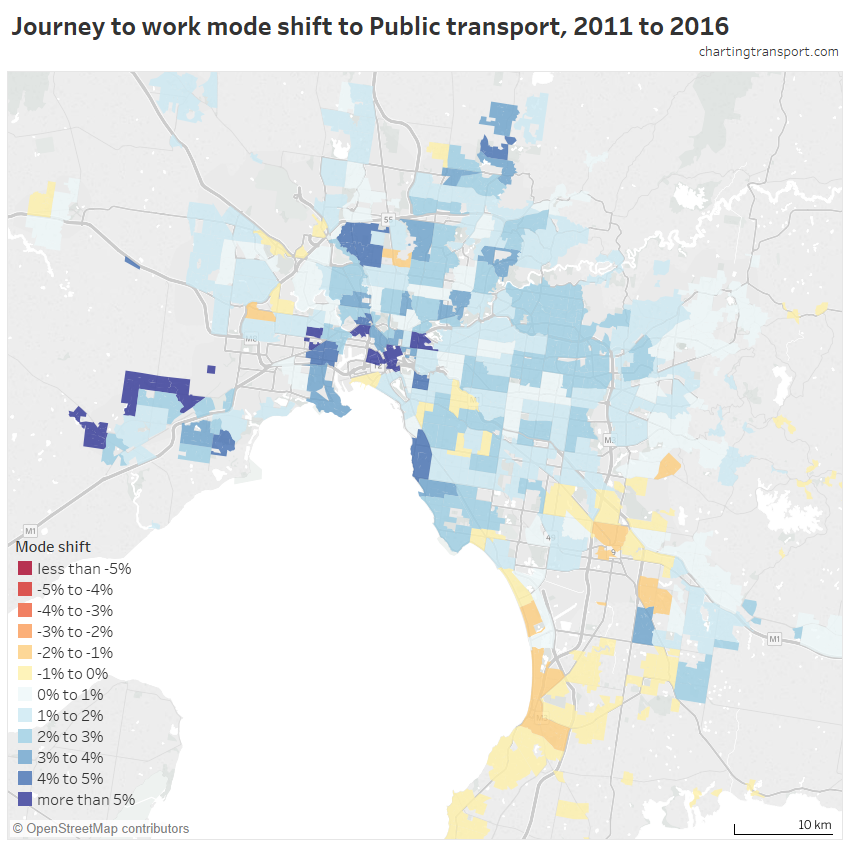
Here’s a map showing mode shift at SA2 level:
(explore in Tableau)

The biggest shifts to public transport in the middle and outer suburbs were in Wyndham Vale, Tarneit, South Morang, Lynbrook/Lyndhurst, Sanctuary Lakes (Point Cook – East), Truganina / Williams Landing, Rockbank, Pascoe Vale, and Glenroy. That’s almost a roll call of all the new train stations opened between 2011 and 2016. The exceptions are Rockbank (a small community at present which received significantly more frequent trains in 2015), Point Cook East (a bus service was introduced in 2015), and Pascoe Vale / Glenroy (where more people are commuting to the city centre and increasingly by public transport).

Inner suburban areas with high mode shifts include West Footscray, Yarraville, Seddon – Kingsville, Collingwood, Abbotsford, Kensington, Flemington, South Yarra – East, and Brighton. The Melbourne CBD itself had a 13% shift to public transport – and actually a 6% mode shift away from walking (which probably reflects the new Free Tram Zone in the CBD area).

The biggest mode shifts away from public transport (of 1 to 2%) were at Ardeer – Albion, Coburg North, Chelsea – Bonbeach, Seaford, Frankston, Dandenong, Hampton Park – Lynbrook, and Lysterfield. At the 2016 census there were no express trains operating on the Frankston railway line due to level crossing removal works, which might have slightly impacted public transport demand in Frankston, Seaford and Chelsea – Bonbeach. I’m not sure of explanations for the others, but these were not large mode shifts.

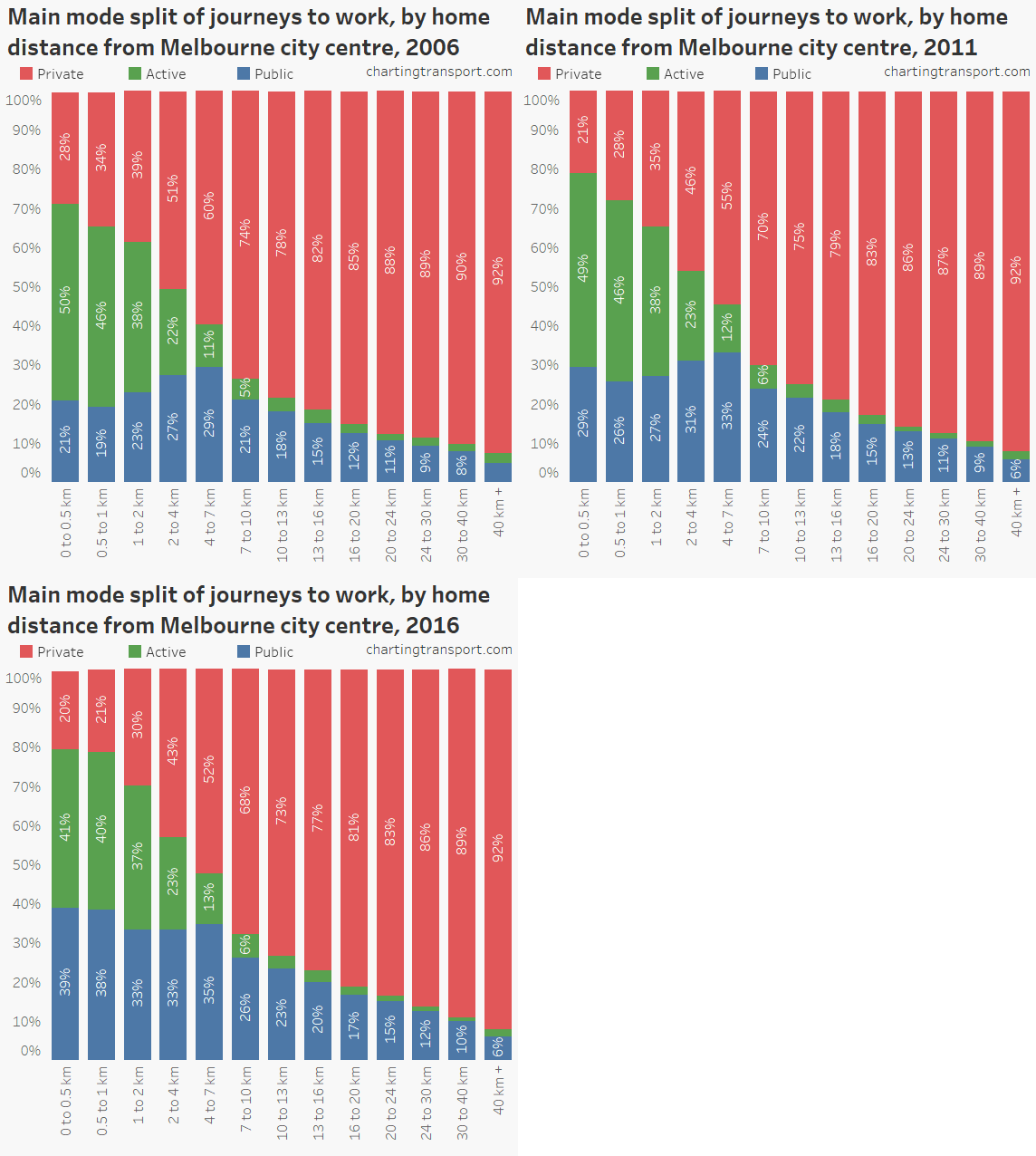
Here’s a chart showing mode split over time, by home distance from the CBD:
Public transport mode share by work location

Here’s a map showing work location public transport mode share (Destination Zones with less than 5 travellers per hectare not shown):
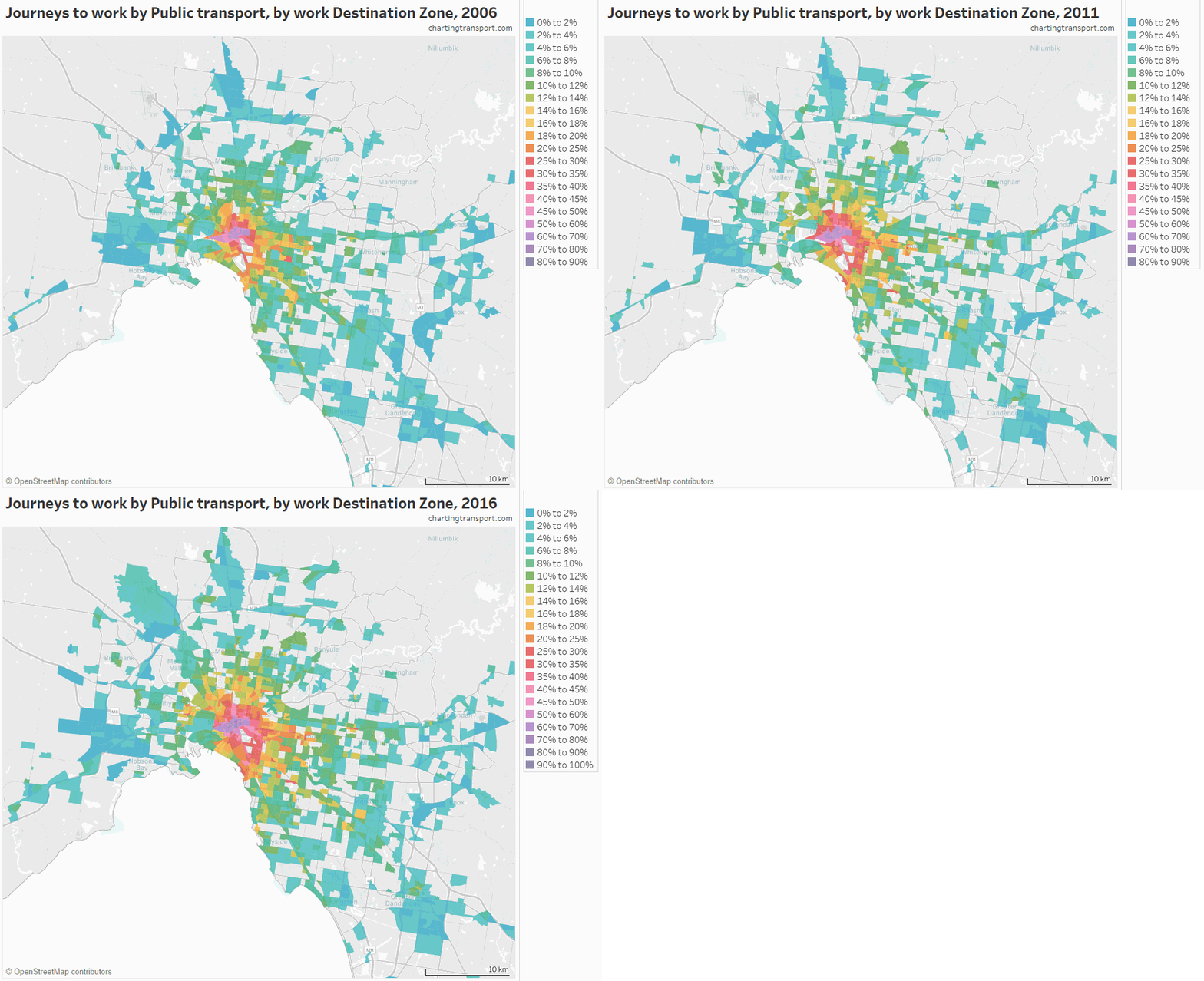
It’s no surprise that public transport mode share is highest in the CBD and surrounding area, and lower in the suburbs. But note the scale – public transport mode share falls away extremely quickly as you move away from the city centre.

Private transport mode shares are very high in the middle and outer suburbs:
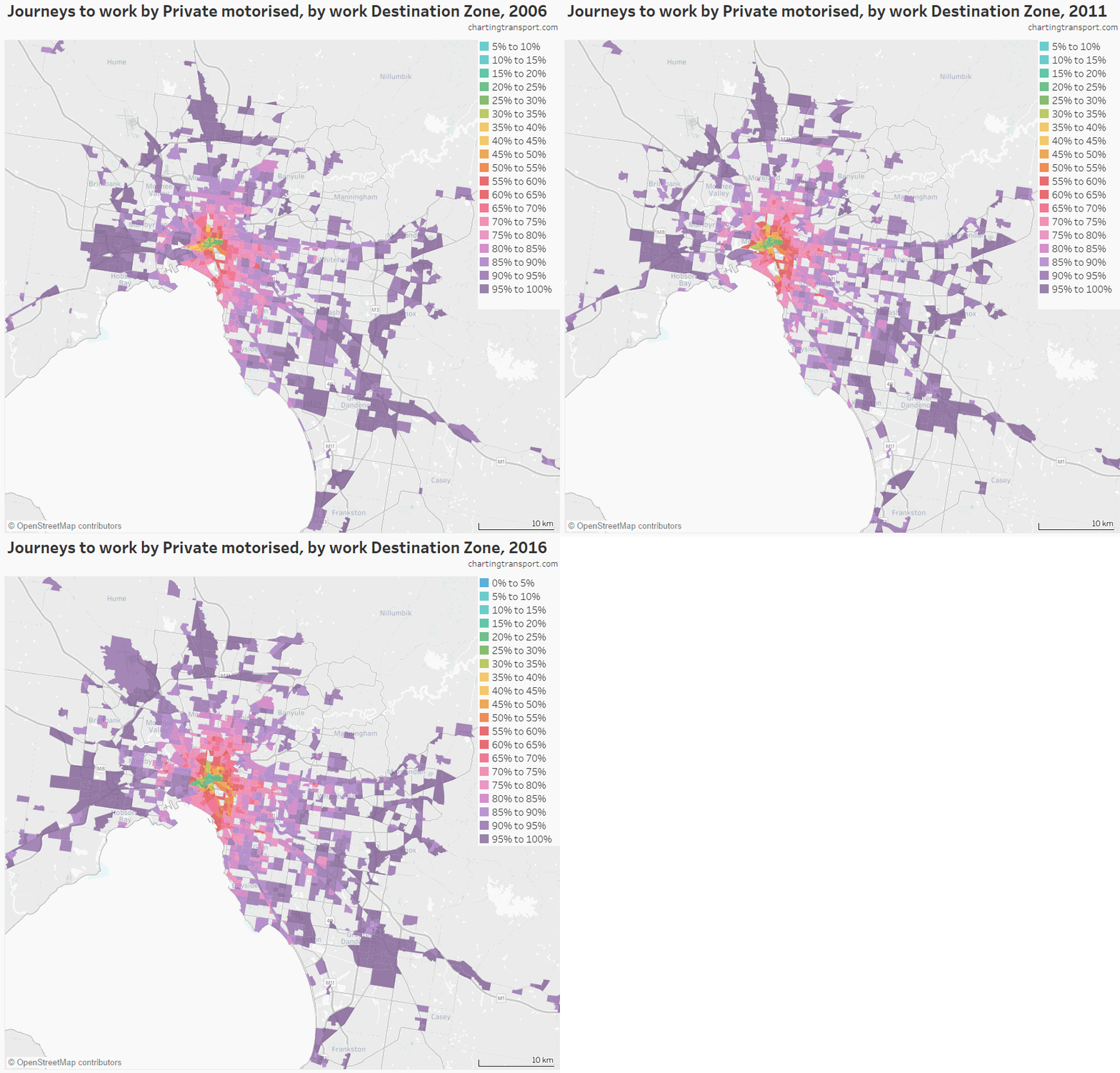
Large areas of Melbourne have near saturation private transport mode share. In most suburban areas employee parking is likely to be free and public transport would struggle to compete with car travel times, even on congested roads (particularly for buses that are also on those congested roads).

There are some isolated pockets of relatively high public transport mode share in the suburbs, including

  • 34% in a pocket of Caulfield – North (right next to Caulfield Station),
  • 33% in a pocket of Footscray (includes the site of the new State Trustees office tower near the station),
  • 25% in a pocket of Box Hill near the station, and
  • 17% at the Monash University Clayton campus.

Explore the data yourself in Tableau.

Here’s an enlargement of the inner city area:

And here’s a map showing the mode shift between 2011 and 2016 by workplace location (for SA2s with at least 4 jobs per hectare):
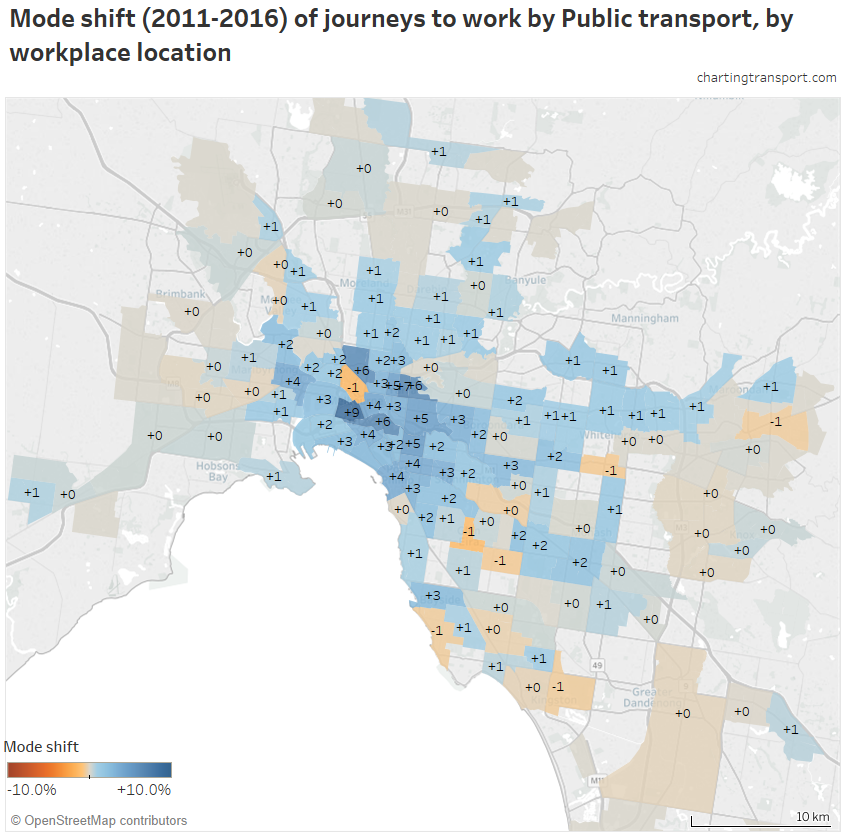
The biggest shifts to public transport were in the inner city. The biggest shifts away from public transport were 1.4% in Ormond – Glen Huntly (rail stations temporarily closed) and North Melbourne.

Here’s a closer look at the inner city:
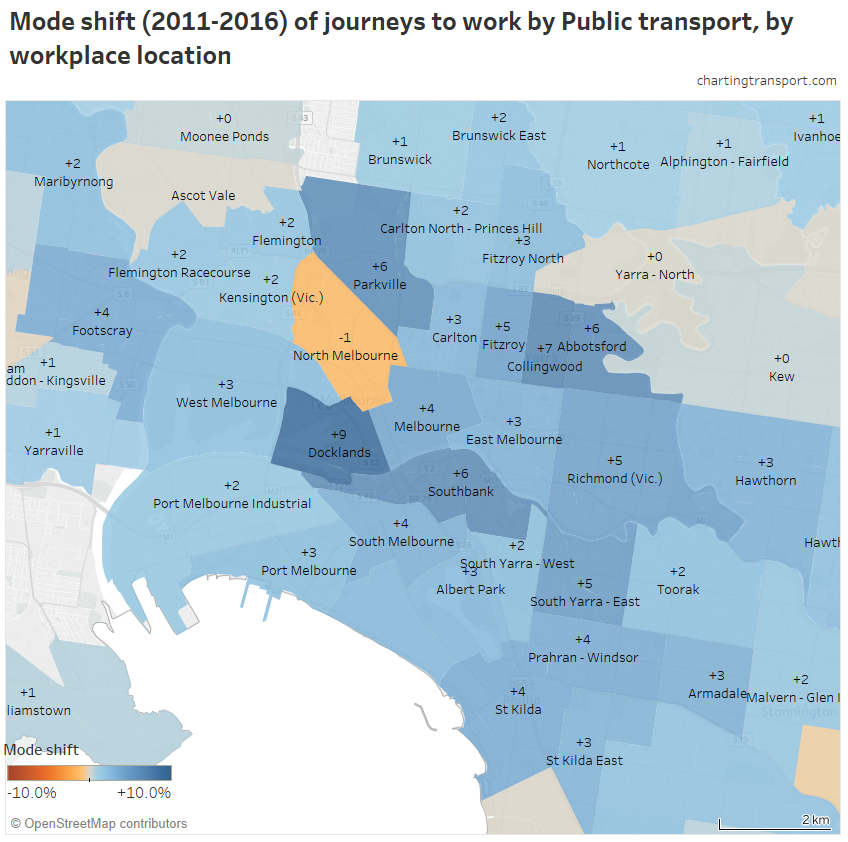
Docklands had the highest mode shift to public transport of 9% (almost all of it involving train) followed by Collingwood with 7%, and Parkville, Southbank, and Abbotsford with 6%.

North Melbourne saw a decline of 1.4% – at the same time private transport mode share and active (only) mode shares increased by 1%.

Another way to slice this data is by distance from the CBD. Here are main mode shares by workplace distance from the centre, over time:

For this and several upcoming pieces of analysis, I have aggregated journeys into three “main mode” categories:

  • Public transport (any trip involving public transport)
  • Private transport (any journey involving private transport that doesn’t also involve public transport)
  • Active transport only (walking or cycling)

Here are the mode shifts by workplace distance from the centre between 2006 and 2016:
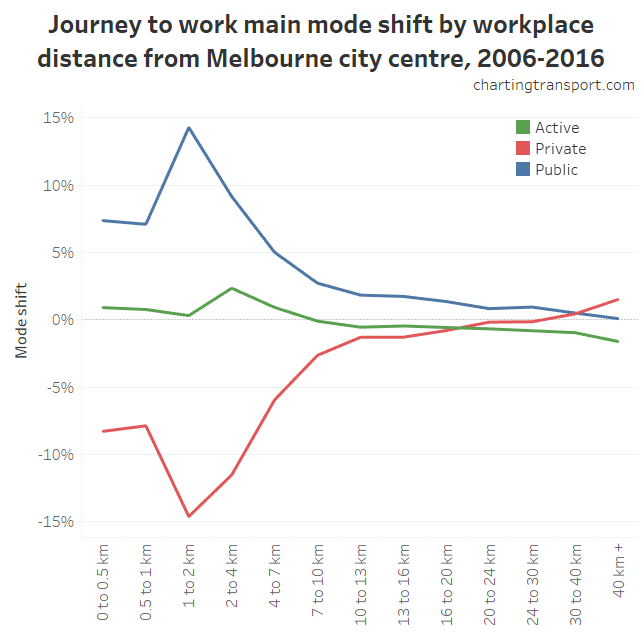
The biggest mode shift from private to public transport was for distances of 1-2km from the city centre, which includes Docklands, East Melbourne, most of Southbank, and southern Carlton and Parkville (see here for a reference map). A mode shift to public transport (on average) was seen for workplaces up to 40km from the city centre. The biggest mode shift to active transport was for jobs 2-4 km from the city centre (but do keep in mind that weather can impact active transport mode shares on census day).

What about job density?

Up until now I’ve been looking at mode shifts by geography – but the zones can have very different numbers of commuters. What matters more is the overall change in volumes for different modes. A big mode shift for a small number of journeys can be a smaller trip count than a small mode shift on a large number of journeys.

Firstly, here’s a map of jobs per hectare in Melbourne (well, jobs where someone travelled on census day and stated their mode, so slight underestimates of total employment density):

Outside the city centre, relatively high job density destination zones include:

  • Heidelberg (Austin/Mercy hospitals with 10.2% PT mode share),
  • Monash Medical Centre in Clayton (8.3% PT mode share),
  • Northern Hospital (3.8% PT mode share),
  • Victoria University Footscray Park campus (21.1% PT mode share),
  • Swinburne University Hawthorn (39.8% PT mode share),
  • a pocket of Box Hill (19.9% PT mode share),
  • a zone including the Coles head office in Tooronga (11.2% PT mode share),
  • an area near Camberwell station (26.8% PT mode share),
  • a pocket of Richmond on Church Street (27.8% PT mode share), and
  • a pocket of Richmond containing the Epworth Hospital (39.5% PT mode share).

Explore this map in Tableau.

You’ll probably not be very surprised to see that there is a very strong negative correlation between job density and private transport mode share. The following chart shows the relationship between the two for each Melbourne SA2 with the thin end of each “worm” being 2006 and the thick end 2016 (note: the job density scale is exponential):
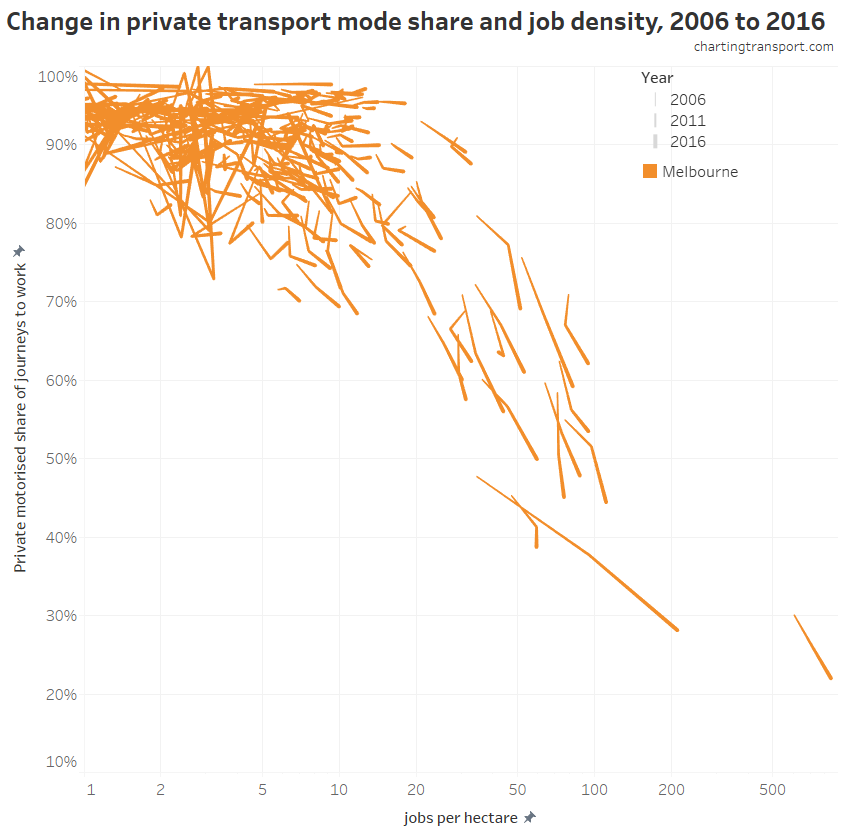
Correlation of course is not necessarily causation – high job density doesn’t automatically trigger improved public and active transport options. But parking is likely to be more expensive and/or less plentiful in areas with high employment density, and many employers will be attracted to locations with good public transport access so they can tap into larger labour pools.

The Melbourne CBD SA2 is at the bottom right corner of the chart, if you were wondering.

The Port Melbourne Industrial and Clayton SA2s are relatively high density employment areas with around 90% private transport mode shares.

Here’s a zoom in on the “middle” of the above chart, with added colour and labels to help distinguish the lines:
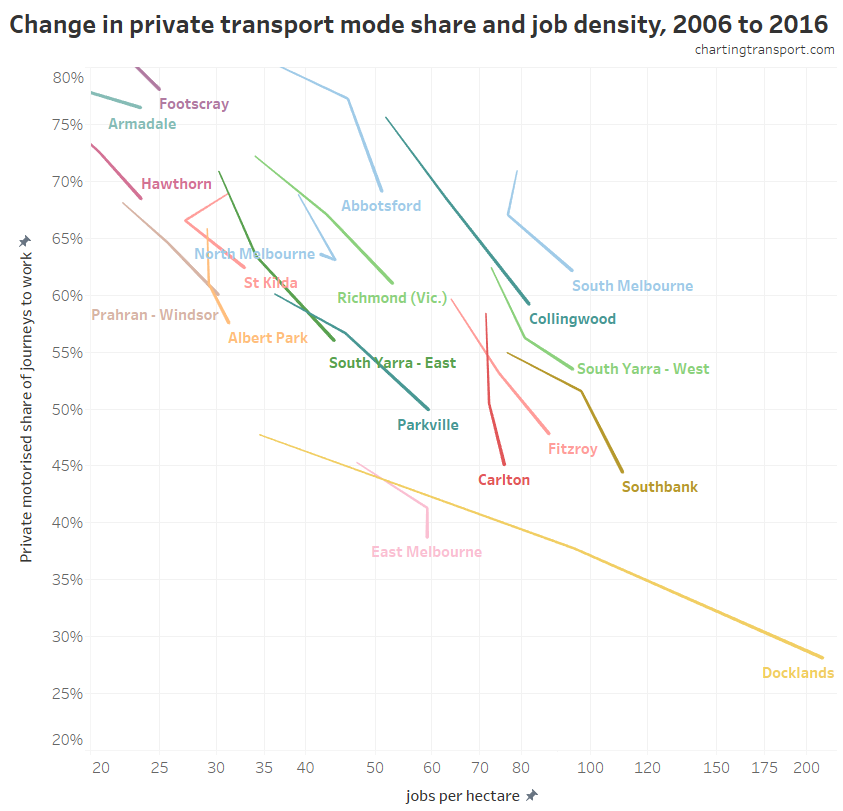
Not only is there a strong (negative) relationship between job density and private transport mode share, most of these SA2s are moving down and to the right on the chart (with the exception of North Melbourne which saw only small change between 2011 and 2016). However the correlation probably reflects many new jobs being created in areas with good public and active transport access, particularly as Melbourne grows its knowledge economy and employers want access to a wide labour market.

How does private transport mode share relate to car parking provision?

Do more people drive to work if parking is more plentiful where they work?

Thanks to the City of Melbourne’s Census of Land Use and Employment, I can create a chart showing the number of non-residential off-street car parks per 100 employees in the City of Melbourne (which I will refer to as “parking provision” as shorthand):
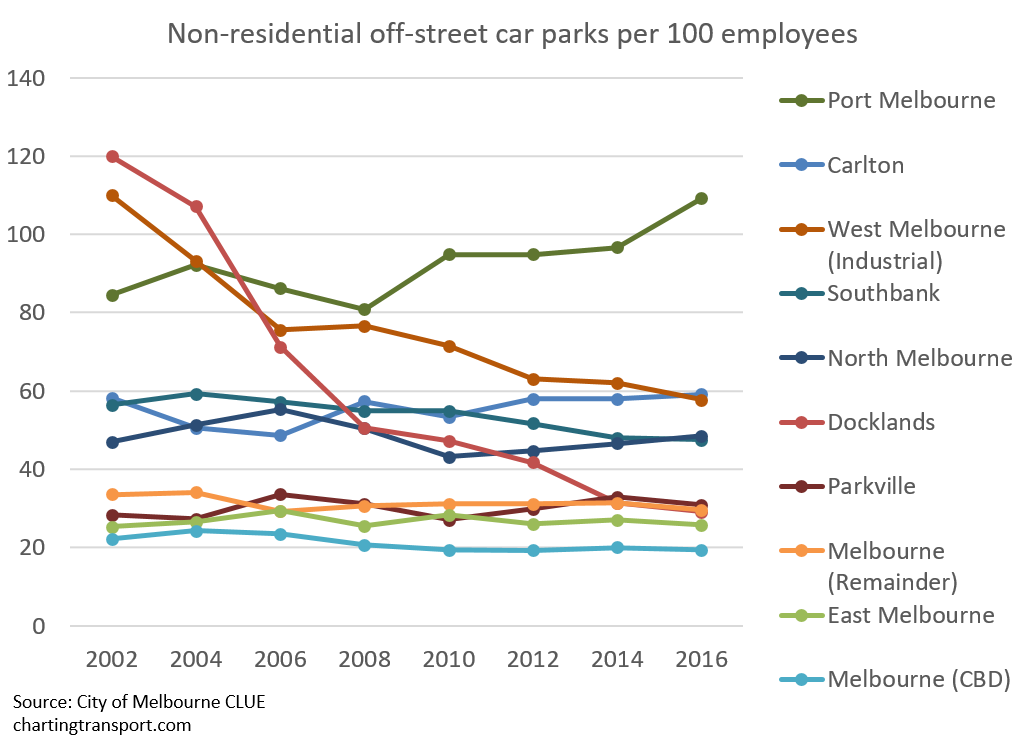
(see a map of CLUE areas)

Car parking provision per employee has increased in Carlton, North Melbourne and Port Melbourne and decreased in Docklands, West Melbourne (industrial), and Southbank. Docklands had the highest car parking provision in 2002 but this has fallen dramatically and land has been developed for employment usage. Southbank, which borders the CBD, has relatively high car park provisioning – much higher than Docklands and East Melbourne.

Here’s the relationship between parking provision and journey to work private transport mode share between 2006 and 2016:

It’s little surprise to see a strong relationship between the two, although Carlton is seeing increasing parking provision but decreasing private transport mode share (maybe those car parks aren’t priced for commuters?).

If all non-resident off street car parks were used by commuters, then you would expect the private transport mode share to be the same as the car parks per employee ratio.

Private transport mode shares were much the same as parking provision rates in Melbourne CBD, Docklands, and Southbank, suggesting most non-residential car parks are being used by commuters (with the market finding the right price to fill the car parks?). Private transport mode share was higher than car parking provision in East Melbourne, Parkville, South Yarra, North Melbourne, and West Melbourne (industrial). This might be to do with on-street parking and/or more re-use of car parks by shift workers (eg hospital workers).

Port Melbourne parking provision is very high (there is also lots of on-street parking). It’s possible some people park in Port Melbourne and walk across Lorimer Street (the CLUE border) to work in “Docklands” (which includes a significant area just north of Lorimer Street). It’s also likely that many parking spaces are reserved for visitors to businesses. Carlton similarly had higher parking provision than private transport mode share (again, could be priced for visitors).

(Data notes: For 2011, I have taken the average of 2010 and 2012 data as CLUE is conducted every even year. I’ve done a best fit of destinations zones to CLUE areas, which is not always a perfect match)

Where are the new jobs and how did people get to them?

Here’s a map showing the relative number of new jobs per workplace SA2, and the main mode used to reach them:
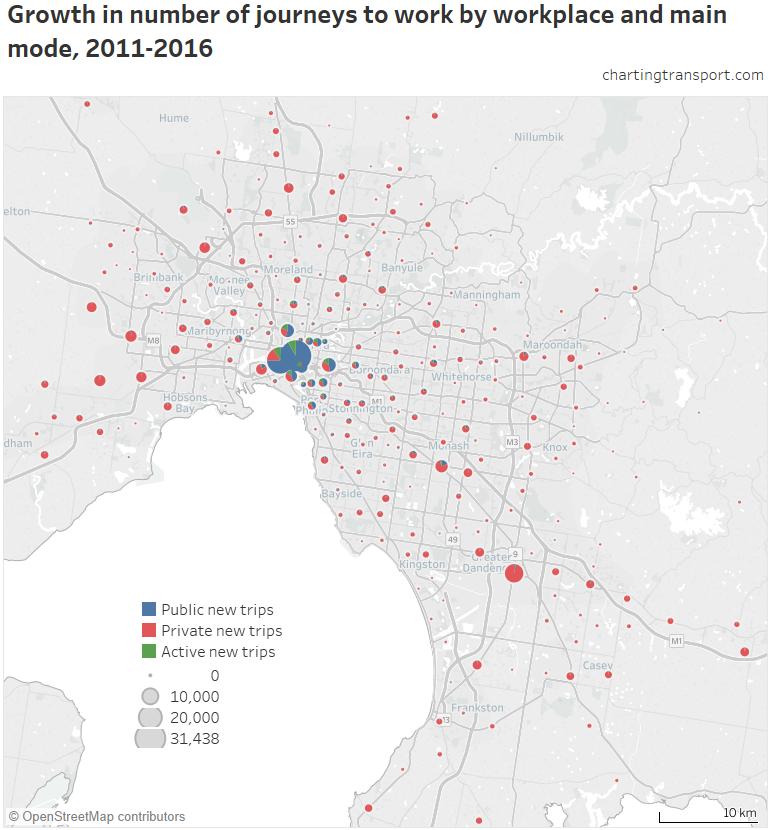
The biggest growth in jobs was in the CBD (+31,438), followed by Docklands (+22,993), Dandenong (+11,136), and then Richmond (+6,242).

And here’s an enlargement of the inner city:
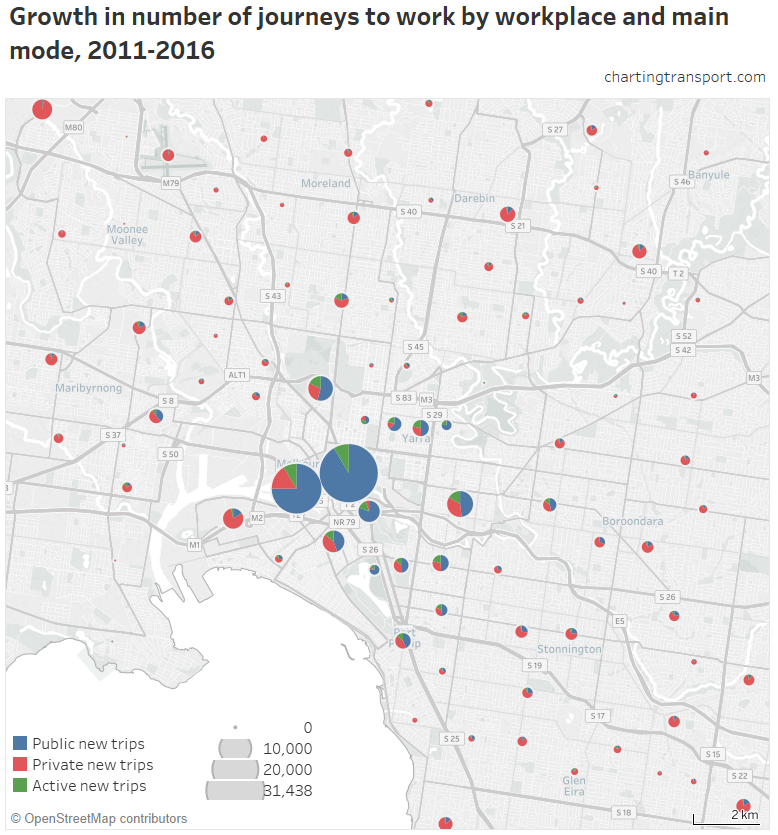
(explore this data in Tableau)

The CBD added 31,438 jobs, and almost all of those were accounted for by public transport journeys, although 2,630 were by active transport, and only 449 new jobs by private transport (1%).

Likewise most of the growth in Docklands and Southbank was by public transport, and then in several inner suburbs private transport was a minority a new trips.

However, Southbank still has a relatively high private transport mode share of 46% for an area so close to the CBD. The earlier car parking chart showed that Southbank has about one off-street non-residential car park for every two employees. These include over 5000 car parks at the Crown complex alone (with $16 all day commuter parking available as at November 2017). It stands to reason that the high car parking provision could significantly contribute to the relatively high private transport mode share, which is in turn generating large volumes of radial car traffic to the city centre on congested roads. Planning authorities might want to consider this when reviewing applications for new non-residential car parks in Southbank.

Here’s a chart look looking at commuter volumes changes by workplace distance from the CBD (see here for a map of the bands).
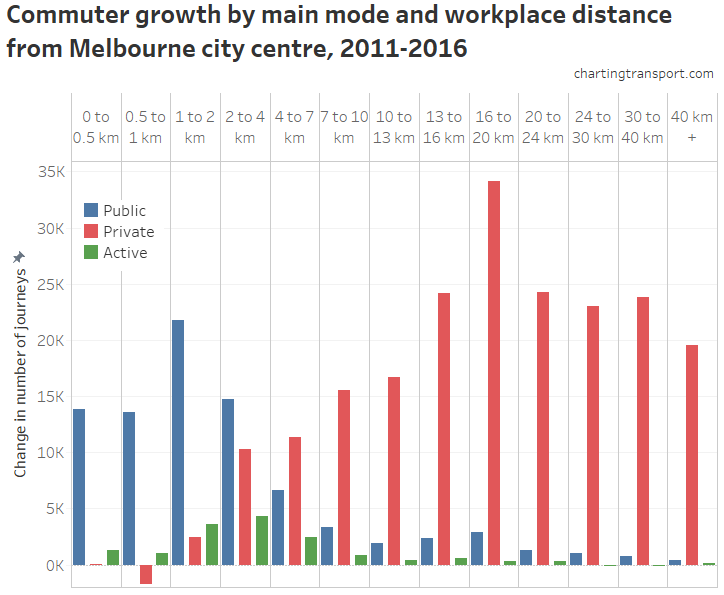
(Note: the X-axis is quasi-exponential)

Public transport dominated new journeys to work up to 4km from the city centre. Private transport dominated new journeys to workplaces more than 4km from the city centre – however that doesn’t necessarily mean a mode shift away from public transport if the new trips have a higher public transport mode share than the 2011 trips. Indeed there was a mode shift towards public transport for workplaces in most parts of Melbourne.

Here is a map showing the private transport mode share of net new journeys to work by place of work:

Private transport had the lowest mode share of new jobs in the inner city. As seen on the map, some relative anomalies for their distance from the CBD include Box Hill (64%), Hampton (57%), Brunswick East (34%), Dingley Village (28%), and Albert Park (6%). Explore the data in Tableau.

Where did the new commuters come from and what mode did they use?

Here’s a map showing the (relative) net volume change of private transport journeys to work, by home location:
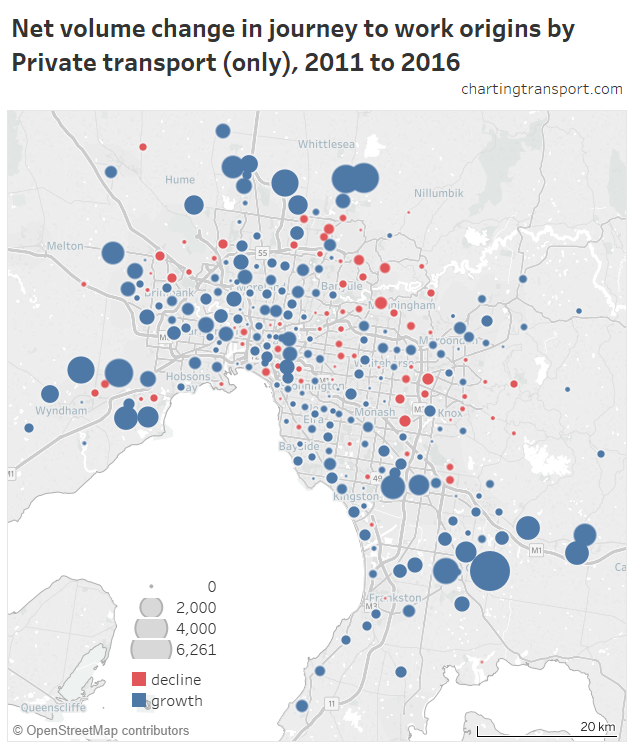
As you can see many of the new private transport journeys to work commenced in the growth areas, although there were also some substantial numbers from inner suburbs such as South Yarra, Richmond, Braybrook, Maribyrnong and Abbotsford.

There are many middle suburban SA2s with declines. These are also suburbs where there has been population decline – which I suspect are seeing empty nesting (adult children moving out) and people retiring from work. For example Templestowe generated 566 fewer private transport trips, 28 fewer active transport only trips, but only 70 new public transport trips.

Here’s a similar map showing change in public transport journeys:
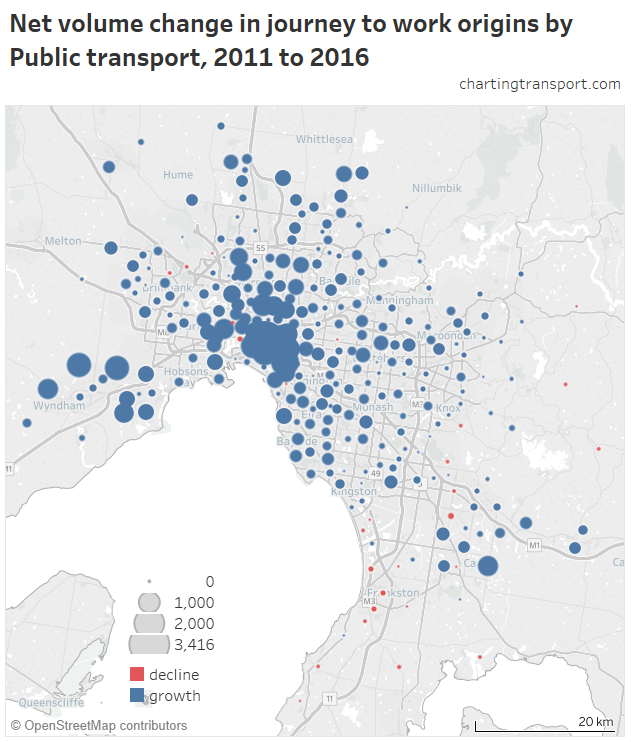
The biggest increases were from the inner city, with the CBD itself generating the largest number of new public transport trips (including almost 2500 journeys involving tram). However there were a number of new public transport trips from the Wyndham area in the south-west (where new train stations opened).

Here’s a map of the total new trip volume and main mode split:
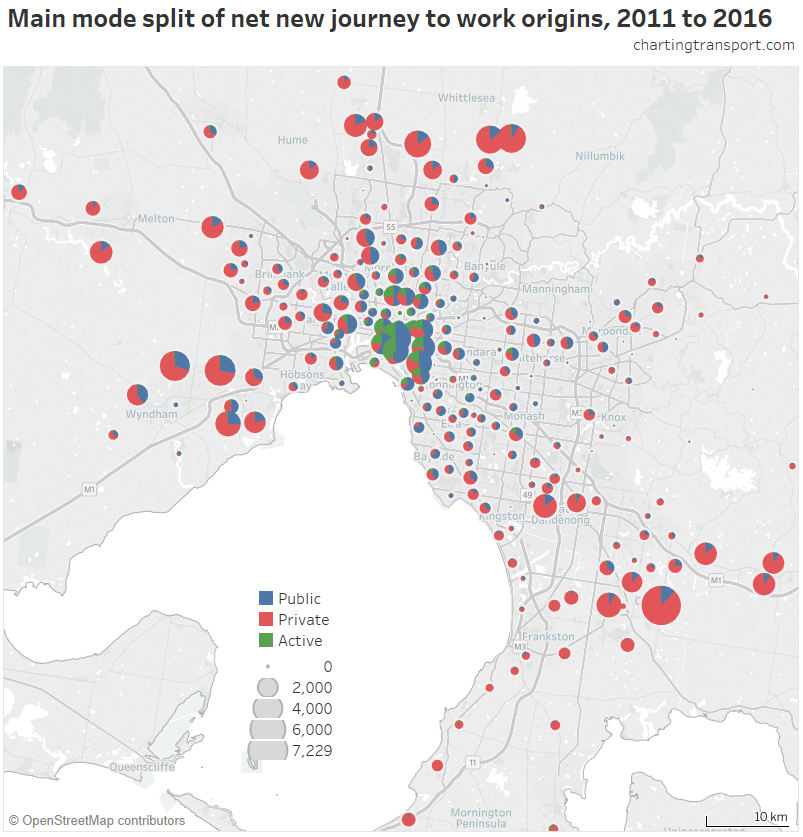
(explore in Tableau)

You can see that private transport dominates new journeys from the outer suburbs, but less so in the south-west where a new train line was opened. The middle and inner suburbs are hard to see on that map, so here is a zoomed in version:
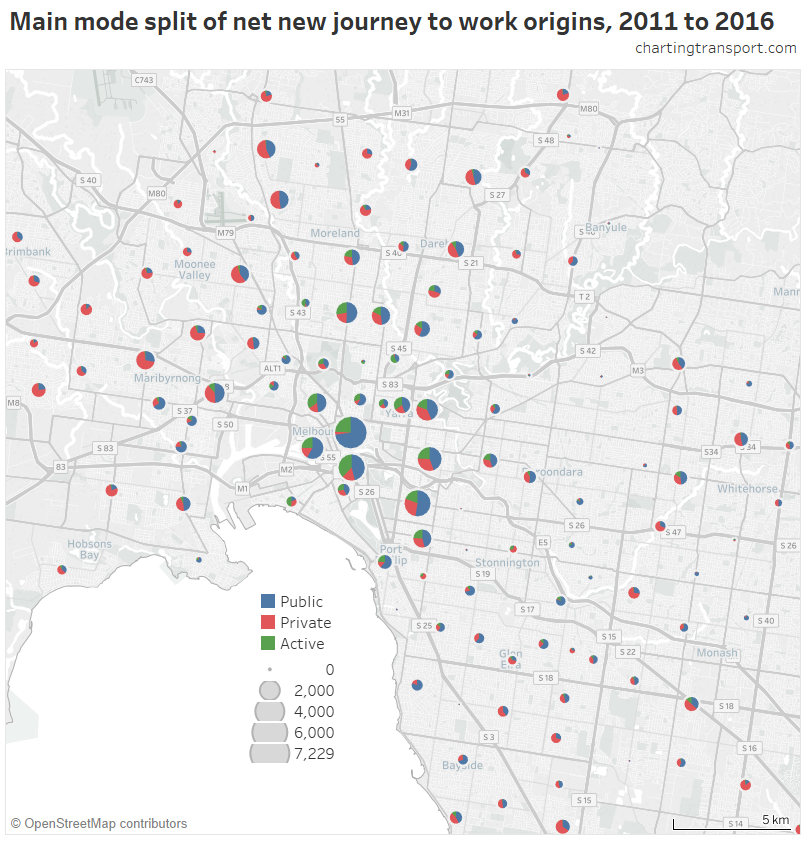
You can see many areas where private transport accounted for a minority of new trips. Also, around half of new trips in several middle northern suburbs were by public transport.

Here’s how it looks by distance from the city centre:

Public transport dominated new journeys to work for home locations up until 10km from the city centre, was roughly even with private transport from 10km to 20km (hence a net mode shift to public transport). However private transport dominated new commuter journeys beyond 20km – most of which is from urban growth areas. The 24-30 km band covers most of the western and northern growth areas, while the 40km+ band is almost entirely the south-east growth areas.

Here is a view of the private transport mode share of net new trips:

(explore in Tableau)

The pink areas had a net decline in the number of private transport trips (or total trips) generated, so calculating a mode share doesn’t make a lot of sense. There are some areas with 100%+ which means more new private transport trips were generated than total new trips – ie active and/or public transport trips declined.

You can again see that private transport dominated new trips in the most outer suburbs, with notable exceptions in the west:

  • Wyndham in the south-west where two new train stations opened. 41% of new trips from Wyndham Vale and 30% of new trips from Tarneit were by public transport.
  • Sunbury in the north-west, to which the Metro train network was extended in 2012.  Around 37% of new trips from Sunbury -South were by public transport (that’s 307 trips).

How has the distribution of home and work locations in Melbourne changed by distance from the city?

Here’s a chart showing the number of journey to work origins and destinations by distance from the city centre by year. Note the distance intervals are not even, so look for the vertical differences in this chart:

You can see most of the worker population growth (origins) has been in the outer suburbs. The destination (job) growth was much more concentrated in the inner city between 2006 and 2011, but then more evenly distributed across the city in 2016.

The median distance of commuter home locations from the city centre increased from 18.2 km in 2006 to 18.6 km in 2016. The median distance from the city centre of commuter workplaces decreased from 13.3 km in 2006 to 12.8 km in 2011 but then increased back to 13.3 km in 2016.

Here’s another way at looking at the task. I’ve split Melbourne by SA2 distance from the CBD (to create 10km wide rings) for home and work locations (and further split out the CBD as a place of work) to create a matrix. Within each cell of the matrix is a pie chart – the size of which represents the relative number of commuter trips between that home and work ring, and the colours showing the main mode. I’ve then animated it over 2011 and 2016 (to make it five dimensional!).

I think this chart fairly neatly summarises journeys to work in Melbourne:

  • Private transport dominates all journeys that stay more than 5km from the city centre (all but top left corner)
  • Active transport is only significant for commuters who work and live in the same ring (diagonal top left – bottom right), or for trips entirely within 15 km of the centre (six cells in top left corner)
  • Public transport dominates journeys to the CBD, no matter how far away people’s homes are, but the number of such journeys falls away rapidly with home distance from the CBD. Very few people commute from the outer suburbs to the CBD.
  • Private transport commuters are mostly travelling between middle suburbs, not to the CBD or even the to within 5 km of the city. However on average they are travelling towards the centre. This will become clearer shortly.
  • Public transport otherwise only gets 15% or better mode share for trips to within 5 km of the centre or the relatively small number of outward trips from the inner 5km.

Here’s a look at the absolute change in number of trips between the rings:

You can see:

  • A significant growth in private transport trips, particularly within 5 – 25 km from the CBD.
  • A significant growth in public transport trips, mostly to the CBD and areas within 5 km from the CBD.

Where are commuters headed on different modes?

This next analysis looks at the distribution of origins and destinations for people using particular modes, which can be compared to all journeys.

The next chart looks at the distributions of work destinations by main mode for each census year (using a higher resolution set of distances from the CBD).

On the far right is the distribution of jobs across Melbourne (with roughly equal numbers in each distance interval), and then to the left you can see the distribution of workplace locations for people who used particular modes. You can see how different modes are more prominent in different parts of the city.

You might need to click to enlarge to read the detail.

In 2016, trips to within 2km of the city centre accounted for 19% of all journeys, but 62% of public transport journeys, 31% of walking journeys, and only 7% of private transport only journeys.

Train, tram, and bicycle journeys are biased towards the inner city, while private transport only journeys are biased to the outer suburbs. Walking and bus journeys are only slightly biased towards the inner city. This should come as no surprise given the maps above showing high public transport mode shares in the inner city and very high private transport mode shares in most of the rest of the city.

Over time, public transport journeys to work became less likely to be to the central city as public transport gained more trips to the suburbs. However bus journeys to work became more likely to be in the city centre (this probably reflects the significant upgrades in bus services between the Doncaster area and city centre).

Notes on the data:

  • Unless a mode is labelled “only”, then I’ve counted journeys that involved that mode (and possibly other modes).
  • Sorry I don’t have public transport mode specific data for 2006 so there are some blank columns.

Where do commuters using different modes live?

Here’s the same breakdown, but by home distance from the city centre:
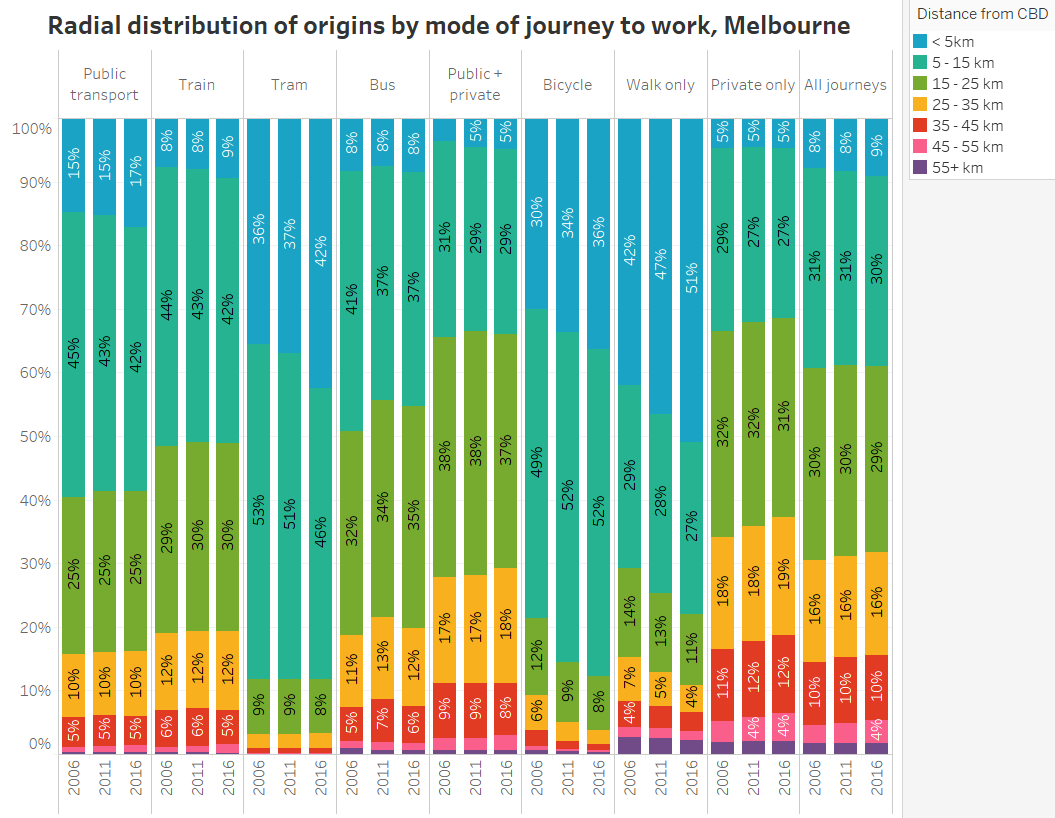
Private transport commuters were slightly more likely to come from the middle and outer suburbs. Tram and bicycle commuters were much more likely to come from the inner city. Bus commuters were over-represented in the 15-25 km band – probably dominated by the Doncaster area. Train commuters were over-represented in distances 5-25 km from the city, and under-represented in distances 35 km and beyond. Journeys by both public and private transport were more likely to come from the middle suburbs.

51% of people walking to work live within 5 km of the city centre, and the growth in walking journeys to work has been much stronger in the inner city.

Here’s a chart showing the most common home-work pairs for distance rings from the CBD for public transport journeys. It’s like a pie chart, but rectangular, larger and much easier to label (I haven’t labelled the small boxes in the bottom right hand corner):

You can see the most common combination is from 5-15 kms to 0-5 kms. This is followed by 15-25 to 0-5 kms and 0-5 to 0-5 kms.

Here’s the same for private transport only journeys:


There is a much more even distribution.

Finally, here is the same for active-only journeys to work:

This is much more polarised, with almost 40% of active transport trips being entirely within 5 km of the city centre. The second most common journey is within 5-15km of the city followed by from 5-15 km to 0-5 km.

In future posts I will look at more specific mode shares and shifts in more detail, the relationship between motor vehicle ownership and journey to work mode shares, and much more!

I hope you have found this analysis at least half as interesting as I have.

(note: this post uses data re-issued in December 2017 after ABS pulled the original Place of Work data in November 2017 due to quality concerns)

This post was updated on 24 March 2018 with improved maps. Also, data reported at SA2 level is now as extracted at SA2 level for 2011 and 2016, rather than an aggregation of CD/SA1/DZ data (each of which has small random adjustment for privacy reasons, which amplifies when you aggregate, also some work destinations seem to be coded to an SA2 but not a specific DZ). This does have a small impact, particularly for mode shifts and mode shares of new trips. On 7 April 2018 this post was updated to count journeys by “Other” and “Bicycle, Other” as private transport to ensure completeness of total mode share (we don’t actually know what modes “Other” is, so this isn’t perfect).

This post was further updated on 11 May 2018 to include minor adjustments to DZ workplace counts in 2011 to account for jobs where the SA2 was known but the DZ was not, and to improve mapping from 2011 DZs to 2016 SA2s. Refer to the appendix in the Brisbane post for all the details about the data.


Trends in journey to work mode shares in Australian cities to 2016 (second edition)

Tue 24 October, 2017

[Updated 1 December 2017 with reissued Place of Work data]

The ABS has now released all census data for the 2016 journey to work. This post takes a city-level view of mode share trends. It has been expanded and updated from a first edition that only looked at place of work data.

My preferred measure of mode share is by place of enumeration – ie how did you travel to work based on where you were on census night (see appendix for discussion on other measures).

I’m using Greater Capital City Statistical Areas (GCCSA) geography for 2011 and 2016 and Statistical Divisions for earlier years. For Perth, Melbourne, Adelaide, Brisbane and Hobart the GCCSAs are larger than the Statistical Divisions used for earlier years, but then those cities have also grown over time. See appendix 1 for more discussion.

Some of my data goes back to 1976 – I’ll show as much history as I have for each mode/modal combination.

Public transport mode share

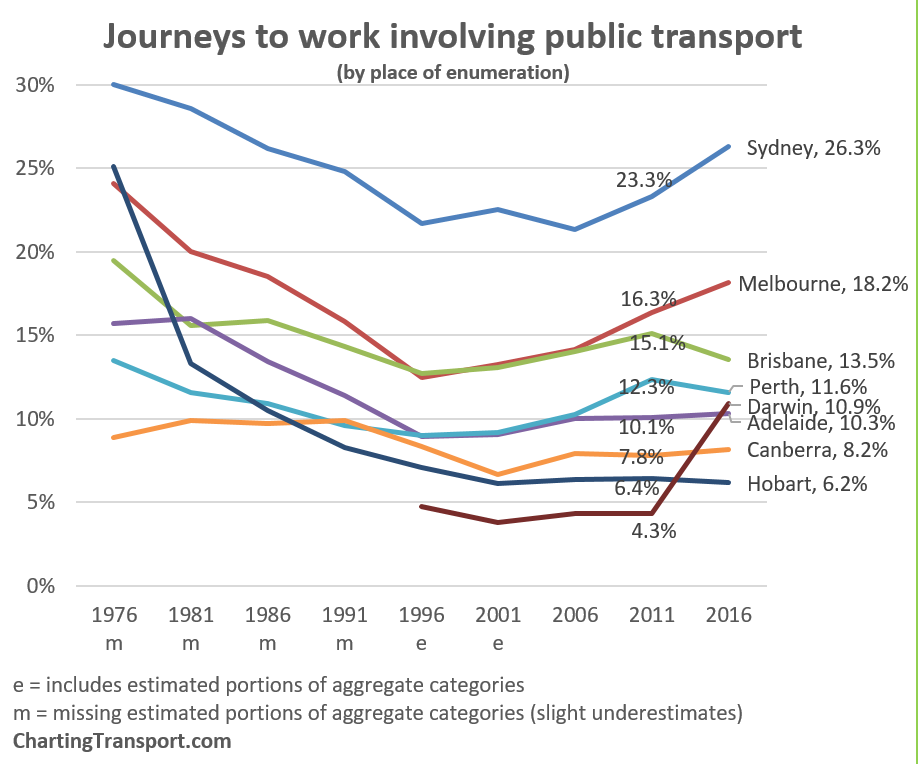
Sydney continues to have the largest public transport mode share, and the largest shift of the big cities. Melbourne also saw significant positive mode shift, but Perth and particularly Brisbane had mode shift away from public transport.

There’s so much to unpack behind these trends, particularly around the changing distribution of jobs in cities that I’m going to save that lengthy discussion for another blog post.

But what about the…

Massive mode shift to “public transport” in Darwin?!?

[this section updated 26 Oct 2017]

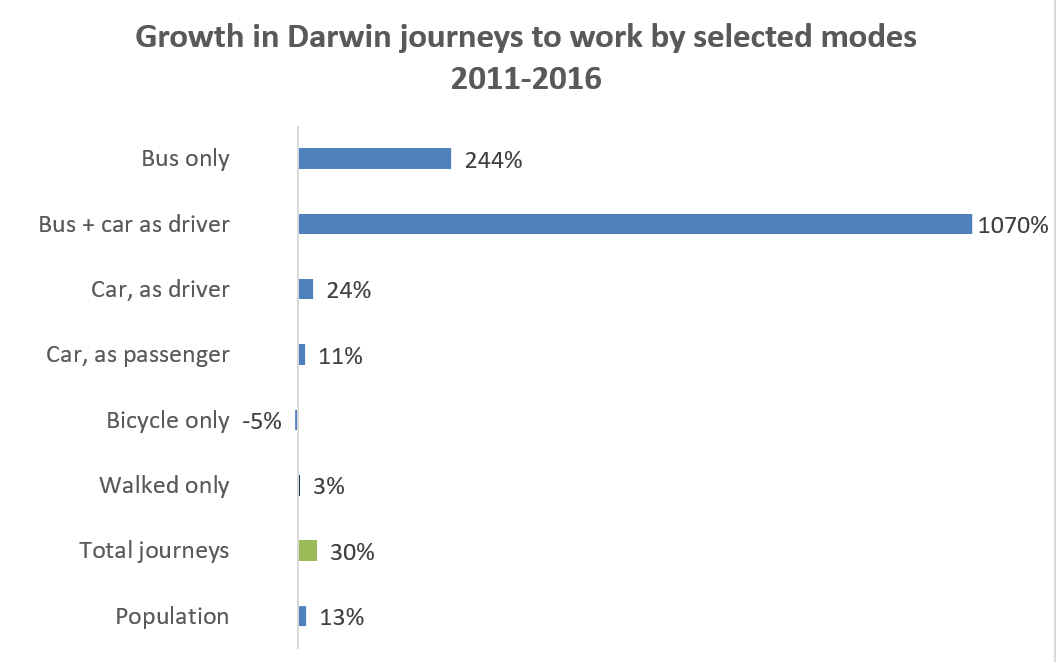
Yes, I have triple-checked I downloaded the right data. “Public transport” mode share increased from 4.3% to 10.9%. The number of people reporting bus-only journeys went from 1648 in 2011 to 5661 in 2016, which is growth of 244%. There has also been a spike in the total number of journeys to work in 2011, 30% higher than in 2011, while population growth was 13%.

Initially I thought this might have been a data error, but I’ve since learnt that there is a large LNG gas project just outside Darwin, and up to 180 privately operated buses are being used to transport up to 4700 workers to the site. This massive commuter task is swamping the usage of public buses.

Here’s the percentage growth in selected journey types between 2011 and 2016:

Bus + car as driver grew from 74 to 866 journeys, which reflects the establishment of park and ride sites around Darwin for the special commuter buses. Bus only journeys increased from 1953 to 5744. So it looks like most workers are getting the bus from home and/or forgot to mention the car part of their journey (in previous censuses I’ve seen many people living kilometres from a train station saying they got to work by train and walking only).

So this new project has swamped organic trends, although it is quite plausible that some people have shifted from cycling/walking to local jobs to using buses to commute to the LNG project (which is outside urban Darwin). When I look at workplaces within the Darwin Significant Urban Area (2011 boundary), public transport mode share is 6.0%, in 2016, still an increase from 4.4% in 2011. More on that in a future post.

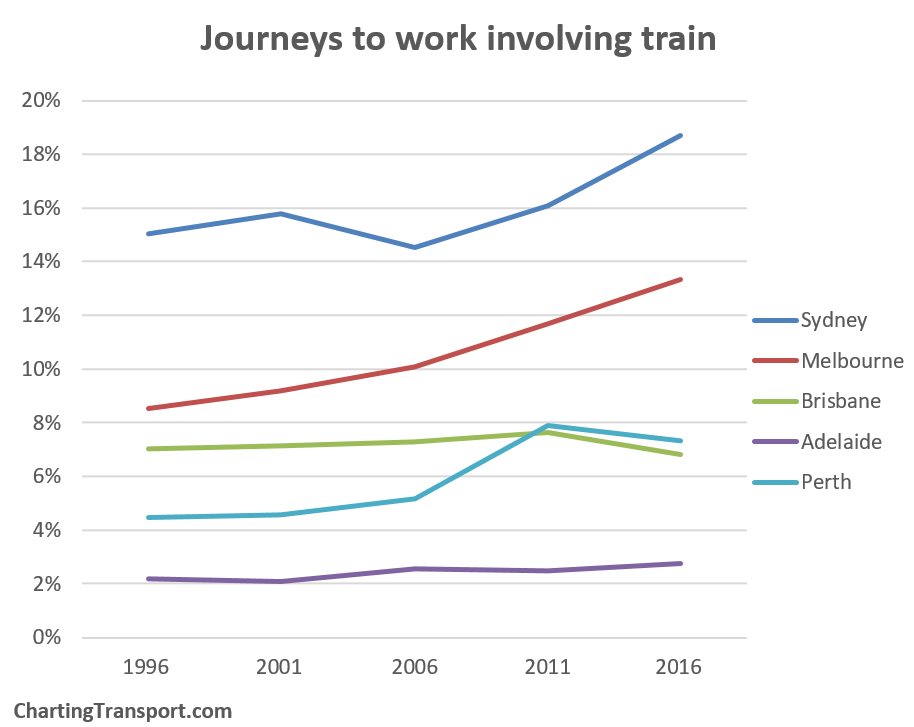
Train

Sydney saw the fastest train mode share growth, followed by Melbourne, while Brisbane and Perth went backwards.

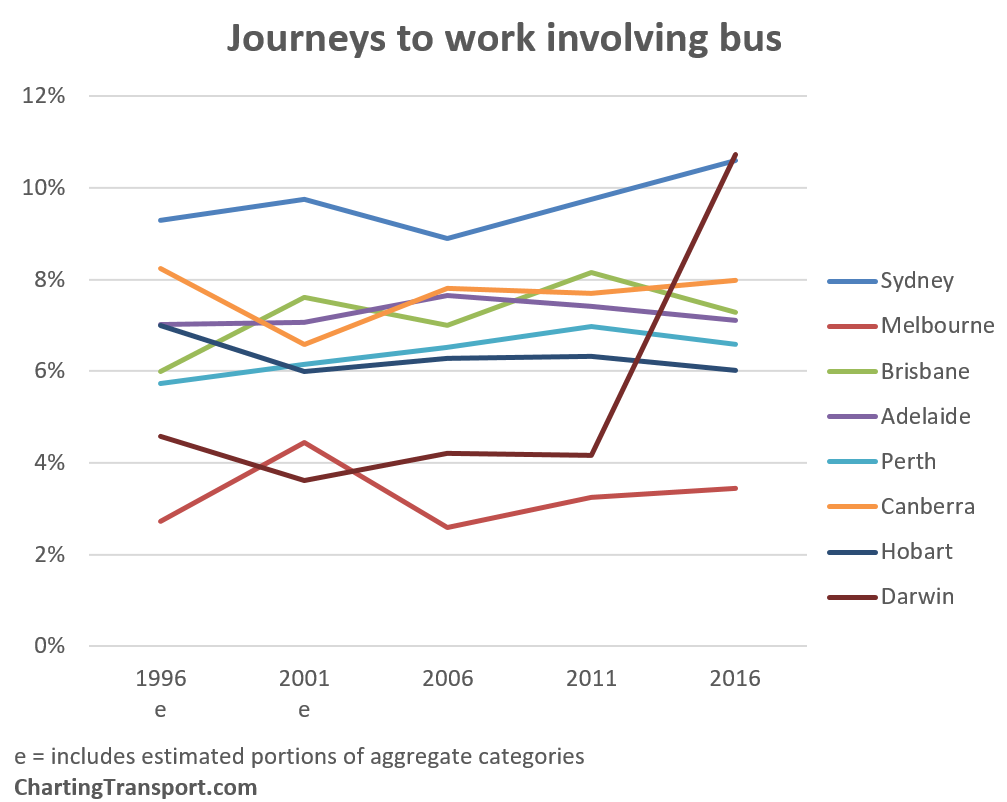
Bus

Darwin just overtook Sydney for top spot thanks to the LNG project. Otherwise only Sydney, Canberra and Melbourne saw growth in bus mode share. Melbourne’s figure remains very low, however it is important to keep in mind that trams provide most of the on-street inner suburban radial public transport function in Melbourne.

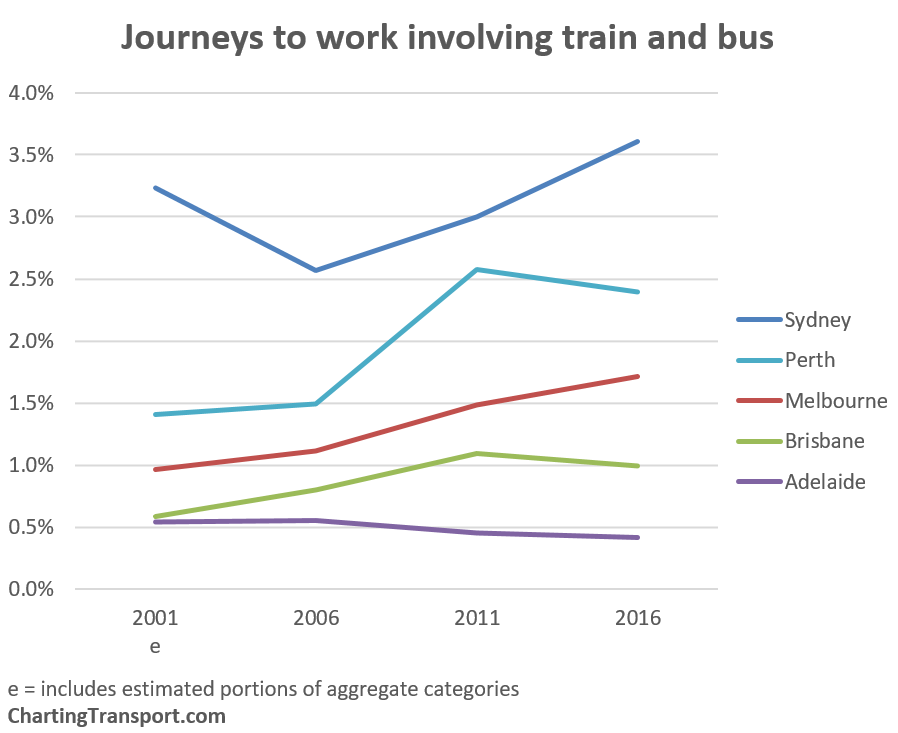
Train and bus

Sydney comes out on top, with a large increase in 2016 (although much of this is still concentrated around Bondi where there are high bus frequencies and no fare penalties for transfers – more on that in an upcoming post). Melbourne is seeing substantial growth (perhaps due to improvements in modal coordination), while Perth, Adelaide and Brisbane had declines in terms of mode share (Brisbane and Adelaide were also declines on raw counts, not just mode share). I’m sure some people will want to comment about degrees of modal integration in different cities.

Train and bicycle

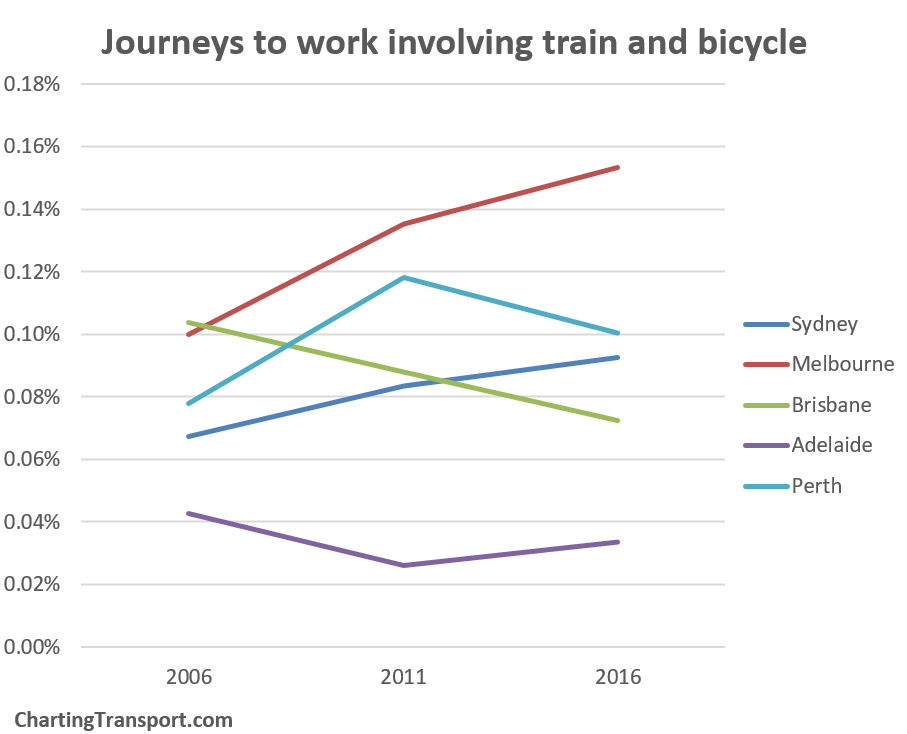
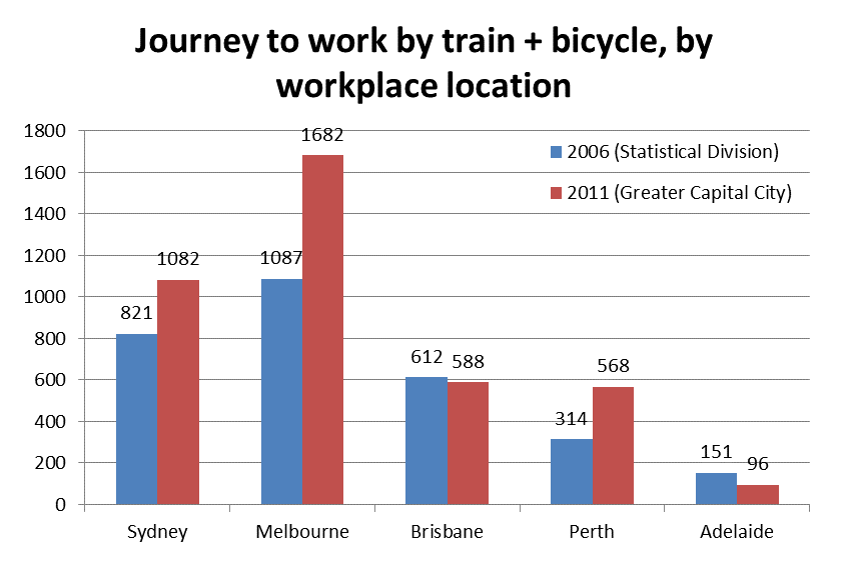
Some cities are also trying to promote the bicycle and train combination as an efficient way to get around (they are the fastest motorised and (mostly)non-motorised surface modes because they can generally sail past congested traffic). The mode shares are still tiny however:

Sydney and Melbourne are growing but the other cities are in decline in terms of mode share.

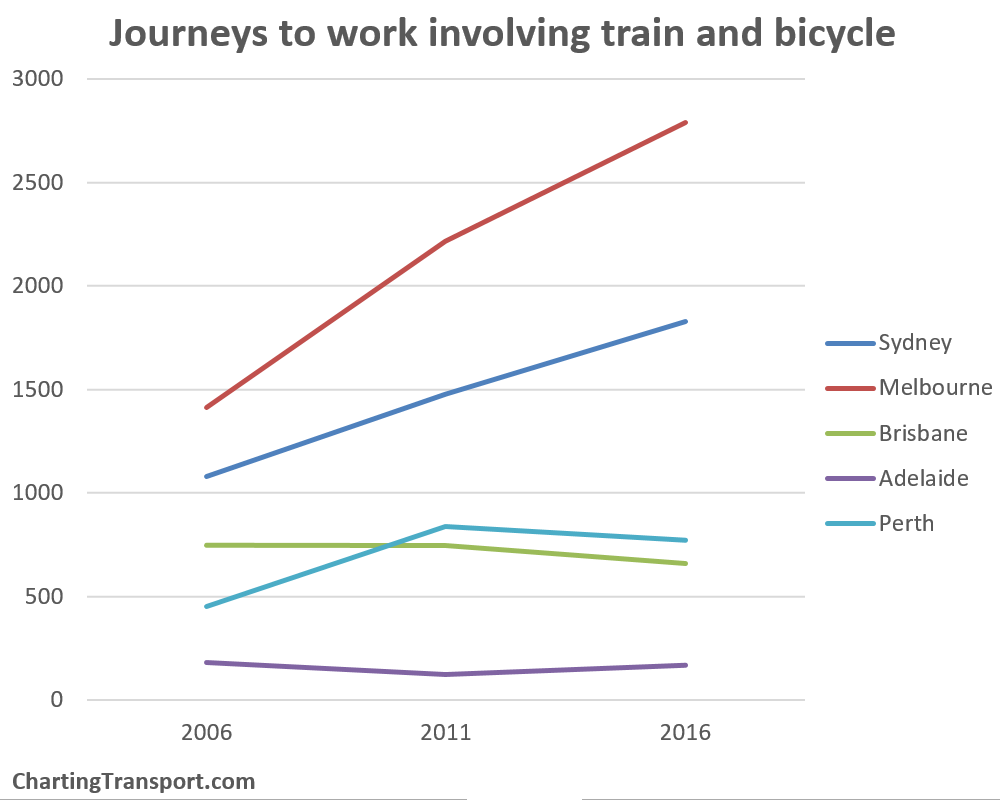
As this modal combination is coming off an almost zero base, it’s also probably worth looking at the raw counts:

The downturns in Brisbane and Perth are not huge in raw numbers, and probably reflect the general mode shift away from public transport (which is probably more to do with changing job distributions than bicycle facilities at train stations).

Cycling

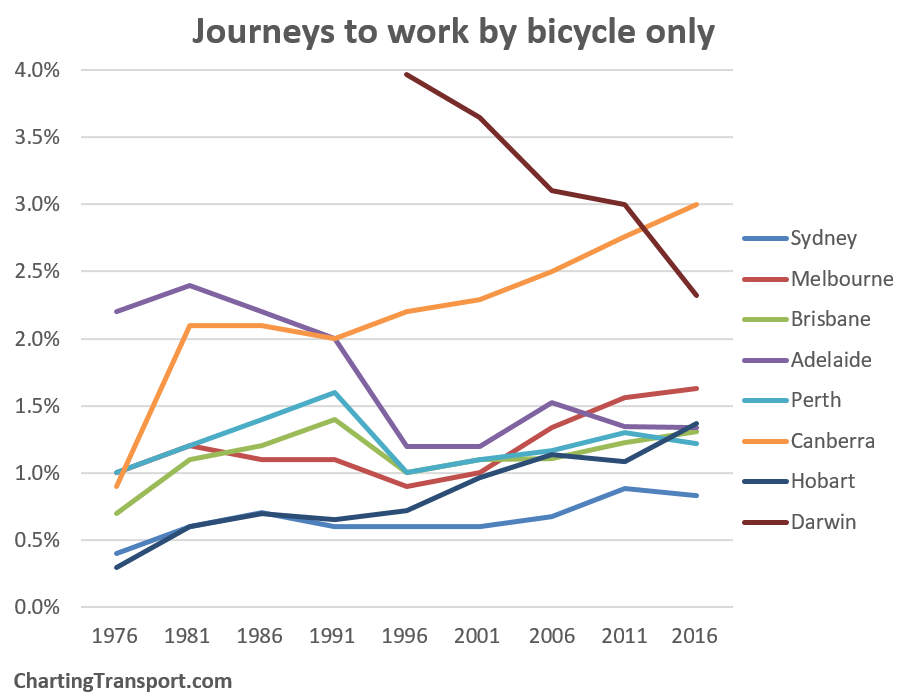
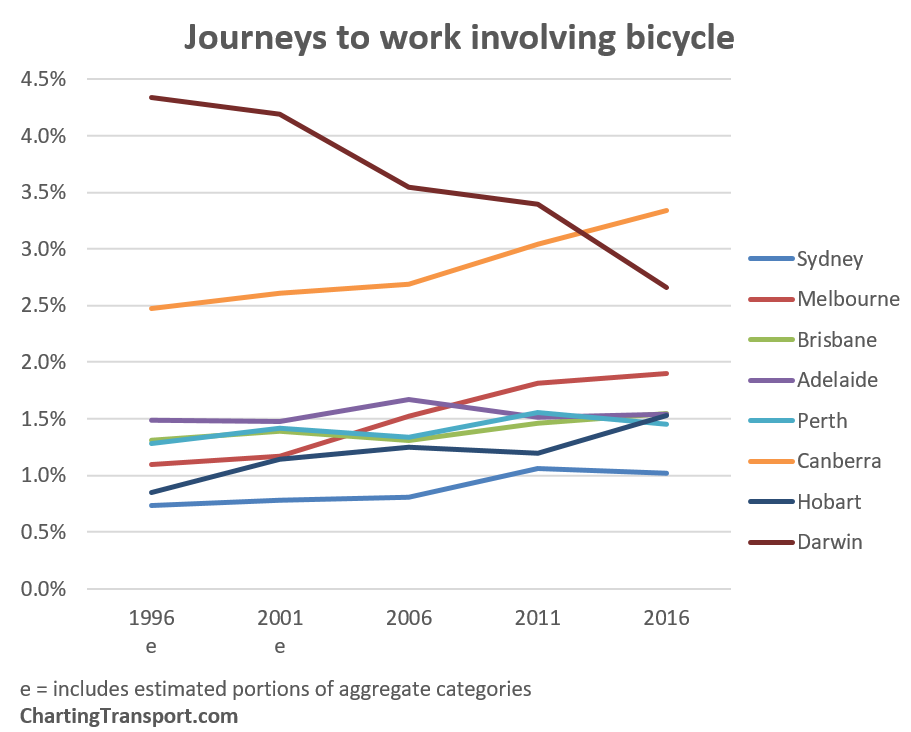
I have a longer time-series of bicycle-only mode share, compared to “involving bicycle”, so two charts here:

Observations:

  • Darwin lost top placing for cycling to work with a large decline in mode share (refer discussion above about the massive shift to bus).
  • Canberra took the lead with more strong growth.
  • Melbourne increased slightly between 2011 and 2016 (note: rain was forecast on census day which may have suppressed growth, more on that in a moment).
  • Hobart had a big increase in 2016, following rain in 2011.
  • Sydney remains at the bottom of the pack and declined in 2016.

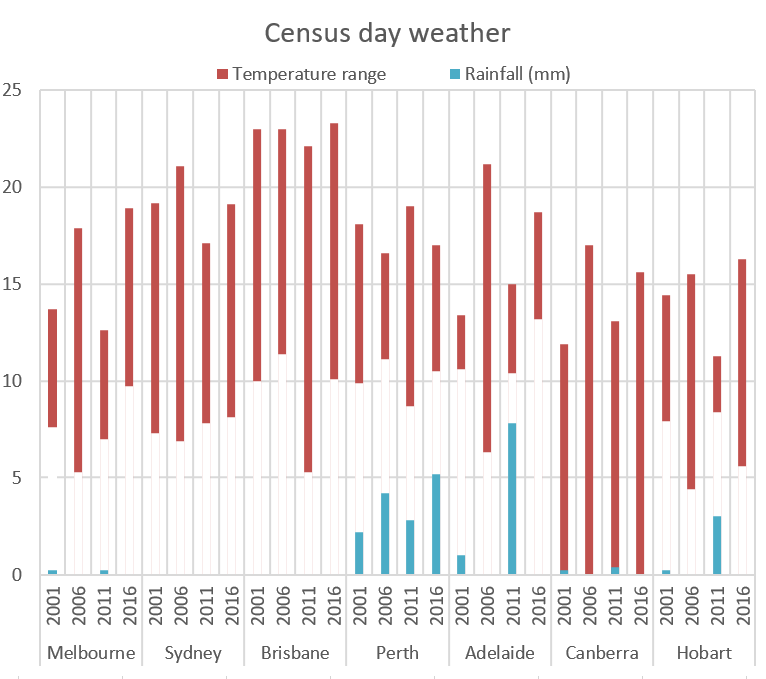
Walking and cycling mode share is likely to be impacted by weather. Here’s a summary of recent census weather conditions for most cities (note: Canberra minimums were -3 in 2001, -7 in 2006, 0 in 2011 and -1 in 2016):

Perth had rain on all of the last four census days, while Adelaide had significant rain only in 2001 and 2011 (and indeed 2006 shows up with higher active transport mode share). Hobart had significant rain in 2011, which appears to have suppressed active transport mode share that year.

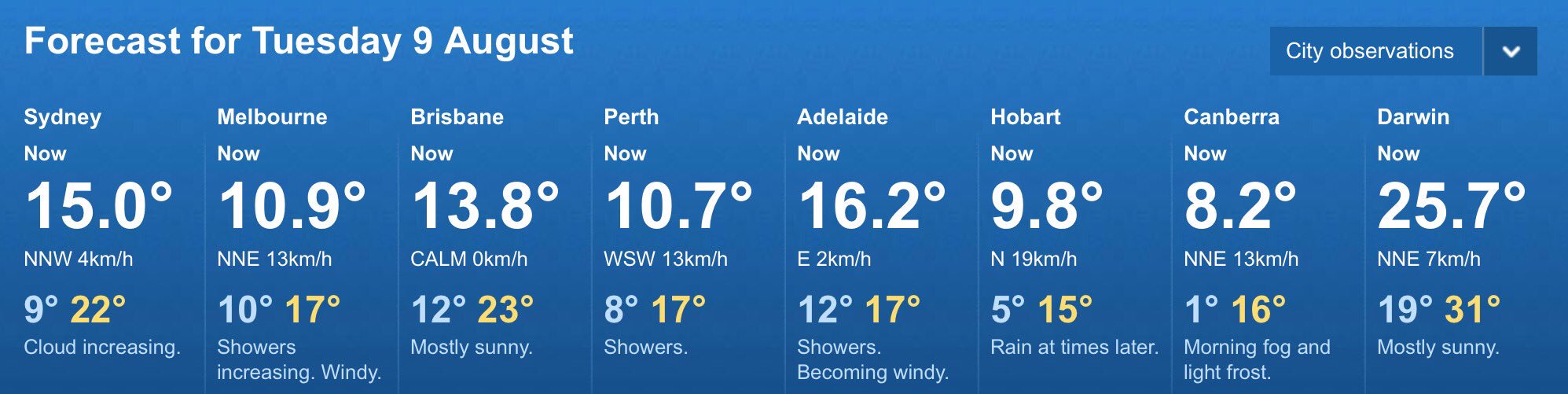
But perhaps equally important is the forecast weather as that could set people’s plans the night before. Here was the forecast for the 2016 census day,  from the BOM website the night before:

Note that it didn’t end up raining in Melbourne, Adelaide, or Hobart.

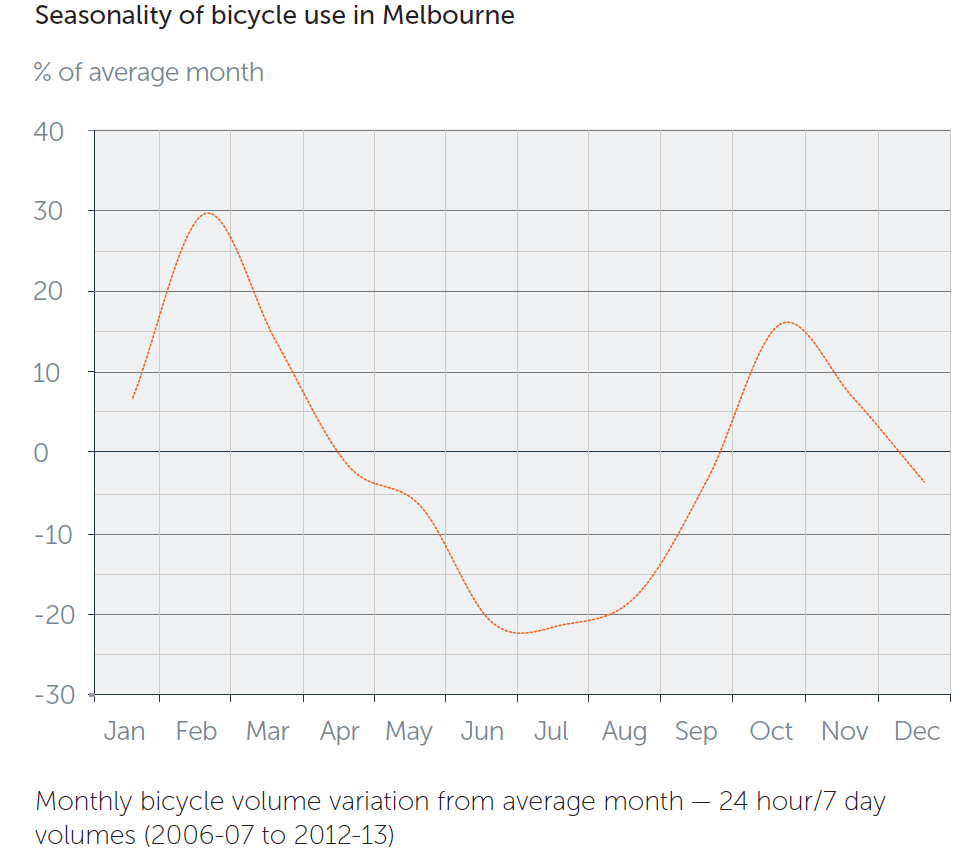
The census is conducted in winter – which is the best time to cycle in Darwin (dry season) and not a great time to cycle in other cities. However the icy weather in Canberra clearly hasn’t stopped it getting the highest and fastest growing cycling mode share of all cities!

Indeed here is a chart from VicRoads showing the seasonality of cycling in Melbourne at their bicycle counters:

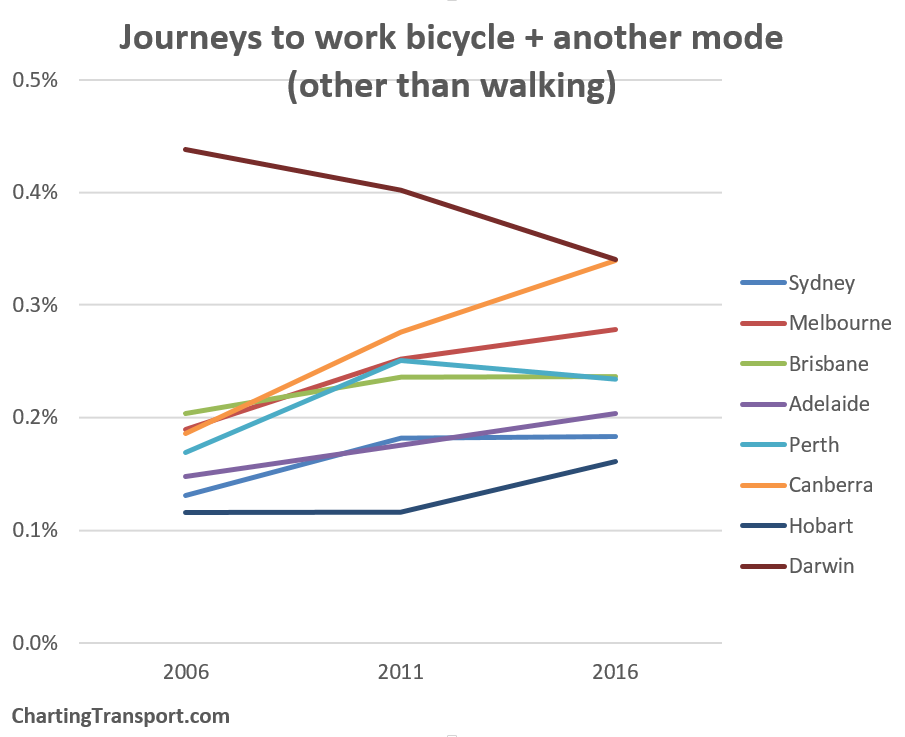
And in case you are interested, here are the (small) mode shares of journeys involving bicycle and some other modes (other than walking):

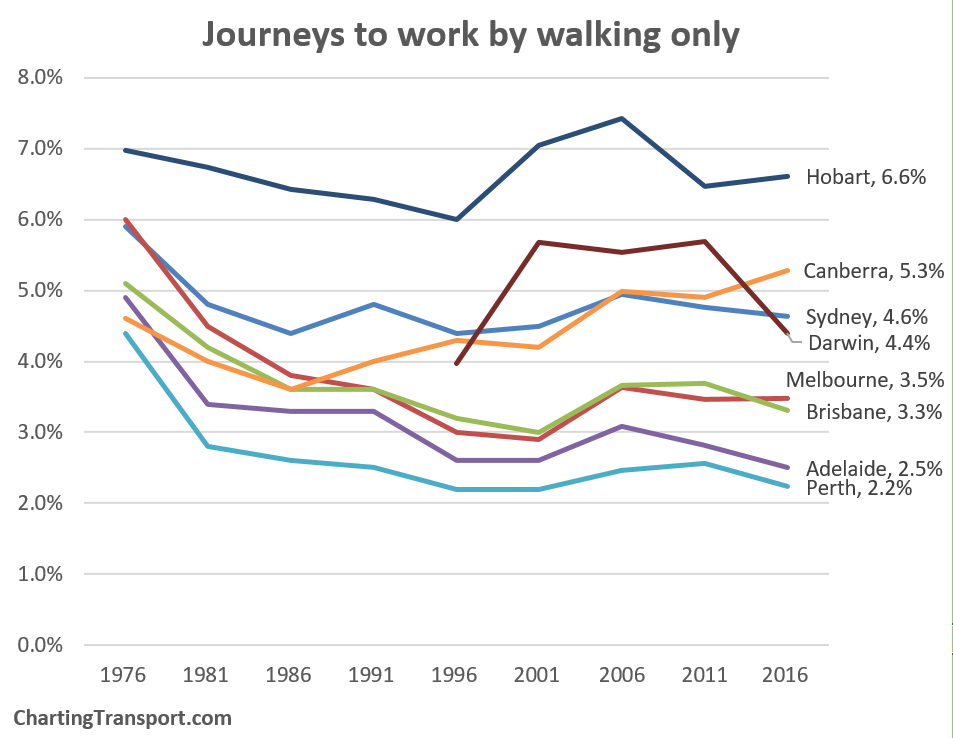
Walking only

Canberra was the only city to have a big increase, while there were declines in Darwin, Perth, Adelaide, Brisbane, and Sydney.

The smaller cities had the highest walking share, perhaps as people are – on average – closer to their workplace, followed by Sydney – the densest city. But city size doesn’t seem to explain cycling mode shares.

Car

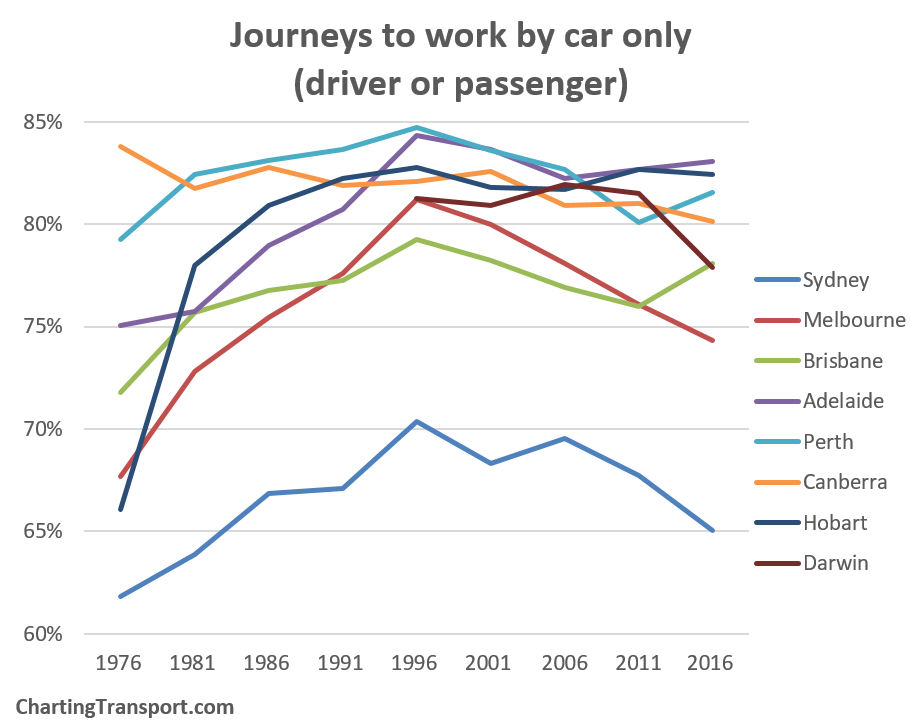
The following chart shows the proportion of journeys to work made by car only (either as driver or passenger):

Sydney has the lowest car only mode share and it declined again in 2016. It was followed by Melbourne in 2016. Brisbane and Perth had large increases in car mode share in 2016 (in line with the PT decline mentioned above). Darwin also shows a big shift away from the car to public transport (although the total number of car trips still increased by 24%). Adelaide hit top spot, followed by Hobart and Perth.

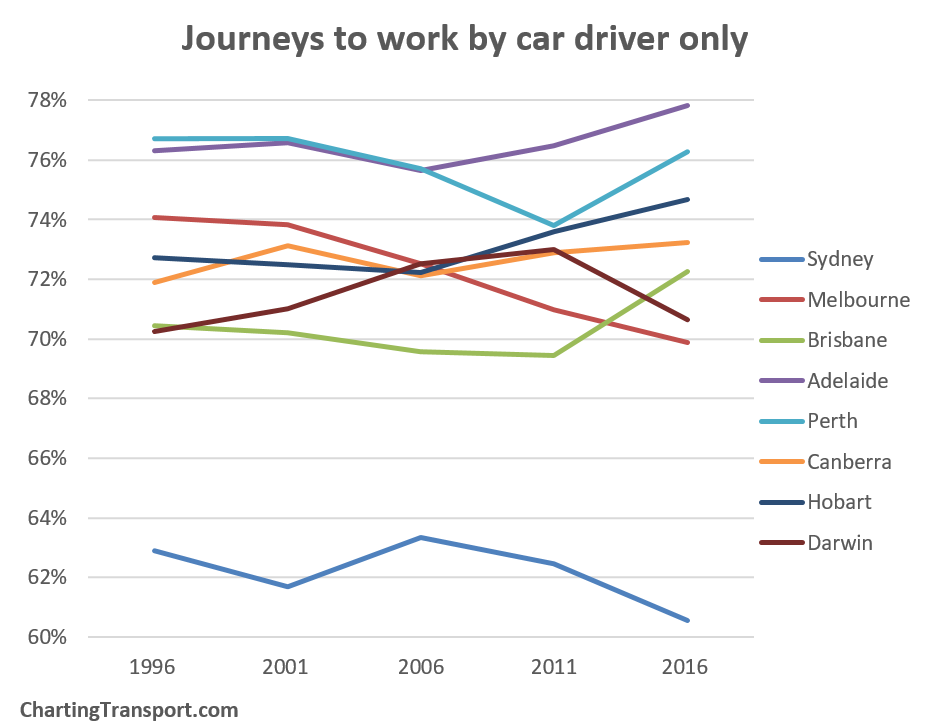
Here is car as driver only:

And here is car as passenger only:

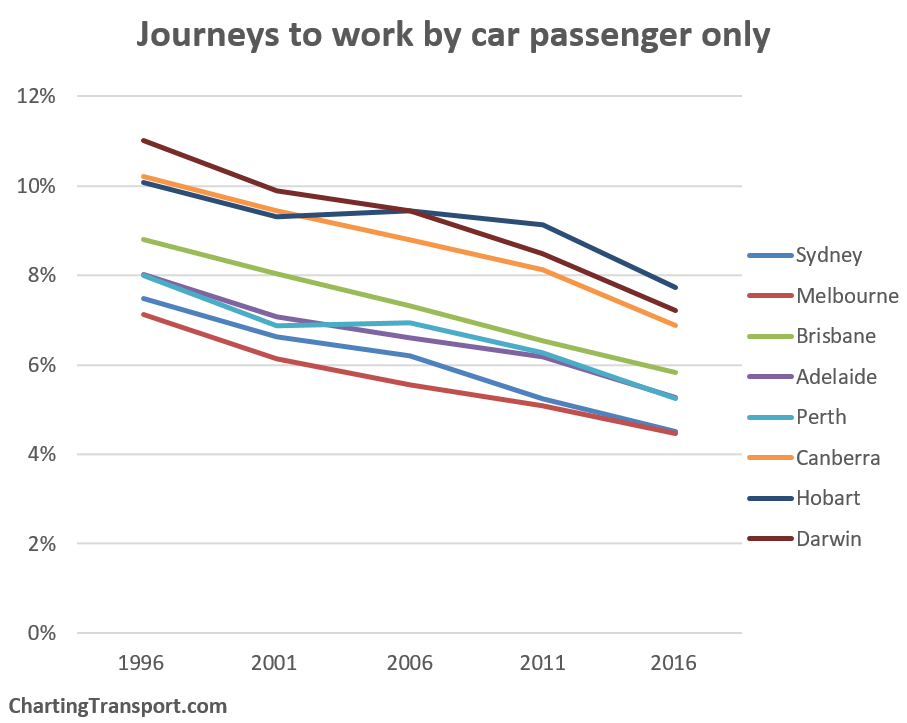
Car as passenger declined in all cities again in 2016, but was more common in the smaller cities, and least common in the bigger cities. I’m not sure why car as passenger declines paused for Perth and Sydney in 2006.

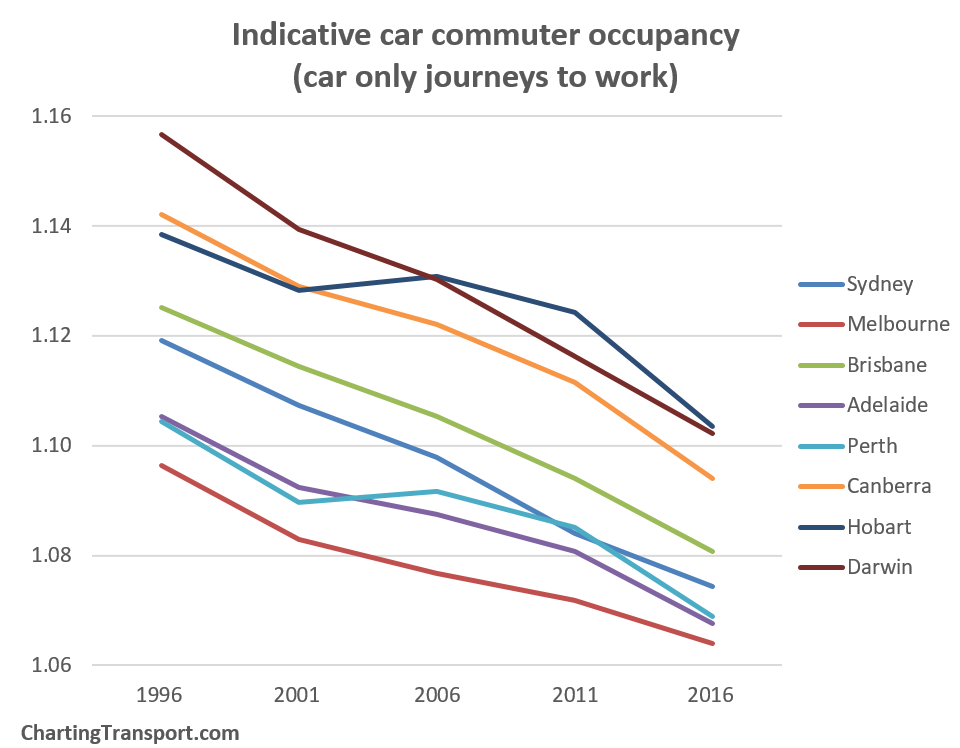
We can calculate an implied notional journey to work car occupancy by comparing car driver only and car passenger only journeys. This is not actual car occupancy, because it excludes people not travelling to work and excludes journeys that involved cars and other modes. However it does provide an indication of trends in car pooling for journeys to work.

There were further significant decreases in car commuter occupancy, in line with increasing car ownership and affordability.

Private transport

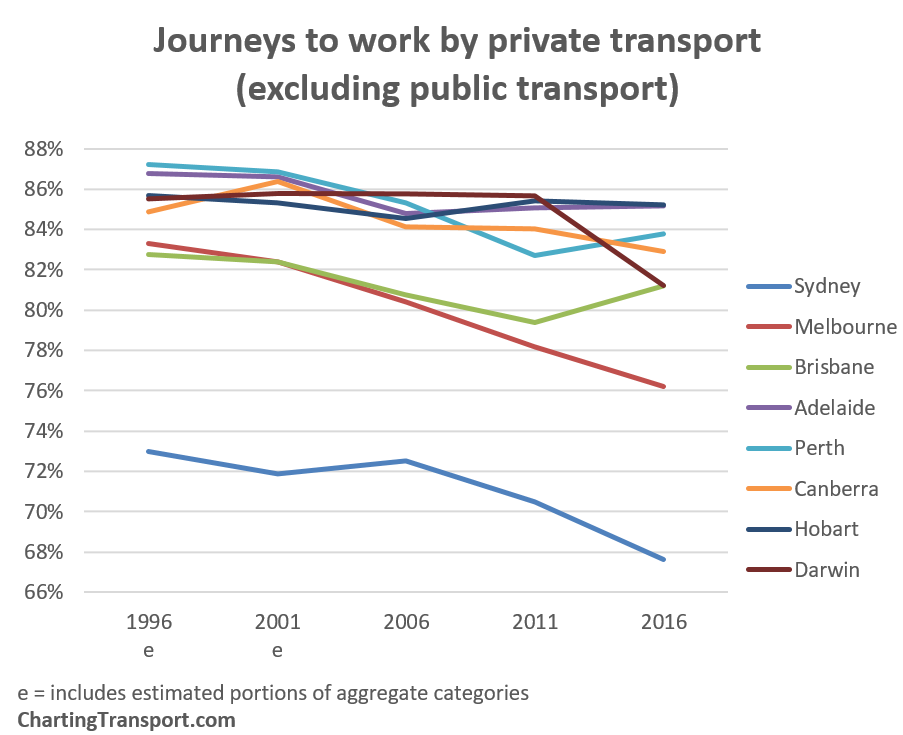
Here is a chart summing all modal combinations involving cars (driver or passenger), motorcycle/scooter, taxis, and trucks, but excluding any journeys that also include public transport.

The trends mirror what we have seen above, and are very similar to car-only travel.


Overall mode split

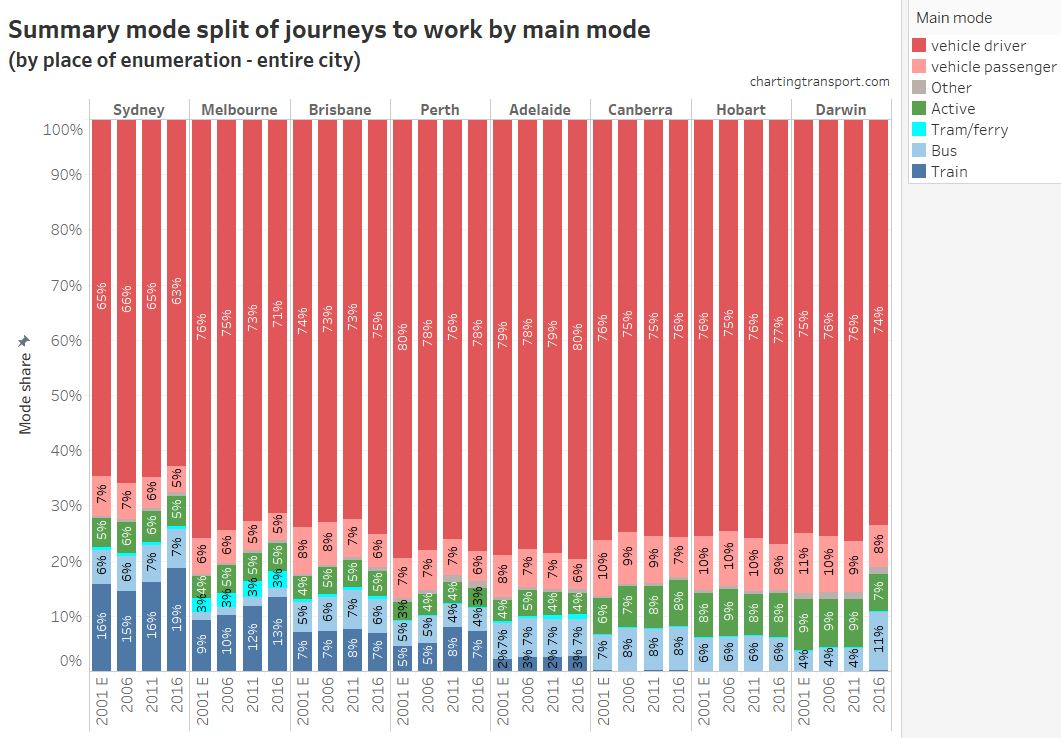
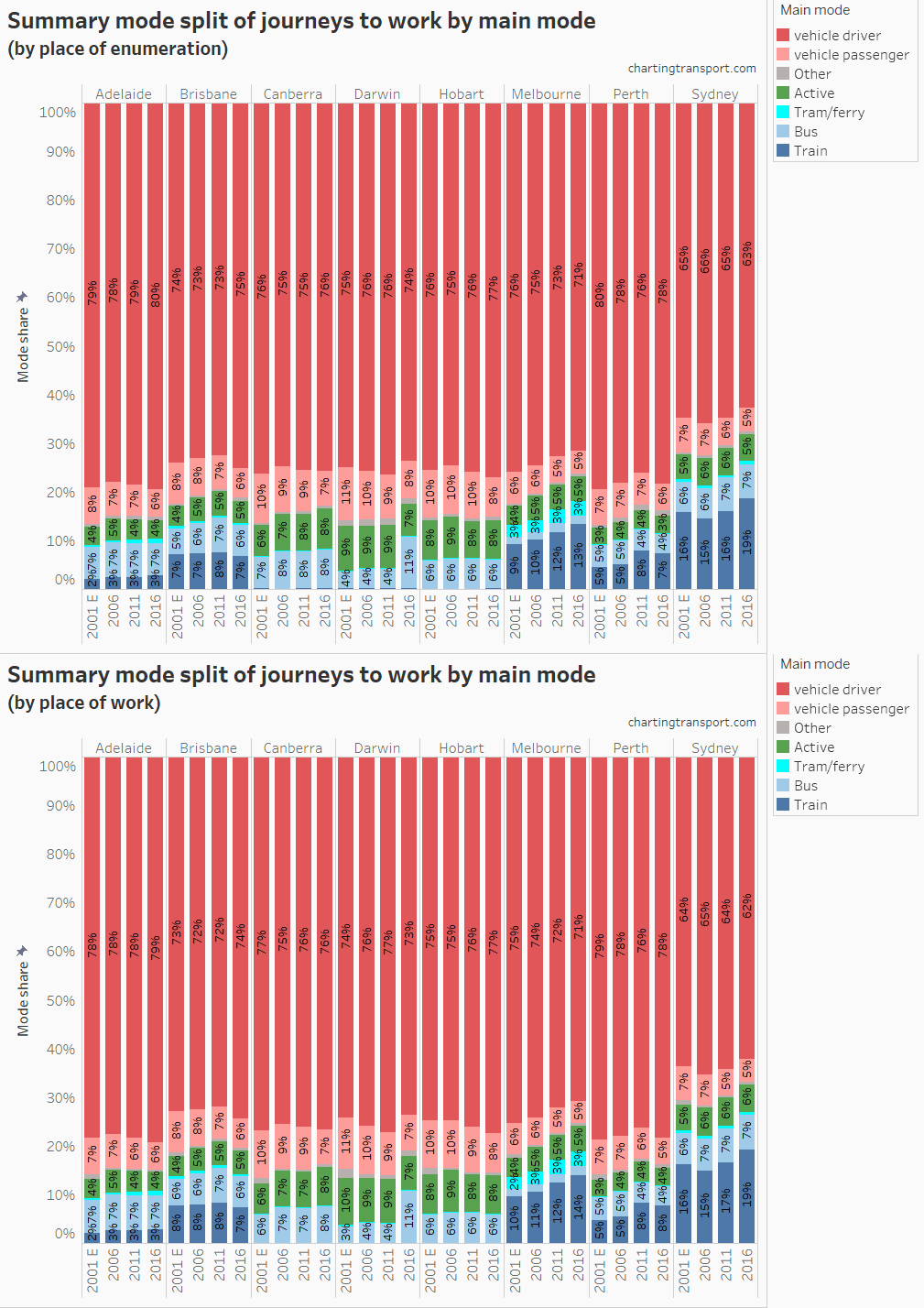
Here’s an overall split of journeys to work by “main mode” (click to enlarge):

Note: the 2001 data includes estimated splits of aggregated modes based on 2006 data.

I assigned a ‘main mode’ based on a hierarchy as follows:

  • Any journey involving train is counted with the main mode as train
  • Any other journey involving bus is counted with the main mode as bus
  • Any other journey involving tram and/or ferry is counted as “tram/ferry”
  • Any other journey involving car as driver, truck or motorbike/scooter is counted as “vehicle driver”
  • Any other journey involving car as passenger or taxi is counted as “vehicle passenger”
  • Any other journey involving walking or cycling only as “active”

How different are “place of work” and “place of enumeration” mode shares?

[this section updated 1 December 2017 with re-issued Place of Work data. See new Appendix 3 below for analysis of the changes]

The first edition of this post reported only “place of work” data, as place of enumeration data wasn’t released until 11 November 2017. This second edition now focuses on place of enumeration – where people were on census night.

The differences are not huge, as most people who live in a city also work in that city, but there are still a number of people who leave or enter cities’ statistical boundaries to go to work. Here’s an animation showing the main mode split by place of work and enumeration so you can compare the differences (you’ll need to click to enlarge). The animation dwells longer on place of work data.

Public + active transport main mode shares are generally higher for larger cities with place of work data, and smaller for smaller cities.

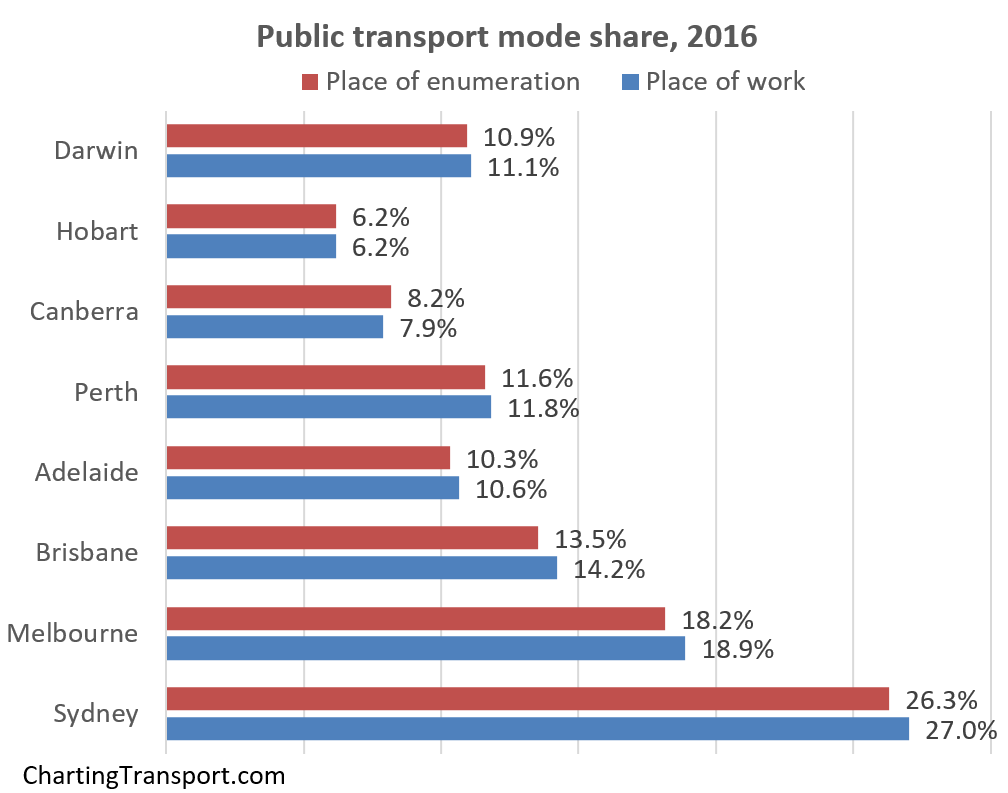
Here’s a closer look at the 2016 public transport mode shares by the two measures:

See also a detailed comparison in Appendix 1 below for 2011 Melbourne data.

I’d like to acknowledge Dr John Stone for assistance with historical journey to work data.

Appendix 1 – How to measure journey to work mode share

Firstly, I exclude people who did not work, worked at home, or did not state how they worked. The first two categories generate no transport activity, and if the actual results for “not stated” were biased in any way we would have no way of knowing how.

I prefer to use “place of enumeration” data (ie where people were on census night). “Place of usual residence” data is also available, but is unfortunately contaminated by people who were away from home on census day. The other data source is “Place of work”.

Some people might prefer to measure mode shares on Urban Centres which excludes rural areas within the larger blobs that are Greater Capital City Statistical Areas and Statistical Divisions (use this ABS map page to compare boundaries). However, “place of work” data is not readily available for that geography, and this method also excludes satellite urban centres that might be detached from the main urban centre, but are very much part of the economic unit of the city.

Another option is “Significant Urban Area”, which includes more fringe areas, and some more satellite towns, and in Canberra’s case crosses the NSW border to capture Queanbeyan.

What difference does it make?

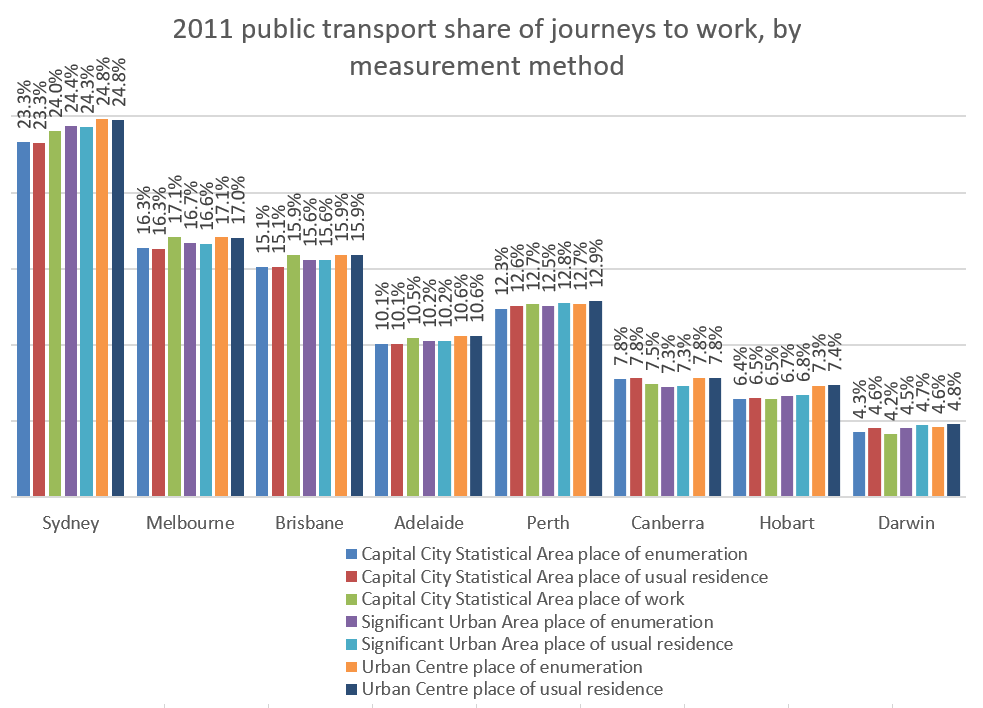
Here’s a comparison of public transport mode shares for the different methods for 2011.

If you look closely, you’ll notice:

  • The more than you remove non-urban areas, the higher your public transport mode share, which makes sense, as those non-urban areas are mostly not served by public transport.
  • Place of usual residence tends to increase public transport mode shares for smaller cities (people probably visiting larger cities) and depresses public transport mode share in larger cities (people visiting smaller cities and towns).
  • Place of work is only readily available for Greater Capital City Statistical Areas. For the bigger cities it tends to inflate PT mode share where people might be using good inter-urban public transport options, or driving to good public transport options on the edges of cities (eg trains). However it has the opposite impact in Darwin and Canberra, where driving into the city is probably easier.

But I think the main point is that for any time series trend analysis you should use the same measure if possible.

If you want to compare the two, I’ve created a Tableau Public visualisation that has a large number of mode shares by both place of work and place of enumeration.

Appendix 2 – Estimating pre-2006 mode shares from aggregated data

For 2006 onwards, ABS TableBuilder provides counts for every possible combination of up to three modes (other than walking, which is assumed to be part of every journey). For example, in Melbourne in 2006, 36 people went to work by taxi, car as driver, and car as passenger (or so they said!). Unfortunately for years before 2006 data is not readily available with a full breakdown.

The 2001 data includes only aggregated counts for the following categories:

  • train and other (excluding bus)
  • bus and other (excluding train)
  • other two modes (no train or bus)
  • train and two other modes
  • bus and two other modes (excluding train)
  • three other modes (no train or bus)

Together these accounted for 3.7% of journeys in Melbourne and 4.5% of journeys in Sydney.

However all but two of those aggregate categories definitely involve train and/or bus, so can be included in public transport mode share calculations.

Journeys in the aggregate categories “Other two modes” and “Other three modes” might involve tram and/or ferry trips (if such modes exist in a city), but we don’t know for sure.

I’ve used the complete modal data for 2006 to calculate the percentage of 2006 journeys that fit into these two categories that are by public transport. I’ve then assumed these same percentage apply in 2001 to estimate total public transport mode shares for 2001 (for want of a better method).

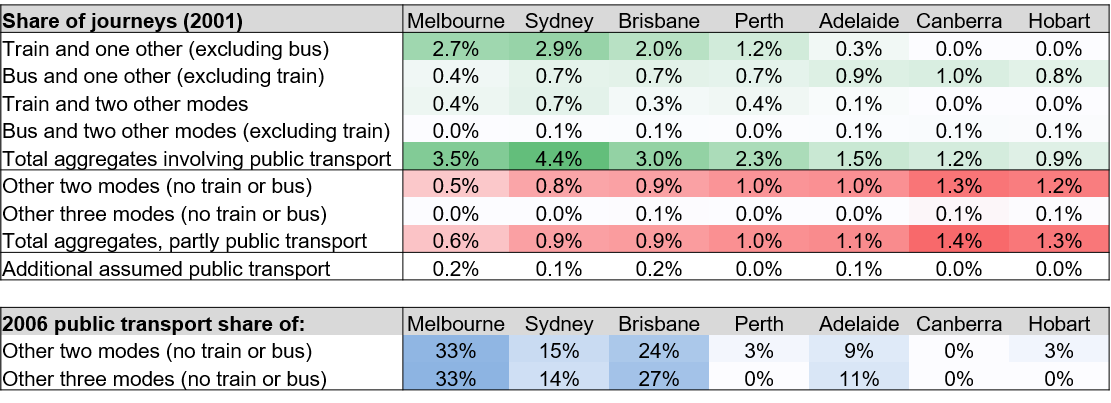
Here are the 2001 relevant stats for each city:

(note: totals do not add perfectly due to rounding)

The estimates add up to 0.2% to the total public transport mode shares in cities with significant modes beyond train and bus (namely ferry and tram in Sydney, tram in Melbourne, ferry in Brisbane, tram and Adelaide). This almost entirely comes from “other two modes” category while “other three modes” is tiny. For these categories, almost no journeys in Perth, Canberra and Hobart actually involved a public transport mode.

In the past I have knowingly ignored public transport journeys that might be part of these categories, which almost certainly means public transport mode share is underestimated (I suspect most other analysts have too). By including some assumed public transport journeys my estimate should be closer to the true value, which I think is better than an underestimate.

But are these reasonable estimates? Are the 2001 modal breakdowns for these categories likely to be the same as 2006? Maybe not exactly, but because we are multiplying small numbers by small numbers, the impact of slightly inaccurate estimates is unlikely to shift the total by more than 0.1%. I tested the methodology between 2006 and 2011 results (eg using 2011 full breakdown against created 2006 aggregate categories and vice versa) and the estimated total mode shares were almost always exactly the same as the perfectly calculated shares (at worst there was a difference of 0.1% when rounding to one decimal place).

In the first edition of this post I had to estimate 2016 place of work mode shares in a similar way for public and private transport, but I wasn’t confident enough to estimate mode share of journeys involving cycling.

I now have the final data and I promised to see how I went, so here’s a comparison:

If you round to one decimal place, the estimates were no different for public and private transport and out by up to 0.1% for cycling (which is relatively significant for the small cycling mode shares).

I’ve applied a similar approach to estimate several other mode share types, and these are marked on charts.

Appendix 3 – How different is the re-issued place of work data?

In December 2017, ABS re-issued Place of Work data due to data quality issues. This is how they described it:

**The place of work data for the 2016 Census has been temporarily removed from the ABS website so an issue can be corrected. There was a discrepancy in the process used to transform detailed workplace location information into data suitable for output. The ABS will release the updated information in TableBuilder on December 2. The Working Population Profiles will be updated on December 13.**

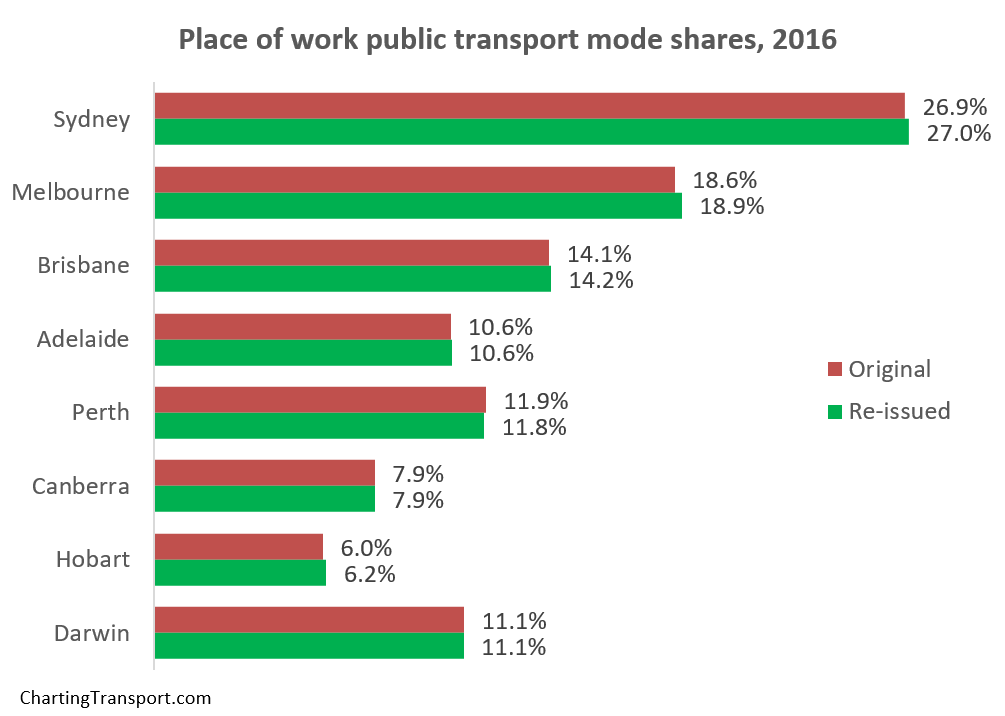
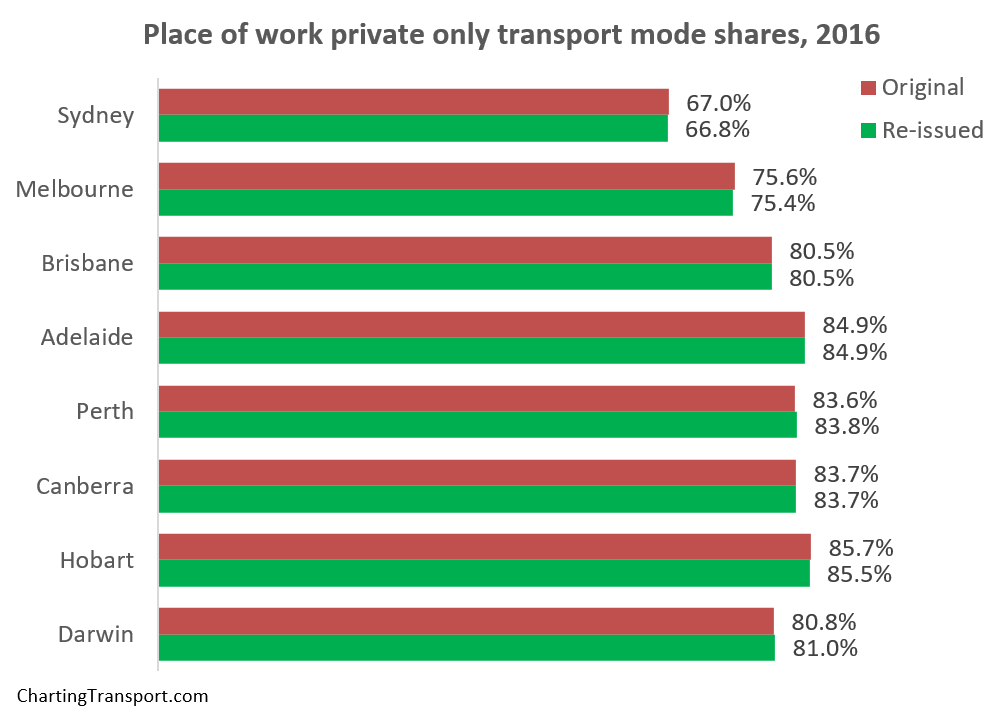
I have loaded the new data, and here are differences in public transport and private transport mode shares for capital cities:

You can see differences of up to 0.3% (Melbourne PT mode share), but mostly quite small.


What does the census tell us about cycling to work?

Mon 27 January, 2014

Who is cycling to work? Where do they live? Where do they work? How old are they? What work do they do? Do men commute by bicycle more than women? How far are cyclists commuting? What other modes are cyclists using?

The census provides some answer to these questions for the entire Australian working population, albeit for one winter’s day every five years.

This post builds on material I presented at the Bike Futures 2013 conference, using census data from across Australian with a little more detail on capital cities and my home city Melbourne.

It’s not a short post, so settle in for 13 charts and 17 maps of data analysis.

How has cycling mode share changed over time?

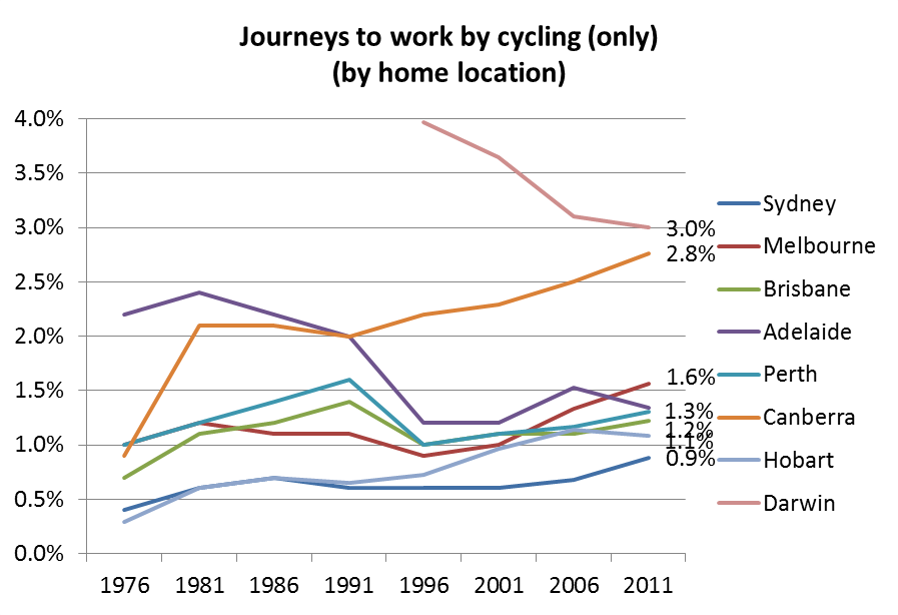
The first chart shows the proportion of journeys to work by bicycle (only) in Australia’s capital cities.

Cyclcing only mode share for cities time series

Darwin appears to the capital of cycling to work, although it is quickly losing ground to Canberra (unfortunately I don’t have figures for Darwin pre-1996).  The census is conducted in Darwin’s dry season, but other data suggests there is little difference in bicycle activity between the wet and dry seasons.

Melbourne has shown very strong growth since 2001 and Sydney showed strong growth between 2006 and 2011. Cycling mode share has grown in all cities since 1996.

Mode shares collapsed in Adelaide, Sydney, Brisbane, and Melbourne between 1991 and 1996, which many people have attributed to the introduction of mandatory helmet laws (Alan Davies has a good discussion about this issue on his blog).

But as I pointed out at the start, census data is only good for one winter’s day every five years. Does the weather on these days impact the results?

Here is a chart roughly summarising the weather in (most of) the capital cities for 2001, 2006 and 2011 in terms of minimum temperature, maximum temperature and rainfall. It doesn’t cover wind, nor what time of day it rained (although perhaps some fair-weather cyclists might avoid riding on any forecast rain). It also fails to show the sub-zero minimums in Canberra (involves asking too much from Excel).

Census day weather

You can see that 2011 was wetter in Adelaide and Hobart than previous years, and this coincides with lower cycling mode shares in these cities in 2011. So census data is quite problematic from a weather point of view. That said, most cities had very little or no rain on the last three census days.

Where were the commuter cyclists living and working?

Other posts on this blog have also covered some of these maps, but not for all cities.

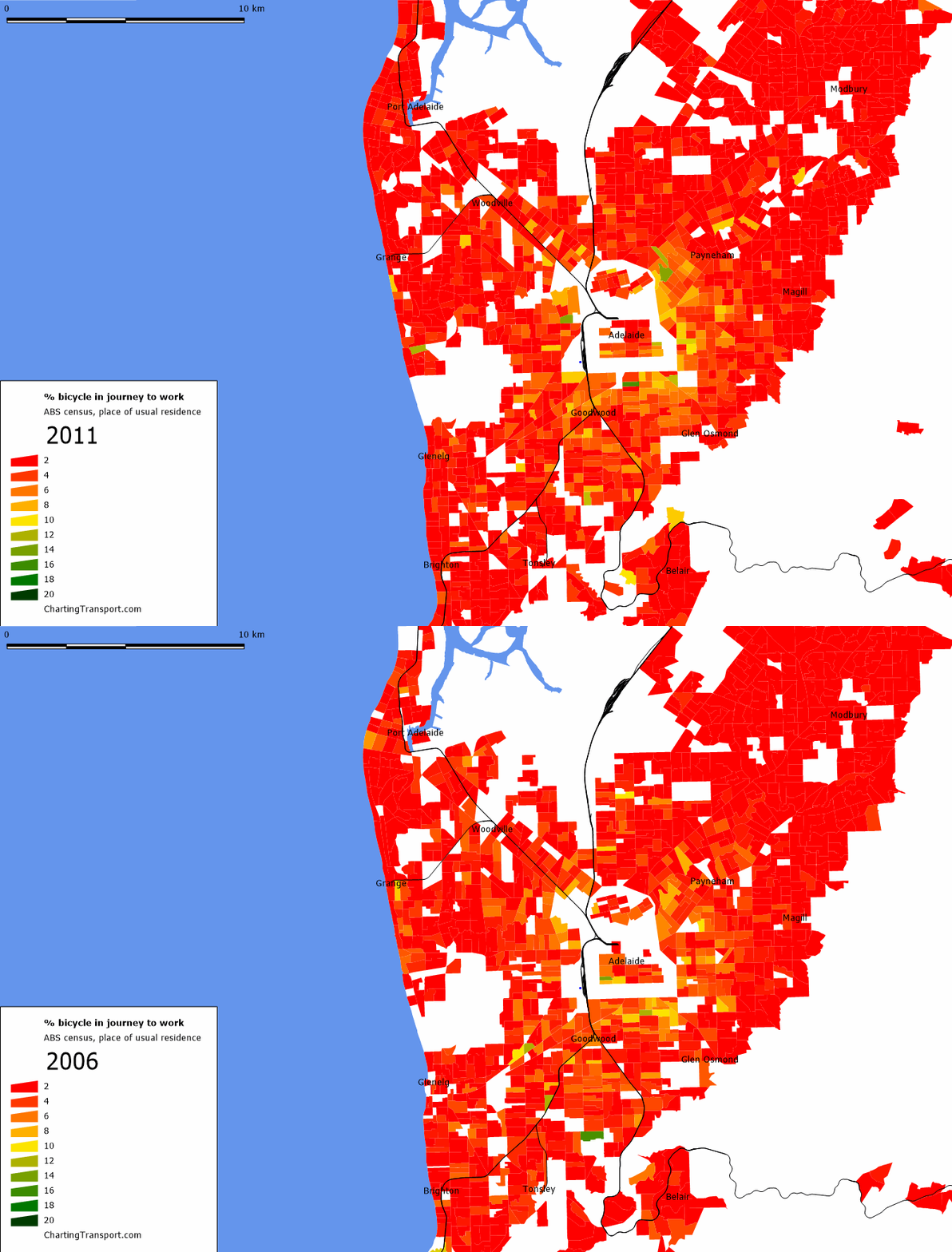
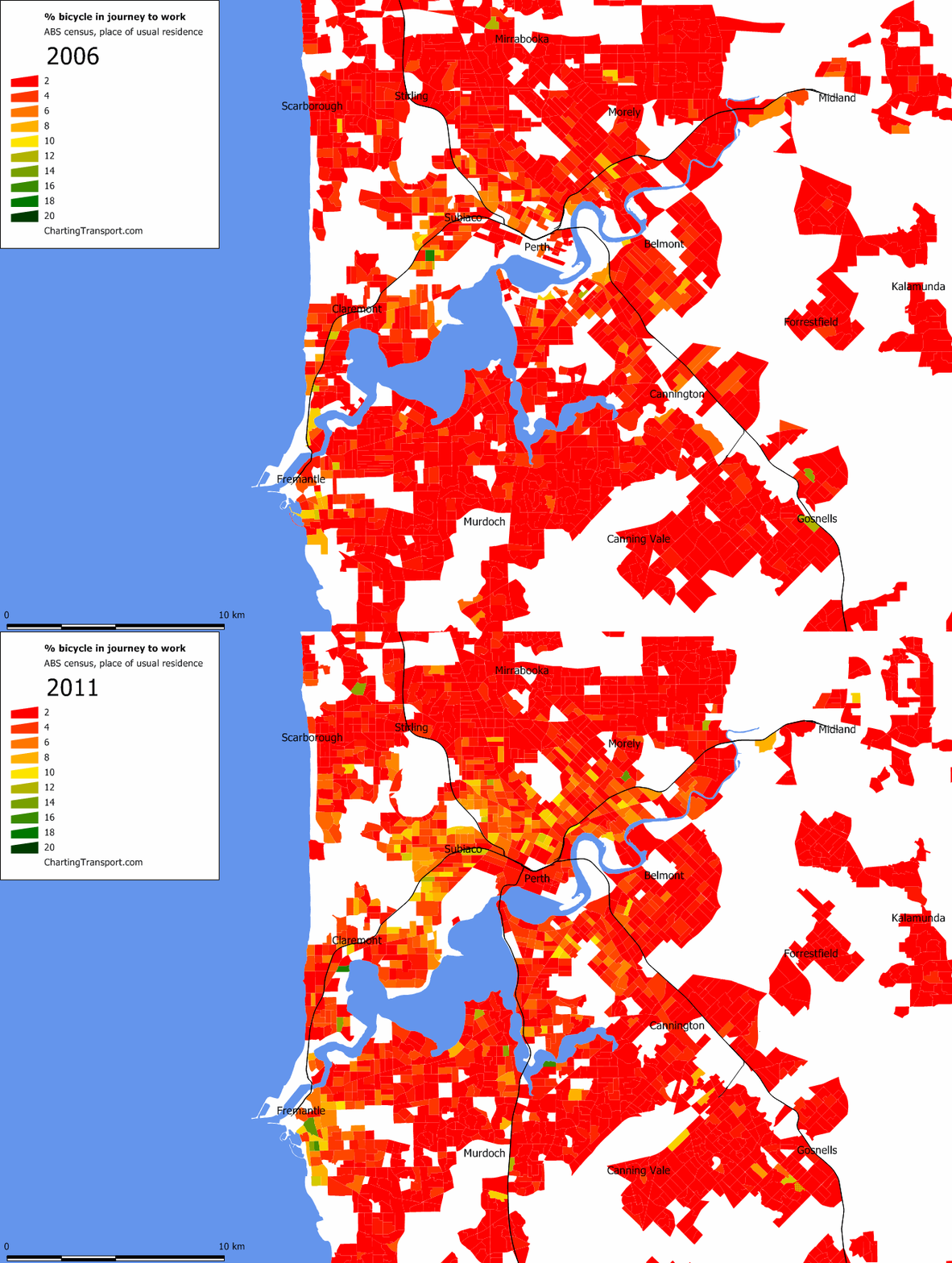
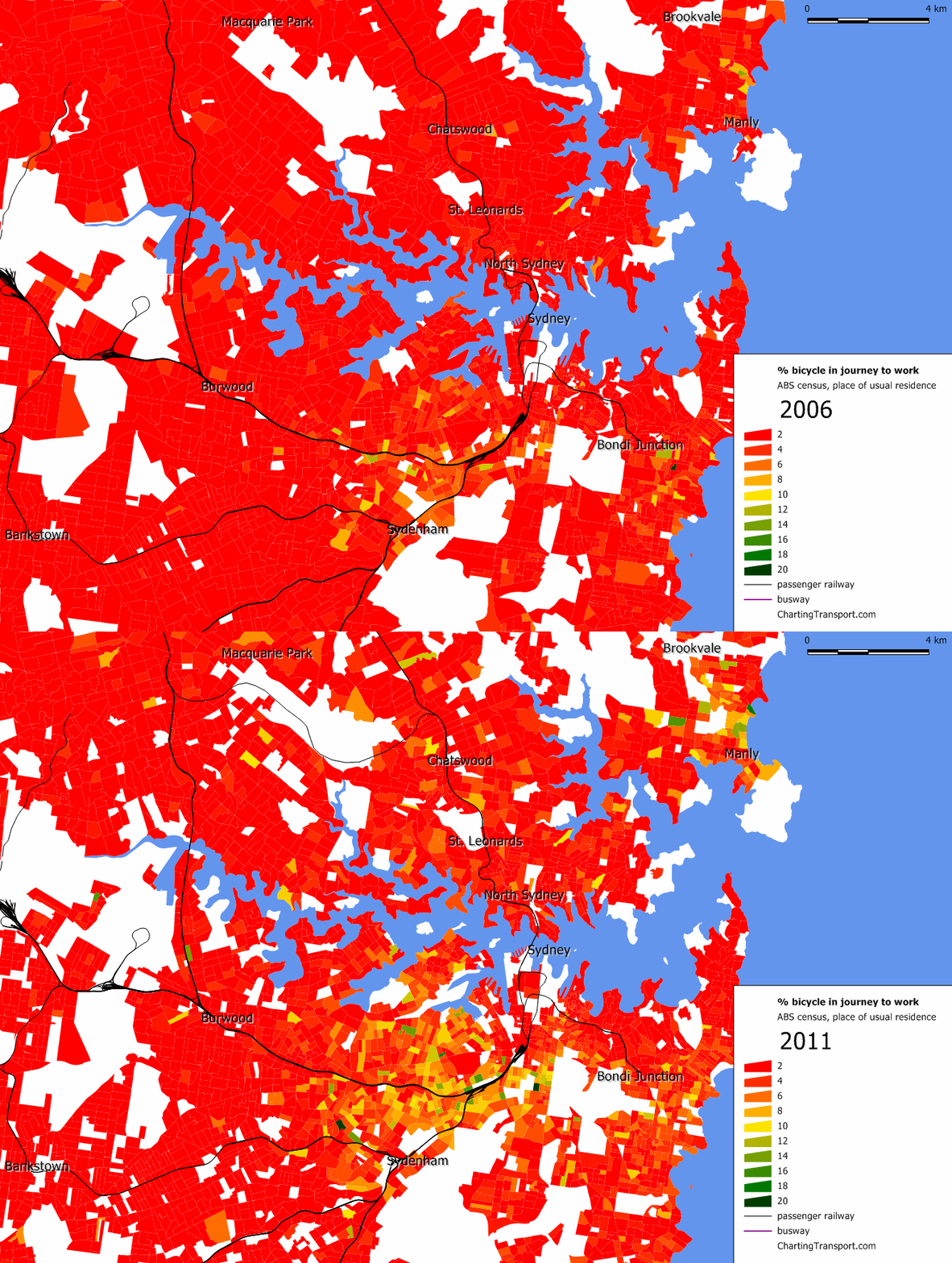
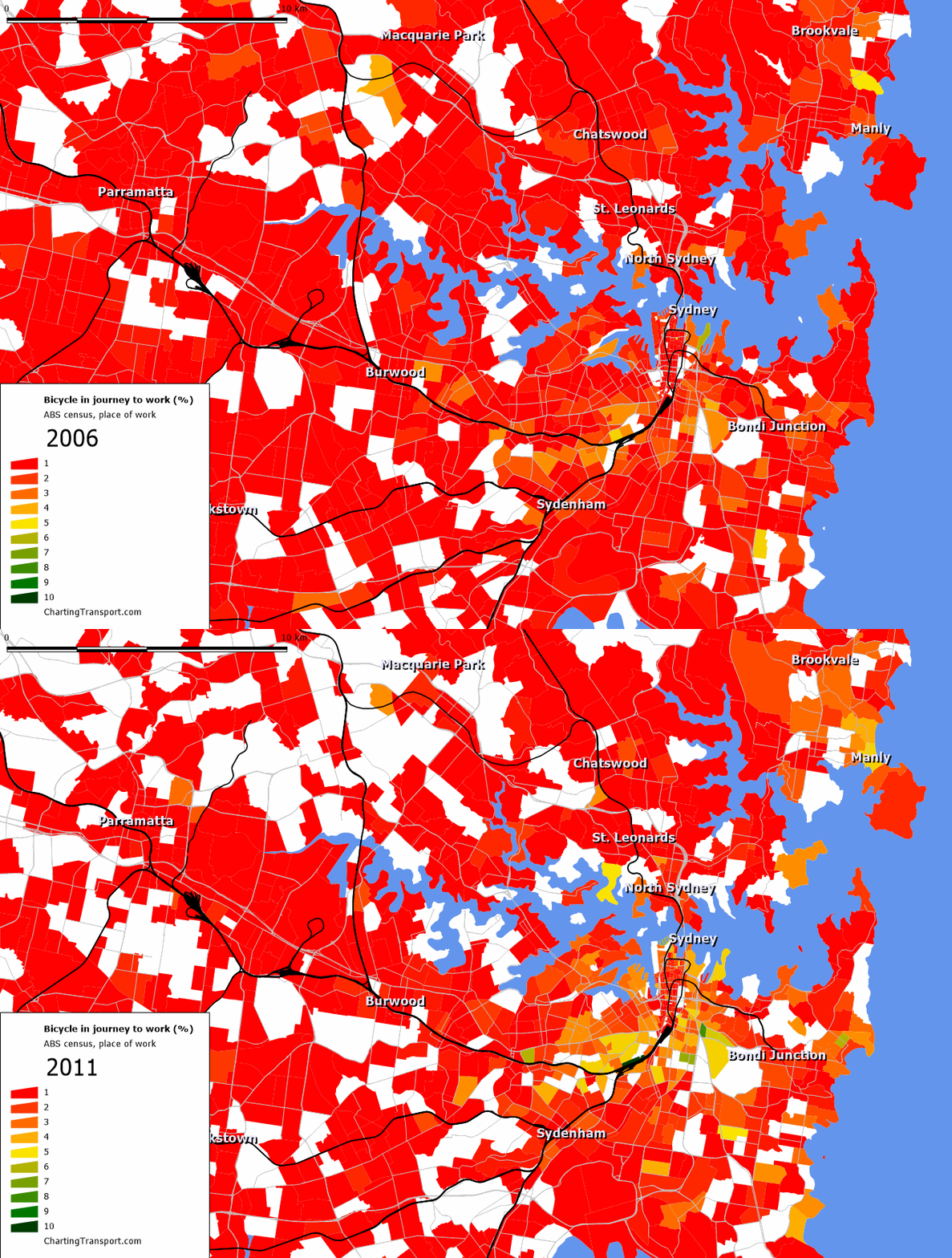
Some of the following maps are animated to show both 2006 and 2011 results, and note that the colour scales are not the same for all maps. I’ve sometimes zoomed into inner city areas when these are the only places with significant cycling mode share. White sections on maps represent areas with low density, or where the number of overall commuters was very small (sorry I haven’t gone to the effort of making every map 100% consistent, but rest assured the areas in white are less interesting). Click on the maps to see more detail.

Canberra

Firstly home locations:

ACT 2011 bicycle

The cycling commuters mostly appear to be coming from the inner northern suburbs. I don’t know Canberra intimately, but Google maps doesn’t show a higher concentration of cycling infrastructure in this area compared to the rest of Canberra.

Secondly, bicycle mode share by work destination (at the larger SA2 geography):

Canberra 2011 SA2 dest bicycle any

The highest mode share was 12% in the SA2 of Acton, which is dominated by the Australian National University. Perhaps a lot of the university staff live in the inner northern suburbs of Canberra?

Melbourne

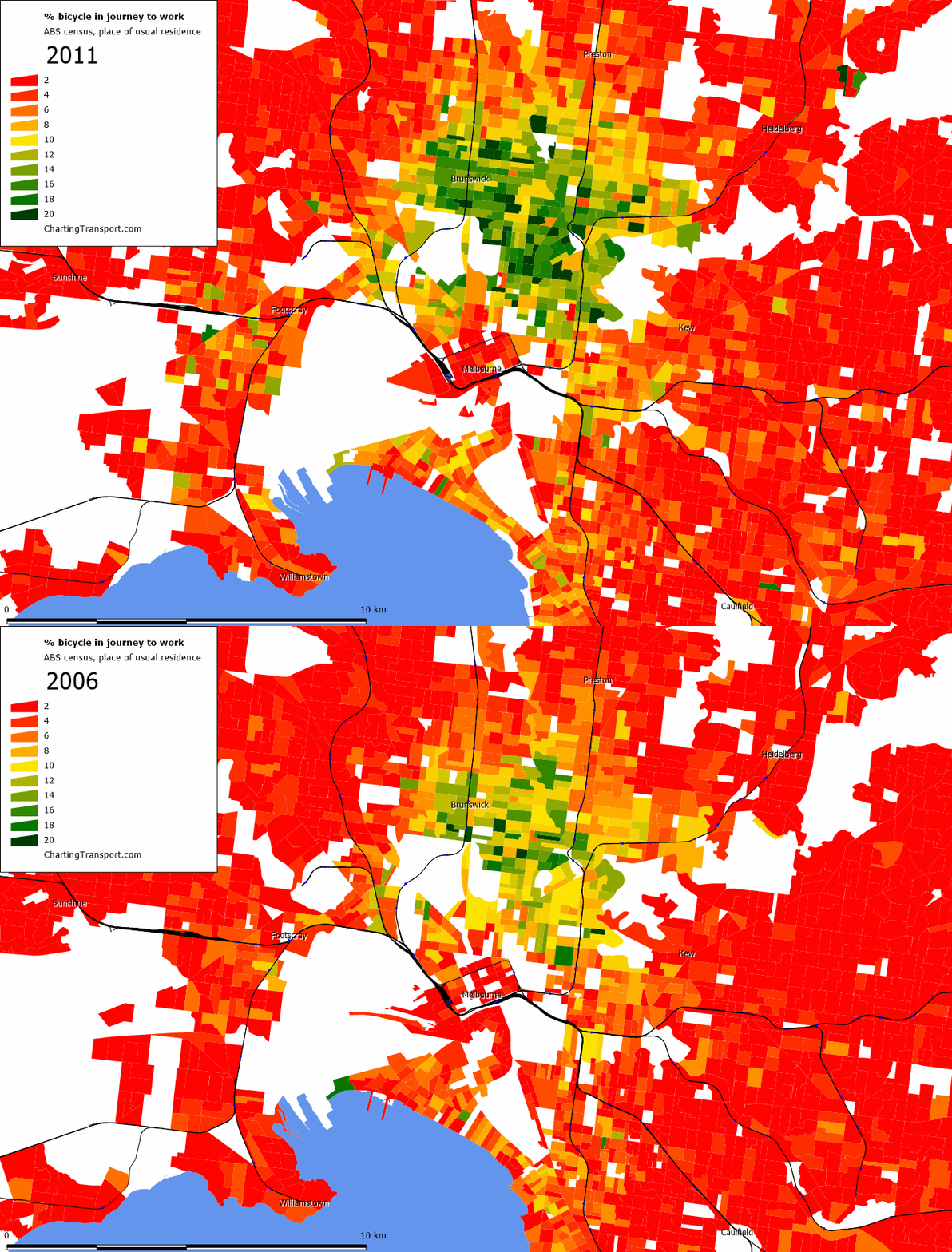
By home location:

Melb bicycle any zoom

Cycling mode share is highest for origins in the inner northern suburbs and has grown strongly since 2006. There’s also been some growth in the Maribyrnong  and Port Phillip council areas off a lower base.

By work location (note: this data is at the smaller destination zone geography):

bicycle mode share DZ Melbourne inner

Cycling to work boomed in inner Melbourne between 2006 and 2011, particularly to workplaces in the inner north. Princess Hill had the highest bike share of 14% in 2011 (possibly dominated by Princess Hill Secondary College employees), followed by a pocket of south-west Carlton that jumped from around 5% to 13%. Apart from the inner north, there were notable increases in Richmond, Balaclava, Yarraville and Southbank. Cycling rates within the CBD are relatively low, perhaps reflecting limited cycling infrastructure on CBD most streets in 2006 and 2011.

Adelaide

Firstly, by home:

Adl bicycle any zoom

Adelaide appears to lack any major concentrations of cycling, although slightly higher levels are found just outside the parkland surrounding the CBD.

Secondly, bicycle mode share by work destination at the (larger) SA2 geography:

Adl 2011 SA2 dest bicycle

The numbers are all small, with 3% in the (large) Adelaide CBD. I imagine a map based on destination zones might show some pockets with higher mode share, but that data isn’t freely available unfortunately.

Perth

By home location:

Perth cycling inner

The inner northern and western suburbs, and south of Fremantle seem to be the main areas of cycling growth.

For workplaces at the larger SA2 geography:

Perth 2011 dest SA2 bicycle

The highest mode share was in ‘Swanbourne – Mount Claremont’, only slightly ahead of ‘Nedlands – Dalkeith – Crawley’ – which contains the University of Western Australia. The Fremantle SA2 (with 3% bicycle mode share by destination) includes of Rottnest Island where around 20% of the 73 resident commuters cycled to work, but the result will be easily dominated by the mainland Fremantle section.

Again, I suspect some smaller pockets would have had higher mode shares if I had access to destination zone data.

Brisbane

By home location:

Bris cycling

There was significant growth in cycling from the West End, and around the University of Queensland/St Lucia – which may be related to the opening of the Eleanor Schonell Bridge (after the 2006 census) which only carries pedestrians, cyclists and buses.

By work location (at larger SA2 geography):

Bris 2011 dest bicycle

The highest share was in St Lucia – which is probably dominated by the University of Queensland. Neighbouring Fairfield – Dutton Park came in second. These two areas are directly joined by the Eleanor Schonell Bridge which provides cycling a major advantage over private transport. It seems to have been quite successful at promoting cycling in these areas.

Sydney

First by home location:

Sydney cycling zoom

There were quite noticeable shifts to cycling in the inner south and around Manly.

By work location (by smaller destination zone geography):

Syd dest bicycle

There was strong growth, again in the inner southern suburbs. In 2011 bicycle mode share was highest in Everleigh (11.5%) following by the University of NSW (Paddington) at 7.9% (excluding travel zones with less than 200 employees who travelled).

Rural Australia

Here’s a map showing bicycle share by SA2 workplace location for all of Australia, which gives a sense of bicycle mode shares in rural areas.

Australia 2011 dest bicycle mode share

Higher regional/rural bicycle mode shares are evident in southern Northern Territory (Petermann – Simpson), Katherine (NT), the Exmouth region, the Otway SA2 on the Great Ocean Road in western Victoria, and Longford – Loch Sport in eastern Victoria. I’ll let other people explain those.

The SA2s in Australia with the highest cycling mode shares in 2011 (by home location) were:

  • Lord Howe Island, NSW: 21%
  • Acton, ACT (covering Australian National University): 12%
  • Port Douglas, Queensland: 10%
  • Parkville, Victoria (covering the University of Melbourne main campus): 8%
  • East Side, Northern Territory (Alice Springs): 8%
  • St Lucia, Queensland (covering the University of Queensland): 8%

How far did people cycle to work? (in Melbourne)

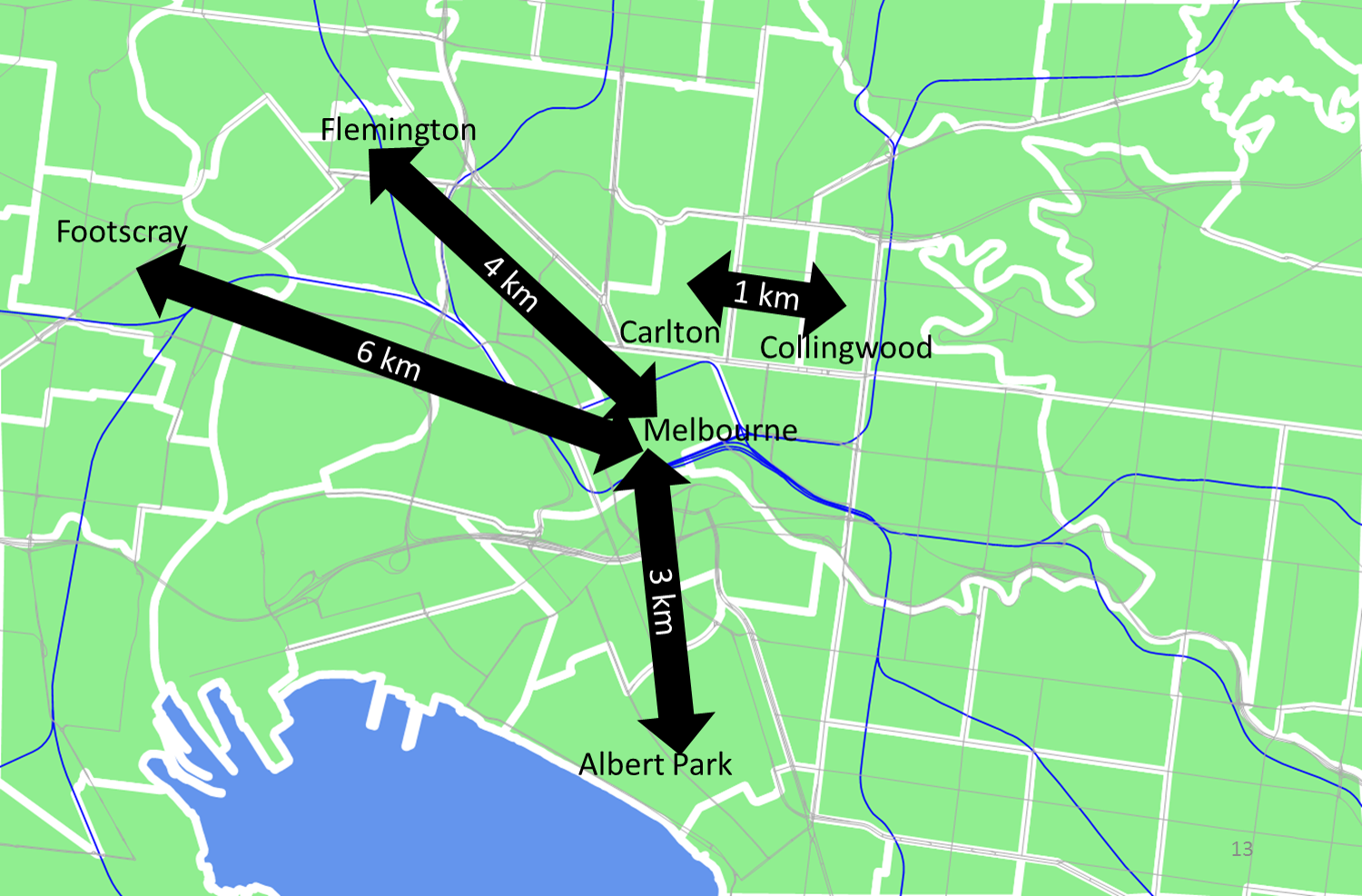
It is difficult to get precise distances for journeys to work, but approximations are possible. I’ve calculated the approximate distance for each journey to work by measuring the straight line distance between the centroid of the home and work SA2s and then rounded to the nearest whole km. To give a feel for how this looks, here is a map showing inner Melbourne SA2s and the approximate distances between selected SA2s:

SA2 distances sample map

This distance measure generally works well in inner city areas. However in the outer suburbs SA2s are often much larger in size, and sometimes only partially urbanised. However as we’ve seen above the volumes of cycling journeys to work are very low in these places, so that hopefully won’t skew the results signficantly.

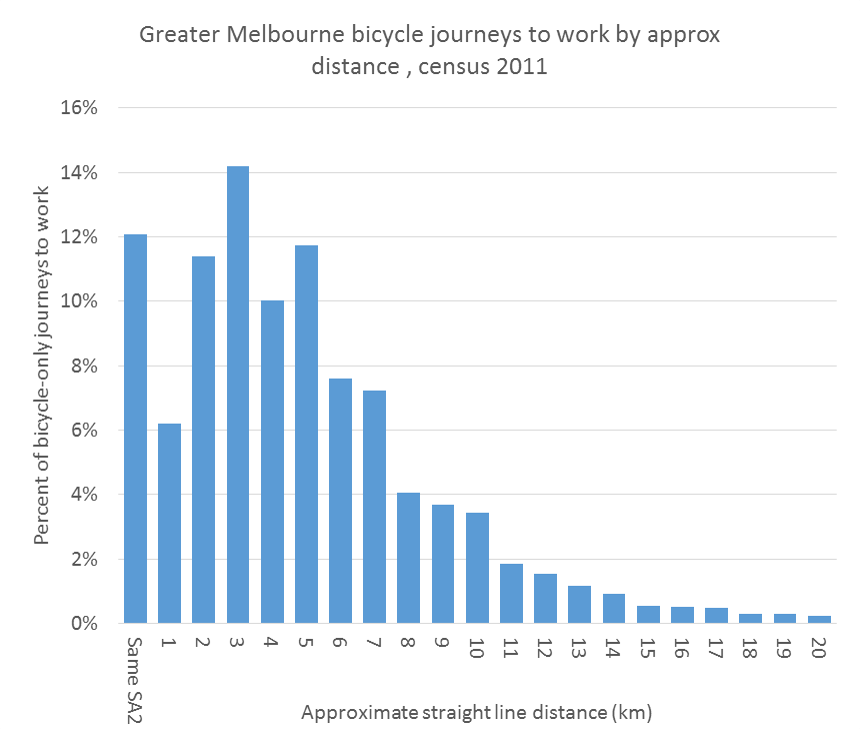
2011 Melb JTW cycling distances

Two-thirds of cycling journeys to work in Melbourne were approximately 5km or less, with 80% less than 7 km, and 30% were 2 km or less.

The longest commute recorded within Greater Melbourne was approximately 44km.

Was cycling combined with other modes?

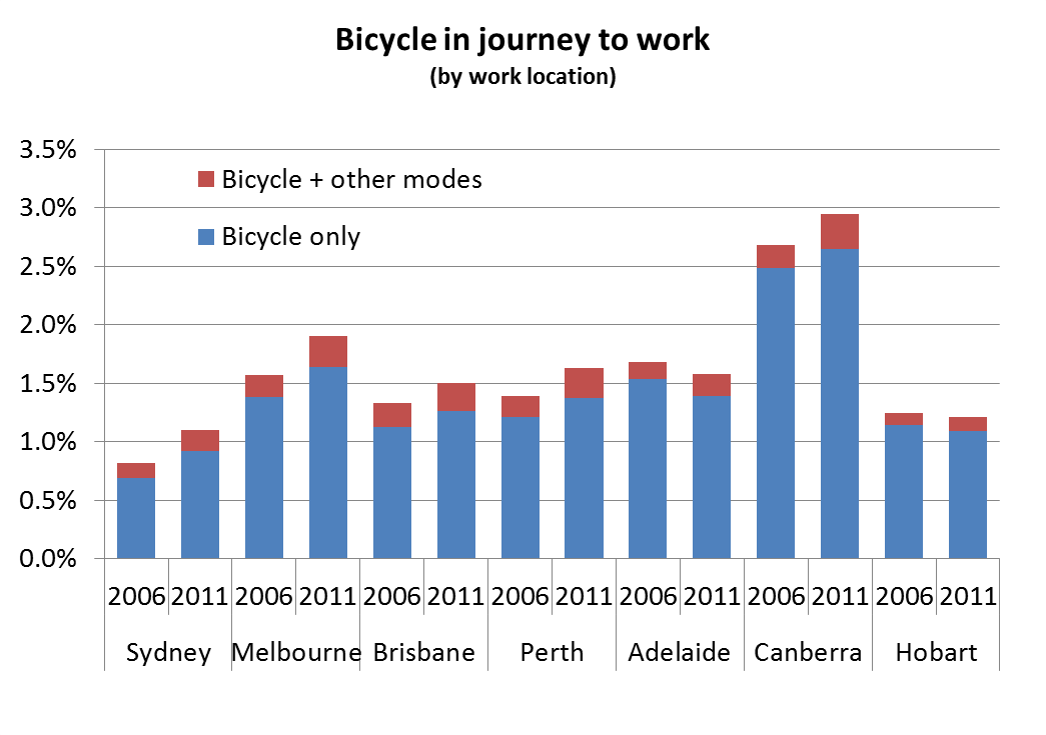
The following chart shows that bicycles were seldom combined with other modes:

cycling - presence of other modes 2006 2011

Around 16-17% of cycling commuters in the four largest cities in 2011 involved another mode. Use of other modes with cycling grew in all cities between 2006 and 2011

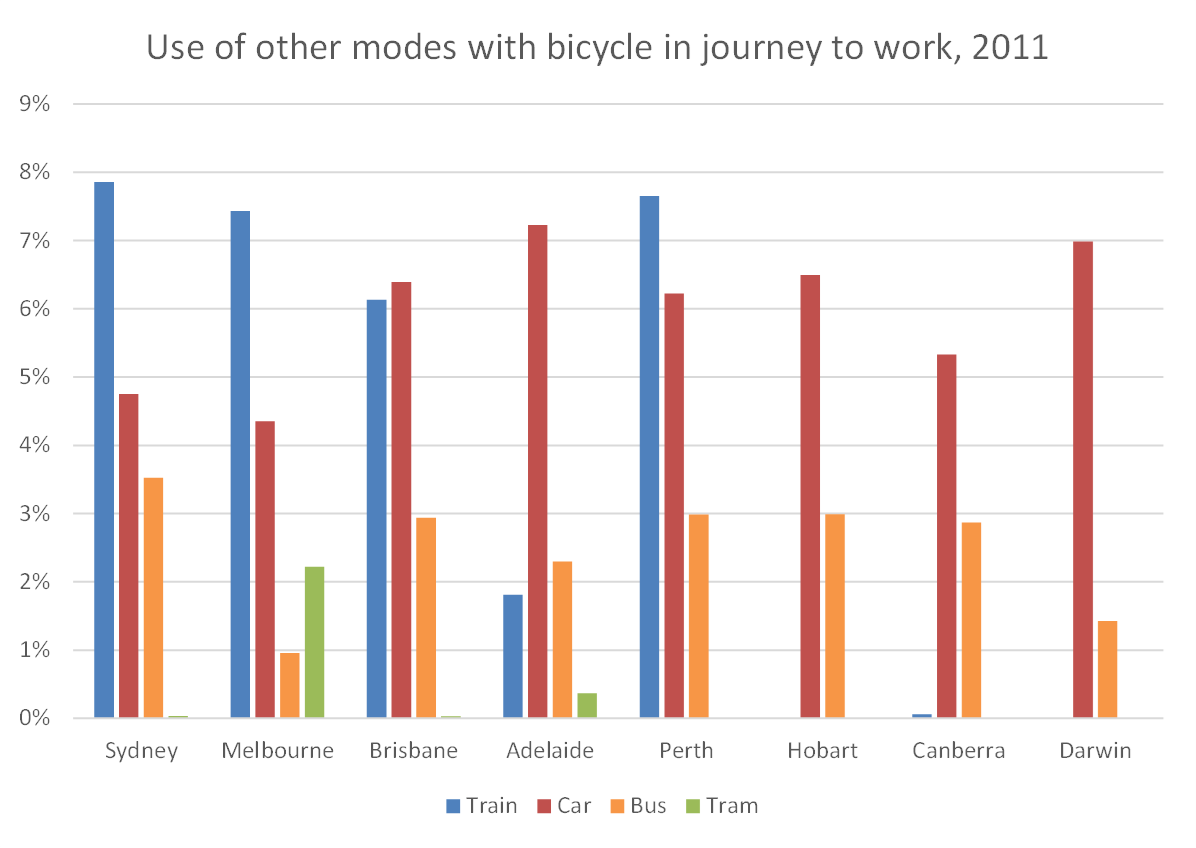
The next chart shows what these other modes were:

Other modes with cycling 2011

Sydney, Melbourne, Brisbane and Perth had high rates of bicycle use with trains, while combining car and bicycle was more common in the smaller cities.

The next chart shows the number of trips involving bicycle and trains in 2006 and 2011:

JTW bicycle + train raw numbers

The chart shows the relative success of Melbourne Parkiteer program of introducing high quality bicycle cages at train stations, which has helped boost the number of people access the train network by bicycle by around 600 between 2006 and 2011. I understand a similar project has been undertaken in Perth which saw growth of around 250.

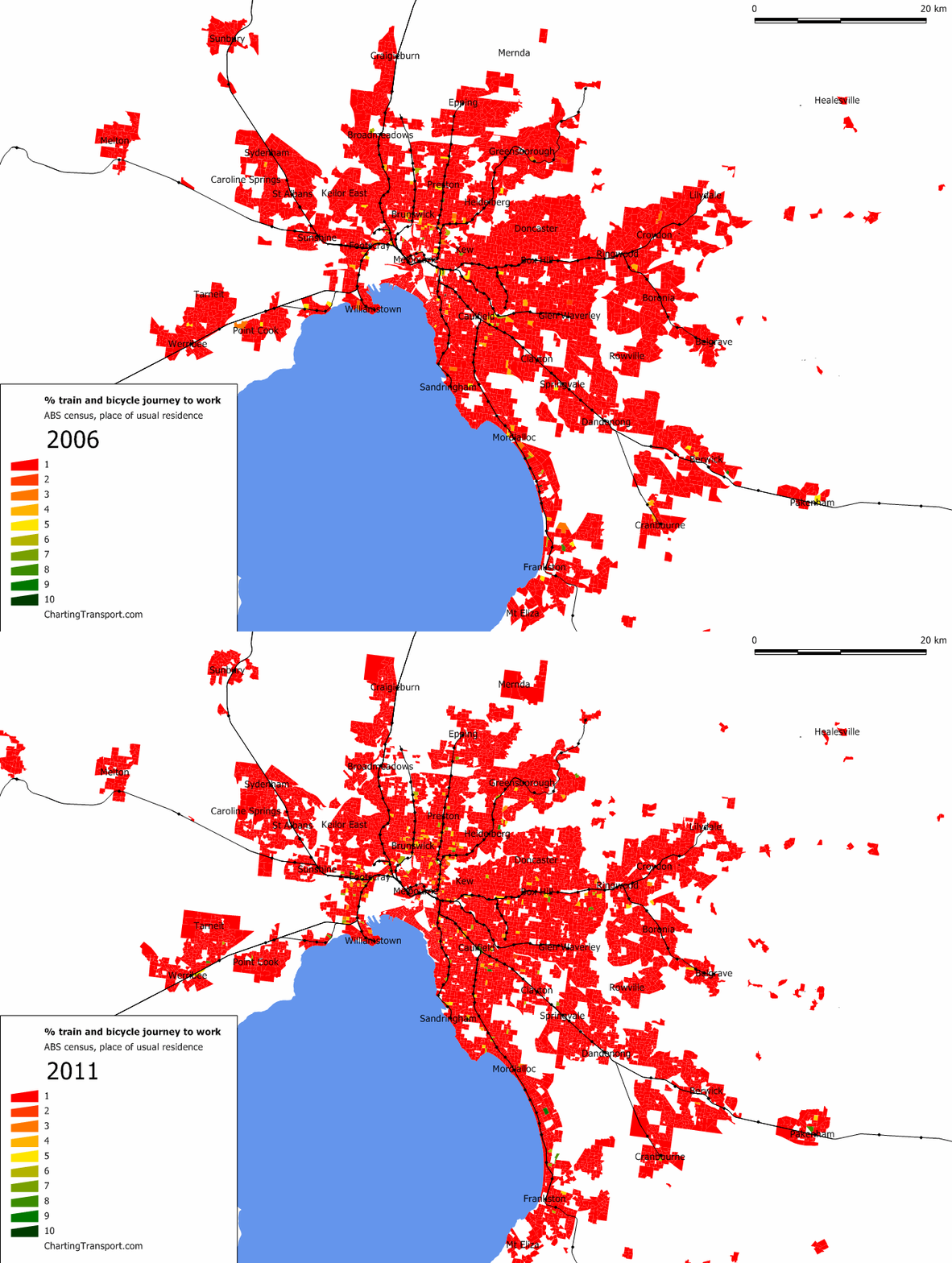
In Melbourne, the home locations for people using bicycle and train are extremely scattered – the following map shows a seemingly random smattering:

Melb bicycle + train

How does commuter cycling vary by age and sex?

bicycle mode share by age sex

This chart shows remarkably clear patterns. Males were much more likely to cycle to work. Teenage boys (particularly those under driving age) had the highest cycling mode shares (with teenage girls much less likely to cycle). The next peak for men was around the mid thirties, and women’s mode share peaked around ages 28-32.

Where are women more likely to cycle to work?

Women are sometimes talked about as the “indicator species” for cycling – ie if you have large numbers of women cycling compared to men then maybe you have good cycling infrastructure that attracts a broader range of people.

The census data can shed some light on this. For each SA2 in Melbourne, I have calculated the male and female cycling mode shares both as a home origin, and as a work destination (this analysis looks at people who only used bicycle (and walking) in their journey to work). I’ve then calculated the ratio of male mode share to female mode for each area (SA2).

I’ve used the ratio of mode shares in preference to the straight gender split of cycling commuters – as female workforce participation is generally lower and there can be spatial variations in the gender split of the workforce. 46% of all journeys within Greater Melbourne in the 2011 census were by females, but only 28% of cycling journeys to work were by females.
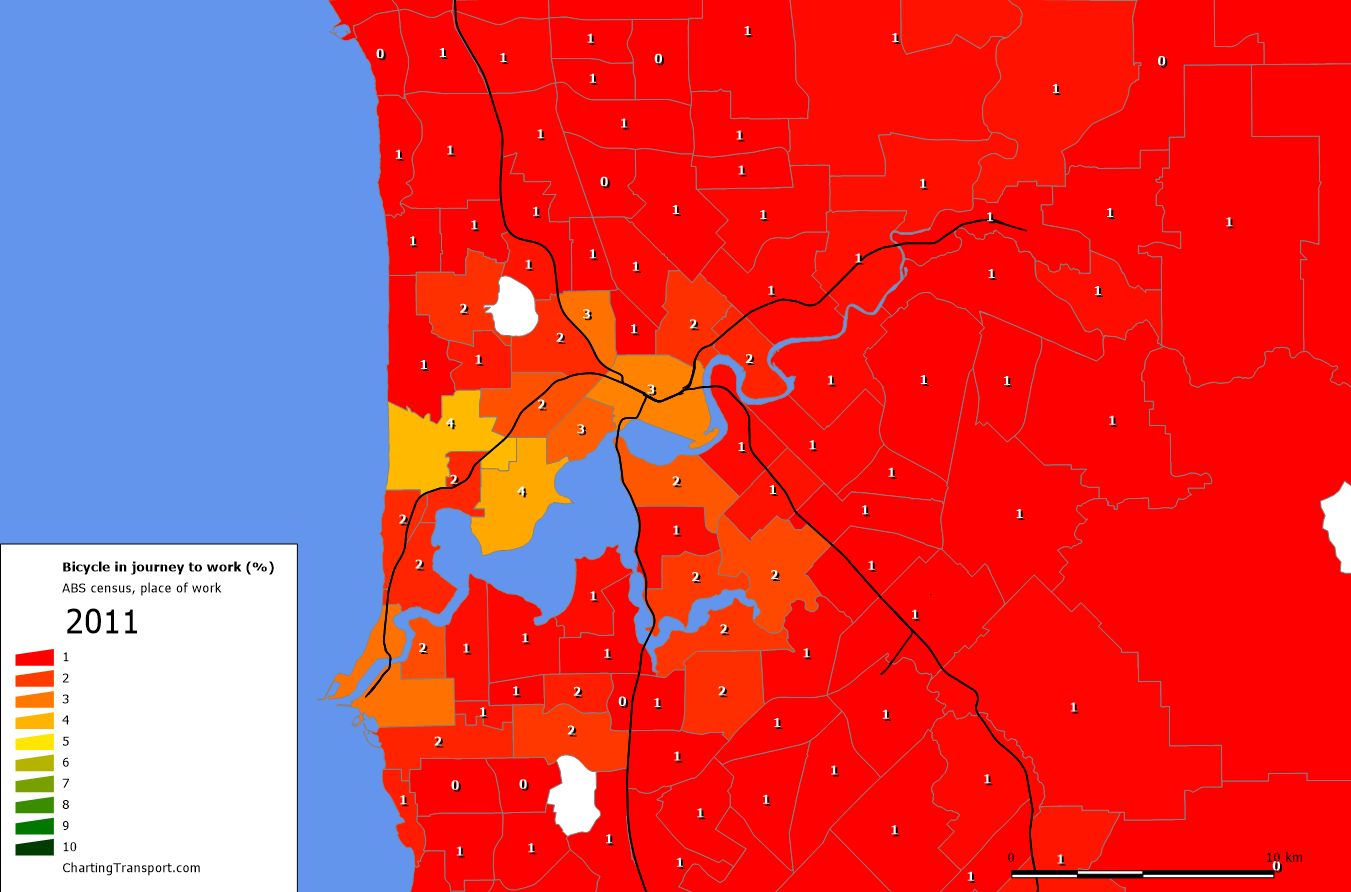
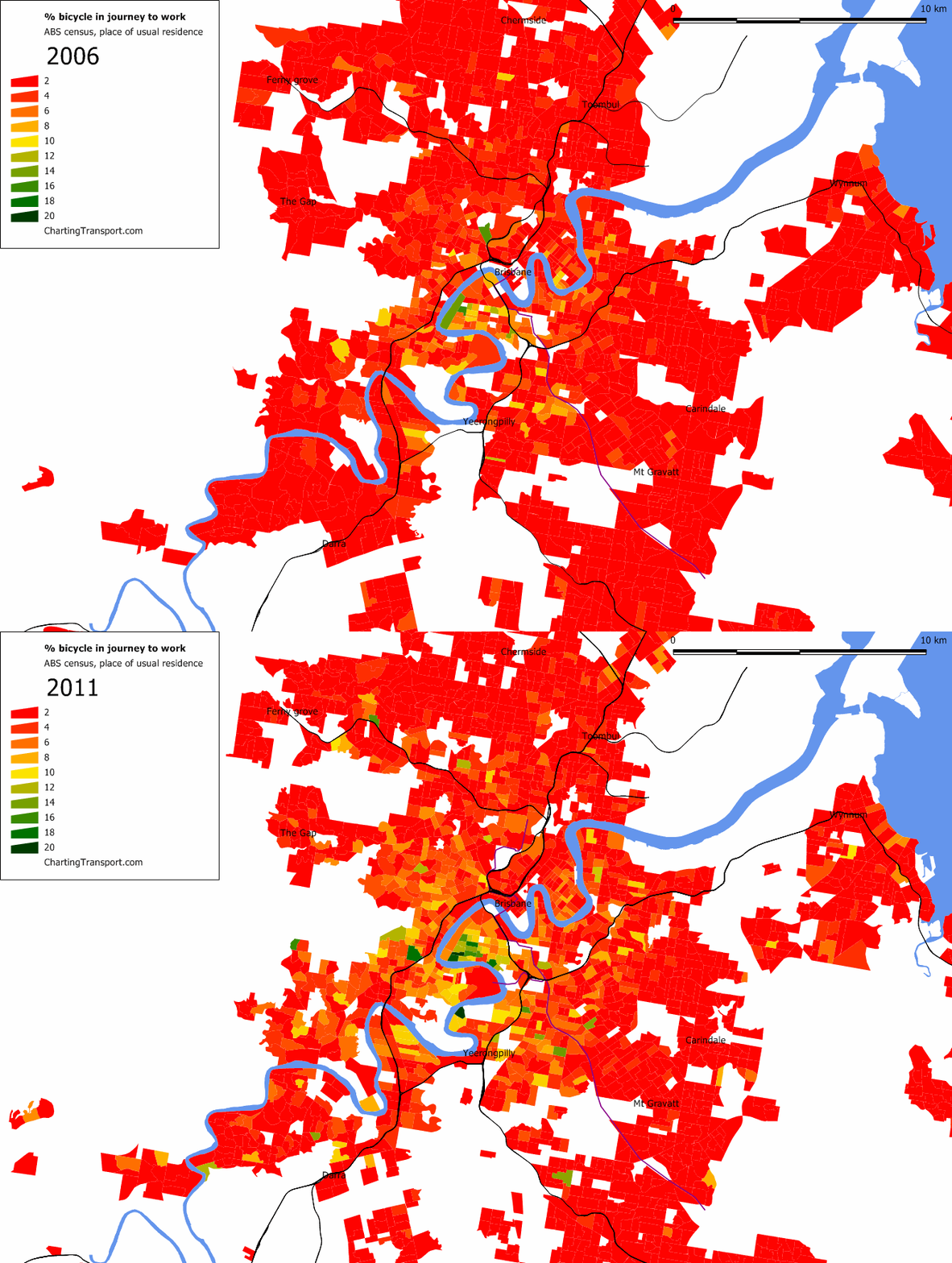
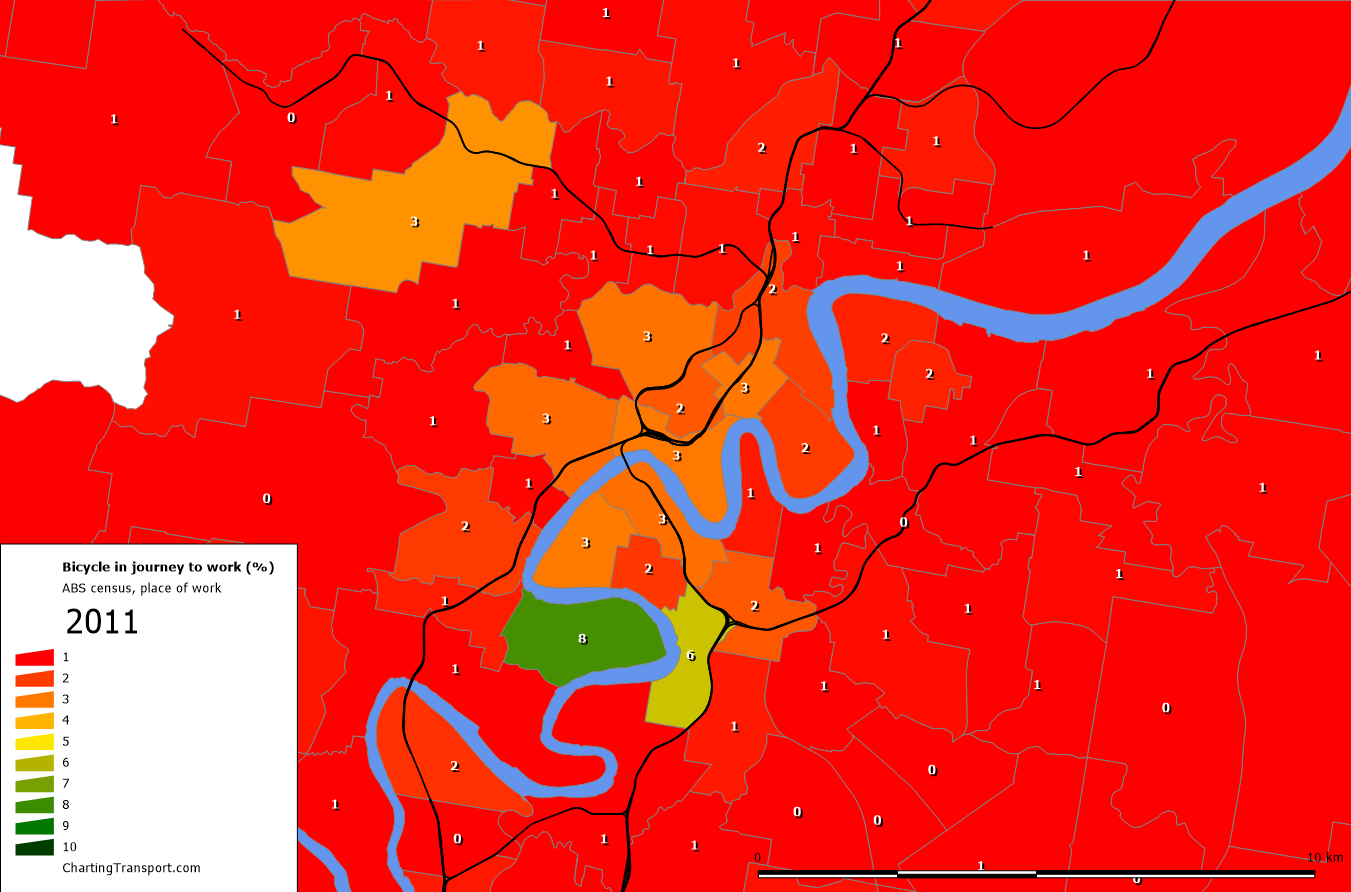
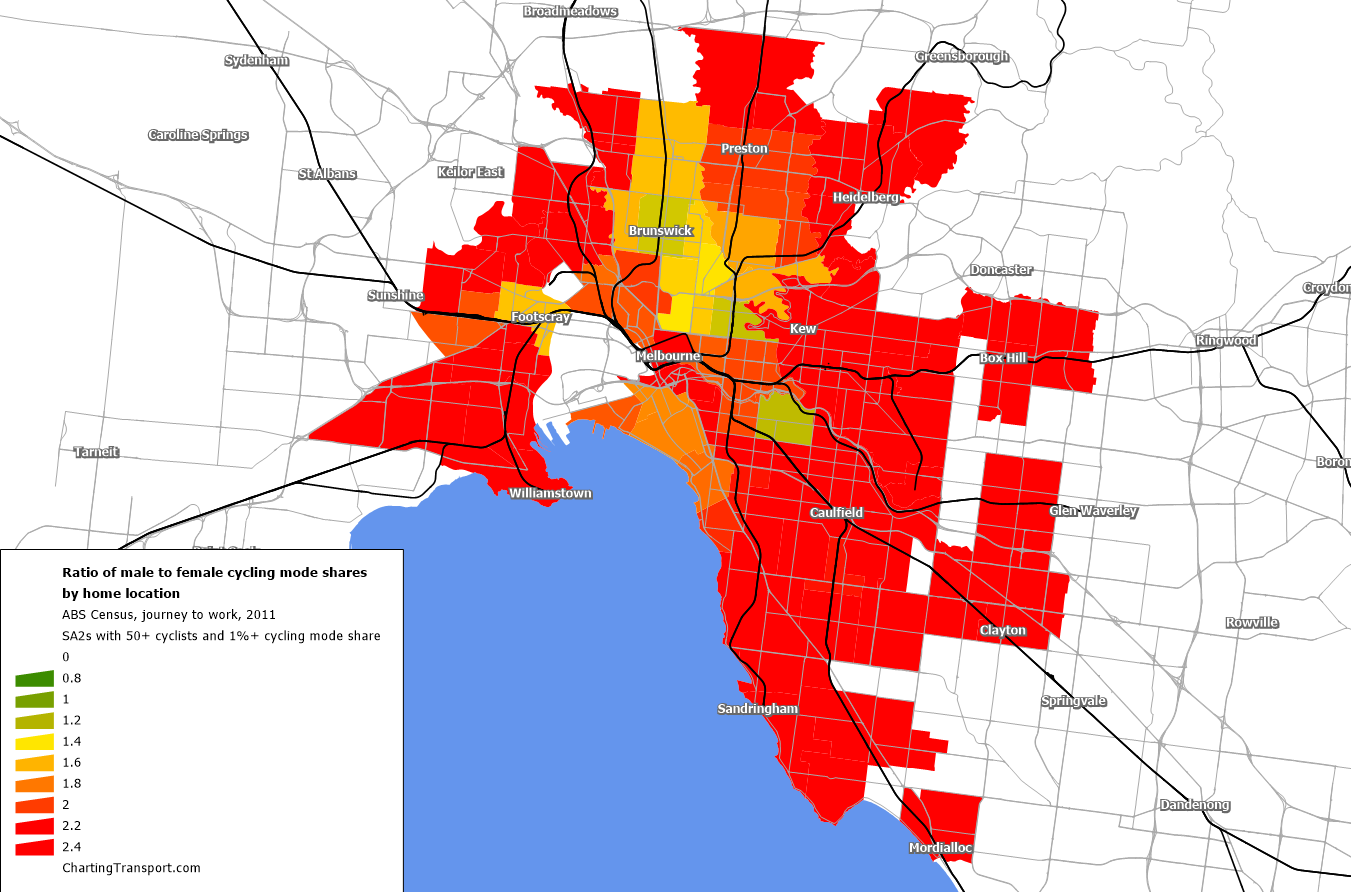
The following map shows the ratio of male to female cycling mode shares by home location for SA2s (with more than 50 commuter cyclists, and where the bicycle mode share is above 1%):

Melb 2011 cycling gender ratio home

Areas attracting comparable female and male bicycle shares include the inner northern suburbs and – curiously – Toorak (probably many using the off-road Gardiners Creek and Yarra Trails to access the city centre).

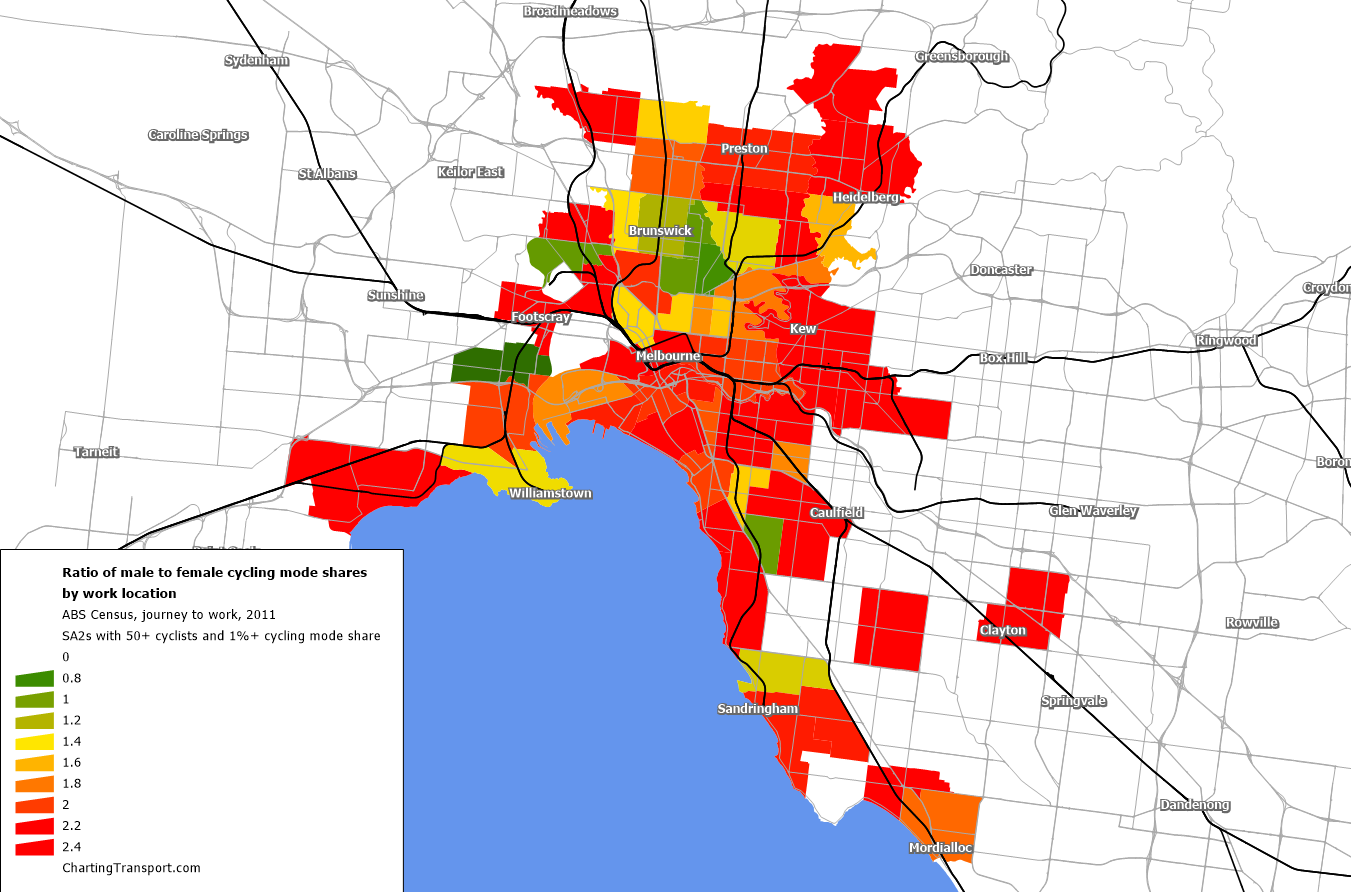
Here’s a similar map, but by workplace areas:

Melb 2011 cycling share gender ratio WP

The patterns are much more pronounced. Six SA2s had higher female mode shares than male: Yarraville, Fitzroy North, Brunswick East, Ascot Vale, Carlton North – Princes Hill, and Elsternwick.

The areas with near-1 ratios of male to female mode shares were similar to the areas with higher total cycling mode shares. The following chart confirms this relationship (note areas with cycling mode shares below 1% not shown):

gender ratio and overal mode share

What this also shows is that home-area mode shares reach much higher values than workplace-area mode shares. Perhaps the secret is in the home-area cycling infrastructure? Or perhaps it’s more to do with the residential demographics?

See the Bicycle Network Victoria website for more data about female cycling rates in Melbourne.

Do women cycle the same distances as men?

Again using the approximate straight line commuting distances (as explained above) the following chart shows that women’s cycling commutes are a little shorter than men’s, but not by much:

commute distance and gender

The median female cycling commute was approximately 1.8 km shorter than for males.

What types of workers are more likely to cycle to work?

Firstly, I’ve looked at the differences between public and private sector employees.

Before I dive into the data, it’s important to recognise that different types of workers are not evenly spread across Australia. Some types of jobs concentrate in city centres while others might be more likely to be found in the suburbs or the country. Therefore many of the following charts show results for Australia as a whole, but also for people working in central Melbourne (the SA2s of Melbourne, Carlton, Docklands, East Melbourne, North Melbourne and Southbank), which has a relatively high rate of cycling to work.

The data suggests public servants were much more likely to cycle to work:

cycling by employer type

The local government result has prompted me to calculate the cycling mode shares for local government workers across Australia (assuming workers work within the council for which they work). Here are bicycle mode shares for the top 20 councils for employee cycling mode share in the census:

Council State Bicycle mode share
Tumby Bay (DC) SA 23.5%
Kent (S) WA 18.8%
Carnamah (S) WA 16.0%
Central Highlands (M) Qld 14.3%
Uralla (A) NSW 13.8%
Wakefield (DC) SA 13.5%
Nannup (S) WA 12.5%
Broome (S) WA 12.1%
Alice Springs (T) NT 11.8%
Narembeen (S) WA 11.5%
Blackall Tambo (R) Qld 11.3%
Kowanyama (S) Qld 11.2%
Exmouth (S) WA 11.1%
Yarra (C) Vic 10.4%
Glamorgan/Spring Bay (M) Tas 8.7%
Torres (S) Tas 8.6%
Yarriambiack (S) Qld 8.3%
Mallala (DC) Vic 8.0%
Richmond Valley (A) NSW 7.2%
McKinlay (S) Qld 6.7%

Most of the top 20 are non-metropolitan councils. Melbourne’s City of Yarra is the top metropolitan city council (within Greater Melbourne the next highest councils are Moreland 6.1%, Port Phillip 5.6%, Melbourne 5.6% and then Stonnington 4.9%).

National government employees had the highest bicycle mode share of all of Australia. I suspect this relates to university staff, as many of the earlier maps showed university campuses often had relatively high rates of employees cycling (85% of “higher education” employees count as “national government” employees).

The census data can also be disaggregated by income:

cycling mode share by income

Cycling mode shares were highest for people on high incomes. Initially I thought this might reflect the fact that high income jobs are often in city centres were cycling is relatively competitive with private and public transport. However, even within central Melbourne workers, cycling rates are higher for those on high incomes (curiously with a second peak for those on incomes between $300 and $399 per week).

Does cycling to work make you healthier and therefore more likely to get promoted and earn a higher income? Or are employers offering workplace cycling facilities to attract highly paid staff? I haven’t got data that answer those questions.

Consistent with higher rates of cycling for higher income earners, those in more highly skilled occupations were more likely to cycle to work:

cycling mode share by profession

I suspect this might reflect the presence/absence of workplace cycling facilities (perhaps office workplaces are more likely to provide cycling facilities than retailers for example) and/or the ability to afford to live close to work (which makes cycling easier).

Are recent immigrants more likely to ride to work?

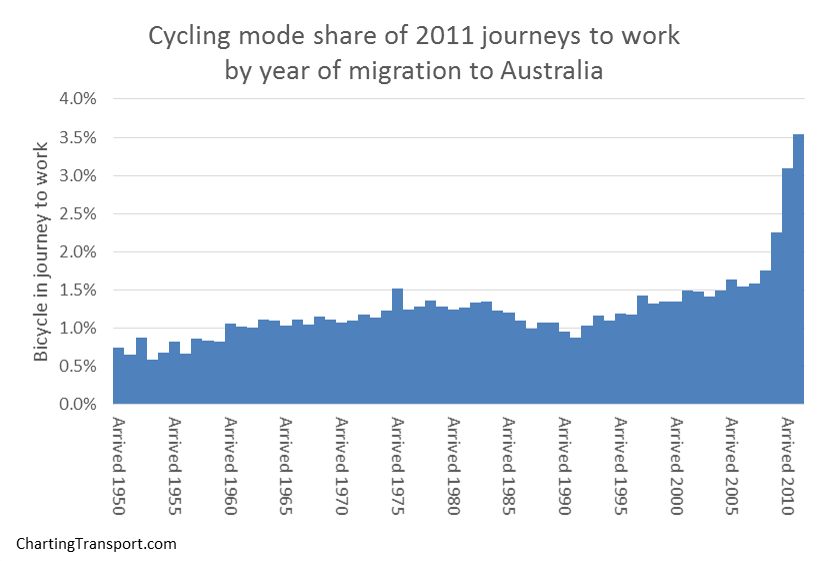
This one really surprised me and I only investigated it because it was possible to do. The census asks what year people migrated to Australia (if not born here), and it turns out that recent immigrants were much more likely to cycle to work:

cycling mode share by migration year

This might be explained by the demographics of recent immigrants (eg car ownership, home location, income levels, occupation and age).

I’d welcome comments on any other trends people might spot in the data.


What other modes did train commuters use in their journey to work?

Sun 23 June, 2013

Following on from my last post about public transport multi-modality in the journey to work, this post takes a more detailed look at what modes were used in conjunction with trains in journeys to work.

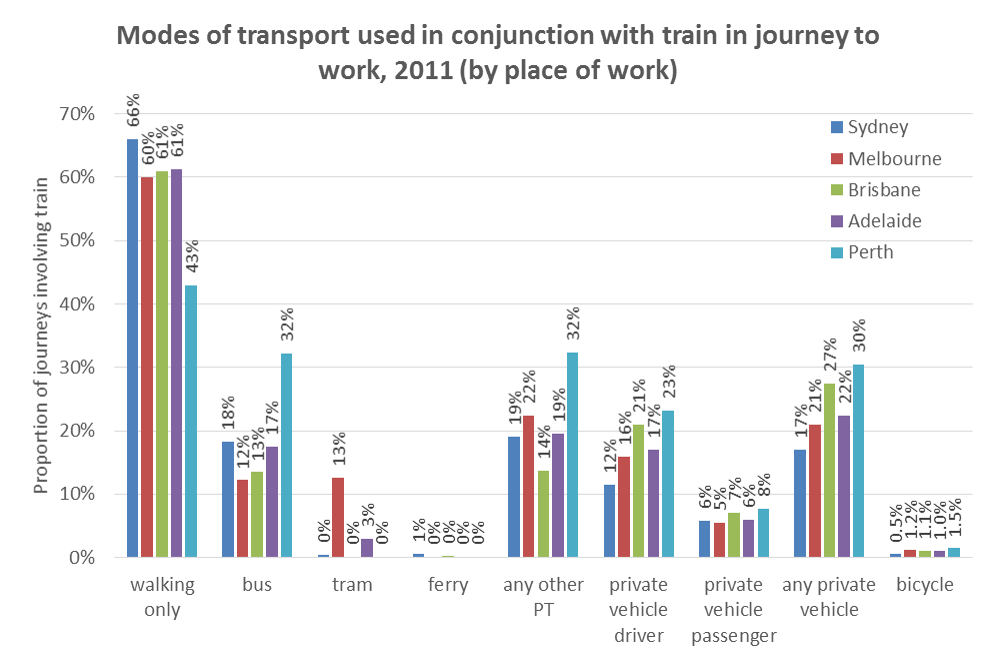
Trains provide a backbone for public transport systems in Australia’s five largest cities, but only a minority of the population within each city is within walking distance of a train station. So what other modes were used in combination with trains for journeys to work in 2011? (according to the ABS census)

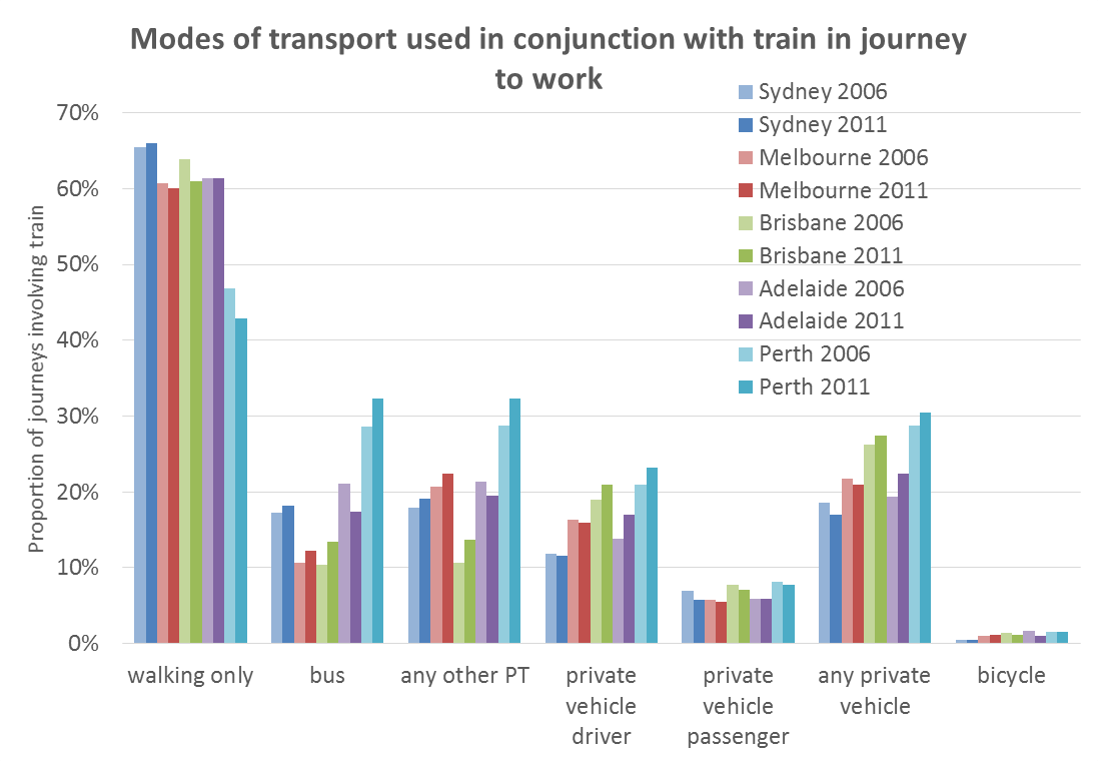
2011 train other modes

This chart shows that ‘walking only’ (ie no modes other than ‘train’ specified) was the most common response for people who used trains in four of the five cities, with Perth the notable exception. Perth’s rail network includes two heavily patronised lines that are largely within freeway corridors, with longer than traditional station spacing and much smaller walking catchments for each station. Perth train commuters were therefore much more likely to involve other modes of transport in their journey to work.

Private (motorised) vehicle transport was more common than other modes of public transport in Brisbane, but the other cities were fairly evenly balanced between private vehicle transport and other public transport modes.

Perth had the highest share of train commuters reporting also using buses (almost a third), suggesting the train feeder bus networks are working quite well.

Sydney had a similar rate of other public transport mode use to other cities, despite limited multi-modal fare integration, although Sydney did have the highest reported rate of ‘walking only’ for train commuters.

Melbourne had the second highest rate of other public transport modes being involved, with roughly equal amounts of bus and tram.

What modes are used to access train stations?

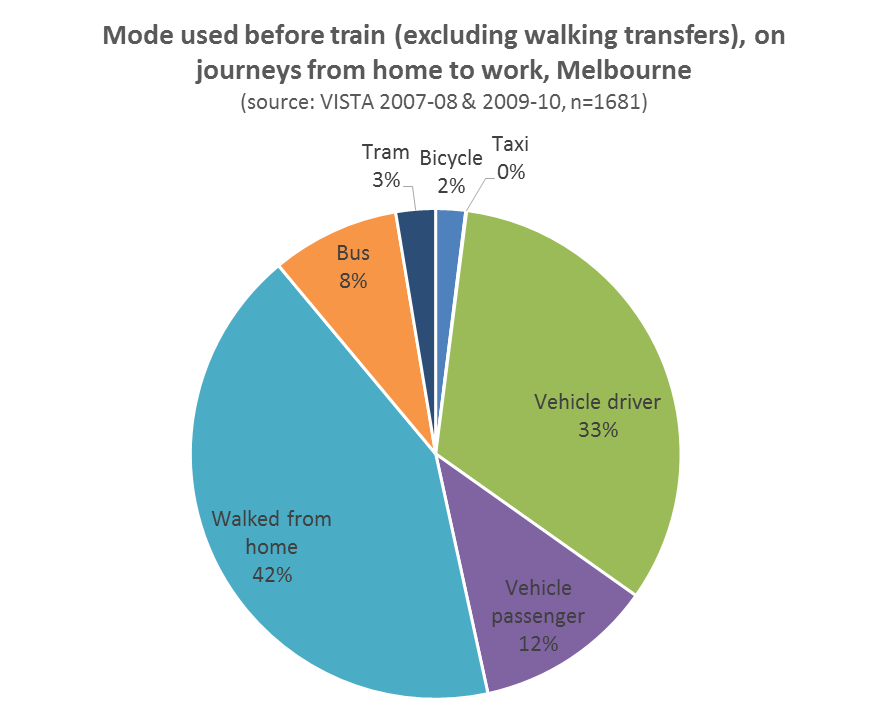
The census doesn’t tell us the order of modes used in the journey to work, but I can get a picture of this from Melbourne’s household travel survey, VISTA:

VISTA JTW pretrain mode

(note that train does not appear as this analysis looks at the mode preceding the first use of train).

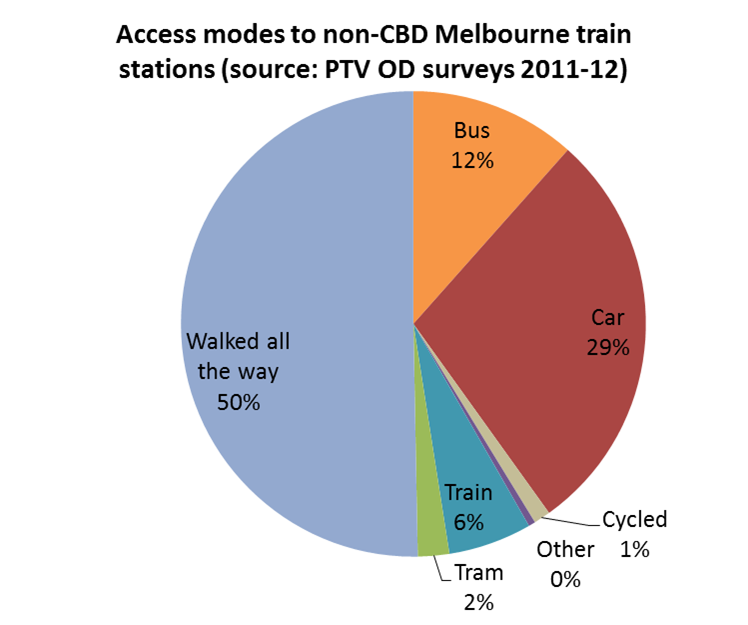
Some recently published PTV data on use of train stations also allows analysis of estimated access mode splits for 7am-7pm weekday train station entries based on origin-destination surveys of journeys of any purpose.

The following chart shows access modes to non-CBD stations (i.e. excluding Flinders Street, Southern Cross, Flagstaff, Melbourne Central, and Parliament):

Access modes to Melbourne non CBD train stations

The data sets aren’t in strong agreement about ‘walking only’ and private vehicle use, although they all have different measurement frames.

The disparity may support the suggestion that there is under-reporting of rail-feeder modes other than walking in the census – particularly vehicle driver/passenger (see also an earlier post that found people living beyond reasonable walking distance of train stations reporting train and walking only to get to work). On the other hand, it may also be that train-based journeys to work have lower rates of private vehicle use than for other journey purposes.

All the figures also suggest that trams are much more likely to be used after trains in the journey to work in Melbourne, which makes sense, as there are only a few tram lines in suburban Melbourne that feed the rail network, and trams provide comprehensive street-based transport within the inner city area helping to distribute people who arrive by train.

In fact, here is a chart showing the reported access modes for Melbourne’s CBD train stations, showing a much higher tram share of access modes:

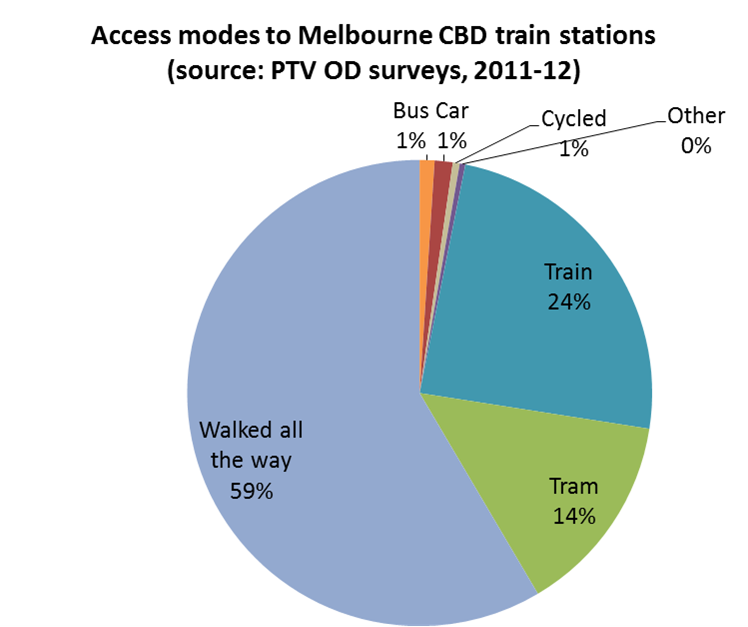
Access modes to Melbourne CBD train stations

The data shows walking as the dominant access mode, but also a quite large number of train-train transfers at CBD stations.

Changes over time

So how have these trends changed over time? (at least, as far as people fill out their census forms)

Unfortunately sufficiently detailed data isn’t available for 2001, but here is a comparison of 2006 and 2011 census journey to work data for the five cities:

2006 and 2011 train other modes

You can see for Perth that the ‘walking only’ share dropped in favour of most other modes (following opening of the Mandurah rail line).

Brisbane also had a notable shift away from ‘walking only’, particularly to the use of other public transport modes, which might reflect continued changes in travel habits following full multi-modal fare integration in 2004-05. However Brisbane retained the rate of use of other public transport modes in journeys involving train of all cities.

Adelaide had a decline in buses being part of train-based journeys to work, but an increase in trams and private vehicle drivers.

Melbourne saw an increase in bus use with train journeys, with a decline in all other modes and ‘walking only’.

Sydney saw small increases in ‘walking only’ and bus use for people making journeys to work involving trains.

In terms of bicycles being part of train-based journeys, Melbourne had the biggest increase (from 1.0% to 1.2% of journeys involving trains), while Adelaide went backwards (1.6% to 1.0%, although I have no idea if this might have been weather related).

You might be wondering about trucks, taxis and motorbikes. Okay, well even if you aren’t, I should point out that I have made some assumptions in aggregating the census data:

  • Anyone reporting truck or motorcycle/scooter has been counted as private vehicle driver (although they may have been passengers on such vehicles, although I’m guessing this is less likely than them being drivers)
  • Anyone reporting taxi I have counted as private vehicle passenger.

For more information on other modes used with trains in Melbourne see pages 26-27 of the PTV Network Development Plan for Metropolitan Rail, and recently published PTV data for use of train stations, including access modes.