A simple look at passenger transport trends in Australian cities

Sat 25 June, 2011

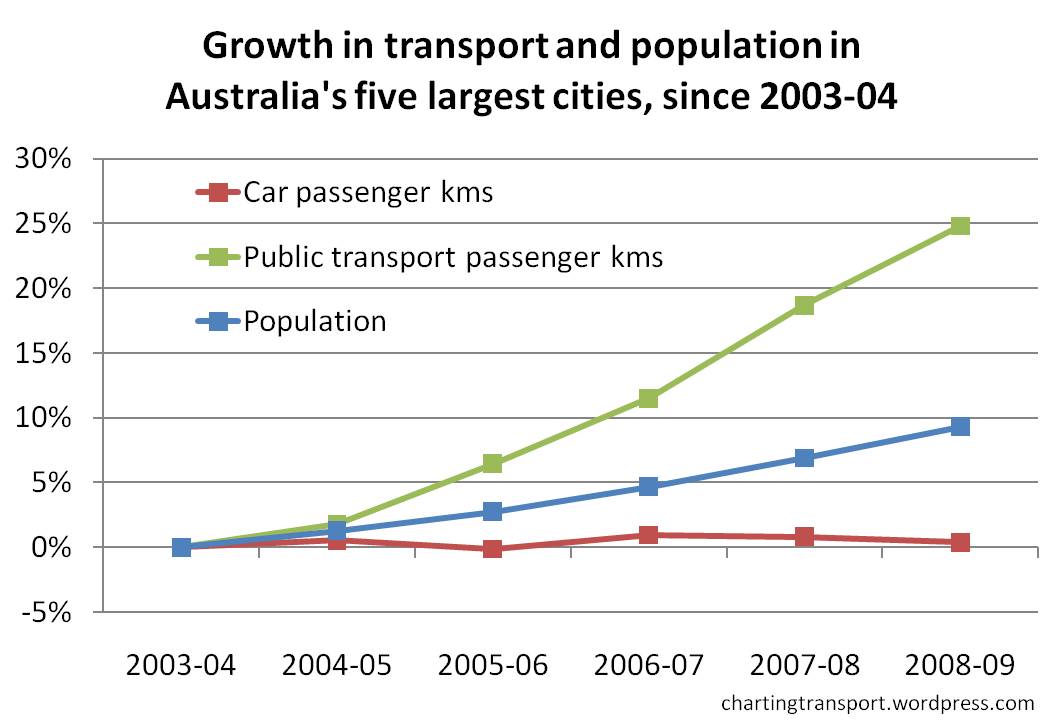
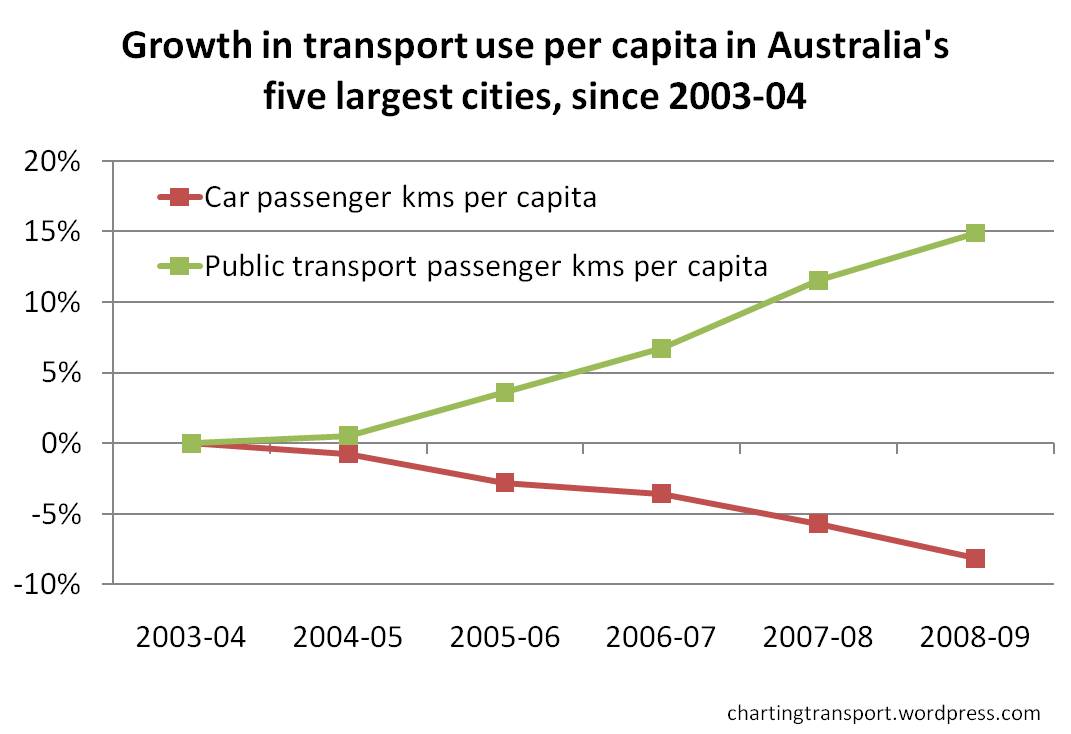
While I’ve covered passenger transport trends in detail in another post, here are a couple of simple views of the data that provide a pretty stark summary of the recent mode shifts:

Or per capita growth:

I think those charts mostly speak for themselves.

(For the record, the five biggest cities are Sydney, Melbourne, Brisbane, Perth, and Adelaide)

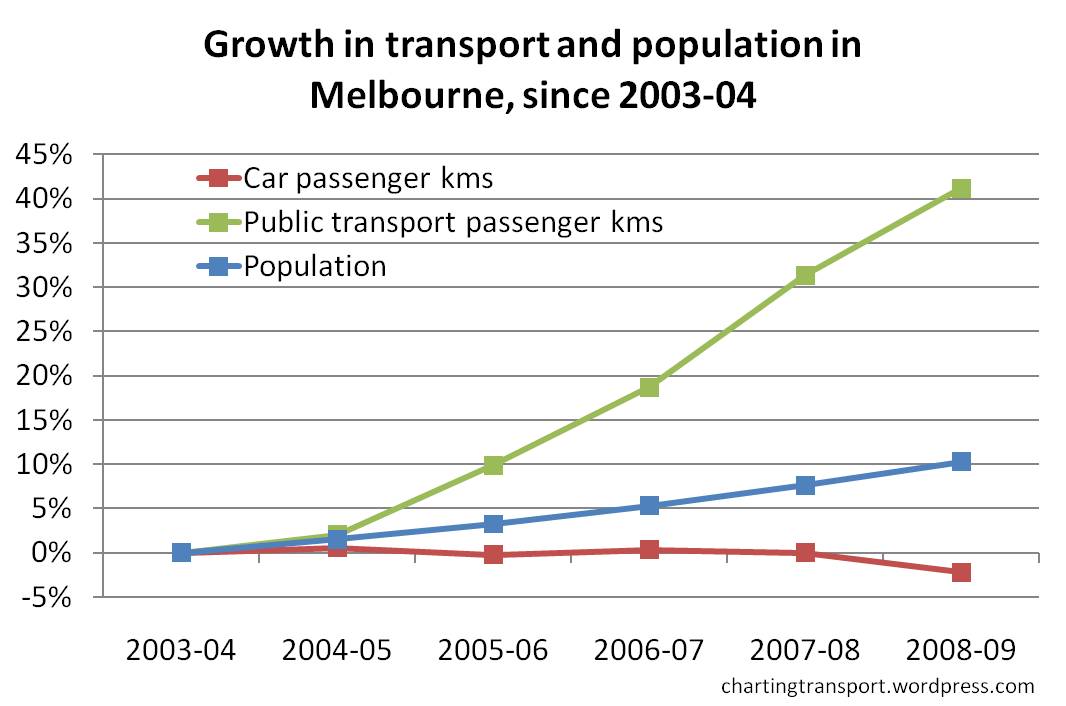
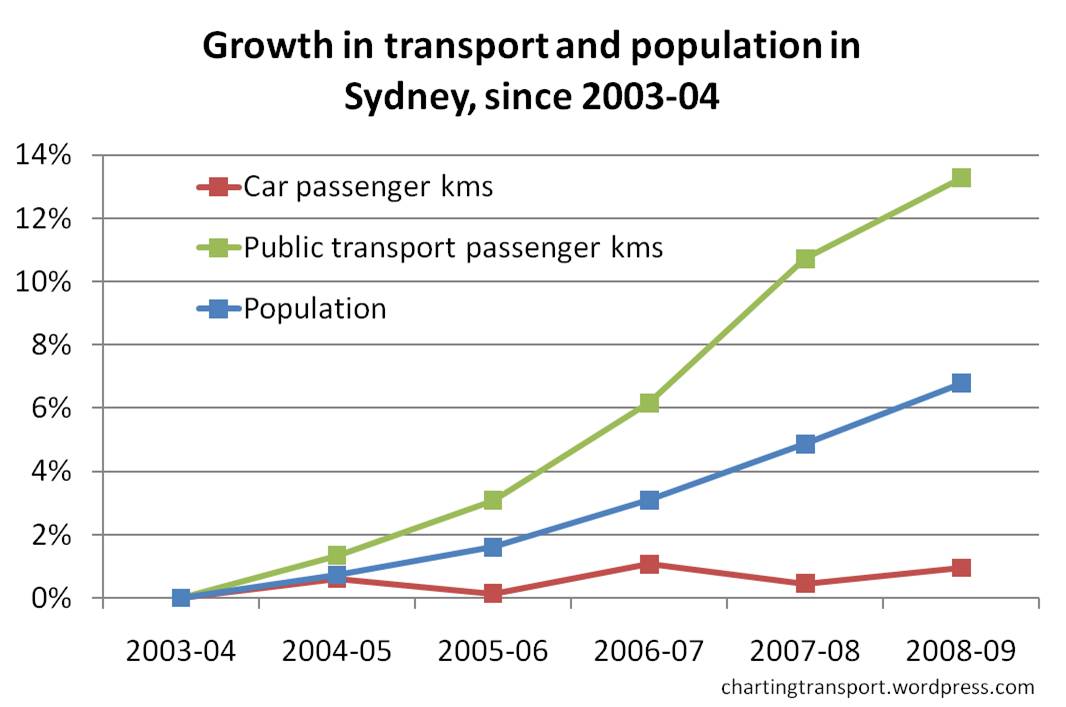
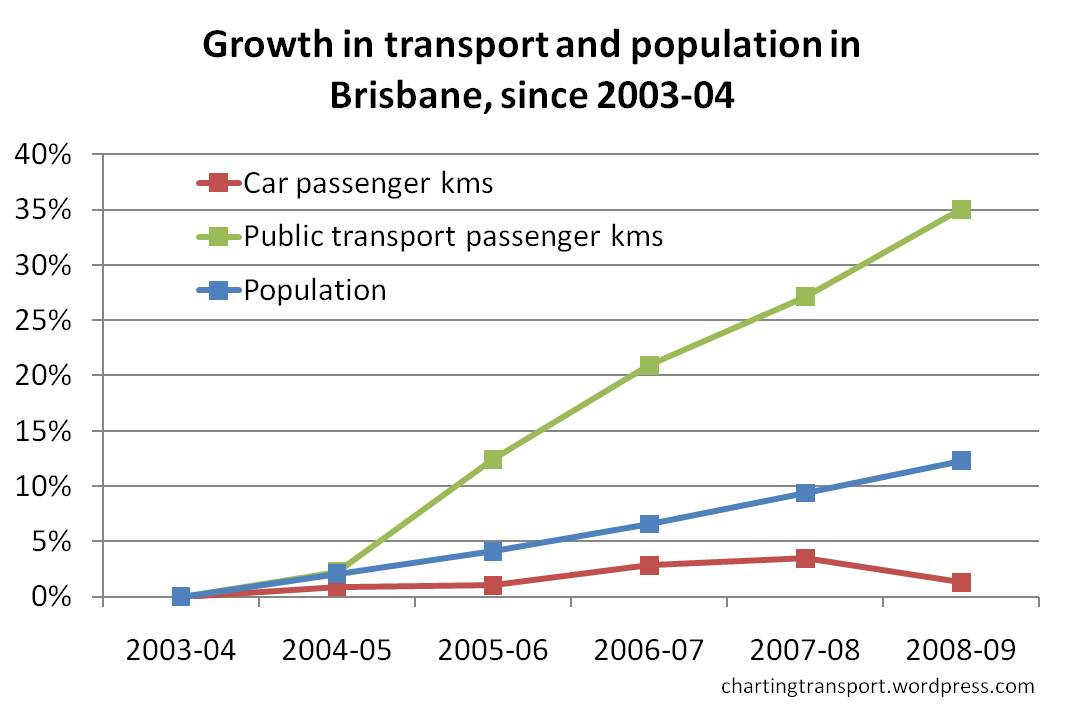
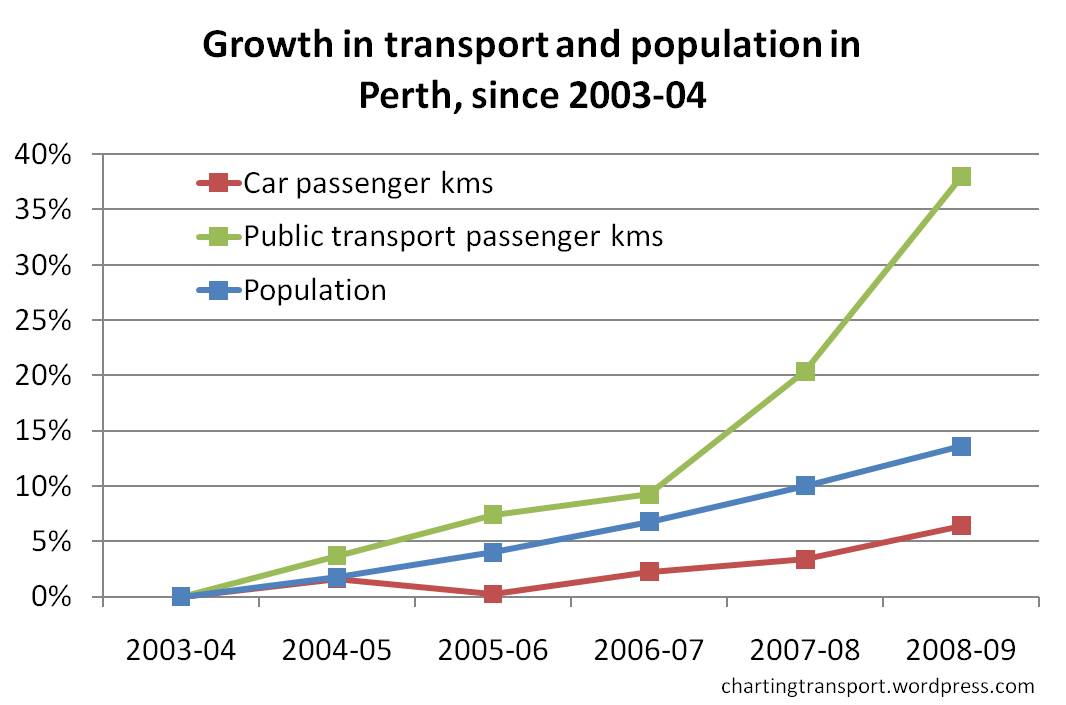
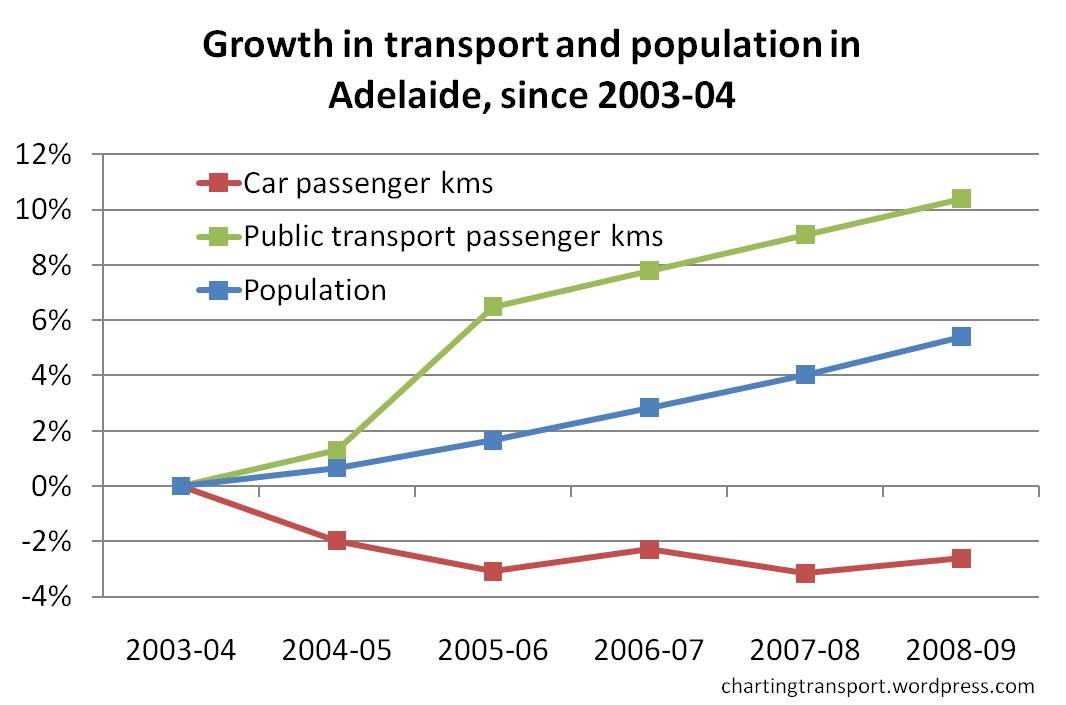
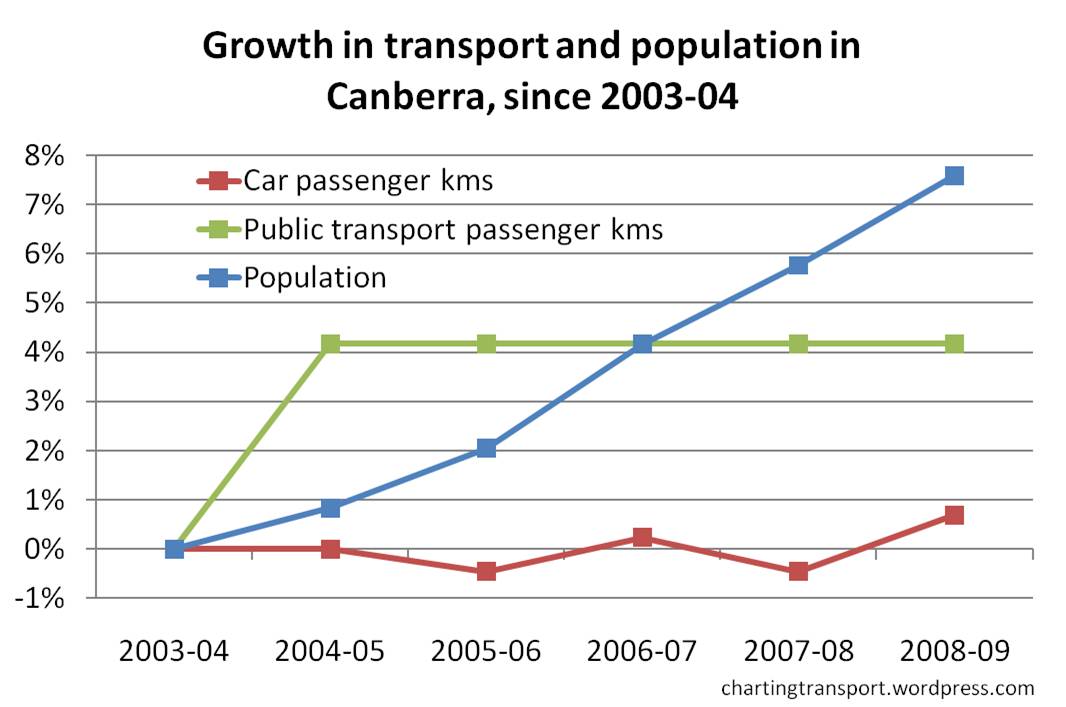
By popular demand, here are charts for each city (plus Canberra):

Note:

  • These charts have very different scales on the Y axis. Compare with caution.
  • Canberra public transport passenger km (actually just bus passenger kms) is reported as “0.25” billion passenger kms for five straight years, hence the straight green line.
  • While I haven’t drawn the second set of charts for each city, in all cities, car passenger kms per capita have reduced (red lines below blue lines). Public tranpsort passenger kms per capita have increased in all cities except Canberra.

Transport and Liveability – the public’s view

Wed 26 January, 2011

What do people feel is more important to liveability, a good public transport service or a good road network? How do people rate their transport systems? And do people derive liveability from extensive motorway networks?

The Property Council of Australia recently commissioned some polling about the liveability of Australian cities. It looked at 17 attributes of a city including public transport and road network performance.

With the data available, I aim to shed some light on those questions.

About the data

The survey was conducted in September/October 2010, and included around 600 respondents in a representative sample from the major cities (except Perth which was a sample of only 318 for some reason, which will increase the margin of error).

In my analysis I’ve left out the very small cities of Hobart and Darwin. Sorry guys, but you are both smaller than the Gold Coast, the Sunshine Coast, Newcastle, and Wollongong – which weren’t included in the survey. In fact, the Gold Coast and Newcastle are bigger than Canberra, so maybe I should have left Canberra out too.

The survey looked at the importance and performance of 17 attributes:

  • The look and design of the city (the buildings, streetscapes and cityscape) is attractive
  • The city is clean, well maintained and unpolluted
  • There is a wide range of recreational outdoor environments (like parks and playgrounds, cycle paths, beaches, countryside, etc)
  • There is a wide range of cultural entertainment options (like cafes, restaurants, markets, theatres, nightspots and sporting events)
  • There is a good public transport service
  • There is a good road network and minimal traffic congestion
  • It is a safe place for people and their property
  • The natural environment is attractive
  • There are good approaches to environmental sustainability and climate change
  • There are good healthcare services
  • There are good schools and other educational facilities
  • There is a good range of quality affordable housing
  • There is a good balance of different housing types (e.g. houses or units)
  • There are good employment and economic opportunities
  • It is an affordable place to have a good standard of living
  • The climate is good
  • There is a diverse range of people who get along well

More info about the survey here.

What’s more important to liveability – a good public transport service or a good road network?

Importance data was gathered by asking respondents to rank each of the 17 attributes in order of importance.

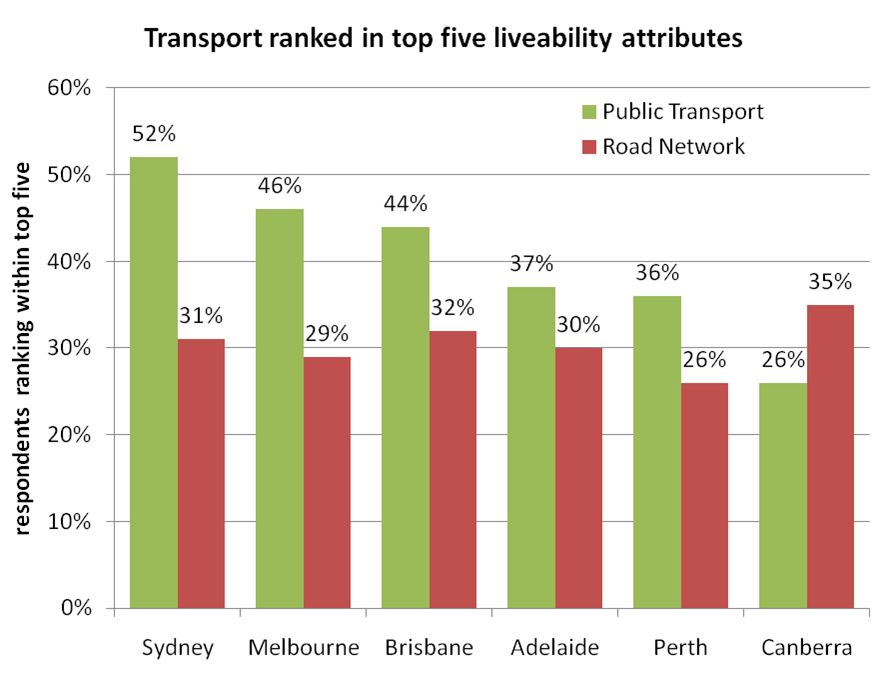
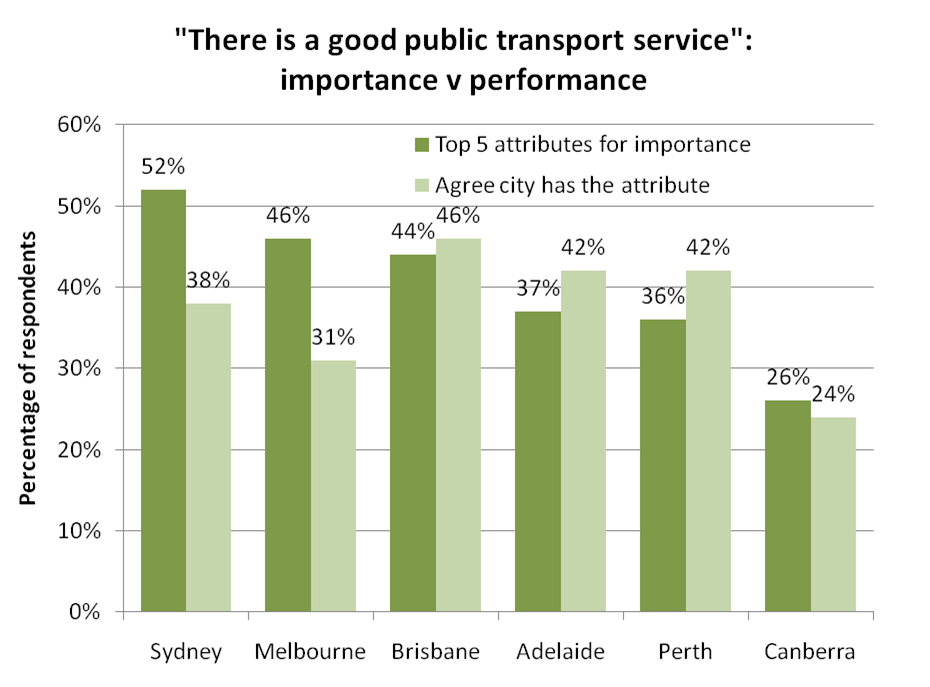
First chart shows what percentage of respondents ranked public transport and road networks in their top 5 most important attributes:

Public transport was highly important for liveability for a significant portion of respondents in all cities, but more so in larger cities.

A good public transport service out-rated a good road network as highly important for liveability in all cities except Canberra. Is this because people in Canberra don’t see a congestion issue that needs to be tackled with public transport?

Another way of looking at importance is relative ranking. An average ranking was calculated for each attribute and the attributes then listed in order of average ranking. The following chart shows the position of the transport attributes in this list (a kind of re-ranking):

Public transport ranked highly in all cities (except Canberra), and was 3rd top in Sydney. A good road network came 7th in all cities except Melbourne and Adelaide where it was slightly lower.

Suffice it to say, most respondents in large cities thought having a good public transport service was more important to their city’s liveability than having a good road network with minimal traffic congestion (with the exception of the smaller city of Canberra). Indeed many commentators think congestion is a good thing, but I doubt many members of public would agree.

How do the cities rate on public transport?

Firstly, did people in each city agree or disagree that their city had a good public transport network?

Brisbane had the highest proportion of respondents agreeing their city had a good public transport network, with Melbourne, Brisbane, Adelaide and Perth not far behind. Respondents in Sydney and Canberra had the highest rate of disagreement.

Next a chart to compare the portion of respondents who thought public transport was one of their top 5 liveability attributes, and the portion who think their city has a good public transport service:

While around half of respondents in Sydney and Melbourne ranked public transport as very important, a significantly smaller portion agreed their cities had a good public transport service, suggesting a high level of dissatisfaction.

Fewer Canberra respondents thought public transport was important or thought Canberra had a good public transport service. Again not surprising considering Canberra has a road network that probably meets passenger transport needs quite well.

I should say that just because more people agree that their city has a good public transport service than those who rank it as one of their top 5 attributes, doesn’t mean the public transport service exceeds their expectations for a liveable city.

How do the cities rate on road networks?

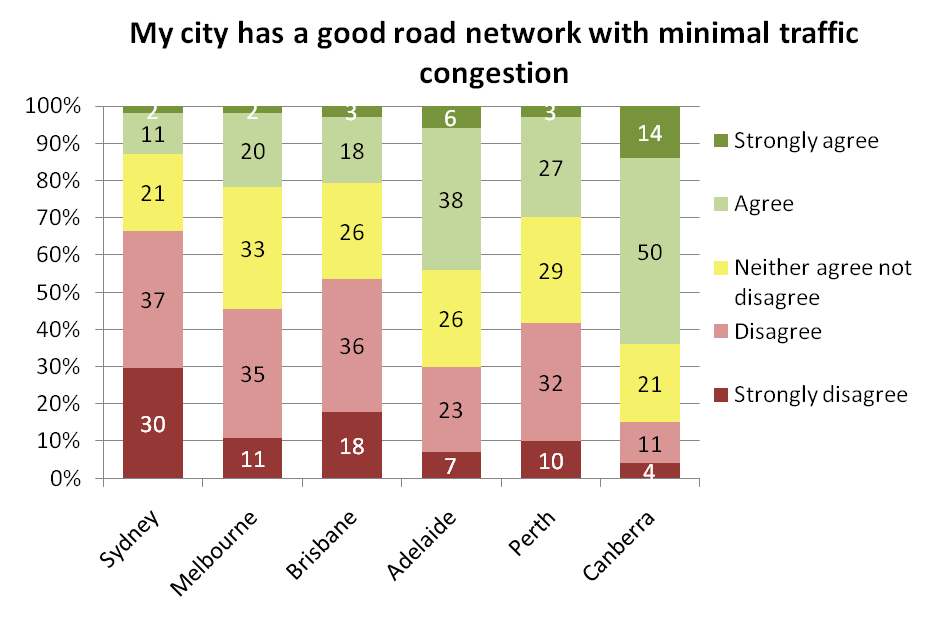
A majority of respondents in Sydney disagreed that it has a good road network, even though Sydney has embarked on many major motorway building projects in recent years. So, is the answer to build more/wider motorways (which arguably just induce more traffic), or perhaps tackle the transport challenges in a way that reduces overall traffic? The results of this survey suggest having a good public transport service is seen as more important for liveability in Sydney (and all the other large cities).

Perth, Melbourne and Brisbane also have considerable freeway/motorway networks, but only a minority of respondents think their cities have good road networks.

Respondents in Canberra and Adelaide were more likely to agree that their city had a good road network. Canberra isn’t a surprise, but Adelaide is interesting: it is the only major city in Australia without an extensive freeway network, and yet more respondents were content with their road network, and the city was ranked most liveable overall.

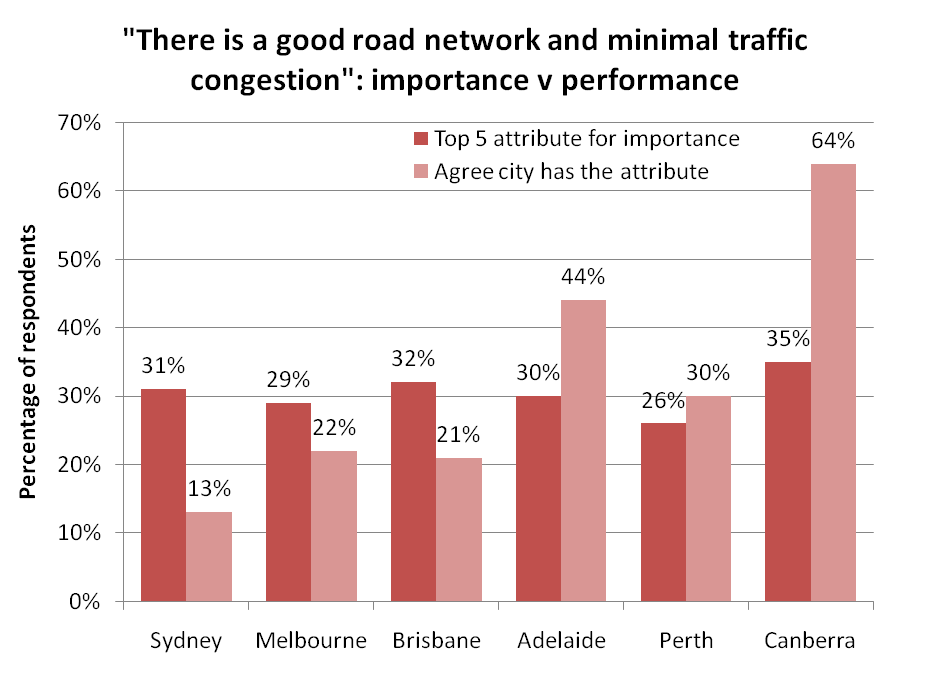
Finally, here is a comparison of importance and rated performance of road networks:

People in Sydney appear to be most dissatisfied with their road network, while people in the relatively smaller cities of Adelaide, Perth and Canberra had higher levels of satisfaction.

For comparisons between cities on all 17 attributes, have a look at this presentation.


A look at Melbourne CBD transport

Sun 23 January, 2011

My last post looked at suburban employment areas, but what about the CBD? With the review of the City of Melbourne’s Transport Strategy, I’ve taken on a detailed analysis of transport to and from the CBD.

In this post I’ll look at questions like:

  • Do CBD commuters come from the inner or outer suburbs?
  • Do wealthy executive types snub public transport?
  • How does mode share vary between the sexes and young and old?
  • What impact are employer parking and driving subsidies having on mode choice?

I’m mostly focussing on the inner Melbourne CBD – using the ABS definition of “Melbourne – inner” SLA, which is essentially the Hoddle grid. However I’ve included Southbank or Docklands a couple of times, and there are also some comparisons with Sydney, Brisbane and Perth CBDs.

This is a long post, so grab a cuppa and get comfortable.

Where do the commuters come from?

According to the 2006 census, there were 137,853 commuter journeys into the CBD.

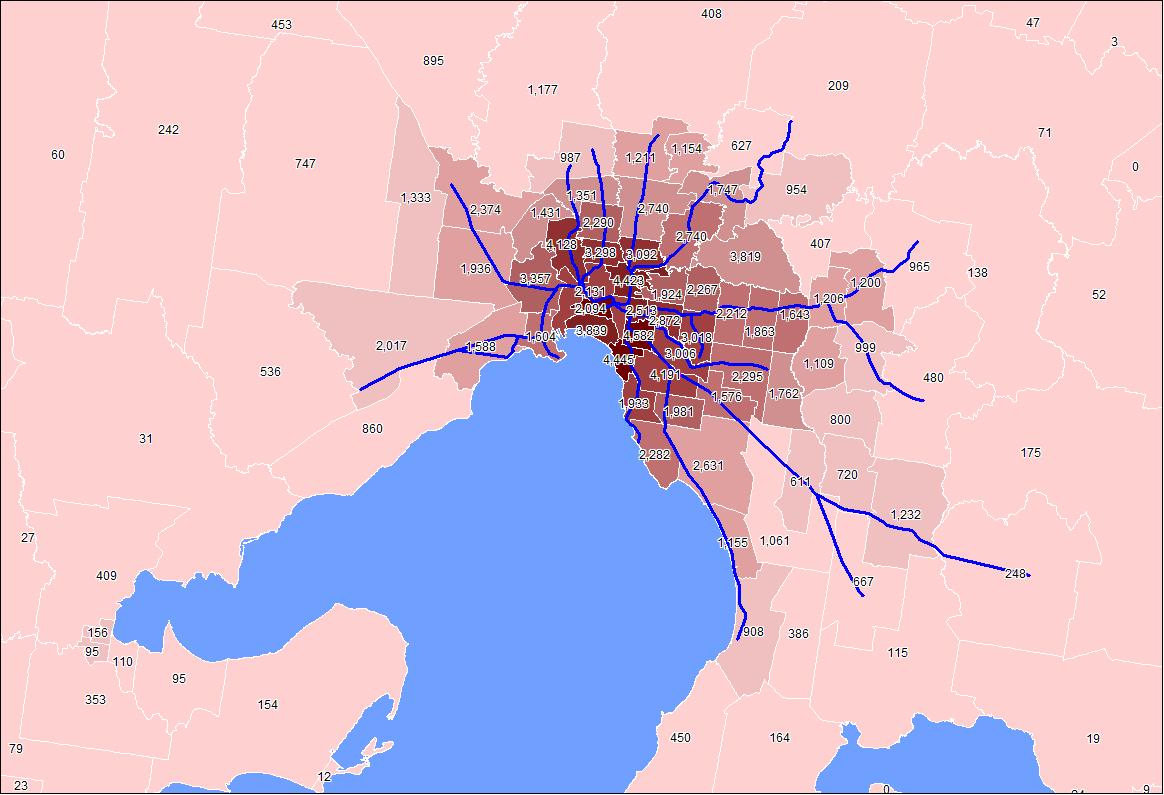
The first map shows the number of commuters from each SLA in Melbourne. The shading represents simple density of CBD commuters by area, which is not ideal because outer metro SLAs can be impacted by low average population density. At the same time, not all SLAs have the same population so some will always have large numbers (eg Manningham west). As always, click to zoom in.

The CBD attracted workers from all over Melbourne, but certainly with a high concentration from the inner suburbs.

To get around the density issue, I’ve drawn a map showing the percentage of workers from each SLA who work in the CBD, Southbank or Docklands:
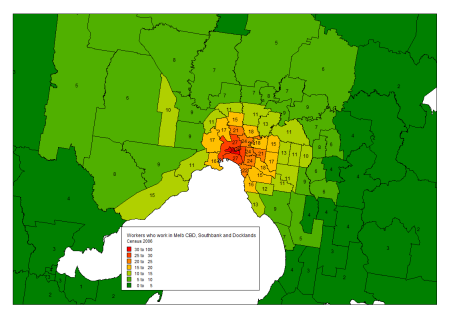
You can see the percentage drops off fairly uniformly by distance. The CBD is not a major destination for most middle and outer suburban areas.

What modes of transport do commuters use? (by area)

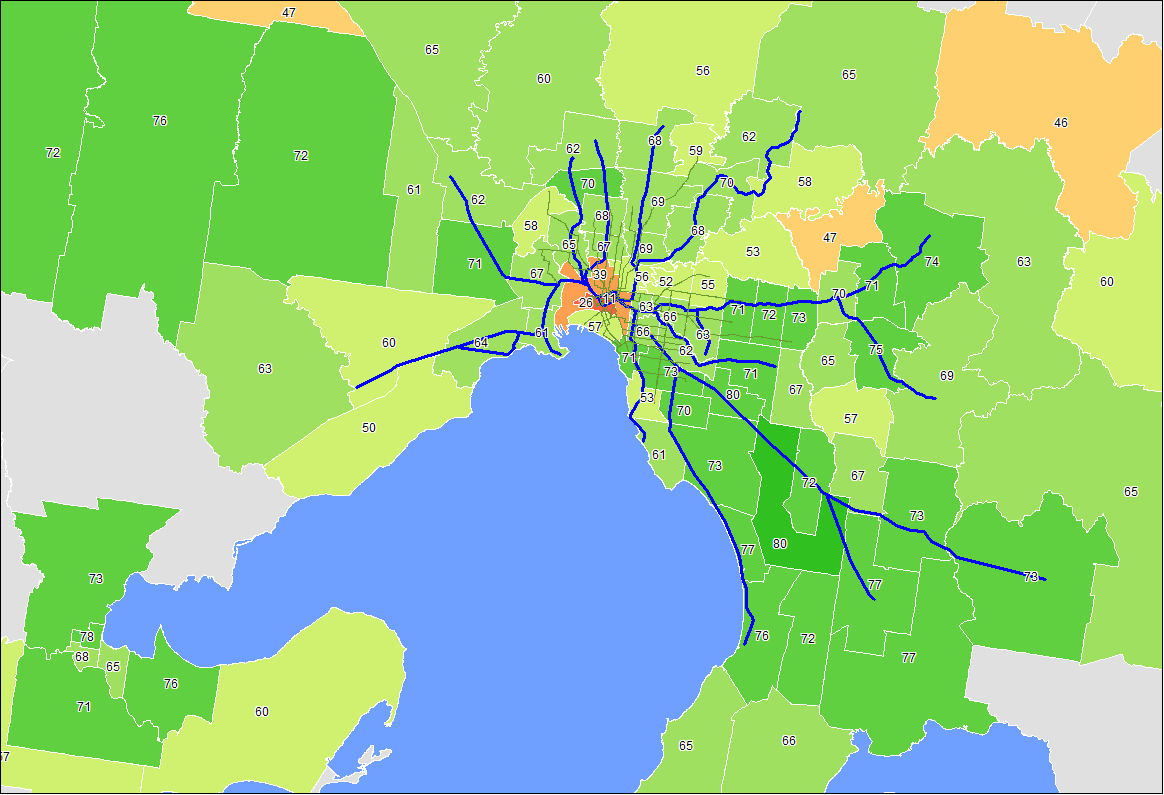
Firstly a map showing the public transport mode share from each SLA (green = higher):

Public transport mode share was largely above 70% for much of Melbourne and indeed most surrounding areas.

A few low spots stick out:

  • Manningham west and east, serviced only by buses (that have recently been signficantly upgraded)
  • Northern parts of Boroondara and 52% and 55%. These wealthy areas are serviced by frequent trams and buses, although with a relatively slow trip in.
  • Rowville (Knox south) is at 57%, but bear in mind there were only 800 commuters from Rowville to the CBD (and I expect most of these would be park and ride train commuters). In fact, the catchment of the proposed Rowville rail line passes through three SLAs, with a total CBD commuter population of 4138. Allowing for catchments of other radial public transport lines in the SLAs, the CBD commuter catchment of the proposed Rowville line might be 2000-3000, or about 3 full trains. But of course a line would also be used for trips to other destinations (particularly Monash), and it would probably cause changes in travel patterns over time once built. I might look at this more in a future post. In the meantime you might want to read Alan Davies take, and a 2004 pre-feasibility study (here is a summary presentation).
  • Wealthy Brighton is well serviced by the Sandringham line, but only half used public transport to get to the CBD. There is no easy freeway connecting Brighton and the CBD, so why are they driving? I’ll come back to that.
  • The inner SLAs in Melbourne, Yarra and Port Phillip are slightly lower, probably due to a high rate of walking and cycling. More on that later too.

You can see a high PT mode share for the relatively small numbers of commuters from Geelong (around 800 in total). $4.3b is being spent on a regional rail link, that will separate regional trains from suburban trains. Regional trains from outside Melbourne seat less than 500 people, but because they run express through much of Melbourne they each consume probably around two all-stopping suburban train paths (which have a capacity of around 1000 each). I haven’t seen any debate about whether encouraging regional commuting by train into central Melbourne is worthwhile, though I’m sure people living in those areas appreciate the trains.

Next a map showing private transport mode share (red = higher):
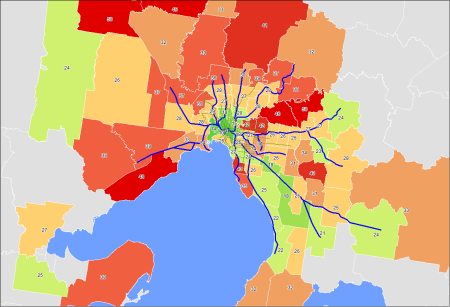
Private transport mode share was highest for Manningham, northern Boroondara, Wyndham South (including Point Cook), Bayside, Rowville, and the outer northern fringes.

But a high car mode share may not be a huge issue if the number of car commuters is low. The next map shows the number of private transport commuter trips from each SLA, shaded by relative density:

Observations:

  • Like we saw in my last post for South Melbourne, there were large numbers of car commuters coming from the inner suburbs, particularly to the south-east. These areas are well connected to the CBD by public transport, and also quite wealthy. Is wealth a driver of higher car mode share? Read on.
  • Manningham west had a large number of car commuters (with a reasonable density). This area is entirely reliant on bus services, which have been upgraded considerably since 2006, with strong patronage growth resulting. In 2006, the last bus from the CBD on the Eastern Freeway – Doncaster Road route (307) was around 6:45pm. It’s now around midnight (on route 907 that replaced 307).
  • There were also a large number from Wyndham north-east (Werribee – Hoppers Crossing area) which is not shaded dark on the map due to low average population density. In 2006, peak train services on the Werribee line were often 20 minutes apart, and bus services only ran every 40 minutes. The train frequency has since increased to 6/hour but the (feeder) bus frequencies are still 40 minutes in peak periods.
  • Moonee Valley (Moonee Ponds-Essendon area) was a large contributor of cars, despite frequent trains and trams to the CBD. Not sure why that is, although Essendon is a relatively wealthy area.

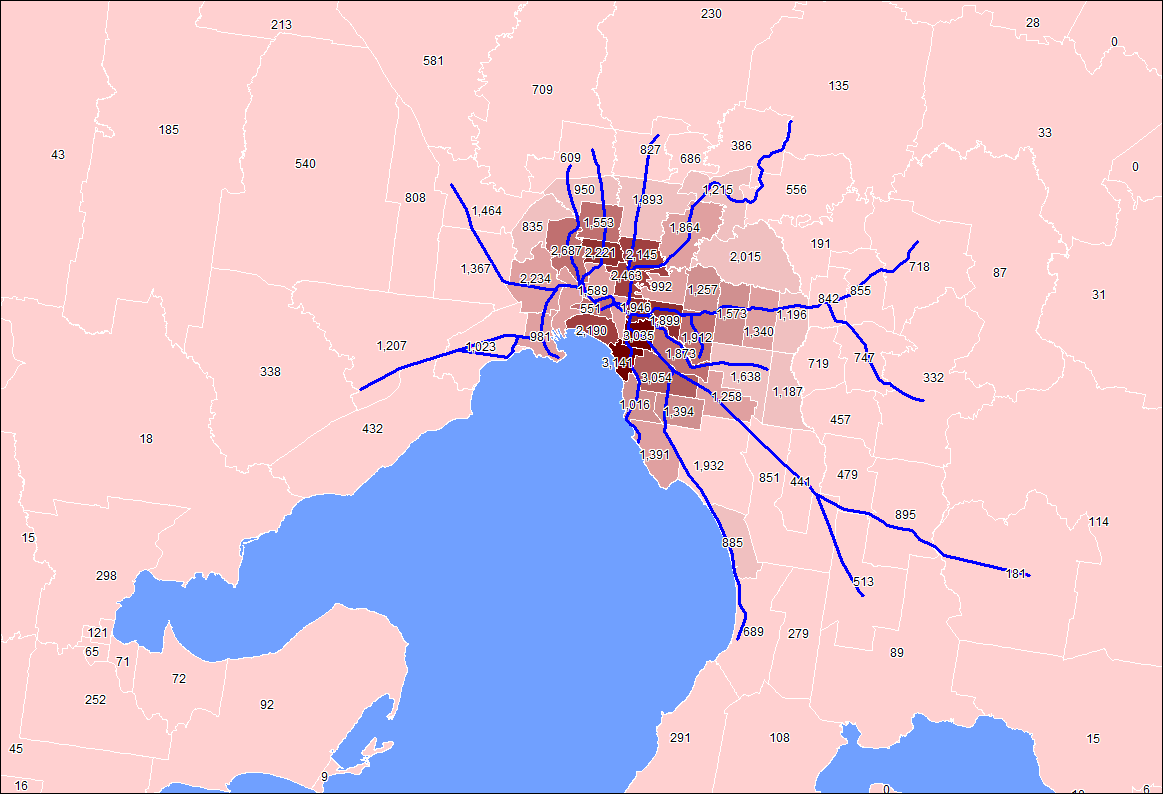
Here is a another map of private transport commuters, except it is shaded by numbers rather than density. Manningham west stands out, but bear in mind it is one of the largest SLAs in Melbourne by population. You can see the outer western SLAs show up on this map also.

And for a flip side, here is where the public transport passengers were coming from (shaded by density):
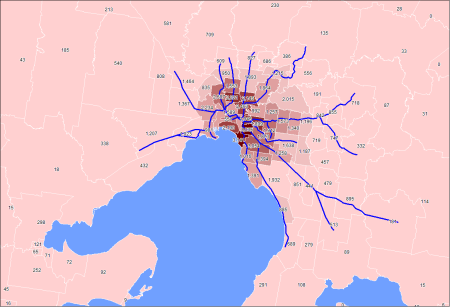
There are large concentrations coming from the inner suburbs, but also the middle eastern suburbs which are well connected by trains. The Manningham west area had over 2000 public transport commuters to the CBD, many of which would have been on buses only.

Again, to get around the low population density problem, I’ve also drawn a similar map shaded by total numbers:

We saw low PT and car mode shares for the inner city. I haven’t drawn a map of walking mode share for the CBD but you can see public and private transport mode shares are low in the inner city, with walking likely to fill the gap. A map of walking mode share to any work destination is in another post.

The cycling figures are quite interesting. Next map shows the bicycle mode share to the CBD (any trip involving bicycle) (green=higher):
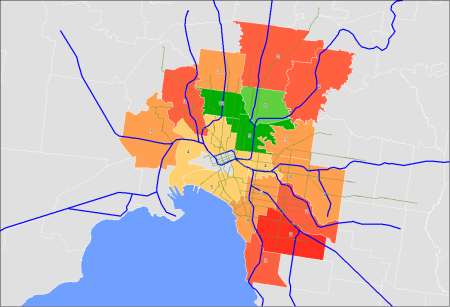
The figures are for Yarra north, Brunswick and Northcote are surprisingly high at 8-10%. Remember that the census is taken in winter (August). As I recall it wasn’t a rainy day. Bicycle mode share is also lower for commuters from the City of Melbourne itself. SLAs in grey lacked sufficient data.

Here are the total number of CBD bicycle commuters per SLA (shading by numbers, not density):

According to the data, people also rode from as far out as Frankston, Croydon, Ringwood and Sunbury! Census data is like that (as I recall, someone in Banyule claimed to have gone to work by ferry).

What modes did people use overall?

Here is a chart showing the overall mode split for all CBD workers:

Trains accounted for almost half of all CBD arrivals.

While buses accounted for only 2% of all CBD commuters, they were the only mode used by 32% in Manningham west, 11% in Kew, 9% in Camberwell north, 7% in Maribyrnong, and 5% in Altona.

Next chart shows mode split in a more simplified form:

Public Transport dominates, but still over a quarter came by car – including over 32,000 car drivers.

Public transport took 67% of motorised commuter trips into the CBD.

Active transport is at 8%, which probably represents those who live within walking distance of the CBD.

So how does Melbourne compare to other large Australian cities? The following chart compares Sydney, Brisbane, Perth and Melbourne CBDs. I’ve used the SLA that represents the inner core of business activity in each city to try to make in a reasonably fair comparison. Unfortunately Adelaide does not have a true inner CBD SLA to compare against (the central SLA includes all of North Adelaide, including lower density residential areas).
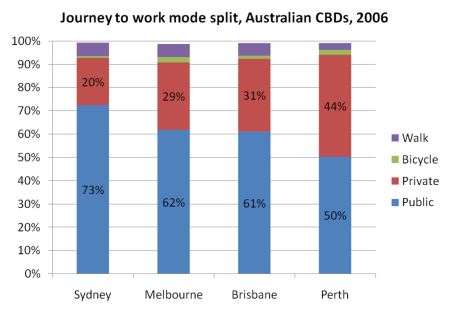
Sydney has the highest public transport mode share, with Melbourne and Brisbane very close (to my surprise). Perth is very much a car CBD, although mode shares are likely to have changed following the opening of the Mandurah rail line since 2006. The 2011 figures will be very interesting.

Perth walking more share was 3.0%, lower than 5.3-5.8% in the other cities – probably because of a lack of inner city residents.

And for the record, cycling was highest in Melbourne at 2.3%, followed by Perth at 2.0%, Brisbane at 1.5%, and Sydney at 0.8%.

The number of car driver journeys to work in the Melbourne CBD actually decreased from 34,289 in 2001 to 30,570 in 2006, a mode share drop from 27% to 23% (ref). This happened despite a 20% increase in the number of parking spaces in the CBD between 2000 and 2006 (ref):

I’ve included Southbank and Docklands in this chart for interest – Southbank parking supply actually went down between 2006 and 2008.

[parking stats updated June 2012 with 2010 CLUE data:]

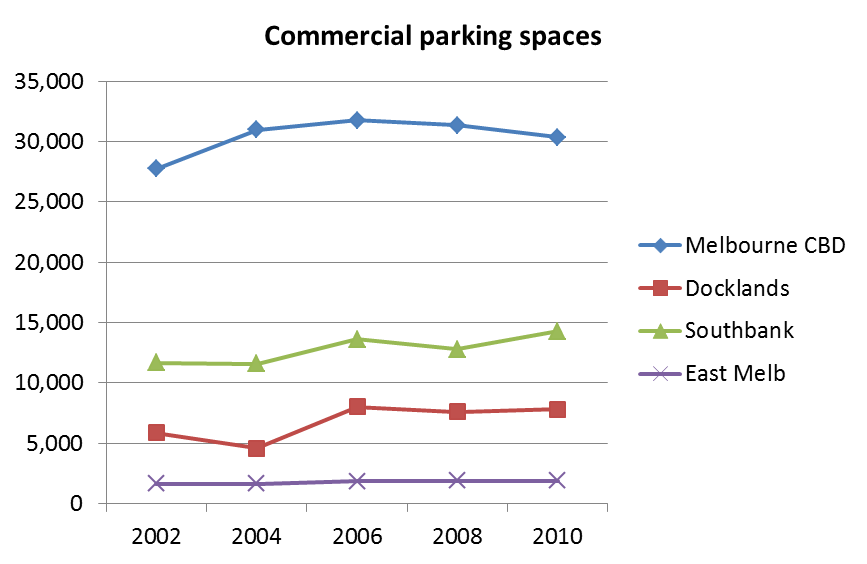
Looking at commercial parking spaces only:
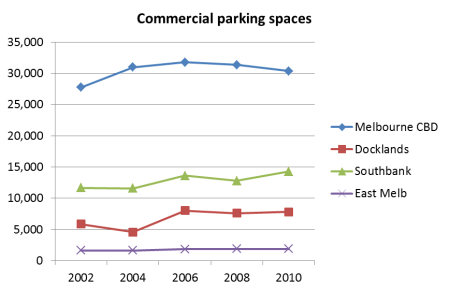
The number of commercial parking spaces has actually declined in the CBD and there has been very little growth in Docklands (despite an increase in employment).

Here is the ratio of employees to commercial parking spaces:

While the ratios are flat in three of the areas, Docklands has seen strong growth in employment without equivalent growth in commercial car parking.

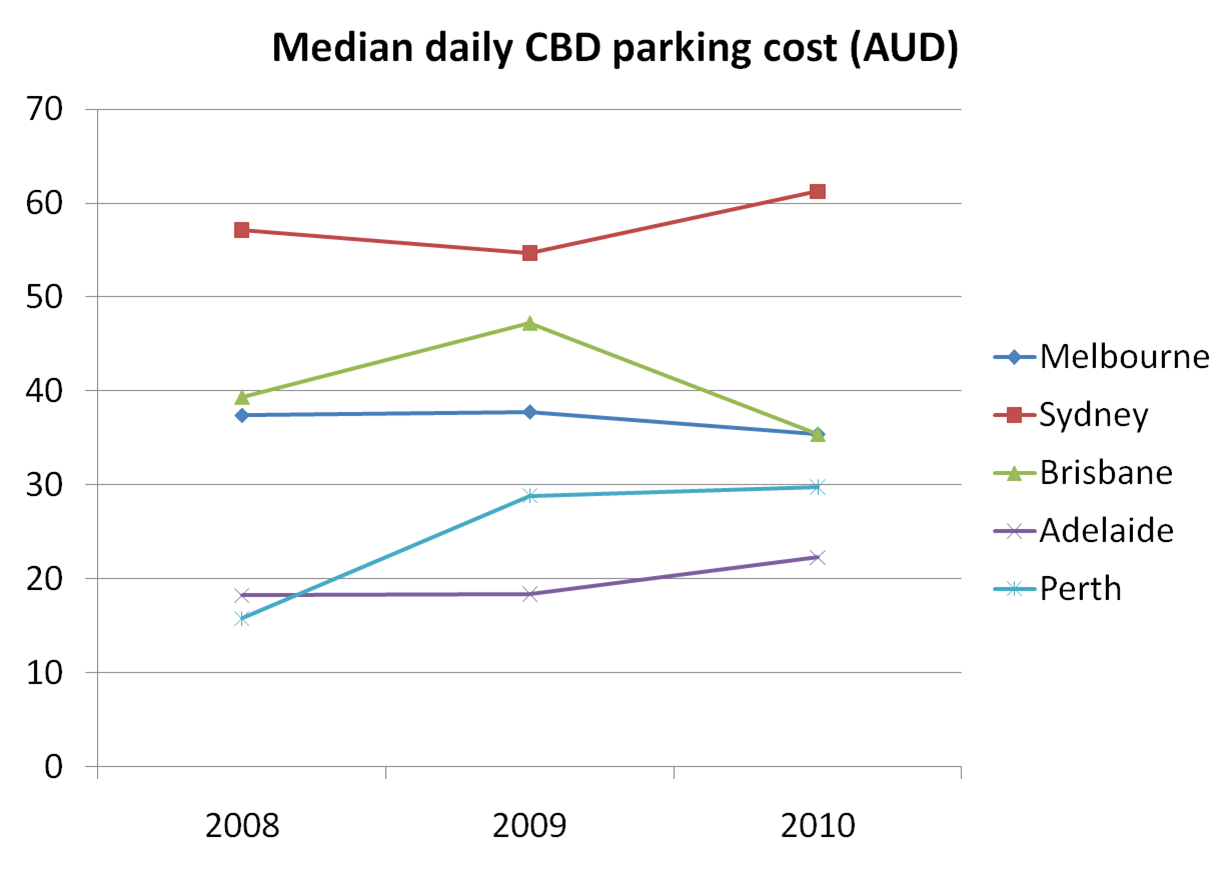
Colliers International have recently begun surveying CBD parking costs. Here are the results for Australia (adjusted to AUD using 1 July exchange rates):
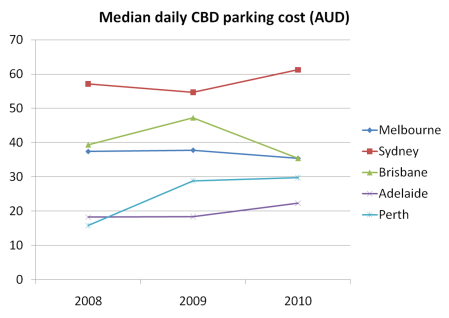
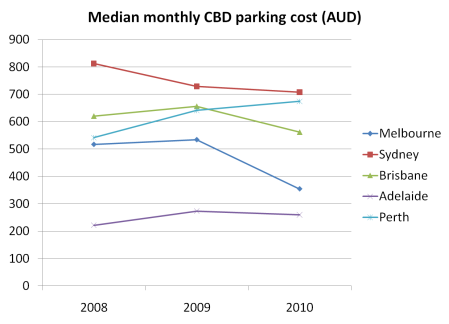
I don’t pretend to be an expert in CBD parking markets, but the differences between daily and monthly rates suggest some complexity. In Melbourne at least, it is quite common to find “early bird” parking for $13-17 (and “early bird” usually means parking your car before 10am).

I’m perhaps more inclined to go on the monthly rates, as they are probably more competitive. Melbourne prices collapsed in 2010, at the same time that public transport patronage growth stalled. Prices also went down in all other cities except Perth (which had the strongest public transport growth of the major cities in 2009-10).

So is CBD parking price a driver of public transport patronage? Probably too early to tell because of a lack of much time series on parking cost data (including 2006 data), but worth looking at in future.

What modes are different commuters using?

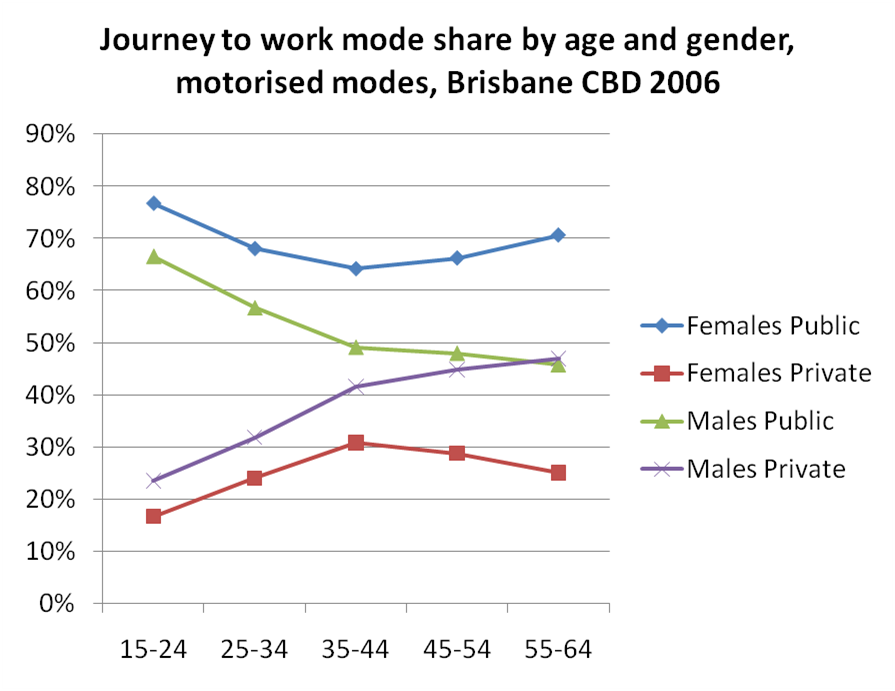
Firstly, mode share of motorised journeys by age and gender:
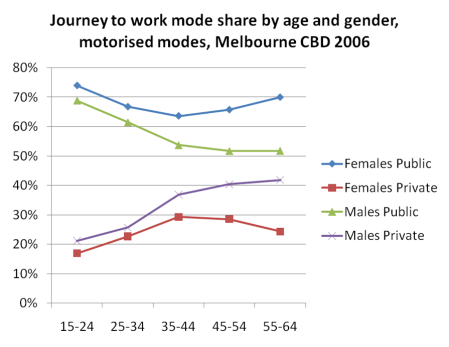
As you might expect, public transport mode share is higher amongst younger people and females. But for females it is also high for older women, with a curious dip at 35-44 years (typical kids at primary school years?). For men, private transport mode share was higher for older men. I’ve not shown 65-74 because the total number of such commuters was very small.

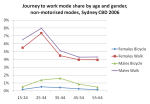
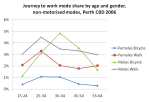
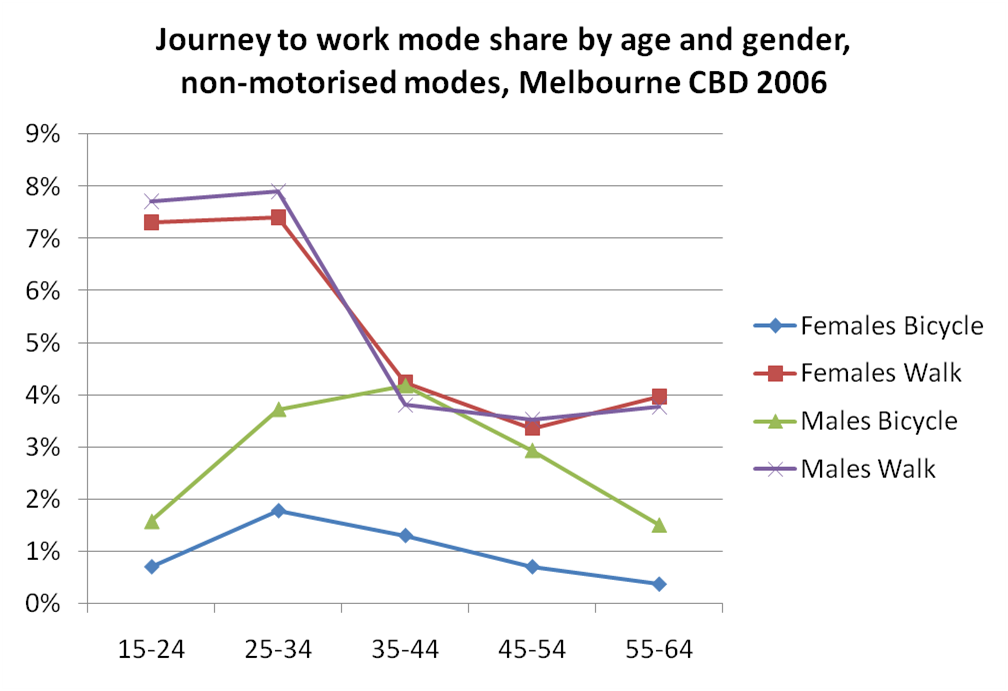
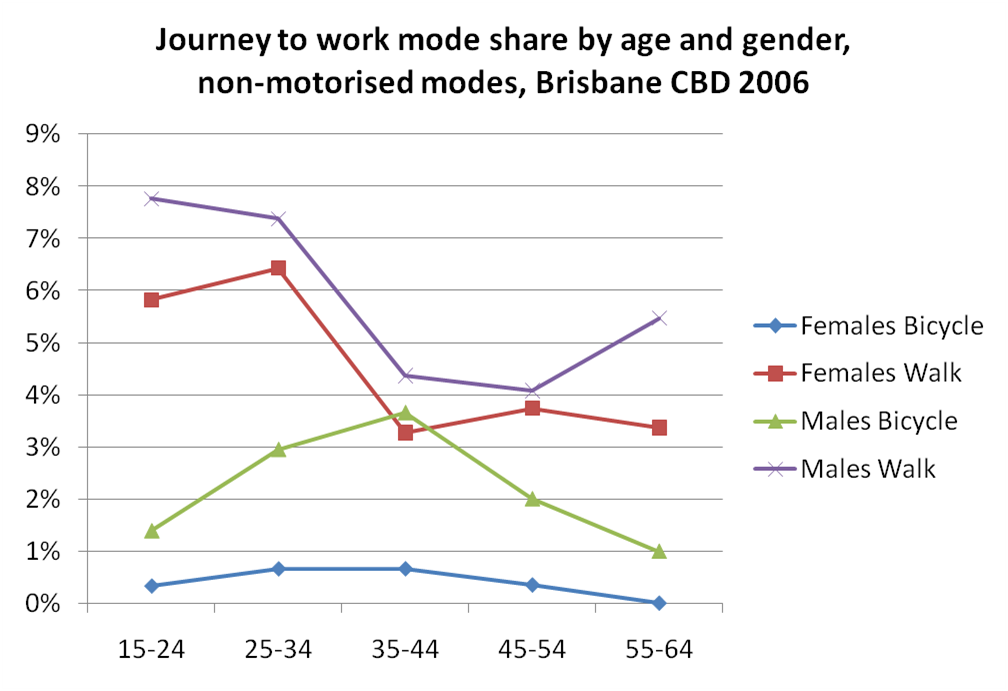
I’ve put non-motorised modes on a separate chart as they are much lower shares:
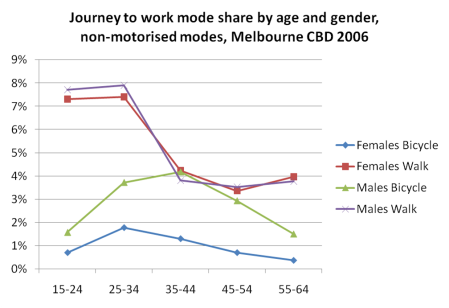
Walking was much higher for younger people. Is this because of lower car ownership, less willingness/ability to pay for transport, higher residential proximity to the CBD, and/or higher health and fitness focus? Unfortunately I don’t have the datasets to answer those questions.

Cycling mode share peaked with men aged 35-44, with men much more likely to cycle than women.

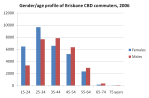
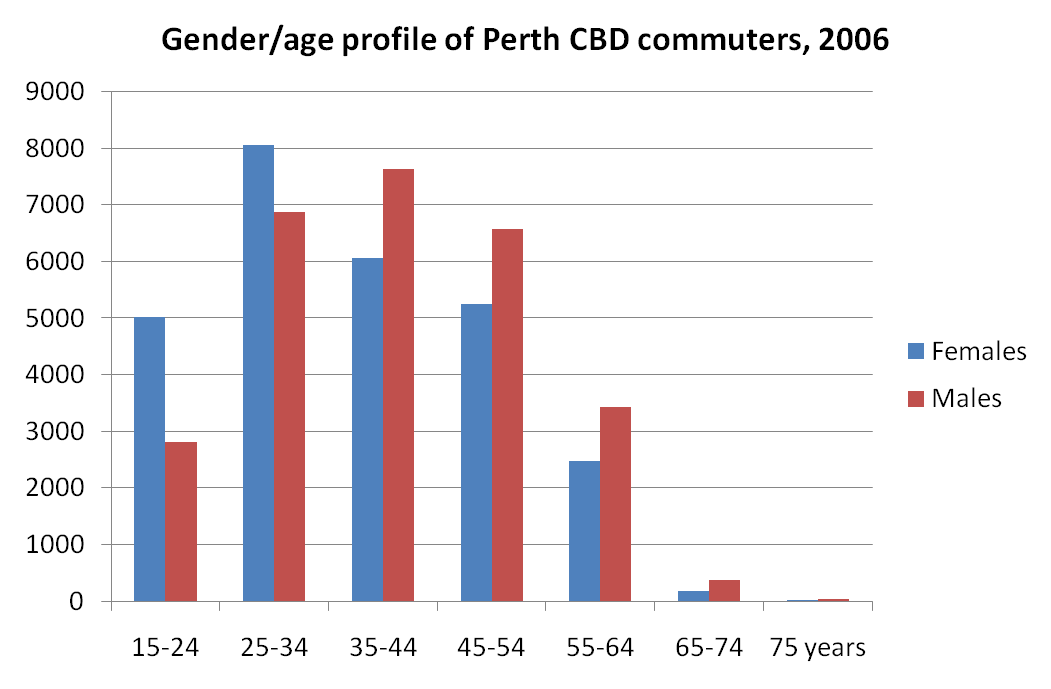
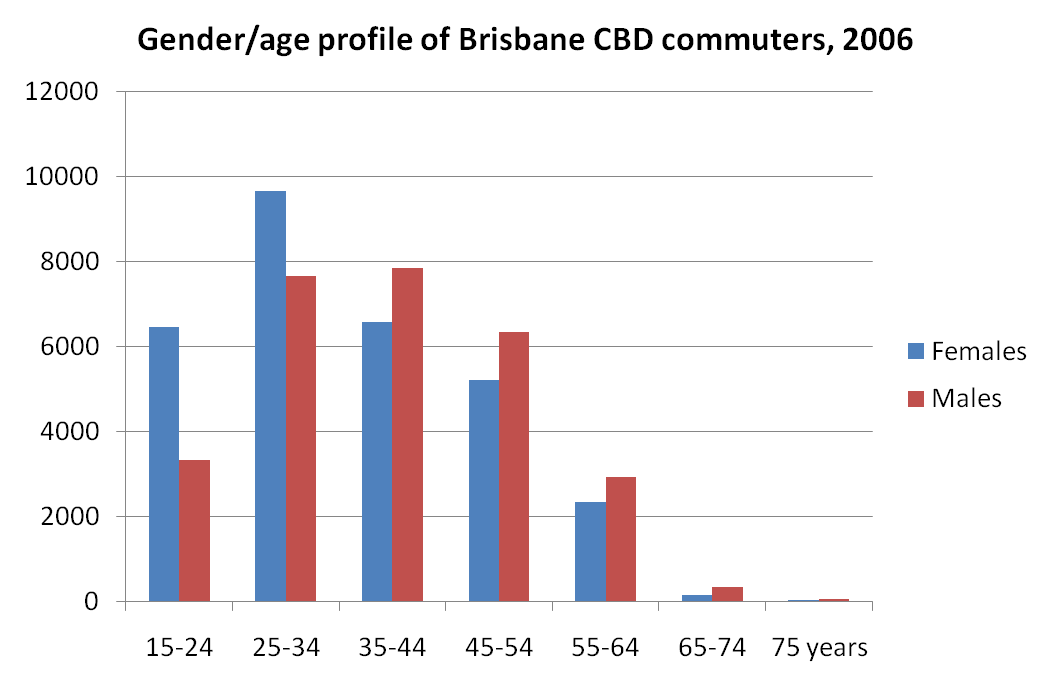
For reference, here is a demographic breakdown of CBD workers – it peaks at 25-34, with women slightly younger on average:

And here are the same charts for Brisbane:
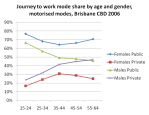
Sydney:

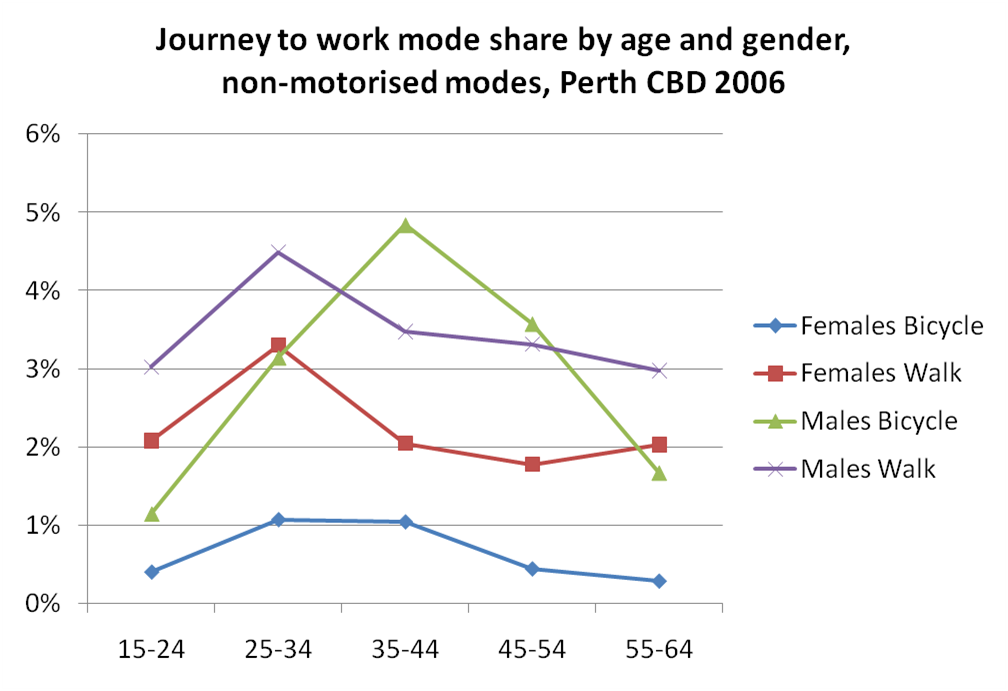
and Perth:

You can see:

  • cycling mode share peaked for men aged 35-44 in all cities
  • walking tended to peak for people aged 25-34
  • public transport mode share dipped for women aged 35-44 in all cities
  • In Perth, men aged over 35 had a higher private transport mode share than public transport, the only city where this occurred.

So, do executives (presumably many from wealthy inner city suburbs) shy away from using public transport?
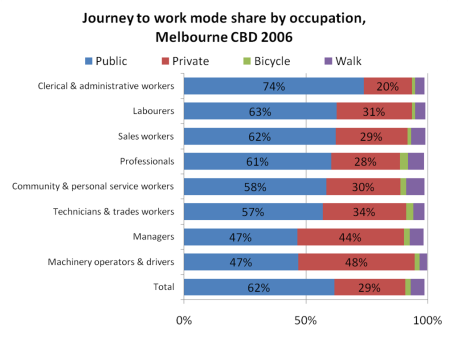
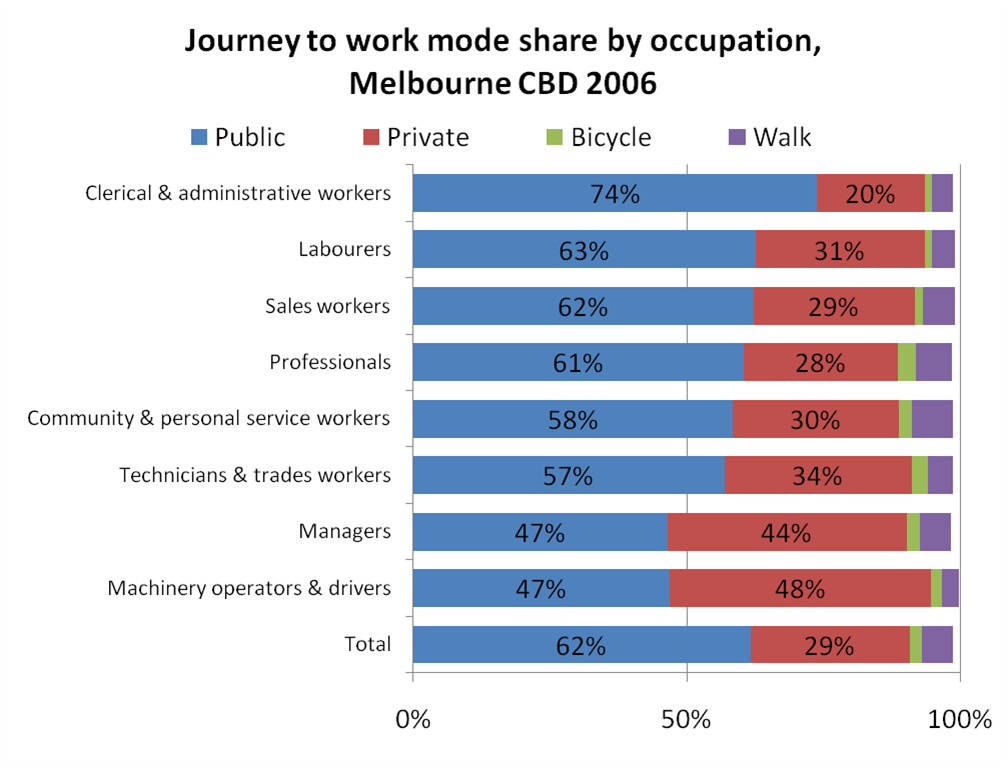
Indeed they do. They represented 16% of Melbourne CBD workers, but 24% of car commuters (9538 car trips in total). Maybe because many of them get company cars/parking as parts of their packages? More on that coming up.

Lower paid clerical and administrative workers were most likely to use public transport (and probably least able to afford driving and parking costs).

Note that Machinery operators & drivers also had a higher private transport mode share – I expect many are professional drivers coming in their work car (there were only around 1000 in this occupational category).

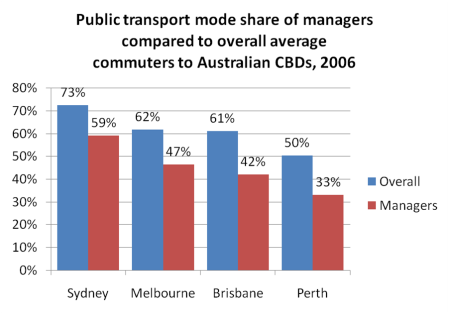
Back to managers – the next chart shows they are also more likely to snub public transport in Sydney, Brisbane and Perth:
What about other trip purposes?

The following charts show data from the VISTA 2007 household travel survey, that includes all trip types and all of Melbourne.VISTA is a survey, not a census, so there is a margin or error involved, and unfortunately the sample sizes are not large (provided in charts as “n=”). The total VISTA 2007 dataset has 2955 surveyed trips into the Melbourne CBD (across all days of the week), of which 1973 were motorised.

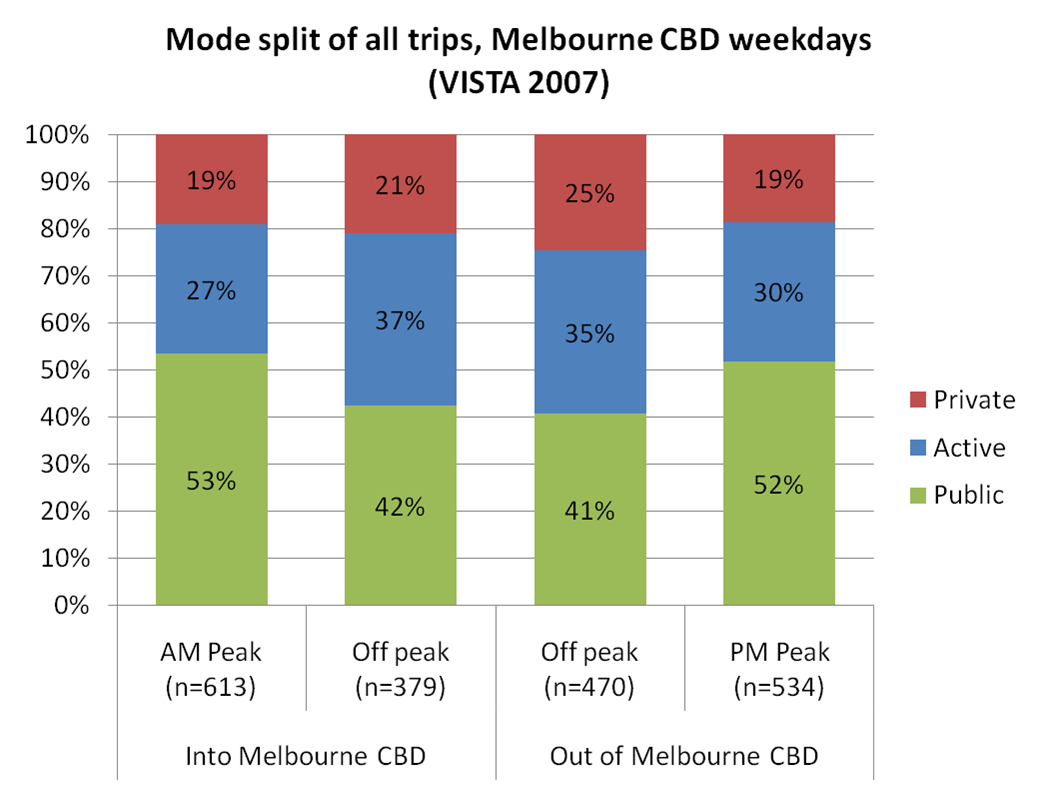
First chart shows mode split for trip legs into and out of the CBD, by time of day on weekdays:

Weekday AM peak is 7-9am, and PM peak is 3-6pm, anything else is classed as off-peak. Unfortunately there are only 190 trips in/out of the CBD on weekends in the sample, which has too large a margin of error to be too meaningful (7%).

Active transport (walking and cycling) and public transport were clearly dominant. When looking only at motorised trips, Public transport took 74% of inbound AM peak and outbound PM peak trips, and 67%/62% of off-peak in/out bound trips.

Recall above that motorised journeys to work in 2006 were 67% by public transport, suggesting people travelling for reasons other than work in peak periods were slightly more likely to use public transport.

What about wealth? I’ve used average household income per occupant, to remove the impacts of household size, and grouped this by $500 amounts. Note: the sample sizes are quite small for larger income groups.
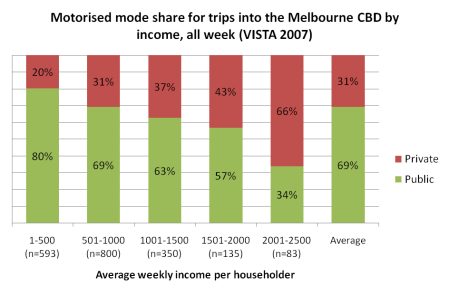
Sure enough, there appears to be a trend that people from higher income households were more likely to use private transport for travel into the CBD.

What about age?

While the sample sizes are relatively small, there certainly appears to have been a higher propensity to use private transport for travel to the CBD by middle-aged people.

There may be a trend back to public transport for older people, but the margin of error is around 10% for the last two age groups so this is not certain. However it would fit with Seniors being able to access cheaper public transport fares.

In terms of gender, 73% of females who used motorised transport came by public transport, compared to 67% of males – a similar difference to commuters.

Who’s paying for the private transport?

While for many people driving to the CBD for work everyday is something of a non-option, there are still tens of thousands who do. Is employer sponsored driving and parking costs influencing their mode choice?

VISTA lets us take a look at that also, although there is only a sample of 183 AM peak private transport trips (margin of error around 7%).

According to the data, around 29% of cars driven into the CBD in the AM peak had their running costs paid by a company, and 36% had parking paid for by employers. Remarkably, 34% reported no parking costs for off-street parking (these trips mostly for work purposes) – which doesn’t sound right for the CBD in the AM peak! I’m not aware of any publicly available free off-street parking spaces. Perhaps the respondents overlooked the fact that someone else was at least paying for the land on which they parked? If that is the case, then it would appear that less than a third of cars driven into the CBD in the AM peak were not employer subsidised in parking or running costs.

Employer subsidies appear to be an incentive to drive to the CBD. By contrast, only around 2% of general Melbourne AM peak car drivers had employee paid parking, and only around 13% had car running costs paid by an employer (VISTA 2007).

One of the most effective ways to reduce car mode share for journeys to work in the Melbourne CBD would appear to be reducing employer subsidies for parking and driving costs. Schemes such as parking cash out help employees see how much their parking and driving costs are being subsidised. If they have the option of receiving that money directly as salary they might make different choices (depending on tax treatment of course!).

That said, with current capacity issues on Melbourne’s trains and trams, trying to shift more CBD commuter trips from car to public transport in the short-term might not be a government priority just at the moment.

And lastly, for the record, 6 and 8 cylinder cars parked in the CBD did not appear to be over-represented. Cars of well-known luxury brands were over-represented (15% v 6% metro average).

I think that’s enough now! 🙂

Active transport is at 8%, which probably represents those who live within walking distance of the CBD. In order to take out the walking component, I’ve also taken a sample that excludes an “inner ring” around the CBD, as shown in the following map:

If you take out the inner ring, the mode split is 69% PT, 28% car, 1.9% cycling and 1.4% walking longer distances.
Public transport patronage trends in Australasian cities

Sat 13 November, 2010

[updated 12 January 2015]

With some effort and assistance from others, I’ve managed to compile public transport patronage data for major cities in Australia and New Zealand. What follows are trends on what I do have, including figures for 2013-14 for most cities.

A large number of caveats are required around the data (particularly Sydney). I have used South East Queensland (the TransLink service area) and what I am calling Sydney and surrounds (the catchment for CityRail including Sydney, Newcastle/Hunter, and Wollongong/Illawarra). See below for full details.

Overall Patronage growth

All PT growth 6

This chart shows growth in patronage since 2001-02 (an arbitrary start year).

Observations:

  • Several cities have shown very strong growth:
    • In Perth part of this can be attributed to the opening of the Mandurah rail line in late 2007.
    • Melbourne saw strong patronage growth between 2004 and 2011, with a particularly big jump in 2008-09.
    • South East Queensland invested in bus services between 2003 and 2009, including radial busways to the Brisbane CBD. However patronage peaked in 2009-10, and has been flat or declining since. This may be impacted by the floods and associated free travel periods (not counted as patronage), and recent above-CPI fare price rises. Also train patronage under the old paper ticketing system may have been overestimated – creating an inconsistency in the time series as people transition to Go Card.
    • Auckland and Christchurch had very strong growth to a peak in 2002-03 (attributed by some to a boom in international students), a lull and then strong growth again from 2007. Christchurch patronage fell dramatically in 2010-11 following a major earthquake that closed large parts of the CBD (where PT probably had a high mode share) and led to population decline.
  • The other cities are languishing significantly behind:
    • Sydney’s problems with public transport are often discussed, and I understand there has been relatively little expansion in services in recent years. Some modest growth is evident from 2010 onwards. It is very difficult to obtain Sydney bus patronage data, and I do not have a 2013-14 data point.
    • Adelaide has not been investing significantly in bus or train services in recent years (although that is now changing). Patronage peaked in 2009-10. The completion of recent rail upgrades may see rises in the coming years.
    • Canberra has seen both funding cuts and increases over the years.
    • Hobart is included for completeness. I cannot comment on reasons for patronage trends there. Their annual report does.
    • Wellington has also had only modest patronage growth, although it maintains the strongest rate of public transport use in New Zealand.

Note:

  • Greater Sydney data is very difficult to obtain – mostly because private bus, ferry and light rail data is not published in any consistent form. In the above I have used a dataset prepared by BITRE and data published by the NSW Bureau of Transport Statistics.

Train patronage

train pax growth 4

  • Auckland train patronage growth is off the chart. 2013-14 patronage was around 508% higher than 2001-02 patronage, following 10 consecutive years of annual growth above 10% (there was actually a decline in patronage in 2012-13 of 8.3% but growth rebounded in 2013-14 to 14.4%). Auckland has been heavily investing in services, a new city terminal, and electrification. Patronage growth is off a very small base, such that percentage growth rates are very large.
  • You can see the significant surge in Perth train patronage following the opening of the Mandurah line in late 2007. Patronage has more than doubled in 10 years, although curiously declined in 2013-14.
  • Melbourne saw a steady increase in train patronage between 2005 and 2011, an easing in 2011-12, but further growth since then.
  • South East Queensland train patronage figures dropped after 2009. TransLink make a comment about a change of ticketing system impacting these figures in their tracker report (previous estimates probably being inflated), so it is unclear what the “real” trend is.
  • Adelaide train patronage dropped until 2012 as lines closed for extended periods to enable electrification works. Lines have reopened and electric services are running, with a bounce in patronage evident from 2012.

Bus patronage

Bus growth 3

  • South East Queensland is by far the standout for bus patronage growth, which has followed substantial investment in busways and increases in bus frequency. Patronage almost doubled to 2012 on SEQ buses, although there has been a decline post 2012.
  • Melbourne’s bus patronage has grown significantly since 2006-07 onwards, although with a difficult to explain spike in 2011-12.
  • Perth’s bus patronage is an interesting story. Between 2007-08 and 2009-10, patronage increased by 14%, while timetabled kms only increased by 2.8%. When the Mandurah line was opened in late 2007, buses that previously travelled into the city were converted into rail feeder buses. This significantly reduced the bus trip lengths and hence passenger trip lengths for people who now transfer onto trains (the introduction of transfers might also have increased total boardings more than the total number of “journeys”). Presumably it meant that bus frequencies could be improved and/or buses were reconfigured to meet travel demands that were not well catered for previously.

Ferry and light rail patronage

other modes growth 3

  • Brisbane ferry patronage almost doubled between 2002-03 and 2008-09, collapsed in 2010-11 following service suspensions and cutbacks resulting from flood damage, and then bounced back from 2011 and is growing stronger still. The strong growth to 2008-09 followed increased services, and fare integration with other modes.
  • Adelaide tram patronage grew significantly following the tram extensions into the city that opened in 2007 and 2010 (travel within the CBD area being free). For reasons better known to others, Adelaide tram patronage has declined since 2011.
  • Sydney ferry patronage has been mostly flat until 2013 (note: at the time of writing I did not have a good estimate of private ferry patronage (approx 9% of all ferry patronage) – from 2009-10 onwards I have simply assumed no change in those numbers for want of something better).

Boardings per capita

Trends in public transport patronage will of course be impacted by population growth, so the ratio of the two can be a good indicator of system performance.

However, it is not necessarily fair to compare cities. The Sydney transit area includes many urban areas significantly detached from the main Sydney metropolitan area, including the cities of Newcastle and Wollongong. South East Queensland includes the Gold and Sunshine Coasts. But the Melbourne catchment does not include Victoria’s equivalent city of Geelong. The boardings per capita figure for the main Sydney and Brisbane metropolitan areas would likely be higher than the figures here. So it is more important to look at trends (household travel survey mode share figures may be a better method of comparison).

boardings per capita 3

  • This chart shows Melbourne as the stand-out in terms of increasing boardings per capita, a trend that started in 2004-05 (as many other of my posts have shown), although with some decline in 2012-13.
  • South East Queensland showed an increasing trend between around 2003-04 and 2008-09 but has since been in decline.
  • Perth had a significant increase in 2008-09, following the opening of the Mandurah rail line.
  • Adelaide has declined in recent years (in part due to rail works) while Canberra and Hobart remain flat.
  • Sydney+surrounds has bucked the trend of the larger cities, with no great increase in boardings per capita.
  • Wellington has the highest boardings per capita in New Zealand (notionally higher than most Australian cities). When you take into account that Wellington does not have a heavily transfer-orientated PT network, a figure for PT “journeys” per capita for Wellington is likely to be very competitive with Melbourne and Sydney.
  • Auckland has seen some steady growth in recent years from a low base.
  • Christchurch had seen some small growth to 2009-10, but collapsed in 2010-11, after major earthquake disruptions in the city. They appear to have arrested the decline in 2012-13.

Again, I must stress that it is dangerous to read too much into comparisons between cities because of the somewhat arbitrary definitions of transit system area boundaries.

For New Zealand, I have used “service area population” estimates kindly provided to me by Ian Wallis and Associates (for up to 2009-10) and then applied district population growth rates to estimate 2010-11 (and subsequent) service area populations.

A slightly better measure than public transport boardings per capita might be public transport journeys (or linked trips) per capita. This is something I would like to explore more in a future post.

The BITRE yearbook includes data on passenger kms per mode per city. From this data it is possible to obtain estimates of mass transit passenger kms per capita (I say mass transit, as they do not distinguish public and private bus). Here’s a chart using the 2014 yearbook data:

BITRE mass transit kms per capita

The trends are not dissimilar to my chart above. The BITRE figures are presumably a multiplication of estimated boardings (very similar data to mine) by estimated average route length (I suspect highly accurate time series, data on this is hard to find), or similar.

Long term patronage data

David Cosgrove from BITRE recently collated annual data on public transport patronage for all Australian capital cities, right back to 1900. His very interesting ATRF 2011 paper is here. He includes several summary charts which I won’t repeat here. What follows is some further analysis of this particular dataset.

The following chart shows estimated public transport trips per capita over 110 years:

Note BITRE used Sydney statistical division population with all Cityrail patronage, which is different to my approach above. It probably explains why Sydney figures are much higher.

Public transport usage rates grew until Word War 1, dropped in the Great Depression, peaked during petrol rationing in World War 2, and then declined until around 1980. In the bottom right corner you can see several cities trending upwards in recent times.

It is interesting to see Canberra had comparatively very low rates of public transport use until the 1980s – perhaps the product a low density car-based city from the start? Although public transport was clearly important leading up to Word War 2.

The Darwin figures are even lower – I’m not sure of the history but perhaps Darwin only became big enough to need public transport in the 1950s, a time when the car was becoming widely affordable.

You can see a spike in Hobart PT use from 1975 to 1977 – when the Tasman Bridge connecting the two sides of the city was severed after being struck by a ship.

The paper also includes estimates of passenger kms by mode since 1945. Here is a chart showing public transport mode share of motorised passenger kms:

Again I think the Sydney figures are inflated by non-Sydney Cityrail patronage.

More BITRE analysis is available in this 2014 paper.

Caveats and Disclaimers

This stuff is important, particularly for Sydney figures. (Similar caveats would apply to the long-term data from BITRE immediately above)

  • Patronage is invariably an estimation exercise, as not all passengers buy or validate a ticket when they board. The methodology used by agencies probably varies quite a bit. For example, Translink don’t seem to estimate free trips. The figures I have presented however are estimates of boardings (including boardings on journeys involving transfers). As far as I am aware, they include school children travelling on government funded bus services.
  • I have adjusted official Melbourne bus patronage figures to account for a change in estimation methodology.
  • Sydney bus patronage is very difficult to estimate, as figures are not routinely published for private operators. I’ve used a BITRE time series for Greater Sydney bus patronage (related to this paper).
  • The Sydney ferries figures include private operators (maybe 1-2 million per year), but I have had to estimate figures post 2009-10.
  • Sydney Metro light rail don’t generally publish their patronage figures to great precision. The 2008-09 figure I have is 7 million (rounded to the nearest million).
  • I have calculated the population of “Sydney+surrounds” as a combination of SA3 areas covering metropolitan Sydney, Newcastle, the Hunter Valley and Illawarra region. Here’s a map. Unfortunately it’s not a perfect match for the footprint of CityRail and “outer metropolitan” bus services, but I think reasonably close, particularly for trend analysis purposes.
  • South East Queensland includes Greater Brisbane Statistical Area plus the SA4 areas of Sunshine Coast and Gold Coast.
  • For other cities I have used population figures for Greater Perth (which includes Mandurah), Greater Adelaide and the Melbourne Statistical Division (estimated for 2011-12 based on an SA2 mapping, as towns within the “Greater Melbourne” Statistical Area that are not in the old Melbourne Statistical Division are not counted in official metropolitan bus and train patronage figures).
  • For all financial year population figures I have averaged the June 30 estimates at either end of each financial year.
  • I have not included:
    • Hobart ferries (with limited commuter services)
    • Queanbeyan buses (which connect Canberra with the satellite town of Queanbeyan, just over the border in NSW)
    • Metropolitan V/Line services in Melbourne: diesel train services currently operate to Melton which is in the Melbourne Statistical Division and has bus patronage that is counted as “metropolitan”. In previous years, V/line diesel trains also serviced the metropolitan area between St Albans and Sunbury and between Broadmeadows and Craigieburn (until these sections were electrified). I understand the metropolitan patronage on these services is in the order of a few million boardings per year, which is less than 1% of total Melbourne public transport patronage.
  • School holidays typically impact on public transport patronage (particularly suburban buses), and not all financial years contain the same number of (high patronage) school days as school holidays often straddle the June/July break of month. Different states have holidays in different weeks. This means that the individual growth figure for one year in one city might be impacted by up to 1-2% away from the underlying trend. However, this should wash out over several years for index values.
  • Compiling patronage figures is a very messy business. I’ve done the best I can, but I cannot guarantee that there are no omissions or calculation errors.

Data sources: