How is public transport patronage recovering after the pandemic in Australian and New Zealand cities?

Tue 8 August, 2023

With the COVID19 pandemic seemingly behind us, what has been happening to public transport patronage? Has it recovered to 2019 levels? In which cities is public transport patronage recovering the strongest?

This post provides my best estimates of how much public transport patronage has recovered in major Australian and New Zealand cities.

In my last post I talked about the problems when transit agencies only publish monthly total patronage (or weekly or quarterly totals). For those cities that don’t publish more useful data, I’ve used what I think is a reasonable methodology to try to adjust those figures to take into account calendar effects.

Unlike most of my posts, I’ll present the findings first then explain how I got them (because I reckon a good portion of even this blog’s readers might be less interested in the methodology).

Estimates of typical school week public transport patronage recovery

Here’s a chart comparing estimated typical school week patronage per month to the same month in 2019 (the year before the COVID19 pandemic) where clean data is available. My confidence levels around estimates for each city is discussed further below.
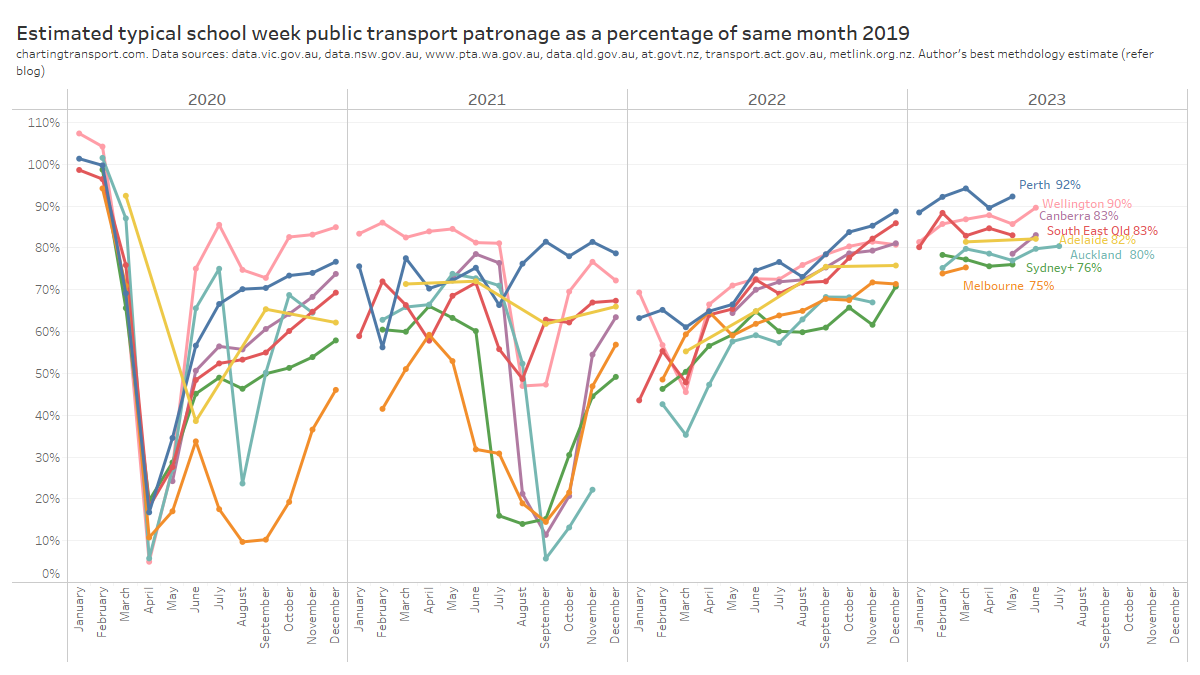
Technical notes: Sydney+ refers to the Opal ticketing region that includes Greater Sydney, Newcastle/Hunter, Blue Mountains, and the Illawarra. Typical school week patronage is the sum of the median patronage for each day of the week (where available), otherwise an estimate of average school week patronage. More explanation below.

Perth has been at or near the top of patronage recovery for most recent months, perhaps partly boosted by a new rail line opening to the airport and High Wycombe in October 2022.

Wellington – which I suspect is an unsung public transport powerhouse – is in second place at 90%, whilst all other cities are between 75% and 83%.

Looking at the 2023 data, most cities appear to be relatively flat in their patronage recovery (except Perth and Wellington), which might suggest that travel patterns have settled following the pandemic (including a share of office workers working remotely some days per week).

How does patronage recovery compare to population growth?

I’ve calculated the change in population for each city since June 2019. For South East Queensland I’ve used an approximation of the Translink service area, and for “Sydney+” I’ve used an approximation of the Opal fare region covering Sydney and surrounds. At the time of writing, population estimates were only available until June 2022.
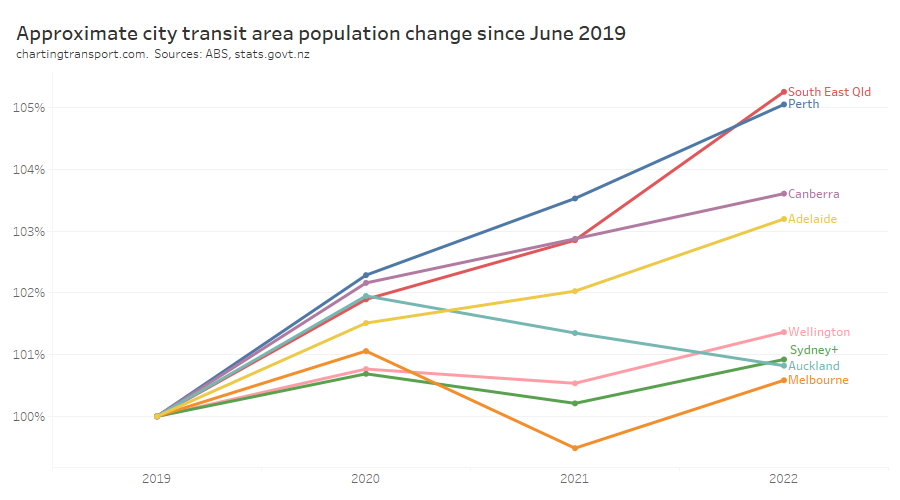
There are significant differences between the cities.

So how does public transport patronage recovery compare to population change? The following chart shows June 2022 patronage and population as a proportion of June 2019 levels:

The changes in population are much smaller than the changes in patronage and I have deliberately used a similar scale on each axis to illustrate this. Population growth certainly does not explain most of the variation in patronage recovery, but it is very likely to be a factor.

Perth had the highest patronage recovery in June 2022, but only some of this could be attributed to high population growth. Wellington had little population growth but the second highest patronage recovery to June 2022.

Perth might have the highest patronage recovery rate overall because it spent the least amount of time under lockdown, and so commuters had less time getting used to working at home. Melbourne, Sydney, Canberra, and Auckland spent the longest periods under lockdown, and – with the exception of Canberra – seem to be tracking at the bottom end of the patronage recovery ratings, which might reflect their workers becoming more comfortable with working from home during the pandemic. However I’m just speculating.

How has patronage recovery varied by day type?

Here’s patronage recovery for school weekdays (for cities which publish weekday data):
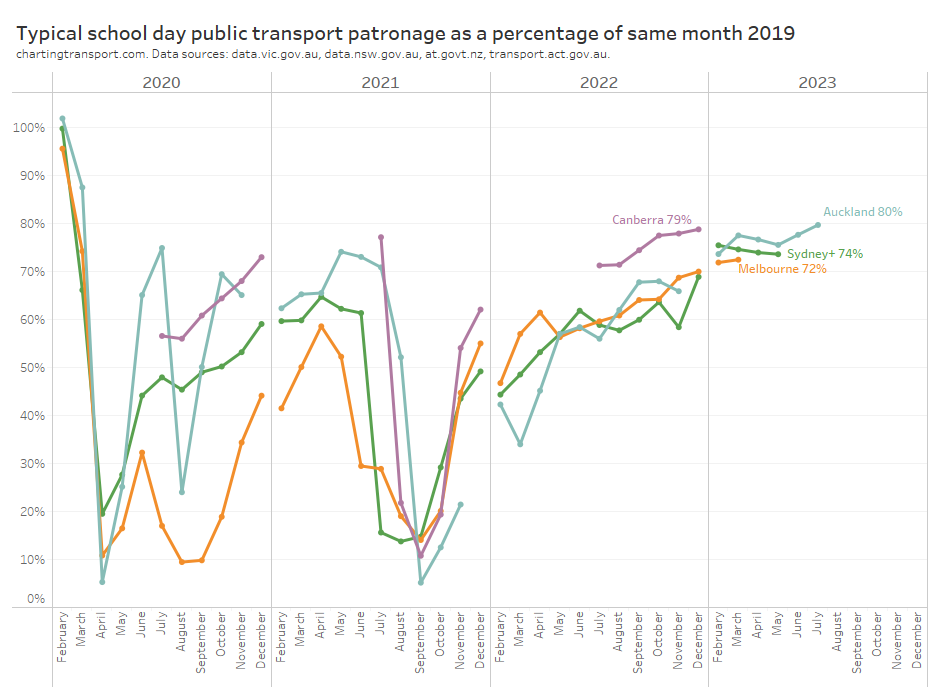
Note: Canberra estimates are only available for July to December because daily patronage data has unfortunately not been published for January to June 2019.

And here is the same for weekends (again for the same four cities that publish weekend data):
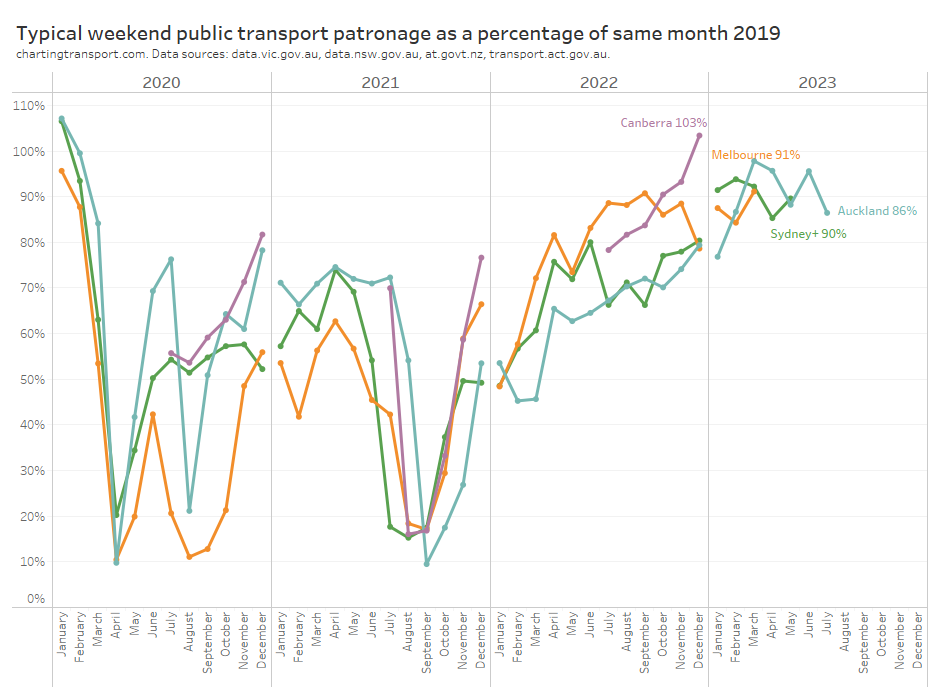
Weekend patronage is a bit more volatile as weekends typically have varying levels of major events and planned service disruptions. Most months also only have 8 weekend days, so a couple of unusual days can skew the month average and create “noise” in the data.

However all cities have been above 90% patronage recovery on weekends. Weekend patronage has returned more strongly than weekday patronage, probably because new remote working patterns only significantly impact weekdays.

How has patronage recovery varied between cities by mode?

I’m only confident about predicting modal patronage in cities that report daily or average day type patronage by mode, as the day type weightings used from another city might not apply equally to all modes.

Here is school weekday train patronage recovery for Sydney, Melbourne, and Auckland:
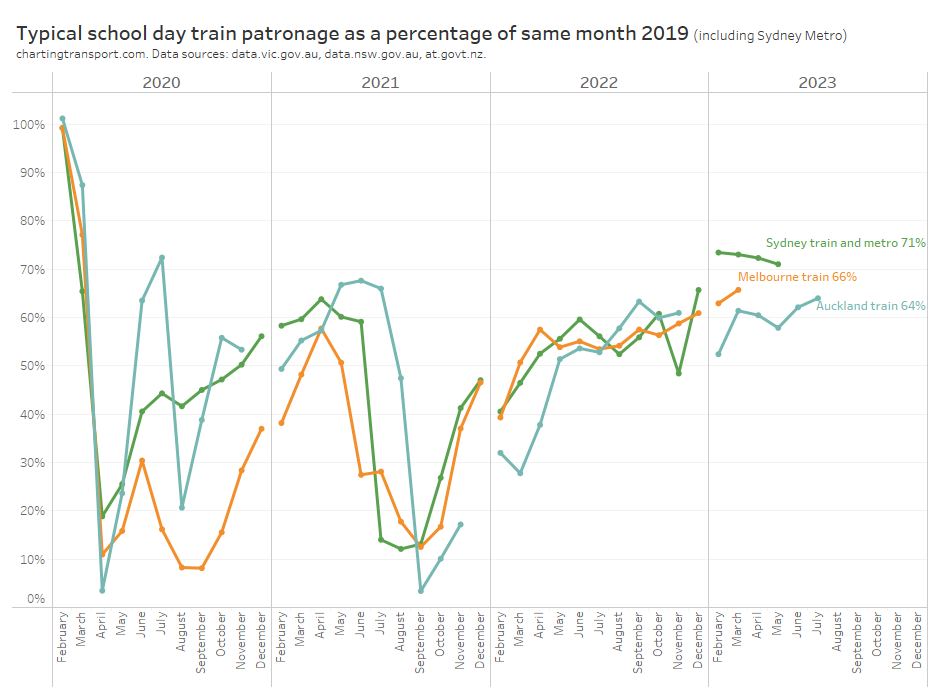
Auckland is slightly below Sydney and Melbourne, and recovery rates are lower than public transport overall. I suspect this may be due to train networks having a significant role in CBD commuting – a travel market most impacted by remote working.

And here is the data for weekends:

Curiously there is a lot more variation between cities. There’s also a lot more variation between months, which could well be related to the “noise” of occasional planned service disruptions and major events.

Here is average school day bus patronage for four cities where data is available:
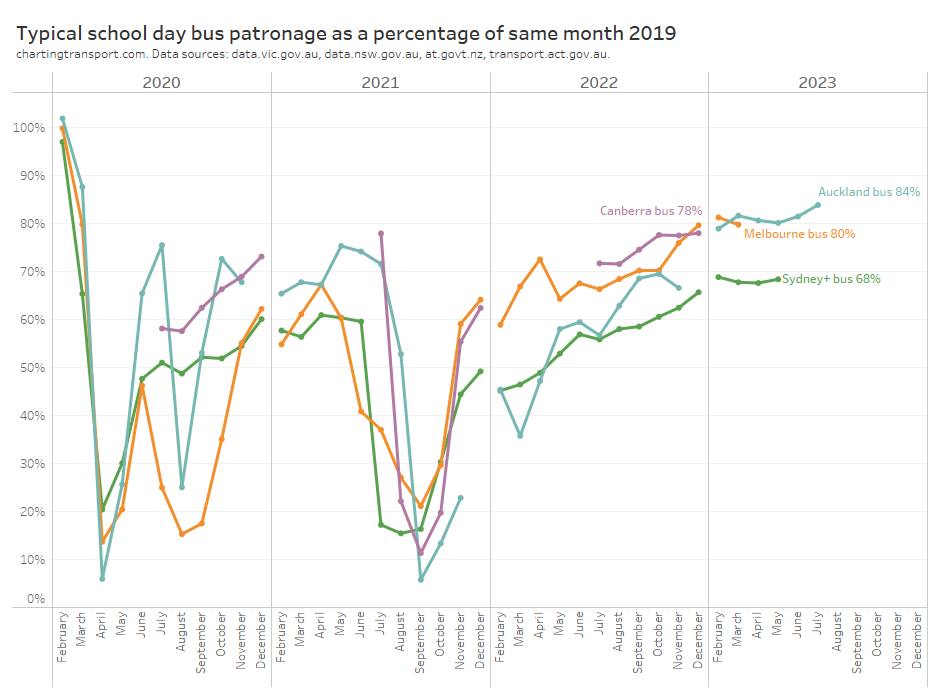
Bus patronage recovery is lowest in Sydney, perhaps because buses play a more significant role in Sydney CBD commuter travel which will be impacted by working from home (Melbourne’s bus services are mostly not focussed on the CBD). However buses also play a major role in public transport travel to the CBDs of Auckland and Canberra, although with probably lower public transport mode shares (unfortunately it doesn’t seem possible to get public transport mode share for the Auckland CBD from 2018 NZ Census data).

And for completeness, here is a chart for weekend bus patronage:
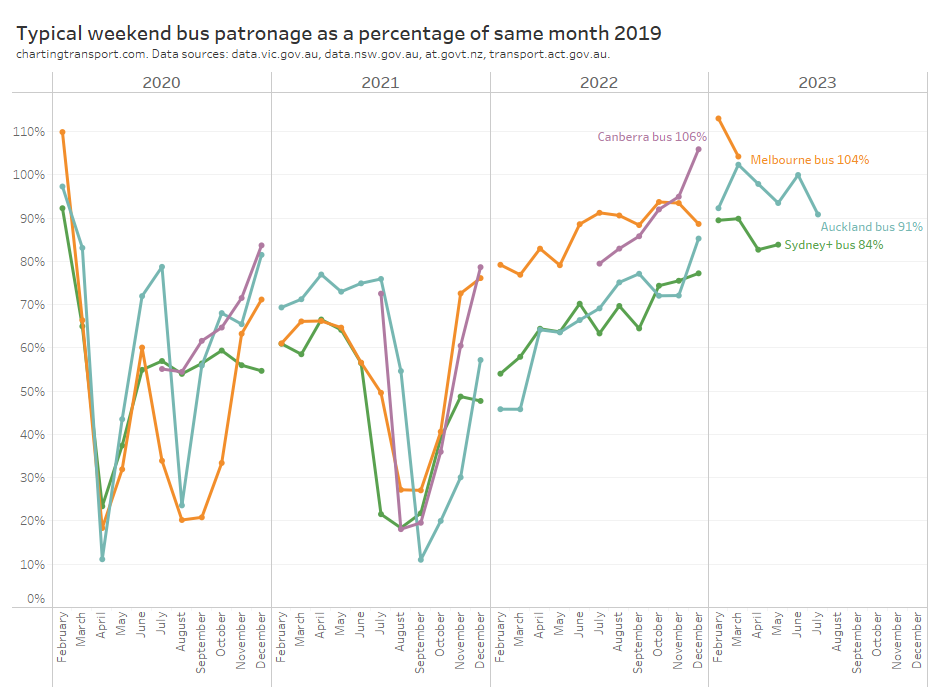
Weekend bus patronage recovery is higher than weekdays, and higher than weekend train patronage recovery, in all cities. Reported weekend bus patronage in Canberra, Melbourne, and Auckland has exceeded 2019 level in recent months.

How good are these estimates?

Some agencies publish very useful data such as daily patronage or day type average patronage, while others only publish monthly or quarterly totals which is much less useful for trend analysis. Here’s a summary of how I estimated time-series patronage and therefore patronage recovery in each city (which I will explain below).

City/regionData used to estimate time-series patronageConfidence
MelbourneReported average patronage by day of the week and day typeHigh
Sydney+ = Greater Sydney, Newcastle/Hunter, Blue Mountains, Wollongong (Opal catchment)Reported average school weekday and average weekend day patronage per month (dashboard)Moderate
South East Queensland (Translink) – including Brisbane, Gold Coast, Sunshine CoastReported weekly totals, aggregated to months, and adjusted by day type weightings calculated for Melbourne 2022.Lower
AdelaideReported quarterly totals, adjusted by day type weightings calculated for Auckland 2022.Lower
PerthReported monthly totals, adjusted by day type weightings calculated for Auckland 2022.Lower
CanberraReported daily patronage (from July 2019) and monthly total patronage for May and June 2019 adjusted by day type weightings calculated for Canberra 2022 (weekdays) and 2019 (weekends and public holidays). Data pre-May 2019 has been excluded as there was a step change in boardings when a new network was implemented in late April 2019. May 2019 has been included however I should note it had unusually high boardings.Moderate
AucklandReported daily patronage (up to 23 July 2023 at the time of writing).High
WellingtonReported monthly totals, adjusted by day type weightings calculated for Auckland 2022.Lower

For Melbourne and Auckland excellent data is published that allows calculation of typical school week patronage for February to December, which gives me high confidence in the estimates. Canberra has published daily patronage data but only from July 2019 so I’ve had to estimate school week patronage for May and June 2019 from monthly totals (process described below).

You’ll notice I’ve referred to “typical” patronage rather than average patronage. For cities with daily data, I’ve summed the median patronage of each relevant day of the week, rather than taking a simple average of days of that day type in the month. Taking the median can help remove outlier days, and summing over the days of the week means I’m weighting each day of the week equally, regardless of how many occurrences there are in a month (eg a month with 5 Sundays and 4 Saturdays). For Melbourne I’ve only got the average patronage per day of the week, but I’m still summing one value of each day of the week.

Transport for NSW have an interactive dashboard from which you can manually transcribe (but not copy or download) the average school weekday patronage and average weekend daily patronage for each mode and each month. I’ve compiled a typical school week estimate using 5 times the average school weekday plus 2 times the average weekend day. This is likely pretty close to what true average school week patronage is (more discussion below).

But what about the other cities?

How can you estimate patronage trends in cities where only monthly, quarterly, or weekly total patronage data is available?

Rather than simply calculating percentage patronage recovery on monthly totals (which has all the issues I explained in my previous post), I’ve made an attempt to compensate for the day type composition of each month in each city.

Basically this method involves calculating a weighting for each month, based on the day type composition of each month. If you divide total monthly patronage by the sum of weightings for all days of each month you can get a school weekday equivalent figure on which you can do time series analysis.

This requires a calendar of day types, and assumptions around the relative patronage weightings of each day type.

I’ve compiled calendars for each city using various public sources (including this handy machine readable public holiday data by data.gov.au).

Technical note: In New Zealand it seems schools generally are able to vary their start and end of year by up to 5 regular weekdays. I’ve excluded these 10 weekdays from many calculations because they do not represent clean school or school holiday weekdays. For December 2019 I have also excluded two weeks for Auckland due to unusually low reported patronage due to bus driver industrial action.

The assumed day type weightings need to come from another city, on the hope that they will be similar to the true value. But which city, and measured in what year?

I’ve calculated the relative patronage weights of each day type for Melbourne, Canberra, Auckland, plus one school week sample from February 2020 for Sydney+ (Opal region). These are indexed to a school Monday being 1.
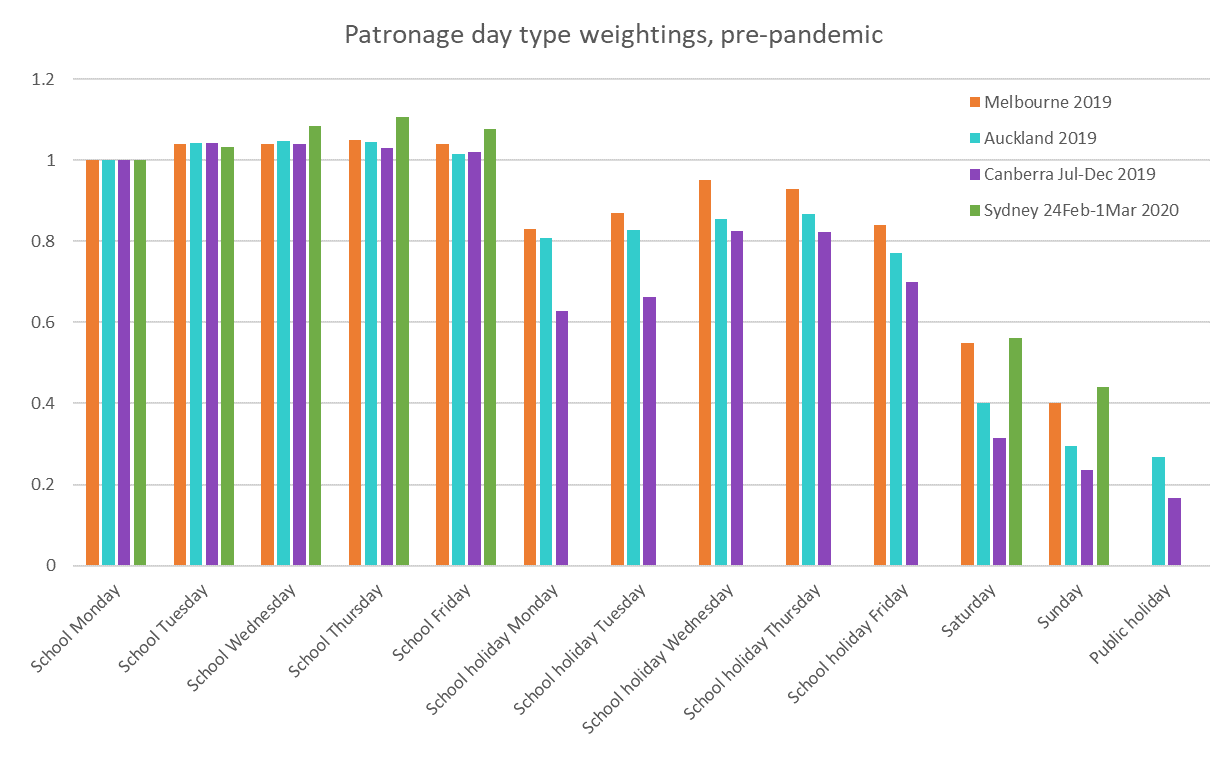
Note: no data is available for public holidays in Melbourne, and the Sydney data does not include school holiday weekdays or public holidays.

Melbourne, Canberra, and Auckland weightings are pretty similar across days of the week for school days, but Melbourne’s school holiday weekdays and weekends were relatively busier than both Auckland and Canberra. The Canberra school holiday figures are highly variable between weekdays and are only available for the second half of 2019 (so are impacted more significantly by the timing of Christmas).

The data suggests the big cities of Sydney and Melbourne attract much more weekend patronage compared to the smaller cities. They also have higher public transport mode shares – refer Update on Australian transport trends (December 2022) for comparisons between Australia cities. In terms of public transport share of journeys to work, Auckland was at around 14% in 2018, while Melbourne was 18.2% in 2016). This suggest Melbourne day type weightings might be suitable for larger cities while Auckland day type weightings might be suitable for smaller cities.

The next question is: which year’s weightings should be used? The chart above showed day type weightings from pre-pandemic times, but it turns out they have changed a bit since the pandemic. Here are 2022 day type weightings:
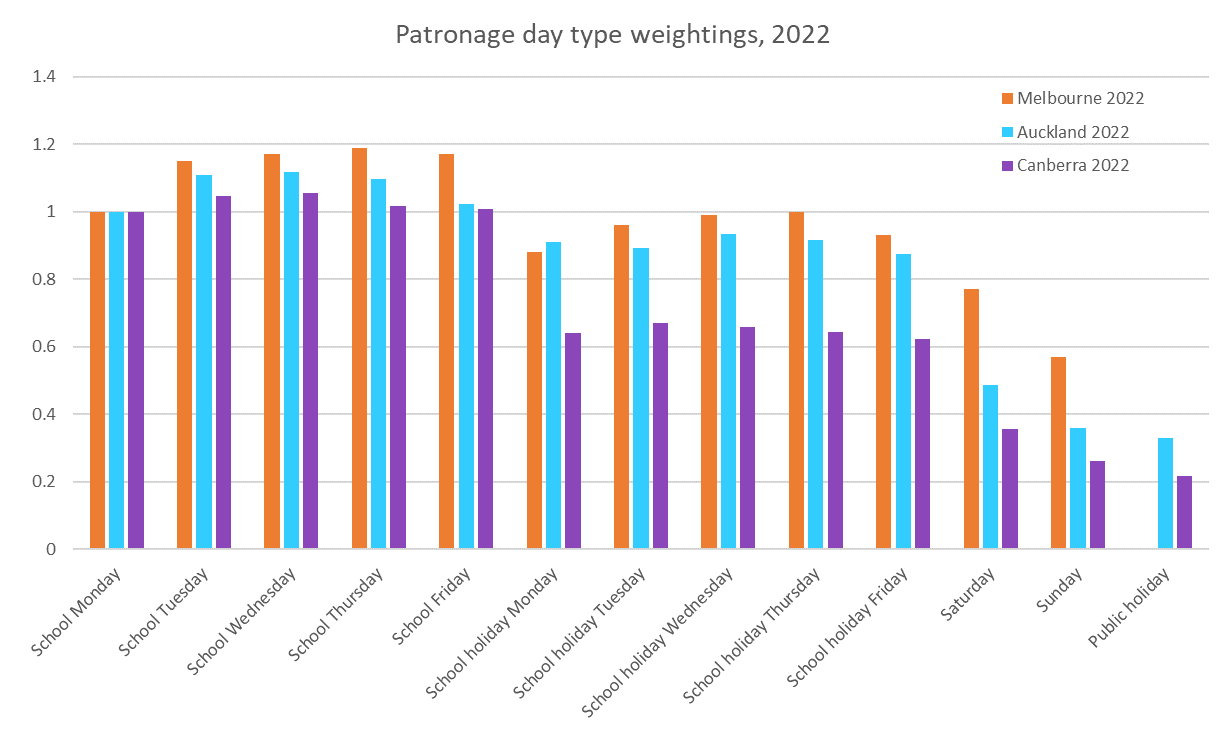
In all cities in 2022 there is a lot more variation across Monday to Friday school days (Mondays and Fridays being popular remote working days) and school holiday weekdays are much more similar between Melbourne and Auckland, while weekends remain quite different.

In fact here’s how the cities with available data compare for ratios between weekends and school weekdays in 2019 and 2022:
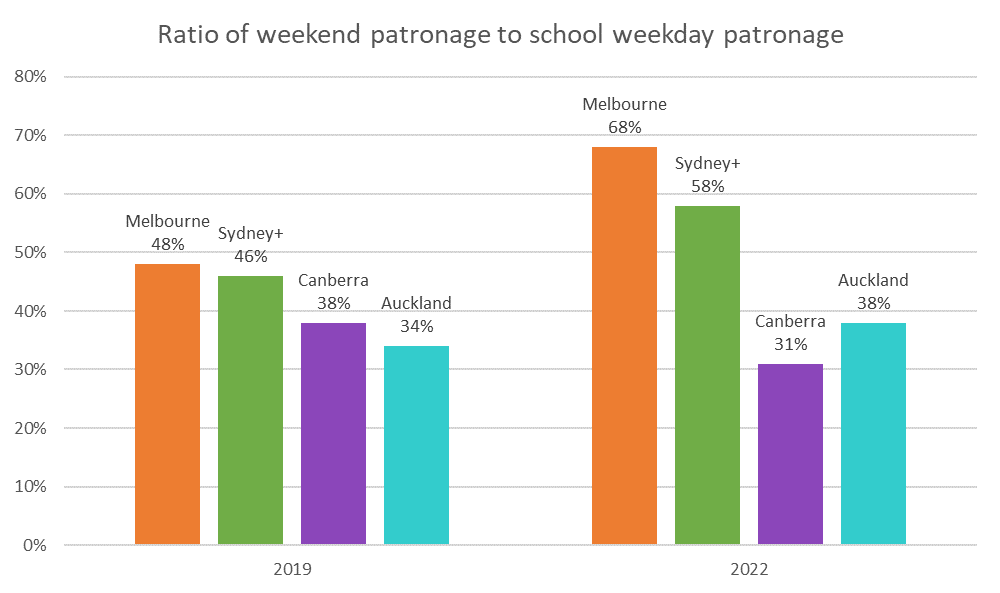
The ratios increased in all cities between 2019 and 2022 except Canberra. The 2019 ratios are remarkably close between Melbourne and Sydney, but the 2022 data shows a higher weighting for weekends in Melbourne than Sydney. The Auckland and Canberra ratios are substantially lower in both years. The ratio went down in Canberra in 2022 possibly due to issues obtaining enough drivers to run weekend timetables in that city.

So what day type weightings should we use for each city?

Should we use Melbourne, Auckland, or Canberra weightings, and from what year should we derive these weightings? And how worried should we be about getting these weightings right?

Well, Auckland provides us with daily patronage data for a “medium sized” city, which allows us to compare calculated typical school week patronage, and also allows calculations as if only more summary data was available (as per other cities). However we need to exclude both January and December, as there were no normal school weekdays in those months in 2019.
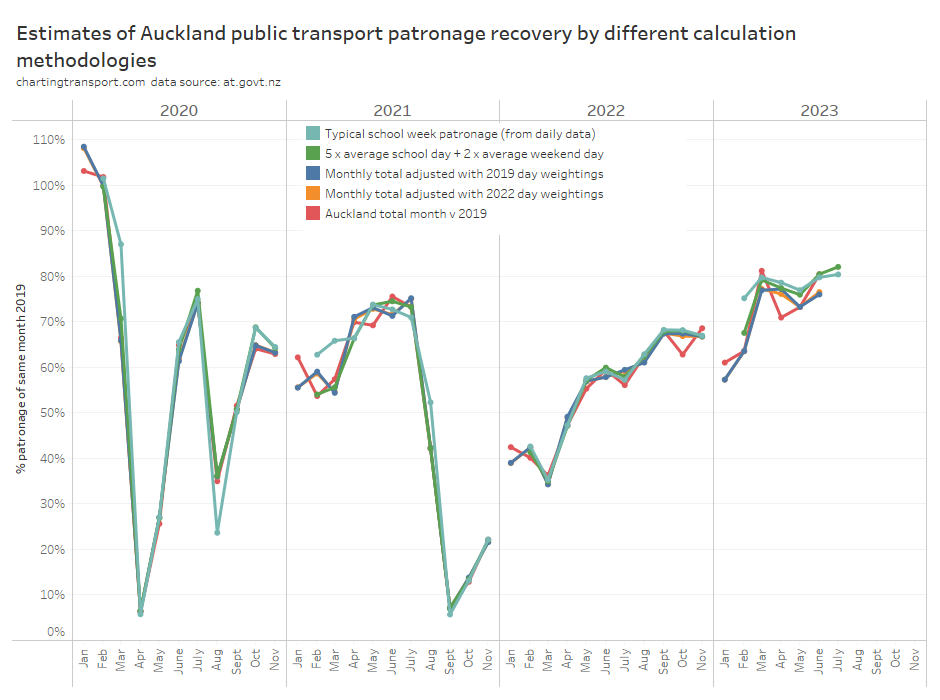
The red line (total monthly patronage with no calendar effect adjustments) has the most fluctuations month to month and I’m pretty confident this is misleading for all the reasons mentioned in my last post.

Most of the other methodologies produce a figure fairly close to the best estimate (teal line), except in 2021 and 2023.

The green line (compiled 5 x average school day + 2 x average weekend day) is mostly within 2% of the (arguably) best estimate, but there are variations that will be explained by the green line not taking into account the day of the week composition of the month, nor excluding outlier busy/quiet days (unlike medians). So if you only have average school weekday and average weekend day data you’re not going to be too far off the best estimate. That gives me “moderate” confidence to use Sydney’s average school weekday and average weekend day patronage data to estimate patronage recovery.

But what if you only have total monthly patronage and have to use day type weightings? It’s a bit hard to see the differences in the above chart, so here’s a zoom in for 2022 and 2023:
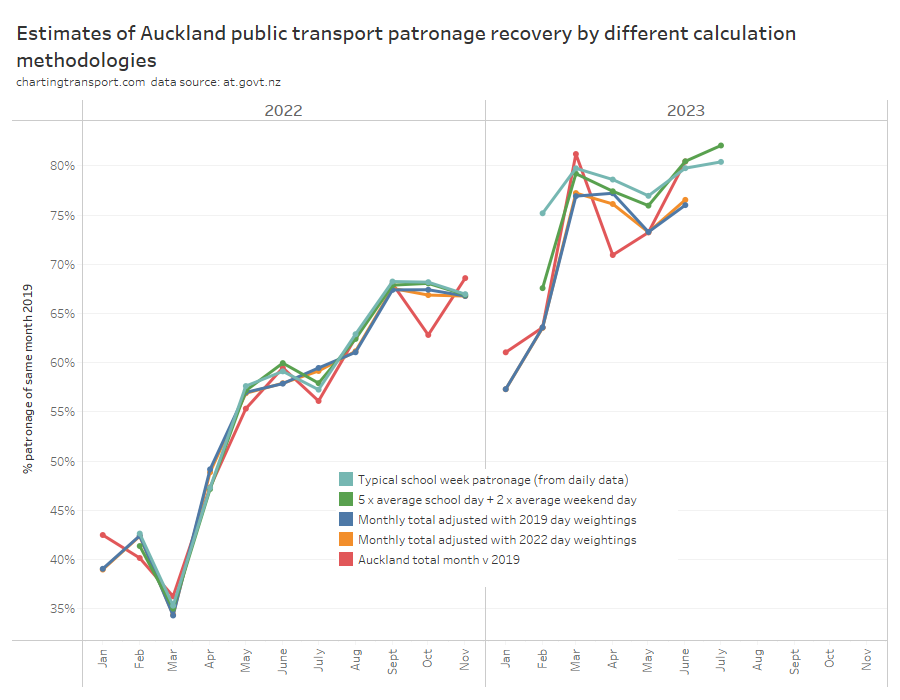
There’s not a lot of difference between the 2019 and 2022 day type weightings, and notably both methods underestimate patronage recovery for most months of 2023, which is not ideal. Note: February 2023 had several days of significant disruptions due to major flooding events which impacted most measures (except the “typical school week” measure that uses medians to reduce the impact of outliers).

Sydney also provides data that allows us to compare day type weighting estimates to the probably quite good compiled school week estimate (based on 5 average school weekdays and 2 average weekend days). The next chart includes estimates of Sydney patronage recovery using day type weightings from Melbourne and Auckland for different years:
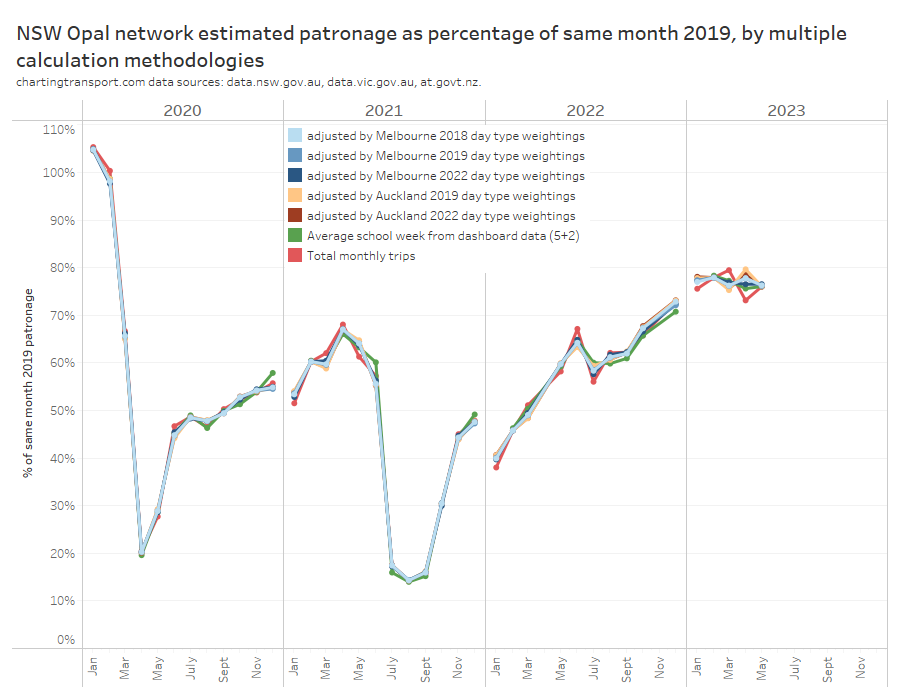
Technical note: I have assumed Melbourne public holidays have the same day type weighting as Sundays, for want of more published data.

The estimates are mostly pretty close, but let’s zoom into recent months to see the differences between the methodologies more clearly:
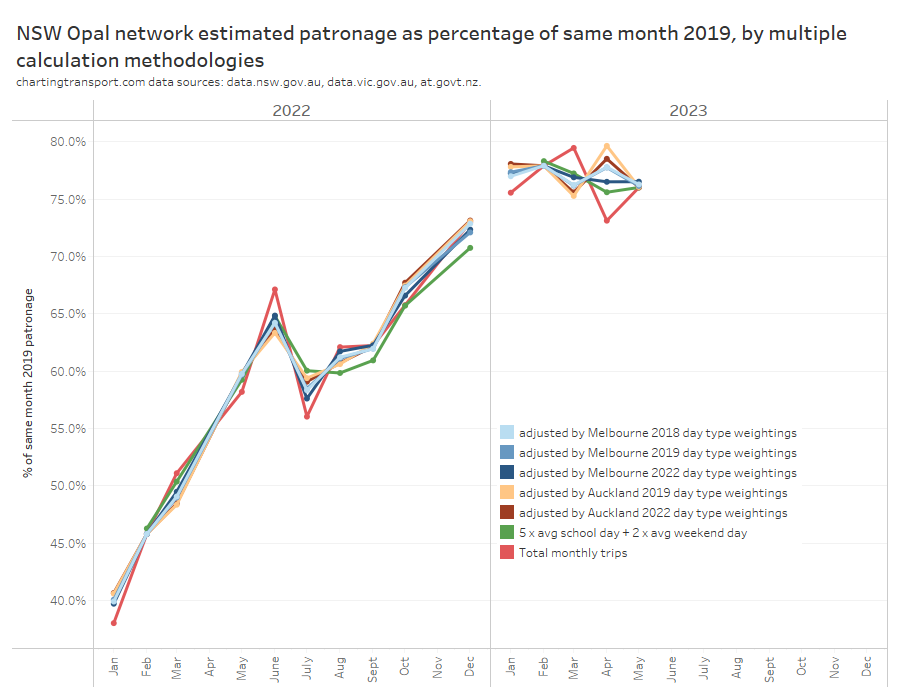
The closest estimate to the compiled average school week data is using Melbourne 2022 day type weightings to adjust monthly totals (the difference is up to 0.9% in April 2023). This suggests Melbourne is probably the best city from which to source day type weightings to apply to Sydney (both large cities), and 2022 (a post-pandemic year) might be a better source year for these weightings. That’s consistent with Sydney having similar ratios of weekday to weekend patronage as Melbourne.

You can see the red line (a simple total monthly patronage comparison) is again often the biggest outlier, which is what happens when you don’t control for calendar effects. I mentioned at the start of my last post that the raw monthly totals suggested a misleadingly large 6.4% drop in patronage recovery from 79.5% in March 2023 to 73.1% in April 2023. On the average school week estimates, patronage recovery dropped only 1.8% from 77.2% to 75.6%.

So which city’s day type weightings are most appropriate for the smaller cities of Perth, Adelaide, Wellington, and Brisbane that don’t currently publish day type patronage? Does it even make a lot of difference?

Well here are patronage recovery estimates for Adelaide, Brisbane, Wellington, and Perth using both Melbourne and Auckland day type weightings from 2022.

Most of the estimates are within 1%, although there are some larger variances for Wellington and Perth.

The Wellington recovery line is smoother for Melbourne weightings in 2021, but smoother with Auckland weightings in 2022 and 2023 (so far). The Wellington estimates can differ by up to 2% and a smoother trend line may or may not mean that one source city for day type weightings is better than the other.

The fact that Melbourne day weightings worked better than Auckland day weightings when it came to Sydney suggests that larger city weightings might be appropriate for other large cities, and perhaps smaller city weightings might be appropriate for other smaller cities.

I have adopted Melbourne day type weightings for South East Queensland, and Auckland day type weightings for Adelaide, Perth, and Wellington, on the principle that larger cities are likely to have relatively higher public transport patronage on weekends (compared to weekdays). Of course I would really rather prefer to not have make assumptions.

That was pretty complicated and involved – is there a lazy option?

Okay, so if you don’t have – or want to compile – calendar data and/or you don’t want to use day type weightings from another city, you can still compile rolling 12 month patronage totals and compare those year-on-year to estimate patronage growth.

The worst times of year at which to measure year-on-year patronage growth are probably at the end of March, June, September, and December (because of when school holidays fall). Of course being quarter ends, these are also probably the most common times it is measured!

It’s slightly better to measure year on year growth for 12 month periods ending with February, May, August, and/or November, as years ending in these months will contain four complete sets of school holidays, and exactly one Easter (at least for countries with similar school terms to Australia and New Zealand). However there will still be errors because of variations in day type composition of those 12 month periods.

In my last post I introduced the mythical city of Predictaville, where public transport patronage is perfectly constant by day type and they follow Victorian school and public holidays. Here is what Predictaville patronage growth would look like measured year on year at end of November each year:

Calculated growth ranges between +0.8% and -0.9%, which is about half as bad as +1.6% to -1.6% when measured at other month ends, but still not ideal (the true value is zero). The errors in the real world will depend on the relative mix of patronage between day types (Predictaville patronage per day type was modelled on Melbourne’s buses).

That’s a not-too-terrible option for patronage growth, but if you are interested in patronage recovery versus 2019 on a monthly basis, I’m not sure there is any reasonable lazy option.

Let’s hope the usefulness of published patronage data improves soon so complicated assumptions-based calendar adjustments and problematic lazy calculation options can be avoided!


How is population density changing in Australian cities? (2023 update)

Sat 10 June, 2023

This detailed post from 2023 does not include the population latest data. For the latest summary metrics, see Trends in major city population density.

With the release of more detailed 2021 census data and June 2022 population estimates, it’s now possible to look more closely at how Australia’s larger capital cities have changed, particularly following the onset of the COVID19 pandemic in 2020.

This post examines ABS population grid data for 2006 to 2023 for Greater Capital City Statistical Areas, including:

  • Trends in overall population-weighted density for cities;
  • Changes in the distribution of population living at different densities;
  • Changes in the distribution of population living at different distances from each city’s CBD;
  • Changes in population density by distance from each city’s CBD;
  • Changes in the distribution of population living at different distances from train and busway stations;
  • Changes in population density in areas close to train and busway stations;
  • The population density of “new” urban residential areas in each city (are cities sprawling at low density?); and
  • Changes in the size of the urban residential footprint of cities.

I’ve also got some animated maps showing the density of each city over those years, and I’ve had a bit of a look at how the ABS corrected population estimates for 2007 to 2021 following the release of 2021 census data.

For some other detailed analysis – and a longer history of city population density – see How is density changing in Australian cities? (2nd edition).

I’ve not included the smaller cities of Hobart and Darwin as they have a small footprint, and too many grid cells are on the edge of an urban area.

Population weighted density

My preferred measure of city density is population-weighted density, which takes a weighted average of the density all statistical areas in a city, with each area weighted by its population (this stops lightly populated rural areas pulling down average density – for more discussion see How is density changing in Australian cities? (2nd edition)).

I also prefer to calculate this measure on a consistent statistical area geography and the only consistent statistical area geography available for Australia is the square kilometre population grid published by the ABS.

With the recent release of 2021 census data, ABS issued revised population grid estimates for all years from 2017 onwards, which saw significant corrections in some cities (see appendix for more details). There has also been a slight change in the methodology for the 2021 grid that ABS say may result in a more ‘targeted representation’, but it’s unclear what that means.

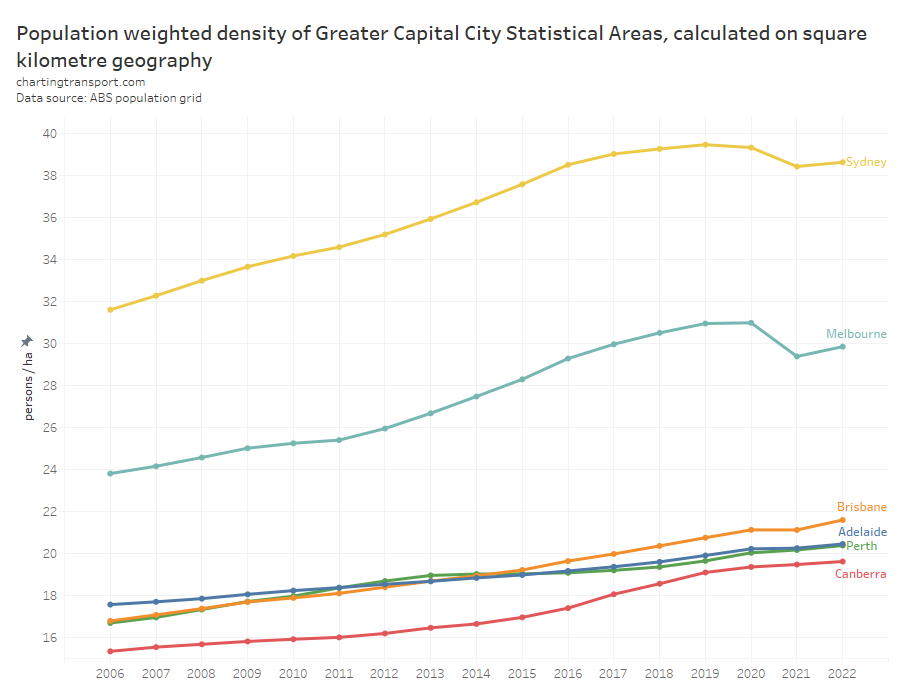
Here’s the revised trend in population weighted density calculated on square km grid geography for Greater Capital City Statistical Areas in June of each year:

Sydney has almost double the population density of most other Australian cities (on this measure), with the exception being Melbourne which sits halfway in between.

Population weighted density was rising in all cities until 2019, although the growth was notably slowing in Sydney from about 2016.

The pandemic hit in March 2020 and led to a flatlining of density in Melbourne and a decline in Sydney by June 2020, while other cities continued to densify. Then Sydney and Melbourne’s population weighted density dropped considerably in the year to June 2021 – probably a combination an exodus of temporary international migrants and internal migration away from the big cities (particularly Melbourne that had experienced long lockdowns). Most other cities flatlined between June 2020 and June 2021.

Then by June 2022 density had increased again in all cities, after international borders reopened in early 2022.

I expect some fairly substantial changes between June 2022 and June 2023 in some cities as migration has surged further and rental vacancy rates have plummeted in several cities.

Population living at different densities

The following chart shows the proportion of the population in each city living at different density ranges over time:

All cities show a sustained pre-pandemic trend towards more people living at higher densities. However the pandemic saw significant drops in people living at the higher density categories in 2021 in Melbourne, Sydney, and Canberra.

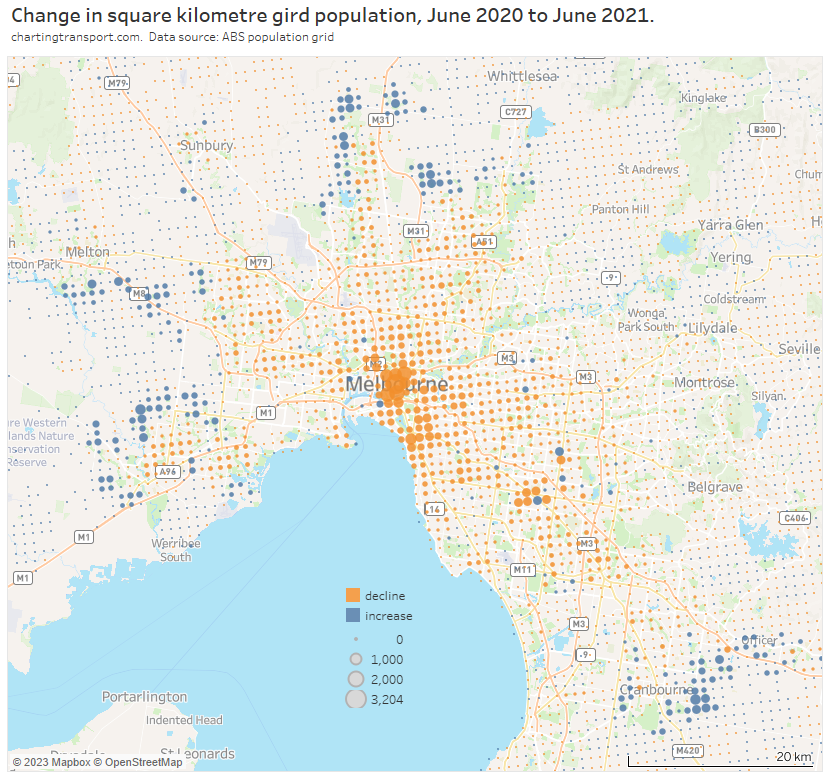
So where was this loss of density? The next chart shows the change in population for grid squares across Melbourne between June 2020 and June 2021. Larger dots are more change, blue is an increase and orange is a decline:

You can see significant declines in population (and hence population density) in the inner city areas – so much so that the dots overlap. This is likely largely explained by the exodus of many international students and other temporary migrants.

You can also see population decline around Monash University’s Clayton campus in the south-eastern suburbs.

At the same time there were large increases in population in the outer growth areas, as is normally the case. Other pockets of population growth include Footscray, Moonee Ponds, Box Hill, Port Melbourne, Clayton (M-City), and Doncaster, likely related to the completion of new residential towers.

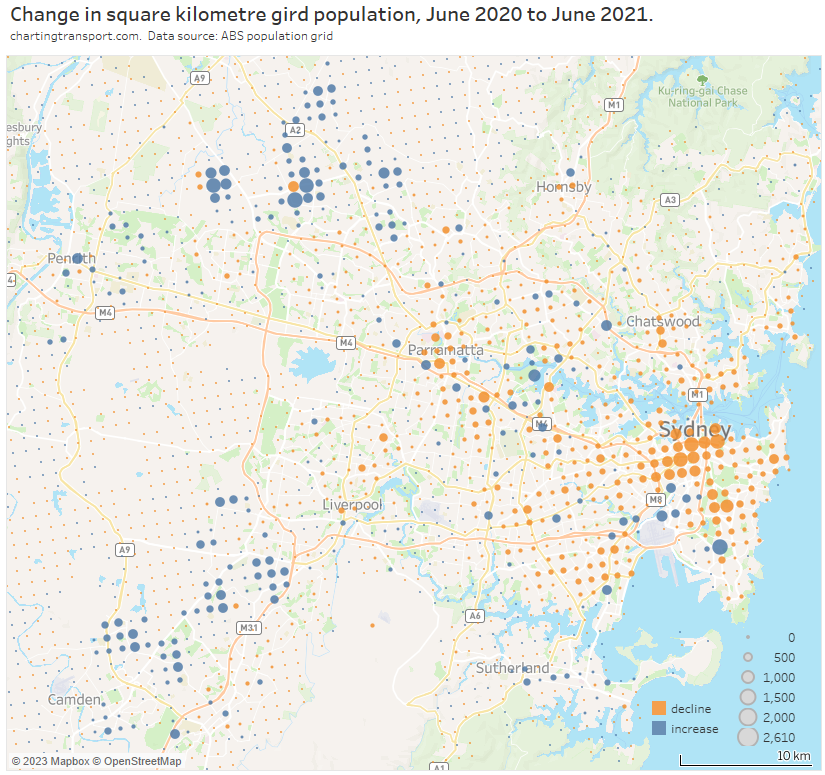
Here’s the same for Sydney:

There was significant population decline in the inner city and around Kensington (which has a major university campus), and the largest growth was seen in urban fringe growth areas to the north-west and south-west. Pockets of population growth were also seen at Wentworth Point, Eastgardens, Mascot, North Ryde, and Mays Hill, amongst others.

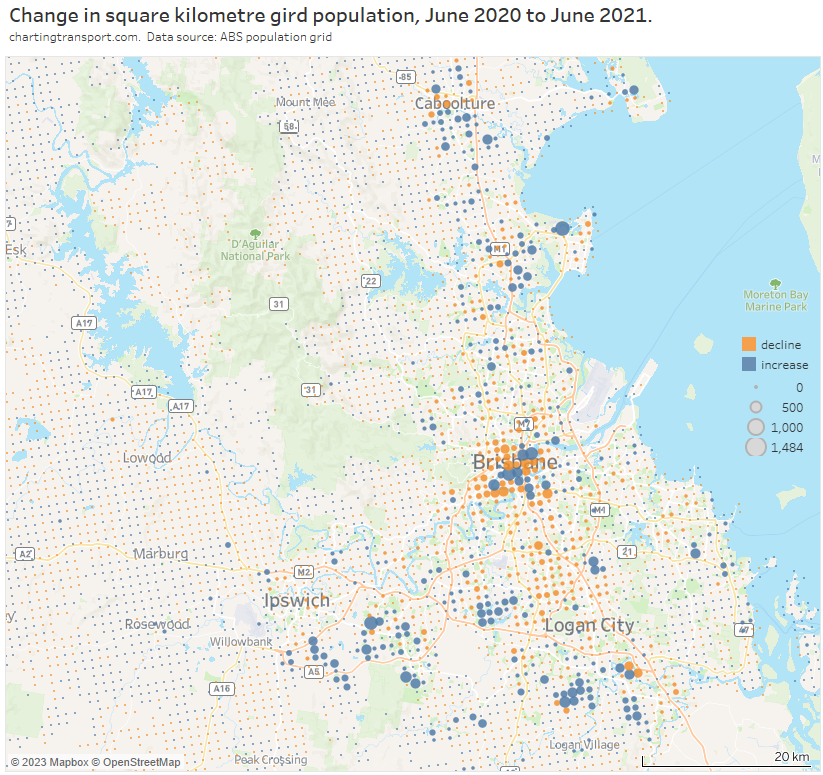
Here is the same for Brisbane:

Inner-city Brisbane was much more a mixed bag, which explains the less overall change in the density composition of the city. Some areas showed declines (including St Lucia, New Farm, Kelvin Grove, Coorparoo) while others saw increases (including Fortitude Valley, West End, South Brisbane, Buranda, CBD south).

Proportion of population living at different distances from the city centre

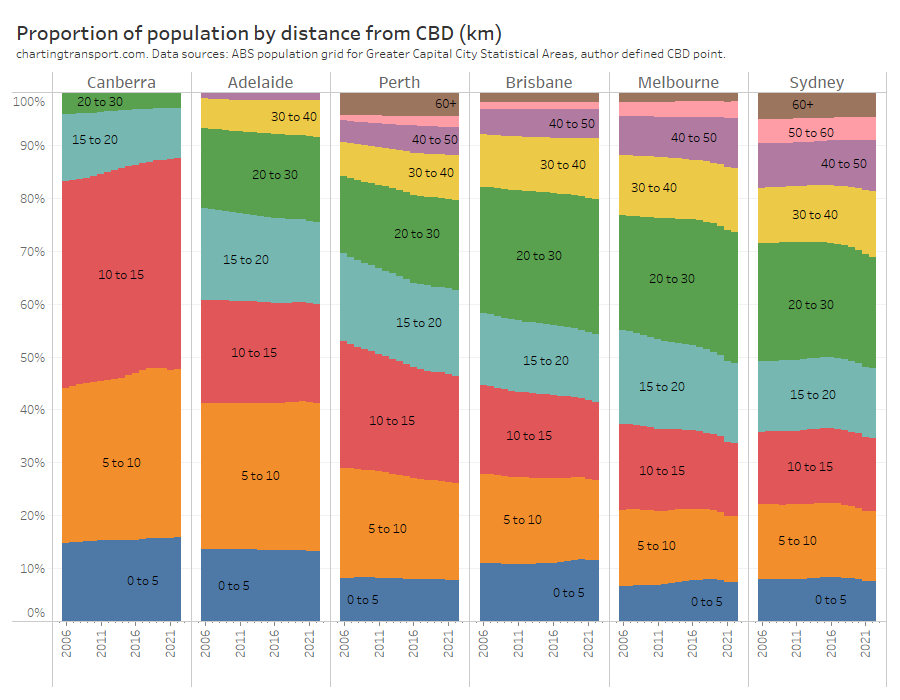
The next chart shows the proportion of people living at approximate distance bands from each city’s CBD over time:

All cities have seen a general trend towards more of their population living further from the CBD, with the notable exception of Canberra which has seen the outer urban fringe expanding by little more than a couple of kilometres at the most, and substantial in-fill housing at major town centres and the inner city (see also animated density map below). I should note that the Greater Capital City Statistical Area boundary for Canberra is simply the ACT boundary, and does not include the neighbouring NSW urban area of Queanbeyan, which is arguably functionally part of “greater Canberra”.

In 2021, Sydney and Melbourne saw a step change towards living further out, in line with the sudden reduction in central city population.

Population density by distance from a city’s CBD

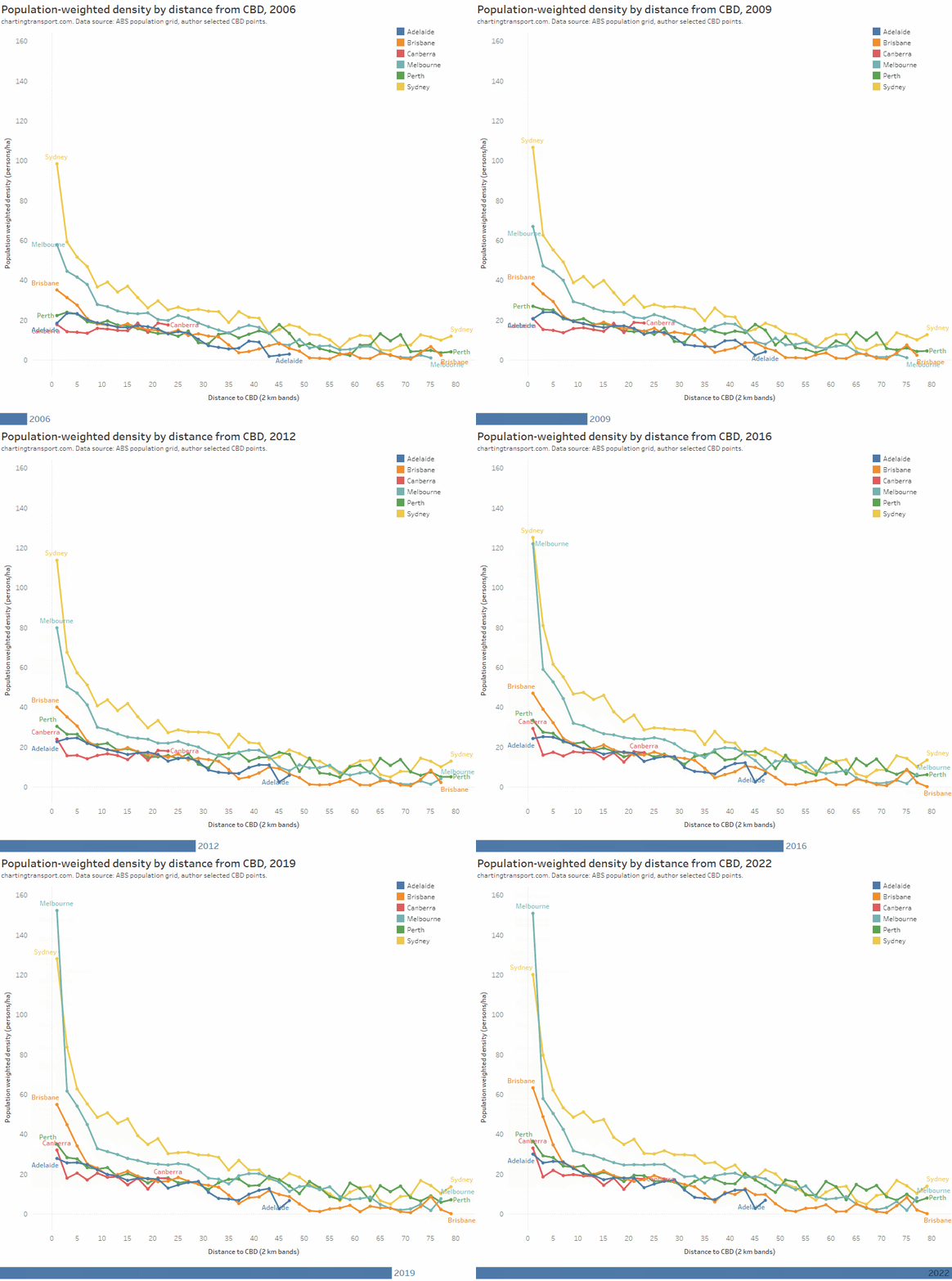
Here’s an animated chart showing how population weighted density has varied by distance from each city’s CBD over time:

In most cities there has been a trend to significantly increasing density closer to the CBD, with central Melbourne overtaking central Sydney in 2017.

Sydney has maintained significantly higher density than all other cities at most distances from CBDs, with Melbourne a fair step behind, then most other cities flatten out to around 20-26 persons/ha from around 6+km out from their CBDs in 2022.

Canberra appears to flatten out to around 20 persons/ha at 3-4 kms from its CBD (Civic) however it is important to note that Canberra has a lot of non-residential land relatively close to Civic which reduces density for many grid cells that are on an urban fringe (refer maps toward the end of this post).

Population living near rapid transit stations

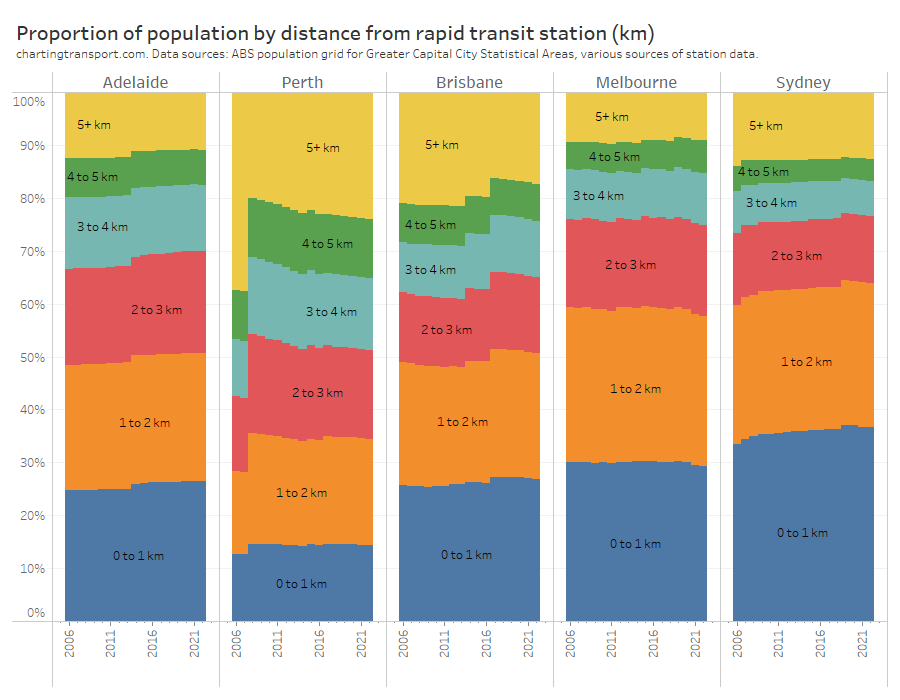
I’ve been maintaining a spatial data set of rapid transit stations (train and busway stations) including years of opening and closing, and from this it’s possible to assess what proportion of each city lives close to stations:

Sydney has the largest proportion of it’s population living quite close to rapid transit stations, with Perth having the lowest.

There are step changes on this chart where new train lines have opened. Sydney, Brisbane, and Adelaide have been successful at increasing population close to stations. The opening of the Mandurah rail line made a big difference in Perth in 2009 but the city has been growing remote from stations since then (MetroNet projects will probably turn this around significantly in the next few years). Melbourne was roughly keeping the same proportion of the population close to stations although that changed in 2021 with the exodus of inner city residents (I anticipate a substantial correction in 2023).

Population density around rapid transit stations

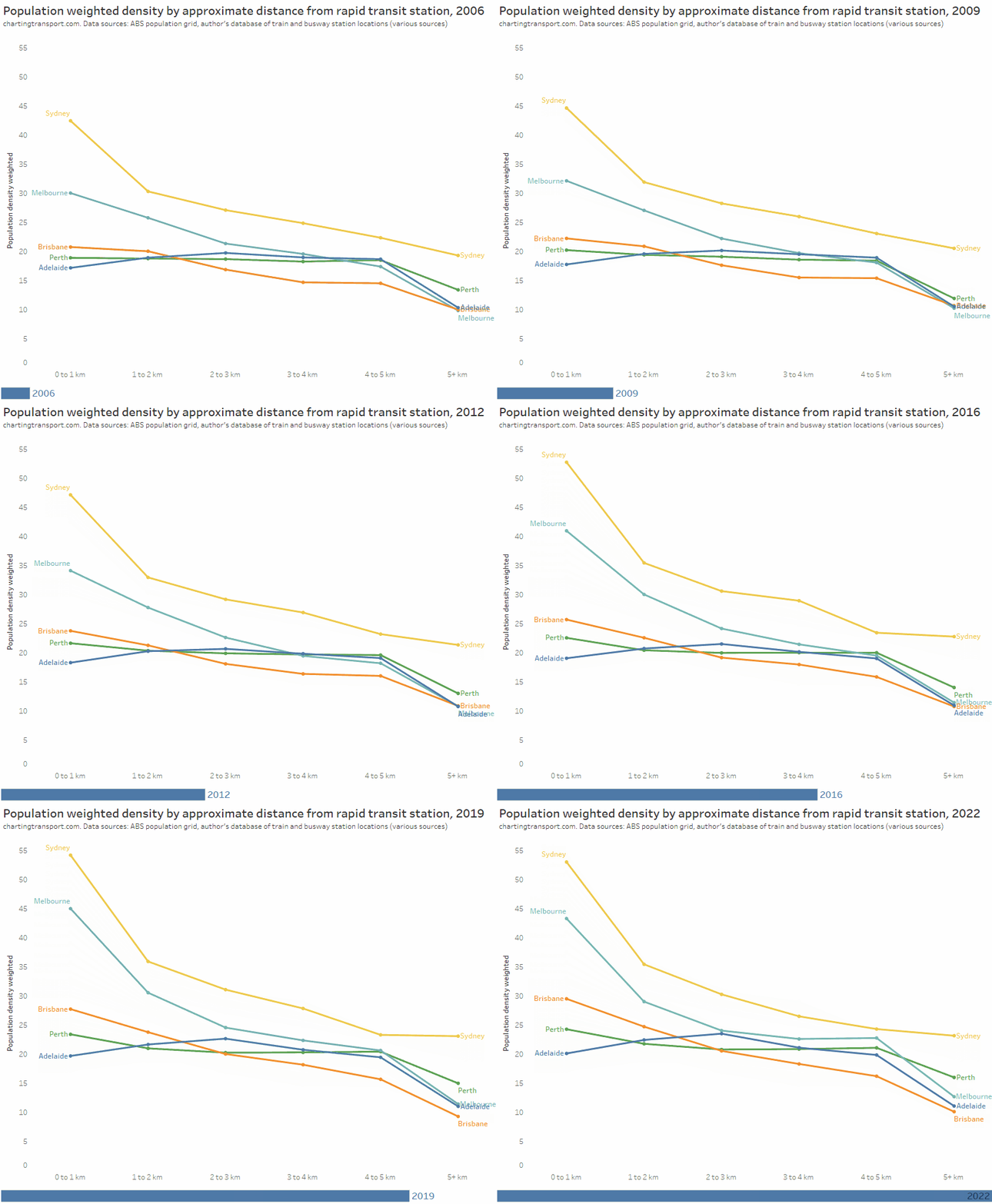
The following animated chart shows the aggregate population-weighted density for areas around rapid transit stations in the five biggest cities over time:

Sydney has lead Australia with higher densities around train stations, followed by Melbourne. Perth has only slightly higher densities around stations (in aggregate) compared to other parts of the city. Population density is generally lower around Adelaide train and busway stations compared to the rest of the city – the antithesis of transit orientated development.

How dense are new urban areas?

I’ve previously looked at the density of outer urban growth areas on my blog, and here is another way of looking at that using square kilometre grid data.

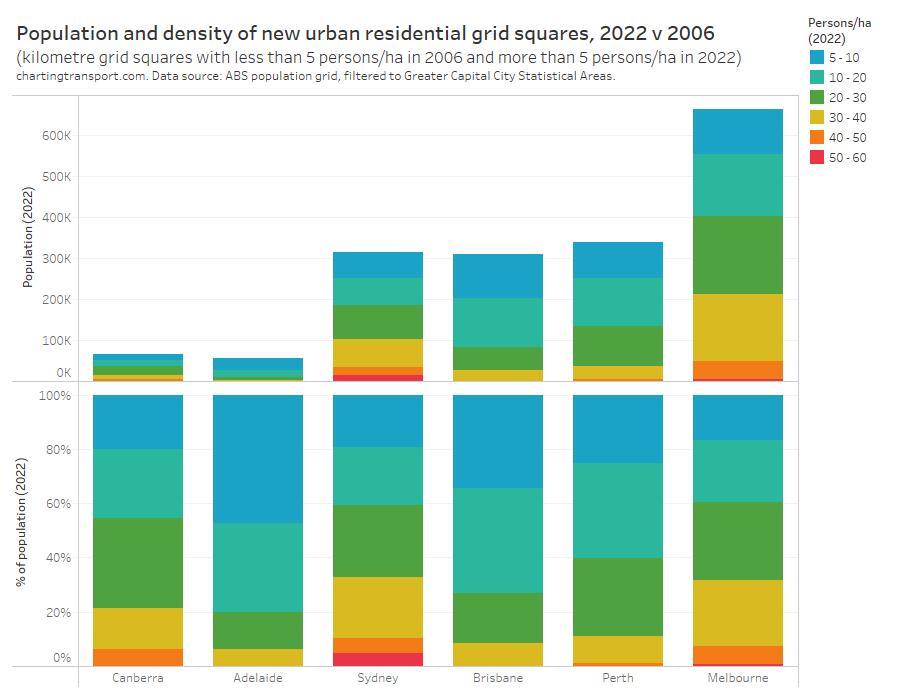
I’ve attempted to identify new urban residential grid squares by filtering for squares that averaged less than 5 persons per hectare in 2006 and more than 5 persons per hectare in 2022 (using 5 persons/ha as an arbitrary threshold for urban residential areas, and I think that’s a pretty low threshold).

The vast bulk of these grid cells (and associated population) are on the urban fringe, but a handful in each city are brownfield sites that were previously non-residential (for Melbourne 99% of the population of these grid cells are in urban fringe areas).

It’s also not perfect because square kilometre grid cells will often contain a mix of residential and non-residential land uses, but it is analysis that can be done easily and quickly, and in aggregate I expect it will be broadly indicate of overall patterns.

The following chart shows the population of new urban residential grid cells (since 2006), and the proportion of this population by 2022 population density:

You can see Melbourne has almost double the population in these new urban residential grid squares compared to Perth, Brisbane, and Sydney. This indicates Melbourne has been sprawling more than any other city since 2006. Slow-growing Adelaide only put on about 56k people in new urban grid squares, slightly less than Canberra.

The bottom half of the chart shows that new urban grid squares in Sydney, Melbourne, and Canberra are generally much more dense than those in other cities. This likely reflects planning policies for higher residential densities in new urban areas in those cities. In fact, all of these grid cells with density 40+ in 2022 are on the urban fringes, except one brownfield cell in Mascot (Sydney).

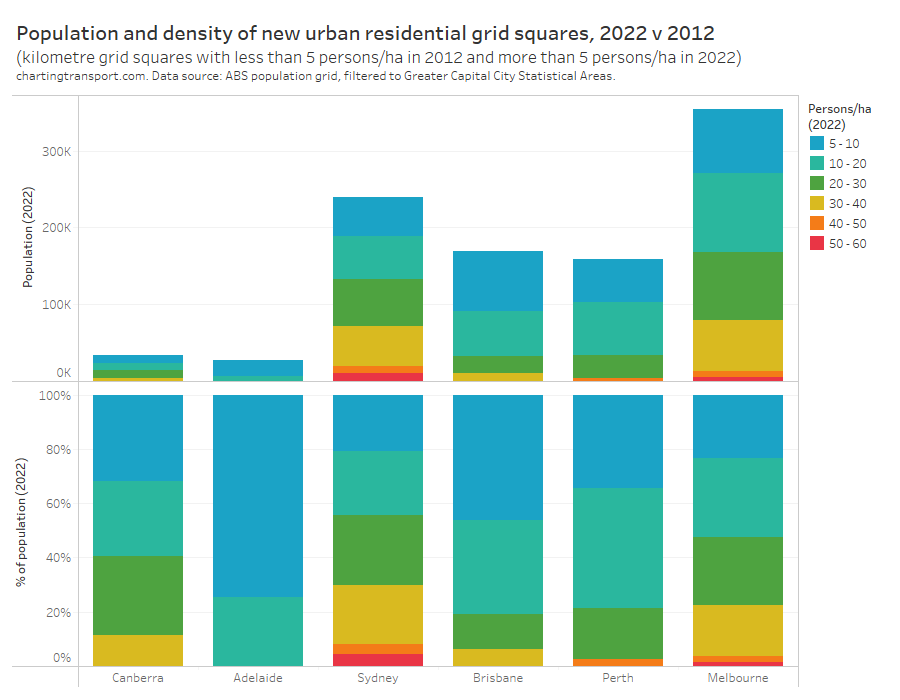
But of course planning policies can change over time, so here is the equivalent chart looking at new urban residential squares since 2012:

It’s not a lot different. The density of these more recent new urban residential grid cells is generally highest in Sydney, following by Melbourne and Canberra. New urban residential grid cells in Adelaide mostly had fewer than 20 persons/ha, but then also there are not that many such grid cells and they didn’t have much population in 2022.

Perth has managed one new grid cell with over 40 persons/ha in 2022 – it is located in Piara Waters (which has many single storey houses with tiny backyards).

How much has the urban footprint of cities been expanding?

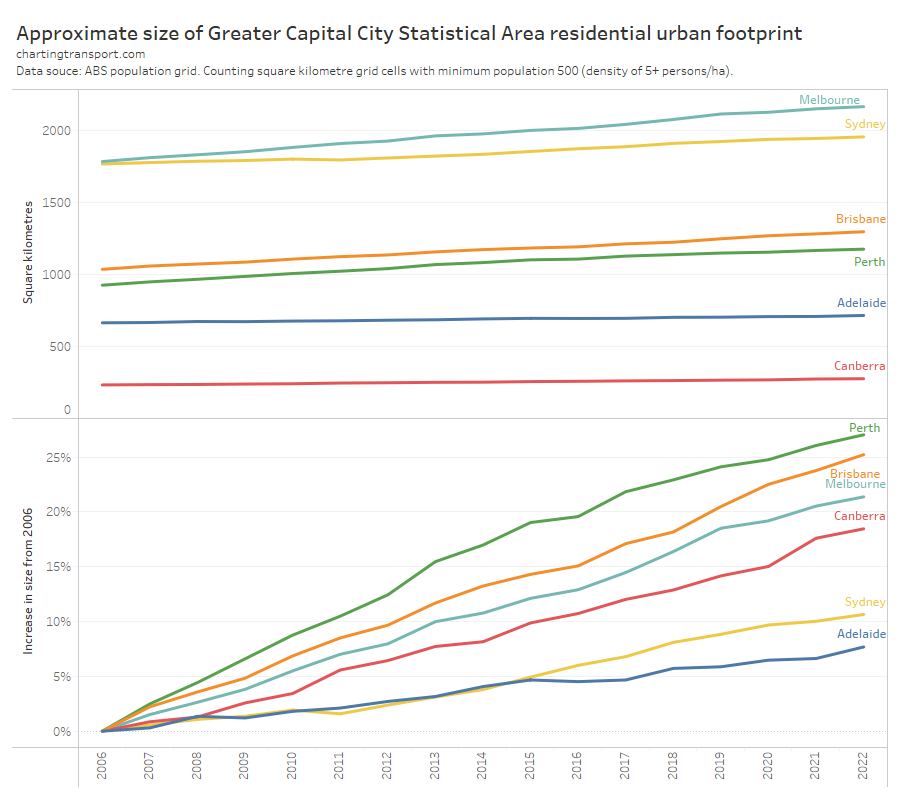
The population grid data only measures residential population so it cannot be used to estimate the size of the total urban footprint of cities over time, but we can use it to estimate the urban residential footprint. I’ve again used 5 persons/ha as a threshold, and here’s how the cities have growth since 2006:

Melbourne and Sydney had much the same footprint in 2006 but Melbourne has since grown significantly larger in size than Sydney, although Sydney still has a larger Capital City Statistical Area population.

The bottom half of the chart shows that Perth has had the largest percentage growth in urban residential area, followed by Brisbane then Melbourne. Sydney and Adelaide have had the least growth in footprint, and are also seeing the least population growth in percentage terms.

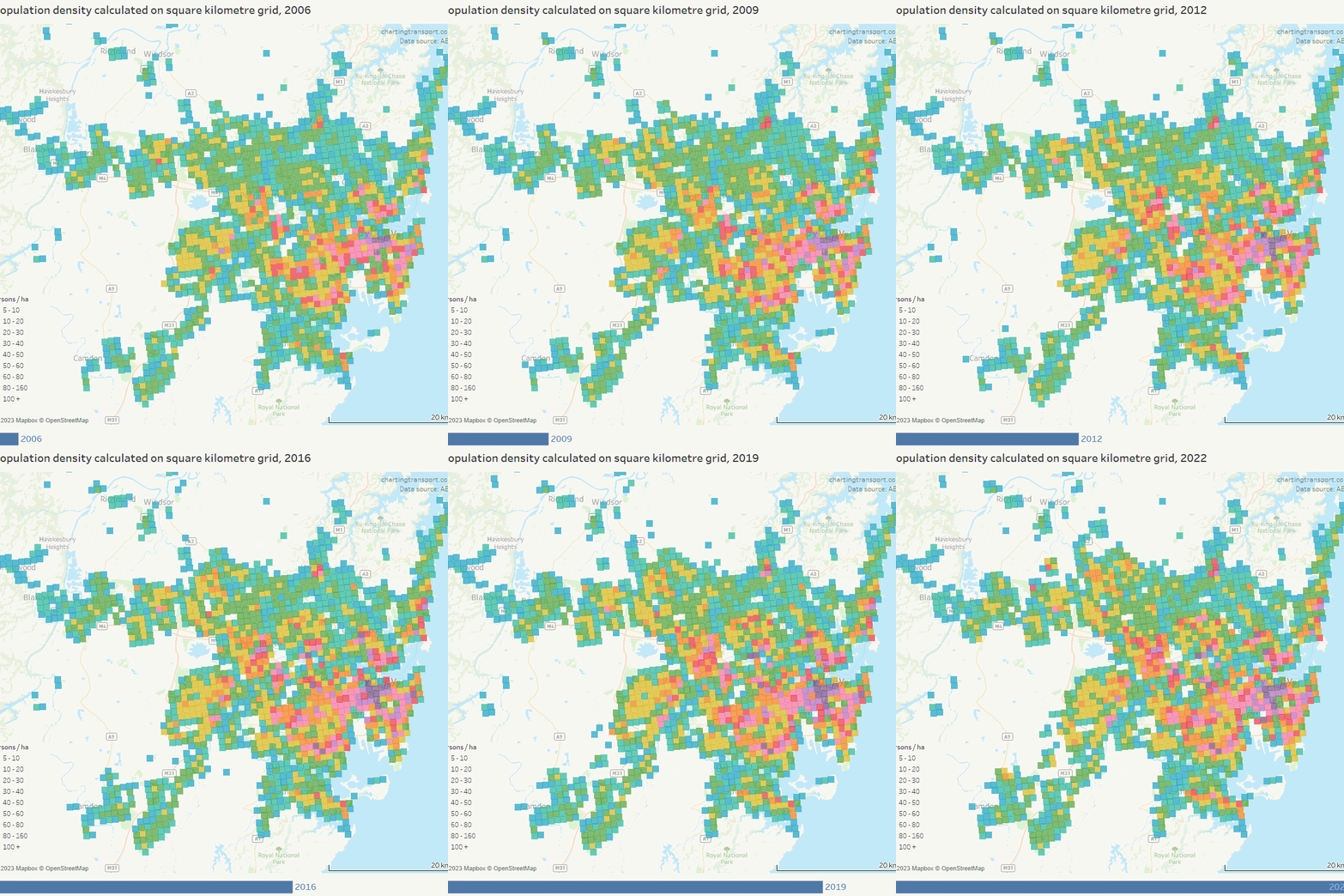
Animated density maps of Australian cities

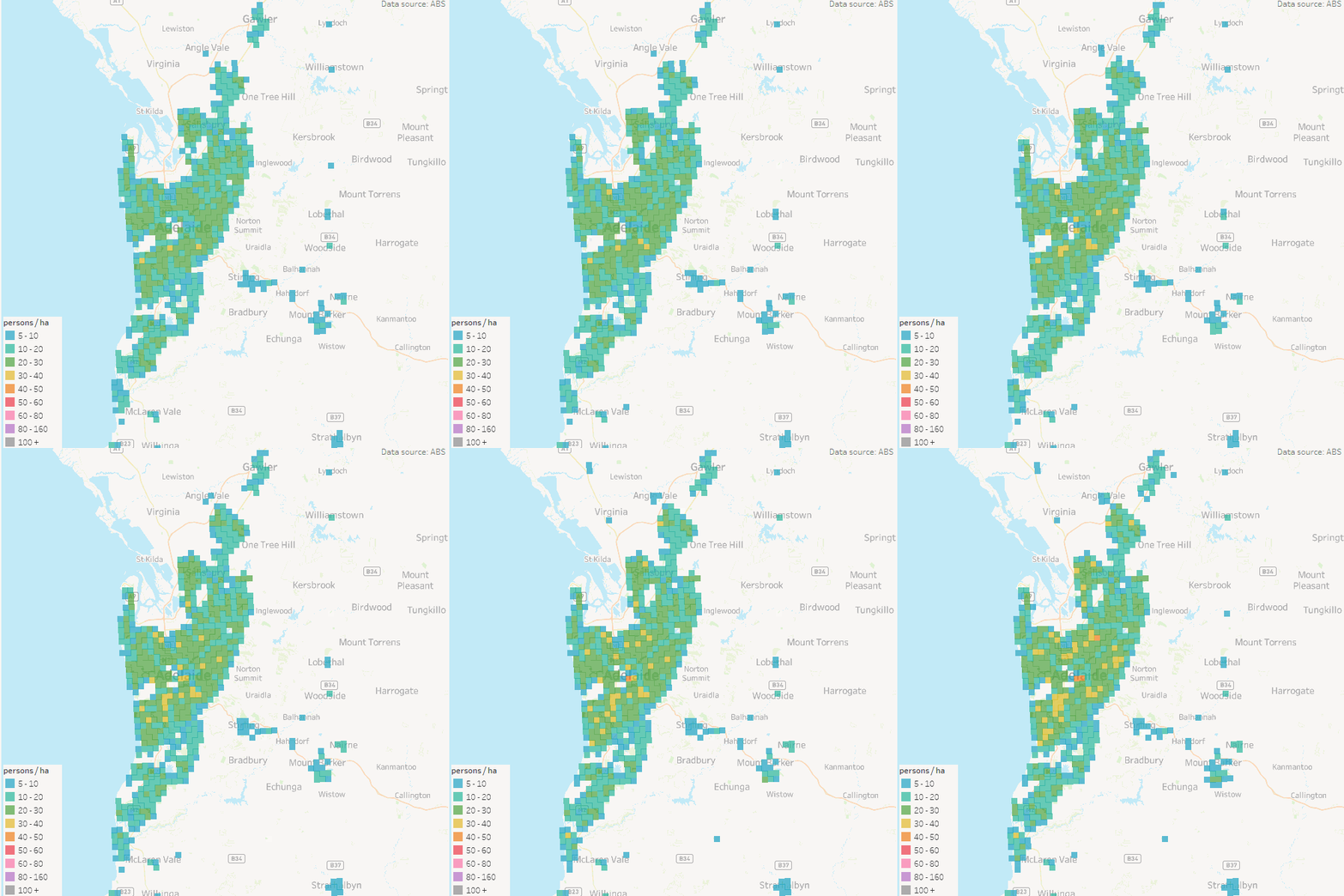
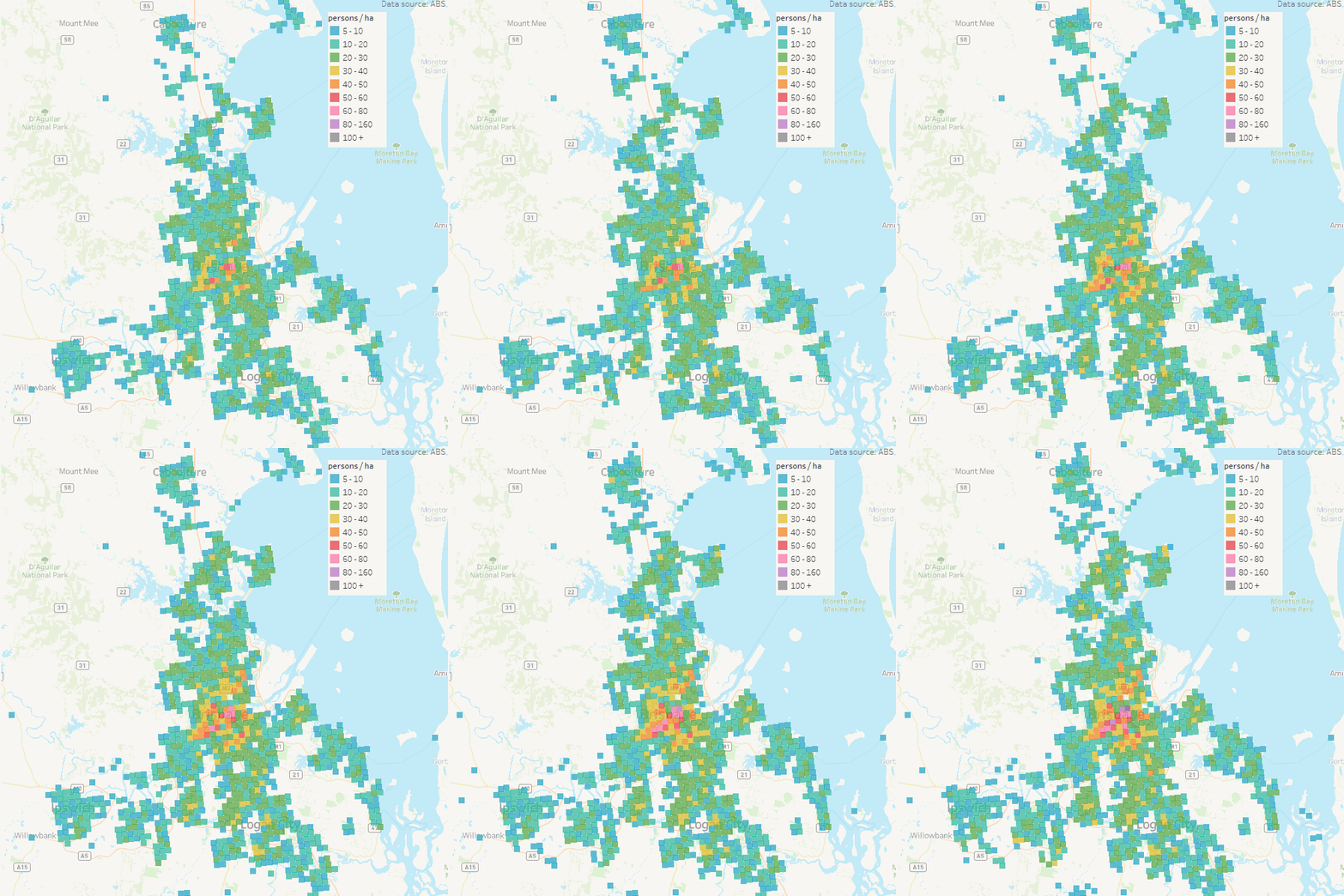
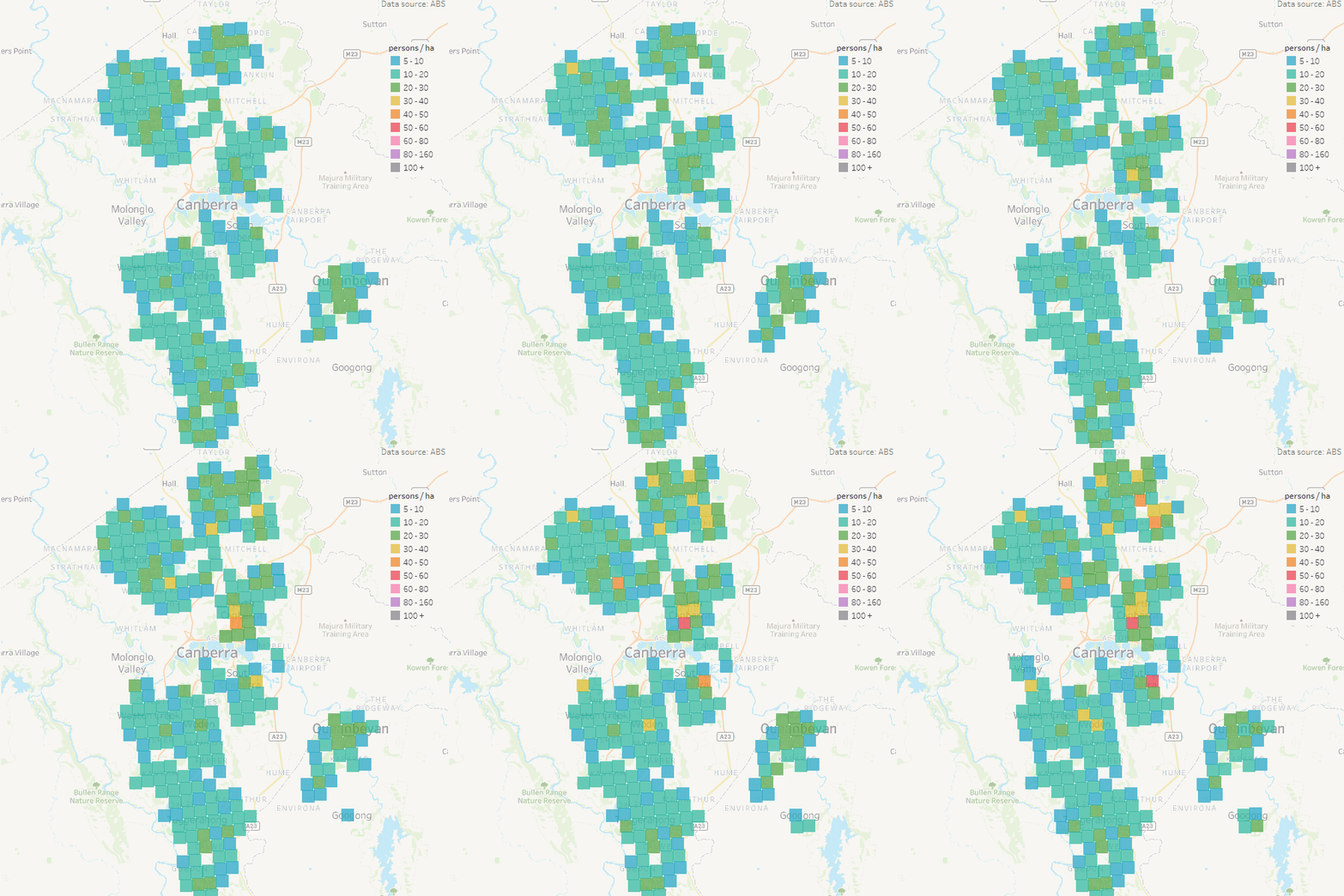
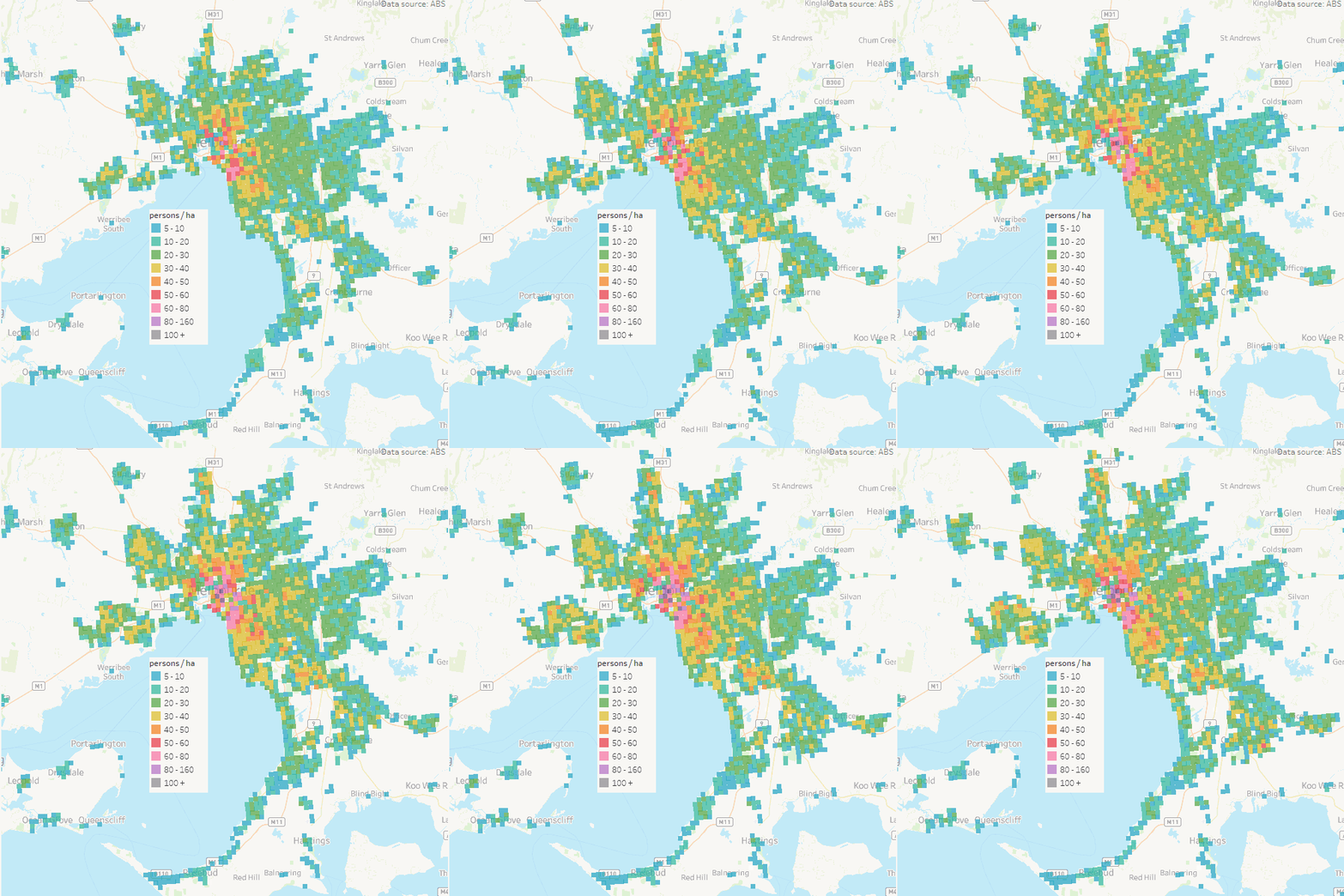
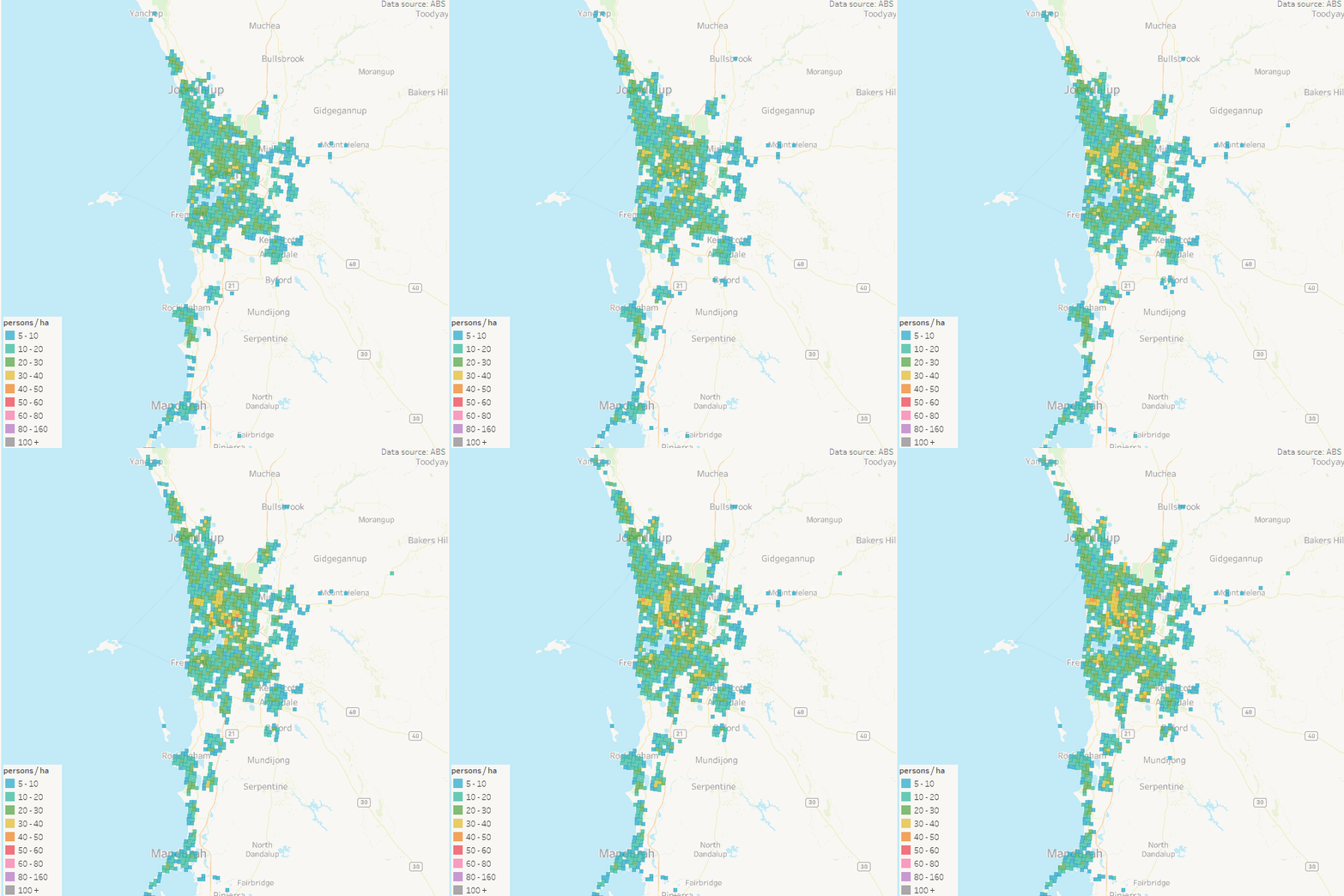
Here are some animated density maps for Australia’s six largest cities from 2006 to 2022 for you to ponder.

Some things to watch for:

  • Limited urban sprawl and significant densification of pockets of established areas in Canberra
  • Much larger areas of higher density in Sydney and Melbourne
  • Relatively high densities in some urban growth areas in Melbourne, Brisbane, and Sydney from the late 2010s
  • Low density sprawl in Perth, but also densification of some inner suburban areas (along the Scarborough Beach Road and Wanneroo Road corridors, and inner suburbs like Subiaco and North Perth)
  • Limited urban sprawl in Adelaide, along with densification of inner suburbs

Appendix: Corrections to ABS population estimates following Census 2021

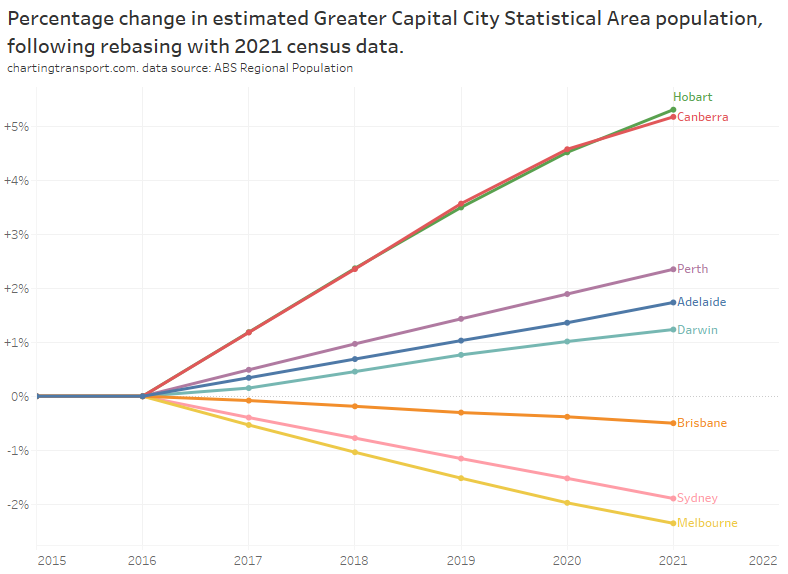
The 2021 census resulted in quite large revisions to estimated population in many cities as shown in the following chart.

Melbourne’s estimated 2021 population was revised down 2.4%, Sydney down 1.9%, while Canberra and Hobart were revised up more than 5%. To be fair to the ABS, the pandemic and border closures were unprecedented and their impacts on regional population were not easy to predict.
These corrections sum to a linear trend between 2016 and 2021 at the city level, although there was a redistribution of the estimated population within each city.

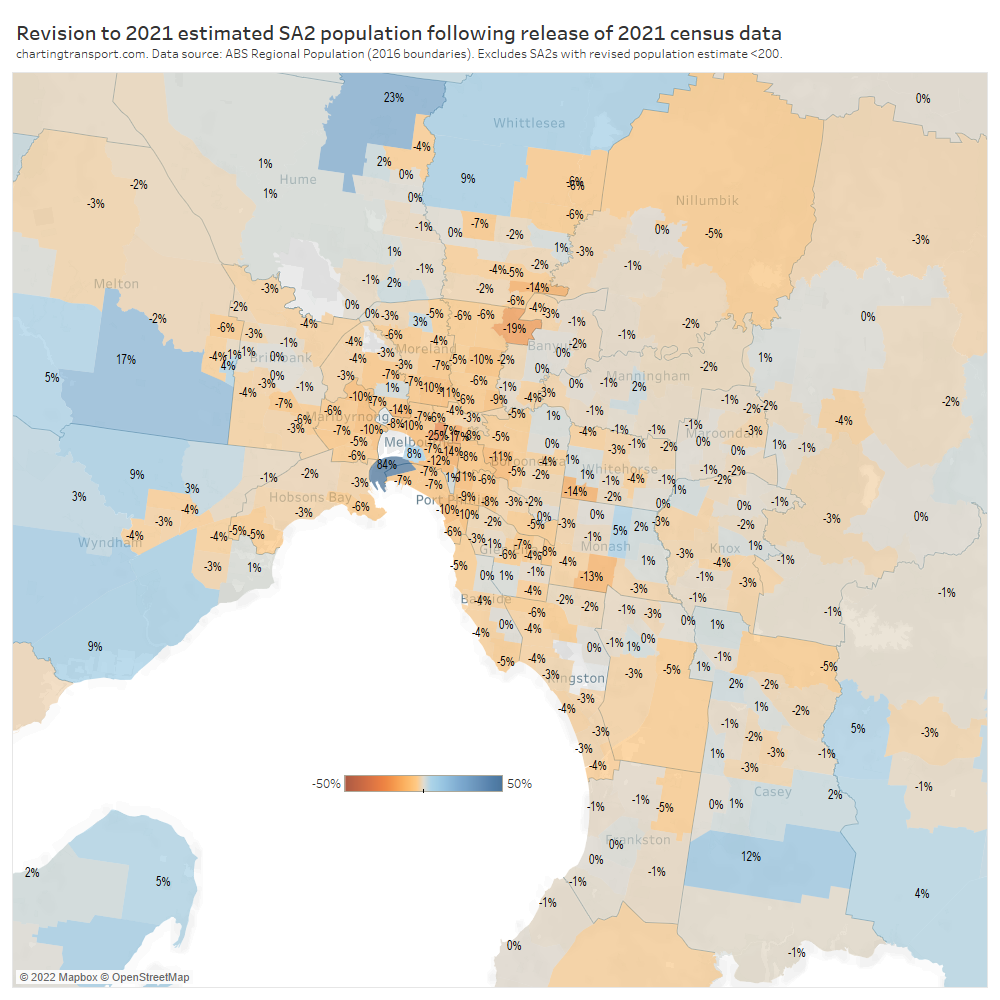
The following chart shows some detail of estimated population revisions at SA2 level for Melbourne in 2021:

The biggest reduction was in Carlton (-25% right next to University of Melbourne), and there were also reductions near other university campuses, including Kingsbury (-19%), Burwood (-14%) and Clayton (-13%). The biggest upwards revision was Fishermans Bend (+84%), and there were plenty of upwards revisions in outer urban growth areas.
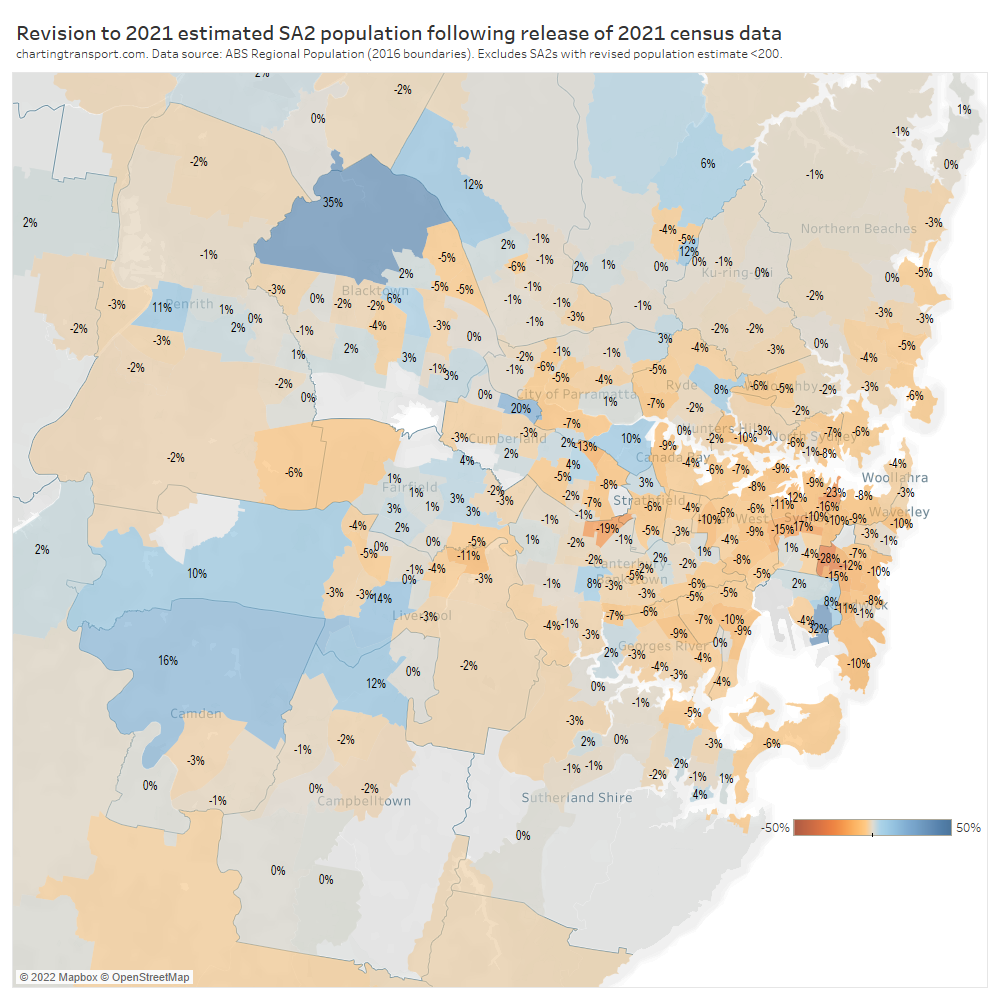
And here is Sydney:

There were big reductions in Kensington (-28%, centred on UNSW), Redfern-Chippendale (-17%), many other areas near university campuses, and around the Sydney CBD.

Like Melbourne, urban growth areas on the fringe were revised upwards, including +35% in Riverstone-Marden Park.


What can the 2021 census tell us about commuting to work in Australia’s big CBDs during the COVID19 pandemic?

Sun 2 April, 2023

The bustling Central Business Districts (CBDs) of Australia’s biggest cities were the powerhouses of the Australian economy, underpinned by public transport networks that delivered hundreds of thousands of commuters each weekday. But the COVID19 pandemic significantly disrupted CBD commuting. Working remotely from home became not just acceptable, but temporarily mandatory, and public transport patronage crashed during lockdowns.

So what might be the new normal in a post-pandemic work for commuting to our CBDs? Will people shift from public to private transport, driving up traffic congestion? How many – and what sorts of people – might work from home?

This post will try to shed some light on those questions by examining what the 2021 Australian census can tell us about how travel to our CBDs altered during the COVID19 pandemic, particularly the differences between locked-down and COVID-free cities. I’ll look at patterns and trends by age, occupation, and commuting distance. I’ll finish with a look at recent transport indications in Melbourne.

As a transport planner, I’m particularly interested in CBDs as there is a significant contest for market share between public and private transport. Before the pandemic, public transport dominated commuter mode share in the biggest CBDs, and CBDs make up a significant share of all public transport commuter trips.

Reminder: what was happening on Census day 2021

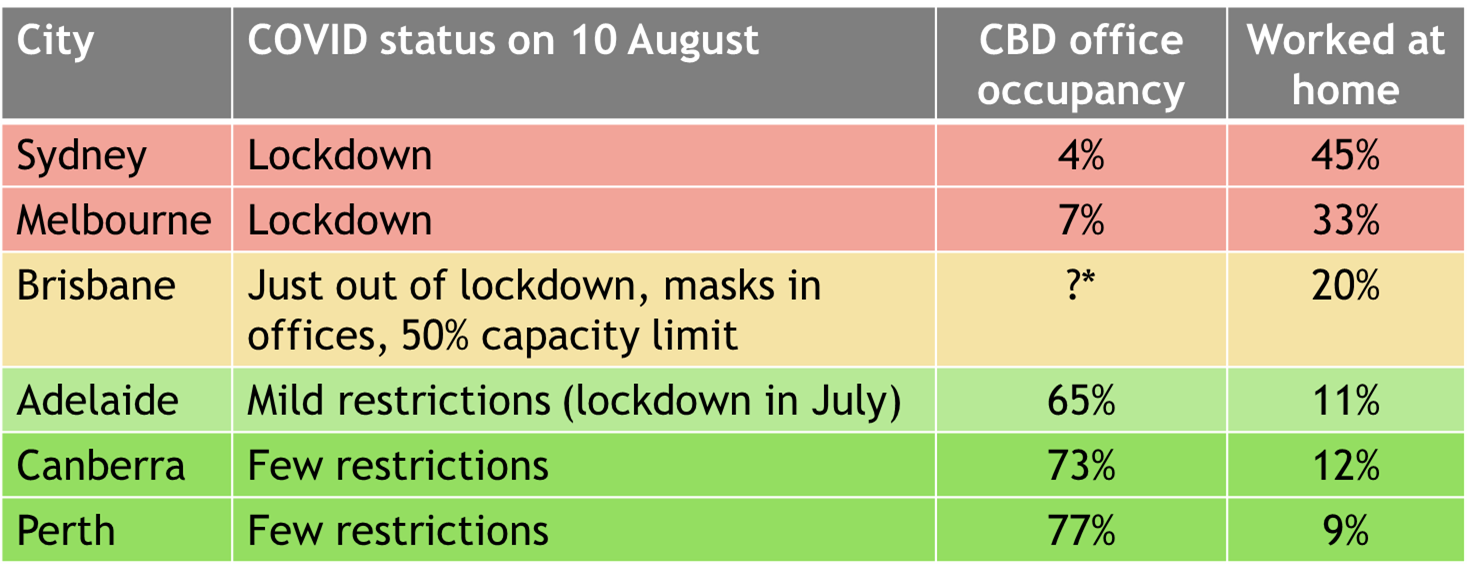
Melbourne and Sydney were in “lockdown” with workers required to work from home if possible. Brisbane was just out of lockdown, and the other cities were pretty much COVID-free, although Adelaide had experienced a short lockdown in July 2021. Here’s a summary of some key metrics (CBD office occupancy data sourced from the Property Council):

*The Property Council reported a figure of 60% for August 2021, but this would have been illegal on 10 August as there was a 50% capacity limit just after lockdown. We don’t know the exact dates when the office occupancy survey was conducted, I can only assume later in that month when restrictions were eased. 47% of CBD employees reported working remotely on census day.

What is a Central Business District?

I think of Central Business Districts as the civic, commercial, and business centre of a city, generally characterised by an area dense employment. Unfortunately the ABS’s SA2 boundaries don’t really align with these areas – especially Perth (pre 2021) and Adelaide where the SA2s covering the CBD also included areas of single-storey semi-detached housing.

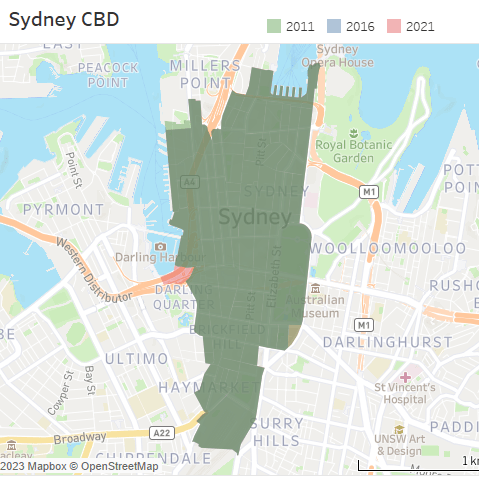
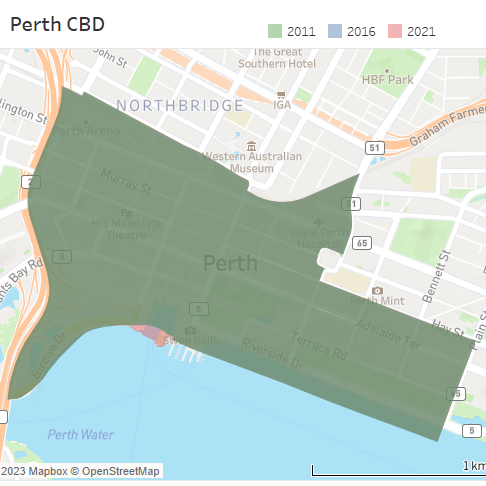
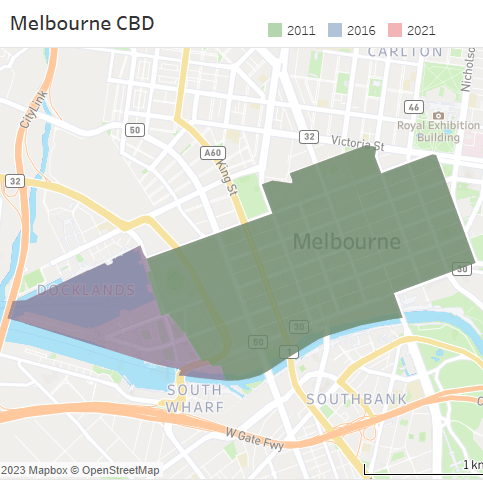
So for this analysis I’ve created my own CBD boundaries for Australia’s five largest cities. I’ve selected a set of destination zones that were relatively dense in 2021. I’ve tried for reasonably smooth boundaries, and have tried to avoid under-developed areas that might have cheaper car parking. I’ve then created equivalent sets of 2011 and 2016 destination zones – as similar as possible to the 2021 boundary – with the one exception of the Melbourne CBD from which I have excluded south-western parts of Docklands in 2011 due to low employment densities in that year (much of the land was yet to be developed and instead occupied by surface car parking).

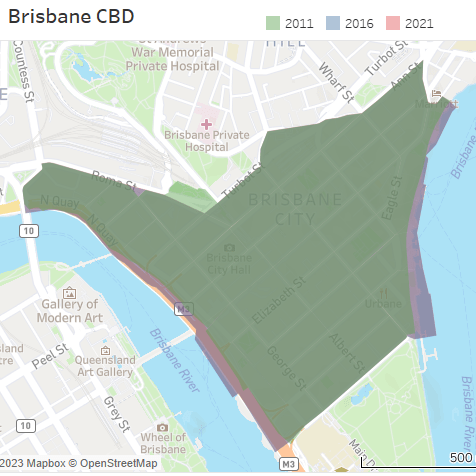
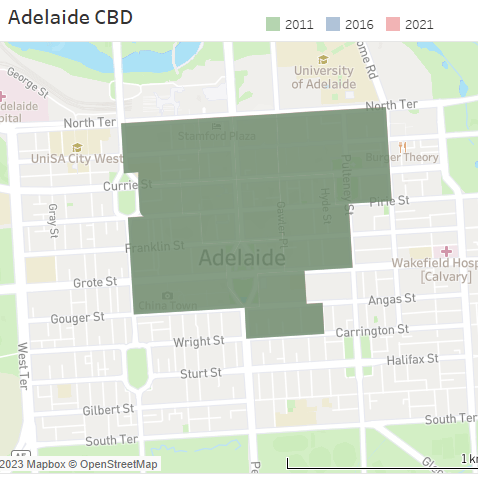
Here are maps of these CBD areas. I’ve transparently shaded the CBD for each census year in a different colour which mostly overlap to show dark green. Purple areas are where boundaries are not identical for all years.

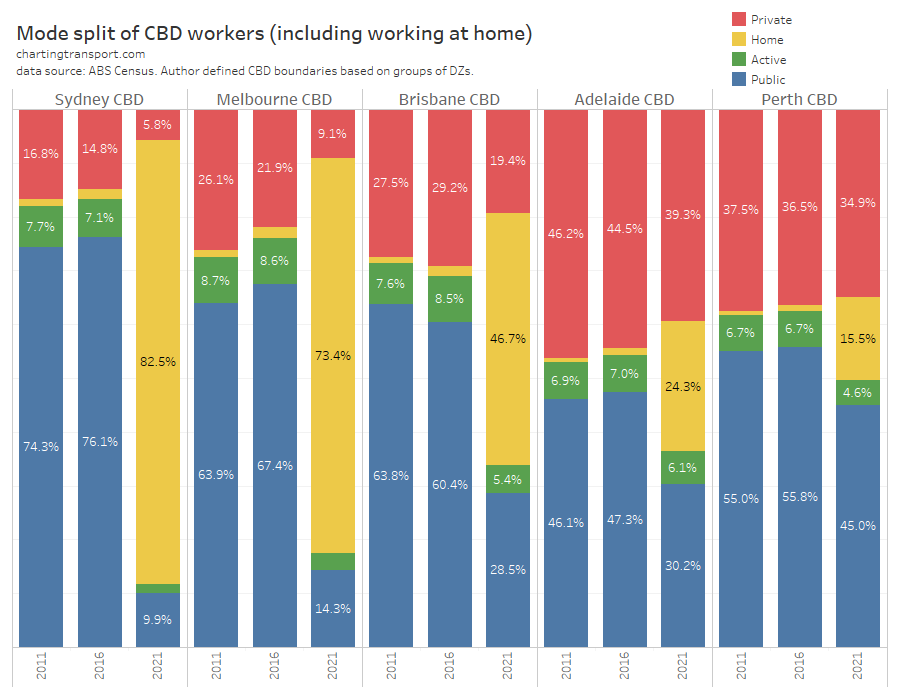
Here are the mode splits for those CBD areas, including those who worked at home:

As you would expect, working at home dominated in locked-down Sydney and Melbourne in 2021, but was also quite common in Brisbane and Adelaide. In COVID-free Perth, working at home only accounted for 15.5% of CBD employees with the other 84.5% attending their workplaces on census day.

Public transport mode shares increased between 2011 and 2016 in all CBDs except Brisbane, but then in 2021 there was a significant shift away from all travelling modes to working at home in all cities.

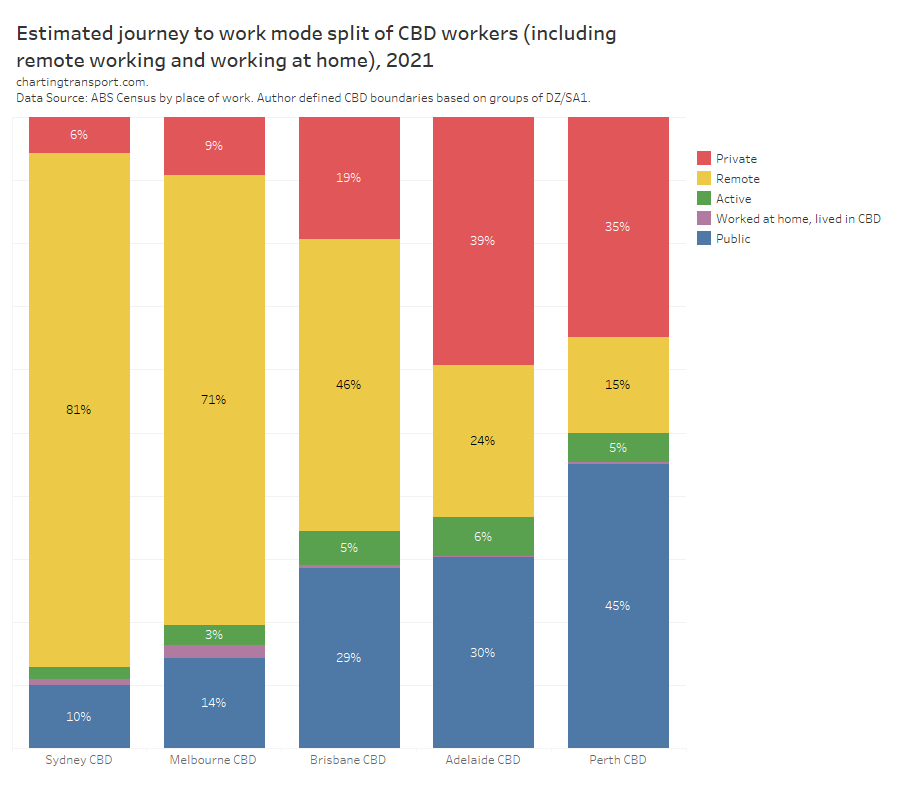
The working at home share may include people who routinely work from their home in a CBD area. To get some idea about these numbers, I’ve split the worked at home share for 2021 into those who lived inside and outside the CBD:

Only a tiny share of CBD workers worked at home and also lived within the CBD. Some of these will have been working remote from their regular workplace and others will have been routinely working at home (I could try to split these apart with deeper analysis but it doesn’t seem worthwhile with such small numbers).

How did working at home vary by age of CBD workers?

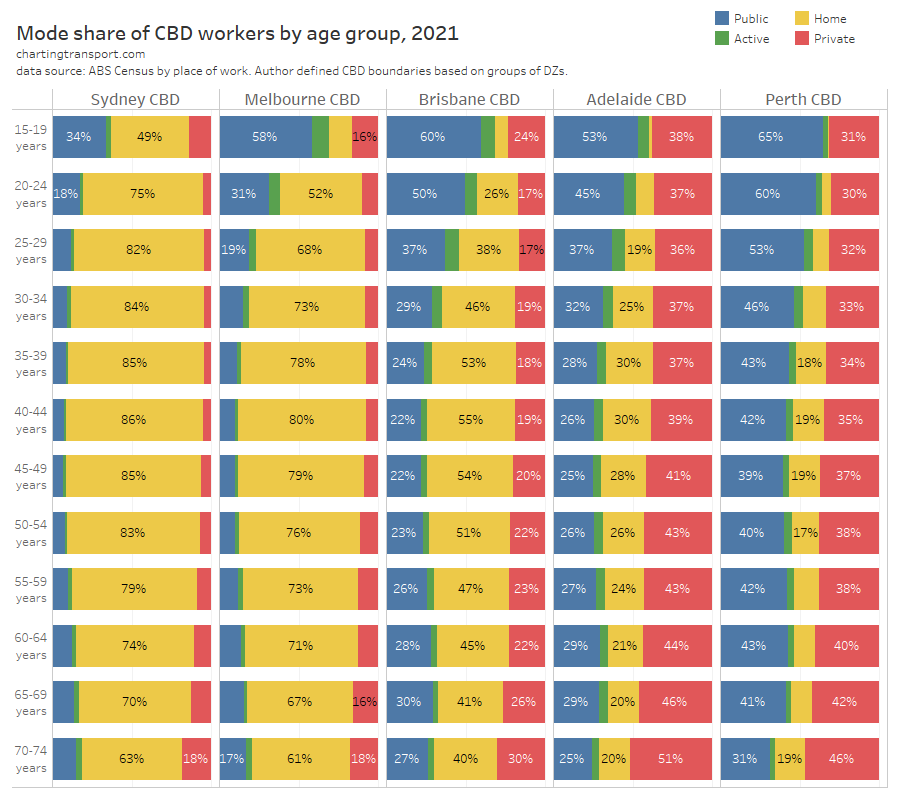
A really interesting finding here is that working at home peaked for those in their early 40s in almost all cities – an age with plenty of parents with child caring responsibilities. Teenagers and those in their early 20s were the least likely to work from home, probably because they were more likely to be in jobs not amenable to working at home (eg retail and hospitality). But perhaps also some younger white collar workers may have preferred to build professional networks by being present in the CBD.

In Adelaide and Perth there was a definite trend that younger commuters were more likely to use public transport, and older commuters more likely to use private transport. This was consistent with all cities in earlier censuses (although this was not the case in Brisbane in 2021).

This got me thinking. The COVID19 pandemic and ~18 month border closure surely had some impact on the age distribution of the CBD workforce.

Indeed, here’s a look at the age composition of CBD workers over time:

Between 2011 and 2016 all cities showed a shift in the age composition towards older employees, perhaps as the cohorts of more highly educated Australians got older, people stay in the workforce until later in life, and/or other changing demographics of our cities.

But in most cities (perhaps not Adelaide) there seemed to be a larger shift towards older workers between 2016 and 2021. I suspect this will reflect fewer recent skilled migrants and international students in 2021.

We know from other analysis (see: Why are younger adults more likely to use public transport? (an exploration of mode shares by age – part 1)) that younger adults generally have higher rates of public transport use, so the shift in demographics might be favouring a mode shift away from public transport – all other things being equal (which of course they are not). There was mostly a shift towards public transport for CBD workers between 2011 and 2016, so other factors must have had an overriding impact.

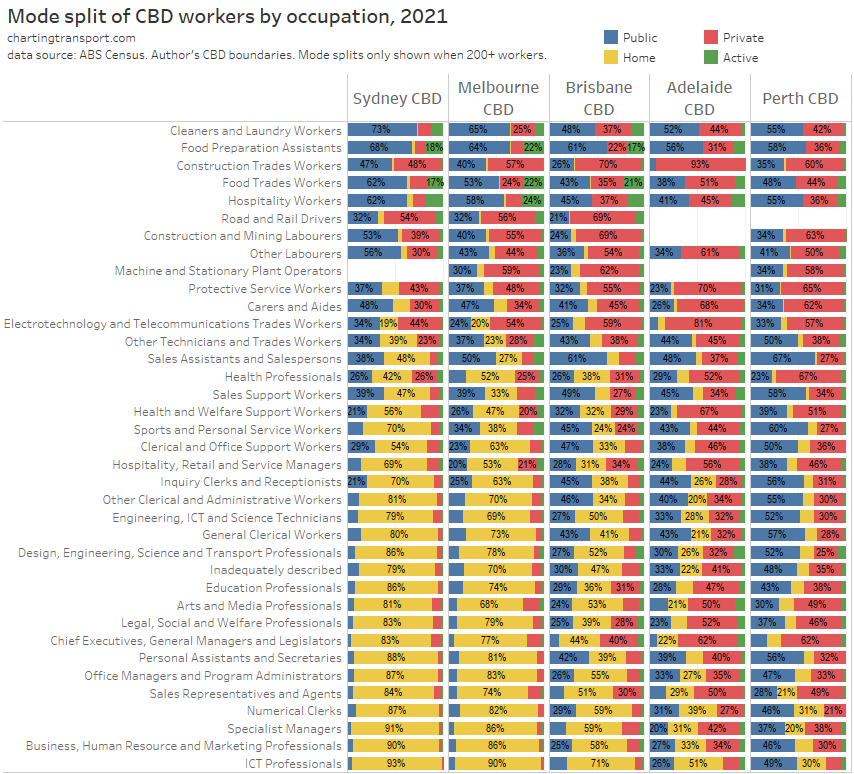
How did working at home vary by CBD worker occupation?

I’ve sorted the occupations by overall worked at home share, which was similar across the cities. This list roughly sorts from blue collar to white collar and I haven’t seen any surprises in this chart. I’ll come back to occupations shortly.

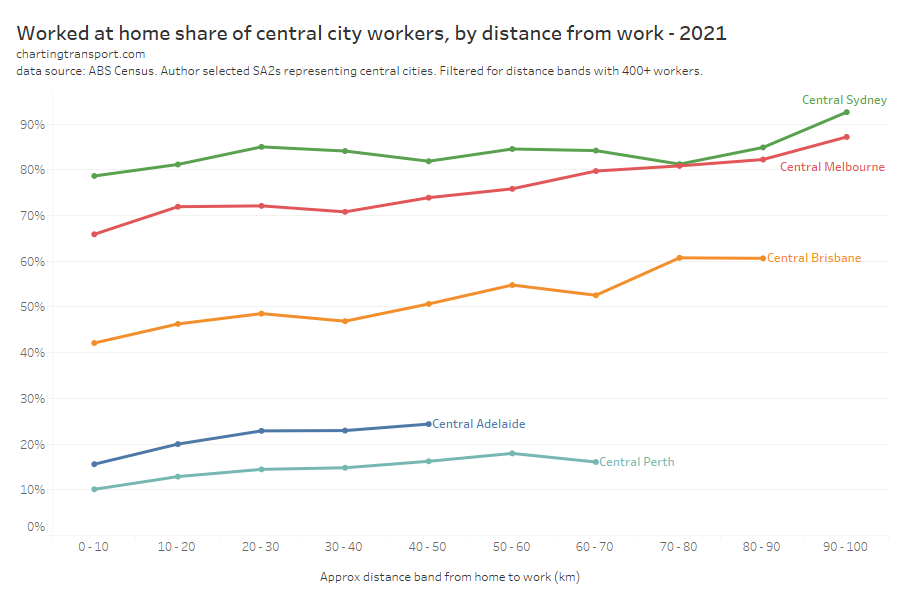
How did working at home vary by distance from work?

The following chart shows working at home rates by approximate distance from home to work, for central area workers.

Technical note: For this analysis I’ve used journey to work data disaggregated by home SA2, work SA2, and whether or not workers worked at home. I’ve defined central city areas as collections of SA2s (so different boundaries to my CBD areas). Distances between home and work SA2s are calculated on SA2 centroids then aggregated to ranges.

In all cities there was a general trend to higher rates of working at home for people living further from the central city, although Sydney rates of remote working were high at all distances (the strictness of lockdown probably overriding the impact of commuting distance). This pattern in other cities likely reflects the increased incentive to work from home when you have a longer commute to avoid.

Did COVID lead to a mode shift from public to private transport?

Some transport planners have been concerned that COVID19 might lead to a permanent mode shift from public transport to private transport, probably for two reasons:

  1. A reduction in total commuter demand might make private transport slightly more competitive (eg if parking costs reduce), resulting in a different mode split equilibrium. We can only really test this aspect in Perth and Adelaide as they were COVID-free but with a small but significant share of workers working remotely.
  2. People have a fear of becoming infected by COVID19 on public transport and therefore switch to private transport (although COVID can also spread in workplaces of course). It’s a bit harder to test this as Sydney and Melbourne were in lockdown (movement restrictions no doubt had much more impact than infection fear). Perth, Canberra, and Adelaide were COVID-free, although there might have been a some fear of undetected COVID circulating – and indeed that was probably happening in Canberra which went into lockdown a few days after the census. Brisbane was just out of lockdown with some restrictions remaining so infection fear may have been higher than in Perth and Adelaide. However the level of infection fear in these “COVID-free” cities in 2021 would certainly be less than that in 2022 and 2023 where COVID is known to be circulating in the community (although there’s since been plenty of opportunity to get vaccinated).

The hypothesis I want to test for COVID-free cities is that there was a mode shift from public transport to private transport, alongside the overall mode shift to working at home.

Okay, so what can census data tell us?

Unfortunately it’s almost impossible to know the behaviour change of individuals who had the same home and work locations in 2016 and 2021 without another data source. I don’t have access to the census longitudinal dataset and that might not even have a sufficient sample of CBD workers who didn’t change home or work location between the two censuses.

But I can explore this question by looking at the changes in overall volumes and mode shares, and then drilling down into different age and occupation cohorts.

How much mode shift was there between travelling modes?

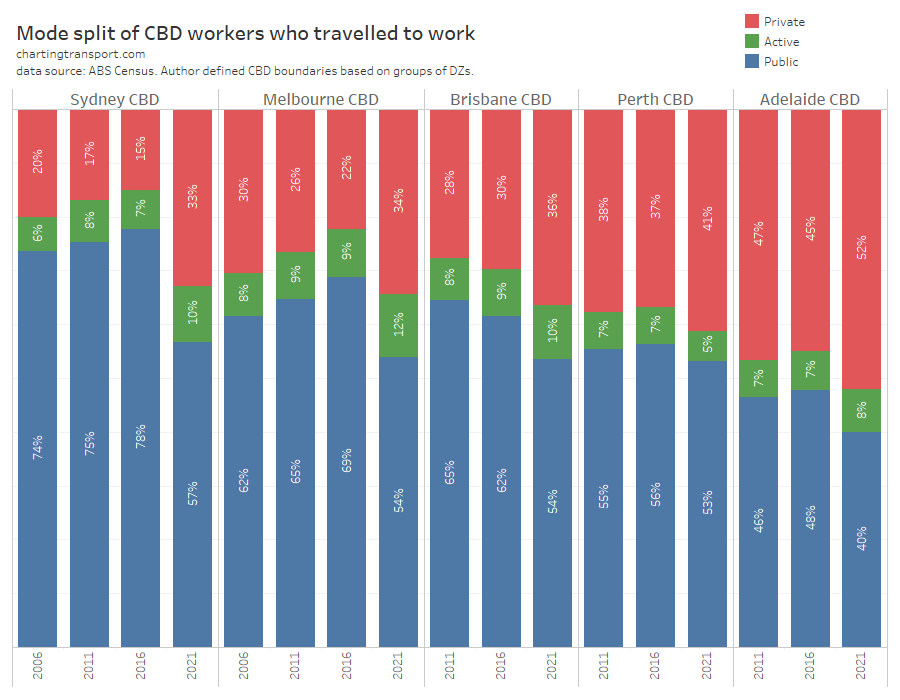
Let’s first look at the overall change in mode split of people who did commute to CBDs in the last three-four censuses (I have 2006 data for Melbourne and Sydney, but only for those who travelled):

On this split, all cities saw a significant mode shift to private transport travel in 2021. The smallest was 4% in COVID-free Perth, while the largest was 18% in locked-down Sydney.

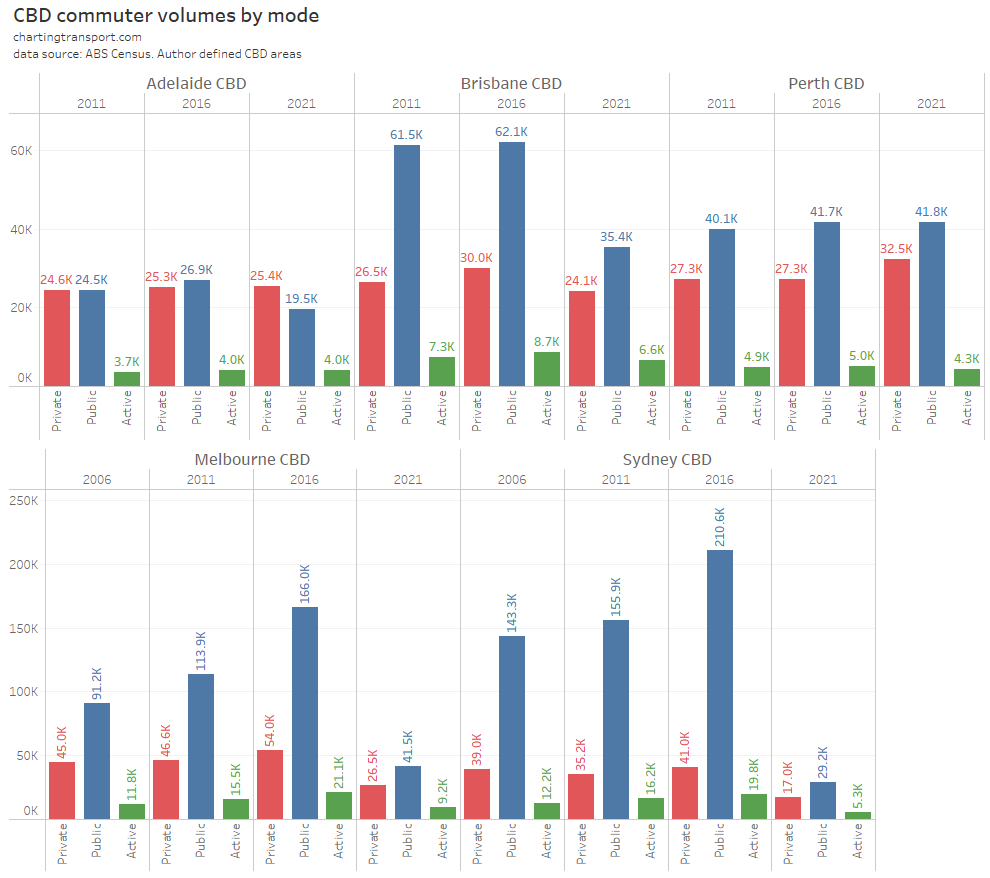
To explore further, here are the total volumes of commuters to CBDs for each mode, across the last three-four censuses:

In the locked-down cities there was a substantial drop in both public and private transport commuters in 2021, although a larger proportional drop for public transport (in line with mode shifts seen above).

But I’m particularly interested in the then COVID-free cities of Adelaide and Perth, that exhibited COVID-free travel behaviour. Let’s start with a deep dive for Perth.

How did commuting behaviour change for Perth CBD commuters between 2016 and 2021?

The overall CBD workforce increased substantially from 83.0k to 105.7k, and this increase saw 5,164 more private transport trips, and about 85 more public transport trips. But the biggest net increase was for working at home.

If we include remote working, the overall mode share of private transport declined by 1.6% from 36.5% to 34.9%. Any mode shift from public transport to private transport was swamped by the overall shift to working remotely.

But does the overall pattern mask some mode shifts within age or occupation groups?

Did some age groups shift modes more than others? Initially for this analysis I started to look at the change in modal mix by five year age group, but of course the people within these 5 year age bands entirely change between censuses (that are held five years apart), so that wouldn’t be measuring behaviour change of a similar group of people.

Instead I’ve looked at the change in modal mix by approximate birth year cohorts (we only know people’s age in August, so the birth year groups are approximate – for example someone aged 25 at the 2021 census could have been born anytime between 11 August 1995 and 10 August 1996, but I’ve allocated them to the 1996 to 2000 cohort).

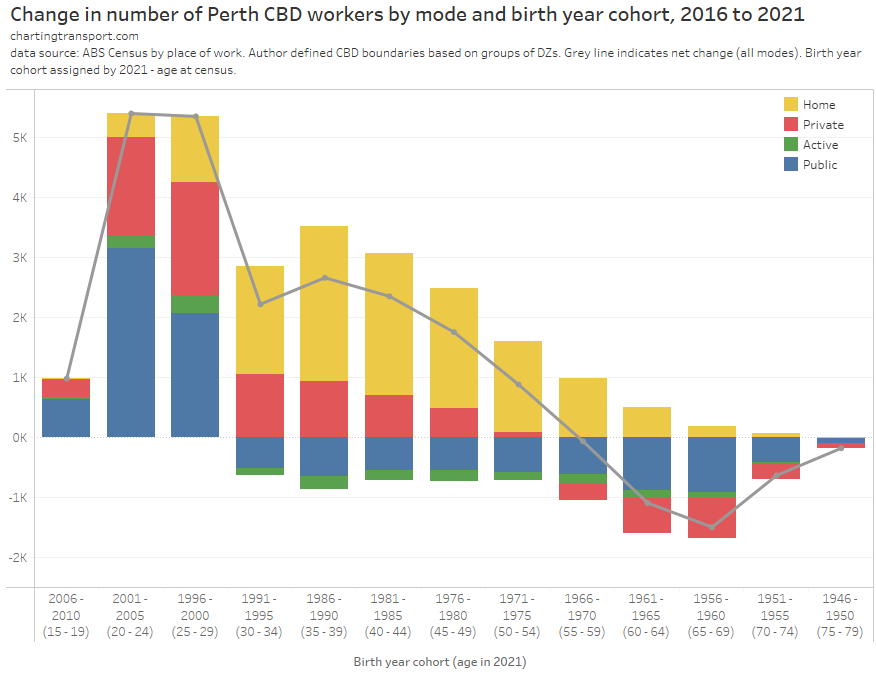
Here is the net change in volume of Perth CBD workers by birth year cohort and commuter mode (I’ve included the age of this cohort in 2021 at the bottom of the chart for reference).

As you would expect, people aged in their 20s in 2021 made up a significant share of new CBD employees, and workers aged 60+ in 2021 (55+ in 2016) had a net reduction as many went into retirement.

Public transport had the largest share of net new trips for those aged 20-24 in 2021, although a substantial share also travelled by private transport. There was a more even split of net new trips for those aged 25-29 in 2021.

There was also substantial employee growth for people aged 30+ in 2021 (unlike in 2016), and for those aged 30-54 in 2021 the biggest change was a net increase in working at home.

There were increases in private transport use and decreases in public transport use for those aged 30 to 54 in 2021. This was a net 2270* commuters – about 2.1% of the overall CBD workforce (*summing the absolute values of the smaller of the public or private transport shift). But the overall private transport mode shift was -1.6% so changes in other age groups (particularly young adults) washed out all of this shift of middle-aged workers.

Was this mode shift for middle aged workers something to do with COVID, or was it something that was destined to happen anyway? On this blog I’ve explored the relationship between age and public transport mode share in great detail, and there’s certainly a pattern of decline with age, particularly as people become parents. See: Why are younger adults more likely to use public transport? (an exploration of mode shares by age) – part 1, part 2, and part 3.

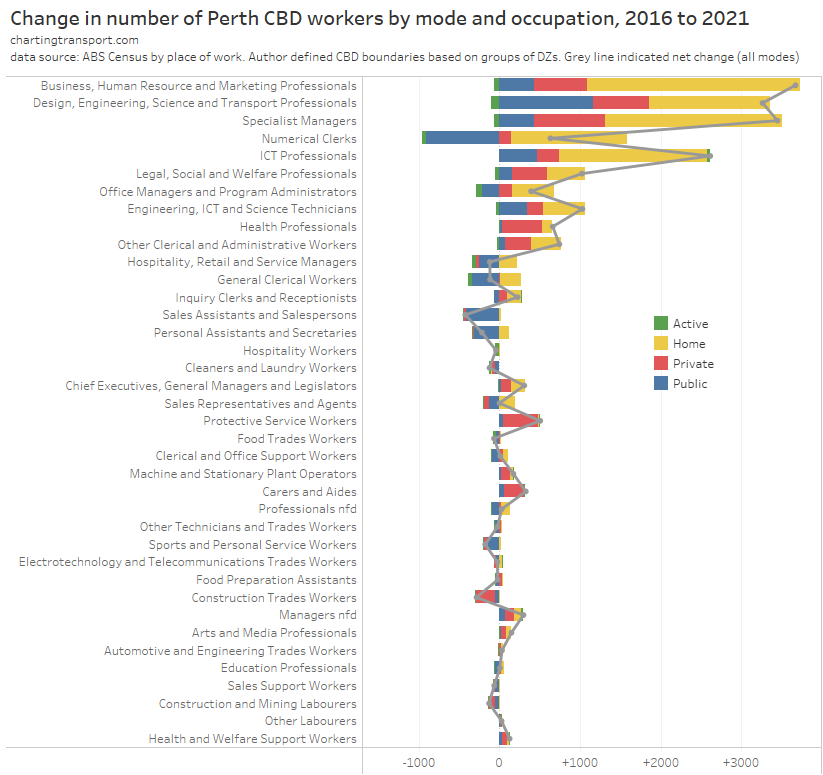
What about mode changes for different occupations? Here’s a look at commuter volume changes by mode and occupation for Perth’s CBD:

The Perth CBD put on a lot more professionals and specialist managers between 2016 and 2021, and working at home accounted for most of this net growth. The number of new public and private trips varied considerably by category but private transport growth outnumbered public transport growth for most professions.

In particular, almost all the growth in health professionals, protective service workers, and carers and aides was accounted for by private transport. These are occupations where working remotely from home is often difficult, and the high rates of private transport growth might also reflect significant rates of shift work where off-peak public transport service levels are often less competitive with private transport.

There are not many occupations that saw a net shift from public to private transport – these included office managers, program administrators, and clerical and office support workers. But again these numbers were tiny compared to the size of the Perth CBD workforce – suggesting there was very little net shift from public to private transport.

Overall there was a 1.6% shift away from private transport commuting to the Perth CBD, with most of the other mode shift being from public transport to remote working. The evidence from Perth does not support the hypothesis.

How did commuting behaviour change for Adelaide CBD commuters?

Adelaide saw only a tiny increase in the number of private transport commuters, but a significant decrease in the number of people who travelled on public transport. Overall there was a 5.3% shift away from private transport mode share (when you include remote working).

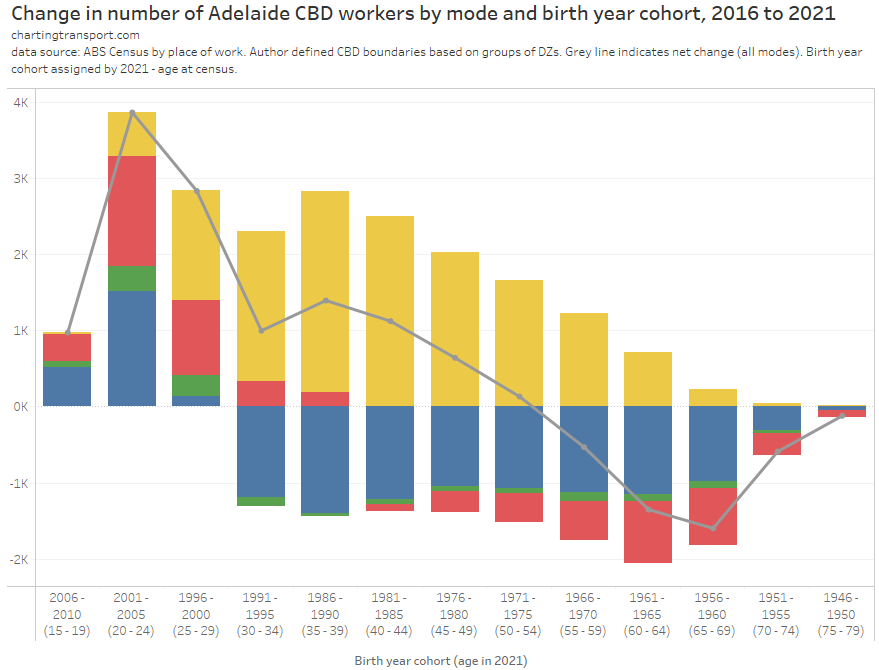
As per the analysis for Perth, here’s the change in volume of trips by mode and birth year:

For Adelaide most of the net mode shift also appears to be from public transport to working remotely. There was a net increase in private transport commuting for people aged 15 to 34 in 2021, and a small decline in private transport trips for older age groups.

There was only a tiny net shift from public to private transport of 526 people within those aged 30-39 in 2021.

Like Perth, working at home accounted for a smaller share of the employment growth for younger adults.

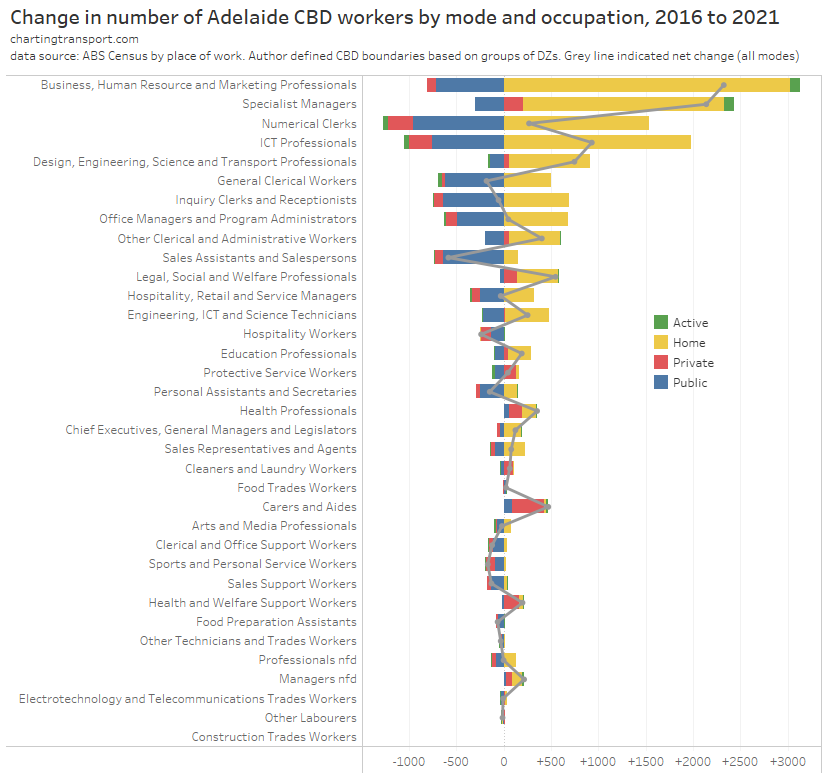
Here’s a look at occupations for Adelaide:

Again, the biggest mode shift here appears to have been from public transport to working at home, with the notable exception again of carers and aides, and health professionals (although small numbers). In most occupations there was also a mode shift away from private transport. Very few occupations show a net shift from public transport to private transport in Adelaide.

The evidence of Adelaide does not support the hypothesis of mode shift from public to private transport. The biggest change was a mode shift from public transport to remote working (plus some mode shift from private transport to remote working).

How did the mix of CBD car commuters change?

Yet another way of looking at potential mode shifts is whether the people driving to work in the CBD in 2021 were any different to previous censuses. For this analysis I’ve filtered for commuters to CBDs who did not use any public transport, but did travel as a vehicle driver or on motorbike/scooter (you might argue “Truck” should be included as well, but we don’t know whether there people were drivers or passengers and the numbers are tiny so I don’t think it is material).

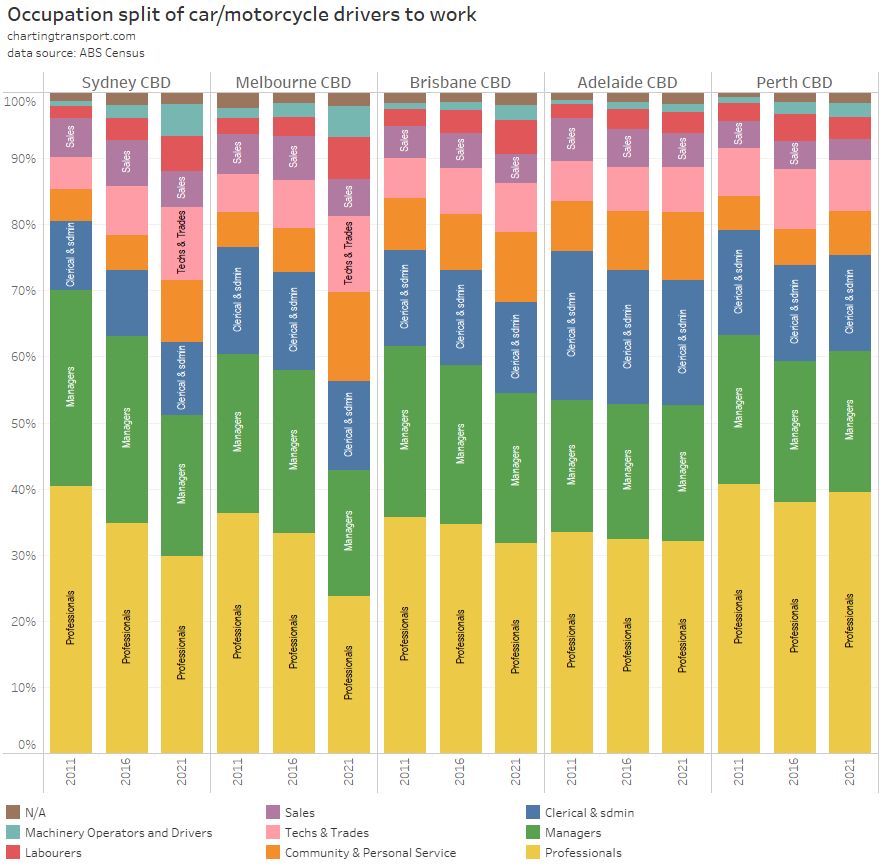
Firstly here is the occupation split of vehicle drivers to work in the five CBDs over the last three censuses:

In most cities, there was a noticeable change in occupation share between 2016 and 2021 towards technicians and trade, labourers, machinery operators and drivers, and community and personal service workers, and away from professionals and managers. Basically a shift from white collar to blue/fluoro collar jobs, as many white collar workers shifted to working remotely. This shift was largest in the locked down cities of Melbourne and Sydney, but was also visible in Adelaide and Brisbane to a lesser extent.

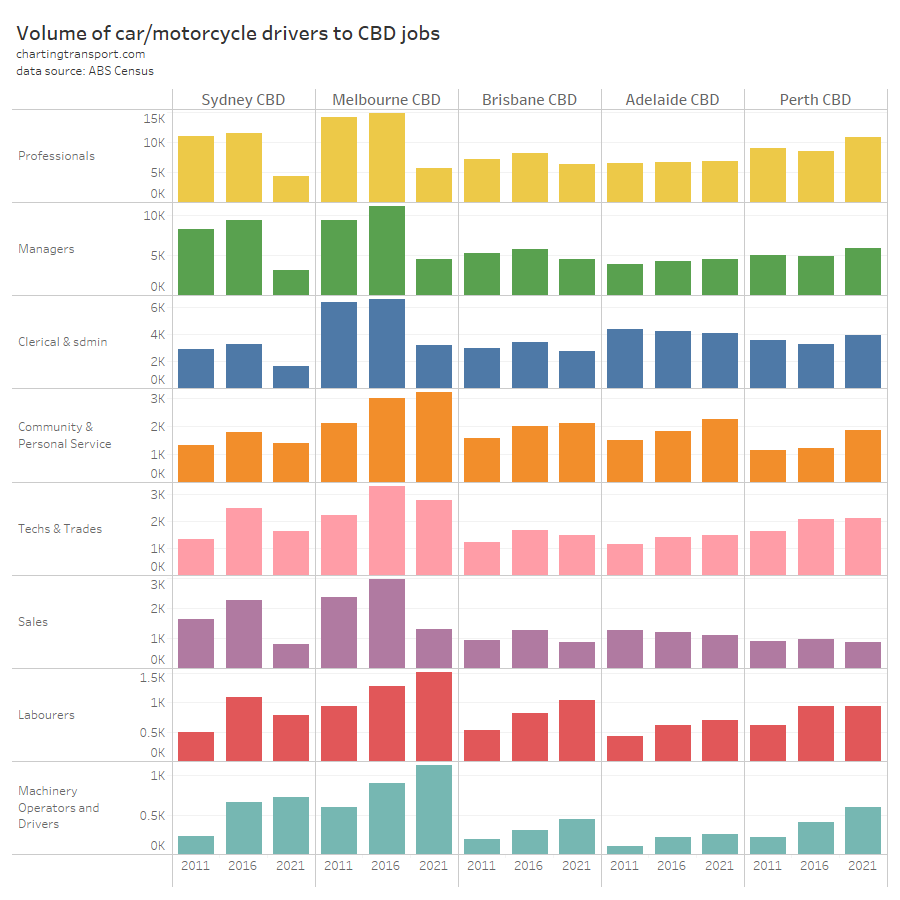
It is also interesting to look at the change in volumes. Note the Y-axis on the following chart has an independent scale for each occupation group, with the biggest occupation groups at the top:

In locked-down Sydney and Melbourne, there was a massive decrease in white collar workers and an increase in machinery operators and drivers. Melbourne also saw an increase in labourers and community and personal service workers. This might reflect a reduction in car parking prices, although I cannot find evidence that prices were actually lower on census day (the City of Melbourne waived parking fees and restrictions from just after the census).

Diving deeper, there was a big increase in protective service workers in the Melbourne CBD, and about 2166 of them drove to work in 2021 (up from 1660 in 2016). This may reflect the opening of the new Victorian Police Centre in Spencer Street in 2020, complete with 600 car parks. Indeed the destination zone that includes this building (and Southern Cross Station) saw an increase of 769 private transport commuters between 2016 and 2021, the biggest increase of any CBD destination zone.

In COVID-free Perth there was an increase in professionals, clerical and administrative workers, managers, community and personal service workers, and machinery operators and drivers who drove to work, and there was only a decline in sales workers.

So what have I learnt from the latest census data?

I’ve covered a bit of ground, so here’s a summary of key findings and some discussion:

  • Locked-down Sydney and Melbourne saw a significant shift to remote working of CBD employees in 2021. COVID-free CBDs saw much less shift to remote working (Adelaide 24% and Perth 15%).
  • Remote working was most common for middle-aged CBD employees (peaking at 40-44 age bracket), and much lower for younger adults and a little less common for older employees.
  • All CBDs saw a step change in the workforce age composition between 2016 and 2021, shifting to an older workforce, probably related to the halt to immigration during the pandemic.
  • In most cities, remote working in 2021 was slightly more common for CBD employees who lived further from their CBD.
  • In all cities, the main mode shift between 2016 and 2021 seems to be from public transport to remote working.
  • No city saw a net mode shift from public transport to private transport (when you include remote working in the modal mix). The main mode shift in COVID-free cities appears to be from public transport to remote working. However it is entirely possible that some public transport commuters switched to private transport, but this was more than offset by other commuters who shifted from private transport to remote working. Few age or occupation cohorts saw a net shift from public to private transport.
  • The only CBD to see a significant increase in private transport commuter trips was Perth (with +5164). However this was still a net mode shift away from private transport mode share due to massive growth in overall CBD employment between 2016 and 2021. I’m curious about how this happened, and I will explore it further in an upcoming post.
  • Occupations likely to include many shift workers saw the biggest net private transport commuter growth in Adelaide and Perth – including health professionals, protective service workers (including police), carers, and aids.

So what can we expect in a “post-pandemic” world?

At the 2021 census all Australian cities were either in lockdown or were perceived to be COVID-free. No Australian cities were “living with COVID”, and in the cities with COVID circulating, few workers faced a choice between workplace attendance and remote working.

At the time of writing (March 2023), COVID is circulating across Australia and there are very few restrictions to restrict spread. There is an ongoing risk of COVID infection when using public transport and attending an indoor workplace (although you can choose to wear a mask of course).

Is this leading to a mode shift from public to private transport in this “post-pandemic” world? Have we even reached a new steady state? The best data to answer this will come from the 2026 census.

In the meantime I have had a quick look at some transport indicators for Melbourne.

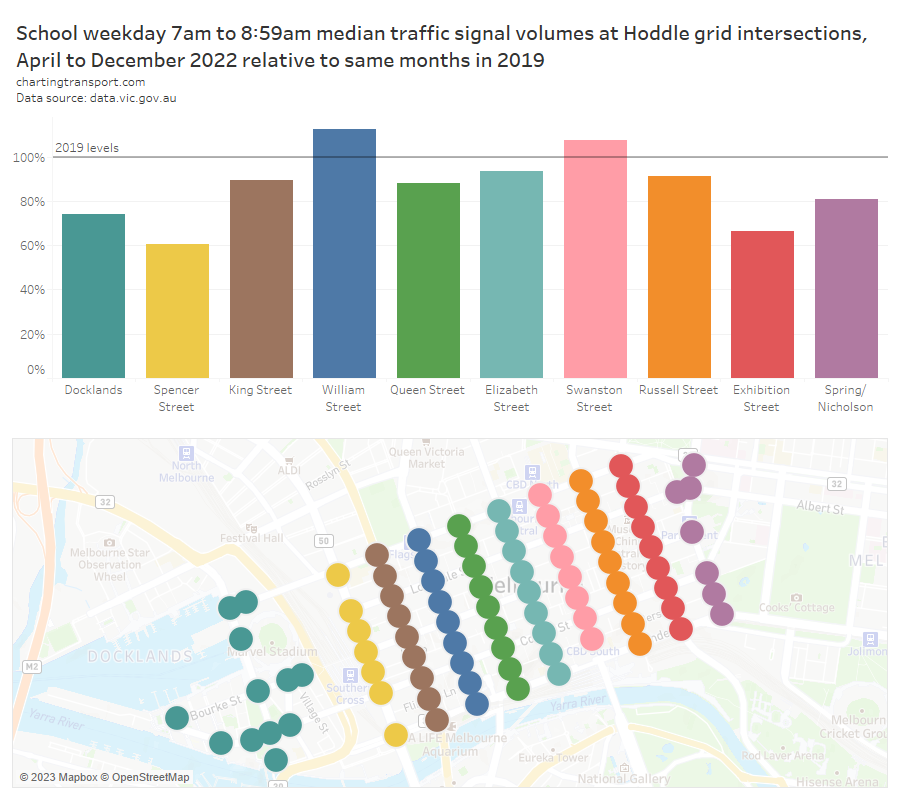
Vehicle traffic through CBD intersections in 2022 (excluding Q1) was consistently below 2019 levels in the AM peak in most parts of the CBD. However it’s only a rough indication as much of this traffic will be for purposes other than private transport commuting to the CBD (eg deliveries, through-traffic, buses, etc) (I’ve excluded signals on Wurundjeri Way which is likely to have much through-traffic).

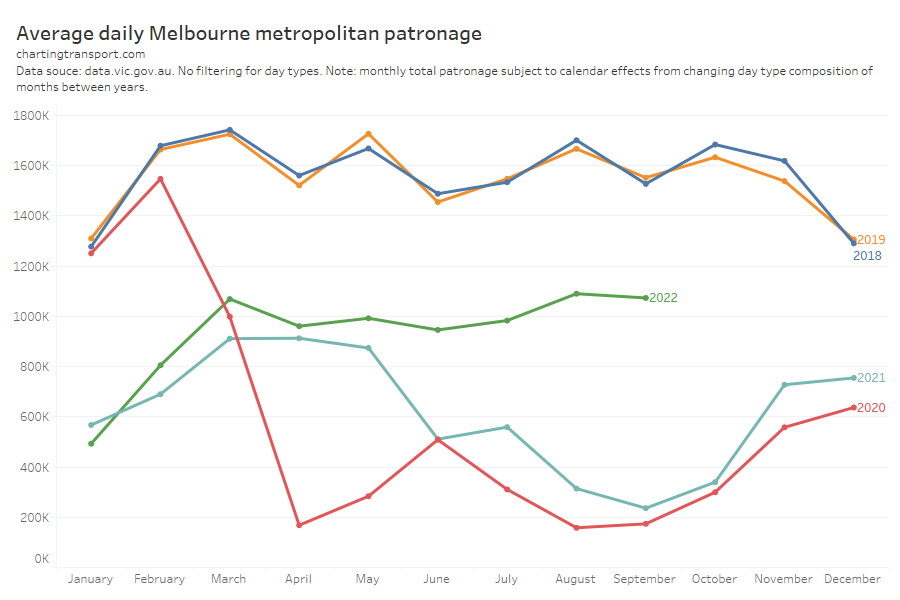
The next chart shows average daily patronage for metropolitan trains, trams, and buses in Melbourne based on published total monthly patronage data but not taking into account the different day type compositions of months between years (I’d much prefer to use average school weekday patronage data to avoid calendar effects, but that data series only ran as far as June 2022 at the time of writing).

This data suggests CBD private transport commuter volumes in 2022 might be a bit below 2019 levels, while there has been a substantial reduction in public transport commuting. This is consistent with what was seen in Adelaide in the 2021 census – mostly a mode shift from public transport to remote working. Furthermore, if there has been a significant increase in Melbourne CBD employment, private transport mode share (when you include remote working) is more likely to have declined below 2019 levels.

Is infection fear still influencing mode choice?

The largest COVID wave in Victoria (so far at the time of writing) occurred in January 2022 peaking at 1229 people in hospital and there was significant public transport patronage suppression (well beyond the usual summer holiday lull) as many people choose to stay home (or were sick and had to stay home). Infection fear was probably having a big impact, as I recall there were few restrictions regarding workplace attendance.

There was also a fairly large COVID wave in winter 2022 peaking at 906 hospitalisations in July, but the above chart shows no significant associated reduction in public transport patronage. This suggests infection fear was probably having a very small impact on transport behaviour in mid-2022.

Certainly in my experience few people are wearing masks on Melbourne’s public transport at the time of writing, but maybe a cautious minority have still not returned to the network.

Emerging indications are that public transport patronage is returning even more strongly in February and March 2023, which might reflect even lower levels of infection fear (hospitalisation numbers have also reached the lowest numbers since September 2021), and/or it might reflect a surge in population growth and CBD employment/student numbers. Things to keep an eye on over time!


What can the 2021 census tell us about working at home during the COVID19 pandemic?

Wed 1 February, 2023

10 August 2021 was an Australian census like no other. Sydney and Melbourne were under fairly strict “lockdown” restrictions due to the COVID19 pandemic, Brisbane was two days out of a lockdown, while Adelaide, Perth, and Canberra had temporarily eliminated COVID and were living a life of few restrictions.

So how did the way people go to work change? There’s lots to unpack on this question and I’ll do that over a few blog posts.

This post will focus on how many people worked from home in 2021, how many of these people were working remotely, how this compared across locked-down and COVID-free cities, which occupations were more likely to work from home in different cities, and what this might mean for future public transport patronage. I’ll also have a quick look at what proportion of employees were not working on census day.

What was happening on Census day 2021?

Melbourne and Sydney were in “lockdown” with workers required to work from home if possible, Brisbane was just out of lockdown, while the other cities were pretty much COVID-free, although Adelaide had experienced a short lockdown in July 2021. Here’s a summary of some key metrics (CBD office occupancy sourced from the Property Council):

*The Property Council reported a figure of 60% for August 2021, but this would have been illegal on 10 August as there was a 50% capacity limit. We don’t know the exact dates when the survey was conducted, I can only assume later in that month when restrictions were eased. 47% of Brisbane CBD employees reported working at home on census day.

How have mode shares changed between censuses?

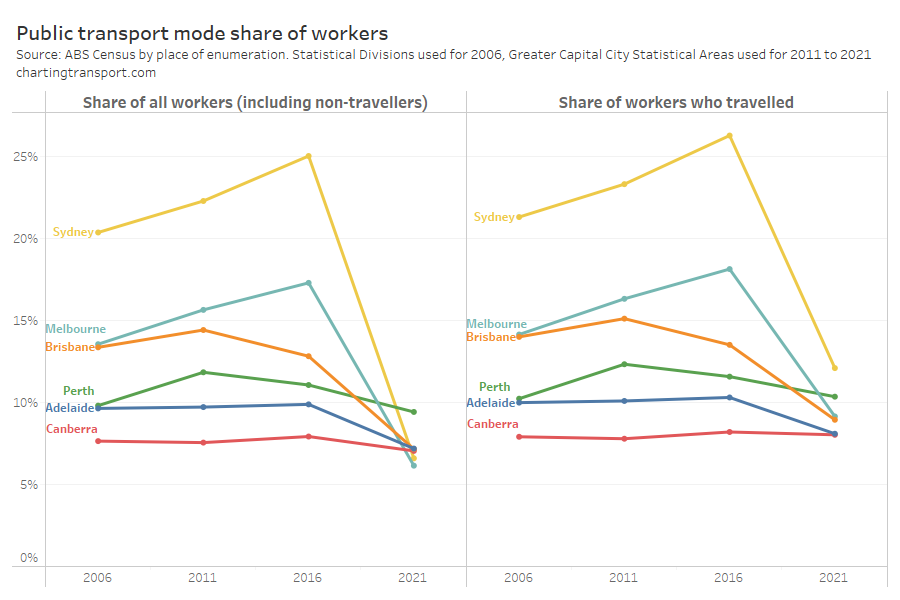
Given working at home now represents a much more significant share of all workers, I’ve calculated public transport mode shares both including and excluding people who travelled to a workplace:

It will be no surprise that public transport mode shares dropped dramatically in most cities. The biggest mode share drops were in the locked down cities of Melbourne and Sydney, but there were large falls also in Brisbane and Adelaide (which was also impacted by closure of the Gawler train line during 2021). Relatively COVID-free Canberra and Perth saw more modest reductions in line with the trend from 2011 to 2016, and for Canberra there was little change in the public transport mode share of people who did travel to work.

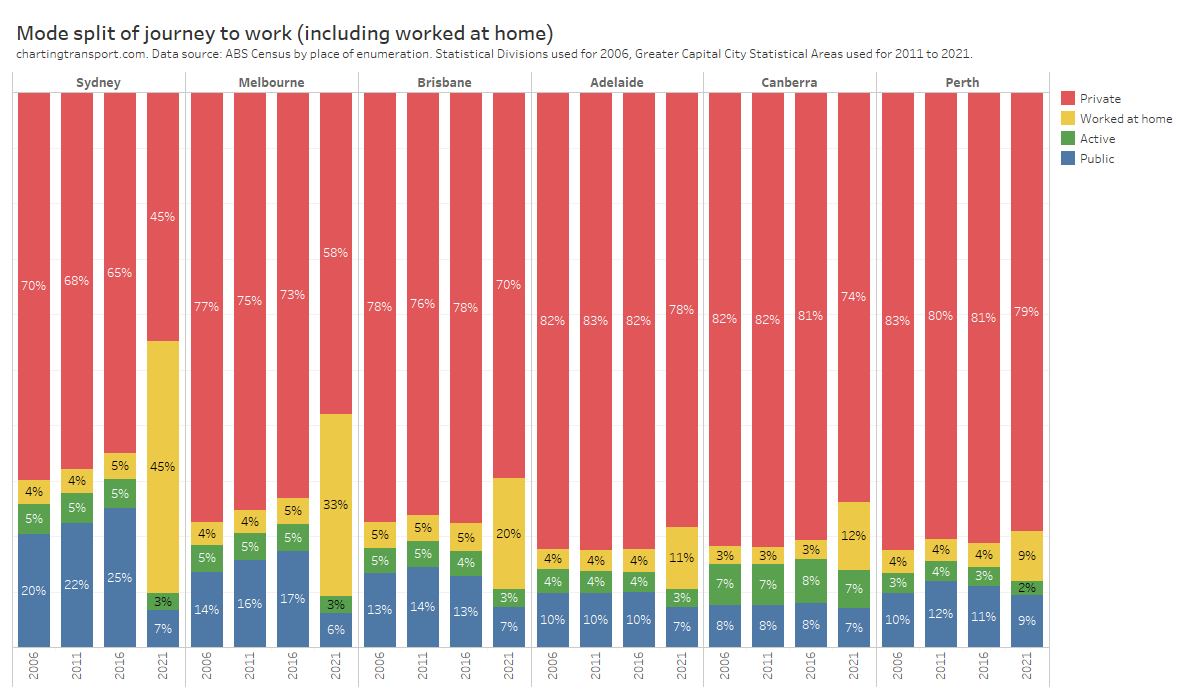
Here’s a look at the total mode split (including people who worked at home as a “mode”):

The largest rates of working at home in 2021 were unsurprisingly in the most COVID-impacted cities at the time.

The biggest mode shift in 2021 was from public transport to working-at-home, but there were also mode shifts away from active transport and private transport, even in the COVID-free cities.

How many people were working remotely?

All of Australia had experienced COVID lockdowns in March 2020, and for that period a significant portion of the workforce suddenly transitioned to working at home. What was a fringe activity in 2016 suddenly became the new normal for many employees and employers. This was most acutely noticed in the central business districts of our cities where office workers went almost entirely remote.

As discussed in my previous post on this topic, historically most people who worked at home on census day reported their work SA2 as the same as their home SA2, and I am assuming the vast majority of these people have their home as their regular workplace.

To better understand working at home, I’ve extracted worked at home counts from the 2011, 2016 and 2021 censuses, and then split the “worked at home” workers by whether or not their workplace SA2 was the same as their home SA2.

This allows an estimation of the number and share of people who worked remotely and those who regularly worked at home. I say estimation because the ABS aims to protect privacy by “randomly” adjusting small numbers in downloadable data and never reports values of 1 or 2. When I add up the number of people remote working within Greater Melbourne in 2021, 22% of that total comes from counts of 3 people between specific home SA2 – work SA2 pairs (Sydney was 21%, Brisbane 24%, Perth 29%). The true count for many of these pairs will not be exactly 3 people, so summing lots of small volumes that are “randomly adjusted” may result in a biased accumulation of small number errors. For 2011 and 2016 the summation of remote workers includes an even larger share of 3s so I’m not going to give the summation value here, but I’m confident the true summation is still tiny (much less than 1%).

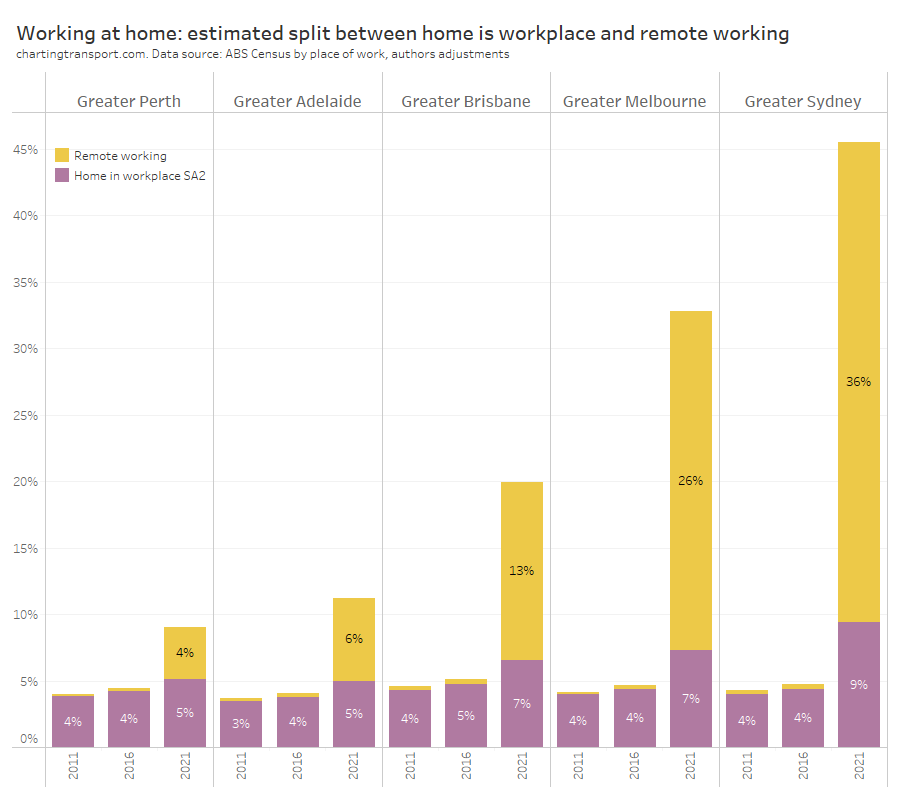
These imperfect estimates of “home in work SA2” share and “remote working” shares don’t perfectly add up to the known total working at home share for the city (eg Sydney the sum was 2% over the actual for 2021 but other cities were pretty close). For want of a better method, I’ve scaled these estimated volumes such that their sum equals the known total worked at home volume, and I’m not going to quote any decimal places.

Here are my estimated shares of workers who classify as “remote working” and “home in workplace SA2” by census year:

The pre-COVID regularly working at home rates were mostly around 4-5%, but this was estimated to have increased significantly in Sydney, Melbourne, and Brisbane in 2021. I suspect this is a mix of people who gave up their regular workplace and permanently shifted to working at home and some people who filled in the census inaccurately and indicated that their workplace at the time was their home, even though that might have been a temporary arrangement during COVID restrictions.

The COVID-free cities experienced remote working rates of only 4-6%, whereas the heavily restricted cities of Sydney and Melbourne had remote working rates of 36% and 26% respectively.

Where was remote working most common?

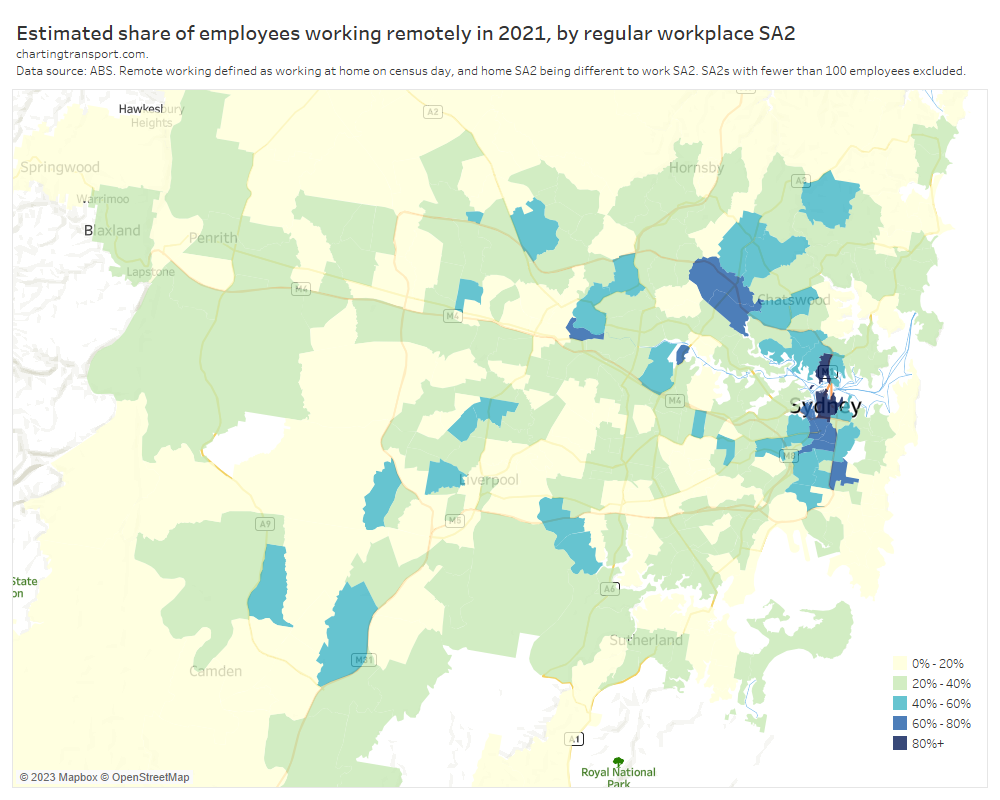
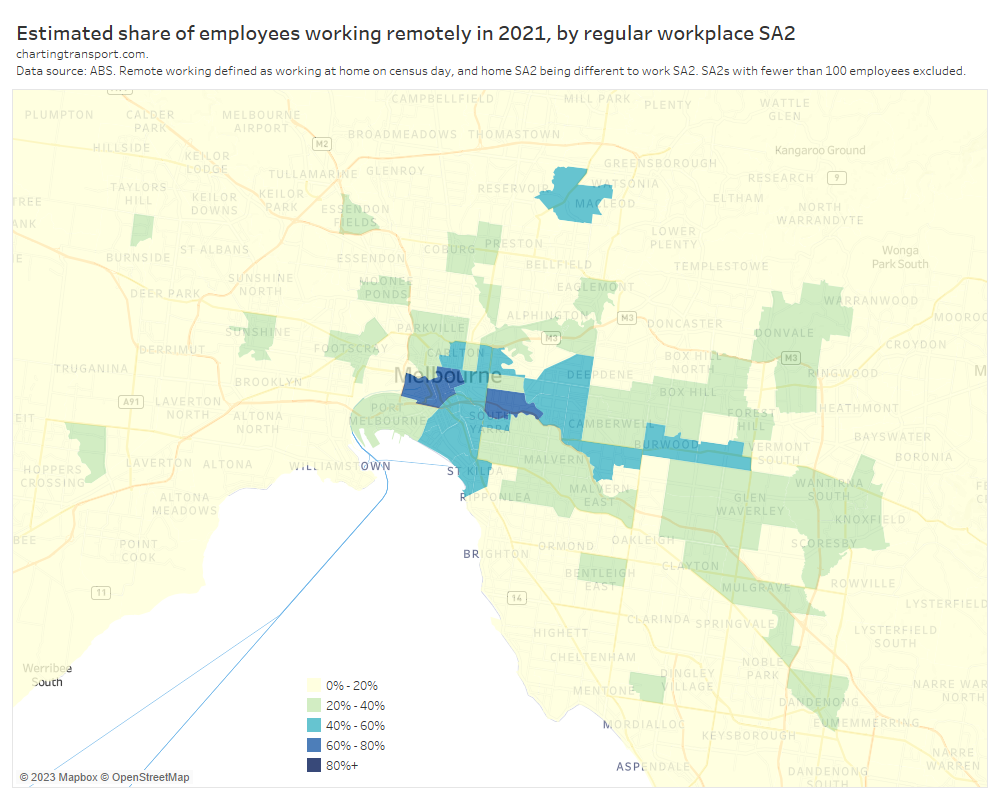
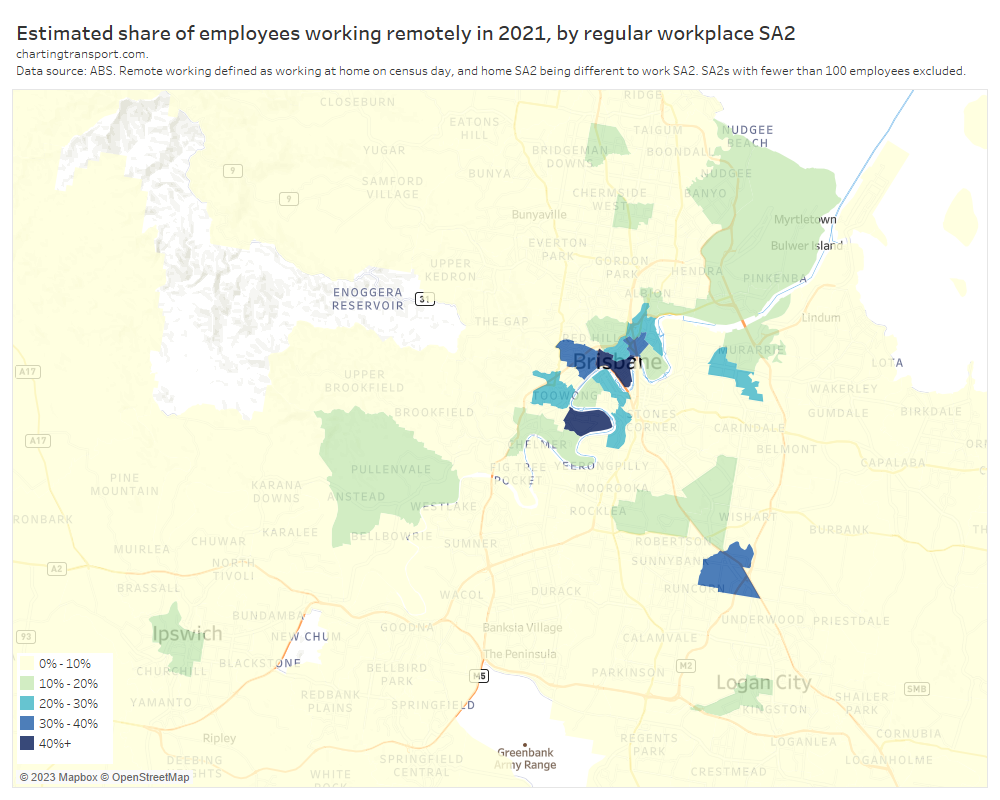
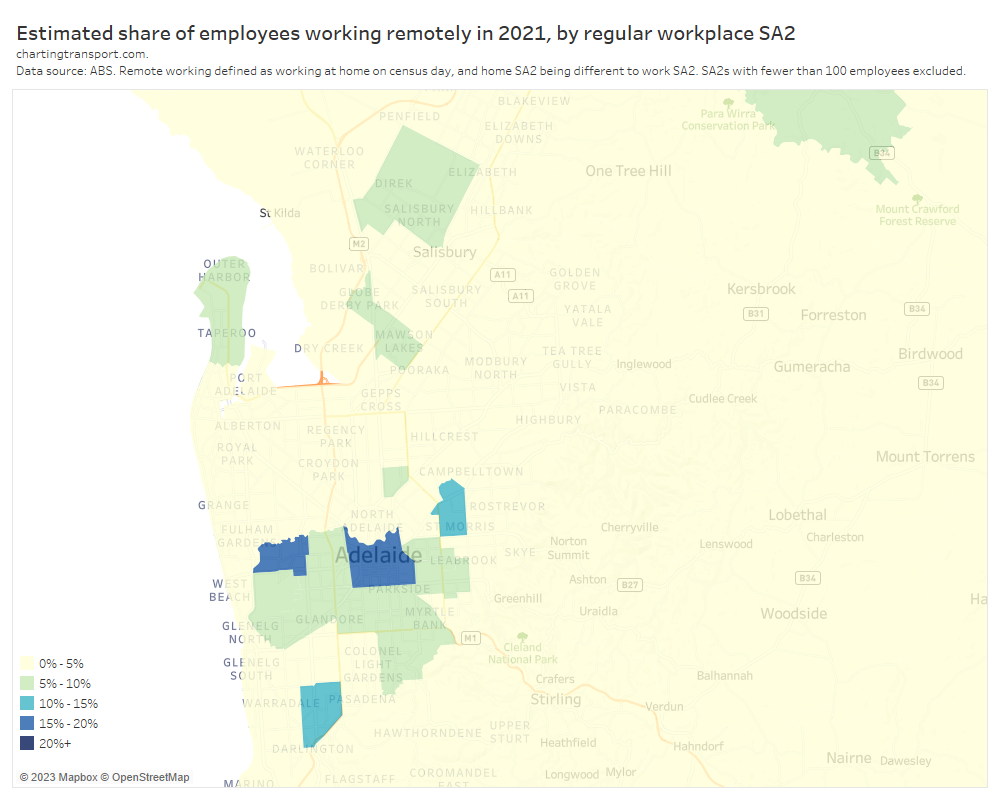
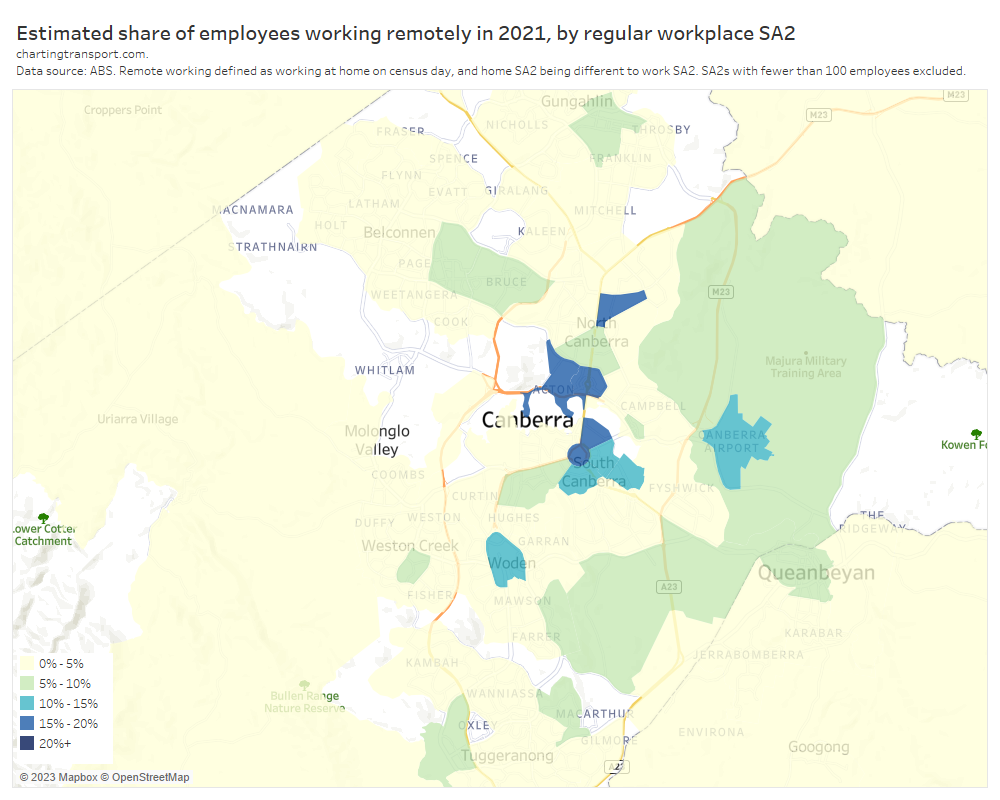
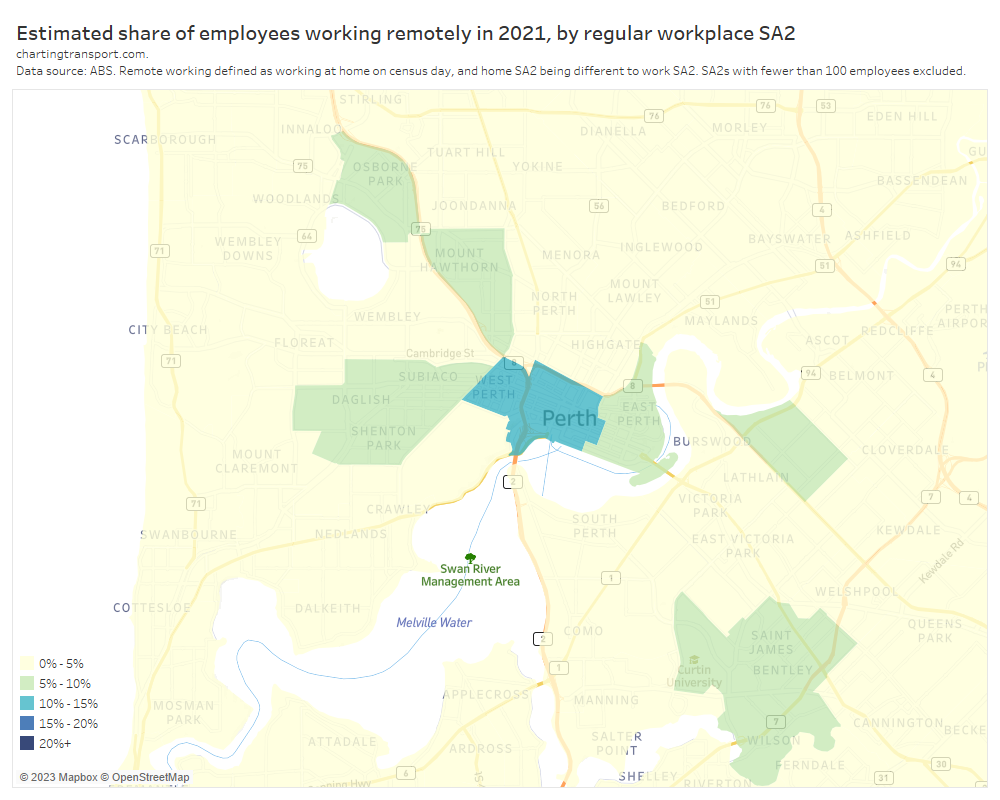
What follows are maps showing estimated rates of remote working for workplace SA2s across the five big cities. There’s definitely an issue of aggregating many small numbers that are ‘randomly adjusted’, so I’m not going to report exact numbers, but rather classify SA2s into bands.

Here are the remote working hotspots for Sydney:

The highest rates of remote working were seen for workplaces in the dense employment areas of central Sydney, North Sydney, Macquarie Park / Ryde, Parramatta, Rhodes, and Kensington (which is dominated by a university campus). All white collar hotspots.

Here’s Melbourne:

Melbourne had a lot fewer remote working hotspots, in line with it having a lot fewer suburban employment clusters (see: Suburban employment clusters and the journey to work in Australian cities). Apart from the central city and inner suburbs, remote working hotpots included SA2s with large university campuses such as Kingsbury, Burwood, and Hawthorn.

Remote working was less prevalent in Brisbane so I’ve used a different colour scale:

And for the COVID-free cities I’ve used an even smaller colour scale and focussed on SA2s that had rates above 5%.

Adelaide:

I’m not sure why there was a relatively high rate of remote working in Lockleys in the inner-west. Does anyone have any thoughts on this?

Canberra:

Perth:

Remote working was unsurprisingly more common in CBDs, some inner-city SA2s that contain concentrations of white collar employment, and some suburban SA2s that contain universities.

Central business districts are obvious areas to see high levels of remote working. My next post in this series will focus in more detail on changing commuter patterns for CBD workers in Australia’s five biggest cities.

Which occupation types transitioned to working at home?

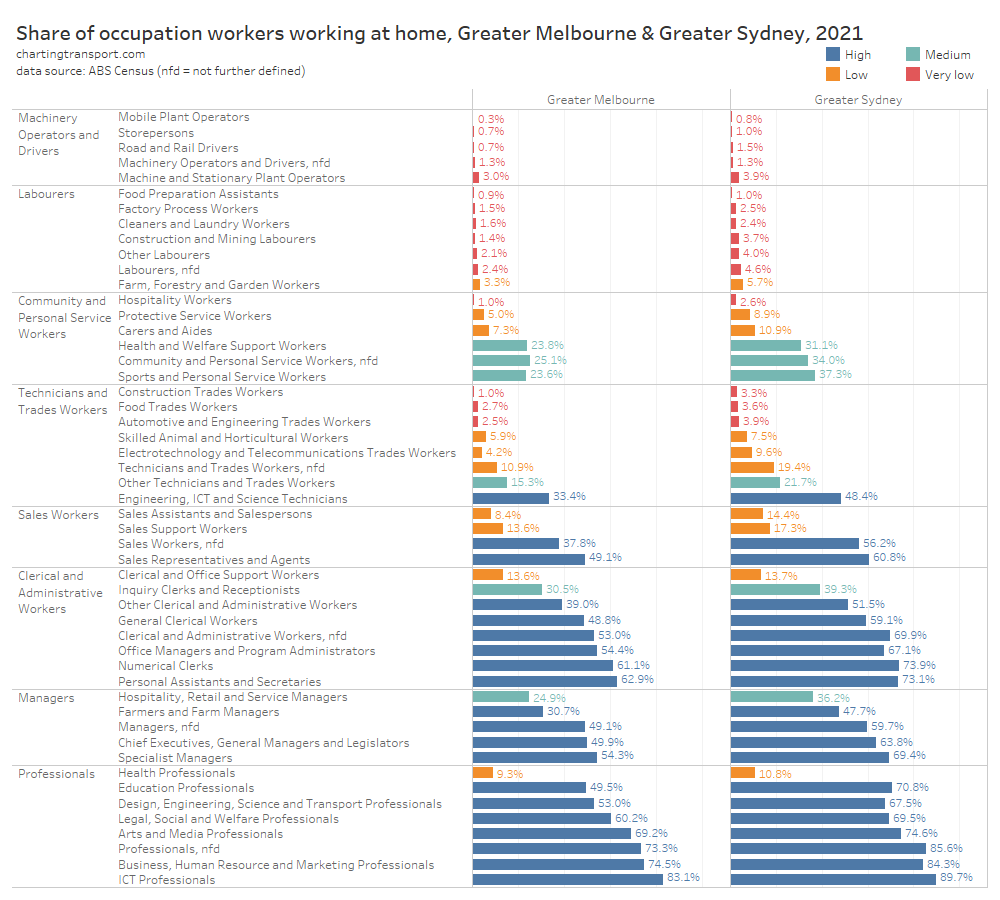
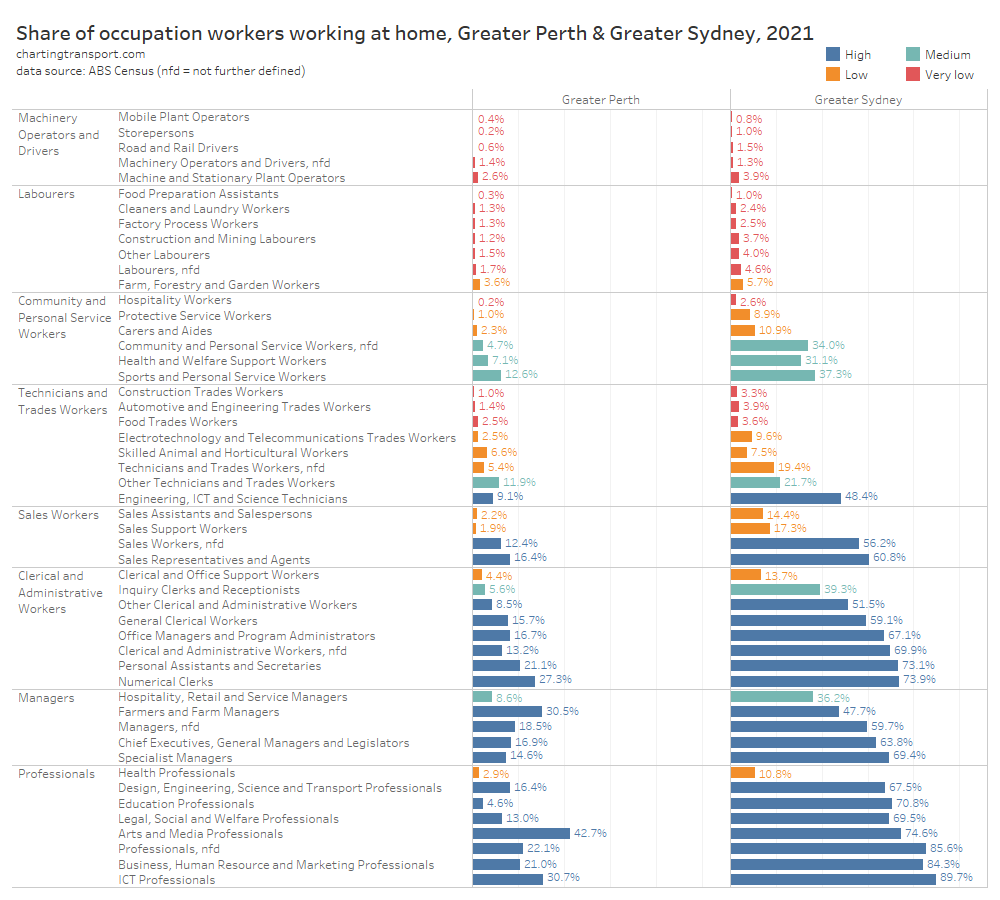
The following chart shows the rates of working at home by occupation for locked down Sydney and Melbourne in 2021:

As you read down the occupations listed there are no great surprises, with white collar jobs showing much higher rates of working at home. I’ve classified the occupations into four different bands of working at home rates based on conditions in locked-down Sydney and Melbourne. I’ll re-use these groupings for other cities shortly.

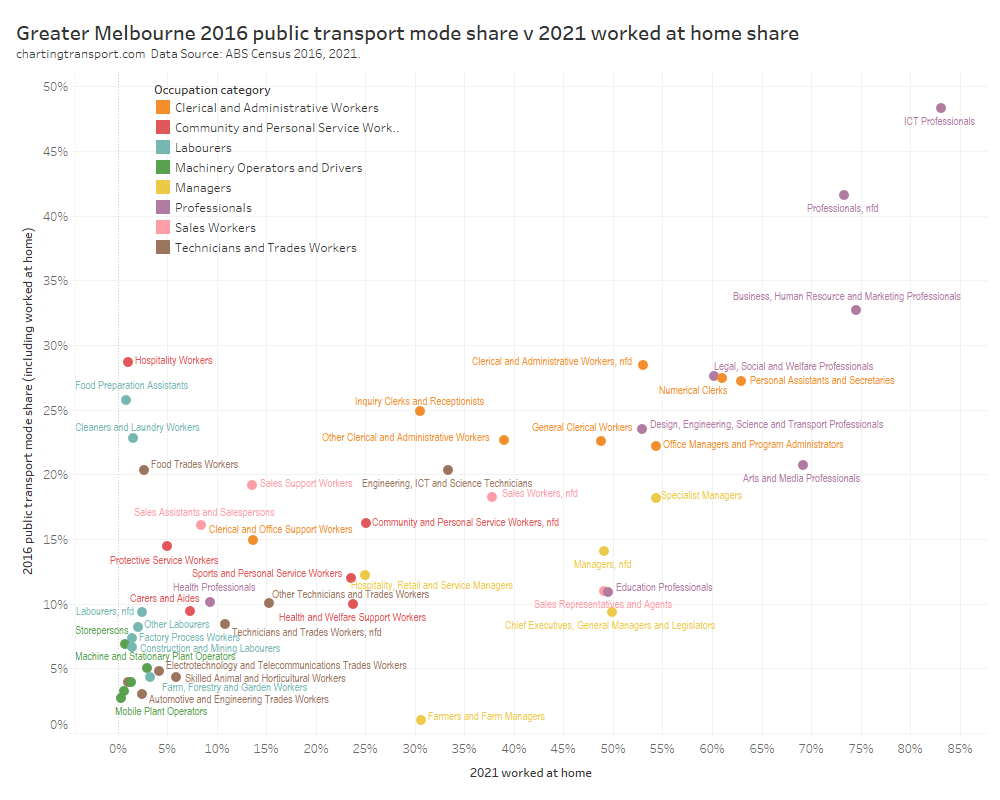
Many of these occupations had high public transport mode shares in 2016 (at least for Greater Melbourne), which is consistent with the dramatic drops in public transport volumes and mode share:

Many of the occupations with high public transport mode share in 2016 had high rates of working at home in 2021 (top right quadrant of the chart).

How do locked down cities compare to COVID-free Perth in 2021? The following chart includes Sydney and Perth for comparison purposes:

The occupations with relatively higher rates of working at home in Perth 2021 were fairly similar to those in Sydney, just at a much smaller scale (about four times). Occupations with much lower working at home rates in Perth than Sydney include education workers (schools and universities were not running remotely in Perth). Arts and media professionals topped working from home in Perth – but this occupation group also had relatively high rates of working at home in 2016. Other occupations with high levels of working from home in Perth were famers and farm managers (for obvious reasons) and ICT professionals (likely very adaptable to working remotely).

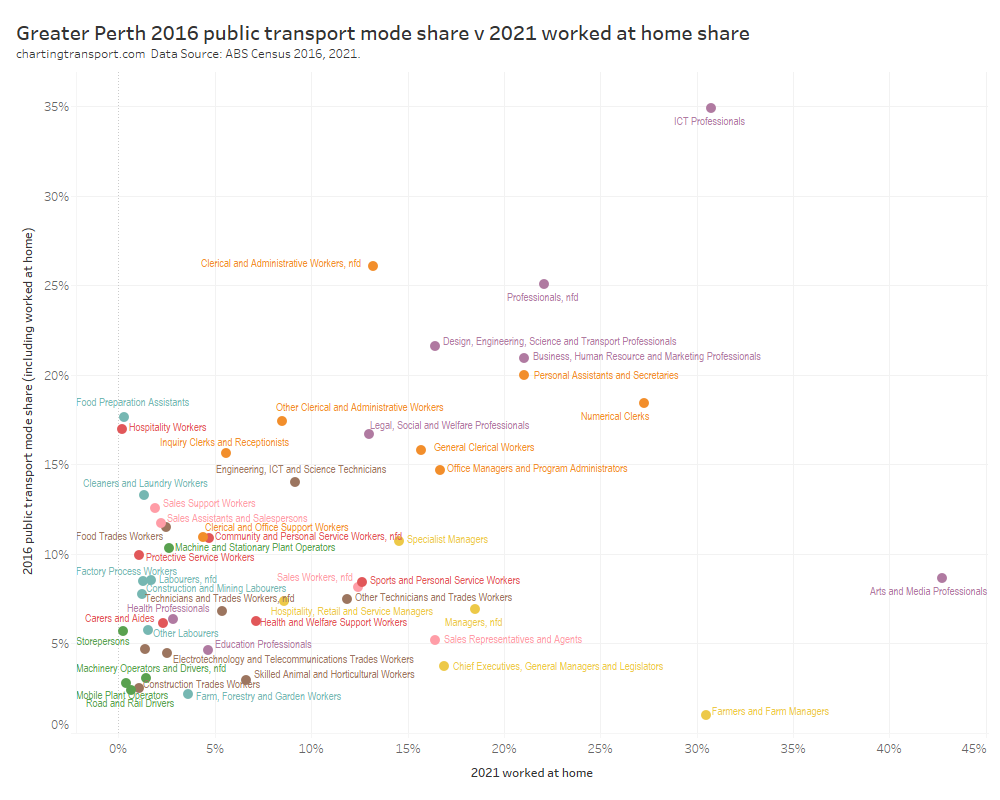
The following chart again compares 2021 working from home mode shares with 2016 public transport mode shares, but this time for Perth:

The same white-collar jobs appear in the top-right of the chart, suggesting a significant mode shift from public transport to working at home.

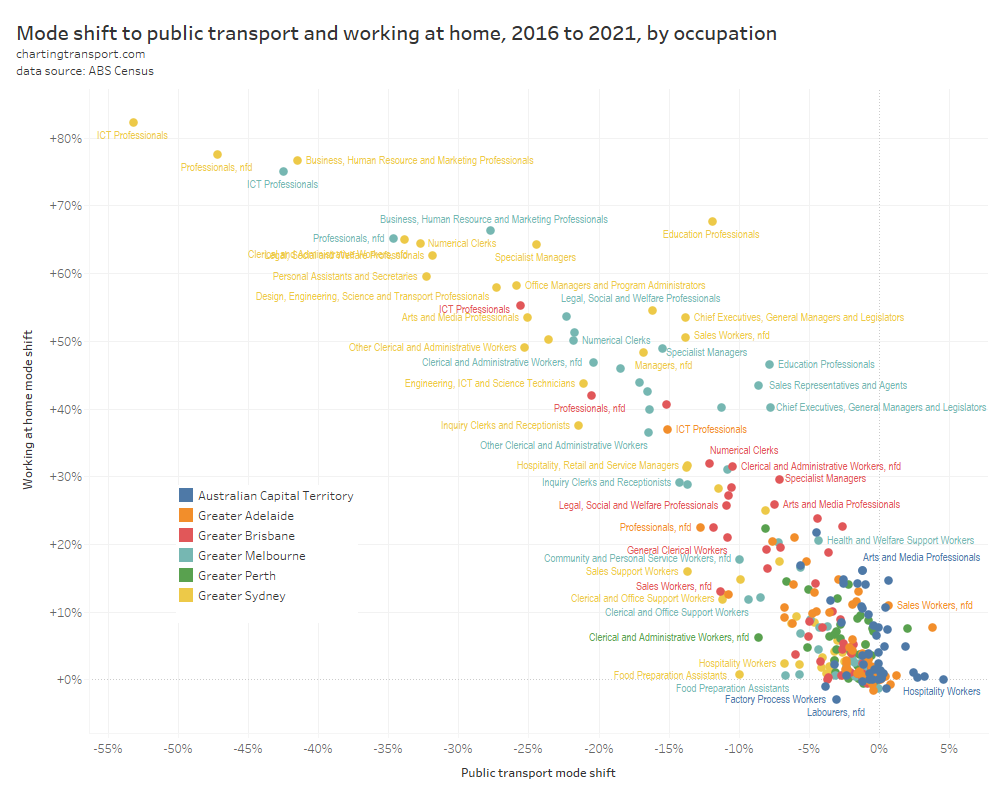
Here’s a look at public transport and worked-at-home mode shifts by occupation across the six big cities:

You can clearly see the relationship between public transport and home-working mode shifts, particularly for Sydney, Melbourne, and Brisbane. The relationships is very roughly that the working at home mode shift was around double the public transport mode shift. However the relationship is a little less clear in Adelaide, Perth, and Canberra.

I think this tells us that occupations that had high rates of public transport use in pre-pandemic times are mostly the same occupations that are highly amenable to working remotely. And of course these occupations have concentrations of workers in CBDs (hence the high use of public transport). To the extent that employers facilitate ongoing working from home, there will likely be a reduction in public transport commuter volumes. From a congestion and emissions point of view, that’s undoubtedly a good thing. There are of course also arguments about the agglomeration benefits of workers being physically in the same place.

Are occupations more amenable to working from home on the rise?

Thinking to the future, are these occupations with higher rates of working at home in 2021 on the rise or decline? The following chart attempts to answer this question:

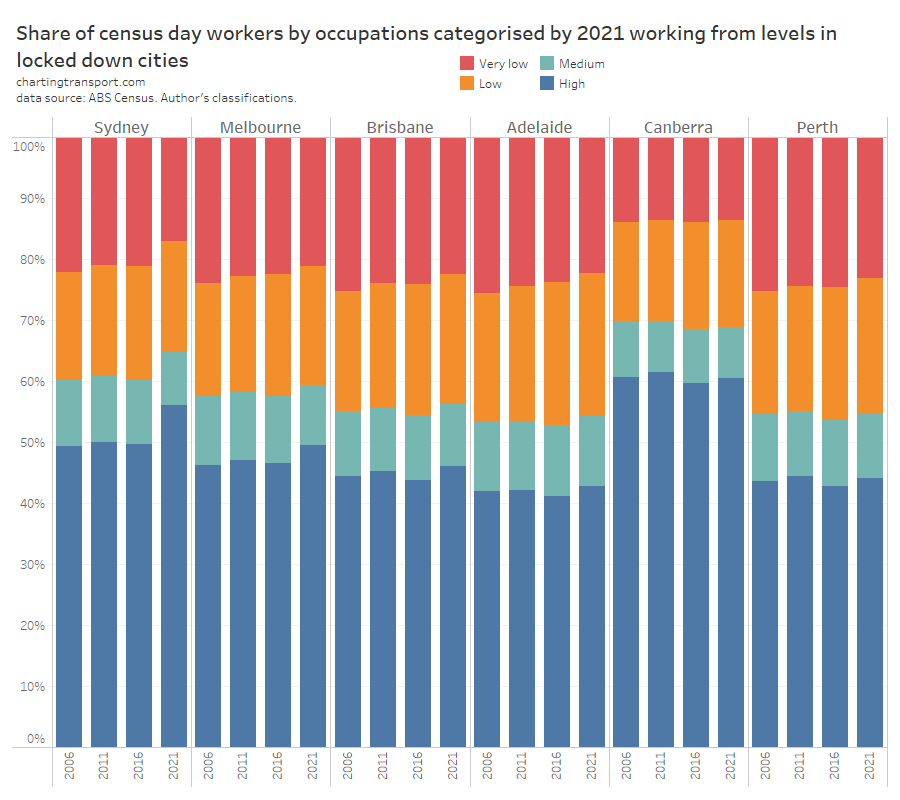
Unfortunately I’m not sure the chart provides a clear answer. Many people were simply unable to work due to lockdowns on census day in Sydney and Melbourne. They aren’t on the chart. This appears to skews the overall share of jobs by category in those cities to the “High” end.

In the COVID-free cities, there doesn’t appear to be a clear trend over time. In 2016 the “High” occupations reduce share in all cities but then bounced back up in 2021.

However one important insight from this chart is that Canberra has the largest share of “High” occupations – followed by the bigger cities of Sydney and Melbourne. These cities are likely to have more specialist white collar professionals, and therefore they may have higher overall rates of ongoing remote working in the post-pandemic world. Public transport patronage will likely take longer to return to pre-pandemic levels these cities.

One final thing…

How many people were not working on census day in 2021?

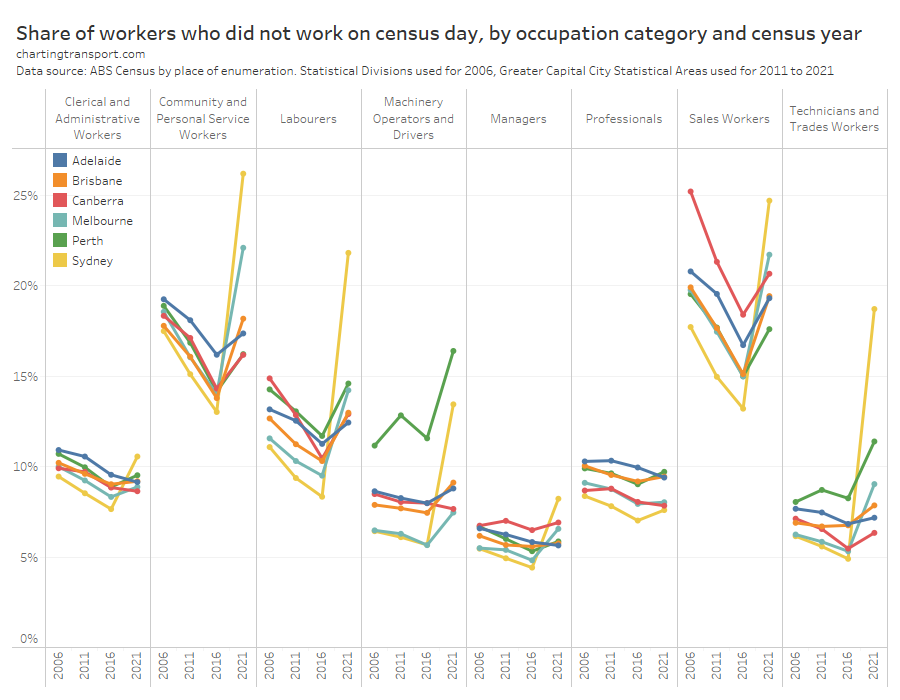
Not every employed person works on census day, perhaps because they work part-time, casual, shift-work, or were unable to work that day. And of course in August 2021 a lot more people than usual were unable to work in Sydney and Melbourne. Here’s a look at the share of employed people who did not work on census day, by occupation category and census year:

After a downwards trend between 2006 and 2016, most occupation categories in most cities had a big uptick in not working on census day in 2021, most notably in Sydney where there were very strict lockdown rules. Curiously these upticks were present even in COVID-free cities like Adelaide, Perth, and Canberra, possibly reflecting an overall economic downturn, a lack of interstate and international travel, supply chain breakdowns, and/or maybe some other factors.

I hope you’ve found this post interesting. I’ll be unpacking more census data in some upcoming posts, including a more detailed look at CBD workers and a look at changes in demographics – particularly from the impact of suspending immigration during the pandemic. Stay tuned.