Trends in car ownership

Sun 7 August, 2011

[post updated in April 2016 with 2015 data. For some more recent data see this post published in December 2018]

Is the rate of car ownership still growing in Australia?

Firstly, by car ownership rate I mean the ratio of the number of registered “passenger vehicles” (from the ABS Motor Vehicle Census) to population (also from ABS). So while some of the measures in the post are not strictly for cars only, I’ve not worried too much about the distinction because I’m most interested in the trends.

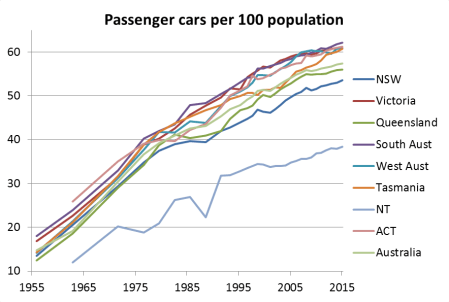
The oldest motor vehicle census data is from 1955, and it is no surprise to see car ownership rates in Australia have risen considerably since then:

What is interesting in this chart is the relative rate of car ownership between states and territories. The Northern Territory is consistently the lowest – I’m guessing related to remote indigenous populations with low car ownership. New South Wales may reflect the relatively dense Sydney where car ownership is less important for many. I’m not sure of the reasons for other differences. It might be slight differences in reporting from the state agencies (see ABS’s explanatory notes).

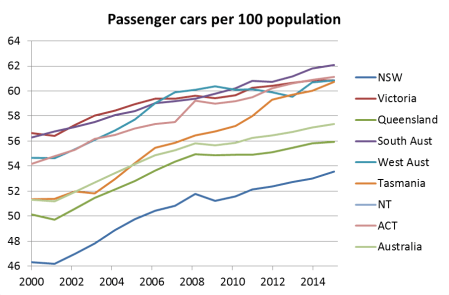
But what about the most recent trends? Here is the same data from 2000 onwards (NT off the chart): 

You can see growth across all states, although there are several periods where some states flat-lined, particularly around 2008.

So while we have reached peak car use, we haven’t reached peak car ownership as a nation.

What about car ownership in cities?

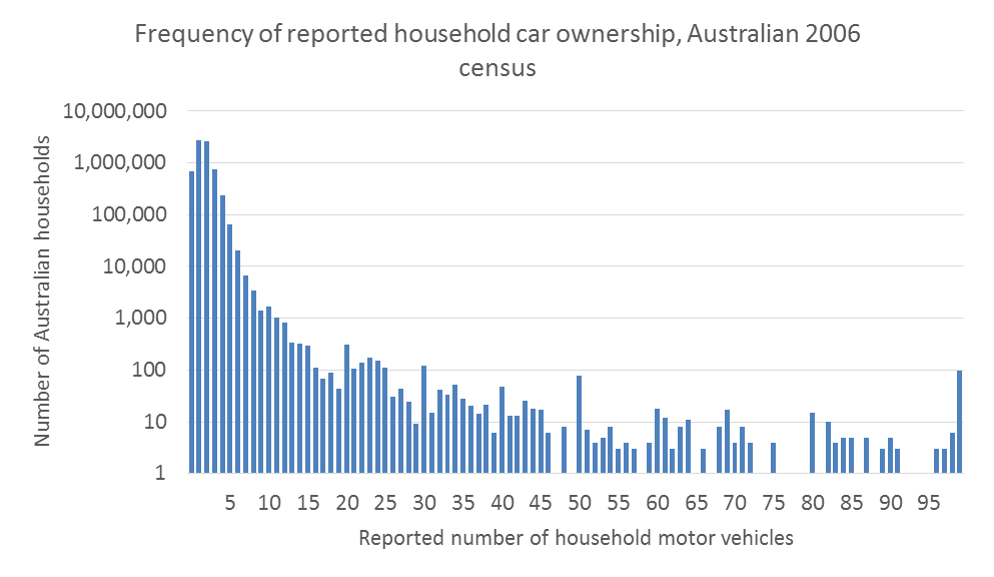
Motor vehicle ownership data is also available from the census, with data provided on the number of households with different numbers of vehicles. The 2006 census reported the number of households with every number of motor vehicles 0 to 99, and here is the frequency distribution:

household car frequency 2006

In 2011 census data ABS only report the number of households with “4 or more” motor vehicles. I’ve calculated the average number of cars for this category for 2006 for each city and applied that to the 2011 data to get total motor vehicle estimates for 2011.

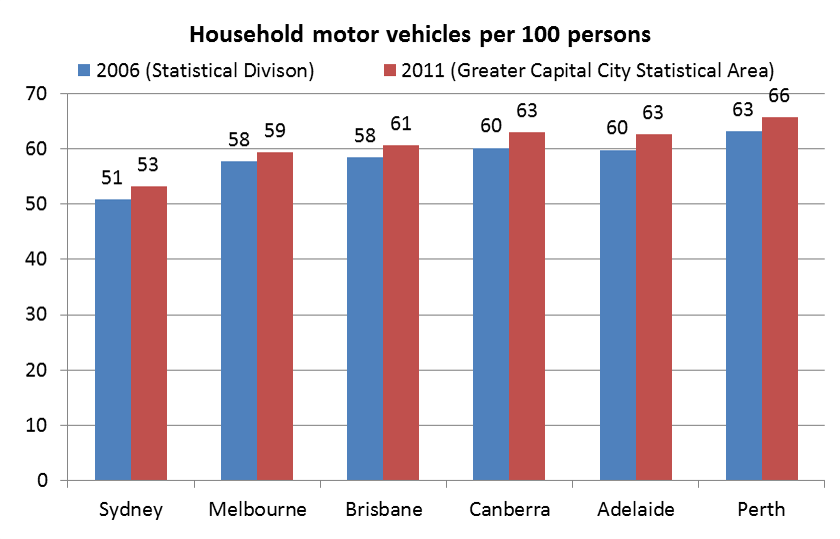
The following chart shows household motor vehicle ownership rates for major city areas for 2006 and 2011 (boundaries changing slightly to include more peripheral areas that are likely to have higher car ownership):

City car ownership 2006 and 2011

Sydney has the lowest rate of motor vehicle ownership, and Perth the highest, with Melbourne showing the least growth.

Here is the relationship between car ownership and journey to work by car-only:

car ownership v car JTW

While all cities had an increase in car ownership between 2006 and 2011, all but two had a reduction in car-only mode share of journeys to work. They were Adelaide and Canberra which also had the largest increases in car ownership rates.

While cities overall show increasing ownership rates, there were reductions in motor vehicles per capita in many municipalities between 2006 and 2011, including the City of Perth, the City of Melbourne, the City of Adelaide, the City of Willoughby, and the City of North Sydney. This suggests car ownership is in decline in some inner city areas of Australian cities (more spatial detail for Melbourne is available in another post). These areas generally have good public transport and many local services within walking distance, and I’d guess many new residents are not bothering with car ownership.

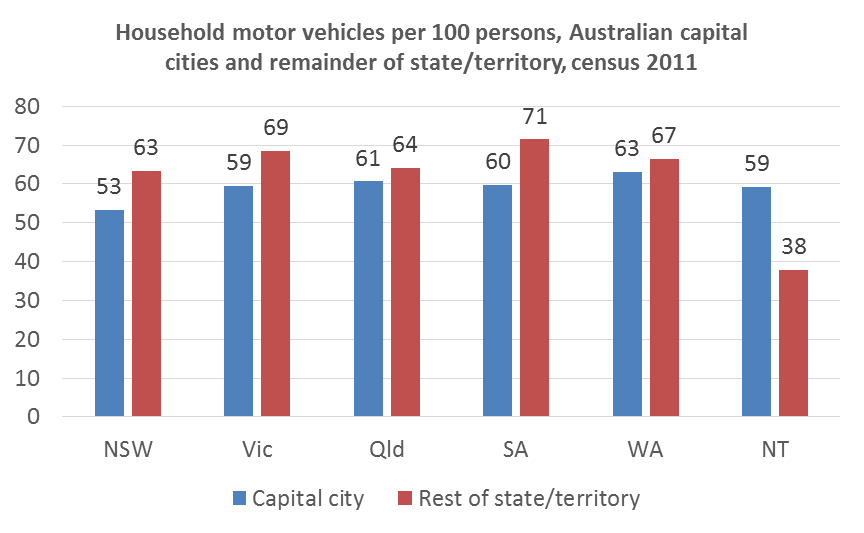
The following chart compares motor vehicle ownership rates between capital city areas and the rest of each state or territory for 2011 census data:

car ownership capital v rest of state 2011

Car ownership is certainly higher outside most capital cities – except in the Northern Territory as I suspected (curiously Darwin has around the same car ownership rate as Melbourne).

How does car ownership vary by demographics?

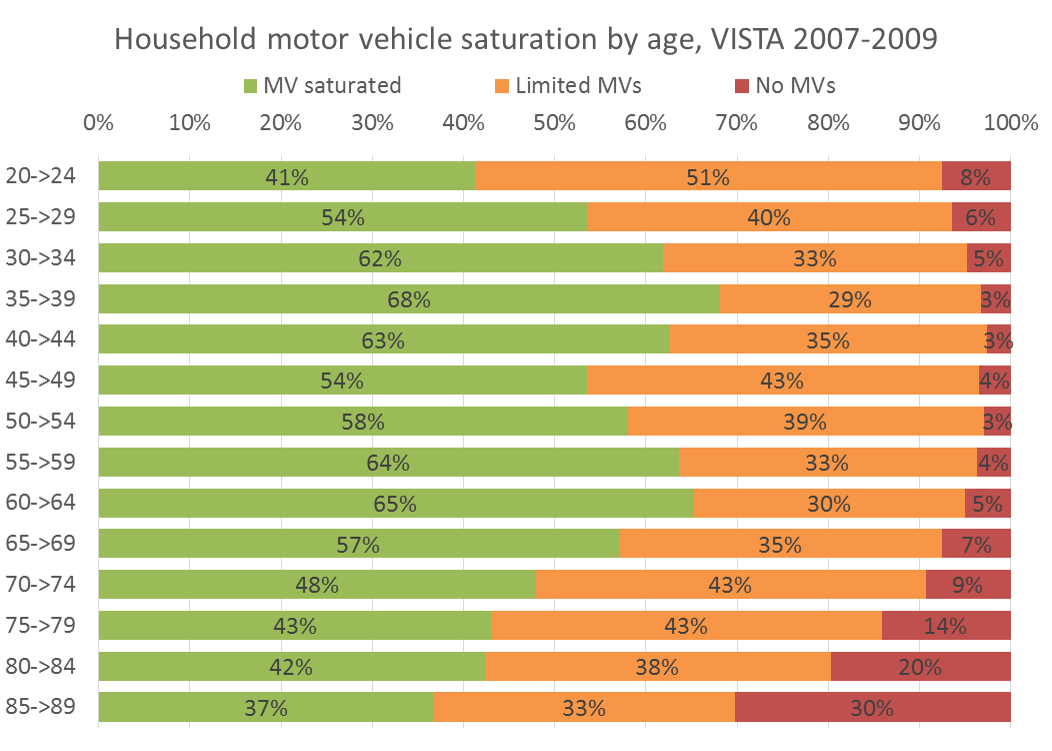
The Victorian Integrated Survey of Travel and Activity (VISTA) provides detailed data about households in Melbourne and regional Victorian cities for the years 2007-2009. So while I cannot extract trends, we can look at the patterns of car ownership rates.

I have classified all households in the VISTA dataset into one of three categories:

  • household with no motor vehicles
  • limited motor vehicle ownership: less motor vehicles than people of driving age (arbitrarily defined as 18-80), or
  • saturated motor vehicle ownership: motor vehicle count equals or exceeds the number of people of driving age (“MV saturated” in the chart).

mv ownership by age draft

You can see that people aged 35 to 59 are least likely to live in households without motor vehicles, while younger adults are most likely to live in a household with limited car ownership. There are curiously two peaks in saturated car ownership – aged 35-39 and 60-64. The saddle in between might be explained by family households with driving age children.

The following chart looks at household car ownership by household type, with “young families” classed as households where all children are under 10 years of age.

mv ownership by hh status

Some very clear patterns emerge, with households incorporating parents and children very likely to own at least one motor vehicle. Sole person households were most likely to not own a motor vehicle. Limited motor vehicle ownership was most common in “other” household structures, parent+children households with older children, and couple households with no kids.

It seems Australians find car ownership a high priority if they have young children. Other analysis on this blog found that such households also have the lowest rates of public transport use, and a very strong inverse relationship between motor vehicle ownership and public transport use.

What about usage of each car?

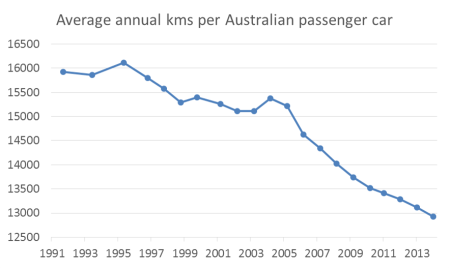
Using data from the BITRE 2015 yearbook, it is possible to calculate estimated annual kms per passenger car. For this I’m comparing the number of vehicles at the motor vehicle census date with an estimate of total car kms in the previous 12 months (straight line interpolation of BITRE year ending June figures). This isn’t a perfect measure as the number of cars grows throughout the 12 month period where kilometres are taken, but it is still a guide to the trend.

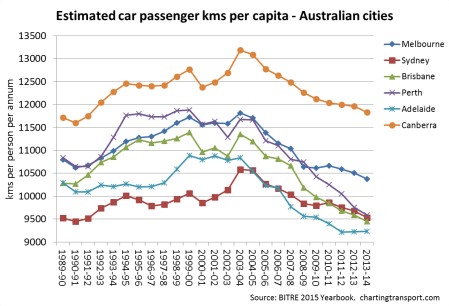
The steeper downwards trend since 2005 is similar to the downwards trend in car passenger kms per capita in Australian cities:

Since around 2005, car ownership has continued to rise while car passenger kilometres per capita has fallen. This suggests we are driving cars shorter distances and/or less often.

What about motorcycles?

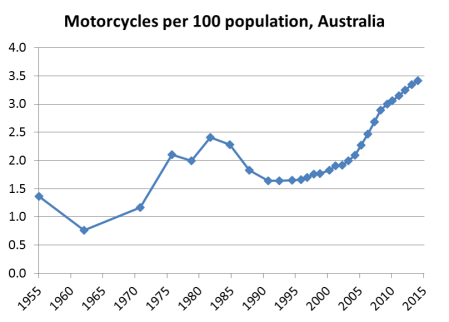
Are more people owning motorcycles instead of cars? Here’s the long-term trend:

You can see motorcycle ownership rates peaked around 1980, dipped in the mid 1990s and have grown significantly since around 2004 (although still very small). Does it explain the slowdown in the car ownership rate from 2008?

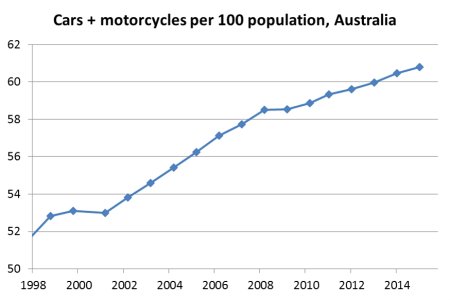
This chart still shows a slow-down after 2008, so it doesn’t look like rising motorcycle ownership fully explains the slow-down in car ownership. Motorcycle ownership took off in 2004, but car ownership slowed in 2008.

What about the ageing population?

Could the data be impacted by a changing age profile? We know that older aged people are less likely to have their driver’s license and are more likely to live in a household with lower car ownership (refer above), so maybe this would lead to a declining car ownership rate per head of population as a greater portion of the population is older.

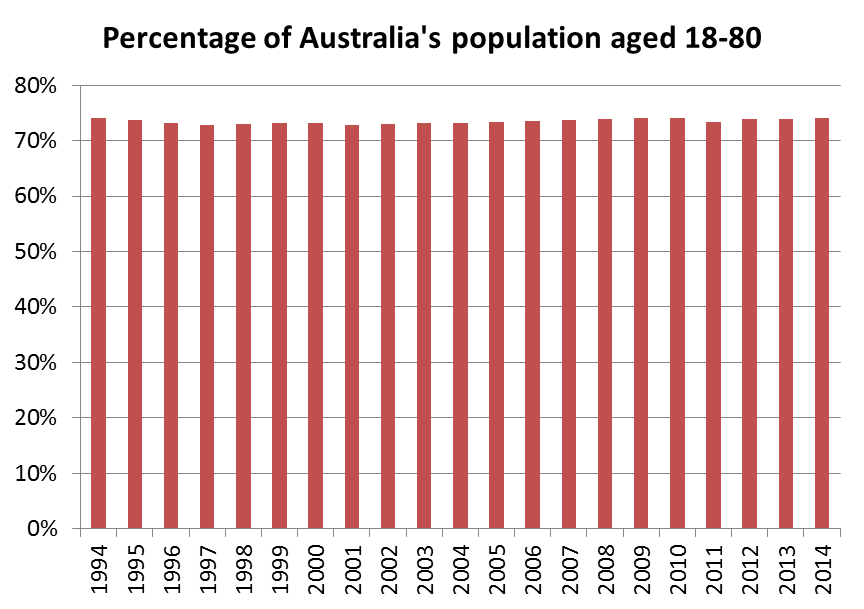
Suppose most car owners are aged 18 to 80 years. Here’s the percentage of Australia’s population within that age band:

Population aged 18-80

The share has been very steady at around 73 to 74% for all of the last 21 years, which suggests little impact on overall car ownership rates. Then again, those aged 80 today are more likely to have a driver’s license that those aged 80 in 1994. So the rate of car ownership of younger people has probably grown less. We know their rate of driver’s license ownership has declined over time, but I’m not aware of any readily available data that would confirm a lower rate of car ownership by younger people over time (it’s probably available from the Sydney Household Travel Survey datasets).

Notes on the data:

  • The ABS Motor Vehicle Census has been taken in different months in different years. State population estimates are only available on a quarterly basis. I have used the nearest quarterly population figure for each motor vehicle census where they do not align (never more than one month out).

A simple look at passenger transport trends in Australian cities

Sat 25 June, 2011

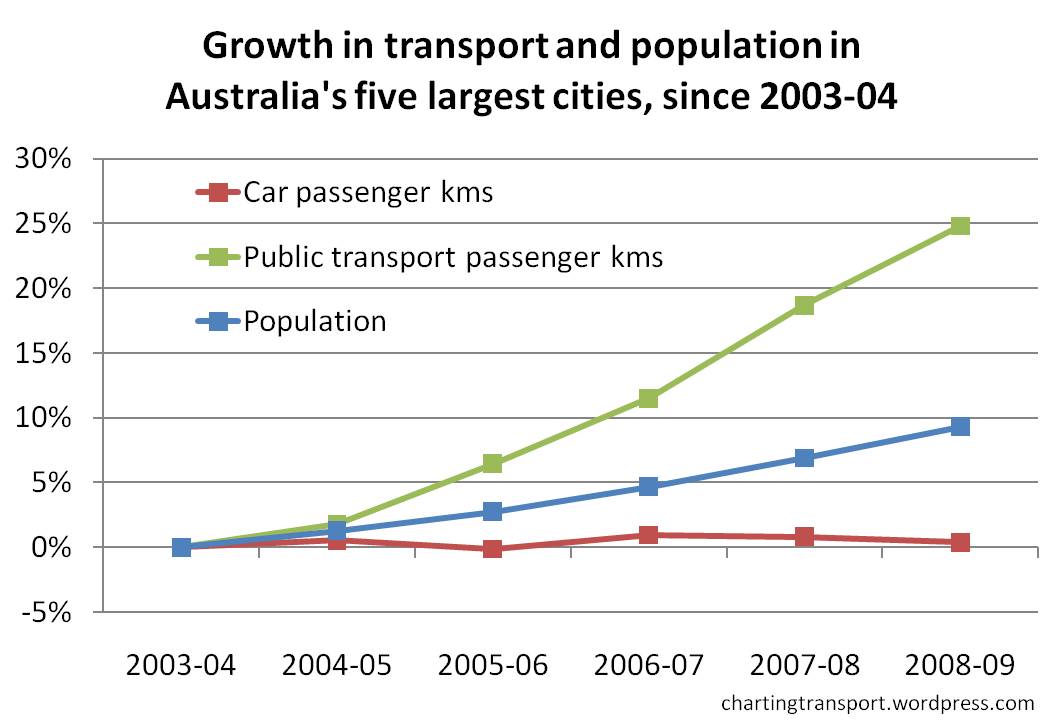
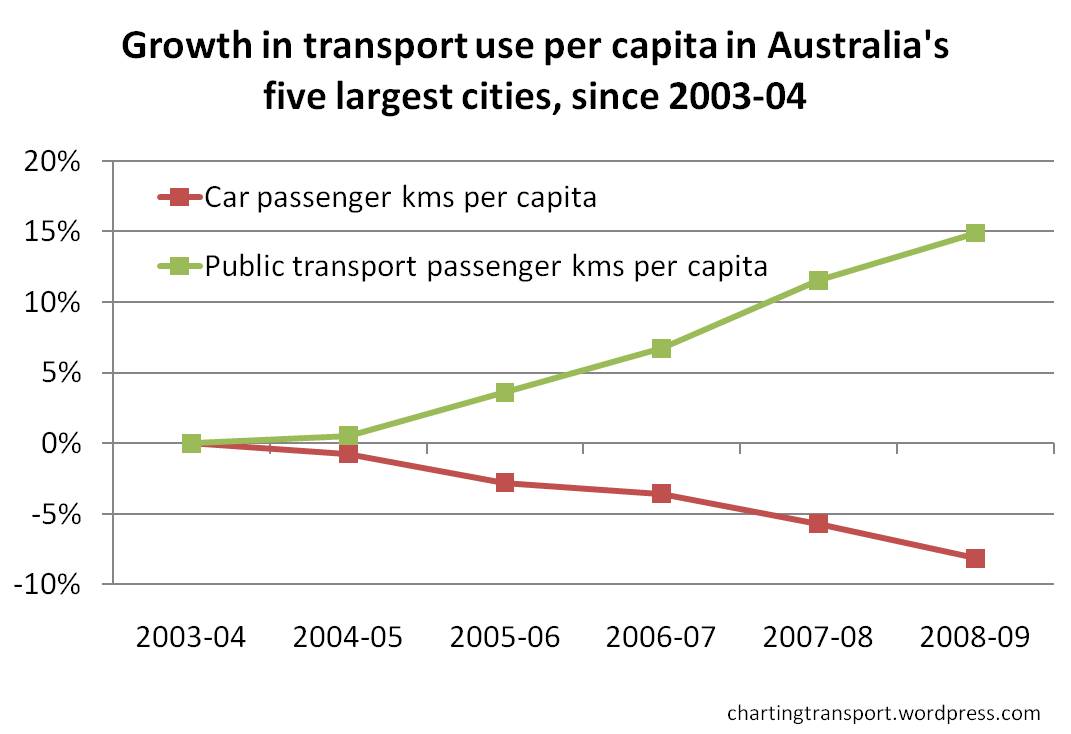
While I’ve covered passenger transport trends in detail in another post, here are a couple of simple views of the data that provide a pretty stark summary of the recent mode shifts:

Or per capita growth:

I think those charts mostly speak for themselves.

(For the record, the five biggest cities are Sydney, Melbourne, Brisbane, Perth, and Adelaide)

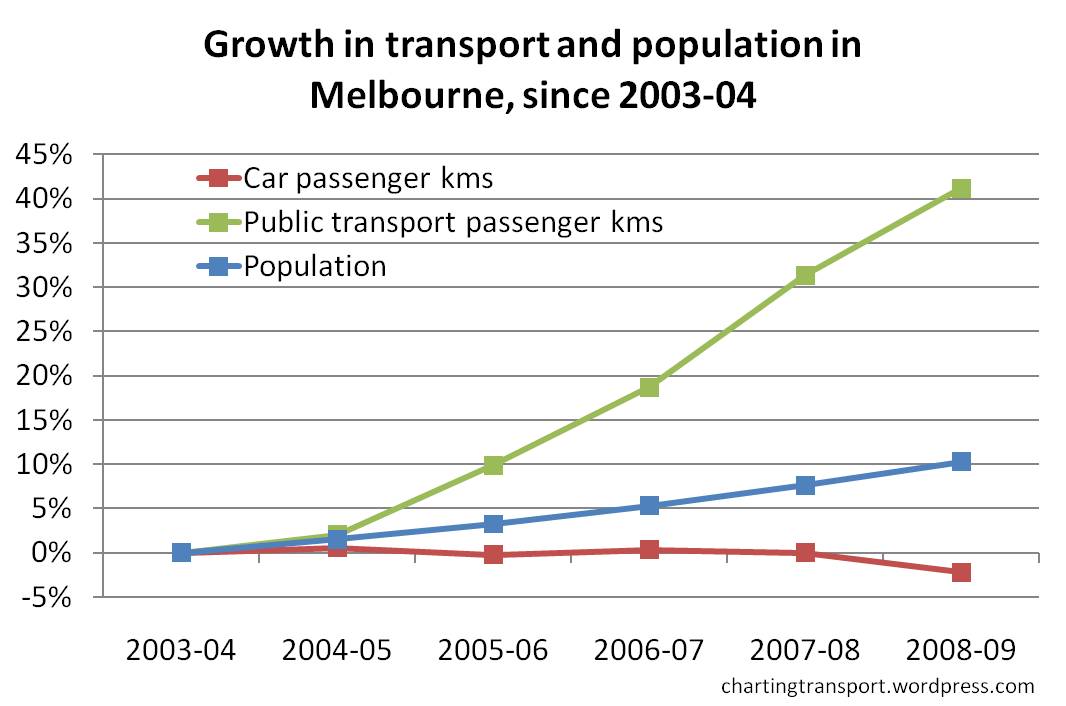
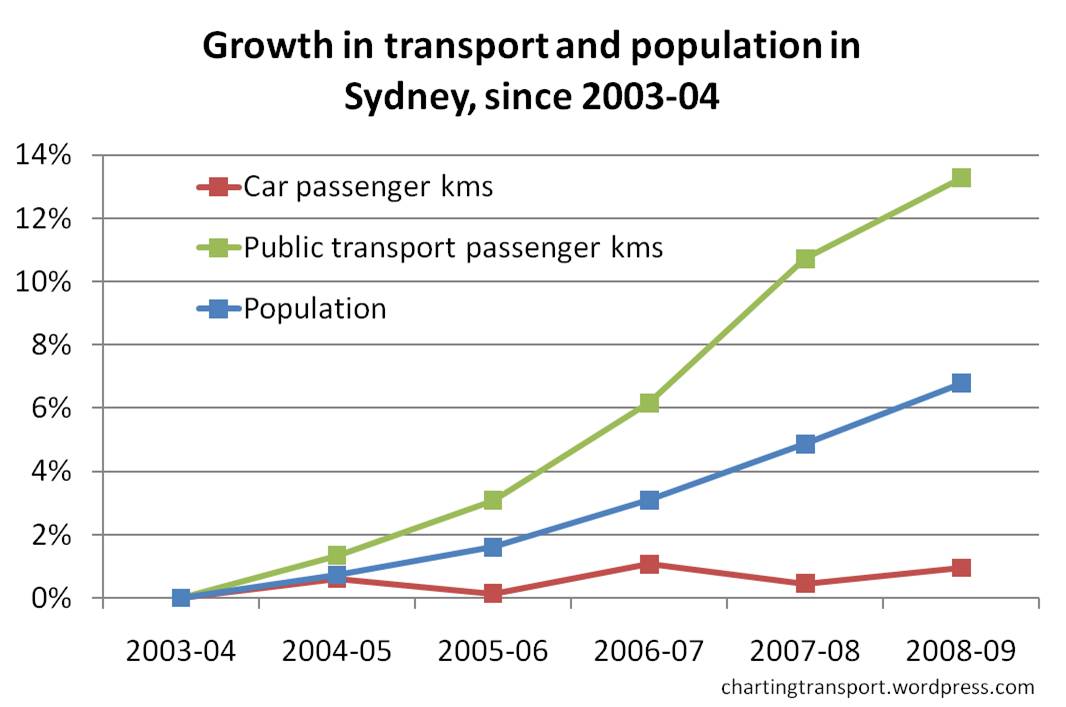
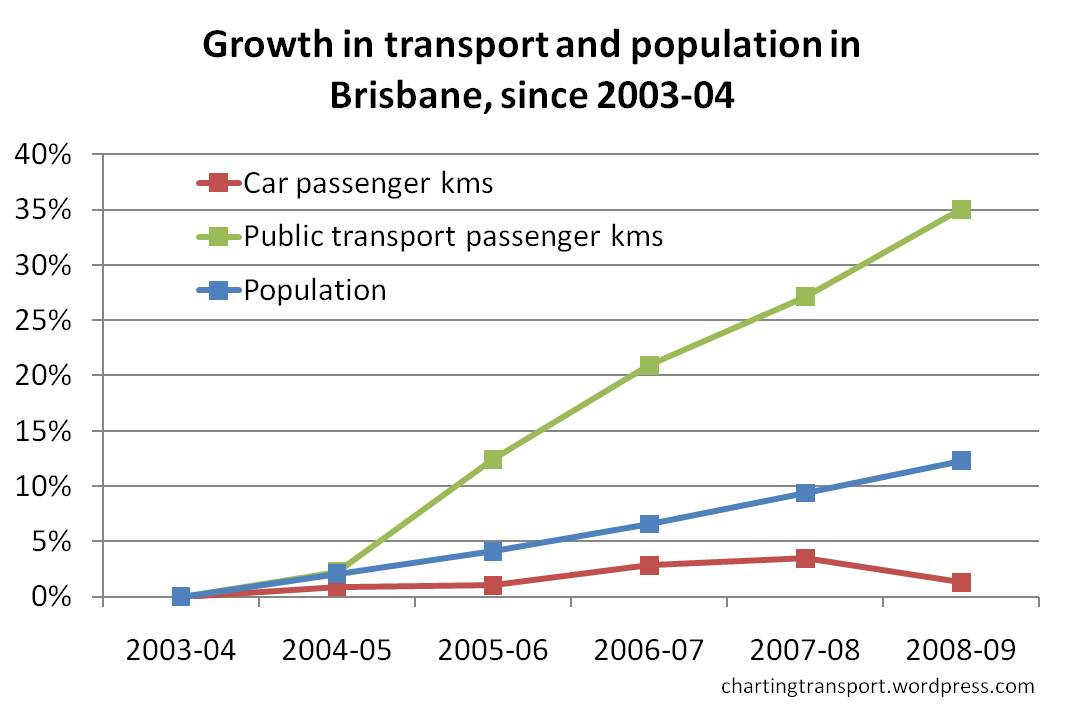
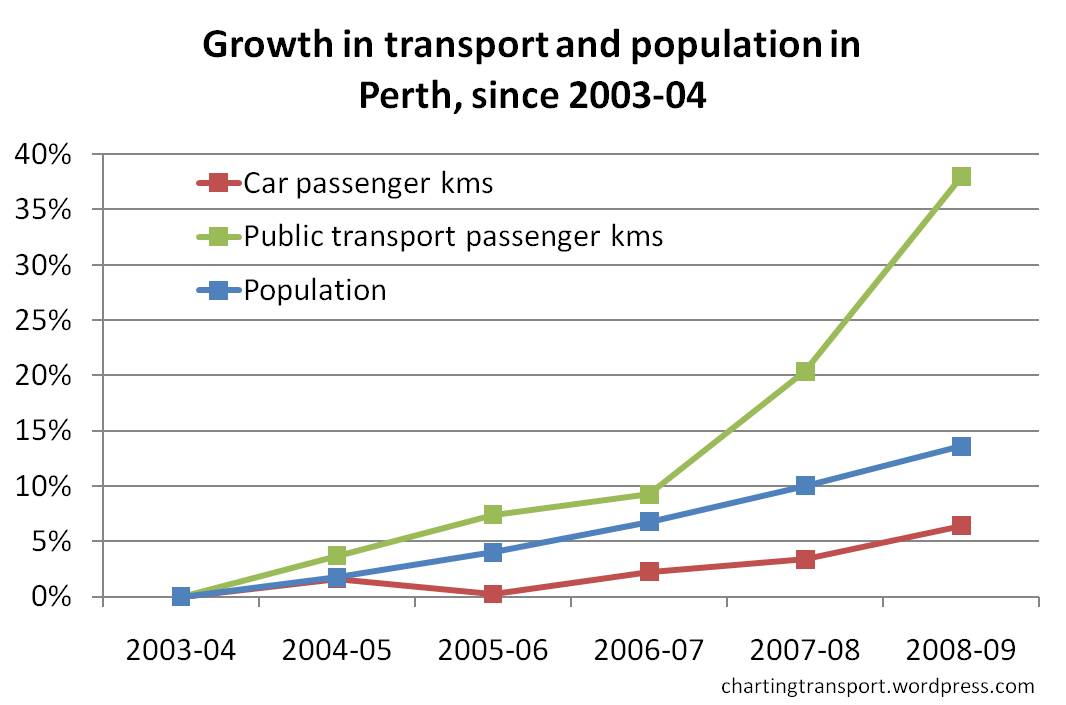
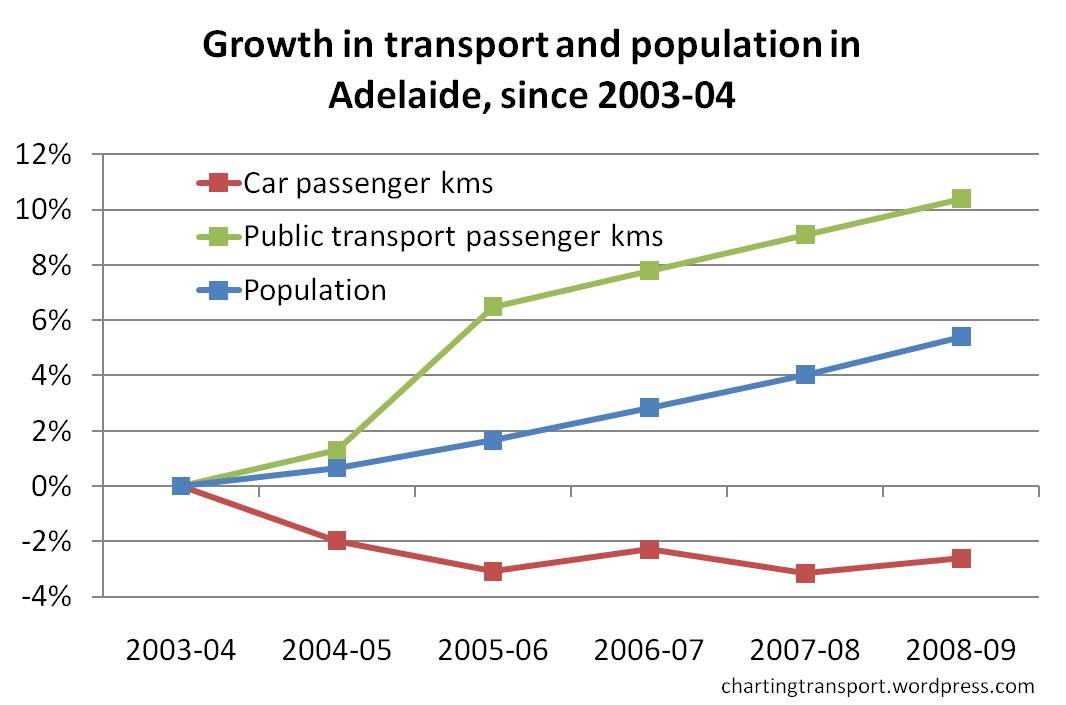
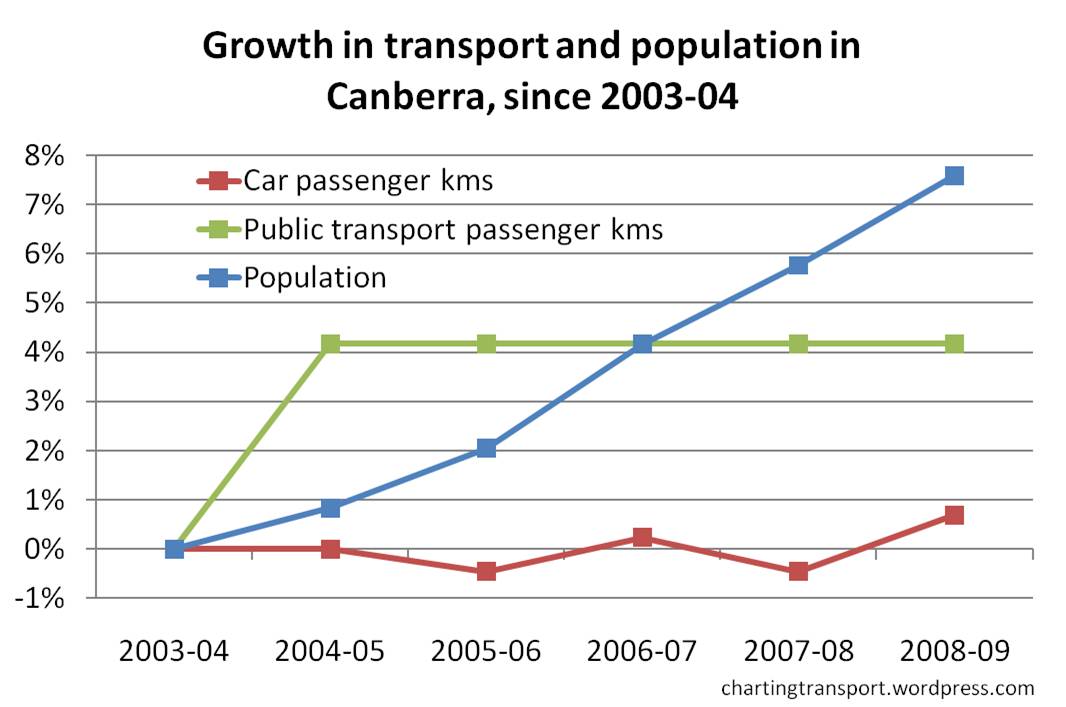
By popular demand, here are charts for each city (plus Canberra):

Note:

  • These charts have very different scales on the Y axis. Compare with caution.
  • Canberra public transport passenger km (actually just bus passenger kms) is reported as “0.25” billion passenger kms for five straight years, hence the straight green line.
  • While I haven’t drawn the second set of charts for each city, in all cities, car passenger kms per capita have reduced (red lines below blue lines). Public tranpsort passenger kms per capita have increased in all cities except Canberra.

A look at Melbourne CBD transport

Sun 23 January, 2011

My last post looked at suburban employment areas, but what about the CBD? With the review of the City of Melbourne’s Transport Strategy, I’ve taken on a detailed analysis of transport to and from the CBD.

In this post I’ll look at questions like:

  • Do CBD commuters come from the inner or outer suburbs?
  • Do wealthy executive types snub public transport?
  • How does mode share vary between the sexes and young and old?
  • What impact are employer parking and driving subsidies having on mode choice?

I’m mostly focussing on the inner Melbourne CBD – using the ABS definition of “Melbourne – inner” SLA, which is essentially the Hoddle grid. However I’ve included Southbank or Docklands a couple of times, and there are also some comparisons with Sydney, Brisbane and Perth CBDs.

This is a long post, so grab a cuppa and get comfortable.

Where do the commuters come from?

According to the 2006 census, there were 137,853 commuter journeys into the CBD.

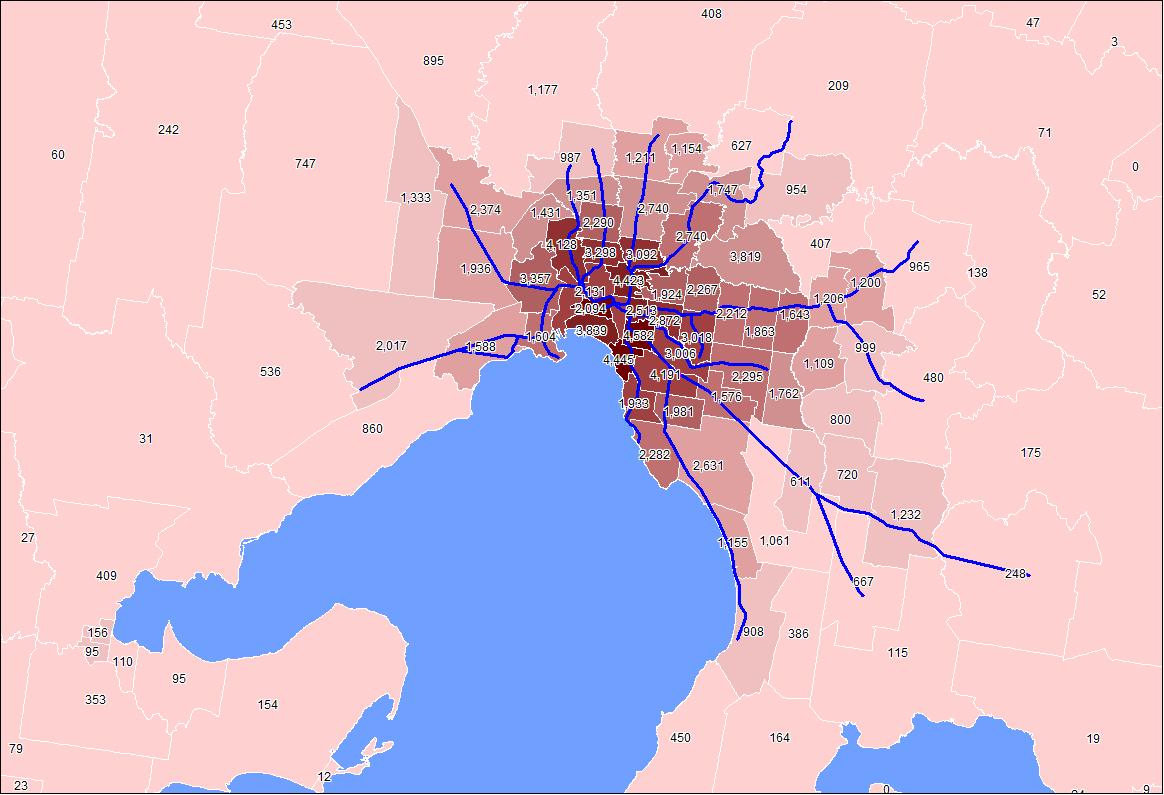
The first map shows the number of commuters from each SLA in Melbourne. The shading represents simple density of CBD commuters by area, which is not ideal because outer metro SLAs can be impacted by low average population density. At the same time, not all SLAs have the same population so some will always have large numbers (eg Manningham west). As always, click to zoom in.

The CBD attracted workers from all over Melbourne, but certainly with a high concentration from the inner suburbs.

To get around the density issue, I’ve drawn a map showing the percentage of workers from each SLA who work in the CBD, Southbank or Docklands:
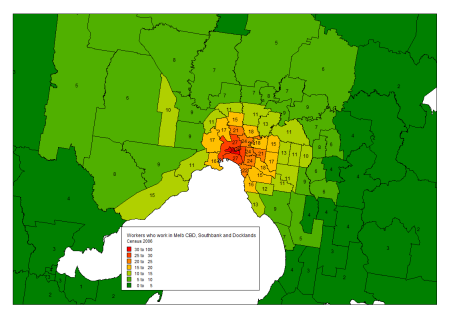
You can see the percentage drops off fairly uniformly by distance. The CBD is not a major destination for most middle and outer suburban areas.

What modes of transport do commuters use? (by area)

Firstly a map showing the public transport mode share from each SLA (green = higher):

Public transport mode share was largely above 70% for much of Melbourne and indeed most surrounding areas.

A few low spots stick out:

  • Manningham west and east, serviced only by buses (that have recently been signficantly upgraded)
  • Northern parts of Boroondara and 52% and 55%. These wealthy areas are serviced by frequent trams and buses, although with a relatively slow trip in.
  • Rowville (Knox south) is at 57%, but bear in mind there were only 800 commuters from Rowville to the CBD (and I expect most of these would be park and ride train commuters). In fact, the catchment of the proposed Rowville rail line passes through three SLAs, with a total CBD commuter population of 4138. Allowing for catchments of other radial public transport lines in the SLAs, the CBD commuter catchment of the proposed Rowville line might be 2000-3000, or about 3 full trains. But of course a line would also be used for trips to other destinations (particularly Monash), and it would probably cause changes in travel patterns over time once built. I might look at this more in a future post. In the meantime you might want to read Alan Davies take, and a 2004 pre-feasibility study (here is a summary presentation).
  • Wealthy Brighton is well serviced by the Sandringham line, but only half used public transport to get to the CBD. There is no easy freeway connecting Brighton and the CBD, so why are they driving? I’ll come back to that.
  • The inner SLAs in Melbourne, Yarra and Port Phillip are slightly lower, probably due to a high rate of walking and cycling. More on that later too.

You can see a high PT mode share for the relatively small numbers of commuters from Geelong (around 800 in total). $4.3b is being spent on a regional rail link, that will separate regional trains from suburban trains. Regional trains from outside Melbourne seat less than 500 people, but because they run express through much of Melbourne they each consume probably around two all-stopping suburban train paths (which have a capacity of around 1000 each). I haven’t seen any debate about whether encouraging regional commuting by train into central Melbourne is worthwhile, though I’m sure people living in those areas appreciate the trains.

Next a map showing private transport mode share (red = higher):
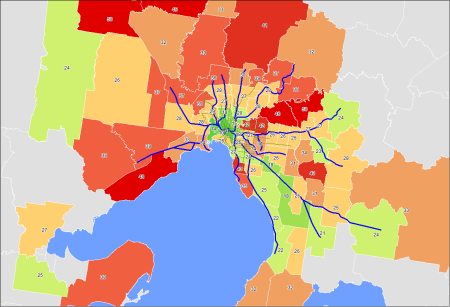
Private transport mode share was highest for Manningham, northern Boroondara, Wyndham South (including Point Cook), Bayside, Rowville, and the outer northern fringes.

But a high car mode share may not be a huge issue if the number of car commuters is low. The next map shows the number of private transport commuter trips from each SLA, shaded by relative density:

Observations:

  • Like we saw in my last post for South Melbourne, there were large numbers of car commuters coming from the inner suburbs, particularly to the south-east. These areas are well connected to the CBD by public transport, and also quite wealthy. Is wealth a driver of higher car mode share? Read on.
  • Manningham west had a large number of car commuters (with a reasonable density). This area is entirely reliant on bus services, which have been upgraded considerably since 2006, with strong patronage growth resulting. In 2006, the last bus from the CBD on the Eastern Freeway – Doncaster Road route (307) was around 6:45pm. It’s now around midnight (on route 907 that replaced 307).
  • There were also a large number from Wyndham north-east (Werribee – Hoppers Crossing area) which is not shaded dark on the map due to low average population density. In 2006, peak train services on the Werribee line were often 20 minutes apart, and bus services only ran every 40 minutes. The train frequency has since increased to 6/hour but the (feeder) bus frequencies are still 40 minutes in peak periods.
  • Moonee Valley (Moonee Ponds-Essendon area) was a large contributor of cars, despite frequent trains and trams to the CBD. Not sure why that is, although Essendon is a relatively wealthy area.

Here is a another map of private transport commuters, except it is shaded by numbers rather than density. Manningham west stands out, but bear in mind it is one of the largest SLAs in Melbourne by population. You can see the outer western SLAs show up on this map also.

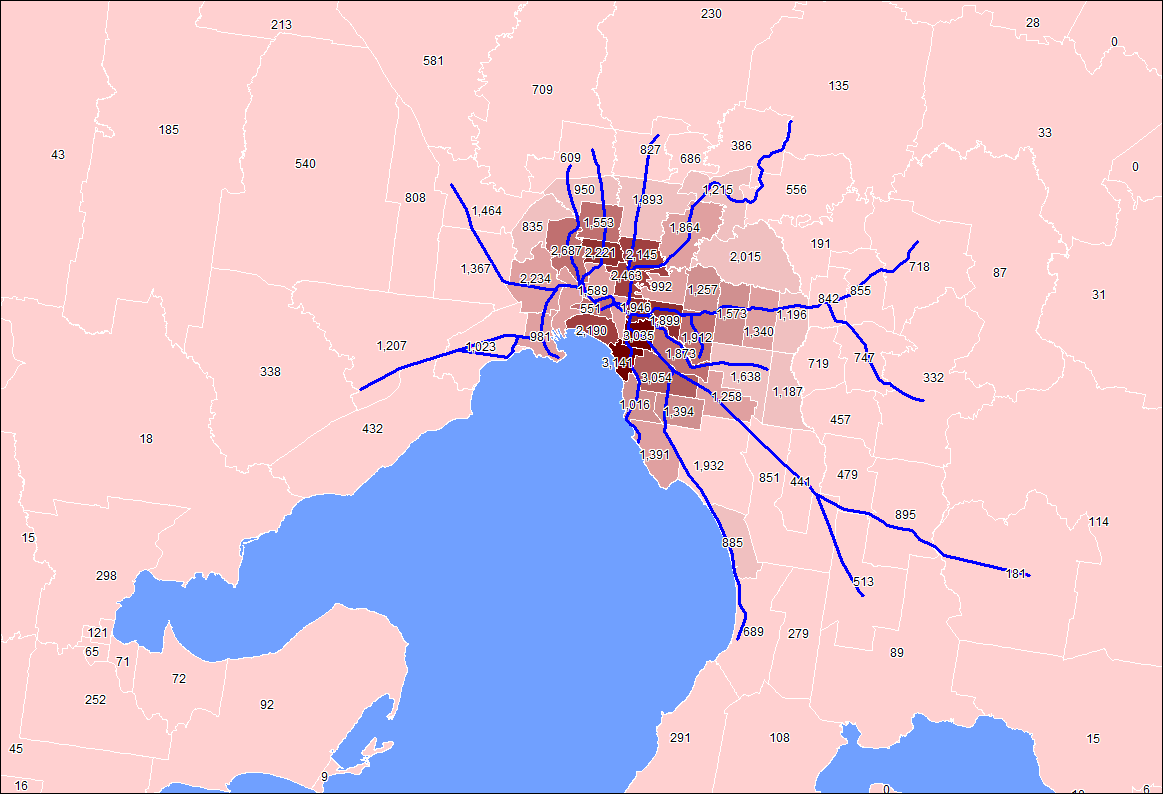
And for a flip side, here is where the public transport passengers were coming from (shaded by density):
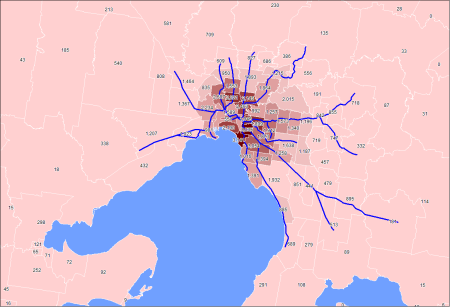
There are large concentrations coming from the inner suburbs, but also the middle eastern suburbs which are well connected by trains. The Manningham west area had over 2000 public transport commuters to the CBD, many of which would have been on buses only.

Again, to get around the low population density problem, I’ve also drawn a similar map shaded by total numbers:

We saw low PT and car mode shares for the inner city. I haven’t drawn a map of walking mode share for the CBD but you can see public and private transport mode shares are low in the inner city, with walking likely to fill the gap. A map of walking mode share to any work destination is in another post.

The cycling figures are quite interesting. Next map shows the bicycle mode share to the CBD (any trip involving bicycle) (green=higher):
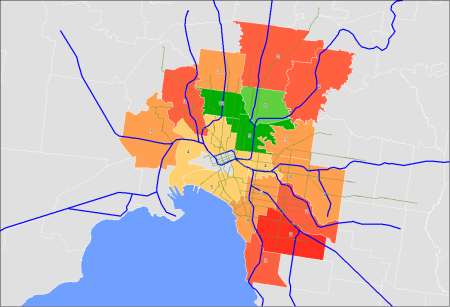
The figures are for Yarra north, Brunswick and Northcote are surprisingly high at 8-10%. Remember that the census is taken in winter (August). As I recall it wasn’t a rainy day. Bicycle mode share is also lower for commuters from the City of Melbourne itself. SLAs in grey lacked sufficient data.

Here are the total number of CBD bicycle commuters per SLA (shading by numbers, not density):

According to the data, people also rode from as far out as Frankston, Croydon, Ringwood and Sunbury! Census data is like that (as I recall, someone in Banyule claimed to have gone to work by ferry).

What modes did people use overall?

Here is a chart showing the overall mode split for all CBD workers:

Trains accounted for almost half of all CBD arrivals.

While buses accounted for only 2% of all CBD commuters, they were the only mode used by 32% in Manningham west, 11% in Kew, 9% in Camberwell north, 7% in Maribyrnong, and 5% in Altona.

Next chart shows mode split in a more simplified form:

Public Transport dominates, but still over a quarter came by car – including over 32,000 car drivers.

Public transport took 67% of motorised commuter trips into the CBD.

Active transport is at 8%, which probably represents those who live within walking distance of the CBD.

So how does Melbourne compare to other large Australian cities? The following chart compares Sydney, Brisbane, Perth and Melbourne CBDs. I’ve used the SLA that represents the inner core of business activity in each city to try to make in a reasonably fair comparison. Unfortunately Adelaide does not have a true inner CBD SLA to compare against (the central SLA includes all of North Adelaide, including lower density residential areas).
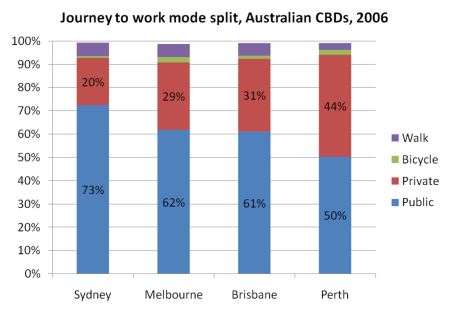
Sydney has the highest public transport mode share, with Melbourne and Brisbane very close (to my surprise). Perth is very much a car CBD, although mode shares are likely to have changed following the opening of the Mandurah rail line since 2006. The 2011 figures will be very interesting.

Perth walking more share was 3.0%, lower than 5.3-5.8% in the other cities – probably because of a lack of inner city residents.

And for the record, cycling was highest in Melbourne at 2.3%, followed by Perth at 2.0%, Brisbane at 1.5%, and Sydney at 0.8%.

The number of car driver journeys to work in the Melbourne CBD actually decreased from 34,289 in 2001 to 30,570 in 2006, a mode share drop from 27% to 23% (ref). This happened despite a 20% increase in the number of parking spaces in the CBD between 2000 and 2006 (ref):

I’ve included Southbank and Docklands in this chart for interest – Southbank parking supply actually went down between 2006 and 2008.

[parking stats updated June 2012 with 2010 CLUE data:]

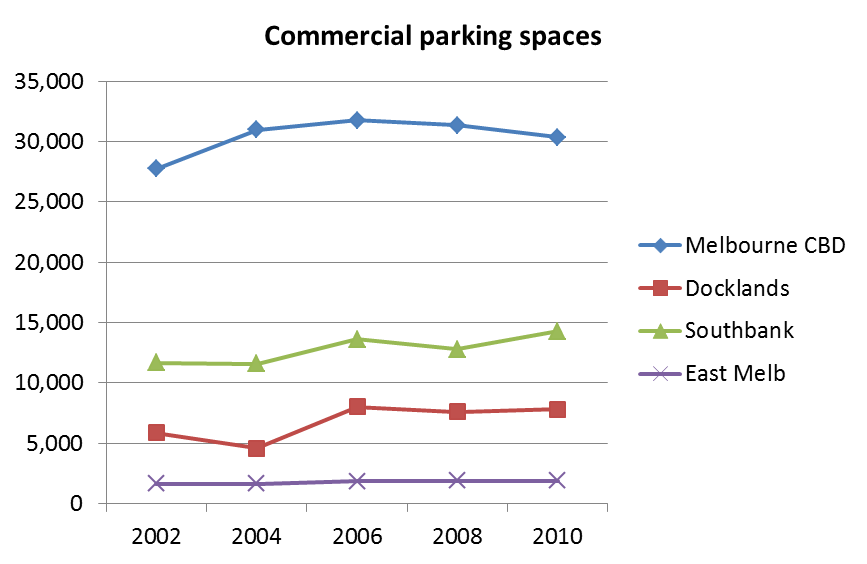
Looking at commercial parking spaces only:
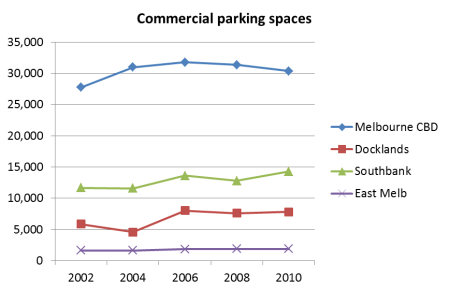
The number of commercial parking spaces has actually declined in the CBD and there has been very little growth in Docklands (despite an increase in employment).

Here is the ratio of employees to commercial parking spaces:

While the ratios are flat in three of the areas, Docklands has seen strong growth in employment without equivalent growth in commercial car parking.

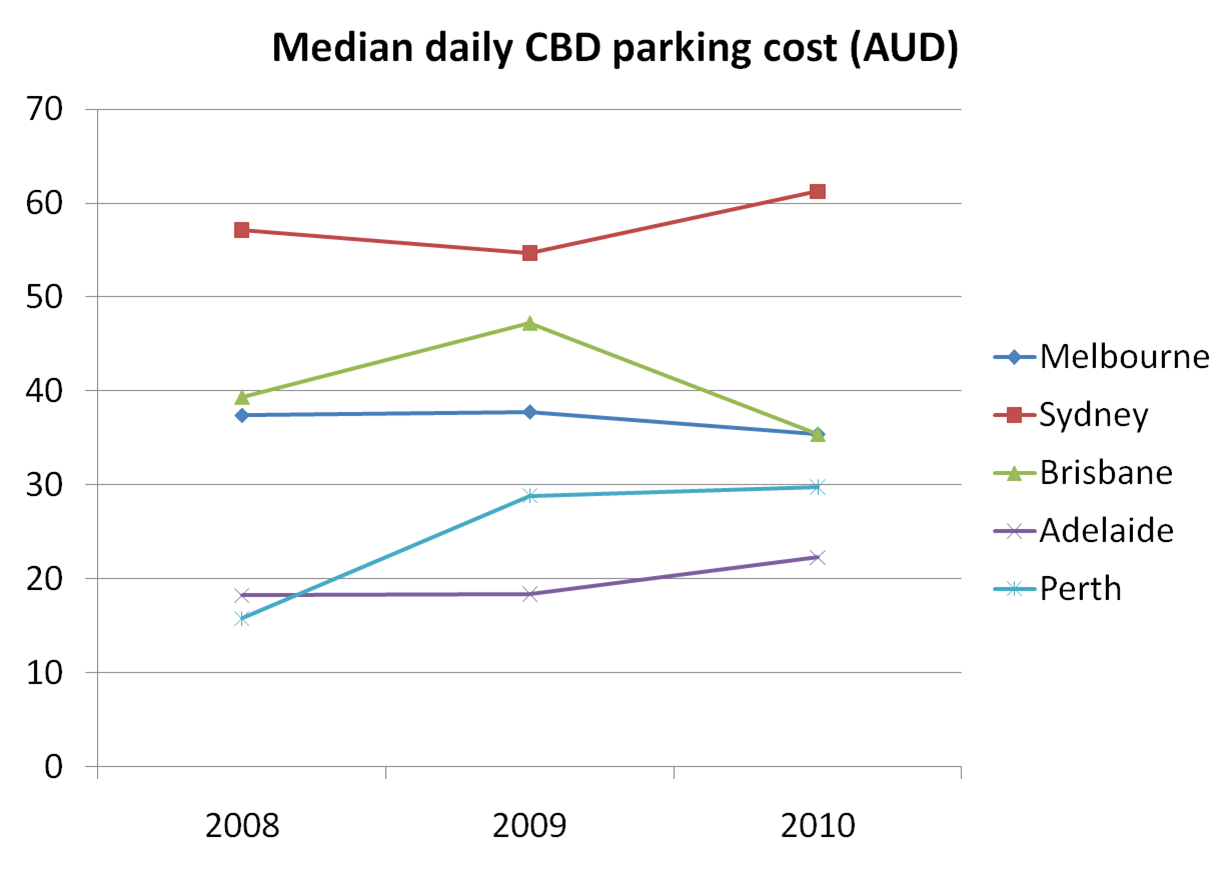
Colliers International have recently begun surveying CBD parking costs. Here are the results for Australia (adjusted to AUD using 1 July exchange rates):
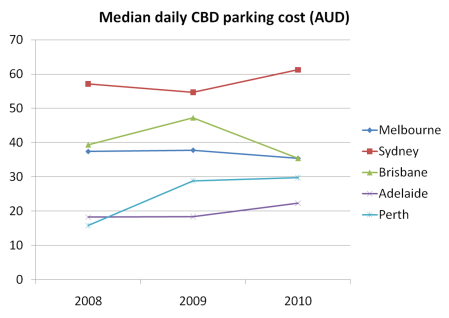
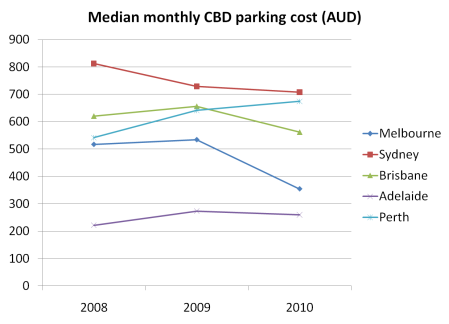
I don’t pretend to be an expert in CBD parking markets, but the differences between daily and monthly rates suggest some complexity. In Melbourne at least, it is quite common to find “early bird” parking for $13-17 (and “early bird” usually means parking your car before 10am).

I’m perhaps more inclined to go on the monthly rates, as they are probably more competitive. Melbourne prices collapsed in 2010, at the same time that public transport patronage growth stalled. Prices also went down in all other cities except Perth (which had the strongest public transport growth of the major cities in 2009-10).

So is CBD parking price a driver of public transport patronage? Probably too early to tell because of a lack of much time series on parking cost data (including 2006 data), but worth looking at in future.

What modes are different commuters using?

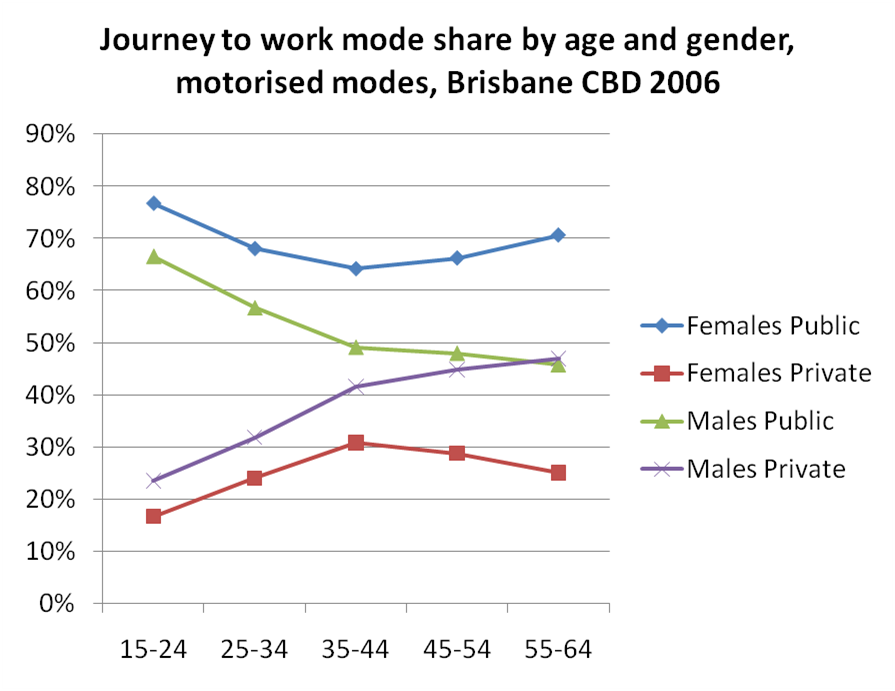
Firstly, mode share of motorised journeys by age and gender:
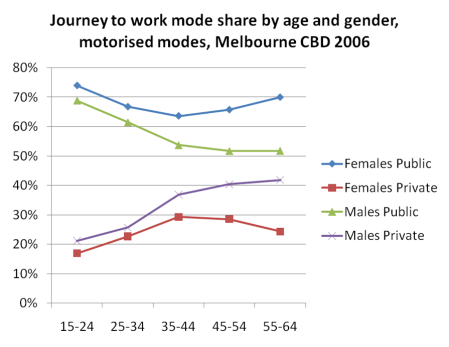
As you might expect, public transport mode share is higher amongst younger people and females. But for females it is also high for older women, with a curious dip at 35-44 years (typical kids at primary school years?). For men, private transport mode share was higher for older men. I’ve not shown 65-74 because the total number of such commuters was very small.

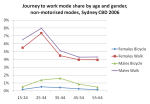
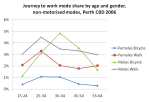
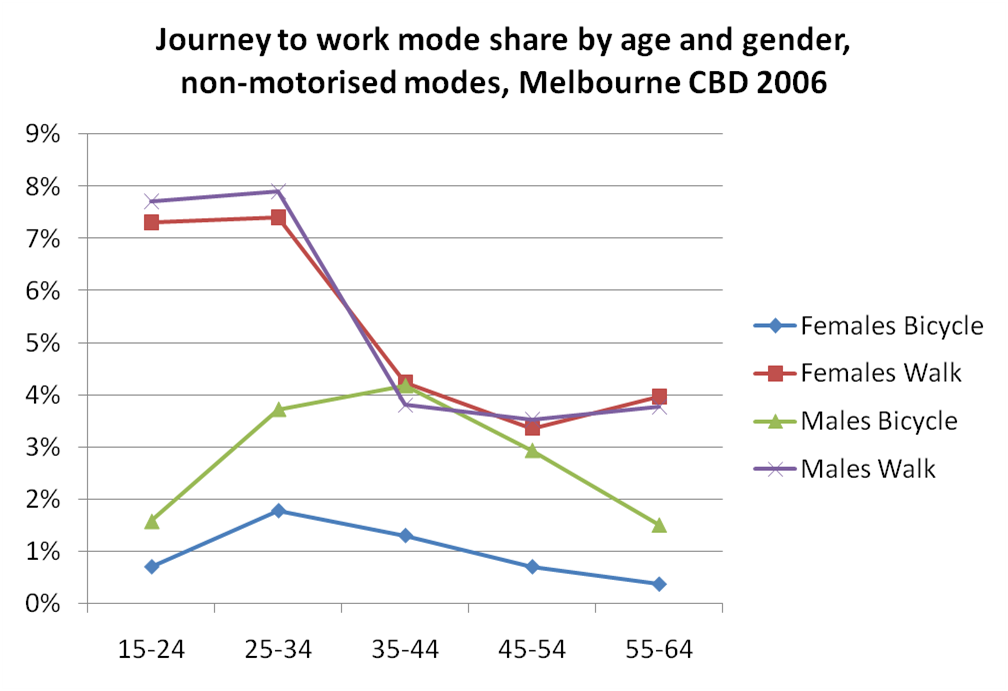
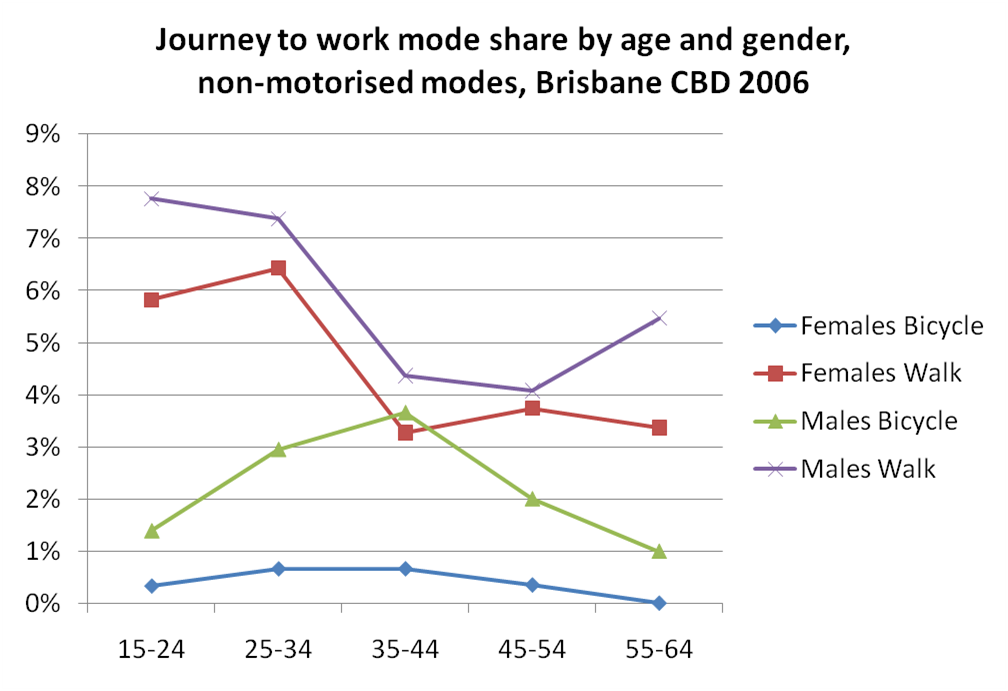
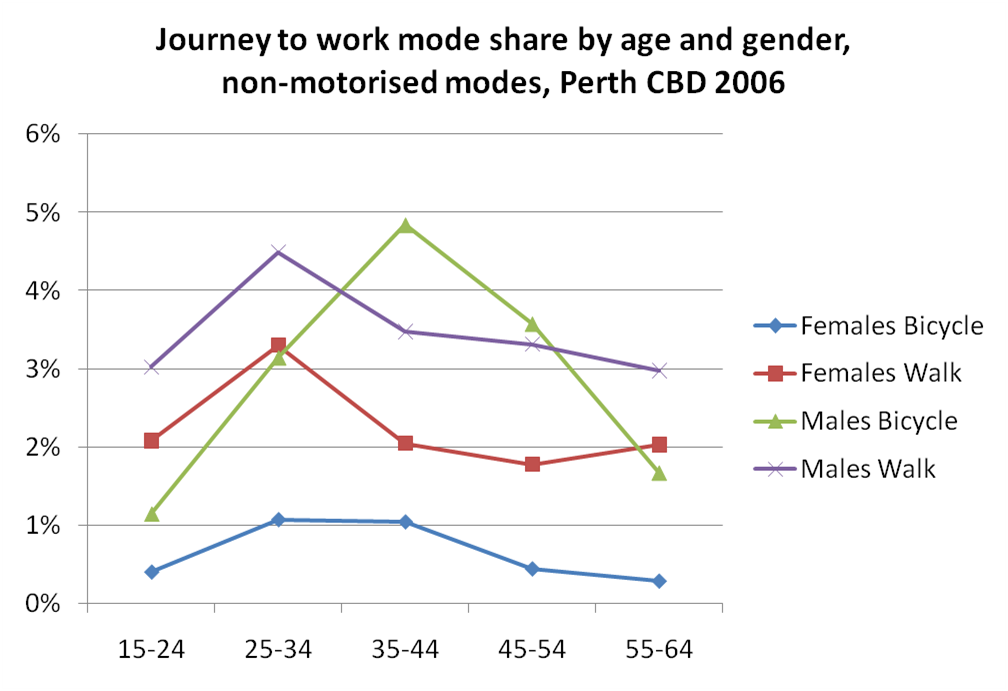
I’ve put non-motorised modes on a separate chart as they are much lower shares:
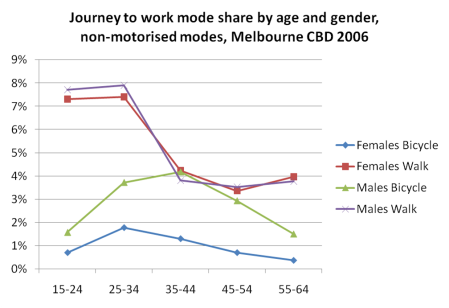
Walking was much higher for younger people. Is this because of lower car ownership, less willingness/ability to pay for transport, higher residential proximity to the CBD, and/or higher health and fitness focus? Unfortunately I don’t have the datasets to answer those questions.

Cycling mode share peaked with men aged 35-44, with men much more likely to cycle than women.

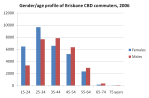
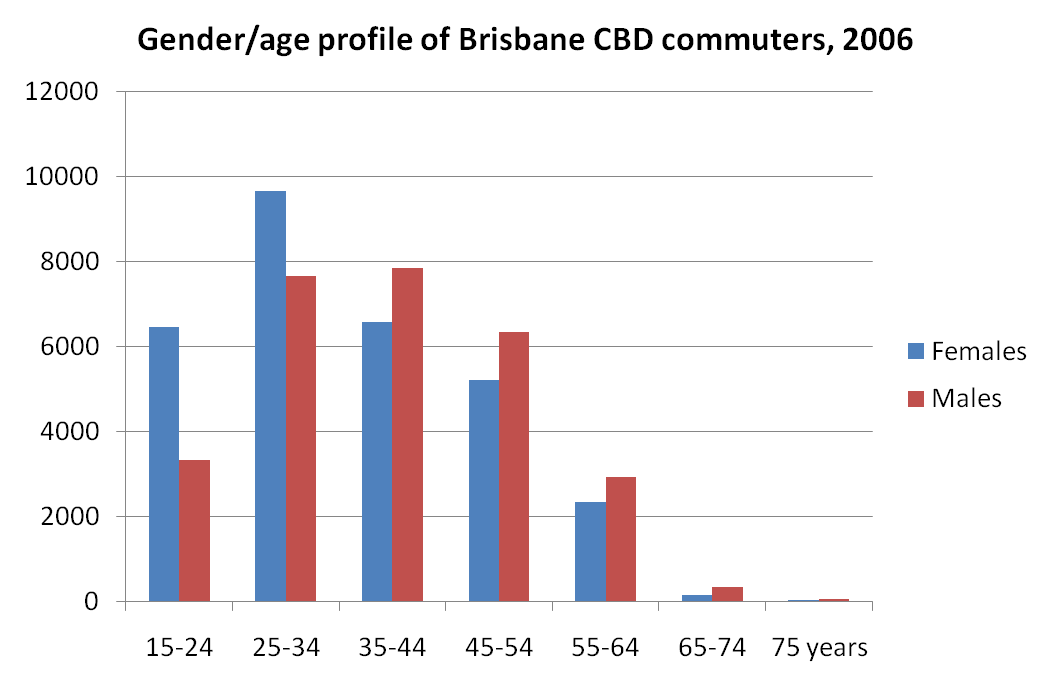
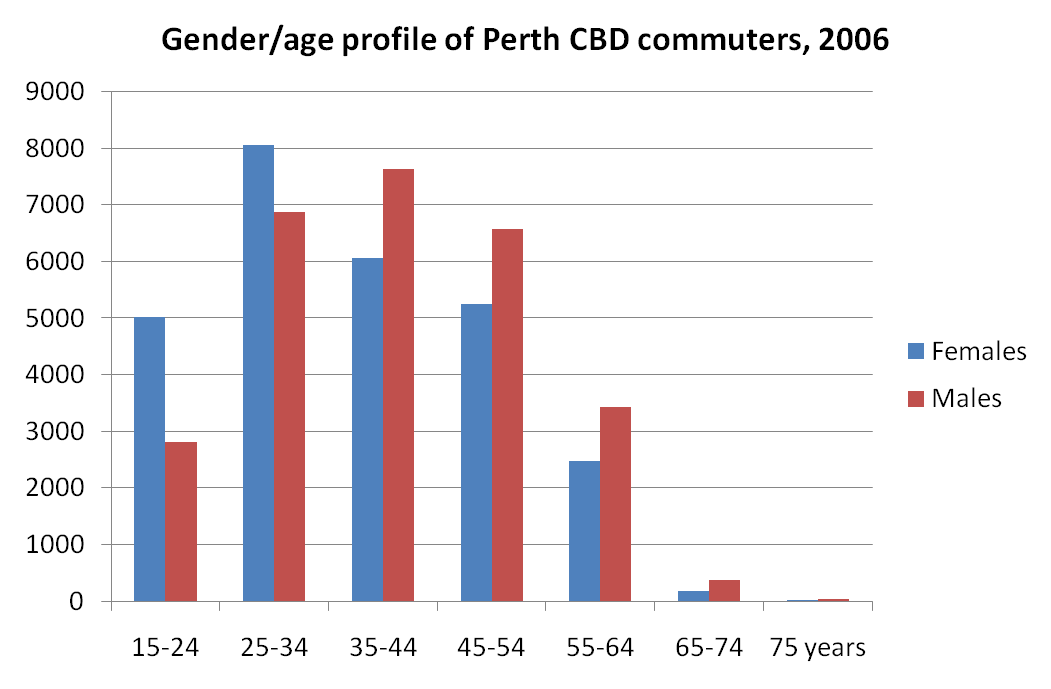
For reference, here is a demographic breakdown of CBD workers – it peaks at 25-34, with women slightly younger on average:

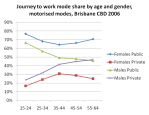
And here are the same charts for Brisbane:
Sydney:

and Perth:

You can see:

  • cycling mode share peaked for men aged 35-44 in all cities
  • walking tended to peak for people aged 25-34
  • public transport mode share dipped for women aged 35-44 in all cities
  • In Perth, men aged over 35 had a higher private transport mode share than public transport, the only city where this occurred.

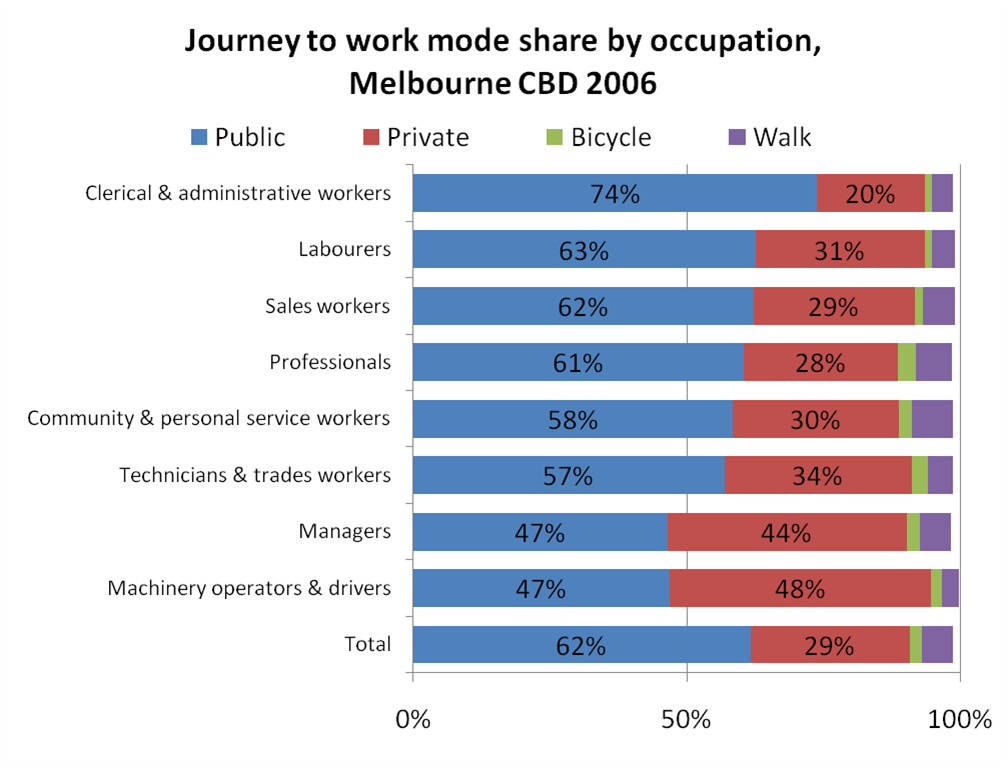
So, do executives (presumably many from wealthy inner city suburbs) shy away from using public transport?
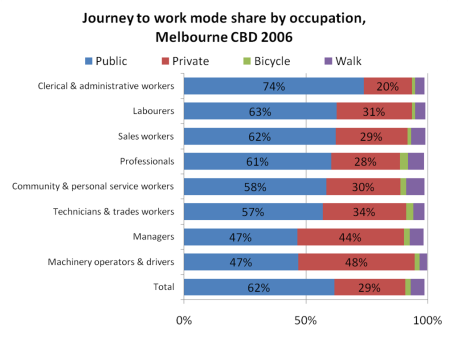
Indeed they do. They represented 16% of Melbourne CBD workers, but 24% of car commuters (9538 car trips in total). Maybe because many of them get company cars/parking as parts of their packages? More on that coming up.

Lower paid clerical and administrative workers were most likely to use public transport (and probably least able to afford driving and parking costs).

Note that Machinery operators & drivers also had a higher private transport mode share – I expect many are professional drivers coming in their work car (there were only around 1000 in this occupational category).

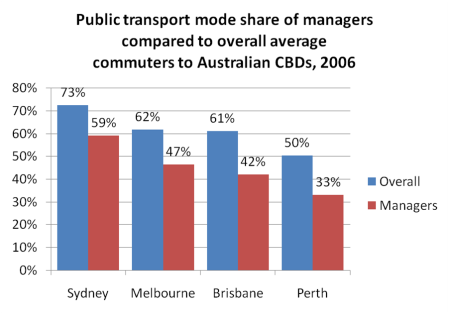
Back to managers – the next chart shows they are also more likely to snub public transport in Sydney, Brisbane and Perth:
What about other trip purposes?

The following charts show data from the VISTA 2007 household travel survey, that includes all trip types and all of Melbourne.VISTA is a survey, not a census, so there is a margin or error involved, and unfortunately the sample sizes are not large (provided in charts as “n=”). The total VISTA 2007 dataset has 2955 surveyed trips into the Melbourne CBD (across all days of the week), of which 1973 were motorised.

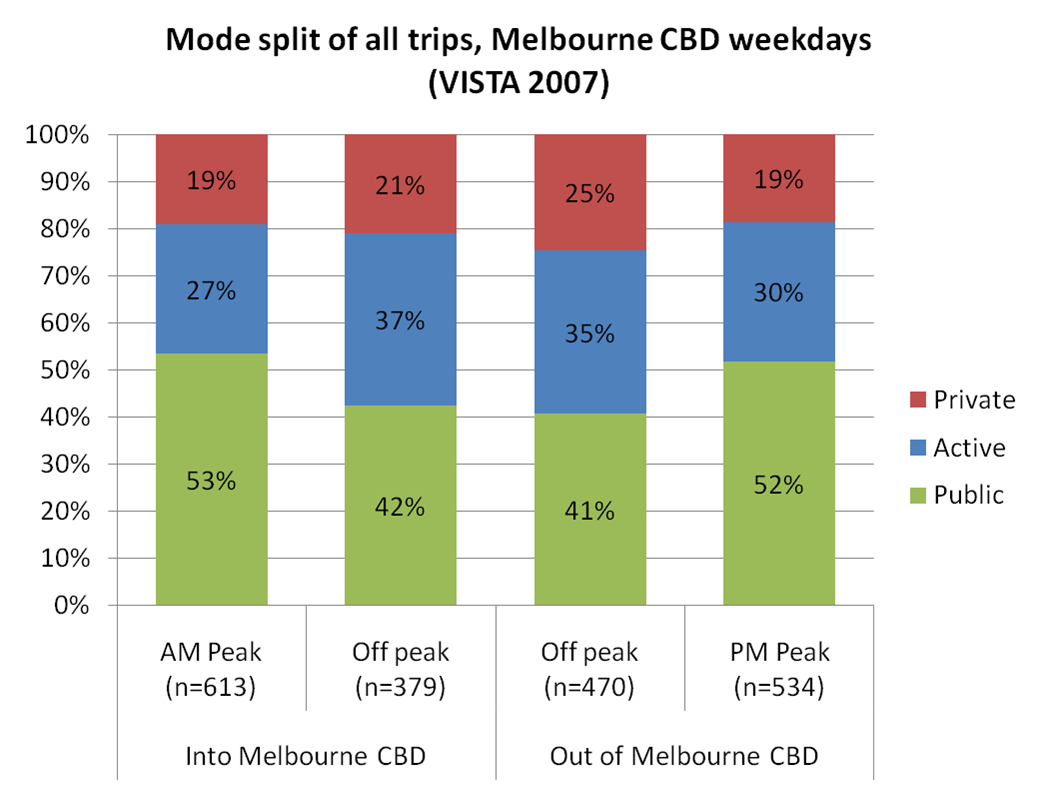
First chart shows mode split for trip legs into and out of the CBD, by time of day on weekdays:

Weekday AM peak is 7-9am, and PM peak is 3-6pm, anything else is classed as off-peak. Unfortunately there are only 190 trips in/out of the CBD on weekends in the sample, which has too large a margin of error to be too meaningful (7%).

Active transport (walking and cycling) and public transport were clearly dominant. When looking only at motorised trips, Public transport took 74% of inbound AM peak and outbound PM peak trips, and 67%/62% of off-peak in/out bound trips.

Recall above that motorised journeys to work in 2006 were 67% by public transport, suggesting people travelling for reasons other than work in peak periods were slightly more likely to use public transport.

What about wealth? I’ve used average household income per occupant, to remove the impacts of household size, and grouped this by $500 amounts. Note: the sample sizes are quite small for larger income groups.
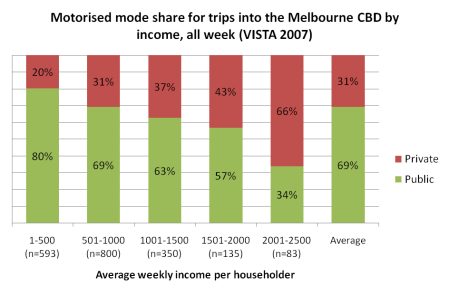
Sure enough, there appears to be a trend that people from higher income households were more likely to use private transport for travel into the CBD.

What about age?

While the sample sizes are relatively small, there certainly appears to have been a higher propensity to use private transport for travel to the CBD by middle-aged people.

There may be a trend back to public transport for older people, but the margin of error is around 10% for the last two age groups so this is not certain. However it would fit with Seniors being able to access cheaper public transport fares.

In terms of gender, 73% of females who used motorised transport came by public transport, compared to 67% of males – a similar difference to commuters.

Who’s paying for the private transport?

While for many people driving to the CBD for work everyday is something of a non-option, there are still tens of thousands who do. Is employer sponsored driving and parking costs influencing their mode choice?

VISTA lets us take a look at that also, although there is only a sample of 183 AM peak private transport trips (margin of error around 7%).

According to the data, around 29% of cars driven into the CBD in the AM peak had their running costs paid by a company, and 36% had parking paid for by employers. Remarkably, 34% reported no parking costs for off-street parking (these trips mostly for work purposes) – which doesn’t sound right for the CBD in the AM peak! I’m not aware of any publicly available free off-street parking spaces. Perhaps the respondents overlooked the fact that someone else was at least paying for the land on which they parked? If that is the case, then it would appear that less than a third of cars driven into the CBD in the AM peak were not employer subsidised in parking or running costs.

Employer subsidies appear to be an incentive to drive to the CBD. By contrast, only around 2% of general Melbourne AM peak car drivers had employee paid parking, and only around 13% had car running costs paid by an employer (VISTA 2007).

One of the most effective ways to reduce car mode share for journeys to work in the Melbourne CBD would appear to be reducing employer subsidies for parking and driving costs. Schemes such as parking cash out help employees see how much their parking and driving costs are being subsidised. If they have the option of receiving that money directly as salary they might make different choices (depending on tax treatment of course!).

That said, with current capacity issues on Melbourne’s trains and trams, trying to shift more CBD commuter trips from car to public transport in the short-term might not be a government priority just at the moment.

And lastly, for the record, 6 and 8 cylinder cars parked in the CBD did not appear to be over-represented. Cars of well-known luxury brands were over-represented (15% v 6% metro average).

I think that’s enough now! 🙂

Active transport is at 8%, which probably represents those who live within walking distance of the CBD. In order to take out the walking component, I’ve also taken a sample that excludes an “inner ring” around the CBD, as shown in the following map:

If you take out the inner ring, the mode split is 69% PT, 28% car, 1.9% cycling and 1.4% walking longer distances.
Transport mode share to employment areas in Melbourne 2006

Fri 19 November, 2010

In another post, I’ve mapped out the transport mode shares by residential origins. These maps are fairly common. But what are the mode shares like for employment destinations across Melbourne?

In this post I have mapped out the public transport, car and bicycle mode shares for journey work in each “destination zone” (the smallest unit in the ABS journey to work census data) from the 2006 census.

Note:

  • In the mode share maps I have only shown zones with an employment density of 1000 people per square km or higher to avoid small sample sizes causing issues (people work almost everywhere, but I want to focus on denser employment areas).
  • I’ve removed “did not travel”, “worked from home”, “all other modes” and “method not stated” from my mode share calculations. We don’t know the real mode share, but hopefully the mode shares under “all other modes” and “method not stated” are not too different from those where we know the mode.
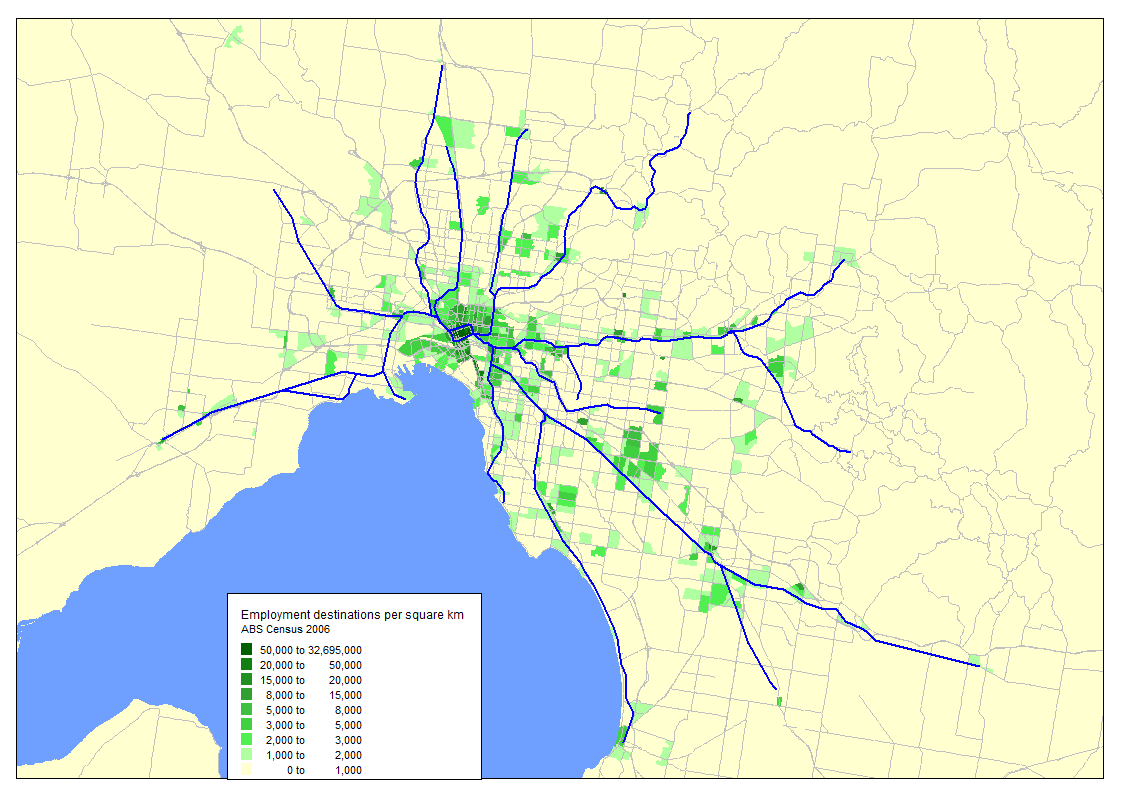
Employment Density

But before looking at mode shares, it is worth looking at employment density. To view these maps you’ll need to click to zoom (open them in a new window if you can).

You can see:

  • Dense employment in the inner city (no surprises)
  • Industrial areas like Monash, South Dandenong, Somerton, North Altona, Moorabbin, and Bayswater.
  • Major shopping centres (at least those that have their own destination zone) such as Werribee Plaza, Sunshine, Moonee Ponds, Northland, Box Hill, Doncaster Shoppingtown, Greensborough, Ringwood, Knox City, Chadstone, Fountain Gate, Southland, Forest Hill.
  • Other dense suburban spots include Tooronga (Coles headquarters) and Camberwell (shops plus some office buildings)

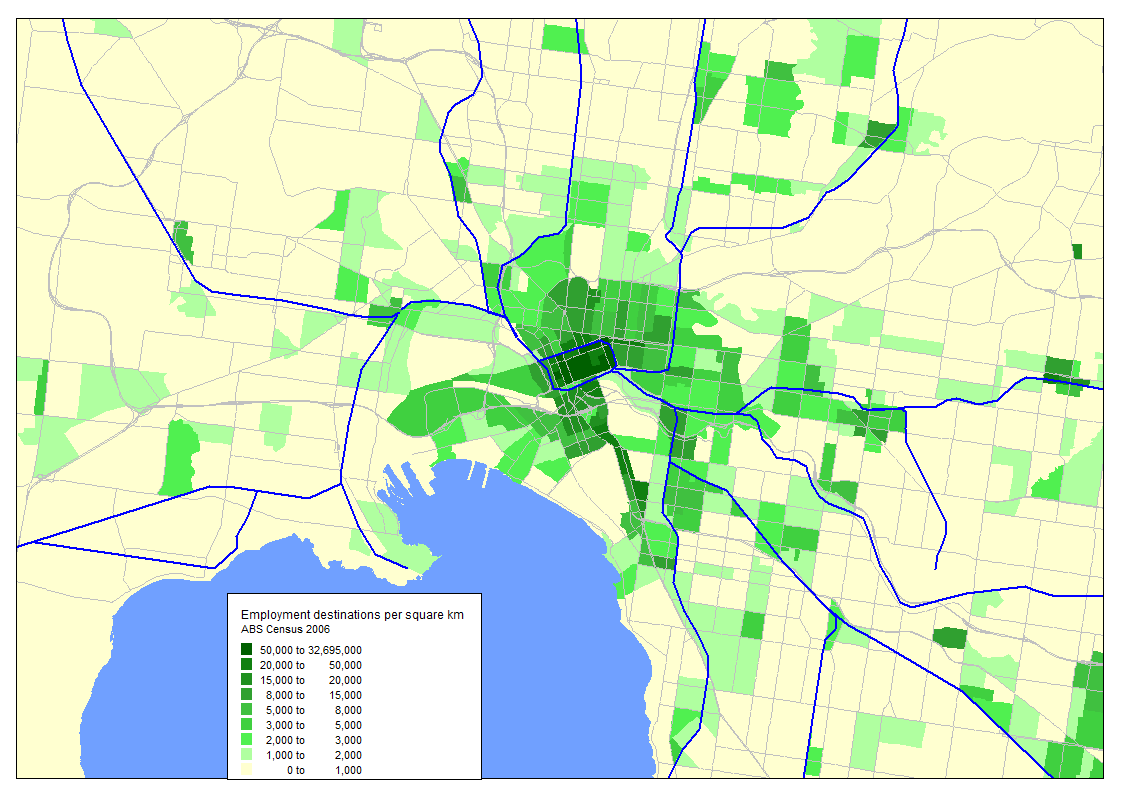
Looking at the inner city area:

Obviously the CBD is dense, but there is a corridor north of the CBD towards Melbourne University, and south along St Kilda Road. The densities are very high when you have high-rise buildings, so it is a little difficult to show the variation. But can at least look for building shadows on Near Maps.

Public Transport mode share

You can pretty clearly see a high public transport mode share for destinations in the inner city, and very low mode shares in the suburbs.

However there are a few spots in the suburbs with relatively higher public transport mode shares than surrounding areas:

  • Monash University Clayton campus (parking is not easy and this is a focal point for the local bus network)
  • Huntingdale near the station (unclear why the high mode share in 2006)
  • Moorabbin near the station (an activity centre including some office buildings)
  • Box Hill (a Central Activities District on a frequent train line and significant bus interchange).
  • Ringwood (also a Central Activities District on a rail junction in the outer east)

And the mode shares to large suburban shopping centres (remember these are journeys to work only) are surprisingly high (relatively anyway):

  • Chadstone 13%
  • Southland 12%
  • Northland 10%
  • Highpoint 10%
  • Doncaster (Shoppingtown) 8%
  • Fountain Gate 7%
  • Knox City 7%
  • Werribee Plaza 6%

An aside: it’s unfortunate that some shopping centre owners are less enthusiastic about providing good facilities for buses, even though around 1 in 10 of their workforce comes by bus (all of the above listed centres are not served by trains). I am now armed with some factoids.

Notably, public transport mode shares were quite low at three of the nominated Central Activities Districts (CADs), including Broadmeadows, Dandenong and Frankston. If these are to be successful CADs, then public transport will need to be made a much more attractive access mode. I suspect this requires a focus on the local bus networks, as peak rail services to these centres are already quite frequent).

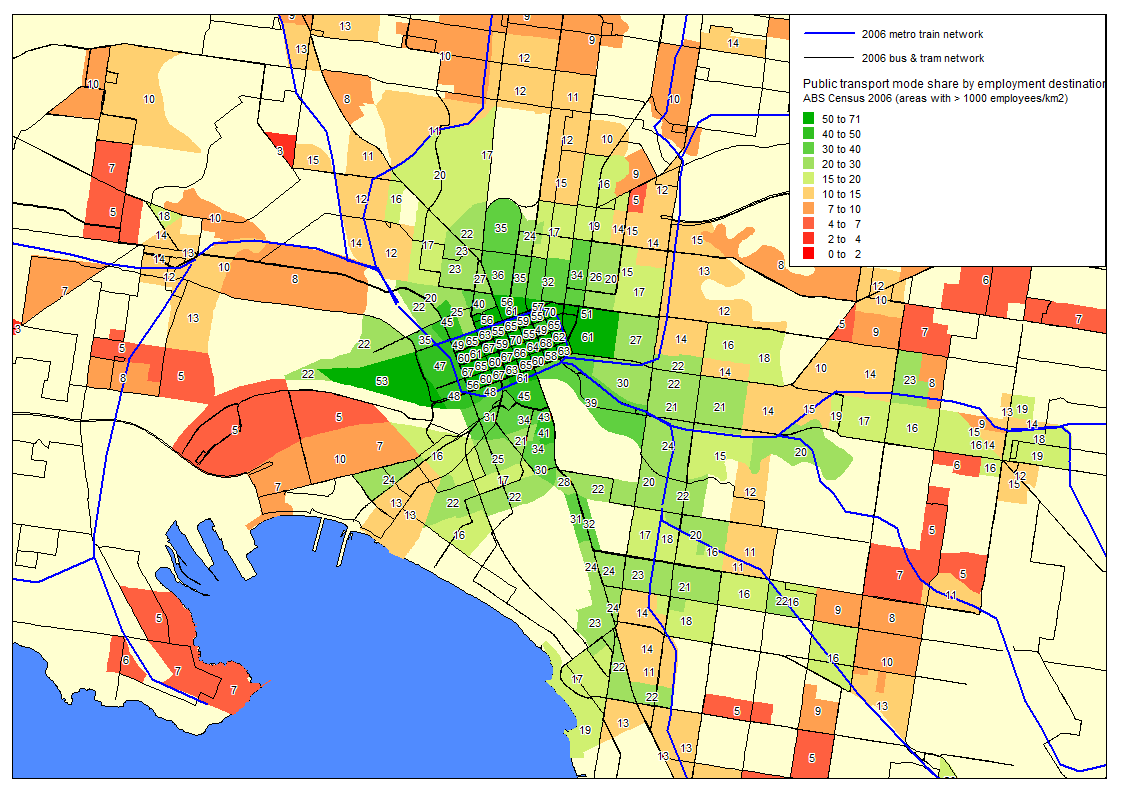
So what about the inner city area? This map zooms in, and I’ve actually labelled the public transport mode share for each destination zone (again you will need to open the enlargement in a new tab to see).

You can see public transport has a high mode share in the CBD grid and surrounds. It peaks at 70% at a few places in the CBD grid.

But it drops off fairly quickly as you move away:

  • Mode share drops into the 21-45% range in the Southbank/South Melbourne area. Essentially most people need to transfer to tram to get there (the 55 tram runs through the middle of it, but the only real train interchange location is Flagstaff, in the north of the CBD)
  • The Parkville precinct has mode shares around 35% (accessible by frequent trams that do interchange with Melbourne Central station).
  • The northern parts of Docklands have only 22% public transport mode share. These areas are awkward to reach by public transport (long walk from Southern Cross station, a slow tram connection, or a walk from a bus stop)
  • The Dynon area (WNW of the CBD) has only 8% mode share, despite being served by frequent buses. This is probably to do with the industries present – freight transport (early starts) and the Wholesale Fruit and Vegetable Market (which opens at 3:30 am or 4:30 am depending on the day of the week).
  • St Kilda Road to the south of the CBD has many high-rise office blocks, but public transport mode share ranges from 23 to 32% in the lower section, despite extremely frequent tram services along St Kilda Road that provide direct access from many inner south-eastern suburbs. In the AM peak, the busiest direction for trams on St Kilda Road is actually southbound – as people transfer from trains at Flinders Street.  The new rail tunnel is proposed to run through the CBD and terminate at Domain Road. The tunnel won’t improve public transport access for the thousands of employees who live  in the inner south-east until it is extended to Caulfield (I’ll look at this in more detail in another post).
  • The Fishermans Bend area (across the river, WSW of the CBD) has mode shares around 5%. This area is served by buses from the CBD that actually have a peak flow out of the CBD in the AM peak. As I will show in another post, most of the workers in Fishermans Bend come from the western suburbs of Melbourne, and presumably a great many of them drive to work across the Westgate Bridge. There is one bus route (232) that runs across the Westgate Bridge and along Williamstown Road (which borders the Port Melbourne industrial area to the south), however it has a very limited catchment in North Altona.

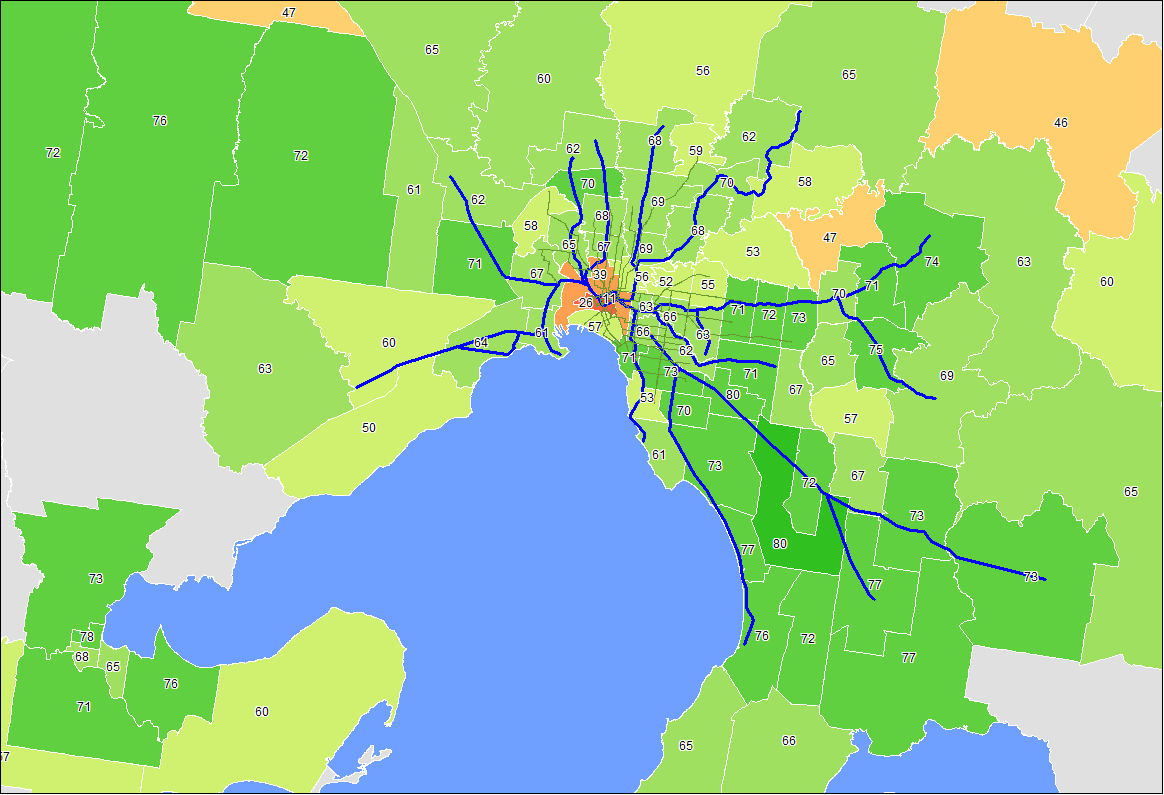
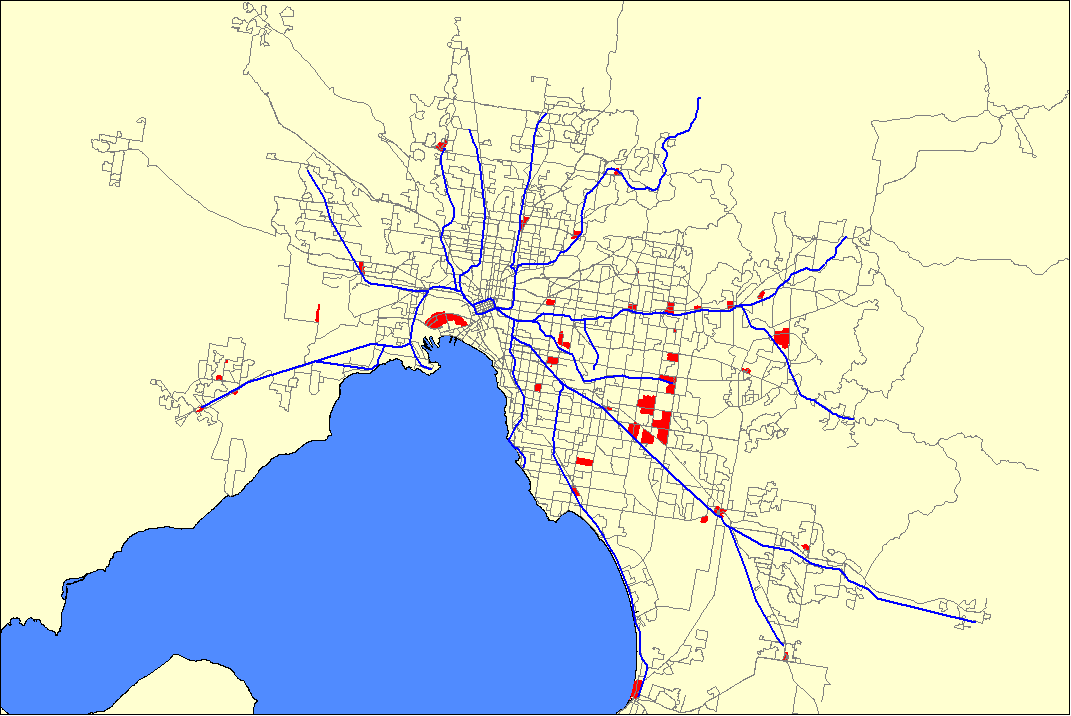
If density is good for public transport, then where are the dense employment areas with low public transport mode share? The following map shows destination zones with employment density over 3000 per square kilometre and public transport mode share less than 10% (arbitrary cut-offs I realise):

These should be strong candidates for gaining greater public transport mode share, perhaps if they were better served by better public transport.

Walking through the locations:

  • Fishermans Bend already has reasonable peak period public transport, but it comes from the CBD, while the workers come from the western suburbs and have to transfer.
  • Werribee town centre and Werribee Plaza Shopping Centre – the bus routes to these centres run every 40 or 60 minutes in the peak.
  • Tooronga – the Coles Headquarters – a long walk from the station or nearby tram, or a half hourly north-south bus service. Not to mention some big hills and presumably cheap parking.
  • Large areas of Monash including Clayton, Notting Hill, Mount Waverley. Some parts of this area were serviced by SmartBus routes (703 along Blackburn and 888/9 along Springvale Roads) in 2006. Another (900) has been introduced along Wellington Road since. However issues in this area include that many of the employees come from the south-eastern suburbs (requiring transfers from a train as opposed to easy access from the Monash Freeway), and that the road grid spacing is large – many workplaces will be a long walk from bus stops.
  • Glen Waverley – around the train station. Note really sure why, it has good access by bus and train.
  • The Tally Ho business park in Burwood East (at the intersection of tram 75 and a SmartBus route 888/9). A classic car-orientated suburban business park (including a VicRoads office no less).
  • The south-eastern corner of Moorabbin – this area is served by a few peak period only bus trips.
  • Central Dandenong – many bus routes into Dandenong operate only hourly. A SmartBus route has since been introduced (901).
  • Fountain Gate – again many hourly or worse bus frequencies in the outer south-eastern suburbs.
  • Cranbourne Shops – many low frequency bus routes (some trips bypass the shopping centre in peak periods).
  • Central Frankston – on a train line, but many low frequency bus routes. A SmartBus route has since been introduced from the north (901).
  • A patch in Kew along Denmark Street. Which happens to include the VicRoads head office and Xavier College  (PT mode share around 9%).
  • Along Whitehorse Road in Blackburn and Mitcham, including areas a decent walk from the train stations. A SmartBus service (901) has just been introduced along this stretch of Whitehorse Road.
  • Bayswater industrial area – served by some peak period only bus deviations.
  • Heidelberg – just west of the rail line include the Austin Hospital. A SmartBus route (903) has since been introduced through Heidelberg. The area around Box Hill Hospital shows up – this may reflect the many shift workers involved in a hospital operation.
  • Preston around High Street. A SmartBus service (903) now goes through here also.
  • Broadmeadows – a Central Activities District which was at the end of a metropolitan train line in 2006 and buses ran relatively infrequently (many every 30-40 minutes). On Near Map it looks like half the landspace is occupied by car parking! It’s recently had two SmartBus routes introduced (901 and 902).
  • Sunshine, north of the station. The main retail area was developed away from the station and bus interchange and half the landscape is filled with car parking. A SmartBus route (903) now runs through this area. And would you believe there is a major VicRoads office there also?
  • Central Greensborough – two SmartBus routes have now been introduced to this centre (901 and 902), improving access from all directions

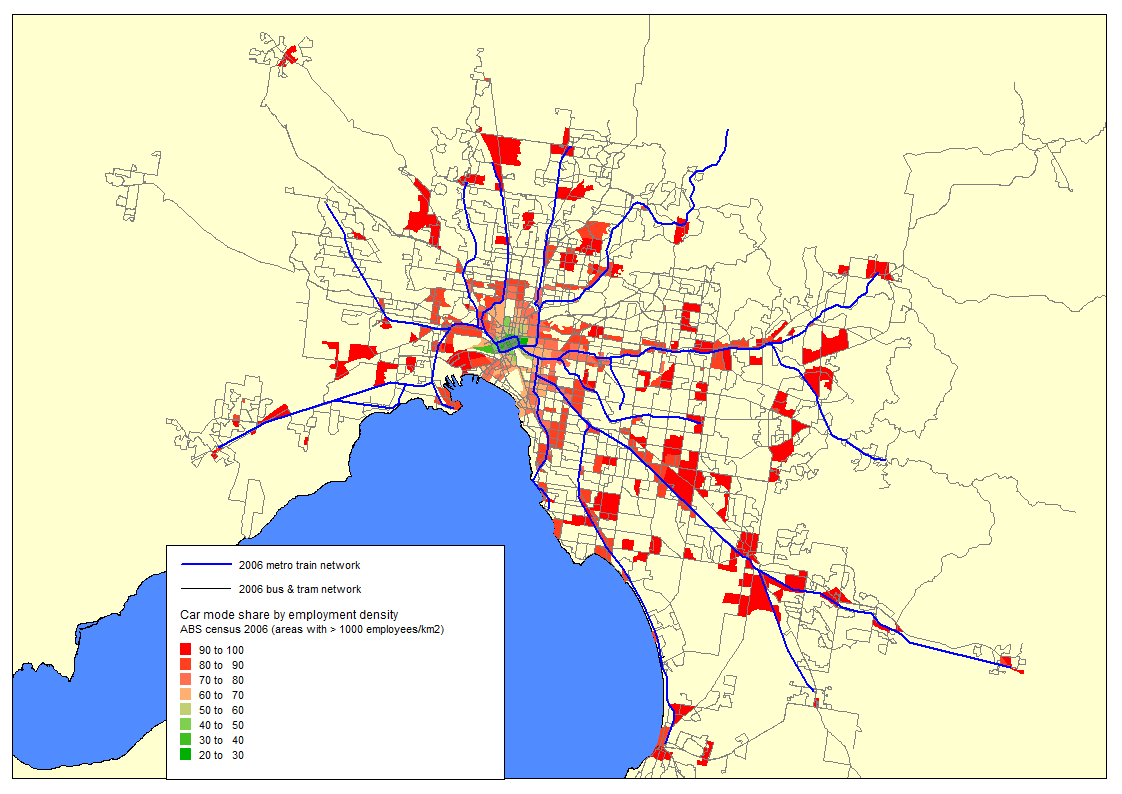
Car mode share

Public transport doesn’t represent the full sustainable transport mode share as many people can walk or cycle. So the following chart looks at non-sustainable mode share – ie cars.

Apart from the inner city areas, car clearly dominates. The furthest out any level of escape from the car reaches is St Kilda in the south, Brunswick in the north, and Glenferrie in the east (probably the Swinburne University campus).

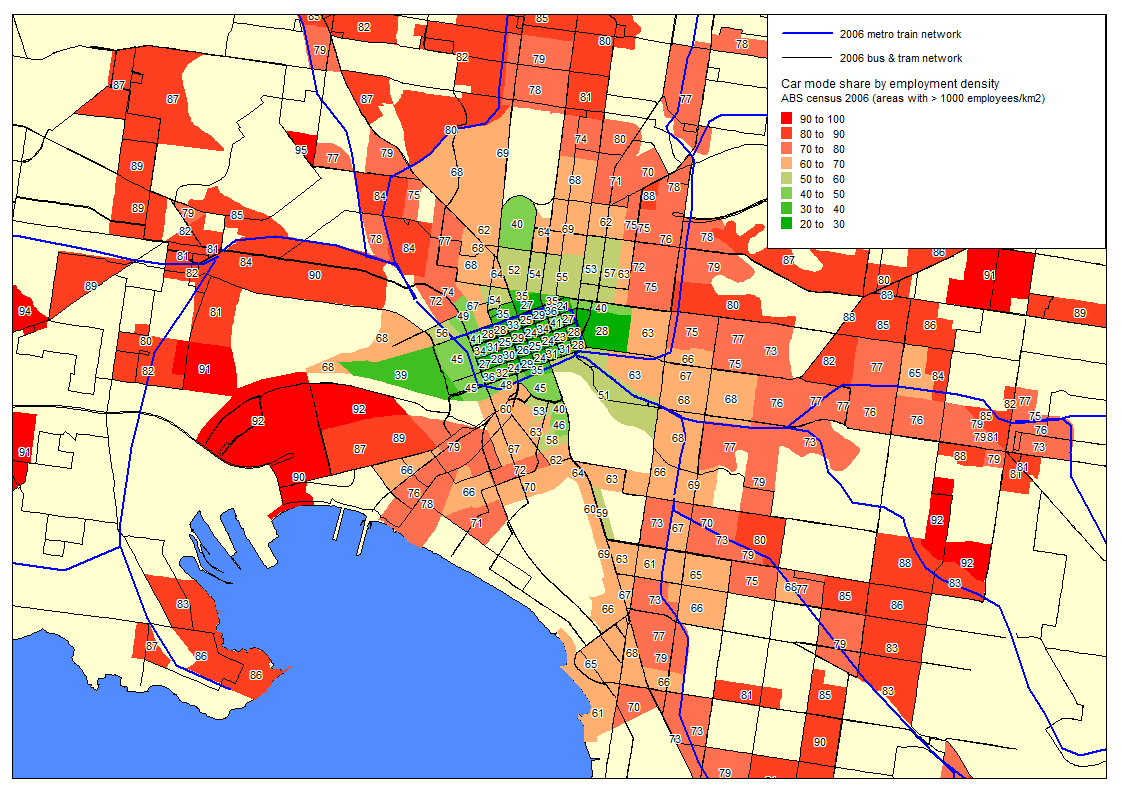
In the inner city area:

You can see high car mode shares even near the city:

  • Car mode share is in the 60s around Melbourne University (the main university campus area itself at 40%)
  • Most of St Kilda Road around the 60s
  • 92% in Fishermans Bend
  • 80% in Abbotsford on the north side of Victoria Street (a very heavily congested street due to lack of options in the area)

But you can also see the area immediately east of the CBD block at 28%. This block is full of decision makers from the Parliament House and several central agencies of state government. Is that encouraging? For the record: census day in 2006 was a parliamentary sitting day.

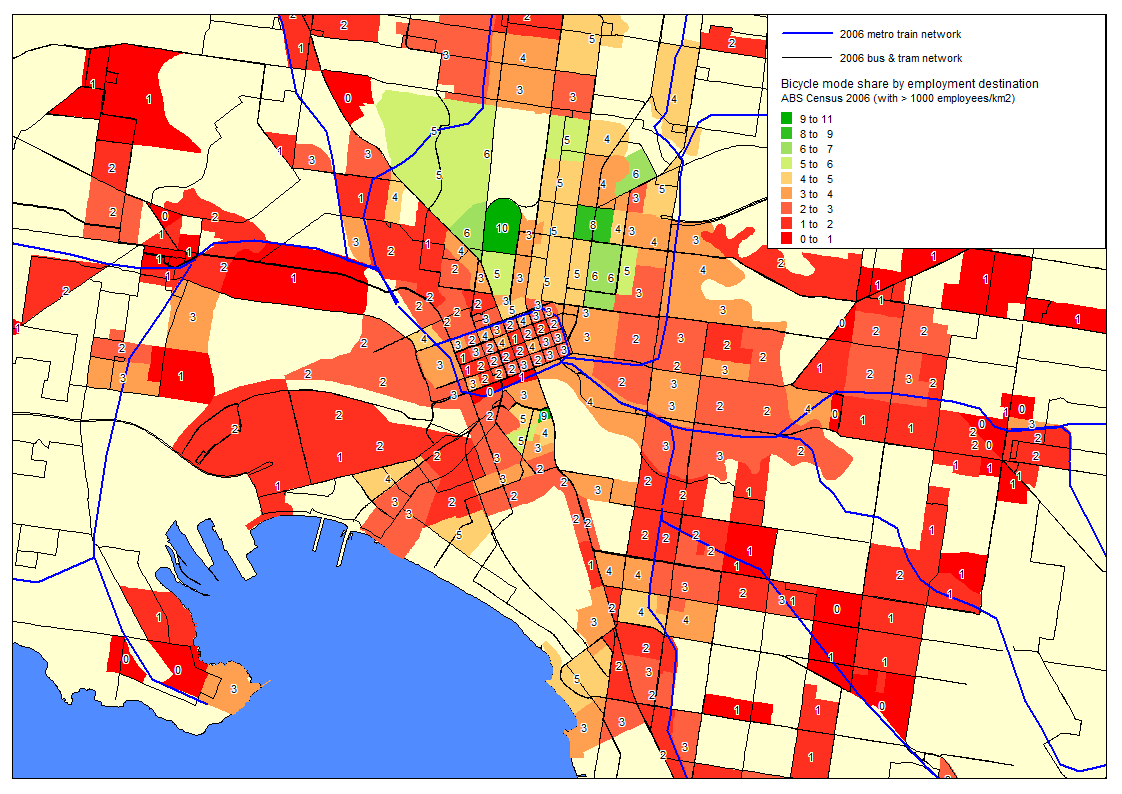
Bicycle mode share

Finally, a look at bicycle mode share (although actually this is any trip involving bicycle, including riding to a train station). This is a bit unkind because it all depends on the weather of the day (I cannot find records, but as I recall it was not a very rainy day).

The numbers are very small, but there are a few standouts:

  • 10% mode share to the main Melbourne University campus (and remember, this is only journeys to work, not journeys to study)
  • 9% mode share to the Victorian College of the Arts in Southbank
  • 8% in central Fitzroy Street, around Brunswick Street. Very bike friendly streets in this area, and car parking is more limited.

It will be very interesting to see these numbers for 2011, as there has been a boom in cycling in Melbourne in recent year.

A future post will look at where employees come from for each major employment area. Do public transport join homes and workplaces well?